
The Forbidden Photos of a Lady Above Suspicion (1970)

A couple Halloweens ago, I was costumed as a creepy teddy bear and dancing to loud electronic music over cocktails at R Bar.  Being a helpless cinema addict and not on the hunt for a Halloween hookup, I remember fixating on the muted, subtitled giallo that was screening on the walls of R Bar, fascinated.  My body may have been politely gyrating to the DJ’s set, but my mind was racing trying to figure out what gorgeous giallo oddity was providing the party’s background texture, since it was one that I had not yet seen.  Some light googling on All Saint’s Day led me to the typically poetic, overlong giallo title The Forbidden Photos of a Lady Above Suspicion, which soon enough mysteriously appeared on a used DVD at a local thrift store.  Is it the same copy they were spinning at R Bar?  Was I being stalked by a giallo?  What could this vintage Technicolor erotic thriller possibly want from me?  The answer, of course, was nude photographs.

In retrospect, it’s funny that of all the gialli in the world, the above-the-bar selection that Halloween night was Forbidden Photos, since it’s not nearly as pronounced of a Horror Film as some of the more obvious titles from a Bava, or a Fulci, or an Argento.  Director Luciano Ercoli is less of a household name because of that lack of horror fandom support, since this falls closer to the proto-erotic thriller end of the giallo spectrum than the proto-slasher end.  With an atypically focused script from Ernesto Gastaldi and a softly melodramatic score from Ennio Morricone, Forbidden Photos is relatively straightforward and emotional for a giallo – trading in throat slashings from a leather-gloved killer for amateur porno shoots & sadomasochistic acts of blackmail.   It’s stylish, swanky, sadistic and, ultimately, sad, with internal-monologue narration that invests in its female victim’s inner life more than most examples of the genre.

Dagmar Lassander stars as the tormented Minou, played with the sad, glassy eyes and stiff, vaulted wigs of a Cole Escola character.  While her wealthy businessman husband is away on a work trip, she is physically assaulted by a mysterious brute who claims to have evidence that her spouse is a murderer (through the ludicrous method of artificially inducing The Bends in a business rival, then staging their death as a drowning).  Drawn into the stranger’s web, she involuntarily sleeps with him to receive (and destroy) evidence of the murder in trade, then briefly becomes his “sex slave” once he produces photographic evidence of their tryst (i.e., her rape) which he again leverages as blackmail.  Seedy pornography seems to be the criminal’s livelihood, as he appears as a performer himself in illicit photos owned by Minou’s hedonist bisexual friend Dominique (Susan Scott, who steals every scene she’s in).  Only, he may not exist outside of the pornography at all. Minou quickly spirals as the master-slave relationship escalates until her blackmailer suddenly vanishes; she’s then unsure whether she’s being gaslit or losing her grip on reality thanks to her favorite snack & drink combo of cocktails & tranquilizer pills.  That mental breakdown is when the film fully tips into supernatural horror territory, finally justifying its Halloween Night background programming.

In his interview on the 2006 Blue Underground disc I picked up, Gastaldi credits Forbidden Photos‘s unusual sense of clarity & cohesion to Ercoli sticking to the narrative of his screenplay instead of using it as a flimsy excuse for whatever visual indulgence happened to catch the director’s attention that day, as was giallo tradition.  An incredibly prolific writer in his heyday, Gastaldi would know, having written over eighty produced screenplays – including such formidable titles as All the Colors of the Dark, The Whip and the Body, The Vampire and the Ballerina, and Your Vice is a Locked Room and Only I Have the Key.  If you’re looking for the version of Forbidden Photos that takes wild, stylistic swings at the expense of narrative & tonal control, I’d recommend Fulci’s maniacal erotic thriller The Devil’s Honey, which is much looser in its forced S&M plot.  Ercoli is more grounded & restrained in his approach, which means that this is the rare giallo where the reveals behind its central mystery (whether Minou is being blackmailed or experiencing a mental breakdown) actually matter to the audience, as opposed to being treated as a last-minute formality.

That’s not to say that Forbidden Photos is not dripping with classic giallo style.  All of its characters live in sparse, swanky houses, which operate more as minimalist art galleries than traditional homes.  When Minou reunites with her husband after her initial attack, he’s introduced through a pane of shattered glass, sharply calling his honesty & integrity into question.  When she first enters her blackmailer’s apartment, she has to peer into his seedy world through Lynchian red-velvet curtains, like entering a fairy tale realm through a theatre stage.  Her rape in that apartment is only visually represented in flashback, with the more salacious details punctuated by a severe “Chinese devil statue” that the brute keeps on display.  Even more important to the picture is Minou’s genuine sexual tension with Dominique.  Their first hangout together involves the two gal-pals browsing through a mountain of amateur pornography, much of it featuring Dominique herself.  Dominique is such an aspirational antidote to Minou’s torturous lack of confidence that you actively root for her not to be involved with Minou’s potential gaslighting plot, since the story would be much more satisfying if they could manage to stay “friends.”  I will not spoil the way that story turns out, but I think it says a lot that it’s a giallo with a mystery worth leaving unspoiled just as much as it’s worthy of being projected as a stylish Halloween Night mood-setter at a dive-bar dance party.

-Brandon Ledet

Lagniappe Podcast: Destroy All Monsters (1968)

For this lagniappe episode of The Swampflix Podcast, Boomer, Brandon, and Alli discuss the kaiju battle royal Destroy All Monsters (1968), featuring Godzilla and all his best frenemies.

00:00 Welcome

01:09 The Craft (1996)
04:20 The Shining (1980)
07:26 Fight Club (1999)
14:47 Malignant (2021)
18:17 Civil War (2024)
19:36 It’s What’s Inside (2024)
28:52 Megalopolis (2024)
40:41 Look What Happened to Rosemary’s Baby (1976)
49:00 Christine (1983)
52:07 They (2002)
56:45 The Grudge (2019)
1:00:25 Mr. Crocket (2024)
1:05:17 Sex Demon (1975)
1:12:47 Flesh and Fantasy (1943)

1:19:13 Destroy All Monsters (1968)

You can stay up to date with our podcast through SoundCloud, Spotify, iTunes, TuneIn, or by following the links on this page.

– The Lagniappe Podcast Crew

Flesh and Fantasy (1943)

Most scholars cite the 1945 British “portmanteau” film Dead of Night as popularizing the horror anthology genre.  No one would claim it was the first horror anthology film, since the storytelling format is almost as old as the cinematic medium itself, but it is credited for establishing the rules & tones of the genre that would eventually be codified in anthologies from Amicus, EC Comics adaptations, and the like.  That horror-history milestone puts the 1943 anthology film Flesh and Fantasy in a unique position.  Since the Universal Horror production precedes Dead of Night by a couple years, it avoids a lot of the typical trappings of a by-the-numbers portmanteau, delivering something so far outside the expectations of the horror anthology format that it almost doesn’t qualify as horror at all.  It’s a lot more handsomely staged and a lot less macabre than what most anthologies would become in its wake, often transforming its characters through supernatural phenomena instead of punishing them for their moral transgressions.  More genre-faithful titles like Asylum, Creepshow, and Tales from the Crypt introduce selfish, amoral assholes who get their cosmic comeuppance at the hands of otherworldly ghouls, while Flesh and Fantasy plays its horror with a softer touch.  We have immense sympathy for each of its hopeless protagonists, rooting for them to make it out of their darkly fantastic crises alive & improved.  The movie is not vicious enough to be chilling, but it is beautifully eerie throughout, and its three tales of “dreams and fortune tellers” each land with genuine dramatic impact (which is then somewhat undercut by a racist punchline in the final seconds because, again, it was the 1940s).

The first tale (read from a spooky short story collection over a nightcap between businessmen in the hotel-lobby wraparound) immediately sidesteps genre expectations in its chosen setting.  While there are countless horror stories set on the thin-veil-between-worlds holidays of Halloween, Christmas, and New Year’s Eve, Flesh and Fantasy finds its own thin-veil fantasy realm in the final few hours of Mardi Gras night, just before the Christian calendar transitions from hedonism to Lent.  The story starts with the discovery of a dead body pulled from the banks of the Mississippi River, a victim of suicide by drowning.  Drunken, costumed revelers briefly sober up while gathering around the unidentified corpse, but then quickly return to partying the last few hours of Carnival away before midnight ends the fun.  Only one woman stays behind, sympathizing with the suicide victim a little too intimately and considering joining him in death.  She sees herself as too ugly to be loved or to even party with the rest of her community, as represented by harsh low-angle lighting that accentuates strange, scowling curves on actor Betty Field’s otherwise pretty face.  Just before she drowns herself, a mysterious mask shop owner offers her an It’s a Wonderful Life-style perspective shift on her miserable life, allowing her to be beautiful for the last few hours of Mardi Gras thanks to a yassified plaster mask.  She, of course, subsequently learns a Twilight Zone-style lesson about how beauty comes from within, but the enchantment of the mask and the magical costume shop that provides it still hangs over her all-in-one-night journey like a heavy, eerie fog.  The only death in the segment happens before the story even starts, and all of its supernatural imagery is derived from the Mardi Gras floats & costumes parading in the background.

Legendary noir actor Edward G. Robinson has a much rougher time in his segment, in which he plays a wealthy lawyer who’s told by a palm reader that he’s going to become a murderer in the near future, to his shock.  This, of course becomes a story about self-fulfilling prophecies, as Robinson’s obsession over his fate to become a murderer against his will is the exact catalyst that drives him to becoming a murderer.  It’s like a noir variation on The Hands of Orlac in that way, with Robinson having heated debates with his own reflection & shadow about who in his life would be most ethical to kill, just to get the weight of the prophecy off his shoulders.  The argument is rendered in creepy, hushed whispers, which are echoed in the clouds of urban steam that pour in from every corner of the frame.  Likewise, the third & final segment of the film involves a self-fulfilling prophecy about a tightrope walker (Charles Boyer, of Gaslight fame) who envisions his own death in a nightmare featuring a cameo from (Robinson’s Double Indemnity co-star) Barbara Stanwyck.  Only, he doesn’t actually meet Stanwyck’s noir-archetype femme fatale until after he sees her in his dream, and he ignores the déjà vu feeling in pursuit of romance, ensuring that the dream will eventually come true.  It’s the most surreal segment of the trio, featuring psychedelic double-exposure compositions in its multiple dream sequences that provide the only true effects shots in the film, give or take the rear projection of Tarnished Angels-style Mardi Gras parade float footage in the opening vignette or Robinson’s onscreen doubling in the second.  It’s also the gentlest in its horror elements, though, offering a much kinder fate to Boyer’s helplessly smitten tightrope walker than what Robinson suffers after his own doom & gloom vision of the future.

In one of the stranger deviations from typical horror anthology formatting, there’s no wraparound buffer between the second and third segments, which bleed right into each other.  Edward G. Robinson reaches the end of his rope outside the very circus where Charles Boyer is walking his rope, so that the two stories are daisy-chained together.  That narrative conjunction feels excitingly ahead of its time, but it also leaves the opening Mardi Gras segment feeling isolated & insular in comparison.  The thematic & narrative connections between the tightrope & palm reading segments are crystal clear, which leaves a haze over how they relate to the opener.  What’s really important, though, is that all three segments are solidly satisfying and entertaining on their own terms, so that even if the audience might walk away with a personal favorite, it’s unlikely that one would stand out as the stinker of the bunch.  That might be the biggest deviation from horror anthology tradition, since even the best examples of the genre usually include a throwaway story that provides convenient bathroom-break time between the bangers.  The only throwaway segments of Flesh and Fantasy are its wraparound story which, again, concludes on a casually racist quip about superstitious “gypsies”.  If a horror anthology is going to whiff on any of its individual segments, the wraparound is the ideal place to do so, since it doesn’t tend to linger in the memory as much as the stories it scaffolds.  As a result, Flesh and Fantasy does register as one of the all-time greats of its genre, often by virtue of not falling victim to that genre’s worst, yet-to-be-established tropes.

-Brandon Ledet

Podcast #223: Communion (1989) & Alien Abductions

Welcome to Episode #223 of The Swampflix Podcast. For this episode, Hanna, James, and Brandon discuss a grab bag of movies about uncanny alien encounters, starting with the Christopher Walken alien abduction horror Communion (1989).

00:00 Welcome

01:43 Pulse (2001)
07:56 Alan Resnick
18:41 The Exorcist Steps
24:41 Carrie (1976)

29:36 Communion (1989)
51:19 Fire in the Sky (1993)
1:05:27 Xtro (1982)
1:21:47 The Arrival (1980)
1:38:02 Love & Saucers (2017)

You can stay up to date with our podcast through SoundCloud, Spotify, iTunes, TuneIn, or by following the links on this page.

– The Podcast Crew

Carrie (1976)

Running this movie blog for the past decade has rotted my brain to the point where I can’t even vacation without planning my day around cinematic artifacts.  Thankfully, I recently found plenty cinema history to visit in Washington D.C.: a superb selection of used film-criticism texts for sale at Second Story Books, a few gorgeous art objects on display at the Smithsonian Museum of American History (including a foam face-hugger egg from Aliens) and, of course, the infamous Exorcist Steps at Georgetown.  That part was easy.  What was a little more difficult to pin down was a local screening of a D.C.-specific film to commemorate the trip, like when I caught the Bay Area Blaxploitation relic Solomon King at The Roxie in San Francisco.  Visiting D.C. during an election year, I expected there to be some local rep series of 70s-political-paranoia classics screening somewhere, but what I mostly found was the usual suspects that clog up most corporate cinema calendars: Harry Potter, Hitchcock, the rest.  Weirdly, though, I did discover a D.C.-specific tidbit when The Angelika Pop-up at Union Market listed a couple screenings of the classic 1976 adaptation of the Stephen King novel Carrie.  Although King’s work is generally associated with Maine, the movie version of Carrie neither premiered there nor in more traditional first-run cities like Los Angeles or New York.  For its first couple weeks in theaters, Carrie played exclusively in the D.C. and Baltimore distribution markets before expanding nationwide, for no other reason that I could identify besides giving this humble movie blogger something regionally specific to do on a Monday afternoon while vacationing there a half-decade later, where I comprised exactly 50% of the attending audience.

Even without knowing its bizarre distribution history, Carrie has always been a kind of orphaned anomaly to me.  The problem is that it’s almost too perfect as a literary adaptation, vividly capturing everything I remember about King’s most powerful, most succinct work.  It’s so vivid, in fact, that I had remembered looking up the definition of the word “telekinesis” in my high school library while reading it for the first time, only to rediscover on this viewing that my supposed research was actually just a scene from the novel & film.  Given that narrative loyalty to its source text and given its looming stature in the larger canon of All-Timer Horror, it’s easy to forget that Carrie is also a great Brian De Palma film, maybe even one of the director’s personal best.  While not as wildly chaotic as a Sisters or a Body Double, Carrie does not find De Palma tempering his stylistic flourishes for wide-audience appeal.  The man never met a lens he didn’t want to split or a Hitchcock trope he didn’t want to reinterpret, and those personality ticks are present all over Carrie if you’re looking for them.  Every time he doubles the frame or imports notes from Psycho score the film’s placement in his personal canon becomes just as clear as its placement in the larger Horror canon.  Carrie is just so self-evidently great on its own terms that I never think of it as a De Palma film first and foremost.  Maybe it’s just not sleazy or ludicrous enough to register among his more idiosyncratic titles like Dressed to Kill or Femme Fatale.  Either way, I can’t name another time when a De Palma film has made me cry in public, whether those tears were earned by the director or by his lead actor, Sissy Spacek.

Spacek stars as the titular Carrie White, a cowering teenage recluse whose abusive homelife (at the hands of her religious zealot mother, played by Piper Laurie) makes her an easy target for high school bullies (including improbable castings of Nancy Allen, John Travolta, and P.J. Soles as cackling teenage demons).  What Carrie’s wicked parents & peers don’t know is that she has a powerful mind that can violently lash out if provoked, like a goth Matilda.  Because this is a high school movie, this all comes to a head at prom, when Carrie is taken on a pity date by one of her former bullies and then grotesquely pranked by the rest of the knuckleheads, who pour days-old pig’s blood on her homemade gown so that everyone can point and laugh at the freak.  In an act of moody teen-outsider wish-fulfillment, she snaps and effectively burns the entire town to the ground with her immense, supernatural intellect, taking revenge on world that was cruel to her for no other reason than the fact that she was born Different.  Carrie is bookended by bloodshed, but not in the way you’d expect a classic horror movie to be.  It ends with the pig-blood prank and begins with Carrie getting her first period in a high school locker room, having had no previous sex-ed training to prepare her for the shocking experience, much to her peers’ cruel delight.  That inciting menstruation is exactly what makes it one of the core texts of the Puberty as Monstrous Transformation canon, with especially thunderous echoes in later horror titles like Ginger Snaps, Teeth, and Raw.  It’s a perfect, self-contained text in that way, when the other heights of De Palma’s filmography tend to be defined by ecstatic messiness and directorial indulgence.

This theatrical revisit of Carrie is the first viewing that both made me cry (when Carrie finally enjoys herself for ten minutes of her otherwise miserable life at prom) and made me jump out of my seat (when Carrie’s undead hand reaches out from the rubble of her home, post-revenge).  Those strong emotional reactions directly resulted from De Palma’s deliberately Hitchcockian use of tension.  His filmmaking hero famously demonstrated how to build cinematic suspense through the “Bomb Under the Table” analogy, explaining that the best way to keep the audience on edge is to show us the bomb minutes before it goes off rather than to surprise us with it at the moment of detonation.  Ever dutifully faithful to the Master of Suspense, De Palma literally translates the Bomb Under the Table tension of that analogy to the Bucket in the Rafters totem of King’s novel.  He allows us to be swept up in the momentary fantasy of Carrie White’s prom night romance, but not without repeatedly cutting to the bucket of pig’s blood that hovers over her, waiting to tip over at the most painful moment possible.  The way he draws out that tension can be knowingly absurd at times, especially when the camera trails up & down the string that controls it in long, unbroken tracking shots that tease its precarious position above our poor, murderous heroine’s head.  It’s incredibly effective, though, and its obvious adherence to Hitchcock tradition is just as much a De Palma calling card as the countless shots framed with a dual-focus split-diopter lens (as well as the leering girls’ locker room opening that crams in as many naked actresses as the script would possibly allow, the pervert).

I don’t know that I discovered anything new about Carrie by watching it in the unlikely city where it premiered in its initial theatrical run, but I did rediscover a lot of what made it feel so powerful when I first saw it in my own moody, poorly socialized high school years.  Back then, I would’ve watched the movie alone in my bedroom on a rented VHS tape.  Now, I watched it alone with an afternoon beer in a city where I didn’t know anyone and didn’t have anything especially urgent to do.  Its story of religious resentments and teenage revenge felt empowering when I was still a Catholic school grump, but this time I didn’t feel invigorated by it the same way I did revisiting The Craft at The Prytania last year.  I mostly just felt sad, unnerved, and coldly alienated from the rest of humanity by the time the end credits rolled – all reassuring signs that it’s an all-timer of a horror movie.

-Brandon Ledet

The Exorcist Steps at Georgetown

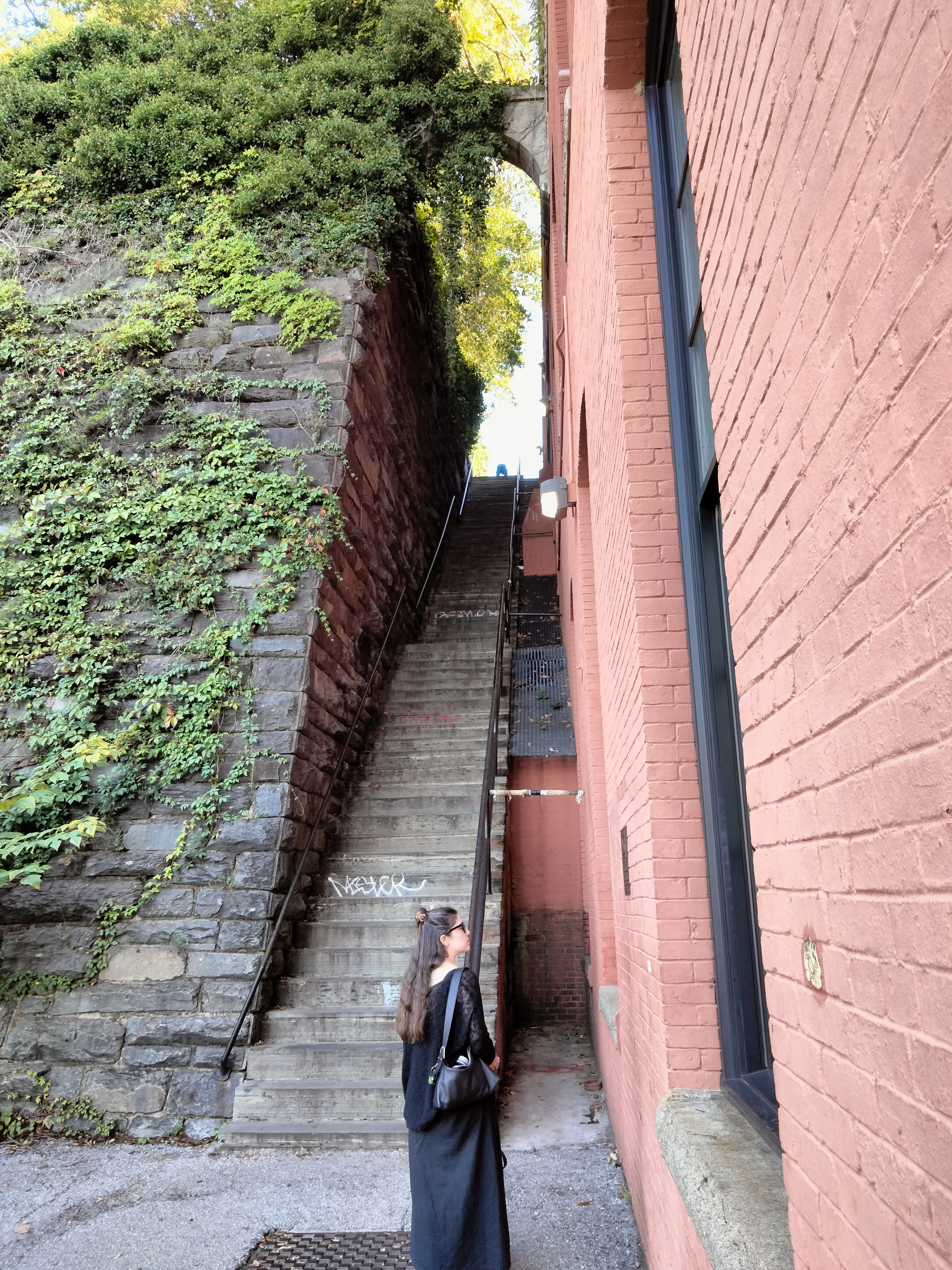
When you search for cinematic tourist attractions in Washington D.C., all signs point you towards Georgetown University – the setting and filming location for William Friedkin’s 1973 adaptation of the William Peter Blatty novel The Exorcist.  Specifically, they route you to the bottom of “The Exorcist Steps”: the death site of the fictional composite character Father Karras, who launches himself down those horrifically steep steps as a heroic act of suicide at the film’s climax.  Given Friedkin’s determination to make the supernatural terror of Blatty’s novel feel as believably authentic as possible, it’s not surprising to learn that the steps are a real location.  Referred to as “The Hitchcock Steps” at the time of filming (either in reference to their 19th Century designer, according to Friedkin’s memoir or, more credibly, in reference to the famous 20th Century director, according to locals), they’re a vertigo-inducing connection point between two busy streets at the edge of Georgetown’s campus. The extreme concrete flight burned a hole in Blatty’s mind while he was a student there, as did a local news report about a legitimate, certified exorcism performed in the Washington, D.C. area.  The only facts Friedkin had to fudge were minor geographical quibbles that allowed Karras to reach the steps from a nearby window, something that bothered the detail-obsessed filmmaker who wanted to keep his visualization of the novel as accurate as possible.  It seems that time has since corrected that adaptational inaccuracy, since there are now several windows facing the concrete staircase that could easily accommodate Karras’s leap.  I know this, of course, because I recently visited The Exorcist Steps on a trip to Washington, D.C., despite not being an especially big fan of The Exorcist.

I just find Friedkin’s grounded, real-world approach to supernatural horror to be a little too dry to deliver the genre goods.  A lot of people highly regard The Exorcist as one of the all-time greats precisely because it’s “accurate” to the real-world events that inspired it, finding terror in the idea that what it depicts could really happen.  I appreciate the tortured domestic drama that results from that approach, especially as a story about two lost adults (Ellen Burstyn as a semi-fictionalized stand-in for Shirley MacLaine and Jason Miller as the doomed Father Karras) desperately looking for a lifeline in a world that no longer makes sense.  It’s only after they’ve thoroughly exhausted the scientific, atheistic explanations that could debunk the possibility of demonic possession that Friedkin fully gives in to the supernatural mania of the premise, allowing Linda Blair to literally spew pure evil into the world.  Personally, I much prefer the ecstatic mania of The Exorcist‘s two direct sequels, The Exorcist II: The Heretic and The Exorcist III: Legion.  That’s where the dark magic of the demonic-possession premise really comes to life, unconcerned with duty to real-world reporting or to Blatty’s writing (despite his continued creative participation in the series).  The kinds of audiences who value tasteful restraint over uninhibited entertainment are likely to dismiss the Exorcist sequels outright as silly dilutions of an important, respectable piece of art.  Those sequels are exactly what attracted me to visiting The Exorcist Steps in Georgetown, though, since they speak more loudly to my tastes as a horror fanatic who prefers his horror to be fantastic rather than realistic.

So, what most D.C. travel guides tend to gloss over is that The Exorcist Steps are not only significant to the events of the original Exorcist film.  They are a constant, chilling presence throughout the initial trilogy, even more iconic to the series than Linda Blair’s spinning head.  In The Exorcist, the steps are largely used as an ominous mood-setter, repeatedly presaging Karras’s fall in establishing shots that beckon the in-over-his-head, faith-questioning priest to meet an early end.  The Exorcist II also uses them as an establishing exterior to signal that the story has returned to Georgetown.  While most of The Heretic is spent detailing young Regan’s life in New York City therapists’ offices—attempting to heal from her demonic episode through radical dream-state hypnosis sessions—it can’t help but drag the audience back to Georgetown at regular intervals, afraid to stray too far away from the familiar details of the original.  Each return to Georgetown is established by a shot of the infamous concrete steps . . . except, not really.  The Exorcist II was shot on a studio lot in Los Angeles as a cost-saving measure, so all onscreen appearances of The Exorcist Steps are an artificial substitute for the real thing.  The genuine, real-life steps reappear in the series’ crown jewel The Exorcist III, though, and without the continued participation of Linda Blair as a now-adult Reagan, the series has no choice but to treat them with total reverence.  They’re lovingly framed with music-video smoke machines at exaggerated angles, including several action shots of the camera rolling down each step in a dizzying spectacle from Karras’s tumbling POV.  The inciting beheadings at the start of The Exorcist III occur on the 15th anniversary of Karras’s fall down those steps, which get their own reverent shout-out during Brad Dourif’s show-stopping speech as the Devil incarnate.  It isn’t until The Exorcist III that The Exorcist Steps truly got their full due as a horror nerd fetish object; it was a slow upward climb to get there.

The Exorcist Steps were officially designated as a Washington, D.C. landmark in 2015 with the installation of an informative plaque marking Karras’s death site.  Shamefully, there are no mentions of The Exorcist II or The Exorcist III on that plaque, despite their significant contributions to those steps’ legacy.  When I visited them on an clammy Monday morning, I was greeted by the exact two kinds of frequent visitors you’d expect to see: a fellow gothy tourist who, like me, was there to take pictures and an annoyed local jogger who was impatient for us to get out of the way of his workout routine zipping up & down the steps.  I will share my pictures of the steps and their accompanying plaque below as documentation of the state they’re in as of this posting, in hopes that more joggers will be annoyed by horror movie nerds who happen to read this and will be visiting D.C. in the near future.  More importantly, though, I’d like to highlight that The Exorcist Steps’ significance to The Exorcist are thunderously amplified by that film’s own sequels, which are just as much worth rewatching before your visit as the original.  There’s even an added bonus to rewatching The Exorcist II before visiting D.C. in that the film also features a lengthy visit to the Natural History Museum, which is one of the city’s other must-visit tourist destinations.  Of course, Linda Blair’s tour of the Natural History Museum appears to be the one in New York City, not the one in D.C., but the effect is largely the same, much like how that film’s version of The Exorcist Steps aren’t actually The Exorcist Steps.  Let’s take a lesson from Friedkin’s folly and not get too wrapped up in the pursuit of accuracy at the expense of pleasure.

-Brandon Ledet

Sex Demon (1975)

These days, rip-offs & retreads of The Exorcist are all the same grim-grey trudges through tired Catholic iconography.  They’re so dutifully routine that I can close my eyes and picture the entirety of titles like The Exorcism, The Last Exorcism, The Pope’s Exorcist, and The Exorcism of Emily Rose without having seen so much as a trailer; the only novelty left in the genre is Russell Crowe occasionally doing an outrageous Italian accent.  That wasn’t always the case.  While William Friedkin’s original Exorcist was a relatively reserved, grounded horror film that tried to make a supernatural phenomenon feel like a genuine real-world threat, a lot of its immediate echoes were bonkers, wildly unpredictable novelties (not least of all its own sequel The Exorcist III).  We used to live in a world where an Exorcist riff could be a Blacksploitation sex romp like Abby, a Turkish copyright violator like Şeytan or, apparently, a hardcore gay porno like 1975’s Sex Demon.  To be clear, Sex Demon is not a porno parody of The Exorcist.  It’s a strangely serious, sinister knockoff of the original – a psychedelic story about a cursed medallion, nightmare-realm Satanic orgies, and a couple who’s normal, milquetoast life together is violently disrupted by demonic possession . . . and ejaculating erections.  It would take a lot of footage of Russell Crowe riding a Vespa to match that kind of novelty.

To celebrate their anniversary, a gay male couple have morning sex and then venture out of the apartment to buy each other gifts.  Some misguiding antiquing leads to the purchase of a cursed medallion (helpfully accompanied by a note that explains “This medallion is cursed”), which the older man buys for his younger lover as an affectionate gesture.  Since there’s less than an hour’s worth of celluloid to fill, the medallion makes quick work of transforming the younger boyfriend from gentle lover to demonic rapist, sending him on a manic quest to fist, piss on, and cum inside as many men as he can before either the spell wears off or his body expires.  The movie skips all of the science vs. religion diagnoses of its source text and gets right to the bed-rattling goods, but it somehow doesn’t lose an ounce of the feel-bad domestic horror in the process.  By mirroring specific objects & moments from the original Exorcist, it invites a parent-child reading on the main couple’s age gap relationship, which is a kind of 40-something/20-something affair.  Having given his younger boyfriend a cursed anniversary present, the older man is worried that he’s psychologically fucked the kid up for life, and a lot of the same helpless exasperation Reagan’s mother feels in the original carries over here.  It’s a feel-bad porno where even the sex scenes are set to a somber, menacing orchestral score, leaving you to wonder exactly what audience this was intended to please. 

Sex Demon‘s specific allusions to moments & totems from The Exorcist are relatively sparse beyond a brief recreation of the Catholic, climactic bedside ritual meant to cast the demon out of its host body.  It might not have clearly been presented as an Exorcist knockoff at all if it weren’t for the final scene’s violent tumble down a flight of apartment stairs or the marketing tagline declaring “Not even an exorcist could help!”  It’s only in retrospect that some moments stand out as allusions to The Exorcist, like Reagan’s masturbation with a crucifix being reworked as the possessed man stabbing a hookup in the anus with a screwdriver.  A lot of Sex Demon‘s horror is of its own making, including a ritualistic Satanic orgy that signals halfway through the runtime that the demonic possession has begun (a move that feels more inspired by Rosemary’s Baby than anything Friedkin directed).  The real creative centerpiece is a concluding montage that chaotically remixes all of the preceding film’s imagery into a violent, dizzying meltdown.  Sex scenes, antiques, dive bar strippers, candles, skulls, kitchen cabinets, and wobbly lamps rapidly flash over a menacing orchestral soundtrack, as if every frame snipped onto the editing room floor was randomly stitched together in lieu of filming something new for the climax.  That nauseating montage feels legitimately evil by the time it reaches its fever pitch, and for the first time you almost forget you’re watching something otherwise dutifully derivative.

Sex Demon was a lost film for nearly four decades, recently rediscovered and restored through the archival diligence of Ask Any Buddy‘s Elizabeth Purchell.  This was a much more substantial preservation of a lost porno parody than the infamous Bat Pussy reels uncovered by Something Weird in the 1990s.  It’s a battered, seemingly incomplete print, but it gets across the film’s artistic significance as an independent queer cinema mutation of a now-canonized horror classic.  Bat Pussy is much too silly of a comparison point, since Sex Demon takes its dramatic, romantic tension seriously enough to match other vintage porno outliers like Both Ways, Equation to an Unknown, and Pandora’s Mirror.  If you’re looking for a goofy parody of The Exorcist, you’re looking for the 1990 Leslie Nielsen comedy Repossessed.  Sex Demon is much more concerned with echoing the evil, supernatural horrors of the original, which is a pretty lofty goal for low-budget pornography.

-Brandon Ledet

Burial Ground (1981)

One of the great joys of Italo zombie schlock is the genre’s chaotic, anything-goes unpredictability.   In Zombi, a zombie has an underwater fist fight with a shark.  In Cemetery Man, a zombie’s severed head becomes a gravedigger’s loving bride.  In Demons, the zombies emerge through the silver screen to infect a horror-movie audience in their theater seats. In the most preposterous scenario of all, The Beyond imagines a New Orleans home with a basement (which, of course, opens a portal to Hell for the zombies to crawl through).  1981’s Burial Ground features none of that chaotic energy.  Narratively, it’s a by-the-numbers zombie invasion story that’s only extraordinary in its efficiency.  The film opens with an archeologist disturbing the ancient burial ground of the title and awakening the flesh-hungry zombies within.  This inciting incident is immediately followed by the arrival of several romantic couples at the estate who don’t seem terribly concerned about their missing archeologist friend.  They waste a little time exploring the musty mansion grounds (mostly looking for places to have sex, naturally), but it’s not long before the disturbed zombies arrive on the scene to eat them alive.  There isn’t much story to speak of from there – just an army of the undead slowly hunting down their soon-to-be-disemboweled victims one at a time.  It’s more commendable for its excess and its expediency than it is for its delivery of weirdo Italo-horror anomalies.

Well, that’s not entirely true.  There is one anomaly worth singling out in Burial Ground: a little boy named Michael.  Since most of the houseguests at the zombie-infested estate are adult couples, Michael stands out as the only child on the premises, which the movie frequently exploits by putting the vulnerable little chap in grave danger.  What really makes him stand out, though, is the casting of the 25-year-old actor Peter Bark in the role, playing a small child with an adult’s face.  The idea was to get around child labor laws that would have limited daily shooting schedules by casting an adult who could work more grueling production hours, but it’s a decision that adds an intensely absurd layer of menace on top of everything Michael does & says.  When he complains that the estate “smells of death” or suggests that his mother light an encroaching zombie on fire, his adult facial features undercut his childlike vocal dub with pure, ancient sadism.  Burial Ground intentionally leans into that discomfort too, spending a lot of time detailing Michael’s childlike curiosity about the adults’ sexual habits – at first as a Peeping Tom, then as an incestuous suitor for his freaked-out mother.  He is undoubtedly the star of the show, and once he inevitably joins the ranks of the zombie hoard you can’t help but leap out of your seat to cheer on his uncanny reign of terror like your favorite football team just scored a 100-yard touchdown.

I’m convinced that Burial Ground would still be recommendable as a late-night zombie horror even without the Michael weirdness.  It’s an all-killer-no-filler affair, not wasting any time explaining why zombies are attacking these horny couples or even why those couples gathered in the first place.  Instead, it invests that energy into making its zombies as grotesque as possible on a tight budget.  Tons of care went into costuming the ambling ghouls with a wide range of gnarly latex masks so that they all have distinct personalities.  Their faces drip with hanging worms and maggots.  Their victims bleed lipstick red as zombie hands tear out their guts in retro Romero fashion.  Not as much care went into making those zombie hands look gross enough to match the latex masks, though, leaving most of them fleshy and intact so it appears as if they’ve never worked a day in their undead zombie lives.  And yet, they clearly have a strong work ethic.  They tirelessly invade the palatial vacation home in search of gross-out gore gags to entertain the audience watching at home, each set piece scored in droning, arrhythmic 80s synths.  Peter Bark’s jarring performance as little Michael is an anomalous element of the film that makes it a must-see entry in the Italo zombie canon, but it’s not entirely reliant on his eerie novelty for its entertainment value.  I don’t know that I could say the same about a scenario where Zombi didn’t depict a zombie fighting a shark.

-Brandon Ledet

Cure (1997)

New Orleans is currently enjoying the best repertory cinema programming it’s had in my lifetime.  I may have missed the healthy art-cinema scene that was obliterated by the arrival of the AMC “Palace” multiplexes in the city’s suburbs in the 1990s, but something beautiful & exciting has sprouted from that rubble in the 2020s.  Looking back at the older movies we’ve covered on the blog over the past ten years because they happened to be screening locally, it’s immediately clear that local programmers are getting more adventurous & esoteric in their tastes.  It used to be that you could only catch rep screenings of Hitchcock classics like To Catch a Thief & Strangers on a Train on Sunday mornings at The Prytania’s ongoing Classic Movies series.  Now every Wednesday night is a head-to-head battle to see who can screen the hipper, edgier title between the Gap Tooth Cinema series at The Broad (formerly known as Wildwood) and the Prytania Cinema Club at Canal Place (former host of Wildwood).  That competitive battle has resulted in a robust local slate including hard-to-see titles like Entertaining Mr. Sloane, On the Silver Globe, and Coonskin as well as celebratory screenings of true cult classics like Pink Flamingos, Blue Velvet, and House.  And that’s not including the one-off barroom & coffee shop screenings and the week-long restoration runs of other weirdo classics around town.  The New Orleans repertory scene is still nowhere near matching the behemoth breadth of a New York, a Los Angeles, or even an Austin, but it’s at least better now than it was when we first started this blog ten years ago, and you can clearly see that progress charted on this Letterboxd list of what we’ve been able to cover because of it.

According to that list, the 100th local repertory screening I’ve attended in the first ten years of Swampflix was the hypnotic Japanese horror film Cure, thanks to the aforementioned Prytania Cinema Club.  An early calling card film for the still-working, still-thriving Kiyoshi Kurosawa, Cure arrived during the serial killer thriller era of the post-Silence of the Lambs 1990s.  Kōji Yakusho stars as a Tokyo police detective working to connect a series of vicious murders in which victims’ throats are slashed in the same meticulous “X” pattern but were executed by different killers, found dazed at the scene of the crime.  The common link between these parallel domestic killings is an amnesiac drifter and former psychology student played by Masato Hagiwara, who appears to be weaponizing an old-fashioned form of Mesmerism to incite the murders.  While the detective struggles to pin these surrogate acts of violence on a man who can barely remember information told to him earlier in a single conversation, let alone his own life story or name, the mesmerism starts to infect the cop’s intrusive thoughts, interrupting the normal flow of a serial killer movie.  His mentally ill wife mutates from a patient in his care to the obvious next victim in the hypnosis-induced murder spree, and all he can really do to stop it is to feebly threaten violence against a dazed, checked-out slacker who only offers middle-distance stares and vague philosophical questions in response.  It’s a horror movie about an infectious idea, which is always a creepier enemy to fight against since there can be no physical, decisive victory.  Attempts to diminish or punish the killer mesmerist only bring him into the presence of even more dangerous men higher up the law-enforcement food chain, spreading the threat instead of squashing it.

I loved getting the chance to see Cure for the first time in a proper theater, fully submerged in its eerie, icy mood without the trivial distractions of home viewing.  It’s the kind of movie that asks you to pay attention to the roaring hums of machines—fluorescent lights, car engines, washing machines, ocean tide—and the jarring silence of their sudden absence.  The blink-and-miss-them flashes of the unreliable detective-protagonist’s hypnotic visions of his own domestic violence could easily be missed with a cell phone or a house pet or passing traffic competing for your momentary attention at home.  It’s an extraordinarily creepy film but also a subtle one.  At the same time, it made me question whether this entire enterprise of lauding repertory programming can be detrimental to the way we watch and think about contemporary releases.  At least, I left Cure a little skeptical about why so many movie nerds are willing to give into the pure-evil vibes of vintage Japanese horrors like this, Suicide Club, and Perfect Blue but get hung up on the supposed plot incoherence of their modern American equivalent in Longlegs.  All four of those works warp the familiar beats of the traditional serial killer thriller into new, grotesque configurations by dredging up the supernatural menace lurking just under the genre’s real-world surface.  Only Longlegs hasn’t had the benefit of multiple decades of critical analysis and cultural context lending additional meaning & significance to the events of its supernatural plot, so that discerning cinephile audiences get tripped up on whether its story makes practical sense instead of focusing on what really matters: its atmospheric sense, its evil vibes.  Cure has long since let go of that baggage.  It’s been canonized as a great work, so its ambiguity is taken as an asset instead of an oversight.

What I’m really celebrating here is the gift of access.  To date, I had only seen one other Kurosawa film: his atypical sci-fi comedy-thriller Doppelgänger, which has largely been forgotten as a lesser work.  That film’s DVD just happened to fall into my lap at my local Goodwill, which is how I find a lot of older movies outside the taste-making curation of streamers like The Criterion Channel, Mubi, and Tubi.  Having that curation spill out of my living room and into proper cinemas in recent years has been a wonderful, welcome change of pace.  I might’ve kept Cure on the watchlist backburner for another decade or two if it weren’t screening a couple bus stops away from my office cubicle.  I also likely would have missed one of its eerie, intrusive flashes of violence had I watched it alone at home, where I’m always one phone notification away from zapping a movie of all its sensory magic.  I hope The Prytania Cinema Club and Gap Tooth Cinema keep competing for my patronage every Wednesday into eternity to keep that magic alive.  Or, better yet, I hope one of them gives up their Wednesday slot for a different night so I don’t have to make an either/or choice every week.  I missed a screening of the Rowlands-Cassavetes collab Opening Night so I could finally check out Cure instead, even though it would have been a lovely way to commemorate the recent passing of an all-timer of a powerhouse actor.  Having that either/or choice is a privilege that I didn’t have just a few years ago, when the majority of local rep screenings were our weekly Sunday morning visits with Rene Brunet.

-Brandon Ledet

Shadowzone (1990)

I’m a sucker for genre movies about the supernatural power of dreams, since it frees filmmakers up to visualize just about anything they want onscreen.  From obscure oddities like Paperhouse & Beyond Dream’s Door to beloved horror-nerd classics like the Nightmares on Elm Street to artsy-fartsy pioneers like Un Chien Andalou, some of the most powerfully surreal images ever achieved in cinema have resulted from dreamworld genre fare.  That’s why it’s a little disappointing when a dream-logic horror movie lacks that ambition to astonish, instead relying on more pedestrian thrills like, say, rubber monsters and naked breasts.  The early Full Moon feature Shadowzone is one such disappointment: a low-budget, straight-to-VHS sci-fi horror about an Extended Deep Sleep trial in which the power of the dream-state human brain unlocks a doorway to an alternate dimension . . . and all that comes through that doorway is tits & monsters.  In any other context, tits & monsters would be a satisfying payoff for renting VHS-horror schlock, but here they’re a little bit of a letdown, especially considering how much more expensive and less expressive Shadowzone is compared to its fellow sleep-study-horror Beyond Dream’s Door.

Louise Fletcher revives her role as the low-energy sleep study doctor she plays in The Exorcist II: The Heretic, except now with a mad scientist bent.  Along with a fellow drowsy mad scientist played by James Wong, she conducts Extended Deep Sleep studies on naked models in the low-rent version of the hypersleep pods from Alien.  Just as they’re starting to discover the awesome, supernatural power the human mind can unlock when submerged in Deep Sleep for days on end, their work is suddenly scrutinized by a military investigator because one of their test subjects inconveniently popped like a balloon.  The flayed corpse of that experiment gone wrong promises a level of gore the movie will not match again until the very end.  Instead, the still-sleeping subjects’ powerful minds let an interdimensional monster through the doorway between worlds that the remaining survivors in the lab (and the audience at home) cannot actually see.  It’s only visible to the lab-equipment monitors, not to the naked eye.  Still, it kills them off one by one in their sealed underground bunker, like an invisible version of The Thing . . . until it finally reveals its admittedly fantastic creature design in a strobe-lit ending borrowed from Altered States.

There’s a meta-element to Shadowzone, where it’s so boring between its mutant creature attacks that you can’t tell whether you actually saw them or you dreamed them during an unplanned mid-film nap.  It’s possible that my unenthused experience with it was a result of presentation, since the version currently streaming on Amazon Prime is a half-hour longer than its normal listed runtime of 80min, and none of the additional footage includes the tits & monsters that provide its only sources of entertainment value.  What’s left is just empty space that could have easily been filled by whatever surreal, outlandish images the fine folks at Full Moon could dare to imagine, and instead is just long stretches of nothing.  The good news is that you’re likely in no danger of being bored or let down by the film yourself, since the only scenario when any reasonable person would have sought this out would be if it were still 1990 and your local video store had already rented out every VHS of the better titles it visually references: Alien, Altered States, and The Thing.  Now, you can just stream Beyond Dream’s Door instead without worrying that Tubi is going to run out of copies.

-Brandon Ledet