

Vibes (1988)

As is often my wont, I was recently extolling to a friend about the virtues of our local library, and declared I would purchase said friend an inexpensive DVD player the next time I saw one at an estate sale (there’s a one-in-four chance there will be, in my experience) so that he could enjoy some of the more obscure picks that are available. This was perhaps days before the announcement that Netflix would be discontinuing its DVD-by-mail service, which was very close to my heart and which flung wide the doors for me to discover a plethora of movies and shows that had been out of my reach before. I couldn’t afford to have internet in my home when I was in college, but even at nineteen I could spare $8 a month for a constant stream of discs into my apartment, and although my local library can’t boast that it has a copy of everything (and for some reason doesn’t do interlibrary loans for media), there are thousands of things that are otherwise inaccessible now. My friend joked (I hope) that everything is streaming now, and that there’s no reason to own such a thing; I pointed out that I have been watching a lot of episodes of Ebert & Roeper at the Movies recently and that it’s opened my eyes to a huge number of movies that I never would have known existed otherwise. Every episode, the boys discuss 4-5 movies, with two of them usually being films that have remained in the public consciousness or otherwise has some kind of name brand recognition (your Top Gun, your Beauty and the Beast, a Silence of the Lambs), one or two movies that fall into the moderately obscure “oh, yeah,” category, (Uncle Buck, for instance, or She-Devil, or Major League: Back to the Minors; anything that you’d watch at a hotel when you’re on vacation and it’s raining on a Saturday afternoon), and then one or two movies that have, for all intents and purposes, vanished from the face of the earth. Is it worth listing those? We Think the World of You from 1988 and 1994’s BackBeat aren’t the kinds of titles you drop when you’re trying to impress someone. Buried among these episodes, I stumbled across their review of Vibes that sparked my interest and, having finally seen it (thanks, libraries!), has also stolen my heart. 

Ostentatious but insecure Sylvia (Cyndi Lauper – yes, really) meets staid museum curator Nick (Jeff Goldblum doing the platonic ideal of a Jeff Goldblum performance) under strange circumstances; they and several others are guests of Dr. Steele (Julian Sands), a parapsychologist. They’re both psychics; he’s a psychometrist, meaning that he can read the history of an object and even information about the people who have touched it, while she gained clairvoyance via a psychic guide named Louise, whom only she can see and hear. Louise, via Sylvia, warns Nick that his long-term girlfriend has been unfaithful while he’s been away, and although he doesn’t believe it, he’s confronted with the truth when his powers inadvertently reveal her deceit. Sylvia, meanwhile, meets her occasional flame Fred (Steve Buscemi) at the racetrack, where she is cajoled into using her powers to pick a winning horse on his behalf, only to be unceremoniously ditched for another woman moments later. Returning home, she finds a man named Harry (Peter Falk) in her kitchen, where he offers her $50K to help find his son, who has gone missing in Ecuador. Sylvia then enlists Nick to go along as well, since two psychics are better than one, and he opts to go rather than continue to spiral out and stew over the failure of his relationship. Once they arrive, Nick deduces with his powers that Harry has deceived them, and the older man admits that he’s actually seeking a fabled room of gold in the mountains, which was previously discovered by his business partner, but the latter man has since been hospitalized in a persistent vegetative state. The two psychics reluctantly agree to go, falling in love while being pursued the whole way by Steele, fellow psychic Ingo (Googy Gress), and a sexy assassin (Elizabeth Peña). 

I mentioned above that Gene and Roger reviewed this movie; I didn’t mention that they both hated it. Not hated hated hated it, but neither was very impressed. In fact, most critics seem to have felt this way, as it’s sitting at 13% on Rotten Tomatoes. I’ve never considered that a perfect metric for a movie’s actual quality, but as a measurement of critical favor, it’s very telling. About halfway through this movie, my best friend, after several chuckles aloud, asked me how the film could have been reviewed so poorly, and neither of us could believe it. Unfortunately, it wasn’t that long after this that the film’s quality dipped, to the point where I could understand how a general audience may have been turned off by the pacing issues in the film’s third act. We can’t really go any further without noting, however, that Lauper is incredibly charming here, and a delight to watch. 

I can’t remember the last time I watched one of these kinds of movies—you know, where a non-actor performer (or sports star) is trying to break into pictures—and the non-traditional actor really disappears into the role. She has great comedic timing for someone with no real background in that field, and she and Falk have amazing chemistry. She and Goldblum are a delight to watch together as well; according to her autobiography, they didn’t get along, but you wouldn’t be able to tell from how well they play off of each other here. Goldblum’s decision to go full Goldblum matches her energy perfectly, as even though Lauper’s hair, make-up, and sartorial choices are always completely over the top, her vibe (sorry) is much more subdued than the man standing next to her, eyes bugging and stams stammering. 

The first few scenes in Ecuador are fun, as the trio arrives there to head for the mountains, albeit there’s some All in the Family-era racism from Falk’s character that doesn’t pass the sniff test these days. At first, these seem like mannerisms of the character Harry is playing, of the terrified father of a missing boy, but he spouts off a few other Bunkerisms even after the reveal that are jarring in an otherwise very goofy movie. Travelogue scenes set prior to the cresting of the mountain are gorgeous, capturing the natural verdant beauty of the Ecuadorian mountains, like something out of a movie with a much higher budget. Unfortunately, once Sylvia, Nicky, and their pursuers get to the mountaintop where Harry’s partner found a small, glowing pyramid in the film’s cold open, the plot drags considerably. All of this takes place on a set, which is fine, but the effect of being at the top of a high peak with nothing in the background makes the whole thing feel like it’s taking place in a void. Right before they arrive, we’re treated to a gorgeously rendered matte painting, but once on the actual mountaintop set, characters move around and make choices that feel like shuffling the deck before the denouement. This goes some way to explain why contemporary critics may have turned on the movie when the third act trended toward boredom, but I’m more forgiving, especially when there’s so much charm and appreciable humor on display. 

The film manages to run the gamut of different comedic styles. When the trio first arrive in Ecuador, Sylvia teases Nick for bringing so much luggage, assuming that he’s overpacked. He reveals that one of the suitcases contains an entire month’s worth of dehydrated rations; when Sylvia points out that it’s normally the bacteria in the water that caused travellers of the time to become ill, Nick reveals that another suitcase is full of giant jugs of water, which he also brought along. Later, after Harry’s deception has been revealed, he and Sylvia find themselves at the tiki-themed hotel bar, where he is drinking directly from one of the jugs, which has a festive paper umbrella embellishment. It’s a good visual gag, one among many, including one in which the 5’3” Lauper and the 6’4″ Goldblum perform a tango that ends with her arms around his shoulders, essentially being carried, with her legs dangling back and forth. It all leads one to believe that the contemporary audiences and critics of the time may simply have misunderstood that the film understands that its zany, sometimes cartoony plot is intentional, not the result of poor writing or direction. 

The real crime here is that the public reaction pushed Lauper to abandon film business, albeit not completely. She’s effervescent here in a very real way, like she’s trying some things out. At one point, when Nick rejects her because he misunderstands the reasons that she’s expressing interest, Lauper shifts into an affected Transatlantic accent and mockingly blurts “I want you bad all right. I dream about you and me and a house in Long Island. I’m only half a woman until I make love to you.” For someone who’s not really part of the business, she’s making interesting acting choices that reveal a talent range that most people wouldn’t assume. Reportedly, Dan Aykroyd was first interested in the project (which makes sense, since he’s a big believer in the paranormal in real life) but left because he refused to be in a movie with Lauper, which is both absurd and for the best, since Goldblum’s take on Nick is a much more believable match for Sylvia than I could imagine Aykroyd providing. As a fun bit of fluff, this is one worth tracking down. 

-Mark “Boomer” Redmond

Chatterbox! (1977)

I’m currently watching Sex and the City for the first time without ever having much interest in it until now, and it’s instantly become an all-time favorite show.  It turns out it makes a lot more sense once you hit your thirties. Who knew? In the last episode I watched, Charlotte confesses to her brunch buddies that her gynecologist prescribed a mild antidepressant to help get a vaginal infection in-check, pouting in a hushed panic “My vagina is depressed!”  That kind of candid sexual humor was a large part of what made the show such a cultural phenomenon in the early aughts, when it was a lot less common to hear women openly joke about their genitals on national television.  Before then, you had to go digging in smut to find that kind of ribald women’s humor, as evidenced by 1977’s (incredibly well-titled) talking vagina comedy Chatterbox! being directed by gay porno auteur Tom DeSimone.  Chatterbox! only qualifies as a softcore porno if you squint at its AM Gold soft-rock lovemaking scenes with the most puritanical eye. Its main-attraction talking vagina never even makes an appearance on-screen, whether to avoid an X rating or to avoid the practical mechanics of gynecological puppetry.  Still, it’s got a mildly naughty pedigree as an out-of-time, post-hardcore nudie cutie.  It wasn’t until the early 2000s that you could hear women joke about their vaginas having minds of their own on the HBO sitcom equivalent of Seinfeld.  Before then, you had to go see a dirty movie, even if not in the same sketchy theaters where they played DeSimone’s true trenchcoaters.

Most contemporary reviews of Chatterbox! dismissed it as a low-brow, juvenile sex comedy and a masturbatory fantasy for men.  They were only half right.  Yes, the jokes are idiotically crude, like when Virginia the Talking Vagina greets her mother with the zinger, “You didn’t even kiss me hello!” or when a potential sex partner responds to her propositions with “You didn’t even move your lips!”  It’s all harmless schtick, but it’s schtick all the same.  Still, the hapless hairdresser who happens to be attached to Virginia, Penelope, reacts to her supernatural genital predicament with such embarrassed horror that it’s difficult to imagine someone treating the film as pure masturbation fodder.  As much fun as Virginia is having seducing every man (and most women) in their presence, Penelope is mortified that her crotch is getting so much attention, especially by the time the pair become late night talk show regulars as a kind of side show act.  The film is pitched more directly to the women in the audience than you might expect, playing less like a macho fantasy than an adolescent stress dream about showing up to school naked.  Its closest comparison point is The Peanut Butter Solution—a childhood nightmare about rapid hair growth—not the rearranged-female-body misogyny of Deep Throat.  Penelope’s talking, misbehaving vagina is presumably voicing her sexual id, but it does little to bring her out of her shell as a sexual person.  The two are mostly at odds with each other and struggle to find an equilibrium they’re happy with, much like Charlotte York whining about her depressed vagina to friends at brunch.

Chatterbox! is the kind of ramshackle production where the boom mic is onscreen so much it deserves its own character credit.  At one point, Rip Taylor—a total pro—stealthily swats it out of the frame in annoyance for stealing his moment.  The film’s sub-mainstream production values and other titles director’s back catalog (including gems like Swap Meat and Confessions of a Male Groupie) might raise questions of why it didn’t go full-porno, but I personally admire its decision to launch directly into its premise with no funny business.  Virginia starts talking immediately in the first scene, complaining about Penelope’s longtime boyfriend’s lovemaking skills because Penelope would never voice those complaints herself.  It’s not long before they make their debut on stage & television, after Penelope quickly manages to convince her friends & psychiatrist that Virginia really does have a mind of her own.  That efficiency leaves room in the tight 70min runtime for Virginia to launch a star-making career as a disco singer, including multiple performances of her nonsense hit single “Wang Dang Doodle.”  This is an aggressively silly, unsexy sex comedy about a woman’s war with her own body, like a Doris Wishman prototype for How to Get Ahead in Advertising – one with a lot less to say but a much more interesting place to say it from.  I’m sure there are so-bad-its-good cult movie obsessives who think they’re laughing at the movie’s expense—the A Talking Pussy!?! jokes write themselves—but it appears to know exactly how silly and misshapen it is, to the point where it’s always in on the joke. In a word, it’s a hoot.

Also, in case you’re wondering, Penelope is a Charlotte but Virginia is a textbook Samantha. And, yes, I plan on ending every review with this exact analytical lens until I get this show out of my system.

-Brandon Ledet

Signature Move (2017)

I remember Jennifer Reeder’s surrealist high school melodrama Knives & Skin harshly dividing the audience at Overlook Film Fest in 2019, with the more macho Horror Bros in the crowd grumbling that it was the worst film they’d seen all fest and with other scattered weirdos gushing that it was the best.  Personally, I dug it, especially for the way it warped the teen-friendly Lynchian melodrama of early Riverdale by submerging it in a hallucinatory Robotrip aesthetic.  I wasn’t especially surprised that Knives & Skin confused the more rigidly horror-minded section of the crowd, though, since it’s a Laura Palmer-style murder mystery that doesn’t care as much about the murder as it cares about teen-girl bedroom decor and eerie vocal choir renditions of 80s pop tunes.  Hell, even my own reaction was confused.   I left the theater thinking I had watched a messy but ambitious debut feature from a boldly stylistic genre nerd.  I was wrong.  Reeder had not only made a name for herself as a prolific short filmmaker on the festival circuit, but she also had already completed her first feature in 2017’s Signature Move.  And now having caught up with that debut, I’m as confused as ever.  After the slow-motion, high-style freakout of Knives & Skin, I was expecting a lot more visual panache out of the straightforward, Sundancey romcom that preceded it.  I still don’t have a clear answer to the question “Who is Jennifer Reeder?” Maybe I never will.

Signature Move stars Fawzia Mirza as a closeted, thirtysomething Chicagoan who hides her lesbian social life from her first-generation mother, an agoraphobic shut-in who spends all her time watching Pakistani soap operas and needling her daughter about marriage.  As an act of private rebellion and stress relief, Mirza secretly trains as a professional wrestler between dull dayshifts working the desk at a law office.  She also sneaks around the city’s lesbian bar scene, where she meets a much more out-and-proud love interest played by Sari Sanchez.  Her new girlfriend lives a freer, more honest lesbian life, having grown up with an actual professional wrestler as her mother – an open-minded luchadora named Luna Peligrosa.  As one woman struggles to reveal her true self to her conservative parent and the other refuses to regress into the closet, conflict ensues.  From there, there isn’t much to Signature Move that you can’t find in any 90s festival-circuit romcom or, more recently, any streaming-era sitcom.  Even the lesbian-scene setting isn’t especially distinctive amongst similar, superior titles like Saving Face, Appropriate Behavior, The Watermelon Woman, or whatever was the first queer romcom you happened to catch on IFC before Netflix “disrupted” (i.e., gutted) the original purpose of cable.  I suppose there’s some value in documenting the food, fabrics, art, jewelry, and bootleg DVDs of Chicago’s Muslim & Latinx neighborhoods as our two mismatched-but-perfectly-matched lovers negotiate their new relationship, but in some ways those moments of cultural window dressing almost make the film more anonymous among similar low-budget comedies that pad out the programs at Sundance & Outfest every single year.

If there’s any detectable trace of Jennifer Reeder auteurism in Signature Move, it’s in the inevitable climax where Mirza’s shut-in mother bravely ventures out of their shared apartment to witness her daughter’s pro wrestling debut at what appears to be a lucha-drag hybrid event akin to our local Choke Hole drag-wrasslin’ promotion.  There’s a heightened artificiality to that queer-dream-realm wrestling venue that Reeder would later intensify & expand in Knives & Skin until it consumed an entire fictional suburb.  Otherwise, I can’t say I found much to either praise or pick apart with any fervor in Signature Move, which is just as straightforward & unassuming as Knives & Skin is uncanny & confounding.  It’s a cute enough movie on its own terms, though, and there can never be enough media celebrating how gay wrestling is as a microculture.  Otherwise, it appears that I time-traveled in the wrong direction when trying to get a firmer handle on Jennifer Reeder’s signature aesthetics as a director.  Her two follow-up features after Knives & Skin—last year’s Night’s End and the upcoming Perpetrator—are both supernatural horrors that promise a lot more room for the high-style, low-logic playfulness that caught my attention at Overlook than this cookie-cutter indie romcom was ever going to deliver.

-Brandon Ledet

Lagniappe Podcast: Murder by Death (1976)

For this lagniappe episode of the podcast, Boomer, Brandon, and Alli discuss the murder mystery meta comedy Murder by Death (1976), a direct precursor to Clue (1985).

00:00 Welcome

06:33 Heavenly Creatures (1994)
12:30 Bodies Bodies Bodies (2022)
15:38 Ant-Man and the Wasp: Quantumania (2023)
19:01 Lust in the Dust (1984)
23:50 Scream VI (2023)
40:52 Cocaine Bear (2023)
42:45 Day of the Animals (1977)
46:46 Cleo from 5 to 7 (1962)
51:14 Nathan for You: Finding Frances (2017)

58:13 Murder by Death (1976

You can stay up to date with our podcast through SoundCloudSpotifyiTunesStitcherTuneIn, or by following the links on this page.

-The Lagniappe Podcast Crew

Lagniappe Podcast: Delirious (1991)

For this lagniappe episode of the podcast, Boomer, Brandon, and Alli discuss the John Candy meta comedy Delirious (1991), in which a concussed soap opera writer finds himself stuck inside his own show, which he can manipulate minute-to-minute via typewriter.

00:00 Welcome

04:55 Spellbound (1945)
09:50 Star Trek V: The Final Frontier (1989)
13:25 Intolerable Cruelty (2003)
17:43 The Ladykillers (2004)
21:26 Cocaine Bear (2023)
30:30 The Mothman Prophecies (2002)
36:40 Calvaire (2004)
41:55 Project Wolf Hunting (2023)
44:27 The Outwaters (2023)

51:17 Delirious (1991)

You can stay up to date with our podcast through SoundCloudSpotifyiTunesStitcherTuneIn, or by following the links on this page.

-The Lagniappe Podcast Crew

Podcast #180: Gentlemen Prefer Gentlemen Prefer Blondes (1953) to Blonde (2022)

Welcome to Episode #180 of The Swampflix Podcast.  For this episode, Brandon, James, Britnee, and Hanna discuss the classic films and lasting legacy of Marilyn Monroe, from her beloved comedies like Gentlemen Prefer Blondes (1953) to her post-modern post mortem Blonde (2022).

00:00 Welcome

2:00 Krewe Divine
3:30 Divine Trash (1998)
4:36 Attachment (2023)
8:35 SexWorld (1978)
12:15 Bijou (1972)
15:58 The Red Shoes (1948)
18:10 A Matter of Life and Death (1946)
20:35 Chan is Missing (1982)
21:51 Caravaggio (1986)

26:04 Blonde (2022)
44:30 Gentlemen Prefer Blondes (1953)
58:56 Some Like It Hot (1959)
1:16:23 Niagara (1953)
12:25:25 Don’t Bother to Knock (1952)

You can stay up to date with our podcast through SoundCloudSpotifyiTunesStitcherTuneIn, or by following the links on this page.

-The Podcast Crew

The Last of Sheila (1973)

Swampflix readers, the internet has been essentially de-democratized. What I mean by that is that when you or I go online to look for the answer to a question or read one (1) article about a thing that we engaged with or enjoyed, we no longer get to interact with that article in a vacuum. Unless you’re VPN’d up every single time that you look for a movie review or try to purchase a replacement ice mold for the Rival snow cone maker that you purchased at an estate sale without realizing that it required a part that was not present, you’re going to start getting ads for snowball machines and your YouTube homepage is going to be flooded with think pieces and video essays about the film that you just wanted one critic’s viewpoint on. Well, that and advertisements and algorithmically driven content to make you stay on the platform longer, feel encouraged to interact with the content to drive engagement, etc. Like most Swampflix contributors, my interests are not fully in alignment with the zeitgeist, but every once in a while, they are; unfortunately, although that means that I was as excited about M3GAN as the culture at large was, discussion of her wasn’t omnipresent in the discourse of the YouTube channels that I haven’t blocked. But boy howdy did YouTube love that I loved Glass Onion. Amidst a deluge of clickbait bids titled “[Number] Things You Missed in Glass Onion!”, “All the Secret Connections between Knives Out and Glass Onion!”, and the like, I have to admit that I did encourage the algorithm just a little by watching videos that talked about the various films and TV shows that had served as inspiration for the film, because I go through periods where mysteries are all that I ever want to consume. Frequently cited as a major creative jumping-off point for the film was 1973’s The Last of Sheila

Helmed by director Herbert Ross and scripted by Anthony Perkins and Stephen Sondheim (the only screenplay credit for each), the film tells the story of film producer Clinton Greene (James Coburn) and his plan to take several of his friends on a pleasure cruise aboard his private yacht. Their voyage begins, presumably not accidentally, on the anniversary of the death of Greene’s girlfriend, Sheila, who left one of his parties in a fit and was killed by a hit-and-run driver mere blocks from his house. An avid player of games of strategy and wit, Greene has planned out a series of mystery nights where his guests will go ashore with a set of clues and split up to try and solve a mystery. Each person aboard is also given a card that is to be their “secret identity” for the game, and the first of these that we see as characters open their envelopes are things like “Alcoholic,” “Shoplifter,” and “Homosexual.” Further, each of his traveling companions was there the night of Sheila’s death: Christine (Dyan Cannon), a film talent agent who’s full of wit and flirtatiousness in that a 1970s showbiz liberated way; glamorous but troubled starlet Alice (Raquel Welch) and her current beau, another film agent named Anthony (Ian McShane), who’s forever angling to get more involved with the production side of film; faded movie star and giant of another age Philip Dexter (James Mason) who’s now stuck in undignified commercials for dog food; and Tom Parkman (Richard Benjamin), a screenwriter who’s been stuck doing rewrites on spaghetti westerns while his original work remains unsold and unproduced. The only person on the cruise whom we are explicitly told wasn’t there the night Sheila died isTom’s wife Lee (Joan Hackett), a kind but idle and neurotic heiress. The first night of the mystery game is largely a success, with half of the group getting to the secret while the other half is either too late or doesn’t try at all. On the second night, however, tragedy strikes, and when not everyone comes back to the boat, our cast of characters return to the site of the previous evening’s game and discover that someone from their number has died, under mysterious circumstances. 

Excited as I was to finally see this film, at a full two hours, it starts to feel its length in places. The site of the second night’s game is an abandoned monastery where the gang has to don identity-revealing robes and remain quiet until they locate the confessional in which Greene is hiding, which makes for a lot of fun as characters pass each other without we in the audience ever really knowing with whom they’re speaking or even if the characters know; unfortunately, this runabout through the monastery feels much longer than the ten minutes of screen time that it occupies and unfortunately telegraphs that a twist is coming. For the first hour of the movie, the omnipresent implication is that Greene has arranged some elaborate plan to discover which of his guests was Sheila’s killer, but a savvy viewer will know that there’s simply no time left in the runtime of the film to go through five more puzzles, and so there’s going to be a complicating factor at any moment. You’re not surprised by the second death, merely by who is the unfortunate corpse. I’ll be the first to admit that I might have been spoiled (or had a certain part of my brain atrophy while another part grew three sizes) by watching some 250+ episodes of Murder, She Wrote in the past thirteen months, so I could be stuck on that formula, but an hour in feels like an awfully late place to stick your midpoint murder twist. At the same time, there’s no fat to trim here, no extraneous beats that don’t reveal something relevant about character, motive, time, and secrecy, it’s just that the relevancy of all of these narrative moments is often revealed late in the game. 

If there are two performers who stand out to me, I’d have to name Cannon and Hackett. Every performance here is good, but Cannon is delivering a wonderfully understated performance as a woman who’s committed to living life as sensually and hedonistically as possible but whose dark past she regrets; she’s stunning. A whodunit like this doesn’t require the sincerity and humanity that she brings to her delivery of a monologue in which she confesses to having furthered her career by slipping some names to the HUAC, but it certainly elevates it. “Then those people didn’t work for a while,” she says. “Now they work. Sometimes I try and get them work. Sometimes I see them on the street and sometimes … they cross the street.” She tries to play off her guilt, but no one is convinced, least of all herself, and it’s magical. Also doing great work here is Hackett, whose frantic, nervous, chain-smoking Lee is clearly having a very hard time with all of this business right from the start as the only person aboard who doesn’t belong there, since she was hundreds of miles away when Sheila died. As the only person we can be assured isn’t a killer, she seems to understand the jeopardy of being on the boat with someone willing to cover up their hand in an accident that resulted in a death. After all, someone almost kills Christine by turning on the yacht’s propellers while she’s taking a swim; who’s to say there won’t be more “accidents”? The big stars are clearly supposed to be Mason and Benjamin, the actor and the writer, who take point on trying to spin out the narrative that would lead to the things that the group has uncovered and discovered—and let there be no mistake, they are both more than satisfactory, with Mason having the upper hand over Benjamin in the charm department—but it’s Cannon and Hackett that I’ll be thinking about weeks from now. 

Let’s talk humor. I’d be remiss if I didn’t mention that, alongside the performances, the other tempering element that helps the movie feel like it’s got some pep in its step when it gets a little slow is the film’s comedic wit. Before she can even get on the boat, Christine complains about the lack of a drink in her hand by declaring “My mouth is so dry they could shoot Lawrence of Arabia in it,” which I’ve found myself saying every once in a while over the years without ever remembering its origin (it’s the pull quote used for the film in Douglas Brode’s compendium—and my longtime companion—Edge of Your Seat: The 100 Greatest Movie Thrillers, where it ranks at 88th). Even the jokes that characters make that are supposed to be either unfunny or in bad taste within the text got a chuckle out of me, especially those that poke fun at Hollywood and celebrity culture. This includes Greene’s mocking of Tom’s body of work as a second set of eyes on Westerns by asking him to read from a section of Fistful of Lasagna (“or whatever it’s called”). Even if the references are a half century old now, the core truths in play keep the film feeling fresh, despite some major dissonance in other areas that it’s important to address: one of the characters is outed as a child molestor, which is bad enough, but the other characters don’t really seem to think that it’s a problem that needs to be addressed or even has a glimmer of an idea of reporting him to the authorities. If there’s one thing in this film that hasn’t aged well, it’s the casualness with which that horrifying little tidbit is dropped and the lack of reaction to it. 

Already, I’ve risked giving away too much of the plot of this one, so I’ll wrap it up. Stellar performances, creative misdirects and clues, and clever jokes stashed away in little corners more than make up for the times where the film feels like it’s dragging the bottom. Although you can rent this one streaming, I’m sure your local library has a DVD that’s probably got some fun extras and easter eggs on it, so why not visit them instead? 

-Mark “Boomer” Redmond

See How They Run (2022)

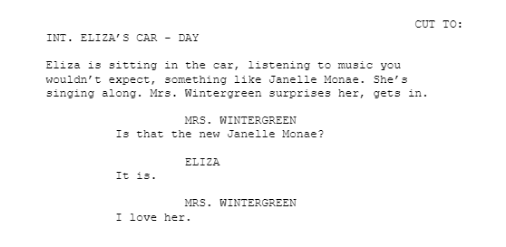
I recently talked on the podcast about my dear friend Ana Reyes’s astounding and well-deserved success surrounding her first novel, The House in the Pines (still #2 on the NYT bestseller list for hardback fiction as of this writing!). When we were all having drinks after the launch party back on January 3, her husband, who is also a writer and friend, mentioned to me that he and Ana had recently been talking about how ahead of the “cozy mystery” curve I was when I put together my pitch document/series bible for the as-yet-undiscovered project Mrs. Wintergreen. As I smiled a toothless grin that belied my bitterness that fate has not seen fit to bring Mrs. Wintergreen to life, I didn’t even point out that not only was that the case, but also that I had even included a scene in which my protagonist, 108-year-old semi-pro sleuth Constance Wintergreen, expressed an appreciation for Glass Onion star Janelle Monae:

Anyway. 

Agatha Christie is very in vogue, as evidenced by not only the aforementioned Christe-adjacent 2022 release Glass Onion, but also the Christie-containing See How They Run, a confident first feature from director Tom George penned by Mark Chappell, who is perhaps best known for his writing for the David Cross vehicle The Increasingly Poor Decisions of Todd Margaret. A period piece, the film begins on the night of the hundredth performance of The Mousetrap, a Christie-authored play which is infamous for two things: first, that there is a twist ending that the audience is encouraged not to reveal to others, resulting in the play’s ending remaining largely unknown to this day, and second, that the contract for the play forbids any adaptation of the source material to film (or the short story on which it was based from being published) until at least six months have passed since its final performance at London’s West End. This was a particularly long-sighted bit of legal play, as the show has run continuously (other than a COVID-caused pause) since its opening night in October of 1952, seventy years ago. In fact, I have some suspicion that this film exists solely for that reason, as it is the closest we can get to a Mousetrap adaptation for the foreseeable future. 

Leo Köpernick (Adrien Brody) is a sleazy slimeball of an American film director (redundant, I know) who has his sights set on turning The Mousetrap into a hit motion picture. That previously noted clause about the show being forced to close before this can even be a possibility is at the forefront of the minds of many involved, but theatre producer Petula Spencer (Ruth Wilson) assures him that the play has already reached its 100th performance and surely it will run out of steam soon, espousing the idea that a narrative with a whodunit at its core will, by its nature, see few repeat visitors and will necessitate closure sooner than later. Although we the viewers are sufficiently distant from this event that this is an historical irony for us, the contemporary American studio system is so confident that they already have Mervyn Cocker-Norris (David Oyelowo) working on a screenplay. Cocker-Norris’s English sensibilities and sense of adaptational faithfulness brings him into conflict with the flashy Köpernick, although the former is not alone in his distaste for the latter: British film producer John Woolf (Reece Shearsmith) is also protecting a scandalous secret about which Köpernick is blackmailing him; Köpernick is rude to all members of waitstaff everywhere, which includes the put-upon usher Dennis Corrigan (Charlie Cooper); and, mere moments before his murder at the ten minute mark, he is decked by Richard “John ‘Spared no expense’ Hammond” Attenborough (Harris Dickinson), who portrays the lead in The Mousetrap, for flirting with his co-star and wife Ann Saville (Pippa Bennett-Warner). The investigation of his death necessitates the appearance of Inspector Stoppard (Sam Rockwell), the archetype of the drunken detective who plays fast and loose with the rules; due to a shortage of available partners, he is paired with Constable Stalker (Saoirse Ronan), a plucky, energetic up-and-comer who is mere months away from being the first woman to take the sergeant’s exams. 

This is a neat little movie that makes sense in and of itself but also functions as a love letter to Christie and to her longtime fans, a body of which I consider myself to be a member. For instance: a scene in which the excitable Stalker asks a hotelier what part of France he is from based on the fact that he speaks French only to receive a deadpan response that he is Belgian is a fun comic bit in and of itself, but it’s also a nod to fans of Christie’s Belgian detective Hercule Poirot, who often finds himself on the receiving end of this exact misunderstanding. There’s also a good running gag about Hamlet: Early on, Attenborough says of The Mousetrap “It’s not exactly Hamlet.” Later, Stoppard half-quotes Act II Scene II’s famous ending line “The play’s the thing” [“Wherein I’ll catch the conscience of the King”], spoken when Hamlet commits himself to obtaining evidence of his uncle Claudius’s guilt through an elicitation of a confession upon seeing a fictionalization of Hamlet’s father’s murder. This is itself a circular reference, as not only does it reveal that Stoddard has realized that the connection between the murder of Köpernick may actually have to do with the play’s content, not its performance as initially suspected, but the word “mousetrap” likely comes from Hamlet in the first place as Hamlet refers to the play as a mousetrap in Act III Scene II (line 2131), in what may be the invention of the term. Your mileage is likely to vary on certain comic elements, of course; whether or not you find it clever that Cocker-Norris disdains screenplays that include flashbacks as crass and artless moments before one occurs in his narration is going to be left up to the individual viewer. I find his asking of “Whatever next? A caption that says, ‘Three weeks later’?” juxtaposed with that very caption to be charming and fun, but I know that others will find it to be more of a moment of bathos. 

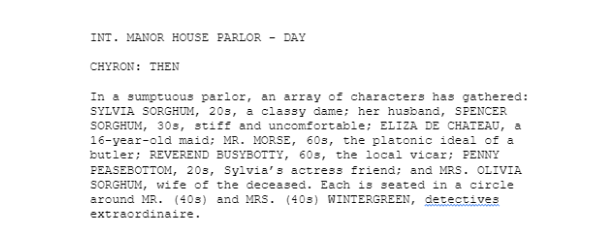
My favorite gag, however, cribs neither from Shakespeare or Christie, but Adaptation: in a flashback, much to the chagrin of Cocker-Norris, we get to see a little bit of how Köpernick’s mind works as he shows a series of storyboards that he put together for the climax of the film version of The Mousetrap. The images are quick cuts between detailed insets: gloved hands at a power box, a revolver being cocked by an unknown person, a fire breaking out in the middle of a tense standoff with a hostage—all of it very un-Christie and extremely Hollywood. This is Köpernick’s attempt to “jazz up” the very un-Hollywood and extremely Christie ending of the play, which uses one of her most well-known and genre-defining tropes: the end-of-the-story summation gathering, in which the detective gets everyone together in a parlor to explain their investigation and conclusion. In fact, not that it matters, but it’s so very much part of the genre that a parody of this type of scene is the very first thing that happens in the script for the Mrs. Wintergreen pilot, “Mrs. Wintergreen and the Thorny Dilemma” 

See How They Run turns this on its ear by playing both sides in the same way that Adaptation does, by mocking the hand that feeds it via denigrating comments about the formulaic nature of Hollywood adaptations, and then doing each and every one of the things that it mocks. The climax of the film takes place in a parlor that has the exact same layout, dimension, and decorations as the final set of the play, although this is obscured until the last possible moment to reveal it. The revolver, the fire, the standoff, the power box—the whole thing plays out in exactly the same way that Köpernick’s storyboard does. It’s a lot of fun to watch. (So would Mrs. Wintergreen be, I think, but I digress.) 

I was engaging with some essay or other this week and was taken aback when the author noted that, for all of his extremely large body of literary work, Isaac Asimov’s oeuvre rarely sees film adaptations, with only a handful ever being produced: Konets Vechnosti from 1987, based on The End of Eternity, which I assume must have had a subtitled release in the U.S. at some point but I can find no evidence of; the Robin Williams vehicle Bicentennial Man; two separate adaptations of the 1941 short story “Nightfall;” and, theoretically at least, I, Robot. In general, the world does not lack for Christie adaptations; they are so numerous that films based on And Then They Were None alone have their own Wikipedia subpage. The Mirror Crack’d from Side to Side was adapted as an episode of Miss Marple and Agatha Christie’s Marple, which are two separate television shows, as well as a film version in 1980 starring Angela Lansbury as Marple. When it comes to Christie media, we are the lilies of the field, neither toiling nor spinning, nevertheless arrayed in splendor. But we don’t have an adaptation of The Mousetrap, and we likely never will. Even if that day comes, there’s a risk it will be as dull and uninteresting as 2017’s Crooked House, which even Glenn Close and Gillian Anderson couldn’t save. What we do have is See How They Run, which is more than good enough; it’s great. 

-Mark “Boomer” Redmond

Podcast #178: On the Count of Three & 2022’s Honorable Mentions

Welcome to Episode #178 of The Swampflix Podcast. For this episode, Brandon, James, Britnee, and Hanna continue our discussion of the Top Films of 2022 with some honorable mentions, starting with the Jerrod Carmichael suicide comedy On the Count of Three.

00:00 Welcome

02:00 M3GAN (2023)
03:20 Shin Ultraman (2023)
05:25 Sick (2023)
07:25 Skinamarink (2023)

16:05 On the Count of Three (2022)
35:53 Aline (2022)
55:40 Lux Æterna (2022)
1:10:13 We Met in Virtual Reality (2022)

You can stay up to date with our podcast by subscribing on SoundCloudSpotifyiTunesStitcher, or TuneIn.

– The Podcast Crew

From Daniel Sadcliffe to Daniel Radcliffe

I never engaged much with the Harry Potter movies as they rolled out throughout the aughts, but from what I remember glimpsing in Dear Reader, Wizard People, Daniel Radcliffe was not an especially talented child actor.  I couldn’t hear Radcliffe’s pipsqueak line-readings over the drunken growls of Brad Neely’s alternate narration track, but I distinctly remember him having a dazed, deer-in-headlights look in Wizard People that suggested even he didn’t know why he was helming the blockbuster franchise.  It’s incredible, then, that Radcliffe was able to turn that early windfall into what’s now a decades-running acting career instead of just a passive, eternal source of royalty checks.  What’s even more incredible is just how weird he’s committed to making that career.  Radcliffe continually chooses projects where he gets to play absolute freaks: Dr. Frankenstein’s groveling hunchback lab assistant (and possible boyfriend), a computer nerd with guns surgically bolted to his hands, a farting corpse with a magical boner, any role he can land to distance himself from his association with Harry Potter – efforts I am cruelly undermining here.  Much like the kids who headlined the Twilight series, Radcliffe has put his blockbuster blood money to great use in the years since he broke free. Only, while RPat & KStew are chasing high-brow critical prestige, Radcliffe is out there determined to be seen as the biggest weirdo to grace the screen since Nic Cage screeched about the bees.  It’s been a truly magical transformation.

Radcliffe’s determination to let his freak flag fly recently reached its highest fever pitch in the Funny or Die sketch turned Roku Channel Original Weird: The Al Yankovic StoryWeird is a mock biopic that sensationalizes the notoriously squeaky-clean polka musician Weird Al’s life to match the more traditional rock ‘n roll hedonism of his MTV-era colleagues, complete with Dr. Demento scouting talent at the local biker bar and Al’s father forbidding him to play “the devil’s squeezebox.”  It’s a single-joke premise that might feel a little redundant for anyone who’s already seen similar music industry parodies like Walk Hard & Popstar: Never Stop Never Stopping, but its single joke is still—importantly—very funny.  Weird is the kind of comedy nerd’s comedy where every character introduction has you muttering “Oh, that’s good casting” under your breath.  It’s Radcliffe’s casting that really makes the film special, though.  As much as the purpose of Weird is to contextualize Al Yankovic as an essential American pop culture icon—alongside fellow greats like Madonna, Elvira, Pee-wee, and Divine—it also completes the mission of contextualizing Daniel Radcliffe as a true weirdo himself (although a Brit).  Radcliffe commits to the bit with full fervor, playing the raw, scuzzy, self-destructive sexuality of Weird Al as if he were starring in an Iggy Pop biopic instead, strengthening the over-the-top absurdism of the film’s only joke by playing it with a straight face unseen in the genre since Leslie Nielsen passed.  Radcliffe has played much weirder characters than Al in the past—the titular Swiss Army Man chief among them—but I’m not sure he’s ever done so more convincingly.

Things weren’t always this way.  A decade before The Al Yankovic Story, Radcliffe’s career appeared to be taking a much more pedestrian leading-man path, starting with the 2012 adaptation of The Woman in Black.  A comeback production for the legendary Gothic horror studio Hammer, The Woman in Black is super scary, both as a traditional ghost story and as a worst-case-scenario vision of Radcliffe’s potential career as a bland leading man instead of an eccentric weirdo millionaire.  Both Hammer and Radcliffe had a lot to prove in the otherwise low-stakes, low-profile production, and only Hammer scored high in that gamble.  In its story of a vengeful ghost who targets rural village children, Hammer was able to prove they were ready to produce well-balanced, traditionalist ghost stories again – offering a mix of shameless jump scares and long stretches of atmospheric quiet where all of the spookery lingers in backgrounds, mirrors, and mist.  It’s not an especially shocking nor inventive horror film, but it is an efficient & effective one, where every adaptive choice helps amplify its eerie scares . . . except for Radcliffe’s casting as the lead.  Much like in the early Harry Potter films, Radcliffe is just kinda there.  He’d be easily replaceable as the film’s lead if it weren’t for his box-office draw as a recognizable name on the poster, which would only lead to diminishing returns if his career continued down that path (especially as the Harry Potter franchise sunk further into the toxic muck of TERFdom).  The Woman in Black was marketed as Radcliffe’s debut as a serious adult actor, a legitimate talent with real staying power beyond the franchise that made him famous as a tyke.  Instead, he comes across as just some guy, totally replaceable by any number of BBC repertory players.

The curious thing here is that The Woman in Black is a much better movie than Weird; it’s just not a better Daniel Radcliffe Movie.  I would much rather live in a world where Radcliffe is a walking, talking Nic Cagian meme than one where he’s a competent but unnoticeable leading man.  Looking back at the ten years between The Woman in Black and Weird, it appears that Radcliffe also wants to live in that world. He’s a genuine weirdo, and I think that’s beautiful.

-Brandon Ledet