There was a lot of understandable pushback against the initial wave of “pandemic cinema” that was made during the first couple years of COVID-19, movies that distilled the mood & setting of our global lockdown into the same smartphone video diaries and Zoom meeting windows that we were already submerged in outside of The Movies anyway. A lot of the resistance to that iconography from audiences & critics alike was just fatigue with the cheapness & smallness of that era in image production, but it was always couched in a concern that in the long term even the best pandemic movies were going to be instantly dated and, thus, disposable. Betrand Bonello’s Coma defies that line of criticism by expanding the scope of lockdown-era doldrums as a symptom of a larger global illness, one that’s now persisted a half-decade beyond the initial COVID-19 outbreak. It’s been nearly five years since the earliest COVID lockdowns and the world still feels like it hasn’t broken the spell we fell under then; we’re all still sleeping under the same weighted blanket of dread & futility. That’s bad news for our collective mental health, but it’s great for the thematic shelf life of Coma, which finally went into wide release in 2024 after premiering at European film festivals two long, grueling years earlier.
Coma is a multimedia experiment in which Bonello attempts to relive the early lockdown days of the pandemic through his teenage daughter’s eyes. A five-minute intro directly addresses the teen in subtitles without accompanying audio, urging her to not “surrender to the current mood,” because he believes things will eventually get better if we survive long enough to see it. The drama that follows is mostly confined to a teen girl’s bedroom, with an actress playing a fictionalized version of his child (Louise Labèque, notably of Bonello’s Zombi Child). She reaches out to peers through Zoom & FaceTime calls—at one point organizing a group-chat ranking of history’s greatest serial killers—but for the most part she’s tasked with entertaining herself in isolation. She plays with Barbie dolls the way an 18-year-old would, imagining them in salacious soap opera sex scandals and feeding them outrageous dialogue from internet sources like Trump’s Twitter scroll. She obsesses over the New Age musings of a social media influencer called Patricia Coma (Julia Faure, soon to appear in Bonello’s The Beast), who seems wise & poised until it becomes apparent that she’s suffering the same existential malaise as her followers. The room alternates between rotoscope animation, Blair Witch found-footage nightmares set in a limbo-like “Free Zone” between worlds, paranoiac surveillance footage, and sponcon commercials for a pointless, existential memory game called The Revelator. The entire movie is just the daily toiling of a teenager who passes her time “doing nothing much,” and the oppressive listlessness of it all is suffocating.
Bonello is mostly being playful here, and most of the appeal of the movie is in watching an accomplished filmmaker daydream in internet language, mentally drifting from the boredom of modern life. Still, there is a heartfelt urgency in his appeal to his daughter to remain resilient despite the great Enshitification of everything, to the point where the movie is less about her interior response to the lockdown than it is about his own anxieties about having created a young child in such grim, impotent times. In pandemic cinema terms, the result lands somewhere between the vulnerable earnestness of Bo Burnham’s Inside and the digital-age terror of the screenlife horror Host. It’s the same push-and-pull tension between dread and romantic idealism in Bonello’s follow-up, The Beast, except that this time he’s actively fighting to not let the dread win. Coma finds Bonello desperately searching for hope in an increasingly isolating dead-end world, because he has to believe his child is not going to suffer through The End. The real horror of it all, of course, is that no one ever imagined the apocalypse would be this much of a bore. As a species, we’ve never been lonelier or more useless than we are right now, and the first year of COVID lockdowns was only the start of that cultural decomposition. I wish this movie had aged poorly in the past couple years, but unfortunately it’s still painfully relevant.
Boredom is a funny thing. I recently attended a screening of Family Portrait, a domestic drama that runs just under eighty minutes. In truth, I call it a “drama” because I’m not really sure what else it could be, even though the word drama implies a level of action that’s not really present here. I don’t want to come down too hard on this film, as it was made by a local filmmaker and shot in the hill country near me, with help from a grant from the film society to which I belong. When asked about it by friends after the show, I admitted that although I wasn’t bored by it (I am, after all, that insufferable film person archetype who loves The Tree of Wooden Clogs and whom the internet loves to hate), it was boring. Intentionally so, I think, but nonetheless, a successful experiment in generating the sensation of being the guest at someone else’s family get-together and having nothing to do there is going to be, well, that. Director Lucy Kerr could not be present at the screening that I attended, but she shot an introduction for the film that looked like she was being forced to do it at gunpoint, and that set a certain tone for the whole thing.
The plot, such as it is, revolves around Katy (Deragh Campbell), who has returned to her family’s humongous estate, which lies on the Guadalupe River, so that her assembled sisters, brothers-in-law, and nieces and nephews can take their Christmas card photo. Also present is her boyfriend Olek (Chris Galust), a Polish immigrant, who is to be the photographer and who is excused from the photograph as he has not married into the family yet. After the film opens with a dialogue-free scene in which these as-yet-unknown-to-us characters cross a large yard and gather beneath a tree in slightly slowed footage, the soundtrack droning as we see a few small interactions between characters that imply we’ll be learning more about them later, we start the day with Katy, who wakes up later than the rest of the family. She asks Olek why he reacted the way he did to one of the other near-dozen adults the previous night; he didn’t like the way that they were talking about his accent (which they misidentify as Russian despite knowing he’s Polish), and she reminds him that these are simple Texas people. Her mother prepares breakfast (with the help of a “domestic”), her father tells a meandering story about how one of the family’s photos (that we don’t get to see) is a famous one that was long-misidentified as being from the Vietnam War rather than from WWII. The family gets word that an uncle’s stepdaughter has died after a recent hospital visit; Katy’s father expresses that he thinks that she died because she went to the hospital (and in this case he appears to be right, as the implication is that she was an early COVID-19 victim before the virus was acknowledged), which leads to a light argument with his daughters about hospital safety and mandatory (meningitis) vaccines (for public university students).
Most of the film follows Katy as she tries to find her mother so that they can take their card photo and she and Olek can catch their flight, while everyone else just kind of shrugs off her concerns and says that the matriarch has to be around somewhere. Most of the interactions that take place do so around her as she wanders the property, finally going into first the woods and then the river before coming back to the house, and the film ending. Two of her brothers in law lounge on lawn chairs as one recounts to the other at hypnotic length about how the office that he worked at in the early nineties became obsessed with watching a streaming video of a university coffee pot. Her sisters have a brief talk about dreams in the most literal way possible; one of them admits that she literally has no ability to imagine things, that she can’t create an image in her mind, and that she doesn’t really know if she dreams. Recounting it as a topic here makes it sound thoughtful, and I want to clarify here that this is not the case. It’s more like being privy to a discussion between three adults with no real inner lives to speak of as they while away a lunch date in the next booth over at Bennigan’s. In fact, every conversation that every character has is so insubstantial that, in comparison to how little seemed to happen, I’m surprised I was able to get this much text onto the page describing these vignettes.
They only constitute about a fifth of the film, however, as the rest of it consists mostly of long shots of leaves blowing in the wind, water flowing in a stream, minutes-long extreme close-ups of jawlines and partial profiles, and long pans around what can only be described as a compound rather than a yard as Katy languidly looks for her mother. One of my first interpretations, which I must admit is not too charitable to Kerr, was that this was a poor attempt at imitating European art films. You know when you’re watching something like King of the Hill or Arrested Development or The Simpsons and there’s a gag about a film in the vein of, say, Tree of Wooden Clogs, and they parody it as plotless, static, and boring? Family Portrait, in some ways, feels like someone who’s never seen a European film but who has seen the parodies of it trying to make an earnest attempt at that kind of art. That’s boring, but like I said, that doesn’t bore me. I’ve seen a lot of this kind of grasping for artistic merit over the years, and this one is far and away one of the prettiest examples, if nothing else. From there, though, I thought, perhaps that is the point. After all, we’ve all had that feeling of the midday doldrums, the feeling you get when you’ve been around family for too long (or spent some time with someone else’s huge family) and you’ve got nothing but time to kill until the appointed hour of dinner or to leave (or take a family picture). Adding a layer of that element of anxiety that’s moderately surreal and ephemeral but not quite nightmarish; it’s a stress dream about getting everything together in time to make it to the airport and trying to get help from the people around you, but they’re all completely apathetic about it. It evokes that fine line between boredom and panic, and if I had come to rest on that as my final reading of the text, I would have concluded that the movie was a bit pretentious but harmless and sufficiently pleasant in terms of its technical composition, and I’d add that I was glad I had seen it in the theater as I don’t think I would have been able to stay engaged at home.
But in the composition of this review, I’ve decided to try and go very generous with regards to Kerr, and say that maybe Family Portrait isn’t about that at all. You see, this isn’t at all what I was expecting when I first saw this on the film society’s calendar, with a blurb that summarized the film as “Gathering at the dawn of the COVID-19 pandemic, a Texas clan’s attempts to sit for a photograph are foiled by a missing matriarch and her disturbed daughter,” and which promised “a study of cracked family dynamics into a series of chiaroscuro contrasts.” You read that and you think “Oh, maybe it’s about a family that doesn’t get along very well but who are able to put things aside once a year for this picture, and then they end up trapped together for an extended period of time.” That sounds fun. Or “Maybe it’s about the conflict between this rich family and their servants as they’re all forced together.” I loved Triangle of Sadness, that sounds great! But this film is none of those things. The novel coronavirus is largely a background detail in Family Portrait, and I couldn’t stop wondering why such a minor narrative element was so vital to the narrative of the marketing. The sudden disappearance of Katy’s mother isn’t because she got infected; that’s not how it works.
The only conclusion I could reach was that, perhaps, this is a film about the banality of evil, in a similar vein as Zone of Interest. If that’s the case, it’s also an oddly confessional one, as Kerr shot the film entirely in and around her family home, which she notes in the introduction is called “Kerplunk” in a presumed play on the family name (and in fact, a plaque with Kerplunk written on it appears in one of the many common rooms in the house, where the men of the family are watching football). If I were a first-time filmmaker and the recipient of a grant, I wouldn’t cop to the fact that I grew up in that level of decadent comfort, in a gigantic home of countless rooms on an estate that meets a lazy flowing river and encompasses various other buildings as well as separate tennis and basketball courts. It’s like advertising to the whole world that you had the privilege of a spacious home and plenty of outdoor space while the rest of us were squirreled away in our little apartment hovels sanitizing apples and cereal boxes. This family, which we’ll call “the Kerrs” for the sake of simplicity, are completely insulated from the reality of the pandemic at their gates, with their servants still at hand and where the most stressful thing in life is trying to take a photograph. The banality of every conversation, then, contributes to the larger examination of aristocratic separation from common suffering, and that’s a brave thing to bring to the table for dissection as a filmmaker.
Is this a confession? A pretension? An experiment in boredom? In the end, I’m not sure.
Besides maybe the horny-old-biddies football comedy 80 For Brady being inexplicably set in 2017, the new straight-to-Peacock slasher Sick is likely to be the most conceptually bizarre period piece of the season. The COVID-19 pandemic might be waning, but it is still ongoing, which makes screenwriter Kevin Williamson’s decision to set Sick in the early-pandemic days of Spring 2020 a little confusing, if not outright immoral. COVID-themed horror that takes advantage of the pandemic’s of-the-moment novelty and finance-forgiving social isolation is now a three-year-old gimmick at this point, with early standouts like the excellent screenlife ghost story Host getting produced & released in the same timeframe when Sick is set. So, why would Williamson bother stepping outside his highly successful slasher franchise Scream to dial the clock back to those early COVID days, when that’s already such an overcrowded market? Apparently, it’s because he’s been itching to complain about people who are a little too zealous & militant about mask-wearing, social-distancing safety measures in public life, and he couldn’t be satisfied venting about it in a Facebook rant like every other Gen-X crank, so he made a feature film instead.
In its opening hour, Sick appears to take the ambient terror of COVID very seriously, likening it to the intangible menace of horrors like Final Destination, The Happening, and Skinamarink. Again, this is a period piece set in the early wiping-down-your-groceries era of the pandemic, when coherent public understanding of how COVID spreads—let alone vaccines—had yet to formulate. There’s an oppressive paranoia in all public life that’s distinct to that era, illustrated by how a single cough in a grocery store has all other shoppers shooting daggers in your direction. The tension is instantly high, and the vibes are instantly bad, which is a great start for a lean, low-budget slasher with only 80 minutes of playtime. It’s also a great excuse to isolate a slasher’s teens-in-peril victims, who plan to ride the pandemic out by self-quarantining in a cabin in the woods. The knife-wielding killer who stalks them also comes pre-masked, as was the fashion (and legitimate safety precaution) of the time. All of this COVID-based terror is cleverly considered, but once the killer’s face & motives are revealed, Williamson’s screenplay devolves from we’re-all-in-this-together societal camaraderie into bitchy “Some of you are taking this pandemic stuff a little too seriously” apathy, and all of the tension gives way to eyerolls & jerk-off motions.
As often as Williams is determined to step on rakes in the last few pages of his screenplay, a lot of Sick‘s faults are smoothed over by DTV action director John Hyams’s knack for bone-crunching impact & small-scale visual spectacle. The novelty of COVID horror is fading, and the basic tropes of the home-invasion slasher are so familiar that Williamson made a name for himself mocking them in a meta-horror franchise nearly three decades ago, but Hyams manages to make Sick feel consistently thrilling & surprising from moment to moment. Yes, we have already seen Jason Voorhees emerge from Crystal Lake as an unkillable ghoul, but have we ever seen him thrust his blade at victims from under the water, like a deadly-sharp Jaws fin? Yes, we’ve already seen teens chased around a remote cabin after enjoying a few hand-rolled joints, but rarely with such creative, dynamic blocking & fight choreography – since most independent first-wave slashers of that ilk were made by youngsters who enjoyed a few beers & joints on-set themselves. Honestly, Sick has all the hallmarks of a classic slasher: style, efficiency, brutality, novelty, and boneheaded reactionary politics that sour nearly all of those merits. According to that scorecard, Hyams has acquitted himself, Williamson has embarrassed everyone and, as is always true, Jane Adams (whose role I won’t spoil) deserves better.
The sci-fi anime Belle dreams of a far-out futureworld where all social & commercial activity online is ported to a Virtual Reality realm in which our external bodies & environments are just as fluid as our internal psyches. According to the documentary We Met in Virtual Reality, that future has already arrived, at least for a small number of tech-savvy übernerds. Billed as “the first feature-length documentary filmed entirely in VR,” it’s basically Belle except for “real” and without all those pesky trips back to the physical world. It’s a pixelated descent into the kind of niche nerd-culture subdungeons that the internet was built for but rarely achieves anymore. Right now, it’s unclear whether the Metaverse will succeed in replacing that psychedelic digi-realm with an infinite digi-Target, but this still feels like a vital, of-the-moment snapshot of what VR life looks like in the early 2020s. It’s the utopian counterpoint to the more sinister vision of Belle, and it’s somehow one with just as much anime imagery.
Users of the virtual reality platform VRChat explain how VR offers infinite possibilities in how they can interact and be perceived in a new, revolutionized social space that’s only limited by their own imaginations. Meanwhile, they’re speaking through digital avatars that can be neatly categorized into a few anime & furry subgenres, mostly made up of pre-existing IP. It turns out that given all the possibilities in all human creation, most people want to be seen as a hot lady with a tail. And who could blame them? Taken at face value, the interviewees would have you believe they’re creating a digital utopia that’s broken free from the cruelties & limitations of the physical world, but what’s onscreen is just a virtual simulation of real-world grind & commerce now populated by catbois, wolfsonas, and anime babes. The VRChat represented here is a glitchy, pixelated echo of pre-existing rituals under real-world capitalism: weddings, funerals, improv classes, lap dances, raves, etc. That tension between what the infinite possibilities of this digi-realm offers vs. what’s actually achieved within it pushes the film beyond initial, superficial reactions like “This looks weird,” and “Who are these people irl?”.
A large part of the utopian rhetoric posited here is a result of COVID, since most of its interviews were recorded in the pre-vaccine days of 2020 & 2021. Many of the subjects who flocked to VRChat in that time describe themselves as having been lonely, anxious, and suicidal before finding community there. Every bellydancing class, ASL instruction, and virtual driving lesson captured “on film” ends with a group photo, with all the hot, tailed, anime avatars crowding into a single frame to make cutesy faces at a virtual camera. It often feels like that group photo is more important than the activity it’s commemorating. These nerds really do love each other, just as much as they love the freedom to style their digital bodies to match their true personae (often with little regard for matching traditional gender presentations to the expected pronouns of the “real” world). I’m not yet convinced that Zuckerberg will lure your average normie into the VR lifestyle in the coming years, but it’s easy to see the appeal for this specific subset of very-online nerds, especially within the context of COVID-era isolation.
Beyond its introduction to a subculture most viewers don’t have access to otherwise, We Met in Virtual Reality is also an interesting advancement in documentary tech. It’s not simply screengrabbed from a livestream of virtual reality interactions. It’s traditionally directed, paying attention to coverage, “camera” placement, and narrative flow in an entirely simulated environment. While VRChat feels like an early step into a new realm of online interaction that hasn’t quite gotten its footing yet, the movie does the same for documentary filmmaking in that new, digital realm. Take a look at it now, while it’s still a rudimentary immersion in surreal images and far-out ideas; and fear the soon-to-come days of Belle when all significant social interactions are filtered through this exact lens. For better or for worse, this is the future of life & art.
Of course, of all the big-name Hollywood filmmakers you’d expect to thrive in spite of COVID-era production troubles, Steven Soderbergh has been thriving the brightest. Three decades into his career, Soderbergh still conveys a playfulness and adaptability that have got to be near impossible to maintain in an industry that’s increasingly hostile towards anything that’s not pre-established, multi-billion-dollar IP. While most legendary auteurs have struggled to get no-brainer projects off the ground, Soderbergh remains a scrappy, resourceful innovator who’s still making exciting work at the margins of the industry – the kind of movies you’d expect out of a director in their twenties with something to prove. Adding the circumstances of the COVID pandemic to his already unstoppable filmmaking routine is just another obstacle for Soderbergh to navigate his way around, and I wouldn’t be surprised if he was genuinely delighted by the challenge. Two years into the pandemic, he’s already made and distributed three feature films, making it look disgustingly easy while most of the Hollywood machine feels like it’s still on pause. I’m halfway convinced that he’ll be up to four COVID-era features by the time I finish typing this paragraph.
Although Soderbergh has already delivered other experiments in COVID-era cinema (all for HBO Max), his latest dispatch, Kimi, is the first that feels like it was produced during the pandemic. While Let Them All Talk & No Sudden Move would’ve felt right at home in any other year of Soderbergh’s post-“retirement” era, Kimi directly acknowledges the ongoing pandemic and integrates it into its narrative. It initially plays like Soderbergh making an easy exercise out of updating Rear Window for the COVID era. Zoë Kravitz stars as a low-level surveillance tech who reviews and solves technical issues for an Alexa-style personal assistant gadget called Kimi. An agoraphobe whose anxiety about leaving the apartment is only worsened by the pandemic, she’s limited almost all of her in-person social interactions to physical communication with the tenants of the apartment building opposite her window. Given how most COVID-era productions have shifted to screenlife thrillers contained to laptops and single-location living spaces, you’re trained to expect the entire movie to play out in this one beautiful, but restrictive Seattle apartment. Instead, Soderbergh turns that familiar set-up into an excuse for a totally Unsane remix of The Net. While working her surveillance data-collection job, Kravitz discovers evidence of a violent crime. Reporting it puts her in danger of suffering a similar fate of the victim she’s trying to save, as the corporate suits at Kimi will literally kill to prevent the resulting public scandal. So, she has to go on the run outside her apartment to escape violent, corporate thugs, which is really just an excuse for Soderbergh to play with the unique anxieties of what it feels like to exist in public right now.
The brilliant thing about Kimi is that it feels like a throwback to mid-budget tech thrillers of the 1990s like Sneakers and The Net—the exact kind of movies that most Hollywood studios neglect to make anymore—even though it has distinctly modern sensibilities in its technophobic satire & production circumstances. The film’s paranoia about the illusion of online privacy, its dual use of the Kimi tech as both a weapon & a punchline, and Kravitz’s e-girl haircut are all firmly rooted in modern internet culture, but they’re treated with a retro Hollywood thriller sensibility in the film’s plotting. Meanwhile, Soderbergh is having fun playing with his filmmaking toys, as always. He shoots Kravitz’s nervous escape on the streets of Seattle with a sped-up skateboard video aesthetic that recalls the anxious discomforts of Unsane. He stunt-casts comedians David Wain & Andy Daily in bit dramatic roles that recall similar casting pranks in The Informant. Most importantly, he continues his reign of filming the ugliest, drabbest office settings in the biz, depicting our current corporate hellscape as a fluorescent-lit nightmare we’d all be lucky to wake up from at any second. If there’s anything that unifies Soderbergh’s filmmaking sensibilities beyond his continued playfulness in craft, it’s that all his films maintain a sternly anti-Capitalist political bent – capturing the cruelty, tastelessness, and absence of Life in our soul-drained modern world like no other filmmaker working today. It’s all very honest about the exact corporate power structures that are crushing the few good things left in this world, while also recalling the phoniest blockbuster thrillers of Hollywood past. Exciting stuff.
I have no idea how much longer COVID will continue to disrupt the production logistics of traditional Hollywood filmmaking. I’ve stopped trying to predict the future after these last two years of watching a global health crisis get unnecessarily prolonged in a game of profit-over-people politics. Still, I can say with full confidence that Soderbergh will continue to make movies as long as he’s alive on this planet, and his movies will continue to confront those exact misanthropic politics for what they are. They’ll also continue to be wonderfully entertaining; he’s always dependable for that, even if his modes of professional survival are forever in flux.
Doug Liman’s COVID-themed, straight-to-HBO romcom Locked Down has seemingly hit a raw nerve for a lot of the pro critics who were assigned to cover it. What I found to be a low-key, innocuous charmer has been burdened with tons of handwringing about what Popular Art is allowed to be made & distributed during the ongoing coronavirus pandemic. The collective complaint appears to be that movies should transport their audience away from the time & place we occupy, not dwell in it; or at least that being stuck in our domestic spaces for the past year has emphasized a need for pop culture escapism. Locked Down‘s major faux pas against good taste is in its desire to be of-the-moment, compromising its value as fluff entertainment by reminding us just how miserable it is to be alive in our confined, isolated worlds right now. It has critics gritting their teeth in guarded anticipation of more COVID-themed pop media to come, especially since ongoing lockdown restrictions continue to limit what can be made & distributed in the year. I just personally fail to see how any of this is intrinsically bad.
A lot of my openness to COVID-themed pop media is an extension of my interest in, of all things, social media-themed horror films. I do love a gimmicky exploitation flick that fixates on the distinctly modern evils of momentary novelties like Skype calls (Unfriended), ride-share apps (Spree), Facebook timelines (Friend Request), Instagram clout (Ingrid Goes West), camgirl chatrooms (Cam), and so on. Not only are these technophobic thrillers entertaining for their traditional genre payoffs, but they’re also culturally valuable for daring to document the particular inanities of what our lives look & feel like online in a way that the more respectable corners of Mainstream Cinema wouldn’t dare. In a way, Locked Down (along with other COVID-era productions) is a natural evolution of that kind of strike-while-the-iron’s-hot exploitation filmmaking. It’s blatantly capitalizing on the idiosyncrasies of surviving the past year by using them to flavor an otherwise superficial, well-behaved genre film. The only difference is that it’s hanging those of-the-moment details off of genres people usually take more seriously than the technophobic horror: the break-up drama, the romcom, the heist film, etc. Whether or not that kind of cynical Life During COVID documentation violates a current cultural desire for Movie Magic escapism, it will only become more valuable the further we get away from this moment.
In fact, Locked Down is already a document of a bygone era. Its version of Life During COVID is more specific to the earliest lockdown orders of last March when the world at large finally started taking the virus seriously (i.e. when it nearly assassinated Tom Hanks). Anne Hathaway & Chiwetel Ejiofor star as a bitter Londoner couple who foolishly break up just when the stay-at-home orders hit the city, confining their romantic meltdown to a single (fabulously stylish) house they’re pressured not to leave. Their isolation from the outside world and increased “alone” time triggers an avalanche of neurotic second-guessings of their life philosophies & self-mythologies. They not only reassess their relationship, but also the overall trajectory of their life together, their individual professional careers, and the world at large. Meanwhile, early-pandemic observations about empty city streets, supermarket mask etiquette, at-home breadmaking, laggy Zoom calls (a convenient excuse for Celebrity Cameos), and the introduction of pajama bottoms to “office” wear anchor those alone-time reassessments to a very specific, instantly recognizable moment in recent history. All of this anti-romantic back & forth unfolds like a lightly bitter stage play (thanks mostly to the limited setting and the screenwriting contribution from Locke-director Steven Knight) until seemingly insignificant details accumulate to present an absurd opportunity to the struggling couple: they could easily pull off a minimal-effort diamond heist. Even just the suggestion of that risky transgression is enough to reignite their lost excitement for life & each other. The major conflict of the heist is not in its planning but in the decision of whether or not to go through with it at all.
In a word, Locked Down is cute. Like with the last time Anne Hathaway starred in a frothy heist comedy (Ocean’s 8), its only major sin is that it’s decent enough but Soderbergh could’ve done something phenomenal with the same cast & resources. Its major selling point—whether or not anyone knows it yet—is that it’ll be a great fluffy time capsule for people who were too snooty or squeamish to watch last year’s Host. The promotional materials for Locked Down have claimed that it’s “one of the first and most ambitious films to be conceived and shot during the pandemic”. I know that’s bullshit for two glaring reasons: 1. Critics who are professionally assigned to watch & review pop media are apparently already sick of grappling with COVID-era cinema, indicating that it’s far from a novelty at this point. 2. The found-footage Zoom meeting horror flick Host was conceived, shot, and released last summer, when many of Locked Down‘s more zeitgiesty observations would’ve still felt fresh. Host was also way more ambitious in its genre payoffs & budget-defying stunts, whereas Locked Down is mostly just handsome celebrities exchanging cutesy monologues in a few limited locales. Even its central diamond “heist” is mostly a series of conversations. The only difference is that Host (despite being the far superior work) happens to belong to a genre that most audiences don’t take seriously as Art, whereas Locked Down echoes more widely familiar moods & rhythms of Mainstream Filmmaking, which has largely been halted for the past 10 months. Despite the cries of its COVID-era commentary being Too Soon, Too Crass, or Too Much, I think there’s immense cultural value to pop media like this directly grappling with the real-world circumstances that are limiting its scope by effectively documenting them for cultural posterity. It’s time-capsule exploitation filmmaking at its sweetest & most harmless, so I’m a little baffled as to why it’s become such a critical scapegoat.
I’ve already spilled gallons of digital ink praising high-concept horror films about The Evils of The Internet and how technology is going to kill us all. I promise it’s not a bit. I’m genuinely enamored with movies that fully commit to an Online Horror gimmick, especially the ones that hone in on a specific app or social media platform for a temporal anchor (Skype in Unfriended, OnlyFans in Cam, CandyCrush in #horror, Snapchat in Sickhouse, Facebook timelines in Friend Request, etc.). The argument against the Online Horror gimmick is that it makes these films feel instantly dated, which I’d contend is more of a virtue than a fault. We spend so much of our modern lives online, navigating virtual spaces, that it feels outright dishonest that contemporary cinema would not reflect that digitized reality. Yet, it seems only gimmicky horror films are the ones brave enough to truthfully document & preserve our daily “lived” experience. They’re no more dated than Citizen Kane was for capturing the media mogul megalomania of contemporary figures like William Randolph Hearst or Casablancawas for reflecting America’s selfish isolationism in the earliest days of WWII. Evil Internet novelty horrors capture the moods & textures of our current era, where most of our lives play out in the eerie spaces beyond touchscreens & keyboards.
In that context, the new Shudder original Host is likely to remain one of the most vital, honest films released this year. Written, filmed, edited, and released in the months since the world went into lockdown for the current COVID-19 pandemic, Host is an instantly dated horror film and damn proud of it. Like the real-time Skype session gimmick of Unfriended (and plenty of other online found footage horrors besides), the film is staged as a fictional hour-long Zoom meeting. It’s a digital space many of us have had to become quickly acquainted with in recent months as working remotely has become more of a norm. Host smartly builds a lot of its scares around Zoom-specific quirks like the eeriness of lag time, the obscured view of pixilation, the uncanny-valley creepiness of artificial backgrounds & facial-recognition filters, and the feedback echo of a user logging into the same meeting on two separate devices. Its end credits are even scrolled through as a Zoom Participants list, which is a wonderfully thorough commitment to the premise. Other COVID-era details like a character scrambling to put on a face mask before fleeing out of their apartment or a young couple in quarantine becoming increasingly frustrated with each other’s constant presence drives home the nowness of the film even further for a shockingly unnerving experience. A decade from now (assuming we’re all alive a decade from now), this will be a priceless cultural time capsule of what life has been like this incredibly bizarre year. Of course, watching it while those wounds are still fresh only makes it more perversely fun & horrific in the interim.
Story-wise, there’s not much going on here that hasn’t already been accomplished in Unfriended (or Unfriended 2: Dark Webor Searchingor The Den or so on). If anything, this is basically just a kinder, gentler Unfriended with genuinely likeable characters. That doesn’t necessarily make it an improvement on the formula, but it at least opens it up to a different flavor palate. A group of college-age women gather in a Zoom meeting for an online séance led by a spiritual guide who becomes disconnected mid-call, leaving them vulnerable to whatever ghosts or demons they may have conjured in the process. They’re generally likeable kids, and their only sin, really, is not taking the idea of an online séance very seriously (a sentiment likely shared by most of the film’s audience), which results in supernatural backlash from spirits on the other side of barrier between realms. Once the spirits start punishing these women for their careless indulgences in sarcasm & edgelord humor (they seem to be particularly miffed about a tasteless suicide joke), the movie mostly devolves into a series of haunted house gags where each Zoom participant is snuffed out one by one. The scares are impressively staged, combining practical & computerized effects to really stretch how much can be collaboratively achieved in a social-distance lockdown. And, honestly, it’s impressive that anything was achieved at all, considering how difficult it’s been to complete simple tasks and function as a human being in recent months.
Perhaps the most COVID-aware aspect of Host is that it’s only an hour long, which graciously accommodates how scattered & limited our attention spans have been since the world stopped in its tracks. Even if you’re not fully convinced that this kind of high-gimmick novelty horror about The Evils of The Internet is worthy of your attention, that hour-long commitment is such a small ask. It’s unlikely that we’ll see another feature film this year that so directly, accurately captures what life is like right now, and I’m honestly not shocked that my beloved Online Horror subgenre was the engine that got us there. It’s perfectly suited for that kind of of-the-moment documentation, with plenty of other entertaining payoffs besides.
Last Spring, Shotgun Cinema projected the 1950 health-epidemic noir Panic in the Streets large & loud for a free screening at the Marigny Opera House, as part of that season’s Science on Screen series. As a shot-on-location noir set in New Orleans and an Elia Kazan-directed procedural drama, Panic in the Streets proved to be a solid genre entry, but not much more. As a historical act of local people-watching, however, it carried a lot of clout as something exceptional, and I was glad to have shared that experience with a live, local community. There was a warm, electric feeling in that room as the movie offered a time-machine vision of our city’s past in an entertaining genre film package.
Once the movie concluded, however, the crowd gradually disbanded before the screening was officially over. The Science on Screen series included a post-film lecture and Q&A with specialists on each particular movie’s topic, and as that night’s guest scientist began their spiel the once-enraptured crowd gradually trailed off into the night one at a time, out of apparent collective disinterest. In retrospect, we all should have stayed & listened to that lecture. Hell, we all should have been taking notes. Panic in the Streets is specifically about a plague spreading through the streets of New Orleans, where current new case rates for COVID-19 are exceptionally high, and the lecture was about how epidemics of that nature tend to spread through communities like ours. We had all gathered that night to marvel at a vision of our city’s distant past, but we were also unknowingly looking into our not-too-distant future.
Usually, when a Hollywood production is shot on-location in New Orleans, the expectation is that the audience will be doing some tourist sightseeing. 80s & 90s thrillers like The Big Easy & Hard Target were especially shameless about this, setting scenes in conspicuous tourist spots like Tipitina’s, Mardi Gras parade float warehouses, and Bourbon Street strip joints for easy, sleazy atmosphere as they drunkenly stumbled around the city. Panic in the Streets aimed for an entirely different kind of local seasoning. Directed by Kazan shortly before he fired off major hits like A Streetcar Named Desire & On the Waterfront, Panic in the Streets was something of an experiment & a gamble for the Studio Era way of doing things. The prospect of exporting productions to shoot entirely on-location in far-off cities wasn’t business as usual yet, which might explain why Kazan didn’t think to make use of the New Orleans locale in the now-traditional ways of visiting famous clubs, capturing Mardi Gras crowds, or just generally making a big deal about the environment where the action is staged. There are a few familiar shots of French Quarter exteriors (that haven’t changed at all in the last 70 years) and the film eventually concludes in a shipping dock warehouse setting that feels unique to its chosen location, but most of its drama is confined to the city’s interior spaces, which are familiar but not entirely unique.
The novelty of shooting a Studio Era film entirely on-location did lead to a different, less frequently travelled path to local authenticity, though. Over 80% of the hired cast & crew for Panic in the Streets were local to New Orleans, which is still an unusual way of doing things by big-budget Hollywood standards, even with all the productions that film down here for the tax credits. It may not do much to document what the city itself looked like in the 1950s, but the film offers something a little more precious instead: documentation of and collaboration with the city’s people. The local cast & crew sported neither the thick Y’at nor Cajun accents typical to Hollywood productions set here and it was nice to hear a movie character pronounce “New Orleans” correctly on the big screen (a rarer occurrence than you might expect). Even without that local connotation, though, there’s just a natural authenticity to the movie that arises from casting real-life characters in a majority of the roles, so that very few faces on the screen are the pristine, homogenous brand of Hollywood Beauty we’re used to seeing at the movies.
Outside its context as a New Orleans peoplewatching time capsule, Panic in the Streets is a fairly standard noir. Its central hook promises something novel beyond the standard antihero lawmen vs. wise guy criminals dynamic that usually defines the genre, but the film ultimately still adheres to those tropes. NOPD detectives and representatives from the federal US Public Health Service reluctantly team up to track down a murderer who is now patient zero in a potential city-wide epidemic of the pneumonic plague, thanks to a comprised victim. This unusual medical angle to the crime thriller drama does allow for some distinctive detail unusual to the genre: scientific jargon about “anti-plague serums,” wry humor about tough-guy cops who are afraid of taking their inoculation shots, an excuse to burn all the evidence with the infected-and-murdered man’s body just to make the mystery killer’s identity tougher to crack, etc. Mostly, the plague angle is merely used to build tension by giving local cops & federal officials a tight 48-hour window to catch their killer before his contagions become a city-wide threat.
There are some conflicts built around “college men” health officials and blue-collar detectives flaunting their authority in the investigation, but those confrontations mostly amount to angry macho men yelling about Jurisdiction at top volume, which feels standard to most cop thrillers. The rest of Panic in the Streets is a faithful amalgamation of classic noir tropes: post-German Expressionist lighting, witty retorts muttered under hard-drinking cops’ breath, a villain who looks like he was plucked from a Dick Tracy lineup, more sewer-grate steam that New Orleans has ever seen, and so on. Anyone with a built-in appreciation for noir as a genre won’t need much more than the plague outbreak premise and the New Orleans locale for the film to be of interest, but it still doesn’t go very far out of its way to distinguish itself beyond those novelties – especially considering the prestige Elia Kazan represents behind the camera.
At the time of last year’s screening, I thought of Panic in the Streets as a curio that would only be of interest to locals, but I’ve seen a huge increase in outside audience’s interest surrounding it in recent weeks. Of course, most of the film’s draw all these months later has nothing to do with its ability to satisfy noir genre beats nor its value as vintage New Orleans tourism. In the time of COVID-19, many audiences are scrambling to uncover older film titles that explore the horrors & social mechanics of large-scale health epidemics. If the goal of these coronavirus-inspired excursions into plague cinema past is to cathartically indulge in the scariest possible fallout scenarios of our current global health crisis, you’re probably better off watching a modern thriller like Contagion or Outbreak instead. If anything, Panic in the Streets’s depiction of a citywide viral contamination is almost reassuringly quaint compared to our current circumstances. Containing the epidemic is just as simple as catching a few low-level criminals who’ve been passing it around among themselves, which is antithetical to how we understand the seemingly uncontainable, exponential spread of contamination that’s playing out in charts & graphs on the news this very minute.
Speaking even as someone in New Orleans (where new case rates for COVID-19 are exceptionally high thanks to massive Mardi Gras gatherings’ ominous presence in the not-too-distant rearview) who recently watched it in a crowded room, this movie is a comforting vision of an easily conquerable epidemic. I very much wish our current real-world crisis could be boiled down to just a few no-good scoundrels who need to be cornered at the Mississippi River docks. There’s a comfort to that simplicity. Instead, we’re in a much more complex mess of irresponsible disinformation campaigns, economic exploitation, and the deaths of our communities’ most vulnerable comrades – one where there cannot be a clear, decisive victory over the enemy when this is all “over.” A few dozen movie nerds remaining in their seats for the full lecture after that Shotgun Cinema screening wouldn’t have been enough to prevent these current helltimes, but it couldn’t have hurt for us to enter them better informed.
As you likely already know, there are a ton of people who are currently out of work as a result of the ongoing COVID-19 crisis. You’re likely already seeing pleas from service industry folks, independent arts spaces, and all other sorts of communities in need for donations & contributions of income. If you live in New Orleans, for instance, it’s worth noting that the indefinitely-closed Broad Theater is currently donating 25% of their gift card sales to their staff, paid out weekly. It’s also a great time to reach out to individual artists you appreciate to pay direct support, as they often survive by very thin margins on a good week.
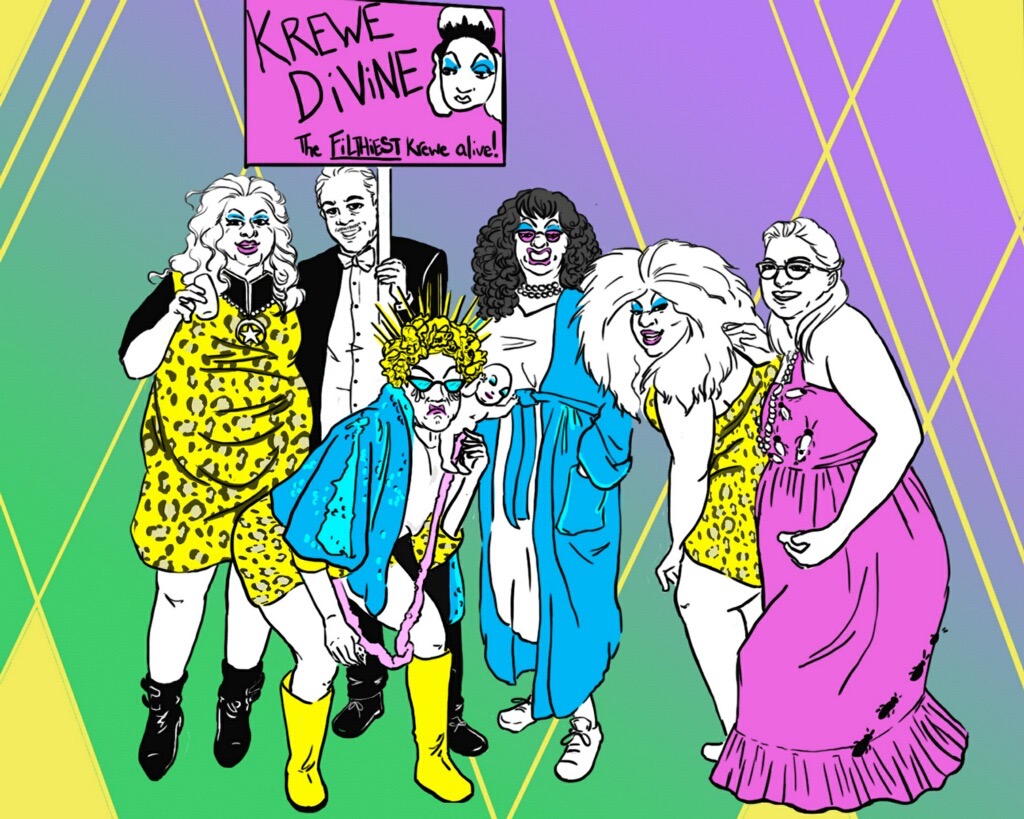
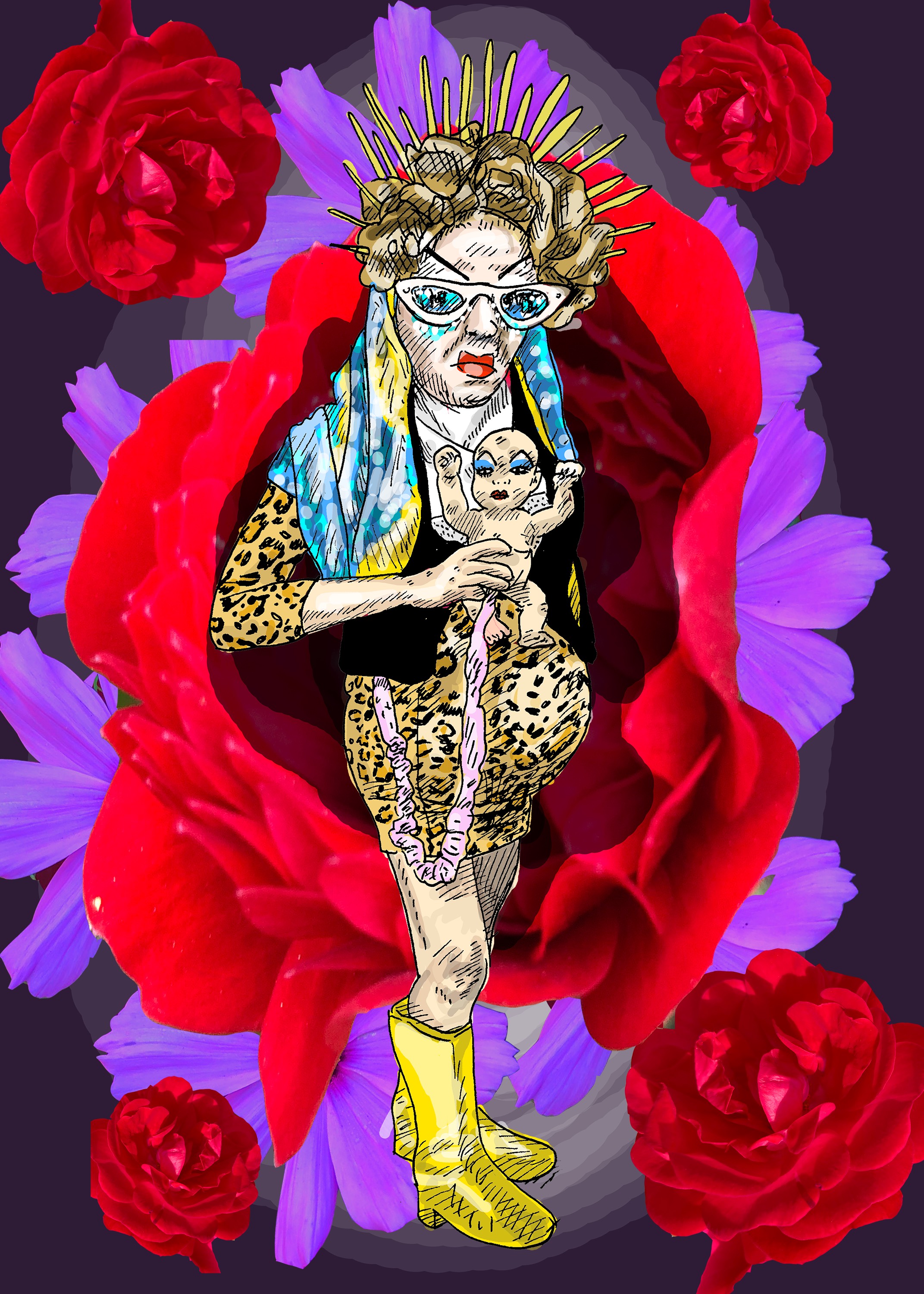
In that spirit, here’s a spotlight on two artists who could use an increase in commissions & donations in these increasingly dark helltimes. As examples of their work, I’m including portraits they’ve recently done of our Krewe Divine looks from this year and links to their personal websites where you can contact them directly. Check out their divine art, consider sending support, and let’s continue to take care of each other as best as we can.
Jennifer works as a PA in Los Angeles, where practically all productions are effectively coming to a halt. They’re currently taking commissions for digital art through their Instagram account.
Liz Yerby makes comics in Portland, Oregon, and is looking for an increase in paid work to help stay afloat. You can check out more of their art on their website and contact them directly by email for commissions.





 Swampflix