The Final Member (2014)

EPSON MFP image

fourstar

The recent documentary The Final Member, which could easily have been a mutedly quirky tour through the famed Icelandic Phallological Museum, somehow manages to find a deeper purpose beyond simply profiling what is essentially a room full of severed dicks floating in jars. The basic concept of the world-class Nordic penis museum is fascinating enough in the abstract, but not really worth putting together the travel funds for the long trek. So, a simple guided tour through its collection would’ve most likely been enough for a decent, but inessential documentary to survive on. Instead, The Final Member explores ideas like artists fading before completing their life’s work, the near-extinction of larger-than-life personalities, and the ways penises relate to patriotism, elevating itself above the mediocre aims a more straightforward production would’ve achieved. For a penis museum documentary, it’s surprisingly moving & thought-provoking.

There are three boisterous personalities at the heart of The Final Member’s success. The museum’s founder, Sigurdur “Siggi” Hjartarson, is of course the main subject and commands attention expertly. An educator & a family man, Siggi explains that a lot of people find his dedication to penile preservation off-putting, mistaking him for a pervert instead of the total sweetheart & academic taxonomist he truly is. He describes how he started the museum as a joke 40 years ago in his home with just a few animal specimens for show. It ballooned from there, resulting in Siggi’s now massive specimen room that features at least one penis specimen from every mammalian species except for one: human. His collection’s largest piece is, of course, the penis from a sperm whale and the smallest is the penis bone from a hamster. It’s adorable how Siggi proudly shows off his specimens (as well as his handcrafted penis art) even if most of it looks like organic garbage “with testicles!” (emphasis Siggi’s). As a guy who seems to have it all (penis-wise anyway), it’s heartbreaking to hear Siggi worry about whether or not he’ll be able to finalize his collection with a human specimen before he dies. He explains that often “artists die without finishing their work” & that thought visibly weigh heavy on him as his health deteriorates. That’s where the other boisterous two personalities enter the story.

As the title indicates, The Final Member is less about the Icelandic penis museum in general and more about the race to complete the puzzle, to provide the missing piece: a human penis. There are two viable contenders aiming to fill this role, an aging Icelandic celebrity adventurer & a simple American cowboy. The Icelandic candidate, although ancient, is vocally proud of his past sexual prowess, so he has a sort of a famous penis that could bring a little bit of cultural cachet to the museum. When Siggi asks him, “Do you have any use for your penis after you’re dead?” he finds himself shrugging and offering his specimen for the collection. Not to be outdone, the American candidate offers to donate his penis to the museum while he is still alive. You see, although he is a simple cowboy, he is a simple cowboy with a deep affection for his own dick. As he puts it, “I didn’t want my penis to go away when I die,” and as the story escalates it becomes increasingly clear that he really is so proud of his American man meat (which he assumes is automatically better than the Icelandic competition based on its nationality alone) that he is dead serious about mutilating himself to become the first human entry in the collection.

The Final Member does a lot of what you might expect from a film about a penis museum: it tours the specimen room; it provides a history of the museum’s origins; it asks questions like “Why is it so taboo to talk about the penis in the 21st century?” That’s all fascinating stuff, but what’s really special is the way it finds a real story to tell at the heart of the museum’s legacy, complete with a race to the finish line and a clear contender to root for, but without adopting a mocking or a get-a-load-of-this-weirdo tone for anyone involved. It’s a story about patriotism and the satisfaction of completing your life’s work just as much as it is a profile of a room filled with thousands of penises. I expected the film to be entertaining in sort of a Ripley’s Believe It or Not kind of way, but what was delivered was a lot more revealing about both the legacy Siggi will leave behind when he dies & the differences between Icelandic & American national pride. It’s a much greater film than I expected.

-Brandon Ledet

Going Clear: Scientology and the Prison of Belief (2015)

EPSON MFP image

threehalfstar

The only reason the likes of the recent HBO documentary Going Clear have not been released before (or at least not with this large of a budget) is because it’s an endeavor that requires a certain amount of bravery. Its subject, the (secretive, abusive, and dare I say cult-like) “religious” organization The Church of Scientology, is infamous for its bullying tactics when counteracting its vocal critics, almost to the point where I’m nervous to praise a film that attacks it even on this site, the most inconsequential of all blogs. Almost. Going Clear took a lot of guts to make, just like it took a lot of guts to write the book it was based on and it took a lot of guts for former church members to speak out in its interviews. It has the feeling of a long time coming for a subject so flagrantly nefarious in the public eye, but it’s also completely understandable why it took so long for a major outlet to speak out against it in this way.

Directed by prolific documentarian Alex Gibney, Going Clear does an excellent job of gradually introducing the audience to the insane world of Scientology’s beliefs & practices the same way the organization is known to gradually accustom its own members. The film mimics the form of an “audit” (a combination of a therapy session & a taped confession), a practice that plays a major role in Scientology’s recruitment process. At first the ideas of discharging hurtful memories and basic meditation through audits sound like reasonable forms of therapy and personal improvement. Also, the organization’s basic goals of freeing the Earth from insanity & criminality seem fairly admirable on the surface. As the film digs deeper, however, it starts to reveal a much stranger set of promises: superpowers that allow members to “transcend all perameters” & “achieve godspeed”, scientific instruments that can weigh the mass of your thoughts, billion year contracts to “save the world” (through indentured servitude, of course), and the quest to “unhypnotize” man. That’s not even getting into the more out-there concepts of prison planets & galactic overlords. If Gibney had introduced these details in the opening minutes (much like if Scientology introduced them in their initial recruitment efforts) they’d feel somewhat unbelievable, but by the time you get to them in the film they feel both very real and very much terrifying.

One of the tactics Going Clear employs very well is allowing the founder of it subject, deceased sci-fi writer L. Ron Hubbard, to speak for himself. Hubbard spent a large part of his adult life avoiding charges of tax fraud, so it is rare that you actually get to hear him talk about the monster he created. Footage from at least two separate interviews are assembled here to allow him to speak directly on Scientology’s core beliefs (as well as less savory topics like “the primitive races, including the white race”). As portrayed here, Hubbard was an abusive husband, a former Satanic occultist, a paranoid dissenter of traditional modes of mental health, and a prolific writer of pulp fiction. Initially, he conceived Scientology as a means of making money, quoted here telling his wife “The only way to make any real money is to have a religion”. A religion, of course, would afford Hubbard a tax exempt status that would allow him to hoard his earnings. As his personal health deteriorated, however, he began to believe his own teachings (concepts mostly cobbled together from the plots of pulp sci-fi novels he had written before his religious pursuit). To Hubbard’s credit, the modern monster that Scientology has become does not seem exactly like a devious, well-thought-out exploitation scheme, but rather the musings of a very sick man that were twisted even further after his death by power-hungry members of the church, especially the current leader David Miscavige.

This history lesson in this first half of Going Clear was much more interesting than what I would describe as the celebrity gossip second half. While explaining the basic teachings of the church, the film employs a fascinating type of visual collage that feels transcendent of its basic documentary format. Once the film delves into the modern era, which is mostly contingent on the involvement of Hollywood celebrities Tom Cruise & John Travolta, it loses a little steam as an unique work, depending mostly upon the church’s Dianetics recruitment videos for much of its visual charms. That’s not to say Tavolta & Cruise’s involvement are not inherently fascinating. When they first appear on the screen Travolta is dressed in soldier’s fatigues (on a movie set) and Cruise is wearing an oversized medallion (the “Freedom Medal of Valor”, as it were), two costume choices with enough bizarre energy on their own to make the millionaire weirdos’ presence interesting. It’s just that the back half of the film feels less special than the first, like it is something that anyone curious enough to watch a Scientology profile on YouTube could’ve encountered before.

As a whole, however, Going Clear is a fascinating look into the lives of people who have left the church as they look back upon the thetans, e-meters, out of body experiences, and Xenus that populated their troubled pasts. It may lose a little visual flair as it narrows its focus on Travolta & Cruise, but their inclusion is necessary as it calls into question the idea that as long as you give the church all of your money they can make anything possible. Is there an element of blackmail that maintains their involvement in Scientology or is does that “Next stop: infinity” slogan hold more weight than you would expect? Given the abusive, conniving practices of the church laid out here (not to mention basic laws of science & physics), it feels a lot more likely that it’s the former rather than the latter, but Scientology is such a strange, insular, shrouded entity that anything feels possible . . . as long as you give them all of your money.

-Brandon Ledet

French Quarter (Film) Festival 2015

EPSON MFP image

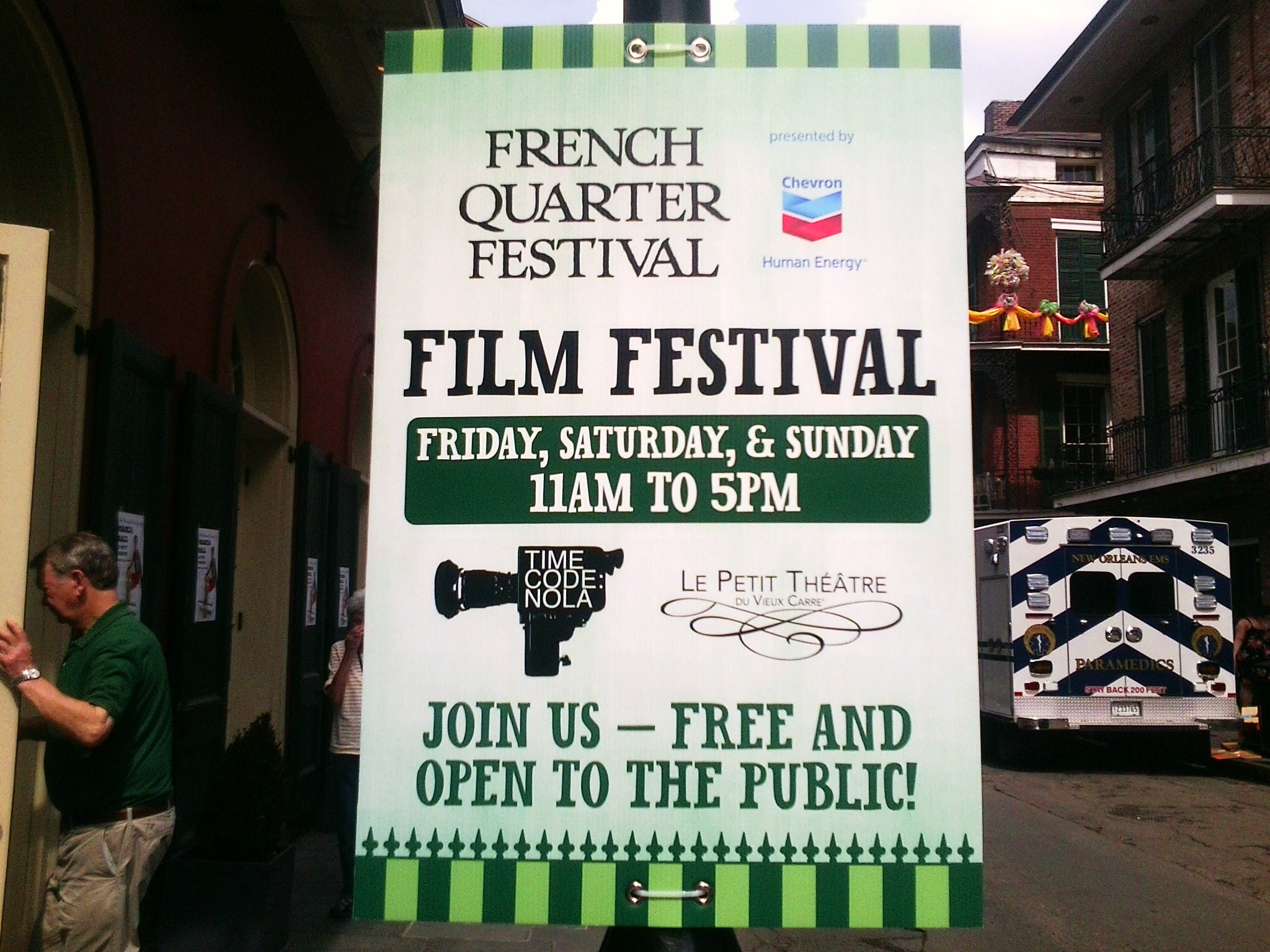
It’s usually around Mardi Gras when the city wakes up from its winter slumber, suddenly coming to life after months of hibernation. Tourists start to arrive in town to drink in the streets & enjoy the sunshine while their friends & loved ones freeze in the snow back home. Locals stop acting like total babies about what passes for “the cold” down here and venture at least as far as their front porches to enjoy the second lines & boiled crawfish. Mardi Gras is only the start to this Spring awakening, however, and the spirit to excess rolls right on into our festival season, which stretches on as long as it can before it’s too hot too drink gallons of beer in the daylight and visitors abandon us for the summer. Jazz Fest stands tall as the most obvious pinnacle of the season, but French Quarter Fest has recently been giving that juggernaut a run for its money. What used to essentially be “Jazz Fest for Locals” is now ballooning to be its own feature attraction, drawing thousands downtown for deliciously cheap local food & free music. To my recent discovery & surprise, it also features a free film festival.

I’ve been to French Quarter Fest a few times over the years, but this year was the first I’d ever heard of a film festival accompanying the better advertised attractions of food, drink, and local brass. Located just outside Jacskon Square at Le Petit Theatre, a venue that traditionally stages live drama, the film festival is a cocoon-like respite in the center of madness, the eye of a drunken storm. After wandering from stage to stage, drinking like a madman & downing hot sauce-soaked poboys in the heat (and unfortunately this year, the rain) it’s difficult to describe just how much of a relief it was to sit in a darkened, air conditioned room and watch movies. Presented by the folks behind Timecode: NOLA, the offerings at the French Quarter Film Fest are a well-curated group of documentaries seemingly selected to make the city look good for visitors. It featured several documentaries I had never seen before as well as ones I already know intimately, essentially upper crust of the kind of New Orleans-praising fare you’d expect to catch on late night PBS.

0410151108

I attempted to catch one film a day at the festival to get a decent sampling of its offerings, but my Friday afternoon plans got derailed when I coincidentally ran into a friend at a live performance on Royal Street and ended up missing the classic, doc Always for Pleasure. There pretty much is no substitution for the all-encompassing sampling of New Orleans culture in Always for Pleasure, but it’s a film I already know well (and one that’s currently available on Hulu), so I had no qualms with missing it for a chance to enjoy French Quarter Fest’s more traditional offerings of booze & live music. Actually, I feel like it was even more in the spirit of the movie to miss it. Filmed in the 1970s, the Criterion-approved Les Blank documentary truly is the best introduction to local culture that I could possibly imagine. Where else are you going to find soul legend Irma Thomas sharing her red beans & rice recipe and Allen Toussaint explaining the significance of jazz funerals & second lines. There’s also glimpses of crawfish boils, Mardi Gras Indians, St. Patty’s Day celebrations in the Irish Channel, and what essentially amounts to music videos for Wild Thcopitoulas & Professor Longhair. An interviewee in Always for Pleasure describes New Orleans as “The City that Care Forgot” & “The last city in American where you can feel free to live,” and the supporting images that surround those claims make it feel like he might be onto something.

On Saturday, I not only made it to the screening I wanted to catch; I desperately needed to. After sweating it out in the drunken, downtown masses, it was a life-saving sensation to watch the documentary He’s the Prettiest: A Salute to Big Chief Allison “Tootie” Montana’s 50 Years of Mardi Gras Indian Suiting. He’s the Prettiest obviously has a much more focused subject than Always for Pleasure, choosing to narrow in solely on a profile of Mardi Gras Indian Chief Tootie as he dressed for his final outing. Tootie is not only a significant chief because of his 50 consecutive years of suiting, but in the innovative artistry he brought to the practice. Instead of merely continuing the traditional Mardi Gras Indian beading he inherited, Tootie introduced the concept of 3-D designs to his suits, elevating the painstaking bead work to unparalleled levels of intricate design. He’s the Prettiest is less interested in the history of Mardi Gras Indian culture than it is providing a platform for Tootie’s work to shine. It’s essentially a moving art gallery for beautiful designs, a constant tribal soundtrack of thumping tambourines & rhythmic chants providing a rich texture for bead work that would already be dazzling in a silent, still image. It’s an important profile of a brilliant, unfortunately deceased artist whose work doesn’t receive as much formal fine art praise as it should.

On Sunday afternoon, once the rain died off, we caught the final film of the festival, Faubourg Tremé: The Untold Story of Black New Orleans. Initially conceived as a history lesson reviving a forgotten storyline in which New Orleans was a historical forerunner in racial equality & integration, providing then unheard of freedoms for people of color long before the 1960s Civil Rights movement (freedoms sadly poisoned by the years of Jim Crow), the documentary about the historic district of Faubourg Tremé was derailed by a little storm called Hurricane Katrina. The final third of the film captured a time I rarely care to revisit, a time in which most people couldn’t afford to return to the city they knew & loved and the ones that could struggled to piece their lives (and families) back together from the wreckage. It was an emotionally crippling note to end the festival on, but once I stepped back onto the city streets and watched a nameless group of ten-to-fifteen year olds playing traditional brass music draw a lively crowd outside the French Market (most likely the best set I saw all festival) I realized that Faubourg Tremé was for the most part a depressing story because it was an incomplete one. It captured the city’s incomprehensible lows (right down to the storm’s irrevocable psychological damage & a beyond troubled history of race relations), but did not have the time to capture the resiliency that brought the city back to life in the years following the broken levees. We all went through Hell to get here, but there’s plenty of our culture left to make the struggle worthwhile.

The couple of screenings I successfully made it to at this year’s French Quarter Film Festival were surprisingly well-attended, but also decidedly low-key. It seemed to be mostly older couples who, like my lame-ass self, needed a break from the external madness of drunken tourists and admittedly overpriced drinks (hey, at least they pay for the music). More importantly, the films selected had the kind of celebratory quality that gets you genuinely excited about your own city & culture in a heartfelt way, especially in the last minute acknowledgment that we’ve been through Hell together. There were plenty of opportunities for me to fall in love with New Orleans all over again at this year’s French Quarter Festival, like trying my first ever alcoholic snowball (which honestly wasn’t all that different from a daiquiri) or listening to any brass band you can name jamming outside the US Mint or overhearing a cop explain to a couple of passed out crust punks, “Look, if you want to sleep out here, you gotta do it by the river.” That sense of civic & cultural pride was surprisingly just as potent in the mid-afternoon darkness of Le Petit Theater as it was on the busy streets surrounding it; and it was just as simple as watching a couple of movies in the dark with a few strangers/neighbors.

-Brandon Ledet

The Sheik (2014)

wrasslin

three star

Much like with hip-hop or viral content, professional wrestling is all about self-promotion. In pro wrestling, you don’t necessarily have to be the best, you just have to convince your audience that you’re the best. Just ask Hulk Hogan. As the 80s era’s choice for the face of the company (that company being the WWE, of course), Hogan seemingly tore through every formidable opponent tossed his way, from Andre the Giant to “Macho Man” Randy Savage to Zeus. His rapid rise in popularity caused a version of mild cultural hysteria that was even afforded its own name. The Hulkster was smartly branded as not only a single wrestler, but an entire movement. Hulkamania was an 80s phenomenon that gave birth to both the annual cultural juggernaut WrestleMania and the lesser, round-the-year spectacle of WWE as a household sport. Hulk Hogan’s shameless self-promotion in the 1980s built that empire, supported with major backing from the multi-million dollar company pulling the strings, of course.

Last year’s profile documentary The Sheik’s most ambitious (and yet still believable) claim is that the success of Hulkamania (and, by extension, WrestleMania) was largely dependent on the appeal of Hogan’s main opponent, The Iron Sheik. Playing off of Americans’ Islamophobic prejudices during the Carter era Iranian hostage crisis, The Iron Sheik is credited here for being the ideal heel for Hogan, essentially single-handedly putting him over with the crowd. Born in Iran in the 1940s, Hossein Khosrow “The Sheik” Ali Vaziri was raised in a culture where traditional wrestling was a national obsession, where a healthy body meant a healthy state. Describing his teenage life in The Sheik, Ali Vaziri says “I was married to the wrestling mat. I didn’t care about girls; I cared about wrestling.” It was this dedication that landed him the position as bodyguard for the Iranian shah and, after emigration, an all-American coach for the Olympic wrestling team. The Iron Sheik was a mild-mannered American hero with an exceedingly sweet Midwestern wife & three adorable daughters before he found his true calling as a pro wrestling heel (a “bad guy”) that perfectly counteracted The Hulkster’s “I am a real American” persona simply by being a foreigner (nevermind that he has a depthless love for the country that he adopted).

The Sheik is not only credited in this flattering profile as contributing to the success of Hulkamania, but also for creating the priceless term “jabroni” (later popularized by Dwayne “The Rock” Johnson, of course) as well as the arguably-more-important public revelation that pro wrestling is, in fact, rigged. Once upon a time the ultra-macho ballet known as pro wrestling was assumed to be a true-to-life physical competition until (as this doc tells it) The Iron Sheik & supposed opponent “Hacksaw” Jim Duggan were arrested together on a beer & drug binge. It was the first time a face & a heel were ever proven to be hanging out as buds outside the squared circle. This “revelation” eventually lead to WWE magnate Vince McMahon seeking (and achieving) the tax breaks that come with being classified as a form of entertainment and not a professional sport.

If The Sheik is to be believed its subject would be credited as the sole launching pad for the very existence of modern pro wrestling itself and not just as the highly effective, very much timely heel that’s most likely closer to the truth. However, it isn’t until the film relaxes on the revisionist history lesson and profiles The Sheik’s more recent transition from drug addict with a broken body & a heart of gold to reformed family man that it loses a good deal of its credibility. It’s true that The Iron Sheik has a truly fascinating Twitter, YouTube and Howard Stern presence, but the movie conveniently sidesteps the racist & homophobic tendencies of his statements in those forums. As a journalistic, documentary endeavor, The Sheik fails to uncover answers that doesn’t support its central thesis that The Iron Sheik is 100% awesome, no faults. As a rose-colored profile of a very storied man who calls everyone “Bubba”, never says anything offensive about minorities, and most definitely quit mountains of crack cocaine, it’s much more effective. Supporting interviews with pro wrestling staples like Jim Ross, The Rock (who was apparently babysat by The Sheik’s wife as a child), Jake “The Snake” Roberts, Mick “Mankind” Foley, Brett “The Hitman” Hart, Jimmy Hart, and King Kong Bundy are sure to please any “sports entertainment” fan who are looking for a collection of anecdotes and not a controversial expose. The Sheik may be an exercise in shameless self-promotion, but that’s far from a new concept in the world of pro wrestling and (much like with the “sport” it covers) it’s a much more satisfactory proposition if you know what you’re in for before you arrive.

-Brandon Ledet

Häxan: Witchcraft Through the Ages (1922)

witch

fourstar

Although it was made a few years before the term “documentary” was coined, Häxan was far from the first non-fiction film ever made. It may, however, be the first documentary to ever be billed as a horror film. Based on the painstaking research of Danish writer/director Benjamin Christensen, Häxan is a hot-button doc that pretends to be about the “real” history of witchcraft, but is in truth a condemnation of how modern society deals with mental health. Although it begins & ends with lectures on antiquated notions of geography and health care, most of the film consists of live reenactments of medieval depictions of witchcraft that often blend the film’s documentary genre with classic silent horror. The reenactments are not only the sugar that helps the medicine go down. They’re also technical marvels that made Häxan the most expensive Scandinavian silent film ever made and a cinematic outlaw in countries that found its depictions of witches & devils to be blasphemous.

In its reenactments, Häxan looks like what you’d get if Fritz Lang’s Metropolis were set in Hell. Devils wag their tongues and suggestively churn butter while witches make potions out of thieves’ fingers, cat feces, and doves’ hearts. Women are lured out of their marriage beds by demons for late night naked dance parties and rub salves on each other’s backs that give them the ability to fly around on brooms. In these scenes, Häxan is the most metal 20s movie I’ve ever encountered. There’s so much wild imagery in the costuming and practical effects that I swear I’ve seen directly echoed before in VHS-era creature features like Nightbreed, Demons and C.H.U.D. The movie’s late night witches’ councils could also pretty much be considered source material for Kate Bush’s incredible “Sat in Your Lap” music video. Although Häxan boasts a serious message it deeply cares about, there’s no denying that it has a lot of fun in scaring the shit out of people with the medieval “The Devil takes many shapes” concept. Recreating live-action versions of witchcraft from art history is the film’s bread & butter, even if Ben Christensen had a loftier purpose in mind.

As devilishly fun & influential as the reenactment scenes are, Häxan (like a lot of hot button documentaries) is ultimately a huge downer. When the film returns to the real world to draw the thread between how women with mental illness have been treated in the past (as witches) and how they’re treated in the present (as lepers & pariahs) the naked dance parties are a far off memory and a flood of more sobering thoughts comes crashing through. The narration explicitly states “The Devil does not belong to the past” and asks “Isn’t superstition still rampant among us?” as depictions of the horrors of modern mental institutions and shady health care practices play out on the screen. Christensen then smartly returns to the opening depictions of the crystal spheres & bowl-shaped landscapes people once believed to be the science of the Universe’s structure, calling into question the validity of modern scientific consensus. Even nearly a hundred years since Häxan’s release, the sentiment is still potent. There are still huge flaws in our treatment of mental health & we still need flashy, sinful entertainment to draw our attention to them. Along with its hellish practical effects & creature design, the film’s central message has a surprisingly long shelf life.

Häxan is currently streaming on Hulu Plus.

-Brandon Ledet

Saturday Night (2010)

EPSON MFP image

three star

One of my all-time favorite pop culture documents is Live From New York, the oral history of Saturday Night Live. It’s an impressively thorough work that traces the grueling writer’s room structure of the sketch comedy institution back to the coked-out shenanigans of the 1970s. The absurdly late hours & rapid-fire turnaround that give the show’s more gloriously inane moments their loopy, “Why would someone even write that?” absurdity seem like a very peculiar business practice, but make total sense when considered in the context of their 1970s origins. Over the three decades of SNL covered in the book, not much changes institutionally. The show is like a river that only gradually shifts its course as a constant supply of fresh faces flow through it.

In case you are interested in how SNL functions, but can’t be bothered with the ~700 page task of Live From New York, James Franco has your back. His 2010 documentary Saturday Night was seven years behind the definitive oral history, but is much more easily digestible and covers much of the same territory. The premise is simple: Franco films the one-week cycle of the production a single SNL episode. On the starting Monday, the writers & cast cram into Lorne Michaels’ office to pitch seeds of ideas for sketches that could possibly be developed that week. As the days roll on the crew develops around 50 sketches that get torn down & rebuilt through a series of table readings, producers’ meetings and live rehearsals. They frantically grasp at sketch comedy straws & avoid sleep like the plague with only the faint promise that something they develop makes the live broadcast. After a single day of rest it’s Monday again and they’re pitching sketch ideas for the next SNL host. It’s a punishing/fascinating creative process that may be a hangover of the 70s party scene when rampant drug use could get you through the ordeal, but it’s one that pays off with some of the more bizarre realized ideas on broadcast television for four decades running.

Saturday Night starts with its most amusing moments. It’s genuinely delightful to watch the wheels turn in writers’ & performers’ heads when they’re excited about getting to work on an infant sketch idea. The fun fades a bit as the work gets more difficult, the frustration involved with the detailed logistics of developing a sketch on full display for the camera. Franco’s choice to film a week John Malkovich hosted pays dividends, as his subject is an endlessly fascinating personality even when just standing around idling as the SNL machine swirls around him. Cast members like Bill Hader & Will Forte also carry the film a long way, especially early in the creative process when they’re frantically riffing or selecting fart noises from a sound board. There are a few moments when Franco’s personality becomes intrusive, like a frustratingly useless scene involving Hader’s dressing room mirror & the intentionally conspicuous absence of Amy Poehler, but for the most part he pulls the film off with a calm, low-key tone that benefits the laborious process he documents. Saturday Night is a great companion piece to the more definitive Live From New York book. There are less mind-blowing anecdotes & juicy gossip than in the whopping oral history, but the film brings the day-to-day logistics of the pop culture institution’s unfathomable workload into vivid focus.

Saturday Night is currently streaming on Hulu.

-Brandon Ledet

Arakimentari (2004)

EPSON MFP image

three star

A short, brisk documentary about Japanese artist Nobuyoshi Araki, Arakimentari tiptoes the same line as its subject: the division between fine art & shameless erotica. Araki, a photographer, is an excitable pervert even in his old age, rapidly firing off lofty platitudes about the visual appeal of vaginas & what it means to be an artist. The movie itself begins with the questions “What is a photographer? What is photography?” before diving head first into Araki’s unique world of daily self-documentation & bondage model photo shoots. As a total weirdo and a sexual deviant, Araki comes across here as the (much cheerier) Robert Crumb of photography.

Araki reached his peak cultural popularity in the 1990s & Arakimentari is smart to mimic a 90s aesthetic in the telling of his work. There’s a truly hip 90s NYC vibe in the movie’s long stretches where aggressive electronic music (provided by DJ Krush) plays over blindingly fast slide shows of Araki’s photography. The movie works best in these montages, allowing the art to speak for itself. Portraits, flowers, everyday objects, and muted landscapes mix with Araki’s obscene erotica in surreal bursts. Several photographers are interviewed to help provide context for Araki’s significance, but musician Björk is also included as a kind of Ambassador of 90s Cool. She explains that she found his work when she lived in London during that decade, describing what a powerful discovery it was at the time. Björk also points to the significance of Araki’s book about his deceased wife in a moment that gets a deservedly calmer, tenderer type of slideshow than the rest of his work does here.

Arakimentari is not a prying, tell-all type of documentary. It offers its subject’s life & work for review in the best light possible. It tells the story of an energetic degenerate with a photographic eye & a constant smile, without asking him to reveal too much about either himself or his detractors. Its best moments occur when the art is offered for viewing free of context, but Araki himself is an amusing character & deft storyteller that makes the rest of the run time worthwhile as well.

-Brandon Ledet

When Björk Met Attenborough (2013)

EPSON MFP image

three star

At just over 45 minutes, the short-form documentary When Björk Met Attenborough is more or less supplementary material for the brilliant Biophilia Live concert film. The documentary’s central conversation between the idiosyncratic musician Björk and famed naturalist David Attenborough is philosophically stimulating, but is not all the film has to offer. The movie also serves as a key to understanding exactly what Björk was trying to accomplish with the muli-media Biophilia project, especially her ambitions in trying to change the way we “see, hear, think about and make music”. She says early in the run time that “It seems to be around this age I am now you have to make a sort of spiritual statement” and When Björk Met Attenborough does a great job of detailing just how ambitious her statement is.

In her attempt to position Biophilia as a spiritual statement, Björk looks back on the way she experienced music as a child. She speaks fondly of singing on her lonely walks to school through inclement Icelandic weather, music serving as a private conversation between her and Nature. She also expresses frustration with how schools taught her to interact with music through ancient Europen composers and non-intuitive instruments. With Biophilia, Björk attempts to rewire how music, nature, and technology interact with each other into a more innate process. She begins this journey with a tour through London’s Museum of Natural History, the largest natural history collection in the world, guided by Sir David Attenborough.

The central conversation between Björk and Attenborough is unfortunately a little stiff and, well, unnatural. Ignoring the artifice of the encounter, though, the ideas discussed about where nature & music meet are thoroughly engaging. Lyrebirds mimicking ring tones & chain saws, the evolutionary advantage of a beautiful singing voice, and the prevalent sexuality in modern pop music all make for great philosophical fodder. The true highlight, however, is their discussion of the Biophilia song “Crystalline” in the museum’s massive crystal room. Attenborough & Björk pick apart the “mathematical beauty” of crystal formations & other natural phenomenon and how Nature’s patterns are mimicked in music’s time signatures. It’s a lofty concept, but one made convincing by two abstract minds who love to look for such connections between science and art.

The “Crystalline” segment opens other threads for the film to follow, especially in how technology can be exploited to harness the stated connection between nature & music. First, the film demonstrates through cymatics (the study of sound’s visible patterns) how the song “Crystalline” looks, as opposed to how it sounds. Other inventions like the sharpsichord, a rigged Tesla coil, and swinging pendulum harps that use gravity to play their notes all prompt the audience to consider “the way we see, hear, think about, and make music”. Björk also collaborates with legendary neurologist Oliver Sacks and several software developers to utilize touchscreen technology in computer apps that create new ways of making music in a more intuitive way. She not only integrates existing technology in Biophilia, but also pushes to create her own.

When considered in isolation, When Björk Met Attenborough is an interesting intellectual exercise. When considered as part of Biophilia as a larger multi-media art piece it’s a Rosetta Stone, documenting a vastly ambitious work that tries to encompass music, nature, and technology in one definitive whole. The matter-of-fact tone of Tilda Swinton’s narration and Björk’s titular conversation with Attenborough makes this ambition seem perfectly natural and reasonably attainable. It’s not the kind of documentary that’s going to pick apart the ideas at play and question their validity. After all, the movie ends with Attenborough paying Björk a huge compliment. Instead it’s the kind of film that offers strange ideas at face value so the audience’s minds can run away with them and draw their own outlandish, philosophical conclusions.

-Brandon Ledet

Rich Hill (2014)

rich hill

fourhalfstar

“God has to be busy with everyone else. Hopefully he will come into my life. I hope it happens. It’s going to break my heart if it don’t.” – Andrew

Andrew, Harley, and Appachey are teenage boys living well below the poverty line in Rich Hill, Missouri. Population: 1,393. Each boy has their own dreams, but the reality of their grim, rural surroundings severely limits their chances of obtaining them. Andrew, a sweet, hardworking athlete who loves God and his family, shows the most promise of the trio, but is constantly uprooted by his father in the search for steady employment. Then there are Appachey and Harley, whose anger and frustration sometimes lead to darker outlets. Appachey is a skater who wants to teach art in China one day. Rebellious and prone to violence, he lives in dilapidated squalor with his chain smoking mother and sisters and often gets into fights at school with students and administration. He seems irrevocably lost. Harley is funny and good natured but also socially awkward, lethargic, and obsessed with knives. He is taken care of by his grandmother after his mother is imprisoned for trying to kill his step dad, who Harley claims sexually abused him.

There are thousands of cities in America like Rich Hill, with thousands of children like Andrew, Harley, and Appachey. Small, impoverished working class communities where poverty, prison, drug abuse, and violence are the daily norm and hopelessness and lack of opportunity coincide with high school football, church, and 4th of July parades. Directors (and cousins) Tracy Droz Tragos and Andrew Droz Palermo chronicle this bleak slice of Americana with empathy and an open heart. Maybe it’s because the filmmakers are from Rich Hill, but they thankfully do not make this an issue film or a political statement. Instead the film’s focus is squarely on the boys who obviously trusted the filmmakers as they share intimate and painful details of their lives.

Stylistically, the film feels less like a documentary and more like a Terrence Malick film; its poetic realism and evocative score help capture the beauty in these bleak settings. Rich Hill is one of the great modern American documentaries and deserves to be held in the same regard as other modern classics like Hoop Dreams. Sobering, yet ultimately uplifting, it is a hauntingly powerful capsule, a mosaic of the impoverished working class, and a critique of the American Dream.

You can watch Rich Hill right now on PBS.com through Feb. 3, 2015.

-James Cohn

Wrestling for Jesus: The Tale of T-Money (2011)

wrestlingjesus

twohalfstar

The very last pro wrestling documentary I watched when assembling my Top Ten list for the genre was GLOW, the story of an over-the-top 80s glam wrestling promotion that saw brief success on television. Wrestling for Jesus was a jarring, smelling salts follow-up to GLOW. It pulled me out of GLOW’s glitter-covered reverie only to wake me on the small-town poverty side of wrestling. This is the wrestling of backyards & gymnasiums, where audience members were likely to have attended high school or at least church with the performers. Where the Gorgeous Ladies of Wrestling bragged about how they were the greatest show on Earth, the men of WFJ thought themselves to be, you know, pretty good and some of them would even like to maybe get paid a small sum of money for risking life-altering injuries in the Lord’s name.

The wrestlers who express interest in making a modest amount of money for their time and compromised health are secular defectors of the Wrestling For Jesus promotion. WFJ, as a non-profit organization, accepts donations for their live events, but those donations are directly given to the church. The events themselves are an extension of church in a way. Performers’ promos boast about their ability to spread the gospel & sermons are delivered from the ring after matches. These men are wrestling solely for Jesus, to bring new followers into their faith through sports entertainment, not to make money. As far as recruitment tactics go, it’s a fairly convincing one.

However, participation in WFJ isn’t entirely selfless. At the very least the WFJ community helped the titular T-Money overcome the grief surrounding his father’s suicide. T-Money’s triumph over his grief may have been short-lived, but he basically thanks WFJ (an organization he runs with his wife) for saving his life. As the film progresses, his WFJ-aided recovery gradually reveals itself to be one step on a long road that would see rougher patches (like his own suicide attempt & a domestic violence arrest). T-Money sounds conflicted at times about whether he believes WFJ is a positive or negative long-term influence in his life, confessing that sometimes he hides his true personality in the community’s presence. It’s likely he’s also hiding his true self in the camera’s presence. The refusal to follow this thread of thought to a satisfying conclusion is the documentary’s fatal flaw.

There’s a sense that T-Money is on the brink of a personal epiphany that the movie doesn’t stick around to discover with him. When one of his fellow WFJ performers breaks his neck in the ring, T-Money is moved to tears in his proclamation that he wishes it was his own neck that had broken instead. The injured wrestler appears to be pleased with his time in WFJ, believing he had sacrificed his body to a noble cause. T-Money appears less convinced, but the movie doesn’t follow him long enough (or push him to speak honestly enough) to find out what that means.

Unresolved ending aside, the filmmakers do a fine job of remaining objective when they could easily have made their subject look foolish or evil. That objectivity doesn’t exactly shield the Christian wrestlers from the incongruity of infusing religion into a sport built on camp & violence, but it does allow them to be sympathetic even as the phenomenon feels increasingly bizarre. Wrestling for Jesus was far from the most essential wrestling doc I’ve seen in recent months, but also far from the worst. WFJ‘s Achilles heel is that its fascinating subject could have made for a much better movie if only the filmmakers had allowed it more time to develop & pushed for more honesty. If director Nathan Clarke couldn’t afford to dig deeper, his film could have at least benefited from some of GLOW’s outlandish hubris. There’s nothing like some old-fashioned self-aggrandizing to cover up a lackluster wrestling program.

Wrestling For Jesus is currently streaming on Netflix and Amazon Prime.

-Brandon Ledet