
Animation Mixtape (2025)

Last year, legendary animator Don Hertzfeldt self-distributed a traveling roadshow release for his latest short film ME in a double-feature package with his 2012 masterpiece It’s Such a Beautiful Day. Encouraged by the expediency of that release after decades of struggling to get his work into wide distribution, Hertzfeldt has now put together a new roadshow collection of weirdo experiments in animation, reportedly as a theatrical-only release. With this year’s Animation Mixtape, Hertzfeldt has collected a chaotic assemblage of animated outsider art that he personally finds amusing, ranging in decade of production from the 1980s to the 2020s, in medium from stop-motion to computer graphics, and in runtime from a few seconds to 18 minutes. The individual shorts don’t speak to each other except in how they might inform or reflect Hertzfeldt’s own artistic sensibilities. Maks Rzontkowki’s “Martyr’s Guidebook” is a dispirited diary entry from our current digital wasteland, rendered in video game ones & zeroes. Mark Baker’s “The Hill Farm” is a self-amused relic of hippie slacker sentiments from decades in the past, illustrated in traditional pencil sketches. Jesse Moynihan’s “Jesus 2” is a prophetic vision of our singularity hell future, regurgitated from the psychedelic fantasia of Adventure Time-era children’s cartoons. The other ten or so shorts fall somewhere between those aesthetic & temporal markers, each with their own distinct tones & styles. The only discernible reason they’ve been grouped together is because Don Hertzfeldt likes them and wants to use his cinephile-approved name brand to offer them wider public attention.

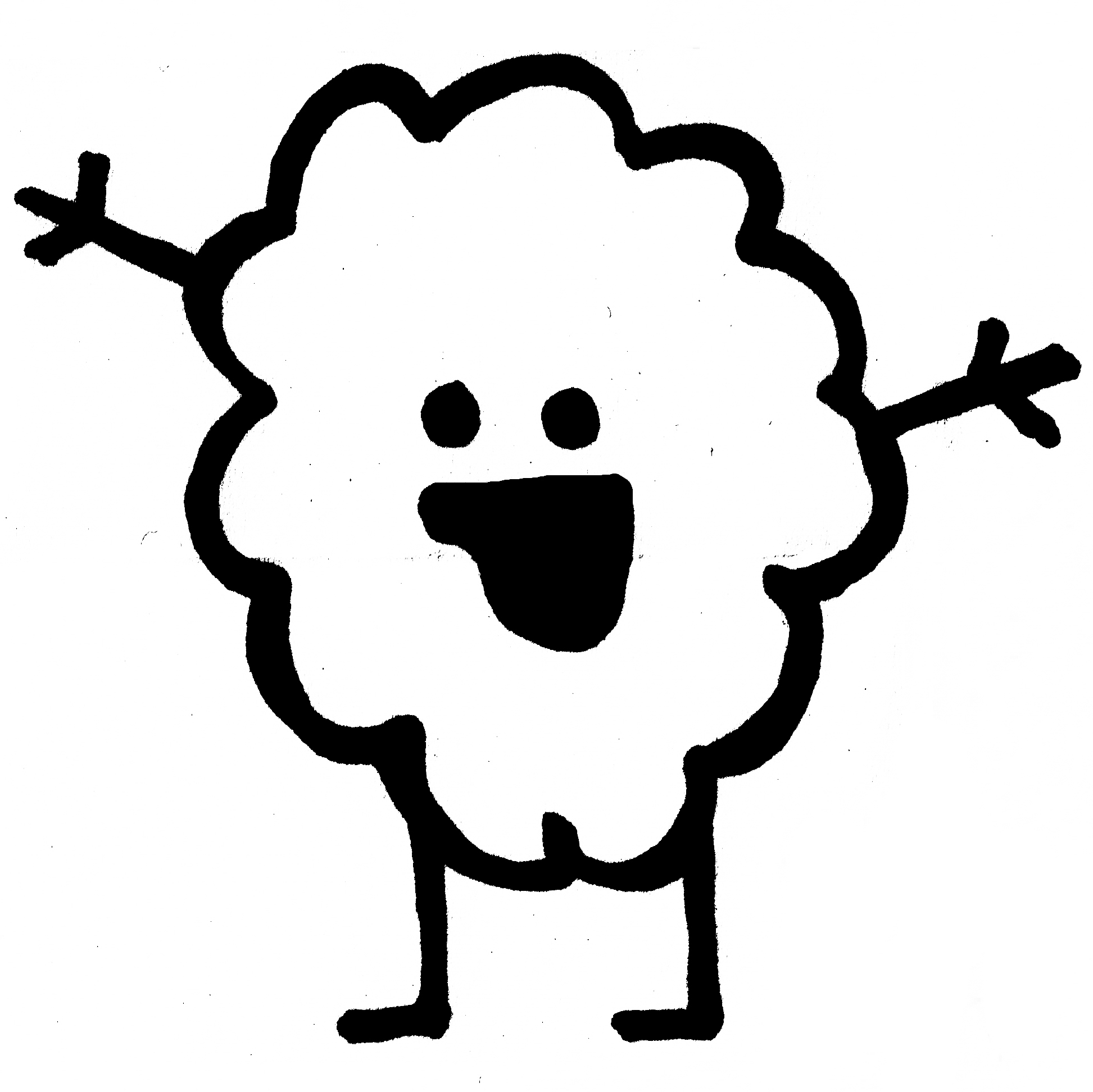
Beyond his curational oversight of this mixtape project, Hertzfeldt contributed two short wraparound segments to bookend the program, hosted by the little whooping “My anus is bleeding!” cloud puffs from his infamous Rejected cartoons. Between their fits of inane “Whoo!” and “Yayyy!” cheerleading, the little cloud puffs explain that the main purpose of the project is make money for the filmmakers involved, confessing that they are all broke and desperate. Our whooping hosts then warn that because of lack of funding for this kind of work, portions of the program had to be created with generative A.I. technology in order to cut corners. Hertzfeldt then proceeds to flippantly mock the A.I. slop that’s threatening to put this kind of personal, handmade animation out of business, transforming his beloved bleeding-anus puffballs into machine-like A.I. monstrosities that continually shapeshift and puke their digital guts out in an aggressively meaningless display. Given these bookends’ open hostility towards A.I. as a substitute for personable, handcrafted art, it’s likely that they were animated by Hertzfeldt and not created using the very plagiarism engines he intended to mock. I hope so, anyway. In either case, these brief anti-A.I. segments are useful as a contrast to the genuinely imaginative work Hertzfeldt highlights in the mixtape playlist, effectively issued as a threat illustrating what the state of art will soon become if actual, real-life artists can no longer afford to make a living. Even the trippy Takeshi Murata short “Larry”—in which infinite computer renderings of a dog dunking a basketball devolve into digital slop—has a more personable quality to it than its generative A.I. equivalents.

Hertzfeldt credibly names generative A.I. as the biggest threat to these artists’ livelihood, but I found another throughline in the shorts’ credits to be just as alarming. Almost every film in this mixtape includes a title card acknowledging funding from national arts foundations like the National Film Board of Canada and the Polish Film Institute. While A.I.-addicted corporations are working to replace artists with computer programs in the private sphere, The Man is also working to eliminate that kind of public funding for the arts in order to shave a few measly bucks off of governments’ ledgers. The inevitable result of that financial restriction is that most modern animation is a computer-generated corporate product — an opportunity for brazenly lazy celebrities like Chris Pratt to collect easy paychecks voicing talking animals and famous video game characters. Besides the better-funded anime from Japan’s robust filmmaking industry, there are only occasional gems like the recent slacker comedy Boys Go to Jupiter that make it past animators’ personal YouTube & Vimeo accounts into proper theaters. The only venue I can think of where animation this diversely, playfully daring is exhibited in public is at local film festivals like NOFF, which will be programming ten or so animated shorts later this month. As Hertzfeldt acknowledges in the press notes for this year’s Animation Mixtape, however, “While over 10,000 short films are made every year by filmmakers at various stages of their career, only a fraction make it into film festivals and are able to be seen in a classic theatrical setting.” He decided to increase that fraction as best he could with this limited-release roadshow, which is admirable considering how little support these animators are getting from other established institutions.

-Brandon Ledet

It’s Such a Beautiful Day (2012)

When I saw Don Hertzfeldt’s latest animated short at this year’s Overlook, there was an hour-long line of giddy nerds queued up to squeeze in for a specialty screening and Q&A.  A few months later, ME was paired with a victory-lap roadshow exhibition of Hertzfeldt’s 2012 feature It’s Such a Beautiful Day, which I attended with a smattering of fellow introverts avoiding eye contact and the afternoon sun in the complimentary AC.  Both experiences were immaculate.  The hustle & bustle of the film festival environment made ME feel like a burning-hot ticket, especially since fans could corner the animator in the flesh to force such intimate experiences as asking questions during a moderated panel, showing him the tattoos he inspired, asking for autographs and, in my case, catching a glimpse of him wolfing down Shake Shack between screenings like a regular Joe.  The theatrical rollout was obviously less intimate, but Hertzfeldt did his best to make it feel personal.  As an intermission between the short & feature, he FaceTimes the audience with a pre-recorded message to explain the ways in which It’s Such a Beautiful Day was a breakthrough formal experiment for his art and to also apologize for exhaustion of watching it so soon after ME.  It still felt like a one-of-a-kind presentation for a work that was once streaming without context or personalization on Netflix, even though this exact Cinematic Event is currently touring dozens of international cities.

I’ve never thought of Hertzfeldt as a public figure before this recent tour.  Since he largely works alone on self-taught animation techniques that take years to calibrate, I’ve always imagined him as a reclusive outsider artist, the exact kind of quiet introvert that his movies attract to the theater.  Early works like Billy’s Balloon, Rejected, and Beautiful Day all had a word-of-mouth quality to their cultural awareness, and if his widest critical breakout World of Tomorrow screened anywhere near where I live with this level of fanfare, I totally missed it.  Unsurprisingly, it turns out Hertzfeldt does carry himself with a quiet, shy, apologetic demeanor, seemingly surprised by the continued cult enthusiasm for his animated stick figure abstractions.  It also turns out that his public personality was a lot more integral to the tone & narrative of It’s Such a Beautiful Day than I remembered, since his gentle voice is a constant hum on its soundtrack as the film’s scene-by-scene narrator.  There’s an observational comic-strip humor to It’s Such a Beautiful Day that makes it feel a hand-drawn diary, especially considering the direct, intimate rapport the director establishes with his audience through narration.  That’s what makes it so horrifying when it develops into a diary of personal anxieties rather than a diary of personal experiences as its story escalates, given that if any of this happened to Hertzfeldt himself, he would be either institutionalized or, more likely, dead.

Hertzfeldt narrates the daily, mundane thoughts & experiences of a middle-aged stick figure named Bill.  Our milquetoast protagonist starts his journey suffering the same nagging indignities that plague us all: awkwardly waiting for buses, awkwardly chatting with strangers, awkwardly navigating urban hellscapes, etc.  Bill’s suffering takes on increasing specificity as his mental health declines, though, due largely to a brain tumor that distorts his ability to think clearly (and inevitably kills him).  Although told in third-person, the narration is filtered entirely through Bill’s increasingly warped perception of reality, and the imagery warps to match it.  The white copy-paper backdrop of Hertzfeldt’s early works give way to photographic mixed-media textures that Bill stumbles through in non-linear time loops, untethered from logic.  His observations occasionally become crass & offensive as his POV is compromised by his tumor, making this one of the great illustrations of intrusive thoughts, mental illness, and unreliable narration.  Like all of Hertzfeldt’s work, it’s also a great illustration of Millennial humor, from its grim death-wish nihilism to its LOL-so-random internet cringe.  There’s even a literal bacon joke that anchors the picture to the Epic Bacon humor of the 2010s, which only makes it more impressive that the film manages to sketch out an earnest, authentic big-picture demonstration of what it feels like to think & function with a brain distorted by anxiety, depression, and physical malady.  For a small, devoted audience, no film has ever felt truer.

When Hertzfeldt refers to It’s Such a Beautiful Day as experimental, he means it more in terms of process than in terms of genre.  He filmed the animation cells for the project using a bulky 1940s camera, experimenting with how to segment the frame through multiple exposures by blocking the lens, sometimes mixing traditional animation with stock footage.  Even so, there are some aesthetic touches to the film that do recall Experimental Cinema in the Stan Brakhage/Maya Deren sense, with flashes of pure color overtaking the screen to tell the story through emotion & mood rather than through figure & voice.  It was a drastic evolution for an animator who used to work exclusively in black & white line drawings, with only a few pops of color adding visual excitement to the frame – an evolution that’s since only gotten more extreme through multi-media layering in The World of Tomorrow & ME.  The one thing that hasn’t changed, really, is Hertzfeldt’s unique sense of comic timing, which mines dark humor out of the mundane absurdism of being alive.  His ability to perfectly time a punchline made him a cult figure long before he fully distinguished his craft as a visual artist, so it’s been wonderful to spend so much time hearing those jokes in his own voice this year, whether in his heavily-narrated cult classic or in his Q&A tour promoting his new, dialogue-free short.  It’s fitting, then, that the only way to access these films (if they aren’t physically traveling to your neighborhood theater) is to purchase them directly from the artist’s website.  I imagine he personally packages each shipment by hand and includes a scribbled note of apology for making your brain a little darker with his harsh approach to life & art.

-Brandon Ledet

Podcast #210: In a Violent Nature & Overlook Film Fest 2024

Welcome to Episode #210 of The Swampflix Podcast. For this episode, Brandon, James, Britnee, Hanna, and guest Bill Arceneaux discuss a selection of horror films that screened at this year’s Overlook Film Festival, starting with the gory slow-cinema slasher In a Violent Nature.

00:00 Welcome

04:47 In a Violent Nature

23:43 Moviegoing with Bill
32:16 ME
46:12 Dream Factory
53:47 Hypoxia
56:54 The Influencer
1:04:03 Red Rooms
1:24:58 Humanist Vampire Seeking Consenting Suicidal Person
1:35:46 Infested
1:41:07 Oddity
1:44:54 Cuckoo
1:48:46 I Saw the TV Glow
1:55:20 Abigail

Overlook 2024, Ranked and Reviewed

  1. ME
  2. I Saw the TV Glow 
  3. Cuckoo
  4. In a Violent Nature 
  5. Infested 
  6. Oddity
  7. Red Rooms 
  8. Sleep
  9. Look Into My Eyes
  10. Hood Witch
  11. Azrael
  12. Arcadian
  13. Abigail 

You can stay up to date with our podcast through SoundCloudSpotifyiTunesTuneIn, or by following the links on this page.

– The Podcast Crew