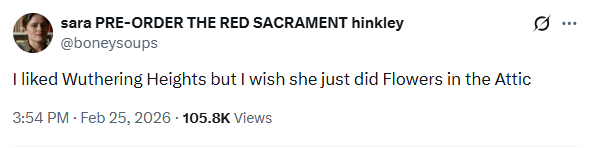
Before I got a chance to see Emerald Fennell’s recent “adaptation” “Wuthering Heights,” I stumbled across this social media post in the wild:
I had just recently completed my own most recent rewatch of 1987’s Flowers in the Attic, and I became fixated on this idea. I’ve been down the Flowers in the Attic rabbit hole more times than I’d care to remember, but at its core, I’ve always been fascinated by the connection between Emily Brontë’s and V.C. Andrews’s novels. I don’t know if there’s any academic discussion of this out there, but I have no doubt in my mind that Andrews drew inspiration from Wuthering Heights, from naming her protagonist “Cathy” to making the implied, sublimated incest of Heights (I’ve always subscribed to the theory that Heathcliff is Earnshaw’s bastard son, meaning he and Catherine are half-siblings) explicit and pervasive in Flowers in the Attic and its sequels.
When I did get around to seeing “Wuthering Heights,” my major criticism of it ended up being that it doesn’t need to, and in fact shouldn’t, be Wuthering Heights at all. The most interesting characters in that film are Alison Oliver’s Isabella and Hong Chau’s Nelly, and one could have done a Rosaline style film about the former or even gone full-tilt into the “Nelly is the villain” concept and made a Cruella style picture about the latter, and either one of them would have been infinitely more interesting than watching “Wuthering Heights” bash two sexy Australian Barbie dolls at each other while reenacting a half-remembered SparkNote. In essence, both Flowers in the Attic and “Wuthering Heights” are both unfaithful mutations of the same source material, which means that Fennell might actually be the perfect person to make a Flowers in the Attic adaptation. Right?
I don’t think so… however, I do think that she would be the ideal person to adapt the first follow-up novel, Petals on the Wind. It would be incorrect to say that Petals is an easier novel to read than Flowers. While it may eschew most of the more taboo elements that made Flowers so salacious, adult Cathy finds herself in just as dire straits in Petals, where she is constantly subject to sexual danger regardless of which of her husbands is exerting force over her. Based on the overall negative reaction to Fennell’s Promising Young Woman (which I didn’t share), I don’t think that she has the sensitivity needed to present Flowers. This is, after all, a director who looked at the same source text that Andrews did and, where Andrews saw both the tenderness and the danger of Heathcliff and Cathy together and the way that it would affect future generations, instead got horned up by imagining them getting off to voyeuristic observation of a couple of servants going at it in a barn. But also, don’t worry, in this version Cathy and Heathcliff definitely aren’t half-siblings, so don’t worry, it’s okay if you get aroused!
For those who are interested, Flowers in the Attic (the novel) doesn’t end in the same way that the ‘87 film does. The latter includes a hastily-shot death scene for Corrine Dollanganger after being confronted by her children during her wedding to Bart Winslow, her late father’s lawyer, as producers felt that the book’s ending, which occurs when the children simply escape the house after learning that their grandfather is dead and Bart and Corrine have been married for over a year. This big confrontation scene seems like it would be right up Fennell’s alley, and the equivalent scene, in which Cathy crashes the Winslow family’s Christmas party at Foxworth Hall to reveal to Corrine that she has (a) seduced Bart and (b) is pregnant by him, is the climax of Petals on the Wind. Of course, this is between her first marriage to an abusive narcissist and her second marriage to the doctor who fostered the children following their escape. Petals also borrows from Brontë, although it’s Charlotte this time, as Paul, the aforementioned doctor, initially pretends that his wife is dead before revealing that she’s actually in an institution, such that his initial overtures toward Cathy when she is of age are much like Rochester’s towards the title character in Jane Eyre. It’s all very, very messy, a true soap opera, and that’s the wheelhouse that Fennell would most bloom in if she took that opportunity.
Brandon has already written about Emerald Fennell’s “Wuthering Heights,” and although I was forewarned, my own love for the source material meant that, sooner or later, I was going to have to check this hot mess out for myself. And what a mess it is! Not as hot as one would expect, though, given that the director’s stated intention with this adaptation has been to recreate the horniness that she presumes is the universal experience of all first time readers. The thing about ”Wuthering Heights” is that the text I found myself thinking about most often while watching it wasn’t the novel itself or any of the prior adaptations, but Wicked: For Good. In writing about that film, I posited that its greatest flaw is also its greatest weakness: it only exists as a commercial product because of its connection to The Wonderful Wizard of Oz and its offshoots, sequels, and adaptations as a brand. The first half of the play (and the earlier film that adapted only that opening half) is allowed to find all sorts of fun things to explore within the “canon” of Oz, since the only thing it carries over is the necessity that, at some point, the Wicked Witch of the West and Glinda the Good Witch must eventually become enemies, in the public eye if not in reality. Everything else is fair game. In the second half of the play, which became For Good, every action exists in service of putting the characters from Wizard of Oz into the positions that they will be when Dorothy meets them upon her arrival in the fairy land, so characters march lock-step toward their places in the canon regardless of whether that works on a narrative, character, or even emotionally meaningful level. “Wuthering Heights” has the same problem. I’m not going to say it’s a bad movie because it’s a bad adaptation of Wuthering Heights, which it most certainly is, but it’s a bad movie because it’s an attempt at adapting Emily Brontë’s novel at all.
Widower Mr. Earnshaw (Martin Clunes), the tenant of farmhouse Wuthering Heights, returns home from the city with a young boy in tow, whom he “rescued” from a life of being abused by a drunken father so that he can come to the Heights and be abused by a drunken stranger instead. He gives the boy to his daughter, Cathy, who names the child “Heathcliff, after my dead brother,” and the two form a fast friendship. Also present in the household is Nelly, who as the bastard daughter of a lord is not entitled to recognition or shelter, but is welcome to act as the formal companion to Cathy; this relationship is challenged by Cathy’s burgeoning devotion to Heathcliff, who absorbs some of Earnshaw’s parental abuse. Some years later, Cathy (Margot Robbie) and Heathcliff (Jacob Elordi) watch as a procession of carriages deliver their new neighbors, The Lintons, to the manor of Thrushcross Grange. Cathy, who has been raised with no mother and is thus somewhat as wild and unmannered as her lowborn foster brother, sneaks up to spy on Edgar Linton (Shazad Latif) and his “ward” Isabella (Alison Oliver) and ends up injuring her ankle and being hosted at Thrushcross Grange for several weeks to recuperate. She returns to Wuthering Heights “quite the lady” and admits to Nelly (Hong Chau) that she has fallen in love with Linton and will marry him; she says aloud that she cannot marry Heathcliff because of their vast social class gap, and Nelly, knowing that Heathcliff has overheard this, keeps this information to herself. Linton and Catherine marry, Heathcliff leaves, Catherine becomes pregnant, and Heathcliff returns, at which point Catherine learns that Nelly allowed him to believe that Catherine didn’t love him. Heathcliff marries Isabella, but he and Catherine begin a brief, torrid affair that ends in tragedy.
If you’re familiar with the novel (or any of its more faithful adaptations, although there are surprisingly few), then that synopsis undoubtedly feels strange to you. It’s like Brontë’s in some ways; the character names are the same and some of the larger events from the novel are present. The exclusion of Hindley, Cathy’s brother and Heathcliff’s primary tormentor (and thus also his wife and child), is very jarring, as is the complete absence of Mrs. Earnshaw. Earnshaw family employee Joseph has also been aged down and cast with a handsome actor (Ewan Mitchell), eschewing the novel Joseph’s characterization as a religious zealot and instead giving him the chance to engage in kinky, largely unseen BDSM with one of the housemaids so that Heathcliff and Cathy can observe them surreptitiously in a way that sets both characters’ sexual imaginations ablaze. Most adaptations focus solely on the Cathy/Heathcliff story and leave out the entire plot about the second generation that constitutes the entire second half of Wuthering Heights, so its excision here isn’t surprising, but knowing that it doesn’t need to take that into consideration, “Wuthering Heights” decides to instead have Cathy not only die, but miscarry her child with Linton, since there’s no reason to have a living child if the story isn’t going to continue. I also can’t fault the film for choosing to narratively manifest the “Nelly is the villain” theory. Although I have personally never accepted that in my reading of the text, it has become the prevailing literary lens for the novel’s academic criticism since James Hafley first posited this thesis in 1958. (If you have JSTOR access, his essay can be found here; it’s a good read even if you, like I, remain unconvinced.)
If you’re not familiar with the novel, none of this may seem like it changes that much about the text, but I can assure you: it does. My distaste for the film could be said to be either (a) entirely predicated on, or (b) have nothing to do with my love of Wuthering Heights, by which I mean that I don’t particularly care that this is a bad adaptation of Wuthering Heights—in fact, the number of faithful adaptations is rare, and I prefer some of the less faithful adaptations over the more detail-oriented ones—I just don’t think this needed to be an adaptation of Wuthering Heights specifically. It almost feels as if Fennell responded to critics’ dismissal of Saltburnas a lesser Talented Mr. Ripley by deciding to take her Wuthering Heights-inspired erotic fiction and—in an inverse of E.L. James filing the serial numbers off of her Twilight fanfiction and publishing it as Fifty Shades of Grey—direct an adaptation of that and call it “Wuthering Heights.” I’m not frustrated with this movie as a fan of Brontë’s; I’m frustrated with it as a movie lover, the part of me that just wants to go to the movies and have a good time. Where this ties into Wicked: For Good is that like that film, “Wuthering Heights” goes awry in having to fall in line with the text that it is branded, meaning that the film is inexorably tied to the text from which it takes its name, when liberating it from that title would have allowed this to go in more interesting directions.
Robbie is very good as Cathy (Elordi is fine), but our two lead characters are so boring. In the film’s second act, we get to see some of the home life of Heathcliff and Isabella, and it’s the best stuff in the movie. Instead of being a victim of Heathcliff’s abuse, Isabella is all-in on his weird degradation play; she gets off on sending letters to Cathy and Nelly lying about how horrid Heathcliff is to her while also clearly enjoying being chained up and treated like a dog. We’ve already gotten a clear look into her bizarre psyche earlier in the film, in which we learn that she has an entire room devoted solely to her hair ribbons, and we get to see her create a fun murder scene in miniature by venting her frustrations at Cathy herself on the doll she made of the woman instead, with a dollhouse tableau that’s as funny as it is disturbing. While sitting in the theater, I couldn’t help but think about how much better a movie “Wuthering Heights” would be if it realized that its most interesting character was Isabella, and the movie had been made about her instead. I fantasized about the film taking a sudden turn into being about Heathcliff realizing that Isabella truly could match his freak and the two of them falling for each other. “Wuthering Heights” could never go in that direction because it’s called “Wuthering Heights,” rather than “[Untitled Emerald Fennell Sexy Gothic Romance starring Jacob Elordi].” The first time that we meet Isabella, she’s sitting in the garden and delivering an excruciatingly detailed recap of Romeo & Juliet to Linton. For a moment, I really was naive enough to think that Fennell was going to do something truly audacious, and that the mention of the play would draw attention to something crucial that Shakespeare’s play and Brontë’s novel share: they are decidedly tragic, non-romantic stories that the general public perceives as romantic. Alas, this was not to be the case, and the director’s much-vaunted “audacity” was once again constrained to the erotic consumption of another person’s bodily fluids (and occasionally egg yolks). Ho-hum.
Where Emerald Fennell does allow herself to get really freaky with things that she adds from outside the text are the moments where the film does actually shine. When she first arrives to live at Thrushcross Grange, Cathy is ushered into a room that Linton has prepared for her by having the place painted “the most beautiful color in the world, the color of [Cathy’s] flesh.” As we enter the room, it looks tasteful enough, but as the camera moves closer we get to see that Linton has had the decorators recreate not only her freckles but the light, almost imperceptible blue veins beneath. It’s delightfully grotesque. The film also occasionally goes for utter camp in a few fine moments, with the standout being the scene in which Mr. Earnshaw dies, surrounded by a physically impossible stack of empty wine and liquor bottles. The film also features very beautiful tableaux; there are several nearly-still chiaroscuro images of characters lit solely by the natural light streaming through a window, calling to mind Rembrandt’s Anna and the Blind Tobit or the Rembrandtian A Man seated reading at a Table in a Lofty Room. Evoking the imagery of Caspar David Friedrich’s Wanderer above the Sea of Fog is an easy go-to for Heathcliff’s return, but it’s also an effective choice. Visually, the film’s depiction of Thrushcross Grange having strong juxtapositions of white and blood-red are striking, even if the choice doesn’t seem to have a deeper meaning other than the most superficial symbolism. Any one of those things would have been a delight to see in [Untitled Emerald Fennell Sexy Gothic Romance starring Jacob Elordi], in which Fennell wouldn’t have felt the need to remain bound to “adapting” Wuthering Heights and instead been able to go full bore into the story she really wanted to tell. Instead, we have this disappointment.
Wuthering Heights is one of my all-time favorite works of art. Emily Brontë’s 19th Century novel is a shockingly horrific read for anyone who’s ever been assigned it in a high school or college-level literature course, expecting it to be a melodramatic romance (matched only in its homework-assignment shock value by her sister’s novel Jane Eyre). Wuthering Heights is not a traditionally tragic love affair; it imagines romantic attraction as a form of life-destroying doom that compels all involved to viciously tear each other apart out of the insatiable hunger of yearning, never to be satisfied through physical touch. It should be no surprise, then, that the latest, loudest adaptation of that novel would receive equally loud criticism for the ways it reduces its source text to a more familiar, better-behaved romance, as if it were a dime store paperback instead of a great work of Gothic lit. Personally, I can’t conjure the energy to care. To my knowledge, no movie version of Wuthering Heights to date has approached anything near faithful adaptation. They tend to leave the business of adapting the novel’s second half—in which a second generation of interfamilial combatants continue the first half’s vicious games of yearning & revenge—to be retold only via BBC miniseries, which are too tonally genteel to convey the full, feral nature of the source text. So far, what we’ve seen is a story dutifully half-told, with no real personal imposition on the text by the filmmakers behind the camera (besides maybe Andrea Arnold’s race-conscious adaptation from the 2010s, which gets specific in conveying the novel’s themes of “otherness,” usually left more vaguely defined). They tend to be more transcriptive than interpretive. So, I find myself in the embarrassing position of being impressed by the crassly unfaithful adaptation of one my favorite novels for at least engaging with the material in a transformative way, even if it’s more deimagined than reimagined. “Death of the author” means allowing our sacred texts to become entirely new beasts in afterlife.
Despite all the prepackaged backlash, “Wuthering Heights” proved to be another erratically entertaining piece of lurid pop art from Emerald Fennell, whose previous works Saltburn & Promising Young Woman were also loudly scrutinized in their own time for their thematic carelessness. Fennell appears eager to get ahead of the criticism in this case, adding the titular scare quotes in an effort to defuse any expectations that she might be sincerely adapting Brontë’s novel. Every image is prefaced with a wink, signaling to the audience that it’s okay to have fun this time instead of getting too hung up on Heathcliff & Cathy’s recursively lethal, semi-incestuous attraction to each other. It’s not so much an adaptation of Wuthering Heights as it is an adaptation of the horned-up dreams a teenager might have while reading Wuthering Heights — often illustrated in fancam-style montages that insert bodice-ripping sex scenes into a story that used to be about the destructive nature of unconsummated lust. Jacob Elordi & Margot Robbie are cast more for their paperback-romance cover art appeal than their appropriateness for the source material. Charli XCX is employed to soundtrack the music video rhythms of the edit to rush the story along before the discomfort of any one cruel moment has time to fully sink in. Even when destroying other women’s lives in order to get Cathy’s attention, Heathcliff seeks enthusiastic consent, turning what used to be domestic abuse into a kind of elaborate BDSM game. It’s all in good fun (give or take the obligatory tragic ending), staged entirely for the purpose of hiring movie stars to play dress-up and dry hump, supplementing the wet sounds of actual sex with bizarrely chosen surrogates like fish heads, snail slime, egg yolks, and raw dough. As goofy & half-considered as it is, it’s also Emerald Fennell’s best work to date. She continues to improve as a populist entertainer with every picture, but she has also suffered the great misfortune of being immediately successful, so everything she does is met with obnoxiously loud scrutiny. Hopefully all of her generational wealth serves as a small comfort in this difficult time.
The same week that Wuthering Heights topped the US box office (proving yet again that online backlash has no tangible effect outside your Twitter feed), I saw another domestic release of an unfaithful literary mutation. The new anime film Scarlet restages Hamlet as a sword-and-sorcery fantasy epic in a Hell-adjacent afterlife, seemingly combining the characters of Hamlet & Ophelia into one newly imagined, feminist action hero. I’m no Shakespeare scholar but, like Wuthering Heights, Hamlet does fall into the category of great literary works I was assigned to read multiple times throughout high school & college, and I don’t remember the bard describing the young Dane being groped by countless hands of the undead under a sky of black ocean waves in his stage directions. By the time Scarlet interjects a title card that drags the story back to 16th Century Denmark, I couldn’t help but treat it as a visual gag. I laughed, but I was the only one laughing in that theater, because I was the only one in the theater at all. Director Mamoru Hosoda is relatively well known among anime nerds for earlier works like Summer Wars, Wolf Children, and The Girl Who Leapt Through Time, but recently he’s been on a kick where he reinterprets literary classics as high-fantasy adventure films featuring heroic warrior princesses. With Belle, he relocated characters from Beauty and the Beast to a Virtual Reality other-realm where violence & power is wielded through pop songstress supremacy and it online follower counts. With Scarlet, he reinterprets Hamlet as a warrior princess saga about the value of forgiving yourself instead of seeking revenge, set in a timeless afterlife where the souls of 16th Century nobility can fall in love with 21st Century hunks who have working-class jobs but angelically noble hearts. Unlike with “Wuthering Heights”, no one appears to be especially angry about these far-out reinterpretations of their source texts, likely for two very obvious reasons: 1. Hamlet & La Belle et La Bête have already enjoyed multiple faithful movie adaptations while Brontë’s novel hasn’t and, more importantly, 2. Way fewer people are watching them.
As of this posting, roughly 9,000 people have logged Hosoda’s unfaithful Hamlet mutation on Letterboxd, compared to the 570,000 who have logged Fennell’s unfaithful mutation of Wuthering Heights. That’s an imperfect metric when measuring these two films’ audience reach (not least of all because “Wuthering Heights” has been review-bombed by angry social media addicts who haven’t yet seen the film themselves), but those two numbers are extremely disparate enough to mean something. Some people are mad at Emerald Fennell for not adhering to one specific interpretation of Brontë’s book as if it is the only objectively correct one (i.e., the Arnold-friendly interpretation in which Heathcliff’s otherness is based more in race than class). Others are mad at her for having no interpretation at all, using a half-remembered impression of what the book is kinda-sorta like as an excuse to stage a series of images that make her horny. I find both criticisms to be misguided. No movie owes fealty to it literary source text; all that matters is the distinctness of the vision that literature inspired. For all of her consistently reckless flippancy, Fennell’s vision gets increasingly distinct every picture. We’re also getting a clearer picture of what she personally finds erotic, which I’d argue is one of the best uses of the cinematic artform any director can pursue. Forget using the art of moviemaking as a machine that generates empathy; it’s much more useful as a window into the unresolved psychosexual issues of artists who don’t know how to effectively express themselves through any other medium. In Fennell’s case, that window appears to be attached to a candy-coated dollhouse with an immature brat trapped inside, which she expresses here by re-working Catherine Earnshaw into an indecisive woman-child who suffers through attempts to have her cake and eat it too. She even employed the official mascot of Brat culture to sing on the soundtrack, continuously underlining the point. While prettier to look at and grander in scale, I don’t know that Hosoda’s films are useful as a window into anything especially personal about his hang-ups or worldview. The images are more pleasant and the ideas are more carefully thought out, but to what end? Maybe the other obvious reason that fewer people are talking about them is because there’s just not as much to say.
There are a few tried & true Awards Bait subgenres that always get released in bulk this time of year, in hopes of dredging up some much-coveted Oscar Buzz: the miserabilist drama in which glamorous movie stars bravely ugly themselves up to look like downtrodden commonfolk, the Wikipedia-summary biopic in which movie stars cosplay as recognizable historical figures through prosthetic “transformations”, the buttoned-up period piece that scoops up a couple easy Best Costume Design statues while no one is looking, etc. As much as The Academy has strived to change public perception of what qualifies as “An Oscars Movie” by diversifying its voting membership in recent years, we all still recognize Awards Bait when we see it. That’s what makes it so fun to spot the interlopers among traditional late-in-the-year releases – the trashy genre pictures that somehow get mismarketed as Serious Dramas for Adults to help fill out studios’ FYC publicity campaigns. Every now and then a sickly, grotesque psychological thriller like Jokerwill win a couple Oscars because it happens to star Joaquin Phoenix, who was grandfathered in as an Awards Contender from past, prestigious work. The Shape of Water, The Silence of the Lambs, Misery, Traffic, Training Day, Suicide Squad, The Girl with the Dragon Tattoo . . . There’s room for one or two trashy genre pictures to sneak into every Awards Season conversation, often resulting in the Oscars’ most controversial Major Category wins. Personally, I always find the chaotic discourse sparked by those lowly genre outliers amusing this time of year, since everything else about the Awards Season ritual feels so predictably repetitive & set in stone.
Since the hyperbolic decrying of Joker as “dangerous” and (more credibly) creatively bankrupt in 2019, I’m not sure there’s been a more divisive genre winner than Emerald Fennell’s debut Promising Young Woman, which won the Best Original Screenplay Oscar the very next year (among five nominations, including Best Picture). A bitterly funny rape revenge thriller with a music video pop art aesthetic, Promising Young Woman was mostly treated as a Serious Film worthy of awards consideration because of its relevance to #MeToo era feminism. If released in any other context than the Awards Season window the year Harvey Weinstein was sentenced to prison, it likely would have been ignored by the Awards Industry establishment, as most high-style, low-logic thrillers are. Instead, it became a hotly debated item of great political importance that year, picked apart for months by critics and the general commentariat for the ways its feminist talking points fall apart under politically informed scrutiny (especially as it resolves in last-minute copaganda). Just a couple years later, Fennell’s follow-up, Saltburn, is repeating the same pattern. An airport paperback mockbuster version of The Talented Mr. Ripley, Saltburn is trashy, catty pulp that has the misfortune of being marketed & evaluated as Serious Art. It’s another deliciously styled, politically vapid thriller from Fennell, who still has yet to learn how to land a dismount in the last few pages of her screenplays but fills those pages with plenty eye candy to keep you smiling on the journey to that letdown. If released in the summer under any other director’s name, it would likely get by okay as Skinsploitation schlock, but the film festival & FYC awards screener ritual is unkind to that kind of beach-read indulgence – whether or not it eventually wins her a second Oscar.
I don’t think all of this instant, widespread scrutiny is healthy for Emerald Fennell’s art or career. Saltburn is an improvement over Promising Young Woman in most formalist contexts, but her loopy screenwriting impulses & confused politics persist here in a way that’s going to make her a repeat target for vitriolic discourse if she doesn’t start cutting her teeth on quieter projects. Here, she makes a grand political statement on the issue of Class instead of the issue of Misogyny, tracking the sinister social ladder maneuvers of a cash-strapped Barry Keoghan among the friends, family, and portraits of “dead rellies” on Jacob Elordi’s grand, titular estate. Anyone who’s ever seen a class-interloper thriller before knows exactly where Saltburn is going about halfway into the first act, so it’s unclear how shocking the details of Keoghan’s violent climb up the University of Oxford social ladder are supposed to be as they’re gradually doled out as gotcha reveals. The details of his obsessive, covetous attraction to Elordi’s dirtbag rich boy hunk are a fun diversion from the FYC season’s traditionally stuffy, buttoned up fare, though, especially by the time Keoghan is slurping up Elordi’s bathwater after a vigorous jerk off session. There’s a lot to be annoyed about in Saltburn if you’re looking for critical ammunition: the impatient trailer & recap montages that bookend the story, the choice to frame the grand opulence of its vast exteriors in Academy Ratio, the anachronistic needle drops that fall outside its 2006 setting, etc. I guess I just didn’t take it seriously enough to be enraged by it, the way much more serious critics are. To me, it falls more in the trashy, disposable lineage of a Gossip Girl, Cruel Intentions,Fierce People, or Do Revenge than in the lineage of great works like Mr. Ripley or Kind Hearts & Coronets. It’s dumb, harmless fun.
I at least understand how Fennell’s precedence as a promising Oscar Winner earns Saltburn an automatic slot in the Awards Season conversation. The Thomasin McKenzie vehicle Eileen is more of an enigma in that context, even though it’s the better film. Is it McKenzie’s association with recent (and likewise divisive) Oscar-winner Jojo Rabbit? Is it the venerated movie star glamour of co-star Anne Hathaway? Hard to say. The marketing for Eileen seems to be leaning on its Christmastime setting and its themes of lesbian obsession to position it as an indulgence in Carol cosplay. Calling it “Carol for perverts” might be bordering on redundancy, so maybe let’s settle for “Carol as dime store paperback noir.” It’s as if a Patricia Highsmith obsessive found Todd Haynes’s adaptation of The Price of Salt a little too classy to properly represent her work, so it was time to dirty up her reputation again. As soon as its title card materializes in throwback 40s noir font, it’s clear that the movie is having fun with familiar genre tropes, resurrecting an outdated mode of crime thriller screenwriting in seedy homage. What follows is a fun, loopy, perversely detailed daydream that doesn’t make much sense in the context of real-world logic, but follows the sweaty, impulsive logic of noir-era crime novels. It’s a story told through intrusive thoughts, illustrating the violent & sexual fantasies of McKenzie’s character as she imagines fucking or killing everyone within arm’s reach – depending on whichever desire applies. It takes a while for her to lose the distinction between imagined behavior vs. real-world action, saving the movie’s physically violent turn for third-act catharsis, but there’s plenty trashy, sordid imagery to string the audience along to that shocker conclusion.
Like Saltburn, Eileen is less commendable for the events of its plot than it is for the tensions between its two main characters. McKenzie’s protagonist is just as much of a violent little outsider weirdo as Keoghan’s; she just does as a better job of managing her violent impulses . . . for a while. She stars as a lonely small-town prison employee with no regular social interaction outside the verbal abuses of her alcoholic father (Shea Whigham), who describes her as a non-person, the 1960s equivalent of an NPC. Filling her days with chronic masturbation and daydreams of bloodshed, she’s shaken out of her routine by the hiring of a new prison psychologist: a chain-smoking Hitchcock blonde played by an unusually devious Hathaway. The film’s visual echoes of Carol set up an expectation that Hathaway will be more involved in the central drama than she really is; she’s really just there to accelerate the obsessive, intrusive impulses of McKenzie’s imagination until tragedy inevitably strikes. Like in Saltburn, the lurid promise of their same-sex attraction is never physically consummated between bedsheets, but instead pays off in murder. Neither work could be credibly accused of “queerbaiting”, though, since their main characters’ sexual desires are explicitly detailed to the point of obsessive kink. It’s just that they’re both more psychological thrillers about intensely strange social outsiders than they are proper erotic thrillers about genuine, dangerous relationships. Most of the sordid action takes place in the characters’ warped imaginations. In that context, Eileen is the more satisfying movie of the pair, since it’s more of a thorough character study of a single person’s psyche than it is diagnostic of a larger, metaphorical social issue.
I don’t mean for this pairing to be predictive of either film’s Awards Season chances. I have no idea whether Saltburn or Eileen will make a dent on professional publications’ Best of the Year lists or stick around for the grueling gauntlet of Oscars Discourse. I’m only responding to them in this context because they were screened for critics’ Awards Consideration in the final month of the year instead of being unceremoniously ignored the way most trashy, pulpy thrillers are for rest of the calendar. The reasoning for that awards push is baffling to me in both cases, outside maybe the chance they give their actors to try out new, exotic accents onscreen (English & New English, respectively). I welcome the kind of discoursive chaos genre films like this bring to the Awards Season ritual, though, no matter how little they belong in conversation or how annoying that conversation gets when they happen to break through & win something.
When we were talking about coverage and discussing the Barbenheimer phenomenon, Brandon generously offered me the opportunity to be the one who covered Barbie, after I declared in no uncertain terms that I had no interest in Oppenheimer (sorry, Cillian). I did my part, going to the movie on opening night, wearing the only garment I own with any pink in it—a mostly-blue luau shirt with flamingos nestled in the pattern—and having my picture taken in the doll box that was being hastily assembled in the lobby when I arrived. It’s looking like this one will end up being a favorite for a lot of the Swampflix crew, and I’m happy to report that I had a good time as well.
Barbie (Margot Robbie) is the most popular resident of Barbieland, a pink utopia inhabited by a seemingly endless series of Barbies, including President Barbie (Issa Rae), Doctor Barbie (Hari Neff), Physicist Barbie (Emma Mackey), Journalist Barbie (Ritu Arya), and Author Barbie (Alexandra Schipp). There are also a multitude of Kens, including the “stereotypical” Ken (Ryan Gosling), whose job is “beach” and who is paired with likewise stereotypical Prime!Barbie. Also present is his primary rival Ken (Simu Liu), and several others (including Ncuti Gatwa), as well as one-offs like Ken’s friend Allan (Michael Cera) and poor pregnant Midge (Emerald Fennell). Every day is beautiful, as Barbie interacts with her dreamhouse, drinking imaginary milk from empty doll cups and bathing in a waterless shower, then goes about her adventures before retiring back to her home for a nightly dance party. Things couldn’t be more perfect, until one day Prime!Barbie asks the others if they ever think about dying, which brings the party to a screeching halt. The next day, nothing goes right; her shower is inexplicably cold, her imaginary milk is spoiled, her heart shaped waffles are burned and fail to land perfectly on her plate, and worst of all, she’s somehow become a flat-footed doll in a world of high heels. At the advice of her compatriots, she seeks guidance about her situation from “Weird” Barbie (Kate McKinnon), who was “played with too hard.” Weird Barbie sends Prime!Barbie on a quest to the real world to find the girl who’s playing with her so that she can cheer her back up so that her distinctly un-Barbie thoughts stop finding their way into Prime!Barbie’s head.
In the real world, Gloria (America Ferrera) is the receptionist at Mattel, a company that, despite depending on the monetization of the fantasies of little girls, is run entirely by men in identical gray suits; she finds herself drawing concepts for new dolls that share/embody her personal ennui. When Barbie (with stowaway Ken) escapes the boundaries of Barbieland and enters California via a portal at Venice Beach, young Mattel employee Aaron (Connor Swindells, the third alum from Sex Education in the movie) is contacted by the FBI to warn the dollmakers about this breach, and he delivers the news directly to the CEO (Will Ferrell). Elsewhere, Barbie’s search for her doll seems to lead to a dead end as she finds Sasha (Ariana Greenblatt), her presumed dollplayer, only to find that the girl has become a tween edgelady who dresses down the cowboy-clad living doll for her ties to capitalism, neoliberal feminism, and body dysmorphia. While this is happening, Ken comes face-to-face with the omnipresent patriarchal nature of the real world, wholeheartedly buying into the ideals of male domination because of his own lack of fulfillment in his non-relationship with Barbie. Upon his return, he spreads this anti-gospel around to the other Kens, which leads to all of the Barbies losing the memories of their impressive accomplishments in lieu of becoming servile dolls to the Kens with whom they are paired. With help from Gloria and Sasha, who are mother and daughter, Prime!Barbie has to try and wrest control of Barbieland back before it becomes the Kendom forever.
Early marketing for the movie featured that famous image of Margot Robbie, currently poised at the moment between memetic and iconic, with the tagline “Barbie is everything.” And not only is she, but Robbie is a star, baby. Although there may never come a day when society forgives Suicide Squad, it’s time for us to all try and forget it, because Robbie is really outdoing herself with each new project. As an actress, her absolute control over her every movement and facial muscle is astonishing. When confronted by a world in which she is frequently hated instead of universally beloved, it would be easy for this sort of narrative turn to feel like one of those “the regent learns their subjects hate them” plots, but because Robbie’s Barbie is kind, empathetic, fun-loving, and heretofore carefree, it’s emotionally devastating, and Robbie makes it work. That having been said, the beating emotional heart at the center of the film is America Ferrera, whose Gloria is the motivating factor behind all of the events of the film, and who gives a powerhouse monologue near the film’s climax that utterly steals the show. Kate McKinnon’s smaller part is also a delight, and the explanations of how she came to be the way that she is have a kind of quintessence of truth that I couldn’t help but laugh at. I was a bit disappointed upon the initial entrance into the real world with Gosling’s Ken instead of Liu’s, the latter of whom I found much more charming in their initial scenes, but given that specific Ken is called on to temporarily become the king of the jerks, literally and figuratively, I came to prefer that it was Gosling’s Ken who becomes the film’s antagonist for a bit.
At the core of that antagonism is Ken’s deep and profound insecurity. Ken’s existence, his destiny, is to be “and Ken” to Prime!Barbie, secondary to her. Since Barbie—as the idealization of a certain idea of liberated womanhood—doesn’t need him the way that he needs her, he lives in a perpetual existential crisis in which he has no real job or purpose other than an exaggeratedly asymmetrical relationship. It’s precisely this lack of security in his identity that leaves him open to being brain-poisoned by patriarchy, and he even ultimately admits that he got carried away and that what he really wanted to get into wasn’t phallocentric government so much as horses (it makes sense in context … sort of). There was no way that a movie like this one wasn’t going to end up on the radar of all the expected grifter outrage manufacturing machine mouthpieces, but the ones who can’t stop blathering on and on about film’s “woke” agenda with the fury of a man who’s mad that his wife put the cookies on a shelf he can’t reach; they’re really tattling on themselves with this outing, even more than usual. It takes a truly deep level of self-doubt and an utter dearth of self-reflection to take a look at this movie, which is about how sad, unfulfilled men unsuccessfully try to fill that void inside with toxic masculinity and be like “This is a movie that attacks me personally.” Do you not even see how much you’re showing your whole ass with that, bro? The Kens aren’t even doing the things that are violent, just the things that are annoying, like keeping a slovenly house, favoring patent leather couches, and mansplaining The Godfather. They’re not trying to entrap women through emotionally manipulative therapy lingo, or being shitty to their pregnant wife while she begs to be allowed to leave the house without administering veterinary medicine that she’s medically forbidden to handle, or isolating a woman with the intent to do harm. Don’t be like that. Just have a “brewski-beer” and teach yourself how to play a Matchbox Twenty song or two and let this one float past you in the stream, man.
In this case, the MST3k mantra applies on a couple of levels. Remember, this is just a movie, and you should just relax, both in any attempts to make this light, effervescent, bubblegum movie into another wedge in the culture war, and in the more traditional sense of letting go of the urge to try to figure out the exact limits of the film’s internal logic. It’s not what anyone is here for. This is an aesthetic experience just as much as (if not more than) it is a narrative one, and that’s what art is, baby. Just have a good time.




 Swampflix