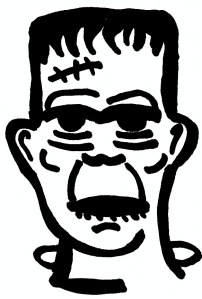

One of the most satisfying things about watching the Bela Lugosi/Boris Karloff collaborations The Black Cat, The Raven, and The Invisible Ray is that it’s been nice to see the two horror legends play characters outside of their usual roles as Count Dracula & the Frankenstein monster. It’s been even more of an unexpected treat to watch their offscreen professional rivalry reflected in their antagonistic onscreeen dynamic, adding an interesting meta context to their work together. Both of those elements are missing from Son of Frankenstein. The final film in Karloff’s trilogy of Universal Pictures Frankenstein productions, Son of Frankenstein is a dreary, by-the-numbers affair. The first Frankenstein film had a strange, otherworldly magic to it already dubbed on this site The Spirit of The Spirit of the Beehive. Its followup, The Bride of Frankenstein, is remarkable for its prowess as an early example of the horror comedy. The third film has, what, Bela Lugosi’s first performance as Igor? A replacement Dr. Frankenstin Jr. with a John Waters mustache? The first appearance of the Frankenstein monster’s fur vest? These might be interesting images in isolation, but they hardly amount to justification for a 100 minute feature, the lengthiest of the Lugosi-Karloff collaborations at the time of its release.
This spirit of creative bankruptcy is apparent in Son of Frankenstein as soon as Franken-junior is introduced with the line, “This one’s probably just as bad as his father!” Franken-junior also laments early on that people often get his father mixed up with his monstrous creation, upset that his family name is synonymous with horror & monsters. That pretty much sums up the entirety of the film’s interesting dialogue. Franken-junior is, of course, met with a cold reception when he moves into his deceased mad scientist father’s spooky castle and, of course, becomes obsessed with recreating Franken-senior’s work. Through a little bit of revisionist cheating, it’s revealed that the Frankenstein monster (played by Karloff, of course) & Igor (played by Bela Lugosi, as mentioned), are still for the most part physically intact, despite certainly being destroyed in the earlier films. Somewhere along the way Franken-junior’s little moppet offspring, Franken-junior Jr., “adorably” gives his dad away to the cops in a high-pitched squeak that pretty much made me want to watch the little bastard drown in a fire. That’s the most I felt of the film’s conflict. The only element of interest, really, is that Karloff’s monster & Lugosi’s Igor are good buddies, forming a sweet sort of symbiotic relationship in a world that wasn’t made for them, to say the least.
Although Karloff’s reign as the top-billed performer continues here & you’d think that Lugosi’s secondary role as Igor would push him to the side, Son of Frankenstein actually stands as a victory for Lugosi in terms of the actors’ longtime struggle to hog the spotlight. It’s not the best of their joint efforts, but at least Lugosi got more lines? He’s oddly captivating as Igor, especially in his Wolfman-like make-up (why did Lugosi never play the Wolfman?!) complete with a broken neck from a past lynching, while Karloff is remarkably dull as the monster he’s played so well in the past. In a completely non-verbal performance, his sole moment of interest is a scene in which he smashes Franken-junior’s very sciency science lab in a blind rage, an image that’s begging for an “open up this pit” meme. The rest of the film is just Karloff going through the motions while Lugosi tries to make the most of his role as a hairy, deformed Igor.
Son of Frankenstein arrived in the midst of a career slump for both Lugosi & Karloff. The decline of monster films that followed The Raven had limited the amount of roles the spooky duo were offered, but a successful double bill re-release of the original Dracula & Frankenstein films renewed interest in the Universal Pictures “famous monsters” brand, which lead to Son of Frankenstein‘s production. Although the film was a financial success for the studio, it’s a creatively weak endeavor at best, amounting to not much more than a collection of “what if?”s. What if, as originally planned, horror icon Peter Lorre had played the role of Franken-junior? What if Bela Lugosi had played the Wolfman instead of Igor & battled Karloff’s monster in a continuation of their meta rivalry? What if Franken-Junior Jr died a slow, agonizing death in a fire, putting an end to his annoying little squeaks forever? Alas, nothing so satisfying is delivered in Son of Frankenstein. That didn’t stop the studio, however, from returning to the well at least one more time in Ghost of Frankenstein. Karloff smartly declined to reprise his role for that trifle, obviously growing tired of the limitations of his most famous character. Unfortunately, Lugosi’s escape from the franchise was not so easy, as he returned as Igor in the Lon Cheney film. Poor Bela.
-Brandon Ledet