

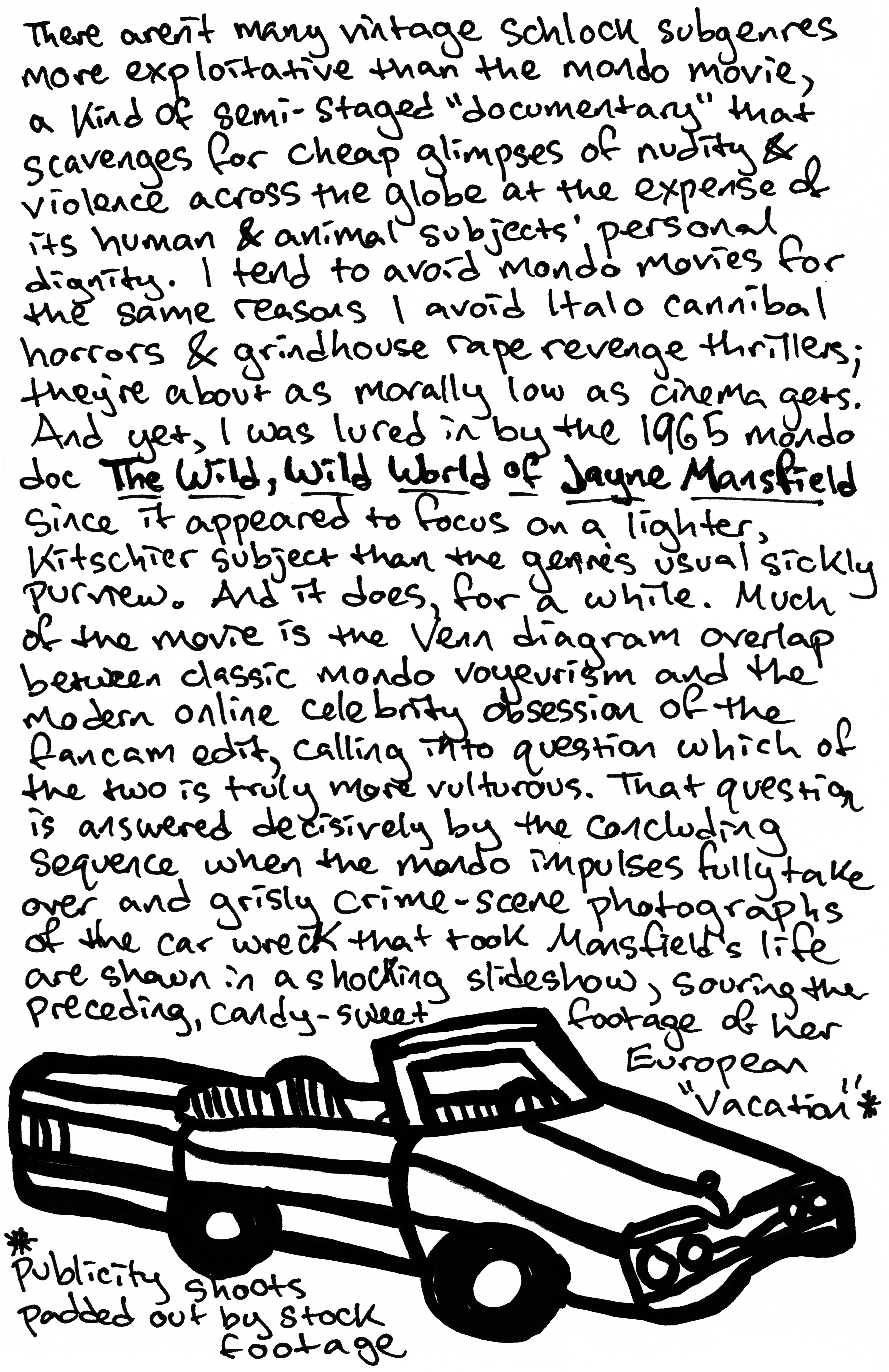


-Brandon Ledet
-Brandon Ledet

Our current Movie of the Month, 1957’s Will Success Spoil Rock Hunter?, finds Jayne Mansfield at the height of her manic bimbo superpowers. Mansfield already strutted her outrageous proportions & bubbly-ditz persona to great comedic effect in her first collaboration with Looney Tunes legend Frank Tashlin, 1956’s The Girl Can’t Help It, but she wasn’t allowed to step outside her usual cultural designation as the Great Value™ Marilyn Monroe in that picture. In Rock Hunter, Mansfield finally strayed far enough outside Marilyn’s looming shadow to pioneer her own territory in high-femme comedic vamping. Mansfield is pure bimbo mayhem in Rock Hunter, turning every inhale of breath into an orgasmic squeal and every costume change into a mind-blowing reveal. Instead of playing an exaggeration of Monroe, she’s playing an exaggeration of herself – complete with verbal, metatextual references to her Girl Can’t Help It stardom. It’s like watching a pro wrestler get assigned a go-nowhere, bad-vibes gimmick and then somehow win over the crowd by playing it as a ludicrous self-caricature. It’s the film where she out-Marilyned Marilyn to such an absurd extreme that the comparison is obliterated entirely.
No viewing of Will Success Spoil Rock Hunter? is complete without also having seen its rock ‘n roll sister film The Girl Can’t Help It, but if you’ve already graduated from The Frank Tashlin School of Jayne Mansfield Studies, there’s still plenty more of Mansfield’s career left to explore. Mansfield has a few dozen credits to her name on IMDb, ranging from dead-serious noirs to ribald slapstick comedies. None that I have seen can compete with the sublime silliness of her collaborations with Tashlin, but there’s still more to Mansfield’s screen persona than those two consecutive roles. So, here are a few recommended titles if you enjoyed our Movie of the Month and want to bask in more of her weaponized bimbo glamour.

The Wayward Bus (1957)
In 1957’s The Wayward Bus, Mansfield plays a famous stripper on the run, dodging unwanted nudie magazine notoriety on a bumpy bus trip down to a Mexican hideout. That makes the film sound a lot lighter & sillier than it is in practice, which is evident as soon as the title card announces its literary prestige as “John Steinbeck’s The Wayward Bus,” a serious drama for serious adults. Mansfield stars opposite several character actors running away from their problems on the titular Sweetheart bus (including a young Joan Collins as the bus driver’s violently alcoholic wife), but much of the drama revolves around how difficult it is for her fellow passengers to avert their eyes from her striking figure. It’s both the only movie I’ve seen where Jayne Mansfield was actually asked to Act, and the only one where her outrageous silhouette was treated as a liability instead of a superpower. A sordid little stage drama set in motion by the magic of rear protection in the bus’s windows, The Wayward Bus suffered a long line of production delays that eventually made room for Mansfield in the cast after cycling through bigger-name actors like Marlon Brando, Gene Tierney, Joanne Woodward, Robert Mitchum, and Shelley Winters, despite being a relatively standard-issue studio picture. That delay was a blessing in giving Mansfield some space to test out her dramatic chops, but also a curse in that it pushed its release to one year after Monroe’s similar roadside noir Bus Stop – to which it was inevitably, unfavorably compared in the press.

Too Hot to Handle (1960)
Mansfield also plays a jaded, troubled stripper in 1960’s Too Hot to Handle (alternately titled Playgirl After Dark), but she’s not asked to be as dramatically vulnerable here. Her character has graduated from stripper to stripper-manager at the seedy nightclub The Pink Flamingo, run by her doomed gangster boyfriend (and Christopher Lee as the gangster’s disturbingly young, handsome, mustachioed right-hand man). In genre terms, this film finds Mansfield working in the sex comedy realm that made her famous, but its British sensibilities afford it more of a dry martini-soaked sarcasm than what you’ll find in Tashlin’s sugar-addled farces. With underplayed zingers like “That’s a very nice dress you’ve nearly got on,” it’s not a knee-slapper so much as it’s a muted chuckler, and so Mansfield gets a chance to tone down her absurd femme-caricature persona to a smokier, more detached register. Even if not consistently hilarious, it’s shocking that this day-drunk British noir bothers to be as wryly funny as it is, since its main attraction is obviously the opportunity to watch Jayne Mansfield model outrageously tight, see-through outfits while puffing on the world’s longest cigarette holder. Self-billed as an “expose of sexy, sordid Soho, England’s greatest shame,” the film relies heavily on her physical presence to attract an audience, going as far as to rile up censors with completely transparent gowns that got it harshly edited in America. The fact that it manages to land a few one-liners on top of that drunken burlesque act is just lagniappe.

Promises! Promises! (1963)
It turns out see-through gowns are not enough to keep your horndog audience coming back forever. Eventually, you’ve got to take off the gowns entirely. While Mansfield reached her highest artistic peaks in her Frank Tashlin collaborations, she might be better known for her starring role in the mainstream nudie cutie Promises! Promises!, which delivered on its Playboy-publicized promise to become the first sound-era Hollywood film to feature a nude female star. In the very first scene of Promises! Promises!, Mansfield is introduced taking a bubble bath, making sure to rise above the suds just enough to give the audience a full look at her outrageous, unclothed figure. In the next, she disrobes of that pretense, going shamelessly topless as if Russ Meyer were leering behind the camera. Unfortunately, the rest of the picture does not have the magic Russ Meyer touch. You might wonder what this cornball sex comedy is going to do with its remaining 70 minutes after it gets Mansfield’s publicity-stunt nude scenes out of the way in the first 4. The answer, apparently, is shamelessly repeat those same images in clunky dream sequences to milk them for all their worth. The schticky German psychologists, sissy hairdressers, and stock footage of cruise ship shuffleboard players that pad out the rest of this farce are desperate & dire, and the only genuine fun to be found in the entire picture is in Mansfield’s two brief, breathy musical numbers. Still, being the first actress to go nude in a mainstream, post-Hays Code Hollywood is a major distinction Mansfield could claim that her professional superior Marilyn Monroe could not (if not only because Monroe’s own attempt at that ground-breaking achievement, Something’s Got to Give, was derailed by the star’s tragic death). Unfortunately, that only helps relieve some of the sting of Marilyn’s own boat-ride farce Gentlemen Prefer Blondes being one of the most beloved comedies of all time while Promises! Promises! is mostly just a giant pile of ship.
-Brandon Ledet
Until a couple weeks ago, there were exactly two things I “knew” about Jayne Mansfield: she was a cheap imitation of Marilyn Monroe, and she died in a horrific car accident. It turns out both of those bullet points were hazier & more complicated than I understood them to be. Yes, Mansfield died tragically young on a late-night drive to New Orleans but, no, she was not decapitated as the sensationalist urban-legend reports of her death would have you believe. Yes, Mansfield was often cast and marketed as a Great Value™ Marilyn Monroe alternative, but she managed to push her screen persona beyond that rigid typecasting to become her own distinct, wonderful thing. I always thought of Jayne Mansfield as someone who starred in a couple minor roles before her life & career were abruptly cut short, but she’s got a few dozen credits to her name on IMDb—ranging from dead-serious noirs to ribald slapstick comedies—most of which have nothing to do with her designated place in Marilyn’s shadow. I have a daunting curriculum ahead of me in parsing out exactly who Jayne Mansfield was as an onscreen persona, a too-long-delayed education I hope will override my initial, ignorant assumptions about her.
Since I’m not going to watch all three dozen of her acting credits in a single go, the best crash-course education in Jayne Mansfield studies I could figure was checking out her two most iconic roles: her collaborations with Looney Tunes legend Frank Tashlin. Their first film together, the 1956 rock-and-roll comedy The Girl Can’t Help It, was my most obvious entry point, since it’s something I’ve seen lovingly referenced in several John Waters pictures. Not only do the rock-and-roll teens’ reaction shots in Hairspray pull direct influence from The Girl Can’t Help It‘s various concert performances, but Waters also lovingly parodied Mansfield’s title-song strut for one of the very best gags in Pink Flamingos. In the Frank Tashlin version, Mansfield struts down a city block in a form-fitting dress, while every man she passes on the street instantly overheats at the sight of her – milk boiling out of bottles & popcorn popping out bags in their hands like premature ejaculate. In the John Waters version, Divine recreates the exact same strut while bewildered Baltimoreans gawk at her in confusion & disgust, stunned in total awe of her filthy divinity. In case the connection isn’t clear, both versions are set to the Little Richard tune “The Girl Can’t Help It,” which made the Tashlin movie a must-see movie on my watchlist for years.
Unfortunately, I can’t say that The Girl Can’t Help It is the ideal Mansfield talent showcase. It’s fantastic as a rock-and-roll concert film, featuring a wealth of standalone performances from Little Richard, Fats Domino, The Platters, and the like. It’s also the ultimate example of a movie studio pigeonholing Mansfield as a Marilyn stand-in instead of allowing her to be her own thing. Monroe made her secretly-smart-ditz schtick look so easy that you can only tell how tricky it is when someone else bungles it. Mansfield is adorable as the drag club caricature of that archetype, at least, and it’s amusing that her … questionable talents are essential to the plot of her starring-role debut. She plays the reluctant girlfriend of a gangster who’s forcing her into a nightclub-singer career she does not want (or even have the talent) to pursue. She looks fantastic in her snatched-waist wardrobe—an effect wonderfully compounded by the endless supply of horndog men who make cartoon wolf-eyes at her—and her breathy obliviousness is a delightfully absurd exaggeration of retro femininity. It just sucks that the comparisons to Marilyn’s similar not-so-ditzy ditzes are so unavoidable, since her character and her performance are not allowed to have the same depth & nuance as Monroe’s most iconic roles.
It wasn’t until her next Tashlin collab, the 1957 ad industry satire Will Success Spoil Rock Hunter?, that Mansfield really came into her own as a screen persona. Her drag-club Marilyn caricature is adorable enough in The Girl Can’t Help It, but she pushes the act to such a transcendent extreme in the next film that the comparison is obliterated entirely. Mansfield is pure bimbo mayhem in Rock Hunter, turning every inhale of breath into an orgasmic squeal and every costume change into a mind-blowing reveal. Instead of playing an exaggeration of Monroe, she’s playing an exaggeration of herself – complete with verbal, metatextual references to her Girl Can’t Help It stardom. It’s like watching a pro wrestler get assigned a go-nowhere, mood-killing gimmick and then somehow win over the crowd by playing it as a cartoonish extreme. Even the teen girls of Rock Hunter have a crush on Mansfield, not just the men passing by, and you feel that lasting Ultimate Bimbo impact influence future women who’ve played that same archetype (notably including Elvira, whose pet poodle in Mistress of the Dark was likely an homage to Mansfield’s here). Tashlin matches Mansfield’s nuclear zaniness in his direction of Rock Hunter too, firing off rapid-fire sex jokes and TV commercial parodies as if he were consciously bridging the temporal gap between The Marx Brothers and ZAZ. In retrospect, The Girl Can’t Help It feels like a trial run for the film where they really set out to let loose, which tracks with the knowledge that Rock Hunter started as a Broadway stage play (also starring Mansfield) before The Girl Can’t Help It was developed.
I understand, logically, why The Girl Can’t Help It is the Tashlin-Mansfield collaboration that’s getting a spiffy new Criterion restoration. There’s a distinct pop-art iconography to it that is undeniably potent, as indicated by the homage of its titular strut in Pink Flamingos (which is also getting a Criterion polish this year). The movie is very proud of its technical beauty, bragging about its indulgences in “the grandeur of Cinemascope” and “the gorgeous, lifelike color of DeLuxe” in its William Castle-style intro. It’s clear to me, though, that Tashlin & Mansfield were at their absolute best in their latter collaboration, which exaggerates everything that’s great about The Girl Can’t Help It (except the music) to a beautifully ludicrous extreme. Will Success Spoil Rock Hunter? taught me how to appreciate Jayne Mansfield as her own unique persona, breaking her out of the Marilyn Monroe impersonator box I used to store her in (despite her Rock Hunter character being written as a spoof of Monroe’s performance in The Seven Year Itch). Now all I have to do is catch up with the thirty other Mansfield movies I haven’t seen so I can fully understand her surprisingly extensive career as an actress. So far, I’ve only read the syllabus and skimmed the highlights; it’s time to do the coursework.
-Brandon Ledet
 Swampflix