

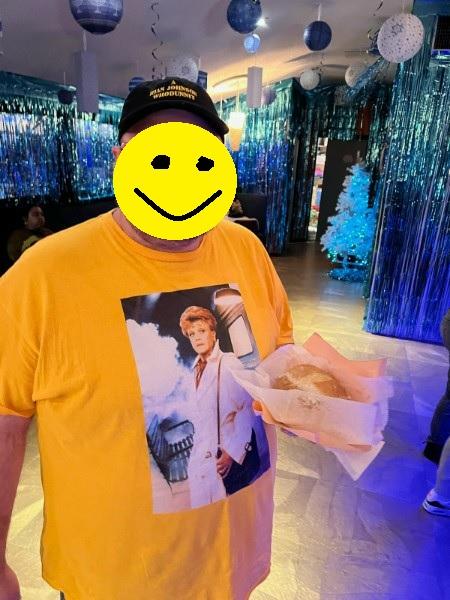
“It hides not behind complexity but behind mind numbing, obvious clarity!” So Daniel Craig’s Glass Onion character Benoit Blanc, called by Google “the world’s greatest detective,” says to much-vaunted “inventor” Miles Bron (Edward Norton) toward the end of this Knives Out sequel. I was a big fan of Knives Out when it premiered a few years ago. Brandon got a screener copy of its sequel along with some fun swag, and he was kind enough to both let me wait until the film fell into my greedy little clutches to publish a review, but also send along some of said swag, which includes the fantastic “A Rian Johnson Whodunnit” hat which you can see me wearing below while also clothed in one of my Angela Lansbury shirts:
For Glass Onion, Benoit Blanc once again finds himself insulated from the world among a smaller world of morons, ingrates, and moronic ingrates as well as hucksters, snake oil salesman, and politicians. This time, he has ostensibly received an invitation to a murder mystery weekend at the home of the aforementioned Bron, who is an amalgamation of various rich douchebag stereotypes (and truths) but who most closely resembles Elon Musk due to his involvement in various companies and businesses which work together to create an impression of a wise ubermensch, when he is in fact a little weirdo who obsesses over getting approval from others. Also invited to the island were several of Bron’s friends, each of whom received a puzzle box that required them to work together to solve and receive their invitation. There’s Birdie (Kate Hudson), the ignorant socialite whose put-upon assistant Peg (Jessica Henwick) has the full time responsibility of not letting her tweet something racist and dumb that could get her cancelled for good; there’s also sad MRA Duke (Dave Bautista) who lives in his mother’s basement while hawking various products that promise to make his viewers “alphas” like he presents himself to be, while his social-climber girlfriend Whiskey (Madelyn Cline) plays along with his internet image. On the smarter end of the scale of Bron’s friends is Lionel Toussaint (Leslie Odom, Jr.), one of the lead scientists at Alpha who liaises with upper management about Bron’s ideas; and the gang is rounded out by Claire Debella (Kathryn Hahn), former governor of Connecticut who is now campaigning for a senatorial run. Finally and apparently unexpectedly, also in attendance is Andi Brand (Janelle Monáe), a former business partner of Bron’s who was unsuccessful in preventing him from pushing her out of the business and exposing his questionable business practices. It’s May 2020, and they have gathered at Bron’s Grecian estate, which is topped with an ostentatious lúkovichnaya glava made of transparent glass, from which the film partially takes its name.
Of course, the title could mean a lot of things. For instance, it’s the name of the bar where all of the main characters (sans Blanc) gathered in their pre-wealth days, when Andi first brought them all together and before they all stabbed her in the back. It’s also, famously, the title of a track from what we colloquially call The White Album, although it’s properly titled The Beatles. Following all of the fan speculation about the meanings of some of the more psychedelic and impenetrable lyrics on their 1967 album Sgt. Pepper’s Lonely Hearts Club Band, John Lennon opted to pen a song that was intentionally antagonistic to anyone attempting to find a deeper meaning in the words; even if you don’t know the song title, you’re familiar with the Paul is dead conspiracy theory that’s now 55 years strong because of the lyrics “the Walrus is Paul.” Or, as Blanc says at one point: “I like the glass onion as a metaphor, an object that seems densely layered, but in reality the center is in plain sight.” From title to exposition, everything is a clue here, just as it was in Knives Out in 2019, and although the social criticism is a little shallower and more obvious than it was last time, I’m still here for the very fun ride.
Of course, that’s one of the things that makes films this elegantly constructed difficult to write about. You’re either going to end up recapitulating all of the fun and foreshadowing how it pays off, which ruins the ride for first-time viewers (hell, I’m already worried I might have given away who the killer is just from my little gags in this review so far) or you’re stuck trying to explicate on something in which the pleasure of the viewer lies in running alongside the narrative and having the revelations to the audience coincide with those to the characters. It’s tricky to pull off, and I’ve often cited how I feel comedy and mystery exist in and evoke neurochemical pleasure in the same parts of the mind: it’s all very specific planting and payoff, and if your audience gets to the solution/punchline too far in advance of the flow of the narrative, it can be death for both genres. Melding them together is a perfect idea (I’ve got more than one work in progress right now that does precisely that) that also doubles the potential for the film to crash and burn like, I don’t know, a SpaceX Falcon 1 launch. Both the previous Knives Out film and this one manage to pull it off. Every reveal makes total sense and falls perfectly in line with what we’ve already seen and what we already know while still allowing us to feel some sense of accomplishment in “figuring it out” along with the characters. It’s an effect you can only find in great examples of the genre, like Murder, She Wrote, which gets a loving reference here in the form of several celebrity cameos playing Among Us with Blanc during his quarantine blues before his invitation to the Onion, most notably and most wonderfully the divine, magical Dame Lansbury.
If I have any complaints about the film, they are few and far between. Blanc is bigger and bolder here than he was in the last film, which matches the zanier plot of this one but also makes it feel like the character isn’t quite consistent. This one doesn’t straddle the line of mocking conservatism and neoliberalism from a slightly left position as well as the last one did, which makes this one feel more “Hollywood” than the last one as well, despite both featuring a cast full of legitimate movie stars. It has a little bit of the Trump SNL taint on it (alternatively we could call it the There’s Someone Inside Your House problem), where just because something happens to align with my belief system doesn’t mean that it automatically makes it a better or more worthwhile piece of art. Most of its barbs are sharp, though. In particular, I love the detail that Birdie, who has already been shown to have zero concern about hosting a superspreader event in her apartment, arrives to the dock on the way to Bron’s island in what the script describes as a “fashionable but totally useless lace mask”. Some of them land a little more loudly or call more attention to themselves than they should, when I don’t remember the first film having any issues with this at all, but maybe that’s the nature of political satire now. There are elements of the plot, setting, and choices here that seem eerily prescient given how long the film took to make, like that it was in theaters at the time that Elon Musk had his bluff legally called and was forced to complete his purchase of Twitter, or that there is a giant mural in Bron’s house depicting Kanye West as Jesus Christ, which is both funny and depressing given the nature of West’s current public persona entirely revolving around spouting Anti-Semitic rhetoric with his whole chest. It recalls how there was an entire garden industry on the internet for a while of pointing out things that The Simpsons “predicted,” when the simpler and more depressing reality is that, with a few notable exceptions, there hasn’t been much of an improvement in most people’s lives since 1989. Glass Onion didn’t predict anything either, but it certainly has a talent to reflect how bleak things are at the moment.
At the end of the day, this is the kind of movie that I can only recommend you watch it or not, given that saying more than I’ve already said runs the risk of spoiling too much. If you’ve already got Netflix, you really have no reason not to, and I think that you’ll really enjoy the twists and turns along the way if you have the patience. And you’re at home, where you can pause and create your own intermission to go to the bathroom or make a cocktail, so why not? If nothing else, every person who watches this movie pushes Ben Shapiro closer and closer to having an epiphanic moment about what his actual place in the world is, and isn’t that a dream we should all strive towards?
-Mark “Boomer” Redmond


 Swampflix