A Litany for Survival: The Life and Work of Audre Lorde (1995)

I have never been more creatively or spiritually fulfilled than I was for the few brief years when my biggest weekly priority was an academically rigorous poetry workshop. Still, I gave up the practice as soon as I graduated college, realizing that sticking with it would mean a life-long professional dedication to academia, something I had no interest in pursuing. I was fondly reminded of those days while watching the documentary A Litany for Survival, though, which features several scenes of its subject—activist-poet Audre Lorde—running a poetry workshop at Hunter College in New York City. She’s tough on her students’ work in a productive, fully engaged way that you can see improving their art in real time. Other formidable poets like Adrienne Rich & Sonia Sanchez appear in interviews to reminisce about how Lorde improved their own work through a similar kind of collaborative criticism, pushing them to sharpen their ideas through revision. It’s difficult to write meaningfully without that kind of peer-to-peer friction, which is largely why I gave up on the medium of poetry entirely to work on this silly movie blog instead. And that’s not even taking into account how increasingly niche & insular the world of poetry has continued to become in recent decades. Anyone who’s still out there making a full life out of that kind of work is superheroic, since this 90s-era documentary already feels like a time machine trip back to the last moment it was considered societally Important in any way.

Audre Lorde was tough on everyone: her students, her colleagues, her children, her nation, herself. Which is to say that she continuously fought for a better world the entire time she was alive, applying her skill for ruthless revision to societal structures the same way she applied it to her own poetry, through political activism causes like Civil Rights, Gay Rights, and Feminism. She billed herself as a “Black, lesbian, feminist, socialist, mother, warrior, poet,” rising to prominence in the literary world in the 1960s & 70s, when those identity markers had a real-life chance to either get you killed or change the world. Her writing and her activism were both heavily fixated on Intersectionality, drilling down into the particulars of what made her a distinct social outsider while also seeking commonality among comrades who were fighting similar struggles. By the time documentarians Michelle Parkerson & Ada Gay Griffin told her life story in the 1990s, she had shifted to fighting a very different fight: battling cancer instead of oppression. A Litany for Survival is a very straight-forward, made-for-PBS style production, but it took nearly a decade to complete, so a significant chunk of the footage features Lorde wheezing through her final days while suffering from lung cancer, no longer able to perform her poems with her usual fierceness. Thankfully, they were around for her healthier days too, when she could still provoke & incite with the best of ’em.

In both form & content, the movie Litany most reminded me of was the more recent documentary Going to Mars: The Nikki Giovanni Project. Giovanni occupied such a similar place in American literature that Litany only passingly references her by her first name, “Nikki”, since you presumably already know who she is if you’re watching this profile of her contemporary. Both films exceed their limitations as PBS-style documentary profiles of activist-poets by drifting through different phases of their lives instead of strictly following a linear birth-to-death biography. We meet Lorde in her final years of illness, when she can barely speak. Earlier, more forceful interviews about her life story then mix with audiobook readings of her prose autobiography Zami, live readings of her most iconic poems, and candid domestic scenes shared with loved ones in the final decade of her life. None of these conversations or monologues feel complete in representation; the edit crossfades between them like overlapping waves, illustrating the images evoked by Lorde’s past with still photographs from her personal albums and vintage NYC stock footage. It’s a full life retold in out-of-context snippets, with the only incomplete element being that we never see the world through Lorde’s own handheld camcorder, which she points around her home garden in her final days as a new way to capture images for her art.

A newly restored version of A Litany for Survival recently saw its local premiere at the Patois Film Festival, screening at the Joan Mitchell Center instead of the fest’s usual home at The Broad. That venue choice was . . . suboptimal for appreciating what the new scan might have offered as a pure sensory experience, but it did contribute to my personal nostalgia for college-level poetry workshops. It was projected onto a scuffed-up screen that unrolled from the ceiling; every shifting body in the packed room’s hard-backed chairs could be acutely heard & felt; and the presentation concluded with a panel discussion about how Lorde’s work was an effective form of political activism. It was a perfect simulation of a college classroom environment, like a VR headset experience of what it might be like to have Audre Lorde sit across a workshop table from you, pushing you to do better work and to make a better world. I’m still not convinced that I should quit my desk job and enroll in grad school just because I miss participating in those workshops for real (if not only because the guaranteed outcome would be me getting another desk job after graduating, with only more debt to show for it), but it was a pure pleasure to return to that headspace, and it made for an easy argument that Lorde improved the life & work of everyone she ever collaborated with.

-Brandon Ledet
Emeralds in the Attic, or Promising Young Petals

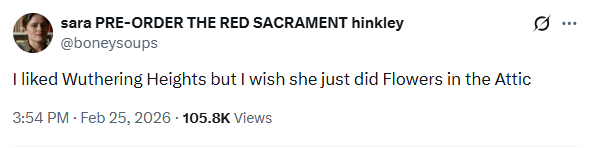
Before I got a chance to see Emerald Fennell’s recent “adaptation” “Wuthering Heights, I stumbled across this social media post in the wild: 

I had just recently completed my own most recent rewatch of 1987’s Flowers in the Attic, and I became fixated on this idea. I’ve been down the Flowers in the Attic rabbit hole more times than I’d care to remember, but at its core, I’ve always been fascinated by the connection between Emily Brontë’s and V.C. Andrews’s novels. I don’t know if there’s any academic discussion of this out there, but I have no doubt in my mind that Andrews drew inspiration from Wuthering Heights, from naming her protagonist “Cathy” to making the implied, sublimated incest of Heights (I’ve always subscribed to the theory that Heathcliff is Earnshaw’s bastard son, meaning he and Catherine are half-siblings) explicit and pervasive in Flowers in the Attic and its sequels. 

When I did get around to seeing “Wuthering Heights, my major criticism of it ended up being that it doesn’t need to, and in fact shouldn’t, be Wuthering Heights at all. The most interesting characters in that film are Alison Oliver’s Isabella and Hong Chau’s Nelly, and one could have done a Rosaline style film about the former or even gone full-tilt into the “Nelly is the villain” concept and made a Cruella style picture about the latter, and either one of them would have been infinitely more interesting than watching “Wuthering Heights” bash two sexy Australian Barbie dolls at each other while reenacting a half-remembered SparkNote. In essence, both Flowers in the Attic and “Wuthering Heights” are both unfaithful mutations of the same source material, which means that Fennell might actually be the perfect person to make a Flowers in the Attic adaptation. Right? 

I don’t think so… however, I do think that she would be the ideal person to adapt the first follow-up novel, Petals on the Wind. It would be incorrect to say that Petals is an easier novel to read than Flowers. While it may eschew most of the more taboo elements that made Flowers so salacious, adult Cathy finds herself in just as dire straits in Petals, where she is constantly subject to sexual danger regardless of which of her husbands is exerting force over her. Based on the overall negative reaction to Fennell’s Promising Young Woman (which I didn’t share), I don’t think that she has the sensitivity needed to present Flowers. This is, after all, a director who looked at the same source text that Andrews did and, where Andrews saw both the tenderness and the danger of Heathcliff and Cathy together and the way that it would affect future generations, instead got horned up by imagining them getting off to voyeuristic observation of a couple of servants going at it in a barn. But also, don’t worry, in this version Cathy and Heathcliff definitely aren’t half-siblings, so don’t worry, it’s okay if you get aroused!

For those who are interested, Flowers in the Attic (the novel) doesn’t end in the same way that the ‘87 film does. The latter includes a hastily-shot death scene for Corrine Dollanganger after being confronted by her children during her wedding to Bart Winslow, her late father’s lawyer, as producers felt that the book’s ending, which occurs when the children simply escape the house after learning that their grandfather is dead and Bart and Corrine have been married for over a year. This big confrontation scene seems like it would be right up Fennell’s alley, and the equivalent scene, in which Cathy crashes the Winslow family’s Christmas party at Foxworth Hall to reveal to Corrine that she has (a) seduced Bart and (b) is pregnant by him, is the climax of Petals on the Wind. Of course, this is between her first marriage to an abusive narcissist and her second marriage to the doctor who fostered the children following their escape. Petals also borrows from Brontë, although it’s Charlotte this time, as Paul, the aforementioned doctor, initially pretends that his wife is dead before revealing that she’s actually in an institution, such that his initial overtures toward Cathy when she is of age are much like Rochester’s towards the title character in Jane Eyre. It’s all very, very messy, a true soap opera, and that’s the wheelhouse that Fennell would most bloom in if she took that opportunity. 

-Mark “Boomer” Redmond

“Wuthering Heights” (2026)

Brandon has already written about Emerald Fennell’s “Wuthering Heights,” and although I was forewarned, my own love for the source material meant that, sooner or later, I was going to have to check this hot mess out for myself. And what a mess it is! Not as hot as one would expect, though, given that the director’s stated intention with this adaptation has been to recreate the horniness that she presumes is the universal experience of all first time readers. The thing about ”Wuthering Heights” is that the text I found myself thinking about most often while watching it wasn’t the novel itself or any of the prior adaptations, but Wicked: For Good. In writing about that film, I posited that its greatest flaw is also its greatest weakness: it only exists as a commercial product because of its connection to The Wonderful Wizard of Oz and its offshoots, sequels, and adaptations as a brand. The first half of the play (and the earlier film that adapted only that opening half) is allowed to find all sorts of fun things to explore within the “canon” of Oz, since the only thing it carries over is the necessity that, at some point, the Wicked Witch of the West and Glinda the Good Witch must eventually become enemies, in the public eye if not in reality. Everything else is fair game. In the second half of the play, which became For Good, every action exists in service of putting the characters from Wizard of Oz into the positions that they will be when Dorothy meets them upon her arrival in the fairy land, so characters march lock-step toward their places in the canon regardless of whether that works on a narrative, character, or even emotionally meaningful level. “Wuthering Heights” has the same problem. I’m not going to say it’s a bad movie because it’s a bad adaptation of Wuthering Heights, which it most certainly is, but it’s a bad movie because it’s an attempt at adapting Emily Brontë’s novel at all

Widower Mr. Earnshaw (Martin Clunes), the tenant of farmhouse Wuthering Heights, returns home from the city with a young boy in tow, whom he “rescued” from a life of being abused by a drunken father so that he can come to the Heights and be abused by a drunken stranger instead. He gives the boy to his daughter, Cathy, who names the child “Heathcliff, after my dead brother,” and the two form a fast friendship. Also present in the household is Nelly, who as the bastard daughter of a lord is not entitled to recognition or shelter, but is welcome to act as the formal companion to Cathy; this relationship is challenged by Cathy’s burgeoning devotion to Heathcliff, who absorbs some of Earnshaw’s parental abuse. Some years later, Cathy (Margot Robbie) and Heathcliff (Jacob Elordi) watch as a procession of carriages deliver their new neighbors, The Lintons, to the manor of Thrushcross Grange. Cathy, who has been raised with no mother and is thus somewhat as wild and unmannered as her lowborn foster brother, sneaks up to spy on Edgar Linton (Shazad Latif) and his “ward” Isabella (Alison Oliver) and ends up injuring her ankle and being hosted at Thrushcross Grange for several weeks to recuperate. She returns to Wuthering Heights “quite the lady” and admits to Nelly (Hong Chau) that she has fallen in love with Linton and will marry him; she says aloud that she cannot marry Heathcliff because of their vast social class gap, and Nelly, knowing that Heathcliff has overheard this, keeps this information to herself. Linton and Catherine marry, Heathcliff leaves, Catherine becomes pregnant, and Heathcliff returns, at which point Catherine learns that Nelly allowed him to believe that Catherine didn’t love him. Heathcliff marries Isabella, but he and Catherine begin a brief, torrid affair that ends in tragedy. 

If you’re familiar with the novel (or any of its more faithful adaptations, although there are surprisingly few), then that synopsis undoubtedly feels strange to you. It’s like Brontë’s in some ways; the character names are the same and some of the larger events from the novel are present. The exclusion of Hindley, Cathy’s brother and Heathcliff’s primary tormentor (and thus also his wife and child), is very jarring, as is the complete absence of Mrs. Earnshaw. Earnshaw family employee Joseph has also been aged down and cast with a handsome actor (Ewan Mitchell), eschewing the novel Joseph’s characterization as a religious zealot and instead giving him the chance to engage in kinky, largely unseen BDSM with one of the housemaids so that Heathcliff and Cathy can observe them surreptitiously in a way that sets both characters’ sexual imaginations ablaze. Most adaptations focus solely on the Cathy/Heathcliff story and leave out the entire plot about the second generation that constitutes the entire second half of Wuthering Heights, so its excision here isn’t surprising, but knowing that it doesn’t need to take that into consideration, “Wuthering Heights” decides to instead have Cathy not only die, but miscarry her child with Linton, since there’s no reason to have a living child if the story isn’t going to continue. I also can’t fault the film for choosing to narratively manifest the “Nelly is the villain” theory. Although I have personally never accepted that in my reading of the text, it has become the prevailing literary lens for the novel’s academic criticism since James Hafley first posited this thesis in 1958. (If you have JSTOR access, his essay can be found here; it’s a good read even if you, like I, remain unconvinced.) 

If you’re not familiar with the novel, none of this may seem like it changes that much about the text, but I can assure you: it does. My distaste for the film could be said to be either (a) entirely predicated on, or (b) have nothing to do with my love of Wuthering Heights, by which I mean that I don’t particularly care that this is a bad adaptation of Wuthering Heights—in fact, the number of faithful adaptations is rare, and I prefer some of the less faithful adaptations over the more detail-oriented ones—I just don’t think this needed to be an adaptation of Wuthering Heights specifically. It almost feels as if Fennell responded to critics’ dismissal of Saltburn as a lesser Talented Mr. Ripley by deciding to take her Wuthering Heights-inspired erotic fiction and—in an inverse of E.L. James filing the serial numbers off of her Twilight fanfiction and publishing it as Fifty Shades of Grey—direct an adaptation of that and call it “Wuthering Heights. I’m not frustrated with this movie as a fan of Brontë’s; I’m frustrated with it as a movie lover, the part of me that just wants to go to the movies and have a good time. Where this ties into Wicked: For Good is that like that film, “Wuthering Heights” goes awry in having to fall in line with the text that it is branded, meaning that the film is inexorably tied to the text from which it takes its name, when liberating it from that title would have allowed this to go in more interesting directions.

Robbie is very good as Cathy (Elordi is fine), but our two lead characters are so boring. In the film’s second act, we get to see some of the home life of Heathcliff and Isabella, and it’s the best stuff in the movie. Instead of being a victim of Heathcliff’s abuse, Isabella is all-in on his weird degradation play; she gets off on sending letters to Cathy and Nelly lying about how horrid Heathcliff is to her while also clearly enjoying being chained up and treated like a dog. We’ve already gotten a clear look into her bizarre psyche earlier in the film, in which we learn that she has an entire room devoted solely to her hair ribbons, and we get to see her create a fun murder scene in miniature by venting her frustrations at Cathy herself on the doll she made of the woman instead, with a dollhouse tableau that’s as funny as it is disturbing. While sitting in the theater, I couldn’t help but think about how much better a movie “Wuthering Heights” would be if it realized that its most interesting character was Isabella, and the movie had been made about her instead. I fantasized about the film taking a sudden turn into being about Heathcliff realizing that Isabella truly could match his freak and the two of them falling for each other. “Wuthering Heights” could never go in that direction because it’s called “Wuthering Heights,” rather than “[Untitled Emerald Fennell Sexy Gothic Romance starring Jacob Elordi].” The first time that we meet Isabella, she’s sitting in the garden and delivering an excruciatingly detailed recap of Romeo & Juliet to Linton. For a moment, I really was naive enough to think that Fennell was going to do something truly audacious, and that the mention of the play would draw attention to something crucial that Shakespeare’s play and Brontë’s novel share: they are decidedly tragic, non-romantic stories that the general public perceives as romantic. Alas, this was not to be the case, and the director’s much-vaunted “audacity” was once again constrained to the erotic consumption of another person’s bodily fluids (and occasionally egg yolks). Ho-hum.

Where Emerald Fennell does allow herself to get really freaky with things that she adds from outside the text are the moments where the film does actually shine. When she first arrives to live at Thrushcross Grange, Cathy is ushered into a room that Linton has prepared for her by having the place painted “the most beautiful color in the world, the color of [Cathy’s] flesh.” As we enter the room, it looks tasteful enough, but as the camera moves closer we get to see that Linton has had the decorators recreate not only her freckles but the light, almost imperceptible blue veins beneath. It’s delightfully grotesque. The film also occasionally goes for utter camp in a few fine moments, with the standout being the scene in which Mr. Earnshaw dies, surrounded by a physically impossible stack of empty wine and liquor bottles. The film also features very beautiful tableaux; there are several nearly-still chiaroscuro images of characters lit solely by the natural light streaming through a window, calling to mind Rembrandt’s Anna and the Blind Tobit or the Rembrandtian A Man seated reading at a Table in a Lofty Room. Evoking the imagery of Caspar David Friedrich’s Wanderer above the Sea of Fog is an easy go-to for Heathcliff’s return, but it’s also an effective choice. Visually, the film’s depiction of Thrushcross Grange having strong juxtapositions of white and blood-red are striking, even if the choice doesn’t seem to have a deeper meaning other than the most superficial symbolism. Any one of those things would have been a delight to see in [Untitled Emerald Fennell Sexy Gothic Romance starring Jacob Elordi], in which Fennell wouldn’t have felt the need to remain bound to “adapting” Wuthering Heights and instead been able to go full bore into the story she really wanted to tell. Instead, we have this disappointment.

-Mark “Boomer” Redmond

Unfaithful Mutations

Wuthering Heights is one of my all-time favorite works of art. Emily Brontë’s 19th Century novel is a shockingly horrific read for anyone who’s ever been assigned it in a high school or college-level literature course, expecting it to be a melodramatic romance (matched only in its homework-assignment shock value by her sister’s novel Jane Eyre). Wuthering Heights is not a traditionally tragic love affair; it imagines romantic attraction as a form of life-destroying doom that compels all involved to viciously tear each other apart out of the insatiable hunger of yearning, never to be satisfied through physical touch. It should be no surprise, then, that the latest, loudest adaptation of that novel would receive equally loud criticism for the ways it reduces its source text to a more familiar, better-behaved romance, as if it were a dime store paperback instead of a great work of Gothic lit. Personally, I can’t conjure the energy to care. To my knowledge, no movie version of Wuthering Heights to date has approached anything near faithful adaptation. They tend to leave the business of adapting the novel’s second half—in which a second generation of interfamilial combatants continue the first half’s vicious games of yearning & revenge—to be retold only via BBC miniseries, which are too tonally genteel to convey the full, feral nature of the source text. So far, what we’ve seen is a story dutifully half-told, with no real personal imposition on the text by the filmmakers behind the camera (besides maybe Andrea Arnold’s race-conscious adaptation from the 2010s, which gets specific in conveying the novel’s themes of “otherness,” usually left more vaguely defined). They tend to be more transcriptive than interpretive. So, I find myself in the embarrassing position of being impressed by the crassly unfaithful adaptation of one my favorite novels for at least engaging with the material in a transformative way, even if it’s more deimagined than reimagined. “Death of the author” means allowing our sacred texts to become entirely new beasts in afterlife.

Despite all the prepackaged backlash, “Wuthering Heights” proved to be another erratically entertaining piece of lurid pop art from Emerald Fennell, whose previous works Saltburn & Promising Young Woman were also loudly scrutinized in their own time for their thematic carelessness. Fennell appears eager to get ahead of the criticism in this case, adding the titular scare quotes in an effort to defuse any expectations that she might be sincerely adapting Brontë’s novel. Every image is prefaced with a wink, signaling to the audience that it’s okay to have fun this time instead of getting too hung up on Heathcliff & Cathy’s recursively lethal, semi-incestuous attraction to each other. It’s not so much an adaptation of Wuthering Heights as it is an adaptation of the horned-up dreams a teenager might have while reading Wuthering Heights — often illustrated in fancam-style montages that insert bodice-ripping sex scenes into a story that used to be about the destructive nature of unconsummated lust. Jacob Elordi & Margot Robbie are cast more for their paperback-romance cover art appeal than their appropriateness for the source material. Charli XCX is employed to soundtrack the music video rhythms of the edit to rush the story along before the discomfort of any one cruel moment has time to fully sink in. Even when destroying other women’s lives in order to get Cathy’s attention, Heathcliff seeks enthusiastic consent, turning what used to be domestic abuse into a kind of elaborate BDSM game. It’s all in good fun (give or take the obligatory tragic ending), staged entirely for the purpose of hiring movie stars to play dress-up and dry hump, supplementing the wet sounds of actual sex with bizarrely chosen surrogates like fish heads, snail slime, egg yolks, and raw dough. As goofy & half-considered as it is, it’s also Emerald Fennell’s best work to date. She continues to improve as a populist entertainer with every picture, but she has also suffered the great misfortune of being immediately successful, so everything she does is met with obnoxiously loud scrutiny. Hopefully all of her generational wealth serves as a small comfort in this difficult time.

The same week that Wuthering Heights topped the US box office (proving yet again that online backlash has no tangible effect outside your Twitter feed), I saw another domestic release of an unfaithful literary mutation. The new anime film Scarlet restages Hamlet as a sword-and-sorcery fantasy epic in a Hell-adjacent afterlife, seemingly combining the characters of Hamlet & Ophelia into one newly imagined, feminist action hero. I’m no Shakespeare scholar but, like Wuthering Heights, Hamlet does fall into the category of great literary works I was assigned to read multiple times throughout high school & college, and I don’t remember the bard describing the young Dane being groped by countless hands of the undead under a sky of black ocean waves in his stage directions. By the time Scarlet interjects a title card that drags the story back to 16th Century Denmark, I couldn’t help but treat it as a visual gag. I laughed, but I was the only one laughing in that theater, because I was the only one in the theater at all. Director Mamoru Hosoda is relatively well known among anime nerds for earlier works like Summer Wars, Wolf Children, and The Girl Who Leapt Through Time, but recently he’s been on a kick where he reinterprets literary classics as high-fantasy adventure films featuring heroic warrior princesses. With Belle, he relocated characters from Beauty and the Beast to a Virtual Reality other-realm where violence & power is wielded through pop songstress supremacy and it online follower counts. With Scarlet, he reinterprets Hamlet as a warrior princess saga about the value of forgiving yourself instead of seeking revenge, set in a timeless afterlife where the souls of 16th Century nobility can fall in love with 21st Century hunks who have working-class jobs but angelically noble hearts. Unlike with “Wuthering Heights”, no one appears to be especially angry about these far-out reinterpretations of their source texts, likely for two very obvious reasons: 1. Hamlet & La Belle et La Bête have already enjoyed multiple faithful movie adaptations while Brontë’s novel hasn’t and, more importantly, 2. Way fewer people are watching them.

As of this posting, roughly 9,000 people have logged Hosoda’s unfaithful Hamlet mutation on Letterboxd, compared to the 570,000 who have logged Fennell’s unfaithful mutation of Wuthering Heights. That’s an imperfect metric when measuring these two films’ audience reach (not least of all because “Wuthering Heights” has been review-bombed by angry social media addicts who haven’t yet seen the film themselves), but those two numbers are extremely disparate enough to mean something. Some people are mad at Emerald Fennell for not adhering to one specific interpretation of Brontë’s book as if it is the only objectively correct one (i.e., the Arnold-friendly interpretation in which Heathcliff’s otherness is based more in race than class). Others are mad at her for having no interpretation at all, using a half-remembered impression of what the book is kinda-sorta like as an excuse to stage a series of images that make her horny. I find both criticisms to be misguided. No movie owes fealty to it literary source text; all that matters is the distinctness of the vision that literature inspired. For all of her consistently reckless flippancy, Fennell’s vision gets increasingly distinct every picture. We’re also getting a clearer picture of what she personally finds erotic, which I’d argue is one of the best uses of the cinematic artform any director can pursue. Forget using the art of moviemaking as a machine that generates empathy; it’s much more useful as a window into the unresolved psychosexual issues of artists who don’t know how to effectively express themselves through any other medium. In Fennell’s case, that window appears to be attached to a candy-coated dollhouse with an immature brat trapped inside, which she expresses here by re-working Catherine Earnshaw into an indecisive woman-child who suffers through attempts to have her cake and eat it too. She even employed the official mascot of Brat culture to sing on the soundtrack, continuously underlining the point. While prettier to look at and grander in scale, I don’t know that Hosoda’s films are useful as a window into anything especially personal about his hang-ups or worldview. The images are more pleasant and the ideas are more carefully thought out, but to what end? Maybe the other obvious reason that fewer people are talking about them is because there’s just not as much to say.

-Brandon Ledet

Maddening Odysseys

Let’s ignore for a second who’s directing it. It’s insane that hordes of young movie nerds are buying tickets to an adaptation of Homer’s The Odyssey a full year in advance of its release date next summer. Of course, what those nerds are actually buying tickets to is The New Christopher Nolan Picture, as they’d show up to just about anything with that director’s name on it, in blind faith. There’s nothing culturally current or relevant about Homer otherwise, at least not in the decade since JLo was wooed with a thrifted “first-edition” copy of The Iliad in the  dipshit erotic thriller The Boy Next Door. So, there’s something incredibly funny about Nolan leading Dark Knight die-hards into Greek Lit scholarship for the next year, studying ancient verse and Wikipedia summaries in anticipation of the biggest summer blockbuster of 2026. I won’t be purchasing an advanced Odyssey ticket myself (partially because they’re already selling out), but I can’t pretend I’m above that kind of literary hoodwinking either. In fact, in the past week I’ve watched multiple 3-hour epic adaptations of ancient literary texts that I wouldn’t have any personal interest in if they weren’t repackaged as Movie Nerd fodder. Whether I was lured in by the director, the genre, the screengrabs, or—my biggest weakness—a physical media flash sale, I found myself spending hours getting lost in maddening odysseys into literary adaptation every night after work this week, finding way more academia than usual in my cinematic escapism.

Watching Federico Fellini’s 1969 adaptation of the ancient Roman epic Satyricon, it becomes clear why humanity bothered to invent the film camera in the first place: pornographic opera, operatic porno, and everything in-between. Every image elicits a “Whoa,” while every sound earns an “Eww,” splitting the difference between Hollywood Babylon extravagance & Grand Guignol grotesquerie. It’s also an impossible adaptation, as entire chapters of its source text have been lost to time, leaving gigantic holes in the story Fellini dared himself to tell. What’s left is a long journey in which our hero Encolpius attempts to reclaim a lost love slave who was stolen & sold by his best frenemy, Ascyltus. Much like Odysseus finding his way home after the Trojan War, Satyricon is an episodic adventure in which Encolpius repeatedly fails to reclaim ownership of his beautiful boy-slave while repeatedly running into Ascyltus having the time of his life no matter what perils the former bros find themselves in from scene to scene. There’s often no connective tissue between the individual set pieces, since entire chapters of the book are missing. So, it mostly functions as a collection of living tableaux, with Fellini striving to create images as beautiful and, to quote him directing the background actors on-set, “as wild & crazy as possible!” In some scenes, characters lament that fine arts like poetry, painting, and sculpture are not what they used to be while chatting in the ancient Roman equivalent of an art gallery. Other scenes are built around fart jokes & sexual farce in which the cure for impotence is getting your tush spanked by a harem of late-60s hippie babes. For your sanity, it’s best not to pay too close attention to the beat-to-beat progress of the story and instead save that energy for planning the next decade of Mardi Gras costumes around what lewks the hundreds of extras are modeling in the background.

Paying too close attention to every narrative avenue of 1965’s The Saragossa Manuscript would also drive an audience insane, which in that case is entirely the point. A Polish adaptation of an early-19th Century novel written in French but set in Spain, it’s already a Russian nesting doll of international post-modern contexts before you get into the particulars of the plot. In the first framing device, Spanish & French officers on opposing sides of The Napoleonic War find the titular manuscript in a home that’s crumbling under gunfire. Illustrated with surrealist art & vulgar erotica, the manuscript appears to tell the story of the Spanish officer’s own grandfather, baiting him to continue reading with promised insights into his own heritage. Roaming a countryside populated almost exclusively by demons & “evil ghosts,” the Spaniard in the manuscript finds himself listening to the endless anecdotes & half-remembered dreams of fellow travelers (each with their own characters who have stories to tell), mapping out an impossible labyrinth of framing devices within framing devices so absurdly complex even Guy Maddin couldn’t find the exit. By the time he’s five or so layers deep into anecdotes within dreams within tales within sagas, the Spaniard complains that he has lost track of the border “where reality ends and fantasy takes over,” which fellow listeners helpfully compare to abstract concepts like Poetry and The Infinite. Nothing especially exciting happens in The Saragossa Manuscript. The story involves demons, ghosts, Spanish Inquisitors, dream-realm polygamists, and swashbuckling swordplay, but it’s all just as mundane as listening to a friend describe a dream they had last week (in which a dreamed-up character recounted their own half-remembered dream). The most thrilling plot development is a moment when the Spaniard within the manuscript places his hands on a copy of the manuscript himself and starts reading the book of his own life, making it clear that the audience is being relentlessly fucked with without mercy.

The narrative shape of Marcell Jankovics’s animated epic The Tragedy of Man is much easier to define than either Satyricon‘s or Saragossa Manuscript‘s. It’s just as maddening in its narrative ambition & scale, however, as it attempts to recount the entire history of everything — from the birth of the universe to its inevitable future collapse. Completed over several decades of hand-drawn animation, The Tragedy of Man is a psychedelic infographic that illustrates humanity’s entire existence through the visual art, philosophy sermons, and methods of power in each era depicted. It’s as visually stunning as it is intellectually exhaustive, not least of all because it is adapted from a 19th Century play cited as the pinnacle of Hungarian literature. It’s difficult to imagine what a staging of that play might look like based on the constantly shifting psychedelia rendered here, in which early humanity is depicted in a series of cave paintings, ancient Egypt is depicted in animated hieroglyphics, modern times are depicted in Ralph Bakshi-style pop art, and the distant future is depicted in unfathomable science fiction speculation. The stage-play source text makes sense in the constant dual-voiced dialogue between the Biblical figures of Adam & Lucifer, however, who spend the entire three-hour runtime narrating the evolution of man’s self-destructive introspection & philosophy. No matter how harshly the art style or historical circumstances shift from segment to segment, it’s a constant refrain that humanity’s main folly is our ambition for everlasting fame, which leads us only to harm ourselves & each other instead of being happy with our current, temporary lot in life. What’s staggering about the film is its millennia-spanning quest to prove that point with visual & historical citations across the entirety of time, which is too large of a scale for the human brain to fully comprehend, let alone contain in a single work of art.

Each of these epic-scale literary adaptations were immensely satisfying as self-contained art films, but I’m not convinced that they’re effective as advertisements for their source texts. I’m no closer to reading Petronius’s Satyricon now that I’ve enjoyed the perverse visual delights of Fellini Satyricon. Likewise, I doubt Christopher Nolan’s The Odyssey is going to spark a renewed cultural interest in ancient art & poetry beyond inspiring a few opening-weekend clickbait articles. These unwieldy, impossible-to-fully-adapt literary source texts are much more useful to filmmakers than they are to the resulting films’ audiences. They inspire grand-scale, abstract storytelling in a medium that’s at its best when it reaches for Poetry & The Infinite instead of getting mired in pettier concerns like Logic & Plot. According to The Tragedy of Man, that kind of transcendent ambition is corruptive to the human spirit, but since all we’re doing here is telling stories and making pretty pictures, I guess it’s okay in this case. Hopefully, adapting a saga as immense & sprawling as The Odyssey will help break Nolan away from the more clinical, reserved approach he generally takes to blockbuster filmmaking. And if he happens to sell a few paperback copies of The Complete Works of Homer in the process, all the better.

-Brandon Ledet

The Age of Innocence (1993)

The period-piece romance The Age of Innocence is never the first title that comes to mind in discussions of Martin Scorsese’s work, nor even the tenth. After a long career defined by stories of Catholic faith, brutal violence, and the mafia, the name Scorsese usually conjures crime-thriller titles like GoodFellas, Casino, The Departed, and The Irishman, not his adaptation of a Gilded Age romance novel by Edith Wharton. The Age of Innocence is not all that extreme of an outlier within his larger catalog, though, at least not in terms of theme. Despite first appearances, it is a quintessential Martin Scorsese picture, in that it’s a distinctly New York story about violent passion & conspiracy. It’s also immediately recognizable as one of his very best, calling into question whether his career would’ve been improved if he were diverted into only directing the American equivalent of Merchant-Ivory costume dramas instead of sticking to his typical crisis-of-faith & organized-crime stories.

The plot is centered on a love-triangle scandal in 19th Century NYC, in which a young, ambitious lawyer (Daniel Day-Lewis) is distracted from his impending marriage to a naive socialite (Winona Ryder) by the arrival of her disgraced, free-spirited cousin (Michelle Pfeiffer), to whom he is a better-suited romantic match. While helping the cousin break free from an abusive marriage to a European nobleman without stumbling into the public scandal of divorce, the lawyer falls into obsessive, feverish love with her without even noticing his transgression. Everyone around the forbidden couple notices, however, even if the organized gossip network of NYC society would never speak such sin aloud in mixed company. The result is a competition between two simultaneous conspiracies: one in which the potentially adulterous lovers believe they are discreetly indulging in their shared passion without notice, and a larger one in which their city-wide social circle closes ranks to shut their emotional affair down for good before it has a chance to become physical. The shock of the story is in learning just how active the younger, performatively dim fiancée is within the conspiracy to nip the affair in the bud, which is the kind of last-minute reveal that makes you want to immediately rewatch from the beginning through a new lens — the highest compliment that can be paid to any movie.

All of the passion, yearning, and unspoken political maneuvering of the story is inherited from its literary source material, with Scorsese going as far as to preserve the beauty of Wharton’s prose in a constant narration track from Joanne Woodward. He makes his presence known in the visual language, though, pulling influence from infamously showy, experimental directors in his mental cinematic encyclopedia. He employed Saul Bass for the opening credits sequence—time-elapsed flowers blooming in double exposure over vintage lace—sharing a core collaborator with Alfred Hitchcock. Full-screen flashes of white, yellow, and red express the violent passion of his characters in direct allusion to François Truffaut. Stuttered montage of opera-house audiences recalls the crude, tactile animation of Stan Brakhage. The opera theatre itself—the grandest temple of New York social life—is shot with the erratic, swooping verve of Argento’s Opera. Longtime Scorsese collaborator Thelma Schoonmaker is equally aggressive in the editing room, overwhelming the audience with insert shots of extravagant meals & tobacco-smoking instruments in fetishistic detail. The director even physically inserts himself into the picture in a single-scene cameo as a portrait photographer, again recalling the legend & legacy of Hitchcock. He is respectful of Wharton’s source text, but he’s not delicate with it.

Even without Scorsese’s technical bravado intensifying the breathy dialogue exchanges, The Age of Innocence would still register as a cut above most of the literary dramas that rack up easy Best Costume Design Oscars year to year. The central cast is phenomenal, with Winona Ryder weaponizing her appearance of naivety to devastating effect, Michelle Pfeiffer causing havoc as the only member of New York Society who dares to speak & live honestly, and Daniel Day-Lewis showing a softer, more vulnerable side of himself before his wayward yearning transforms him into one of the violently passionate freaks he usually plays. His own naivety is neither cultivated nor performative, as he believes he is keeping his sinful desires hidden from the public while comparing the idea of his would-be lover returning to her marriage as a sentence worse than death & Hell in Byronic hyperbole. He never allows himself to fully consummate his lust, but the small ways he indulges it is somehow more sexual than actual sex — sneaking kisses to her wrists, her slippers, and her parasol as if those sneaky micro-transgressions could go possibly go unnoticed. The other two corners of the central love triangle are equally strong, but all of the passion, pain, and betrayal of the story is clearly visible in his dark, burning eyes, a reminder that he used to be one of the best actors in the world before he became an unlikely fashionista.

One of Wharton’s most clever lines preserved here is Pfeiffer’s observation that “all of the blind obeying of traditions, somebody else’s traditions” in New York society is self-defeating, since “it seems stupid to have discovered America only it make it a copy of another country.” All of the rules about virtue, propriety, fashion, and divorce that keep the central trio locked in a social prison of their own design are leftover from the social values of upper-class Europe. An entirely new world is being actively built around them, while they insist in living by the rules of an old one. Scorsese appears to be operating in a temporal limbo between old & new worlds here as well, gazing slack-jawed at the gorgeous oil-painting galleries & soaring architecture of the story’s Gilded Age setting while also brazenly distorting the visual aesthetics of the era through his own distinctly 1990s style. Both the romance of the picture and the auteur behind it are torn in two by the conflicting interests of tradition & passion. In that way, the seemingly incongruous marriage of filmmaker & genre is exactly what makes The Age of Innocence so remarkably great. It’s almost enough to make you wonder what would happen if Julian Fellows were making a hyperviolent organized-crime saga instead of coasting on Downton Abbey fumes with The Gilded Age.

-Brandon Ledet

Mishima: A Life in Four Chapters (1985)

Sometime recently, I was telling a friend of mine (a fellow freak, if you will) a story that I had just read in an interview with one of Yukio Mishima’s former lovers. The person was a sex worker, and Mishima picked them up at a gay bar with the intention of having something longer term, but they ended up only meeting twice, because the sex worker was so disturbed by the scene that Mishima wanted. In essence, he didn’t want a partner; he wanted a witness, someone to watch as Mishima committed play-seppuku – complete with a false dagger and a red sash that took the place of Mishima’s entrails and blood. According to the account, Mishima came to complete erection and ejaculated at the time that he drew the false blade across his stomach, all without ever touching his genitals. I haven’t been able to find that interview again, but it crosses my mind often. Mishima was an awful man, but he’s nonetheless fascinating, and it’s an endless source of fascination to me whenever I stumble across some incel fascist on the internet who worships Mishima but is bigoted against queer people; it’s a truly fascinating compartmentalization of ideological conflicts. As a result of recounting that anecdote, there’s been a lot of Mishima talk in the friend group lately, which culminated in a recent screening of Paul Schrader’s 1985 biopic Mishima: A Life in Four Chapters

The film, which features a score composed by Philip Glass (when his name appeared on screen, one of my friends declared “I knew it! He loves arpeggios!”) and which was executive produced by both Francis Ford Coppola and George Lucas, is a true technical achievement. The narrative takes place in three different segments, some of which break down further into smaller sub-sections. There are the biographical sections, which include everything prior to the fateful day that Mishima attempted his coup (all in black & white) and the day of said sad little effort (in color). Although there is factual information in these sections—like the fact that Mishima was isolated from the rest of his family as a child by his grandmother, who forbade him from sport, sunlight, and playing with other boys—the film has very little interest in the elements that make up a traditional drama about a real person. This isn’t a biography of Mishima so much as it is a portrait of him, and it’s an expressionistic one at that. 

Where this is most apparent is in the way that Schrader adapts, with extreme brevity, parts of three different Mishima novels. The first segment is based upon The Temple of the Golden Pavilion, which was loosely based upon the arson of the golden pavilion at Kinkaku-ji in Kyoto. In it, a boy named Mizoguchi, who is afflicted with a debilitating stammer, becomes an acolyte of the titular temple but comes to hate it and ultimately burns it down (this is an oversimplification of the plot, but so is the retelling in the film). The second segment is based loosely on one of the four characters who populate the novel Kyoko’s House, in which a young actor named Osamu agrees to sell himself to a woman who is part of the yakuza in exchange for the cancellation of his mother’s debts; he and the woman become lovers, and they begin to partake in sadomasochism that ultimately leads to both his death and hers. The third adapts part of Runaway Horses, a 1930s-set period piece about a young man named Isao who, trained in the samurai code by his father, resents the apparent Westernization and materialism of his community and nation, so he plots to assassinate several key government figures in order to halt the spread of capitalism and its influence upon Japan. 

Although the biographical segments are shot in a more realistic style (the black & white “history” being filmed very traditionally, while the “day of the coup attempt” segments are all done with handheld cameras to add a kinetic energy to the proceedings), the narrative adaptation sections have a lovely artificiality. The room that Osuma and his lover share is a vaporwave lover’s nest in a black void, and Mizoguchi and his friend walk a constant path around a scale replica of the temple on stones that imply a path across a body of water that is no more than a painted floor. Isao and his friends plan their assassinations within another room in a void, but when their plans are stopped by the authorities, this is represented by all of the panels comprising the room’s walls being pulled outward and collapsing as police surround them from all sides. It’s a bold stylistic choice, but one that pays off, as these are the coolest and most interesting parts of the film, and as a metaphor for Mishima himself, it’s also very clever. Each of the men who populate these narratives represent some part of Mishima’s psyche. Pavilion’s Mizoguchi is obsessed with an ideal of beauty and longs to set it free just as Mishima was obsessed with the traditional Yamato-damashii (Japanese cultural traditions and values) and was willing to commit destructive acts to see it unshackled; Osuma represents Mishima’s devotion to his ideal, imperialist vision of Japan and his willingness to be hurt or even killed in a masochistic relationship with that vision; and Runaway Isao’s ultranationalism is Mishima to the core, down to the eerie way in which Mishima predicted (or perhaps announced) his death, as he and Isao share the same fate. 

If you’re looking for a scholarly work about Yukio Mishima, this isn’t it. One of our friends (the same one who identified Glass’s arpeggios) asked if she would need to know anything about Mishima before watching the movie, and we told her “no” before the screening, but I’m not sure I’d say the same thing now. From a narrative perspective, having no knowledge about Mishima (and especially not knowing how he died) makes the ending more shocking and perhaps more powerful, but I’m also not sure how much one would get out of this if this was their first introduction to him. If anything, as the film does little to elaborate on the extent to which Mishima’s views were utterly fascistic, it could end up making him more of a figure of admiration for his life (which is, uh, bad) and not for his literature (which is fine, in my opinion). The man wrote a play entitled My Friend Hitler, after all, and although scholarship is split on whether it’s a fascist work or an anti-fascist one, I’m going to make Roland Barthes roll over in his grave a little on this one and say that, in this case, what we know of the author is relevant to interpretation of the text. On the whole, that’s a bit of a Paul Schrader specialty—the line between apologia and empathy is always fuzzy in his work—but it’s worth noting that his first choice was to adapt Forbidden Colors, arguably Mishima’s most overtly homosexual work, was rejected by the Mishima estate, which led to the inclusion of Kyoko’s Room instead, so the extent to which he was able to craft a fuller portrait of the man was undeniably curtailed. 

The movie is vibrant, and, as an impressionistic telling of the life of a … let’s say “conflicted” writer, it’s beautiful and impressive. I’m not sure it’s a great movie, but it’s certainly a cool one, and it’s worth checking out if you have any interest in Mishima and his work.

-Mark “Boomer” Redmond

FYC 2023: Bad Boys of Literature

Awards Season is traditionally the one stretch in the cinematic calendar when pro critics and Hollywood publicists are allowed to aggressively promote Serious Art instead of Tentpole IP.  Neither the rush to crank out Best of the Year lists before competing publications nor the wine-and-dine FYC Industry parties that secure Oscar nominations are the most dignified way of highlighting what’s new & great in cinema, but it’s the system we’ve got to work with, and I appreciate the rhythm of the ritual.  One of the sure-sign markers that we are deep in Awards Season territory right now is that distributors & publicists are starting to screen movies (the lowest of low-brow artforms) about literature (the highest of high-brow subjects).  Anytime an academically minded movie about the morals, politics, and commerce of literature breaks out of the festival circuit to earn theatrical distribution in the final month of the year, you can be sure that it’s being positioned as a serious Awards Contender worthy of critical & industrial accolades.  What’s fun about the two high-profile literary titles that recently hit my FYC inbox is that they’re not well-behaved, agreeable participators in that tradition.  They’re both political provocations determined to shake up the literary status quo – too thorny to truly be considered Awards Bait crowd-pleasers, to their credit.

The major contender in this pairing is the publishing-world satire American Fiction, starring Jeffrey Wright as a frustrated English professor who writes a deliberately shitty, racist novel to parody the worst trends of the industry that regularly rejects his pitches, only to be horrified when it’s a runaway success.  The film isn’t exactly Bamboozled-level confrontational in its satire of what white audiences want from Black art, but it isn’t far off, giving its fake in-movie novels titles like My Pafology and We’s Lives in Da Ghetto.  The movie is often very funny as a cynical skewering of NPR liberalism, even if it often feels like the call is coming from inside the house. More importantly, it might finally be the Jeffrey Wright showcase that graduates him from That Guy character actor to household name (the NPR household, at least).  He’s given plenty of space to rattle off humorist dialogue as a fast-talking catty academic, and there’s a surprising amount of sincere domestic drama that fills the space between his satirist jokes.  Maybe too much.  American Fiction commits the most common sin of adapting a novel to the screen (in this case Erasure by Percival Everett), in that it’s willing to feel busy & overstuffed instead of editing out characters & plot events for a more streamlined narrative.  The upside of that approach is that Wright is given room to interact with other greatly talented Black actors like Tracee Ellis Ross, Issa Rae, Keith David, and Sterling K. Brown, each of whom play characters as complicated as his grumpy cynic protagonist.  It’s a funny satire about the grotesque commercialization of “The African American Experience” in modern media, but it’s also just an emotionally satisfying family drama with an excellent cast.

The other literary provocation making the rounds right now is the trans-rights essay film Orlando, My Political Biography, in which philosopher-turned-filmmaker Paul B. Preciado praises & confronts the literary genius of Virginia Woolf.  In particular, Preciado stages a conceptually shaky rebuttal to Woolf’s novel Orlando, taking it to task for not holding up to the scrutiny of modern gender & class politics (while also effusively praising it as an artistic triumph with profound personal insight into his own life).  Dozens of trans & nonbinary performers announce themselves in the film as a living continuation of the Orlando character, who “changes sex” while asleep halfway into Woolf’s novel.  They mix readings from the text with personal accounts of their own lives in the current political push for trans rights, often with Preciado’s narration pushing back on Woolf for making transitioning sound so magically easy & carefree.  The performative artifice of the project reminds me a lot of the communal therapy in Joshua Oppenheimer’s The Act of Killing or Kitty Green’s Casting JonBenet, which create academic playgrounds for real people to work out their real feelings in false environments.  Despite that playfulness in form, though, I just wasn’t fully convinced by My Political Biography‘s academic approach to literary representation, especially by the time it starts referring to famous trans women like Christine Jorgensen and Marsha P. Johnson as extensions of Orlando.  Woolf’s fantastical novel evokes themes of gender fluidity that might still be applicable to the modern world in abstract terms, but the way this project demands that it concretely speaks for the individual experiences of all trans & nonbinary people gets decreasingly credible the further the metaphor is stretched.

Even if I wasn’t fully convinced by the academic rigor of Orlando, My Political Biography, I still appreciated its daringness as a political & literary provocation.  The way it casually claims Virginia Woolf as “perhaps nonbinary” herself, proudly demonstrates hormone shots & top surgery scars as a form of “pharmacoliberation,” and bends every personal monologue from its contributors into an affront to “The Binary Empire” is admirably confrontational as political activism, even if it falls short elsewhere in marrying abstract concepts to individual experiences.  There’s also some wonderfully playful anachronism in its attempts to graft Orlando the character onto the modern world, especially in early scenes where a nonbinary performer is modernizing Woolf’s text on a laptop while dressed in football pads & an Elizabethan collar.  Likewise, American Fiction makes a few momentary missteps in its academic satire (particularly in its opening-scene parody of “safe space” campus culture), but it’s still admirable for being willing to throw punches in the first place.  The movie directly grapples with its own participation in marketing Black stories to apologetic white audiences, culminating in an indecision on how best to conclude its narrative without creating the illusion that the issue of Race in the publishing industry has been resolved.  Where it comes ahead as the better film in this pairing is that it manages to pose those kinds of grand political provocations without losing touch with the (fictional) individuals at its center, never speaking for an entire social class through a strict, prescriptive lens.  In either case, though, I’m just happy there’s something out there to talk about other than the latest Marvel movie or Tom Cruise actioner; I almost feel like I’ve been reading books instead of mindlessly watching a screen.

-Brandon Ledet

The French Dispatch (2021)

When I was a teenager, I thought of Wes Anderson as a singular genius who made esoteric art films for in-the-know sophisticates.  In my thirties, I now see him for what he actually is: a populist entertainer.  The fussed-over dollhouse dioramas that typify Anderson’s visual style often distract from the qualities that make his films so popular & rewatchable: they’re funny.  Laughing my way through his new high-style anthology comedy The French Dispatch felt like a rediscovery of the heart & humor that always shine in Anderson’s work but are often forgotten in retrospect as we discuss the consistency of his visual quirks.  People often complain about how visually lazy mainstream comedies are, and here’s a film packed with Hollywood Celebrities where every scene is overloaded with gorgeous visuals and hilarious jokes.  You can access it at practically any strip mall multiplex, right alongside the superhero & animated-animal sequels that otherwise crowd the marquee.  No one else is making films exactly like Anderson’s, but everyone stands a chance of being entertained by them.

Judging by the wraparound segments of The French Dispatch, Wes Anderson appears to be self-aware of his usefulness in presenting Art Film aesthetics to wide audiences.  The titular literary magazine is written by high-brow artsy types in the fictional town of Ennui, France, but is published as a newspaper insert in the farmlands of Kansas.  The film is structured like a magazine layout, with light humorous moodsetters, standalone articles of in-depth culture writing, and a heartfelt obituary to cap it all off.  The deceased is the magazine’s editor, whose death makes the entire film feel like a love letter to the lost art of editing at large, in the age of ad-driven clickbait production.  Mostly, though, it’s all just a platform for rapidfire joke deliveries from talented celebrities dressed up in gorgeous costumes & sets.  The anthology structure makes it play like a warmer, more frantic version of Roy Andersson’s sketch comedies, except the presence of household names like Frances McDormand & Benicio Del Toro means that more than a couple dozen people will actually watch it.  And they’ll laugh.  The French Dispatch may be more-of-the-same from Wes Anderson, but it really helped clarify how much I value him as a comedic filmmaker – even if he’d likely rather be referred to as a “humorist”.

Scrolling through this ensemble comedy’s massive cast list, it’s easy to distinguish which new additions to the Wes Anderson family feel at home among the returning players (i.e., Jeffrey Wright as a James Baldwin stand-in) vs. which ones were invited to the party merely because they’re celebrities (i.e., Liev Schreiber as the talk show host who interviews Wright).  It’s much more difficult to single out which performer is the film’s MVP.  Tilda Swinton is the funniest; Henry Winkler is the most surprising; Benicio del Toro is the most emotionally affecting.  It’s likely, though, that the film’s true MVP is newcomer Timothée Chalamet as a scrawny political idealist who incites a vague yet violent student’s revolution on the streets of Ennuii with no clear political goal beyond the fun of youthful rebellion.  It’s not that Chalamet is any stronger of a presence than this fellow castmates, but his Teen Beat heartthrob status outside the film is highly likely to draw some fresh blood into Anderson’s aging, increasingly jaded audience.  The general reaction to The French Dispatch indicates that adult audiences who’ve been watching Wes Anderson since the 1990s are tiring of his schtick. Meanwhile, teenage girls hoping to get a peek at their favorite shirtless twink are perfect candidates for newfound, lifelong Anderson devotion.  He worked best on me when I was that age, anyway.

The French Dispatch is dense & delightful enough that I’m already excited to watch it again, which is exactly how I felt when I first watched titles like Rushmore & The Life Aquatic in my teens.  It might be my favorite of his film since The Royal Tenenbaums, or at least it feels like a perfect encapsulation of everything he’s been playing with since then.  There’s a high likelihood that I walked out of Moonrise Kingdom & The Grand Budapest Hotel with this same renewed enthusiasm for his work, and I’ve merely forgotten that immediate elation in the few years since.  Regardless, I don’t know that I’ve ever so clearly seen him as one of America’s great comedic filmmakers the way I do now.  His visual & verbal joke deliveries in this latest dispatch are incredibly sharp & consistently funny.  Many scenes start as fussed-over dollhouse dioramas shot from a cold, clinical distance.  Those neatly segmented spaces tend to fill with oddly endearing goofballs, though, and you can tell he’s having the most fun when he’s feeding them punchlines.

-Brandon Ledet

Frances Hodgson Burnett’s Quietly Magical 1990s Revival

It’s been over a hundred years since turn-of-the-century author Frances Hodgson Burnett was a hip, happening commodity on the children’s literature circuit, but her work’s been perpetually floating around the cultural zeitgeist ever since. That’s mostly due to the ongoing popularity of Burnett’s 1911 novel The Secret Garden, which is constantly being adapted for stage, television, and silver screen for each new generation of young audiences. Just last year, a big-budget reworking of The Secret Garden passed through theaters like a fart in the wind, unnoticed by most audiences despite the source material’s apparently evergreen popularity. I didn’t bother with the 2020 version of The Secret Garden, mostly because the gaudy CGI & overbearing orchestral swells of the trailers looked like they were adding way too many bells & whistles to a story mostly loved for its sweetness in simplicity. Had the movie been a proper hit (something it never had a chance to accomplish, if not only due to the COVID pandemic’s across-the-board-kneecapping of theatrical distribution), it would not have surprised me that its CG Magic additions to the story were welcoming to a younger generation of kids who are used to that digital patina. For me, the latest Secret Garden movie’s release mostly served as a reminder that Burnett’s novels had another, earlier Cultural Moment when I was a kid, something I can’t help but regard as their best era of adaptation to date.

Way back in the ancient days of the mid-1990s there were two wonderful, beloved adaptations of Frances Hodgson Burnett’s most popular novels, both shot by A-list cinematographers. Of course, the decade saw just as many forgotten, mediocre film & television versions of The Secret Garden, A Little Princess, and Little Lord Fauntleroy as any other era in popular media, but there were two exceptional films that stood out among the dreck. The first (and most substantial) of the pair is 1993’s adaptation of The Secret Garden, directed by Agnieszka Holland and shot by industry legend Roger Deakins. Half a G-rated Gothic horror about haunted, lonely children and half gorgeous Technicolor nature footage, the 1993 Secret Garden is a tender, incredibly patient children’s classic that I should have caught up with sooner. Where the treacly, desperately whimsical trailers for the 2020 Secret Garden push the delicate magic of the source material past its breaking point, Holland’s interpretation is interested in the more cinematic magic of Mood. The protagonist is a “queer, unresponsive little thing,” a prideful young orphan known to her lower-class bunkmates as “Mary Quite Contrary.” Displaced from a life with servants & extravagant parties to a spooky mansion haunted by her depressive, reclusive uncle who can’t stand the sight of her, she’s a child who’s proud of her prickly, don’t-even-fucking-look-at-me exterior. The magic of the film is subtle, represented mostly in her environment’s transformation from a dark, moody estate with possible ghosts lurking in the shadows to a sunshiny, springtime garden that she collaborates on restoring with the fellow lonely children she meets in & around the surrounding moors. Watching her guarded personality bloom into openness & empathy along with time-elapsed photography of the blooming, lush garden as she makes her first genuine friends is beautifully, genuinely magical, something the film is confident in highlighting without much in the way of special effects – computerized or otherwise.

The 1995 adaptation of A Little Princess—directed by Alfonso Cuarón and shot by Emmanuel Lubezki—admittedly does indulge in some shockingly cheap, overstepping CGI, but it at least sequesters those images within its story-time fantasy sequences. The set-up of the story is much the same as The Secret Garden, with a once-wealthy British child being knocked down the ladder of class once she is orphaned, now forced to work as a servant at her boarding school or face a destitute life of homelessness. This is a film I actually remember seeing as a kid; it was Baby’s First Cuarón in fact, something I did not at all connect to my high school-love of Y Tu Mamá También until decades later. It follows a much more traditional, familiar fairy tale premise for a kids’ movie than The Secret Garden, but it still squeezes in some gorgeously artificial illustrations of The Ramayana (told as bedtime stories at the boarding school), with Lubezki doing his best possible precursor to The Fall, give or take some ill-advised mid-90s CGI. Outside those bedtime story fantasies, the real magic of A Little Princess is still fairly subtle & unstrained. Its thesis is that “All girls are princesses”, whether they’re a spoiled boarding school brat or the orphaned peasant who mops the floors and serves them breakfast. I can’t claim that the movie matches or exceeds the heights of Cuarón’s later, more critically lauded works, but that “Everyone’s a princess” sentiment clashes against the horrors of labor exploitation the protagonist stuffers in a way that really left an impression on me as a kid; the Ramayana fantasy sequences only underline the magic of that much more grounded, “realistic” frame story. The only glaring faults of the film is that the Ramayana demons should have been rendered in traditional stop-motion animation and the unavoidable fact that 1993’s The Secret Garden is by far the better film.

Since I haven’t seen the 2020 The Secret Garden and I’m only contrasting these films against its trailers, I can’t make any objective claims about their superiority as works of art. The two major 1990s adaptations of Burnett’s novels did make a lasting impression on the generation who grew up with them, though, whereas the most recent film seems to have been an instantly forgotten blip. In fact, most adaptations of Burnett’s work appear to be routine, disposable, going-though-the-motions children’s media tedium, which makes those two 90s films stand out as an exception to the rule. At the very least, they’re both commendable for the subtle, controlled way they accentuate the magic & the beauty of Burnett’s novels, which is a funny thing to be able to say about two films where children live in fairy tale castles and communicate with animals. It’s apparently very easy to cheapen & deflate that magic if you desperately push it to the forefront instead allowing it to quietly bloom.

-Brandon Ledet