Party Girl (1958)

I’ve been hearing the term “dream ballet” tossed around with unusual frequency lately, due to that glamorous Old Hollywood indulgence enjoying a resurgence in the Oscar nominees Maestro & Barbie.  Both films feature an abrupt break from reality in which their male leads slip into a dream dimension to express their abstract emotional state through the art of balletic, interpretive dance – something much more common to the grand movie musicals of Hollywood’s Golden Era than to the overly cynical, logical filmmaking landscape we’re currently trudging through.  It shouldn’t have surprised me, then, that all of this “dream ballet” chatter was echoed in my recent thrift store Blu-ray purchase of the Old Hollywood classic Party Girl, which stops its real-world story of doomed lovers on a mobsters’ payroll in its tracks to indulge in a few escapist sequences of fantastical dance.  Where Party Girl‘s otherworldly dance numbers tripped me up, though, is in the way they subvert & pervert the most timelessly iconic dream ballet sequence in the Old Hollywood canon (the same one visually referenced in the “I’m Just Ken” dream ballet interlude of Greta Gerwig’s Barbie movie).  In Party Girl, dancer-turned-actress Cyd Charisse reworks her breakout performance in the dream ballet sequence from Singing in the Rain into a show girl strip tease.  The ethereal pinks & purples of Singing in the Rain‘s infinite studio set are retrofitted to the stage of a Prohibition-era Chicago gangster hangout called The Golden Rooster, and Charisse takes a moment in that otherworldly void to flirt with the camera instead of the audience in the room with her.  She’s initially costumed in a showgirl outfit with an eccentrically long train that flows behind her movements—until she removes it in classic burlesque tease—recalling the gorgeous white fabric that trailed her movements in Singing in the Rain.  It turns out her brief dance with Gene Kelley in that film was so instantly iconic that it was already being lovingly referenced just a few years later (decades before Ryan Gosling was even born).

Unfortunately, Party Girl peaks early with that balletic strip tease, and Charisse is given little to do off-stage, despite playing the titular moll.  She stars as 1930s Chicago showgirl Vicky Gaye, who earns extra cash between shows at The Golden Rooster by making paid appearances at mobster parties in private residences (a light, Hays Code-approved form of prostitution).  While working one of these pop-up speakeasy parties, she falls for the mobsters’ suave attorney, a “guardian angel for punks & gunmen” played by a disappointingly stiff Robert Taylor.  Their romance is a dully dignified one, with both parties pushing each other to get out of The Life even though they’re both on the same mobster’s payroll.  Courtroom debates, backroom negotiations, boat trips overseas, and medical crises ensue at a leisurely pace, occasionally interrupted by Tommy-gun fire & mildly salacious dance numbers.  Director Nicholas Ray brings the same eye for lurid beauty that elevates much more essential classics in his catalog like Johnny Guitar, especially in the way he puts the Metrocolor film processing to use in his splashes of gold & red.  Unfortunately, his flair for full-glam Old Hollywood magic is the wrong approach for noir, a genre that would’ve been much better suited for his scrappier early pictures like Rebel Without a Cause.  As a major studio noir, Party Girl is hopelessly bloated, something that’s apparent as soon as it widens the frame into CinemaScope.  It’s still beautiful nonetheless, whether it’s gawking at the vivid reds of a blood-filled bathtub or gawking at the glittering gold & pink sequins of Cyd Charisse’s dance costumes.  By the time she reappears onstage for a second dance break from reality in a leopard print gown, all of the energy of the picture has already bled out in one too many courtroom scenes, which are always death for late-period, major studio noir.

I don’t know that Cyd Charisse’s first big dance number in Party Girl technically counts as a dream ballet, since it’s narratively set up as a nightclub stage act instead of an expressionistic break from reality.  I do know that it’s referencing the go-to standard of dream ballet sequences, though, a connection to Singing in the Rain that’s made apparent enough by Charisse’s casting before it’s underlined in her costuming.  That dance routine also deliberately disregards the physical boundaries of its stage the same way Busby Berkeley used to in his own fantastical dance sequences, treating the camera as the audience POV instead of staying anchored to the extras seated in the room.  It’s the most alive Ray ever feels behind the camera, and it’s the one stretch of the film where Charisse’s screen presence feels irreplaceable.  I haven’t seen Maestro myself, nor am I likely to unprompted, but I can report that I was equally thrilled by the visual Singing in the Rain callback in Barbie‘s dream ballet sequence last summer.  In that moment, I felt the high-artifice movie magic of Old Hollywood return in full force, a sensibility echoed in the over-stylized set & costume design throughout Barbieland.  Hopefully, a third dream ballet sequence in a major motion picture will continue the trend after its repetition in Maestro; it’s one of the most genius tropes invented by the Hollywood dream machine, the kind of overwhelming sensory indulgence that inspires nerds with TCM & Criterion subscriptions to mutter “pure cinema” under our breath.

-Brandon Ledet

White Heat (1949)

I’m only a few episodes into my first-time watch of the HBO series The Sopranos, and I already see why it became a pet favorite among cinephiles.  Not only is it one of the first watercooler shows that nudged the TV drama format towards the more cinematic anti-hero era of so-called “Peak Television” (I’m more of a sitcom guy personally, don’t shoot), but it also constantly references the exact kinds of Italo-American gangster dramas that turn pimply college freshmen into cinephiles in the first place.  In just the first few episodes of the show, characters have already made multiple references to the Godfather trilogy and to Goodfellas; there’s even a brief appearance from a Scorsese lookalike, coked out and ducking into a trashy nightclub.  It’s safe to assume, then, that the Sopranos writers’ room was well versed in the rich history of the American gangster picture, so I’m also going to assume it was no coincidence that I was thinking a lot about Tony Soprano while recently watching the 1949 James Cagney noir White Heat (also for the first time).

Like The Sopranos, White Heat is also specifically about the pathological neuroses of the American mobster archetype. James Cagney’s Cody Jarrett is an unhinged sadist of a mob boss with a “psychopathic devotion” to his mother and not much affection for any other living being.  Despite ruling over his goons with an iron fist, Jarrett frequently suffers intense (possibly psychosomatic) migraines that require that his mother remain on standby to coddle him back to good health.  At the start of The Sopranos, James Gandolfini’s New Jersey mafia don Tony suffers similar spells.  Stressed to the brink by the various pressures of his job as the local head of “sanitation,” Tony Soprano starts experiencing panic attacks that cause him to faint, inspiring him to take up regular sessions with a psychiatrist (Lorraine Bracco) that provide the show with a convenient episodic narrative structure.  Tony also has a remarkably evil mother whom he loves dearly, but that parallel appears unrelated.  Most mafia media centered on a mob boss in crisis tracks the way these anti-hero archetypes must delicately balance the necessary brutality of their jobs with the vulnerability of becoming so brutal that it inspires mutiny (whether among members of their own crew or among the cops on their payroll).  What makes White Heat & The Sopranos stand out in that genre is in their Freudian interest in those powerful brutes’ troubled psychology, an interest that places the 1940s Cagney picture decades ahead of the curve.

Cagney was enough of a studio star by the time he made White Heat that he had a sweetheart deal to develop his own projects as a creative voice.  Already having set the high standard for the American gangster picture in 1931’s The Public Enemy, he wasn’t particularly interested in returning to the genre until he was inspired to push his character’s psychology to shocking extremes.  One way you can tell Cagney gives an all-timer performance in White Heat is that he manages to make a character named “Cody” genuinely intimidating, scary even.   He’s described as “inhuman” by the cops on his tail, shooting lead into their bellies with reckless abandon – sometimes to cover his tracks, sometimes just because.  The film’s opening train heist is particularly brutal, with Cagney’s stunt double hopping onto a moving locomotive and shooting every cop, conductor, and railway worker who gets a good look at him dead, just in case.  When one of his most trusted goons accidentally has his face melted off by the train’s furious steam, Cody cruelly leaves him for dead, writhing in pain under his bandages.  Cody’s boyishly sweet to his mother but an absolute terror to everyone else.  He grinds his teeth.  He strangles his moll.  He’s little more than an excuse for Cagney to run wild as a murderous psychopath, more Norman Bates than Vito Corleone.

White Heat is not as iconic of a Cagney mobster picture as The Public Enemy, which is more directly referenced in episodes of The Sopranos that I have not gotten to yet.  This later work from Cagney is a little too tardy & bloated to register as the height of classic-period American noir.  The opening train heist and subsequent fallout is shocking in its brutality, but that effect slowly dulls in the lull leading up to the second heist in the final act, which is delayed by a largely uninteresting plot involving a voluntary jail stint and an undercover cop.  Cagney’s feverish performance keeps the energy up in the meantime, though, as you immediately get the sense that there’s no other way for a character so psychotically chaotic to meet his end than in a storm of bullets; all of the tension is just in waiting for that storm to approach and worrying about who he’ll hurt before it arrives.  Cagney never takes his foot off the gas, delivering his final “Made it ma! Top of the world!” line readings as if he’s winning the lottery instead of being shot to death.  I haven’t yet spoiled myself on how Tony Soprano’s going to go out six seasons of television from where I am now, but I assume it’s going to be just as tragic of an end, just likely without Cody Jarrett’s celebratory zeal for violence.  Tony may be suffering a mental health crisis, but he’s not nearly as violently, manically crazed as Cody; few characters are.

-Brandon Ledet

Physical Media Mafia

When Warner Brothers cancelled the release of their upcoming Batgirl film in post-production and then started scraping HBO Max exclusives from their servers last month, there was a lot of “I told you so” gloating from physical media collectors online.  I have a lot of admiration for the physical media freaks out there with endless towers of hideous plastic snap cases lining their home library walls.  Even if most of those movies just collect dust, unwatched, there’s an archivist’s spirit to that kind of obsessive collecting & cataloging that really does feel like an act of defiance, even if a consumerist one.  Charging monthly subscription fees for behind-a-paywall access to movies & TV shows that can be wiped from servers at any minute is a truly anti-democratic, anti-art distribution model, and I’ve got a lot of respect for collectors who are building personal libraries to combat that exclusivity & intangibility.  At the same time, I do not understand how most amateurs can afford the hobby. 

I heavily rely on physical media to keep my movie-nerd lifestyle affordable, but not in the way the loudest, proudest collectors do.  If I dropped $30 to $50 on every new Blu-ray release I wanted to own, it would financially devastate me in a matter of weeks, especially in our current boom of genre-focused boutique labels specifically designed to drain my bank account in particular.  Instead, I regularly borrow DVDs of new releases (and podcast homework titles) from the New Orleans Public Library, which is a surprisingly dependable, easily accessible resource.  When I do collect movies, I’m usually scooping up a handful of DVDs at a local thrift store, watching them once, and selling them back to a second-hand media shop for store credit so I can “buy” something I actually want to own.  This ritual isn’t in defiance of the streaming service subscription model, exactly.  It’s more in defiance of our failing local infrastructure.  I can power my home with solar panels during a hurricane outage, but I can’t power the regional cable company, which sometimes means I’m bored with no internet connection for a full week and only my thrift store DVDs to keep me entertained — let’s say about once a year, somewhere in the June to November range.

There doesn’t even need to be a hurricane for that stockpile to come in handy.  I arrived home from a sweaty bus ride a few weeks ago to an unexplained neighborhood-wide internet outage, courtesy of Cox Cable.  One cancelled podcast recording later, I had nothing to keep myself occupied with except the thrift store DVDs collecting dust in my watchpile.  So, I scraped together the best double feature I could out of that meager library, settling on a pair of quirky crime pictures about women at the outskirts of the Long Island mafia.  I doubt many film programmers have paired Jonathan Demme’s beloved 1988 crime-world comedy Married to the Mob with anonymous workman director David Anspaugh’s 2002 restaurant melodrama WiseGirls, mostly because I doubt many people even know that WiseGirls exists.  It’s the exact kind of movie you find on a Goodwill DVD shelf and then watch when the internet’s down on an otherwise excruciatingly boring evening.  And in that context, it ain’t half bad.

WiseGirls stars Mira Sorvino as a med school dropout who takes a minimum-wage job waiting tables at a mobster’s restaurant in her hometown on Long Island.  There, she finds life-changing friendship with her two fellow waitresses, played by the much more charismatic Mariah Carey & Melora Walters.  It’s a bizarrely serious drama, especially given how fun & flirty the marketing makes it appear.  The women deal with the same sexist bullshit most waitresses suffer — pinched, groped, berated, infantilized, and slapped while they’re just trying to run a plate of spaghetti to table 7.  Working for a mobster restauranteur adds some extra challenges on top of that industry-standard misogyny, though, like so much freshly grated parmesan.  Sorvino cleans bullet wounds, dodges assassination, and is pressured into distributing heroin via tin-foil takeout swans.  It’s perfectly cromulent for a drama that premiered at Sundance then went straight to Cinemax. The only real surprise is how very great Mariah Carey is in this otherwise very mediocre movie.  Rival chanteuse JLo had to wait 16 years for Hustlers to complete her post-Gigli redemption arc. In contrast, Carey redeemed herself with an effortlessly charming, entirely naturalistic performance just one year after Glitter.  It’s a shame not enough people saw WiseGirls to come to her defense while those wounds were still fresh, and most of the press wasn’t about her performance but instead focused on a behind-the-scenes fight where she hurled a saltshaker at Mira Sorvino’s head.  Given how much Glitter lingers as a time-capsule punchline of the early aughts, maybe WiseGirls would’ve had more of a lasting impact if Carey was a disaster in it.  Too bad she’s really good.

The cast for Demme’s Married to the Mob is in no need of redemption or reclamation.  Michelle Pfeiffer stars the reluctant wife of a mobster, who uses her husband’s unexpected assassination as an excuse to flee the Family.  Pfeiffer is joined by the likes of Alec Baldwin, Joan Cusack, Oliver Platt, Matthew Modine, and Al “Grandpa Munster” Lewis in a full-charm offensive.  Behind the camera, Demme is joined by regular collaborators like cinematographer Tak Fujimoto & musician David Byrne, with Colleen Atwood on costumes and a cool-kid soundtrack featuring artists like The Pixies, The Feelies, Deb Harry, The Tom Tom Club, New Order, and Sinéad O’Connor while they were all still at their hippest.  All the prestige & pedigree missing from WiseGirls is overflowing out of this mainstream mafia comedy, which is somehow both much sillier and much more violent.  It feels like the exact ideal people are nostalgic for when they complain that mainstream comedies have lost their sense of visual style, punching up its goofball humor with vivid colors & complex camera moves. I can’t quite match the soaring enthusiasm of its loudest champions, but it looks great, everyone’s super charming in it, and Pfeiffer gets to wear cute outfits, which is more than enough for this type of broad comedy.  Its competency & sterling reputation can make it less interesting to pick apart than the aughts-era relic WiseGirls, but it’s undeniably the more thoughtful, better crafted movie about women who have to cater to & skirt around the macho mobsters of Long Island.  It’s also cute that the better respected movie of that pair is the one that features Modine & Platt as cops who dress in a series of Gene Parmesan-level disguises to spy on the mob.

You’d think that after Lorraine Bracco & Debi Mazar were so electrically entertaining in GoodFellas, these women-centered mafia stories would be less of a novelty, but WiseGirls & Married to the Mob still feel relatively rare in their choice of POV.  It was double bill that came together through happenstance, but they had plenty in common, including restaurants’ function as a meat market for mobster mistresses and cocktails tossed in those mobsters’ faces when they cross a line.  My solidarity with true physical media collectors is another happenstance.  While proper collectors are preparing for a pop media apocalypse where personal libraries and torrent sites will be the only way to access most films, I’m just trying to get by on a limited budget in a region with a crumbling infrastructure.  I’m mostly getting my DVDs & Blu-rays through libraries & thrift stores, not online distribution hubs like Amazon or Diabolik, but I very much appreciate that there are true collectors out there saving cinema & footing the bill.  I am but the WiseGirls to their Married to the Mob.

-Brandon Ledet

Gangubai Kathiawadi (2022)

I’ve been very slow to respond to the lulls between COVID spikes over the past couple years, waiting too long to poke my head out my turtle shell before the next variant sends me back inside.  As a result, I wasn’t fully ready to dive into the social deep end of Mardi Gras this past month, even though the gorgeous vibes and weather were making me terribly jealous of everyone out there celebrating early glimpses of a “post-COVID” life.  I’m gradually easing myself back into the world outside my living room, though, by which I mean I’ve returned to movie theaters for the first time since the lull between Delta & Omicron.  I generally appreciate the ways the theatrical environment enhances the joys of movie-watching for me, not least of all in how it forces me to ignore my phone for two-hour blocks – a near-impossible feat at home.  However, as I’ve returned to cinemas, I’ve found that the types of movies I’ve been watching on the big screen haven’t really changed.  If you ask most audiences, the only three movies of note to be released in the past year have featured Batmen, Spider-men, or Ghostbusters, and everything else has been either disposable or nonexistent.  I’m not feeling especially drawn to those big-name IPs as I’ve returned to the theater, though, whether that’s a safety precaution in avoiding indoor crowds or if I’m just out of practice in seeking out anything that’s not a low-budget indie that will soon be streaming anyway.  I’ve finally started leaving the house again, but I’m leaving it to watch the exact kinds of movies I was already watching on my couch.

The major exception to this loss of big-budget appetite is that I am ravenous for Indian blockbusters now that I’m back at the megaplex.  I enjoyed watching both Tamil-language actioners I caught at home last year—Karnan (an over-the-top blockbuster version of Bacuaru) & Master (an over-the-top blockbuster version of Dangerous Minds)—but I can’t say I loved them quite as much as I would have on the big screen, rattled by their booming sound & gargantuan visuals for their full three-hour runtimes.  So, the biggest change to my movie-going diet since I started leaving the house again is that I’m watching mainstream Indian cinema again, which I’m finding way more thoroughly entertaining (and way less conversationally exhausting) than its Hollywood equivalent.  While almost everyone I know was checking in with The Batman on its opening weekend, I sat down in a near-empty theater to gaze at another superhero of sorts: the fearless sex-worker advocate Gangubai.  The Bollywood drama Gangubai Kathiawadi is a formulaic, loose-with-the-facts biopic of its titular Indian political activist, depicted as rising to power from a victim of forced prostitution to a Mafia Queen to a populist hero of women’s rights.  As is tradition with most big-budget Indian productions, it delivers everything you could possibly want out of a movie, all at once: music, dance, laughs, danger, romance, tragedy, and shameless feel-goodery.  It’s also the rare Bollywood counterprogramming that’s actually shorter than the mainstream American blockbuster that’s currently crowding theater marquees.  Gangubai Kathiawadi is a half-hour shorter than The Batman and offers a much more impressive range of emotions & entertainment value.

For at least the first forty minutes of Gangubai Kathiawadi, I was worried I made a huge mistake in choosing which Indian crowdpleaser to return to theaters for.  The red-light Kamathipura district of Mumbai that the movie dwells in makes for a grim atmosphere.  Gangubai immediately looks cool & powerful at the start of the film, but she’s introduced in conversation with a child who’s being forced to start life as a prostitute after being sold to a brothel by her abusive, adult husband.  Asked to show the kid the ropes, Gangubai recounts her own story of being sold to a brothel by a boyfriend who promised her a career as a Bollywood actress.  Even with the rape & other violence mostly obscured offscreen, this early human-trafficking portion of the story is almost too dark to stomach, but that only makes the movie more satisfying once it starts hitting its feel-good biopic beats in the second hour.  Gangubai rescues the child from repeating that plight instead of condemning her to it, then recounts how she rose through the ranks in her own brothel to become the most powerful political voice in Kamathipura.  She essentially unionizes her fellow sex workers so they can set the terms of their employment, first as a low-level crime boss then later as a legitimate politician.  As she rose to power, I was hugely won over by the movie’s emotional stings & sex-work politics in a way that really surprised me, even if it took nearly an hour of squirming to get there.  By the time Gangubai shuts down all business in Kamathipura for a night so that her fellow sex workers can dance & celebrate instead of working for the first time in their lives, I cried.  Later, when she advocates in a radio broadcast speech that these women should be able to “Live with dignity” despite moralistic, hypocritical objections to their profession, I cried even harder.  It’s wonderful, hard-hitting schmaltz.

I am far from an expert in any of India’s varied, sprawling film industries, but I have finally seen enough of these movies to recognize a few of its main recurring players.  Gangubai is played by Alia Bhatt, who played the take-no-shit, tough-as-nails girlfriend in the “Bollywood 8-Mile” drama Gully Boy.  I was amazed by her fierce defiance in that performance, which she amplifies here to the point where she’s practically a sex-worker superhero.  Gangubai slaps anyone who disrespects her.  She openly drinks & smokes despite men’s moral objections.  She practically has a kink for making men sit on the floor to admire from below, which at one point manifests in forcing a young admirer to take her tailoring measurements in total awe of her body.  When she walks down the streets of Kamathipura, she immediately gathers a crowd of starstruck on-lookers, an effect that’s amplified by crunchy guitar riffs announcing her presence – like Gal Godot in Wonder Woman gear.  Just about the only thing she doesn’t do is lip-sync during her own musical numbers.  I have little context for how standard that is in modern Bollywood productions, but here it has an MTV-era music video effect, where she gets to strike powerful poses without worrying about emoting to the romantic lyrics.  Like an 80s action hero, Gangubai is presented as the coolest, most righteous person who ever lived, and Bhatt is incredibly adept at performing that badass self-assurance.  Between this film & Gully Boy, I’d even go as far as calling myself a fan, at least to the point where I’m looking forward to seeing her pop up as an “extended cameo appearance” in the upcoming S.S. Rajamouli film RRR.

Not everyone was impressed with the real-life Gangubai Kothewali’s portrayal in Gangubai Kathiawadi.  Her surviving family sued Bhatt, the film’s producers, and the authors of its source material for defamation, claiming that Kothewali was a social worker who was never employed by the brothels she serviced.  There are also news articles dismissing that controversy as a marketing ploy initiated by the producers themselves, so who knows.  All I can say for sure is that I don’t hold based-on-a-true-story Hollywood pictures accountable for being factually inaccurate, so I’m not sure how much that matters here.  The film was adapted from one thirty-page chapter in a much larger historical book about the Kamathipura red-light district called Mafia Queens of Mumbai, so it left itself a lot of room to build whatever story it wanted out of broad-strokes aspects of the real Gangubai’s life.  It went with the most formulaic, crowd-pleasing approach possible, typified by eye-pleasing symmetrical tableaus of vintage Mumbai street life and a romantic depiction of workers hooking by candlelight during a city-wide power outage.  It’s a big, beautiful mainstream heart-warmer with a shockingly grim opening and shockingly sharp political edge.  I’m more typically drawn to over-the-top Kollywood action thrillers than this sincere Bollywood drama, but I was fully satisfied by the movie-magic charms of Gangubai Kathiawadi in a way that I rarely am by American movies on its budgetary scale.  It was a satisfying return to a specific flavor of theatrical experience I’ve greatly missed over the past couple years.

-Brandon Ledet

The Damned Don’t Cry (1950)

There are many shades to The Joan Crawford Noir. Mildred Pierce is, of course, the crown jewel of the genre – a transcendent work that’s equal parts moody crime picture & proto-Sirkian melodrama. For its part, Possessed splits the difference between the typical Crawford noir and her future subgenre of psychobiddy thrillers, leaning into the powerhouse actor’s unmatched skills in portraying woman-on-the-verge mental unraveling. By contrast, The Damned Don’t Cry doesn’t offer much in the way of variety, novelty, or excellence in its own version of The Joan Crawford Noir. It’s a great crime thriller on its own terms, but as an entry in the genre it’s the one that relies on the Joaniest Joan, noiriest noir payoffs & tropes.

In the Damned Don’t Cry, Crawford plays a ruthless social climber whose ambition gets the best of her when she finds herself caught between two rival mobster boyfriends. It’s basically the noir version of Baby Face, except she’s sleeping her way up a nation-wide mafia network instead of a single office building (and without the pre-Code vulgarity, of course). Like all of the Crawford noirs, these events are recounted in lengthy flashbacks, with our distressed femme fatale at her lowest point looking back on the road that got her there. She’s worked her way up from abject poverty to low-level grifts & sex work to an all-powerful mafiosa – only for it all to come crumbling down with a single gunshot. Refreshingly, the movie doesn’t go as far as to condemn her for her violent, sexually charged ambition either. When looking back to her poverty-stricken beginnings after following her tawdry ascent to wealth & power, the movie basically shrugs and asks “Who could blame her? Wouldn’t you do the same if you could?”

While this does share some delicious melodrama with the much more refined, accomplished Mildred Pierce, it can only best that film in terms of its adherence to noir payoffs & tropes. The Damned Don’t Cry is soaked in the window-blinds lighting, amoral criminals, and sultry sexuality typical to noir. Most importantly, it affords Crawford plenty opportunities to indulge in the over-stylized, rapidfire dialogue of the genre, delivering one-liners like “I was about to say it was a pleasure meeting with a gentlemen, but I was wrong on both counts” and “Self-respect is something you tell yourself you’ve got when you’ve got nothing else.” Mildred Pierce is undeniably the best Crawford noir, but The Damned Don’t Cry is the noiriest Crawford noir, which is a fabulous distinction in itself.

-Brandon Ledet

Capone (2020)

I’m not sure that Josh Trank bounced back from his career-imploding misfire Fant4stic (2015) with a better film, but he’s certainly returning to the scene with a more memorable & entertaining one. Trank’s misshapen Al Capone biopic stands alone in a genre defined only one other film to date: Venom (2018), by which I mean it’s a tragically bland nothing of a movie that Tom Hardy’s bizarro performance transforms into a riotous good time through sheer force of will. Trank wrote, directed, and edited Capone himself, so you think you’d be able to credit some of the film’s entertainment value to his guiding hand. Yet, his dialogue, direction, and editing choices are all so aggressively uninteresting that it’s a miracle any audience could sit through the entire picture without slipping into a coma. Tom Hardy alone is the source of that miracle, and it’s his batshit performance that transforms Capone into something truly remarkable, even if just remarkably laughable.

Capone covers only the final year of the notorious gangster’s life, which he spent under house arrest while left senile by neurosyphilis at the age of 48. Trank attempts to use this syphilitic madness as a device that allows the narrative to surreally drift through time & space as Capone’s mind wanders through his own memories, feeling immense guilt over the violence he commissioned at the height of his Chicago crime boss days. There’s no sense of purpose or immersive atmosphere to these drifts through Capone’s subconscious, though. When the movie’s over you’re left pondering if it had anything to say about violence, guilt, syphilis, Capone, or anything at all. The movie has no discernible reason to exist except in giving Tom Hardy the freedom to run wild in the titular role. Luckily for Trank, Hardy more than makes up for any & all filmmaking deficiencies by turning Capone into a one-man freak show. Against all odds, the film truly is a spectacle.

With none of the film’s stylistic or narrative elements being compelling enough to get in his way, Tom Hardy is given the greenlight to transform Capone into a series of Nic Cagian stunts. His demented vision of the titular gangster is horrifically grotesque. He mumbles incoherently in a garbled growl more appropriate for a talking trash can than a human being. He dresses in old biddy drag, fires pistols at alligators, belts out his showtunes from The Wizard of Oz, and fires a gold-plated Tommy gun at his friends & family while aimlessly wandering the grounds of his mansion in a soiled diaper. Admittedly, all these stunts were written into the screenplay, so it’s not as if Hardy ad-libbed the film’s saving graces. He’s just responsible for making them fun to watch in a bewildering sideshow act kind of way that we normally only allow Nic Cage to perform. It has got to be the most compelling, amusingly outrageous performance you’ll ever see where a main character pisses, shits, and pukes themselves for the entire runtime while staring directly at the audience with grotesquely bloodshot eyes.

I’m embarrassed by how much fun I had with Capone. By most reasonable metrics, it’s a terrible film, one that’s only dragged down by the eye-rolling decisions made by its commanding auteur. Why hire El-P to produce a score if his work is going to be so anonymous that the audience forgets that factoid immediately after seeing his name in the opening credits? Why cast eternally loveable performers like Linda Cardellini & Kyle MaClachlan just so they can sit around watching Tom Hardy do his thing? Why the fuck do you think the world needs a ~spooky~ rendition of Louis Armstrong’s “Blueberry Hill?” Who is any of this for? It ultimately doesn’t matter. All things considered, this is a much more memorable, entertaining, and overly ambitious take on the pathetic-mobster-geezer-regretting-his-evil-deeds story than the infinitely more competent The Irishman, so it really doesn’t matter how it got there. I would watch Tom Hardy shit his pants on an infinite loop if the results were always going to be this fun.

-Brandon Ledet

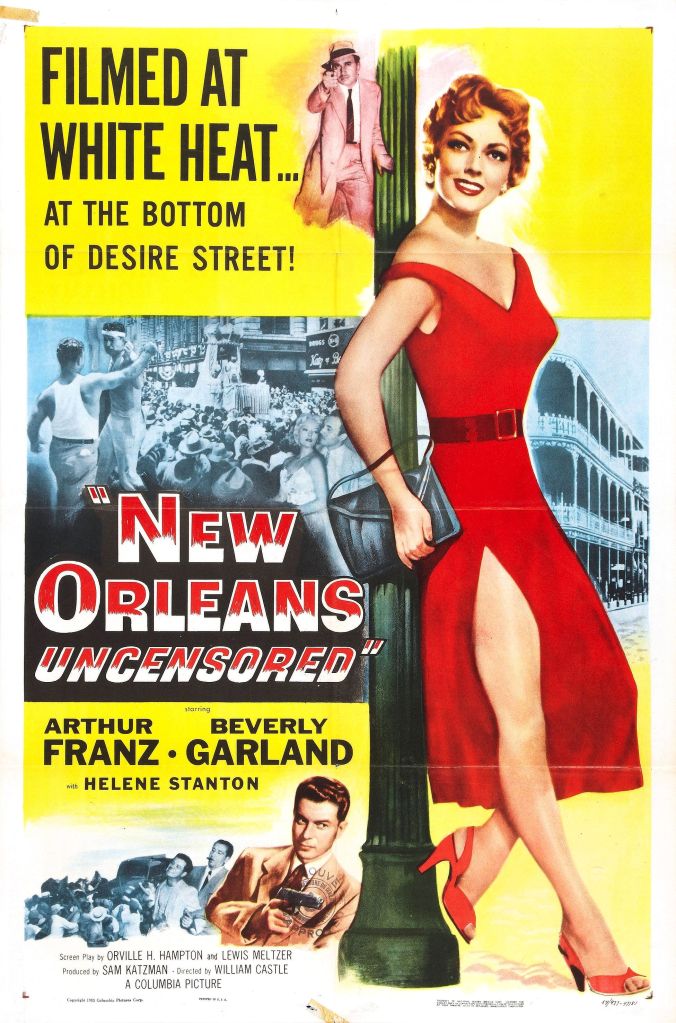
New Orleans Uncensored (1955)

The Prytania has been running an unofficial William Castle retrospective over the past few months as part of their ongoing Classic Movies series. That programming choice made a lot of sense around October, when Castle’s iconically kitschy team-ups with Vincent Price – The Tingler, The House on Haunted Hill, 13 Ghosts, etc. – where a perfect celebratory lead-up to Halloween. One Castle title just before that run stood out like a sore thumb, though, as it predated his infamous theatrical horror gimmicks and instead fell into a genre Castle isn’t often associated with. New Orleans Uncensored is a cheap-o, locally shot noir about corrupt shipping dock workers, much more in tune with films like Panic in the Streets than anything resembling the Percepto! or Emergo! horror gimmickry that later made Castle a legend. The director does find stray chances to exhibit his eye for striking, attention-grabbing imagery throughout the film, but for the most part his presence is overpowered by New Orleans itself, making the film more of a worthwhile curio for locals than it is for Castle fanatics.

Originally titled Riot on Pier 6, this film mostly concerns the organized crime rackets that had quietly, gradually overtaken hold of the second largest port in the U.S. Amazingly, it frames the suggestion that New Orleans government & business might be susceptible to corruption as a total shock; sixty years later it’s as obvious of a fact as the sky being blue. The docks themselves are portrayed as gruff working-class playpens where fistfights often break out en mass to the point where workers are recruited for professional boxing careers and assigned nicknames like “Scrappy.” This wild, bully-overrun schoolyard is controlled from behind the scenes by a few Dick Tracy-level mobster archetypes who tend to fire bullets instead of throwing punches, the cowards. We watch a naïve outsider who hopes to start his own legit shipping business at the docks get seduced by the power & convenience the existing mafia structure offers him instead; he then eventually helps the fine folks at the NOPD take those criminals down once he realizes the full scope of their corruption & violence. It’s all very surface-level, familiar noir territory.

The one distinguishing element of New Orleans Uncensored is the visual spectacle of its locale – a 1950s New Orleans backdrop that looks almost exactly the same half a century later. Whereas Panic in the Streets was a document of local faces & personalities, Castle’s film is actively interested in documenting the physical locations of the city like an excited sight-seeing tourist. Panic in the Streets was mostly contained at the shipping docks and backrooms that concerned its plot, while New Orleans Uncensored goes out of its way to capture as many of the city’s cultural hotspots as possible: Pontchartain Beach, The Court of Two Sisters, Jackson Square, French Quarter nightclubs, Canal Street float parades, etc. In one particularly egregious indulgence in sight-seeing, a couple shares a nightcap beignet at Café du Monde, claiming the ritual is “a traditional New Orleans way of saying goodnight.” It’s practically a tourism board television ad. Of course, as the title suggest, the appeal of this local sightseeing to outsiders is the city’s national reputation for sin & debauchery. The film’s plot about corrupt shipping dock companies getting their due punishment for their transgressions against social order is mostly an excuse for displaying as much sex, drunkenness, and Cajun-flavored merriment as the Hays Code would allow. That becomes a major problem in the snooze of third act when the tourism is sidelined to resolve the much less engaging mafia plot, but it’s fun while the good times last.

There isn’t much room for William Castle to show off this unique touch for attention-grabbing gimmickry & cheap-o surrealism while ogling “The Mistress of The Mississippi.” Outside an opening credits graphic where a disembodied hand stamps the word “UNCENSORED” on a map of the city and a drunken montage depicting an all-nighter of a couple partying until dawn in French Quarter nightclubs, Castle is fairly well behaved in his visual stylings. The closest the film comes to touching on his iconic gimmickry is the way the movie is presented as if it were a documentary instead of a fictional drama – bolstered by stock footage & news reel voiceover. However, that choice often reads as an Ed Woodian means of cutting financial corners more than some deliberate artistic vision. If anything, the movie does function as a genuine documentary, as its sightseeing record of a 1950s New Orleans is far more valuable & purposeful than its criminal conspiracy drama or its William Castle visual play. The history & personality of the city is far more pronounced than Castle’s here, and if the movie maintains any value as a cinematic artifact it’s in that local tourism.

-Brandon Ledet

Roger Ebert Film School, Lesson 31: GoodFellas (1990)

Roger Ebert Film School is a recurring feature in which Brandon attempts to watch & review all 200+ movies referenced in the print & film versions of Roger Ebert’s (auto)biography Life Itself.

Where GoodFellas (1990) is referenced in Life Itself: On page 157 of the first edition hardback, Ebert explains his general taste in cinema. He writes, “Not all good movies are about Good People. I also like movies about Bad People who have a sense of humor. […] Henry Hill, the hero of GoodFellas, is not a good fella, but he has the ability to be honest with us about why he enjoyed being bad. He is not a hypocrite.”

What Ebert had to say in his review(s): “Most films, even great ones, evaporate like mist once you’ve returned to the real world; they leave memories behind, but their reality fades fairly quickly. Not this film, which shows America’s finest filmmaker at the peak of his form. No finer film has ever been made about organized crime – not even The Godfather, although the two works are not really comparable.” -from his 1990 review for the Chicago Sun-Times

“What Scorsese does above all else is share his enthusiasm for the material. The film has the headlong momentum of a storyteller who knows he has a good one to share. Scorsese’s camera caresses these guys, pays attention to the shines on their shoes and the cut of their clothes. And when they’re planning the famous Lufthansa robbery, he has them whispering together in a tight three-shot that has their heads leaning low and close with the thrill of their own audacity. You can see how much fun it is for them to steal.” -from his 2002 review for his Great Movies series

Whenever pressed for my Favorite Movie of All Time, my answer tends to flip flop between Paul Thomas Anderson’s Boogie Nights & Martin Scorsese’s GoodFellas. Neither answer is especially bold or indicative of my general tastes. They’re both massively popular titles with wide appeal. Still, they’re the two films I revisit most frequently and the two I think best exemplify everything cinema can be: terrifying, erotic, hilarious, gorgeous, musical, etc. Arriving years later than GoodFellas, Boogie Nights certainly pulled a lot of influence from Scorsese’s gangster magnum opus: absurdly complex tracking shots, sensual immersions in pop music indulgence, a narrative structure that posits the 1970s as a glorious time of hedonistic excess & the 1980s as dark times of cocaine-fueled downfall, etc. That more or less makes GoodFellas the birthplace of what I love most about modern cinema and, thus, leaves me no choice but to shamelessly gush without criticism whenever prompted to discuss it.

Scorsese reportedly wasn’t interested in making another organized crime picture after the early effort Mean Streets already covered what he wanted to say on the subject. Reading the Nicholas Pileggi book Wiseguy: Life in a Mafia Family on the set of The Color of Money completely turned him around on the idea. The book’s sweeping, decades-spanning look at how the Italian mafia operated on both a generational/cultural level and on a day-to-day operations basis inspired him to want to tell a mafia story that plays “like a two and a half hour trailer.” The result is a lyrical sense of pacing that both moves from the 50s to the 80s with the patience of a flood and freezes still for intimate moments of violence & tension when the situation calls for it. I could easily see that same “two and a half hour trailer” Scorsese quote being turned around on the film as an insult, but for me it’s pure pop cinema bliss. GoodFellas evolves the French New Wave influences that excited New Hollywood auteurs in the early 70s into an entirely new, powerful beast. It sets in motion a near-undetectable shift in cinematic language that feels Citizen Kane-esque in the way it wasn’t immediately appreciated, but informed everything that followed in its wake.

Although GoodFellas follows dozens of characters over the span of four decades, it’s solidly anchored by its narrator & POV character Henry Hill, modeled after a real life mobster by the same name. The story begins with adult Hill (played by a career-high Ray Liotta) opening the trunk of a car to stab & shoot a wriggling victim inside who had been annoying him & his two closest cohorts (played by Robert De Niro & Joe Pesci) with their pathetic cries for help. As this motley crew mercilessly ends their victim’s life, Liotta intones, “As far back as I can remember, I always wanted to be a gangster.” Scorsese does almost too good of a job of communicating exactly why someone would want to join the violent world of organized crime. The film follows Hill from his powerless youth as the son of Irish & Italian immigrants to his godlike power as an adult gangster with two mistresses and an endless network of untouchable killers who have his back. Scorsese also gets across the pitfalls of burning that fast & bright, as well the ugliness of a life in crime in general: the murders, the drug addiction, the paranoia of police scrutiny, the casual racism, etc. Coppola’s The Godfather trilogy may attempt a more ambitious summation of mafia culture in its endless scope & runtime, but the way GoodFellas boils that same subject down to its most essential pleasures & tragedies in just over two hours is far more miraculous in both its efficiency & its moment to moment effect.

Scorsese declared that he wanted to model GoodFellas‘s overall style after the New Wave classic Jules and Jim, especially in its narration, quick cuts, freeze frames, and wide variety in setting. He was deliberately attempting to overwhelm his audience with the intoxicating allure & apocalyptic downfalls of a life in crime. This effect can be achieved with the odd power of the tracking shot from NYC streets to the front row table at the Copacabana nightclub. It can be built through a thirty minute exercise in Hitchcock-flavored tension as narcotics officers close in on Henry Hill’s drug-running empire, It can also burst out quickly in a pop music montage that reveals an extensive line of dead characters disposed of without ceremony. From the giallo purples & reds of the nightclub lighting to Liotta’s constant narration commanding the pace with meticulous control, GoodFellas feels like Scorsese’s attempt to throw everything he knows about cinema at the screen in every single shot. Much like its well-balanced soundtrack (featuring artists like The Ronettes, The Shangri-Las, Cream, and The Rolling Stones), GoodFellas feels like a Greatest Hits collection of cinematic techniques, perfectly curated so the album only feels more charming on every revisit instead of making you long for the sources it borrowed from.

Besides its eclectic, immaculate approach to craft behind the camera, GoodFellas also boasts some of cinema’s all-time best dramatic performances. As the centerpiece, Liotta obviously commands a lot of attention, especially with his maniacal laugh & coldly brutish readings of lines like, “Everybody takes a beating sometimes,” and “Fuck you, pay me.” Although she isn’t afforded nearly as much time in the spotlight, Lorraine Bracco’s role as Henry’s wife, Karen Hill, is occasionally allowed to overpower his perspective with her own narration. She does a great job of getting across the allure of being married to a mobster (“I gotta tell the truth, it turned me on,”) as well as directly vocalizing Scorsese’s intent to leave the audience feeling dizzy or drunk. Mobsters with names like Frankie No-Nose & Jimmy Two-Times round out the rest of the cast, but only De Niro’s mentor-turned-bully & Pesci’s loose cannon hothead threaten to steal the show. Pesci, in particular, lends credence to Scorsese’s claim that in-character ad-libs guided rewrites of the script. Whether delivering lines like “Fuck ’em! Fuck ’em in the ear,” or lightly ribbing his mother (played by Scorsese’s real life mother Catherine Scorsese) over her mediocre painting skills, Pesci feels like he fully embodies the character. In fact, the entire cast feels like they were born to play their respective roles, which might help explain why (most of) their careers have felt relatively lackluster since.

Although it certainly traffics in populist cinema waters, GoodFellas has a natural divisiveness to it, possibly in part because of its omnipresent narration & deliberately overwhelming pace. The film feels now as if its legacy as an all-time classic is solidified, but there were multiple walkouts during its test screenings & the only Oscar it won from its six (mostly technical) nominations was for Joe Pesci’s performance. I do not have the critical ability to step outside of myself and consider its flaws. My admiration for it only grows in every revisit and I love getting swept up in its crushing flood of pure cinema bliss. The only film I could maybe claim better delivers on its exact formula is Boogie Nights, but that’s a point I flip flop on as often as I revisit either work individually. GoodFellas might just be the best the medium has to offer.

Roger’s Rating (4/4, 100%)

Brandon’s Rating (5/5, 100%)

Next Lesson: The Marriage of Maria Braun (1979)

-Brandon Ledet

The Legitimacy of Paranoia in Mikey and Nicky (1976) & Mickey One (1965)

One of the most immediately striking aspects of Elaine May’s Mikey and Nicky is the way the film’s in media res introduction completely disorients anyone trying to get a grip on its overall narrative. The film opens with a strung out criminal played by John Cassavetes bunkered down in a shit hole motel, deathly paranoid that someone is out to kill him. He brings in an old friend, played by Peter Falk, to help him escape this fate and to sober up enough to not die at his own hands from the side effects of nihilistic alcoholism. As time goes on in the film, the audience is gradually clued in to the fact that this fear of assassination is very much legitimate. Cassavetes’s anti-hero (emphasis on the “anti”) is indeed being hunted down by the mafia for a past offense, no matter how often his only friend in the world lies to his face by telling him everything’s going to be okay and that he’s just being paranoid. I got the feeling while watching this story unfold that I had recently seen a similar scenario play out in another ramshackle organized crime picture from the New Hollywood era, its paranoia being especially reminiscent of the early scenes in Cassavetes’s motel hideout.

Arthur Penn’s forgotten surrealist crime thriller gem Mickey One preceeds his New Hollywood kickstarter Bonnie and Clyde by a couple of years, but also stars Warren Beatty and attempts to marry French New Wave sensibilities to a new flavor of American Cinema just like that bonafide classic. In the film, Beatty plays a stand-up comedian who finds himself at odds with the organized crime syndicates who run the nightclubs that employ him as an entertainer. Convinced that he’s in immediate danger of having his life ended and his body anonymously dumped in a junkyard, Mickey changes his identity and attempts to hide out doing menial labor until the spotlight calls his name so loudly that he cannot resist and again risks being assassinated to pursue his craft. Unlike in Mikey and Nicky, however, this paranoia is never explicitly justified in the film by outright threats from the mob. We’re never even sure if Mickey is being targeted by the mob, let alone why. It could very well be all in his head, as it’s only represented onscreen through a few side glances from menacing strangers, a beating in a dark alley way, and the intense scrutiny of stage lights during an existentially terrifying audition sequence. It’s all very abstract in comparison to the real world that represented in May’s film, despite where that one starts.

A significant difference between the depiction of paranoia in Mikey and Nicky & Mickey One might be tied to their positions within the New Hollywood movement. Mickey One was a precursor to New Hollywood sensibilities, still holding on tight to the art film abstraction that guided the French New Wave films that inspired the movement’s young auteurs. Mikey and Nicky arrived a decade later, joining the New Hollywood fray long after crime films like The French Connection and Mean Streets had already mapped out what an artful organized crime picture would look like in that era. What’s interesting to me (along with the odd similarity in the films’ titles) is the way those two sentiments overlap at the beginning of Mikey and Nicky. We begin the film not fully convinced that there’s any organized threat of assassination at all, as if we’re just listening to Cassavetes’s fears like the ravings of a mad man. That intangible threat of baseless paranoia and question of legitimacy carries throughout Mickey One, which easily matches Mikey and Nicky in drunken, ramshackle energy, but feels much more adrift & untethered to the real world. Even though I heartily believe Mikey and Nicky is the better film for that sense of grounded, real world consequences. I greatly respect the way Mickey One was able to sustain that feverish paranoia for the length of an entire picture. I suspect the two titles would make for an exciting double feature if paired together, but be prepared to spend most of the evening checking over your shoulder or else you might get whacked.

For more on May’s Movie of the Month, Elaine May’s small scale mafia drama Mickey and Nicky, check out our Swampchat discussion of the film and last week’s look at its closest Scorsese comparison point, Mean Streets (1973).

-Brandon Ledet

Low Level Crime and New York City Grime in Mean Streets (1973) & Mikey and Nicky (1976)

In our initial conversation about May’s Movie of the Month, the 1976 Elaine May mafia pic Mikey and Nicky, Alli wrote about how the modern organized crime picture as a genre typically is associated with large ensemble casts, gigantic budgets, and sweeping themes about the Italian immigrant experience in modern America. That does ring especially true if you think of Coppola’s Godfather trilogy and Scorsese’s Goodfellas, one of my all-time favorite films, as typifiers of the genre, as you likely should. Mikey and Nicky has much smaller concerns than either of those grand, ambitious works. Instead of attempting to capture the entirety of the mafia’s rise and fall in America, from poverty to opulence to back again, May’s film focuses on the small players who are but individual pixels in that much larger picture. The titular characters of her film, played by John Cassavetes & Peter Falk, are low level nobodies, merely necessary annoyances to their mob bosses, who treat them with open contempt. Staged over the course of a single night, the film’s minor drama reaches its lowest point when the two characters, despite essentially being each other’s only friends in the world, fight over a broken wrist watch in the dimly lit, visibly disgusting streets of pre-Giuliani NYC. There’s nothing grand or glamorous about the organized crime players in May’s film. They’re the lowlifes who’re left to fight over their mob bosses’ crumbs. That sentiment wasn’t entirely absent from Scorsese’s mafia pictures, however, even if his work in Goodfellas later represented Mikey and Nicky‘s aesthetic opposite. Three years before May’s film made it out of editing room post-production Hell, Scorsese had delivered a spiritually similar gangster film, one with common themes about small players fighting over pittances and with a common New York City grime.

I often dismiss Mean Streets as a kind of trial run for what Scorsese would later achieve in Goodfellas, but there’s a distinctly punk, lowkey charm to the film that makes it a rewarding watch in its own right. Harvey Keitel stars as a low level numbers runner who struggles with then-risque topics like interracial romantic desire & atheistic religious doubt. What really creates conflict for him as a low level mafia type, however, is the idiotic proto-punk antics of a life long friend, played by Robert De Niro. Living fast & loud, De Niro’s Falstaffian foil leaves a trail of financial debts & bruised egos wherever he goes, a mess Keitel’s troubled anti-hero often finds himself having to clean up. The dynamic of Mikey and Nicky is more or less the same, with its titular, brotherly lowlife criminals finding themselves at odds because one of them brings hateful scrutiny through his bratty, bridge-burning hedonism. With minuscule budgets & then-unproven directors, both films never had much of a chance to touch the more grandiose mafia stories of The Godfather or Goodfellas. The keep their scopes as small as possible, building tension in the betrayals and petty disagreements between their individual sets of low level criminal fiends. There’s something inherently tragic & pathetic about watching these crime world nobodies butt heads over minuscule debts & mafia etiquette while the higher-ups profit off their violence offscreen. By keeping their stories small & highly specific, both films do a great job in their own way of exposing a larger truth about the world of organized crime, if only by inference. Mikey and Nicky keeps things especially focused & streamlined, playing almost like a two-man stage play for long stretches, but Mean Streets is similarly dedicated to profiling the minor tragedies of low level criminals.

Besides their shared indulgence in minor crime world tragedy, Mean Streets & Mikey and Nicky are also both great snapshots of New York City grime. Scorsese’s reputation as a master of capturing 70s NYC in all of its sleazy glory might be more closely associated with Taxi Driver, which is a film more or less about the subject, but Mean Streets feels almost more authentic for using 70s NYC as a backdrop & a playground instead or a focal point. Keitel & De Niro’s crime-ridden tour of the Old New York is a great atmospheric measurement of the underbelly sleaze and working class angst that would soon lead to the city’s punk rock boom in just a few trips around the Sun. Mikey and Nicky feels even more authentic in its grimy New York City tourism, since it pulls an all-nighter, tearing through NYC street lights past an endless parade of barroom cretins, urban graveyards, and seedy late night cinemas. The New York City portrait captured by these two films a duo is of a city that’s long gone, cleaned up & policed into oblivion. Both films almost function as historical documents in this way, but more importantly, their shared New York City grime is an essential element in their bottom of the barrel crime world tragedies. Scorsese & May’s directorial styles were noticeably disparate in pulling off their minor New York City crime stories, with Mean Streets reaching for the pop music sleekness later perfected in Goodfellas & Mikey and Nicky luxuriating in the rough exploitation film looseness off handheld cameras & improvised dialogue. Together, though, they represent a small scale version of what we’re used to seeing in our mafia media, with more individualized stakes and a decisively punk rock attitude. I believe May made the better film in this pairing, but both entries are worthwhile for very similar reasons.

For more on May’s Movie of the Month, Elaine May’s small scale mafia drama Mickey and Nicky, check out our Swampchat discussion of the film.

-Brandon Ledet