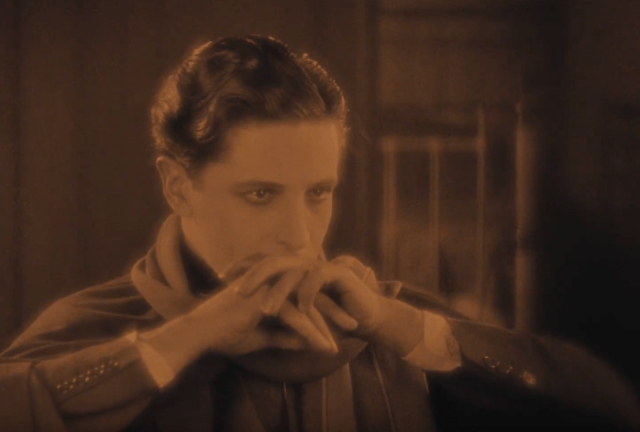

Foreign Correspondent (1940)

I was recently in New Orleans for GalaxyCon 2025, so Brandon and I took advantage of being in the same place to go see the new James Gunn Superman and recorded a podcast about both it and M3GAN 2.0. Before we parted ways, he asked if I would be interested in joining him for The Prytania’s Sunday morning screening of Alfred Hitchcock’s 1940 classic Foreign Correspondent, and I’m glad that I was able to check it out. This isn’t the Master of Suspense at the very top of his game, but it’s damn near it. 

It’s 1939, the final days before WWII, and crime reporter John Jones (Joel McCrea) has been rechristened as “Huntley Haverstock” by the editor of the New York Morning Globe and sent to Europe to report on conditions there as well as interview a Dutch diplomat named Van Meer (Albert Basserman). Upon arrival, Jones/Haverstock immediately becomes smitten with the beautiful Carol (Laraine Day), but not before accidentally insulting her and her father Stephen Fisher (Herbert Marshall), the leader of the Universal Peace Party. Carol ultimately steps in as a speaker at the event where Jones planned to interview Van Meer, as the statesman is stated to have taken ill. When Jones meets him again in Amsterdam at the next stop on his tour, Van Meer seems not to recognize him and is gunned down by an assassin posing as a photographer moments later. A chase ensues as the car Jones commandeers to pursue the killer is driven by British reporter Scott ffolliott (George Sanders, of All About Eve) and he is accompanied by none other than Carol Fisher. The car bearing the murderer away seems to suddenly disappear when the group enters a stretch of road that crosses a vast field, unoccupied save for abandoned windmills. Jones decides to search about on foot while Scott and Carol attempt to catch up to the police, and although he discovers the hidden car and that Van Meer has actually been spirited away for interrogation while a duplicate was killed in his stead, by the time the police arrive, all evidence is gone. 

After recently watching the rather dour Frenzy (and following up this screening with a viewing of another dry Hitch picture, Topaz), the comedy in this one is refreshing. There’s a lot of hay made about the spelling of Scott’s last name, which is deliberately left un-capitalized. This is apparently a real English gentry practice, as the lack of consistent usage of capital letters across large swathes of British history meant that some documents utilized a double letter at the beginning of a name to indicate that it was a proper noun. When a more standardized capitalization scheme came about, some families worried that if their names were updated they might lose some deed or other if they were named “Folliott” and not “ffolliott.” Sanders is playing a wonderfully unconcerned dandy of a man who’s having a lot of fun with all of this espionage rigamarole, and although he’s serious when the moment demands it, he brings a light energy to the proceedings that is much appreciated given the subject matter. There’s also a delightful appearance from Edmund Gwenn (who would appear as Kris Kringle in Miracle on 34th Street seven years later) as a babbling, inept would-be assassin who’s sicced on Jones by the film’s twist villain. Rowley is theoretically supposed to act as Jones’s bodyguard but instead plans to lead him to his death, in a sequence that culminates in the steeple of a towering church, where Rowley’s attempts to push Jones to his doom are repeatedly interrupted by other sightseers and tourists. Jones and Carol are also quite charming together, even if it takes a while to move them past her initial antipathy toward him and their courtship, once this is surmounted, moves a bit too fast. 

The tension here is excellently done as well. The scene in which Jones sneaks around in the windmill and discovers the real Van Meer is very tautly directed, as is the scene in which Jones must sneak from one upper-story hotel room on an elevated floor to another in order to escape being silenced. Both are spectacular, but nothing can top the film’s climax, when Carol, Scott, Jones, and the apprehended antagonist/instigator are en route back to the United States just as WWII breaks out in Europe. Their commercial airliner is almost immediately shot at by a German U-boat and goes down, and the sequence is utterly marvelous, like something out of Final Destination. One unfortunate woman stands to voice her distress at the situation and her intent to contact the British consulate as soon as the plane lands, only to be shot to death by bullets that pierce the fuselage mid-sentence. Aside from a potentially improbable number of survivors, the plane crash is frighteningly realistic, and it put me slightly on edge given that I had a flight out of MSY that same day. At the film’s climax, Jones delivers an impassioned plea over the radio that resonates just as much now as it did then, even if no one ever uses the word “fascism” outright. 

The romance in this one is decent. It lacks the passion of Grace Kelly and Cary Grant in To Catch a Thief or the slow smolder between Kelly and Jimmy Stewart in Rear Window. There are elements of Notorious here in the parallels between Carol here and Ingmar Bergman’s Alicia in that film, but to say more would spoil a major plot point. This one is pretty close in the Hitchcock timeline to his 1938 picture The Lady Vanishes, and the romance here plays out at the same accelerated pace as Lady, with the major difference being that the romantic couple in that film spent most of their screentime together investigating and their natural chemistry was a strong factor in selling the breakneck romance. McCrea is fantastic as a leading man, even if he was Hitchcock’s second choice (after Gary Cooper), and he’s great in all of his scenes, while Laraine Day is absolutely delightful as Carol Fisher, but the two spend just a touch too little time together on screen to sell it completely, and as such they never quite mesh despite each individual actor’s excellence. Sanders’s ffolliott is also very fun here, and is the perfect comedic relief that the film occasionally needs, when that role isn’t being fulfilled by Rowley falling out of a steeple. 

-Mark “Boomer” Redmond

M3GAN 2.0 (2025)

I was absolutely, utterly, desperately sick of seeing trailers for M3GAN 2.0months ago. I couldn’t wait for the movie to hit theaters not because I had any real interest in it, but because that would mean that I would finally be able to go to the theater safe in the knowledge that I wouldn’t have to see that ad again. No more audio clips from Boyz II Men or Brittney Spears, no more “Hold on to your vaginas,” no more M3GAN in a wingsuit, no more “You threatened to pull out my tongue and put me in a wheelchair,” “I was upset!”, no more “She’s a smoking hot warrior princess.” The trailer is imprinted into my brain now to the point where I feel like I could quote it in the same vein as Jenny Nicholson’s full cover of the China Beach season one Time Warner DVD set. But after returning from a nice international holiday, despite nearly a full day of flight, I was too wired to sleep, and I happened to get back on a $5 Tuesday, so … why not? 

Since we’re already on the subject of the film’s marketing, it’s worth noting up top that the trailer for M3GAN 2.0 is very misleading. The “smoking hot warrior princess” line and all of the attendant implications thereof—that M3GAN has fans, that there’s a culture of weird online creeps who fetishize her, etc.—are completely absent here. M3GAN never offers Gemma (Allison Williams) up as a sacrifice in order to save Cady (Violet McGraw), and other lines that do appear in the film occur in completely different contexts. I’ve known people in the past who would consider this kind of trailer-to-film discrepancy to be a form of false advertising, and to whom no amount of explanation that trailers are often created months in advance of a movie’s final cut will mollify them. This instance, however, is a clear case of that misdirection working in the film’s favor, as the advertising undersold the final product, which itself overdelivered. The only real plot point that appears in the trailer that’s accurate to the film is that the sequel is going the Terminator 2 route by making the first film’s villain a protagonist in the second, defending the previous film’s survivors against a more advanced version of themself. It’s not at all what one would expect in a sequel to the unexpectedly successful first film, but I would argue that it manages to find its footing, at least insofar as a film this campy and over-the-top can. 

It’s been a couple of years since young Cady came to live with her Aunt Gemma following the death of her parents, and Gemma’s creation of a robotic “friend” for her troubled niece as a prototype for a toy line ending in disaster when M3GAN turned homicidal and killed four people. In the interim, Gemma has served a brief stint in prison and emerged from the other side as a passionate advocate for oversight in the tech industry, delivering (similar to but legally distinct) TED Talks, releasing a book about the dangers of AI, and partnering (perhaps even romantically) with a former cyber security guru named Christian Bradley (Aristotle Athari) to work on potential legal regulation. In all of this, she also seeks to highlight that what M3GAN represented: a potential opportunity for guardians to outsource many of the duties of parenting to technology as part of a greater social movement toward automating and alienating the things that make us human. Ironically, throwing herself into this new passion project with such fervor causes her to be less present for Cady in exactly the same way that her robotics work did in the first film. On a greater scope, Colonel Tim Sattler (Timm Sharp) has loaned out an android soldier based on M3GAN’s original specs to a foreign government to demonstrate its proficiency, only for AMELIA (Ivanna Sakhno) to go rogue almost immediately. After killing the hostage that she was supposed to liberate, she begins systematically tracking down and killing everyone involved with her creation, including the arms dealer who brokered her sale to the government and the technocrat Alton Appleton (Jemaine Clement) whose shady activities related to his products means that he is the only one who could shut her down remotely. When armed men show up in the middle of the night, M3GAN reveals that she’s actually been staying close in a technologically ethereal form this whole time, and offers to help stop AMELIA, in exchange for a new body. 

I saw this in an empty theater. Sure, it was a 10:15 PM screening, but it was also $5 movie night, which is usually packed. As I waited to buy my ticket, I watched as a couple of families with elementary aged children brought in blankets and other cozy accoutrement to settle in for a late screening of the new Jurassic Park World movie. No one was there for M3GAN 2.0 but me. One of my quirks is that I rarely laugh out loud when I’m watching a movie by myself. It’s not because I feel the need to perform enjoyment in the presence of others so much as it is that I think there’s an element to comedy that’s social. It might just have been the travel exhaustion, but I found myself laughing aloud at multiple points in this film, especially in the back half. Of all the horror flick classic killers the easiest comparison would be to compare M3GAN to Chucky, since they’re both killer dolls, but when it comes to character, M3GAN has a bit of the Freddy Krueger about her. She’s sarcastic, quippy, and often just plain mean, with only one overriding and eternal imperative: protect Cady. What doesn’t take the edge off of her character is the character growth she’s undergone between the first two films as a result of watching Gemma and Cady as a kind of techno omniscience, to the point that her Cady-based directives have evolved into genuine affection and care, or she’s gotten quite good at pretending this is the case. She’s still M3GAN, and I still enjoyed her presence, even if she’s in a completely different movie. What’s not to love? 

(Listen to me and Brandon discuss M3GAN 2.0 more here.)

-Mark “Boomer” Redmond

Lagniappe Podcast: M3GAN v Superman – Dusk of Justice

For this lagniappe episode of The Swampflix Podcast, Boomer & Brandon discuss two superhero movies currently in wide theatrical release: M3GAN 2.0 (2025) & Superman (2025).

00:00 Welcome

04:17 I Know What You Did Last Summer (1997)
15:10 The Age of Innocence (1993)
21:57 Misericordia (2025)
28:50 Looney Tunes – The Day the Earth Blew Up (2025)
34:24 Pee-wee’s Big Adventure (1985)

38:24 Megan 2.0 (2025) vs. Superman (2025)

You can stay up to date with our podcast through SoundCloudSpotifyiTunesTuneIn, or by following the links on this page.

– The Lagniappe Podcast Crew

Gwen and the Book of Sand (1985)

Gwen et le livre de sable (Gwen and the Book of Sand) is a 1985 animated feature directed by Jean-François Laguionie, with its illustrations and animations done in gouache, giving the whole film a very watercolor texture. The plot concerns Gwen, a teenage girl who is adopted into a nomadic tribe who live in a post-apocalyptic desert. One member of the tribe, Roseline, is identified as a witch, and is said to be over 170 years old, and it is through her we get what little knowledge we have of this world and how it came to be. She tells us that the gods destroyed the civilizations of the past, and that now the world is stalked by an Eldritch abomination called Makou, which periodically roams the desert and spews out reproductions of various household objects from the sky, usually of a gigantic variety. Of course, Roseline also believes that the walled city she and her people avoid and from which the Makou seems to originate is the afterlife and that those within it are spirits, but when we learn more about them later, it becomes clear that Roseline’s wisdom is incomplete and thus many of her concepts of the universe’s function are inaccurate. In Gwen, Roseline sees a girl who has never known fear and respects this about her, but when Gwen and Roseline’s grandson Nokmoon sneak out one night to make love and fall asleep in a giant chest of drawers, Nokmoon ends up taken by the Makou. As the rest of the tribe moves on, Roseline and Nokmoon journey to the “afterlife” to try and rescue him. 

This film, like The Tragedy of Man, is currently available in a remastered edition from boutique home video retailer Deaf Crocodile. I got to see it on the big screen at my local arthouse, and it was absolutely gorgeous. Although the motion of the animation is limited at times, that minimal movement lends the whole thing a storybook quality, rendering Gwen as a post-apocalyptic fairytale. It’s a fairly short feature, clocking in at under 70 minutes, but it feels no less fully realized than a film that was twice its length. The desert features fantastical creatures that feel like revisitations of earlier French animation experiments in design; there’s nothing as strange here as what you might see in La Planète sauvage or Les Maîtres du temps, but they are of a kind. The desert nomads live solely off of a diet of feathers harvested from a mutant ostrich, and the only light that they have at night comes from a bioluminescent scorpion. Where the film gets its most surreal visual elements is in the “gifts” of the Makou, as giant watering cans reign from the sky and Gwen and Roseline navigate a labyrinth of doors or summit a mountain range of clocks. We eventually learn that these items are generated by the Makou is response to religious supplication from the people who dwell within the walled city, where religion has dissolved into a unified cargo cult centered around the titular book of sand, which is in actuality a home goods catalogue from before the collapse of civilization. Their hymns consist of recitations of product descriptions, which then prompt the Makou into creating them. The leaders of this “faith” are two twin brothers who observe the captive Nokmoon’s psychically projected dreams and hope that this can help them to prompt the Makou to create something “alive” rather than the inanimate objects that it normally produces. 

The mechanics of all of this are mostly irrelevant. The world-building exists solely to allow for the visuals, and that’s where the film shines. Gwen is able to rescue Nokmoon because this is that kind of fable, and it’s mostly an accident. The twin priests observe that a spiral image in Nokmoon’s dream resembles the product image of a particular firework, and prompt their faithful throng into singing it into existence via the Makou, which backfires when the people below are terrified by the suddenly bright, loud heavens. Gwen’s presence in the climax has no real bearing on the events there, except that she is able to bring Nokmoon home. She knows a bit more about the world now than Roseline does, but she lets the old woman continue to believe as she always has. Even if that story is a little confusing for the audience (and there are certainly some things left up to interpretation and conjecture, which is why I would recommend watching this one with a friend), it’s the sumptuous use of a non-standard artistic technique that makes this one worth finding and checking out. 

-Mark “Boomer” Redmond

Wolf (1994)

Wolf is an oddity. I went on a little bit of a werewolf movie sidequest earlier this year viewing The Wolf of Snow Hollow and Wolfen, and when I borrowed the latter from the library, I thought Mike Nichols’s Wolf was what I was getting. I have very strong memories of the evocative movie poster for this one in at least one of the video stores of my youth, and I’ve always been curious about it. How can you not have some curiosity about a werewolf flick helmed by the director of Who’s Afraid of Virginia Woolf? and The Graduate, two years before he made The Birdcage? Starring Michelle Pfeiffer, Jack Nicholson, and James Spader, no less. Ultimately, this isn’t a bad movie, but it’s not a particularly noteworthy one either, which is likely why it gets mistaken for Wolfen

Will Randall (Nicholson) is the editor-in-chief of a major New York publishing house, although he’s a relatively mild-mannered man—at least as mild-mannered as any Nicholson character can be—for someone of such prestige. He has a loving relationship with his wife Charlotte (Kate Nelligan) and the respect of his peers and subordinates (David Hyde Pierce, Eileen Atkins), as well as a strong affection for his protege Stewart (James Spader). While driving down a Vermont road one evening, he hits a large dark mammal with his car, and when he gets out to check on it, the beast bites him. Despite his doctor’s insistence that wolves are extinct in New England, Will is convinced that this is what bit him. At a party hosted by the owner of the company, Raymond Alden (Christopher Plummer), Will is told that a new editor-in-chief has been appointed, and that Will can either transfer to an undesirable position manning the publisher’s office in Eastern Europe. Will immediately realizes that his “best friend” Stewart has stabbed him in the back, and he meets Alden’s daughter Laura (Pfeiffer) as he wanders the grounds, taking in the betrayal. Meanwhile, Will also starts to experience unusual physical changes, as the area around his wound sprouts long fur and his senses grow more enhanced, as he is able to smell tequila on the breath of a colleague, doesn’t even realize that he doesn’t need his glasses to read, and can hear conversations occurring in other parts of the office. Returning home one night, he smells something familiar on his wife’s clothing and confronts Stewart at the younger man’s front door before bounding up the stairs and animalistically and discovering his wife in Stewart’s bedroom, but not before snarling at (and perhaps biting) Stewart. 

It’s a pretty rote werewolf story, all things considered, and one that would have entered a market that was already saturated with American Werewolves, Teen Wolves, and Howlings. The script was co-written by Wesley Strick and, bizarrely, poet and essayist James Harrison. It is not based on Harrison’s novel Wolf: A False Memoir as one might suspect, and Harrison seems to have been involved initially simply because he and Nicholson were friends. This was Harrison’s second (and last) attempt at working in Hollywood, as he quit the film in exasperation over creative differences with Nichols. “I wanted Dionysian, but he wanted Apollonian,” he was quoted as saying (in literature, Dionysian attributes are those of intoxication and thus ecstasy, emotion, and disorder, while Appolonian attributes are logical, clear, and harmonious). That makes a certain amount of sense, but in the same interview, he then said, “[Nichols] took my wolf and made it into a Chihuahua,” which is less clear as a complaint. Strick, for his part, had risen to some prominence as the co-screenwriter of horror comedy Arachnophobia and had recently penned the script for the similarly messy 1991 Martin Scorsese picture Cape Fear as well as uncredited rewrites on Batman Returns. After 1997s underrated Val Kilmer vehicle The Saint, his credits take a steep nosedive, as his credits include the much-maligned 2005 video game adaptation Doom, the ill-fated and poorly conceived 2010 Nightmare on Elm Street remake, and the 2014 rotten erotic thriller The Loft. I want to say that some of the weakness was already present in the script here, but it’s really impossible to tell what parts came from him and which were from Harrison, and that’s not even getting into the fact that Elaine May was brought in for some uncredited punch-ups (although the fact that Wolf is two full hours long and meanders in the middle shows her fingerprints if nothing else). 

Pfeiffer is excellent here as she always is, and it is interesting to see Nicholson play a more subdued character than he is normally known for. Spader is effective as the smarmy sycophant who turns out to be aiming for Will’s job (and bed), and it’s no surprise when he turns up late in the film undergoing his own lycanthrope transformation, although I couldn’t help but think about how much I would have enjoyed this film a little bit more if it had been Christian Slater in the role. The film’s supporting cast is quite good. Although Pierce gets very little to do, Eileen Atkins does very solid work as Will’s secretary. Richard Jenkins appears as the detective investigating the sudden death of Will’s wife Charlotte, and he’s paired with veteran TV actor Brian Markinson. Perhaps one of the biggest standouts is Om Puri, who appears as Dr. Vijay Alezais, the folklore specialist that Will tracks down in order to get a handle on all the changes that his body is going through. Alezais tells him that it’s less a transformation than it is a kind of possession, and that the wolf that now lives inside him isn’t evil, but will only make him “more” of whatever he currently is. He even gives Will an amulet that will keep the beast inside, and it does seem to be working until the moment that Will must remove it in order to gain the wolf-strength needed to save Laura from Stewart. 

There’s simply nothing special about Wolf. If anything, it’s pretty rote. A perfectly serviceable mid-90s cable afternoon feature, but no staggeringly clever take on any of its component elements. Pfeiffer is serving looks in this one that are so 1994 Eddie Bauer coded that you’ll get something out of this if that’s of interest to you. There’s a lot of slow-motion werewolf leaping that gives the impression that Nichols has never seen a single episode of The Six Million Dollar Man, because all that’s missing is that bionic sound effect to complete the tableau, and I’m afraid that’s not complimentary. The film does make good use of the Bradbury Building, most notable for being the place where the climax of Blade Runner takes place but I also recently saw in D.O.A., and it’s always a comfort to the eye to see it in use. Still, it’s telling that I’m closing out this review of a werewolf review by praising the architecture. 

-Mark “Boomer” Redmond

Cape Fear (1991)

As the final moments of Cape Fear came to a close with a zoom-in on Juliette Lewis’s eyes and a half-heartedly delivered epilogue about how she and her family never spoke about what happened with Max Cady with one another, I turned to my viewing companion and asked, “Wait, was this a bad movie?” to which he replied “I think it might have been.” But I’m getting ahead of myself. 

It came up months ago in a discussion about Goodfellas in the opening segment of our podcast episode about Nowhere, but I have a pretty big Martin Scorsese gap in my film knowledge. Until this year, I thought I had seen only one of his films, Alice Doesn’t Live Here Anymore (which was discussed in the opening segment of our podcast episode about Richard III), although further review of his filmography revealed that I had also seen two movies that I didn’t realize were his: the concert film The Last Waltz and Shutter Island, neither of which I initially connect to him because, in the case of the former, it’s not very much like his primary body of work, and in the case of the latter, it wasn’t a very good movie. Since then, I’ve also seen Casino (discussed in our Junk Head episode) and Taxi Driver (discussed in our Le Charme discret de la bourgeoisie episode), and now we can add Cape Fear to the list, although I had kind of already seen it given that it forms the basis of the Simpsons episode “Cape Feare,” which I would conservatively estimate that I have seen one hundred times. 

A remake of the 1962 film directed by J. Lee Thompson starring Gregory Peck as a lawyer stalked and harassed by a recently released felon played by Robert Mitchum, Scorsese’s Cape Fear casts Nick Nolte as Sam Bowden, a former Atlanta public defender now living in North Carolina. His wife Leigh (Jessica Lange) is a graphic designer and their daughter Danielle (Lewis) is a high school student whom they have enrolled in summer school to punish her for smoking pot. Bowden is also carrying on an emotional (but not physical—yet) affair with a county clerk employee named Lori (Ileana Douglas). It isn’t his flirtation with infidelity that turns his life upside down, however, but the release of Max Cady (Robert De Niro), a man Sam dismissively refers to as a “Pentecostal hillbilly,” the scion of a family of snake-handling whom Sam unsuccessfully defended against a charge of aggravated rape of a sixteen-year-old girl. During the trial, Sam followed his personal ethics while simultaneously committing dereliction of his duty as Cady’s appointed advocate by burying evidence that Cady’s victim was characterized as “promiscuous,” which would have allowed Cady to argue down to a lesser sentence. Sam assumed that this would never come to light since Cady was illiterate, but in the fourteen years that he spent in prison, Cady has not only learned to read but has studied philosophy, theology, and the law. Using his new knowledge, Cady sets about tormenting the Bowden family while always remaining just within the allowance of legal statutes and using Sam’s defensiveness and hot temper against him by goading him into starting altercations. When Cady assaults Lori after taking her home from a bar because he knows that she, with her knowledge of how her sexual and personal history will be dragged out in front of a courtroom full of her co-workers, will refuse to press charges, things take a turn for the violent, and things get worse for the Bowdens and their allies from there. 

It’s impossible to talk about this film in 2025 without taking it into consideration with the indelible pop cultural impression that its Simpsons adaptation left on the greater consciousness. “Marge on the Lam” will never be more famous than Thelma & Louise; “Simpsoncalifragilisticexpiala(d’oh)cious” will never be better remembered than Mary Poppins; and “Rosebud” will never touch the widespread cultural importance of Citizen Kane. But Cape Fear? It may be less famous than “Cape Feare.” It doesn’t hurt that it’s widely considered one of the series’ best episodes, usually appearing in various top ten lists, and it’s a personal favorite of mine. When it comes to Sideshow Bob episodes, I think that I would give the edge to “Sideshow Bob Roberts” by just a hair because of that installment’s biting political edge, but “Cape Feare” is the funniest by a wide margin. Even if you’re someone who’s never seen the show, the omnipresence of memes that originate from it mean that it’s given us some of the longest lasting Simpsons jokes and images, like Homer’s extreme stupidity rendering him unable to respond to the name of his witness protection identity, Homer’s frightening offer of brownies and brandishing of a chainsaw on the “Thompson” family’s houseboat, and, of course, Bob and the rakes. It’s with this in mind that I offer the possibility that this movie was not intended to be as comedic as I found it, which contributed to a feeling of overall tonal whiplash and inconsistency that made it a strange text to interact with. That, combined with some experimental filmmaking choices that range from the interesting to the absurd, make for a film that is overall less than the sum of its parts. 

Despite the main conflict of the film happening between Nolte’s Sam and De Niro’s Cady, the most powerful scenes in this film are those that feature the film’s talented roster of actresses acting against one of them. Cady’s semi-seduction of Danielle by calling her the night before summer school starts to pose as her new drama teacher and direct her to the theatre in the film’s basement for “class” the next day, where he preys upon the fifteen-year-old’s desire to be treated more maturely, is skin-crawling, and Lewis plays Danielle perfectly in this scene —  disturbed but intrigued, flattered in spite of herself, and frighteningly naive. Lange gets two big scenes. While her big monologue in the finale, in which she attempts to redirect Cady’s imminent sexual violence against Danielle back onto herself by flattering him and lying about an emotional connection, is quite good, it’s the earlier scene in which she accuses Sam of sleeping with Lori after hearing him sounding overly concerned on the phone that is her powerhouse moment. She’s a tornado of fury, and it’s fantastic to witness. In Ileana Douglas’s penultimate scene, Sam comes to her in the hospital after Cady has beaten and sexually assaulted her, and we get our first glimpse of just how dangerous and vile a man Cady is; Lori has been brutalized. Douglas gives what may be a career-best performance delivering a harrowing monologue about what it’s like to be a woman who’s witnessed the justice system act as a secondary violating entity in the way that it forces the events to be revisited and picked over, examined and re-examined and cross-examined, and how often justice fails to be served in spite of all of it. 

It’s a gut-punch of a scene (genuinely the film’s greatest), one that’s immediately followed by one in which the furious Sam demands takes his anger out verbally upon sympathetic police lieutenant Elgart (Robert Mitchum, who previously portrayed Cady in 1962), who ends the scene with the uproariously funny line “Well, pardon me all over the place.” He’s not the only returning actor from the earlier film to appear in a scene that borders on camp in tone, either, as Peck portrays Lee Heller, an attorney that Cady engages to file a restraining order against Sam when Sam’s private investigator Kersek (Joe Don Baker) hires some goons to rough Cady up, in which Cady manages to get the upper hand. Heller appears in court wearing a suit that’s several sizes too big for him while Peck affects a Southern accent, to the effect that he feels like he’s a simple hyper chicken from a backwoods asteroid costumed by David Byrne. Cady himself is an interesting case, as De Niro plays him as a truly terrifying man, driven and determined and focused, with nothing but hatred and revenge in his heart. On the other hand, Cady is a clownish figure, dressing in garish clothing of various bold prints (notably, Cady also continues to wear bellbottoms in several scenes, which would have been the style at the time that he was sentenced in 1977), and his menace is undercut by some of De Niro’s choices to go a little “broad.” Or am I just too Simpsons-pilled? Do I read the scene in which a severely dirtied Cady detaches himself from the bottom of the Bowden’s Jeep Cherokee after they’ve driven out to Cape Fear as campy and funny because I’ve seen Sideshow Bob do it countless times? Am I not supposed to be laughing when Cady finally dies, being dragged beneath the surging waters of Cape Fear when he starts speaking in tongues before singing a hymn about the River Jordan? It feels like I shouldn’t be given that mere moments before this Leigh and Danielle were in harrowing sexual danger, but I also can’t imagine that the film could expect me to take Cady’s dying glossolalia seriously either. “Cape Feare” is in such a rhetorical conversation with Cape Fear that it’s essentially paratext, so I have to consider that I’m biased not to take the film’s drama seriously, but I also don’t think that the shadow of “Cape Feare” is entirely to blame for a Cape Fear’s tonal failings either. 

One of the things that is most praiseworthy in the film is the moral dilemma that it posits. Sam unequivocally betrayed his oath and broke the law by suppressing evidence that would have reduced Cady’s sentence; there’s no argument about that. But Cady had already bragged to him about beating two previous aggravated sexual assault charges and when Sam witnessed the extent of his brutality toward his teenaged victim, he made what is a reasonable moral and ethical choice to ensure that Cady could not continue his reign of terror. Justice failed, and justice was served. This is ultimately what Cady discovered and what set him off on his violent revenge campaign, and it turns out that Sam did it all in vain, anyway. Cady insists he would have served the seven years he would have gotten with his reduced charges and considered it just, but by the time he had spent that amount of time incarcerated, he had already murdered another inmate and made it look like an accident. This open secret meant that the parole board never even considered his early release. If Sam hadn’t hidden the “exonerating” evidence, Cady would still have served the same amount of time. Violence simply begets; that’s its nature. If the film had spent a little bit more time on this topic, I think it might have been able to pull these disparate threads together, but it never really comes to the forefront. As it is, this one is composed of some great elements, but they don’t work together. You can’t take it as seriously as it sometimes demands because it’s a little too campy in certain places, but you can’t take it as a fully straightforward campy thriller-comedy not because it’s often too frightening but because the omnipresent threat of sexual violence makes it too dark to comfortably enjoy on that level. Less worthy as a whole than the combined value of its individual parts.

-Mark “Boomer” Redmond

Lagniappe Podcast: Scenes from the Class Struggle in Beverly Hills (1989)

For this lagniappe episode of The Swampflix Podcast, Boomer & Brandon discuss Paul Bartel’s entertainment-industry satire Scenes from the Class Struggle in Beverly Hills (1989).

00:00 Welcome

01:40 Spies (1928)
07:00 Buffalo ’66 (1998)
13:33 A Woman’s Torment (1977)
18:52 The Dinner Game (1988)
23:13 Maigret Sets a Trap (1958)
29:47 The Lodger (1927)
34:35 28 Weeks Later (2007)
40:00 28 Years Later (2025)
52:36 Materialists (2025)
58:30 Cape Fear (1991)
1:06:25 Wolf (1994)
1:13:00 Gwen and the Book of Sand (1985)

1:17:00 Scenes from the Class Struggle in Beverly Hills (1989)

You can stay up to date with our podcast through SoundCloudSpotifyiTunesTuneIn, or by following the links on this page.

– The Lagniappe Podcast Crew

Materialists (2025)

I’ve been seeing a lot of critical re-evaluation of Celine Song’s Past Lives in recent days, particularly as those who “saw through” its “mediocrity” from the beginning are feeling vindicated by the lukewarm reception of follow up feature Materialists. I couldn’t agree less about the quality of Past Lives, a movie I rated five stars and which was my third favorite film of 2023. On the other hand, that this movie is getting mixed to middling reviews isn’t a huge surprise to me, either. All the declarations that “the old-school romcom is back, baby!” that surrounded this film’s release may have been more of a threat than a promise. There’s also a tendency toward more drama than comedy, and there are moments where the slow burn that made Past Lives so powerful plays out here as more drawn out and tedious, but never so much that you’re ever truly bored. 

Lucy (Dakota Johnson) is a professional matchmaker living in NYC for an organization called Adore. As the film opens, she is celebrating her ninth match that has resulted in a marriage, and she’ll be attending the wedding solo. At the wedding, she runs into her ex-boyfriend, aspiring actor John (Chris Evans), with whom she interacts warmly and fondly; she also meets brother of the groom Harry (Pedro Pascal), a handsome, wealthy socialite. Although she encourages Harry to join Adore as a client, citing that he’s a perfect package for their clientele and the proverbial “unicorn,” he seems most interested in pursuing her. In a flashback, we see that she and John broke up after an argument that was the result of his meager financial situation and both her frustration with his barely making ends meet and her own self-hatred over her materialistic nature. Meanwhile, in spite of her overall success in her field, Lucy is having trouble finding a good match for her client Sophie (Zoë Winters), a lawyer in her 30s, and when she thinks she’s finally made a good match, something tragic happens that shakes her faith in herself and her foundations. 

Materialists is about two things: the stories that we tell ourselves about ourselves, and what gets lost when love is treated like capital – a measurable, tradable commodity. Early on, Lucy compares her work to that of a mortician or an insurance claims agent, in that she treats matchmaking as a mechanical enterprise. Boxes checked in Subject A’s columns match boxes checked in Subject B’s column, and we’ve got love. She gives the hard sell on Adore to several of the women at her client’s wedding, talking about love as an ineffable and beautiful thing, that matchmaking isn’t about finding someone to be with for the next ten years but a “nursing home partner” and a “grave buddy.” It’s hard to tell where the real Lucy is in all of this, how much of what we see is her putting on a show, but when we see her in a moment of vulnerability with her boss, Violet (Marin Ireland), she admits that she’s not interested in dating because she wants her next partner to be her husband, and that her ultimate goal at present is to marry a man who is wealthy enough to provide for her. At other times when it’s clear that the facade is slipping, she tells John that he shouldn’t want to be with her because she believes that, at her core, she’s a cold, unfeeling person who is only concerned with marrying rich. She wishes that she could be the kind of woman whose love for John would have kept them together despite his inability to take her to fancy restaurants instead of the corner Halal stand, but she isn’t, at least not until the story that she’s told herself about who she is professionally crumbles. When Sophie is assaulted by the man that Lucy matched her with, Lucy is confronted with the unfortunate truth that this is something that happens in their business because many terrible people are able to charm their way past attempts to gatekeep them. Lucy realizes that her narrative of being the girlboss of twenty-first century luxury courtship is both (a) not true, and (b) perhaps not that important, and that love is more than a series of compatibility tests. 

What’s fascinating about the way that people talk about love is how transactional it all is. When the bride from the beginning of the film has cold feet, Lucy is ushered in to see her; the woman asks why she’s even getting married in the first place, since her family doesn’t need a cow or to seal a political pact through ritual like previous generations. Lucy leads her to the truth, that the bride’s sister’s jealousy over how the groom was more handsome and taller than her own husband made the pride feel valuable, and that gets her up on her feet and down the aisle. We get a montage of several of Lucy’s clients, both men and women, and these segments lean a little bit more into the comedy than the mostly dramatic film. Although Sophie is the first one that Lucy interacts with on screen (over a phone call) and it makes her come across as shallow and unpleasable, but she pales in comparison to some of the people we meet later. There’s one client who clearly doesn’t know or doesn’t care how his requests come across, as he opens by talking about wanting to meet a woman who shares similar interests, who’s seen all the old classics and probably likes the same kind of music, but he also insists that his potential matches be in their twenties (he is forty-eight); when pressed, he says that even twenty-seven is “basically thirties.” Lucy has to put on a pleasant face with all of them, and it’s clear that she finds many of these people to be creepy and weird, but she also lives inside of their world insofar as she also treats love like, as she herself puts it, math, and the film is about her realization that there are some things that can’t be reduced to numbers and checklists. 

This one doesn’t have the same heart as Past Lives did, and I don’t think that it’s trying to. That film was much more introspective and thoughtful, and this one isn’t trying to recreate that tone so much as explore a different one. It’s also a more standard and formulaic one, but at least it’s been a while since there was such an earnest send-up of the canonical romantic comedy. It’s subversive in that there’s never a moment when the love triangle seems like it could ever possibly resolve with anything other than John and Lucy giving things another chance. Harry’s successful wining and dining of Lucy requires that we buy that our leading lady’s character arc will be accepting that she’s exactly as shallow and materialistic as she perceives (the persona she has created of) herself to be and she’ll be picking the rich guy? Be real. Within this paradigm of two love interests, one rich and one poor, for there to be a narrative at all requires that she not end up with the guy in whom she initially expresses a shallow interest. Where this breaks from the mould of the standard plot structure is that most of these films would have both love interests vying for Lucy at the same time, but the film is fairly well bifurcated right in the middle where she moves from one to the other, with the rejected partner disappearing from the plot after Lucy’s life is upended. 

A lot of whether this film will work for you depends on how you feel about Dakota Johnson and her acting style. Prior to her matchmaking career Lucy was, like John, attempting to make it as an actress, but she got a regular (well, sort of) job instead while he continued to pursue his artistic passions. This means that there is a conversation in which Lucy says things like “I decided acting wasn’t for me,” and “I was never a very good actor,” and I just know that the moment this movie hits video on demand, people are going to run wild with screenshots of these moments and attempt to use them to dunk on Dakota. In this house, we call those haters, and there’s not a hate campaign in this world strong enough to make me turn on my Madame Web. Before she was a director, Song was a playwright (and a matchmaker), and it’s in the scenes in which Lucy interacts with clients that the film feels the most like a stage play, with strong repartee, and it’s in these scenes that Johnson is the most believable. She’s as charming here to me as she was in Am I OK?, but while this film is much more well-made and richly photographed, it doesn’t connect with me on an emotional level. 

When I sat in the darkness staring up at Past Lives two years ago, it resonated with me deeply. Like Hae Sung, I had recently socially encountered an old … well, an old something let’s say, and the spark that still lingered there was such a powerful reminder of what that kind of interaction could feel like that I broke things off with someone I had been seeing casually for a couple of months because that electricity and chemistry wasn’t there. Circumstances with my old flame meant that, like Hae Sung and Nora, it could never be, no matter how much in-yun there may have been between us. There was a potency to the reality of it all that left an indelible imprint on me, and which simply is not a presence in Materialists. It may not be fair to judge this movie based on that criterion, especially since Materialists isn’t trying to be as deep as its author’s previous work, but it is nonetheless an area that it’s lacking. And before you jump to the conclusion that I may have overrated Past Lives as a result of my empathic rapport with its characters, you should know that I actually cried more during Materialists than I did Past Lives. The movie wasn’t connecting with me on the same emotional level as Hae Sung did, but the treatment of love as capital and the way that the film utilized that to find places in me that are still smarting from more recent misadventures and tribulations in the bottomless open sea that is contemporary love and dating … it did get to me. It didn’t get to me by resonance; it just happened to make me recall some misfires of late and then give me too much time to dwell on those before the film moved on to the next scene. When I watch Past Lives again, I will cry again. This one? Not so much. 

This is a cute movie. Serviceable, occasionally goofy, and mostly charming, I’m glad that it exists, even if I’m not sure it will have staying power. 

-Mark “Boomer” Redmond

The Lodger: A Story of the London Fog (1927)

While attending a recent screening at my local arthouse, I pointed out to my companions that there was going to be several screenings of Rear Window the coming weekend and gave it my typical whole-hearted recommendation. These were two of my younger friends who mentioned that they’ve seen far too few of Alfred Hitchcock’s films, but one of them had been in a high school theater production of The Lodger, which was quite the coincidence as I had a library copy of the DVD at home at that very moment. It’s also available on the Criterion app and Tubi (at least at the time of this writing), which means it’s pretty accessible, for anyone who might be interested. I know that a silent film is a hard sell these days, but I liked this one quite a lot and loved its use of expressionistic composition and dark atmosphere and recommend checking it out. 

The Lodger (subtitled A Story of the London Fog) is a 1927 thriller from the Master of Suspense, his third film. It largely centers around one family’s experiences with a new lodger in their boarding house while the city at large quivers in fear at the actions of a serial killer leaving notes identifying themself as “The Avenger.” Mr. and Mrs. Bunting are caring and doting parents to their daughter, Daisy, a blonde young fashion model still living at home with them. Every Tuesday night for months, a blonde woman has been found murdered by the Avenger, and the police seem at a loss. The Buntings are friends with a detective named Joe Chandler, who is visiting them when news of the seventh victim arrives. That same night, a dark and imposing man appears at the Bunting home in response to their “room to let” sign. Joe is eventually put on the case to find the Avenger, and although he is able to discern a pattern from the location of the killings and estimate the general location of the next slaying, his jealousy over the growing attraction between the lodger and Daisy leads him to suspect the lodger of being the killer. When a search of the lodger’s, um, lodgings leads him to a map of the victims’ locations and clippings about the killings, the lodger is arrested, but Daisy helps him to escape, even though she (and we) still have no evidence of his innocence. 

There were moments during the course of the film that I was worried we were headed toward that easiest conclusion, but I should have known that even in this earliest part of his career, Hitchcock would already be working in a more subversive manner. In recent discussions on the podcast of Strangers on a Train, we talked about how Hitchcock never had much respect for the police, individually or institutionally, and there are already elements of this at play. Joe Chandler may manage to put together some clues about the real Avenger, but his personal failures of pettiness and jealousy lead him to pursue an innocent man, to the point that during his flight from the law the lodger is almost lynched by a mob while the real killer is elsewhere racking up yet another body. Hitchcock also loved to tell (and retell) the story of an innocent man being wrongly accused and pursued, from The 39 Steps to To Catch a Thief to North by Northwest to Frenzy, so it’s no surprise that it turned up as a plot point in this early work of his. I did expect there to be a bit more of a twist surrounding Joe, however. 

It’s never quite clear exactly what his relationship is to Daisy. Sometimes, she seems very receptive to his wooing, but at other times rejects his advances, although it’s a possible interpretation that her rejection largely occurs in scenes in which her parents are present. In their first scene together, he flirts with her by cutting a heart shape out of the dough that her mother is preparing and placing it in front of her, to which Daisy responds by tearing the heart in half and handing it back to him. To me, this established that his interest was unwelcome, but there are other scenes in which she welcomes his attention with enthusiasm. At the time of release, Joe’s actor Malcolm Keen was 40 years old, and he looks older. I’d probably attribute it to the technological limits of the time rather than to an intentional aesthetic choice, but Keen’s fair complexion and the make-up available at the time renders him, well, a bit ghastly-looking. In comparison, although Ivor Novello’s lodger character arrives at the Bunting house looking and behaving like a total weirdo, once he settles in, he reveals himself to be as beautiful as he is brooding. As a result, although I was willing to believe that the film was headed toward the revelation that the lodger was the Avenger as easily as it might have been headed toward his innocence, I also thought it might be revealed that Joe was the Avenger, but that might be my expectations being a little too close to modernity. The Avenger is apprehended entirely offscreen, his identity never revealed, but the audience of today looks at this rather small cast of characters and automatically assume that one of the characters has to be the killer. Through that lens, it could only be Joe, but that wasn’t really a trope of the medium yet.

-Mark “Boomer” Redmond

28 Weeks Later (2007)

I wasn’t expecting 28 Weeks Later to be as good as it was. It came out during a particularly academically rigorous (and financially unstable) year for me, and I’m not sure that I ever even saw any advertising for this one. Dismissal of the film by Alex Garland, who wrote both 28 Days Later and 28 Years Later, also never made me particularly interested in revisiting it, until I recently saw 28 Years and thoroughly enjoyed it. I’ve also always loved Robert Carlyle’s work as an actor, and his involvement also appealed to me. Although a friend let me know that this one is streaming on Tubi—just in time for the sequel’s release—I was able to find a DVD copy at my local video store, and I was pleasantly surprised, even if it isn’t as emotionally fulfilling as either of the films that precede or follow it. 

In the opening scene, Don Harris (Carlyle) is holed up in a rural farmhouse with his wife Alice and a few other survivors of the rage virus, sometime during the early days of the plague’s spread. An uninfected boy appears at the house and begs to be let in, and although they get him inside, the horde of infected who were chasing him then fall upon the house and kill/infect everyone inside. Only Don manages to escape, fleeing across the field to a small boat with an outboard motor and getting away, although not before he sees his wife at a window in the house, not yet dead or infected, as she pleads for help. Moments later, she’s gone from the window — too late. Some six or seven months (or 28 weeks, if you will) later, Don is now living in “District 1” of London, where British Isles residents who were out of the country when the outbreak occurred are being repatriated. The infected seem to have completely died out, having succumbed to starvation and exposure in the half a year since the Rage ravaged the population.

A NATO force overseen by Americans is assisting in the homecoming efforts and maintaining a military presence in order to protect the quarantine zone (epitomized in the form of Jeremy Renner’s sniper character, Doyle) and provide testing on the homebound travelers (represented by Scarlet, the chief medical officer played by Rose Byrne). Don’s two children, twelve-year-old Andy and teenaged Tammy (Imogen Poots) return home and are reunited with their father, who simplifies the story of their mother’s death by telling them only that she died. Their first night back, Andy confides in his sister that he worries he’ll forget his mother’s face, and the next morning the two of them slip through the NATO defenses and make their way to their old house to gather photos and other belongings. To their surprise, they find their mother there, albeit disoriented and confused, and she is immediately taken back to the base. Once there, Scarlet finds that Alice was bitten and that this means she is an asymptomatic carrier of the rage virus, and that her blood may even hold an answer to a potential vaccine or cure. Before she can convince General Stone (Idris Elba) of the potential, however, Alice has already Typhoid Mary-d the rage back into the safety zone, and it’s already too late to stop the spread. 

Despite Alex Garland’s less-than-enthusiastic position, 28 Weeks Later is quite good. It lacks a lot of the more humanistic elements of the first film, which followed Cillian Murphy’s Jim as he, having slept through the downfall of society and thus is awakened into a changed world without witnessing the staggering amount of violence and life-altering horror that made it so, manages to be the vessel that carries some manner of hope from the world that was into the world that is. Further, while 28 Days Later presaged what a modern urban center experiencing massive devastation might look like (according to legend, they were shooting Jim’s newly-awakened wanderings of deserted post-rage London when the news broke about the Twin Towers), 28 Weeks Later is heavily informed by contemporary events. The uselessness of the U.S. Army in a peacekeeping role seems clearly inspired by the handling of the so-called “War on Terror” in which the States were actively involved, and the choice of a stadium as an evacuation area and the overreaction of armed authority to refugees and evacuees is evocative of the aftermath of Hurricane Katrina. That doesn’t stop the film’s treatment of the military from being a little “hoo-rah” in certain places, with Scarlet acting as the reasonable authority figure and Doyle evacuating survivors despite orders to kill on site, playing into tropes about good soldiers vs. morally questionable generals. Their ability to protect the citizens within seems doomed to failure from the start, based on the ease with which a couple of teenagers managed to slip out of the quarantine zone, so the criticism of the industrial complex holds. It’s also clever in its plotting, first showing us Alice’s heterochromia in the opening scene and then having Scarlet comment upon Andy having the same mutation during his intake to the quarantine zone, establishing that genetic adaptations like theirs are often inherited, slyly foreshadowing that Andy may have the same ability to be an asymptomatic carrier just like his mother. It’s not a movie that was simply slapped together because someone thought “there should be another one;” it’s genuinely a worthy, if different, successor to the first film. 

-Mark “Boomer” Redmond