War and Peace, Part II: Natasha Rostova (1965)

The second part of Sergei Bondarchuk’s four-part adaptation of War and Peace contrasts and serves as companion to the previous film, which focused primarily on the “war” of the title, while Part II: Natasha Rostova, instead gives us a portrait of “peace,” as much as such a thing can exist in the heartland when war is at the borders. Natasha Rostova (Ludmila Savelyeva) played a fairly minor role in the first film, where she appeared as a young girl at a fête hosted in her family home in honor of her older brother Nikolai, before he went off to the war effort alongside Andrei Bolkonsky (Vyacheslav Tikhonov). There, her childhood innocence was a counterpoint to the war that we would soon see, and served as a reminder of what the war was meant to protect. Here, she is still naive, but is reaching adulthood. When she goes to her first ball, we hear her internal monologue as she panics that no one asks her to dance. Encouraged by Pierre (Bondarchuk), who is now officially Count Bezukhov, Andrei takes his “protege” for a spin around the parquet, and it only takes one waltz for sixteen year old Natasha to be utterly smitten with him. 

Andrei, who has been in a state of depression after recovering from his near death in the last film only to arrive home in time to watch his wife die in childbirth, ponders an apparent dead oak in early springtime, and compares himself to it, a hollowed shell that only seems alive. After meeting Natasha, he is reinvigorated, and passes the same tree, only to discover that it has put out new green leaves for the spring. He appears at the Rostova’s home and asks for Natasha’s hand, but states that they should not announce their engagement and instead delay marriage for a year, ostensibly so that Natasha can have some life experiences and decide if marriage to an older man is really what she wants for herself. (It’s worth noting here that I have no idea how old Andrei is supposed to be, but Tikhonov was almost forty.) He goes away to further convalesce abroad, and she goes nearly mad with missing him. Pierre has made some kind of peace with his wife Helene, and she attends the Moscow Opera with Natasha in tow, which leads to the girl meeting Helene’s brother Anatole (Vasily Lanovoy). Anatole was part of Pierre’s old drinking crowd with Dolokhov (Oleg Yefremov), the man Pierre wounded but did not kill in a duel in part one, and is an utter cad. At Dolokhov’s suggestion, he begins to pursue Natasha, despite already having married a foreign woman while serving abroad. When confronted about this by his sister, he declares that either the other marriage is irrelevant in Russia, in which case he gets what he wants, or he’ll be found to be a bigamist and driven out of polite society, in which case he will still get what he wants, which is Natasha’s innocence. Eventually, Natasha’s hostess learns of her plans to elope with Anatole and chastises her, and Natasha breaks down in tears; Anatole’s attempts to abscond with Natasha are repelled by Andrei’s watchmen. When Pierre sees Anatole’s eyes light up at the prospect of being bought off, he calls him a “vile, heartless brood.” 

Andrei is, ironically, no prince either. In the first film, he tries to convince Pierre to never marry, citing his unhappy union with the very pregnant Lise, whom he completely abandons in order to join the war effort despite there being no expectation of him to do so. Textually, it’s a good thing that he did, as he will prove invaluable to the war and a great leader later, but that’s immaterial to his motivations. He returned from the Battle of Austerlitz just in time to bear witness to Lise dying in childbirth and tell her that he loved her and regretted leaving her alone. This time around, he immediately falls in love with a child (the standards of the time notwithstanding), tells her he’ll marry her but not for a year, and then disappears again. (It appears that this delay was a demand by Andrei’s father in the source text, but no explicit reason is given in the film other than the one cited above, that she should be allowed to gather some life experiences before getting hitched to an older man.) When she does become excited at the prospect of marrying him, after spending weeks yearning for him to return to the Rostova family compound, we get to see him react in real time as his affection turns to disgust the moment that the marriage proposal is accepted. I’m not sure if this is an intentionally ugly portrait of Andrei, to show that he’s a man who immediately stops desiring something the moment that he actually has it, but whether this is a deviation from the source text or something that was not considered in the novel is irrelevant; it’s textual here. In the film’s closing minutes, Pierre reminds him of a conversation that the two had in St. Petersburg regarding morality and ethics. “I said that a fallen woman should be forgiven,” Andrei admits, “but I didn’t say that I could forgive her; I can’t” (emphasis added). As someone going into this adaptation with no real knowledge of Tolstoy’s novel, I had assumed that Pierre was one of its heroes, but I’m not so sure now. 

As Natasha breaks down, declaring her life to be over, Pierre cheers her up by telling her that if he were younger and single, he would beg for her hand, and this appears to break her out of her funk. Immediately after, Pierre is taking a sleigh ride when he sees Napoleon’s Comet overhead, and that narration informs us: “It seemed to Pierre that this falling star was a symbol of what was passing in his own softened and uplifted soul.” An image of the comet in the night sky is suddenly harshened by the crashing of a loud, dramatic scare chord, then some peasants crossing themselves, which was a delightful transition. The year “1812” rolls up onto the screen as ominous music plays, and the final image that we see is of Napoleon’s forces invading the western Russian frontier, promising more hideous war in the immediate future, “contrary to human reason, and human nature.” 

After the explosive, violent nature of Part I: Andrei Bolkonsky, Part II: Natasha Rostova is a bit of a breather, which makes the pacing of the whole thing feel slightly less thrilling in comparison. Despite being nearly an entire third shorter than Andrei, Natasha feels longer. The less dense narrative events are given some space to stretch out; it is, perhaps, too much breathing room. Internal monologue is a tricky thing to adapt to film as a medium, and one of the go-to failed examples that always comes to mind is David Lynch’s Dune, in which different characters’ thoughts are shared with the audience via whispery voice over. That’s not a novel idea in and of itself, but everything gets a bit muddied when the audience is bombarded with the thoughts of dozens of people. That tactic was also present in Andrei, but that film was cramming so many things into its long runtime that one didn’t have time to contemplate it. Here, we find the Rostova women preparing for a ball at around eight minutes into the film, and there’s an unfathomably complicated tracking shot as they all get ready, and then at about nine minutes in, they arrive to the gala, where we get another extremely impressive tracking shot that moves from the grand staircase in the entryway of a palace, goes up the stairs in order to watch Natasha and her cousin ascend, then enter the ballroom and wind through the various corridors, and it’s four minutes without a single cut. It’s beautiful and masterful, but we spend a lot of time at this party, to the point that one starts to have a little too much time without anything progressing. One becomes a bit tired of the pageantry and starts to wonder when we’re going to just get on with it, especially since there are still many hours left to go in this story. 

Where the film does see great success is in its style. One gets the feeling that Bondarchuk was delighted to get to play indoors after what must have been a miserable shoot on the first film. There are several sections in which the film becomes a split screen, divided between warm and cold colors, as characters have conversations that parallel one another. It makes for a beautiful tableau:


On the beauty of its images alone, this film safely rides into “excellent” territory, despite not living up to the standard set by Andrei. The ominous cliffhanger ending is a delight, and I’m looking forward to seeing how this plays out in the following segments. You can find Part II on Mosfilm’s YouTube channel here.

-Mark “Boomer” Redmond

War and Peace, Part I: Andrei Bolkonsky (1965)

How do you adapt a novel like Leo Tolstoy’s War and Peace, a tome so notoriously lengthy (587,287 words) that, for over a century, merely having read it was considered a badge of honor, a sign of elite literary prowess? If you’re Paramount Pictures in the 1950s, you cast Audrey Hepburn as the teenaged ingenue Natasha Rostova opposite fifty-year-old Henry Fonda and forty-year-old Mel Ferrer, and you try to cram as much of the novel as you can into 208 minutes (admittedly a runtime not to be scoffed at). Not to be outdone, however, the Soviets decided that a Western War and Peace simply could not be allowed to be the film adaptation that everyone would remember, so they set out on a half-decade journey to create and release four different films, each roughly adapting one of the novel’s volumes. Four Soviet War and Peace films were released between 1965 and 1967, totaling over seven hours of runtiy. Having already seen what masters some of the Soviet filmmakers were, and what stunning pieces of filmmaking they created with The Cranes are Flying and Soy Cuba, when a friend suggested we pursue this massive undertaking, we leapt in with both feet. 

The three primary characters about which the narrative circles are Pierre Bezukhov (Sergei Bondarchuk, who also directed all four films), Andrei Bolkonsky (Vyacheslav Tikhonov), and Natasha Rostova (Ludmila Savelyeva), although Natasha’s involvement with the narrative of Part 1 is minimal. Pierre, the bastard son of an unfathomably wealthy Russian count, has just returned to St. Petersburg after having been educated in France; both his illegitimacy and his more French way of thinking make him socially awkward, especially as Napoleon is leading France against Russia’s allies at the time of Pierre’s homecoming. At a ball, he reunites with his friend, Prince Andrei Bolkonsky, who is at the crux of an existential crisis after growing disillusioned with the life of the aristocracy of St. Petersburg and bored with his socialite wife. To that end, he plans to join the war effort as an aide-de-camp to a Russian general, leaving his very pregnant wife in the care of his eccentric father, the elder Prince Andrei Bolkonsky, and his religious sister, the Princess Maria.

Despite Andrei’s warnings that Pierre should avoid the company of drunken roustabouts Anatole Kuragin and Fedor Dolokhov, Pierre ends up involved in an embarrassing bit of public drunkenness in which the three of them strap a policeman to a bear and throw him in a river (we do not get to witness this on screen, but we do see them drinking with the bear at a party immediately prior), resulting in Anatole and Pierre being expelled from St. Petersburg and Dolokhov being demoted in rank in the Russian army. When Count Bezukhov dies and recognizes Pierre as his legal heir, the new count becomes a desired party guest (and potential husband for any number of voluptuous aristocrats) overnight, and he finds himself courted by Helene Kuragin, Anatole’s sister, and the two wed despite Andrei’s admonitions against marriage in general. 

Dolokhov, Andrei, and Nikolai Rostov (the older brother of Natasha, who, like his sister, is less important here but becomes more so down the line) are all present at the Battle of Austerlitz, where Andrei is presumed to have died in battle. On the home front, Pierre becomes obsessed with the rumors that Helene and Dolokhov are having an affair, challenging Dolokhov to a duel. Despite Dolokhov’s military training, Pierre manages to shoot him, albeit not fatally, and Dolokhov misses his return shot. Pierre is horrified by the fact that he very nearly took another man’s life, becoming introspective and philosophical. Andrei, for his part, has had similar revelations in the field of war, and is revealed to his family to be alive when he returns home, just in time to witness his wife die in childbirth, realizing too late that he did truly love her, or so he says. 

It may not seem that this outline, although fairly complex (and admittedly oversimplified), could fill nearly two and a half hours of screentime, but it does, and marvelously. I’m writing this review after having only watched the first two parts, and while Part Two is more about the “peace” part of the original text’s title, Andrei Bolkonsky is very much about the war. Weary generals arrive to tell their Russian counterparts about their complete defeat in other campaigns, the war and its justifications (and the narcissistic self-justifications of those who participate) are a constant topic among every rung of society that we witness, and we are treated to a very protracted depiction of the Battle of Austerlitz. It’s the last of these that’s most fascinating, as it’s long been a topic of film criticism that the depiction of warfare, especially in American and other Western films, often tries to articulate an argument against war but fails because it cannot help but depict war as glorious and honorable because of the very nature of filmic language. (If you’re too online, you may recognize a shadow of this in the now ever-present “depiction equals endorsement” fallacy that will be a product of discourse from now until we’re all dead.) Or, to paraphrase an old Lindsay Ellis video, a movie might make war look bad, but doesn’t it also make it look kind of badass? 

Counter-examples to this thesis are usually films of extreme misery, like Come and See or Threads, and although War and Peace is not interested in forcing the audience to suffer like those films, it makes for a very effective piece of anti-war art. It’s also a reminder that, for most of human history, warfare was a straightforward affair of armament, topography, and the sheer number of human bodies one army could throw at the enemy’s own masses. This was the most expensive film that the Soviets ever made, and every penny (or ruble, as the case may be) is on screen. Twelve thousand actors march toward each other on a series of hills, shrouded in fog and gun smoke, and when they meet, they fight to the death, brutally and without sentimentality. Soldiers break under the pressure and flee while others die in pursuit of their own glory, but all of them are men who have been led to believe that fighting and dying for Mother Russia is all adventure and excitement, only to realize too late that war is only ever death and despair. It’s technically impressive and gorgeously shot, capturing what feels like an endless field of battle, stretching as far as the eye can see, and what that eye beholds is hell on earth. Andrei’s revelation of the fact that he rejected a life of leisure at home with his loving wife because he believed in the fantasy of glorious war is paralleled in Pierre’s horror at himself and the fact that he nearly allowed something as petty as his own insecurities to drive him to kill. 

It’s all very good stuff, and the film is inarguably a masterpiece, an epic made with machine-like precision that unfolds like a series of blooms, one after another. There are elements of its visual style that I think become even more clear in the following film, and I’ll talk about them as they become more concrete. As of the time of this writing, Mosfilm has the entire series, remastered from 70mm just a few years ago, up on their YouTube for free; Part One is here. If you love movies, do yourself a favor, and watch it right now. 

-Mark “Boomer” Redmond
The Invite (2026)

After the much derided (but enjoyed by me) Don’t Worry Darling, Olivia Wilde was put in director jail for a while, only returning this year with the premier of The Invite, a comedy starring Wilde, Seth Rogen, Penélope Cruz, and Edward Norton. Wilde and Rogan portray Angela and Joe, a couple whose married life is circling the drain, with Norton and Cruz as their upstairs neighbors Hawk and Pína. Taking place over the course of a single, awkward, semi-disastrous, illuminating dinner party that Angela and Joe host, the film plays out as a less biting, more comedic version of Who’s Afraid of Virginia Woolf?

The strains on Angela and Joe’s married life are self-evident from the get-go. Angela is a consummate (and bad) liar who, when caught in her dishonesty, simply freaks out until something else comes up conversationally that distracts from her lies. She prepares an elaborate meal and charcuterie in her excitement over the dinner, which was only planned earlier that morning after a chance encounter with Pína, despite lying to Joe that she told him about it the night before, and that he simply didn’t listen to her. When Hawk compliments her on a designer rug, she claims to have found it at a flea market, despite the audience seeing her unpack it and lay it out during the film’s opening title sequence. It appears that she has chosen to fill her life with these falsehoods (and too many podcasts) to distract herself from its banality, despite that life being one that she chose, as she admits that she got her degree and never did anything with it. For his part, Joe is also dissatisfied, seeing himself as a failure due to the one hit wonder nature of his band, his employment as a music instructor at a third-rate, non-prestigious conservatory, and the fact that the couple and their daughter live in the apartment that he grew up in. From within the horizon of her own unhappiness, Angela can only see that they live in a beautiful home, have a daughter who adores her father, and that Joe has an ideal job, regardless of the lack of respect that his institution commands. 

Into this dynamic comes the duo of Pína and Hawk, whom Angela is desperate to impress and for whom Joe has nothing but contempt, as he finds Hawk’s casual small talk in the elevator annoying, not to mention that the upstairs couple’s sex life is both very active and extremely loud. The dinner itself is a disaster, Angela’s souffle is completely burnt, Pína is revealed to be a vegan (debatable, given that her contribution to the meal is a flan) and unable to eat anything other than the charcuterie olives, and Angela’s lack of planning means that their only option for wine is a bottle given to them by Joe’s late uncle to save for a future anniversary. The two break off into pairs, with Pína joining Joe for a joint in his office while Angela gives Hawk a tour of the house that ends with tequila shots. With everyone properly socially lubricated, Hawk and Pína apologize for the frequent ruckuses upstairs before Joe can address the subject more hostilely, and admit that they are swingers who are interested in their hosts. Angela is fascinated by the possibilities that this opens up, and Joe, initially resistant to the idea based on the assumption that he would be excluded, also warms to the idea. The results are moderately disastrous, but not in the way that one would expect. 

The Invite is an adaptation of the 2020 Spanish film The People Upstairs, with a screenplay from Rashida Jones and a co-credited Will McCormack, whose only feature writing credit prior to this was as a co-story writer on Toy Story 4. The script is a delight, capturing a great deal of insight into relationships and their idiosyncratic disconnections (or, as Leo Tolstoy might put it, each failing marriage is “unhappy in its own way”) while never losing sight of the fact that this is first and foremost a comedy. That doesn’t mean that the film treats every part of its subject matter with levity, with a particularly noteworthy scene in which Norton’s Hawk delivers a sobering monologue about his failures as a husband to his now-deceased wife, but even that is undercut by the fact that this is Hawk’s self-rationalization for his current sexual curiosity. Penélope Cruz struts around this film with the knowledge and understanding that she is one of the sexiest people on earth, and her calm, casual demeanor is as magnetic to the audience as it is to an enraptured Angela. I also found myself charmed by Seth Rogen here; much of his film career consisted of variations on the single central idea of “pothead gets into A Situation,” which has never been a brand of humor that resonates with me. In The Invite, Rogen is still the snarky stoner providing commentary on everything that passes before him, but he’s also a sad, trapped man, and he conveys that complexity in a commanding way. 

The real revelation here, as is the case with all of her projects, is Olivia Wilde. Booksmart was universally praised while the critical reception to Don’t Worry Darling was… harsh. It’s impossible to fully sift out every part of that backlash to the latter that had more to do with the casting and behind-the-scenes controversy than the actual quality, but criticisms of Darling included that it was a bit of a mish-mash, never fully committing to any of its myriad ideas enough to coalesce into a solid thesis. While that wasn’t a problem for me, The Invite is a film that’s so confident and singular in its vision that it feels like a direct answer to that critique. This film is the twenty-first century reinvention of Woody Allen’s 70s adultery comedies (the film is even dedicated in memoriam to Diane Keaton), but Wilde has so thoroughly committed to separating the art from the artist that she has taken on Allen’s role as both director of the film and neurotic lead, with great success. Wilde reveals herself here as a very talented physical comedian as well; one of the biggest of my many laughs in this film came during Angela’s argument with Joe about cancelling the dinner, where the camera shifts to a downward angle that positions the front of the oven on the left side of the screen. Wilde crouches into the frame, almost feral, gesticulating to the souffle within. It’s very confident, but also strangely vulnerable, and I loved it. 

A story like this has the potential to feel extremely heteronormative, especially as it revolves around two typical man/woman pairs, one of them sexually repressed and the other more permissive and exploratory. While it stretches belief that a modern day couple would be completely unfamiliar with swinging, if this were an American film of even a decade ago, the main couple would open things up a little, have an awkward interaction that proves that they really love one another, and resolve to recommit to heteronormative routines. The Invite doesn’t do that; in fact, it never gets to the “sex” part of the sex comedy, and instead has the encounter collapse before it ever really gets started. Angela and Joe’s relationship isn’t rattled by temptation in order to come out stronger on the other side; instead, the revelations that emerge from both the need for trust and the rejection of anger that open relationships demand highlights that each is miserable. The ending is deliberately ambiguous, as Pína tells them directly that, in her opinion as a psychotherapist, their relationship is over, but also that a new relationship can form between two people if they try. It’s sweet without being overly sentimental, and it works.

-Mark “Boomer” Redmond

Lagniappe Podcast: BLKNWS – Terms & Conditions (2026)

For this lagniappe episode of The Swampflix Podcast, Boomer & Brandon discuss the encyclopedic Black culture mixtape BLKNWS: Terms & Conditions (2026).

00:00 Welcome
02:35 Supergirl (2026)
14:14 Roommates (1982)
18:45 Touch Me (2026)
33:05 BloodSisters (1995)
37:12 War and Peace (1965-1967)
1:02:22 Shōwa era Godzilla (1954–1975)
1:11:33 Vortex (2022)
1:21:51 Family Portraits – A Trilogy of America (2003)

1:27:30 BLKNWS – Terms & Conditions (2026)
2:04:50 2026 so far

You can stay up to date with our podcast through SoundCloud, Spotify, iTunes, TuneIn, or by following the links on this page.

– The Lagniappe Podcast Crew

Touch Me (2026)

Touch Me had its Shudder premiere this week, and I went into it completely blind, which I recommend for anyone who is interested. This is a color-soaked fever dream of a movie, an erotic thriller wrapped in a science fiction plot that doesn’t shy away from turning a titillating moment into one of pure body horror, then following that up with a joke that underlines the tone without undercutting it. It’s fresh, fun, and something decidedly new, although it’s obviously not going to be for everyone. 

The film opens on a therapy session with Joey (Olivia Taylor Dudley) detailing an experience she had with a charismatic man five years earlier. She ran into him at two separate events wearing an out-of-place track suit, and mockingly (and correctly) dismissed him as an alien. When he revealed that this was true and that he came from another world devastated by climate change to save the earth from falling victim to the same fate, she allowed him to share his psychic touch with her, which had a euphoric effect that effectively combatted her psychological issues. She hasn’t seen him since a sexual encounter between the two of them turned into an assault when he wouldn’t stop despite her asking him to, running straight to the home of her gay best friend Craig (Jordan Gavaris), where she has remained ever since. For reasons that are revealed later, the two are able to live comfortably in Craig’s home, despite neither having a job, but when an unexpected and costly plumbing emergency occurs, Joey starts looking for work. This brings her back into contact with Brian (Lou Taylor Pucci), her alien ex, and she ultimately accepts his invitation for her and Craig to spend some time in his modern mansion in the hills. There’s some friction between the two and Brian’s human assistant Laura (Marlene Forte), but after a few sessions of alien group therapy, things are going well, until they suddenly aren’t. 

One of the barriers that I think some viewers will have with this one will come down to its playful zaniness. Touch Me isn’t trying to be taken at face value and as such calls attention to its filmic and fictional nature constantly. After Joey witnesses video evidence that there’s something more sinister going on than she’s been led to believe, the film shows us the backstory of the person she’s just seen die in a black and white segment; the victim was lured in via hookup app, with the telltale sounds of Grindr notifications going off but those messages appearing on screen like silent picture intertitles. It’s quirky, but not overly so. When Joey considers applying to work at the coffee shop she frequents, the “help wanted” sign on the counter appears and reappears in multiple floating bubbles that frame her face. It’s cartoonish, and the tone of the film supports it, but I can see a lot of the film-going audience growing frustrated with Touch Me because of this visual playfulness in a film that spends much of its time dealing with sexual assault and its psychological impacts. Those scenes are never played for laughs and are treated with appropriate weight, and we’re never subjected to it and only witness the victims recount them in therapeutic sessions, both legitimate and manipulative. That tonal whiplash is part of what makes the film special, however, and I don’t think that I would have it any other way.

Brian turns out to want “cross-species intercourse” with both of his hot young houseguests (and as many others as possible), and the film is very good at capturing what makes him both desirable and uncannily, repulsively inhuman. Pucci is an attractive man who has clearly put a lot of work into maintaining his physique, but he also has very impressive control over his facial muscles in a way that, in combination with his unnatural dark hair, allows him to look eerie and not entirely trustworthy. When characters are aroused by him, either through psychic manipulation or basic human lust, the film communicates this through erotic, almost pornographic close ups of his bouncing pectoral muscles or undulating abs, but then intersplices this with off-putting close-ups that feature his creepy stare and libido-shriveling Gary-Oldman-in-Bram Stoker’s Dracula grooming. It’s very effective at being both arousing and off-putting, and I’m not sure I’ve ever seen a film that captures that line so well. Both Taylor Dudley and Gavaris are familiar to me as a viewer who soaked up a lot of 2010s Vancouver-based genre television; the former portrayed divisive character Alice in The Magicians and the latter was the universally beloved Felix on Orphan Black. I was delighted to see both of them in this film, and they not only have great chemistry with one another but are also putting in performances that are so distinct that, despite having spent dozens of hours with them as their familiar-to-me characters, I never found myself slipping into thinking about Alice or Felix at all. Joey’s grief is completely different from Alice’s, as is her expression thereof; Craig is easier to differentiate from Felix since he doesn’t share that character’s accent, but Craig also lacks Felix’s motivation, integrity, and unrelenting self-love. When it comes to Gavaris, his dedication to picking up the weights as he aged out of his Orphan Black era twinkiness was a cause of some concern for me; I started following him on social media some years ago when he led a short-lived comedy series called The Lake in which Julia Stiles played his conniving step-sister, and the way that he would post about his workouts and the way he felt about his body was troubling. One hopes that he’s come to terms with that since then, and that Craig’s body dysmorphia here is him taking some agency over Gavaris’s own, since Craig calls himself “fat” and “hideous” despite being neither. 

Of course, it’s also an equally valid interpretation that Craig doesn’t actually think that he’s either of those things, and that it is instead his way of fishing for compliments from Joey. It’s a sign of their co-dependency; we eventually learn that they were both victims of childhood sexual assault, but that Joey has kept this from Craig, which has allowed for him to weaponize his victimhood against her in a way that she feels she can’t counter without either being forced to relitigate her trauma or risk her living situation. It’s not ideal for either of them, and demonstrates how this betrayal during their vulnerable years has led them to dismiss those traumas flippantly, through dismissive humor, or through total suppression, and this makes them easy prey for Brian. It’s good stuff, and although the film draws attention to its artificiality through overt stylism, it doesn’t feel the need to broadcast that it’s tackling “elevated” horror themes. 

I’ve had mixed feelings about a lot of the horror that’s come out this year. I was personally underwhelmed by Obsession because of the familiarity of its narrative structure, but I was also quite taken with Leviticus despite the fact that it traffics in images and ideas that are not necessarily novel either, just viewed through a new lens. Touch Me is fresh, irreverent, exciting, and sexy, despite also owing major debts in its visual inspiration to Neon Demon, Ex Machina, and Mandy. It won’t be for everyone, but will be thoroughly enjoyed by those for whom it does work. 

-Mark “Boomer” Redmond
Supergirl (2026)

It’s summer, which means that it’s the time when studios are putting out their big releases, hoping to get those big bucks from people seeking shelter in a cold dark theater on a hot afternoon or entire families coming out to see the latest computer animated intellectual property product together, getting snacks and commemorative blankets and popcorn buckets that will be leaching microplastics into landfills long after the human race is dead. It’s been an odd year, wherein the two most talked about films of the current season are both horror—Obsession and Backrooms—and both are still playing at my local megaplex, as are more recent wide releases like Leviticus. It feels strange to have the films that would normally be reserved for a late fall/early winter release appearing at the same time as more standard blockbuster-courting fare like Masters of the Universe (which the ten screen theater near me has already dropped, despite it being released less than a month ago). And into that market comes Supergirl, the follow-up to last year’s Superman, starring Milly Alcock as the younger cousin of the Big Blue Boy Scout, out on her solo adventure. Will it manage to find an audience, or will the one-two punch of Toy Story 5 and Minions & Monsters be too big of a kryptonite chunk for the Woman of Tomorrow to overcome? 

When the film opens, our heroine is a depressed party girl on an interstellar pub crawl, flying around in her caravan-esque spaceship with her unruly dog Krypto and drinking herself into a stupor. While spending time on a planet with a red sun so that its nullifying effect on her superpowers can allow her to get properly wasted, she encounters recently orphaned Ruthye (Eve Ridley), the young daughter of a master swordsmith who is seeking revenge on her family’s murderer, Krem (Matthias Schoenaerts). Krem is the leader of a group of space brigands who sex traffic “wives” from the planets they pillage to continue to propagate their “all male species.” When Supergirl’s defense of the naive Ruthye garners the attention of Krem, he shoots Krypto with a poison that starts the clock on the film; the last daughter of Krypton only has three days to track Krem down and get the antidote, while also trying to impart a lesson about the emptiness of vengeance to the determined Ruthye. Along the way, the two encounter immortal intergalactic bounty hunter Lobo (Jason Momoa), whose presence here is superfluous at best. 

There’s a lot to love and enjoy in Supergirl. Alcock is charming in the lead role, enough that some of the failures in character consistency are papered over by her performance. For the most part, the film also looks great. The title character’s barhopping showcases a myriad of excellent set designs and great alien creature effects, many if not all of which are practical in some way. When David Corenswet reappears as Superman in his video calls and in the flashbacks to his cousin’s arrival on Earth, he’s effectively corny in the way that made last summer’s outing so endearing. The film takes the opportunity that telling a story in a grungy, lived-in, space environment presents and offers the viewer a wide variety of environments to watch Supergirl kick ass in: an interstellar greyhound full of a dozen different alien species, a villainous bar full of unsavory space pirates, a gravity-defying aircraft carrier as it crashes into a mountain range. 

The drawbacks, however, are just as numerous. It’s not my habit to bully child actors, but to put it as politely as possible, fourteen-year-old Eve Ridley is not a very good actor. She has plenty of time to become one, but she fails to imbue the character with the kind of pathos that’s needed. Apparently, she was in the UK’s tour of Les Misérables when she was only ten years old, and you can see it in her performance; she’s a child of the stage, a student of a form of theatre that’s all about projecting enough to be heard in the back row. She has not yet learned the more nuanced acting that the close-up requires. When the effects are bad, they are quite bad, with the most frustrating example being the CGI effect used for Supergirl’s hair in space. Just get Milly Alcock in an actual pool of water and let her hair splay out naturally! It’s awful. Perhaps most glaring, however, is the overall presence of Lobo, who doesn’t really need to be here. He’s only present because Momoa was a “fan cast” for Lobo for a long time. Once upon a time, a fantasy casting was just something that you read in Wizard magazine and thought, “Huh, yeah, Josh Hartnett would make a good Nightwing,” and then move on. In the present, as the very existence of a released Snyder Cut shows, the outsized power of fandoms is enough to make or break a film. So sure, why not, let’s just let the extratextual reason of making the internet shut up justify sticking Lobo the bounty hunter in here, rather than the more traditional justifications like “narrative,” “character,” or “theme.” 

The director of this film, Craig Gillespie, is the man who helmed I, Tonya and Cruella, and those films’ use of tonally jarring humor and juxtaposition are present here. After all, this is a film in which a super dog delivers a groin attack and Supergirl pretends to be a Valley Girl to divert the anger of the aforementioned Lobo, but also one in which the villains are sex traffickers who treat the film’s young sidekick as merchandise to be haggled over. There’s also little point in denying that the fingerprints of Warner Bros.’s DC visionary James Gunn are all over it, especially when it comes to the more CGI-heavy fight scenes. It’s very reminiscent of Guardians of the Galaxy, which isn’t necessarily negative, but certainly bears mentioning. Where it also seems to draw inspiration from is in the glut of 80s Star Wars knockoffs like Spacehunter: Adventures in the Forbidden Zone, but the eighties-ness of it all doesn’t end there, with villains taken straight from the Mad Max sequels. Nostalgia for that era has become radioactive over the past decade of Stranger Things and imitators thereof, but it feels somehow more sincere and real than most mainstream attempts at invoking the media of the decade. To put it succinctly, Supergirl is doing in earnest what Turbo Kid did ironically, and it mostly succeeds. 

You may have noticed that the character’s actual name, Kara, hasn’t come up yet in this review. The film also saves the first use of “Kara” on screen for quite some time, drawing attention to this fact by pointing out in act two that Ruthye doesn’t even know what Kara’s name is. This is done with intentionality, as the first time that anyone utters “Kara” is when her father, Zor-El (David Krumholtz) uses it in her expository flashback. As we learn, Zor-El (brother of Superman’s father Jor-El, whom we saw last summer telling his son to become a god on earth) and his wife Alura (Emily Beecham) escaped the destruction of Krypton via a force field that encircles an entire city, allowing it to live on after the planet exploded. Unfortunately, since said explosion resulted in kryptonite poisoning the soil of their little city in a bubble, Kara’s father sends their daughter, born 8 years after the Kryptonian apocalypse, out in an escape pod, along with the puppy she found rooting through the trash on the day of her mother’s funeral. “Kara” is a ghost of a world that no longer exists, and when someone finally verbalizes it out loud, it’s supposed to be emotionally effective in a way that the film struggles to fully convey. 

Most recent versions of Supergirl take their backstory from the 2005 relaunch of the character, in which she is technically Kal/Clark’s older cousin but whose pod was knocked off course, causing her to arrive as a teenager after he has already grown into an adult. This hews closer to the original concept, including the Argo City forcefield and her being born some years after Krypton’s destruction, but it also includes concepts from the aughts version, which makes the film a bit of a mish-mash in a way that plot hole pedants will likely latch onto and care too much about. Frankly, it does not make a lot of sense to try and have it both ways. For instance, at one point Kara saves Ruthye from an alien whom she has unintentionally insulted because of differing cultural norms. At this point in the narrative, we don’t know that Kara was born post-Krypton, so one assumes that she has knowledge about interstellar customs because she was from a world that was at least somewhat involved in interstellar communication. When we later learn that she lived her entire pre-Earth life in a literal bubble, it makes much less sense. Why would she know that setting your bag at the feet of this particular species is an insult if she’s never had contact with other aliens, especially in comparison to a child who lives on the planet that the space bus ferrying said alien arrives at? One must assume that Argo City never had contact with other non-Kryptonians. Otherwise, there would have been some option to save its citizens rather than letting them all die of Kryptonite cancer. It’s a plot element that’s not entirely thought-through, and although I’m not usually one to get hung up on something like this, it demonstrates that this was a narrative that was, perhaps, not given enough drafts to work out all the kinks (or, more likely, had so many drafts that the kinks became inevitable). 

This is a fun movie, and a cute one. It fails to recapture the effectiveness of last summer’s DC superhero outing, which was in some ways more narratively messy but nonetheless more thematically coherent. At the same time, it’s a cutesy little space adventure with lots of cool set designs, a braver approach to color and lighting than most post-Avengers comic book adaptations, and interesting aliens. A little more time spent rendering (or considering the necessity of) certain special effects would have been appreciated, but it’s decent overall. Perhaps not worth running out to the theater to see, but if you don’t do that, we may never see this version of Supergirl again. It’s up to you whether that’s something you want to vote for with your box office dollars. Between this and Minions & Monsters, it’s almost certainly the lesser of two evils.

-Mark “Boomer” Redmond

Programming Maisie

Last year, after watching The Blue Gardenia and being particularly taken with Ann Sothern in it, I looked her up and discovered that, over the course of eight years, she had starred in ten(!) films as a character named Maisie Ravier, a misadventuring showgirl. Those ten films are largely forgotten now, but I found all of them on Russia’s YouTube equivalent as uploaded VHS rips from Turner Classic Movies airings, and I dutifully archived them for this year with the intent of watching them all and writing about them for something I intended to call “Maisie May.”

Maisie May extended beyond the reach of the actual calendar month, but we still had a good time, didn’t we? In wrapping up these hours spent with Ann Sothern, I figured it would be best to do a ranking of the Maisie series, from worst to best. There’s virtually zero continuity within these films, so you can really pick up any of them at random. In a discussion that we had on a recent episode of the podcast, Brandon posited that these films would fit in easily as “programmers,” the kind of thing one would plug into an empty space in a screening event or programming block that could easily fit a broad theme. In that spirit, here comes Maisie, with recommendations for pairings. 

10. Congo Maisie

Easily the worst of the bunch. Should not be programmed outside of an academic setting about casual racism in Hollywood history, alongside Birth of a Nation and Crash. 

9. Maisie Gets Her Man

Below par. Sothern gets pushed to the side to make room for big name costar Red Skelton, who does a series of bits that are so awkwardly unfunny that time seems to stand still. Picks up once the intrigue of the plot starts to set in, but it’ll be far too late in the runtime for most to perk up about it. 

Series: Red Skelton Red-trospective, as the finale following Merton of the Movies and Whistling in the Dark. 

8. Gold Rush Maisie

A decent but somewhat middling effort, an attempt to cash in on both the recent publication of John Steinbeck’s The Grapes of Wrath and the John Ford film adaptation thereof, coming out the very same year as the latter. Some charming performances from child actors, and Maisie’s conflict with the grumpy ghost town dwellers is a nice treat. Nothing to write home about. 

Series: The Dust Bowl, between The Grapes of Wrath, naturally, and Paper Moon. 

7. Ringside Maisie

Maisie finds herself employed as the companion of an elderly woman who doesn’t know that her son is making his money as a boxer. The story’s a little thin, but Maisie gets the opportunity to shine regardless, and it’s an unexpected twist that the decent girlfriend of the lead turns out to be a heel. Sothern has great chemistry with her real-life husband in what I believe is the only production they ever shared. 

Series: Let’s Get Ready to Rrrrrrumble, as the second feature following Body and Soul and preceding Raging Bull.

6. Maisie

The film in which we first meet our beloved heroine. The story beats in this nontraditional comic Western appear, retroactively, to be tired, but it’s only because the later films would lift bits: the unfaithful woman, the sudden appearance of an unexpected suicide (or an attempt thereof), Maisie settling down at the end with a man and a fortune, neither of which will ever be seen again. There’s a reason that there were so many sequels, though, and it’s because Ann Sothern really is just that charming. 

Series: How the West Was Fun, sandwiched between City Slickers and Support Your Local Sheriff!

5. Maisie Was a Lady

A fun little romp wherein we find Maisie in the employ of some mopey rich folks. She charms her way into everyone’s hearts, gives a father a dressing down for trying to fill the void he left in his children’s lives with money, and saves an ingenue from being taken advantage of by a philandering hanger-on. Good stuff. 

Series: Maid to Love You, at the top of the bill, followed by Diary of a Chambermaid and Scenes from the Class Struggle in Beverly Hills.

4. Undercover Maisie

In her final screen outing, Maisie joins the LAPD as an undercover officer with the division that investigates scams and con artists. She flunks her first mission but refuses to give up, resulting in her being taken captive by a trio of criminals and forcing her to use all her wits to break free. Suffers a little for being too much like Maisie Goes to Reno in some of its broader elements, and one of the weaker romance plots for this stronger back half of the series. Fun, but not the strongest way to end the series. 

Series: Legendary Legal Ladies, sandwiched between Miss Congeniality and Yes, Madam!

3. Maisie Goes to Reno

Maisie, overworking herself in the war effort, develops a facial tic that causes her to wink at inopportune times, earning her a prescription for some time off. She decides to spend it in Reno working as an entertainer, but a promise to a young soldier leads her to stumble onto a plot to manipulate the soldier’s wife into a divorce, so that the new divorcee can be bled dry by her business partners. Maisie goes all out in trying to save a stranger’s marriage.

Series: Reno Divorcees, as the comedic breather between The Women and Desert Hearts.

2. Swing Shift Maisie

Maisie almost meets her match in conniving would-be actress Iris (Jean Rogers), while also documenting what women helping in the war effort did in their downtime and acting as a subliminal OSHA-esque reminder about protective equipment in the workplace. 

Series: B&W Women And War, alongside The Cranes are Flying and Millions Like Us. 

1. Up Goes Maisie

Maisie finally gets involved in some real espionage! It’s corporate espionage, sure, but it still counts. Maisie’s love interest du jour is the inventor of a helicopter that can be operated as easily as a car, but one of the men on his crew is in collaboration to steal the prototype and fake its destruction. Maisie gets drugged at her engagement party and does a high dive in her clothes, and by the end of the film she’s flying the sweetest miniature of retro futurist helicopter that you ever saw like she was born for the skies. An utter delight.

Series: Fantastic Aviatrices, as the lead up to Sky Captain and the World of Tomorrow, followed by Nausicaa. 

-Mark “Boomer” Redmond
Undercover Maisie (1947)

And so, at last, we find ourselves on our final outing with Maisie Ravier. Before we get into Undercover Maisie, however, I’d like to offer an elegy for the Maisie films that never were and must only exist in our hearts and imaginations. Maisie the Pledge, wherein Maisie enters college as a non-traditional student, joins a sorority, discovers that the dean’s wife is embezzling from the university, exposes her, and falls in love with an English professor. Maisie on the Orient Express, which finds Maisie solving a not-too-vicious murder on a snowed-in train, becoming engaged to the movie’s Poirot stand-in during the final minutes. Maisie Goes to Washington, where Maisie visits her mother’s retirement home and discovers elder mistreatment happening there, and she goes all the way to the Supreme Court to put a stop to it, charming a handsome young lawmaker in the process. Chairman Maisie, which finds Maisie securing the acquittal of an innocent man by finding the still-living supposed victim while breaking out of being sequestered, all while softening the heart of a hard-nosed district attorney. Mayday for Maisie, Whoopsie Maisie (Brandon’s suggestion), Natural History Maisie . . . . We could have had it all. Of course, it’s entirely possible that Maisie did all of these things in her radio show that ran concurrently with the later films, but we’re not a vintage radio comedy website, and although I can foresee myself occasionally checking in on the audio adventures of our heroine if I start to feel the need for a little Maisie in my life, I’m not about to dive headlong into that rabbit hole. 

We open in classic Maisie fashion; she’s got a job offer somewhere distant and needs to make her way there. For Undercover Maisie, this means that we find our heroine in Los Angeles trying to make her way back to New York, where she has an offer for a job as a bubble bath demonstrator (as she says, it’s good, clean work). She meets a seemingly kindly elderly woman who needs a travel companion for the long drive, and she convinces Maisie to use the specially installed glove compartment mini-safe to hide her valuables, then ditches Maisie when she goes into the gas station to get road snacks. Just as an innocent and delighted Maisie notes that they won’t be seeing any men for a while so she can get onions on her hamburgers, the woman drives off. We then cut to Maisie giving her statement to “bunco” detective Paul Scott (Barry Nelson), who investigates con artists and schemes, and he’s so impressed by Maisie’s photographic memory and perfect recall that he pressures the chief of police into hiring her as an undercover officer. Maisie goes through an accelerated police academy course in montage, but when she goes to the gym to learn self-defense, most of the other trainees (and the trainer) find her gorgeous presence so distracting that she’s assigned to do her hand-to-hand training one-on-one with Chip Dolan (Mark Daniels), a bunco cop whom Scott previously busted down for a past failure that’s never quite clear. 

There’s not quite a love triangle here, but the tension is strong. Dolan has no real designs on Maisie; she simply sympathizes with him in a way that Scott responds to jealously, especially when she asks Scott to give Dolan another chance. Scott, for his part, is too by-the-book for his own good, and overly devoted to his job. On the night that Maisie passes her civil service exam, Scott wants to put her right to work, but Dolan convinces the chief to let Maisie have one night to relax and celebrate. Scott turns up at her apartment later and invites her out for a night on the town, but it turns out that this was a cover to catch a pickpocket at a night club, and Maisie’s rightfully peeved at the deception. Scott slowly softens toward Maisie, and toward Dolan too, and gets the other man his job back. 

For Maisie’s first official assignment, she goes to see a fortune teller named Amor (Leon Ames), who channels her character’s dead fiancé and mother to tell her that she will soon meet someone who will present her with a foolproof investment opportunity. Later that day, she “coincidentally” meets Gilfred Rogers, a real estate broker. A trap is laid for the con artists, but when she crouches down, she accidentally reveals her slip, which has her name embroidered on it. Rogers, deducing the deception, congratulates Maisie for passing her final test, claiming to be a fellow law enforcement officer who was secretly confirming her readiness for undercover work. He and his accomplices slip away, and Maisie is embarrassed, determining that she has to catch them herself to make up for her failure. She finds a scrap of evidence that leads to a function where the con artist group is planning to scam a large number of G.I.s out of the funds they were given to build homes, but before she can do anything about it, the trio of con artists binds and gags her. “Amor” is a thief, but not a murderer, and he plans to merely keep her captive until the checks they’ve acquired clear, then they’ll leave her somewhere that the police will find her and be on their merry way. Co-conspirator Mrs. Canford (Gloria Holden, aka Dracula’s Daughter) convinces her husband that there’s no way that they can let Maisie go alive, which leads to some pretty high stakes. 

The film’s biggest weakness is that it feels like it’s aping Harry Beaumont’s previous outing, Maisie Goes to Reno, a little too closely. Maisie is once again held against her will by two men and a woman, the latter of whom slaps her across the face in a moment of fury. What differentiates it is that “Amor” is a much more interesting character than the leader of the conspirators in Nevada. Maisie is also more physically capable this time around; when she’s slapped, she immediately uses some of her self-defense techniques, only failing because she’s outnumbered. Maisie is a character whose comedy is usually verbal or situational; she’s quick with a retort or witticism, or the humor comes from her failing to fit in socially, as in Maisie Was a Lady and Up Goes Maisie. Here, she gets to do some good physical work, although the film’s attempts to hide Maisie’s more broad-shouldered and muscular stunt double are about as effectively convincing as the miniature helicopter flying around Pasadena last time. We do get to see Maisie keep her wits about her, though, as she finds ways to sneak messages out during her captivity and even leaves a clue about where she’s being taken on a road sign by leaving behind the same trademark undergarment that gave her away to the con artists earlier. The film hits its most exciting point with only two minutes of runtime left, as Mrs. Canford and her husband march Maisie off into the brush on the side of the road to shoot her. Maisie pretends to fall, gathering a handful of sand, and uses it Dale Gribble style to get the drop on her captors. She takes a rolling tumble over the brow of a hill with Canford, and she spends the last 45 seconds of the movie judo flipping both of the Canfords, which was a step down from Maisie flying around, but was nonetheless very cute and fun. 

And that’s where we leave Maisie. She’s engaged (again), seemingly ready to settle down, but we’ll never really know. The character may have been getting a little long in the tooth (when an APB is put out for the missing Officer Ravier, she’s described as being 25; Ann Sothern was nearly 40), but I believe that Maisie could have carried on. At the very least, she’ll always be where we left her: ready to start a new adventure, once again rolling her boulder up a hill, ready to change the lives of everyone she meets. 

-Mark “Boomer” Redmond

Up Goes Maisie (1946)

It’s 1946, the war is over, and like so many women of her generation, our beloved Maisie Ravier finds herself out of work now that the men have come back from Over There and resumed their civilian work. After finishing a secretarial program, Maisie starts applying to various suitable jobs all over the city, but finds that everywhere she goes, the wolfish men who interview her are only interested in her as an object of their carnal desire. She finally finds a position with Joe Morton (George Murphy) when she goes into his office dressed “frumpily” (which, in classic Hollywood fashion, does nothing to hide Ann Sothern’s beauty). When he discovers that she has deceived him, he initially believes that she’s a corporate spy sent to uncover the secrets of a prototype helicopter that he’s developing, but he warms to her when he realizes that she built the very same model of aircraft that he flew overseas. She gets to work as both his secretary and assisting in the construction of the copter, alongside Mitch O’Hara and Bill Stuart, whom Joe met in the service, and his college buddy Tim Kingby (Stephen McNally). This soon blossoms into love, and the two become engaged, although Joe can only afford a ring and not a stone to put in it, at least until the helicopter prototype is sold. 

Maisie’s hiring throws a wrench into the plans of Mr. Nuboult (Paul Harvey), who is posing as a kind of angel investor in Joe’s prototype while secretly working on stealing the designs for himself. He’s assisted in this by his lovely daughter Barbara (Hillary Brooke, who appeared two years earlier as the fake psychic medium in Ministry of Fear) as well as Tim, who is operating as Nuboult’s man on the inside. When Maisie discovers a discrepancy in Tim’s receipts that show that he’s ordered twice the number of a specific part, she’s insistent on reviewing all of the back invoices to make sure that they haven’t been double-billed in the past. When Tim relays his gaffe to Nuboult, the older man sends Barbara to town, ostensibly to take Maisie out for an engagement party with some of her high society friends. Maisie, feeling pressured by Barbara’s premonitions of a life of social obligations as a wealthy inventor’s wife, admits that she feels out of place among the wealthy women, given her lack of social class and education (she claims she “set a record for the mile running from the truant officer”). Despite a lifetime of teetotaling as a result of her father’s alcoholism, Maisie allows Barbara to pressure her into taking one drink to toast with, which Barbara has drugged. This results in Maisie making a bit of a spectacle of herself in front of what the following morning’s paper refers to as “hundreds of socialites,” which culminates in Maisie taking a dive into the hotel pool fully dressed. When she comes out of it, Barbara convinces her to save Joe from public humiliation and disappear, and Maisie agrees. Will she uncover the deception in time to save Joe’s patent? 

After Swing Shift Maisie played with the possibility of international intrigue before settling on a more down to earth conflict and then Maisie Goes to Reno sent our heroine to the desert in order to get mixed up in shady, complex legal shenanigans, the filmmakers behind Up Goes Maisie finally decided to go all-in on an espionage plot. It’s corporate espionage, of course, but it counts. It’s also a striking example of a thriller in which the MacGuffin isn’t a McGuffin at all, but is integral to the plot; the duplicate helicopter parts are used to swap out a partially completed version with the real deal, and the conspirators burn the storage facility down. Maisie puts the pieces together and ultimately ends up at the controls of the copter, which she is able to pilot due to having transcribed all of the directions in her secretary role. It’s a perfectly constructed Maisie plot: our favorite down on her luck showgirl shows a lot of pluck, gives several lying rats just what she thinks of them, and has a few zany set pieces, but it’s all wrapped around a pretty tightly plotted conspiracy narrative. If it weren’t for Maisie coming along, their plan would have gone off without a hitch; first, she welds Joe’s air medal into the frame of the helicopter as a good luck charm, and the object’s absence from the supposed burned out wreckage reveals the switch. Her discovery of the fudged invoices starts the ball rolling on the revelation that Tim is planning to sell Joe out, and if she hadn’t happened to be serving a couple of cops as a carhop when the report of the fire came in over the radio, no one would have been the wiser. They would have gotten away with it, if it weren’t for that meddling Maisie! 

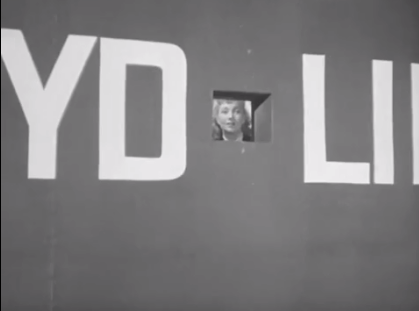
Visually, this is a standout picture as well. Director Harry Beaumont was born in 1888 and performed as an actor in silent films before taking the reins, directing MGM’s first talkie musical, The Broadway Melody, a 1929 release that won Best Picture that year (Beaumont lost best director to Frank Lloyd for The Divine Lady). This was his second Maisie picture, after having helmed the aforementioned Maisie Goes to Reno; the tight plotting and visual flourishes of both bode well for our final outing in Undercover Maisie, which was his penultimate credit. There’s a particularly beautifully composed shot of Maisie, Mitch, and Bill sneaking into the factory where the real copter has been taken by the corporate spies; the darker plot also allows Beaumont to add in some noir touches. It’s not just a good use of light that sets this one apart, however, as the camera has some fun with framing; my favorite is the scene in which Maisie, fugitive from love, observing his test flight at the Rose Bowl through a tiny little window in the scoreboard that’s just barely big enough to see her face: 

As for the helicopter itself, it’s a silver lozenge with two horizontal rotors, and it’s a charmingly perfect vision of atomic age futurism that looks great when the actors are interacting with it. The cheat to fake takeoffs and landings is obvious, but very easy to play along with. When Maisie pilots it in the climax, the chopper is represented by an utterly adorable miniature with a completely static figurine of Maisie inside. Before you know it, Maisie’s hovering outside of an office building, where she startles a woman who then uses a vertical flagpole to get Maisie a telephone, and while it’s very funny, it’s also tense. It’s worth noting that all of this is happening while Maisie is clad in her carhop uniform, which includes a heart-shaped bib with ruffles, puffed sleeves, an oversized sash bow on the rear, and petticoats; it’s her cutest look yet, and she makes it looks effortless. And she even gets to have a brief catfight with Barbara while wearing it! 

The Maisie series, here at the very end, is on a real upward trajectory, no pun intended. It’s unfortunate that we only have one more outing with her before we bid her farewell, but at least we have that to look forward to.

-Mark “Boomer” Redmond

Lagniappe Podcast: Three Days of the Condor (1975)

For this lagniappe episode of The Swampflix Podcast, Boomer & Brandon discuss the paranoid 70s espionage thriller Three Days of the Condor, starring Robert Redford as the CIA’s biggest nerd.

00:00 Welcome
01:48 Night Nurse (2026)
08:00 Up Goes Maisie (1946)
12:40 Undercover Maisie (1947)
19:50 Stolen Kingdom (2026)
27:43 All the President’s Men (1976)
36:00 Disclosure Day (2026)
52:02 The Death of Robin Hood (2026)
1:02:50 Scary Movie (2026)
1:16:40 Time and Water (2026)
1:20:53 Leviticus (2026)

1:32:53 Three Days of the Condor (1975)

You can stay up to date with our podcast through SoundCloud, Spotify, iTunes, TuneIn, or by following the links on this page.

– The Lagniappe Podcast Crew