Every time there’s news about a new Batman, there’s a new wave of “[Actor] is my Batman” discourse (Kevin Conroy is mine, for the record). For me, a more important question is: Who’s your Final Girl? There are a lot of good contenders, but mine has always been Sidney Prescott, followed very closely by Nancy Thompson. I was so excited to hear about 5cream after it had been so long since Scream 4, and was eagerly looking forward to seeing it as if Sidney were actually an old friend of mine with whom I would be getting the chance to catch up. So, it’s a bit of a disappointment that it takes so long for her to show up here, which is further underlined by the fact that we never get to see the three main characters of this franchise reunite for, well, one last time. Gale Weathers (Courteney Cox) gets scenes with both Dewey (David Arquette) and Sidney (Neve Campbell), and Sidney and Dewey talk briefly on the phone, but the three of them are never on screen together. That’s kind of weird, right?
It’s been twenty-five years since Stu Macher (Matthew Lillard) and Billy Loomis (Skeet Ulrich) killed seven people within a series of peculiar homicides that were modeled after murders in slasher films. In the decade and a half that followed, there were three copycat sprees: one based around the “rules” of sequels, another those rules pertaining to trilogies, and in 2011 at the height of remake mania, a murder bender pertaining to sequels, reboots, and the like. But it’s been a quiet ten years, and all of our favorite characters aren’t where we left them. Dewey and Gale split up and he’s living in a Woodsboro trailer park, mooning over Gale still as she hosts a NY-based morning show. Sidney’s as far as she can be from Colorado, living her best life, presumably, since she has no trouble going for a healthy jog without fear of being watched; and she even answers her phone when she gets a call from an unfamiliar number (I can tell you one thing, if I were Sidney Prescott, I would never have owned or answered a telephone any time after 2002). All of that changes when a young girl named Tara (Jenna Ortega) is attacked in her home by Ghostface, and we’re introduced to our conceit for this time around.
You see, Tara likes scary movies, but only “elevated horror”: things like It Follows, The VVitch, and Hereditary (her favorite, she says, as it’s a “meditation on grief and motherhood”). But Ghostface doesn’t want to talk about that; he’s more interested in what she knows about Stab, the film series within the film series that began life as a “ripped from the headlines” horror flick about the killings in the 1996 original, and which had, by Scream 4, bloated to a seven-movie franchise which had long ago stopped pretending to be based on true stories. Aligning with tradition, Tara is forced to participate under threat of violence to someone she cares about, and she gets through the first couple of questions but gets tripped up by the third. Just as Barrymore’s Casey Becker fumbled and said that Jason was the killer in Friday the 13th (it’s actually Mrs. Voorhees), Tara says that the killer in the original Stab was Billy Loomis, as it’s a trick question—she forgot about Stu. In a break with tradition, Tara actually survives this attack, if barely; this leads to the return of her older sister Sam (Melissa Barrera) to Woodsboro, but as it turns out, that might have been the point. As it turns out, Tara and Sam have a connection to previous killings, and they’re not the only ones. Several people in Tara’s tight-knit group of friends are, as it turns out, with Heather Matarazzo returning for a cameo as Martha Meeks, Randy’s younger sister from Scream 3, now the mother of twins Chad (Mason Gooding) and Mindy (Jasmin Savoy Brown) with whom Tara is friends, as well as a reappearance of Judy Hicks (the always-welcome Marley Shelton), now sheriff of the town after having previously served as Dewey’s deputy in Scream 4, and her son Wes (Dylan Minnette) is also among their group. That’s not all, though, as we also have Amber (Mikey Madison), Tara’s best friend, as well as Chad’s girlfriend Liv (Sonia Ben Ammar).
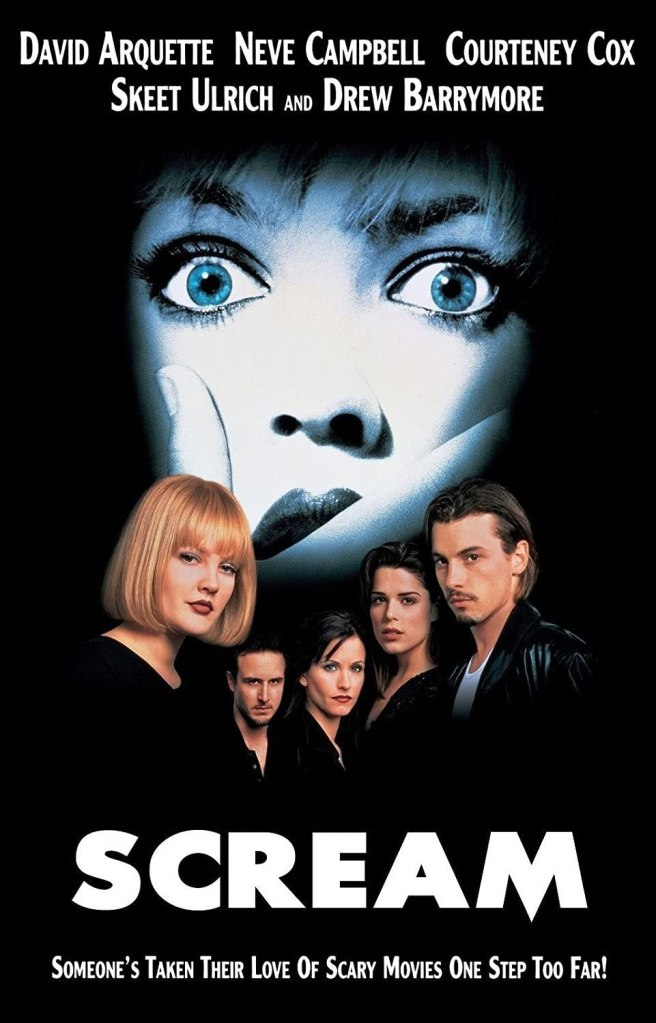
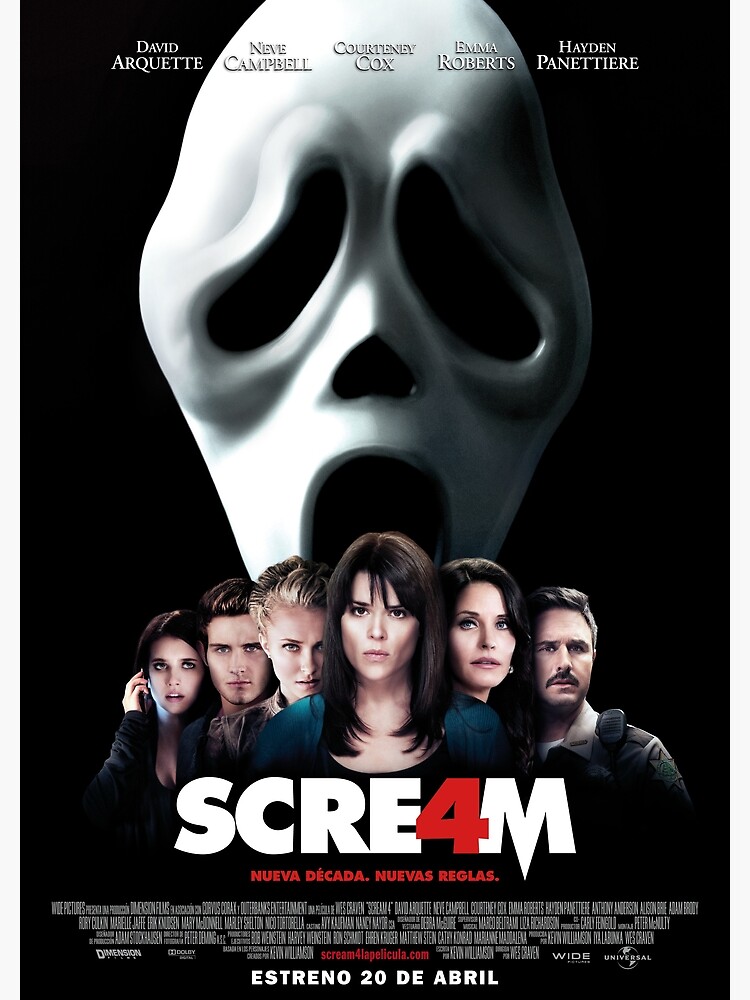
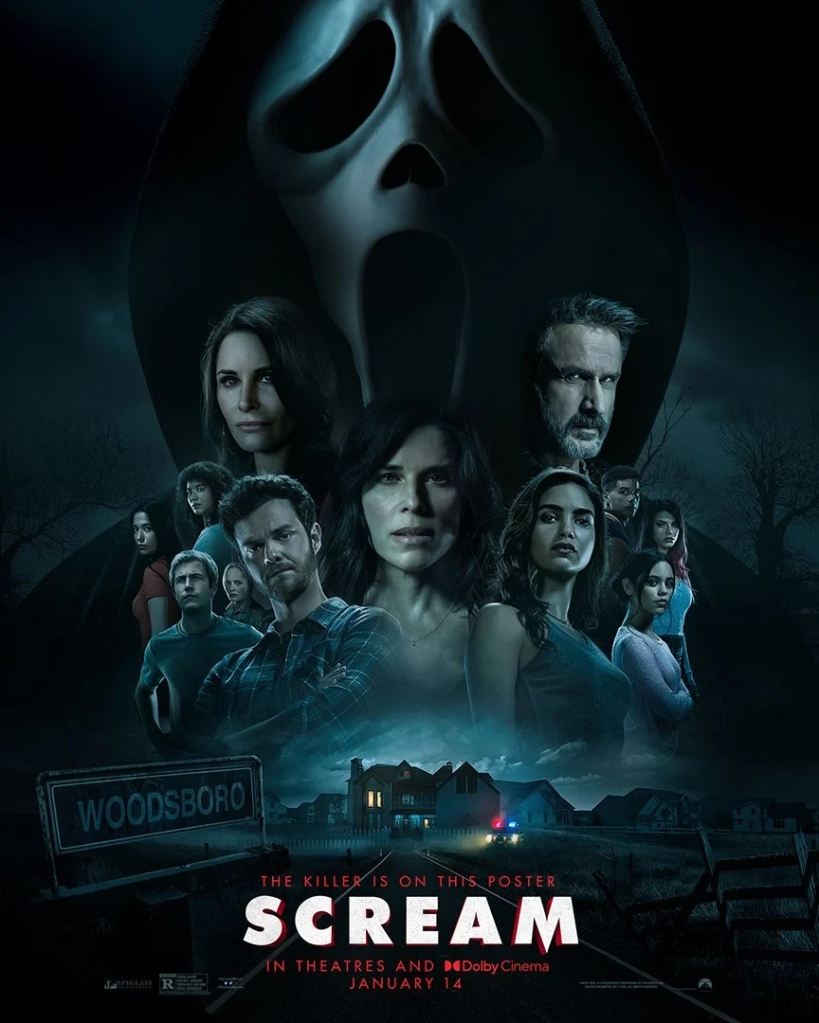
The biggest of the film’s flaws—beyond how little our legacy characters get to do and how late some of them appear in the screenplay (Gale doesn’t appear in person until nearly an hour in)—is that there are simply too many characters, and you can even see it in the poster. Consider the poster for the first Scream, which had five characters in total, including the three we would come to know as our principal characters in this series, but hyping up the appearance of Drew Barrymore, whose pre-titles murder is still the franchise’s defining moment. Then came Scream 2, which likewise limited its poster to five characters: the core three, Sidney’s new boyfriend, and (once again) the decoy lead who is killed off in the film’s opening. Scream 3‘s poster followed this trend with five characters, and then Scream 4 featured the first cast expansion to feature six: the three leads, and the would-be new Sidney, her boyfriend, and the new Randy Meeks. But the poster for this one has a full dozen people on it, and it’s just too many.
I don’t want to be the one to complain that Kyle Gallner is here, since he was in both one of the most original horrors of the aughts and the most derivative remake of the same relevant time period (Jennifer’s Body and the remake of Nightmare on Elm Street, respectively), so he feels like a genre acknowledgement that belongs here; but he’s also the most frivolous presence, existing only to provide cannon fodder for Ghostface and cement the theory that the killers are targeting people connected to the original killings when it’s revealed that he’s the son of Stu’s (I believe) heretofore unmentioned sister. When Dewey recounts “three attacks” at the 30-minute mark, I legitimately turned to my friend and asked if there was an assault I was forgetting other than Tara’s attack and “the one at the hospital,” and had to be reminded that he had been there at all. Liv’s also the worst kind of red herring, in that though it’s true that she always seems to be conveniently elsewhere when a killing occurs, she also is such a non-presence that when she’s not on screen; you forget that she exists. It is a bit of a narrative catch-22, though, since there need to be killings of people outside of this friend group to provide clues about the killer’s selection process, but if you change the story a bit and have, for instance, Dewey gathering potential victims who aren’t as familiar with one another to protect them from Ghostface, then you kinda lose the friend group Screamness of it all. And, despite all of that, the first two people I first and most immediately suspected, which is both satisfying and a little deflating.
It may seem like I have a lot of complaints, but I actually thoroughly enjoyed this one. It vaults over Scream 3 handily and lands just behind Scream 4 in the rankings. The reinvention here may actually be mpre clever, but it doesn’t feel as clever. The opening of Scream 4 alone was a fun, bizarre ride that really shook things up to the point where you weren’t really sure what the rules were anymore. The motive of the killings is fantastic; we learn early on that the previous year saw the release of Stab, which is actually Stab 8 (get it?), and that fans hated it—and from what little of it we see, with good reason. Stab has become a cultural phenomenon in Scream‘s world, and that world has now entered the era of The Snyder Cut, wherein groups of fanboys feel that the media belongs to them, so they want to course correct back to the “original concept” by enacting a new series of murders in Woodsboro to inspire the Stab franchise to return to its roots. It’s not as clever as “movies made us do it,” but it’s just as cohesive, and allows for one of the killers to deliver great lines like “How can fandom be toxic?” while holding a bloody knife.
1. Titane — Julia Ducournau’s follow-up to Rawis a greasy, Cronenbergian nightmare we didn’t want to wake up from: a darkly comic body horror about a serial killer who’s impregnated by a Cadillac and finds herself hiding out with an aging firefighter, disguising herself amongst his cartoonishly macho employees. It’s a nuclear gender meltdown with no clear sense to be made in its burnt-to-the-ground wreckage, finding unlikely refuge in the violence of pure-masc camaraderie & social ritual. At times overwhelmingly explicit and unflinchingly fixated on its own gory violence, but also a heartwarming tale of unconditional love.
2. Pig — Not at all what you’d expect from a Nic Cage revenge thriller about a disgruntled chef’s John Wick-style mission to recover his stolen truffle pig. An understated execution of a preposterous premise, refusing to behave either as a sober return-to-form showcase for the often-mocked actor or as fodder for his infinite supply of so-bad-its-good YouTube highlight reels. It’s its own uniquely beautiful, tenderly macho thing, with more to say about the beauty of a thoughtfully prepared meal than the peculiar flavors of Cage’s screen presence. Its heart is big, genuine, and forgiving, which is why it’s so moving despite its funhouse mirror reflection of the Portland culinary scene.
3. Barb and Star Go to Vista Del Mar — A delightful throwback to a very specific type of airheaded buddy comedy that rarely gets made anymore (think Romy & Michelle, A Night at the Roxbury, Dude Where’s My Car?, etc.), especially not with this level of grandeur in expensive set pieces and show-stopping musical numbers. And it’s even rarer to see that comedic spotlight shone on middle-aged women: a demographic who don’t often get to enjoy the spotlight in anything, even goofy comedies. We’re already hoping for sequels.
4. Saint Maud — A horrific illustration of how traditional stories of sainthood & martyrdom would play out through a modern, critical lens. An intensely strange character study of a woman of newfound, uninformed, fragmented faith: a personal belief system she obsessively devotes herself to, holding others to the strictures of her singular ideology even though no one on Earth could possibly know what’s going on inside her mind. And what’s in there is fantastical: orgasmic visions of God and the Devil, Heaven and Hell, atheist souls in desperate need of saving, and an attempted act of self-canonization that’s almost too harrowing to look at directly.
5. The Green Knight — A gritty, modernized illustration of an Arthurian quest — one that’s willing to critique the myths of yore, but not so much that the magic is lost. The modern atmospheric horror treatment does wonders for the fantasy genre, apparently; it really sells the tension & dark magic. The moments of onscreen sorcery are dreamlike & metal as fuck, making for an unlikely new Christmas classic.
6. Bo Burnham: Inside — As a “comedy special” this pandemic-era video diary can be hit-or-miss joke by joke. The songs are great, though, and by the time it fully devolves into panicked video art about Internet Age despair it’s undeniably substantial. It perfectly captures the feeling of reality itself crumbling around us as we remain in isolation, unable to tell what’s real and what’s not in our increasingly fake modern world.
7. The French Dispatch — Film nerds often complain about how visually lazy studio comedies are, so here’s a movie packed with Hollywood Celebrities where every scene is overloaded with gorgeous visuals and hilarious jokes. The anthology format affords Wes Anderson carte blanche to cram even more visual details & gags into the frame than usual, making for a texturally rich text. If his previous films are beautifully decorated cakes, this one is a full banquet.
8. The Power of the Dog — Jane Campion’s unnerving take on the Western genre conveys a masterful command of tone & form. And even if Westerns aren’t usually your thing, it’s still a relatable story about that one dipshit bully in your family whose sudden death would instantly improve the lives of everyone you know.
9. Lapsis — A high-concept, low-budget satire about our near-future gig economy dystopia. It doesn’t aim for the laugh-a-minute absurdism of Sorry to Bother You, but it’s maybe even more successful in pinpointing exactly how dispiriting it feels to live & work right now. It’s also incredibly smart in identifying what kind of radical labor movements we need to build to topple the power imbalances workers suffer under, offering a solution instead of just dwelling on the problem.
10. Mandibles— Quentin Dupieux’s absurdist comedy about bumbling criminals who adopt & corrupt a gigantic housefly so it can join them in acts of petty theft. A laugh-out-loud gem that’s smarter and more imaginative than the Dumb & Dumber-era Farrelly Brothers movies it recalls. And yet, it’s somehow just as hopelessly, delightfully stupid.
For this lagniappe episode of the podcast, Boomer, Brandon, and Alli discuss Guy Maddin’s My Winnipeg (2007), a “docu-fantasia” homage to the director’s Canadian home-city Winnipeg.
I decided to leave Marvel movies off of my list this year. Unusual for me, I know, but this comes after having no superhero movies at all on my list last year and sleeping the sleep of the innocent after separating comic book movies from other films when compiling my respective top 100 movies of the 2010s list vs. the top 15 four superhero flicks of the 2010s. That said, there is a movie on this list that’s technically a comic book movie, although for me it’s mostly on the list because it’s a (gross) James Gunn picture. So, yeah, I’ve already spoiled it. That having been said, I saw both Black Widow and Spider-Man: No Way Home and enjoyed them both quite a lot, so feel free to read my reviews of those.
For Christmas 2021, my best friend also gave me this shirt, which is an in-joke from Jenny Nicholson’s THE Vampire Diaries Video, which would be my favorite film of 2021, measured by any metric that counted said content as cinema. Apparently, in her order, my best friend thanked Jenny for creating the best film of 2021, and Jenny responded “Thanks.” When this was divulged to me, I had a parasocial glee that I can’t describe. I don’t know why I’m even explaining this, since it’s currently sitting at 6.9 million views (up from 5.9 million at Christmas), which means that, statistically, you’ve already watched it (twice). I will not be answering follow up questions about my mathematical process, but this was the best long form video format thing that cannot technically be called a movie.
I also want to say that I really wanted to like Together Together. I absolutely adore Patti Harrison. Although we only know of one planet with sapient life on it, I think Patti would be in the top ten funniest beings from the five funniest orbs. I don’t know why her Funny or Die skits in which she reviewed animals have disappeared from the internet, but at least they were up long enough for me to make some GIFs, like this one. I wish I could have put this in the top list, but while this one would be worth watching for Patti alone (and with appearances from Julio Torres and Rosalind Chao, that should really push it over the top), if you, like me, can’t really get behind a film that has Ed Helms as the leading man, maybe just stick to Patti’s standup.
Honorable mentions for what almost made the list: Rare Beasts (which ended up ranked at 16th), What Lies Below (discussed briefly here shortly after the 18-minute mark), and A Classic Horror Story.
Ok, without further ado!
15. Things Heard and Seen
This slow-burn thriller is the third annual winner of the unofficial “film with the most Shining vibes,” joining 2019’s champ Doctor Sleep and 2020’s winner The Lodge. Read my review here.
14. The Paper Tigers
The perfect movie to watch with your male relatives when you need something to fill the void between you! From my review: “The action here is nothing short of spectacular. It’s always a treat to see martial arts depicted with an emphasis on the arts over the martial, and this is a truly elegant film to behold. […] The comic elements are more grounded in character than we’re accustomed to [and] Paper Tigers doesn’t rely on old stereotypes and tiresome cliches to create a rhetorical space for joke-telling, and the comedy that does recall those dead horses is punching (and kicking, and breaking bricks) up, not down.”
13. We Need to Do Something
From my review: “We Need to Do Something proves that, even if one has to film under pandemic restrictions, some of our old stalwarts [like IFC Midnight] can still get something into the consumer’s home that mostly hits, all while doing more with less. […] I’ll grant that this could be because of some of my own psychological fears and damage contributing to the overall discomfort and anxiety that I felt during the runtime. Just asUnsane ended up as my number three film of 2018 by knowing where all of my fears live, so too does We Need to Do Something effectively and articulately seek out and find all of my weak points.”
12. The Toll
A movie that could easily have fallen into the trap of being kinda dumb, this one ends up being far more interesting than it has any right to be, as it counterposes images of memories with a truly deep, dark forest, within which dwells something truly inhuman. I feel like when I recommend this one to people, I’m like the older woman on the tractor who tells the main characters that it may seem like they’re in the same place but that they are really worlds apart, since it seems like no one else has been as impressed by this one as I have. Still, maybe you’ll like it, dear reader? Read my review here.
11. The French Dispatch
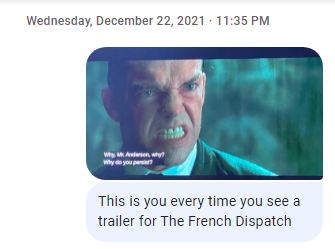
I have a friend who hates Wes Anderson. Like, really, really hates him. Seeing the trailer for The French Dispatch sent him into a rage, so much so that I sent this to him a while back:
I, however, am not a hater. In fact, when I learned from a friend who worked for Vulcan Video (North) that their DOS rental records went back so far that he could even take a look at what Anderson rented when he was a UT student developing the ideas and images that would go on to influence Bottle Rocket, I became obsessed with obtaining this information and possessing it for myself. If you’re reading this, Mr. Anderson, you can rest assured that this information never made its way into my hands, as the good people of Vulcan kept your privacy, and I couldn’t get my FOIA filed in time before that location closed. Even though the computer with that information sat at South Vulcan in order to merge the two databases, I still never managed to get my nerdy little talons on it. I do think that this is a more personal effort than others from the director’s oeuvre, and it’s as much a career inspection (I hesitate to use the term “retrospective,” as it has such a… finality) as it is a film, which means it doesn’t connect with me as a viewer with the same intimacy and immediacy as my favorites from that filmography (which, for the record, are Fantastic Mr. Fox, Royal Tenenbaums, Life Aquatic, and Grand Budapest Hotel). In those, the conceits of the story and framing form less of a barrier for me than they do here, as I didn’t really slide into the world of Dispatch as smoothly, but it’s still effervescent and fun, and I recommend it. Read Brandon’s review here.
10. The Suicide Squad
You know, I just love Starro. I think about every iteration of Starro that I’ve seen over the years and how they’re always kind of … cute. Blue and purple starfish guy; he’s only got one eye but it’s a big Bambi of a peeper, and he’s threatening but not very … gross. I’m a simple man and I like my James Gunn like I like my Cronenberg: again, gross. What The Suicide Squad has going for it in terms of sheer entertainment value is that it’s loud, slippery, fun, bloody, and full of bilge and bile. We all know seastars are gross, right? They have eyes at the ends of their limbs and they move around on gross little tentacles and there are over 2000 species of them in almost every kind of aquatic environment you can name. Here, Starro isn’t an adorable cartoon seastar but a massive, disgusting monster with nauseatingly realistic flesh, and then sometimes it opens up little trypophobia-triggering pores and shoots out more gross little dudes. I know I’m stuck on that point and there’s a lot more going on here than that, but I was very pleased with this one. Read Brandon’s review here.
9. Pig
I’ve been working on this list for a while, and this past week, the internet gifted us with this performatively sneering tweet about people watching “baby food culture” on airplanes, which of course set off a great deal of discourse about what constitutes said baby food, whether an airplane was really the proper space in which to engage with (presumably) richer texts like Schindler’s List or Hereditary. Others raised the point that some people opt for these as they are reasonably certain that they will be free of things that they might be embarrassed for watching in public (although I was plenty embarrassed to watch Ready Player One in 2018 but was reasonably certain that I would never see anyone on that flight again; now that’s baby food culture). There have been times for me when watching a movie on a plane actually contributed to the film, if that can be believed; there’s nothing like being forced to make yourself small as 6’2’’ guy with a shoulder width of 24+ inches sitting in a middle seat and subjecting yourself to Unsane. What I will say is that I watched Pig on an airplane, mostly, and I was still moved by it. Well, I watched the first 70 minutes on the flight from Raleigh to Atlanta, and then watched the rest of it on Hulu at home, and it was still one of the best films (and viewing experiences) I had last year, just as much as the Very Cinematic film that’s next on this list. Read Brandon’s review here.
8. The Green Knight
In what I advised in what I correctly characterized as “more of a summary than a review” of The Green Knight, I recognized that it was “an exercise for myself as much as it is a recommendation.” When talking about Alicia Vikander’s big speech, I asked and answered a question that applies as much to the film as a whole as it does to that scene: “Is it ‘good’? I’m not sure, but it sure was huge.”
7. Saint Maud
Last year during the introductory segment for our podcast about Ginger Snaps, we briefly discussed the film Ghost Stories, and specifically how it does “that thing I like.” We didn’t get into specifics since the specific thing that I like (henceforth TTIL) is always a spoiler, but for a longer discussion of that, feel free to check out our early Lagniappe episode about Housebound, which also does TTIL. All of this is to say that Saint Maudalso does TTIL, and it does so with style and aplomb aplenty. The trailer for this one played before the last film I saw in theaters before the first quarantine, and I had already seen it several times before then, but this was a film that was definitely worth the wait. The relationship between people of fundamentalist faith and those without is a constant source of interest for me, as demonstrated pretty extensively here over the years, not least of all with my Planet Mirth series. Here, our protagonist is a woman of a newfound faith, a belief born more of trauma and recrimination than one with which she was endowed by her parents or arrived at via a winding road of theological research. As such, it’s very personal and fervent while also being wild and piecemeal; despite its fragmentary and uninformed nature, the title character is nonetheless devoted and holds others to the strictures of her ideology, despite the fact that no one on earth could possibly know what’s going on inside her mind. And what’s in there is fantastical: visions of God and the devil, heaven and hell, and all of it finally coming to a head in an attempted act of self-canonization that’s almost too harrowing. Read Brandon’s review here.
6. Psycho Goreman
Brandon was less-than-sold on this one when he reviewed it last year, and I think that his review is fair and reflective of his taste. His opinions aren’t my own (although I would also compare it to Turbo Kid, which was my number three film of 2015), however, and although we align in a lot of ways, this one sat at the top of my list for most of the year, until a few late-in-the-year surprises managed to dethrone it. Although I used “smorgasbord” when describing Turbo Kid in the above-linked 2015 list, it’s been six years, so I feel comfortable using it again. This is a movie about a truly horrible and unlikable little girl, a bully who through nothing more powerful than coincidence comes into possession of a totem that allows her to control an otherwise unstoppable killing machine. Of course, Psycho “PG” Goreman (as she dubs him) isn’t a machine, he’s a living being, albeit one who defies “life” in much the same way as the monsters on the covers of 1980s metal album covers. Against his will, PG undergoes a journey of self-discovery, of a kind at least, as he learns that he has a fondness for hunky boys as well as dealing death. My favorite bits are when he is forced to become the drummer in his young friend(?)’s band, as well as the conversion of poor Alasdair into a big ol’ brain monster, which is never reversed. I got a kick out of this one.
5. Titane
When we recently discussed Titane on the Lagniappe podcast, I confessed to my intense jealousy about the fact that Brandon got to see (and review) the film before I did, especially after I got to see Raw in limited release and got copy on it to editorial within a day, beating a lot of actual media outlets to the punch, which is rare for our Little Swamp Engine that Can. There were many delays, caused first by COVID, then a friend’s school schedule, then COVID again, before I finally got the film through legitimate means (wink) and watched it at home. When I told the friend with whom I shared that viewing experience about how high the film would likely end up ranking on my list, she was shocked, and noted that she thought the film was pretentious. I could hardly agree less, to be honest, as I don’t think that this film is putting on any airs at all. It’s a body horror dark comedy about a serial killer who gets pregnant with a Cadillac’s baby and finds herself hiding out with an aging French firefighter and trying to disguise herself amongst a bunch of his macho employees. That it might be saying something about gender as performance is there, but I think it’s communicating less of a capital-M “Message” than something like Videodrome, which is the film it most reminded me of. It’s a long, strange journey, and I loved it.
4. Plan B
From my review: “[Plan B]’s not just funny, it’s funny in a very intimate way, which matches the subject matter, appropriately interspersed with emotional reminders of the potency of teenage emotion. […] And it does it all with humor that verges-upon-but-does-not-quite-become gross-out comedy, vignetted character portraits of outlandish but somehow instantly familiar personalities, and the warmth of basking in the effortless conversational volley between two best friends who know each other better than anyone else in the world.”
3. Dune
As I summed it up in my review of the film (slash jeremiad about the state of online film discourse and criticism, as is my wont), “Dune is good. See it.”
2. Cryptozoo
The end of the opening pre-title sequence of Cryptozoo may as well have been written by the Magical Realism bot on Twitter: In 1967, a woman wearing a unicorn’s horn around her neck finds a sign warning of dangerous cryptids; the paint is wet. And at that point, we’re only getting started. I was surprised to see only a single director listed on IMDb and Wikipedia for Cryptozoo, because I distinctly remembered seeing a woman’s name in the “A Film By” credit, which is usually reserved for the director(s), and marveling that I had accidentally managed to watch four films directed by women in a row without any intent to do so (following Rare Beasts, Plan B, and Matrix: Resurrections). The film does conclude with “A Film by Jane Samborski and Dash Shaw,” but Shaw is the writer and director, while Samborski is later credited as the film’s Animation Director, which I suppose makes a certain amount of sense, as the animation here is completely integral to the storytelling in a way that advancing animation technology has unintentionally driven creativity to the margins. As digital animation (or more specifically vector-asset based animation) becomes more the norm, a lot has been lost over the years. This can be found everywhere but the particular longevity of The Simpsons allows for an easy reference point: take for instance the way that Marge’s hair moves with character in this GIF of her in the opening credits that The Simpsons had for decades, and compare it to her hair’s stiff, lifeless lack of movement as she turns her head at the same moment in the HD credits which are now 10+ years old at this point. It’s not necessarily a bad thing that there’s now a lower barrier to entry for potential animators, but corporate interests mean that corners are going to be cut when it comes to animation and as a result, we now have stuff like that Red Ape Family cartoon thing that I’m not going to link to. The animation here is stunning, truly one of the most novel things I’ve seen in years, and I was captivated by every moment of this movie. This was released by Magnolia Pictures, and you know you wouldn’t see a film that would be so undisguised in its criticism of neoliberalism’s tendency to act capitalism apologia or attempt to correct social problems by invoking the free market in a wider release from a bigger studio; Disney Studios might let the Red Guardian in Black Widow have “Karl Marx” tattooed across his knuckles, but a monopoly of that size is never going to engage with leftist ideas in a meaningful way. Within Cryptozoo, capitalism will clearly not create a path for social acceptance of The Other. Simply gathering beings into a single location like a reservation zoo and grafting them onto the larger apparatus of capitalism will not forge freedom. Yes, it may possibly save them from greater harm in the outside world, but it also forces them to exist alongside of and engage with an economic system that allows them to subsist but not excel; cryptid keeper Lauren specifically notes that her business partner Joan’s inheritance will not last forever and that there is a profit motive to making Cryptozoo an enterprise and not merely a cryptid sanctuary because it is otherwise unsustainable. This is the best original animated feature I’ve seen in a very long time. Read Brandon’s review here.
1. Promising Young Woman
I kinda do this thing almost every year where I do a whole song and dance about how I feel that films released on or after Christmas don’t really count for that year’s list and should count for the following year’s. In 2016, this was my logic for including Anomalisa; in 2019, I did a whole round-up of films that I missed in 2018 because of my accident. This film, which released as a nasty little present on Christmas Day in 2020, is my holdover for this year, and ended up being my favorite movie of the year. And before you start flogging me for this choice: I understand that this is a Problematic Fave. I’ve read the thinkpieces about how this piece of media is Bad, Actually, and I don’t think any of them are incorrect. This one in particular is often pointed to as a source of the reasons why this movie is bad and you should feel bad for liking it, and I have to say that I don’t disagree with a single one of its points. I’ll try to avoid spoilers about it, but this is a movie about a woman getting revenge “on behalf” of her now-dead friend in a method that ultimately costs her everything and makes her a victim as well. That’s a totally acceptable thing to find objectionable, frankly. In fact, the backlash against this one was so bad that on three separate occasions, I withheld telling people this was my favorite movie of 2021 until pressed, and in each instance, my companion had pretty similar feedback about the ongoing problems with contemporary film discourse revolving around the apparent need for the objet d’art to perfectly align with their personal morals and ethics. I’m not going to pretend that I’ve never fallen into this trap myself (looking back, a one-star review for 4 mosche di veluto grigio is a little harsh, especially since my biggest problem with the film was just how shitty and unlikable the protagonist was), but I don’t think that this is the best way to discuss a piece of art, and certainly shouldn’t be the only way through which we explore the text. There’s a lot going on with our lead Cassandra’s self-destructive behavior and her self-sacrifice, and although the sheer volume of critical writing that takes aim solely or primarily at this aspect of the narrative is demonstrative that it can’t be just a few people for whom this is their primary critical lens, but a large portion of it. For some people, self-sacrifice is noble; for others, it isn’t. For me, something that aligns with my values, or professes to, does not make it a good work of art, and a piece of art does not necessarily become objectionable because it does not share my values. The SNL of the Trump years wasn’t funny just because they (professed to) hate him as much as I did. In fact, that was frequently the least funny satire they ever did; I spent a lot of my youth rewatching SNL in syndication with references to political events that were before my time or outside of my frame of reference, and they could still be funny even without knowledge of the specifics. The lip-service, inoffensively topical social statements in There’s Someone Inside Your House made the film worse, in my opinion, than it would have if it were simply a straightforward slasher. As I write this at this very moment, I have a poster from the Guggenheim’s 2014 Italian Futurism exhibit behind me; most of the participants in that movement were fascists, but Dinamismo di un Ciclista and Lampada ad arco don’t become bad paintings just because Umberto Boccioni and Giacomo Balla were bad people. To me, this was a fascinating piece of art, regardless of whether I thought its morals and values were aligned with my own. I felt its highs and its lows, the dread and the hope and the guilt and the exhilaration, and ultimately the vindication, in spite of itself. Read Brandon’s review here.
There are a lot of things that they just don’t make like they used to. Cadbury creme eggs, Star Warses, western democracy. But one thing that’s still reliably chugging along through the same well-worn, comfortable ruts that the covered wagons made, and that’s the small-town crime thriller. Now with more Eric Bana!
Bana stars in The Dry as Aaron Falk, a federal agent in Australia who returns to his fictional hometown of Kiewarra, some twenty years after he was run out of town by locals who believed the then-teenaged Aaron (Joe Klocek) had something to do with the drowning death of his girlfriend, Ellie (Bebe Bettencourt). Although Kiewarra is now suffering economically due to the titular intense drought, flashbacks show a verdant river and fields as backdrop to the youthful friendship between Aaron and Luke (played by Martin Dingle-Wall as an adult and Sam Corlett in the past), as well as Luke’s then-girlfriend, Gretchen (Claude Scott-Mitchell). Unfortunately, it’s the tragic death of Luke and his family that’s brought Aaron home after all this time, in an apparent murder suicide at the hands of his old friend.
Asked by Luke’s parents to stay and investigate further in order to prove their son’s innocence, Aaron finds himself the object of scorn and scrutiny by Ellie’s older brother Grant (Matt Nable), who still believes Aaron got off scot-free for his sister’s murder, as well as Ellie’s now cognitively challenged father Mal (William Zappa), who confusedly accuses Aaron for covering up for his son, not recognizing that the man he’s accusing is the Falk boy. He also reunites with Gretchen (Genevieve O’Reilly), and the two reconnect while he investigates. While reviewing the files of Luke’s wife, Aaron discovers “Grant?” written on the back of a document, which leads him into conflict with Ellie’s family once again.
Most of the reviews for this film label it a “slow burn,” and it’s definitely that, with an emphasis on “slow.” This isn’t necessarily a bad thing, but it also wasn’t really what I was in the mood for when I was finally able to set aside some time to screen this one. There are no molds being broken here; nothing ever starts to get meta or strays from the conventional. It’s your standard Protagonist Archetype 7C (Law Enforcement Officer, Federal) with modifier 32-A (Chip on the Shoulder) sigma (adolescent tragedy), in setting 3 (small town) B (where they grew up) dash 5 (in economic crisis) dash B (due to inclement weather), where Kappa (a homicide) has occurred, involving Pi-3 (their childhood friend). The plot is solid and hangs together. It’s nothing new, but if this is the thing that’s up your alley, then you will enjoy it.
Normally, when we apply the descriptor “paint by numbers,” which certainly applies here, we’re talking about something with mass market appeal and application. This film is more of a masterpiece by numbers, where your end result is something that’s good enough to be truly proud of, or even be turned into a 1000-piece puzzle. I wish I could speak more highly of it, because what normally renders the more run-of-the-mill versions of these films to the heap of forgotten mediocrity is that they have no staying power beyond their twist, but this one is gorgeously shot, thoughtfully edited, and masterfully acted. You can really feel the heat radiating off of the ground in draught-addled Kiewarra, but it’s not enough to elevate this into the pantheon of its genre. It’s above average but does not exceed expectations.
I was very excited this past summer when, during that period when things were starting to reopen and I was able to go back to the theater for the first time sinceEmma. way back in March 2020, to seeBlack Widow. I managed to see two others in theaters before the end of the year, when threats of Omicron (Persei 8) means that many of us are once again sworn off of the in-person theatrical experience, Nicole Kidman be damned. For the past two weeks, I’ve been trying to squeeze in a few last 2021 releases in order to soothe my conscience with regards to ensuring that my forthcoming end of the year list was sufficiently well rounded and informed, consistently texting Brandon that “I just need[ed] to finish Matrix Resurrections/The French Dispatch/etc. and then I [would] ‘call it.'” Many years ago, I wrote that no one could gaslight me like I could gaslight myself, and like Charles Boyer himself, I just kept moving those goalposts, until I think we are finally at an end, as I got the opportunity to see Spider-Man: No Way Home in a relatively safe environment courtesy of coincidental access to a GMC Terrain and Austin’s own Blue Starlite Drive In.
Spoilers!
We open just where we left off inFar from Home, with our friendly neighborhood Spider-Twink (Tom Holland) having just had his secret identity as Peter Parker exposed by J. Jonah Jameson, once again played by J.K. Simmons, although this time instead of being an editorial-mad editor, he’s here running a Daily Bugle that, instead of being a decently respectable publication, is not-quite-InfoWars. Although no criminal charges associated with the accusation that he killed Mysterio manage to stick (thanks in no small part to Charlie Cox reprising his role as Matt “Daredevil” Murdock), the repercussions of the allegations ripple throughout his life. Peter and May have to move out of their apartment to avoid harassment from Mysterio truthers, and the controversy costs Peter and his friends the opportunity to go to MIT together. It’s the last of these that prompts Peter to seek out assistance from Dr. Strange to try and reverse the damage, but Peter’s second guessing causes the magic to go haywire, setting off a bizarre series of events.
Seriously, spoilers.
As a result, everyone who knows Peter Parker is Spider-Man, even in other universes, begins to appear in New York. Doc Ock (Alfred Molina) from Spider-Man 2? Of course! Willem Dafoe’s hypnotic Sam Raimi-movies Green Goblin? You betcha! Electro (Jamie Foxx) from Amazing Spider-Man 2? Um, ok, yeah. Thomas Haden Church as Raimi’s Sandman and Rhys Ifans as Lizard? If, um, if you want, I guess. Aunt May (Rosemary Harris)?! Unfortunately, no, although I kept an eagle eye out for both her and Mageina Tovah. Peter manages to round up these accidental invaders with help from Ned (Jacob Batalon) and MJ (Zendaya), and Strange prepares to send them back. However, when each of them shares that the last thing that they remember are the moments leading up to what we the audience know are their deaths (give or take a Sandman), Peter decides that he can’t knowingly send them to their respective dooms without instead curing them so that they might live instead: repairing the broken interface between Octavius and his cybernetic arms, ridding Osbourne of the Goblin identity, delectrifying Electro, etc. It’s actually kind of nice, but of course, goblins gotta goblin, so it goes off the rails, which is where things start to get really interesting.
I wasn’t sure what to expect from this one. A few years back, the CW DC shows did a big multiverse crossover event that managed to incorporate a shocking number of appearances from “other universes” that were explicitly other media adaptations: Smallville, Doom Patrol, Titans, the 1990s Flash, Superman Returns, and even more esoteric examples like Lucifer. There were appearances from Huntress from the short-lived Birds of Prey series from 2002, Burt Ward reprising his role as Dick “Robin” Grayson from the 1960s, and having Kevin Conroy, who voiced Batman in the 1990s animated series (aka my Batman), appear in the flesh as Bruce Wayne for the first time. Watching it unfold was like a matryoshka doll of niche specificity; it was a much lower budget than this, obviously, but it was still fun. I knew Far from Home was planned as a big crossover, that would start off the multiverse thing, which was hinted at in WandaVision and would play a big role in the upcoming Doctor Strange and the Who Cares, blah blah blah. But following on the heels of the what narratively should (but obviously capitalistically never could) have been the finale of this whole enterprise withEndgame, I didn’t really think that another installment in the Disney money-printing machine would manage to elicit the same kind of emotional thrill that of four-color yesteryear.
And then it did, somehow. Maybe? There’s no Disney logo at the beginning; when the Sony logo came up, followed by Tristar, I thought it was another trailer, until the ending audio from Far from Home played. But I’m getting off track. Pre-release, it was impossible to avoid the rumors. Would Tobey Maguire come back? Surely not. The rights alone would make it all so complicated. But someone saw, or said they saw, or maybe heard from the PA that you met at a friend’s party that Andrew Garfield and his Tumblr-famous jiggly puffs were spotted back in the old spandex. And somehow, post-release, even after a couple of weeks, I assumed that it must not have happened, since no one on Twitter had spoiled it (for me) yet, but yeah, here they are. And, like, it’s impossible not to feel a swell of something warm inside when they all meet here.
It’s common to call reference-heavy, perhaps even fan service-y fare a “love letter to the fans.” I’m not usually a fan of that phrase since most of the things that are intended to be so—perhaps especially when it comes to my beloved Star Trek franchise—usually come out muddy at best and are frequently, sometimes infamously, bad. And this does run the risk of that, especially if one is too young to really remember or to have ever even seen the older films referenced herein. But sometimes, especially in trying times, maybe a little bit of nostalgia is all that you need. Sometimes, it’s more than enough. Spider-Man: Three Spider-Men wrang legitimate tears out of me, and not just because no one bothered, I assume, to see what Rosemary Harris was doing. After the two older Spider-Men recount to Gen-Z Peter how they respectively lost their Uncle Ben and/or Gwen Stacy, Amazing Spider-Man gets the opportunity to save a falling MJ here, and this time he succeeds where he failed before, and it’s genuinely one of the most emotionally satisfying things that this bombastic, bloated franchise has ever managed to affect.
And that’s just the bittersweet stuff; there’s still plenty of humor to go around, although obviously not on the level ofHomecoming. I’ve spoiled enough of the drama that I’ll leave the comedy unrepeated so that there’s something for you to still discover if you haven’t already seen this one. If there’s one big quibble that I do have, it’s that Jameson as no-celebrities-were-harmed Alex Jones doesn’t quite work for me. Firstly, there’s no way that Marvel could ever let J.K. Simmons ever go full Jones; Disney might take a couple of potshots at him by having Jameson hawk not-quite-nootropics, but a film under their umbrella is never going to have Jameson get involved with Pizzagate or get taken to court for calling the Battle of New York survivors crisis actors. Although the film briefly touches on what the equivalent of our own real world conspiracy theorists would look like in the MCU, it’s pretty toothless. Going soft on Jones with a parody that neither sees him get his comeuppance nor push his pathological adherence to his outrageous beliefs past the line where his charisma fails to walk him back … you just wonder why they bothered.
I guess I should close by saying that although this was a lot of fun, it doesn’t really hook me on the franchise’s future at all. I didn’t stay for the post-credits scene, and although it’s true that I was, as stated, at a drive-in and that my bladder was full, I still simply couldn’t bring myself to care enough to stay. But, like, does that matter? Did it ever? Maybe. Probably not. As a capper on the Spider-Man series, this would also do, and it brings it all home.
I’ve been a huge fan of Natalie Morales for a very, very long time. In fact, I just got the Middleman DVD box set for Christmas and am doling out episodes to myself at a slow rewatch pace like a post-holiday Advent calendar, after my last rewatch of gray market .avi files that are still watermarked with the ABC Family branding. I heard about the then-unfilmed Plan B, Morales’s directorial debut, sometime back and then don’t remember ever hearing anything else about it until it premiered on Hulu. There’s a distinct style to her comedic delivery and timing that I have always loved, and it’s present in her other non-Wendy Watson roles with which we have been graced over the years; it’s also present here, in an esoteric spiritual way and in the way that her voice comes through so clearly in the cadence of her characters’ dialogue.
Lupe (Victoria Moroles) and Sunny (Kuhoo Verma) are best friends. Both have single parents: Sunny is an only child being raised by her mother, Rosie (Jolly Abraham), a driven real estate agent with high expectations for Sunny’s academic performance; Lupe has younger brothers, and her mother passed away some time ago, pushing her minister father (Jacob Vargas) towards overprotection, against which she bristles. Sunny’s crushing on Hunter (Michael Provost), a sensitive boy whose signature pairing of cardigan and P.E. uniform revs her engine, and she’s egged on by the ostensibly more sexually experienced Lupe. When Rosie leaves for an out-of-state realty conference, Lupe convinces Sunny to throw a house party in order to spend time with Hunter, but when he leaves with another girl, Sunny ends up having (brief and unsatisfying) sex with a different classmate, the zealously Christian dweeb Kyle (Mason Cook).
The next morning, she realizes that despite her best efforts to use protection, she may be amongst the minute percentage for whom condoms are ineffective. This kicks off a series of events in which the girls try to obtain the titular pharmaceutical, during the course of which they run afoul of a pharmacist (Jay Chandrasekhar) who invokes the state’s laws allowing for those of his profession to withhold medication based on “moral” objections, a gas station attendant (Edi Patterson, of The Righteous Gemstones) with her own issues, and a supposedly teenaged drug dealer (the 31-year-old Moses Storm) whose apparent age is the result of never drinking water. En route to the closest Planned Parenthood, a several-hour car ride that turns into an overnight coming-of-age road comedy, Sunny has an unexpected encounter with Hunter, and Lupe finally meets her oft-mentioned off screen love interest, Logan, for the first time in person; both we and Sunny learn that Logan (Myha’la Herrold) is actually a woman. With the ticking clock to get both the Plan B pill before it starts to lose its efficacy, and for the girls to get home before Sunny’s mom gets back from her conference, one never forgets that stakes, regardless of how many peals of laughter are experienced between delays.
There’s a great scene early on in which we get a one-scene performance from Rachel Dratch as Ms. Flaucher, the characters’ sex ed teacher. Just like I did, they’re getting an abstinence-only curriculum in which premarital sex is given an elaborate metaphor. You know the one; in his late-2019 stand-up special, Jaboukie Young-White talked about his Catholic upbringing in which the sinfulness of the Marital Act outside of the Marriage Bed was demonstrated by having everyone spit in a cup and challenging the last person to drink it. My school also had the one with the Scotch tape, in which once you put it on someone’s shirt, then someone else’s, then a third person’s, the tape lost adhesiveness, to show how we could never really properly bond to our future spouses if we allowed ourselves to be sullied by physical encounters in which loose threads were exchanged, if you follow. The September 2019 installment of Into the Dark, entitled Pure, took place at a purity retreat; during the scene in which the event’s spiritual leader asked for a piece of gum and started chewing it, I told my then-roommate that this was about to become a metaphor for how “gross” and “used” people were, and he couldn’t believe that this prediction came true. At least I am too old to have been subjected to Christian trap music, which plays a role here in Plan B.
On the VHS tape (ha!) shown to Lupe and Sunny’s class, a woman’s virginity (and it’s specifically a woman’s in this case, which is discussed) is presented as a much-abused car, which her husband refuses to ride in. There’s something essential about comedy that requires it to be knowing, and that’s what elevates Plan B. It’s not just funny, it’s funny in a very intimate way, which matches the subject matter, appropriately interspersed with emotional reminders of the potency of teenage emotion. Sometimes, no matter how adult you think you are and attempt to take care of your problems, you’re still a child and you need an adult, and it’s ok to acknowledge that. That emotional honesty plays out in its demonstration of young love, and how it can be sweet and still a little embarrassing. And it does it all with humor that verges-upon-but-does-not-quite-become gross-out comedy, vignetted character portraits of outlandish but somehow instantly familiar personalities, and the warmth of basking in the effortless conversational volley between two best friends who know each other better than anyone else in the world. There are a few missteps; I personally can’t stand a late-film friendship-threatening argument, and although this one is blissfully short and quickly reversed, that really underscores how unnecessary it is. But I’m not here to get bogged down in those details, and neither should you be. This one’s a lot of fun.
Rare Beasts is the directorial debut of Billie Piper, whom you might know as a nineties British pop star, the companion of the Ninth and Tenth Doctors, or perhaps even from Secret Diary of a Call Girl or Penny Dreadful. It also stars the talented Piper and was written by her as well, and it’s a bizarre, barbed delight, despite the mixed reviews, which we’ll get to.
Mandy (Piper) is a single mother to the behaviorally challenged Larch (Toby Woolf), who may be on the spectrum. She works for a TV production company where she and several others are tasked with delivering pitch ideas, and the ones which the audience is allowed to hear are universally bad. It’s here that Mandy meets her relationship interest, Pete (Leo Bill). I say “relationship interest” because I initially typed “love interest” and then gagged a little, updated it to “romantic interest” and thought that this was an inaccurate adjective as well, given that there’s very little in the way of romance either. Pete’s a horrible man who comes very close to turning red and having kettle steam jet out of the sides of his head on their first date, as he spews unprompted vitriol about how much he hates women and desires what he considers an ideal marriage (one of female subservience), and how these questionable values align with his religious identity. Like, no one ever says “MRA” or “red pilled” but there’s a very clear reason why he’s alone.
Nonetheless, the two navigate through the stations of the canon of the romcom plot; they go to their first wedding together (where Mandy briefly flirts with a man with whom she clearly has a history, and whose eyes twitch exactly like Larch’s), have a day in the park (which ends in a scene in which Pete and Larch bond and seemingly come to some kind of understanding by way of a screeching tantrum mirror match), and Mandy meeting Pete’s family for the first time. Every situation is frighteningly familiar to anyone who’s ever seen a screaming match break out at a wedding or family dinner, but also takes comfort in the bleak humor of detachment; it’s Marge Simpson in “Scenes from the Class Struggle in Springfield” murmuring her way into the act break after grimly telling herself “At times like this, I guess all you can do is laugh” – The Movie. That’s especially true as these relationship woes play out against the scenery of her relationship with her mother (Kerry Fox), who is terminally ill and, although separated from him, is still tormented by the not-so-harmless shenanigans of Mandy’s mostly absentee father (David Thewlis).
I’m always someone who’s more interested in a fascinating movie over one that’s “good,” but I think Rare Beasts manages to be both. There’s a hyperreality to the bizarre dialogue, which is stilted and almost impenetrable in its content at times, but always delivered in a perfect clipped cadence. It’s an experience that ends up feeling like you’re hovering halfway between an unfamiliar Shakespeare play performed with the original dialogue but in a modern setting and one of those short films or musical performances that are meant to evoke the experience of what English sounds like to non-English speakers. It’s surreal and hyperreal at the same time.
Mandy is captivating (as is Piper). She’s struggling, and that’s life. Larch is going to be who he is, and there’s very little that can be done about it. People are horrible, meeting dates is a tragedy in slow motion, and your parents will, someday, die. My favorite detail about Mandy is that, according to her father, she would write little death threats when she was a child. He laughs this off, but when pressed for what kind of threats they were, he notes that they were the kind “that would have you thinking,” as his eyes widen. Rare Beasts is a film of subtle details in that way; in an attempt at foregoing all the potential issues with intimacy, she shows Pete every part of herself, revealing in extreme detail which parts of her body she is neurotically obsessed about (there are many, including her legs, which are “too much femur, not enough tibia.”
The camerawork here is fantastic, shockingly ambitious for a first-time director and surprisingly effective and empathetic where it needs to be. When her sexist boss insults her talent and fires her, there’s a reversal of the kind of shot that’s so frequently applied to women; she is framed though his legs, and instead of being titillating, the angle at which his legs are spread (much more than would make logical sense for a standing person not in the middle of a cheer routine) creates a sense of overall wrongness that permeates the film just as it permeates our existence. At one point after Mandy stands up for herself, there’s an immediate cut to a crane shot of Pete and Mandy running through a deserted London intersection, and it’s like something out of a coming-of-age film, but it feels wrong, long before the details set in. At one point, when Mandy is eavesdropping on her parents by sitting on the floor outside of her mother’s bedroom, her father notices here and shuts the door, but he’s looking down on her as if she were a child, shortly before a sequence in which Mandy tap dances from childhood to her present age, in line with the film’s frequent dream logic.
I was surprised by the film’s low Rotten Tomatoes score, which is an extremely imperfect metric at best, but when looking at the reviews and the critics who provided them, I noticed a pattern, and dug in a little further. There were 50 reviews, and for 48 of them, I could identify the critic’s gender (bless Rory Doherty for putting his pronouns in his Twitter bio and keeping that from being 47). Of those, 26 (54.2%) were written by women, and 22 (45.8%) were written by men, which is pretty uncommon; normally, reviews from male critics on RT outnumber those by women 2:1. I tried to find a film with similar statistics that I could compare that to and confirm, and after taking a look at The Novice, which had 60 reviews, I realized that it was also a film with a woman helming it, as both writer and director, so that would hew too close and skew the results. Then I found Cyrano, which at the time had 51 reviews, Joe Wright’s period piece with Peter Dinklage in the title role. With roughly equivalent reviews, 12 (25.5%) were written by women, and 38 (75.5%) by men. So yeah. Of Rare Beasts‘ 48, 10 of the male critics (45.5%) gave it a negative review, as opposed to 8 (30.8%) critics who are women. So not only did this film attract disproportionately female critical attention, more men still somehow managed to dislike it than women, and with women having an internal positive/negative ratio of 2.25:1, compared to 1.2:1 for dudes. So, I guess what I’m saying is that if you’re a man, maybe this one won’t be to your liking, but that’s not a guarantee since, you know, I thought it was excellent. Then again, this film is very much Not For Everyone, so maybe that’s to be expected.
For this lagniappe episode of the podcast, Boomer, Brandon, and Alli discuss Julia Ducournau’s Titane, a distinctly macho, thematically elusive nightmare about a serial killer who learns how to love a fellow human being as much as she loves cars.
For this lagniappe episode of the podcast, Boomer, Brandon, and Alli discuss the psychedelic sci-fi horror The Visitor (1979), a chaotic mix of psychic space aliens, killer birds, and Satanic blood cults.
00:00 Welcome
01:11 The Nightmare Before Christmas (1993) 03:24 Don’t Hang Up (2016) 05:22 In the Earth (2021) 09:27 Gaia (2021) 10:50 A Nasty Piece of Work (2019) 12:55 A Muppet Christmas Carol (1992) 18:33 The Innocents (1961) 23:23 Streets of Fire (1984) 27:00 The Hellstrom Chronicle (1971)
30:03 The Visitor (1979) 50:50 Deadly Games (1989)




















 Swampflix


