Tár (2022)

I didn’t really have any interest in Tár when it first appeared on the scene. For one thing, Brandon’s Tár/Triangle of Sadness mash-up review invoked the name of Aaron Sorkin twice, which made me think he was actually associated with the production, which was a turn off for me (he’s not, and I was forced to retreat from a pre-viewing argument in embarrassment when this fact was pointed out to me after I claimed it, but in my defense, the last time Todd Field made a movie, I was nineteen years old). For another, I have an intense aversion to most “Oscar bait” movies, which this seemed to be in every conceivable way. But after watching Maggie Mae Fish’s video essay “Tár on Time”, I knew it was only a matter of, ahem, time before I would fall into its orbit. Because this isn’t just an Oscar bait feature, it’s a movie that falls into my favorite not-quite-a-genre: women on the verge. And what a rich and rewarding text it is (to me, anyway, even if that makes me, in Brandon’s words, one of “the most boring people alive”). 

Tár is the story of Lydia Tár, an elitist célébrité, a woman of prolific success in one of the most misogynistic artistic professions, musical conduction. But she’s not just that, of course; she’s also an accomplished composer, a studied musical anthropologist, an instructor at Julliard, and a forthcoming author. Outside of the realm of art and instruction, however, her personal life is … well, not “messier,” since every part of her life is ordered, measured, and precise, but definitely less in her command, even if she thinks that she’s in complete control. Her existence is a perfect curation of an image of who “Lydia Tár” is and what she means, and it’s built not on a solid foundation as she thinks and pretends, but hangs like a spiderweb, intricate and beautiful but incredibly fragile at the same time. Her marriage is perfunctory, passionless, and transactional, and the only person in her life who reciprocates her love without expectation, her daughter Petra, often goes long periods without seeing her, and even when she does, she calls her “Lydia,” not “Mom.” 

Her professional accomplishments, which include completion of an EGOT, draws a curtain over the fact that, like countless men who have come before her in the same profession and who have abused every iota of power which has ever been accorded them, she is a predator. Lydia Tár, over the course of her career, has left a bevy of scarred women in her wake, students upon whom she has heaped her affections and with whom she has carried on power-imbalanced affairs, all with the expectation that, under (or after) her tutelage, said women will reap the benefits of her largesse in the form of placement into a competitive composition program or coveted conductor position. When the film opens, however, the first crack in the ice over the deeper waters of her abuses of power is starting to form: Eliot Kaplan (Mark Strong), who oversees the Tár Fellowship (the organization that launders her sexual predation into academic acceptability), notes that they’ve placed every one of the previous fellows into a conservatory somewhere, Lydia herself notes “except one.” Although her house of cards was bound to fall eventually, it’s that one, a woman named Krista Tayor, who will be the catalyst that brings about the fall of Tár. 

In some ways, Tár is a ghost story, and Krista is the specter, regardless of whether she is on this plane of existence or not. She is a ghost, existing permanently on the outskirts of our perception, and perhaps Lydia’s as well. We never see her face: in early scenes and before we are aware of who she is, we see her from behind as she takes in the spectacle that is the walking, talking performance entitled “Lydia Tár”; she appears in Lydia’s dreams, but the warping of space that is the common element for these nightmare sequences occludes her; even the newspaper article that Lydia reads about her uses a photograph of Krista in motion, conducting, a great lock of her fiery red hair obscuring her face like a mask. She is present and non-present at once, like a vapor that Lydia tries to disperse with a waving of her conductorial hand, but which lingers, waiting for Lydia’s comeuppance. Although it’s not my interpretation, it’s possible to read that there is something supernatural at play here as well, as there are certain moments that imply a more conventional haunting is at play; Lydia is forever aware of various noises behind the walls or out of her sight. While running, she hears screams coming from somewhere out of her range of vision (keen-eared viewers will recognize these as, of all things, Heather’s screams from The Blair Witch Project); while trying to work on her newest composition, she is constantly interrupted by a two-tone sound reminiscent of a doorbell, which is later revealed to be the emergency tone of her dying neighbor on the other side of the wall; she is awoken by the humming of her refrigerator and the ticking of a metronome inside of a cabinet. It’s the last of these that’s most intriguing, as the metronome’s face is inscribed with a Kené pattern, which is not only used as a form of writing by the Shipibo-Konibo people of Peru who were the subject of five years of study by Lydia, but also appears in other places; notably, this pattern was added to the title page of Vita Sackville-West’s Challenge that is left anonymously at Lydia’s hotel (and which was presumably drawn in by Krista), as well as appearing in Petra’s bedroom in the form of clay that the child has been playing with.
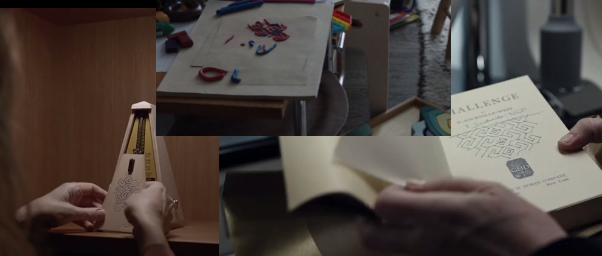
Notably, this scene with the clay occurs after we learn that Krista has died. Is this just something that Petra saw in her mother’s work that she’s recreating, or a pattern that she stumbled across purely coincidentally? We know that Lydia gives her keys to her assistants based on an interaction with Francesca, so it’s not out of the realm of possibility that the inscription and activation of the earlier ticking metronome could have been something that Krista did intentionally in order to get under Lydia’s skin, but the clay remains unanswered. The fact that Petra is not allowed in Lydia’s office is mentioned several times, but immediately after observing the pattern in her daughter’s playthings, Lydia then finds Petra in that very office, a ghostly silhouette in the gossamer curtains, where the child has hidden from her sitter. Did Petra start the metronome while playing around after bedtime? Is Lydia sleepwalking and creating these patterns herself? The film doesn’t (and shouldn’t) provide a solid answer, and while I am firmly of the belief that there’s nothing supernatural happening here, the film doesn’t completely rule out that interpretation for the viewer who is so inclined. 

Frankly, that everything is happening might have a rational explanation, or that perhaps in her spiral Lydia is seeing patterns (literally) where they do not exist as her past catches up with her, is much more frightening and anxiety-inducing. Frequently, Lydia is seen responding to sounds, or perhaps impressions, that she perceives but which we do not. While listening to NPR, she mocks the tone of the voice on the speaker, then turns to look behind her suddenly as if she just saw something out of the corner of her eye. This happens several times throughout the film, and it paints her as a person who, although seemingly thoroughly self-possessed, is always looking over her shoulder for her past to catch up with her. That’s what makes this a “woman on the verge” picture: the mask of sanity is slipping. To quote her directly, Lydia knows that her fall from grace is coming, inevitable even, and we know it too; she “know[s] precisely what time it is, and the exact moment we [Lydia and we the viewer] will arrive at our destination together,” and that destination is her downfall. 

Everything about Lydia Tár is a lie, but she doesn’t see it that way; she’s conducting the way that people perceive her, even if that means out and out falsehood. She steals her wife’s medication before the movie even starts, gets replacements while abroad, and pretends to find a pill in a drawer when she returns home to find her wife in medical distress. She claims that she never reads reviews but in fact takes a detour on her miles-long run to visit a newsstand off the beaten path, where the proprietor has already pulled the publication with her most recent review for her; they do this all the time, and she adds this latest to a box of many more. She claims that other women doth protest too much about sexism in her field but she knows that this is an out and out falsehood. Her fellowship is supposed to help support women who want to get into the field, but it’s really little more than a recruitment front for the next ingenue who will become her sexual prey. She rejects gendered terminology and prefers “maestro” to “maestra,” but when confronting her daughter’s bully, identifies herself as Petra’s father, because she knows that, outside of being witty, urbane, and dismissive of the power of patriarchy as part of her public persona, maleness, with its power to intimidate and threaten, is still substantial, even if that masculinity exists only in perception and not reality. Even her impassioned defense of Bach to a queer, BIPOC student is not about Bach, but about herself: one must separate the art from the artist, she insists, but she’s really talking about herself, because beneath all the layers of tailored suits and carefully choreographed photoshoots that the art which is entitled Lydia Tár must be separated from the artist, Linda Tarr (as we learn she was named before deciding to play her own game of identity politics). It is a preemptive apology, not in the sense that it precedes her many ethical failings, but in the sense that it precedes their discovery. She’s already on the edge, verging on the fall, and she can hear her destiny sneaking up on her, even if there’s nothing there when she turns to look at it. 

This is a rich, detailed, many-layered, and beautiful text, one that lends itself to a multitude of interpretations. It’s dense with meaning and subtleties that exist to be cleaved and inspected. Now that it’s available to a wide audience, I can’t recommend it highly enough. It’s demanding, but it’s worth the reward. 

-Mark “Boomer” Redmond

SHAZAM! (2019)

Look, up in the sky! It’s Zachary Levi, and he’s buff as hell! And we’re all calling him “Shazam” instead of “Captain Marvel,” for reasons that were complicated for a long time and are even more complex now. Great!

SHAZAM! is a whole hell of a lot of fun, a modern day kid’s wish fulfillment film that harkens back to a time when it was still possible for such a thing to be dark, vulgar, and tongue-in-cheek. This is a movie in which 14-year-olds are bullied for being different, catastrophic car accidents are presented in brutal detail and have life-altering consequences, kids are interested in strip clubs despite the preponderance of internet porn, giant demon monsters bite adult heads off and capture children, and one of the first things that two underage teenage boys elect to do upon realizing that one of them appears to be an adult is buy beer. Which is not to say that there’s not a lot of sentiment here as well, though it manages to avoid being cloying for the most part, and even I was surprised at how much it was able to manipulate my emotions – I mean “move me” – in its emotional moments. It has a lot of heart, is what I’m saying, but manages to avoid getting treacly by balancing its emotionality with good jokes and the occasional supernatural murder.

In 1974, Thad Sivana is en route with his cruel and demanding father (John Glover, who looks amazing for 74) and bullying older brother to his grandfather’s house for Christmas when his Magic 8-Ball toy flashes a series of glyphs and he is transported to the Rock of Eternity, a realm from which all magic flows. He meets the wizard Shazam (Djimon Hounsou), who tells of the council of wizards who safeguard magic, of which he is the last living remnant, and of the Seven Deadly Sins, trapped on the Rock in statue form. He offers the boy a chance to accept his power and take his place as the champion of magic, but Thad is more drawn to a magical object, which whispers to him. Shazam tells him that he has failed the test and transports him back to his father’s car, whereupon he freaks out and attempts to get “back” by jumping out of the moving car, causing an accident.

In the present, Billy Batson (Asher Angel) is a fourteen year old foster kid who has run from dozens of homes in the eleven years since his mother lost him at a carnival. After the foster system catches up with him after his most recent escape, he is placed with Rosa and Victor Vasquez (Cooper Andrews and Marta Milans), former foster kids themselves who run their own home now. Their eldest is Mary (Grace Fulton), who is soon to finish high school and about to start college, followed by Freddie (IT’s Jack Dylan Grazer), the same age as Billy, a disabled nerd obsessed with superheroes, which, lest we forget, exist in this world. There’s also the overweight Pedro (Jovan Armand), whose “goal is to get swole,” preteen Eugene (Ian Chen), whose schtick is being obsessed with video games, and the youngest, Darla (Faithe Herman), a sweet elementary-aged girl whose greatest desire is to show Billy the affection that he so desperately needs and get that same love in return (she also steals every scene that she’s in). Meanwhile and elsewhere, the now adult Dr. Thaddeus Sivana (Mark Strong) has an entire facility of psychologists and scientists working on the phenomenon of “mass hallucinations” by tracking down and interviewing others who were brought to the Rock of Eternity and failed to pass the test. Finding his way in, he unleashes the Sins from their captivity and becomes their magical champion.

Billy is prepared to take off again pretty much immediately, but as he’s attempting to disappear after his first day of school, he helps Freddie fight off two bullies (Carson MacCormac and Evan Marsh) who first assault him and then mock him for being motherless. Escaping, he too finds himself at the Rock of Eternity, where the now-dying Shazam chooses Billy as his champion, allowing him to turn into a magically-powered adult superhero (Zachary Levi) when he speaks the word “Shazam!” But as long as those powers exist, the Sins won’t rest … .

After all the origin stories that we’re all so sick of, one comes along that absolutely works. The obvious (and at this point  this observation is well-worn) influence is from Tom Hanks’s 1988 wish-fulfillment fantasy flick Big, which we’ll just assume that everyone has seen. The comparison almost makes itself, especially since that film, like this one, has some narrative elements that normally wouldn’t fly today in this world of sanitized children’s films – can you imagine a wide release like Return to Oz, Secret of NIMH, The Goonies, or even The NeverEnding Story coming out in theaters next week without there being a significant parental backlash? I mean, when was the last time you saw a movie that had both a teenage protagonist and a man’s head getting bitten off? But there’s also some Journey of Natty Gann thrown in there to pluck at the heartstrings, plus some imagery that could basically have been taken from The Gate thrown in for good measure. Also, Jackass.

I won’t get into what the Shazam power is or what mythological archetypes his powers are drawn from (that’s what Wikipedia is for), and this took a nice and unexpected (though in retrospect properly foreshadowed) turn toward the end that I don’t want to spoil since it genuinely took me by surprise, so I’ll be brief. This movie is genuine. It’s true to itself and has a genuine warmth that helps glaze over some of the iffier narrative choices, taking a film that verges on melodrama at points and pulls it back from that edge with a firm hand. There’s become such a delineation between “media for kids” and “media for adults” that we’re so unaccustomed to a film that is squarely in the realm of entertainment for the whole family that we’re not sure how to access it and interact with it, but this is one of those films. Kids will love it. Adults will also love it, even if they are as cynical as I am and started cringing as soon as Freddie claimed to know Shazam and immediately foresaw exactly where that plot line was headed. But all of that was balanced out by the joy of watching two kids, one of them in the body of a superpowered adult, performing Johnny Knoxville style stunts to test his limits. When almost every scene is a real gem, even something as rote for a superhero movie as stopping a mugging in a park, it encourages forgiveness of some of the more obvious story choices. This one is going to stick around.

-Mark “Boomer” Redmond

Kingsman: The Golden Circle (2017)

I approached this sequel with a fair amount of trepidation. The first Kingsman was an anomaly in that it seemed to fly under most people’s radar (it was in its third week when I saw it, on a Thursday afternoon, and there was not another soul in the entire theater) but was successful enough via word of mouth (after all, there is a sequel now) that it became a bit of a cult film almost instantaneously. The press for the film has been overwhelmingly negative, and I had reservations about seeing how far a follow-up to one of my favorite films of 2015 could possibly stray into territory that garnered such negative feelings.

And frankly, I just don’t get it. This movie is awesome.

Around my office I’m known as the guy who likes the weird artsy shit (and, if you’re reading this site, you probably are that guy or gal or person of a nonbinary nature in your office too), but I also genuinely love a surprise, over-the-top, tongue-in-cheek roller coaster of an action film when one somehow stumbles out of the studio system to slouch toward either notoriety or be forgotten. I wasn’t at all interested in the first Kingsman after seeing an overlong preview for it on FX during American Horror Story until a friend promised me that there was more to it than met the eye. And there was! It’s an unapologetic spy film that cribs from My Fair Lady (explicitly), blows the heads off of hundreds of people in a colorful fireworks display, and twists the familiar elements of the gentleman spy and action genres so far around that they essentially break off. It’s not the greatest film ever made, but it was an exceedingly well-choreographed exercise in bubblegum brutality and Blofeldian pomp.

The new film, Kingsman: The Golden Circle is all of those things as well. It’s a little more bloated than its predecessor in length and that nudge-nudge-wink-wink factor (it’s a fine line that’s difficult to manage/navigate), while running a little leaner on some subtlety. Sure, there are no lines that lean so heavily on the fourth wall as the original’s clunky “This ain’t that kind of movie, bruv,” but there is a salon robot that files down and a fifties themed villainous lair buried in “technically undiscovered” ruins in a jungle, not to mention the best use of Sir Elton John in a movie since Almost Famous.

We pick up where we left off last time, with Eggsy (Taron Egerton), codename Galahad, still mourning the loss of his mentor Harry (Colin Firth), the previous Galahad. We learn that he’s still dating Princess Tilde (Hanna Alström), whom he rescued from Valentine’s base at the end of the previous film and that the apparently-killed Charlie (Edward Holcroft), a Kingsman recruit who failed to make the cut, was mangled at the end of the last film but is still alive. In fact, he’s working for Poppy (Julianne Moore), a drug empress who wipes out all of Kingsman but Eggsy and Merlin (Mark Strong), the agency’s surrogate for Bond’s Q. The Kingsman doomsday vault points them in the direction of a kind of sister organization known as Statesman, which uses a distillery as the front for their off-book missions. After some of that good old-fashioned Let’s You and Him Fight nonsense, the remnants of Kingsman team with the Statesman cowboy stereotypes to thwart Poppy’s plan to strongarm the U.S. government into decriminalizing all drugs by withholding the antidote to a virus of her own design. “Champ” Champagne (Jeff Bridges) is the leader of his group: wild card party animal Tequila (Channing Tatum), archetypal honorable gunslinger Whiskey (Pedro Pascal), and shrinking violet Merlin equivalent Ginger Ale (Halle Berry). Before they reach the finish line, there’s much discussion of John Denver, a tussle or two with a couple of killer robotic dogs, a man being forced to eat a hamburger made of his friend, and a painful looking identity-erasing makeover. Also, there’s a subplot about the evil unnamed PoTUS (Bruce Greenwood) cackling and lying. And a wedding.

A lot of people have taken issue with some of the more subversive elements of the film and the way that they turn our hero into a bit of an idiot, but I like that. It’s another way of subverting the Roger Moore Bond’s tropes, because Eggsy isn’t the perfect wish fulfillment hero that Bond is. His friends are uncouth, he’s careless with his lethal gadgetry, and he doesn’t see an obvious traitor in his midst until it’s almost too late.When Whiskey and the Galahads (band name!) visit a facility hidden within some kind of ski resort, you expect that it’s going to be a play on the fact that Roger Moore’s Bond skied all the time, in A View to a Kill, For Your Eyes Only, and The Spy Who Loved Me. But nope, there’s no overlong ski chase, just a giant skyway plummeting from the sky.

Eggsy is still the un-Bond, and while this film fails to have the same (relative) gravity as it managed to maintain via the character arcs of the first, there’s a development there that I think is being overlooked by those who are decrying this as a bombastic failure, either as a follow-up or a standalone film. One of the things that people seem to be most upset about is the fact that Eggsy chooses to call his girlfriend and get permission to sleep with another woman in pursuit of the mission. Yes, it’s dumb in that it’s poorly timed (he couldn’t have called her on the way to the rendezvous?), but it reflects another anti-Bond quality that makes Eggsy more likable and relatable. For all the power fantasies that he fulfills, James Bond is an aggressive womanizer and kind of an asshole. He always gets the job done, but you know that if his marriage to Tracy Bond had lasted more than eight minutes he would have given her the old Betsy Draper special every time he was in the field, whether it was beneficial to his mission or just because he was bored. The film goes out of its way to show you just how unlike Bond Eggsy is in this way, and it’s actually refreshingly original. Also, there’s a laser whip.

I’ve also seen some responses to the political commentary in the film, which is allegedly slanted left. I was surprised to read this interpretation of the film after my screening, as I actually thought the film was rather toothless in its reflection of the current American political climate (not that I expected any deep commentary at all in this one, but by making the PotUS a major character, you invite that criticism). After all, in the last one, it was made pretty explicit that President Obama (along with essentially every political leader save for Tilde and her father and perhaps a few other dissidents) was a willing participant in villainous mastermind’s evil scheme. I’ve seen dismissal of the Oval Office subplot as being “pandering” because the evil president’s moral victor is an older blonde woman, a way of giving liberals the world that they want to live in. I didn’t (and don’t) see it that way, however. All of the reporting that we see within the film comes straight from Fox News, and, in comparison to the complicit Obama of the first film, the evil President herein is given neither a name or an explicit political party, and doesn’t have the mannerisms or characteristics that would truly make him an analog of Trump: no combover, no dayglo skin, no broken or rambling sentences or rogue trains of thought. There’s no actual political commentary here, and that’s fine; this is just another generic evil president in a long line of fictional evil presidents. If you see Trump in this performance, well, that’s up to you.

Overall, this is a sequel that works. It’s a bit paler and a not quite as fun, but it’s stylish, witty, visceral, colorful, and a hell of a lot of fun. It’s a film that’s not to be taken seriously, and it delivers on the promise that the (spoilery!) trailer sets up. On a scale of sequels that copied the template of the first film verbatim from Men in Black II to 10 Cloverfied Lane, it errs on the “scenes from the last one, but with a twist!” side, but there’s still enough new to satisfy you, as long as you’re willing to get lost in a candy kingdom of headshots and people getting cut in half. And Elton John in fabulous feathery shackles.

-Mark “Boomer” Redmond