D.O.A. (1949)

D.O.A. is a tight little noir thriller (#89 in Douglas Brode’s list in Edge of Your Seat, for those of you playing along at home) that’s one of the most perfect encapsulations of the genre. At 82 minutes, there’s almost no fat to be trimmed, and since it lapsed into the public domain years ago because of failure to renew the copyright, it’s accessible pretty much anywhere. Director Rudolph Maté, who would go on to helm When Worlds Collide just a year later, had risen through the ranks as a cinematographer, having earned his stripes on films as varied and well-remembered as Carl Theodor Dreyer’s The Passion of Joan of Arc and Vampyr, Alfred Hitchcock’s The Foreign Correspondent, and the Rita Hayworth vehicle Gilda from director Charles Vidor. That eye for composition is striking in the film’s opening sequence, a minutes-long tracking shot that follows a man through a vast and echoey police station to find a particular detective so that he can report a murder: his own. 

Frank Bigelow (Edmond O’Brien) is an accountant and notary public in the desert town of Banning, California, population about seven thousand at the time. His secretary, Paula (Pamela Britton) is madly in love with him, a situation that he seems disinterested in either quashing or pursuing. He springs the news to her that he’s taking a solo weekend trip to San Francisco, much to her disappointment, but there’s nothing she can do to stop him, and away he goes. Arriving at his lodgings, he discovers that the place is full of salesmen who have just wrapped up an annual conference and are holding various parties all over the hotel. The place is lousy with pretty ladies in expensive fur coats, and Frank seems more than ready to sow some oats hither and yon, but not before he returns Paula’s messages. She’s not pleased to hear all the caterwauling in the background, but she nevertheless dutifully reports that a man named Eugene Philips, an importer-exporter, had been desperately trying to reach him all afternoon, ending with the cryptic statement that if he didn’t talk to Frank right away “it would be too late.” Frank goes out with the salesmen from the room across the hall to a jazz bar, where the host’s wife starts to get a little too handsy, and he excuses himself to make small talk with a pretty blonde at the bar. Distracted, he doesn’t notice the lurking figure with his back to the camera surreptitiously slipping something into his drink. The next morning, he feels extremely ill and gets a terminal diagnosis; he’s ingested the “luminous toxin,” a poison with no antidote, and now he has only days left to live, not much time to find out who his killer is.

There’s a lot that happens in the first act of this one, which is great, since it means that the second and third acts move at a breakneck speed as Frank works to pull at all of the threads of a decently convoluted conspiracy and solve his own murder before he drops dead. Paula is a fascinating character, as she initially comes off as slightly off-putting, pestering Frank to the point of workplace sexual harassment. She insists that he take her out for a drink and is notably upset that Frank made plans for a weekend trip that didn’t include her, but she also seems to realize that this is Frank taking an opportunity to give himself one last weekend as a swinging bachelor before settling into a life with her in Banning. Upon awakening in San Francisco on Saturday morning, he’s clearly ready to go back and marry Paula, even before he learns that he’s dying. Once he tells her that he needs her, she shows up to act as his sidekick for the rest of the film, and there’s real affection there. The great tragedy may be that if she hadn’t been suffocating him so, he might not have felt the need to spend a weekend away from her, and then he wouldn’t have been poisoned. Alas. Not that it would have helped save Eugene Phillips, who was going to “commit suicide” that Friday night one way or another. 

One of the other great tragedies in this has a major noir bent, which is the trope of the innocent man caught up in a dangerous web of lies and crime. For Frank, it comes down to a particular bill of sale that he notarized for Phillips months in the past, one that would have proved the dead man’s innocence. It’s not really spoiling much; the film’s electric energy all revolves around Frank going from place to place and getting answers that lead to more questions, all leading back to Phillips’s untimely demise. Who’s the real villain here? Is it Phillips’s brother, who was carrying on an affair with his sister-in-law? Is it Halliday, Eugene’s business partner? Is it the mysterious George Reynolds, whom no one seems to have ever seen and which may be no more than an alias? It’s a tight little mystery that’s completely streamlined. Just as Frank is running out of time, he grows increasingly frantic and desperate to find out who’s responsible for setting his death in motion and ensure that Paula is out of their reach, and the film feels similarly harried and headlong as it rushes toward the conclusion. 

Maté’s is a name that one doesn’t hear bandied about in cinephile circles all that much. It can’t help that, looking at his CV, his filmography is all over the place. There are several films noir listed there, many of which seem intriguing even if I’ve never heard of them, like Union Station starring William Holden, Paula starring Loretta Young, and Forbidden starring Tony Curtis. But in the midst of those are a motley assortment of historical adventures (The Prince Who Was a Thief, The Black Shield of Falworth, and The 300 Spartans), romantic comedies (It Had to Be You, Sally and Saint Anne), Oscar bait (No Sad Songs for Me), and far, far too many Westerns to name. The man worked, and his talent is clear here, and I’m excited to see if I can track down some of his other noir and crime thrillers, even if I have no interest in Siege at Red River, The Far Horizons, or The Rawhide Years. The performances here are great as well, as O’Brien perfectly embodies a man who’s clearly been spending too much time helping farmers file their taxes and fending off Paula’s pawing at him and just needs to know he could still get a city girl’s number, even if he can’t follow through with ringing her up. Britton also walks a narrow tightrope here, needing to play Paula as written while also making her someone we find likable enough to root for her and Frank to get together. With such a short time commitment and widespread availability (it’s even on Tubi), D.O.A. is worth checking out. 

-Mark “Boomer” Redmond

Beyond a Reasonable Doubt (1956)

1956’s Beyond a Reasonable Doubt is a late-career noir directed by Fritz Lang, his very last production for an American studio. It’s weirdly flat in style for Lang, whose early triumphs M & Metropolois helped establish foundational cinematic language that pushed the still-young artform to its furthest extremes. Here, he’s so bored with the form that he goes through the motions of a legal procedural as if he were making a televised Movie of the Week, give or take a few lateral camera maneuvers that attempt to liven up long scenes of men talking at desks & tables. Lang even calls attention to this TV-movie quality by speeding along witness testimony in montage as presented on a local news broadcast, shot in the same multi-camera style as the film proper. However, the longer you stick with Beyond a Reasonable Doubt‘s preposterous, only-in-the-movies courtroom drama the more complicated its moral & narrative implications become, until it spirals out into a big-picture indictment of the entire American justice system and then, ultimately, lands a few unexpected jabs as a twist-a-minute thriller. What I’m getting at here is that it’s Fritz Lang’s Juror #2.

Dana Andrews (of Laura fame) stars as a hotshot novelist who’s eager to score a big hit with his second book so he can afford a high-society marriage to his newspaper heiress fiancée (Joan Fontaine, of Rebecca fame). His best lead is a hairbrained idea cooked up by his father-in-law-to-be, a newspaper man who’s in constant public battle with the local DA over the ethics of capital punishment. Incensed that the DA is “trying to reach the governor’s chair over the bodies of executed men,” the father-in-law schemes to trick the aspiring politician into sentencing a provably innocent man to death based on planted, circumstantial evidence. Convinced that the scheme has the potential for national publicity, the novelist foolishly agrees to frame himself for the murder of a burlesque dancer, hoping to turn the experience into his next hit book (and, why not, make a political statement against capital punishment too, if it’s convenient enough). As anyone who’s ever seen a movie before would guess, things go awry when the evidence proving his innocence is destroyed, and his fated date with an electric chair becomes more inevitable than theoretical.

It’s how Douglas Morrow’s script disappears that exonerating evidence and what happens to the novelist once it’s gone that makes Beyond a Reasonable Doubt narratively tricky. The 80-minute potboiler doesn’t fully get cooking until the final quarter, when Morrow throws in at least one twist too many and the pot boils over. The first twist is a violent shock. The second is a disappointingly conventional cop-out that defuses the tension. Then, the third twist desperately attempts to add some traditional thriller tension back into the plot, calling the movie’s morals & politics into question in a way that can’t fully be reconciled because it happens at the very last moment. At the start, Beyond a Reasonable Doubt is a thought experiment cooked up by noble writers who aim to take down wicked politicians who use state-sanctioned murder to further their careers. Since the objectively evil practice of capital punishment is still alive & well today (with Louisiana & other states gassing prisoners and subjecting them to firing squads again), maybe it’s to the movie’s benefit that it ends as a cheap-thrills mystery plot instead. Lang & Morrow made no detectable impact on the American justice system, but they did pull a few gasps out of an unsuspecting audience, even if entirely out of incredulity. Like with Clint Eastwood’s Juror #2, I doubt it would’ve been notable to anyone if it were filed under a workman director’s name instead of Lang’s, but there is something to its moral precarity that can’t be fully dismissed.

-Brandon Ledet

The Dark Mirror (1946)

I was recently so impressed with The Spiral Staircase that I went down a little bit of a rabbit hole seeking out other films from director Robert Siodmak. Just a year after Staircase, he helmed another shockingly modern proto-slasher entitled The Dark Mirror. The film stars Olivia de Havilland in dual roles as twin sisters Ruth and Terry Collins, one of whom is concealing a dark secret. You see, Terry is a sweet girl working at a lobby newspaper stand and has fallen for the beguiling charms of one Dr. Frank Peralta, who has an office in the building. When she’s seen leaving his apartment the very night on which he was found stabbed to death, multiple eyewitnesses can account for her presence — except that her alibi is rock solid, as she was also seen at the exact same time in the park by her butcher and a patrolman. Befuddled police lieutenant Stevenson (Thomas Mitchell) can’t make heads or tails of it until he visits Terry one night and meets her twin sister, Ruth, learning that the two live together and even trade off the “Terry” identity in public so that they only have to have one job. When the district attorney admits that they can’t make a case against either woman as they’d each be covered by the proverbial shadow of a doubt, Stevenson enlists the help of Dr. Scott Elliott (Lew Ayres), who coincidentally has an office in the same building as the late Peralta and happens to be a specialist in the field of twin studies, to surreptitiously study the two and find out which of them is the killer. 

The duplication special effects in this one are fantastic, give or take a couple of dodgier scenes where the intercutting and blocking don’t quite measure up. As the title would suggest, there are numerous sequences in which mirrors are a focal point, including several in which both Ruth sits at a vanity mirror and has a conversation with Terry while the latter reclines in bed behind her, both of them visible in the reflection. It was a technical marvel, and I kept trying to figure out how it was done, getting a little lost in trying to tease out the details (I decided it must have been that the Terry segment was shot first and then projected on a screen behind de Havilland while she shot the Ruth portion). Regardless of how it was accomplished, it looks amazing, and when the two are in the same shot using split screen tech, it’s also very well done. Of course, all of that movie magic would be wasted were it not for de Havilland’s strong performances as each sister, as there’s never any real doubt about who’s who. The film often differentiates them through their monogrammed bathrobes, Ruth’s “R” brooch, and a pair of extremely tacky necklaces that bear their full first names, but de Havilland plays each woman so that these visual cues are largely unnecessary. Terry seems forthright and personable while also clearly being the steelier, stronger woman; Ruth appears to be extremely kind-hearted and verging on the naive, and clearly more troubled by the situation in which the twins find themselves than her sister. 

Contemporary reviews of the film were mixed, but one of the ones that stood out to me was from Variety, which stated that the film “runs the full gamut of themes currently in vogue at the box office — from psychiatry to romance back again to the double identity gimmick and murder mystery.” I was struck a bit by this reference to “psychiatry” as a common film topic, since I’ve not run across many films of this era in which this was a common element or theme. M certainly had an element of psychological detective work at play, and there was a series of films based on an earlier radio series that began with 1943’s Crime Doctor (all ten films in the series were released before 1949). If anything, I associate suspense thrillers of the 1960s with direct references to psychiatry: hitting the ground running in 1960 with Psycho devoting its closing moments to a psychologist explaining Norman’s particular maladies; the ongoing exploration of the psychological profiles of the dueling personalities at the center of Whatever Happened to Baby Jane? in 1962; the journey to the heart of the mental health hospital system in 1963’s Shock Corridor. On further reflection, though, this one came very close on the heels of Gaslight in 1944 and Alfred Hitchcock’s 1945 feature Spellbound, the latter of which featured Ingrid Bergman as a psychoanalyst who falls for her amnesiac patient played by Gregory Peck (who wouldn’t?), so I suppose there is a possibility that this was, at the time, a gimmicky attempt to cash in on a recent craze (no pun intended). It even features a Rorschach test, although they refer to it only as an “inkblot test,” as perhaps the Swiss inventor’s name hit the post-war American ear as a little too Germanic. 

Where this one fell a little short of Staircase’s greatness was in its failure to live up to my expectations, which is hardly the film’s fault. I’m eighty years removed from when this was made, so it may be unfair of me to resent that the twists in this one didn’t go as far as I would have liked. I would have appreciated the film more had it spent some small amount of time on the possibility that neither sister was Peralta’s murderer, as it would have been fun to see de Havilland playing off of herself in scenes in which both sisters wonder if the other is a killer. I’ve also seen “Treehouse of Horror VII” (the one with Bart’s evil twin Hugo locked in the attic) more times than I could possibly recall, so there’s a part of my brain that kept waiting for the twist that the supposed “good” twin was the killer and that the “bad” twin was covering for them, or that one of the twins had some history of violence but not the one we think. Maybe the twins were both trolling Dr. Elliott all this time and occasionally impersonating one another in their sessions with him. Any one of those would have pushed my rating a little higher; instead, once Dr. Elliott establishes that one of the women is a one-in-a-kajillion sociopath, it’s clear which one is virtuous and which one is responsible for all their troubles, and it’s a little rote from there. What keeps it from falling off completely is that this revelation allows more insight into just how manipulative one sister is of the other, and the final scene is still a phenomenal showcase for de Havilland. This one has been slightly difficult to find at times, but is currently available on the Roku app. If you, like me, don’t have that, then maybe you can find it at your local library. I did!

-Mark “Boomer” Redmond

The Spiral Staircase (1946)

I’ve brought up in previous reviews that, for many of my teenage years, Douglas Brode’s Edge of Your Seat: The 100 Greatest Movie Thrillers was a treasury of knowledge for me. I’ve had the book for decades, making notes in it that go back to 2003 about when I watched a film on the list, what my personal rating was, that sort of thing. I’m still working my way through it, having seen about half of them. Some of these were fairly recent, like The Conversation (#60) and The Last of Sheila (#88), with my Roger Corman Poe adaptation journey meaning that The Pit and the Pendulum (#61) soon to be added to that list. Just ahead of that one and The Conversation, at #59, is 1946’s The Spiral Staircase, and I’m delighted to report that it does not disappoint. Just as a forewarning to anyone who may be interested and has access to Brode’s book, however, please note that the film’s synopsis does spoil the identity of the killer, so make sure to view the film before reading that section. 

Set some years before the film’s actual production date (more on that later), the film opens on Helen (Dorothy McGuire) attending a screening of the silent 1896 film The Kiss, although the movie treats this as a feature rather than the 18 second featurette that it really is. The screening is being held just off of the lobby of a hotel, and upstairs, a woman is strangled to death. The constable (James Bell) arrives and speaks with Dr. Parry (Kent Smith), a relative newcomer in town who wishes to offer his opinion, even though the town’s primary physician is already on-site. Parry then offers to give Helen a ride home in his horse-and-buggy, and it becomes apparent that Helen is mute, and Parry regards her with some affection and has attempted to interest her in seeing a Bostonian doctor friend of his about treatment for her condition. He’s pulled away by a medical emergency before getting her all the way home, but she’s fine to walk the rest of the way, at least until a sudden thunderstorm occurs. As Helen races back to the mansion in which she is employed as a servant, we see that she is being watched by a rain-drenched man in a slicker and hat. There’s great concern that Helen may be the killer’s next victim, as each of the previous killings were of women with some kind of disability. 

The mansion itself is a great set, with the spiral staircase that Helen ascends and descends throughout taking center stage. Even though we spend an unbroken hour within its walls, the house’s expansiveness means that it never becomes boring visually, and we learn the place’s general layout fairly quickly, which makes the breakneck pace of the final act easy to follow as Helen rushes about, pursued by her would-be killer. It also means that there’s plenty of room for a smorgasbord of characters, any one of which could be the murderer. There’s Dr. Parry, of course, whose recent arrival to the community marks him as a kind of outsider, and whose interest in Helen could be more than merely medical or social. The house’s matriarch is Mrs. Warren (Ethel Barrymore), apparently bedridden and requiring nursing care, but who prefers the ministrations of Helen, although she warns the girl several times that she should flee the house and never come back, if she can. The house is also occupied by Professor Albert Warren (George Brent), Mrs. Warren’s stepson, an upstanding member of the community who nonetheless has some resentment for his stepbrother Steven (Gordon Oliver), who has all but abandoned his mother to Albert’s care while he lives prodigally on the family’s money, only taking time from philandering around Europe with loose women when he needs to return home to refresh his accounts. This means that he, too, has only recently returned, and his arrival’s overlap with the sudden rash of killings makes him suspicious, and although he tells the constable that he didn’t leave the house the whole of that day, Professor Warren notes that his shoes are muddied, and questions why he would lie. Of course, one wonders when he would have time to get away when he’s so smitten with Blanche (Rhonda Fleming), the professor’s assistant/secretary. For the most part, the women are above suspicion, except for Mrs. Warren’s nurse, Barker (Sara Allgood, just a few years after her Best Support Actress win for How Green Was My Valley), whom one character refers to as being just as good as a man in a fight. Also not a likely suspect is Mrs. Oates (the Bride of Frankenstein herself Elsa Lanchester), the housekeeper, although her groundskeeper husband, Mr. Oates has suspicion cast upon him from the moment he appears, as he enters the house wearing a raincoat and hat just like the person stalking Helen in the yard. 

It’s a decent cast for a mystery that takes place over the course of a single evening in a single locale, creating a great sense of suspense. Clues are planted throughout (like the early foreshadowing of the use of ether as a medicine for Mrs. Warren), doubts are raised about everyone’s activities (like who has the missing ether), and characters are given good reasons to be leave the vicinity just long enough to be suspicious (like Mr. Oates being sent to the next town over to get more ether; it’s a rather ether heavy plot). We learn fairly early on that Mrs. Warren is a crack shot and may be less enfeebled than she lets on, as she keeps a gun next to her bed that Helen is unable to wrest from her grasp, and she boasts about having slain the tiger that gave its life for her bedroom rug. She even notes that her late husband used to tell her that although she was not as pretty as his first wife, she was a much better shot. That late Mr. Warren, though long passed, cast a pall over the house that is still very much in effect. A man of much machismo, he resented that neither of his sons had much interest in sport or riflery as he did, and thought little of both of them as they instead chose academia and ribaldry as their passions instead. That paternal disappointment is at play in the behavior of both living Warren men, and a revelation that a woman was murdered at the house years before casts further suspicion on them both. It’s great character work that effectively keeps you guessing until the moment that the killer is revealed. 

We often talk about Psycho as the sort of decades-early prototype of the slasher genre, but there are a lot of novel, modern elements here that are also clearly part of that same genealogy, and even earlier to boot. Images of the slicker-wearing killer hiding just where Helen cannot see him, framed from the back, have a very slasher vibe, with the first image that comes to mind being the hook-wielding killer in exactly the same outfit in I Know What You Did Last Summer. As Dario Argento later would, director Robert Siodmak used himself to represent the killer before the reveal, most notably in several moments where there is an extreme close up of the killer’s eye. Sometimes, we get to see the reflection of a victim in said eye, which is not something I expected to see in a film produced in 1945. It’s so modern that it feels almost too far ahead of its time. We even get several first-person shots from the killer as he snuffs out his victims. In the first, they attack the woman when she’s changing clothes and is halfway through getting her dress on, her arms pinned in an overhead position, her long-nailed hands grasping at the air as she struggles; in the second, the victim plays the old “Oh! It’s you! You scared me!” routine until the killer lunges and strangles her in a chiaroscuro-lit cellar, with the actual murder happening in the darkened, unlit center of the frame, her seemingly disembodied hands likewise clawing at nothing from opposite sides of the image. 

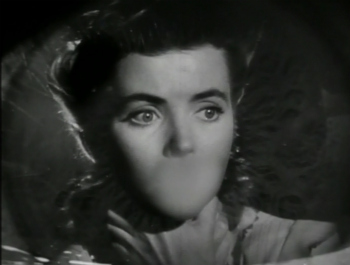
The imagery is potent, and the film isn’t afraid to occasionally go for the surreal. When Helen first returns to the Warren estate and is making her way up the grand central staircase, she stops for a moment to look into the mirror mounted on the landing (which will later make for some very cool angles in the chase scenes), and the camera crawls along the floor of the upstairs to reveal a pair of feet, letting us know that the killer is already in the house and is watching. As the killer watches, we see from their perspective that Helen has no mouth, and although the effect is rather limited, it’s still very creepy. Later still, when Parry has convinced Helen to run away with him, we get to see her imagine a brief, sweet courtship that leads right up to a wedding, the daydream turning into a nightmare when she is unable to say “I do,” as even in her fantasy she is unable to speak. 

Helen is a very cool final girl, and McGuire imbues a character who has no lines before the film’s final moment with a great deal of life and vivaciousness, conveying a lot through her body language and expressions. In one of the film’s most exciting moments, Helen is alone in the house with the killer as everyone else is dead, gone, imprisoned, or bedbound, and the constable comes to relay that Dr. Parry will not be returning that evening as he is attending a medical emergency, and Helen, in an upstairs room, beats against the window to get the lawman’s attention to no avail, and her desperation and frustration as he leaves are palpable. We see her playfulness with Mrs. Warren, her professionalism with Professor Warren, and her warmth and affection with Mr. and Mrs. Oates, and there’s a tangible difference in the way that she “speaks” to each of them. It’s damn fine acting work. The two best on-screen pairings are McGuire with Barrymore and McGuire with Lanchester. For the former, there’s an authentic sense of maternal warmth and protectiveness that Mrs. Warren has for Helen, and Helen seems to be the only person in the house whose company Mrs. Warren genuinely enjoys. With the latter, a lot of that is simply that Mrs. Oates is my favorite character here, and she was a delight every moment that she was present. Her rambling to Helen when she first returns home is quite fun, as is her antipathy toward her husband’s lazy dog. There’s a very fun bit in which she goes for her hidden brandy and finds it empty, to which Mr. Oates replies that he got rid of it because of her temperament. Later, when Professor Warren needs her help retrieving a bottle of brandy from the cellar, she fakes dropping the candle in order to steal another bottle for herself. It’s a helpful addition of some physical comedy to the proceedings while also setting up a scene later in which Helen locks her potential killer in the same underground room (and also a scene in which Helen is unable to rouse Mrs. Oates to help her with the killer as the older woman is passed out drunk). 

One thing that seems to be a point of contention is exactly when the film is supposed to be set. It’s clearly some time before the actual production date, as there is not a single automobile in sight, with characters riding around in horses and buggies. There’s no on-screen confirmation of an exact year, but Wikipedia lists it as 1906, as does TVTropes (although I assume the latter gets this from the former). Brode’s book lists it as 1916, and in fact makes some hay with the fact that this would have been right in the middle of the Great War, at a time when Freudian theory was becoming somewhat mainstream and that the film’s text is about Freudian themes of suppression and desire. It doesn’t really matter in the end, but thought it was worth mentioning, as I sometimes wonder where we get these “facts” about movies, and the way that something you might only learn in a now long-lost press kit have somehow been passed down as paratext and become unclear over time. 

-Mark “Boomer” Redmond

Lagniappe Podcast: The Big Sleep (1946)

For this lagniappe episode of The Swampflix Podcast, Boomer & Brandon discuss the classic Howard Hawks noir The Big Sleep (1946), starring Humphrey Bogart & Lauren Bacall.

00:00 Welcome

01:52 The Murder of Mr. Devil (1970)
06:58 Teeth (2007)
13:48 Citizen Ruth (1996)
20:48 Wander to Wonder (2025)
23:44 No Other Land (2025)
27:33 The Monkey (2025)
35:19 Heart Eyes (2025)
41:03 Armand (2025)
45:08 Grand Theft Hamlet (2025)
50:44 Mickey 17 (2025)
53:48 Universal Language (2025)

58:27 The Big Sleep (1946)

You can stay up to date with our podcast through SoundCloudSpotifyiTunesTuneIn, or by following the links on this page.

– The Lagniappe Podcast Crew

Mirage (1965)

Much like its amnesiac protagonist, Mirage is lost in time.  A major studio noir directed by Edward Dmytryk and starring Gregory Peck, it’s got the professional pedigree of a movie produced decades earlier, except when it comes to the grimier details of its era’s loosened morals.  Mirage walks like a stylish 1940s crime cheapie but talks like post-Code 1960s sleaze, with disorienting references to orgies & suicide and a score composed by Quincy Jones.  It echoes the political paranoia of its contemporaries like Dr. Strangelove and The Manchurian Candidate, and yet its official designation as a “neo-noir” feels like miscategorization.  It’s a legitimate, bona fide noir that lost track of where it belongs in time, so that the trippier psych thriller touches that color the corners of its black & white frame register as an out-of-bounds intrusion that the can’t be fully reconciled.  That dissonance makes for exciting tension as you constantly forget and are reminded of when it was made, and just how much more vulgarity Hollywood could get away with then.

Gregory Peck stars as an amnesiac who has to solve the mystery of his own identity before he’s shot dead.  He is literally in the dark at the start of the film, as his office building experiences a sudden blackout at the precise moment when the last two years of his life have leapt out of his memory.  It’s also at that exact moment when a fellow tenant of the building has leapt to their death on the concrete below, represented in gory detail by insert shots of a watermelon falling to New York City pavement.  Guided by candlelight, Peck navigates his way out of a handsy crowd of hot-to-go office girls and attempts to go about his day in the fresh air of Wall Street sidewalks.  Only, he can’t fully remember what shape his day usually takes, and he’s weirdly agitated by any questions that prompt him to think about his personal life or his past.  Scared, he seeks context clues about who he is from a skeptical psychiatrist, a former lover who’s scared to fill him in (Diane Baker, modeling jewels by Tiffany & Company according to the credits), and a doddering, in-over-his-head private detective (Walter Matthau, in the comic relief role).  The answer to the question of his basic identity is a last-minute twist with its own specific, detailed politics, but most of the movie is about the question itself, hinged on a declaration that “If you’re not committed to something, you’re just taking up space.”

Mirage is not only lost in time; it’s also somewhat lost to time.  With no current streaming distribution and no physical copies in the New Orleans Public Library system, the only reason I stumbled across the movie is that I found a second-hand DVD at the thrift store.  Its modern obscurity is partially due to its reputation as the B-picture leftovers of Stanley Donan’s Charade, which employed a significant portion of its creative team (Matthau included).  It’s much better recommended as either a late-to-the-game paranoid manhunt noir from a director & star who could’ve made a more stripped-down version of the same picture twenty years earlier, or as an early-to-the-game paranoid psych thriller akin to Fincher’s The Game from thirty years later.  Mirage‘s visual aesthetic is typical to 1940s noir, and its blasé relationship with sex & violence is typical to the 1960s cocktails set, but its cross-cutting head trip identity crisis is untethered to any specific era.  It’s a movie that purposefully dislodges the audience from linear-timeline logic to create a sense of displacement & unease, which is an effect that’s only intensified the further we’ve drifted from its own temporal context.

-Brandon Ledet

Dark Passage (1947)

One of the weirdest ways that the right wing griftosphere has managed to warp the minds of otherwise leftward and progressive young folks who are insufficiently critical of the online sources that inform their beliefs in the past couple of years has been the age gap discourse. In a very short period of time, we’ve gone from debating separating the art from the artist with regards to legitimate predators like Woody Allen and Roman Polanski to fully accepting the specious pseudoscience about when a brain is “fully formed” based on a tweet about a tweet about a tweet about a peer-reviewed study. I’m not going to pretend like we don’t live in a predatory world, especially for those who lack (or have been prevented from having) the ability to advocate for themselves. But I also can’t pretend that every time I see another young YouTuber fully and uncritically spread the idea that all age gap relationships are inherently unethical or immoral, it makes my heart preemptively hurt for all the ways that these uninformed blanket ideas are going to hurt the people that the purveyors of social commentary think they’re helping. If the right can get the left to eat itself by pushing the idea that women can’t make their own decisions at 18, or at 25, then they’ll eventually move the Overton window far enough to get people to think that women can’t make their own decisions at any age, or use this same logic to prevent trans people from living as their most authentic selves at any age. We’re only going to see it get worse. Luckily, Humphrey Bogart (born 1899) and Lauren Bacall (born 1924) have been dead long enough that (hopefully), they will escape the scrutiny of the neo-Puritans in Breadtube clothing.

Dark Passage was the third of four film that Bogey and Bacall made together during their marriage, and it’s a great little low-commitment noir. Bogart plays Vince Parry, a man wrongfully convicted of murdering his wife, and Bacall plays Irene Jansen, a woman who is sympathetic to him because of her own father’s false murder conviction. When Parry escapes from San Quentin, he first is picked up by a man named Baker (Clifton Young), but when Baker overhears the radio bulletin about Parry’s escape, the two scuffle and Parry steals his clothing. Before he does anything too rash, Irene appears on the scene and manages to secret him into San Francisco past the manhunt. While she’s out shopping for clothes, her snoopy friend Madge (Agnes Moorhead) appears at her door and, hearing the record playing inside, insists that Irene open up, until Parry has to pretend that he’s Irene’s gentleman caller. As it turns out, Madge and Parry have a history of their own; she wanted him and tried to induce him to an affair, and she provided the damning evidence (read: perjury) at Parry’s trial. Madge is also the ex-fiance of Bob (Bruce Bennett), who is now pursuing Irene. Parry leaves Irene’s and meets a sympathetic cabby named Sam (Tom D’Andrea) who sets Parry up with a discredited back alley plastic surgeon (Houseley Stevenson) to change his face. Unfortunately, upon awakening, Parry returns to the home of the friend who promised to house him during recovery only to find the man murdered, and Parry once again at the end of a frame job. 

The general consensus about this one is that the first half is much more exciting than the second, and I can see why. For the first forty minutes, the film is shot almost entirely in first person from Parry’s point of view, and it’s such a refreshingly modern and unconventional stylistic device that you can’t help but marvel at it, even nearly seven decades later. It’s Bogart’s voice throughout, of course, but we only ever see “Vincent Parry” as a photo in the newspaper, and the only time that Parry is on screen pre-face change is when he’s in the back of Sam’s cab and is backlit so that not even the outline of a face can be seen, which lends this one a great noir gravitas. This also allows for the opportunity for Bacall to make long, lingering stares straight down the barrel of the camera, as if she’s looking straight into your soul as she tells you that she believes in your innocence; she’s absolute magic here. While Parry is getting the surgery, he undergoes a marvelously psychedelic subjective dream sequence, with great kaleidoscopic effects and double (and triple) exposure overlays that also manages to feel very modern and fresh. The issue for a lot of people seems to be that this is where they start to lose interest, and the complete abandonment of those ahead-of-their-time visual choices as the rest of the movie plays out as a much more straightforward noir picture. I didn’t mind this, though, as I found the narrative sufficiently compelling and remained invested in whether Parry would ever be able to escape from the city and if Irene would be able to join him, as well as figuring out who actually did kill the late Mrs. Parry and Parry’s friend George. And the film is not completely without some very exciting shots to follow, especially as the action picks up; Parry is nearly apprehended by the police at one point, there’s a sequence of dangerous driving, and there are even two separate fall deaths with surprisingly decent dummy work. I liked it quite a lot. 

-Mark “Boomer” Redmond

Kiss of Death (1947)

Usually, when a classic-period noir is singled out for praise, it’s because it’s lean, rapid-fire machine gun entertainment – a high-style, high-energy crime picture achieved on a low-rent budget.  1947’s Kiss of Death has none of those qualities.  After opening on a botched Christmas Eve jewel heist in a tense, largely wordless sequence, the film’s urge to entertain goes dark.  This is an oddly leisurely, somber noir about the jail-sweat struggles of one of those failed jewel thieves (played by the aptly named Victor Mature) as he’s pressured to rat on his accomplices who got away.  At first, he refuses to squeal, but threats against his family change his tune, and he reluctantly becomes an undercover rat helping cops bust the crime rings that used to supply his income, much to his personal shame.  Watching this family man squirm under police pressure in his jail cell is far from the perverse sex-and-violence pleasures audiences usually seek in classic noir, so most of Kiss of Death ends up feeling limp in its genre payoffs.  It’s still worthy of all its praise & attention, though, thanks to a maniac villain by the name of Tommy Udo.

Richard Windmark’s performance as the sad-sack squealer’s charismatic, villainous foil heroically brings Kiss of Death back to life after the much more reserved Victor Mature drowns it in moralistic tedium.  Windmark’s infamous gangster Tommy Udo is a murderous sociopath whom the D.A. wants the jewel thief to snitch on as a fellow convict, but he proves too dangerous to be around, even for a minute.  Windmark is such an energizing lunatic in the role that he earned an unlikely Oscar nomination for it, presumably for being the only sign of life in an otherwise plodding picture.  Along with the likes of James Cagney, Peter Lorre, and Ann Savage, he gives one of the all-time great unhinged noir-villain performances, often credited alongside Conrad Veidt in The Man Who Laughs for inspiring the look & persona of The Joker.  When a cop asks Udo if he has a minute to talk, he spits back “I wouldn’t give you the skin off a grape.”  He condescendingly refers to his fellow gangsters by the uniform nickname “Squirt.”  He pushes wheelchair-using biddies down the stairs just for rubbing him the wrong way.  He is the entertaining volatility that most noirs exude in their filmmaking personified in a single movie-stealing character.

Besides the dark, revitalizing energy of Windmark’s performance, Kiss of Death is most commendable for its early use of location shooting around 1940s New York City, including prison scenes shot at Sing Sing.  Shooting outside of a Los Angeles studio lot was atypical for a small-scale crime picture at the time, which you can tell as soon as an opening-credits title card brags about the novelty.  It’s also unusual for a noir of this kind to be narrated by the doomed antihero’s love interest (and, weirdly, his kids’ former babysitter, played by Colleen Gray), but I can’t say her voice adds as much interest or texture to the picture as the location shooting, except maybe in softening the genre’s macho tendencies.  Otherwise, Hollywood workman director Henry Hathaway (True Grit, Niagara, Call Northside 777) brings a controlled, level-headed approach to the production that keeps it from achieving anything especially flashy or memorable within its genre template.  Only Tommy Udo breaks through that containment of Old Hollywood professionalism, transforming a cozy afternoon watch into a momentarily thrilling freak show.  He is the spectacle worth seeking out here, the only reason the film is remembered at all.

-Brandon Ledet

Podcast # 227: Madame X (1966) & Self-Reinvented Women

Welcome to Episode #227 of The Swampflix Podcast. For this episode, Hanna, James, Britnee and Brandon discuss a grab bag of movies about women who reinvent themselves with made-up identities, starting with the 1966 Lana Turner drama Madame X.

00:00 Welcome

01:31 Hot Frosty (2024)
05:25 Mother’s Instinct (2024)
07:33 Endless Love (1981)
11:22 My Old Ass (2024)
18:30 Out of the Blue (1980)
24:16 The 36th Chamber of Shaolin (1978)

31:00 Madame X (1966)
55:00 A Woman’s Face (1938)
1:12:22 Sleeping with the Enemy (1991)
1:30:07 The Last Seduction (1994)

You can stay up to date with our podcast through SoundCloudSpotifyiTunesTuneIn, or by following the links on this page.

– The Podcast Crew