
Mirage (1965)

Much like its amnesiac protagonist, Mirage is lost in time.  A major studio noir directed by Edward Dmytryk and starring Gregory Peck, it’s got the professional pedigree of a movie produced decades earlier, except when it comes to the grimier details of its era’s loosened morals.  Mirage walks like a stylish 1940s crime cheapie but talks like post-Code 1960s sleaze, with disorienting references to orgies & suicide and a score composed by Quincy Jones.  It echoes the political paranoia of its contemporaries like Dr. Strangelove and The Manchurian Candidate, and yet its official designation as a “neo-noir” feels like miscategorization.  It’s a legitimate, bona fide noir that lost track of where it belongs in time, so that the trippier psych thriller touches that color the corners of its black & white frame register as an out-of-bounds intrusion that the can’t be fully reconciled.  That dissonance makes for exciting tension as you constantly forget and are reminded of when it was made, and just how much more vulgarity Hollywood could get away with then.

Gregory Peck stars as an amnesiac who has to solve the mystery of his own identity before he’s shot dead.  He is literally in the dark at the start of the film, as his office building experiences a sudden blackout at the precise moment when the last two years of his life have leapt out of his memory.  It’s also at that exact moment when a fellow tenant of the building has leapt to their death on the concrete below, represented in gory detail by insert shots of a watermelon falling to New York City pavement.  Guided by candlelight, Peck navigates his way out of a handsy crowd of hot-to-go office girls and attempts to go about his day in the fresh air of Wall Street sidewalks.  Only, he can’t fully remember what shape his day usually takes, and he’s weirdly agitated by any questions that prompt him to think about his personal life or his past.  Scared, he seeks context clues about who he is from a skeptical psychiatrist, a former lover who’s scared to fill him in (Diane Baker, modeling jewels by Tiffany & Company according to the credits), and a doddering, in-over-his-head private detective (Walter Matthau, in the comic relief role).  The answer to the question of his basic identity is a last-minute twist with its own specific, detailed politics, but most of the movie is about the question itself, hinged on a declaration that “If you’re not committed to something, you’re just taking up space.”

Mirage is not only lost in time; it’s also somewhat lost to time.  With no current streaming distribution and no physical copies in the New Orleans Public Library system, the only reason I stumbled across the movie is that I found a second-hand DVD at the thrift store.  Its modern obscurity is partially due to its reputation as the B-picture leftovers of Stanley Donan’s Charade, which employed a significant portion of its creative team (Matthau included).  It’s much better recommended as either a late-to-the-game paranoid manhunt noir from a director & star who could’ve made a more stripped-down version of the same picture twenty years earlier, or as an early-to-the-game paranoid psych thriller akin to Fincher’s The Game from thirty years later.  Mirage‘s visual aesthetic is typical to 1940s noir, and its blasé relationship with sex & violence is typical to the 1960s cocktails set, but its cross-cutting head trip identity crisis is untethered to any specific era.  It’s a movie that purposefully dislodges the audience from linear-timeline logic to create a sense of displacement & unease, which is an effect that’s only intensified the further we’ve drifted from its own temporal context.

-Brandon Ledet

Dark Passage (1947)

One of the weirdest ways that the right wing griftosphere has managed to warp the minds of otherwise leftward and progressive young folks who are insufficiently critical of the online sources that inform their beliefs in the past couple of years has been the age gap discourse. In a very short period of time, we’ve gone from debating separating the art from the artist with regards to legitimate predators like Woody Allen and Roman Polanski to fully accepting the specious pseudoscience about when a brain is “fully formed” based on a tweet about a tweet about a tweet about a peer-reviewed study. I’m not going to pretend like we don’t live in a predatory world, especially for those who lack (or have been prevented from having) the ability to advocate for themselves. But I also can’t pretend that every time I see another young YouTuber fully and uncritically spread the idea that all age gap relationships are inherently unethical or immoral, it makes my heart preemptively hurt for all the ways that these uninformed blanket ideas are going to hurt the people that the purveyors of social commentary think they’re helping. If the right can get the left to eat itself by pushing the idea that women can’t make their own decisions at 18, or at 25, then they’ll eventually move the Overton window far enough to get people to think that women can’t make their own decisions at any age, or use this same logic to prevent trans people from living as their most authentic selves at any age. We’re only going to see it get worse. Luckily, Humphrey Bogart (born 1899) and Lauren Bacall (born 1924) have been dead long enough that (hopefully), they will escape the scrutiny of the neo-Puritans in Breadtube clothing.

Dark Passage was the third of four film that Bogey and Bacall made together during their marriage, and it’s a great little low-commitment noir. Bogart plays Vince Parry, a man wrongfully convicted of murdering his wife, and Bacall plays Irene Jansen, a woman who is sympathetic to him because of her own father’s false murder conviction. When Parry escapes from San Quentin, he first is picked up by a man named Baker (Clifton Young), but when Baker overhears the radio bulletin about Parry’s escape, the two scuffle and Parry steals his clothing. Before he does anything too rash, Irene appears on the scene and manages to secret him into San Francisco past the manhunt. While she’s out shopping for clothes, her snoopy friend Madge (Agnes Moorhead) appears at her door and, hearing the record playing inside, insists that Irene open up, until Parry has to pretend that he’s Irene’s gentleman caller. As it turns out, Madge and Parry have a history of their own; she wanted him and tried to induce him to an affair, and she provided the damning evidence (read: perjury) at Parry’s trial. Madge is also the ex-fiance of Bob (Bruce Bennett), who is now pursuing Irene. Parry leaves Irene’s and meets a sympathetic cabby named Sam (Tom D’Andrea) who sets Parry up with a discredited back alley plastic surgeon (Houseley Stevenson) to change his face. Unfortunately, upon awakening, Parry returns to the home of the friend who promised to house him during recovery only to find the man murdered, and Parry once again at the end of a frame job. 

The general consensus about this one is that the first half is much more exciting than the second, and I can see why. For the first forty minutes, the film is shot almost entirely in first person from Parry’s point of view, and it’s such a refreshingly modern and unconventional stylistic device that you can’t help but marvel at it, even nearly seven decades later. It’s Bogart’s voice throughout, of course, but we only ever see “Vincent Parry” as a photo in the newspaper, and the only time that Parry is on screen pre-face change is when he’s in the back of Sam’s cab and is backlit so that not even the outline of a face can be seen, which lends this one a great noir gravitas. This also allows for the opportunity for Bacall to make long, lingering stares straight down the barrel of the camera, as if she’s looking straight into your soul as she tells you that she believes in your innocence; she’s absolute magic here. While Parry is getting the surgery, he undergoes a marvelously psychedelic subjective dream sequence, with great kaleidoscopic effects and double (and triple) exposure overlays that also manages to feel very modern and fresh. The issue for a lot of people seems to be that this is where they start to lose interest, and the complete abandonment of those ahead-of-their-time visual choices as the rest of the movie plays out as a much more straightforward noir picture. I didn’t mind this, though, as I found the narrative sufficiently compelling and remained invested in whether Parry would ever be able to escape from the city and if Irene would be able to join him, as well as figuring out who actually did kill the late Mrs. Parry and Parry’s friend George. And the film is not completely without some very exciting shots to follow, especially as the action picks up; Parry is nearly apprehended by the police at one point, there’s a sequence of dangerous driving, and there are even two separate fall deaths with surprisingly decent dummy work. I liked it quite a lot. 

-Mark “Boomer” Redmond
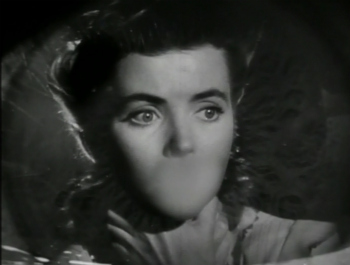
Kiss of Death (1947)

Usually, when a classic-period noir is singled out for praise, it’s because it’s lean, rapid-fire machine gun entertainment – a high-style, high-energy crime picture achieved on a low-rent budget.  1947’s Kiss of Death has none of those qualities.  After opening on a botched Christmas Eve jewel heist in a tense, largely wordless sequence, the film’s urge to entertain goes dark.  This is an oddly leisurely, somber noir about the jail-sweat struggles of one of those failed jewel thieves (played by the aptly named Victor Mature) as he’s pressured to rat on his accomplices who got away.  At first, he refuses to squeal, but threats against his family change his tune, and he reluctantly becomes an undercover rat helping cops bust the crime rings that used to supply his income, much to his personal shame.  Watching this family man squirm under police pressure in his jail cell is far from the perverse sex-and-violence pleasures audiences usually seek in classic noir, so most of Kiss of Death ends up feeling limp in its genre payoffs.  It’s still worthy of all its praise & attention, though, thanks to a maniac villain by the name of Tommy Udo.

Richard Windmark’s performance as the sad-sack squealer’s charismatic, villainous foil heroically brings Kiss of Death back to life after the much more reserved Victor Mature drowns it in moralistic tedium.  Windmark’s infamous gangster Tommy Udo is a murderous sociopath whom the D.A. wants the jewel thief to snitch on as a fellow convict, but he proves too dangerous to be around, even for a minute.  Windmark is such an energizing lunatic in the role that he earned an unlikely Oscar nomination for it, presumably for being the only sign of life in an otherwise plodding picture.  Along with the likes of James Cagney, Peter Lorre, and Ann Savage, he gives one of the all-time great unhinged noir-villain performances, often credited alongside Conrad Veidt in The Man Who Laughs for inspiring the look & persona of The Joker.  When a cop asks Udo if he has a minute to talk, he spits back “I wouldn’t give you the skin off a grape.”  He condescendingly refers to his fellow gangsters by the uniform nickname “Squirt.”  He pushes wheelchair-using biddies down the stairs just for rubbing him the wrong way.  He is the entertaining volatility that most noirs exude in their filmmaking personified in a single movie-stealing character.

Besides the dark, revitalizing energy of Windmark’s performance, Kiss of Death is most commendable for its early use of location shooting around 1940s New York City, including prison scenes shot at Sing Sing.  Shooting outside of a Los Angeles studio lot was atypical for a small-scale crime picture at the time, which you can tell as soon as an opening-credits title card brags about the novelty.  It’s also unusual for a noir of this kind to be narrated by the doomed antihero’s love interest (and, weirdly, his kids’ former babysitter, played by Colleen Gray), but I can’t say her voice adds as much interest or texture to the picture as the location shooting, except maybe in softening the genre’s macho tendencies.  Otherwise, Hollywood workman director Henry Hathaway (True Grit, Niagara, Call Northside 777) brings a controlled, level-headed approach to the production that keeps it from achieving anything especially flashy or memorable within its genre template.  Only Tommy Udo breaks through that containment of Old Hollywood professionalism, transforming a cozy afternoon watch into a momentarily thrilling freak show.  He is the spectacle worth seeking out here, the only reason the film is remembered at all.

-Brandon Ledet

Podcast # 227: Madame X (1966) & Self-Reinvented Women

Welcome to Episode #227 of The Swampflix Podcast. For this episode, Hanna, James, Britnee and Brandon discuss a grab bag of movies about women who reinvent themselves with made-up identities, starting with the 1966 Lana Turner drama Madame X.

00:00 Welcome

01:31 Hot Frosty (2024)
05:25 Mother’s Instinct (2024)
07:33 Endless Love (1981)
11:22 My Old Ass (2024)
18:30 Out of the Blue (1980)
24:16 The 36th Chamber of Shaolin (1978)

31:00 Madame X (1966)
55:00 A Woman’s Face (1938)
1:12:22 Sleeping with the Enemy (1991)
1:30:07 The Last Seduction (1994)

You can stay up to date with our podcast through SoundCloudSpotifyiTunesTuneIn, or by following the links on this page.

– The Podcast Crew

Le Samouraï (1967)

I have not felt motivated to watch Richard Linklater’s undercover cop comedy Hit Man since it hit Netflix, but I did happen to catch its opening half-hour in the holiest of cinematic venues: muted on the TV at my neighborhood bar.  The one sequence that caught my eye while I was enjoying my banh mi and cocktail that evening was an early montage of classic film clips in which Glen Powell’s pretend-hit-man explains that the entire hired assassin concept is a movie trope, not a real-life occupation.  I don’t know whether the 1967 neo-noir Le Samouraï was referenced in that quick montage because I wouldn’t see it screened at the theater down the street from that bar until a few days later, but it would have fit right in.  Like Branded to Kill, In Bruges, John Wick, Barry, and all the other hired-assassin media that Hit Man gently mocks for its outlandishness, Le Samouraï imagines a complex crime-world hierarchy in which money is routinely exchanged for murder, no questions asked – a world with its own bureaucratic rules & procedures.  Like those films, it’s also fully aware of its indulgence in outlandish fiction, striving to be as cool & entertaining as possible without worrying about being factual.  If anything, the most outlandish aspect of Le Samouraï is its casting of the extraordinarily handsome Alain Delon as an anonymous assassin who goes unnoticed in public as he executes his orders, which is a logical misstep Hit Man repeats by casting the Hollywood handsome Glen Powell as a master of disguise who can credibly disappear undercover.

In its own way, Le Samouraï is also a commentary on classic crime movie tropes, or it’s at least in direct communication with them.  A few years after Jean-Luc Godard’s Breathless shook up the French filmmaking establishment by returning to the high-style chaos of classic American noir, Jean-Pierre Melville offered a much calmer, stranger refraction of the American gangster picture.  Delon’s mostly silent hitman glides through the streets of Paris with an overly professional, emotionless affect, but he still vainly checks his image in every mirror he passes, making sure his trench coat & fedora match the classic noir archetype projected in his mind.  He’s a film trope out of time, which leads to great pop-art juxtaposition when he passes advertisements for modern products like Orangina on city streets.  A disorienting organ motif loops on the soundtrack as he wordlessly carries out his work, dodges cops, and kills professional rivals, giving his crime world setting the same dreamlike quality that the Goblin soundtrack gives the ballet school of Dario Argento’s Suspriria.  If Godard brought the crime film back to the poverty-row roots of its infancy, Melville pushed it forward past the point of death to the world beyond, sending his audience to a hypnotically hip hitman heaven.  Most of the storytelling is visual, with all of the loudmouth blathering left for the cops on Delon’s tail.  In other words, it’s all style, to the point where the style is the substance.

Any further praise I could heap on Le Samouraï that would just be variations on labeling it Cool.  The opening scroll that explains Delon’s antihero protagonist lives by an honorable samurai code?  Cool.  His anxious-bird home alarm system; his small collection of adoring Parisian babes who will likely be his undoing; his deep knowledge of the public transit system that allows him to avoid arrest?  All very cool.  What’s even cooler is that I got the chance to see the movie with a full, enthusiastic crowd, thanks to the popularity of The Broad’s regular $6 Tuesdays deal.  Like the muted television hanging over the local watering hole, $6 Tuesdays has become a great cinematic equalizer that has made watching movies into a communal event again, rather than something I do alone in the dark while everyone else watches Hit Man on Netflix at home.  If there were only a new digital restoration of a classic Euro genre film I’ve never seen before making the theatrical rounds every week, I’d be set. 

-Brandon Ledet

Singapore Sling (1990)

It took a couple weeks of diligent blog posts & podcast recordings to review all thirteen screenings I caught at this year’s Overlook Film Festival, of which the major highlights were local premieres of Don Hertzfeldt’s Me, Tilman Singer’s Cuckoo, and Jane Schoenbrun’s I Saw the TV Glow.  Overlook recaps are never complete if you only cover what movies you saw at the fest, though; it’s just as important to report on the movies you took home from the fest, thanks to the consistent, essential presence of boutique Blu-ray distributor Vinegar Syndrome as an on-site vendor.  I pick up killer genre obscurities from the Vinegar Syndrome table every year, mostly because I’m prompted to select titles I’ve never heard of before by their striking cover art and by the curational nudging of a knowledgeable sales rep.  I’ve left past Overlooks with blind-buy purchases of Nightbeast, The Suckling, and Fleshpot on 42nd Street – all bangers.  This year’s highlight purchase was a recent in-house restoration of the 1990 Greek sexploitation thriller Singapore Sling, a movie that jumped out at me through the striking black-and-white S&M iconography on its slipcover and that over-delivered on the debauchery that graphic promises.  Equal parts horror, noir, and pornography, it’s gorgeous high-art smut: the exact qualities Vinegar Syndrome regulars search for in the label’s extensive catalog.  It’s almost unbelievable that it’s a new release for the company, since it feels just as perfectly calibrated to their brand as early, signature VS titles like The Telephone Book.

There are three separate narrators in this sordid domestic drama, all of whom directly address the audience in stage-play soliloquy.  One is the titular Singapore Sling (named after a cocktail recipe, the only scrap of identification that can be found on his person); he’s a macho noir archetype who’s taken hard to alcoholism as his years-long search for his beloved, vanished Laura has proven fruitless. Tracking Laura’s ghost to a mysterious, remote mansion, he meets our other two narrators: the dominatrix owner of the estate and her childlike nympho daughter – a mother-daughter duo who are introduced to the audience roleplaying as the missing Laura and engaging in incestuous, fetishistic sex with the aid of a strap-on dildo.  You see, they most definitely killed the missing woman, along with dozens of unnamed servants buried in a mass grave under their home’s flower garden, because they are wealthy and thus depraved.  Like all noir protagonists, our POV character is doomed as soon as he stumbles into the web of these femmes fatales.  They immediately beat him into concussion, tie him to a bedframe with ropes & leather straps, and take turns raping him while teasing out whether he’s aware of their similar abuse of the mysterious Laura.  Speaking of which, the name “Laura” is repeated by all three players with feverish, orgasmic frequency, and it eventually proves to be a direct allusion to the classic 1940s Otto Preminger noir, complete with out-of-context references to Laura’s broken lake house radio.  Whether you ever thought the noir genre could use a little sprucing up with proto-torture-porn sensibilities is dependent on your personal interests as an audience, but I can at least say I’ve never seen that exact combination before.

Singapore Sling is incestuous femdom erotica filtered through the filmmaking aesthetics of classic Universal monster movies.  The father figure of the family home is dressed up like the Boris Karloff version of The Mummy and stored in the attic as an artifactual sex object.  The women of the house keep some traditional BDSM restraints & tools lying around, but they also incorporate perplexing electrical equipment seemingly borrowed from the set of James Wale’s Frankenstein into their “play” (i.e., rape & torture).  Its black-and-white horror sensibilities are warmly familiar, but its rape-fantasy logic feels genuinely dangerous outside the context of privately read erotic fiction, which is only slightly eased by it being played as a taboo freak-out instead of a pure turn-on.  I haven’t felt this shameful while falling in love with a movie since I first watched The Skin I Live In, and its cheeky provocations don’t feel all that out of line with Almodóvar’s general schtick.  I haven’t yet seen any other features from director Nikos Nikolaidis, but it appears that shock & provocation are constant in his work, evidenced by the 2011 documentary of the Vinegar Syndrome disc that features a montage of his actresses pissing & vomiting in a wide range of violent, sexual scenarios.  Here, pissing & vomiting are their versions of cumshots, and their concussed captive has no choice but to lie back and take it until there is a chance to escape.  I have no reference for where Nikolaidis was positioned in the Greek cinematic imagination in his time, but I do see direct evidence here that he was at least influential on currently ascending Greek provocateur Yorgos Lanthimos, from the outlandish incest of Dogtooth to the fruit-flavored masturbation and classic-monster visual cues of Poor Things.

There’s almost no way to recommend Singapore Sling without sounding like a carnival barker luring rubes into a geek show.  Indeed, the film does have a Spider Baby quality to its “Get a load of these freaks!” premise, which never expands beyond hanging around a decrepit mansion with sexual deviants until everyone involved is fucked to death.  For all of its kink & gore, though, it’s a strangely calm, quietly eerie affair, mostly scored by the soft meditation-app rain patter of the “sick and sad” world outside the mansion walls.  It’s not the kind of kill-a-minute splatstick horror that punctuates every sequence with an active disemboweling; it’s the kind of off-putting, degenerate horror that collects the organs from a disemboweling to arrange into sensual tableaux, decorated with victims’ jewelry for perverse beauty.  That stomach-turning disorientation is better experienced than described, which makes this an ideal blind-buy home video experience.  It’s easily my favorite film I’ve picked up from Vinegar Syndrome’s merch table at Overlook, where I consistently gamble on titles without the hive-mind knowledge of the internet informing my purchases.  Relying only on the box-cover artwork and the guidance of Staff Picks at that table is the closest I get to the vintage video store experience in this post-Blockbuster Video world (at least until Future Shock Video gets a storefront going in the not-too-distant future, many many bus rides away). I look forward to it every year almost as much as I look forward to the official selections on the Overlook program. 

-Brandon Ledet

Love Lies Bleeding (2024)

Saint Maud was one of the movies I was most looking forward to prior to the first quarantine back in 2020, having seen many trailers for it all through the last half of 2019. When I finally did get the chance to see it, it was revelatory – an amazing, understatedly vitriolic little thriller that handled religious trauma in a different way. Instead of Maud having been victimized by a past religious indoctrination or being someone who’s so well-versed in scriptural tradition that she can twist it to whatever her ends might be, she’s a dangerously unwell person making up her own faith through incomplete, piecemeal understanding of religion coupled with hallucinatory, delusional “visions.” Throughout that film, we see her interpretation of the world through her perspective; the face of the woman for whom she is a hospice carer takes on elements of the demonic in moments, “God” speaks to her through a roach in her apartment, and she sees herself as an angel in the film’s last moments, until the final split-second that shows us in the audience what’s actually happening to Maud (brutally and horrifically). 

I wasn’t terribly interested in Love Lies Bleeding until the friend with whom I went to see Drive-Away Dolls asked me if we would be seeing it as well, and told me that it was directed by Rose Glass, who also helmed Saint Maud. That was better advertisement than any of the trailers for the film that I had seen, and I was not disappointed. Bleeding is the story of an intensely passionate love between two women and the way that drugs, troubled pasts, unrequited longing, and violence conspire to keep them apart. Somewhere in west Texas—I assume, given the prevalence of Lone Star beer—it’s 1989, and Lou (Kristen Stewart) works at Crater Gym, a cavernous warehouse full of free weights, meatheads, and stenciled slogans like “Pain is weakness leaving the body” and its ilk. It’s a shit life, rubbing one out every night on the couch while her TV dinner goes cold, trying and failing to quit smoking, and unclogging the same gym toilet over and over while fending off the advances of Daisy (Anna Baryshnikov), who may be the only other queer woman in town but whom Lou finds repellant. One day, bisexual bodybuilder Jackie (Kay O’Brian) appears in the gym and upends Lou’s world; she’s hitch-hiking her way to a body-building competition in Vegas and is stopping over here for a bit after getting a job waiting tables at the local gun range/club’s cantina. 

The two immediately hit it off and after a passionate night together in which Lou introduces Jackie to steroids to which she has access, Lou agrees to let Jackie stay with her until she goes further west to the competition. The situation is complicated by the fact that the gun range is owned by Lou Sr. (Ed Harris), Lou’s father. The range is just a cover, though, as his real business is running guns across the border to Mexico, and he’s got local law enforcement in his pocket, and Lou knows he’s bad news since she was once more involved in the family business, although she hasn’t spoken to her father in years following the suspicious disappearance of her mother. The only other remaining family Lou has is her sister Bethany (Jena Malone), mother of three married to utter piece of shit J.J. (Dave Franco), who also works for Lou Sr. and got Jackie her job after he has sex with her in a bar parking lot, the night before she and Lou meet. J.J. is habitually physically abusive of Bethany, and when he puts her in the hospital, the simmering rage, resentment, and violence under the surface of everything comes to a boil, with tragic consequences. 

The southern fried thriller-noir bona fides of this movie are on full display. A mixture of Blood Simple, Thelma & Louise, and Blue Velvet with a little Requiem for a Dream sprinkled in for good measure, the film is elegant in its construction. The fingerprints from Blood Simple are all over this one, from its grimy, sweaty, eighties, west Texas setting to that classic visual of the highway at night, a dark void surrounding the small halo of light from a vehicle’s headlights. Bleeding’s final moments could take place in the exact same field as the one in which Ray buries Dan Hedaya’s Marty, just in daylight. Moreover, just like Abby and Ray in the Coen brothers’ film, our protagonists are forced to commit larger and larger acts of violence in order to try and be together, free from the potential for violence. Ed Harris channels Dennis Hopper’s Frank Booth here, albeit in a more subdued manner. Although his violence is free from any psychosexual elements (give or take how much enjoyment he gets from forcing Jackie to learn to shoot while he “coaches” her through extensive body contact), he is just as sadistic as Booth, and Lou Sr. is perhaps the most frightening onscreen psychopath since Anton Chigurh. The similarities to Thelma & Louise are fairly close to the surface, and there’s something fascinating happening with the way that steroids are treated with the same intensity and as having the potential for the same fall out as intravenous drugs in Requiem

Where this film picks up the torch from Glass’s earlier work is in the way that we are once again made privy to the internal life of an emotionally and mentally unwell person. Jackie is a fascinating character. When we first meet her, she’s using her body to get what she needs, and is at peace with that. She has history, but no origin; the earliest part of her life that she mentions is being adopted at age thirteen (by parents that no longer speak to her and who call her a “monster”), and she tells Lou that she turned to bodybuilding as a way to change her body due to fatphobic bullying. Like Maud, she’s running from something, but unlike her, she also has a goal in mind and is relying on herself to get there, self-actualizing where Maud turned to a hollow, false spirituality. She’s remarkably self-sufficient and dedicated, as we see when she wakes up under an overpass and immediately gets to work on both exercise and brushing her teeth. In this, she is a contrast to both Lou, who is never seen exercising and is instead trying to shortcut with steroids, and Daisy, who is most clearly communicated to us as undesirable through the centering of her poor dental hygiene. She’s still human, however, and allows her lust-turned-passion for Lou and her thirst for validation through victory in the Vegas competition to lead her down a path that deteriorates her mental state. At first, her steroid-affected hallucinations of developing greater vein and muscle definition are empowering and concurrent with her deepening passion with Lou, but when she tries to run from the consequences of her first major (albeit justified) act of violence, she ultimately has a nightmarish series of visions in Vegas that cause her to become even more aggressive, resulting in her falling first into the hands of the authorities and then under the influence of Lou Sr. 

Another thing that’s fun about these visions is the way that they relate back to things that we see her absorbing, even if they’re making their way into her subconscious without her really noticing. After their first night together, Lou prepares breakfast for Jackie, who (somewhat ungratefully) asks her to leave the yolks out, a period-appropriate “healthier” alternative to eating a whole egg; later, in a montage we see Lou carefully separating out the yolks while preparing breakfast, and several shots of the eggs ending up in the garbage alongside the remnants of emptied ashtrays. This comes back around when Jackie later hallucinates that she has vomited Lou onto the stage in front of her at the competition, covered in a sort of amniotic egg white mixture. Further, in the film’s climax, Jackie imagines herself fully hulking out and turning into a giant woman (apologies that that song will be stuck in your head for the rest of the day, Steven Universe fans), and this is actually foreshadowed earlier on, when we see her watching the 1939 animated version of Gulliver’s Travels. (If you’re like me, you probably assumed that this was used because the film is in the public domain, and were delighted to see that there was a narrative reason behind its inclusion.) It’s all very elegantly constructed, and as a man who always loves it when things fall perfectly into place, it was incredibly satisfying. 

There should be no mistaking that this is still a brutal movie. It’s not one for those with queasy stomachs, and I’m not just talking about all of the disgusting mullets (of which there are … many). J.J.’s death is extreme, and we see the aftereffects of it multiple times. That’s the kind of thing you’d probably expect from a movie with the word “bleeding” in the title, but just in case you’re somehow floating around out there with the idea that this is more romance than grit, I want to make it clear that this is a ferocious, vicious piece of work, but I wouldn’t have it any other way.

-Mark “Boomer” Redmond

Brief Encounter (1945)

“Nothing lasts, really. Neither happiness nor despair. Not even life lasts very long.”

All of the stills and promotional posters for David Lean’s 1945 adultery drama Brief Encounter had convinced me that it was going to be a noir, not a stately stage play adaptation.  Having now seen the film in full, I’m not entirely sure I was wrong.  Brief Encounter is a kind of classic noir where the inciting crime is an emotional affair instead of a heist or a murder.  It has all of the stylistic markers of noir: the drastic camera angles, the haze of urban steam, a morally compromised lead recounting their crimes in a confessional narration track.  The fact that there’s no actual crime to speak of does little to muddle that flirtation with the genre.  When the potential adulterers develop their first inside joke it’s like watching them load a revolver.  Each kiss is another bullet unloaded from its chamber.  When they chain-smoke on empty city streets to calm their nerves, they act as if they’re on the lam, avoiding eye contact with city cops.  The whole affair is just as thrillingly romantic as it is unavoidably doomed.

The opening shots of this lean, 86-minute stunner are of two commuter trains passing in opposite directions at a furious speed, their billows of steam settling into a wispy veil over the platform where our would-be lovers first meet.  Later, the lovers are similarly veiled by the gauze of cigarette smoke under movie projector lights, in the cinema where they spend Thursday afternoons sitting in the tension of each other’s desire.  Their entire affair carries the impermanence and impossibility of a dream, with both dreamers daring each other to make it real.  Celia Johnson narrates their emotional crimes in flashback, looking for someone safe to confess to and eventually settling on an internal monologue to her doting but unexciting husband.  In her months-long flirtation with Trevor Howard’s mysterious but gentlemanly doctor, she never gets a glimpse of his homelife with his wife, but we get the sense that it’s just as sweetly serene.  Their entire relationship is based on the spark of excitement found in flirting with a stranger while waiting for their opposite-direction trains home, a romance that can only flourish in a liminal space.  If they did leave their spouses for each other, they’d likely settle into the same warm but bland domestic routines; the spell would be broken.

Whether David Lean was knowingly playing with the tones & tropes of film noir here is unclear.  Since the genre had not yet been fully codified or even named, it’s more likely that he simply framed an adulterous dalliance as if it were a legal crime instead of just a moral one, and the stylistic overtones of the era took care of the rest.  Either way, it’s clear that Brief Encounter has endured as a major influence on modern filmmakers, from the moody high-style tension of Wong Kar-wai’s In the Mood for Love to the opening across-the-bar “What’s their deal?” speculation of Celine Song’s Past Lives.  Because it’s such a dialogue heavy stage-to-screen production, a lot of its power is creditable to Johnson & Howard’s acting chops, especially in the physicality of their guilt-haunted faces.  When Johnson reassures the audience, “I’m a happily married woman,” her body language tells a different story, and there’s similar complexity lurking behind every line delivery of her imagined confession.  Still, Lean is a formidable third wheel, guiding this trainwreck romance from the director’s chair with such intensity that you can practically feel his hand tilting the frame.  There’s no event or action I can point to that would help classify it as a thriller, but it is thrilling from start to end, with a final line of dialogue that’s more explosive than any stick of stolen dynamite.

– Brandon Ledet

Double Indemnity (1944)

When Fred MacMurray’s horndog insurance salesman meets Barbara Stanwyck’s femme fatale at the start of Double Indemnity, she’s dressed only in a beach towel, fresh from sunbathing.  After changing into a knee-length dress, she entertains him in the parlor, pretending to be interested in purchasing car insurance from his company but really feeling out his potential to help with the murder of her husband.  He immediately catches onto her scheme (a hunch confirmed by her conversational shift away from automobile insurance to “accident” insurance), but he sticks around to flirt anyway, mostly for the vague promise of adultery.  When Stanwyck uncrosses her bare legs during this uneasy negotiation to draw MacMurray’s attention to her girly ankle bracelet, it hit me; I had seen this exact dynamic play out before in Basic Instinct.  I was watching a horned-up dope flirt with an obvious murderess in her cliffside California home, mesmerized by strategic flashes of her lower-body flesh.  After I had already retitled the film Double Instinctity in my head, I later retitled it The Insurance Man Always Files Twice, following the clever “accidental death” of Stanwyck’s husband (only to later learn that the novel Double Indemnity was written by the author of the novel The Postman Always Rings Twice, James M. Cain).  By the time the adulterous couple’s alibi for murder involving the anonymity of public train transportation had me retitling it Dangers on a Train, it became clear this was an immeasurably influential American crime picture that was directly imitated and alluded to throughout Hollywood long before Verhoeven arrived to sleaze up the scene.

Although it was released years before the term was coined by a French critic, Double Indemnity did not invent the film noir genre.  Even if the genre hadn’t gotten its start in dime store paperback novels, Humphrey Bogart had already been led to his onscreen doom by Mary Astor’s femme fatale in Double Indemnity‘s suaver older cousin The Maltese Falcon a few years prior.  Stanwyck’s own femme fatale archetype is also named Phyllis Dietrichson, a winking reference to earlier femmes fatale played by Marlene Dietrich in her pre-Code collaborations with Josef von Sternberg.  Still, it’s early and iconic enough that modern audiences get to watch it establish the core tropes of film noir in real time, to the point where it plays like a pastiche of a genre that hadn’t even been named yet.  Before MacMurray is hypnotized by Stanwyck’s anklet, he moseys around her dusty parlor and directly comments on the room’s shadowy lighting and Venetian blinds – two standard visual signifiers of classic noir.  That narration track rattles on at bewildering speeds throughout the entire picture, referring to Stanwyck as “a dame” (when in 3rd person) and “Baby” (when in 2nd person) so many times that it verges on self-parody.  That narration also frames the entire story as a flashback confession to the reasoning behind the central murder, a narrative structure echoed in classic noir melodramas like Mildred Pierce and director Billy Wilder’s own Sunset Boulevard.   Double Indemnity is not the first of its kind, but it is the Platonic ideal of a major studio noir, the same way Detour exemplifies the ideal of the genre’s Poverty Row variety.  And even Detour‘s femme fatale Ann Savage starred in her own shameless knockoff of the picture initially titled Single Indemnity, before it was sued by Paramount Pictures into changing its title to Apology for Murder.

Although Fred MacMurray easily racks up Double Indemnity‘s highest word count on the narration track, he’s not the cast’s MVP.  If nothing else, veteran character actor Edward G. Robinson fast-talks circles around him as his nosy business partner who unravels the adulterous couple’s perfect insurance-scam murder simply by following the hunches in his stomach (which he refers to as his “little man”).  The two insurance men have a great, intimate rapport that plays like genuine affection, whereas MacMurray’s carnal attraction to Barbara Stanwyck is purely violent hedonism.  Stanwyck is the obvious choice for MVP, then, as being led around on an LA murder spree by the leash of her anklet is such an obviously bad idea, but she’s a convincing lure anyway.  Like Michael Douglas’s dipshit cokehead detective in Basic Instinct, MacMurray knows this woman will lead to his doom, but he still gives into her schemes because the sex is that good – a business deal sealed when she appears at his apartment in a wet trench coat for their first act of consummation.  She isn’t afforded nearly as much screentime as MacMurray, but her every appearance is a cinematic event, from her initial beach towel entrance to her unflinching witness of her husband’s murder, to her grocery store appearance in Leave Her to Heaven sunglasses and a Laura Palmer wig.  Barbara Stanwyck’s Phyllis Dietrichson may owe thematic debt to the Marlene Dietrich femmes fatale before her—among other pre-Code influences—but she’s clearly striking and conniving enough to truly earn the term “iconic” that gets tossed around so liberally these days.  MacMurray’s job is just to play the stooge who drools at her anklet-adorned feet, which he does with humorous naivete.

It’s difficult to imagine how shocking the seediness of Double Indemnity would have registered in the 1940s, when noir was still taking its first baby steps.  It took Wilder years to get a version of the script approved for production, since unrepentant murder & adultery were still fictional taboos instead of standard soap opera fodder.  Along with cowriter (and noir novelist in his own right) Raymond Chandler, Wilder drives the wickedness of his characters home in a climactic double-crossing argument where Stanwyck declares both she and her duped insurance man are “rotten,” and he coldly replies, “Only, you’re a little more rotten.”  With barely suppressed pride, she spits back, “Rotten to the heart.”  There is little in the way of whodunit mystery to the script; it’s working more in the howcatchem style of a Columbo or Poker Face.  The real mystery is just how rotten these characters are at heart, a contest Phyllis Dietrichson wins in a walk.  By the time major-studio noir had its revival in Hollywood’s erotic thriller era, Double Indemnity‘s shock value had to be ratcheted up by films like Basic Instinct and the Postman Always Rings Twice remake to catch up with a jaded, seen-it-all audience.  The rotten-hearted cruelty of Stanwyck’s femme fatale remained deliciously evil as times changed, though, and even Sharon Stone’s bisexual murderess in Verhoeven’s version could only play as an homage rather than an escalation.

-Brandon Ledet