Quadrophenia (1979)

I’ve never fully understood where Quadrophenia fits in the grand rock ‘n’ roll continuum. A love-letter to the Mod craze among UK rockers in the 1960s, it was made in a time when that fad’s clean-cut, tailored look had already been nostalgically reclaimed by British punk acts like The Damned. As a result, it’s difficult to tell whether some of the jerky, pogo-style dance moves the Mod kids pull in the film are period-accurate to 1960s rock shows, or if the punks filling out the crowd scenes were bringing some contemporary energy to the production that blurred those temporal boundaries. It’s just as likely the teenage reprobates of both eras happened to dance like that because they were on the same drugs—namely, a combination of cheap beer & stolen amphetamines—so it’s an impossible distinction to make. The project was strangely out of sync with itself since the point of conception, though, considering that it’s a bloated stadium-rock opera adapted from a concept album by The Who at their most overwrought, but it’s set in a time when The Who were a definitive force of ramshackle, no-frills rock ‘n’ roll. One of the most iconic scenes in the film features a Mods-only house party in which the entire crowd erupts into chaos when someone spins The Who’s proto-punk classic “My Generation” on the turntable, which is in disorienting aural contrast to the sleepier, sappier Who tunes that score the soundtrack proper. It’s a picture entirely out of time, evenly split between its setting and the era when it was made. That usually is the case with period pieces, but the ever-evolving trends & deviations of rock ‘n’ roll just makes the dissonance ring even louder than usual.

Perusing the extra features of the Criterion DVD copy of Quadrophenia I recently found at a Public Library liquidation sale, it seems that being out-of-sync with current rock ‘n’ roll trends was inherent to the Mod subculture from the start. Distinguished by their tailored suits, their rejection of early-50s rock ‘n’ roll, and their choice to ride motorized scooters instead of roadster motorbikes, Mods were in direct, violent opposition with the macho, leather-jacketed rockers that kept older rock traditions alive in the years before glam & punk changed everything. In addition to the usual talking-head interviews with the filmmakers, the Criterion discs include several French television news reports about these violent clashes, justifying the film’s third-act, beachside gang war with extratextual evidence that the two subcultures’ rumble was relatively credible to real-life events. However, what struck me most about those news reports was the culturally scattered, postmodern nature of their very existence. Here we have archived broadcasts from French journalists who are fascinated with the hard-edged lifestyle of British teens whose obsession with Italian fashion has spawned a newly mutated subspecies of American rock ‘n’ roll. The French reporters land a few zingers against Mod culture as a “new dandyism” that contextualizes it within older traditions of British counterculture. The postmodern multi-nationality of the phenomenon added an entirely new layer to rock ‘n’ roll cultural identity, though, whereas the motorcycle-riding rockers that the Mods clashed against were only one layer deep, idolizing American rock & fashion from earlier decades.

Appropriately, the strung-out protagonist who guides our tour through the Mods vs Rockers moment of the then-recent past is, himself, out of sync with the world around him. Phil Daniels stars as Jimmy Cooper, a pill-popping teenage Mod who can barely hold onto his entry-level mailroom job because he spends all of his nights sweating through his suits and jumping around to rock ‘n’ roll music with his dirtbag friends. Jimmy is constantly on the search for drugs he cannot find and cannot afford. He’s constantly crushing on a girl who’s only looking for a bit of fun, while constantly ignoring the flirtations of the other girl who actually wants him back. His desperation for Mod-scene notoriety (mostly so he can land his dream girl) only manifests in useless acts of teenage rebellion, like dragging his scooter through more uptight Brits’ flowerbeds, until he’s really given a chance to shine at a town-wide gang fight with rockers that ends in mass arrest. Only, when he’s released from jail, he’s found that his moment of fame was fleeting, his dream girl has already moved on, and the drugs are starting to weigh heavily on his fragile, hormone-addled psyche. In an early, telling scene he has a loud argument about music tastes with a rocker at the local baths (heads up for anyone who’d like to catch a glimpse of a young Ray Winstone’s cock & balls) that ends with the opposing Mod & rocker realizing that they were childhood friends, and there’s no substantial difference between them once stripped of their respective paraphernalia. The tragedy of the film is that Jimmy wants that subcultural distinction to signify a substantial difference between them; he relies on Mod-culture insignia to give his days & persona meaning, only to inevitably find it another empty frivolity, just like everything else in life.

Of course, Quadrophenia itself became a cultural touchstone to be disseminated in the great rock ‘n’ roll diaspora. The reviews & marketing for Jon Moritsugu’s 1994 punk-scene whatsit Mod Fuck Explosion reference West Side Story as the source of inspiration for its fictional gang war, but since the gangs in those films are the titular scooter-riding Mods vs. motorcycle-riding rock ‘n’ rollers, it’s a lot more likely Mortisugu was pulling directly (and cheekily) from The Who’s rock opera. So, there you have a snotty 90s-punk reiteration of a 70s-punk echo of a 60s-rock fad that split from 50s-rocker roots. It’s an out-of-sync rock cinema tradition you’ll find in other beloved period pieces like American Graffiti, Velvet Goldmine, and 24 Hour Party People — all precariously balanced between the eras they depict and the eras in which they were made. If there’s anything positive to glean from that temporal precarity, it’s the overall sense that rock ‘n’ roll never dies; it just tries on different silly outfits from time to time. The Mods’ outfits just happened to be sillier than most. I mean, who wears a tailored suit to a punk show?

-Brandon Ledet

Black Widow (2021)

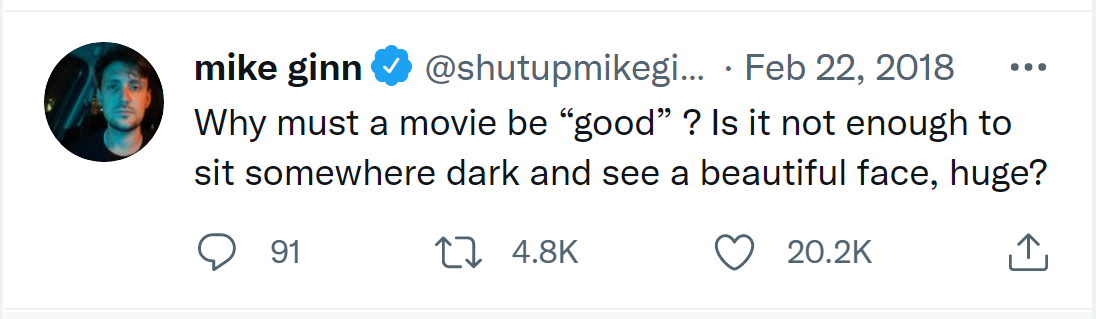
About every 1.6 weeks, someone gets on Twitter and asks some variation of “What’s the best tweet of all time?” There is always of course, the trotting out of the greats, like this one, this one, this classic, this jab, this burn, this zing, mockery of the New York Post, a personal favorite, someone who presumed the universality of a ludicrous idiosyncratic belief and chooses to dickishly ignore that they’re completely wrong, and of course, the truly greatest tweet of all time (and these two, which go out to my friends back home). But what’s “best” anyway? For me, all of these pale in comparison to this tweet, which I think about at least once a week: 

It came to mind again most recently yesterday, as I sat in a movie theater for the first time since Emma., watching Scarlett Johansson and Florence Pugh engage in a car/motorcycle/tank chase through the streets of Budapest and into the city’s subway, exchanging quippy dialogue all the while. In that moment, I flashed back to the similar car chase sequences in Berlin in Civil War, Seoul in Black Panther, San Francisco in Ant-Man and the Wasp, and [Cleveland as D.C.] in Winter Soldier, as well as probably others that I’m forgetting. And although this was another movie that largely stuck to the tried-and-true Marvel formula, I thought to myself, Why must a movie be “novel’? Is it not enough to sit somewhere dark and see a thrilling car chase through a metropolitan area, huge? After all, although this isn’t the first MCU film all about one of our lady heroes, it’s leaps and bounds better than Captain Marvel, which I gave a high star rating to upon release but was largely tepid about it in the review proper (I literally wrote “I’m hot and cold on this one”) and which I look back on now mostly with contempt, as its imperial Yvan eht Nioj underpinnings have only become clearer with the passing of time. 

I’ll admit here that, by and large, it’s pretty easy for a film to manipulate me emotionally (the people would like to enter into evidence my likewise high star rating for 2016’s Ghostbusters), and it’s also not just films that do it. The Alamo Drafthouse has, for the past few years, used the same simple animated introduction before new releases where several colored circles appear, then overlap, then space out to mimic planets orbiting a star, then come back together to embody the six circular cut-outs of the classic film reel canister. My description is overselling the complexity, I think, but I can’t find it online anywhere so forgive me. The sound design of it is fairly simple as well, but this time, after the theater darkened and the traditional Alamo font appeared on screen saying “We missed you,” the pre-show included a montage of clips of characters from the movies at the movies: Amélie, Taxi Driver, Cinema Paradiso, etc., and then the bonging tones of that intro came together, and I was overcome. It felt like coming home, and if I’m warmer to Black Widow than it truly deserves because of it, well, maybe the people will have to enter this review into evidence one day, too, but for now, I have to say, I really liked it. Even my best friend, who is generally apathetic to Marvel movies, thoroughly enjoyed it; immediately afterward, she said she would be willing to pay to see it again, and when we were considering watching another movie back home last night, she said she’d rather just watch television than another movie because she enjoyed Black Widow so thoroughly that she wanted to “marinate” in it a while before another cinematic experience watered it down. Take from that what you will. 

We open in Ohio in 1995, where a young Natasha (Ever Anderson, daughter of Milla Jovovich and Paul W. S. Anderson) rides her bike through suburban streets and into her backyard, where she plays with her younger sister, Yelena (Violet McGraw). When Yelena skins her knee, their mother Melina (Rachel Weisz) attends to her, and there appears to be some tension between Natasha and dear old mom. As night falls, Yelena notes the appearance of fireflies in their backyard, and Melina gives her daughters a little science lesson about bioluminescence. While they set the table, father Alexei (David Harbour) returns home, agitated. He shows Melina a 3.5’’ floppy and notes that “it” is “finally happening.” As Melina whispers a meaningful apology to Natasha at the dinner table, Alexei grabs a rifle and the entire family hops into their SUV and makes haste toward a small airstrip, with S.H.I.E.L.D. agents in pursuit shortly. After a tense shootout, the family manages to make their getaway in a prop plane and land in Cuba, where we learn that the “family” is comprised entirely of Russian agents, even the two children, and that the past three years in America have been part of a long term operation at a secret S.H.I.E.L.D. facility. Natasha attempts to prevent her separation from Yelena, citing that the younger girl is only six years old and too young for training, but Alexei notes that Natasha herself was even younger when she first began, and the two of them are forced apart on the orders of General Dreykov (Ray Winstone). 

After an opening montage (set to a downbeat cover of “Smells Like Teen Spirit”) gives us the general impression of what constitutes a Black Widow’s training in the “Red Room” (it’s not fun!) we move forward to 2016. The rest of the film is set parallel to the events of the aforementioned Captain America: Civil War, following Natasha (Johansson) in hiding after siding with Cap against Tony re: The Sokovia Accords. Elsewhere, Yelena (Pugh) and a team of fellow Black Widows tracks down and ultimately kills a rogue Widow, but not before her former ally exposes her to a red dust that acts as a counteragent to Yelena’s Black Widow programming, which we learn has grown beyond conditioning and brutal training to literal mind control. Natasha makes her way to a safe house in Norway with help from her friend Mason (O-T Fagbenle), who also delivers some things left behind at her last safe house in Budapest, which includes a package from Yelena that contains several vials of the red dust; the dust, in turn ends up drawing the attention of Taskmaster, Dreykov’s right hand killer, who has the ability to mimic the fighting styles of anyone from merely watching a video. Yelena and Natasha reunite and decide to destroy the Red Room once and for all. In order to do so, they must first rescue their “father” from the Siberian gulag to which he has been sent; the former “Red Guardian,” the only successful supersoldier equivalent of Captain America who was produced by the Soviet Union not relives his glory days in stories told to his fellow inmates and is mocked by his guards. He, in turn, leads them to their “mother,” who reveals that she was the scientist who worked on the beginnings of the mind control project. But can any members of this reunited not-really-a-family trust one another long enough to stop Dreykov? 

Look, this is a Disney’s Marvel Cinematic Universe consumable product. You’ve already decided if you’re going to see it or not, and if you’re going to see it, whether you’ll do so on a big screen, fork over an exorbitant amount of money to watch it on Disney+, or wait for a more affordable at-home option. It exists to sell toys, costumes, and trips to theme parks while continuing to build the Disney monopoly that we should all be more worried about since the overseers of antitrust laws are asleep at the wheel, and probably would be more worried about if we weren’t all (a) contemplating our insignificance and powerlessness to stave off the climate disaster that will boil, drown, bury, burn, smother, etc. us all alive, or (b) living in a state of denial of said looming extinction event. Its emotional beats are rote, its storytelling checkpoints are familiar, and the forward thrust of its characters is largely moot considering that, as of 2019, Natasha Romanoff is dead. For what it’s worth, at least Disney isn’t trying to insultingly push Black Widow as “empowering for girls/women” (one can read the text that way, but it’s not part of the metatext for once, and the film itself calls attention to the fact that Natasha’s dark past as an assassin renders her “hero” status among “little girls” problematic, to say the least). This film is also decidedly Not For Children, given its use of the visual language we associate with human trafficking to illustrate the horrors of the Red Room as well as the higher-than-normal profanity and a fairly graphic verbal description of the Red Room’s sterilization procedure. 

I’m sure that there will be some reviews that cite the film’s “heart,” although I would warn readers to take that with a grain of salt. The “reunited family that was really composed of spies but who could be a found family” element is present, and all of the cast (Pugh in particular) sell this angle in their performances, but how much it will resonate with you as a viewer will depend on a lot of factors that are external to the film proper. I wasn’t sold on it, but I still had a blast, and the setpieces here are some of the best that this franchise has brought to the table. Pugh is great in this first entry for her into the MCU, and Harbour brings an effortlessly comedic touch to the proceedings. Weisz has never given a bad performance ever, and her Russian accent here is a delight. It’s a shame that Johansson is finally given a vehicle in this series that is hers and hers alone and it must be an interquel due to the choices made in other films, but she’s been carrying films on her back since she was a literal child, so it’s no surprise that she delivers here in her postscript swan song. If you’re going to see it, see it, before we’re all dead.

-Mark “Boomer” Redmond