I Know What You Did Last Summer (2025)

There is something both inevitable and unfathomable about there being a new I Know What You Did Last Summer legacyquel in wide theatrical release right now. Sure, the combination of Hollywood executives’ unquenchable thirst for name-brand IP and the relative dependability of horror cheapies to turn a tidy profit makes it seem like a no-brainer that this vintage 90s title would get the modern rebootquel treatment. It was pretty low on the priority list too, following a long parade of legacy horror sequels of varying quality in recent years, like Scream, Halloween, Candyman, Texas Chainsaw Massacre, and Final Destination: Bloodlines. Even so, the I Know What You Did Last Summer brand had already been downgraded to straight-to-streaming schlock in its little seen third & fourth entries, so it’s a little surprising to see the title claw its way back onto multiplex marquees. It’s especially surprising when you consider how little there is to the property beyond the recognizability of its title, which makes for easy, memorable parody in Scary Movie-type yuck-em-ups. The first I Know What You Did Last Summer film is a by-the-numbers teen slasher with little bloodshed and little novelty. Its setting in a North Carolina fishing village provides some nice background texture for its otherwise indisticntive murder spree, justifying its hook-handed fisherman killer’s costuming beyond its connection to a timeless urban legend. By the second film in the series, it was already apparent that those details weren’t enough to keep the party going, since I Still Know What You Did Last Summer immediately jumped the shark by sending its teens-in-peril on the kind of Bahamas beach trip that usually arrives multiple seasons into a hokey sitcom like Saved by the Bell. That tropical island locale does little to distract from the fact that the series’ killer isn’t iconic enough to have earned a recognizable moniker by his second outing. You can’t even joke about I Still Know being subtitled The Fisherman’s Tropical Vacay or The Hook Man’s Island Getaway because no one would know what you’re talking about. When the killer’s teenage victims refer to him as “The Slicker Guy” deep into the third act, you can feel the whole brand falling apart from under you . . . and yet here we are, two more sequels and a televised series later.

The benefit of contributing to a legacy this bland is that it sets expectations low. No army of black t-shirted horror bros are going to be outraged about the blasphemous desecration of I Know What You Did Last Summer as a sacred object, not the way they were with more disastrous franchise refreshers like The Exorcist: Believer or the 2010 Nightmare on Elm Street. That gives director Jennifer Kaytin Robinson free rein to be playful & flippant with the material, even if the exercise requires her to be absurdly reverent to the fabled events of 1997. Through reluctant re-unions, nightmare visitations, and a presumptuous sequel set-up stinger, the main casts of the first two I Know What You Did features return here for unearned moments of horror-icon spotlight: Jennifer Love Hewitt, Freddie Prinze Jr., Sarah Michelle Gellar and, briefly, Brandy. As is now legacyquel tradition, they help fill in a younger cast of imperiled teens on their initial bouts with the slicker killer, adding gravitas to previous outings by constantly referencing Trauma in therapy speak (in this case through classroom lecture and conversational references to The Body Keeps The Score). The 4th of July celebrations, fish-themed parade floats, department store mannequins, and town-hall beauty pageant stage of the original film are all treated with sacred reverence as if anyone would remember those details without having recently rewatched it as homework. Robinson undercuts that reverence with metatextual jokes about how “Nostalgia’s overrated” or how it’s not a viable plan to “fuck off to the Bahamas” to escape this particular killer, but those one-liners only go so far. Her bolder choice is to double down on the sassy, aggressive girliness of her straight-to-Netflix comedy thriller Do Revenge here, aiming her I Know What You Did sequel at teen-girl sensibilities instead of trying to please those teens’ aging Millennial parents. Considering that the first Last Summer movie excelled more as a teen melodrama than as a bodycount slasher anyway, it makes sense that this cutesy reboot would be rigorously engineered specifically “for the girlies and the gays.” What’s impressive is that it pulls off that girlish tone while still being the most violent entry in its series to date.

As with the original cast, the new I Know What You Did Last Summer crew is populated by young twentysomethings who are likely only famous to children (give or take whatever die-hard fans Chase Sui Wonders might have picked up from her turn as the least recognizable actor in Bodies Bodies Bodies). As with the original cast, they spend a reckless night partying on a public road by the fishing-village coast, leading to an anonymous stranger’s vehicular death. They do nothing to rescue or report in that moment of crisis, which seemingly leads to vengeance from beyond the grave the following summer, when a hook-handed killer in a fisherman slicker threatens them with notecards & puncture wounds. This reboot does not deviate from the narrative formula of the original, but it does deviate in tone & extremity. While the 1997 film kept most of its kills offscreen and cleanly preserved on fishing-boat ice, the new one leans into its R rating and throws in some additional fishing-themed tools of death to expand the killer’s arsenal: boning knife, anchor rope, harpoon gun, etc. Robinson also expands the horror-nostalgia scope to include allusions to other famous properties, borrowing the Jaws mayor’s refusal to postpone his town’s 4th of July celebrations, the Scream killer’s kitchen-island voyeurism, and some horror-nerd cred from references to podcasts like Colors of the Dark & This Ends at Prom. She balances out all of this genre-fan pandering by keeping the mood light, sassy, and gay. Same-sex couples, bisexual hookups, and a self-satisfied coining of the term “gentrifislaytion” align the film with other recent reclaimed-for-the-girlies horror titles like Do Revenge, Clown in a Cornfield, and 2021’s Slumber Party Massacre remake than traditionally macho horror-convention-bro fare. I don’t believe any of those titles are remarkably great films, but I also recognize that I am not their primary target audience. I was 12 years old when I watched the first I Know What You Did Last Summer in a suburban movie theater, duped into enjoying an afterschool-special melodrama about reckless driving because it was dressed up in the rain-soaked clothes of a post-Scream slasher. Today’s 12-year-olds now have a mediocre-to-everyone-else slasher of their very own here, just as lacking in distinct iconography but now doubly violent, fun, and queer-friendly. I think that’s beautiful.

-Brandon Ledet

I Know What You Did Last Summer (1997)

One of my most distinct moviegoing memories from my childhood was seeing the post-Scream teen slasher I Know What You Did Last Summer with my parents opening weekend. As an exclusive new track from my then-favorite band played over the end credits (“Proud,” by KoЯn), I was in 12-year-old nü-metal brat heaven, beaming in delight. That’s when my father leaned over and whispered in a firm, disappointed tone, “You never get to pick the movie again.” Three decades later, I’m older now than my father’s age was then, and I totally get it. This mildly violent teenage melodrama must be torturously tedious for any adult outside its very narrow target demographic (gloomy Millennials who were 12—and exactly 12—years old in 1997). In retrospect, I can’t believe that I dragged my parents to see it in a theater, regardless of how giddy it made me personally. Even more so, I can’t believe that some poor parent my age now is about to suffer the same fate via legacyquel. Must we forever be tormented by the sins of our mall-goth past? Can’t the world finally forgive & forget what we did that summer? Will there ever be peace in the suburbs?

All of your favorite late-90s teen stars are here: Sarah Michelle Gellar as a small-town beauty queen, Ryan Phillipe as her spoiled fuckboy sweetheart, Freddie Prinze Jr. as the townie interloper who’s desperate to earn his way into his friend group’s tax bracket, and Jennifer Love Hewitt as the only normal, well-adjusted youngster among them. The four bright young things get into trouble one night after partying on the beach outside their small fishing village, when they accidentally strike & kill a pedestrian crossing a dimly lit road and dump his body into a nearby bay to avoid hassle from the law. A year later, this act of semi-voluntary manslaughter haunts all four of the now-estranged kids involved, derailing their professional & educational ambitions as they quietly stew in the isolation of their own guilt & grief. The haunting becomes a lot more literal when a mysterious killer dressed in a fisherman slicker starts picking them off one by one via fish hook, seemingly avenging their hit-and-run victim from beyond the grave. If you’ve seen any formulaic teen slasher, you’ve seen it all before (doubly so if you’ve seen 1985’s The Mutilator); you just haven’t seen it performed by this era-specific cast.

I Know What You Did Last Summer splits the difference between an 80s teen slasher & a 50s road-to-ruin PSA about the perils of reckless driving, updated with a totally 90s cast & an astonishingly shitty 90s soundtrack (including, among other atrocities, covers of “Summer Breeze” by Type O Negative and “Hey Bulldog” by Toad the Wet Sprocket). It’s a little too squeamish about bloodshed to be an effective horror film, slaying most of its victims offscreen and keeping their corpses on ice like freshly caught fish so they don’t stink up the place. It is relatively compelling as an afterschool melodrama, however, with the two main girls’ increasingly grim home lives leading to a few memorable scenes that outperform the undead fisherman’s kills. Its lack of slasher-genre ingenuity is a little surprising given that the screenplay was written by Kevin Williamson one year after he penned the meta-horror hit Scream, which is much smarter about reshaping & reexamining the slasher formula from new angles. His trademark post-modernism enters the frame in an early scene where the teens in peril share campfire stories of the urban legend about a killer with a hook for a hand before suffering an updated version of it in real life, but the same idea was pushed much further in the next year’s Urban Legend, leaving this one effectively moot.

It’s easy to point out the ways in which I Know What You Did Last Summer falls short of 90s slasher greatness, but it’s by no means the worst of Kevin Williamson’s post-Scream teen horror scripts (that would be Teaching Mrs. Tingle). If nothing else, its coastal fishing village on the 4th of July setting affords it some occasional distinguishing novelty, not least of all in the multiple parade sequences featuring gigantic paper mâché fish on wheels. Thanks to Williamson’s previous commercial triumph, it was also made in a time when these teen bodycount movies were produced with robust Hollywood budgets behind them, so director Jim Gillespie (of Venom “fame”) gets to make frequent use of swooping crane shots to liven up the dialogue-heavy melodrama. Still, of all the 90s properties to continually get serialized & rebooted, it makes no sense that something this generic is still being kept alive as Horror Icon IP instead of, say, the more stylish & memorable Williamson-penned classic The Faculty. I pity the poor parents whose pre-teens are going to drag them to the theater for the latest legacyquel addition to the I Know What You Did franchise this summer because they have a crush on one of its famous-only-to-children stars. It’s a tradition that’s gone on for far too long, dragging on since the long-gone days of Soul Asylum, Our Lady Peace, and KoЯn.

-Brandon Ledet

Clown in a Cornfield (2025)

It has got to be frustrating for kids & teens that almost all youth-marketed pop culture these days is reheated leftovers from their parents’ generations. The kids-on-bikes YA horrors of yesteryear have been repackaged in overly nostalgic teen fare like the most recent iterations Stranger Things, Ghostbusters, and Goosebumps. Recent animated kids’ movies have brought Super Mario Bros, Transformers, and Teenage Mutant Ninja Turtles back from their 20th Century gravesites with updated pop culture references & Chris Pratt vocal tracks to appeal to the whole family, not just the children in the room. No wonder entire theaters full of sugar-addled middle schoolers are launching popcorn in ecstatic uproar for a “Chicken Jockey” meme reference in a Minecraft movie. I have no idea what a chicken jockey is, as I’ve never played the Minecraft video game, and that’s entirely the point. The kids deserve something of their own that has zero appeal for anyone over the age of 30, or the entire theatrical distribution system will die a slow death as Gen-Xers & Millennials age out of the moviegoing habit. I don’t know that the new teen slasher Clown in a Cornfield provides that fresh, much-needed teen appeal that’s missing from modern genre filmmaking, but it’s at least demonstratively aware of the problem.

Like most other YA horrors of recent decades, Clown in a Cornfield starts as a nostalgic throwback to a popular fad of yesteryear – in this case teen slashers of the 80s & 90s. Meanwhile, its setting & iconography pull as much influence from vintage Stephen King material as Stranger Things and the recent two-part adaptation of IT, blatantly positioned as a mashup of IT and Children of the Corn. You see, there’s something evil lurking in the cornfields of Kettle Springs, Missouri, and it’s taken the form of the local corn syrup factory’s birthday-clown mascot, Frendo. The local Gen-Z teens who find themselves at the wrong end of Frendo’s chainsaw anger the evil clown by making prankster YouTube videos mocking how scary he looks on the corn syrup’s advertising, setting up a clash between an ancient entity and Kids These Days’ newfangled online hobbies. Things get even eerier as the adults in town prove to be arbitrarily hostile towards the kids for merely existing, locking them up in afterschool detention, bedroom groundings, and literal jail cells for the slightest annoyances. By the time Frendo emerges from the liminal-space cornfield at the edge of town to massacre the teens at their annual barnyard kegger on Founders Day, it’s outright generational warfare, where the crime of being a teenager is an automatic death sentence.

The teens of Kettle Springs are vocally fed up with having to live in a world defined by their parents’ retro pop culture references. We meet the New Kid on the Block, Quinn (Katie Douglas), while she groans at her dad for half-mumbling the lyrics of an Eric B & Rakim track, reminding him that the 1980s is, mathematically speaking, just as outdated for her now as the 1940s was for him then. Later, when her new friend group of fun-loving Zoomer YouTubers is chased around her new hometown by a killer clown, their escape plans are frequently thwarted by their ignorance of older, more physical technology—namely, rotary phones & stick shifts—demonstrating that a disconnection from the past cuts both ways. When confronted with any “The problem with your generation is …” lectures from parents, teachers, and the local sheriff (an unusually macho Will Sasso), the kids spit back accusations of world-destroying apathy at those Gen-X grumps, laying out their motivations for declaring generational warfare in the clearest terms possible. The movie smartly lands on the teens’ side of that cultural debate, even if its violence is a little too safe and its soundtrack is a little too unhip to actually appeal to real-world teens. Maybe that means its appeal is most potent for a crowd slightly younger than its protagonist, which was exactly the case with the teen horrors of my own tween years way back when: I Know What You Did Last Summer, The Faculty, The Craft, Urban Legend, etc.

As the goofball title suggests, Clown in a Cornfield is foremost a horror comedy, finding ironic humor in these lethal intergenerational clashes. The title is fulfilled in the first three minutes of runtime, wherein two Gen-X teens are slain by Frendo in 1991, discovering his presence via the novelty squeaks and oversized prints of his clown shoes. As Frendo slashes, decapitates, and impales his way through Quinn’s Gen-Z friend group, their corn-syrup-thick blood fills the screen with convincing brutality, but the overall focus is on the teens-vs-adults culture clash, not on crafting memorable gore gags. The movie has a similar splatstick-satire energy as director Eli Craig’s earlier triumph Tucker & Dale vs Evil in that way, except maybe with fewer laughs per minute. Given the recent popularity of fellow killer-clown horror franchise Terrifier, it’s unlikely that there’s enough blood or cruelty here to satisfy teens who’re hungry for a memorably extreme, rowdy experience at the picture show with their dirtbag friends. Its YA patina means that it’s a little safer & healthier for their developing brains than the unbridled misogyny & general misanthropy of films like Terrifier, which is just about the last thing that audience wants to hear from a crusty adult like me. So, Clown in a Cornfield still ultimately appeals to parents more than kids, even while actively trying to combat that impulse. It’s cute, which makes it harmless, which makes it “cringe” to its target audience.

-Brandon Ledet

Buzz Cut (2022)

There’s not a lot of information online about Buzz Cut, a New Zealand film from a couple of years ago that recently made its stateside debut. With most movies, you’ll see some variation between multiple synopses on different websites, but everywhere that the film has any online presence at all, the informative text is identical, from IMDb to the movie’s few sparse reviews to the description on Hoopla (where I found it): The Hash House Harriers (“a drinking club with a running problem”) encounter a killer Bee Keeper in a crazy Kiwi horror-comedy that is part Animal House and part 80’s slasher movie. It sounds promising, especially since NZ churned out one of the best horror comedies of the last decade with 2014’s Housebound (directed by future M3GAN helmer Gerard Johnstone). More, the film has a great retro horror poster featuring the film’s slasher, an apiarist (that is, a beekeeper) wielding a chainsaw while surrounded by bees and featuring two great taglines: “By the time you hear the buzzing[,] it’s too late” and “Bee prepared, bee warned, bee scared!” Unfortunately, although there are a few pretty funny bits throughout, some great stylistic choices, and a fairly well-developed plot for a parody, the film’s tendency toward outdated, mean-spirited humor makes the film feel like a throwback in a bad way. 

Jemma is the newest member of the Hash House Harriers, a group of runners who meet up once a year to go on a nature run and spend some time getting sloshed in a cabin. Jemma is especially out of her depth here, since the co-worker who invited her has contracted a bug that renders him unable to participate that year, and the other dozen or so participants are all strangers to her, although not to each other. The main case feels large and unwieldy at first, since it’s naturally a pretty large crew owing to the nature of slashers meaning they’re going to have to start dropping like flies sooner or later. We get two introductions to all of them, the fist of which comes as the camera moves through the converted bus on which they’re en route to “The Hash” and labels each of them with their “hash names,” which range from raunchy puns (Wino-na Ride-Her, Sir Cum Navigator) to mocking insults (Mini-Schlong, Fugly Moa, Rigid Beef Whistle) to what I think are NZ references that are impenetrable to me (Gnarly Barney, Angry Dragon, Gorb). When the gang stops for a rest break, Sir Cum provides Jemma, who has yet to be given a hash name, additional introduction to the players via bits of exposition about each member of the group … and drops a transphobic slur right out of the gate. 

So … yeah — when the film cites one of its influences as Animal House, we’re not talking about the parts where Dean Wormer delivers a hilarious speech about why he wants to get rid of Delta House, or the food fight, or the guitar smashing, or the unbelievable series of events leading up to the fate of that poor horse, we’re talking about the parts where our heroes use the word “n*gro,” play fast and loose with sexual assault and statutory laws, and all the other things that have aged more and more poorly in intervening years. This kind of shit is often present in slashers of yore, but it feels like writer-director Martin Renner really overshot the mark with this retro throwback and ended up in territory that’s not difficult to watch because it’s offensive (which it is), but because it’s not very funny. It stands out in sharp relief to a lot of other good jokes in the script. There’s a particularly funny sequence where the group gathers and drunkenly (and stonedly) argue about social mores, eating habits, and pop culture in a way that betrays both their present inebriation and their intrinsic idiocy. Dim-witted pretty boy Gnarly Barney mistakes Mini-Schlong’s statement that he’s a pescatarian as a profession of faith; Sir Cum is furious that Schlong believes that Deckard is a replicant; Barney confuses Stephen Hawking and Stephen King, and Angry Dragon is stuck on the idea that Star Trek star DeForest Kelley was somehow involved with the clearcutting of the Amazon because she’s hung up on his first name. It’s proof positive that the talent behind this film are not without comedic insight and ability and that they could have produced a funnier movie if they had reined in some of the bits that push past humorously raunchy into retch-inducing territory and cut all the racist shit. 

The film called to mind The FP, another independently produced parody of bygone genre gems, and another which wore its filmmaking competence on its sleeve while being mired down in making cheap jokes that punch down. There are some great stylistic choices here that betray a cleverness that carries over into the script, but only, like, 50% of it. I particularly like the use of old-timey black & white interstitials that explain the hash, and the bit where the pranksters in the group have to navigate the presence of two separate “local farmer with ominous warning” archetypes. In another callback to the cheapy horror flicks of yesteryear, there are two distinct scenes with gratuitous partial frontal nudity, and as the second takes place at a strip club visited in flashback, the characters gathered around to hear this story mock the teller for the unnecessary setting and narrative focus. It’s not that there’s nothing here to enjoy, but I’ve really skipped over a lot of things that are just awful. For instance, one of the runners is a New Zealander of Chinese descent, dudded out as a Rastafarian and going by the hash name “Bruce Ma Lee” (get it?). In one of his very few scenes, his every line of dialogue consists solely of describing the shapes of clouds as various couplings and copulations of his clubmates using language that is as puerile as it is exaggeratedly “broken.” Although there are many things about it that I wish I could recommend, you only get four free borrows from Hoopla a month, and I wouldn’t burn one of them on Buzz Cut

-Mark “Boomer” Redmond

Candy Land (2023)

Whether it’s to avoid dating itself with the rapidly evolving technology of smartphones & social media or if it’s to avoid the practical problem-solving that modern tech offers, a lot of contemporary horror drags its settings back to earlier, grimier eras of the genre’s past.  Personally, I’m getting bored with how much current horror product is an echo of 1970s grindhouse & 1980s neon sleaze. That nostalgic impulse is getting really shortsighted in its avoidance of documenting & processing the world we actually live in now, if not outright cowardly & lazy.  So, if most contemporary horror has to live in the past for narrative convenience, I’m going to be more excited to see movies set outside that genre heyday of the first slasher wave.  For instance, the recent slasher prequel Pearl is inherently more interesting than its grimy sister film X, since its own tongue-in-cheek genre pastiche of Technicolor melodramas is way less familiar & less overmined than the grindhouse Texas Chainsaw riff it followed.  The same goes for the truck stop sex worker slasher Candy Land, which is set in the grunge & grime of the mid-1990s, after the first slasher wave crested and the second, meta-comedic wave began post-Scream.  As soon as the film opens with a montage of transactional sex scenes set to Porno for Pyros’ “Pets,” it already feels like a much-needed break from the digitally added 1970s grain and the Carpenter-nostalgic 1980s synths of its fellow low-budget festival horrors, which have long been a matter of routine.

What endears me most to Candy Land‘s grunge-90s setting is that it doesn’t appear to be nostalgic about past horror trends at all.  It’s instead nostalgic for the film festival boom of the Sundance era that made names like Soderbergh, Araki, and Haynes stars of the indie scene.  Candy Land starts as a very cool, loose hangout dramedy about the daily rituals of truck stop sex workers (or “lot lizards” in CB radio lingo) before it gradually turns into a rigidly formulaic slasher to pay the bills.  The true glory days of independent filmmaking are over, and most low-budget productions that want to score wide distribution have to resort to flashy genre gimmicks to earn streaming sales on the festival market.  And so, we have a workplace drama that opens with sex work and ends with murder, holding back the necessary kill rhythms of a body count slasher as long as it can until it’s time to deliver the goods.  Unlike most slashers that dive headfirst into the bloodbath, that delayed payoff allows you space to care about the characters in peril: a good-girl-gone-bad played by The Deuce‘s Olivia Luccardi, a sweetheart hedonist gigolo played by X‘s Owen Campbell, a shit-heel sheriff played by Sliver‘s Billy Baldwin, etc.  There’s a built-in tension & danger in the main characters’ profession that makes for a great horror setting (something it’s most frank about in an extensive, brutal scene of male-on-male rape), but writer-director John Swab appears to be more interested in making a truck stop Working Girls than a truck stop Friday the 13th.  I admire his practicality.  Not everyone gets to be Sean Baker; sometimes you gotta cosplay as Rob Zombie to land your funding. 

Candy Land excels more in its minor character observations than in the tension release of its cathartic violence.  It’s set in an insular world where all sex is transactional, all sexuality is fluid, and all cops are bastards.  The truck stop brothel has a grunge-fashionista uniform of leather jackets, acrylic nails, booty shorts, and heavy metal t-shirts.  The girls shower, menstruate, and parade puffs of pubic & armpit hair in defiantly casual, thoughtless exhibitionism.  There’s a pronounced overlap in the rules & rituals of working the truck stop and the rules & rituals of the fundamentalist Christian cult Luccardi’s newbie abandoned to get there, both with their own built-in, complex lingo.  There’s also some unmistakable political commentary in which of those two insular cults proves to be harmful to the community at large – first to the johns, then to the workers.  Its Christmastime setting underlines the tension between those two warring worlds with a bitter irony that’s been present in the slasher genre as far back as its pre-Halloween landmark Black Christmas.  The movie might have been more rewarding if it didn’t have to sweep aside its observations of social minutia to make room for bloody hyperviolence, but I doubt it could’ve been widely distributed or even made at all without that genre hook.  At least Swab didn’t default to the industry’s current go-to setting for that horror hook; he instead recalls a brighter time in indie filmmaking when you could make a notable, low-key sex worker drama without having to hit a specific body count metric.

-Brandon Ledet

Sick (2023)

Besides maybe the horny-old-biddies football comedy 80 For Brady being inexplicably set in 2017, the new straight-to-Peacock slasher Sick is likely to be the most conceptually bizarre period piece of the season.  The COVID-19 pandemic might be waning, but it is still ongoing, which makes screenwriter Kevin Williamson’s decision to set Sick in the early-pandemic days of Spring 2020 a little confusing, if not outright immoral.  COVID-themed horror that takes advantage of the pandemic’s of-the-moment novelty and finance-forgiving social isolation is now a three-year-old gimmick at this point, with early standouts like the excellent screenlife ghost story Host getting produced & released in the same timeframe when Sick is set.  So, why would Williamson bother stepping outside his highly successful slasher franchise Scream to dial the clock back to those early COVID days, when that’s already such an overcrowded market?  Apparently, it’s because he’s been itching to complain about people who are a little too zealous & militant about mask-wearing, social-distancing safety measures in public life, and he couldn’t be satisfied venting about it in a Facebook rant like every other Gen-X crank, so he made a feature film instead.

In its opening hour, Sick appears to take the ambient terror of COVID very seriously, likening it to the intangible menace of horrors like Final Destination, The Happening, and Skinamarink.  Again, this is a period piece set in the early wiping-down-your-groceries era of the pandemic, when coherent public understanding of how COVID spreads—let alone vaccines—had yet to formulate.  There’s an oppressive paranoia in all public life that’s distinct to that era, illustrated by how a single cough in a grocery store has all other shoppers shooting daggers in your direction.  The tension is instantly high, and the vibes are instantly bad, which is a great start for a lean, low-budget slasher with only 80 minutes of playtime.  It’s also a great excuse to isolate a slasher’s teens-in-peril victims, who plan to ride the pandemic out by self-quarantining in a cabin in the woods.  The knife-wielding killer who stalks them also comes pre-masked, as was the fashion (and legitimate safety precaution) of the time.  All of this COVID-based terror is cleverly considered, but once the killer’s face & motives are revealed, Williamson’s screenplay devolves from we’re-all-in-this-together societal camaraderie into bitchy “Some of you are taking this pandemic stuff a little too seriously” apathy, and all of the tension gives way to eyerolls & jerk-off motions.

As often as Williams is determined to step on rakes in the last few pages of his screenplay, a lot of Sick‘s faults are smoothed over by DTV action director John Hyams’s knack for bone-crunching impact & small-scale visual spectacle.  The novelty of COVID horror is fading, and the basic tropes of the home-invasion slasher are so familiar that Williamson made a name for himself mocking them in a meta-horror franchise nearly three decades ago, but Hyams manages to make Sick feel consistently thrilling & surprising from moment to moment.  Yes, we have already seen Jason Voorhees emerge from Crystal Lake as an unkillable ghoul, but have we ever seen him thrust his blade at victims from under the water, like a deadly-sharp Jaws fin?  Yes, we’ve already seen teens chased around a remote cabin after enjoying a few hand-rolled joints, but rarely with such creative, dynamic blocking & fight choreography – since most independent first-wave slashers of that ilk were made by youngsters who enjoyed a few beers & joints on-set themselves.  Honestly, Sick has all the hallmarks of a classic slasher: style, efficiency, brutality, novelty, and boneheaded reactionary politics that sour nearly all of those merits.  According to that scorecard, Hyams has acquitted himself, Williamson has embarrassed everyone and, as is always true, Jane Adams (whose role I won’t spoil) deserves better.

-Brandon Ledet

Sissy (2022)

I saw a good number of my favorite movies of the year (so far) at Overlook Film Fest in June, which is usually the case.  The programming at that annual horror festival is unmatched by any other local fest I can name, as long as you’re a fully committed genre nerd who doesn’t pay much attention to the Awards Prestige dramas of the fall.  It’s also condensed to a single weekend in early summer, which means it’s impossible for me to catch every movie I want to see in the program. So, I often spend the half-year after Overlook catching up with titles I missed during the festival (which almost invariably pop up on the streaming platform Shudder at one time or another).  Often, I feel validated in which movies I opted to skip at the fest (i.e., She Will), but every now and then there’s a fun little novelty like Sissy that I wish I had seen with a crowd.  It’s always hard to tell how much of an enthusiasm boost I’m giving to movies based on the horror-nerd fervor of the festival, but I do suspect that Sissy killed in the room at Overlook, and I would have loved to share in that joy.

In micro-subgenre terms, Sissy offers an Australian splatstick comedy version of the modern social media thriller. Let’s call it Heavenly Tweetures, Ingrid Goes Down Under, Aussies Aussies Aussies, whatever you like.  It references cult sitcom Kath & Kim in its opening minutes, so you immediately know that it’s filling an Australia-specific niche.  At the same time, its story of a “mental health” social media influencer who becomes a homicidal maniac when she reunites with her childhood bully is a fairly standard-issue template for its genre.  Sissy only Aussifies that template in its irreverent tone & practical-effects gore.  There’s a Dead Alive tinge to its head-crunching kills that makes for a good, goofy time even when the movie is at its most brutal.  That buoyancy seeps through its ironic Disney princess musical score, its Blood Brilliant Tampons™ visual jokes, and its adoring Love Island reality TV parodies; but it’s the gore gags I most would’ve wanted to experience with a crowd.  They’re delighfully vicious, and they’re ultimately what makes the movie special.

There really isn’t much to Sissy‘s social media satire that you can’t find elsewhere.  The titular killer’s addiction to the endorphin rush of notification chimes and her sociopathic ability to alternate between self-care rhetoric & spon-con abuse of her self-appointed position as a mental health authority are familiar to anyone who’s drawn to this kind of material.  I’d even argue that the other notable social media satire at this year’s Overlook, Deadstream, did a much better job of squeezing laughs out of that exact Youtuber brain-rot persona.  There’s a sincerity to Sissy‘s central drama that you won’t find in Deadstream, though, from its nostalgia for childhood BFF kinship to the anxiety-inducing horrors of joining an established adult friend group midstream.  If there’s any incisive social commentary to be found here, it might be in the #terminallyonline understanding of morality where everyone falls into one of two categories: “A Good Person” or “Cancelled.”  It’s when Sissy desperately, violently strikes out to avoid becoming “Cancelled” that the movie evolves into its ideal form: a flippantly funny slasher, not a thoughtful social treatise.

If watching a mental wellness YouTuber become Jokerfied at the first threat of getting cancelled appeals to you, Sissy is a hoot.  That premise is very appealing to me, so I’m not sure why I didn’t prioritize it at Overlook the way I did with Deadstream.  Frankly, I should be cancelled for the offense.

-Brandon Ledet

Valentine (2001)

It probably hasn’t escaped your attention that I like to talk about Scream. Like, a lot. Scre4m was my 59th favorite movie of the 2010s, I mentioned the franchise nine times in Part II of my favorite horror movies by year list, and I talked about how Sidney Prescott is my favorite final girl in my review of 5cream. I’ve mentioned it on our Lagniappe episodes of the podcast too many times to count, but in our Cherry Falls episode in particular, we talked about the 4-5 year glut of what I like to call “the post-Scream slashers,” which broadly fall into three categories: 

  • Movies that copied Scream‘s self-awareness and setting while adapting and updating classic horror: The Faculty as Invasion of the Body Snatchers – in a high school! Disturbing Behavior is The Stepford Wives – in a high school! Joy Ride is The Hitcher – on a road trip home from college (sorta)!
  • Movies that didn’t seem to understand that what made Scream different was how it commented upon the genre, and so simply copied the setting, the teen cast, the shadowy killer with an inexpensive outfit, and the non-supernatural horror, and just made slasher flicks with high school (and occasionally college) students being tracked down by someone on a mundane vengeance spree: I Know What You Did Last Summer, Urban Legend, and, of course, I Still Know What You Did Last Summer
  • Movies that copied the teens-in-danger trope but didn’t bother to keep it grounded and instead went all-in on the supernatural, like Final Destination and Jeepers Creepers. 

Of course, we cited Cherry Falls as the anti-Scream (and if you want more details, you can listen to the episode), but there was one movie that was accidentally left off of that list, and definitely deserves to be mentioned: Valentine, directed by Urban Legend-helmer Jamie Blanks. I won’t call myself an Urban Legend apologist because that would imply the movie needs to apologize for something (other than the presence of Jared Leto), but I will say that I find it much more entertaining that the critical consensus does, and it’s not just because Loretta Devine is divine. I always wondered if Valentine, which has the prestige of being based on a novel like I Know… and Killing Mr. Griffin, was really as bad as its reputation lets on. It breaks my heart to tell you that, unfortunately, Valentine isn’t a bad movie, it’s just … only 66.7% of a great movie. I don’t know if a lot of it ended up on the cutting room floor (as infamously happened with Disturbing Behavior, which also feels similarly disjointed) or what, but man, I’ve rarely seen a movie that feels like so much of it is missing, and I’ve seen On the Silver Globe

There’s really no other way to talk about why without getting into the entire film, so spoilers ahead, as much as something that was in theaters before 9/11 can be spoiled. 

The film opens with a promising, frenetically cut scene in a middle school Valentine’s dance in 1988, as pipsqueak Jeremy Melton (Joel Palmer) asks five different girls to dance with him: Shelley, Lily, Paige, Kate, and Dorothy. The first three are rude and cruel in the way that children often are, while Kate rejects Jeremy softly with a “maybe in a little while” and Dorothy, who is pudgier than the other girls, accepts his advances. The two of them kiss beneath the bleachers but are discovered by a pack of bullies, who mock them. Dorothy, embarrassed, quickly agrees when the bullies joke about the sixty-pound “pervert” Jeremy “attacking” her, and the bullies pour red punch over him like he’s Carrie White at the prom before stripping him out of his wet clothes and beating him up, while several of the students who are looking on wear uncanny Cupid/cherub masks . Thirteen years later, Shelley (Katherine Heigl, post-Bride of Chucky and right in the middle of Roswell) is a medical student who, after a terrible first date with a man named Jason Marquette (Adam Harrington) who continuously refers to himself in the third person and makes Shelley pay for her portion of the dinner once he realizes she’s not going to sleep with him, is pulling a midnight study session involving an autopsy.  After a jump scare, she receives a Valentine’s card with a macabre inscription before being murdered by the Cupid-masked killer. 

Elsewhere, Paige (Denise Richards) drags Kate (Marley Shelton) to a speed dating event, despite the fact that Kate hasn’t broken things off with boyfriend Adam (David Boreanaz), who is noted to have a drinking problem, hence the two of them being on the outs. they receive news of Shelley’s death and the two women, along with Lily (Jessica Cauffiel) and the now-svelte Dorothy (Jessica Capshaw), meet the detective investigating the murder, Vaughn (Fulvio Cecere). Each begins to receive creepy notes and valentines signed “J.M.,” up to and including a box of chocolates filled with maggots, and we also meet our cavalcade of other love interests/ineffective red herrings: Lily’s boyfriend Max, a video media artist who has built a maze of images of disembodied mouths and sexy torsos talking about love and sex and whatever (no one in the movie seems to like it; I think it’s terribly pretentious but I would also go and have a very good time, for what it’s worth); Dorothy’s new boyfriend Campbell, who’s wormed his way into a guest room at the giant mansion her father owns and keeps talking about NFTs his new start-up and how his money is all tied up therein; Brian, a hot guy that Kate was starting to connect with at speed dating before Paige stole him away; and Gary, Kate’s creepy neighbor, who perpetually pitches unwelcome woo at her in sentences that rhyme with her name and whom she suspects of stealing her underwear in the laundry room. 

The police remain focused on trying to locate Jason Marquette because of the “J.M.” thing and that he was the last person to see Shelley alive. There’s also a subplot about Ruthie (Hedy Burress), a woman who shows up and accuses Campbell of having bled her bank account and warning Dorothy that she’s probably being used for the same scam. The surviving women discuss whether it’s possible that any of the men in their lives could actually be Jeremy Melton, all grown up after hitting the gym and possibly getting plastic surgery, throwing around accusations and various levels of cattiness that reflect deep, unspoken grievances from childhood. Dorothy even admits to having falsely accused Jeremy, which led to him being sent to a reform school, which led to juvenile hall and so on, before he dropped off of the map. Leading up to the climactic house party at Dorothy’s, most of these are whittled away as characters are murdered: the Cupid killer shoots Lily with arrows at Max’s show (her disappearance is unremarked upon by her friends as her having simply gone on her planned business trip), Gary is discovered in Kate’s bedroom trying on her underwear by Cupid and is bludgeoned with an iron, Campbell gets an axe to the back while relighting the pilot light at Dorothy’s, etc., and Ruthie is later killed shortly after discovering his body. It’s also worth noting that in most of these scenes, the Cupid mask is seen bleeding from its right nostril, just as Jeremy did at the dance all those years ago. People leave the party in droves following a power outage that results from the method by which Cupid kills Paige—in the film’s most memorable scene, which we’ll come back to—and when Kate tries to call Lieutenant Vaughn, she discovers his corpse along with a note that she had earlier given to Adam, cementing that he’s Jeremy, come round at last to get his revenge. She goes back to the house, where Adam behaves creepily but could also just be talking about falling off of the wagon, and Kate then fights Cupid, who is unmasked as … Dorothy. However, as Adam cradles her in his arms while they wait for the police to arrive, his nose is bleeding, before we cut to credits. 

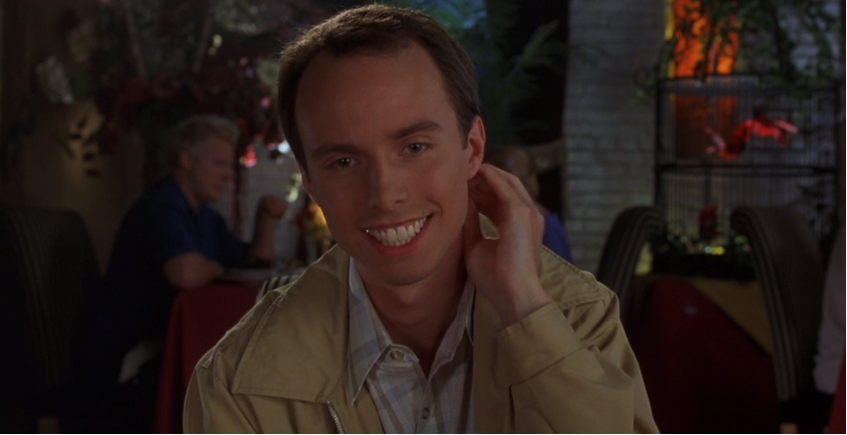
There’s a lot that’s fun and good here, but I’m more fascinated by what isn’t here than what is. Just to start us off with a visual example, one of the men that Kate meets on the speed date is a smiling goon who’s too awkward to work up the nerve to actually say something to her: 

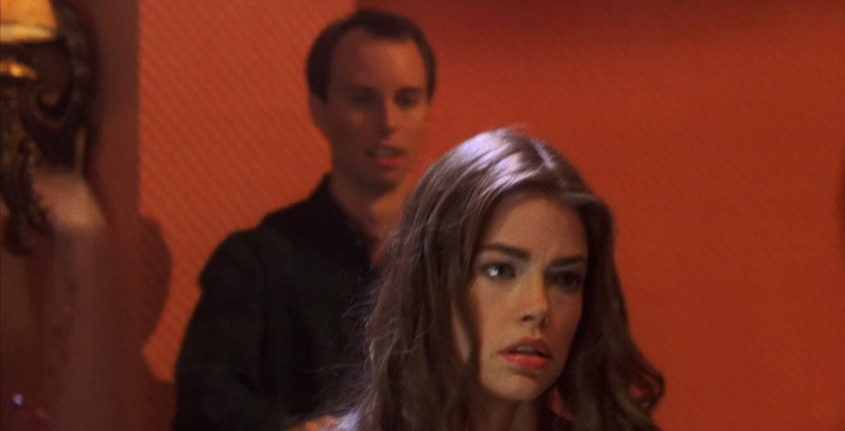
After fifty minutes, this guy shows up again, standing in the stairwell behind Paige when she comes downstairs at Dorothy’s party: 

That’s far too long between scenes for a red herring character to appear and be effective, and so little attention is drawn to him in this second appearance. It’s hard to explain but it just makes it feel like there was or should have been an intervening scene in the film’s second act, where he reappeared briefly and the film could have hinted that he was Jeremy, but it’s simply not present. In fact, there are several large group shots at Max’s art exhibition where it would make perfect sense for him to appear in the background, but I went back and watched that sequence in its entirety and he doesn’t appear in any of the crowd shots, foregrounded or otherwise; it almost makes more sense that he did appear here and was cut. 

And that’s not the only thing that’s narratively unfulfilling or otherwise doesn’t make sense in the language of film. Cameron is one of the film’s more involved red herrings, and he’s used more effectively than some of the others as well given that he is clearly up to no good, but it’s merely criminal, not homicidal.  Unfortunately, however, he is killed mere moments after we’re given the biggest hints that he might be the killer: he is unable to sexually perform for Dorothy, indicating that he’s not as into her as his cover story requires, then he gives her a necklace with a cherubic Cupid on it as a Valentine’s/apology gift, and then he goes down to one of the house’s spa areas and unsuccessfully tries to transfer her father’s money over the phone while scratching at the right side of his nose in agitation. This would be really effective if there were a scene or two in between them that left the house, creating some tension about whether Dorothy was safe or not, then cut back to Cameron trying to transfer funds. To digress for a moment, when Vaughn questions the women about boyfriends who might be behind the scary valentines and such, Kate claims that Adam simply can’t be Jeremy since she’s known him for a couple of years and even rattles off a series of facts about where he’s from and what his parents do for a living. It’s not my practice to review the movie I wish we were presented with or give feedback like this very often (I don’t never have some armchair directing feedback, but it’s not common), but this film almost begs for it, especially because the gaps are conspicuous in their absence; it’s not just that there’s something ephemeral that’s “missing,” it’s like there’s a specific shape that’s been cut out, like when a cartoon character leaves their outline after running through a wall. Right here is the perfect place for a scene where Kate, her certainty about Adam shaken, should have tried to do a little digging about Adam’s past; maybe she’s never actually met these parents and she casually asks Adam about them in a way that makes him react oddly, or she tries to look up the law firm where his mother works only to discover it doesn’t exist or contact the school where Adam’s father supposedly works only to learn there’s no “Mr. Carr” teaching there. Instead, we get two back-to-back scenes (six minutes of screentime) with Cameron and Dorothy in which no tension is built. This is pretty basic stuff, where the audience leaves one scene now assured that Cameron is the killer, then they have that determination undermined by Adam’s behavior or the discovery of lies in his personal history. 

Let’s talk about Scream for a second. I haven’t read the book on which it was based in its entirety, only the first two chapters that are available on certain websites as a preview, but there are enough differences in what I read versus what I saw to say that there were major revisions: Kate’s character is named Jill and is a mystery writer, Paige is called Tara and is an actress, and it is Adam’s character, called Nate here, who is the artist, not Max to bring the film more in line with the Scream narrative. The book opens just after the killer has committed his first revenge murder, and it happened in a bedroom, not a medical school morgue like in the film. The first victim in the novel is already dead at the time of the first line, but Valentine the film goes out of its way to evoke the opening of Scream instead, spending a lot of time with a character getting to know her before she’s killed, and utilizing one of the bigger names in the cast for this scene for shock value. Heigl didn’t have the superstar power that Knocked Up and Grey’s Anatomy would give her in the coming years and certainly wasn’t as famous as Drew Barrymore, but she was one of the big leads in a show that was aimed at and popular with the film’s demographic, and the ongoing staying power of Wish Upon a Star says a lot about how effectively it lodged itself in viewers’ minds. As in Scream, there is police involvement, and the primary red herring (Jason Marquette/Cotton Mather) is arrested for a time while the killings continue unabated, but the killer covers his tracks sufficiently that no one realizes this. And, just like Scream, the movie ends with a giant house party, and it’s this that I want to focus on for a minute. 

Dorothy’s big Valentine’s Day house party takes up far, far too much of this film’s runtime. Valentine is 93 minutes without credits, and the last 35 minutes, nearly 40% of the run time, all take place during this party. Worse that that, remember when I mentioned that nothing happens between the scene with Cameron acting suspiciously with his limp dick and Cupid necklace and the scene of him trying to defraud Dorothy’s father’s bank and then getting murdered? Nothing happens between those two scenes and the party, meaning that we spend the last 41 minutes of the movie at Dorothy’s house. The only time we leave there is when there is a quick cutaway to Lt. Vaughn calling Kate from his car to tell her that Jason Marquette was released and that he might show up at the party. Now, compare this to Scream, which likewise spent a huge part of its runtime (48 minutes) in its final act house party, but we don’t spend that entire time in Stu’s house. There are memorable scenes in the news van and down the road where Gale and Dewey take a walk that function to break up the visual monotony of spending too much screen time in one location. Once again, the outline of something missing is just as present in the narrative as the things that are actually there. To give credit where it’s due, this is where the film’s most interesting kill happens, wherein the killer manages to trap Paige in the hot tub under a clear plastic cover and starts drilling holes in it as she swims around evading the drill bit while having to keep her mouth and nose in the very small space between the cover and the water. It lasts longer than many of the other killing sequences (more on that below) and is very tense, unlike many of the others. 

One of the major things that Valentine, like a lot of Scream imitators, is missing is the characters’ attempts to fight back and survive, which often makes these scenes very brief and lacking in audience investment. In the original, Casey Beckett tries to flee the house and call for help from her parents and Tatum throws bottles of beer at Ghostface and fights for her life before getting stuck in the garage door that breaks her back; in Scream 2, which was released four years before Valentine, Maureen begs the audience to realize she’s not acting and help her, and Cici manages to do some real damage to Ghostface before being thrown off of the sorority house’s roof. And of course, in all of them, Gale and Sidney are pretty banged up at the end because they are badasses who refuse to die. Here, the murders are brief and, insofar as the characters have any agency at all, they mostly just try to hide (ineffectively): Shelley’s is the closest to a real attempt to fight back, but she still ends up hiding in a body bag, which is where the killer finds her; creepy Gary is beaten to death while cowering, moments after being discovered in Kate’s apartment by the killer and is never mentioned again; Lily gets shot to death by arrows from a distance and then falls down the center of a stairwell into a dumpster; Campbell takes an axe to the spine without ever seeing the killer coming for him. I actually saw more of this movie while testing this: from first arrow wound to dumpster fall, Lily’s death takes up 31 seconds of screen time. In comparison, Tatum’s death scene in Scream, from the moment she sees Ghostface to the moment her spine cracks, is 94 seconds, and that’s not counting the 90 seconds before that where she enters the spooky garage, struggles with the beers, and finds herself locked out of the house while tension rises. What’s more, this is one of the few areas in the movie where it feels like the failure is in the film itself, not the editing or the ostentatiously absent footage; there’s nothing missing here, the scenes simply aren’t that good. I also want to point out that some of the murders happen offscreen and it seems like it’s an actual stylistic choice, like Lt. Vaughn’s death being kept secret until Kate discovers his body, while some threads are simply left hanging, like Brian being left tied to the bed by Paige, implying that he might still be upstairs blindfolded and naked while the climax of the movie takes place. 

One thing that Valentine has that Scream doesn’t is opening credits. Stick with me here! Valentine‘s credits are intercut with its opening scene, and like I mentioned earlier, that opening is very effective and the film’s intersplicing of it all means that Valentine can have its cake and eat it, too, having old school long credits but making them interesting enough that the audience doesn’t mind. Unfortunately, this is also the film’s drawback, as the format of the titles spoils who the killer is. David Boreanaz was four years into playing his iconic role of Angel, two seasons of which were on his own show as the title character. That may have only made him a household name in households that watched Buffy, but for those households which also tolerated network series about quirky not-quite-a-cop investigators, his—wait, this math can’t be right. 245 episodes over 12 seasons? Ok, but jeezum petes—uh so yeah, Boreanaz’s turn as Booth on over a decade of Fox’s Bones also contributed to his fame. His is also the only man’s name in the movie that appears on its own during the credits. Richards is credited first, then Boreanaz, then Shelton, Capshaw, and “with” Heigl. The other men are listed in the opening, but always with other names, so you, the audience member who presumably knows who Boreanaz is, are subtly already clued in that he will be the killer, because if it’s not him, who would it be? Surely not one of these other comparative no-names (no offense), most of which, again, don’t effectively function as red herrings because they appear too infrequently. Gary is in two scenes; Brian is in two scenes. Every red herring is only 2/3 of the way there for them to work. The grinning goober who couldn’t talk at the speed dating event is only in two scenes, and all of it feels like a lot of the middle was cut out, where we would get that second scene before the final act that would lead us to believe that any one of them might be the masked killer. There’s even the tiniest bit of a hint that Vaughn might be the killer, since he’s not present at Max’s gallery opening but does mention that he’s seen Max’s work, as well as the sinister way that he isolates Paige and is a creepy lecher about it. Instead, because something is missing about the actual language of film, the viewer spends the whole rest of the movie waiting for the other shoe to drop and Adam to be unmasked as Jeremy. Imagine if Scream had opening credits and Skeet Ulrich was listed second while the rest of the male cast, including David Arquette and Jamie Kennedy, were relegated to tenth and eleventh billing; there would never be a moment of mystery, and there isn’t here, either. 

But that’s just it. The biggest empty hole that’s identifiable here is the lack of a second killer. That’s a foundational part of what made Scream work and is also present in its sequels (other than Scream 3, where it was cut at the last minute) but not its imitators (other than I Still Know…, which almost makes it the better of the two). Except—hear me out here—I think that Valentine did have a second killer, and the removal of that was one of the linchpins that made the rest of the story work. I mentioned before that the Cupid mask has nosebleeds, just like Jeremy, but it doesn’t happen every time. After Kate struggles with the Cupid-masked killer, Adam suddenly appears and kills them, with the unmasking revealing that Dorothy was under there. The Adam-is-Jeremy bloody nose reveal would have us believe that this was all part of Adam’s plan, that he somehow attacked Kate as Cupid and then dressed the disabled Dorothy (perhaps crushing her windpipe so that she couldn’t call out to Kate and reveal the deception) as Cupid so that he could then shoot Dorothy, have her revealed as the killer, and then get back together with Kate with no one to interfere and his vengeance sated. But what if that’s not what was supposed to happen? What if Dorothy and Adam were supposed to be in on it together. Some parts of the film actually make more sense this way, as Adam seems ideologically driven but Dorothy also harbors a lot of bitterness about being the “fat girl” of the group when they were younger. Further, there are some kills that, due to the editing, only make sense if this is the case, and it feels like the fact that the Cupid mask only bleeds sometimes is supposed to be a clue to this reveal, and that re-viewings of the movie with that in mind would reveal who was behind the mask during certain scenes. Adam wants to kill the women who spurned him, but has no reason to kill Cameron, and it’s notable that we don’t see the mask bleed during that scene, and that the timeline would seem to indicate that, since this was a few hours before Dorothy’s party, it was happening at roughly the same time that Adam was across town giving Kate her lollipop valentine. Although Dorothy is the reason that Jeremy went away and took a downward turn, it’s not a completely unrealistic twist that her bitterness toward her richer, smarter, prettier (in her eyes) friends led her to team up with Jeremy to take them down, only for him to fall for Kate and end up betraying her in order to have her be the scapegoat and let him have his dream future with Kate. 

However, for whatever reason, that ending didn’t sit well with test audiences, or perhaps studio executives. Maybe someone thought it was a little dated and fatphobic (which it would have been) and decided to course correct too late to fill in the gaps with it removed. Or maybe this is just a bad movie and I’m too invested in the parts of it that are good to let it go at that and insist on finding ways to close loopholes and fix bad editing with my projected fix-fic to turn this into a better film. But I don’t think so. I think that this was a movie with great promise that fell apart under its own weight with too much supporting material removed, even if I’m wrong about Dorothy. 

-Mark “Boomer” Redmond
Pearl (2022)

The biggest drawback of Ti West’s retro-porno slasher X was its 70s grindhouse aesthetic, which has been ground into the dirt since at least as far back as when Rob Zombie started making movies in the aughts.  X‘s biggest asset was the “X-factor appeal” of its star, Mia Goth, who has by now proven that she can do Anything.  As its rushed-to-market prequel, then, Pearl is a major improvement on X by default, since it switches up its eras of pastiche for something that still has some novelty left in it, and it feeds Goth as much scenery as she wants to devour.  Pearl plays with a tongue-in-cheek Technicolor melodrama aesthetic that you can usually only find in a Todd Haynes or John Waters film, not an axe-murder slasher.  Stylistically, it most reminded me of the pop art farmland comedy Big Top Pee-wee, which may not be as widely beloved as Texas Chainsaw Massacre, but at least hasn’t been mined dry for direct inspiration in horror circles.  More importantly, it centers Goth as both an electric screen presence and as a subversive creative voice, landing her a co-writing credit alongside West.  Goth is a singing, dancing, head-smashing entertainment machine, mapping out the full scope of her range between demonic shrieks and barnburner Bergman monologues.  Much like X, the movie wouldn’t be much without her, but in this case she’s burned into practically every frame, sharing much less screentime with the poor collaborators who have to shine beside her.

I’m not sure Pearl benefits much from its connections to X thematically, even if it couldn’t exist without it financially.  There is one scene in which the underground stag film industry of the 1910s is evoked to echo the 70s porno-shoot setting of X, but it feels shoehorned in out of obligation.  When Pearl botches a chorus-line dance audition, she isn’t recruited to shoot loops. Instead, she briefly watches a stag reel from the safe distance of a projection booth.  Likewise, the film is light on kills, saving Pearl’s murderous rampage for the final act, when West starts to backslide into his default 70s art horror aesthetics, forgetting the assignment at hand.  The film most excels as a psychobiddy origin story, setting up the old-age resentments and pent-up hedonism the character doesn’t fully get to act on until a half-century later.  We watch Pearl train her pet, people-chomping gator; we revisit the familiar layout of the farm where she spends her entire unfulfilling life; and we watch her get acquainted with the axes & adultery she eventually wields as deadly weapons.  In a lot of ways, all of that self-referential lore-seeding weighs the movie down, needlessly stretching its runtime into the triple digits.  Every minute we get to gaze at Goth doing her thing is time well spent, though, and she makes the most of X‘s leftover character details & production funds, scraping together the rare prequel that exceeds its original.

As lukewarm as I am on X, I do appreciate Ti West’s old-timey huckster spirit in turning it into an Event Film out of sheer force of will.  While a lot of audiences have gotten hung up on Pearl‘s visual references to Douglas Sirk & The Wizard of Oz, artist Shawn Mansfield really got to the heart of the picture with the fan-art poster below, framing Pearl as a spiritual successor to William Castle’s axe-murder trashterpiece Strait-Jacket.  West is dabbling in some old-fashioned William Castle razzle-dazzle with this series, relying on marketing stunts to turn X into A Thing before audiences had time to react to it genuinely.  Pearl was announced in the end credits of X, filmed on its leftover sets and production funds.  Likewise, the 80s porn-scene follow-up MaXXXine was announced during the end credits scroll for Pearl.  Usually, that kind of manufactured cult-classic appeal would annoy me, but here it recalls a carnival barker, pro-wrestling promoter tradition in always promising the next attraction that feels very much in the spirit of old school schlockteurs like William Castle, David Friedman, and Roger Corman.  On its own, Pearl could’ve been leaner, zippier, and nastier, but it’s still a hoot overall.  As part of an ongoing porno-slasher trilogy, it’s likely to be the one that maintains the most novelty, since it’s set in an era that hasn’t been as overmined as the 70s & 80s in recent horror trends.  I like what West is going for here, and so far the payoffs are trending upwards.

-Brandon Ledet

Lagniappe Podcast: Cherry Falls (2000)

For this lagniappe episode of the podcast, Boomer, Brandon, and Alli discuss the post-Scream teen slasher Cherry Falls (2000), starring a very gothy Brittany Murphy.

00:00 Welcome

00:42 Psycho Ape! (2020)
02:55 X (2022)
07:17 RRR (2022)
11:50 Bridgerton
15:33 Popstar: Never Stop Never Stopping (2016)
17:10 Josie and the Pussycats (2001)
18:49 Fyre: The Greatest Party that Never Happened (2019)
19:36 What Happened to Monday? (2017)
21:42 Scream (1996)

29:47 Cherry Falls (2000)

You can stay up to date with our podcast through SoundCloudSpotifyiTunesStitcherTuneIn, or by following the links on this page.

– The Lagniappe Podcast Crew