The Not-So-New 52: Justice League — The Flashpoint Paradox (2013)

Welcome to The Not-So-New 52, your digital Swampflix comic book (adaptation) newsstand! Starting in 2007, DC Comics and Warner Premiere entered the direct-to-home-video market with animated features, mostly in the form of adaptations of well-received event comics or notable arcs. This Swampflix feature takes its name from the 2011 DC relaunch event “The New 52,” and since there are (roughly) fifty-two of these animated features as of the start of 2024, Boomer is watching them in order from the beginning with weekly reviews of each. So, get out your longboxes and mylar sleeves and get ready for weekly doses of grousing, praise, befuddlement, recommendations, and occasional onomatopoeia as we get animated for over fifteen years of not-so-new comic cartoons. 

Well … it’s come to this. This feature takes its name from the 2011 reboot of DC comics, The New 52, and if you’ve learned anything from reading these “issues,” it’s that each reboot of the comics requires a “crisis” event in order to reset everything and create a new, “fresh” jumping on point. For The New 52, that crisis was called Flashpoint, and it involved Barry Allen’s version of The Flash traveling back in time to prevent the death of his mother, only to return to a present so altered from his experience that things are worse for everyone else. Sure, his mom is alive in the present, but his wife is married to and has had children with another man, he is without his powers, and several key players in the ongoing preservation of mankind are absent or so altered that they are barely recognizable. If this sounds familiar to you, then maybe you read this comic, or maybe you watched the third season of CW’s The Flash, which adapted parts of this story, or you saw the disastrous Warner Bros release of The Flash last year, which also featured parts of this plot. For something so recent, it’s been picked apart and reused in quite a few adaptational ways. And hey – that’s fine! The source material isn’t the problem with this movie, it’s just that I hate the animation in this one, and I really despise that this was the first step in DC’s attempt to create a more interconnected universe (sigh) among these DTV features, which had heretofore been standalones or duologies. You see, this is the first film in the “DC Animated Movie Universe™,” and that series will encompass sixteen of the next twenty-four of these movies, with up to three or four of them being released in succession before they throw in the occasional standalone to break things up. I have a feeling we’ll be desperate for them when the time comes. On your mark, get set, I guess. 

We open with a brief prologue in which we establish the relationship between child Barry Allen and his mother, including her teaching him the so-called “serenity prayer” as a kind of proverb, followed by him discovering her murdered body after school one day. From this, we transition to present day, where Barry (Justin Chambers), accompanied by his wife Iris (Jennifer Hale), leaves flowers on his mother’s grave and says that he wishes he could have been fast enough to save her that day; Iris reminds him that he was only a boy, and if he had gotten home any earlier, it’s likely that he would have been murdered as well. This discussion is interrupted by news that several of Flash’s rogues have gathered at the Flash Museum in order to destroy his legacy; he arrives to face off against the Top, Mirror Master, Heat Wave, and Captains Boomerang and Cold. He handles them all with relative ease until the arrival of Eobard Thawne (C. Thomas Howell), aka the Reverse Flash, who manages to cement him onto a wall and attach a bomb to him. He also reveals that he’s put bombs on all of the other rogues present, and that’s when the rest of the Justice League arrive, and boy oh boy, are they ugly as shit. Their proportions are all out of whack in a way that I think is aiming to be anime-esque but is really just hideous. I mean, look at Superman here: 
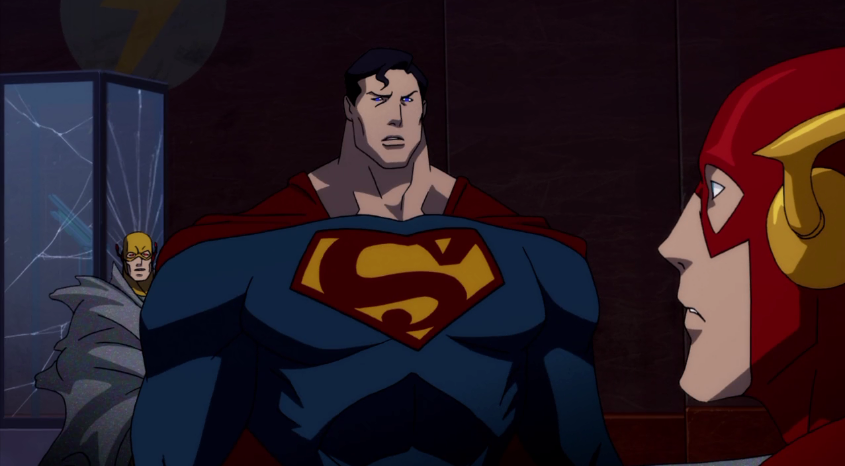
His insignia is three times the width of his face, and his shoulders are 8.5 times as wide as the widest part of his jawline. For comparison, when drawing the human figure in proportion, most artistic instruction tells the artist to draw the shoulder line as twice the length of the height of the head, or three times as wide. Superman’s shoulders here are almost double that, at 3.75 times his head height and 6.92 times his head width. I know that some of this is a matter of artistic license or preference, but I would prefer not to look at this; it’s fucking hideous. If we’re being charitable, we can say that this is probably to provide greater contrast to how emaciated and weak his alternate self will appear in the other timeline (spoiler alert), but I hate it, and it puts as much of a sour taste in my mouth about his new film “series” right from the get-go, both the first time I saw it and this time as well. 

Anyway, after they disarm the bombs and Thawne is taken into custody, he says some creepy shit and we head into the opening credits. When we re-emerge into the film proper, Barry wakes up at his desk to find that things are not quite as he remembered them; his boss asks him for an update on the case of the Elongated Kid being murdered rather than the Elongated Man, a TV news report shows a “Citizen” Cold fighting off Captain Boomerang at the Cold Museum, and oh, yeah, he doesn’t have his powers, and his mother is alive. He tries to tell his mom that he’s the Flash, but she doesn’t have any idea what he’s talking about. Elsewhere, a more grizzled Batman (Kevin McKidd) has no problem using guns or throwing his enemies off of buildings to their deaths, although his attempted murder of a villainess is interrupted by Cyborg (Michael B. Jordan, wasted in this role). The younger hero attempts to recruit the Bat into joining the squad that the former is attempting to put together—and in so doing exposits the greater context of what’s happening in this new reality—in order to end the war between Atlantis, as led by Aquaman (Cary Elwes) and the Amazons, with Queen Diana (Vanessa Marshall) as their leader. These two plotlines intersect when Barry, desperate to find someone to help him figure everything out, slips into Wayne Manor, where he finds that this world’s Batman is Thomas Wayne, who became a vigilante when his young son was gunned down in an alley, rather than the other way around. From here, it’s all about figuring out how to get Barry’s powers back and set right what once went wrong. 

There’s fun to be wrung here from some of the little twists of fate and characterization on the darker side of the mirror. It’s so corny that Martha Wayne becomes the Joker in the same moment that Thomas decides to become Batman that it loops all the way back around to being kind of cool, actually. The idea of the “Shazam Kids,” a group of kids to all merge into one hero in the form of Captain Marvel/Shazam is also a neat little touch. Otherwise, though this is a real slog to get through. My problem with the animation isn’t just that the new character designs are awful (although they are, just terrible, really), but also that some of the designs that are clearly reused from other projects look bizarre alongside these bulging hulks; this is most noticeable with the contingent of Atlanteans who are clearly just copied over from Young Justice (Kaldur is especially obvious), who look like carefully carved Greek statues next to the blown-out Aquaman. It also looks cheap, and it has the unfortunate problem of looking cheaper the longer the movie goes on, as if they were running out of budget with every minute. The seams show most close to the end when a newly-repowered Barry is running at superspeed, and the figure of him running on screen looks like an incompletely rendered animatic, like they didn’t actually bother to give the animation team time to finish rendering the CG elements for the final release. One would think that, with the launch of a new ongoing film franchise following this movie that some of the budget would be spent on creating, for instance, a CGI running Flash that looks top-notch, so that they could then use that same model for future films in the series, but this just looks like shit. Furthermore, although it isn’t this film’s fault, both other adaptations of this story for TV and film include the fact that Barry sets out to save his mother from being killed as the catalyst for the plot, meaning that the mystery in this adaptation—who changed the past and why—is utterly moot if you’re coming to this film after interacting with either of those pieces of media. 

I hate this one, and it doesn’t even really need to exist. In a meta sense, I understand the impulse to make one last movie under the Warner Premier label (which dissolved in 2013 and was absorbed into Warner Bros Home Entertainment and Warner Bros Animation; the next film will be released with solely the latter in its production logos), and to find it clever to do a rebooting crisis as the finale. That doesn’t make me feel more fondly toward it, however. Almost all of these movies so far have been completely standalone, with no connection to one another. So what continuity do you need to reboot in order to start telling a new story from the ground up? None! Just start your DTV interconnected franchise with the next movie! There was no tract of land here that needed to be cleared to build a new house, just open space, and they stuck this hideous movie in here for no good reason.

-Mark “Boomer” Redmond

The Flash (2023)

Hello there, reader! Because of the nature of this movie, the seemingly endless stream of (alleged) criminal acts that the lead star continues to perform, and the fact that a nearly-completed movie starring and helmed by creators of color was shelved for back asswards financial reasons while this one was still released to the general public despite starring an (alleged) criminal, I have chosen to forego a star rating for this film to prevent even the appearance of advocating for you to contribute to its box office or rental take. I myself had no intention of seeing this movie and contributing to it monetarily, but for reasons I cannot disclose, I was able to see it on opening weekend, and Warner Bros. footed the bill. For reasons of legal disavowment, I must reiterate that Swampflix and its affiliates do not endorse piracy, and the fact that I am bringing this up here is not a playful endorsement for pirating this film⸮ Wait, shit, what does that punctuation mark mean? I’ve never seen it before! Anyway, on with The Flash!

When I recently had the good fortune to visit with our fearless leader Brandon in real life recently, he recited a piece of wisdom that I’ve heard him voice before: CGI ages like milk. I don’t disagree, but in the case of today’s film, the CGI arrived rancid upon delivery, and the fact that it did so means that this film has no right to exist in the form that it does. I’m going to reference two pieces of media that, based on box office, Nielsen numbers, and anecdotal evidence in the form of responses to my general questions, you’ve probably never seen: 2013’s regrettable Sam Raimi Baum adaptation Oz the Great and Powerful Movie and the 2019 sexy Spanish drama series Toy Boy. In regards to the latter, the opening sequence of the show contains scenes from within the narrative, but with the characters and all surfaces rendered as if they are made of glazed ceramics (see it here, although it’s possible NSFW for sexy reasons); in the former, there is a character named the China Girl, an animate, living porcelain doll who joins the protagonist’s journey (see a clip here, although it’s possible NSFW for James Franco reasons). The reason that I bring these up is because what these two things are doing in earnest The Flash does blindly, blanketly, and with no remorse; so, so, so many of the images that we see here look like soulless, shiny mannequins as those glazed figurines that a certain generation of our elders collected. Some of the time, it could be argued, that the images are supposed to look like that (we’ll get to the time arena in a minute), but other times, they are clearly not – most notably and frequently, every time we see two different Barry Allens on screen, both played by Ezra Miller, it’s abundantly clear which of the two was played by a stand in upon whom Miller’s visage was pasted, based solely on how nonplastic and uncanny they look. 

I know that Hayley Mills and Lindsay Lohan were never tasked with playing speedsters in their respective Traps, but the technology in the 1990s and the 1960s was more convincing at portraying reunited twins than this movie is at Ezra Miller walking down the street side by side with themself. And the Flash suit! It’s so … bad. Genuinely awful. I went on a bit of a tear just now in the middle of writing this to see if I could find any behind-the-scenes photos of Miller in the suit on set, and there are none, which almost makes it seem to me like they were never in the full suit on set at all, which would in turn explain why it never looked “real” for a single moment that it was on screen. And I’m not just talking every time that there was a fight scene and everything immediately started to look exactly like a super move from Injustice 2, but every time Barry was just standing around doing comedic bits, the suit looked like someone trying to 3-D animate amphibian skin and doing a poor job of it. Ryan Reynolds’s Green Lantern was at least supposed to look the way that it did; this one looks like a mistake that they decided to go ahead and leave in, which makes it completely bananas that this film was released in this form with this lead performer. It boggles the mind that executives were considering recasting the part of Barry Allen because of Miller’s (allegedly) many, many (alleged) crimes and then decided that they didn’t need to, because this looked good enough to put on the big screen. Bananas! Bananas!

Narratively, the film takes its inspiration from the comic Flashpoint, which was released in 2011 as a way to reset the status quo for DC comics, leading into a new continuity that was, in theory, supposed to make the material more accessible to new readers and thus increase circulation. In most recent versions of the Flash comic-book canon, he’s driven by the fact that his mother was killed when he was a child and his father was arrested and (wrongly) convicted of her murder. Since it’s been part and parcel of the whole Flash deal for a while that he can run so fast that he can either travel through time using his speed outright or by access to something called the Speed Force (let’s not get bogged down in those details), it occurs to Barry Allen to try and prevent the murder of his mother, leading to unforeseen consequences on the timeline. If you’re sure you’ve never read that story but it still sounds familiar, it’s because it also formed the basis of the third season of CW’s The Flash, which just finished its ninth and final season, or perhaps you saw the animated direct-to-video film Justice League: The Flashpoint Paradox sometime since its release in 2013. It’s not exactly new territory at this point, is what I’m saying. We get an opening sequence that exists solely to trot out a couple of characters that we’ve seen before and establish that Barry sees Bruce Wayne/Batman as his mentor and that Bruce isn’t necessarily unwelcoming of the younger man but retains his normal aloofness; all of this is here to establish the status quo that they’re going to demolish completely before this movie is over. 

When it looks like Barry’s father (Ron Livingston) is about to lose his appeal, Barry takes off into the past to make one simple change: to make sure his mother (Maribel Verdú, one of the best parts of the film) doesn’t forget to pick up tomatoes at the supermarket the morning the day that she dies, so that his father isn’t absent when someone finds her in a house that they assumed would be empty. As Barry returns to the present, he sees how the wings of that butterfly have affected his life but, before he gets there, something else invades the Speed Force and knocks him out of his time bubble, straight into 2013, on the same day that he was initially struck by lightning and gained his powers. Only this time, since his parents are alive and Barry grew up with a happy childhood, he wasn’t driven to go into forensics to one day learn something that would help him clear his father’s name, so he won’t be in that police lab, so Barry has to take the younger version of himself—differentiated from Present!Flash by nothing more than his longer hair—to the lab to make sure that this happens, which results in the loss of his own powers. Past!Flash, lacking the maturity that Present!Flash had at the same age, grates against the older version of himself, who in turn has to give his younger self a crash course in Being the Flash 101 while powerless and stunned to learn that his little time travel event has affected things that happened even before the changes that he made, including that Eric Stoltz played Marty McFly in Back to the Future as originally cast (a gag that Fringe did once), which resulted in Michael J. Fox taking the leading role in Footloose, which in turn caused Kevin Bacon to play Maverick in Top Gun. Another of the changes he caused is that there are no other metahumans in this timeline, so there’s no one present to stop the Kryptonian invasion led by General Zod (Michael Shannon) that is happening concurrently, but unlike in Man of Steel, there’s no Superman here to stop them. There does happen to be a Batman, so the two Barries seek him out at Wayne Manor, only to find that he’s not the man that Present!Barry has come to know, literally. 

I’m about to reference another piece of media that I’m almost entirely certain you’ve never heard of: a 1984 desktop computer game titled Bouncing Babies, which I played on the very first computer that our family owned (I’m not that old, we were just that poor). In the game, wave after wave of babies are thrown from a burning building, and the player controls a group of paramedics who use a trampoline to bounce the falling babies into the back of an ambulance. The opening action scene of this film is … that? While Batman (Ben Affleck … for now) is embroiled in a high speed chase, Flash is called upon to help prevent the collapse of a hospital that was damaged; this hospital, as it happens, keeps all of the babies in a nursery on the top floor, and when one of the building wings collapses, they all go flying out of the broken windows as the building loses its bearings, and Flash has to whip around on all of the falling debris and such as they fall. One never feels that there’s a real threat, of course, since it’s PS4 Injustice 2 Flash running around saving PS4 Injustice 2 babies, but it’s a fun sequence nonetheless, and that’s something worth noting throughout the film: these are the best action cutscenes from a video game that you’ve ever seen, but there will never be a single moment that you think to yourself that you’re having a cinematic experience. 

And on top of all that, since this is a multiversal story, they end up bringing in soulless CGI golems made in the images of George Reeves and Christopher Reeve as their respective versions of Superman, staring out of the screen like they’re waiting for you to press start to open the game menu; there’s even a bit where a digitally de-aged (or a digitally everythinged) Nicolas Cage fights a giant spider, which was a major point of contention in the direction of the never-finished Superman Lives, with the implication being that there was a timeline in this multiverse where the narrative of that aborted film played out. It’s really banking on your nostalgia factor, which it has to, because while there have been a few good (or at least fun) eggs in this weird DCEU basket of mostly stinkers, there’s nothing iconic in any of these movies onto which one could anchor any meaningful moments. That they went back to the General Zod’s invasion well is very telling here. And if you somehow haven’t been spoiled on one of the big reveals in this movie (the best one, to be honest), I’m not going to ruin that for you here, but to pretend that it’s anything other than a great big nostalgia grab would be pathologically dishonest. 

There’s so much wrong with this movie. The (allegedly) criminal star, an utterly inconsequential love-story plot tumor, the way that Miller plays Barry not so much like someone who’s done some deep actor work on portraying a neurodivergent person as much as they play him like a bully mocking a neurodivergent classmate, the endless parade of ceramic fight sequences, and the way they managed to make poor Helen Slater look like a Lifeforce zombie (that woman deserves better than this, dammit). And yet … and yet …. Twice during this movie I leaned over to my viewing companion: first, during the sequence that adapted Bouncing Babies to the screen, I leaned over and said, with surprise, “I’m … enjoying this?” Later, during yet another action sequence, I said “I hate how much I’m enjoying this.” And, as we left the theater, I confessed: “I regret to inform you of this, but I had a great time.” However, I am once again advising that I do not endorse that you see it, at least not in any way that could contribute to the film financially. If your kids are demanding to watch it, now is the perfect time to trick them into watching the 1990s show starring John Wesley Schipp (I’m not going to link it, but a quick search shows that it’s on YouTube right now, probably illegally), and that will cost you nothing and buy you enough time to Google “how to talk to your family about Ezra Miller” and then just bide your time until this film becomes available in a way that’s free to you. Apropos of nothing, do you have a VPN? I use ExpressVPN, and I love it! (Not sponsored.)

Because yes, dear reader, it’s true, I do regret to inform you that I had a great time. I’m sorry that I saw it in a way that didn’t contribute to the coffers of the Pharisees that canceled Batgirl and that you don’t have that option available to you (yet). Just be patient. You’ll get to look into Superman’s dead eyes soon enough. 

-Mark “Boomer” Redmond

Neil Patrick Harris, Superhero Sidekick

Neil Patrick Harris wears a daunting number of hats in the show business racket: Broadway entertainer, game show host, sitcom star, children’s book author, etc. He’s one of these well-rounded, over-employed entertainers where you’re never sure how they fit all their various projects in a tenable schedule. One of his regular gigs is voiceover work for various animated projects wildly varying in target demographic, but often hitting that one common denominator in all age-specific marketing: superhero media. NPH has had regular voice acting gigs in the superhero pantheon over the years, even voicing the title role in a long-running animated Spiderman series. He’s only voiced characters in two animated superhero movies, though, both of which fall under the DC Comics brand. That’s maybe not that surprising to most people, as the DC Universe Animated Original Movies brand has dozens of feature-length cartoons under its belt to date. What is surprising, though is that someone as talented & recognizable as Neil Patrick Harris has only played supporting characters in both instances of his movie-length collaborations with DC. Likely a reflection of his busy, no time to dally schedule, NPH’s animated superhero movie specialty seems to be punching up a side character’s dialogue with wry, cocky wit, making them appear more fully developed than they’re written to be. As with many of the projects NPH applies his time to, he’s good at his job.

In our current Movie of the Month, 2010’s Batman: Under the Red Hood, NPH’s sidekick role plays as entirely intentional. He’s cast as just one of two ex-Robins, raised under the Caped Crusader’s tutelage in a movie that’s all about Batman’s struggle with the other. NPH appears in the film as Nightwing, an early adopter of the Robin persona who has since branched out to fighting crime on his own, but still desperately needs fatherly approval from a standoffish Batman. Nightwing is an outsider to the central plot involving a second, younger Robin, but he’s also an essential parallel of it. This requires him to be present, but without enough time to develop his persona. It’s a paradox that’s easily fixed by having NPH on hand to instantly sell the character’s sarcastic, performatively confident personality. It’s the same role he fills as The Flash in the earlier DC animated feature The Justice League: The New Frontier, through for entirely different reasons. The Flash is a sidekick to no one and his storyline is one of the driving plot threads in New Frontier, yet NPH is afforded just about the same amount of screen time & character development there as he is in Under the Red Hood. This is because the film is overstuffed with the backstories & character introductions of a long line of superheroes in the film’s cast, who all divvy up the runtime until there’s barely any left to go around. It’s a frequent problem for anyone who’s familiar with the trajectory of modern live-action superhero franchises, especially the DCEU. It’s also a telling contrast to the intimate story told in Red Hood.

As busy & overcrowded as The New Frontier can feel, it does have an excellent central gimmick. Set in the Atomic Age 1950s, the film feels like a better world where Brad Bird made his animated superhero media in traditional 2D instead of with Pixar. Telling the story of an ancient disembodied force that vows to destroy humanity because of its dangerous nuclear proliferation, The New Frontier is decorated wall to wall with the visual kitsch of a 1950s diner with a sci-fi theme. By setting the clock back to that setting, though, it also requires the Justice League to be a uniformed group of disparate superheroes who spend the entire runtime coming together as a team (and joining efforts of an untrustworthy military) for the first time. Characters like The Flash, Superman, and Wonder Woman already have detailed backstories in place, while more character development is afforded the origin stories of lesser characters like The Green Lantern & Martian Manhunter. It’s likely no accident that more seasoned, well-established voice actors are afforded to the three more static characters (NPH, Kyle McLachlan, and Lucy Lawless, respectively), since their personalities need to be more immediately recognizable than the ones who’re developed through origin stories. The Flash is key to the film’s plot, especially in establishing superheroes as McCarthy Era Others (“What’s with that red costume? Red’s for Commies,”) but he’s afforded almost the same amount of screen time as Nightwing in Under the Red Hood: very little. He’s a well-established superhero reduced here to Superman & Wonder Woman’s de facto sidekick.

From a technical standpoint, the more intimate, self-contained story of Under the Red Hood is more effective as a piece of writing, while the overly busy, origins-obsessed plotting of The New Frontier is indicative of the worst impulses of superhero media storytelling. I enjoyed both films very much, though, believing New Frontier’s narrative shortcomings to be far outweighed by the beauty & charm of its Atomic Age aesthetic. Neil Patrick Harris is employed in self-contradictory roles in both pictures. He is both central to the themes & plots and reduced to glorified cameo roles as sidekick & afterthought. NPH does a great job of making both roles memorable, informing both characters with a punchy, wry sense of humor without fully tipping them into wiseass Deadpool territory. Like The New Frontier, the man’s career is spread into an impossible number of directions and it’s impressive the amount of quality work he produces despite that myriad of obligations.

For more on May’s Movie of the Month, the animated superhero thriller Batman: Under the Red Hood, check out our Swampchat discussion of the film and last week’s profile of its Caped Crusader voice actor, Bruce Greenwood.

-Brandon Ledet