Way back in the ancient pop culture landscape of 2018, there was some excitement & novelty to be found in a one-off experiment like Batman Ninja. Sure, every other major film in production was a superhero picture and, sure, the Caped Crusader was in roughly 30% of them, but it was still a welcome break in format to see the genre reimagined in a unique context – freed from the laborious narrative responsibilities of a “shared cinematic universe.” The first Batman Ninja film was an over-the-top indulgence in redesigning famous Batman villains within an alternate-universe anime aesthetic. Its newly released sequel does the same for members of The Justice League, but all the excitement & novelty has been dulled by a constant flood of multiversal storytelling over the years since. Every superhero picture is an alternate-dimension reimagining of familiar superhero archetypes now, and so Batman Ninja vs Yakuza League serves no real purpose beyond being an easy gateway into appreciating the visual delights of anime artistry for previously uninitiated 12-year-olds. Still, it’s cute.
Yakuza League‘s boldest creative gamble is in its assumption that its audience remembers any plot details or running jokes from the previous Batman Ninja outing. The story picks up at the exact moment when the last movie ended, with Batman & Robin returning to modern Gotham from their time-travel adventure in feudal Japan. It seems there are some lingering space-time anomalies resulting from that adventure, mainly that the island of Japan has disappeared from global maps and relocated to the sky above Gotham. The now sky-bound nation’s alternate history has been ruled by infinite yakuza gangs, leading to a “Yakuzageddon” event that threatens to tear Gotham down if the Bat Family cannot fix the corrupted “multiverse frequency” in time. The anomaly initially manifests in a “yakuza hurricane,” raining countless gangster intruders into Gotham like so many Agents Smith from Matrix sequels past. The situation escalates when Batman & Robin fly to the floating Japan in the sky to restore order in the now crime-ridden country, only to discover that the alternate-universe anime equivalents of fellow Justice League members are the biggest, cruelest gangsters of all. Many loud, silly fights ensue as they struggle to restore Justice League values into the Yakuza League variants, with only Wonder Woman working as their ally on the inside.
The major saving grace of Yakuza League is that DC has once again given Japanese animators free rein to reimagine their most iconic characters in an anime context (with Junpei Mizusaki & Shinji Takagi sharing directorial credit). They have as much fun with that freedom as possible, taking for-their-own-sake detours into 80s Saturday morning cartoon parody, Lady Snowblood-inspired karaoke video art, and pop-up book illustrations that help expand the artistic project beyond its most obvious boundaries. By the time Batman climbs into yet another mech suit to fight the Yakuza League equivalent of Superman, however, the “Batman, except it’s anime” aesthetic can’t help but feel a little rote. If you’ve already seen Batman Ninja, you’ve already seen everything Yakuza League has to offer – give or take scenes of The Flash sharing lightning powers & sartorial choices with Mortal Kombat‘s Raiden. If you’ve seen any superhero movie in the 2020s, you’ve also already seen the genre collapse in on itself with this style of “What if?” alternate-universe reimagining, which is starting to feel like an admission that there’s nothing exciting or novel left to mine from this material. It’s all just different flavor packets added to the same basic gruel.
Welcome to The Not-So-New 52, your digital Swampflix comic book (adaptation) newsstand! Starting in 2007, DC Comics and Warner Premiere entered the direct-to-home-video market with animated features, mostly in the form of adaptations of well-received event comics or notable arcs. This Swampflix feature takes its name from the 2011 DC relaunch event “The New 52,” and since there are (roughly) fifty-two of these animated features as of the start of 2024, Boomeris watching them in order from the beginning with weekly reviews of each. So, get out your longboxes and mylar sleeves and get ready for weekly doses of grousing, praise, befuddlement, recommendations, and occasional onomatopoeia as we get animated for over fifteen years of not-so-new comic cartoons.
I feel like I just said this about Justice League: Gods and Monsters, but it’s nice to know that here at about the halfway point of this project, I can still be surprised. Despite having a pretty basic title that promises little more than two teams being thrown at one another like action figures, Justice League vs. Teen Titans breaks out of its role as just another smash-’em-up in this interconnected narrative. You also wouldn’t think it from the very generic promo images that are associated with the film either, but this is a horror movie, and despite being animated, it manages to be a pretty effective one.
Damian’s up to his normal shenanigans, again. Some second stringers like Weather Wizard are causing a ruckus, and the League is there to pound everyone into submission like it’s gear night and the lights are about to come on. Damian’s on crowd control duty, which means he’s standing in a single place and pointing in the direction that fleeing people should use to evacuate. Understandably bored at being given the superhero job equivalent of holding the sign that says “SLOW” on one side and “STOP” on the other at a road construction site, he gets involved when he sees the opportunity to go after the aforementioned climate-based villain. Unbeknownst to the boy, the Weather Wizard is possessed by some four-eyed space demon, and Damian’s brutal takedown forces the demon vapor out of his body, leaving no one to question. Bruce has, once again, had it up the metaphorical here, so Nightwing takes the kid to stay with the Titans, a team run by his ladyfriend, Starfire (Kari Wahlgren). She’s playing den mother to: Jaime Reyes (Jake T. Austin), aka Blue Beetle, a kid with an alien “scarab” on his back that transforms into weaponry and such; Garfield “Beast Boy” Logan (Brandon Soo Hoo), a green boy who can shapeshift into animals; and goth-girl-who’s-sort-of-the-devil’s-daughter Raven (Taissa Farminga, in an inspired bit of casting).
It’s Raven and her backstory on which this film hangs. Her mother was a teen runaway who got involved with a cult, and when said organization did a little ceremony to see what would happen, they summoned an extra-dimensional entity known as Trigon (Jon Bernthal). Raven’s mother was the naive but willing Rosemary in this situation, and her baby, Raven was to be the vessel through which Trigon would permanently enter our plane of existence to conquer the earth and turn it into a hell-like place. His time is nigh, as it turns out, and he’s stepping up his astral gaslighting to get her to open up the portal. Helping his cause is a possessed Superman, through whom Trigon’s minions are able to dig what can only be described as a stargate out of the desert, in preparation for his coming. When the Titans are attacked by Trigon’s henchmen while on an outing to a carnival for some mandatory team-building fun, Raven spills this backstory, and tells them about how she was raised in a magic utopia until she was about eleven, when Trigon found their little hidden fairyland and turned it into hell; this is not an exaggeration, as pits of molten lava erupt, everything is turned to ashes, and every living thing evaporates in a puff, except Raven. She pretended to join him, she sealed him in a crystal that she hid in another dimension, but apparently he’s out and trying to get a stranglehold on our dimension. The Titans can’t be possessed since Raven is protecting them, but nothing is stopping Trigon’s forces from taking over the League . . .
There are a lot of great teen horror elements in here, mostly put to good use. The carnival is such an iconic location for a horror movie and doubly so when the characters are teens, so that whole sequence is a lot of fun. There’s also something about Raven’s pale emo girl aesthetic that’s such a key element of the genre that it transcends decades, so much so that you can almost hear the performance that Winona Ryder would have given as this character if the movie was made in the 80s, or the one that Fairuza Balk would have given if this had been made in the era of The Craft. Her borderline fanfiction backstory—demon daddy didn’t love me and also he is actually essentially the devil—is actually fun here, so I have no complaints. I’ve never really cared all that much about this character in any other media, not even Titans (2018), which I watched all the way through along with dozens of others worldwide, but this is the perfect length to condense everything down into a digestible package. But what really sells this as a horror story is just how awful and gross things get.
We eventually go all the way to (similar to but legally distinct from) Hell, but even before we get there, there’s enough to disturb us here in our own dimension. Raven’s recap of her origin story includes a scene in which Raven’s willing mother is frightened out of her mind when the glamour on her lover fades and she finds herself facing his true demonic form, complete with jet black horns that sprout and grow with a disgusting sound effect, and with additional points popping out like antlers as they elongate. Superman finds himself alone in his apartment laundry room, and not only is the sequence drawn with a lot of spookiness, he tries to get the image out of his head by beating it against a wall for what may have been hours, which is difficult to watch. Once the group does get to the place where the crystal should be, everything for as far as the eye can see just looks like exposed, flayed muscle tissue, with tumorous bones and teeth popping out randomly. At one point, a wall of corpses comes alive and pulls a villain into itself, tearing it apart, all while a giant metal rhombus hovers above the landscape like Leviathan in Hellraiser 2. Beast Boy undergoes a full-on Cronenbergian/Akira tumorous body horror transformation upon exposure to Hell’s energy. Punches are not being pulled in this movie, and its animation lets it get away with a lot.
This isn’t a perfect movie. For one thing, the pace at which they were putting these out and the strains that this would put on any animation team are starting to show, as there are quite a few obvious animation errors that I’m surprised weren’t caught prior to release, mostly in the carnival sequence. One of these is a misspelled sign that advertises “Salloons” [sic] instead of balloons, and another is when Raven and Damian end up dropping their respective guards around each other as they see their dual reflections in some funhouse mirrors, which reflects a sign that says “Smoothies” but doesn’t mirror the text. This sequence, while fun, also goes for that Final Destination vibe with the inclusion of an emo ballad that I believe was written specifically for this release, plays in its entirety over a montage of the Titans bonding, and which is one of the worst things that I have ever heard, genuinely. If you must hear it for yourself, it’s here, but don’t say I didn’t warn you. But if you can make it through that, you’ll be rewarded with something really fun, like a kaiju-sized Trigon making a beeline toward a city to destroy it while Superman, Wonder Woman, and the Flash are completely powerless against it, or dimensions made of meat. That soundtrack is knocking this one back a few pegs, but don’t let that make you skip this one (maybe just mute it during the carnival montage).
Welcome to The Not-So-New 52, your digital Swampflix comic book (adaptation) newsstand! Starting in 2007, DC Comics and Warner Premiere entered the direct-to-home-video market with animated features, mostly in the form of adaptations of well-received event comics or notable arcs. This Swampflix feature takes its name from the 2011 DC relaunch event “The New 52,” and since there are (roughly) fifty-two of these animated features as of the start of 2024, Boomeris watching them in order from the beginning with weekly reviews of each. So, get out your longboxes and mylar sleeves and get ready for weekly doses of grousing, praise, befuddlement, recommendations, and occasional onomatopoeia as we get animated for over fifteen years of not-so-new comic cartoons.
In the world of Justice League: Gods and Monsters, the titular team is composed of only three people: Superman, Batman, and Wonder Woman. Except that this Wonder Woman isn’t Diana, Princess of Themyscira or Paradise Island, but a humanoid extraterrestrial warrior woman named Bekka who hails from the planet of New Genesis. Batman isn’t Bruce Wayne, but is instead Dr. Kirk Langstrom, who appears in the comics and its adaptations as B-tier (if you’re feeling generous) Batman villain Man-Bat, a giant bat creature who was once a man. Here, Langstrom is reimagined as a kind of vampiric anti-hero in the vein of Morbius. Superman is still the last son of Krypton, but we eschew the traditional baby-in-the-space-bulrushes story, and instead Jor-El and Lara are just going to dump some DNA into a rocket and send off a theoretical child they neither know nor love, like in Man of Steel. At the last moment, however, General Zod storms into the laboratory and sticks his finger into the machine (not a euphemism), so that the child that arrives after space gestation is genetically his and Lara’s son. Upon reaching the earth, instead of being discovered by the Kents, who are able to adopt the space child and hide his spaceship on their farm, he is instead first discovered by migrant workers who must flee from government agents, causing this Superman to grow up with no knowledge of his heritage while the government has possession of his pod and access to its technology.
It’s an interesting set-up that allows us to actually examine who these characters are, how they maintain relationships with each other and people on the outside, and how we perceive them as icons through a new lens, darkly. Superman (Benjamin Bratt) here has a more complicated relationship with humanity at large, and at one point idly comments that it might be easier to enforce peace through conquest. Is this a matter of nature or nurture? If it’s the latter, is it possible that there is some genetic predisposition toward egomania that he inherited from his militaristic father? If it’s nurture, is this the result of his identity being deliberately kept from him, or perhaps the result of more direct interaction with the ineptitude (and danger) of the status quo, having seen the way that the American government and people treated his undocumented adopted parents? His relationship with Lois Lane (Paget Brewster) is more adversarial here, and that’s a lot of fun to watch. Like mainstream Wonder Woman, Bekka (Tamara Taylor) is royalty, but instead of coming to “man’s world” as an ambassador of peace, she’s a refugee with nowhere to go after entering into an arranged marriage that was secretly an assassination/coup plot by her father. She’s carrying around a greater burden than Wonder Woman normally does, but she’s nonetheless still paired with Steve Trevor (Tahmoh Penikett) who is now the liaison between President Amanda Waller (Penny Johnson Jerald!) and the League.
As with most things in DC animation, however, Batman is still the star of the show. Michael C. Hall brings a lot of gravitas and pathos to Kirk Langstrom, which is good news, since he’s in a “these super scientists all knew each other in college and there was a terrible accident” plot. The film has to have a pretty strong emotional center if you’re aiming for a demographic that, if they’re at all interested in your product, has probably already seen this exact thing lampooned on The Venture Brothers; I’ve never seen Dexter, so my primary Hall touchpoint is Six Feet Under, and there’s a lot of the vulnerability and introversion that Hall brought to David Fisher there that’s coming through in this performance, perhaps making it slightly better than it has a right to be. See, he was one of the hand-picked graduates of a select group of students overseen by this world’s benevolent(ish) Lex Luthor (Jason Isaacs), although he’s only really remained close to his former best bud and nanomachine specialist Will Magnus (C. Thomas Howell) and Will’s wife Tina (Grey Griffin). Flashbacks to their college days reveal that Tina was always more in love with Kirk than Will, but that the former’s aloofness meant that she found herself in the arms of the latter, although Kirk’s social awkwardness partially stems from his desperate need to find a cure for a wasting disease with which he is afflicted. He’s researching the use of bat plasma, naturally, and when he hits upon the idea of incorporating Will’s research into his own as a hybrid treatment, they put their heads together on it, resulting in the unfortunate Hero Dracula state in which Kirk now finds himself.
The backstory of all three characters takes up a good portion of this film’s runtime, but it never feels expositional. This also means that the main plot of the film is cut down to the bare essentials, which does wonders for the pacing. It’s essentially a mystery story, as we see several other members of the Luthor special program for geniuses killed off by dark, unrecognizable creatures. When the third of these murders occur, it becomes clear that someone is attempting to frame the Justice League for these killings by mimicking their powers and/or fighting techniques. What is “Project Fairplay,” and what does it have to do with the murders? And why take the extra step of making it seem like the Justice League has crossed the moral event horizon? It’s an effective little mystery, probably the first time that one of these movies has attempted a superwhodunit and managed to succeed, with multiple twists that lead up to the big reveal.
It’s also worth noting that Gods and Monsters is done in the artistic style of Bruce Timm, which is to say that it echoes the design aesthetics of Batman: The Animated Series and its associated properties, including Justice League and Justice League: Unlimited. What’s interesting about that is that one of the occasional complaints about those series was that the character designs were too static, specifically that it could be hard to tell the difference between characters when they were unmasked, and that all the female characters in particular were almost identical. I didn’t bring it up in Batman vs. Robin, but that inability to differentiate between characters is becoming an issue over in that ongoing franchise. The big reveal scene of Talon’s identity in that movie (and that he was sleeping with Bruce’s love interest) was completely undercut by the fact that, with the shadowing choices used in the scene to evoke the light of a city skyline at night meant that I initially thought we were finding out that Talon was Nightwing, since they had the exact same jawline, cheekbones, and haircut. Later scenes in normal lighting reveal that he’s a brunet, which helps us tell them apart from that point on in the film when they are out of costume, but that’s not the kind of character modeling you want in an animated film. Here, even though they have the same hair color and are in a lot of scenes together during their college flashbacks, even in the relatively simplified Bruce Timm style, Magnus and Langstrom have sufficiently different features that it’s never an issue, and that’s worth praising here. It’s a small thing, but it’s important.
I enjoyed this one as a nice, refreshing break, and as an interesting spin on the whole “through a lens, darkly” thing that shows us our characters in a different context. The animation style feels like coming home after a long time away, and the plot zips along at a great pace between legitimately interesting backstory reveals. This one gets an unequivocal recommendation.
Welcome to The Not-So-New 52, your digital Swampflix comic book (adaptation) newsstand! Starting in 2007, DC Comics and Warner Premiere entered the direct-to-home-video market with animated features, mostly in the form of adaptations of well-received event comics or notable arcs. This Swampflix feature takes its name from the 2011 DC relaunch event “The New 52,” and since there are (roughly) fifty-two of these animated features as of the start of 2024, Boomeris watching them in order from the beginning with weekly reviews of each. So, get out your longboxes and mylar sleeves and get ready for weekly doses of grousing, praise, befuddlement, recommendations, and occasional onomatopoeia as we get animated for over fifteen years of not-so-new comic cartoons.
Right off the bat, this one starts out a lot stronger than its predecessor, although its differences from it only further ask the question of why Flashpoint Paradox was made in the first place. The art design is miles better, with the character models looking much more slick and complete, and it has a pretty strong opening. Right off the bat (no pun intended), we are introduced to Green Lantern (Justin Kirk) as he pursues an apparent kidnapper that has been construed with the supposed Batman, who most believe to be an urban legend. Rescuing the kidnapping victim from her would-be captor, he unmasks what turns out to be some kind of alien monster, only to be joined by the real Batman (Jason O’Mara). The scene counterbalances exposition with some fun new character work as these two meet for the first time, showcasing Hal’s brashness and sarcasm while allowing him to demonstrate his powers and explain their function and form to Batman, who in turn demonstrates his own newly-playful mystique and the deftness that allows him to play in the same league (pun intended this time) as people with superpowers, when he manages to lift the Green Lantern ring without Hal’s knowledge.
Elsewhere, we get our character introductions to others, some of which are intertwined. Young Billy Batson (Zach Callison) sneaks into a football game to see his hero, Vic Stone (Shemar Moore), ending up sitting in the seat reserved for Stone’s scientist father, Silas (Rocky Carroll). Dr. Stone, as usual, is too preoccupied with his work to take any interest in his son’s athletic achievements; his most recent object of obsession is a seemingly alien device that was delivered to him by the Flash (Christopher Gorham) sometime before the movie began. The device is identical to the one that Batman and Green Lantern were able to obtain from the alien that they pursued in the film’s opening, and which they have taken to Metropolis in order to get more information from the only other alien they know of, Superman (Alan Tudyk). Meanwhile, unconnected to anyone else, Wonder Woman (Michelle Monaghan) finds herself in Washington en route to meet the U.S. President when her motorcade encounters protesters; she initially offers to lend her support in taking action against the person that they are chanting about, only to discover they are carrying an effigy of her. Using her lasso, she compels the leader of the protest to explain why he really hates her, and he is forced to admit that he dresses up as her in lingerie to make himself feel powerful. After she tries some ice cream, she learns that the President will not be able to see her.
This seems as good a time as any to point out that this film has a pretty decent sense of humor, and I appreciated that. Most of the time, when these movies have succeeded, it’s been because of the depth of their dramatic elements, and rarely because they were able to make me laugh. It’s interesting that this was the first real attempt by the DC animation division to create an MCU-style interconnected franchise and came out a few years prior to the 2017 cut of Justice League, and it shares some plot elements with that one – notably, that the villain is fromApokalips, uses Parademons as foot soldiers and Mother Boxes for his plans, and that we see Victor Stone turn into Cyborg over the course of the film as fallout from said Mother Box. Also like that film, it’s also attempting to echo some of that MCU-style jokey dialogue, but to much better effect than the live action adaptation. Not all the jokes land, and the ones that really don’t are mostly references to contemporary pop culture, like Green Lantern initially japing/probing to see if Batman is a vampire by referencing the in-universe product from which True Blood took its title. There are even references to TMZ and World of Warcraft, with the latter invoked in order to tease Darkseid, the film’s villain, for his silly name.
What does work are the interpersonal touches. Batman and GL get off on the wrong foot at the beginning of the movie, and their sniping at each other as they work together usually features the latter moaning about having to deal with the former. Later, when they are joined by Flash, GL immediately tries to ingratiate himself with the speedster, attempting to do an awkward series of secret handshake segments that Flash could not give less of a shit about. When Flash then fanboys upon learning that Batman is real, Lantern tries to play off that the guy is a tool, only for Batman to recognize Flash as a peer, telling him that he does “tight, efficient work” and that shaking his hand, much to GL’s consternation. It’s not groundbreaking intercharacter work, but it is fun. Cyborg’s puzzlement over why the Shazam (Sean Astin) is so interested in partnering with him, in conjunction with Shazam’s apparently adult form fawning over his child alter ego’s hero, also makes for a nice dynamic. There’s also a fair amount of decent physical comedy as well, with one particular standout being the sequence in which an overzealous Lantern is backhanded by an unimpressed Darkseid, then is immediately jumped by a couple of Parademons, who just start kicking him like he went down in a schoolyard fight.
And now for a few one-off notes that I took while watching this one. It’s funny to think of this one as being considered to be a direct continuation of Flashpoint Paradox, taking place in the new timeline created by all the tiny ripple effects left over after Barry tried to fix the timeline in that one. For one thing, Barack Obama was definitively the POTUS in the timeline where Atlantis and the Amazons were at war, with the implication he was president before Flash went back in time, but in this new timeline, he’s replaced by a generic white prez. It’s also funny to me that Diana gets so bored of waiting to meet him that she decides to just bail and get ice cream, given the current president’s fondness for it (he loves it almost as much as genocide and rolling over to show the GOP his soft underbelly). I also really enjoyed the way that Superman and Batman first meet here, with their fight being about as one-sided as you’d expect before the latter stops his god-tier opponent by simply whispering “Clark,” showing immediately that he’s not to be trifled with.
Overall, I enjoyed this one a lot more than I was expecting to. There are parts of it that are so familiar that I can’t help but wonder if I already saw this one or just consumed the comic it adapts or the movie with which it shares so many narrative elements. I can say that I don’t love that the threat that they team up to defeat is Darkseid. I know that’s an artifact of Justice League: Origin, the comic on which this is based, but hitting the ground running with Darkseid as your primary villain still doesn’t quite sit right with me. That’s the kind of thing that you should build up to. Still, this one was actually quite a lot of fun, which was a nice surprise after Flashpoint Paradox. I’m hoping the quality holds.
Welcome to The Not-So-New 52, your digital Swampflix comic book (adaptation) newsstand! Starting in 2007, DC Comics and Warner Premiere entered the direct-to-home-video market with animated features, mostly in the form of adaptations of well-received event comics or notable arcs. This Swampflix feature takes its name from the 2011 DC relaunch event “The New 52,” and since there are (roughly) fifty-two of these animated features as of the start of 2024, Boomeris watching them in order from the beginning with weekly reviews of each. So, get out your longboxes and mylar sleeves and get ready for weekly doses of grousing, praise, befuddlement, recommendations, and occasional onomatopoeia as we get animated for over fifteen years of not-so-new comic cartoons.
Well … it’s come to this. This feature takes its name from the 2011 reboot of DC comics, The New 52, and if you’ve learned anything from reading these “issues,” it’s that each reboot of the comics requires a “crisis” event in order to reset everything and create a new, “fresh” jumping on point. For The New 52, that crisis was called Flashpoint, and it involved Barry Allen’s version of The Flash traveling back in time to prevent the death of his mother, only to return to a present so altered from his experience that things are worse for everyone else. Sure, his mom is alive in the present, but his wife is married to and has had children with another man, he is without his powers, and several key players in the ongoing preservation of mankind are absent or so altered that they are barely recognizable. If this sounds familiar to you, then maybe you read this comic, or maybe you watched the third season of CW’s The Flash, which adapted parts of this story, or you saw the disastrous Warner Bros release of The Flash last year, which also featured parts of this plot. For something so recent, it’s been picked apart and reused in quite a few adaptational ways. And hey – that’s fine! The source material isn’t the problem with this movie, it’s just that I hate the animation in this one, and I really despise that this was the first step in DC’s attempt to create a more interconnected universe (sigh) among these DTV features, which had heretofore been standalones or duologies. You see, this is the first film in the “DC Animated Movie Universe™,” and that series will encompass sixteen of the next twenty-four of these movies, with up to three or four of them being released in succession before they throw in the occasional standalone to break things up. I have a feeling we’ll be desperate for them when the time comes. On your mark, get set, I guess.
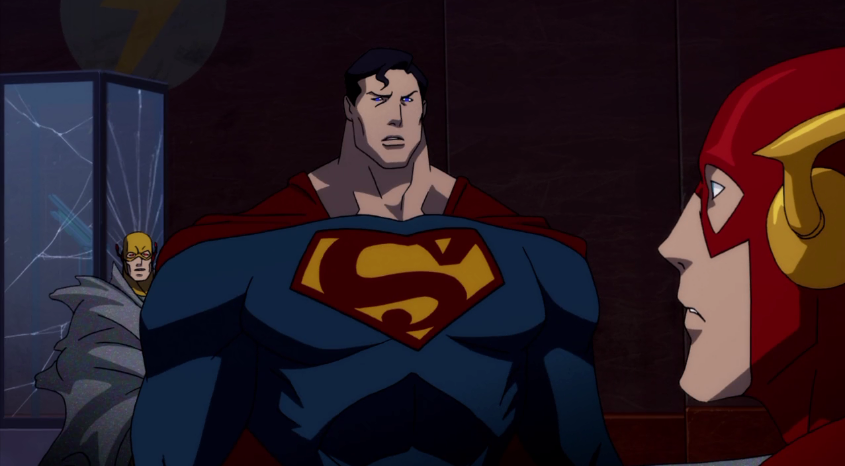
We open with a brief prologue in which we establish the relationship between child Barry Allen and his mother, including her teaching him the so-called “serenity prayer” as a kind of proverb, followed by him discovering her murdered body after school one day. From this, we transition to present day, where Barry (Justin Chambers), accompanied by his wife Iris (Jennifer Hale), leaves flowers on his mother’s grave and says that he wishes he could have been fast enough to save her that day; Iris reminds him that he was only a boy, and if he had gotten home any earlier, it’s likely that he would have been murdered as well. This discussion is interrupted by news that several of Flash’s rogues have gathered at the Flash Museum in order to destroy his legacy; he arrives to face off against the Top, Mirror Master, Heat Wave, and Captains Boomerang and Cold. He handles them all with relative ease until the arrival of Eobard Thawne (C. Thomas Howell), aka the Reverse Flash, who manages to cement him onto a wall and attach a bomb to him. He also reveals that he’s put bombs on all of the other rogues present, and that’s when the rest of the Justice League arrive, and boy oh boy, are they ugly as shit. Their proportions are all out of whack in a way that I think is aiming to be anime-esque but is really just hideous. I mean, look at Superman here:
His insignia is three times the width of his face, and his shoulders are 8.5 times as wide as the widest part of his jawline. For comparison, when drawing the human figure in proportion, most artistic instruction tells the artist to draw the shoulder line as twice the length of the height of the head, or three times as wide. Superman’s shoulders here are almost double that, at 3.75 times his head height and 6.92 times his head width. I know that some of this is a matter of artistic license or preference, but I would prefer not to look at this; it’s fucking hideous. If we’re being charitable, we can say that this is probably to provide greater contrast to how emaciated and weak his alternate self will appear in the other timeline (spoiler alert), but I hate it, and it puts as much of a sour taste in my mouth about his new film “series” right from the get-go, both the first time I saw it and this time as well.
Anyway, after they disarm the bombs and Thawne is taken into custody, he says some creepy shit and we head into the opening credits. When we re-emerge into the film proper, Barry wakes up at his desk to find that things are not quite as he remembered them; his boss asks him for an update on the case of the Elongated Kid being murdered rather than the Elongated Man, a TV news report shows a “Citizen” Cold fighting off Captain Boomerang at the Cold Museum, and oh, yeah, he doesn’t have his powers, and his mother is alive. He tries to tell his mom that he’s the Flash, but she doesn’t have any idea what he’s talking about. Elsewhere, a more grizzled Batman (Kevin McKidd) has no problem using guns or throwing his enemies off of buildings to their deaths, although his attempted murder of a villainess is interrupted by Cyborg (Michael B. Jordan, wasted in this role). The younger hero attempts to recruit the Bat into joining the squad that the former is attempting to put together—and in so doing exposits the greater context of what’s happening in this new reality—in order to end the war between Atlantis, as led by Aquaman (Cary Elwes) and the Amazons, with Queen Diana (Vanessa Marshall) as their leader. These two plotlines intersect when Barry, desperate to find someone to help him figure everything out, slips into Wayne Manor, where he finds that this world’s Batman is Thomas Wayne, who became a vigilante when his young son was gunned down in an alley, rather than the other way around. From here, it’s all about figuring out how to get Barry’s powers back and set right what once went wrong.
There’s fun to be wrung here from some of the little twists of fate and characterization on the darker side of the mirror. It’s so corny that Martha Wayne becomes the Joker in the same moment that Thomas decides to become Batman that it loops all the way back around to being kind of cool, actually. The idea of the “Shazam Kids,” a group of kids to all merge into one hero in the form of Captain Marvel/Shazam is also a neat little touch. Otherwise, though this is a real slog to get through. My problem with the animation isn’t just that the new character designs are awful (although they are, just terrible, really), but also that some of the designs that are clearly reused from other projects look bizarre alongside these bulging hulks; this is most noticeable with the contingent of Atlanteans who are clearly just copied over from Young Justice (Kaldur is especially obvious), who look like carefully carved Greek statues next to the blown-out Aquaman. It also looks cheap, and it has the unfortunate problem of looking cheaper the longer the movie goes on, as if they were running out of budget with every minute. The seams show most close to the end when a newly-repowered Barry is running at superspeed, and the figure of him running on screen looks like an incompletely rendered animatic, like they didn’t actually bother to give the animation team time to finish rendering the CG elements for the final release. One would think that, with the launch of a new ongoing film franchise following this movie that some of the budget would be spent on creating, for instance, a CGI running Flash that looks top-notch, so that they could then use that same model for future films in the series, but this just looks like shit. Furthermore, although it isn’t this film’s fault, both other adaptations of this story for TV and film include the fact that Barry sets out to save his mother from being killed as the catalyst for the plot, meaning that the mystery in this adaptation—who changed the past and why—is utterly moot if you’re coming to this film after interacting with either of those pieces of media.
I hate this one, and it doesn’t even really need to exist. In a meta sense, I understand the impulse to make one last movie under the Warner Premier label (which dissolved in 2013 and was absorbed into Warner Bros Home Entertainment and Warner Bros Animation; the next film will be released with solely the latter in its production logos), and to find it clever to do a rebooting crisis as the finale. That doesn’t make me feel more fondly toward it, however. Almost all of these movies so far have been completely standalone, with no connection to one another. So what continuity do you need to reboot in order to start telling a new story from the ground up? None! Just start your DTV interconnected franchise with the next movie! There was no tract of land here that needed to be cleared to build a new house, just open space, and they stuck this hideous movie in here for no good reason.
Welcome to The Not-So-New 52, your digital Swampflix comic book (adaptation) newsstand! Starting in 2007, DC Comics and Warner Premiere entered the direct-to-home-video market with animated features, mostly in the form of adaptations of well-received event comics or notable arcs. This Swampflix feature takes its name from the 2011 DC relaunch event “The New 52,” and since there are (roughly) fifty-two of these animated features as of the start of 2024, Boomeris watching them in order from the beginning with weekly reviews of each. So, get out your longboxes and mylar sleeves and get ready for weekly doses of grousing, praise, befuddlement, recommendations, and occasional onomatopoeia as we get animated for over fifteen years of not-so-new comic cartoons.
After the personal disappointment that was Superman/Batman: Public Enemies, I was pleasantly surprised to see that not only was the next movie on the docket one that I had seen before, but that it was one that I unabashedly love: Crisis on Two Earths. This one and the film that follows, Under the Red Hood (which I love so much it was the Movie of the Month for May 2018), are back-to-back great films, and the perfect way to wash out the lingering bad taste of Wonder Woman and Public Enemies. An interesting bit of trivia is that this narrative was originally supposed to be produced years earlier as a film that would bridge the gap between Justice League and its follow-up/continuation Justice League Unlimited, both of which I’m fond of. At the end of the former, longtime teammate Hawkgirl was revealed to be a mole for an invasion of Earth by her people, the Thanagarians, before she ultimately chooses to side with the people she was sent to spy upon, and the final arc saw the destruction of the JL’s “Watchtower” headquarters. At the beginning of the latter, the titular team of titans have a newly expanded roster (hence the “unlimited” moniker) and a new Watchtower base, the design of which is the same as the one that appears under construction at the end of this film. From this and other details, it’s easy to see where this would slot in between those TV seasons, but there’s enough that’s different that the viewer is still in for some surprises.
Our film opens with two men we know as villains, Lex Luthor and the Joker (here known as The Jester) breaking into a facility and stealing a small piece of equipment, pursued by two shadowy figures. The Jester sacrifices himself to give Luthor time to escape, giving himself up to two silhouetted figures who appear to be Hawkgirl and Martian Manhunter, but who are revealed as twisted versions of the same. Luthor then transports himself to “our” world, where he immediately turns himself over to the police and demands to speak to Superman. We quickly learn that this version of Luthor comes from a world where the characters we know as heroes are instead replaced by villainous versions: in place of Superman (Mark Harmon), Ultraman (Brian Bloom) runs the Crime Syndicate, an organized crime outfit that he leads with Owlman (James Woods) as his lieutenant instead of Batman (William Baldwin) alongside Superwoman (Gina Torres) rather than Wonder Woman (Vanessa Marshall), Johnny Quick (James Patrick Stuart) in place of the Flash (Josh Keaton), and Power Ring instead of Green Lantern (both Nolan North). Luthor (Chris Noth) has come to beg for the help of the Justice League in order to defeat their evil counterparts and save his world. When they do join him in his crusade, they find themselves in conflict with that world’s U.S. president, a non-evil version of Wade “Deathstroke” Wilson (Bruce Davison), and Martian Manhunter (Jonathan Adams) finds himself falling in love with the president’s daughter, Rose (Freddi Rogers).
This one is a lot of fun, and one of my top favorites of this franchise, even before beginning this watch project. One of the most compelling elements is the relationship between Owlman and Superwoman, who is not a version of Wonder Woman in this world but is instead a twisted mirror of longtime character Mary Marvel, as evidenced by the fact that her crew of “made men” consists of other Shazam-related characters. James Woods may be a name we only speak in soft whispers now in order to avoid catching his attention like the Eye of Sauron now that he’s gone completely fascist, but he gives a great vocal performance as a soft-spoken nihilist in comparison to the normal gruff brusqueness that we have come to expect from the Caped Crusader, and he becomes the true villain of this piece when his philosophy leads to him attempting to wipe out all Earths in every dimension. Convinced that all decisions are meaningless due to the fact that every choice made everywhere creates a new parallel dimension, leading to an exponentially large number of worlds, the number of which is so vast it is indistinguishable from infinity, he decides that the only “true” decision anyone can make is to destroy all of them. For her part, Superwoman, who is at first motivated solely by the desire to conquer and accumulate wealth, is completely on board with this idea once he explains it to her, and Gina Torres sells her ruthless fanaticism beautifully. The fact that she is, in reality, a teenage girl who has simply chosen to live as her adult superhero alter ego at all times makes the whole thing that much creepier and more fun to watch.
The action scenes in this one are very exciting too, in a way that hasn’t been as memorable for me in several of these movies. The level of destruction wrought in Superman: Doomsday was impressive, but it was ultimately a lot of punching back and forth. Wonder Woman had the action as one of its high points, between the monsters vs. Amazons fight at the beginning and the rematch at the end (which included the raising of the dead and forcing the Amazons to fight the corpses of their own reanimated sisters), but this one is chock full, and some of the moments are fascinating in just how small they actually are. Batman, who initially stays behind when the rest of the League goes to the Crime Syndicate dimension as he thinks it falls outside of their purview and that they need to get their own house in order first, ends up facing off against the evil Marvel family on his own, and it’s just our luck as viewers that they appear on the Watchtower at a time when he’s in an Aliens-esque power loader, which makes the fight dynamic more interesting. Once it’s down to just him and Superwoman, he attempts to throw a punch while she has him pinned down, and she calmly tells him that this move will cost him a rib, and she casually breaks one of his by simply applying a tiny bit of pressure with her thumb. It’s deeply unsettling, and I love it.
If there is one plot element that I’m not fully sold on, it’s the relationship between Martian Manhunter and Rose Wilson. There’s something to be said for Rose’s character’s refusal to lie down and roll over for the Crime Syndicate the same way that her father has, at the threat of great danger to her life. That Martian Manhunter conceals himself among her secret service detail and is forced to reveal himself in order to prevent her from assassination at the hands of that world’s evil version of Green Arrow is a fine narrative choice, but the romance that blossoms between them feels a bit tacked-on, even if its presence is supposed to serve as a reflection of what a love based on mutual admiration and fondness looks like, in contrast to the “love” between Owlman and Superwoman. I don’t love that Martian Manhunter mind melds with her after a single kiss (she tells him that this is how they show affection on Earth, and he demonstrates that on Mars they do the same through telepathic contact) and they share all of their thoughts with one another. It’s not merely that he doesn’t really explain this to her before doing so — and, in so doing, gives her a lifetime of his memories and gets all of hers, which makes it feel … less than consensual, especially since she now has firsthand memories of the genocide of the Martians from the point of view of their last survivor. It’s also that his memories include the death of what appears to be his wife and child, which makes the age gap between them feel weirder. I’m not really interested in weighing in on the current obsession with age gap discourse (other than to say that anyone who doesn’t see that the malicious adoption of this discussion by bad faith actors is a ploy to eventually move from “Eighteen-year-old women’s brains are still developing!” to “A woman can’t make rational decisions until she’s 25!” with the ultimate goal of getting to “Women shouldn’t be allowed to make their own decisions!” is a fool, and the insufficiently critical young leftists who are participating in this campaign are doing damage that will take decades to undo), but it does feel a little gross, given that we never really know how old Rose is supposed to be.
I really want to call out Lauren Montgomery here, who shares directing credit with Sam Liu. Montgomery helmed Doomsday, Wonder Woman, and Green Lantern: First Flight, and she’s doing excellent work here as well. Liu’s previous work in this particular franchise was on Public Enemies, which also was nothing to scoff at, especially since I don’t blame him for that film’s egregious art style, any more than I blame Montgomery for the sexist elements of 2009’s Wonder Woman. This one is the best looking of all of them, with the tightest storytelling and the most interesting premise, which manages to feel fully realized despite this film having the same 75-ish minute runtime as all of the other movies so far. In some cases, that’s been the sole positive selling point for these movies, that with their minimal time investment, there’s no reason not to give it a shot. This one feels complete and unrushed in that time while still telling a full and compelling story, and I love that about it. This one gets the biggest recommendation from me yet.
Welcome to The Not-So-New 52, your digital Swampflix comic book (adaptation) newsstand! Starting in 2007, DC Comics and Warner Premiere entered the direct-to-home-video market with animated features, mostly in the form of adaptations of well-received event comics or notable arcs. This Swampflix feature takes its name from the 2011 DC relaunch event “The New 52,” and since there are (roughly) fifty-two of these animated features as of the start of 2024, Boomeris watching them in order from the beginning with weekly reviews of each. So, get out your longboxes and mylar sleeves and get ready for weekly doses of grousing, praise, befuddlement, recommendations, and occasional onomatopoeia as we get animated for over fifteen years of not-so-new comic cartoons.
Many years ago, I used to own the two trade paperback volumes that comprised Darwyn Cooke’s New Frontier comic. The miniseries is an exercise in reimagining the transition between what is considered the comic book Golden Age (about 1938 to 1956, notable for the introductions of Superman, Batman, and Wonder Woman) and that same medium’s Silver Age (1956 to 1970, notable for the introduction of the modern versions of the Flash and Green Lantern as well as the formation of the Justice League in place of the Justice Society). Set over the course of fifteen years, the series begins with the disruption of the superheroic Justice Society in the face of McCarthyism and sees Superman and Wonder Woman go to work for the government while Batman retreats into the shadows. Later, the emergence of new heroes like Flash and Green Lantern, and the accidental transportation of Martian Manhunter from his home planet to earth, arise just in time for the combined forces of two generations of heroes to take on an extinction level threat in the form of a living island populated by sauropods.
Those two volumes were, unfortunately, some of the many books that I sold before my interstate move eight years ago as I was paring down my belongings. I haven’t read it since, but I recall it fondly, and I remember being very pleased with the animated adaptation’s ability to tell the same story concisely without the omission of too many important details. I even used to own this one on DVD before it, too, was resold in one of my many moves. Although it mostly holds up as a movie, I must have grown a lot since the last time I saw it, as some of its flaws stand out rather clearly these days.
In the closing days—in fact, the final day—of the Korean War, USAF pilot Hal Jordan is shot down by Korean pilots moments after learning that an armistice has been declared; he is able to parachute into relative safety, but finds himself facing an enemy soldier who is unaware that the war is over, and is forced to kill the man in self defense. His resulting PTSD from this incident causes him to be the subject of mockery from others after discharge, as they consider him cowardly and perhaps too sympathetic to communism. Elsewhere, Martian J’onn J’onzz is teleported to Gotham City by an astronomer running an experiment, who then dies of a heart attack upon seeing the extraterrestrial’s form. A shapeshifter, J’onzz adopts the persona of a trustworthy detective, all while remaining fearful of violence from humans should they see his true form. These three new heroes as well as the DC “trinity” are brought together, alongside a bevy of comic deep cut characters and some who have become more well-known in the interim because of their presence in the CW “Arrowverse” shows, to face off against the living island and the malevolent consciousness called “the Centre” which animates it.
This is a gorgeously animated movie. It shouldn’t be a surprise that this is a very strong entry into this canon, since the source material was so well loved that it won all three of comics’ major awards, the Eisner, the Harvey, and the Shuster. Darwyn Cooke’s distinctive art style for the comic translates well to fluid motion, and the imagery is evocative of an older era that works well for the narrative. I really appreciate a lot of the artistic choices made here, with the choice to draw Wonder Woman as half a head taller than Superman being a particular source of jot for me. Although the film updates the title to include the phrase “Justice League,” the majority of the story focuses on Hal “Green Lantern” Jordan, and it may simply be that I am a Buffy fan (now and forever), but the choice to cast David Boreanaz, most well known to many as the vampire cursed with a soul, is particularly inspired. Hal feels guilt and shame, but not for the things that his fellow combatants think he should, and is tortured by the blood on his hands, and that’s not only within Boreanaz’s wheelhouse, it’s his forte. Equally genius was the casting of Lucy Lawless to voice Wonder Woman, even if it’s a shame that there’s so little of her in the film; still, she shines in every scene that she is in, and there’s a particular standout sequence in which she liberates a camp of “comfort women,” teaches them to fight, and leaves their former enslavers at the mercy of the freed women. Superman is aghast at this as they are both working as agents of the U.S. at the time, but it’s a well-crafted reminder that this immortal woman has an ethics and morality that is defined by a sense of justice that predates his “American way.”
Despite Diana’s rejection of it, there is a distinctly jingoistic flair to some of the proceedings, and there’s a strange sense of sincerity to it that was lost on me in previous viewings. It is important to bear in mind that post-9/11 American Exceptionalism was an ever-present shadow on the entire landscape of media produced in the west, and in 2008 we were still a few years out from the point where non-satire mainstream films would be able to be openly anti-authoritarian and question the state again (the dam-breaker being the success of The Hunger Games, or at least that’s where I normally pin the turning point). As a comic, New Frontier was able to be a little more subversive, with the narrative focus on McCarthyism serving as a parallel to the contemporary (2004) witch-hunting and scapegoating of members of government who opposed the Bush Administration’s warmongering in the Middle East. The film also cut (other than a mention in the news) a storyline about a Black vigilante who fought the KKK before being murdered at the hands of a white lynch mob, as another indictment of the idea that the past was a place where things were “simpler” and “better.” Most of what remains is shown through the eyes of our objectively good viewpoint characters: the xenophobia that Martian Manhunter knows exists and cloaks himself against in order to “pass,” the muttering of bar patrons that they suspect Flash of being a commit because of his red costume, and the aforementioned belittlement that Hal Jordan receives from those who mistake his pacifism for cowardice and his PTSD for weakness. All of that disappears in the back half of this movie, however, as the film goes full Uncle Sam at the end, with all of the assembled forces against The Centre being identified explicitly as Americans, and, upon their victory, an excerpt from the JFK speech is played over a montage of the new and senior heroes fighting alongside one another as they move forward with a new (American) destiny. It’s not that the film’s sudden, new, shallow patriotism is bad in and of itself (it arguably could be, but I don’t have that in me today), it’s that it comes out of nowhere. I think that the intent is to show a rejection of McCarthy-era fearmongering giving way to a new dawn, but it’s a little too quick of a turn in a film that runs less than eighty minutes. It’s still one of the best of this series, but something I couldn’t ignore on this rewatch.
This … experience (I’m not quite sure it’s a “movie”) opens in an awkward flashback to a time four years ago that barely resembles our present reality, so I will, too. Back in November of 2017, I rode a bus with an exposed face to a movie theater that was located in the same strip mall as an honest-to-goodness travel agency, where I pushed a lever on a dispenser that provided me with a plastic straw that wasn’t even wrapped in paper, just piled into said dispenser with all of its brethren willy nilly by a teenage employee using their bare hand. And I used that straw to drink an ICEE that was as blue as the sky and as big as my femur. The film that I went to see that grey November Saturday was the theatrical release ofJustice League, which I found … sufficiently diverting. “Look!,” I typed with my naïve little fingers, “Up on the screen!” digits as yet unravaged by just how stupid, undignified, and dangerous life was about to become, in every single way it possibly could. “It’s big! It’s dumb! It’s loud!” I wrote, not really thinking myself clever but pressed to come up with anything better. “It’s Justice League!” Now, here we are, a pandemic, an insurrection, and three and a half years later, and the revelation is at hand, and I have to say, it troubles my spirit (which we’ll get into in a minute here), if not my sight, vexed to nightmare.
I’m speaking, of course, about Zack Snyder’s Justice League.
What a rough beast to come round at last, slouching towards HBO Max to be born! There’s no way that the modern reader doesn’t know what I’m referring to, but in case you are reading this some decades in the future, when the internet has collapsed in on itself and there’s nothing left to read but Cathy comics, the fabled Swampflix Tablets, and Chuck Klosterman’s Downtown Owl, I’ll explain. Once upon a time, there was a movie that wasn’t finished because of a tragedy in the director’s life. As a result, directorial duties were handed off from Zack Snyder (aka the film bro’s Michael Bay) to Joss Whedon (aka the thinking man’s Harvey Weinstein) so that the latter could hopefully bring to the DC film franchise some of the tangential Marvel prestige that the former’s previous films had failed to garner. Whedon churned out a mediocre-at-best live action cartoon that was cursed with the worst production problems since God decided to make Richard Stanley into the modern day Job, plagued by contract disputes about facial hair, beset by horrible jokes about the nature of brunch, and savaged by most critics. Immediately, the drowning vermin in the extended gutters began to demand “The Snyder Cut,” and Warner decided to just go ahead and do it, teaching all of the too-online Twitter incels the valuable lesson that you pester and pester and pester long enough (40 months, as it turns out), you’ll eventually wear down everyone enough to get what you want. I’m sure that won’t have any long term consequences that we’ll all regret forever!
As a result of the death of Superman (Henry Cavil) at the end ofBatman v. Superman, a mysterious cube on Themyscira, the island home of the Amazons and Diana/Wonder Woman (Gal Gadot), is activated. This cube is one of three “mother boxes,” sentient computers that, in this version, are used in conjunction with one another to terraform planets into the same hellish landscape as Apokalips, the home of DC supervillain Darkseid (Ray Porter), an omnicidal monarch whose life’s work is to find the Anti-Life Equation, which can be used to subjugate and enslave by destroying all free will in the universe. Diana relates to Bruce “Batman, obviously” Wayne (Ben Affleck) that, in some prehistoric past, Darkseid had visited earth and attempted to unify the mother boxes, but that his attack was repelled by a group of Amazons and gods, Atlanteans (who had not yet migrated to beneath the waves), and humans, with a Green Lantern thrown in there for good measure. The mother boxes themselves were left behind when Darkseid’s forces retreated, and each group—man, Atlantean, and Amazon—were given one of these MacGuffins to guard and stand vigil over. Now, the boxes are awakening after countless centuries of dormancy, and the first has called to the villainous Steppenwolf to reunite it with its fellows in order to turn everything into magma. And it’s up to Bruce and Diana to unite the seven, or six rather, in order to combat him.
The first attempted recruit is Arthur Curry, aka Aquaman (Jason Momoa), the son of an Atlantean woman and a human man, with one foot in both worlds and at home in neither (I assume this is explained in Aquaman). He all but laughs in Bruce’s face and disappears into the sea. Elsewhere, Diana meets Victor Stone, aka Cyborg (Ray Fisher), a former Gotham City University football star who prior to the start of the story was in an accident that claimed his mother’s life and should have killed him as well. In a desperate move, his father Silas (Joe Morton), a STAR Labs scientist with access to the excavated mother box that was to be guarded by mankind, uses the alien technology to save Victor’s life, turning his son into a walking deus ex machina who also happens to be the emotional core of this narrative. Like Aquaman, he too also initially rejects Diana’s offer to join her and Bruce, since he’s too busy doing things that actually make the world a better place (like redistributing wealth, albeit very, very slowly). The only luck the duo have in soliciting assistance is when they meet Barry Allen, aka the Flash (Ezra Miller), a speedster whose superpower lets him move at such speeds that it sometimes affects the flow of time itself. Meanwhile, Steppenwolf is trying to find the third and final mother box in order to do his thing, and this plan includes abducting anyone who’s been near it, including Silas, which brings Cyborg into the fray. They track the abductees to one of the Snyder Cut’s multiple nondescript industrial locations and manage to free them, but even with an assist from Aquaman, they get their asses handed to them, so they decide to cut through this Gordian Knot by digging up Superman’s rotting corpse and bringing it back to life with the mother box, like you do.
Via technobabble and superheroic shenanigans, they manage to resurrect Superman, but it’s Pet Sematary rules so he’s not all there at first, at least until Lois Lane (Amy Adams) shows up and they fly away together, and the two of them reunite with MARTHA (Diane Lane) back at the now-repossessed Kent family farm for a bit while the other five supes fly off to Russia to attack Steppenwolf’s base. Superman eventually joins them, and there’s a lot of CGI action for a really long time, and then the credits roll. Or rather, they don’t, as this thing has more fakeout endings than Return of the King. We get a prison break, a harbor rendezvous, and a dream sequence/future vision that leads into a scene in which Bruce meets the Martian Manhunter (Harry Lennix), all for the price of admission, which I guess is just whatever you were already paying for HBO Max.
Zack Snyder’s Justice League is (infamously) presented in 4:3, which means that it’s in the same aspect ratio as the television you watched as a child (presuming you’re old enough to read and enjoy this website), which honestly did wonders for the release as a whole. Any time something was very, very dumb, my unconscious just said, “This isn’t cinema, it’s TV from the Baywatch generation,” and my conscious was like “pew pew lasers, zap zap zap.” The fact that it’s broken into segments that make it perfect for viewing in chunks while riding an exercise bike, which is the only way that I do anything now anyway since we’re all getting vaccinated and immunized and I will once more have to be perceived in public again, doesn’t hurt either. Although I hate to give the subset of internet weirdos who build their whole identity around the claims that Disney buys positive reviews and that the DCEU is some kind of grand artistic statement instead of an inconsistent corporate product any credit for being right, even if only by accident, this version of the narrative does things that Marvel would legitimately never do. For better or for worse, Guardians of the Galaxy Vol. 3 is not going to have a bunch of Scandinavian women ululating on a gravel beach because someone rented Portrait of a Lady on Fire, and although that’s not a metric of greatness, it’s moody and atmospheric in a way that I didn’t expect. So, yeah … this is good, actually?
Which is not to say that it’s good consistently. There are many, many scenes that take place solely in the realm of The Mind, and not in a way that’s beautiful or complex so much as a way that’s very … brown acid. Everything about the epilogue is pure hot steaming garbage, especially the much-vaunted reappearance of Jared Leto’s Joker. Maybe it’s not the best barometer, but I often use the rapidity of how quickly a TVTropes page grows as well as its editorial tone (or lack thereof) in combination with the Twitter discourse to gauge just how problematic a given fandom is, and I have to say, YIKES. In what is easily the narrative’s worst scene, Joker and the Bat have a super macho, aggro argument about the deaths of loved ones that prompts Affleck’s Batman to proffer a death threat that’s delivered with the same exact cringe as BVS’s infamous “Why’d you say that name?” or the out-of-context Dick Grayson line “Fuck Batman” from Teen Titans, but since the worst people on the internet have adopted kinning/LARPing the Joker, they’re eating this scene up like it’s cherries jubilee on the Fourth of July. It just goes to prove that giving these people this cut of Justice League is possibly the worst thing that we have done as a society. It’s like it’s the last week of school and a bedraggled fourth grade teacher has finally given up on trying to improve the morals, education, or enlightenment of a boy who doesn’t respect his female classmates’ bodily autonomy, the opinions of any individual other than himself, or why it’s wrong to torture small animals, and just gives him a candy bar to shut him up before we head into the long, dark summer slide of western civilization, turning and turning in the widening gyre.
So how to grade something like this? It’s unequivocally a better experience than the theatrical cut, which I gave a 3.5 star review (albeit with the Camp Stamp signifier). It also demands some kind of qualifier to any measure of its quality, however, as things fall apart upon inspection, and the centre cannot hold… your attention for very long, but to call this “camp” doesn’t seem right either, despite the weirdly performative nature of its machismo. But can I justify giving this a 3.5+ star review with no real warning to the potential viewer who uses Swampflix as a guide to quality? I’m flipping a coin and living with the decision.







 Swampflix