Grand Theft Hamlet (2025)

Making art is hard work, even when you’re just goofing off with your friends. No matter how silly a collaborative art project is on a conceptual level—a novelty punk band, an amateur movie blog, a Mardi Gras costuming krewe (to name the few I have personal experience with)—the practicalities of seeing it through gets mired down in the general bullshit drudgery of modern life. Between everyone’s duties to work, to family, and to personal health and well-being, real-life circumstances are always stacked against your success, which can make you question why you’re working so hard for something so silly as, say, organizing a meet-up for a small group of friends to dress as Divine on Mardi Gras day. It does feel great when everything clicks in to place, though. There are few victories sweeter than defying the odds or our modern capitalist hellscape by making something sublimely stupid with your friends.

Even by my personal standards, the communal art project documented in Grand Theft Hamlet is exceedingly inane. “Filmed” entirely inside the video game Grand Theft Auto Online during the early lockdown years of COVID-19 (in the style of We Met in Virtual Reality), Grand Theft Hamlet documents the efforts of two goofball British blokes to organize a staging of Shakespeare’s Hamlet entirely within the gaming platform. It’s an absurdly specific novelty project that quickly leads to a broader story about how hard it is to complete any piece of collaborative art. All the usual roadblocks of squeezing in rehearsals around work schedules, balancing personal obsession with familial obligation, and navigating contributors’ differing excitement levels to distribute labor according to enthusiasm all apply to meeting online to recite Shakespeare while digitally represented as archetypal sex workers & thugs. Only, the video game platform literalizes those obstacles in the form of outside players firing bullets & rockets in your direction while you’re just trying to goof off with your friends.

The tradition of adapting Shakespeare in a novelty setting is long & storied. Even the modern specificity of Grand Theft Auto can’t make this staging a total anomaly, since a digital office-building setting will instantly recall Hamlet (2000) or a burst of neon-lit gunfire will recall Romeo+Juliet (1996). I’m sure there have also been unpermitted guerilla productions of Shakespeare plays periodically shut down by the cops, even if those cops are usually not algorithmically generated NPCs. It’s the effort that Sam Crane & Mark Oosterveen (along with central documentarian Pinny Grylls) put into working around the intended purpose of GTA Online that affords the project its true uniqueness. The triumphant perseverance of a player shouting their lines over machine gunfire during rehearsal while fellow collaborators play defense against disruptive trolls & “griefers” adds a new obstacle to the usual “Let’s put on a show!” artistic sprit. The defiance of carrying on in those chaotic circumstances is energizing, inspiring an actor to shout “You can’t stop art, motherfuckers!” into the digital void.

Hamlet proves to be an apt play to stage for this ludicrous project, not least of all because its tragic Shakespearean violence fits right in with the basic control functions of GTA. The actual themes of the play are genuinely felt in the final edit, especially in scenes where Crane & Oosterveen slip into suicidal ideation thanks to the isolation of COVID-19 lockdowns or when GTA‘s in-universe superhero franchise Impotent Rage is advertised in block letters on billboards & slot machines. The most critical Shakespeare quote repeated in this particular staging, however, isn’t from Hamlet at all. It’s the Macbeth line about how life is “a tale told by an idiot, full of sound and fury, signifying nothing.” That pretty much sums up the whole project, from the proudly idiotic premise to the meaningless displays of violence to the general, persistent emptiness of being alive. It’s also a succinct explanation of why it’s so important to make dumb art projects with your friends despite the effort required to pull it off. Nothing matters anyway; you might as well have a little fun while you’re here.

-Brandon Ledet

To Be or Not to Be (1942)

WW Cinema (formerly Wildwood) is a Wednesday-night screening series at The Broad in which filmmakers and other artists introduce classic repertory titles to an eager film-nerd audience.  These introductions are usually pre-recorded via webcam, but occasionally a low-level celebrity sighting will shake up the weekly routine.  Simpsons & Spinal Tap vet Harry Shearer was the most recent in-person presenter for the series, providing some quick, concise insight about what he thinks makes Ernst Lubitsch’s 1942 wartime comedy To Be or Not to Be a great work of art, then sticking around after the film to answer questions about his own comedic career.  Shearer mentioned that he had a personal, professional connection to the film’s star, Jack Benny, working with him briefly in his first role as a child actor.  He also argued that the film stands as proof that if you feel passionately about a topic—in this case the political & moral evils of Nazism—you should make a comedy about it instead of a drama (with Dr. Strangelove & Taking Off presented as examples of similarly effective satire).  WW Cinema’s programming has had a lot of influence on what gets reviewed on this blog since they moved their screenings down the street from my house, but I don’t always mention the pre-film intros because they’re not the reason I consistently go; I go because their film selections are consistently rewarding.  I’m only mentioning Shearer here because he put on a masterclass of how to present a movie to an audience who might not have seen it before.  He made the screening personal without distracting from the film.  He voiced his reverence for the artist behind it he found most essential to the piece (in his case Benny, not Lubitsch, the opposite of my connection to it).  He rooted the film in its historical context, both within the timeline of WWII and within the timeline of Benny’s career.  And, most importantly, he kept it brief.  I got the feeling that Shearer has suffered through so many poorly curated film intros and Q&As over the decades that he knows exactly how to not fuck it up, which I’m quickly learning at these WW Cinema screenings is a practiced skill; he’s a professional.

Of course, To Be or Not to Be should not need an intro at all, given that Lubitsch’s comedies are just as riotously funny now as they have ever been; just the gift of laughing along with a live audience instead of streaming it alone on The Criterion Channel is enough to make a modern screening of a Lubitsch classic feel like a cultural event.  Even so, I found myself confused as to why this film isn’t as ubiquitously referenced & recommended as The Great Dictator as the best contemporary Nazi satire.  Jack Benny may not be as enduringly popular as Charlie Chaplin, but To Be or Not to Be is just as daring as The Great Dictator – and twice as funny.  Benny first appears onscreen in full Hitler drag, roaming the streets of pre-occupation Poland and attracting a crowd as if he were a space alien who crashed a UFO.  That’s because Hitler had not yet arrived in the country, and Benny is instead playing a famous Warsaw actor who’s rehearsing to play the Nazi dictator on stage.  Even with the threat of Nazi invasion looming over their heads, most of the film’s scene-to-scene drama involves the lives & squabbles of Benny’s theatre troupe, mostly revolving around the love-triangle maneuvering of his even more famous wife (Carole Lombard) and her flirt-crush of the week (Robert Stack).  It’s just like any of Lubitsch’s classic adultery comedies, except that things get deadly serious at the top of the second act when the Nazi invasion of Warsaw starts in earnest.  Miraculously, Lubitsch gradually builds back to the playful humor of the first act as the theatre troupe schemes to survive & subvert occupation, eventually weaponizing their acting skills as dissident spies within the Gestapo.  The dramatic tension of the second act is shockingly brutal for a comedy, especially considering that it mirrored real-life atrocities happening in real time outside the theater walls during this film’s initial run.  The release of that tension when Lubitsch decides to get goofy again is much needed and incredibly effective, sometimes earning huge laughs just by repeating exact dialogue from earlier scenes.  It helps that most of the jokes are at the expense of artists’ narcissism instead of Nazi violence, which is handled with appropriate mourning & disgust.

If I were presenting what makes To Be or Not to Be great, I’d probably talk about the art of establishing an in-joke with your audience, so that callbacks to previous snippets of dialogue can become uproarious punchlines.  For instance, the title refers to a recurring bit in which Benny is interrupted while delivering the famous Hamlet soliloquy by an audience member who always leaves the room when he gets started.  It turns out that the line was used as a signal to his wife’s would-be lover to visit her dressing room while her husband is occupied.  Over time, we come to realize that she may have chosen that particular moment in his performance to drive him mad because they have a longstanding professional jealousy that fuels the fires of their marriage; we also come to realize that the husband cares more about the interrupted soliloquy than he cares about the adultery, even if just slightly.  It’s a hilarious bit that only gets funnier in repetition, to the point where the line “To be or not to be” earns instant laughs despite being one of Shakespeare’s most often repeated phrases.  It’s also a bit that would work in basically any theatrical setting, since it has nothing to do with the Nazi occupation.  In contrast, there’s another recurring bit in which a Jewish actor in the troupe (Felix Bressart) is constantly auditioning for bigger roles by delivering the “If you prick us, do we not bleed?” speech from Shakespeare’s Merchant of Venice, which alternates between being incredibly funny as an example of theatre-world narcissism and incredibly poignant as a heartfelt plea against antisemitism.  Listening to these jokes build to increasingly louder laughs and starker silences in the room was like listening to a classical music piece build to an ecstatic crescendo after starting on softly bowed strings.  Lubitsch died nearly eight decades ago, but he can still command an audience like a master conductor leading an orchestra.  I’ve enjoyed each of his classic comedies that I’ve seen, but usually for the transgression of their playful view of sex & adultery.  I’ve never been so impressed with the joke-building structure of one in this way before, possibly because I’ve never seen one take such a harsh dramatic pause midway through and have to rebuild its humor on the rubble of real-life horror.

I did not present To Be or Not to Be, though, because I did not work with Jack Benny when I was a child. In fact, our time on this planet did not overlap at all.  Harry Shearer’s insistence on the film’s greatness as an argument that comedy can be as passionate & effective at addressing real-world political issues as drama was a convincing one.  His insights about his & Benny’s comedy careers did not interest me quite as much, but he did not hold command of the stage long enough for that disconnect to derail the screening.  He did a great job introducing a great film without distracting from it by making it all about himself, which To Be or Not to Be itself will tell you is extremely difficult for an actor to do.  Most actors would make a world war about themselves if they could get away with it.

-Brandon Ledet

Twelfth Night: Or What You Will (1996)

The 1996 BBC Films production of Twelfth Night: Or What You Will is a mostly faithful staging of the classic Shakespeare comedy, directed by The Royal Shakespeare Company’s Trevor Nunn. It’s not the kind of MTV-era update to Shakespeare’s text that you’ll find in fellow 90s titles like 10 Things I Hate About You or My Own Private Idaho, which tried to Make the Bard Cool Again for a generation who mostly knew him through frustrating homework assignments.  You wouldn’t know that from Twelfth Night‘s poster, though, which sold it as exactly that.  Attempting to cash in on a recent string of mainstream gay comedies with themes of crossdressing & drag, 1996’s Twelfth Night was marketed with the tagline, “Before Priscilla crossed the desert, Wong Foo met Julie Newmar, and the Birdcage was unlocked, there was … Twelfth Night.”  I assume most adults expecting a boundary-pushing gay farce based on that marketing would’ve found this film tame by comparison, as the queer sexual tension of the text isn’t updated or sensationalized for the 90s in any flashy, daring way.  If nothing else, it’s somewhat surprising that Tromeo & Juliet is the 1996 Shakespeare update that includes a lesbian makeout session, given which one would’ve been supported by its source text.

I have to imagine, then, that this version of Twelfth Night was a little more subtle & subversive in its queer appeal.  If the adult audience marketed to in that tagline were already well fed by the mainstream echoes of New Queer Cinema and the bratty teens of the time were looking for Shakespeare plays set in the halls of their high school (preferably starring Julia Styles), it’s the younger, more sheltered crowd who would’ve benefited most from the queer themes of Shakespeare’s play.  It’s not hard to imagine a heavily policed gay preteen who wasn’t allowed to rent a copy of The Adventures of Priscilla, Queen of the Desert sneaking Twelfth Night past their parents as a cultured, educational video store selection.  1996’s Twelfth Night seems ideally suited as a queer-awakening VHS rental for younger audiences who grew up watching titles like Ever After, The Secret Garden, and The Secret of Roan Inish in regular slumber party rotation or on solo lazy afternoons.  Romeo+Juliet was the Shakespeare update with true Gay 90s™ flair; this one lets the confused-lust genderfuckery of the original play stand on its own without any post-MTV stylistic embellishments.  It’s very warmly pleasant & endearing for that, and maybe even quietly transgressive depending on the parental censorship of your childhood household.

I won’t dare recount the plot of such a faithful adaptation of the original play here, at least not until this blog starts generating income as a SparkNotes subsidiary.  All you need to know is that twins who make do as traveling entertainers are separated by shipwreck, presuming each other dead.  Putting their twin-magic cabaret act to good use, the sister goes into hiding in male drag and quickly gets entangled in a queer love triangle with a man & woman who use her as a romantic surrogate, to the sexual confusion of everyone involved.  Then, her near-identical twin brother shows up wearing the same dumb little wispy mustache, leading to a chaotic reset to normalcy at a heterosexual wedding, in classic farcical tradition.  Before order is restored, though, there’s plenty of intense dwelling on the same-gender attraction stoked by the hiding-in-drag sitcom premise.  Characters often breathe heavy as they lean in for a near-kiss – an exchange that reads gay whether it’s Viola-as-Cesario nearly kissing her male employer or Viola-as-Cesario nearly kissing her employer’s female crush.  Other highlights include tender bathtub flirtation between bros and an opening-credits montage where Viola first gets into Cesario drag, with major emphasis put on her stuffing the crotch of her pants for accuracy.  It’s not hard to imagine a young audience discovering things about themselves watching all of this gender play & queer desire onscreen, and it’s all presented under the guise of traditional, sophisticated theatre.

Presuming that you are no longer a sheltered 90s child depending on Blockbuster Video rentals to smuggle Gay Content into your family home, the best reason to watch the 1996 Twelfth Night at this point is the cast.  Imogen Stubbs does a decent enough job in the central Cesario drag king role, in which (through Viola) she mostly equates being a man to being a Bugs Bunny level smartass.  Ben Kingsley, Richard E. Grant, and Nigel Hawthorne are all formidable fools in the goofball periphery of the central conflict as well, along with what I can only presume are veterans of The Royal Shakespeare Company and of multi-episode arcs of Downton Abbey.  The real draw in the cast, though, is a young Helena Bonham Carter, especially if you have any nostalgia for the era when her time machine got stuck in centuries past and she made a name for herself playing love interests in costume dramas (including an early starring role in director Trevor Nunn’s Lady Jane).  While the film’s younger video store audiences experienced a queer awakening at home, HBC was experiencing a kind of goth awakening onscreen as Olivia, who’s introduced in mourning for her own deceased brother, which is what attracts Viola to her.  She takes to black lace like no one before or since; it’s a marriage built to last longer than any among the story’s main players, so it’s romantic to think that it all started here.

-Brandon Ledet

See How They Run (2022)

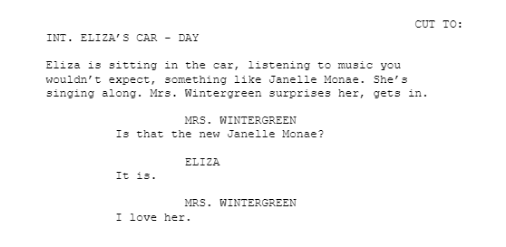
I recently talked on the podcast about my dear friend Ana Reyes’s astounding and well-deserved success surrounding her first novel, The House in the Pines (still #2 on the NYT bestseller list for hardback fiction as of this writing!). When we were all having drinks after the launch party back on January 3, her husband, who is also a writer and friend, mentioned to me that he and Ana had recently been talking about how ahead of the “cozy mystery” curve I was when I put together my pitch document/series bible for the as-yet-undiscovered project Mrs. Wintergreen. As I smiled a toothless grin that belied my bitterness that fate has not seen fit to bring Mrs. Wintergreen to life, I didn’t even point out that not only was that the case, but also that I had even included a scene in which my protagonist, 108-year-old semi-pro sleuth Constance Wintergreen, expressed an appreciation for Glass Onion star Janelle Monae:

Anyway. 

Agatha Christie is very in vogue, as evidenced by not only the aforementioned Christe-adjacent 2022 release Glass Onion, but also the Christie-containing See How They Run, a confident first feature from director Tom George penned by Mark Chappell, who is perhaps best known for his writing for the David Cross vehicle The Increasingly Poor Decisions of Todd Margaret. A period piece, the film begins on the night of the hundredth performance of The Mousetrap, a Christie-authored play which is infamous for two things: first, that there is a twist ending that the audience is encouraged not to reveal to others, resulting in the play’s ending remaining largely unknown to this day, and second, that the contract for the play forbids any adaptation of the source material to film (or the short story on which it was based from being published) until at least six months have passed since its final performance at London’s West End. This was a particularly long-sighted bit of legal play, as the show has run continuously (other than a COVID-caused pause) since its opening night in October of 1952, seventy years ago. In fact, I have some suspicion that this film exists solely for that reason, as it is the closest we can get to a Mousetrap adaptation for the foreseeable future. 

Leo Köpernick (Adrien Brody) is a sleazy slimeball of an American film director (redundant, I know) who has his sights set on turning The Mousetrap into a hit motion picture. That previously noted clause about the show being forced to close before this can even be a possibility is at the forefront of the minds of many involved, but theatre producer Petula Spencer (Ruth Wilson) assures him that the play has already reached its 100th performance and surely it will run out of steam soon, espousing the idea that a narrative with a whodunit at its core will, by its nature, see few repeat visitors and will necessitate closure sooner than later. Although we the viewers are sufficiently distant from this event that this is an historical irony for us, the contemporary American studio system is so confident that they already have Mervyn Cocker-Norris (David Oyelowo) working on a screenplay. Cocker-Norris’s English sensibilities and sense of adaptational faithfulness brings him into conflict with the flashy Köpernick, although the former is not alone in his distaste for the latter: British film producer John Woolf (Reece Shearsmith) is also protecting a scandalous secret about which Köpernick is blackmailing him; Köpernick is rude to all members of waitstaff everywhere, which includes the put-upon usher Dennis Corrigan (Charlie Cooper); and, mere moments before his murder at the ten minute mark, he is decked by Richard “John ‘Spared no expense’ Hammond” Attenborough (Harris Dickinson), who portrays the lead in The Mousetrap, for flirting with his co-star and wife Ann Saville (Pippa Bennett-Warner). The investigation of his death necessitates the appearance of Inspector Stoppard (Sam Rockwell), the archetype of the drunken detective who plays fast and loose with the rules; due to a shortage of available partners, he is paired with Constable Stalker (Saoirse Ronan), a plucky, energetic up-and-comer who is mere months away from being the first woman to take the sergeant’s exams. 

This is a neat little movie that makes sense in and of itself but also functions as a love letter to Christie and to her longtime fans, a body of which I consider myself to be a member. For instance: a scene in which the excitable Stalker asks a hotelier what part of France he is from based on the fact that he speaks French only to receive a deadpan response that he is Belgian is a fun comic bit in and of itself, but it’s also a nod to fans of Christie’s Belgian detective Hercule Poirot, who often finds himself on the receiving end of this exact misunderstanding. There’s also a good running gag about Hamlet: Early on, Attenborough says of The Mousetrap “It’s not exactly Hamlet.” Later, Stoppard half-quotes Act II Scene II’s famous ending line “The play’s the thing” [“Wherein I’ll catch the conscience of the King”], spoken when Hamlet commits himself to obtaining evidence of his uncle Claudius’s guilt through an elicitation of a confession upon seeing a fictionalization of Hamlet’s father’s murder. This is itself a circular reference, as not only does it reveal that Stoddard has realized that the connection between the murder of Köpernick may actually have to do with the play’s content, not its performance as initially suspected, but the word “mousetrap” likely comes from Hamlet in the first place as Hamlet refers to the play as a mousetrap in Act III Scene II (line 2131), in what may be the invention of the term. Your mileage is likely to vary on certain comic elements, of course; whether or not you find it clever that Cocker-Norris disdains screenplays that include flashbacks as crass and artless moments before one occurs in his narration is going to be left up to the individual viewer. I find his asking of “Whatever next? A caption that says, ‘Three weeks later’?” juxtaposed with that very caption to be charming and fun, but I know that others will find it to be more of a moment of bathos. 

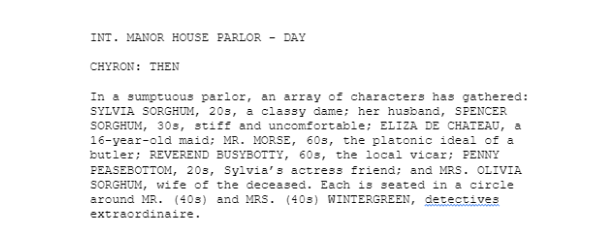
My favorite gag, however, cribs neither from Shakespeare or Christie, but Adaptation: in a flashback, much to the chagrin of Cocker-Norris, we get to see a little bit of how Köpernick’s mind works as he shows a series of storyboards that he put together for the climax of the film version of The Mousetrap. The images are quick cuts between detailed insets: gloved hands at a power box, a revolver being cocked by an unknown person, a fire breaking out in the middle of a tense standoff with a hostage—all of it very un-Christie and extremely Hollywood. This is Köpernick’s attempt to “jazz up” the very un-Hollywood and extremely Christie ending of the play, which uses one of her most well-known and genre-defining tropes: the end-of-the-story summation gathering, in which the detective gets everyone together in a parlor to explain their investigation and conclusion. In fact, not that it matters, but it’s so very much part of the genre that a parody of this type of scene is the very first thing that happens in the script for the Mrs. Wintergreen pilot, “Mrs. Wintergreen and the Thorny Dilemma” 

See How They Run turns this on its ear by playing both sides in the same way that Adaptation does, by mocking the hand that feeds it via denigrating comments about the formulaic nature of Hollywood adaptations, and then doing each and every one of the things that it mocks. The climax of the film takes place in a parlor that has the exact same layout, dimension, and decorations as the final set of the play, although this is obscured until the last possible moment to reveal it. The revolver, the fire, the standoff, the power box—the whole thing plays out in exactly the same way that Köpernick’s storyboard does. It’s a lot of fun to watch. (So would Mrs. Wintergreen be, I think, but I digress.) 

I was engaging with some essay or other this week and was taken aback when the author noted that, for all of his extremely large body of literary work, Isaac Asimov’s oeuvre rarely sees film adaptations, with only a handful ever being produced: Konets Vechnosti from 1987, based on The End of Eternity, which I assume must have had a subtitled release in the U.S. at some point but I can find no evidence of; the Robin Williams vehicle Bicentennial Man; two separate adaptations of the 1941 short story “Nightfall;” and, theoretically at least, I, Robot. In general, the world does not lack for Christie adaptations; they are so numerous that films based on And Then They Were None alone have their own Wikipedia subpage. The Mirror Crack’d from Side to Side was adapted as an episode of Miss Marple and Agatha Christie’s Marple, which are two separate television shows, as well as a film version in 1980 starring Angela Lansbury as Marple. When it comes to Christie media, we are the lilies of the field, neither toiling nor spinning, nevertheless arrayed in splendor. But we don’t have an adaptation of The Mousetrap, and we likely never will. Even if that day comes, there’s a risk it will be as dull and uninteresting as 2017’s Crooked House, which even Glenn Close and Gillian Anderson couldn’t save. What we do have is See How They Run, which is more than good enough; it’s great. 

-Mark “Boomer” Redmond

Episode #82 of The Swampflix Podcast: Sordid Lives (2000) & Gay Plays

Welcome to Episode #82 of The Swampflix Podcast! For our eighty-second episode, Brandon & Britnee revisit the quips & quibbles of cult-classic gay stage plays. They discuss the Del Shores comedy Sordid Lives (2000), its crowd-funded sequel A Very Sordid Wedding (2017) and, for balance, the William Friedkin-directed downer The Boys in the Band (1970). Enjoy!

You can stay up to date with our podcast through SoundCloud, Spotify, iTunes, Stitcher, TuneIn, or by following the links on this page.

– Britnee Lombas & Brandon Ledet

Madeline’s Madeline (2018)

Although she’s been working steadily since the buzzy “mumblecore” movement that established a new standard tone for microbudget indie cinema over a decade ago, 2018 is proving to be a breakout year for Josephine Decker. This started for me, personally, when Decker’s collaborative, self-loathing documentary Flames tore my brain in half in its emotionally volatile record of a toxic, years-long romantic detangling. Her much larger cultural breakout arrived later in a drama where she was more of the auteurist voice: the festival-circuit darling Madeline’s Madeline. What’s impressive about Madeline’s Madeline as a follow-up to Flames is that it maintains the documentary’s emotional volatility and damning self-reflection on the nature & tortures of its own medium, while branching off into the realm of fictional drama. It didn’t hit me quite as hard in the gut as Flames did (perhaps because I was braced for impact this second round in the ring with Decker, whereas I was caught off-guard for the first bout), but Madeline’s Madeline is just as heart-achingly confrontational in its emotional honesty and just as complexly mapped out in its engagement with its own medium as an artform. Decker may have been active and in-plain-sight in both theatre & cinema for at least the last decade solid, but in just two films 2018 has been the year when she set a staggeringly high expectation for the form-breaking phenomena she can achieve on the screen.

Teenage newcomer Helena Howard stars as the titular Madeline, a mentally ill high school student who finds a brief utopian respite in an avant-garde NYC theatre troupe, before that artistic safe space becomes just as messy & volatile as her home-life & her internal psyche. Her home-life crisis is mostly anchored to her relationship with her dangerously high-strung mother (played by Miranda July), a conflict that often erupts into physical violence. As she coldly rejects one mother’s affections at home, Madeline seeks a new motherly figure in her theatre director (played by Molly Parker). This relationship also sours when the play they’re collaborating on with their troupe mutates into a sinister meta-drama about Madeline’s “real” home-life. Madeline’s discomfort with her real-life domestic conflicts being exploited for Art is complicated by the film’s exponential detachment from realty, where the divisions between Art & “reality” become blurred to the point of effective obliteration. A spiritual descendent of Charlie Kauffman projects like Synecdoche, New York or Michel Gondry’s “Bachelorette” video for Björk, Madeline’s Madeline’s echoing of the artifice of theatre in the “The world’s a stage” artifice of real life folds the plot in on itself so many times that it’s near impossible to distinguish what’s “really” happening from what’s just in our protagonist’s head. There’s a clear three-way war that develops between Howard, July, and Parker’s characters, but everything else on the screen is highly subjective to personal interpretation.

This immersion in theatre & artificiality is an immediate cornerstone of the text, as Madeline finds comfort in her troupe’s exercises of getting lost in character work. This starts innocently enough when she’s pretending to be a cat, a turtle, or a pig, but concerns about whether she’s being a sea turtle or “a woman playing a sea turtle” eventually give way to much more violent crises of perception & reality. Madeline has no appetite, is prone to bursts of physical violence, and suffers auditory hallucinations of constant, rhythmic whispers. She’s already a blatantly untrustworthy narrator, then, which Decker chooses to amplify by immersing the audience in her POV on an almost subliminal level. The insular sound design & detail-obsessed photography of the film is so personal to Madeline’s sensory experiences that any “What’s really happening?” narrative concerns are beside the point beyond how they relate to Madeline’s emotional state. Its immersive POV falls closer to the anxiety-driven horrors of Krisha more than the eerie beauty of The Fits, as what Madeline’s feeling is often frustration & an urge to lash out. Her relationships with her director & her mother gradually sync-up with her relationship to theatre, as art itself becomes the weapon she uses to lash out in her all-out war with her dual parental figures (who also wage their own war on each other through theatre). By the time the whole conflict reaches its climax in a Tune-Yards reminiscent performance art piece on an art instillation set, theatre itself becomes both the battlefield & the weapon, whereas it starts the film as a safe-space sanctuary.

The tones & methods of collaborative theatre seem to be a guiding force in Decker’s work, perhaps best represented in the presence of Miranda July (whose undervalued film The Future frequently feels like an influence here) and Sutina Mani (whose work in Snowy Bing Bongs Across the North Star Combat Zone is a more playful take on a similar avant-garde performance art aesthetic). However, by the time the film directly calls itself out for daring to tell the inner life of another person’s story (across barriers like race, mental health, and life experience), I get the exact same form-breaking self-reflection vibe that Decker (again, collaboratively) brought to the screen in Flames. In just the two releases she’s had this year, she’s established a very distinct, often menacing tone of artistic & emotional honesty that’s just as admirably staged as it is emotionally ugly & upsetting. This film wasn’t my personal favorite of the pair, but I believe both are worth an engaged, self-reflective look. I also believe Decker’s trajectory indicates there are more form-breaking freakouts to come, and soon.

-Brandon Ledet

Roger Ebert Film School, Lesson 41: My Dinner with Andre (1981)

Roger Ebert Film School is a recurring feature in which Brandon attempts to watch & review all 200+ movies referenced in the print & film versions of Roger Ebert’s (auto)biography Life Itself.

Where My Dinner with Andre (1981) is referenced in Life Itself: On page 159 of the first edition hardback, Ebert nostalgically discusses the value of well-written dialogue. He writes, “The big difference between today’s dialogue and the dialogue of years ago is that the characters have grown stupid. They say what is needed to advance the plot and get their laughs by their delivery of four-letter words. Hollywood dialogue was once witty, intelligent, ironic, poetic, musical. Today it is flat. So flat that when a movie allows its characters to think fast and talk the same way, the result is invigorating, as in My Dinner with Andre.”

What Ebert had to say in his review(s): “The idea is astonishing in its audacity: a film of two friends talking, just simply talking—but with passion, wit, scandal, whimsy, vision, hope, and despair—for 110 minutes. It sounds at first like one of those underground films of the 1960s, in which great length and minimal content somehow interacted in the dope-addled brains of the audience to provide the impression of deep if somehow elusive profundity. My Dinner with Andre is not like that. It doesn’t use all of those words as a stunt. They are alive on the screen, breathing, pulsing, reminding us of endless, impassioned conversations we’ve had with those few friends worth talking with for hours and hours. Underneath all the other fascinating things in this film beats the tide of friendship, of two people with a genuine interest in one another.” -from his 1989 review for the Chicago Sun-Times

“What My Dinner With Andre exploits is the well-known ability of the mind to picture a story as it is being told. Both Shawn and Gregory are born storytellers, and as they talk we see their faces, but we picture much more: Andre being buried alive, and a monk lifting himself by his fingertips, and fauns cavorting in a forest. And Wally trudging around to agents with his plays, and happily having dinner with Debbie, and, yes, enjoying Heston’s autobiography. We see all of these things so vividly that My Dinner With Andre never, ever, becomes a static series of two shots and closeups, but seems only precariously anchored to that restaurant, and in imminent danger of hurtling itself to the top of Everest (where, Wally stubbornly argues, it is simply not necessary to go to find the truth).” -from his 1999 review for his Great Movies series

I didn’t have regular access to cable television as a kid, but whenever I did manage to find myself alone with a remote control and more than several broadcast-network channels to choose from, I’d often park the dial on IFC. The Independent Film Channel was never as satisfying as an afternoon spent emptily staring at MTV or Comedy Central reruns, but I did enjoy watching it anyway. It gave me the self-satisfaction of an intellectual. Half-watching entry-level indies like Living in Oblivion, Trees Lounge, Kicking & Screaming, and short film programs on IFC made me feel much smarter than the teenage idiot I so obviously was, even though I wasn’t engaging with their individual selections as vigorously as I should have been. My Dinner with Andre might be the quintessential IFC half-watch movie of those lazy juvenile self-indulgences. I remember seeing the movie on television so many times in my younger days, but I can’t recall every actively watching it, absorbing its nuances. A movie mostly consisting of a real-time conversation between NYC playwrights at a hoity toity restraint, My Dinner with Andre was perfect background fodder for pretending I was a budding intellectual, a lie I never came close to living up to.

Of course, I have much greater patience & attention span in my thirties than I did two decades ago, so I had a much easier time engaging with the dialogue-heavy explorations of philosophy & art that play out over this film’s titular meal in my recent revisit. NYC playwrights Wallace Shawn (who I would have known only as The Nice Man form Clueless the last time I saw this picture) & Andre Gregory (an avant-garde theatrical producer who staged Shawn’s first play) share a philosophical back & forth over their meal about Nature vs. Comfort in the modern world, jumping form topic to disparate topic as the natural rhythms of their conversation dictate. At first, Shawn allows Gregory to ramble on unimpeded about his spiritualist journeys beyond the facade of societal & artistic norms, only asking questions to deflect interest in & attention to his own views. As Gregory’s long, troubling answers are increasingly upsetting to his sensibilities, Shawn finally becomes incensed enough to speak up, challenging Gregory’s complaints about how modern society is living in a foggy, zombie-like trance by rightfully countering that Gregory’s spiritualist solutions to that false crisis are impractical to everyday people with normal means. Before that conversational shift, My Dinner with Andre feels exactly like the stuffy, intellectualist nonsense I had casually grouped it in with without giving it too much thought. Once Shawn starts speaking up, however, it becomes a much more vital, useful debate about life, art, and the merits of the modern world

Director Louis Malle (who we’ve covered here before in discussions of Black Moon & Pretty Baby) does his best to make this stage play material feel cinematic, recalling similar Friedkin adaptations like The Birthday Party & The Boys in the Band. Although the conversation is staged in the public space of a restaurant, it’s constrained to the intimate setting of a corner booth. The audience feels like we’re listening in from a table over, invading the players’ privacy. Malle also clues the audience in on Shawn‘s more practical, populist mindset over this dining partner’s by paying attention to the physical language he shares with the waitstaff, whereas Gregory acts as if they’re the only two souls in the room. There’s only so much a director can do with the dialogue-focused material, however, so the most auteurial style Malle allows himself is in depictions of Shawn’s travel to & from the titular meal, riding the subway cars & taxi cabs of late-night NYC. In these moments you can really feel the film’s microbudget, experimental theater means, which only feel a step above its No Wave cinema contemporaries because of the academic nature of the dialogue. There’s even something oddly punk about watching Wallace Shawn travel by subway in cold weather, apparently fighting off a nasal drip & looking mildly displeased by life itself. That’s never something I expected to think about The Nice Man form Clueless.

I could claim that the dense philosophical discussion of art, Nature, and comfort is what endeared me to My Dinner with Andre, but even in this recent, adult rewatch that would be a self-serving lie. I mostly appreciated My Dinner with Andre for the opportunity to spend two hours looking at and listening to Wallace Shawn. In too many roles, Shawn appears only briefly as the bills-paying comic relief, so it was wonderful to hear him speak his own written dialogue for extensive stretches of time while gazing at his Muppetish visage. Before he even speaks up against Gregory’s noxious pontificating he’s already the clear hero to his dinner guest’s villain, making lovably incredulous faces at each absurd, prolonged statement about What’s Wrong with The Modern World. Maybe my fixation on Shawn’s facial expressions and my total opposition to Gregory’s POV are both directly tied to my unintellectual approach to cinema (and life at large). Two decades may have passed since the last time I watched this independent film standard, but affording it a matured, attentive viewing only made me feel like more of an intellectual imposter upon revisit. Thankfully Wallace Shawn was there for me this time to call bullshit on any & all potential pomposity. He really is the best

Roger’s Rating: (4/4, 100%)

Brandon’s Rating (4/5, 80%)

Next Lesson: White Men Can’t Jump (1992)

-Brandon Ledet

Stage Fright (1950)

The opening credits of Alfred Hitchcock’s 1950s thriller Stage Fright begin with a theatrical “safety curtain” lifting to reveal the city of London instead of a stage. This is not only a winking foreshadowing of that safety curtain’s central role in the film’s conclusion, but also immediately opens the film to a Shakespearean “All the world’s a stage” mindset, deliberately so. Stage Fright gleefully traffics in the meta commentary inherent to all movies & plays about stage actors, setting its murder mystery thriller plot in the posh world London theatre. Instead of bringing real world conflict to the artificial environments of a playhouse, however, Hitchcock brings character study stage acting to real life city streets, teasing out information on a first act murder through a series of false identities & well-formed lies. It isn’t until the film’s conclusion that most of the action is confined to an actual theatre and by then that interior space just feels like an extension of the larger city that houses it. It’s a brilliant inversion of what was already well-established trope over half a century ago.

Jane Wyman (of All That Heaven Allows fame) stars as a young character actor in training who’s stuck on a puppy love crush with a boy who’s in big trouble over his actual lover, a famous actress of high society prestige played by Marlene Dietrich. Through an early flashback, we see the young fugitive fleeing a murder charge for the death of Dietrich’s wealthy husband, clutching a bloody dress that would link his lover to the crime. Wyman’s aspiring young actor stashes the fugitive away at her low level smuggler’s home and decides to clear his name herself while the police hunt him down. Her smartass father (a scene-stealing Alastair Sim, who resembles a hybrid between Alec Guinness & John Lithgow) worries that using her stage acting skills to create false identities as a means to gather information is “transmuting melodrama into real life.” He jokes that she’s gathered up a plot, an “interesting” cast, and even a costume (the bloody dress), but is forgetting the real world dangers her “performance” is flirting with. He’s, of course, exactly correct. The actor’s web of lies only lead her further into danger, lust, and mystery as her real world stage play spirals out of her control and one of the great Hitchcock twists entirely disrupts the narrative she had been constructing to absolve her beloved.

Besides the film’s genuinely surprising twist, there are plenty of Hitchcock charms that help distinguish Stage Fright as a notable title among the director’s lesser works. The meta settings of an acting class and a cramped props closet leave plenty of room for Hitchcock’s usual sly, winking-at-the-audience humor. An umbrella-obscured sequence set at a rained-out garden party allows for the director’s mechanically precise craft of set piece staging to come to the forefront. He finds room to play with his usual visual trickery elsewhere as well: a character’s POV fuzzing with prescription glasses, imagined bloodstains on various dresses, a faked split diopter shot (that honestly resembles bad Photoshop in a modern context), etc. These are all minor Hitchcock pleasures, however. For all of Stage Fright‘s small scale successes in meta theatricality & Jane Wyman sleuthing, its biggest draw is the gleeful way Hitchcock shoots & highlights Marlene Dietrich. She doesn’t get nearly as much screentime as Wyman, as she must remain a mysterious figure for the film’s “All the world’s a stage” plot to work, but she still commands the film’s spotlight. Shots of Dietrich smoking under a veil or singing a lengthy Cole Porter number about how she’s too lazy to fuck are what elevates Stage Fright above meta-theatrical murder mystery to something slightly more distinct. Hitchcock did an excellent job of exploring her presence without overplaying her schtick and I’d much more readily recommend the film for someone looking for Top Shelf Dietrich instead of the director’s best. In the end, Dietrich is the star attraction her pompous character believes herself to be and the movie’s meta stage play theatrics are more or less lagniappe.

-Brandon Ledet