I Confess! (1953)

It’s a dark night in Quebec City. We move in, slowly, on one building in particular, gliding in through the window to find a man dead on a carpet. The beaded curtain that hangs over the door to the room is still moving, his killer having departed mere moments earlier. On the street, a man in a cassock emerges from the dead man’s house and moves up the street, slowly, until he enters Ste. Marie’s church. The killer, Otto Keller (O. E. Hasse), begs Father Michael Logan (Montgomery Clift) to take his confession, and the young priest does so. Otto begins with an expression of his gratitude to Father Logan, who helped him and his wife Alma (Dolly Haas) find work and lodging in the rectory, before he admits that he accidentally killed local dirtbag lawyer Villette (Ovila Légaré), whom he initially only intended to rob so that Alma wouldn’t have to work so hard. Father Logan confirms that his confession is held in confidence and that he will not involve the law, but that Keller must return the money and turn himself in. The following morning, Father Logan makes his way to Villette’s house, where he meets primary investigator Inspector Larrue (Karl Malden), who tells him that Otto discovered the body. Larrue observes Father Logan speaking to a woman outside and becomes suspicious, even though he doesn’t hear her say the words “Villette is dead? Then we’re saved!” to the priest. The woman turns out to be Ruth Grandfort (Anne Baxter), the wife of local legislator Pierre Grandfort, who is close friends with Crown Prosecutor Willy Robertson (Brian Aherne), but her and Father Michael’s friendship goes back even further, and is deeper. 

I Confess! gets off to a marvelous start, but then it ends up spinning its wheels for far too long, even for a film that clocks in at a mere 95 minutes. The story feels like it’s headed toward a conclusion at about the halfway mark, and by the time we reached the final third, I kept checking the time and finding myself startled to discover that only a minute or two had passed since I had last checked. The ending is sufficiently strong that the last twelve minutes were at least engaging, but it wasn’t enough to come back from the slump. Conceptually, it’s pure Hitchcock: the wrongfully accused man who must prove his innocence but for some reason cannot, the blonde who loves him, and a crew of police investigators who are at turns both foolish and malicious. As a narrative device, having a character who can’t defend himself against false allegations because he’s bound by the sanctity of the confessional is also a fresh idea, and complicating matters further by having the victim be a blackmailer extorting the priest’s ex-girlfriend in a way that potentially implicates the priest himself is a fun place to take that concept. Unfortunately, Clift is dreadfully dull in this role, Hasse’s turn as the villainous Keller is similarly underwhelming, and the apathy that Hitchcock allegedly had for this project comes through in the workmanlike nature of the cinematography. 

When I told my mother that I had recently watched this one, she asked if it had been released before or after Montgomery Clift’s infamous car accident, noting that he might have been stiff because of the resulting physical and psychological scars (and the addictions that came in attempting to medicate the latter). That didn’t happen until 1956, and I Confess was released only a couple of years after A Place in the Sun, in which I seem to remember finding him very convincing. I don’t know where the blame for his stilted performance here comes from, and I can say the same thing about Hesse. Keller seems to reflect the era’s general antipathy to German immigrants, and taken as a sole piece of evidence in a vacuum, one would think that Hitchcock thought that all Germans who asked only for the opportunity to work and bemoaned their lot in life as “[men] without a country” were simply lying in wait for the opportunity to turn on their supposed benefactors, lie about their motives, steal, frame clergymen, and kill their own wives for trying to see justice done. He’s a factor in the plot, but he’s not a character, and the film is much worse off for letting us know who the manslaughterer is from the start but not making that person interesting. Baxter ends up the MVP here, and the best part of the film comes after Father Michael has been arrested and she decides she has to explain everything to the police at the cost of her social standing and dignity: years before, Michael went off to fight in the war and told Ruth not to wait for him; when he came back, she had already married Pierre. When their innocent reunion is interrupted by a thunderstorm, the two are forced to take shelter in a gazebo, where the blackmailer/victim discovered them the next morning and inferred they had slept together, which would be enough to ruin Ruth’s marriage, embroil her husband in a scandal, and (even though he wasn’t yet ordained) defrock Michael. When her testimony ends up doing more harm than good, as the hours she spent with Michael the night of the murder fall before the time of death but her explanation finally provides the police with a potential motive for Michael, she’s distraught, and Baxter sells it tremendously. It’s just not enough to save it. 

The film almost does something interesting near its conclusion, when the jury finds that there simply isn’t enough evidence to convict Michael and he’s released. Although he’s not culpable in the eyes of the law, his verdict in the court of public opinion is much heavier, and it would have been interesting to spend a little more time with this narrative thread. Can he return to the church? How has his downfall affected the faith of his parishioners? Will some forgive but never forget? None of these questions get the chance to be answered, or even a moment’s breathing room, as Michael barely makes it down the steps before Mrs. Keller attempts to tell Larrue that her husband was the true killer, only for Keller himself to shoot her (so much for the whole motive of his theft being to spare her a life of servitude, I suppose). Oh well. A necessity really only for Hitchcock or Clift completists, I’d say skip this one. 

-Mark “Boomer” Redmond

A History of Violence (2005)

Last month, The New York Times published a list of what their contributors deemed to be the best films of the 21st century. I don’t subscribe to the NYT (their contribution to the regression of the Overton Window on the issue of trans rights is morally and ethically reprehensible), so I’ve only seen it in bits and pieces as screenshots and commentary made their way onto other platforms. A friend who’s more interested in the discourse than I am mentioned that the 2005 film A History of Violence was garnering a lot of late-blooming praise, and I said that I hadn’t really been all that interested in director David Cronenberg’s mid-career pivot from body horror to drama, but that I was willing to check it out (despite my overall apathy for The Shrouds, Crimes of the Future was excellent enough that I’m very pleased he’s returned to his roots). This particular friend and I do not always align on our feelings about films (he was the one who really hated Roger Corman’s The Raven), but by the time the credits rolled on this one, we were united in our bafflement over A History of Violence’s critical acclaim. 

Small town diner owner Tom Stall (Viggo Mortenson) has a peaceful life with his lawyer wife Edie (Maria Bello) and their two children, teenaged Jack (Ashton Holmes) and young Sarah (Heidi Haynes). In the film’s prologue, two hardened spree killers, Leland and Billy (Stephen McHattie and Greg Bryk), murder everyone they encounter at a rural hotel; when they make their way to Millbrook, Indiana, where the Stalls live, they make the mistake of attempting to rob Stall’s Diner and learn the hard way that Tom Stall is more than capable of defending himself and his customers. Tom’s heroic defense of his staff garners national media attention, prompting the arrival of mobster Carl Fogarty (Ed Harris) in Millbrook, claiming that he recognizes Tom as low-level Philadelphia thug Joey Cusack, with whom he shares a violent history (naturally). Tom holds to his declaration that he has no idea what Fogarty’s talking about for as long as he can as he finds his life closing in around him: the revelation of his capacity for violence has led his bullied son to fight back against his tormentors, placing them in the hospital; his daughter is threatened by Fogarty and his men; the friendly local sheriff he’s known for decades no longer trusts him; Edie doesn’t even know who he is anymore and is shattered that her life, up to and including the name she took from her husband, is a lie. As “Tom Stall” begins to fade while “Joey” reasserts himself, the loving husband and father begins to be subsumed by the hair-trigger, foul-tempered thug, who finds himself on a headlong collision course with his brother, mafioso Richie Cusack (William Hurt). 

When this movie came to an end, my friend turned to me and asked why it was that so many film critics were taken with what he characterized as a “RedBox movie,” and I can’t say that I disagree. Although this film predates No Country for Old Men by a couple of years, its opening scene reflects an attempt by Cronenberg to echo the Coen Brothers’ western/neo-noir fusion as exemplified in 1984’s Blood Simple. This was happening at the nadir of the Coens’ career, in the wake of 2003’s fine-but-unremarkable Intolerable Cruelty and 2004’s atrocious The Ladykillers, and it almost feels like the Coens saw Cronenberg’s movie and were inspired to create a better version of this, spawning their resurgence that began with No Country. Additionally, while this film’s opening felt very much like “Cronenberg makes a Coen Bros movie,” the rest of the film settled into a “Cronenberg does Clint Eastwood” feeling. There’s a part of me that wants to give the very Canadian Cronenberg credit for attempting to tackle an inherently American genre and do so through an imitation of the viewpoint/lens of one of the most outspokenly “American” filmmakers, and while I think that’s at play here, that context doesn’t materially improve the film itself. I’ve never thought of Mortensen as being a good or bad actor, really, as I (like most people) think of him as Aragorn first and foremost, and he’s neither the strongest or weakest part of the Lord of the Rings films; at his worst, he’s still serviceable, and his very brief appearance as Lucifer in 1995’s The Prophecy is one of that film’s strongest parts. As much as I love large portions of Cronenberg’s CV, he’s never been an actor’s director, and the performances that he elicits from his actors has never been any of his films’ most interesting elements. No one is surprised by the depth of Stephen Lack’s characterization in Scanners or Oliver Reed’s in The Brood, and as he moved into the eighties the audience’s investment in Johnny in The Dead Zone and Brendel in The Fly comes from the natural charisma of Christopher Walken and Jeff Goldblum, respectively. If we’re being charitable, we could say that Mortensen’s portrayal of Tom/Joey here improves as he moves from one persona to the other, but he’s not the only person here giving a performance that doesn’t measure up to what we as an audience know these actors are capable of. Harris and Bello are the only people who seem to understand what the film requires of them, while Hurt is playing his role like he’s in a MadTV sketch mocking The Sopranos

It’s perhaps not altogether fair to compare this film to others that followed it in this genre. The easiest points of comparison would be films like John Wick and Nobody, which also see a man who’s buried his assassin past (or his history of violence, if you will) beneath a new life and is drawn back into it when his old life reasserts itself. Those films are more concerned with their action elements than with emotional resonance or the effect on the protagonists’ family life (the Wick films circumvent this almost completely by having John’s wife already having died before the first movie opens) so it may not be a very fair comparison, but that’s all that this film has going for it when held up alongside other films of equivalent narrative shape, and it’s not a very strong argument in favor of History. It’s a pale preamble to the more emotionally effective neo-westerns that followed shortly on its heels like No Country and There Will Be Blood, a weaker film when compared to the director’s previous works as it forsakes his strengths as a director (eliciting fascination and disgust in equal measure) and highlights his weaknesses (a lack of character depth), and is ultimately an unsatisfying experience. I’m not sure what it is that I’m missing that others are seeing as so praiseworthy. 

-Mark “Boomer” Redmond

Topaz (1969)

Topaz is the answer to the question, “What if Alfred Hitchcock made a James Bond movie?” Admittedly, Hitchcock had already been making spy movies for literal decades at this point, with this one premiering nearly thirty years after Foreign Correspondent. One of Topaz’s detractors, Pauline Kael, went so far as to write that the film was “the same damned spy picture he’s been making since the thirties, and it’s getting longer, slower, and duller.” I don’t know that I agree with her about the first part, as this one feels quite different in approach to his other spy films that I’ve seen, but it certainly feels longer, moves more slowly, and doesn’t have the same panache. I watched it just a couple of days after seeing Foreign Correspondent at The Prytania, and although that film had a few moments where it started to slow down a little, it was also enlivened by the excellent mid-film car chase and windmill infiltration as well as ending on a high note with the spectacular climax in which a commercial airliner is shot down by German U-boats. In comparison, there’s nary a moment of spectacle in Topaz, with the suspense arising from the tension of international conflict and potential violence. On a more granular level, both films feature a scene in which someone is killed via being thrown out of a window and the audience is kept in suspense about the identity of the victim. In Correspondent, we watch the body being flung from a cathedral and it’s possible that our protagonist may be the one in danger, while in Topaz the body is merely found after the fact by the main character, and we’re initially led to believe it may be his son in law. It’s still excellently filmed and aesthetically pleasing, but it’s also not very special. 

The film is based on a novel by Leon Uris that was inspired by a real French-Soviet conspiracy that Uris’s friend had helped to foil, although the book took many liberties from reality and the film takes many from the novel. After an opening sequence in which a defecting KGB Colonel and his wife and daughter evade recapture by his countrymen in Amsterdam, he’s escorted to the U.S. in care of American secret agent Michael Nordstrom (John Forsythe). None of these people are our main character, however. That’s André Devereaux (Frederick Stafford), a French intelligence officer who operates under the guise of civilian business ventures. Before we even meet him, his colleagues confirm that they agree he is too close to the Americans, and he proves them right almost immediately by agreeing to help Nordstrom get pictures of a secret agreement between the Soviet Union and Cuba on behalf of the U.S., without looping in his own government. He hires a fellow French expat named Philippe (Rosco Lee Browne) to bribe the secretary of General Rico Parra (John Vernon) of Cuba to get this access, and he immediately sets out to Cuba himself following this, much to the chagrin of his long-suffering wife Nicole (Dany Robin). Nicole has heard gossip that Devereaux’s frequent trips to Cuba may have more to do with an affair he’s having with a woman named Juanita de Cordoba than with his duties to France and the free world, and although Devereaux denies it, we see that he goes straight to Juanita (Karin Dor)’s house the moment his plane lands. Some subterfuge happens on the island and Devereaux returns to the states to learn that his wife has left him and returned to Paris, that “Topaz” is the codename of a secret cabal of Soviet sympathizers within the French government, and that he’s being recalled to France to stand before a council regarding his extracurricular activities. With Nordstrom’s intelligence, he has to figure out who the leader of Topaz is before he’s called to stand trial. 

Does that seem like it should take nearly two and a half hours? I’m not sure. Just two years prior, 1967 saw the release of You Only Live Twice (my personal favorite Bond, albeit one of the more problematic ones), which clocked in at 106 minutes, and it certainly seems like a lot more happened in that film than in Topaz. And if that comparison seems like I’m leaping, bear in mind that one of the Bond girls in You Only Live Twice is Karin Dor, who’s one of the best parts of this film as Juanita. There’s a very clear attempt to ape the Bond house style here, with Devereaux having two love interests in the film, the focus on infiltration via impersonation, and most clearly in the prevalence of the gadgetry of spycraft, which the film spends a decent amount of time focusing on. When Devereaux arrives in Cuba, he brings along some cutting-edge photographic equipment along with long distance lenses and remote-control cameras with a range of half a mile. When he gets the information that he needs, information gets stored in a microdot disguised as a period on one of the keys of his typewriter, negatives are stored in the disposable razor blade cartridges, and film is hidden inside the spool of his typewriter ribbon. None of it is as outlandish as some of Q’s later gadgets, but it’s still neat to me, although I could imagine this kind of detail being tedious to others. Again, Kael wasn’t wrong when she said that Hitch’s spy flicks were getting slower. 

That’s not the real weak element here, however, as the major problem is just how uninteresting Devereaux is. One of the more exciting sequences in the whole film happens as he literally watches from across the street, as Philippe poses as a reporter for Ebony (he would prefer to pretend to be from Playboy, and when Devereaux refuses, Philippe teases him for his lack of imagination) and infiltrates the hotel where Rico Parra is staying in Harlem as a show of solidarity with the Black community in America. Philippe lures Parra out onto the balcony to take photos of him waving to the throng that has gathered below so that Parra’s secretary can slink away with the case containing the Cuba-Russia memo. There are several tense moments in which it seems like Parra is going to notice the missing briefcase, and he always seems just on the verge of discovery, until Philippe has just enough time to get the information and deliver it to Devereaux. It’s fantastically tense and the performance from Browne is terrific, and it’s made all the better as this may be the only time I’ve ever seen a Hitchcock film in which a Black actor has been given so much to do. Vernon’s Parra is also an incredibly sympathetic character, all things considered, as Vernon very effectively conveys the internal turmoil that Parra feels when he realizes that Juanita, whom he considers above reproach as she is a “widow of a hero of the revolution,” has been involved with Devereaux’s activities. There’s an entire world happening behind his eyes when he kills her upon discovery of her assistance in Devereaux’s espionage, ensuring that she will not be forced to undergo the same tortures that he has overseen enacted on others. In short, despite this being a cast of less well-known actors than the caliber usually on display in a Hitchcock film, everyone is doing excellent work except for the lead, who’s about as interesting as a block of wood.

If you can get past that protagonist-shaped void of charisma, there’s still a lot to enjoy here. The conspiracy itself is effectively convoluted, and there are a lot of individual moments that stand out. Juanita’s death scene, shot from above as her purple dress spreads around her like a flower or a pool of blood as she falls to the floor, is beautiful. There’s actual archival footage of both Fidel Castro and Che Guevara in a sequence in which Devereaux attends a rally in Cuba, and that’s a lot of fun. The opening sequence, featuring Colonel Kusenov’s flight from the KGB, is marvelously tense, and although it doesn’t live up to the spectacle that we may have come to expect from the master of suspense, it certainly measures up in the suspense department. It seems that the presence of Devereaux’s daughter Michele (Claude Jade) and her husband Francois (Michel Subor) early on is merely incidental, only for them to come back in a major way in the film’s finale, with Francois’s remarkable skill at sketching portraits playing a huge role in the revelation of the identity of Topaz’s ringleader, “Columbine.” As a spy thriller, it’s constructed well, it just lacks the overall oomph that one expects from the director.

(Note: this review is of the 143 minute version of the film widely available in the U.S. and the U.K., rather than the 127-minute theatrical edition which doesn’t seem to have seen home video release in English-speaking markets since the 1987 laserdisc.)

-Mark “Boomer” Redmond

Foreign Correspondent (1940)

I was recently in New Orleans for GalaxyCon 2025, so Brandon and I took advantage of being in the same place to go see the new James Gunn Superman and recorded a podcast about both it and M3GAN 2.0. Before we parted ways, he asked if I would be interested in joining him for The Prytania’s Sunday morning screening of Alfred Hitchcock’s 1940 classic Foreign Correspondent, and I’m glad that I was able to check it out. This isn’t the Master of Suspense at the very top of his game, but it’s damn near it. 

It’s 1939, the final days before WWII, and crime reporter John Jones (Joel McCrea) has been rechristened as “Huntley Haverstock” by the editor of the New York Morning Globe and sent to Europe to report on conditions there as well as interview a Dutch diplomat named Van Meer (Albert Basserman). Upon arrival, Jones/Haverstock immediately becomes smitten with the beautiful Carol (Laraine Day), but not before accidentally insulting her and her father Stephen Fisher (Herbert Marshall), the leader of the Universal Peace Party. Carol ultimately steps in as a speaker at the event where Jones planned to interview Van Meer, as the statesman is stated to have taken ill. When Jones meets him again in Amsterdam at the next stop on his tour, Van Meer seems not to recognize him and is gunned down by an assassin posing as a photographer moments later. A chase ensues as the car Jones commandeers to pursue the killer is driven by British reporter Scott ffolliott (George Sanders, of All About Eve) and he is accompanied by none other than Carol Fisher. The car bearing the murderer away seems to suddenly disappear when the group enters a stretch of road that crosses a vast field, unoccupied save for abandoned windmills. Jones decides to search about on foot while Scott and Carol attempt to catch up to the police, and although he discovers the hidden car and that Van Meer has actually been spirited away for interrogation while a duplicate was killed in his stead, by the time the police arrive, all evidence is gone. 

After recently watching the rather dour Frenzy (and following up this screening with a viewing of another dry Hitch picture, Topaz), the comedy in this one is refreshing. There’s a lot of hay made about the spelling of Scott’s last name, which is deliberately left un-capitalized. This is apparently a real English gentry practice, as the lack of consistent usage of capital letters across large swathes of British history meant that some documents utilized a double letter at the beginning of a name to indicate that it was a proper noun. When a more standardized capitalization scheme came about, some families worried that if their names were updated they might lose some deed or other if they were named “Folliott” and not “ffolliott.” Sanders is playing a wonderfully unconcerned dandy of a man who’s having a lot of fun with all of this espionage rigamarole, and although he’s serious when the moment demands it, he brings a light energy to the proceedings that is much appreciated given the subject matter. There’s also a delightful appearance from Edmund Gwenn (who would appear as Kris Kringle in Miracle on 34th Street seven years later) as a babbling, inept would-be assassin who’s sicced on Jones by the film’s twist villain. Rowley is theoretically supposed to act as Jones’s bodyguard but instead plans to lead him to his death, in a sequence that culminates in the steeple of a towering church, where Rowley’s attempts to push Jones to his doom are repeatedly interrupted by other sightseers and tourists. Jones and Carol are also quite charming together, even if it takes a while to move them past her initial antipathy toward him and their courtship, once this is surmounted, moves a bit too fast. 

The tension here is excellently done as well. The scene in which Jones sneaks around in the windmill and discovers the real Van Meer is very tautly directed, as is the scene in which Jones must sneak from one upper-story hotel room on an elevated floor to another in order to escape being silenced. Both are spectacular, but nothing can top the film’s climax, when Carol, Scott, Jones, and the apprehended antagonist/instigator are en route back to the United States just as WWII breaks out in Europe. Their commercial airliner is almost immediately shot at by a German U-boat and goes down, and the sequence is utterly marvelous, like something out of Final Destination. One unfortunate woman stands to voice her distress at the situation and her intent to contact the British consulate as soon as the plane lands, only to be shot to death by bullets that pierce the fuselage mid-sentence. Aside from a potentially improbable number of survivors, the plane crash is frighteningly realistic, and it put me slightly on edge given that I had a flight out of MSY that same day. At the film’s climax, Jones delivers an impassioned plea over the radio that resonates just as much now as it did then, even if no one ever uses the word “fascism” outright. 

The romance in this one is decent. It lacks the passion of Grace Kelly and Cary Grant in To Catch a Thief or the slow smolder between Kelly and Jimmy Stewart in Rear Window. There are elements of Notorious here in the parallels between Carol here and Ingmar Bergman’s Alicia in that film, but to say more would spoil a major plot point. This one is pretty close in the Hitchcock timeline to his 1938 picture The Lady Vanishes, and the romance here plays out at the same accelerated pace as Lady, with the major difference being that the romantic couple in that film spent most of their screentime together investigating and their natural chemistry was a strong factor in selling the breakneck romance. McCrea is fantastic as a leading man, even if he was Hitchcock’s second choice (after Gary Cooper), and he’s great in all of his scenes, while Laraine Day is absolutely delightful as Carol Fisher, but the two spend just a touch too little time together on screen to sell it completely, and as such they never quite mesh despite each individual actor’s excellence. Sanders’s ffolliott is also very fun here, and is the perfect comedic relief that the film occasionally needs, when that role isn’t being fulfilled by Rowley falling out of a steeple. 

-Mark “Boomer” Redmond

Cape Fear (1991)

As the final moments of Cape Fear came to a close with a zoom-in on Juliette Lewis’s eyes and a half-heartedly delivered epilogue about how she and her family never spoke about what happened with Max Cady with one another, I turned to my viewing companion and asked, “Wait, was this a bad movie?” to which he replied “I think it might have been.” But I’m getting ahead of myself. 

It came up months ago in a discussion about Goodfellas in the opening segment of our podcast episode about Nowhere, but I have a pretty big Martin Scorsese gap in my film knowledge. Until this year, I thought I had seen only one of his films, Alice Doesn’t Live Here Anymore (which was discussed in the opening segment of our podcast episode about Richard III), although further review of his filmography revealed that I had also seen two movies that I didn’t realize were his: the concert film The Last Waltz and Shutter Island, neither of which I initially connect to him because, in the case of the former, it’s not very much like his primary body of work, and in the case of the latter, it wasn’t a very good movie. Since then, I’ve also seen Casino (discussed in our Junk Head episode) and Taxi Driver (discussed in our Le Charme discret de la bourgeoisie episode), and now we can add Cape Fear to the list, although I had kind of already seen it given that it forms the basis of the Simpsons episode “Cape Feare,” which I would conservatively estimate that I have seen one hundred times. 

A remake of the 1962 film directed by J. Lee Thompson starring Gregory Peck as a lawyer stalked and harassed by a recently released felon played by Robert Mitchum, Scorsese’s Cape Fear casts Nick Nolte as Sam Bowden, a former Atlanta public defender now living in North Carolina. His wife Leigh (Jessica Lange) is a graphic designer and their daughter Danielle (Lewis) is a high school student whom they have enrolled in summer school to punish her for smoking pot. Bowden is also carrying on an emotional (but not physical—yet) affair with a county clerk employee named Lori (Ileana Douglas). It isn’t his flirtation with infidelity that turns his life upside down, however, but the release of Max Cady (Robert De Niro), a man Sam dismissively refers to as a “Pentecostal hillbilly,” the scion of a family of snake-handling whom Sam unsuccessfully defended against a charge of aggravated rape of a sixteen-year-old girl. During the trial, Sam followed his personal ethics while simultaneously committing dereliction of his duty as Cady’s appointed advocate by burying evidence that Cady’s victim was characterized as “promiscuous,” which would have allowed Cady to argue down to a lesser sentence. Sam assumed that this would never come to light since Cady was illiterate, but in the fourteen years that he spent in prison, Cady has not only learned to read but has studied philosophy, theology, and the law. Using his new knowledge, Cady sets about tormenting the Bowden family while always remaining just within the allowance of legal statutes and using Sam’s defensiveness and hot temper against him by goading him into starting altercations. When Cady assaults Lori after taking her home from a bar because he knows that she, with her knowledge of how her sexual and personal history will be dragged out in front of a courtroom full of her co-workers, will refuse to press charges, things take a turn for the violent, and things get worse for the Bowdens and their allies from there. 

It’s impossible to talk about this film in 2025 without taking it into consideration with the indelible pop cultural impression that its Simpsons adaptation left on the greater consciousness. “Marge on the Lam” will never be more famous than Thelma & Louise; “Simpsoncalifragilisticexpiala(d’oh)cious” will never be better remembered than Mary Poppins; and “Rosebud” will never touch the widespread cultural importance of Citizen Kane. But Cape Fear? It may be less famous than “Cape Feare.” It doesn’t hurt that it’s widely considered one of the series’ best episodes, usually appearing in various top ten lists, and it’s a personal favorite of mine. When it comes to Sideshow Bob episodes, I think that I would give the edge to “Sideshow Bob Roberts” by just a hair because of that installment’s biting political edge, but “Cape Feare” is the funniest by a wide margin. Even if you’re someone who’s never seen the show, the omnipresence of memes that originate from it mean that it’s given us some of the longest lasting Simpsons jokes and images, like Homer’s extreme stupidity rendering him unable to respond to the name of his witness protection identity, Homer’s frightening offer of brownies and brandishing of a chainsaw on the “Thompson” family’s houseboat, and, of course, Bob and the rakes. It’s with this in mind that I offer the possibility that this movie was not intended to be as comedic as I found it, which contributed to a feeling of overall tonal whiplash and inconsistency that made it a strange text to interact with. That, combined with some experimental filmmaking choices that range from the interesting to the absurd, make for a film that is overall less than the sum of its parts. 

Despite the main conflict of the film happening between Nolte’s Sam and De Niro’s Cady, the most powerful scenes in this film are those that feature the film’s talented roster of actresses acting against one of them. Cady’s semi-seduction of Danielle by calling her the night before summer school starts to pose as her new drama teacher and direct her to the theatre in the film’s basement for “class” the next day, where he preys upon the fifteen-year-old’s desire to be treated more maturely, is skin-crawling, and Lewis plays Danielle perfectly in this scene —  disturbed but intrigued, flattered in spite of herself, and frighteningly naive. Lange gets two big scenes. While her big monologue in the finale, in which she attempts to redirect Cady’s imminent sexual violence against Danielle back onto herself by flattering him and lying about an emotional connection, is quite good, it’s the earlier scene in which she accuses Sam of sleeping with Lori after hearing him sounding overly concerned on the phone that is her powerhouse moment. She’s a tornado of fury, and it’s fantastic to witness. In Ileana Douglas’s penultimate scene, Sam comes to her in the hospital after Cady has beaten and sexually assaulted her, and we get our first glimpse of just how dangerous and vile a man Cady is; Lori has been brutalized. Douglas gives what may be a career-best performance delivering a harrowing monologue about what it’s like to be a woman who’s witnessed the justice system act as a secondary violating entity in the way that it forces the events to be revisited and picked over, examined and re-examined and cross-examined, and how often justice fails to be served in spite of all of it. 

It’s a gut-punch of a scene (genuinely the film’s greatest), one that’s immediately followed by one in which the furious Sam demands takes his anger out verbally upon sympathetic police lieutenant Elgart (Robert Mitchum, who previously portrayed Cady in 1962), who ends the scene with the uproariously funny line “Well, pardon me all over the place.” He’s not the only returning actor from the earlier film to appear in a scene that borders on camp in tone, either, as Peck portrays Lee Heller, an attorney that Cady engages to file a restraining order against Sam when Sam’s private investigator Kersek (Joe Don Baker) hires some goons to rough Cady up, in which Cady manages to get the upper hand. Heller appears in court wearing a suit that’s several sizes too big for him while Peck affects a Southern accent, to the effect that he feels like he’s a simple hyper chicken from a backwoods asteroid costumed by David Byrne. Cady himself is an interesting case, as De Niro plays him as a truly terrifying man, driven and determined and focused, with nothing but hatred and revenge in his heart. On the other hand, Cady is a clownish figure, dressing in garish clothing of various bold prints (notably, Cady also continues to wear bellbottoms in several scenes, which would have been the style at the time that he was sentenced in 1977), and his menace is undercut by some of De Niro’s choices to go a little “broad.” Or am I just too Simpsons-pilled? Do I read the scene in which a severely dirtied Cady detaches himself from the bottom of the Bowden’s Jeep Cherokee after they’ve driven out to Cape Fear as campy and funny because I’ve seen Sideshow Bob do it countless times? Am I not supposed to be laughing when Cady finally dies, being dragged beneath the surging waters of Cape Fear when he starts speaking in tongues before singing a hymn about the River Jordan? It feels like I shouldn’t be given that mere moments before this Leigh and Danielle were in harrowing sexual danger, but I also can’t imagine that the film could expect me to take Cady’s dying glossolalia seriously either. “Cape Feare” is in such a rhetorical conversation with Cape Fear that it’s essentially paratext, so I have to consider that I’m biased not to take the film’s drama seriously, but I also don’t think that the shadow of “Cape Feare” is entirely to blame for a Cape Fear’s tonal failings either. 

One of the things that is most praiseworthy in the film is the moral dilemma that it posits. Sam unequivocally betrayed his oath and broke the law by suppressing evidence that would have reduced Cady’s sentence; there’s no argument about that. But Cady had already bragged to him about beating two previous aggravated sexual assault charges and when Sam witnessed the extent of his brutality toward his teenaged victim, he made what is a reasonable moral and ethical choice to ensure that Cady could not continue his reign of terror. Justice failed, and justice was served. This is ultimately what Cady discovered and what set him off on his violent revenge campaign, and it turns out that Sam did it all in vain, anyway. Cady insists he would have served the seven years he would have gotten with his reduced charges and considered it just, but by the time he had spent that amount of time incarcerated, he had already murdered another inmate and made it look like an accident. This open secret meant that the parole board never even considered his early release. If Sam hadn’t hidden the “exonerating” evidence, Cady would still have served the same amount of time. Violence simply begets; that’s its nature. If the film had spent a little bit more time on this topic, I think it might have been able to pull these disparate threads together, but it never really comes to the forefront. As it is, this one is composed of some great elements, but they don’t work together. You can’t take it as seriously as it sometimes demands because it’s a little too campy in certain places, but you can’t take it as a fully straightforward campy thriller-comedy not because it’s often too frightening but because the omnipresent threat of sexual violence makes it too dark to comfortably enjoy on that level. Less worthy as a whole than the combined value of its individual parts.

-Mark “Boomer” Redmond

The Lodger: A Story of the London Fog (1927)

While attending a recent screening at my local arthouse, I pointed out to my companions that there was going to be several screenings of Rear Window the coming weekend and gave it my typical whole-hearted recommendation. These were two of my younger friends who mentioned that they’ve seen far too few of Alfred Hitchcock’s films, but one of them had been in a high school theater production of The Lodger, which was quite the coincidence as I had a library copy of the DVD at home at that very moment. It’s also available on the Criterion app and Tubi (at least at the time of this writing), which means it’s pretty accessible, for anyone who might be interested. I know that a silent film is a hard sell these days, but I liked this one quite a lot and loved its use of expressionistic composition and dark atmosphere and recommend checking it out. 

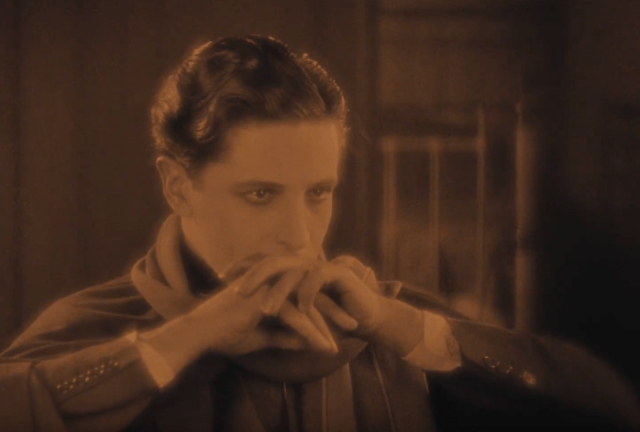
The Lodger (subtitled A Story of the London Fog) is a 1927 thriller from the Master of Suspense, his third film. It largely centers around one family’s experiences with a new lodger in their boarding house while the city at large quivers in fear at the actions of a serial killer leaving notes identifying themself as “The Avenger.” Mr. and Mrs. Bunting are caring and doting parents to their daughter, Daisy, a blonde young fashion model still living at home with them. Every Tuesday night for months, a blonde woman has been found murdered by the Avenger, and the police seem at a loss. The Buntings are friends with a detective named Joe Chandler, who is visiting them when news of the seventh victim arrives. That same night, a dark and imposing man appears at the Bunting home in response to their “room to let” sign. Joe is eventually put on the case to find the Avenger, and although he is able to discern a pattern from the location of the killings and estimate the general location of the next slaying, his jealousy over the growing attraction between the lodger and Daisy leads him to suspect the lodger of being the killer. When a search of the lodger’s, um, lodgings leads him to a map of the victims’ locations and clippings about the killings, the lodger is arrested, but Daisy helps him to escape, even though she (and we) still have no evidence of his innocence. 

There were moments during the course of the film that I was worried we were headed toward that easiest conclusion, but I should have known that even in this earliest part of his career, Hitchcock would already be working in a more subversive manner. In recent discussions on the podcast of Strangers on a Train, we talked about how Hitchcock never had much respect for the police, individually or institutionally, and there are already elements of this at play. Joe Chandler may manage to put together some clues about the real Avenger, but his personal failures of pettiness and jealousy lead him to pursue an innocent man, to the point that during his flight from the law the lodger is almost lynched by a mob while the real killer is elsewhere racking up yet another body. Hitchcock also loved to tell (and retell) the story of an innocent man being wrongly accused and pursued, from The 39 Steps to To Catch a Thief to North by Northwest to Frenzy, so it’s no surprise that it turned up as a plot point in this early work of his. I did expect there to be a bit more of a twist surrounding Joe, however. 

It’s never quite clear exactly what his relationship is to Daisy. Sometimes, she seems very receptive to his wooing, but at other times rejects his advances, although it’s a possible interpretation that her rejection largely occurs in scenes in which her parents are present. In their first scene together, he flirts with her by cutting a heart shape out of the dough that her mother is preparing and placing it in front of her, to which Daisy responds by tearing the heart in half and handing it back to him. To me, this established that his interest was unwelcome, but there are other scenes in which she welcomes his attention with enthusiasm. At the time of release, Joe’s actor Malcolm Keen was 40 years old, and he looks older. I’d probably attribute it to the technological limits of the time rather than to an intentional aesthetic choice, but Keen’s fair complexion and the make-up available at the time renders him, well, a bit ghastly-looking. In comparison, although Ivor Novello’s lodger character arrives at the Bunting house looking and behaving like a total weirdo, once he settles in, he reveals himself to be as beautiful as he is brooding. As a result, although I was willing to believe that the film was headed toward the revelation that the lodger was the Avenger as easily as it might have been headed toward his innocence, I also thought it might be revealed that Joe was the Avenger, but that might be my expectations being a little too close to modernity. The Avenger is apprehended entirely offscreen, his identity never revealed, but the audience of today looks at this rather small cast of characters and automatically assume that one of the characters has to be the killer. Through that lens, it could only be Joe, but that wasn’t really a trope of the medium yet.

-Mark “Boomer” Redmond

D.O.A. (1949)

D.O.A. is a tight little noir thriller (#89 in Douglas Brode’s list in Edge of Your Seat, for those of you playing along at home) that’s one of the most perfect encapsulations of the genre. At 82 minutes, there’s almost no fat to be trimmed, and since it lapsed into the public domain years ago because of failure to renew the copyright, it’s accessible pretty much anywhere. Director Rudolph Maté, who would go on to helm When Worlds Collide just a year later, had risen through the ranks as a cinematographer, having earned his stripes on films as varied and well-remembered as Carl Theodor Dreyer’s The Passion of Joan of Arc and Vampyr, Alfred Hitchcock’s The Foreign Correspondent, and the Rita Hayworth vehicle Gilda from director Charles Vidor. That eye for composition is striking in the film’s opening sequence, a minutes-long tracking shot that follows a man through a vast and echoey police station to find a particular detective so that he can report a murder: his own. 

Frank Bigelow (Edmond O’Brien) is an accountant and notary public in the desert town of Banning, California, population about seven thousand at the time. His secretary, Paula (Pamela Britton) is madly in love with him, a situation that he seems disinterested in either quashing or pursuing. He springs the news to her that he’s taking a solo weekend trip to San Francisco, much to her disappointment, but there’s nothing she can do to stop him, and away he goes. Arriving at his lodgings, he discovers that the place is full of salesmen who have just wrapped up an annual conference and are holding various parties all over the hotel. The place is lousy with pretty ladies in expensive fur coats, and Frank seems more than ready to sow some oats hither and yon, but not before he returns Paula’s messages. She’s not pleased to hear all the caterwauling in the background, but she nevertheless dutifully reports that a man named Eugene Philips, an importer-exporter, had been desperately trying to reach him all afternoon, ending with the cryptic statement that if he didn’t talk to Frank right away “it would be too late.” Frank goes out with the salesmen from the room across the hall to a jazz bar, where the host’s wife starts to get a little too handsy, and he excuses himself to make small talk with a pretty blonde at the bar. Distracted, he doesn’t notice the lurking figure with his back to the camera surreptitiously slipping something into his drink. The next morning, he feels extremely ill and gets a terminal diagnosis; he’s ingested the “luminous toxin,” a poison with no antidote, and now he has only days left to live, not much time to find out who his killer is.

There’s a lot that happens in the first act of this one, which is great, since it means that the second and third acts move at a breakneck speed as Frank works to pull at all of the threads of a decently convoluted conspiracy and solve his own murder before he drops dead. Paula is a fascinating character, as she initially comes off as slightly off-putting, pestering Frank to the point of workplace sexual harassment. She insists that he take her out for a drink and is notably upset that Frank made plans for a weekend trip that didn’t include her, but she also seems to realize that this is Frank taking an opportunity to give himself one last weekend as a swinging bachelor before settling into a life with her in Banning. Upon awakening in San Francisco on Saturday morning, he’s clearly ready to go back and marry Paula, even before he learns that he’s dying. Once he tells her that he needs her, she shows up to act as his sidekick for the rest of the film, and there’s real affection there. The great tragedy may be that if she hadn’t been suffocating him so, he might not have felt the need to spend a weekend away from her, and then he wouldn’t have been poisoned. Alas. Not that it would have helped save Eugene Phillips, who was going to “commit suicide” that Friday night one way or another. 

One of the other great tragedies in this has a major noir bent, which is the trope of the innocent man caught up in a dangerous web of lies and crime. For Frank, it comes down to a particular bill of sale that he notarized for Phillips months in the past, one that would have proved the dead man’s innocence. It’s not really spoiling much; the film’s electric energy all revolves around Frank going from place to place and getting answers that lead to more questions, all leading back to Phillips’s untimely demise. Who’s the real villain here? Is it Phillips’s brother, who was carrying on an affair with his sister-in-law? Is it Halliday, Eugene’s business partner? Is it the mysterious George Reynolds, whom no one seems to have ever seen and which may be no more than an alias? It’s a tight little mystery that’s completely streamlined. Just as Frank is running out of time, he grows increasingly frantic and desperate to find out who’s responsible for setting his death in motion and ensure that Paula is out of their reach, and the film feels similarly harried and headlong as it rushes toward the conclusion. 

Maté’s is a name that one doesn’t hear bandied about in cinephile circles all that much. It can’t help that, looking at his CV, his filmography is all over the place. There are several films noir listed there, many of which seem intriguing even if I’ve never heard of them, like Union Station starring William Holden, Paula starring Loretta Young, and Forbidden starring Tony Curtis. But in the midst of those are a motley assortment of historical adventures (The Prince Who Was a Thief, The Black Shield of Falworth, and The 300 Spartans), romantic comedies (It Had to Be You, Sally and Saint Anne), Oscar bait (No Sad Songs for Me), and far, far too many Westerns to name. The man worked, and his talent is clear here, and I’m excited to see if I can track down some of his other noir and crime thrillers, even if I have no interest in Siege at Red River, The Far Horizons, or The Rawhide Years. The performances here are great as well, as O’Brien perfectly embodies a man who’s clearly been spending too much time helping farmers file their taxes and fending off Paula’s pawing at him and just needs to know he could still get a city girl’s number, even if he can’t follow through with ringing her up. Britton also walks a narrow tightrope here, needing to play Paula as written while also making her someone we find likable enough to root for her and Frank to get together. With such a short time commitment and widespread availability (it’s even on Tubi), D.O.A. is worth checking out. 

-Mark “Boomer” Redmond

Her Vengeance (1988)

Golden Harvest’s 1988 rape revenge thriller Her Vengeance is reportedly a remake of fellow Hong Kong exploitation flick Kiss of Death, released by the rival Shaw Brothers studio in 1974. However, sometime between those two productions the most notorious American landmark of the genre, I Spit on Your Grave, left its permanent mark on the rape revenge template, so citing its primary influence becomes a little muddled. Her Vengeance does adhere to the exact plot structure of Kiss of Death, following the training-and-payback saga of a sexually assaulted woman who learns her martial arts skills from a physically disabled wheelchair user before getting her titular vengeance. Something about the continued violation of that initial assault following her well after the inciting incident screams I Spit on Your Grave to me, though. The frustrating, traumatizing thing about I Spit on Your Grave is that its vengeful antiheroine is assaulted multiple times before she flips the power dynamic of the film’s violence, restarting the 1st-act violation several times over without letting the audience move on to something less vile. In Her Vengeance, the initial assault continues in less literal ways, but persists nonetheless. Our assaulted antiheroine contracts gonorrhea, which exponentially worsens even as she trains her body for combat. She reveals her assault to her blind sister (and, by extension to the audience) by explaining that the gang who jumped her were also the same five scumbags who killed their father and left both the sister and the sister’s fiancée physically disabled. Then, her vengeful warpath accidentally puts the last few living people she cares about in their own mortal danger as innocent bystanders, so that she’s repeatedly traumatized every time the gang goes tit-for-tat with her assassinations. It’s relentlessly, exhaustingly bleak.

Thankfully, the dependably entertaining director Lam Nai-Chou lightens up the mood where he can, bringing some of the cartoonish hijinks from his better-known classics The Seventh Curse & Riki-Oh to a genre not typically known for its goofball amusements. As nightmarishly vicious as the gangsters are in every scene, they do initiate an armored truck heist by sticking a banana in the tailpipe, a classic gag. Frequent Sammo Hung collaborator Lam Ching-ying performs most of the more outlandish antics as our heroine’s wheelchair-using martial arts trainer, using his chair as a weapon and a constant inspiration for over-the-top stunts. Seemingly overwhelmed by the pure evil emanating from the worst of the surviving gangsters, he also rigs his nightclub with lethal boobytraps for a spectacularly violent climax, like a Home Alone precursor for convicted murderers. These outrageous “Triad Spring Cleaning” sequences are especially fun to watch due to the film’s Category III rating, which allows it to indulge in the most grotesque practical gore details imaginable. That freedom to indulge cuts both ways, though, making for an excruciating first-act assault as the gang members take turns abusing our antiheroine in a graveyard nightscape. Lam mercifully does not fixate on actor Pauline Wong Siu-Fung’s naked, abused body during that sequence, which helps diffuse any potential dirtbag eroticism seen elsewhere in this disreputable genre. Instead, he catalogs the cartoonishly evil Dick-Tracy-villain faces of her attackers, each with names like Salty, Long Legs, and Rooster. He also finds some sly humor in her eventual revenge on those C.H.U.D.s, having her cut off one of their ears with a pair of scissors, then later featuring a Vincent Van Gogh portrait as a background detail. Her Vengeance is not the Steel & Lace-level absurd escalation of the rape revenge template you’d expect from the director of The Seventh Curse, but Lam still finds a few occasions to have his usual fun, so it’s not a total dirge.

Curiously, the recent Vinegar Syndrome release includes a longer-running alternate Category IIB cut of the film that averts its lens from some of the more violent details but adds in additional scenes of dramatic context that overcorrects their lost length. Apparently, Golden Harvest produced five different cuts of the film in total, mostly as a preemptive measure to avoid its inevitable censorship by the Hong Kong government. If I were a more diligent cinema scholar I might’ve watched the IIB cut of the film for comparison’s sake before writing this review, or revisited I Spit on Your Grave, or sought out Kiss of Death. Since this is such a deeply, deliberately unpleasant genre, however, I can’t imagine wanting to suffer through this story a second time, no matter how softened or warped. The only reason I watched Her Vengeance in the first place is because it was packaged with my recent purchase of fellow Category III grotesquerie Devil Fetus, and I had some light familiarity with the director’s name. I do not regret the discomfort at all. Pauline Wong Siu-Fung gives a heartbreaking performance as a sweetheart nightclub employee who’s embittered & radicalized by her Triad gang-assault, emerging as a vicious killer herself on the other side. Lam Ching-ying makes spectacular use of his wheelchair prop, delivering some of the coolest, most badass disability representation I’ve ever seen in a martial arts film. Lam Nai-Chou crafts some memorably bizarre action-cinema payoffs typical to his most eccentric works. Still, I don’t think I’ll be making this particular journey into rape-revenge Hell again anytime soon. Once was plenty, thank you. I’ll stick to the relatively wholesome safety of Devil Fetus until these psychic wounds have healed.

-Brandon Ledet

Fight or Flight (2025)

Ironically, Fight or Flight seems to be flying under the radar. The new action comedy from first time feature director James Madigan is a lot of hyperactive, frenetic fun, even when some of the comedy thuds a bit. Some of that may fall on the writing duo of Brooks McLaren and D.J. Cotrona. McLaren’s only previous writing credit is for the 2018 direct-to-Netflix Theo James vehicle How it Ends, while this is Cotrona’s first credit in that category after several years as an actor, most notably as the lead in the From Dusk till Dawn TV series. Despite some weak jokes that fail to land (no pun intended), this is still a pretty fun ride (no pun intended). And hey, stars of both of the turn of the millennium Halloween sequels (Josh Hartnett from 1998’s H20 and Katee Sackhoff from 2002’s Resurrection) appear in a movie together, even if they never share the screen at the same time. That’s something, right? 

Hartnett is Lucas Reyes, who’s drinking himself to death in exile in Bangkok. Stateside, Katherine Brunt (Sackhoff) is busy leading a shadowy quasi-government agency/surveillance network. Her subordinate, Hunter (White Lotus’s Julian Kostov), informs her of a failed unauthorized action that resulted in an explosion in Asia, and that it appears that the incident involved “The Ghost,” a “black hat hacker” and terrorist about which no agency has ever been able to get any information. An overzealous lackey manages to find nearby footage that has been edited to remove the Ghost, Dead Reckoning style, and they extrapolate that they are headed for the Bangkok airport, with the nearest action team too far away to get there in time. Reluctantly, Brunt calls on Reyes, promising to clear up his legal status and allow him to come home. All he has to do is get on the plane, discover the identity of the Ghost and safely take them into custody, and deliver them to the agency alive when the plane lands in San Francisco. Should be simple, except that once they’re airborne, Brunt learns that this whole thing is a trap for the Ghost; an all points bounty has been put out for them, meaning that the plane is full of potential assassins. 

That’s a concept that’s both high and a little broey, and it’s no surprise that when the jokes don’t work it’s because it leans into the latter rather than the former. After I had already groaned at the hyperactive stagey performance of the high-strung air steward Royce (Danny Ashok), what really thudded for me was one of the scenes that revealed more about the conspiracy. Brunt and Hunter take a walk outside of the agency’s headquarters as they discuss who knew what and when and whether or not one of them has any involvement in the leaking of the Ghost’s location, and there’s a lot of hay made (tediously) about how life is all about being top dog, full of machismo from both characters. When they end the discussion, they’ve reached a nearby waterfront, where a yoga class is being conducted by a long-haired hippie type; after they express their mutual disgust at this display, Brunt shakes her head and utters “Pussies.” It’s such a strange little cul-de-sac that exists for no reason other than to show Brunt and Hunter as adversaries vying for the position of alpha, with the oh-so-funny comical turn that it’s a woman calling people pussies. It’s these kinds of things that make this film feel weirdly out of touch in certain places, where ten percent edgelordiness seeps over and cheapens the whole thing. 

Of course, the film is kind of a throwback in other ways. The “X on a plane” format is probably best remembered for giving us Snakes on a Plane, but this is more reminiscent of nineties skybound thrillers like Con Air and Air Force One, with a little bit of Final Destination-esque plane depressurization thrown in for good measure (this is not a spoiler; it’s the first scene). It’s got the shady government agency staffed by former CIA and other operatives but which now operates under a banner that remains undisclosed until fairly late in the game, and the conspiratorial actions that they perpetrate have a distinctly pre-War on Terror feel — more Enemy of the State than The Bourne Identity, although when the film shifts into fight sequences it utilizes the shaky cam effects canonized in that series before becoming the default in virtually every action thriller today. There’s also the presence of an inexplicably powerful supercomputer that the Ghost has created and which represents a threat to certain intelligence infrastructure, and the fact that this asset may be the reason that the Ghost was herded onto an airplane with assassins in the first place. Maybe because I was already in that headspace, this element felt very 90s to me as well, as the writing felt intentionally designed to imitate that “computers can do anything” optimism/fearmongering of the era, from uploading a virus to an alien mothership in Independence Day to deleting your entire identity in The Net. More depressingly, the film acts as if exposing governments and corporations for their exploitation of third world labor and participation in human trafficking would somehow have a negative effect on those entities. The reality that we all inhabit here in 2025 is one where people are still in the highest offices of power despite damning evidence of their involvement with Jeffrey Epstein and people still upgrade their phones every time there’s a new status symbol with full knowledge that they come from sweatshops that “employ” children. It’s cute that the film thinks that the Ghost’s wikileak might have some impact on anything at all; I wish I still had that kind of optimism. 

-Mark “Boomer” Redmond

The Surfer (2025)

As with any other workaholic auteur (Roger Corman, Steven Soderbergh, Quentin Dupieux, etc.), being a Nicolas Cage fan is a numbers game.  He simply makes too many movies for them all to be great—or even watchable—but it’s easy to find moments of greatness in each of them, and occasionally he’ll surprise you with a gem. It’s been a slow trickle of those gems among the typical flood of Cagian schlock so far this decade. At the end of the 2010s, the one-two punch of Mandy & Color Out of Space signaled a professional & artistic comeback that hasn’t really come together since. Instead, Cage has spent the 2020s putting his name & face on the exact middling trash you’d expect him in (The Unbearable Weight of Massive Talent, Willy’s Wonderland, Prisoners of the Ghostland, Arcadian, Renfield, DTV actioners too dull to watch or name) and only occasionally landing in a project that’s actually worthy of his presence: Pig, Dream Scenario, Longlegs and, now, the beach-bum thriller The Surfer. An official Cannes selection helmed by an up-and-coming director of note (Vivarium‘s Lorcan Finnegan), The Surfer commands just enough art-cinema prestige to earn the intensely, consistently committed screen presence of our greatest living movie star. As with all of Cage’s greatest hits, he takes all of the glory for himself through that intensity, while his director-of-note sits quietly in the passenger seat and watches him work. However fallible, he is both actor & auteur, the total package.

The titular surfer (Cage, naturally) is a workaholic yuppie who drives himself mad trying to prove his manliness to a beachful of muscly, Australian bullies. He arrives in a linen suit and a shiny new Lexus, hours away from buying back the million-dollar beachside home his family owned back when his father was still alive and he was still happy. His stubborn mission to surf his childhood beach once again is abruptly cut short by a small cult of Bay Boys who police the area’s unofficial “LOCALS ONLY” policy, shouting “Don’t live here, don’t surf here!” in his face until he retreats in cowardice, humiliated in front of his teenage son. The gang of bullies is led by an Andrew Tate-type manliness guru (Julian McMahon), who’s transformed the beach into a Church of Toxic Masculinity, mirroring the yuppie surfer’s own status-obsessed relationship with the property. Unwilling to back down, the ostensibly wealthy surfer becomes a beach bum to reestablish his locality, going mad with heat exhaustion in the public parking lot while the guru takes everything he’s earned away from him: his board, his car, his food, his water, his house and, inevitably, his son. From there, the surfer must choose from the same diverging paths as the conflicted protagonists of Kitty Green’s The Royal Hotel: either join in the old-fashioned Aussie masculinity or burn it all down. Disastrously, his indecision on which path to take leads him to do nothing, and the stasis starts to make the audience as crazed as our desperately dehydrated antihero.

For his part, director Lorcan Finnegan dresses up The Surfer as a vintage Ozploitation throwback, complete with crash zooms, wildlife B-roll, heatwave distortions, and dreamily laidback, chimes-heavy surf rock. As the Aussie sun wears the surfer down, however, that 70s Ozploitation aesthetic is gradually taken over by a distinct resemblance to Frank Perry’s The Swimmer; Cage retraces Burt Lancaster’s surreal heat-stroke journey into his own macho psyche, hating everything he sees. Finnegan cedes control of the project entirely to Cage, at times shooting him through a fisheye lens as he maniacally harasses all visitors to his parking lot prison and at times lingering on close-ups where his face fills the entire frame. Whereas Finnegan’s debut put the broad practice of Parenthood on trial in an intensely artificial environment, The Surfer interrogates Fatherhood in particular, with Cage acting as an avatar for Patriarchal Failure. Things get unexpectedly philosophical as the Bay Boys gang chants, “Suffer! Surfer! Suffer! Surfer!” while Cage whines in agony, seemingly unable to escape his concrete limbo under Exterminating Angel-style supernatural force. At first, that stasis feels like an excessive indulgence in exposition & foreshadowing, but the longer the audience rots there, the more memory, premonition, and hallucination mix until they’re indistinguishable and all that’s left is the surfer’s pathetic ego. If you need an actor to perform that kind of total psychological breakdown, Cage is obviously your guy. You just need to go in knowing that once cast, he claims authorship through sheer charismatic force.

-Brandon Ledet