Lagniappe Podcast: The Men Who Knew Too Much

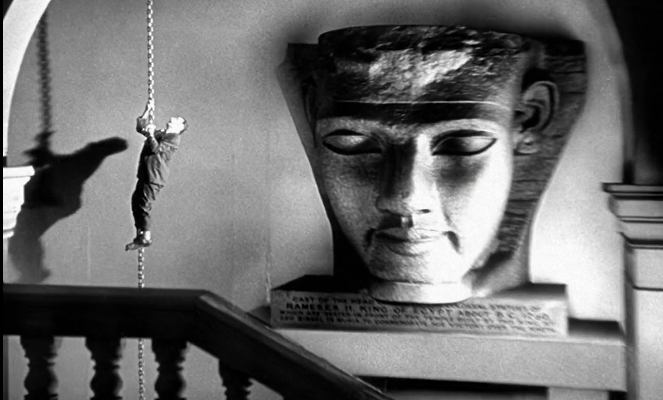
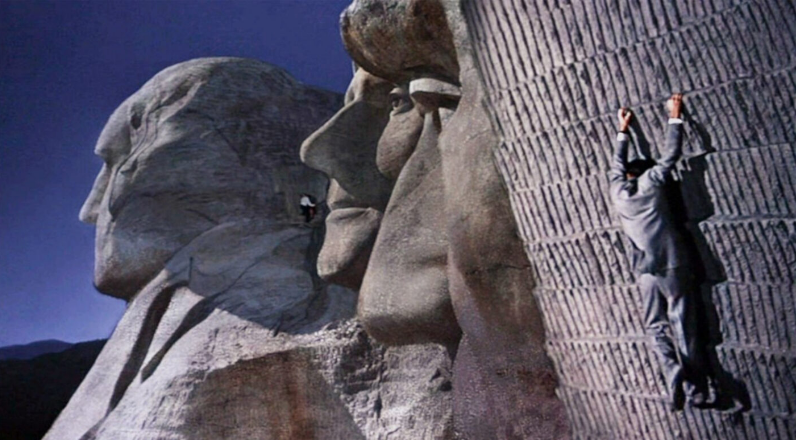
For this lagniappe episode of The Swampflix Podcast, Boomer & Brandon discuss two different films that share the same title and director: Alfred Hitchcock’s The Man Who Knew Too Much (1934) and its loose remake The Man Who Knew Too Much (1956).

00:00 The Soup
02:50 KPop Demon Hunters (2025)
8:02 The Blue Gardenia (1953)
13:25 Erica’s First Holy Sh!t (2022)
20:06 Cloud (2025)
26:40 The Mastermind (2025)
30:54 Eephus (2025)
37:00 Frankenstein (2025)
44:47 Predator – Badlands (2025)
52:32 Keeper (2025)
1:04:36 Materialists (2025)
1:10:15 Die My Love (2025)
1:14:12 Reflections in a Dead Diamond (2025)
1:17:48 Mr. Melvin (2025)
1:22:12 Sirāt (2025)
1:26:37 Twinless (2025)

1:33:00 The Man Who Knew Too Much (1934, 1956)

You can stay up to date with our podcast through SoundCloudSpotifyiTunesTuneIn, or by following the links on this page.

– The Lagniappe Podcast Crew

Spies (1928)

I am excited to watch what’s being marketed as the final chapter in the Mission: Impossible saga later this week, but I’m not sure exactly when I’m going to be able to clear an entire evening for it. Clocking in at 169 minutes of Hollywood action spectacle, The Final Reckoning is easily the longest Mission: Impossible sequel to date. Likewise, the most recent James Bond sequel, 2021’s No Time to Die, clocked in at 163 minutes as the longest of its own decades-spanning franchise. The Fast and Furious series is following the same trend, with both 2021’s F9 and 2023’s Fast X breaking the 140min barrier because two hours is no longer enough space to tell the epic story of black-market street-racers who found a second life as international superspies. I have no doubt that its own upcoming finale, Fast 11, will be even longer. It’s clear that these decades-running espionage thriller series have become bloated through the virtue of their success, racking up enough international box office to earn a blank-check approval for every imaginable indulgence, supercharged by the egos of Hollywood Elite freaks like Tom Cruise & Vin Diesel. In a roundabout way, though, their exponentially expanding runtimes do call back to the earliest days of spy-thriller cinema, both in the episodic “Until next time…” storytelling of pre-show serials and in the epic scale of Fritz Lang’s 1928 genre landmark Spies (aka Spione), which in its original exhibition ran for an impressive 178 minutes, putting all of its modern decedents to shame. Even its incomplete, surviving prints stretch past the 140 minute mark, trimmed down by half an hour but still meeting the modern Hollywood standard.

Despite its near-three-hour runtime, Spies is not an especially self-serious or prestigious work. Lang sets his espionage saga against the same kind of impossible, expressionist backdrops crafted for his sci-fi epic Metropolis the previous year, but it’s all in service of telling a low-brow, pulpy romance between undercover spies. If the film has earned any historical or artistic prestige outside the typically masterful imagery of Lang’s monocled eye, it’s all due to the fact that it is almost a century old. Co-written with his wife & collaborator Thea von Harbou, Spies pioneers a long list of genre tropes both big (referring to the protagonist only by his agent number, 326) and small (comically tiny cameras, disappearing ink, etc). As a result, it now plays heavily tropey, taking three hours to tell a fairly simple love story between two spies who work for opposing agencies. Our somewhat heroic Agent No. 326 (Willy Fritsch) is employed by the German Secret Service to thwart the criminal-mastermind plans of Haghi (Rudolf “Dr. Mabuse” Klien-Rogge) to intercept a top secret British-Japanese peace treaty. Not nearly as suave nor as talented as he thinks, No. 326 is already on the Russian enemy’s radar at the start of his mission, and he’s assigned to be taken down by the femme fatale counterspy Sonja (Gerda Maurus), who’s always two steps ahead of his plan. Only, Sonja is secretly a bit of a softie, blackmailed by Haghi to commit evil deeds. Naturally, she immediately falls in love with No. 326, constantly saving his ass in times of crisis and engineering a scheme to free them both from their professional obligations so they can spend the rest of their lives in each other’s arms.

This airport paperback plot doesn’t sound especially substantial in the abstract, at least not when compared to other, juicier Fritz Lang triumphs of its era like Metropolis, Destiny, and M. It’s illustrated with the same German Expressionist gloom & grandeur as those more infamous works, however, finding Lang at the height of his powers (long before he sleepwalked through late-career studio noirs like Beyond a Reasonable Doubt). The opening prologue and explosive climax are especially stunning, kicking things off with a rapid-fire montage of espionage action and closing things out with a literal circus of violence. It’s at those bookends where Lang crafts isolated images in inserts that rival the beauty of any individual frame of classic cinema: a spy posing atop the rubble of an exploded bank wall, a low-angle close-up of an assassin on a motorcycle, a woman’s hands posed with gun & cigarette. There are a few other scenes sprinkled throughout the sprawling runtime that rival those images (namely, the makeup rituals of a creepy secret agent named Nemo the Clown and a boxing ring encircled by ballroom dancers), but much of the drama between those spectacular bookends takes on stage-play feel. Whereas Ernst Lubitsch would’ve turned No. 326 & Sonja’s ill-advised romance into a perverse romp (see: Trouble in Paradise), Lang & von Harbou craft a fairly somber story rife with blackmail, prostitution, opium addiction, and suicide. The old-fashioned sweetness of the central romance can’t help but be marred by the grim practicalities of spy work, which sometimes leads to bursts of violent visual poetry but often leads to conflicted players clawing their own faces in agony over who to be loyal to – lover or employer.

Even the relatively shortened Restored Cut of Spies was a little trying on my 21st Century attention span, which began to waver any time Lang strayed from grand German Expressionist spectacle to stage-bound melodrama. At the same time, I’ve seen plenty of Ethan Hunt, James Bond, and Dom Toretto spy thrillers in recent years that are just as long but not half as cool. It would’ve taken the same time commitment for me to catch up with the most recent Fast & Furious film, which I never got around to because nothing from the previous, even-longer one lingered with me past the end credits; they even found a way to make a forgettably dull image out of the Fast Family finally launching a car into space. Meanwhile, there are at least a dozen individual frames from Spies that will be burned into the back of my skull forever, even if it’s telling an equally inconsequential story as most of its modern equivalents. All that these bloated spy-thriller sequels need to do to earn their ever-expanding runtimes is take a page from Fritz Lang’s book and craft some of the most fantastic, gorgeously composed images in the history of cinema. It’s that simple.

-Brandon Ledet

The Spiral Staircase (1946)

I’ve brought up in previous reviews that, for many of my teenage years, Douglas Brode’s Edge of Your Seat: The 100 Greatest Movie Thrillers was a treasury of knowledge for me. I’ve had the book for decades, making notes in it that go back to 2003 about when I watched a film on the list, what my personal rating was, that sort of thing. I’m still working my way through it, having seen about half of them. Some of these were fairly recent, like The Conversation (#60) and The Last of Sheila (#88), with my Roger Corman Poe adaptation journey meaning that The Pit and the Pendulum (#61) soon to be added to that list. Just ahead of that one and The Conversation, at #59, is 1946’s The Spiral Staircase, and I’m delighted to report that it does not disappoint. Just as a forewarning to anyone who may be interested and has access to Brode’s book, however, please note that the film’s synopsis does spoil the identity of the killer, so make sure to view the film before reading that section. 

Set some years before the film’s actual production date (more on that later), the film opens on Helen (Dorothy McGuire) attending a screening of the silent 1896 film The Kiss, although the movie treats this as a feature rather than the 18 second featurette that it really is. The screening is being held just off of the lobby of a hotel, and upstairs, a woman is strangled to death. The constable (James Bell) arrives and speaks with Dr. Parry (Kent Smith), a relative newcomer in town who wishes to offer his opinion, even though the town’s primary physician is already on-site. Parry then offers to give Helen a ride home in his horse-and-buggy, and it becomes apparent that Helen is mute, and Parry regards her with some affection and has attempted to interest her in seeing a Bostonian doctor friend of his about treatment for her condition. He’s pulled away by a medical emergency before getting her all the way home, but she’s fine to walk the rest of the way, at least until a sudden thunderstorm occurs. As Helen races back to the mansion in which she is employed as a servant, we see that she is being watched by a rain-drenched man in a slicker and hat. There’s great concern that Helen may be the killer’s next victim, as each of the previous killings were of women with some kind of disability. 

The mansion itself is a great set, with the spiral staircase that Helen ascends and descends throughout taking center stage. Even though we spend an unbroken hour within its walls, the house’s expansiveness means that it never becomes boring visually, and we learn the place’s general layout fairly quickly, which makes the breakneck pace of the final act easy to follow as Helen rushes about, pursued by her would-be killer. It also means that there’s plenty of room for a smorgasbord of characters, any one of which could be the murderer. There’s Dr. Parry, of course, whose recent arrival to the community marks him as a kind of outsider, and whose interest in Helen could be more than merely medical or social. The house’s matriarch is Mrs. Warren (Ethel Barrymore), apparently bedridden and requiring nursing care, but who prefers the ministrations of Helen, although she warns the girl several times that she should flee the house and never come back, if she can. The house is also occupied by Professor Albert Warren (George Brent), Mrs. Warren’s stepson, an upstanding member of the community who nonetheless has some resentment for his stepbrother Steven (Gordon Oliver), who has all but abandoned his mother to Albert’s care while he lives prodigally on the family’s money, only taking time from philandering around Europe with loose women when he needs to return home to refresh his accounts. This means that he, too, has only recently returned, and his arrival’s overlap with the sudden rash of killings makes him suspicious, and although he tells the constable that he didn’t leave the house the whole of that day, Professor Warren notes that his shoes are muddied, and questions why he would lie. Of course, one wonders when he would have time to get away when he’s so smitten with Blanche (Rhonda Fleming), the professor’s assistant/secretary. For the most part, the women are above suspicion, except for Mrs. Warren’s nurse, Barker (Sara Allgood, just a few years after her Best Support Actress win for How Green Was My Valley), whom one character refers to as being just as good as a man in a fight. Also not a likely suspect is Mrs. Oates (the Bride of Frankenstein herself Elsa Lanchester), the housekeeper, although her groundskeeper husband, Mr. Oates has suspicion cast upon him from the moment he appears, as he enters the house wearing a raincoat and hat just like the person stalking Helen in the yard. 

It’s a decent cast for a mystery that takes place over the course of a single evening in a single locale, creating a great sense of suspense. Clues are planted throughout (like the early foreshadowing of the use of ether as a medicine for Mrs. Warren), doubts are raised about everyone’s activities (like who has the missing ether), and characters are given good reasons to be leave the vicinity just long enough to be suspicious (like Mr. Oates being sent to the next town over to get more ether; it’s a rather ether heavy plot). We learn fairly early on that Mrs. Warren is a crack shot and may be less enfeebled than she lets on, as she keeps a gun next to her bed that Helen is unable to wrest from her grasp, and she boasts about having slain the tiger that gave its life for her bedroom rug. She even notes that her late husband used to tell her that although she was not as pretty as his first wife, she was a much better shot. That late Mr. Warren, though long passed, cast a pall over the house that is still very much in effect. A man of much machismo, he resented that neither of his sons had much interest in sport or riflery as he did, and thought little of both of them as they instead chose academia and ribaldry as their passions instead. That paternal disappointment is at play in the behavior of both living Warren men, and a revelation that a woman was murdered at the house years before casts further suspicion on them both. It’s great character work that effectively keeps you guessing until the moment that the killer is revealed. 

We often talk about Psycho as the sort of decades-early prototype of the slasher genre, but there are a lot of novel, modern elements here that are also clearly part of that same genealogy, and even earlier to boot. Images of the slicker-wearing killer hiding just where Helen cannot see him, framed from the back, have a very slasher vibe, with the first image that comes to mind being the hook-wielding killer in exactly the same outfit in I Know What You Did Last Summer. As Dario Argento later would, director Robert Siodmak used himself to represent the killer before the reveal, most notably in several moments where there is an extreme close up of the killer’s eye. Sometimes, we get to see the reflection of a victim in said eye, which is not something I expected to see in a film produced in 1945. It’s so modern that it feels almost too far ahead of its time. We even get several first-person shots from the killer as he snuffs out his victims. In the first, they attack the woman when she’s changing clothes and is halfway through getting her dress on, her arms pinned in an overhead position, her long-nailed hands grasping at the air as she struggles; in the second, the victim plays the old “Oh! It’s you! You scared me!” routine until the killer lunges and strangles her in a chiaroscuro-lit cellar, with the actual murder happening in the darkened, unlit center of the frame, her seemingly disembodied hands likewise clawing at nothing from opposite sides of the image. 

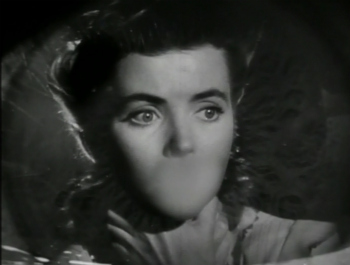
The imagery is potent, and the film isn’t afraid to occasionally go for the surreal. When Helen first returns to the Warren estate and is making her way up the grand central staircase, she stops for a moment to look into the mirror mounted on the landing (which will later make for some very cool angles in the chase scenes), and the camera crawls along the floor of the upstairs to reveal a pair of feet, letting us know that the killer is already in the house and is watching. As the killer watches, we see from their perspective that Helen has no mouth, and although the effect is rather limited, it’s still very creepy. Later still, when Parry has convinced Helen to run away with him, we get to see her imagine a brief, sweet courtship that leads right up to a wedding, the daydream turning into a nightmare when she is unable to say “I do,” as even in her fantasy she is unable to speak. 

Helen is a very cool final girl, and McGuire imbues a character who has no lines before the film’s final moment with a great deal of life and vivaciousness, conveying a lot through her body language and expressions. In one of the film’s most exciting moments, Helen is alone in the house with the killer as everyone else is dead, gone, imprisoned, or bedbound, and the constable comes to relay that Dr. Parry will not be returning that evening as he is attending a medical emergency, and Helen, in an upstairs room, beats against the window to get the lawman’s attention to no avail, and her desperation and frustration as he leaves are palpable. We see her playfulness with Mrs. Warren, her professionalism with Professor Warren, and her warmth and affection with Mr. and Mrs. Oates, and there’s a tangible difference in the way that she “speaks” to each of them. It’s damn fine acting work. The two best on-screen pairings are McGuire with Barrymore and McGuire with Lanchester. For the former, there’s an authentic sense of maternal warmth and protectiveness that Mrs. Warren has for Helen, and Helen seems to be the only person in the house whose company Mrs. Warren genuinely enjoys. With the latter, a lot of that is simply that Mrs. Oates is my favorite character here, and she was a delight every moment that she was present. Her rambling to Helen when she first returns home is quite fun, as is her antipathy toward her husband’s lazy dog. There’s a very fun bit in which she goes for her hidden brandy and finds it empty, to which Mr. Oates replies that he got rid of it because of her temperament. Later, when Professor Warren needs her help retrieving a bottle of brandy from the cellar, she fakes dropping the candle in order to steal another bottle for herself. It’s a helpful addition of some physical comedy to the proceedings while also setting up a scene later in which Helen locks her potential killer in the same underground room (and also a scene in which Helen is unable to rouse Mrs. Oates to help her with the killer as the older woman is passed out drunk). 

One thing that seems to be a point of contention is exactly when the film is supposed to be set. It’s clearly some time before the actual production date, as there is not a single automobile in sight, with characters riding around in horses and buggies. There’s no on-screen confirmation of an exact year, but Wikipedia lists it as 1906, as does TVTropes (although I assume the latter gets this from the former). Brode’s book lists it as 1916, and in fact makes some hay with the fact that this would have been right in the middle of the Great War, at a time when Freudian theory was becoming somewhat mainstream and that the film’s text is about Freudian themes of suppression and desire. It doesn’t really matter in the end, but thought it was worth mentioning, as I sometimes wonder where we get these “facts” about movies, and the way that something you might only learn in a now long-lost press kit have somehow been passed down as paratext and become unclear over time. 

-Mark “Boomer” Redmond

Podcast #237: Combat Shock (1986) & Vetsploitation

Welcome to Episode #237 of The Swampflix Podcast. For this episode, Brandon, James, Britnee, and Hanna discuss a grab bag of vintage genre films about Vietnam War vets suffering from PTSD, starting with the violent exploitation thriller Combat Shock (1986).

00:00 The Pope of Trash
08:50 Bastard Out of Carolina (1996)
13:00 Investigation of a Citizen Above Suspicion (1970)
17:12 Under the Sand (2000)
24:15 Warfare (2025)

33:00 Combat Shock (1986)
52:15 Dead of Night (1974)
1:03:42 Backfire (1988)
1:17:10 Savage Dawn (1985)

You can stay up to date with our podcast through SoundCloudSpotifyiTunesTuneIn, or by following the links on this page.

– The Podcast Crew

Parental Hell at The Overlook Film Festival

When I think of how the horrors of parenting are usually represented in genre cinema, I picture cruel, demonic children. In most horrors & thrillers that prompt you to think twice about having kids, the prompt is a warning that the kids themselves can be absolute nightmares, typified by titles like The Bad Seed, The Omen, Orphan, and We Need to Talk About Kevin. I was treated to an entirely different flavor of parental Hell at this year’s Overlook Film Festival, however, one that torments parents even when their kids are total angels. Both of the high-concept thrillers Redux Redux & Hallow Road ask what if the true horror of parenting is your own potential for failure? What if you fail to keep your children alive or, worse yet, fail to prepare them to keep themselves alive once your part of the job is done? The lifelong responsibility to raise, protect, and prepare another human being for the Hell of everyday living leaves parents incredibly vulnerable to the heightened pain of genre storytelling. It’s just unusual for the source of that pain to be a long, hard look in the mirror.

In Redux Redux, the major failure of the mother figure played by Michaela McManus (sister of co-directors Kevin & Matthew McManus) has already happened before the story begins. We meet her nursing her grief over the loss of her daughter with a weak cup of coffee in a roadside diner. She wordlessly trails the diner’s short-order cook back to his shitty apartment, then stabs him to death in his bedroom. Then, the scenario repeats: the same diner, the same doomed cook, the same violent end. The only thing that changes is the color of the coffee mug. Redux Redux is a revenge-thriller version of the television program Sliders, wherein our grieving-mother antihero jumps from alternate universe to alternate universe to murder her daughter’s killer in thousands of temporarily satisfying ways. Of course, these empty acts of revenge do nothing to bring her daughter back to life; it’s more of a multiversal addiction story than anything, where she hides from her pain by violently acting out against a convenient effigy of the man who ruined everything. The main tension of the movie is whether she can break this violent pattern of addiction to do better by her new, reluctantly adopted daughter figure: a street-smart wiseass teen (Stella Marcus) who’s in danger of becoming the spitting image of her worst self. The horrors of parenting are apparently inescapable, even when you have a magic microwave coffin that allows you to slide into an alternate dimension at a moment’s notice.

In Hallow Road, there’s still plenty of time to do the right thing, but the parents fail anyway. Rosamund Pike & Matthew Rhys star as a middle-aged yuppie couple who are woken in the middle of the night by a panicked phone-call from their college-age daughter. It seems that after a passionate fight with her parents, she decided to go do some drugs in the woods about it, and accidentally struck a stranger with her car on the drive back home. Panicked, the couple start racing to their daughter in their own vehicle, where most of the film is confined for the remainder of the runtime. With only their voices & wisdom to guide their child through this life-changing (and life-ending crisis), they find themselves at a moral crossroads. Do they instruct her to alert the authorities of the accident and face jailtime, potentially saving her stoned-driving victim’s life, or do they help her escape responsibility for her actions, taking a blame for the hit & run themselves to preserve her post-collegiate future? The resulting story is an all-in-a-car, real-time thriller that reimagines 2013’s Locke as a dark fairy tale about irresponsible parenting. The further the couple drive into the woods to “rescue” (i.e., corrupt) their child, the more illogical and darkly magical the rules of their world become, and the the entire film functions as a kind of artificial stage-play examination of parents’ most harmful, regrettable impulses.

Personally, I was much more pleased with the genre payoffs of Hallow Road than I was with Redux Redux, mostly because its internal logic felt more purposeful & thoroughly considered. Because Hallow Road opens itself up to Old World supernatural magic, it’s a lot easier to accept its high-concept premise than the more grounded, sci-fi theorizing of Redux Redux. It brings me no pleasure to act as the screenwriting logic police, but the temporal shenanigans of Redux Redux made no sense to me, especially once I started counting up the untold thousands of weeks the mother figure claims to have been murdering her daughter’s killer for and noticed that she is not, in fact, 100 years old. It’s like the McManus family started writing it as a time-loop movie and subbed in the word “multi-verse” instead at the last minute without cleaning up the implications of how time passes differently in that genre. Meanwhile, director Babak Anvari is in total control of just how much information to reveal to the audience about the logic of his hermetic, supernatural world to keep us on the hook — very little. While Redux Redux plays like an audition for a bigger-budget Hollywood actioner for the McManus clan (if you squint hard enough, you can see Betty Gilpin & Jenny Ortega headlining this one as the makeshift mother-daughter avenger duo), Hallow Road is more realistic about what it can achieve on its car-bound scale, using its confinement & limited resources to increase the attention, rather than distracting from them. Its local premiere at this year’s Overlook was also a nice kind of homecoming for Anvari, whose previous picture Wounds is one of the best New Orleans-set horror movies in recent memory (despite what its general critical response will tell you).

Speaking even more personally, I will never know the full horrors of parental failure illustrated here, because I will never be a parent myself. Maybe the unthinkable nightmare of having lost a child and the resulting addictive, self-destructive coping mechanisms that inevitably follow that kind of tragedy stir up powerful enough emotions in a parental audience that the basic temporal logic of its conceit doesn’t matter much. The violence is effectively nasty at least, and there are a few tense set-pieces that almost distract from the conceptual quibbles (and from the nagging feeling that you’re watching the DTV version of Midnight Special). Meanwhile, the violence of Hallow Road is more verbal & conceptual, as the entire narrative is teased out over the course of a feature-length phone call. I still found it to be the more rattling picture of the two, thanks to the aural jump scares of the sound design and the bigger, crueler questions it asks about what it means to truly be a Good Parent. In either case, I’m happy to have my suspicions that being a parent is a nonstop nightmare confirmed, even if it’s not the kids themselves who are the terror. Apparently, it’s the personal responsibilities & shortcomings that really haunt you.

-Brandon Ledet

Trap (2024)

My best friend constantly teases me about how I rate and rank movies, and how sometimes I’ll describe what seems to her to be the worst movie she’s ever heard of, but which I’ll find something to praise about and then wind up giving it 3.5 stars. For weeks in advance of the premiere of Trap, while she predicted (accurately) that I’d give this one that rating, we speculated about what the major twist would be. I put my money on the premise being that Josh Hartnett’s character was actually kidnapping people because his daughter was some kind of vampire creature, which may simply have been because I saw the trailer for this in conjunction with the one for Abigail so many times that it incepted me a little. In reality, there’s no “big twist” in this one, with the portioned revelations coming not in the form of a huge rug pull but like actual ongoing narrative reveals. I know that what I’m describing is just “a movie” but when you’re talking about a director whose early career was so defined by his whiplash endings that, (A) if you remember Robot Chicken mocking him with the quote “What a twist!”, then congratulations, it’s time to schedule that colonoscopy—that episode aired in 2005—and (B) something this relatively straightforward seems like a novelty. 

Tweenage Riley (Ariel Donoghue) has been having a tough time at school lately, entering that period of adolescence where friend groups start to change and ostracization can be at its most emotionally damaging. She still got good grades this semester, so, as promised, her father Cooper (Josh Hartnett) is taking her to see her favorite pop star, Lady Raven (Saleka Shyamalan). Upon arrival, however, he starts to note that there’s a massive police presence at the arena where the concert is being held, and he discovers that the police learned that a serial killer known as “The Butcher” would be attendance that evening and have turned the entire place into a, well, Trap in order to put an end to his reign of terror. That’s bad news for Cooper, since The Butcher is him. Of course, if you saw the trailer, then you already know that, and you might even assume that this will be the film’s entire premise (I did), but this reveal comes very early in the film and the movie eventually spills out of the arena and into the streets, with quite a lot of plot left to go. I was delighted to see Alison Pill’s name in the credits, and flabbergasted to see the name “Hayley Mills” appear before my eyes. She’s in far less of the movie than one would want, as she plays the FBI profiler who has helped to create the titular trap; the film does play with this, however, as she frequently explains over the radio (one of which Cooper has pilfered) what the Butcher’s next most likely action will be while Cooper is doing it, forcing him to have to reverse and rethink his actions on the fly. Although her role is small, it’s omnipresent and pervasive, and that was fun. 

This feels like M. Night Shyamalan doing his version of a Hitchcock plot. We’ve got a dangerous man stuck in a situation that was devised specifically to entrap him and use his own psychology against him, using his quick thinking (and a lot of luck) to stay one step ahead of his pursuers. It’s as if Roger Thornhill from North by Northwest actually was George Kaplan, and Kaplan was a murderer. Like Norman Bates, Cooper is a man that we know is guilty, and for whom we can’t help but hope that his plan succeeds, because we’re with him every moment — trying to get away from the overly apologetic and invested mother of one of Riley’s friends-turned-mean-girls, watching nervously as other men are pulled out of the crowd for questioning, and being directly questioned by an officer after having learned the codeword taught to stadium staff, but not realizing that he would need to present additional documentation. All through it, Hartnett’s choice to play Cooper as ever-so-slightly off is incredibly effective; he seems superficially charming, and Josh Hartnett’s natural good looks go a long way to explaining why no one seems to notice that there’s something wrong. There’s a real juggling act going on in this performance, as Cooper’s mannerisms seem practiced and artificial every time that he has to interact with another person, like he’s spent a long time imitating human behavior but still hasn’t quite gotten it down, like he’s fluent in being normal, but it’s unmistakably accented. The only time he seems to be himself and not putting on the character of “Cooper” is when he’s alone and calculating his escape route, or when he’s with Riley, which does a lot of work humanizing him. 

One really noteworthy thing here is that this empathy we naturally have for our primary viewpoint character takes a strange turn at about the midpoint, when Lady Raven becomes aware that Cooper is The Butcher and thinks quickly and cleverly in order to stick with him in a way that he can’t prevent without revealing himself. She briefly becomes the heroine of the story, as she manages to get Cooper’s phone away from him and use it to get more information about where his latest victim is being held and then going on Instagram live to ask her massive group of fans to help her find and save the man. The trailers would lead you to believe that the pop superstar arena show is just set dressing, or a means to justify having all of the action take place in a stadium for the novelty of the location, but Lady Raven actually ends up being central to the plot and even emanates a bit of Final Girl energy. Surprisingly, I also found Raven’s music, which Saleka Shyamalan composed and performed herself, to be a lot of fun. Not every one of the tracks that she performs hits the same, but there were a few legitimate bops in there; not since Josie and the Pussycats or Popstar: Never Stop Never Stopping have I enjoyed a movie’s representation of in-universe popular music as much as this, and both of those were comedies. If this movie was a backdoor into springboarding a larger music career for her, I’d say she has a decent chance, and it got me out of the house and into a place where I witnessed shirtless Josh Hartnett (he’s still got it, in case you were wondering) get tased by Hayley Mills (she does too), larger than life. 

There are, of course, some issues. The fact that all of Cooper/The Butcher’s victims are talked about in glowing terms about what great parents/teachers/children/community members they were got a bit of an eyeroll out of me; I don’t need the victims of a serial murderer to be paragons of heteronormative virtue in order to think that their deaths are tragic. If anything, heaping that much praise on them early in the film made me think that the big Shyamalan Twist™ was going to be that Cooper was some kind of vigilante picking off people whose apparent moral perfection belied their true, evil natures. Further, nitpickers will find a lot to complain about here, as there are a number of instances in which Cooper eludes the law’s grasp through pure luck rather than through any ingenuity. This starts first when he manages to find himself in the good graces of an arena employee (Jonathan Langdon) mostly because of his handling of a situation in which Riley and another girl have conflict over the last tour shirt in their shared size, which feels like a reach. Later, however, Cooper dons an apron to pose as staff while attempting to escape to the roof and is stopped by security, who ask him to present a card in conjunction with the codeword, and he just so happens to have grabbed an apron in which the real employee left their wallet, “I’m not The Butcher” card and all. It’s a narrative necessity, but you already know how the people who treat the enjoyment of the cinematic art as some kind of argument to win are going to beat this talking point to death whenever the social media algorithm figures out how to spin Trap discourse into your timeline. I hate to side with them at all, but by the time that Riley gets pulled on-stage to dance with Lady Raven, I had to concede that there were some “conveniences” that might have been spackled over with just one more draft of the script. The fact that Cooper has OCD and that this is something that is only barely hinted at (when he folds his napkin very precisely when he and Riley grab food at the concert) before it becomes a major part of his profile, which ends up seeming a little underbaked, but otherwise, the planting and payoff is effective. 

This is a pretty good time. Nepotism aside, Saleka Shyamalan is a welcome screen presence with musical talent that makes this one work in a way that it absolutely wouldn’t if the concert that the characters were attending felt as artificial as they often do in movies and TV. (There’s actually a cute moment in the early part of the film wherein Riley is singing along to Lady Raven in the car and missing many of the notes, then says to her father that she might want to be a singer one day, and he politely goes along with this dream, which is very funny in the context of said singer being the director’s daughter.) Hartnett is always a welcome addition to any cast, and although seeing the heartthrob of The Faculty and Halloween H20 playing the father of a middle schooler aged me like I had just stepped onto the beach that makes you old, he was great here. I honestly didn’t really realize that Hayley Mills was alive, but seeing her here made me realize how much I’ve missed her, and I hope that this emergence from retirement is long lived and that I get to see her again soon (she also really classes up the joint). It may not be worth running out to the theater to see, but this is one I’d recommend checking out for a nice, low stakes movie night when it comes to home video. 

-Mark “Boomer” Redmond

M (1931)

For a moment, I considered not opening this review with a reference to Laurence Sterne’s novel The Life and Opinions of Tristram Shandy, Gentleman, thinking to myself, “Surely, I’ve referenced it enough already.” Then I double checked and realized I’ve only brought it up twice previously (in my reviews for Beau is Afraid and The Love Butcher), so here we go! Tristram Shandy was published in multiple volumes, the first of which was released in 1759, not even two decades after the publication of the first novel of the English language, Samuel Richardson’s Pamela, or Virtue Rewarded, in 1740. Shandy has long been a fascinating point of study not just because it’s one of the first novels in our language, but because despite being one of the earliest examples, it already demonstrated many stylistic and literary characteristics that we associate with postmodern fiction. Novels went from a complete, well, novelty to something that could be deconstructed within an astonishingly short time, with Shandy featuring a stream of consciousness narrative, a playful interaction with the nature of the printed word on the page (including several pages left intentionally blank to demonstrate a story that the narrator does not know), and various other elements first-time readers are often shocked to find in something so old. 

Fritz Lang’s most famous work, the pioneering silent science fiction film Metropolis, premiered in 1927; just four years later, his first sound picture M was screened for the first time. Within the short period between them, Lang had already developed some of the basic elements of what we would consider keystones of narrative filmmaking and used them in an effective way that’s the equal of any film that’s been produced in the intervening nine decades. In many ways, the introduction of “talkies” was like the building of a cinematic Tower of Babel (quick note here—I started writing this before seeing Metropolis and learning that the biblical Babel story is actually a big part of that text), necessitating a foundational re-evaluation of the language of the art down to its very core. But I’m getting ahead of myself. 

M is the story of a Berlin in terror, as several children have been found murdered in a way that demonstrates they share the same killer. As the film opens, a woman scolds the kids in the courtyard of her building for singing a nursery rhyme about a killer of children as she sets the table for her daughter, who never appears, despite her mother’s increasingly plaintive shouts of the daughter’s name into an empty street. The girl, Elsie Beckmann, has already fallen beneath the dark shadow of Hans Beckert (Peter Lorre), who lures the child to accompany him by purchasing her sweets and a balloon from a blind street vendor. Her eventual fate is implied as we see her beloved ball bounce into a ditch, and the balloon she was given drifts in the wind, abandoned. This sets off a fury in the city, as angry parents demand that more be done to apprehend the child predator, and this creates a domino effect. First, Inspector Lohmann (Otto Wernicke) of the police begins to crack down on various underworld activity, including harassing the patrons of a seemingly legal drinking establishment. That leads, in turn, to a meeting between various capos—led by a man known only as “The Safecracker” (Gustaf Gründgens)—for different criminal elements around the city to convene so that they can start their own manhunt so that the investigation will end and they can get back to racketeering, prostitution, and the like. 

While Lohmann’s men set out to find the murderer using then-novel forensic science like fingerprints, handwriting analysis, and behavioral studies, Safecracker’s boys set up an organized city-wide network of informants among the unhoused. Both end up finding Beckert at roughly the same time, as the killer’s habit of whistling “In the Hall of the Mountain King” during his compulsory episodes leads the blind balloon vendor from the beginning to identify Beckert to one of Safecracker’s men, and they tail him and even manage to tag him (with a white “M,” hence the title) before he realizes he’s being followed and ends up trapped in an office complex. The criminal underworld sets out searching the entire building where Beckert has gone to ground, while Lohmann’s men lay in wait at Beckert’s home, having discovered where he lived through methodical search and the discovery of red pencil shavings that matched the letters Beckert had written to the police. With Beckert now in their hands, Safecracker and company hold a kangaroo trial for the man, one in which he must plead his case for mercy, leading Lorre to give one of the greatest monologues in cinematic history. 

One of the truly great inventions that Lang gives us here is the narrative montage. In a silent film, narrative has to be displayed entirely through image and action, with dialogue and the occasional expository interstitial card, while M takes advantage of the opportunity to deliver information through audible dialogue and visuals at the same time. There’s a point in the film where Inspector Lohmann explains the methodologies that he and his men are using to try and locate the murderer, and as he describes various departments and what they do, we’re able to “visit” those people and places without a break in his monologue and without having to create interstitial expository cards (the closest we come is to a sign that identifies the homicide department). It’s such a common part of contemporary film language that its use is invisible to us now but is a quantum leap in filmic storytelling that we shouldn’t take for granted. Germany’s first “talkie” was The Blue Angel starring Marlene Dietrich, appearing at the movie theater only a year before M, and yet Lang had already created something that’s as integral to the nature of film as we know it as the letter “e” is to our language. And this could have been catalyzed in just about any movie, but it just so happens to have happened in one of the true masterpieces. 

That’s not the only thing that makes it feel so ahead of its time. So much of what we talk about when we talk about a film’s morals and ethics in the present is a discussion of the clarity of the value that the text espouses, but M is less concerned with blame than it is with prevention. That’s demonstrated in two ways: one that’s clearly intentional and is core to the reading of the film, and the other that’s a little more ambiguous and may have been unintentional. First, Lorre’s Beckert is one of the most compelling depictions of a compulsive evil on film. His utter fear at being trapped like a hunted animal pleading for mercy and compassion making him almost pitiable, in spite of the fear we know he inspires. At first appearing solely as a menacing figure, his terrified screaming about how he lives in a constant state of mental agony and that he can only quiet the voices when he commits these heinous acts, one can’t help but pity him, even while affirming that his afflictions don’t justify his crimes. Although there are several minutes of footage that are missing and the abruptness of the ending implies (at least to me) that there may be some frames missing from that final reel, the film that exists is the text that we have and so we must interpret from it. We never hear the verdict of Beckert’s trial; we cut away from the doors of a courtroom to find a few weeping mothers on the bench outside. “This won’t bring back our children,” is all that they have to say, and then “We, too, should keep a closer watch on our children.” Beckert is certainly to blame for his crimes, but he is not the only one responsible, and the only thing that we can exert influence over is ourselves and the company we keep, so that’s where our energy should go. Secondly and more subtly, it’s worth noting that although the police and organized crime figure out Beckert’s identity at roughly the same time, the police go about arresting Beckert by waiting for him in his home while Safecracker’s men catch Beckert when he already has his next victim in hand. Their methodology may not be “just,” but if this had been left entirely to the law, they would have only apprehended him after he had already slain another child, while community action prevented another death. The depiction of a kangaroo court makes it clear that we’re not supposed to see the summary execution of this guy as “justice,” and that the state’s justice should prevail (even if Beckert’s fate is ambiguous), but it’s still inarguable that one more little girl would have died if those same people hadn’t taken the law into their own hands in the first place. Prevention supersedes responsibility. 

M has been so beloved for so long that it’s difficult to say anything new about it. It’s the kind of classic film urtext that has been dissected, contextualized, and decoded nearly to death in nine decades since its release. That also makes it the kind of urtext that has so much discourse that most people are intimidated by the sheer amount of scholarship surrounding it or think that it’ll be outside of their grasp to understand, or they think it falls into the category of impenetrable artsy-fartsy stuff that culture snobs are always going on about. None of that is true. This movie is extremely accessible, not to mention scary, beautiful, and bewitching. There’s a reason that it’s stood the test of time.

-Mark “Boomer” Redmond

Deep Cover (1992)

There was a period of time in my childhood when I was convinced that Laurence Fishburne is the greatest actor alive.  Decades later, I’m once again being swayed to believe that superlative, except now my supporting evidence has less to do with his work in the high-premise sci-fi films The Matrix & Event Horizon than it has to do with his more complex character work in Bill Duke’s Deep Cover & John Singleton’s Boyz n the Hood.  Fishburne was well rewarded in his 1990s heyday, including an Oscar nomination for his brutish portrayal of Ike Turner in What’s Love Got to With It? and an Independent Sprit Award for Best Male Lead in Deep Cover.  To my knowledge, Event Horizon earned no Oscar buzz to speak of in 1997, which would have disappointed me to know at age 11.  Since then, Fishburne has slipped into the Great Actor void, mostly working in TV and in IP extenders when studios should be churning out a new Awards Bait star vehicle for him every year the same way we pamper other living greats like Glenn Close, Annette Benning, and Meryl Streep.  It’s a shame, especially once you get cynical about how other Black legends like Denzel Washington, Angela Bassett, and even Deep Cover director Bill Duke have been left to simmer on the same Hollywood backburner.

It might seem naive to discuss an undercover cop thriller like Deep Cover in these prestige-acting terms, but it really does give Fishburne a lot of room to show off.  If nothing else, it somehow finds an entire new layer of self-conflict to the moral dilemma of a cop having to commit crimes to stop them, despite the already long-bald tires on that trope.  We open with a flashback to the cop’s childhood trauma on A Very Shane Black Christmas, when his addict father was gunned down in front of him while robbing a liquor store for gift & drug money.  The rest of the movie is set in the New Jack City 1990s, where Fishburne’s childhood trauma under the violence & desperation of addiction has curdled into furious disgust with the crack epidemic that has rattled Los Angeles.  In order to take down the white ghouls at the top of the ladder who supply drugs to the Black community, Fishburne allows himself to be recruited to go undercover as one of their business partners.  In the process, he gets especially close to a scummy yuppie lawyer played by Jeff Goldblum, whose “condescending infatuation with everything Black” makes their already volatile workplace relationship even more explosively tense.  Most of Fishburne’s conflict is internal, though.  He is handling, selling, and profiting off the one evil he has dedicated his life to avoiding, and every moment of that hypocritical turmoil weighs heavy in his angry, self-hating eyes.

Deep Cover is currently in print as a Criterion Collection Blu-ray, but it entered my house as a 20-year-old thrift store DVD.  That dichotomy is a perfect snapshot of where it lands on the prestige/trash spectrum, stealthily operating as a high-style art film that’s gone undercover as a thriller-of-the-week marquee filler.  Bill Duke’s directorial instincts deserve just as much credit for its impact as Fishburne’s acting chops, updating classic noir tropes for Spike Lee’s America.  Fishburne’s overly verbose narration track is classic noir at least, and Duke’s vision of Los Angeles is one where every alley spews a volcano of mysterious urban steam into an atmospheric haze of neon reds & blues (often alternating from the tops of passing cop cars).  The editing rhythms are chopped into jerky stops & jumps, feeling more DJ’d than traditionally spliced.  Its aesthetic indulgence in post-MTV style only gets more intense from there the further its characters lose themselves in the momentum of cocaine psychosis – a style that eventually came full circle when the movie was marketed with a tie-in music video featuring Snoop Dogg & Dr. Dre.  It’s a cool video promoting a very cool movie, but what I ended up cherishing most about Deep Cover was the amount of screenpsace it reserved for watching one our greatest living actors be great at acting.  It’s shocking how few other movies afford Fishburne the same generosity.

-Brandon Ledet

Love Lies Bleeding (2024)

Saint Maud was one of the movies I was most looking forward to prior to the first quarantine back in 2020, having seen many trailers for it all through the last half of 2019. When I finally did get the chance to see it, it was revelatory – an amazing, understatedly vitriolic little thriller that handled religious trauma in a different way. Instead of Maud having been victimized by a past religious indoctrination or being someone who’s so well-versed in scriptural tradition that she can twist it to whatever her ends might be, she’s a dangerously unwell person making up her own faith through incomplete, piecemeal understanding of religion coupled with hallucinatory, delusional “visions.” Throughout that film, we see her interpretation of the world through her perspective; the face of the woman for whom she is a hospice carer takes on elements of the demonic in moments, “God” speaks to her through a roach in her apartment, and she sees herself as an angel in the film’s last moments, until the final split-second that shows us in the audience what’s actually happening to Maud (brutally and horrifically). 

I wasn’t terribly interested in Love Lies Bleeding until the friend with whom I went to see Drive-Away Dolls asked me if we would be seeing it as well, and told me that it was directed by Rose Glass, who also helmed Saint Maud. That was better advertisement than any of the trailers for the film that I had seen, and I was not disappointed. Bleeding is the story of an intensely passionate love between two women and the way that drugs, troubled pasts, unrequited longing, and violence conspire to keep them apart. Somewhere in west Texas—I assume, given the prevalence of Lone Star beer—it’s 1989, and Lou (Kristen Stewart) works at Crater Gym, a cavernous warehouse full of free weights, meatheads, and stenciled slogans like “Pain is weakness leaving the body” and its ilk. It’s a shit life, rubbing one out every night on the couch while her TV dinner goes cold, trying and failing to quit smoking, and unclogging the same gym toilet over and over while fending off the advances of Daisy (Anna Baryshnikov), who may be the only other queer woman in town but whom Lou finds repellant. One day, bisexual bodybuilder Jackie (Kay O’Brian) appears in the gym and upends Lou’s world; she’s hitch-hiking her way to a body-building competition in Vegas and is stopping over here for a bit after getting a job waiting tables at the local gun range/club’s cantina. 

The two immediately hit it off and after a passionate night together in which Lou introduces Jackie to steroids to which she has access, Lou agrees to let Jackie stay with her until she goes further west to the competition. The situation is complicated by the fact that the gun range is owned by Lou Sr. (Ed Harris), Lou’s father. The range is just a cover, though, as his real business is running guns across the border to Mexico, and he’s got local law enforcement in his pocket, and Lou knows he’s bad news since she was once more involved in the family business, although she hasn’t spoken to her father in years following the suspicious disappearance of her mother. The only other remaining family Lou has is her sister Bethany (Jena Malone), mother of three married to utter piece of shit J.J. (Dave Franco), who also works for Lou Sr. and got Jackie her job after he has sex with her in a bar parking lot, the night before she and Lou meet. J.J. is habitually physically abusive of Bethany, and when he puts her in the hospital, the simmering rage, resentment, and violence under the surface of everything comes to a boil, with tragic consequences. 

The southern fried thriller-noir bona fides of this movie are on full display. A mixture of Blood Simple, Thelma & Louise, and Blue Velvet with a little Requiem for a Dream sprinkled in for good measure, the film is elegant in its construction. The fingerprints from Blood Simple are all over this one, from its grimy, sweaty, eighties, west Texas setting to that classic visual of the highway at night, a dark void surrounding the small halo of light from a vehicle’s headlights. Bleeding’s final moments could take place in the exact same field as the one in which Ray buries Dan Hedaya’s Marty, just in daylight. Moreover, just like Abby and Ray in the Coen brothers’ film, our protagonists are forced to commit larger and larger acts of violence in order to try and be together, free from the potential for violence. Ed Harris channels Dennis Hopper’s Frank Booth here, albeit in a more subdued manner. Although his violence is free from any psychosexual elements (give or take how much enjoyment he gets from forcing Jackie to learn to shoot while he “coaches” her through extensive body contact), he is just as sadistic as Booth, and Lou Sr. is perhaps the most frightening onscreen psychopath since Anton Chigurh. The similarities to Thelma & Louise are fairly close to the surface, and there’s something fascinating happening with the way that steroids are treated with the same intensity and as having the potential for the same fall out as intravenous drugs in Requiem

Where this film picks up the torch from Glass’s earlier work is in the way that we are once again made privy to the internal life of an emotionally and mentally unwell person. Jackie is a fascinating character. When we first meet her, she’s using her body to get what she needs, and is at peace with that. She has history, but no origin; the earliest part of her life that she mentions is being adopted at age thirteen (by parents that no longer speak to her and who call her a “monster”), and she tells Lou that she turned to bodybuilding as a way to change her body due to fatphobic bullying. Like Maud, she’s running from something, but unlike her, she also has a goal in mind and is relying on herself to get there, self-actualizing where Maud turned to a hollow, false spirituality. She’s remarkably self-sufficient and dedicated, as we see when she wakes up under an overpass and immediately gets to work on both exercise and brushing her teeth. In this, she is a contrast to both Lou, who is never seen exercising and is instead trying to shortcut with steroids, and Daisy, who is most clearly communicated to us as undesirable through the centering of her poor dental hygiene. She’s still human, however, and allows her lust-turned-passion for Lou and her thirst for validation through victory in the Vegas competition to lead her down a path that deteriorates her mental state. At first, her steroid-affected hallucinations of developing greater vein and muscle definition are empowering and concurrent with her deepening passion with Lou, but when she tries to run from the consequences of her first major (albeit justified) act of violence, she ultimately has a nightmarish series of visions in Vegas that cause her to become even more aggressive, resulting in her falling first into the hands of the authorities and then under the influence of Lou Sr. 

Another thing that’s fun about these visions is the way that they relate back to things that we see her absorbing, even if they’re making their way into her subconscious without her really noticing. After their first night together, Lou prepares breakfast for Jackie, who (somewhat ungratefully) asks her to leave the yolks out, a period-appropriate “healthier” alternative to eating a whole egg; later, in a montage we see Lou carefully separating out the yolks while preparing breakfast, and several shots of the eggs ending up in the garbage alongside the remnants of emptied ashtrays. This comes back around when Jackie later hallucinates that she has vomited Lou onto the stage in front of her at the competition, covered in a sort of amniotic egg white mixture. Further, in the film’s climax, Jackie imagines herself fully hulking out and turning into a giant woman (apologies that that song will be stuck in your head for the rest of the day, Steven Universe fans), and this is actually foreshadowed earlier on, when we see her watching the 1939 animated version of Gulliver’s Travels. (If you’re like me, you probably assumed that this was used because the film is in the public domain, and were delighted to see that there was a narrative reason behind its inclusion.) It’s all very elegantly constructed, and as a man who always loves it when things fall perfectly into place, it was incredibly satisfying. 

There should be no mistaking that this is still a brutal movie. It’s not one for those with queasy stomachs, and I’m not just talking about all of the disgusting mullets (of which there are … many). J.J.’s death is extreme, and we see the aftereffects of it multiple times. That’s the kind of thing you’d probably expect from a movie with the word “bleeding” in the title, but just in case you’re somehow floating around out there with the idea that this is more romance than grit, I want to make it clear that this is a ferocious, vicious piece of work, but I wouldn’t have it any other way.

-Mark “Boomer” Redmond

Lagniappe Podcast: The Silent Partner (1978)

For this lagniappe episode of The Swampflix Podcast, Boomer, Brandon, and Alli discuss the Canuxploitation bank heist thriller The Silent Partner (1978), written by Curtis Hanson and starring Elliott Gould.

00:00 Welcome
01:38 Swampflix’s Top 10 Films of 2023

16:16 Total Recall (1990)
19:01 Minority Report (2002)
23;20 The Not-So-New 52
24:07 Earth Girls are Easy (1988)
28:00 The Prince of Pennsylvania (1988)
31:38 Soy Cuba (1964)
34:04 The Cranes are Flying (1957)
37:57 The Book of Clarence (2024)
42:11 Robot Dreams (2024)
45:09 Destroy All Neighbors (2024)
49:00 The Beekeeper (2024)

55:38 The Silent Partner (1978)

You can stay up to date with our podcast through SoundCloudSpotifyiTunesTuneIn, or by following the links on this page.

– The Podcast Crew