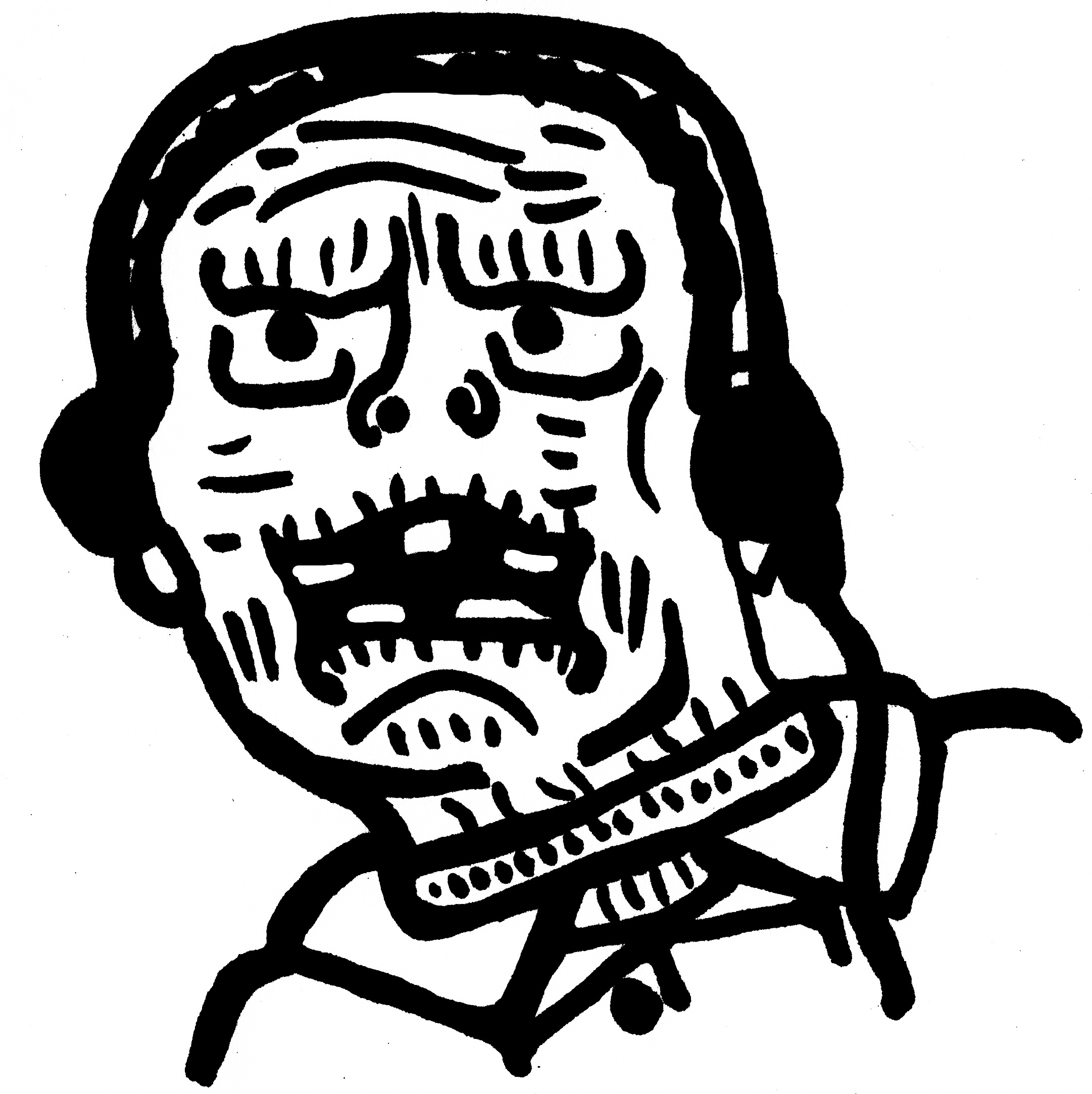
Day of the Dead (1985)

One of the more exhausting tendencies of zombie outbreak stories is how they all inevitably devolve into large-scale militarism. Even the more modern deviations on vintage zombie tropes in 28 Days Later, Overlord, and The Girl With All the Gifts are largely military stories, as if there is no way to depict a worldwide zombie outbreak without filling the frame with tanks & helicopters. All zombie roads lead directly to the military, and they all trail back to George Romero’s original Living Dead trilogy. Following the suburban invasion of 1968’s Night of the Living Dead and 1978’s trapped-in-a-shopping mall satire Dawn of the Dead, 1985’s Day of the Dead is a pure brains-vs.-brawn showdown in an underground military bunker just below the surface of an ongoing zombie apocalypse. If violent, crowd-controlling military action is essential to zombie outbreak storytelling, then movies might as well make the conflict between that military and the citizens it supposedly protects a central part of the text. Being more of an Idea Guy who was always eager to dig into the moral & philosophical implications of his films’ supernatural events than someone who could convincingly stage propulsive action or heartfelt drama, Romero was perfectly suited to explore that conflict at length, locking the audience into the bunker with him until he could sort it all out.

Lori Cardille stars as a scientist willing to dedicate the rest of her life to researching a cure for zombie blood infection. Unfortunately, she’s the only woman in the underground military bunker that’s been retrofitted into her research lab, and the heavily armed meatheads who provide her rations are getting tired of her work showing no discernible progress. The only thing stopping them from stripping her of her lab equipment (and more) is the parallel research of Dr. Matthew Logan, a mad scientist whose colleagues mockingly refer to as “Frankenstein”. Having long given up on finding a cure, Frankenstein has instead shifted his research to training zombie captives from the mines outside the military base on how to behave. He rigs their undead, semi-disassembled bodies to machines, stimulating them with electricity to see how their flesh might be controlled by the living’s command. He’s also taken one specific zombie as a pet, a specimen who he’s nicknamed “Bub” in loving, disdainful memory of his own father. Thanks to the power of positive reinforcement, Bub can vocalize simple phrases, operate a Walkman, salute the military officers in the room, and (most recklessly on Frankenstein’s end) fire a handgun. He can also apparently hold a grudge, since he eventually escapes containment to hunt down the bunker’s most fascistic militant in retribution for the crime of being an asshole.

There are three clear MVPs at work here, Tom Savini the most obvious among them. The all-out zombie mayhem of the final minutes (when the military base is inevitably invaded by the horde outside) gives Savini and his make-up team dozens of chances to stage and restage the classic Romero gag where a victim is overwhelmed & disemboweled by hungry zombies’ reaching hands. Before that climactic payoff, the frequent visits to Frankenstein’s lab allow Savini more freedom to construct individual animatronic monstrosities that show the mad doctor’s abandoned experiments in various stages of failure & disrepair, and the results rank among the gore wizard’s most unforgettable creations. The unlikely comic duo of Frankenstein (Richard Liberty) & Bub (Sherman Howard) are also obvious MVPs, delivering most of the film’s memorable character moments. The way Frankenstein wanders into meetings with military officials smeared from face to boot in infected zombie blood while explaining why they should pet-train the cannibal ghouls instead of shooting them dead makes for consistently rewarding comic relief. Meanwhile, his star pupil Bub is initially amusing as a slack-jawed walking corpse who can only vaguely mime human behavior while chained to the laboratory wall, but he ends up carrying most of the film’s effective pathos once he breaks free – just like the original Dr. Frankenstein’s pet creature.

Like with most Romero classics, I found the scene-to-scene drama in Day of the Dead to be frustratingly inert but was greatly impressed by its thoughtfulness in theme and tactility in violence. Maybe the main scientist’s heart-to-hearts with her infected boyfriend or the renegade helicopter pilot who could eventually fly her to safety ran a little dry, but the larger dramatic concerns about military muscle overpowering scientific experts after the breakdown of societal decorum felt true and continually relevant. On the film’s 30th Anniversary, it isn’t especially difficult to find contemporary meaning in a story about scientists working towards a solution for an infectious illness that could wipe out the entire planet’s population but having their research derailed by a few gun-toting fascists who don’t care to understand the value of the work. The most Romero stands out as a visual stylist here (outside the opportunities he gives Savini’s crew to run wild in the lab) are during a brief zombie hunt sequence in an underground cave, where he brings back the same extreme red & blue crosslighting he experimented with in 1982’s Creepshow. Otherwise, his artistry is most deeply felt in the philosophical nature of his writing, which finds a way to interrogate the inherent militarism of zombie narratives instead of casually accepting it as a matter of course.

-Brandon Ledet
Trauma (1993)

EPSON MFP image

three star

Well, here we are, folks. I wrote in my review of Opera that many considered that film to be Dario Argento’s last good movie, although I had also read that Trauma had its fans as well. I was pleasantly surprised by the director’s “Black Cat” segment of Two Evil Eyes, so I was looking forward to Trauma with some reservations but an open mind. On the whole, this 1993 film (released just a year after the director’s cameo in Innocent Blood) has a lot of meritorious elements in its favor and is a decent movie, but throughout the run time I kept thinking to myself, “Oh, so this is where we’re going now.” Although the giallo elements work, for the most part, the movie’s most memorably quality is blandness, although how much of that is intentional or not is unclear.

The film follows Aura (Asia Argento, in one of her earliest film roles and her first time being directed by her father), a sixteen year old girl who has escaped from a psychiatric hospital where she was undergoing treatment for anorexia. She meets David (Christopher Rydell), a TV news graphic artist and former heroin addict, and he befriends her after assuming that her IV feeding tube scars are track marks. Aura is soon recaptured by social services, however, and returned to the home of her parents, renowned mystics who are hosting a séance. Aura’s mother Adriana (Piper Laurie) claims that a spirit named Nicholas has hijacked the ceremony and is claiming that the serial decapitator The Headhunter is present. Aura watches from an upstairs window as her mother and father flee into the rainy night and runs after them, only to discover that The Headhunter has killed them both. She finds David and asks for his help, placing a strain on his relationship with news anchor Grace (Laura Johnson), who eventually calls the hospital and reports Aura so that she is forced to return there. Meanwhile, David’s investigation leads him to learn that (spoilers through the end of this paragraph) The Headhunter’s victims were all medical professionals in attendance on the night that Adriana was giving birth to her second child, a son to be named Nicholas; the doctor (Brad Dourif in what amounts to an extended cameo) insisted on pushing ahead with inducing labor despite inclement weather and intermittent power outages, and when he is startled by a lightning strike with a scalpel in his hand, he accidentally decapitated the baby. The nurses present convince him to use ECT on Adriana to erase her memory of the event, and her husband is complicit in their cover up. Of course, as in so many of Dario Argento’s movies, this repressed memory eventually resurfaces and the murderer seeks out vengeance.

In an interview on the DVD of La Terza madre, Asia Argento discussed the fact that working as a director had given her new insights as an actress, and it shows in the difference between her presence here and there. She is the weak performative link in this movie, but the film’s flaws are not restricted solely to her amateur abilities. Piper Laurie goes over the top here, as she often does, but Adriana Petrescu lacks the grounding that made Margaret White function so well as a sinister mother figure. Brad Dourif’s barely present on screen (and kudos to the editor of the film’s trailer for excising any reference to him, although the fact that his name appears at the top of the DVD box ruins that reveal), and his appearance ends with one of the worst uses of chroma-key effects I’ve seen in my life. That sequence stands out as particularly terrible, especially given how effective the rest of the movie’s decapitated heads, created by effects genius Tom Savini, are. It’s also strange to me that no one in the film seems to have a problem with the adult David’s romantic and ultimately sexual relationship with teenaged Aura is, other than Grace, whose issues are painted as being the result of jealousy rather than concern for the fact that a sixteen year old may be being taken advantage of by a much older beau. The film’s score also leaves much to be desired, especially in the sequences in which the young boy who lives next door to the killer’s home (Cory Garvin) sneaks into the murder house while chasing a butterfly; they feel more like unused tracks from Dennis the Menace than something created with the intent of increasing tension. The killer’s weapon of choice, a kind of bladed garrote, is a neat invention, but there’s too much tonal inconsistency present throughout, and the homages to Argento’s earlier work (especially Profondo rosso) only serve to demonstrate how much this film pales in comparison. I’m also unclear as to why Argento chose to shoot this picture in what he called “featureless Minnesota,” given that it adds to the overall banality of the film’s cinematography, especially given his masterful use of classic architecture and depth of field in his earlier work.

Having said that, this is not a bad movie, just an unmemorable one. For an Argento completist, it’s a movie that I would recommend over Inferno or Four Flies on Grey Velvet, and the mystery, despite being at times incoherent, works well in spite of its implausibility and absurdity. There are some great visual flourishes as well, especially in Aura’s hallucinatory sequence and in the discovery of the creepy nursery filled with gauzy screens. There’s a laudable attempt to trace the relationships between media, family, and psychological disorders here; it’s misguided and dated in its discussion, but I appreciate that there was an attempt to address this issue, even if the conceptualizations of the root cause of eating disorders is somewhat facile. The scenes set in the mental hospital are also effectively unnerving, even if that trope smacks of ableism when viewed through a modern lens. More than anything, I can tell that this is a movie that suggests a sharp downturn in the director’s work from here on out, even if it is decent within itself.

-Mark “Boomer” Redmond

Due occhi diabolici (aka Two Evil Eyes, 1990)

EPSON MFP image

Following Opera, Dario Argento set to work drumming up enthusiasm from his peers for a collaborative horror anthology film based upon the works of Edgar Allan Poe, despite that genre having already gone fairly quietly into the night after peaking with 1982’s Creepshow. By 1989, the only two directors still involved with the project, Argento and George A. Romero, each directed a roughly hour-long horror short, with both episodes released under the banner film title Due occhi diabolici, or Two Evil Eyes.

“The Facts in the Case of M. Valdemar”

twohalfstar
Initially, Romero conceived of his segment as an adaptation of “The Masque of the Red Death,” reimagining it as a parable about AIDS and updating the setting to a luxurious high rise. Argento argued that this would be inconsistent with his vision of the film. With Argento’s segment capitalizing on many of Poe’s most famous pieces, Romero was forced to choose from the writer’s lesser known works, finally settling on “The Facts in the Case of M. Valdemar.”

The 55-minute segment opens as Jessica Valdemar (Adrienne Barbeau) makes her way to the office of Steven Pike (E.G. Marshall), the lawyer of her dying husband, Ernest (Bingo O’Malley). Jessica was once a flight attendant whom the much-older Ernest brought home after a trip, and she’s ready to get her literal and metaphorical payment for acting as his escort and trophy all these years. Pike’s suspicious protests about Ernest’s deathbed money reshuffling are overturned when he speaks with the man himself over the phone. He is, of course, unaware that Ernest is doing so under hypnosis, perpetrated by his physician, Robert Hoffman (Ramy Zada), who was Jessica’s lover many years before. Jessica and Hoffman must keep Ernest alive in order to make sure that Jessica inherits everything, but he succumbs to his disease while hypnotized. Although his body is dead, his mind is trapped between worlds, and he begins to bemoan that wherever he is, there are “Others” there who want to use his body as a gateway into the world of the living; he begs to be released from his hypnosis and embrace death.

This segment is not without its merits. Barbeau’s appearance here further connects this film to Creepshow, although this segment (and the next) lacks the dark comedy that made that anthology so memorable. When the Others finally track down Hoffman after he escapes, their spectral appearance and creepy, featureless humanoid forms are legitimately scary; film legend Tom Savini’s makeup on both the undead Ernest and the rotting corpse of Hoffman is the work of a craftsman at the top of his game. The problem is that the story feels somehow like a very small story. Watching it, you get the sense that you aren’t watching the first half of a movie as much as you’re viewing a vaguely familiar episode of Night Gallery. The mediocre “Valdemar” takes place almost entirely within a single location, but instead of inspiring feelings of claustrophobia or entrapment, it contributes to the overall perception that it was produced on a budget more suited for television than a theatrical release. If you happen to catch it on television, give it a watch; that’s where it belongs.

“The Black Cat”

fourstar

Dario Argento’s contribution to Two Evil Eyes was much more compelling, although it too suffers in comparison to the source material. Its other primary weakness is in the seemingly odd choices Argento makes about what to spend time on given the segment’s 63ish minute run time. Primarily based upon (and sharing its name with) Poe’s “The Black Cat,” Argento’s segment of the film also incorporates elements from various other Poe stories, well-known and otherwise, as the director paid homage to one of his favorite writers.

Roderick Usher (Harvey Keitel) is a photographer with a morbid streak; his amicable relationship with Detective LeGrand (John Amos) gets him into plenty of crime scenes, where he captures intimate images of the grotesquery that humans can visit upon one another. His live-in girlfriend of four years, Annabel (Madeleine Potter), is a contrasting spirit: a sensitive, meditating concert violinist who gives lessons to teenagers. Annabel adopts a stray black cat with a white spot on her chest, and Roderick takes an instant disliking to the animal. Under pressure from his editor to shoot some material with the same tone as his crime photos but a different subject matter, Usher waits until Annabel takes a couple of her students (Holter Graham and adorable widdle 17-year-old Julie Benz in her first film role) to the opera and then tortures and strangles her poor cat, photographing the whole thing.

Annabel becomes distraught and is correctly suspicious that something horrible has befallen her pet and that she did not run away, as Usher insists. He grows increasingly irritated by Annabel’s grief and, after an afternoon of drinking, he slaps her; he then falls asleep and has vivid dream about a medieval witch who looks like Annabel. She cryptically says that his fate is written in the cat’s white spot before he is brutally executed and starts awake. Annabel discovers Usher’s newest book, Metropolitan Horrors, and realizes that her earlier suspicions were true. Meanwhile, Usher is haunted by the sudden appearance of an identical cat, which he takes back to his home and attempts to kill again, but not before noticing that the cat’s white spot is in the shape of a gallows. He is interrupted by Annabel, and the true horror begins.

Although the plot structure is mostly based upon “The Black Cat,” Argento’s interpretation is also a pastiche of Poe’s other works. When we first meet Usher, who is named for the narrator in “The Fall of the House of Usher,” he is attending a crime scene where a woman was murdered via a descending blade, just as in “The Pit and the Pendulum”. Later, he takes photos of a woman whose body was dug up by her cousin (an uncredited Tom Savini) so that he could remove her teeth, as in “Berenice.” The inspiration for Annabel’s name is obvious, while the couple’s elderly neighbors (Martin Balsam and Kim Hunter) have the surname Pym in honor of the main character of The Narrative of Arthur Gordon Pym of Nantucket, Poe’s only complete novel; yet another character takes her name from the title character of “Eleonora.” There are probably even more that I missed, and, as a love letter to Poe, the number of references packed into this relatively brief outing show how much Argento deeply cares about Poe’s work.

The primary issue here is that the truncated running time of the piece works both for and against it. Argento is, for the most part, forced to keep the focus tight and thus is allowed no weird and unnecessary digressions from the plot. On the other hand, Roderick’s downslide from safety-negligent pranking to drunken domestic abuse to coldly calculated murder cover-up occurs too quickly to incur the kind of gravitas that Argento is presumably hoping to invoke, which makes Usher’s indulgently overlong medieval dream sequence seem even more out-of-place upon reflection. I suppose he could have been banking on Keitel’s general “perpetually on the verge of losing it” aura, but Usher consequently seems like a horrible person from the beginning, so it’s hard to elicit the kind of sympathy that was present in the original text. There, the unnamed narrator struggles with his alcoholism, decrying it as something akin to a curse or a hex, which possesses and controls him in a way that he despises but cannot escape. Here, it’s just Harvey Keitel knocking back tequila shots at a bar and one scene in which he becomes enraged and hits Annabel, and then it’s on to full blown murder and sealing corpses up in walls.

Despite being based upon Poe’s narratives, there is Argento to spare here as well. The director’s giallo trademark of a character struggling to cognitively and consciously understand a clue that was passively observed is given a slight twist, in that the clue comes in a dream rather than the waking world. Instead of observing other characters talking and later discern what was said, the main character watches the Pyms and one of Annabel’s students discuss the possibility that he is a murderer, reading their lips in the moment. Still, there’s something quintessentially American about Poe’s work that shines through in this, the oddly culturally cryptic first film Argento made in the states. (I’ve heard conflicting stories about whether or not any part of Inferno was actually filmed stateside, with the primary point of contention being whether or not the scene at Central Park Lake was shot in NYC or Italy; most sources say NYC, but an interview with Inferno‘s SFX director on that film’s DVD seems to suggest otherwise.) The place where this is most notable however, is in the presence of people of color. Argento’s films are usually awash in white faces, even in crowd scenes. Part of that may largely be the result of ethnic homogeneity in the Italy of the era in which Argento was doing his primary work, but this film is a refreshing exception. John Amos’s character is very likable, as is the pastor with whom Annabel is friends. Even many of the extras are black, causing “Cat” to stand out among Argento’s other work. Overall, it’s definitely worth watching, despite its problems with pacing and tempo.

-Mark “Boomer” Redmond