

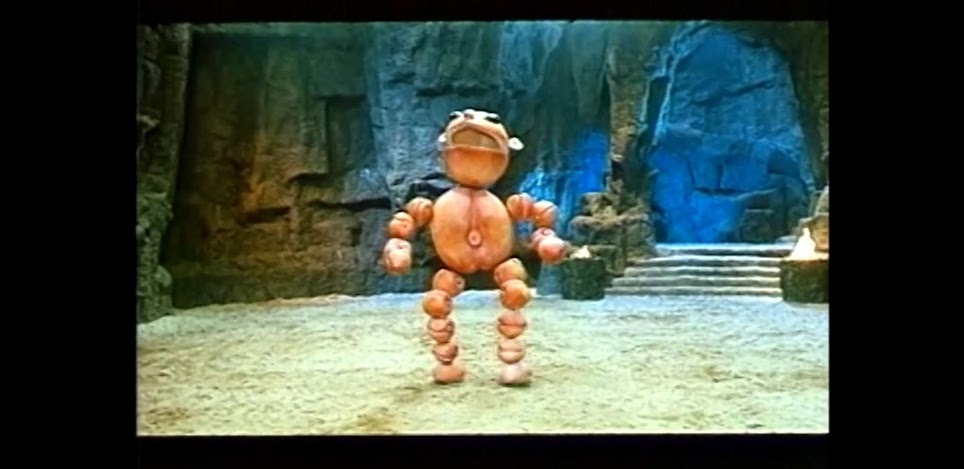
Although our discussion of The Maidens of Heavenly Mountains included ongoing discourse about whether the film was comprehensible, I have yet to be completely disappointed by any of the Wuxia films that was shared with the Swampflix crew by one of our listeners last year. I was excited to get back into the thick of it after loving Buddha’s Palm, and among the movie files I had downloaded to my phone to watch if I got bored while traveling was what I assumed was another Wuxia parody like Buddha’s Palm, titled Child of Peach. Upon completion, I can say that it almost certainly was, as it contains this image:
However, unlike Buddha’s Palm, this movie is awful.
Child of Peach is based on the story of Momotarō, a Japanese folk hero. The linked Wikipedia article gives a more detailed description, but the bare bones stations of the Momotarō canon are as follows . . . A boy is born from a giant peach found floating in a river by an elderly childless couple (in older versions the peach rejuvenates them to a younger age and they conceive of Momotarō more conventionally); he demonstrates essentially superhuman strength at a very early age; he leaves his parents in order to battle demonic Oni who are marauding the lands; and along the way he befriends a talking dog, monkey, and pheasant who join him in his quest to ultimately defeat the demons of Onigashimi, the demon island. This film adheres pretty closely to that schematic, adding in some additional villains, a backstory for our main character, some army shenanigans, and far, far too many puerile bathroom humor gags about piss.
The film opens as every Wuxia film I’ve seen so far has, atop a misty mountaintop, where a master martial artist and his wife are raising their infant son while protecting the Sword of the Sun, attended by the master’s young apprentices who can shapeshift into the animal companions of the Momotarō legend. Here, their names are translated as Tiny-Dog, Tiny-Monkey and, um, “Tiny-Cock.” The mountaintop is invaded by an Oni whose name is translated as King Devil, who slays the couple, but not before the wife beseeches the giant magic peach that is the centerpiece of their cave home to save her child, which it does by taking the baby within itself and flying off of the mountain like a pod out of Krypton. The young animorphs are exiled from the mountain as well as King Demon emerges victorious. Below, an elderly couple argues “humorously” with one another before the wife goes to the river to wash clothes. The giant peach floats by and she gets into some tiresome slapstick shenanigans while trying to capture it. When she does, she plans to eat the peach, only to discover a human(?) child within. Also, before she does so, the big peach urinates on her from its peach crack. Comedy!
“Peach Kid,” as the subtitles refer to him, grows up quickly due to interference from a magic fairy who also used to reside on the mountain of the Sword of the Sun, as she is aware that King Devil has gone to the underworld and resurrected some evil warriors, and his hordes start to ravage the land. A local known as the Melon Knight holds a contest to gather together a group of warriors to fight off King Devil and his goofy minions, with one such event involving the wrestling of a bull. Peach Kid, now a magically aged adult (and very clearly played by a woman, Hsiao-Lao Lin), has already demonstrated super breath when an attempt to stoke the stove fire in his adopted parents’ home results in him blowing the thing apart and whom we have also already seen splitting firewood in half with his bare hands like Captain America in Age of Ultron, manages to flip the animal completely. The soldiers laugh him off, and his animal friends help him get revenge on Melon Knight and his vizier by peeing in their sake. Comedy!
Eventually, all of this comes to a head. Peach Kid and his animal buddies form into a peach-themed Voltron kind of thing (as seen above) and defeat King Devil and all is right in the land.
I really wanted to like this one, and went into it with the expectation that, even if it weren’t great, there would at least be some cool wizard fights, but it barely has any of that. A few of the lieutenant Oni have some cool things going for them; one has a big bag of mystical wind that he can use in fights to blow his opponents backwards, and “Granny” has a staff that shoots a stream of fire, but that’s really all that there is to speak of. It’s also worth noting that the version I saw referred to the windbag Oni as “Aeolus,” whom you may remember from The Odyssey as the god of the wind. I’m not sure that this allusion to Greek mythology is present in the original text, but I did fail to mention earlier that the mountain on which Peach Kid is first born is referred to in the subtitled dialogue as “Olympus.” I can’t tell if that’s just thematic naming on the part of the translator, but I would assume so. There’s very little information about this film online (in English, anyway), and the IMDb translations of the characters names make a lot more sense that what was present in the version I saw. I’ll also admit that the copy I saw had some of the worst subtitle quality control that I have ever seen, as there were large swathes of the dialogue that were rendered completely illegible by their placement on white portions of the screen. I may have understood the film better if a little more care had been put into it, but I don’t think that I would have liked it more. This was intended to be enjoyed only by children, as the preponderance of scat humor and lack of any comedy that would appeal to a more mature audience make clear. If you’re working your way through the Wuxia canon, skip this one.
-Mark “Boomer” Redmond












 Swampflix