It probably hasn’t escaped your attention that I like to talk about Scream. Like, a lot. Scre4m was my 59th favorite movie of the 2010s, I mentioned the franchise nine times in Part II of my favorite horror movies by year list, and I talked about how Sidney Prescott is my favorite final girl in my review of 5cream. I’ve mentioned it on our Lagniappe episodes of the podcast too many times to count, but in our Cherry Falls episode in particular, we talked about the 4-5 year glut of what I like to call “the post-Scream slashers,” which broadly fall into three categories:
- Movies that copied Scream‘s self-awareness and setting while adapting and updating classic horror: The Faculty as Invasion of the Body Snatchers – in a high school! Disturbing Behavior is The Stepford Wives – in a high school! Joy Ride is The Hitcher – on a road trip home from college (sorta)!
- Movies that didn’t seem to understand that what made Scream different was how it commented upon the genre, and so simply copied the setting, the teen cast, the shadowy killer with an inexpensive outfit, and the non-supernatural horror, and just made slasher flicks with high school (and occasionally college) students being tracked down by someone on a mundane vengeance spree: I Know What You Did Last Summer, Urban Legend, and, of course, I Still Know What You Did Last Summer.
- Movies that copied the teens-in-danger trope but didn’t bother to keep it grounded and instead went all-in on the supernatural, like Final Destination and Jeepers Creepers.
Of course, we cited Cherry Falls as the anti-Scream (and if you want more details, you can listen to the episode), but there was one movie that was accidentally left off of that list, and definitely deserves to be mentioned: Valentine, directed by Urban Legend-helmer Jamie Blanks. I won’t call myself an Urban Legend apologist because that would imply the movie needs to apologize for something (other than the presence of Jared Leto), but I will say that I find it much more entertaining that the critical consensus does, and it’s not just because Loretta Devine is divine. I always wondered if Valentine, which has the prestige of being based on a novel like I Know… and Killing Mr. Griffin, was really as bad as its reputation lets on. It breaks my heart to tell you that, unfortunately, Valentine isn’t a bad movie, it’s just … only 66.7% of a great movie. I don’t know if a lot of it ended up on the cutting room floor (as infamously happened with Disturbing Behavior, which also feels similarly disjointed) or what, but man, I’ve rarely seen a movie that feels like so much of it is missing, and I’ve seen On the Silver Globe.
There’s really no other way to talk about why without getting into the entire film, so spoilers ahead, as much as something that was in theaters before 9/11 can be spoiled.
The film opens with a promising, frenetically cut scene in a middle school Valentine’s dance in 1988, as pipsqueak Jeremy Melton (Joel Palmer) asks five different girls to dance with him: Shelley, Lily, Paige, Kate, and Dorothy. The first three are rude and cruel in the way that children often are, while Kate rejects Jeremy softly with a “maybe in a little while” and Dorothy, who is pudgier than the other girls, accepts his advances. The two of them kiss beneath the bleachers but are discovered by a pack of bullies, who mock them. Dorothy, embarrassed, quickly agrees when the bullies joke about the sixty-pound “pervert” Jeremy “attacking” her, and the bullies pour red punch over him like he’s Carrie White at the prom before stripping him out of his wet clothes and beating him up, while several of the students who are looking on wear uncanny Cupid/cherub masks . Thirteen years later, Shelley (Katherine Heigl, post-Bride of Chucky and right in the middle of Roswell) is a medical student who, after a terrible first date with a man named Jason Marquette (Adam Harrington) who continuously refers to himself in the third person and makes Shelley pay for her portion of the dinner once he realizes she’s not going to sleep with him, is pulling a midnight study session involving an autopsy. After a jump scare, she receives a Valentine’s card with a macabre inscription before being murdered by the Cupid-masked killer.
Elsewhere, Paige (Denise Richards) drags Kate (Marley Shelton) to a speed dating event, despite the fact that Kate hasn’t broken things off with boyfriend Adam (David Boreanaz), who is noted to have a drinking problem, hence the two of them being on the outs. they receive news of Shelley’s death and the two women, along with Lily (Jessica Cauffiel) and the now-svelte Dorothy (Jessica Capshaw), meet the detective investigating the murder, Vaughn (Fulvio Cecere). Each begins to receive creepy notes and valentines signed “J.M.,” up to and including a box of chocolates filled with maggots, and we also meet our cavalcade of other love interests/ineffective red herrings: Lily’s boyfriend Max, a video media artist who has built a maze of images of disembodied mouths and sexy torsos talking about love and sex and whatever (no one in the movie seems to like it; I think it’s terribly pretentious but I would also go and have a very good time, for what it’s worth); Dorothy’s new boyfriend Campbell, who’s wormed his way into a guest room at the giant mansion her father owns and keeps talking about NFTs his new start-up and how his money is all tied up therein; Brian, a hot guy that Kate was starting to connect with at speed dating before Paige stole him away; and Gary, Kate’s creepy neighbor, who perpetually pitches unwelcome woo at her in sentences that rhyme with her name and whom she suspects of stealing her underwear in the laundry room.
The police remain focused on trying to locate Jason Marquette because of the “J.M.” thing and that he was the last person to see Shelley alive. There’s also a subplot about Ruthie (Hedy Burress), a woman who shows up and accuses Campbell of having bled her bank account and warning Dorothy that she’s probably being used for the same scam. The surviving women discuss whether it’s possible that any of the men in their lives could actually be Jeremy Melton, all grown up after hitting the gym and possibly getting plastic surgery, throwing around accusations and various levels of cattiness that reflect deep, unspoken grievances from childhood. Dorothy even admits to having falsely accused Jeremy, which led to him being sent to a reform school, which led to juvenile hall and so on, before he dropped off of the map. Leading up to the climactic house party at Dorothy’s, most of these are whittled away as characters are murdered: the Cupid killer shoots Lily with arrows at Max’s show (her disappearance is unremarked upon by her friends as her having simply gone on her planned business trip), Gary is discovered in Kate’s bedroom trying on her underwear by Cupid and is bludgeoned with an iron, Campbell gets an axe to the back while relighting the pilot light at Dorothy’s, etc., and Ruthie is later killed shortly after discovering his body. It’s also worth noting that in most of these scenes, the Cupid mask is seen bleeding from its right nostril, just as Jeremy did at the dance all those years ago. People leave the party in droves following a power outage that results from the method by which Cupid kills Paige—in the film’s most memorable scene, which we’ll come back to—and when Kate tries to call Lieutenant Vaughn, she discovers his corpse along with a note that she had earlier given to Adam, cementing that he’s Jeremy, come round at last to get his revenge. She goes back to the house, where Adam behaves creepily but could also just be talking about falling off of the wagon, and Kate then fights Cupid, who is unmasked as … Dorothy. However, as Adam cradles her in his arms while they wait for the police to arrive, his nose is bleeding, before we cut to credits.
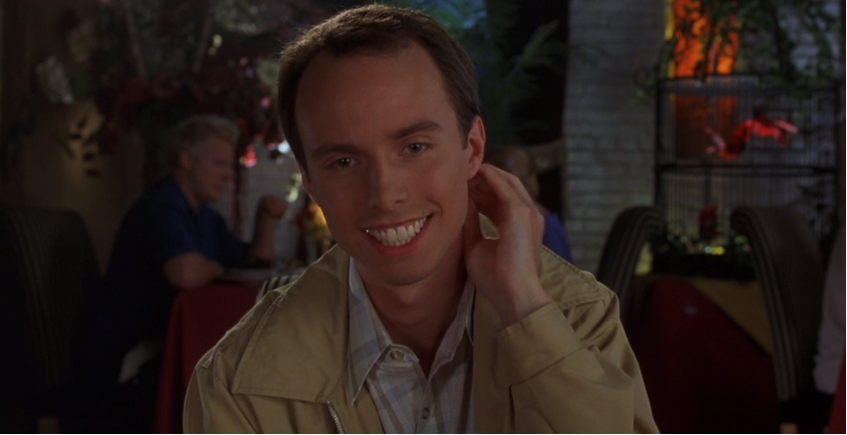
There’s a lot that’s fun and good here, but I’m more fascinated by what isn’t here than what is. Just to start us off with a visual example, one of the men that Kate meets on the speed date is a smiling goon who’s too awkward to work up the nerve to actually say something to her:
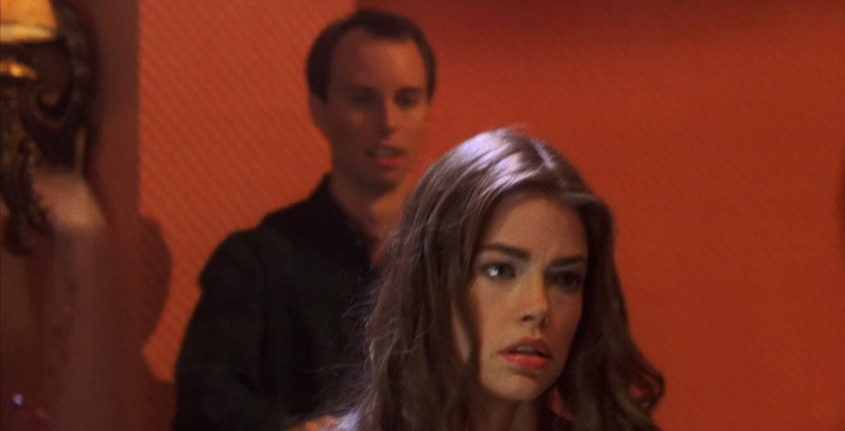
After fifty minutes, this guy shows up again, standing in the stairwell behind Paige when she comes downstairs at Dorothy’s party:
That’s far too long between scenes for a red herring character to appear and be effective, and so little attention is drawn to him in this second appearance. It’s hard to explain but it just makes it feel like there was or should have been an intervening scene in the film’s second act, where he reappeared briefly and the film could have hinted that he was Jeremy, but it’s simply not present. In fact, there are several large group shots at Max’s art exhibition where it would make perfect sense for him to appear in the background, but I went back and watched that sequence in its entirety and he doesn’t appear in any of the crowd shots, foregrounded or otherwise; it almost makes more sense that he did appear here and was cut.
And that’s not the only thing that’s narratively unfulfilling or otherwise doesn’t make sense in the language of film. Cameron is one of the film’s more involved red herrings, and he’s used more effectively than some of the others as well given that he is clearly up to no good, but it’s merely criminal, not homicidal. Unfortunately, however, he is killed mere moments after we’re given the biggest hints that he might be the killer: he is unable to sexually perform for Dorothy, indicating that he’s not as into her as his cover story requires, then he gives her a necklace with a cherubic Cupid on it as a Valentine’s/apology gift, and then he goes down to one of the house’s spa areas and unsuccessfully tries to transfer her father’s money over the phone while scratching at the right side of his nose in agitation. This would be really effective if there were a scene or two in between them that left the house, creating some tension about whether Dorothy was safe or not, then cut back to Cameron trying to transfer funds. To digress for a moment, when Vaughn questions the women about boyfriends who might be behind the scary valentines and such, Kate claims that Adam simply can’t be Jeremy since she’s known him for a couple of years and even rattles off a series of facts about where he’s from and what his parents do for a living. It’s not my practice to review the movie I wish we were presented with or give feedback like this very often (I don’t never have some armchair directing feedback, but it’s not common), but this film almost begs for it, especially because the gaps are conspicuous in their absence; it’s not just that there’s something ephemeral that’s “missing,” it’s like there’s a specific shape that’s been cut out, like when a cartoon character leaves their outline after running through a wall. Right here is the perfect place for a scene where Kate, her certainty about Adam shaken, should have tried to do a little digging about Adam’s past; maybe she’s never actually met these parents and she casually asks Adam about them in a way that makes him react oddly, or she tries to look up the law firm where his mother works only to discover it doesn’t exist or contact the school where Adam’s father supposedly works only to learn there’s no “Mr. Carr” teaching there. Instead, we get two back-to-back scenes (six minutes of screentime) with Cameron and Dorothy in which no tension is built. This is pretty basic stuff, where the audience leaves one scene now assured that Cameron is the killer, then they have that determination undermined by Adam’s behavior or the discovery of lies in his personal history.
Let’s talk about Scream for a second. I haven’t read the book on which it was based in its entirety, only the first two chapters that are available on certain websites as a preview, but there are enough differences in what I read versus what I saw to say that there were major revisions: Kate’s character is named Jill and is a mystery writer, Paige is called Tara and is an actress, and it is Adam’s character, called Nate here, who is the artist, not Max to bring the film more in line with the Scream narrative. The book opens just after the killer has committed his first revenge murder, and it happened in a bedroom, not a medical school morgue like in the film. The first victim in the novel is already dead at the time of the first line, but Valentine the film goes out of its way to evoke the opening of Scream instead, spending a lot of time with a character getting to know her before she’s killed, and utilizing one of the bigger names in the cast for this scene for shock value. Heigl didn’t have the superstar power that Knocked Up and Grey’s Anatomy would give her in the coming years and certainly wasn’t as famous as Drew Barrymore, but she was one of the big leads in a show that was aimed at and popular with the film’s demographic, and the ongoing staying power of Wish Upon a Star says a lot about how effectively it lodged itself in viewers’ minds. As in Scream, there is police involvement, and the primary red herring (Jason Marquette/Cotton Mather) is arrested for a time while the killings continue unabated, but the killer covers his tracks sufficiently that no one realizes this. And, just like Scream, the movie ends with a giant house party, and it’s this that I want to focus on for a minute.
Dorothy’s big Valentine’s Day house party takes up far, far too much of this film’s runtime. Valentine is 93 minutes without credits, and the last 35 minutes, nearly 40% of the run time, all take place during this party. Worse that that, remember when I mentioned that nothing happens between the scene with Cameron acting suspiciously with his limp dick and Cupid necklace and the scene of him trying to defraud Dorothy’s father’s bank and then getting murdered? Nothing happens between those two scenes and the party, meaning that we spend the last 41 minutes of the movie at Dorothy’s house. The only time we leave there is when there is a quick cutaway to Lt. Vaughn calling Kate from his car to tell her that Jason Marquette was released and that he might show up at the party. Now, compare this to Scream, which likewise spent a huge part of its runtime (48 minutes) in its final act house party, but we don’t spend that entire time in Stu’s house. There are memorable scenes in the news van and down the road where Gale and Dewey take a walk that function to break up the visual monotony of spending too much screen time in one location. Once again, the outline of something missing is just as present in the narrative as the things that are actually there. To give credit where it’s due, this is where the film’s most interesting kill happens, wherein the killer manages to trap Paige in the hot tub under a clear plastic cover and starts drilling holes in it as she swims around evading the drill bit while having to keep her mouth and nose in the very small space between the cover and the water. It lasts longer than many of the other killing sequences (more on that below) and is very tense, unlike many of the others.
One of the major things that Valentine, like a lot of Scream imitators, is missing is the characters’ attempts to fight back and survive, which often makes these scenes very brief and lacking in audience investment. In the original, Casey Beckett tries to flee the house and call for help from her parents and Tatum throws bottles of beer at Ghostface and fights for her life before getting stuck in the garage door that breaks her back; in Scream 2, which was released four years before Valentine, Maureen begs the audience to realize she’s not acting and help her, and Cici manages to do some real damage to Ghostface before being thrown off of the sorority house’s roof. And of course, in all of them, Gale and Sidney are pretty banged up at the end because they are badasses who refuse to die. Here, the murders are brief and, insofar as the characters have any agency at all, they mostly just try to hide (ineffectively): Shelley’s is the closest to a real attempt to fight back, but she still ends up hiding in a body bag, which is where the killer finds her; creepy Gary is beaten to death while cowering, moments after being discovered in Kate’s apartment by the killer and is never mentioned again; Lily gets shot to death by arrows from a distance and then falls down the center of a stairwell into a dumpster; Campbell takes an axe to the spine without ever seeing the killer coming for him. I actually saw more of this movie while testing this: from first arrow wound to dumpster fall, Lily’s death takes up 31 seconds of screen time. In comparison, Tatum’s death scene in Scream, from the moment she sees Ghostface to the moment her spine cracks, is 94 seconds, and that’s not counting the 90 seconds before that where she enters the spooky garage, struggles with the beers, and finds herself locked out of the house while tension rises. What’s more, this is one of the few areas in the movie where it feels like the failure is in the film itself, not the editing or the ostentatiously absent footage; there’s nothing missing here, the scenes simply aren’t that good. I also want to point out that some of the murders happen offscreen and it seems like it’s an actual stylistic choice, like Lt. Vaughn’s death being kept secret until Kate discovers his body, while some threads are simply left hanging, like Brian being left tied to the bed by Paige, implying that he might still be upstairs blindfolded and naked while the climax of the movie takes place.
One thing that Valentine has that Scream doesn’t is opening credits. Stick with me here! Valentine‘s credits are intercut with its opening scene, and like I mentioned earlier, that opening is very effective and the film’s intersplicing of it all means that Valentine can have its cake and eat it, too, having old school long credits but making them interesting enough that the audience doesn’t mind. Unfortunately, this is also the film’s drawback, as the format of the titles spoils who the killer is. David Boreanaz was four years into playing his iconic role of Angel, two seasons of which were on his own show as the title character. That may have only made him a household name in households that watched Buffy, but for those households which also tolerated network series about quirky not-quite-a-cop investigators, his—wait, this math can’t be right. 245 episodes over 12 seasons? Ok, but jeezum petes—uh so yeah, Boreanaz’s turn as Booth on over a decade of Fox’s Bones also contributed to his fame. His is also the only man’s name in the movie that appears on its own during the credits. Richards is credited first, then Boreanaz, then Shelton, Capshaw, and “with” Heigl. The other men are listed in the opening, but always with other names, so you, the audience member who presumably knows who Boreanaz is, are subtly already clued in that he will be the killer, because if it’s not him, who would it be? Surely not one of these other comparative no-names (no offense), most of which, again, don’t effectively function as red herrings because they appear too infrequently. Gary is in two scenes; Brian is in two scenes. Every red herring is only 2/3 of the way there for them to work. The grinning goober who couldn’t talk at the speed dating event is only in two scenes, and all of it feels like a lot of the middle was cut out, where we would get that second scene before the final act that would lead us to believe that any one of them might be the masked killer. There’s even the tiniest bit of a hint that Vaughn might be the killer, since he’s not present at Max’s gallery opening but does mention that he’s seen Max’s work, as well as the sinister way that he isolates Paige and is a creepy lecher about it. Instead, because something is missing about the actual language of film, the viewer spends the whole rest of the movie waiting for the other shoe to drop and Adam to be unmasked as Jeremy. Imagine if Scream had opening credits and Skeet Ulrich was listed second while the rest of the male cast, including David Arquette and Jamie Kennedy, were relegated to tenth and eleventh billing; there would never be a moment of mystery, and there isn’t here, either.
But that’s just it. The biggest empty hole that’s identifiable here is the lack of a second killer. That’s a foundational part of what made Scream work and is also present in its sequels (other than Scream 3, where it was cut at the last minute) but not its imitators (other than I Still Know…, which almost makes it the better of the two). Except—hear me out here—I think that Valentine did have a second killer, and the removal of that was one of the linchpins that made the rest of the story work. I mentioned before that the Cupid mask has nosebleeds, just like Jeremy, but it doesn’t happen every time. After Kate struggles with the Cupid-masked killer, Adam suddenly appears and kills them, with the unmasking revealing that Dorothy was under there. The Adam-is-Jeremy bloody nose reveal would have us believe that this was all part of Adam’s plan, that he somehow attacked Kate as Cupid and then dressed the disabled Dorothy (perhaps crushing her windpipe so that she couldn’t call out to Kate and reveal the deception) as Cupid so that he could then shoot Dorothy, have her revealed as the killer, and then get back together with Kate with no one to interfere and his vengeance sated. But what if that’s not what was supposed to happen? What if Dorothy and Adam were supposed to be in on it together. Some parts of the film actually make more sense this way, as Adam seems ideologically driven but Dorothy also harbors a lot of bitterness about being the “fat girl” of the group when they were younger. Further, there are some kills that, due to the editing, only make sense if this is the case, and it feels like the fact that the Cupid mask only bleeds sometimes is supposed to be a clue to this reveal, and that re-viewings of the movie with that in mind would reveal who was behind the mask during certain scenes. Adam wants to kill the women who spurned him, but has no reason to kill Cameron, and it’s notable that we don’t see the mask bleed during that scene, and that the timeline would seem to indicate that, since this was a few hours before Dorothy’s party, it was happening at roughly the same time that Adam was across town giving Kate her lollipop valentine. Although Dorothy is the reason that Jeremy went away and took a downward turn, it’s not a completely unrealistic twist that her bitterness toward her richer, smarter, prettier (in her eyes) friends led her to team up with Jeremy to take them down, only for him to fall for Kate and end up betraying her in order to have her be the scapegoat and let him have his dream future with Kate.
However, for whatever reason, that ending didn’t sit well with test audiences, or perhaps studio executives. Maybe someone thought it was a little dated and fatphobic (which it would have been) and decided to course correct too late to fill in the gaps with it removed. Or maybe this is just a bad movie and I’m too invested in the parts of it that are good to let it go at that and insist on finding ways to close loopholes and fix bad editing with my projected fix-fic to turn this into a better film. But I don’t think so. I think that this was a movie with great promise that fell apart under its own weight with too much supporting material removed, even if I’m wrong about Dorothy.
-Mark “Boomer” Redmond