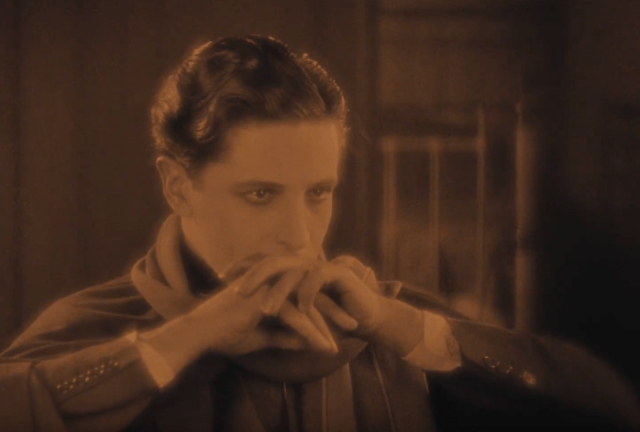
While attending a recent screening at my local arthouse, I pointed out to my companions that there was going to be several screenings of Rear Window the coming weekend and gave it my typical whole-hearted recommendation. These were two of my younger friends who mentioned that they’ve seen far too few of Alfred Hitchcock’s films, but one of them had been in a high school theater production of The Lodger, which was quite the coincidence as I had a library copy of the DVD at home at that very moment. It’s also available on the Criterion app and Tubi (at least at the time of this writing), which means it’s pretty accessible, for anyone who might be interested. I know that a silent film is a hard sell these days, but I liked this one quite a lot and loved its use of expressionistic composition and dark atmosphere and recommend checking it out.
The Lodger (subtitled A Story of the London Fog) is a 1927 thriller from the Master of Suspense, his third film. It largely centers around one family’s experiences with a new lodger in their boarding house while the city at large quivers in fear at the actions of a serial killer leaving notes identifying themself as “The Avenger.” Mr. and Mrs. Bunting are caring and doting parents to their daughter, Daisy, a blonde young fashion model still living at home with them. Every Tuesday night for months, a blonde woman has been found murdered by the Avenger, and the police seem at a loss. The Buntings are friends with a detective named Joe Chandler, who is visiting them when news of the seventh victim arrives. That same night, a dark and imposing man appears at the Bunting home in response to their “room to let” sign. Joe is eventually put on the case to find the Avenger, and although he is able to discern a pattern from the location of the killings and estimate the general location of the next slaying, his jealousy over the growing attraction between the lodger and Daisy leads him to suspect the lodger of being the killer. When a search of the lodger’s, um, lodgings leads him to a map of the victims’ locations and clippings about the killings, the lodger is arrested, but Daisy helps him to escape, even though she (and we) still have no evidence of his innocence.
There were moments during the course of the film that I was worried we were headed toward that easiest conclusion, but I should have known that even in this earliest part of his career, Hitchcock would already be working in a more subversive manner. In recent discussions on the podcast of Strangers on a Train, we talked about how Hitchcock never had much respect for the police, individually or institutionally, and there are already elements of this at play. Joe Chandler may manage to put together some clues about the real Avenger, but his personal failures of pettiness and jealousy lead him to pursue an innocent man, to the point that during his flight from the law the lodger is almost lynched by a mob while the real killer is elsewhere racking up yet another body. Hitchcock also loved to tell (and retell) the story of an innocent man being wrongly accused and pursued, from The 39 Steps to To Catch a Thief to North by Northwest to Frenzy, so it’s no surprise that it turned up as a plot point in this early work of his. I did expect there to be a bit more of a twist surrounding Joe, however.
It’s never quite clear exactly what his relationship is to Daisy. Sometimes, she seems very receptive to his wooing, but at other times rejects his advances, although it’s a possible interpretation that her rejection largely occurs in scenes in which her parents are present. In their first scene together, he flirts with her by cutting a heart shape out of the dough that her mother is preparing and placing it in front of her, to which Daisy responds by tearing the heart in half and handing it back to him. To me, this established that his interest was unwelcome, but there are other scenes in which she welcomes his attention with enthusiasm. At the time of release, Joe’s actor Malcolm Keen was 40 years old, and he looks older. I’d probably attribute it to the technological limits of the time rather than to an intentional aesthetic choice, but Keen’s fair complexion and the make-up available at the time renders him, well, a bit ghastly-looking. In comparison, although Ivor Novello’s lodger character arrives at the Bunting house looking and behaving like a total weirdo, once he settles in, he reveals himself to be as beautiful as he is brooding. As a result, although I was willing to believe that the film was headed toward the revelation that the lodger was the Avenger as easily as it might have been headed toward his innocence, I also thought it might be revealed that Joe was the Avenger, but that might be my expectations being a little too close to modernity. The Avenger is apprehended entirely offscreen, his identity never revealed, but the audience of today looks at this rather small cast of characters and automatically assume that one of the characters has to be the killer. Through that lens, it could only be Joe, but that wasn’t really a trope of the medium yet.
Recently, Brandon texted me to let me know that Puzzle of a Downfall Child—one of my favorite films that I have ever seen and which, when we covered it for Movie of the Month in June of 2019, was almost impossible to find save for a (now deleted) YouTube upload—was on sale from Koni Lorber on Blu-ray for only $10. (We are not sponsored, but I would gratefully accept a free copy if the traffic on the above link is in any way influential.) Brandon mentioned that he thought Dark Intruder would be up my alley, and I realized that I had already acquired a copy of this in a lot of Alfred Hitchcock items some years ago. Dark Intruder is not actually a Hitchcock affiliated project, as it was shot as the pilot for a proposed series to be called Black Cloak, but the crew of the Alfred Hitchcock Presents series did shoot it, so it makes sense that the aficionado whose estate sale I attended would have lumped it in there.
Clocking in at a hair shy of a full hour, Dark Intruder has several points in its favor. Leslie Nielsen plays the lead: a socialite playboy named Brett Kingsford, whose persona belies a fascination with (and some talent for handling) the occult. He has a little person manservant/butler named Nikola (Charles Bolender) who assists him, and he’s friends with Police Commissioner Harvey Misbach (Gilbert Green). If you’re someone like me whose brain has been completely rotted by too many comic book movies, then you probably recognize a very Batman-like pattern in there, simply replacing the “cowardly and superstitious lot” that our apparent layabout aristocrat faces with investigations into the arcane and the mystical. It’s also a period piece, being set in late 19th Century San Francisco, so there’s plenty of handsom cabs, gaslights, and fog to establish the mood. The plot kicks off when Kingsford is visited by his friend Evelyn (Judi Meredith), who asks him to check in on her fiance Robert (Mark Richman), as he has started to become sullen and withdrawn. Kingsford is also summoned by Commissioner Gordon, um, I mean Misbach, to consult on a series of murders. There’s no apparent connection between the victims, but it is clearly the work of a serial killer based on both the modus operandi and that there is a ceramic statuette left behind; the sculptures depict a man with a gargoyle on the back of his head, with each successive totem showing the gargoyle emerging further and further.
There’s some investigative rigamarole, and it’s moderately engaging. Kingsford goes to consult an Asian mystic (if the film was more specific, I could be too) who burns some incense with him and reveals, in a roundabout way, that there will be seven murders and then the creature will fully emerge. If you’re interested in this, it’s a fairly short time commitment (even if it’s one that I wouldn’t say is particularly worth the effort), so be forewarned that I’m about to spoil the reveal of this sixty-year-old failed TV pilot, if that’s something you can bring yourself to care about. Everybody still reading fine with the reveal? Ok. See, Dark Intruder throws out a lot of ideas, including talking about Lovecraftian concepts and name-dropping Dagon, but what this ultimately boils down to is a bit of a Basket Case situation. Evelyn’s fiance Robert was born with a malformed twin that all believed had died save for the family nurse who kept and raised him, and the murdered people were all party to this in some way or another. If the creature can kill all seven intended victims by a certain night (which also happens to be the night of Eliza and Robert’s wedding rehearsal … or something — this was very difficult to pay attention to) then he and Robert will swap bodies, and he will no longer be a monster.
There’s nothing wrong with that premise, but I have to admit that as much as I love Nielsen, he does not feel right in this role. He’s playing the character a bit too modernly, with a bit too much of a sneer. This might be a long reach, but the thing it reminded me of the most was the early-aughts Bruce Campbell TV vehicle Jack of all Trades, a campy pleasure of mine in which Campbell plays an American spy named Jack Stiles, stationed on a South Pacific Island in the early 1800s, and doing a bit of a Scarlet Pimpernel thing in his alter ego as the Daring Dragoon. A part of the comedy comes from the fact that Bruce Campbell is playing the Jack no differently than he would play a modern part; the charm comes from how much you enjoy Bruce Campbell saying something pithy and then making a face at the camera, which is not for everyone (more for me!). It feels strange to call Leslie Nielsen’s performance something that feels “too modern” when we’re talking about something that predates the moon landing, but that’s precisely what’s happening. This isn’t the sincere, stoic Nielsen that you get in Forbidden Planet or any number of his appearances across Columbo & Murder She Wrote, nor is it the all-gas no-brakes tomfoolery of his later career. Instead, it’s just a little subtle smugness to him, where he’s a little too above it all and snarky about it, and it’s the same energy that he had in Airplane! It feels wrong, and that permeates the entire piece.
The design of Robert’s Belial is a mixed bag. The face is appropriately harrowing to look at but is little different from a wolfman design. Dark Intruder is smart to keep this from us for as long as it does, instead showing only the monster’s impressive (and scary) hawklike talons for most of the runtime. Its best sequence involves Kingsford, Robert, and Evelyn having been drawn to meet a reclusive medium, who speaks from beneath a dark cowl with an eerie, distorted voice, and when the protagonistic group leaves, the reveal of those talons from beneath the psychic’s robes is effective. For much of the rest of it, however, wheels are spinning. I was reminded of the last few seasons of Alfred Hitchcock Presents, when the program was retitled as the Alfred Hitchcock Hour and the stories ran for an entire hour block instead of a thirty-minute one. Almost all of those that I have seen suffer a great deal from being expanded to that length, in comparison to the better-paced segments from when the show was half the runtime. Everyone besides Nielsen completists can leave this one off their watchlists, unless you’re merely drawn in by the oddity’s novel mechanical qualities.
I really took my time picking out a movie at the video store last weekend. It was that Saturday between Christmas and the new year, and I had spent the day in solitude, which is not normally my way. I went to the mall to pick out my new sexy wall calendar for the year (you have to wait until after Christmas to buy one for yourself, otherwise someone may get one for you), idly wandered for a bit thinking about the lyrics of “Hard Candy Christmas,” and went to a coffee shop to see a friend who works there but who wasn’t there. I went to the home of a friend who had given me a very nice bath bomb for the holiday and offered up their modern, fancy bathtub for my use while they were out of town, and I sat on their balcony and stared into space. Then I wandered the aisles, trying to think of what I wanted to watch that night, with each DVD box that I picked up making me realize I would rather watch this or that with my friend once he got back to town. I spent a lot of time debating over the director wall and finally settled on a Hitchcock I had never seen.
The Lady Vanishes is the last of the master’s works that he completed in England before he came to the states and engaged with the Hollywood system. Released in 1938, the film follows the misadventure of one Iris Henderson (Margaret Lockwood), a Londoner who has spent her last few weeks of being single skiing with her girlfriends at a town in the fictional country of Bandrika. On her final night, she meets the charming Mrs. Froy, a governess who is returning back to England now that her charges have outgrown their need for her tutelage, and she also encounters the ethnomusicologist Gilbert Redman (Michael Redgrave, father of Vanessa and Lynn, in his first film role), who is in the room above her and recording information about a local folk dance, which disturbs her rest. With the rail lines snowed in, two proper English snoots named Charters and Caldicott (Basil Radford and Naunton Wayne, two of the most English names I have ever seen) are also forced to stay at the same inn, where they fret over the dwindling menu and the increasing unlikelihood that they will make it to any of the cricket matches that are on their agenda. That night, unbeknownst to any of the travellers, a serenader below Mrs. Froy’s window is strangled. The next morning, an attempt is made on Mrs. Froy’s life by someone pushing a potted plant onto her head from an upper window, but Iris is struck instead. Mrs. Froy helps her onto the train and they find themselves in a compartment together. Ultimately, the two wind up having tea and getting to know each other a bit better before Iris takes a short rest. When she awakes, however, she finds Mrs. Froy missing and, worse, everyone in the compartment claims that there never was a Mrs. Froy. As she searches the train for the woman, she happens upon Gilbert again and reluctantly accepts his assistance. The two of them also encounter renowned surgeon Dr. Hartz (Paul Lukas), who attempts to persuade Iris that perhaps the whole thing is the result of her earlier blow to the head. Elsewhere, however, an English barrister named Todhunter orders his mistress (Linden Travers, cheekily credited as playing “Mrs.” Todhunter) not to admit that she saw Froy earlier, lest their involvement in an investigation reveal their affair. Who was Mrs. Froy? Where has she gone? Who is involved?
As a longtime fan of the Alfred Hitchcock Presents TV series, I had long thought very little about this film, as I assumed it would follow the same plot as that program’s episode “Into Thin Air,” which was likewise about a young woman who is told that an older woman (in this case, her mother) was never present at the hotel in which the two are lodging. This turns out to have a completely different narrative, but according to some sources, the novel upon which The Lady Vanishes was based, Ethel Lina White’s The Wheel Spins, was partially inspired by the urban legend of The Vanishing Hotel Room, which was also more explicitly recapitulated in the aforementioned “Into Thin Air,” so it turns out I wasn’t pulling that connection out of, um, thin air. I would recommend that episode as a companion to this film; it’s one of the most cinematic, and makes great use of the minimal sets that the TV production would have had access to. Visually, this is one of Hitchcock’s most striking and sumptuous of his pre-Hollywood era. Although the modern eye can’t help but notice that the Bandrikan town in the film’s opening is a miniature, it’s a very high quality one that allows for some beautiful sweeping shots that move from the train yard to the inn. The rear projection work for the scenes set aboard the train are very effective at conveying a perfect closed loop of a narrative intertwined with a constant momentum, which is quite a lot of fun.
Lockwood and Redgrave are fantastic together. When we first meet Iris, she comes off as a bit of a brat, being treated like royalty by the staff of the inn, who treat the milling crowd in the lobby as an afterthought. Gilbert, for this part, comes off as a cad from the outset as well, as it’s not unreasonable for Iris to request that his guests cease stomp-dancing on the floor directly above her bed. Their initial antipathy is the kind of electric interplay that the nostalgic crowd laments as lacking from contemporary film, and the way that it blossoms into a romance between them is what we go to the movies for, baby. Their interplay would be comic relief enough without the stuffy Caldicott and Charters, but the latter two are merely part of a truly iconic cast of supporting characters. I was particularly taken with “Mrs.” Todhunter, whose moral convictions and equivocations wield the power of life and death at points, even though she herself is unaware of the implications of both her silence and her admissions. Catherine Lacey, who comes into the film as the Nun late in the film, is also a world class addition, and I loved every moment we got to spend with her. The presentation is exciting, the cast is marvelous, and the mystery is wonderful.
Our current Movie of the Month, Alfred Hitchcock’s 1946 post-war noir Notorious, is a love story first and an espionage story second. Most of the thrills in its first hour are found in the bitter flirtation between Ingrid Bergman & Cary Grant, whose catty chemistry pounces on the dividing line of what the Hays Code would allow without ever fully crossing it. There’s so much explosive energy in their love-hate situationship that you often forget the real threat in the picture is the Nazi cabal they’ve gone undercover to subvert. It isn’t until the second half of the film that any of the Nazi expats step into the spotlight with vicious enough villainy to match the volatility of Bergman & Grant’s flirtation. That centerpiece isn’t any of the men who make up the secret Nazi cabal smuggling uranium into their Brazilian hideout, either. It’s one of those men’s mother (Leopoldine Konstantiin), a true believer in the Nazi cause whose default distrust & hatred for Bergman proves useful in outing her as a spy.
Notorious may have been one of the first instances of Hitchcock getting distracted from a movie’s more obvious villains to focus on an evil mother figure instead, but it would be far from the last. In the 1960s in particular, he made a string of iconic thrillers that highlighted wicked mothers at the periphery of the center-stage evil. So, here are a few recommended titles if you enjoyed our Movie of the Month and want to further sink into one of the all-time great directors’ unresolved Mommy Issues.
If you’re going to delve into Hitchcock’s auteurist Mommy Issues, you kinda have to start with the movie that put the “psycho” in “psychobiddy,” right? Psycho is a notorious act of misdirection. It starts as a seedy noir about a lovelorn secretary who robs her boss blind in the daylight, then shifts halfway through to a proto-slasher about a Peeping Tom motel owner who slays that amateur thief and everyone who comes looking for her. It’s also misdirection in the characterization of its sweaty, pervy killer, since its casting of the goofily charmingly Tony Perkins in the role masks the psychosexual violence of the shower scene until it’s too late for his first victim to escape. Perkins is such an adorable, All-American sweetheart that the audience is tempted to continue blaming his overbearing mother for his . . . transgressions, even after it’s revealed that she’s been dead for a solid decade before the audience arrives at the Bates Motel.
Regardless of Norma Bates’s status as a living being, she’s a dark presence in the picture – sometimes literally, as when her silhouette appears in a shower curtain or at the top of a staircase during a kill scene. Before we know what Norman is capable of, we hear Norma shaming him about his “cheap erotic mind” in shrill arguments from the Gothic home outside the motel. By the time Norman insists that “A boy’s best friend is his mother,” we’re already aware of how abusive she is to him, framing him as more of a victim than a killer. The fact that he’s the one keeping his mother alive through his taxidermy & cosplay hobbies is beside the point; the half-remembered, half-improvised arguments he has with her ghost tell a clear story about how her responsibility for his violence.
The Birds (1963)
There’s at least clear Freudian pop psychology reasoning behind the wicked motherhood themes of Psycho, whereas they’re almost completely arbitrary in Hitchcock’s when-animals-attack thriller The Birds. For a long stretch of The Birds, Hitchcock seems uncertain of who’s more likely to peck Tippi Hedren’s eyes out: the supernaturally murderous birds swooping at her head or Lydia, her new boyfriend’s well-meaning but slightly overbearing mother. He eventually does decide that the killer birds are the bigger threat, but it’s a hellish journey getting there.
Hedren stars as an heiress playgirl with an international tabloid reputation for living freely, pranking with wild abandon, and frolicking naked in public fountains. When her flirtatious pranks lead her to the doorstep of a seaside small-town lawyer (Rod Taylor), she immediately finds herself at odds with the oblivious hunk’s mother (Jessica Tandy). The women’s competition for the himbo lawyer’s affections is hilariously apparent in their casting & costuming, mirroring the combatants with similar height, hair, and icy demeanor. Thankfully, being attacked by an organized army of winged hellbeasts in “The Bird War” eventually inspires the women to bond, but in the meantime their volatile tension inspires debates about whether it’s better to experience “a mother’s love” or to just be abandoned, spared of it. There’s a lot of uncanny avian violence in The Birds, but it’s somehow just as unsettling watching a grown man peck his mother on the cheek and call her “Dear” while allowing her to compete against a would-be lover. I have no idea what those two threats—crow & crone—have to do with each other, but I do know it makes for a great thriller.
Marnie (1964)
It’s somewhat foolish to push for a personal, auteurist read on Hitchcock’s adaptations of various novels & short stories that happen to dwell on fictional characters’ Mommy Issues, but by the 1960s his choices to adapt these specific projects really did spell out an obsessional pattern. For instance, the director went through three hired screenwriters during the development of this 1964 noir Marnie, because each were too squeamish to get as psychologically dark as he wanted the picture to be. Through Marnie, Hitchcock perversely lays out all of the various sexual & psychological hangups with women & marriage that echo throughout his work, so it’s impressive that he made a little time to parade around his Mommy Issues too. Thorough!
Much like the initial protagonist of Psycho, the titular Marnie is a seemingly obedient secretary who loots her boss’s safe in the opening sequence, leaving town with grotesque piles of cash. The difference is that Marnie is a habitual thief instead of an impulsive one. She’s also a Freudian headcase, her icy demeaner immediately melting whenever she’s confronted with a lightning storm or the color red. Tippi Hedren plays her as the uneasy middle ground between Norman Bates & Marion Crane: a violently psychotic, intensely vulnerable victim. What’s most unsettling (and maybe even unforgiveable) about Marnie is that Hedren’s victimhood is not blamed on the wealthy playboy (Sean Connery) who exploits her kleptomania to blackmail & rape her as his reluctant bride. Instead, all of Marnie’s problems are—shocker—blamed on Marnie’s mother, a Baltimore widow whose “Aww shucks, I’m just a poor Southerner” facade barely covers up her distanced disgust with her only child. Marnie’s mother adopts neighborhood children as surrogate daughters to ramp up Marnie’s jealousy, offering her actual daughter so little affection that she’ll shout, “Don’t be such a ninny!” at her during a full mental breakdown instead of laying a sympathetic hand on her shoulder. A last-minute flashback eventually fills in the details of how these two women initially arrived at this hateful mother-daughter dynamic, but not until after Hedren mocks the impulse to investigate & explain their dynamic with the line “Me Freud, you Jane.”
Alfred Hitchcock made over 50 movies in his half-century career as a director. I’m sure somewhere in that expansive canon you can find counter examples of his fictional mothers being lovely, loving people. I do find it amusing that so many of his mother figures at the height of his auteurist control as a major filmmaker are awful, hateful women, though. They’re the reason killers kill, the reason thieves steal; they’re the one thing in this world worse than literal Nazis.
Every month one of us makes the rest of the crew watch a movie they’ve never seen before, and we discuss it afterwards. This month Boomer made Brandon & Britnee watch Notorious (1946).
Boomer: For many years, I’ve been calling Notorious my favorite film of the Hitchcock oeuvre. I’ve recently been filling in some blind spots—most notably The Birds and Dial “M” for Murder, which are pretty big ones in that canon—so I wasn’t sure if I would still hold this one in such high esteem, or if I had simply been trying to be cool as a teenager and cite a lesser known one as my favorite and had been, perhaps, wrong all these years (even if I were, I was still of a feather with Roger Ebert, who named it as his favorite work of the director’s). I still remember the first time I caught this one on TCM when I was in high school, with the requisite intro and outro presented by Robert Osborne. He drew attention to the way that the camera at one point provides a point-of-view shot of Ingmar Bergman’s inebriated driving, her view occluded by her errant hair, and how this was meant to give the viewer a sense of her drunkenness; he talked about how Hitch had received a visit from some men from the state who were curious about why the British director seemed to know so much more about uranium than one would expect for someone not involved in espionage. He praised the arch performance of Madame Konstantin and pointed out the way that the story is bookended with a Nazi’s back to the audience as he faces judgment. And, of course, there was discussion about all that Hayes Code-skirting kissing and nuzzling.
Notorious is a love story. Girl’s father is imprisoned for treason, girl meets boy, boy recruits her to infiltrate a cabal of expatriated Nazis who are living in Brazil, boy gets inexplicably jealous when she is able to ingratiate herself with the mark, girl and boy are able to solve the mystery of her new husband’s dealings. Tale as old as time. In more specific terms, Alicia Huberman (Ingrid Bergman) is, at the story’s outset, present for the sentencing of her father to a Miami prison for his sedition and espionage, and although we are never made privy to the details, his final statement to the court reveals that he is unrepentant. She has a party at her house to drown her sorrows, and is drawn to a mysterious handsome man named Devlin (Cary Grant). She finds herself both intrigued and infuriated by his calm stoicism, and her attempts to get him to crack escalate to her insisting that the two of them go for a drive, where her reckless speeding catches the attention of a motorcycle cop, who lets them go when he sees Devlin’s identification. The next morning, he reveals to Alicia that he has been sent to recruit her for a job in Brazil. Once there, the two of them fall in love, although their little state-sponsored honeymoon comes to an abrupt end when her mission is revealed; she is to ingratiate herself with one Alex Sebastian (Claude Rains), a former contact of her father’s who, in the past, was infatuated with her. Devlin has a little pout about this and freezes Alicia out when she begs for some other way she could help, one that wouldn’t tear the two of them apart. It doesn’t work, and Sebastian proves to be an easy mark, and within a short time, he asks her to marry him. Alicia gives Devlin one more chance to speak up and pull her out, but he doesn’t, and she ends up the new Mrs. Sebastian. Her new husband adores her completely, but his hard-nosed mother (Madame Konstantin) is more suspicious of her new daughter-in-law.
What struck me on this most recent viewing is that this film is unhurried, and while an argument could be made that this is to its detriment, I think that true only insofar as one reads this as a thriller, and that it is to Notorious‘s benefit as a love story. So much of the romance is already raced past in order to establish Devlin and Alicia’s passion for one another, and I think that it might be a disservice to the believability of that love to try and abbreviate it any further. It’s fascinating that, as with the previous collaboration between Bergman and Rains, Casablanca, the things which sever our two lovers are duty and patriotism; except that in that film, released at the height of the war in 1942, our reunited Ilsa and Rick are rent asunder for what can be assumed to be the rest of their lives, while this post-war 1946 picture sees Alicia and Devlin get a happy ending (or at least are implied to have one). Spending this much time with the two of them means that the plot doesn’t really kick in until the midpoint of the movie, after an appropriate amount of time to lull you into forgetting that there’s something inevitably coming to rip the two lovers apart. It lends an air of tragedy and gravitas to their parting that they must continue to see one another but deny their passions, which Devlin does behind a screen of sex shaming while Alicia has a harder time concealing her happiness with his company, even when doing so arouses suspicion.
I’m not here to question the late master of suspense and the choices that he made, but I do think that there was room for at least one more close call for Alicia in the Sebastian manor. Madame Sebastian regards Alicia with a constant air of appraisal and unspoken but nonetheless present disapproval. The party sequence in which Alicia and Devlin, through some exciting near-misses, manage to enter the wine cellar in which the secret uranium is hidden and abscond with evidence, is a thrilling one, and there’s some truly magnificent camerawork that swoops over the great Sebastian house entryway, with its checkered tile pattern calling to mind a chessboard that Alicia must cross, before it zooms in on the tiny key in her hand. But I do wish that Alicia had almost been caught another time before or after this, to really build up the tension, although that would risk making the Sebastians seem more naive and less threatening, if she were able to get away with too much before they catch on to her. And when they do catch on to her, we get one of the great lines that I think about all the time, stated by Madame Sebastian to her heartbroken son: “We are protected by the enormity of your stupidity — for a time.”
It’s interesting that this one comes right on the heels of the war, when the potential for a Nazi resurgence on another continent after a short breather was something that would have been on the minds of every member sitting in that audience. I’m hard pressed to think of a contemporary or even recent analogy for how that plot point must have felt for the people watching the film, for whom the revelations of just how depraved and barbaric the regime had been within its borders were still an unfolding series of horrors. I wonder, Brandon, if you feel that the way contemporary events were folded into the narrative is as effective now as it was then, if the film would function as well without that element (and instead focused on a fictional cabal of more generic evil plotters), and if you have any other thoughts on the matter?
Brandon: As you’ve already implied, this is a love story first and an espionoir second, with most of the thrills in the first hour generated through the bitter flirtation between Bergman & Grant. The dialogue walks right up to the line of spilling the details of Bergman’s loose morals every time they bicker, and it’s not hard to imagine Hays Code censors tugging their collars in the screening room. As for contemporary audiences’ reaction to the secret Nazi cabal in the second hour, it’s also not hard to imagine that feeling like a more immediate, chilling threat in the 1940s that it is all these decades later. I just don’t think Hitchcock is interested enough in their fascist violence or ideology to make the specifics of their villainy central to the text. Would the movie be all that different if it were made a few years later and our reluctant couple were spying on Cold War Russians instead of Nazis in exile? I have my doubts. Casablanca was specifically about the futility of attempting to remain politically neutral in the face of Nazi fascism, and it was filmed before America joined the war. Comedies like Chaplin’s The Great Dictator and Lubitsch’s To Be or Not To Be parodied the specifics of Hitler’s racism & mannerisms while he was still alive and ascending to power. Besides the Brazilian setting and the Uranium smuggling plot, there isn’t much specificity to the Nazi presence in Notorious, except as shadowy villains whose suspicion raises the tension of the espionage romance that’s front & center. The specifics of exactly why that romance is so tense (mostly Grant’s closed-minded frustration with Bergman’s disregard for womanly virtue) also go unstated, but most of the fun of the movie is in watching Hitchcock chip away at the restraints that block him from fully vocalizing them. Most of his interest is in the fictional, bitter romance he’s created, not in the real-world politics.
The only way I really felt Hitchcock’s disgust with Nazi scum was through the ghoulish specter of Madame Sebastian, who radiates pure hate in every scene while her younger cohorts act like proper gentlemen. Most of the Nazi cabal’s villainy is hidden behind locked doors, but the matron of the house proudly parades her cruelty out in the open as a voluntary enforcer and a true believer in the cause. She can’t even crochet in her rocking chair without coming across as a Nazi piece of shit, which is a major credit to Madame Konstantin’s performance. Britnee, as our resident hagsploitation expert, I have to ask where you think Madame Sebastian’s legacy falls in the cinematic canon of evil old women. It wouldn’t be for another decade or so that Hitchcock literally put the “Psycho” in “psychobiddy” (speaking of menacing rocking chairs), but it seems he was already interested in the horrors of a hateful, overbearing mother here, assigning most of the onscreen evil to the elderly Madame. The question is, was she evil enough for the task? Did she give you the proper psychobiddy tingles?
Britnee: I’m honored to be considered a hagsploitation expert and will immediately add that to my résumé. With such powerful performances from Bergman and Grant, it’s hard to focus on anyone else, but Madame Konstantin earns your attention. I’m always excited to spend time with a mean old lady who wears fancy dresses, so I was riveted during her scenes. Her cold, emotionless tone & face alone gave me the chills, along with her being Nazi trash. The scene where Alexander wakes her up to tell her the news about being married to an American agent was gold. Madame Sebastian is covered in satin sheets and lights up a cigarette with a devious smile before she starts calling the shots in a “Mommy knows best” sort of way. Alexander’s mommy issues were the icing on the cake for this thriller. It created a very eerie atmosphere, especially in the latter half of the film when we’re stuck in the oedipus mansion with a poisoned Alicia. I got goosebumps when Madame Sebastian appeared in that creepy black dress while Devlin was rescuing Alicia from their evil clutches. Once again, this is more evidence that elderly women with horrible hair make wonderful villains, and Hitchcock knew it. He may just be the godfather of hagsploitation.
Lagniappe
Britnee: Notorious was made into a 5-act opera that premiered in Sweden in 2015. From the clips I’ve stumbled upon, it looks absolutely amazing!
Boomer: I’m embarrassed to admit how late in my life I learned that Isabella Rossellini is Ingrid Bergman’s daughter (this year!). I’ve seen Bergman in a couple of other flicks since learning this, but Notorious is the one in which I see the most direct ties to her daughter. Even though this one comes after Gaslight and Casablanca, both of which I have seen in abundance just as I have Notorious, her accent here is perhaps at its most undisguised. There are moments throughout where I can almost hear Rossellini speaking through her mother, as the more senior actress’s pronunciation here is the most like her daughter’s.
Brandon: Bergman’s intro in the opening sequence is magnificently badass. Who could help falling for a cop-hating lush with a death wish and a sparkly top that exposes her midriff? The fabulously talented pervert that he is, Hathcock puts just as much effort into establishing her character in this opening sequence as he does shooting the espionage payoffs in the final act. The hair-in-eyes effects shot while she’s drunk-driving is one of his great flourishes of camera trickery, and it’s immediately followed up by extreme, twisty Dutch angles from her POV while she sees the room spinning in bed, failing to sober up. As far as noir’s great femmes fatales go, I can only think of one ferocious character intro that outpaces Bergman’s here: Ann Savage’s relentless viciousness in Edward G. Ulmer’s Detour (1945). And even she was meant to be seen as less loveable than she was, uh, savage.
I’ve been getting lazy about how & why I group films together in these self-published reviews. My methodology boils down to comparing movies I happened to see around the same time regardless of their genuine connections, which is why I’m about to unfairly compare A24’s poster Enfant Terrible against The Master of Suspense. I happened to watch Ari Aster’s latest crowd-troller Beau is Afraid on the same day (and the same bus line) as Hitchcock’s dinner party thriller Rope, which recently screened in The Prytania’s Classic Movies series. Watching such a messy, sprawling odyssey so soon after seeing Hitchcock at his tightest & most controlled didn’t do Beau is Afraid many favors, but the comparison was more damning to the way the movie industry has changed in recent decades than it was to the young filmmaker working in that hellscape. This blog post isn’t an argument in favor of returning to the clockwork Studio System that propped Hitchcock up for cinematic worship & infamy, or at least that’s not how I intend it. What I’m more interested in is the pressure imposed on these two filmmakers by their public to deliver historic greatness with every single picture, a cultural impulse that’s become exponentially hyperbolic with the modern invention of online movie fandom – something Hitchcock was lucky to die before witnessing. When Ari Aster makes a movie that alienates his audience, fanboy freaks vocally rage against the screen, demanding that the studio executives at A24 be “held accountable” and that no fellow patrons in the theater “better fucking clap” in appreciation. By contrast, Hitchcock didn’t make much of a name for himself until his third feature film, the silent Jack the Ripper thriller The Lodger, which did already have some hyperbolic critics declaring it “the finest British production ever made” but didn’t inspire widespread audience obsession with the boardroom politics of the studio that greenlit it, Gainsborough Pictures. Once Hitchcock really was directing the finest thrillers ever made, he had dozens more titles behind him. Rope was his 37th feature film; Vertigo was his 47th; my personal favorite, Psycho, was his 49th. Ari Aster will never reach those numbers with this kind of A24 fanboy scrutiny pressuring him to outdo himself with every project, a problem I’m only compounding by comparing him to a master of the artform. If anything, it feels as if Aster’s artistry has already imploded under the pressure just three features into his career.
I enjoyed Beau is Afraid. Lately, I’ve been struggling to get onboard with Charlie Kaufmann-style journeys into the artist’s mind, having been disappointed by big-swing solipsism epics like I’m Thinking of Ending Things, The House That Jack Built, White Noise, and Under the Silver Lake. Beau is just as guilty of tedious self-obsession as those overlong annoyances, especially as Aster uses Joaquin Phoenix’s put-opon avatar as an excuse to voice his own struggles with Anxiety, Guilt, and Mommy Issues. The visualization of those struggles is often darkly hilarious, though, literalizing an anxious introvert’s fears so that the world looks as hellish as it feels to navigate. I appreciated Beau is Afraid most for its big-picture statements on modern life, not its insular ruminations on life inside Ari Aster’s head. In its most powerful form, it’s a grotesque caricature of modern American paranoia, taking a misanthropic view on everyone from violent urban maniacs to suburban security freaks to self-absorbed artists & off-the-gridders to the outlandishly cruel ultra-rich. We’re all monstrous & unworthy of love in our own way, at least as portrayed in this elaborate Aristocrats joke at our expense. At the same time, I’m not convinced that Aster was fully ready to make a statement that grand & all-encompassing. He’s still finding his voice as an artist, and yet he’s already blurting out everything he has to say just in case he’s never handed a microphone this loud again. Beau is Afraid drips with the desperation of a filmmaker who doubts he’ll ever get the opportunity to make another picture on its scale, so he better exorcise all thoughts about life inside & outside of his skull lest they be trapped forever. And if the studio-obsessed C.H.U.D.s in the audience who are throwing literal rotten tomatoes in his direction had their way, he’d be proven right. Aster belongs to a small class of young, instantly famous filmmakers who are carrying immense anticipation to deliver an era-defining classic with each subsequent project, joined only by the likes of Robert Eggers & Jordan Peele. It even feels perverse to say that I enjoyed Beau is Afraid just fine; it was neither the greatest nor the worst movie I saw this past week, much less the greatest or worst movie of all time. That kind of mixed-but-leaning-positive reaction can’t take up much real estate in modern movie discourse, though, not while violent nerds are calling for Aster’s head on a pike, acting exactly like the crazed ghouls they just watched onscreen.
In a way, Rope is just as showy & virtuosic as Aster’s latest; it’s just much less desperate. The thing most audiences remember about Hitchcock’s real-time howcatchem is its early prototype of the single-shot stunt film, which would not be practically possible until movies went digital. Restrained by the length of his film reels, Hitchcock cleverly “hides” his cuts to simulate the experience of one, unbroken 80-minute take. Only, he doesn’t really. Most of the “hidden” cuts are shamelessly blatant zoom-ins on the back of the same character’s dinner jacket, as if Hitchcock were so confident that his audience would follow along for the ride that he felt no need to impress us with variations on the gimmick. He finds other ways to show off without ever leaving the loft, gliding the camera to expertly timed character observations and shoehorning in his trademark onscreen cameo as a neon silhouette in the apartment window. What most impressed me watching it with an audience on the same day I watched Beau is Afraid is that it managed to provoke the exact reactions Aster was looking for without ever making a big show of it. Hitchcock had the audience laughing at cruelty & violence against our better judgement. Speaking personally, he also took me on a journey of immense interiority, clashing both sides of my personality against each other onscreen: the flamboyantly wicked artist Brandon & the timid, guilt-ridden Cancer who ruins all his plans. Those two unlikely murderers strangle an acquaintance they consider intellectually beneath them in the very first screen, purely for the perverse pleasure of the act. Then they throw a dinner party on top of his corpse, earning big laughs out of the morbid tension of their misdeeds with every bitchy academic ice-queen bon mot at his expense. Even knowing the story could only end one glaringly obvious way, I had the time of my life riding the tension to that predetermined destination, and I’d much sooner return to the theater to rewatch that glorified stage play than I would Aster’s Herculean attempt to capture everything everywhere all at once in a single, unwieldy container. Rope somehow really was one of the greatest films I’ve seen in my life. It was also a routine matter of course for its director, who was just trying to deliver his 3-dozenth entertaining genre picture, not a flailing attempt by an upstart youngster trying to deliver one of the all-time-greats right out the gate.
As I already acknowledged, I’m contributing to the exact problem I’m citing here by comparing Aster to such a Film Studies syllabus titan, but I can’t help that the comparison is what happened to be on my mind that sunny Sunday afternoon. I’m an indoor kid, and I chose to hide from the beautiful weather in two different movie theaters on different sides of town, despite the hellish experience of interacting with strangers along the way. I at least hope that this aimless, self-defeating rant is somewhat in the spirit of Beau is Afraid, a film I can’t seem to write about any more clearly or directly. I also hope, against all logic, that Aster gets to make dozens more aimless, self-defeating rants just like it so that he fully develops his craft and—sometime in the 2040s—gets to make his batshit epic equivalent of Rope when he’s at his most confident & efficient. It’s a lot more likely that audience pressure & hyperbole will make that ideal outcome impossible, though, so I suppose it’s for the best that he settled for making a pretty good version of that movie now while he has the chance.
Our very own Alli Hobbs recently guested on the Horror VS Reality podcast to discuss the brutal late-career Hitchcock thriller Frenzy (1972) and its real-life inspiration source John Christie, a.k.a. The Rillington Place Killer.
Give a listen to the Horror VS Reality episode on Frenzy below! And if you like what you hear, you can follow Horror VS Reality on Facebook or Instagram for more deep dives into the true crime stories behind horror cinema classics.
For this lagniappe episode of the podcast, Boomer, Brandon, and Alli discuss Korean provocateur Park Chan-wook’s English-language debut, Stoker (2013) — a high-style Gothic melodrama modeled after Hitchcock’s Shadow of a Doubt.
00:00 Welcome
03:30 The City of Lost Children (1995) 06:35 The X-Files (1998) 10:40 The Unholy (2021) 13:24 A Perfect Enemy (2021) 14:34 Stowaway (2021) 16:12 The Toll (2021) 19:27 Saint Maud (2021) 21:30 Promising Young Woman (2020) 27:56 Psycho Goreman (2021) 37:17 Terminator: Dark Fate (2019) 41:48 Escape Room: Tournament of Champions (2021) 42:33 Pig (2021) 47:15 Hackers (1995)
Welcome to Episode #134 of The Swampflix Podcast. For this episode, Britnee, James, Brandon, and Hanna discuss Alfred Hitchcock’s list-topping classic Vertigo (1958) and its varied homages from cheeky provocateurs Guy Maddin, Brian De Palma, and Lucio Fulci.
00:00 Welcome
02:00 Becky (2020) 03:55 Citizen Ruth (1996) 06:36 Mortal Kombat (2021) 11:20 Clockwatchers (1997) 13:56 The Mitchells vs The Machines (2021) 16:30 Psycho Goreman (2021) 17:35 Barb and Star Go to Vista Del Mar (2021)
19:28 Vertigo (1958) 43:00 Perversion Story (1969) 1:01:11 Obsession (1976) 1:17:40 The Green Fog (2017)
The very concept of a sequel to Alfred Hitchcock’s proto-slasher Psychoshould be treated with extreme suspicion, especially since it took two whole decades for one to reach the big screen. Psycho wasn’t retrofitted to the slasher franchise model until after distant descendants like the Halloween and Friday the 13th series converted its transgressive psychosexual discomforts into crowd-pleasing genre tropes. There’s something inherently degrading about reducing one of cinema’s most notorious creeps to the same level as a Freddy, Jason, or Chucky, but the decades-late follow-ups to the Hitchcock classic still maintain a semblance of legitimacy thanks to Anthony Perkins’s consistent involvement in the Norman Bates role. If you ask most people who even remember that the Psycho sequels exist, you’ll mostly just hear perplexed relief that “They’re not that bad.” Most of that apologetic defense is reserved for Psycho II, a safe but at least unembarrassing continuation of Norman Bates’s story (by way of borrowing its plot wholesale from a much more daring, satisfying film – William Castle’sStrait Jacket). That’s because Psycho II was only made as an act of brand-management damage control, as Universal was dismayed by a novelized sequel to Psycho that mockingly satirized the burgeoning slasher genre and the studio wanted to reclaim control of the title’s public image. As a result, Psycho II is respectably unremarkable, almost to the point where the public forgets that it exists. If you want something really gutsy that actually takes risks with the Psycho brand, then, you have to look to the third installment.
Unlike its admirably adequate predecessor, Psycho III was a commercial flop – forever banishing all further continuations of the Psycho story to the lowly dregs of television. It’s a shame too, since the film stands as a rare auteurist effort from the one contributor who remained constant in all four proper Psycho pictures: Anthony Perkins. Even when he wasn’t playing Norman Bates, Perkins was forever typecast as a wiry killer pervert thanks to the career-defining role, so it makes sense (however sadly) that he would have to use that very platform to express himself artistically. Psycho III is Perkins’s debut feature as a director, and you can feel his personal attachment to the film & character seeping through the screen in a way that’s missing from the measured image-control conservatism of Psycho II. Perkins fully commits to the leering ultraviolence & self-conflicted sleaze of The Psycho Slasher-Sequel here in a way that feels impressively, uncomfortably driven by his id. It’s the best that most late entries into a slasher franchise could hope for: a unique sensory experience that compensates for following a familiar story template by amplifying the violence, sexuality, and surreality of the genre to the point of total delirium. I’d be hard-pressed to put into words exactly what Perkins was trying to say with this sweaty, over-the-top wet nightmare, but it does feel personal to his own creative id just as much as it expresses his most famous character’s psychosexual torments. It’s a shame, then, that the film tanked at the box office and his only other crack at directing a feature was a forgotten micro-budget cannibal sex comedy (titled Lucky Stiff) just a couple years later. It feels like he was really onto something here, but just didn’t yet have the formal skills to precisely hone in on it.
Although he might not have been fully equipped to express himself as a director, Perkins was at least smart enough to pull inspiration from lofty artistic sources. His most commonly cited inspiration was the Coen Brothers’ own directorial debut Blood Simple, of which Perkins was reported to be a huge fan. Indeed, Psycho III does borrow a neon-lit desert motel aesthetic from that stylish neo-noir, and Perkins even hired composer Carter Burwell for the Psycho III score based on the strength of his work in that picture. The influence that really stands out to me, though, is what Perkins picked up while working with notorious madman Ken Russell on one of my favorite films of all time: Crimes of Passion. Just two years after starring as a poppers-addicted priest with a dildo-shaped murder weapon in Russell’s film (his only acting role between Psycho II & Psycho III), Perkins just happens to deliver an oversexed neon-lit slasher with an almost psychedelic fixation on Catholic guilt here. You can feel Russell’s sweaty fingerprints all over Psycho III’s purple neon motel interiors, which are lined with enough porno magazine collages and Catholic relics to keep a psychoanalyst busy for decades. The film never fully jumps from by-the-numbers slasher to Ken Russell psychedelia, but it does weaponize that influence to emphasize the sleaze, the artificiality, and the inner turmoil of Norman’s tiny corner of Hell in a fascinating way. It likely also helps that the film was penned by screenwriter Charles Edward Pogue the same year he wrote Cronenberg’s The Fly, adding a whole other layer of grotesque sexual mania to an already volatile concoction.
The film opens with a young nun (Mommie Dearest’s Diana Scarwid) declaring “There is no God!” against a black screen, then accidentally killing a fellow sister who attempts to prevent her suicide. Disgraced, she hitchhikes into the desert away from her convent at the mercy of a contemptible drifter (Jeff Fahey), who immediately attempts to forcibly grope her while parked in a rainstorm. These two figures – the suicidal nun and the misogynist drifter – inevitably end up taking residence at the Bates Motel under Norman’s leering eyes. From there, Psycho III gradually transforms into a standard (even if remarkably violent) body-count slasher, but these two visiting strangers stand out amongst the mayhem almost as physical manifestations of Norman’s internal conflicts. In the runaway nun, Norman initially sees another Marion Crane, but eventually comes to know her as a kindred spirit whose religious piousness similarly prevents her from non-violently engaging with her own sexuality & thirst for human connection. The drifter, by contrast, is an exaggeration of Norman’s weakness for misogynist violence; he’s cruel to all women in his seedy orbit in a way the polite motel owner never would be, yet Norman himself is even more of a danger to women despite his air of civility. In tandem, their residence in the motel might as well be them literally occupying the opposing sides of Norman’s brain, which is constantly tearing itself in half in these pictures as he fights back the thoughts & kills of his Mother persona. Their dual intrusion on the story is a heightened, dreamlike manifestation of what’s always eating at Norman from the inside, and it’s fascinating to watch Perkins carve out enough space for that incorporeal conflict to fully play out while also satisfying the more pedestrian criteria of a generic mid-80s slasher.
The least interesting aspects of Psycho III are its dutiful ties to series lore. Clips of the iconic shower scene, echoes of the original’s exact frame compositions, repetition of lines like “We all go a little mad sometimes,” and further complications of who was really Norman’s mother (an issue the sequels can never seem to agree on) all distract from Perkins’s directorial inventiveness by making the picture appear more safe & familiar than it truly is. I’m much more interested in the new, fresh distortions Perkins warps this familiar material with, the exact kind of volatile mutations of the source text that were missing in the personality-deficient Psycho II. A bisexual man, Perkins objectifies both his nun and his drifter in equal leering measure – most notably in a scene where he dresses Jeff Fahey in nothing but a tableside lamp that protrudes skyward directly from the actor’s crotch (as a compromise when Fahey didn’t want to commit to full-frontal nudity). The director also hoists Norman Bates to the level of a Biblically iconic figure – explicitly so in a Ken Russellian sequence where the suicidal nun hallucinates Norman’s Mother persona as the Madonna, referring to the incident as a visitation from The Virgin. The way that religious ecstasy clashes with Earthly “hungers of the flesh” elevates the material above most Psycho descendants & other cheapo slashers by making the conflict out to be an eternal morality crisis instead of merely the immediate terror of a knife-wielding maniac. When the Mother voice in Norman’s head scolds him for failing to overcome his “cheap erotic imagination,” it feels like the movie vocalizing the exact religious-hedonist turmoil that’s been driving it mad the entire runtime.
In a better world, we might have gotten to see Anthony Perkins further pursue these themes & aesthetics in original projects that weren’t dampened by their obligations to the Psycho brand. He even admitted in an interview shortly before his death that he felt as if he were “not up to the task” of directing the film at the time, feeling his “technical knowledge was too limited” to fully express what he was going for. Still, I’ll always be more eager to champion an imperfect expression of pure personal id like this sweaty flop than I would a carefully adequate brand custodian like Psycho II. Even if we never got to see Perkins at the height of his wicked powers as a Coens & Russell-inspired auteur, at least he found a way to use the franchise that defined his career as an opportunity to take a stab at that lofty aspiration.









 Swampflix