The last fifteen minutes of Number Seventeen are representative of Alfred Hitchcock at his finest: tense, thrilling, laden with spectacle, and very fun. It’s unfortunate that for a film with such a short runtime (under 65 minutes!), it spends its first three quarters treading water in a sloppy, lousy, mishmash of an Agatha Christie locked room mystery and an Oscar Wilde farce.
The titular location is a seemingly abandoned house where a number of figures converge over the course of a dark and stormy night. There’s an awful lot of farting about during which the difficulty in telling all of the characters apart is made even more complicated by the fact that a lot of proper names are thrown around—Fordyce, Sheldrake, Brant, Barton, etc—among four of the five men, but the characters give false identities at different times and swap them about between each other. Two of the men even have matching hats and identical moustaches! The gist is that a very expensive diamond necklace has been stolen, some number of the men are criminals, one of them is probably a detective, a seemingly dead body is actually alive (twice!), and one of the criminals is accompanied by a woman named Nora (Anne Grey) who is pretending to be deaf and mute, for reasons that are never entirely clear. The only man who seems to be what he presents himself to be is a squatter named Ben (Leon St. Lion, who had previously appeared in the stage version), an alcoholic who has a much-abused sausage in his pocket. It’s all even less thrilling than it sounds.
The plot gets going at last when the necklace turns up and it’s revealed that the house sits atop an access hatch that allows one to descend to a set of railroad tracks that eventually lead to a train ferry. A few of the criminals manage to board it with Nora in tow believing that the necklace is in their possession despite it having been picked from one of their pockets by Ben, while the man who introduced himself as Fordyce attempts to head off their getaway by commandeering a public bus. This is when things finally get interesting, as the thieves crawl around on the outside of the train to take out its various crew when they refuse to accommodate their demands, leaving a few petty burglars at the helm of a runaway locomotive that they don’t know how to stop. This is intercut with the rapid approach of the bus, as we watch the riders’ initial thrill of it all before they start to get tossed around a bit, and there are even brief moments when it appears that the bus and the train will collide, only for the engine to divert to an overpass while the bus passes through a tunnel that goes under the tracks. All the while, peacefully and inexorably, the ferry ship is coming into port.
All of this is done with miniature work that most modern viewers would find laughable, but which I find utterly charming. That’s come to be one of my favorite things about revisiting his earlier films of late, from the impressive opening sequence of The Lady Vanishes to Young and Innocent’s delightful trainyard sequences. This was also a young director who just absolutely loved a train derailment, and Number Seventeen has one that involves smashing through a series of gates and crashing into a ship, with the train car bearing characters I presume we are supposed to care about are slowly sinking beneath the surface of the water like one of those convenient submarine air pockets that the photogenic leads on Baywatch were always finding themselves trapped in. It’s a delight, and it’s almost enough to save the film, but not quite. The final fifteen minutes alone in isolation are worth the ticket price, but if you can, just skip to that ending and don’t worry about the plot at all. Hitchcock didn’t.
Welcome to Episode #260 of The Swampflix Podcast. For this episode, Boomer & Brandon discuss a sampling of espionage thrillers Alfred Hitchcock directed in his early British period, starting with The 39 Steps (1935).
There’s an awkward transition period between silent and sound pictures, and Alfred Hitchcock’s Blackmail sits right in the middle of it. In fact, it straddles the line between the two. If you look up the film online and click the first streaming link that your search results present, you’ll find yourself watching the film in sound, but this was actually a late-breaking change made well into production. The Kino Lorber DVD release that my library has contains both the silent and the talkie versions of the film, and the silent one was actually more financially successful in its day than the other — largely due to the fact that most British cinemas didn’t have sound technology installed yet, reducing the talkie Blackmail’s overall box office. Blackmail stands at this crux in the leap in film technology, and so we must give it some grace for its issues.
Flapper Alice White (Anny Ondra) is dating Scotland Yard detective Frank Webber (John Longden), although she finds him a bit of a bore. On the side, she’s also occasionally going on dates with a painter named Crewe (Cyril Ritchard). After an argument at a tea house, Frank storms out, allowing Crewe to offer to take Alice out, and Frank sees the two leaving together. Crewe takes Alice to his artist’s loft and the two flirt for a bit before Alice volunteers to wear a (for the time) racy dancing costume and model for Crewe; he hides her clothes while she’s changing and his personality drastically changes as he attempts to force himself on her. Alice manages to grab a nearby knife and kill Crewe in self-defense, but she goes home in a state of shock. The following day, reminders of Crewe’s death are all around her, and a gossipy neighbor standing about in her father’s newsstand recounting the grisly details doesn’t help. Frank visits the scene of the killing and finds one of Alice’s gloves, pocketing the evidence before anyone else sees it and bringing it to her, where she wants to tell him everything but can’t verbalize the horror of her situation the previous night. Unfortunately, Alice’s exit from Crewe’s building was witnessed by career criminal Tracy (Donald Calthrop), who arrives with Alice’s other glove and announces his intent to extort both Alice and Frank.
I’m not entirely certain that calling this film a “thriller” accurately reflects the content. The title act of blackmail doesn’t really enter the narrative until quite late in the game, and although the film’s energy picks up in its final act, the first three quarters of its eighty-five-minute runtime is fairly slow-paced. If anything, the film is more of a character study of Alice White than anything else. The film follows her almost entirely and spends a great deal more time on extended examinations of her face as she reacts to things that happen around her. Ondra has the perfect features for this era of filmmaking, with the big eyes and pouty lips that were best suited to convey the outsized emotions that dialogue-free performance required. Her English was so accented, however, that Hitchcock had another actress (Joan Barry) say Alice’s lines off-camera while Ondra lip-synced the dialogue, and the result is a little uncanny. (This was a technological limitation of the time; in Murder!, released the following year, the main character’s internal monologue while listening to the radio was accomplished by having the actor record his lines and then act along to his own voice on the tape, all while a live orchestra played the music that was supposedly playing on his radio.) That slight awkwardness as a result of this method is a little strange, but it unintentionally adds another layer to the performance, as if Alice’s experiences have left her so out of sorts that she’s not entirely in sync with her own mind.
This is Alice’s story: she’s just a girl wanting to have fun, and she’s bored of her cop boyfriend always taking her to the movies. Crewe, a mysterious artist, shows an interest in her and invites her back to his place, where he shows off his work and even lets Alice express herself on a canvas as well, and it’s all fun and games before he reveals his true intentions. She defends herself but kills him in the process and returns home to wash his blood out of her clothes. On the street, the positions of people at rest remind her too much of the state she left Crewe’s body in, and when she’s trying to have breakfast with her family, she can’t get any peace. Her boyfriend arrives with evidence that she’s been two-timing him and she can’t even speak about the kind of danger that she defended herself from. All of this is before Tracy even enters the picture. This isn’t a thriller, really; it’s a noir, one with an inciting incident that would appear in noirs for decades to come, at least into the fifties with titles like The Blue Gardenia. How much you’re going to be invested in the film depends on how much you like Alice, and although I did, I can see her characterization being a harder pill to swallow for others, even before getting into the strange lip syncing issue that may further turn some viewers off. In the end, Tracy is sought for questioning purely as a matter of having a criminal record and having been in the area, and he flees the police, leading to a chase that winds through the British Museum before he falls from the building’s roof to his death. This leads to Crewe’s death being pinned on Tracy and Alice being free to go, but the film lingers on her face in its final moments in a way that makes it plain that although she may be legally absolved, she’s been forever changed by having to slay a man in order to protect herself from his sexual assault.
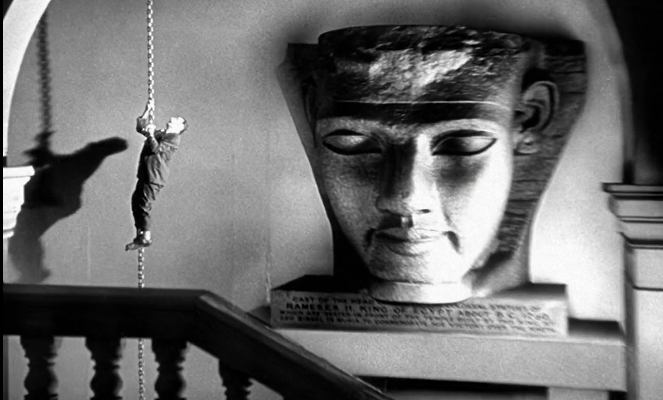
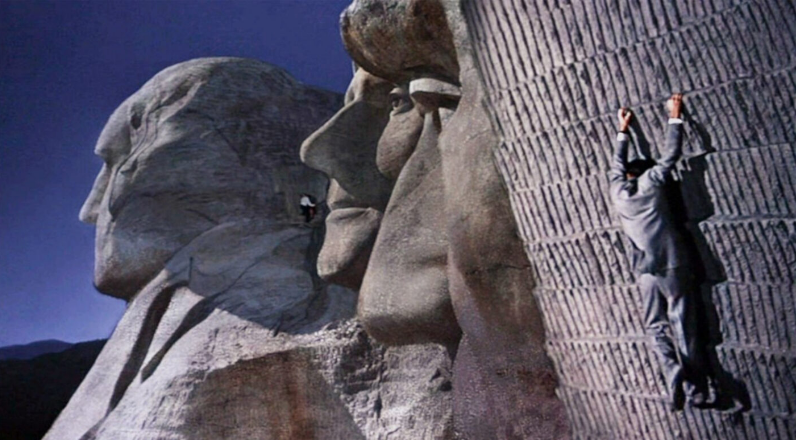
As to the elements that make the film memorable as a Hitchcock text, the final fourth of the film sees Tracy being chased by the police, presaging several images and ideas that would go on to be reliable tricks in the director’s bag. In the British Museum, Tracy descends a rope to escape his pursuers past a giant bust of presumably Egyptian origin. There’s a distinct visual genealogy between this and the finale of North by Northwest:
The Mount Rushmore sequence is also part of another one of Hitchcock’s trademarks, which was to have the film’s final action scenes lead to a rooftop climax, most famously in Vertigo but also To Catch a Thief, Rear Window, and Foreign Correspondent, just to name a few (although for the last two of these Jimmy Stewart is dangled out of a window rather than off of a rooftop and the fall from Westminster Cathedral tower happens at the beginning of the third act rather than its end, respectively). The chase scene through the museum is also clearly echoed in the protracted sequence that concludes I Confess, although this one is stronger and Hitchcock is already demonstrating his strong eye for composition when it comes to setting up the most interesting version of a shot, sticking the camera in the vertices of an oddly shaped room or taking on an overhead view of a large reading area. He’s also already inserting his sly sense of humor into the proceedings. Despite the relative novelty of the art form, the characters within the film are already talking about movies as if the whole enterprise is old hat; Frank seemingly only wants to go to detective flicks which Alice finds boring and predictable, and Frank admits he’s still excited to see the latest one about Scotland Yard, even if “they’re bound to get most things wrong.” Hitchcock’s lack of respect for the institution of the police overall is on display as well, since the entirety of Scotland Yard does, in fact, get most things wrong; they latch onto Tracy based on circumstantial evidence and chase him to his death, unknowingly doing so in order to cover for a killing (albeit a legally defensible one) committed by the girlfriend of one of their own members.
It’s all good stuff, but I doubt that Blackmail remains of much interest even to most film-lovers who don’t have an unhealthy interest in Hitchcock’s body of work. Narratively, it’s not in conversation with his other texts, at least not those we think of as the canonical forty thrillers. Insofar as it’s useful as an interpretative tool for his filmography as a whole, this film feels like an attempt at experimenting with techniques and images that he would perfect later and is fascinating in that right, but I once again fear that this fascination extends only to real Hitch-heads. The Lodger is a much more engaging film if you’re interested in what the director’s silent and silent-adjacent work was like, and for experiments with the artform that sound introduced into the medium, Murder! has more fascinating production trivia and smoother tone overall, although I’d go to bat for Blackmail’s value as a noir character study before I’d recommend the 1930 film. This is in the public domain, so hopefully it’s not too hard for you to find if I’ve sold you on it.
Alfred Hitchcock’s 1930 film Murder! entered the public domain this year, which might lead one to think it would be easier for the public to access. I found a copy online and started watching it, only to make it about 20 minutes in before deciding that the degraded audio quality meant that I was never going to be able to make it through the film without subtitles. I then found a subtitle file online and attempted to burn it onto the video using Handbrake, but it was not in sync, and no amount of fiddling would make it work. After I had tried all of that, I found the film on a streaming service heretofore unused by me called Plex, but the subtitles there all appeared to have been auto-generated. Not only were they inaccurate, but the scene in which Sir John Menier (Herbert Marshall, who would later appear in Foreign Correspondent) has an interior monologue that plays out in concert (no pun intended) with a radio orchestra broadcast had no captions at all because the auto-caption couldn’t hear the dialogue over the music, making them useless. And so, at last, I turned to our old friend, the people’s streaming service Tubi, where the film was free, the subtitles were mostly accurate, and the Charmin bears were playful indeed.
Diana Baring (Norah Baring) is an actress performing in a travelling troupe in “the provinces” when she is found in an unresponsive state next to the body of another actress; she cannot recall committing any crime but cannot account for her state of mind. She is quickly tried and found guilty, and in a miscarriage of justice that is almost on par with her erroneous conviction, one of the jurors is an acquaintance of hers, the aforementioned Sir John, who is browbeaten into giving a guilty verdict by the other jurors. Sir John feels at fault for what has happened to Diana, as he is a theatrical producer who recommended her for the tour on which the murder happened, and he sets out to try and overturn her conviction by finding the real killer. In this, he is assisted by two of Diana’s fellow actors: a husband-and-wife team named Doucie (Phyllis Konstam) and Ted (Edward Chapman) Markham.
Murder! was only Hitchcock’s third feature made with sound, and the film itself shows evidence of this in being less dialogue-driven and more image-oriented while also being innovative with regards to this new technology. The aforementioned scene in which Sir John, while shaving and listening to the radio, shames himself in voice over for being so easily influenced by his fellow jurors and recounts his disappointment at being the person who put Diana in the situation where she could be accused in the first place may be the first film depiction of a character having an inner monologue. Soliloquy is nothing new to drama, of course, but film afforded the unique opportunity to have these representations of internality appear as the character’s “thoughts” rather than on-stage asides, and if Hitchcock didn’t create this film language method outright, I have no doubt that he was certainly the first to have the character’s decisive moments align with the crescendoes of the background music. It’s an inspired touch, and one that demonstrates that Hitch really was the master of his craft, even if this film is slow and plodding to the modern eye. At 100 minutes, it’s only slightly longer than The Lodger, which came out three years prior, and a third as long again as the Peter Lorre-starring The Man Who Knew Too Much, which clocked in at seventy-five minutes with a perfect pace.
If anything, Murder! seems almost experimental, with Hitchcock taking the time to explore all of the ways that he might use sound as part of his films and not worrying too much about whether the runtime could be tightened up a little. The inciting act of violence is relayed via a tracking shot that finds the various performers from Diana and the Markhams’ troupe leaning out of their windows to discern the source of the commotion. The police’s investigation occurs backstage during the next evening’s performances (Diana and the murder victim having been replaced by their understudies, of course), which allows for the sequence to have a lot of life as actors emerge from the dressing room, interact with the detectives, and then get pulled onstage for their scene. Cleverly, this also introduces the fact that two of the characters in the play portray policemen on stage, which plays into a later-revealed clue that Mrs. Markham saw a policeman on the street earlier who was not the same copper who was present at the scene of the crime. If one pays close enough attention, this backstage insight tips us off early on about who the real killer might be. The trial itself plays out very modernly, with montages of witnesses, the judge, and the jury fading into one another before they are adjourned for deliberations, and the jurors discussing the case amongst themselves is good stuff; even though it takes up a solid chunk of screentime, it’s far from the first thing that I’d nominate for the chopping block if we wanted to edit this film down to something more concise. When we find Sir John in his home, we get a series of fade-in/out establishing shots that escort us from his front door to his apartment, which is something that I’m not sure is completely necessary but shows Hitch puzzling out the kind of transitions that will eventually be part and parcel of his unique style as a filmmaker.
The film is not without Hitchcock’s trademark humor, either. Before the Markhams are pressed into assisting Sir John with his investigation, we find them in their boarding house, threatened with eviction by their landlady as their young daughter plays the piano, haltingly and badly, and it’s a fun scene. Sir John also finds himself staying at a boarding house on the road where the landlady’s many children follow her about and climb all over the furniture and luggage, and it’s decently funny. There’s a good energy in the backstage investigation mentioned above that allows for the cast of the play to deliver pithy remarks. Where this remains strongest, though, is in the imaginative use of images and interplay between them; most strikingly, as Diana’s day of execution draws near despite Sir John’s attempts to find the real killer, the montages that show his desperation are double exposed with the shadow of a gallows rising, as the young actress’s fate draws nearer and nearer. This image is then alluded to later when the killer, having returned to their earlier profession as a trapeze artist, realizes that the law has caught up with them and hangs themselves in the middle of their act rather than face trial for their crime. I was also very fond of the shot-reverse-shot scene in which Sir John interviews Diana at the prison, which places them at opposite ends of an almost impossibly long table; they have almost a fisheye lens quality to them that I didn’t expect.
I also quite like how Murder! is in conversation with stage drama. Above and beyond the obvious elements, it’s a fun idea to have Sir John pretend that he’s planning to produce a new play in order to get all of the actors from the disbanded troupe to interact with him. Even more cleverly, he plans an entire “ripped from the headlines” story in which he’ll be dramatizing the killing, and he catches on the idea of having the man he’s determined is the likely killer play the part of the killer in an audition in hopes of eliciting an accidental confession. He even references the fact that he was inspired in part by Hamlet, which features a play within itself in order to “catch the conscience of the king.” The actors themselves provide a lot of color just by the nature of their profession and their eccentricities. The film’s final moments, in which Diana is freed and is ushered into a room to be embraced by Sir John, are revealed via zoom out to reveal the proscenium arch to all be a stage production as well. It’s playing with a lot for a piece of art in a form that was still so novel and fresh.
For this lagniappe episode of The Swampflix Podcast, Boomer & Brandon discuss two different films that share the same title and director: Alfred Hitchcock’s The Man Who Knew Too Much (1934) and its loose remake The Man Who Knew Too Much (1956).
In narrative terms, the 1954 crime thriller Dial M for Murder isn’t much of an outlier in director Alfred Hitchcock’s career. If anything, it’s a useful timesaver for anyone looking for an overview crash course in Classic Hitchcock storytelling, as it effectively plays like what would happen if Strangers on a Train was retold within the stage-play limitations of Rope. Both of those preceding Hitch classics are hypothetical plottings of The Perfect Murder, which inevitably go awry in execution, leading to the murderer’s demise. The premeditated killer in this case (Ray “X-Ray Eyes” Milland) blackmails an old college classmate into killing his adulterous wife (Grace “Princess of Monaco” Kelly) as a lucrative act of marital revenge. The story is mostly contained in a single living room set and is rigidly sectioned into three dramatic acts: the opening act in which the killer explains the scheme to his accomplice, one in which the accomplice fails in his mission mid-strangling, and a final act of Columbo-style “howcatchem” investigation that puts the pieces of the puzzle back together through the nosy inquiries of an unassuming detective (John “Comic Relief” Williams). It’s all very tidy & succinct, possibly owing to the fact that Hitchcock was planning the much more elaborate production of Rear Window while going through the motions of adapting this morbid little stage play.
The surprising thing about Dial M for Murder is that its stage-bound telling doesn’t convey Hitchcock’s visual artistry, which is usually foregrounded as a knack for special effects dazzlement. At least, that’s what I thought when I first left the theater. At the start of the local screening of Dial M in The Prytania’s Classic Movies series, I was disappointed in the quality of the film scan, which appeared to be a fuzzy SD transfer from an ancient DVD print. Then, when Grace Kelly appears onscreen in the first interior scene, her gorgeous face & gowns were suddenly in sharp focus, as if someone had flipped on the HD-quality light switch. The initial fuzziness then periodically returned in a few exterior shots, which appeared to be partially composited or greenscreened for no practical, discernible reason. It turns out, of course, that this alternating visual quality was a result of the film being shot for 3D processing, then later retrofitted into a 2D print. It was produced in the brief early-50s window when the classic red-and-blue 3D glasses presentation was a popular fad, but the novelty of the effect had worn off by the time Dial M hit theaters, and the prints were descaled to a measly two dimensions halfway into its run. As Hitchcock bitterly acknowledged, 3D was “a nine-day wonder, and [he] came in on the ninth day,” making for one of the rare times when he was a latecomer instead of an innovator in visual effects.
The Prytania’s Sunday-morning Classic Movies slot is a reliably wonderful way to catch up on any Old Hollywood mainstays that might be personal blindspots, and Hitchcock’s catalog has long been the backbone of that program. Since the single-screen theater is over a century old, it feels like time-traveling back to the classic films’ initial release, when they likely screened in that very theater. That effect was especially potent for their most recent screening of Dial M for Murder, which was preceded by a classic Looney Tunes short instead of trailers for upcoming attractions (the Hitchcock-spoofing Tweety Bird short “The Last Hungry Cat,” for anyone curious). Part of me wishes that they could have presented the film in its original 3D format, glasses and all, for maximum time-travel novelty. The truth is, though, that Dial M‘s 3D format was very quickly rejected by contemporary audiences, so that most people did see it screened in its confused & compromised 2D form, making my experience with the film authentic to its initial run. To the theater’s credit, they will also be screening William Castle’s 13 Ghosts in its original “Illusion-O” presentation this October, which was Castle’s personally branded 3D gimmick. There’s something beautiful about the fact that Castle’s own special-effects artistry is still chasing after its classier Hitchcock equivalents all these decades later, sometimes in the exact venues where they started their one-sided feud.
While learning about Dial M for Murder‘s retracted 3D tech after leaving the theater did help make sense of why its exterior & effects shots looked so bizarrely hazy, I still can’t figure out why Hitchcock would choose to give such a stage-bound story that treatment in the first place. The beauty of Dial M is in its narrative simplicity. By the final act, the nosy detective’s post-murder puzzle solving mostly comes down to three isolated pieces of evidence: a key, a letter, and a silk stocking. Those three pieces are moved around the puzzle board through verbal speculation, with most of the visual spectacle resulting from Grace Kelly’s elegant beauty and Ray Milland’s dastardly performance as a smug drip who hates his elegantly beautiful wife. Even so, Hitchcock finds small moments for visual extravagance, such as the husband’s explanation of how the murder should go down being framed in a high-angle shot from the ceiling’s POV, as if he and the killer were pieces on a board game. The only moments I can recall that may have benefited from the original 3D effect are the isolated shot of the contract killer reaching his hands out to strangle Kelly as she answers a phone call and the surreal shot of Kelly later answering to a judicial panel as if she were being tried for murder in the courts of Hell. Those few seconds of screentime are not worth filtering the rest of the picture through the 3D process, especially since it mostly consists of lengthy conversations in a single parlor.
It’s a testament to the strength of the stage-play source material and Hitchcock’s ability to wind up tension in his audience that Dial M is still solidly entertaining despite all of the needless distractions of its 3D processing. The Prytania’s Classic Movies crowd was an especially robust turnout that Sunday morning, likely owing to the director’s name recognition. Hitchcock always delivers, apparently even when working on autopilot.
I recently started a rewatch of Star Trek: Voyager (ding!), prompted because the person I’m dating expressed that this series was the most of interest because of their love of Kate Mulgrew, based solely on her performance in Orange is the New Black. We also recently watched Throw Momma from the Train, not because Kate Mulgrew was in it, but because it was on both of our lists, and it was a happy coincidence.
Danny DeVito writes, directs, and co-stars in this late-80s comedy riff on Alfred Hitchcock’s Strangers on a Train, which appears in the film directly as the movie that DeVito’s character, Owen, sees at the behest of his beleaguered creative writing teacher. Said instructor is Larry, played by Billy Crystal, a man whose ex-wife Margaret (Mulgrew) stole the novel he wrote while they were together and is now seeing great success from it — interviews with Oprah, diamond earrings, a palatial Hawaiian estate, etc. Larry’s intense jealousy clouds his mind, and he’s stuck teaching a class of not-very-imaginative adult students who are trying to learn to write. Even among the students, Owen stands out as particularly unimaginative, although his daydreams about killing his overbearing, needy mother (Anne Ramsey) are colorful. When Owen starts to stalk Larry in order to get better insight into the creative process, he learns about Larry’s disastrous divorce and, when Larry suggests he go see a Hitchcock film to better understand how mysteries should be structured, Strangers on a Train just happens to be playing at the local cinema, he happens upon the idea of swapping murders. Misunderstanding Larry’s recommendations, he opts to fly straight to Hawaii and, seizing his opportunity, pushes Margaret overboard on a ferry while she dangles over the side to try and retrieve one of her earrings. Returning home, he now insists that Larry “fulfill” his end of their “bargain” and kill the titular momma, all while Larry tries to avoid being arrested for Margaret’s apparent murder.
Throw Momma from the Train is a perfect little comedy, so tightly structured and so novel that it’s hard to imagine it being made today. Larry’s would-be relationship with colleague Beth (Kim Griest), who loves trains, allows for a lot of train imagery to be scattered throughout as foreshadowing of the film’s allusions as well as its finale. Ramsey is as perfectly loathsome here as she was just a couple of years prior in The Goonies, with her occasional moments of kindness implying a dementia that has rendered her this awful. Crystal is playing the same character that he always does, but when that character makes you the leading man for romcoms of an entire era, why deviate from the norm? Mulgrew’s character’s role in the story necessitates that she disappear fairly early in the runtime, but she makes a great meal out of her scenes, and it’s always fun to see her cut loose a little. It’s DeVito who’s absolutely wonderful here, playing Owen as someone so simple he’s utterly incapable of malice but is nonetheless too dim to be manipulated, at least intentionally. As an actor, his career has largely been made up of playing scoundrels and shitheels, and even though he is the antagonist of his film, you can never hate him.
The film also gets a lot of mileage out of Larry’s class of wannabe writers. One of them is in the process of crafting a coffee table book entitled One Hundred Women I’d Like to Pork, which gets a nice payoff when we see the publication at Larry’s house in the film’s ending. My absolute favorite, however, has to be Mrs. Hazeltine, whose concluding paragraph to her story is, in its entirety: “‘Dive! Dive!’ yelled the Captain through the thing! So the man who makes it dive pressed a button, or a something, and it dove. And, the enemy was foiled again. ‘Looks like we foiled them again,’ said Dave. ‘Yeah,’ said the Captain. ‘We foiled those bastards again. Didn’t we, Dave.’ ‘Yeah,’ said Dave. The End.” If you’ve ever taken a short story class, it’s frighteningly familiar.
For this lagniappe episode of The Swampflix Podcast, Boomer & Brandon discuss the 1943 suburban noir Shadow of a Doubt, which Alfred Hitchcock described as his personal favorite of his own films.
After a recent viewing of Alfred Hitchcock’s Stage Fright, I double checked to see if it had already been covered on the site (it had), since I had learned to do this recently after getting a couple of paragraphs into a review of the director’s Frenzy, which Brandon had also already covered. This made me wonder just how many of Hitch’s thriller features we had covered; these account for 40 of the roughly 45 films in his filmography (I say “roughly” since I’m not sure how we would count his earliest, lost films like Number 13 and The Mountain Eagle), and I texted Brandon that we had covered 13 so far, to which he noted that we had already hit 14 if one counts his discussion of Strangers on a Trainhere. I thought it would be fun to try and do all 40 sometime, and figured I would tackle the next one chronologically after The Lodger. Unfortunately, my local video store does not have a copy of Blackmail!, so I rented Murder!, only to find out that the LaserLight DVD they have in their possession is one of those quick and dirty late nineties/early 2000s releases of a very poor transfer (in fact, The Hitchcock Zone has a warning about this exact DVD). It was, in a word, unwatchable, and that’s coming from someone who buys every unlabelled estate sale VHS he sees just to see what’s on them. I was still in a Hitchcock mood, though, so I decided to see what he had available on the Criterion Collection and stumbled across Young and Innocent, one of his 1937 pictures. The description of the film gave fair warning that the movie did contain a sequence of Blackface, which made me a bit wary. The movie ended up being so much fun and so delightful (in fact, I started to wonder why it wasn’t more well known) that I had completely forgotten about this heads-up by the time that the last ten minutes rolled around, and boy did it negatively affect my perception of this feature overall.
The film opens on an argument between Christine Clay, a British actress returned home after having success in Hollywood, and her ex-husband Guy, who accuses her of “bringing home boys and men” and refusing to accept that the marriage is over. The following morning, young Robert Tisdall (Derrick De Marney) is walking along a cliffside when he sees a body on the beach and climbs down, discovers Christine dead, and sprints away to get help. His speed is witnessed by two girls who had come down to the water to swim, and despite the fact that he did come back with the police, said coppers immediately decide to believe the teenagers’ interpretation that he was fleeing the scene and arrest him; it certainly doesn’t help that his raincoat was recently stolen and Christine was strangled with a raincoat belt, or that he and Christine knew each other from their stateside film work, where Robert was a writer. Their suspicions deepen when they learn that she has left him a substantial amount of money in her will, and he’s prepared for immediate arraignment. While detained at the station, he faints when he learns of this, and is revived by Erica Burgoyne (Nova Pilbeam), the daughter of the police commissioner, and is totally adorable with her Sealyham terrier named Towser and her beat-up, hand-cranked jalopy. When he’s given a clearly incompetent public defender, he flees the overcrowded courthouse and escapes by hiding in Erica’s car. When she runs out of gas, he pushes the car to the nearest petrol station and uses his last few coins to pay for more fuel before hiding out in an abandoned barn. When Erica returns home, she overhears that he can’t get far since he only has thirty pence, and she comes to believe that he must be innocent, as he claimed. When she returns to the barn to leave behind some food and coins for him, the two barely escape discovery by a couple of her father’s policemen, and she ends up agreeing to take him to the boarding house where a drifting vagrant who supposedly has possession of his raincoat may be able to prove his innocence.
De Marney and Pilbeam are utterly charming in these roles. We know from the start that Robert is innocent, so even though Erica’s claims that he’s too sweet-looking to be a murderer are dubious at best, we also can’t help but agree when we see Robert’s boyishness, especially when we get to see the two together in all their on-screen chemistry. In a lot of these “innocent man pursued” pictures, Hitch’s leading men often get frustrated and agitated at their situation, and even though this is early in his career, it’s kind of refreshing to see a man who’s at least somewhat enjoying the ride that he’s on. That makes his flirtation with Erica and her eventual willingness to help him try and find the proof of his innocence a nice, charming romance, with two sweet leads who work quite well together. Once they do locate the homeless china-mender, Old Will (Edward Rigby) and enlist him in their mission, he adds even more charm to their little ensemble. Perhaps my favorite character, however, is Erica’s Aunt Margaret (Mary Clare), who appears when Erica and Robert are still heading to the boarding house where Old Will might be found, and she says that she’ll call her father so that he doesn’t get worried and start looking for her. Erica has forgotten that it’s her younger cousin’s birthday and she gets roped into attending her party. Aunt Margaret is a total busybody and a bit of a party bully, but she’s so arch and funny that she’s much more entertaining than she is frustrating. Her husband, Uncle Basil (Basil Radford, who would appear the following year in The Lady Vanishes), is less suspicious and can see that blossoming romance between Erica and Robert so clearly that he ends up helping them slip away.
The general light-heartedness of this one also makes for a very fun comedic outing, but it’s also not without its fascinating set pieces, either. Besides the aforementioned child’s birthday party scene, Erica’s home life with her father and several younger brothers is also quite charming. It’s clear that her relationship with her family is a loving one, and all of the boys get enough characterization that it’s a delight to watch them all play off of each other. There’s a studious and up-tight one with glasses, the more jocular and athletic middle boy, and the precocious youngest who ends up bringing a rat to the dinner table at one point. This makes the later more serious scene in which her father shows her the resignation letter that he intends to deliver that day (rather than arrest his own daughter, whom he knows has abetted an escaped inmate) all the more impactful. For comedic set pieces, there’s a very good one at the restaurant called Tom’s Hat where Robert’s raincoat first went missing, when a couple of vagrants get into a brawl with some truckers that they feel are giving away a little too much information about Old Will, with Robert forcing his way inside in order to try and save Erica from the kerfuffle, only for her to have already made her way out of the building without any of his help. On the more dramatic side, the abandoned barn makes for a beautiful location, and there’s also a great setpiece where Robert, Old Will, and Erica (and Towser!) drive into an abandoned mine shaft to evade pursuing police, only for the shaft to give way beneath them and swallow the car as they desperately try to climb out of it before it falls. There’s also a great dance sequence at the end where Old Will, having been given an offscreen makeover that he despises, goes to a fancy hotel with Erica to see if he can identify Christine’s killer there, and it’s a sight to behold.
Unfortunately, it’s this final scene in the hotel where the film gets a little too ugly to swallow. It wasn’t uncommon for live musical performances of the era to take advantage of the minstrel show aesthetic, and every single member of the ten-piece band performing at the hotel ballroom is in Blackface, and it’s quite awful. I know that I’m looking at this through a modern lens and the contemporary logic was that it would make sense for the killer to have a job where he’s in some kind of disguise, and being painted to look like a racist caricature made for an understandable method of hiding in plain sight during a time when that kind of entertainment was common. Still, I can’t help but be sickened by the final ten minutes, especially since this one was chugging along at such a nice pace up until that point. I was a little curious as to why the quality control on the subtitles for this film seemed to be barely up to snuff, as the caption “[inaudible]” appears more here than in any other film I’ve ever seen, over a dozen times. Sometimes it’s character names that perhaps the captioner didn’t feel confident in providing or slang of the time that a younger staffer at Criterion might simply be unfamiliar with (in the very opening scene, Guy tells Christine that he won’t accept her “Reno divorce,” which the subtitles render as “[inaudible] divorce”), but at other times it’s just fast child-speech that a trained ear should be able to hear or it’s totally clear dialogue. It made it feel like this was done haphazardly and lazily, and I was keeping track of what I heard in order to email Criterion to recommend an update, but by the end of the film, all of the wind in my sails had gone out after seeing the Blackface sequences, and I get the feeling that whoever was in charge of getting this up onto the Criterion Channel likely had the same deflation. I can’t say that I blame them.
It’s a dark night in Quebec City. We move in, slowly, on one building in particular, gliding in through the window to find a man dead on a carpet. The beaded curtain that hangs over the door to the room is still moving, his killer having departed mere moments earlier. On the street, a man in a cassock emerges from the dead man’s house and moves up the street, slowly, until he enters Ste. Marie’s church. The killer, Otto Keller (O. E. Hasse), begs Father Michael Logan (Montgomery Clift) to take his confession, and the young priest does so. Otto begins with an expression of his gratitude to Father Logan, who helped him and his wife Alma (Dolly Haas) find work and lodging in the rectory, before he admits that he accidentally killed local dirtbag lawyer Villette (Ovila Légaré), whom he initially only intended to rob so that Alma wouldn’t have to work so hard. Father Logan confirms that his confession is held in confidence and that he will not involve the law, but that Keller must return the money and turn himself in. The following morning, Father Logan makes his way to Villette’s house, where he meets primary investigator Inspector Larrue (Karl Malden), who tells him that Otto discovered the body. Larrue observes Father Logan speaking to a woman outside and becomes suspicious, even though he doesn’t hear her say the words “Villette is dead? Then we’re saved!” to the priest. The woman turns out to be Ruth Grandfort (Anne Baxter), the wife of local legislator Pierre Grandfort, who is close friends with Crown Prosecutor Willy Robertson (Brian Aherne), but her and Father Michael’s friendship goes back even further, and is deeper.
I Confess! gets off to a marvelous start, but then it ends up spinning its wheels for far too long, even for a film that clocks in at a mere 95 minutes. The story feels like it’s headed toward a conclusion at about the halfway mark, and by the time we reached the final third, I kept checking the time and finding myself startled to discover that only a minute or two had passed since I had last checked. The ending is sufficiently strong that the last twelve minutes were at least engaging, but it wasn’t enough to come back from the slump. Conceptually, it’s pure Hitchcock: the wrongfully accused man who must prove his innocence but for some reason cannot, the blonde who loves him, and a crew of police investigators who are at turns both foolish and malicious. As a narrative device, having a character who can’t defend himself against false allegations because he’s bound by the sanctity of the confessional is also a fresh idea, and complicating matters further by having the victim be a blackmailer extorting the priest’s ex-girlfriend in a way that potentially implicates the priest himself is a fun place to take that concept. Unfortunately, Clift is dreadfully dull in this role, Hasse’s turn as the villainous Keller is similarly underwhelming, and the apathy that Hitchcock allegedly had for this project comes through in the workmanlike nature of the cinematography.
When I told my mother that I had recently watched this one, she asked if it had been released before or after Montgomery Clift’s infamous car accident, noting that he might have been stiff because of the resulting physical and psychological scars (and the addictions that came in attempting to medicate the latter). That didn’t happen until 1956, and I Confess was released only a couple of years after A Place in the Sun, in which I seem to remember finding him very convincing. I don’t know where the blame for his stilted performance here comes from, and I can say the same thing about Hesse. Keller seems to reflect the era’s general antipathy to German immigrants, and taken as a sole piece of evidence in a vacuum, one would think that Hitchcock thought that all Germans who asked only for the opportunity to work and bemoaned their lot in life as “[men] without a country” were simply lying in wait for the opportunity to turn on their supposed benefactors, lie about their motives, steal, frame clergymen, and kill their own wives for trying to see justice done. He’s a factor in the plot, but he’s not a character, and the film is much worse off for letting us know who the manslaughterer is from the start but not making that person interesting. Baxter ends up the MVP here, and the best part of the film comes after Father Michael has been arrested and she decides she has to explain everything to the police at the cost of her social standing and dignity: years before, Michael went off to fight in the war and told Ruth not to wait for him; when he came back, she had already married Pierre. When their innocent reunion is interrupted by a thunderstorm, the two are forced to take shelter in a gazebo, where the blackmailer/victim discovered them the next morning and inferred they had slept together, which would be enough to ruin Ruth’s marriage, embroil her husband in a scandal, and (even though he wasn’t yet ordained) defrock Michael. When her testimony ends up doing more harm than good, as the hours she spent with Michael the night of the murder fall before the time of death but her explanation finally provides the police with a potential motive for Michael, she’s distraught, and Baxter sells it tremendously. It’s just not enough to save it.
The film almost does something interesting near its conclusion, when the jury finds that there simply isn’t enough evidence to convict Michael and he’s released. Although he’s not culpable in the eyes of the law, his verdict in the court of public opinion is much heavier, and it would have been interesting to spend a little more time with this narrative thread. Can he return to the church? How has his downfall affected the faith of his parishioners? Will some forgive but never forget? None of these questions get the chance to be answered, or even a moment’s breathing room, as Michael barely makes it down the steps before Mrs. Keller attempts to tell Larrue that her husband was the true killer, only for Keller himself to shoot her (so much for the whole motive of his theft being to spare her a life of servitude, I suppose). Oh well. A necessity really only for Hitchcock or Clift completists, I’d say skip this one.