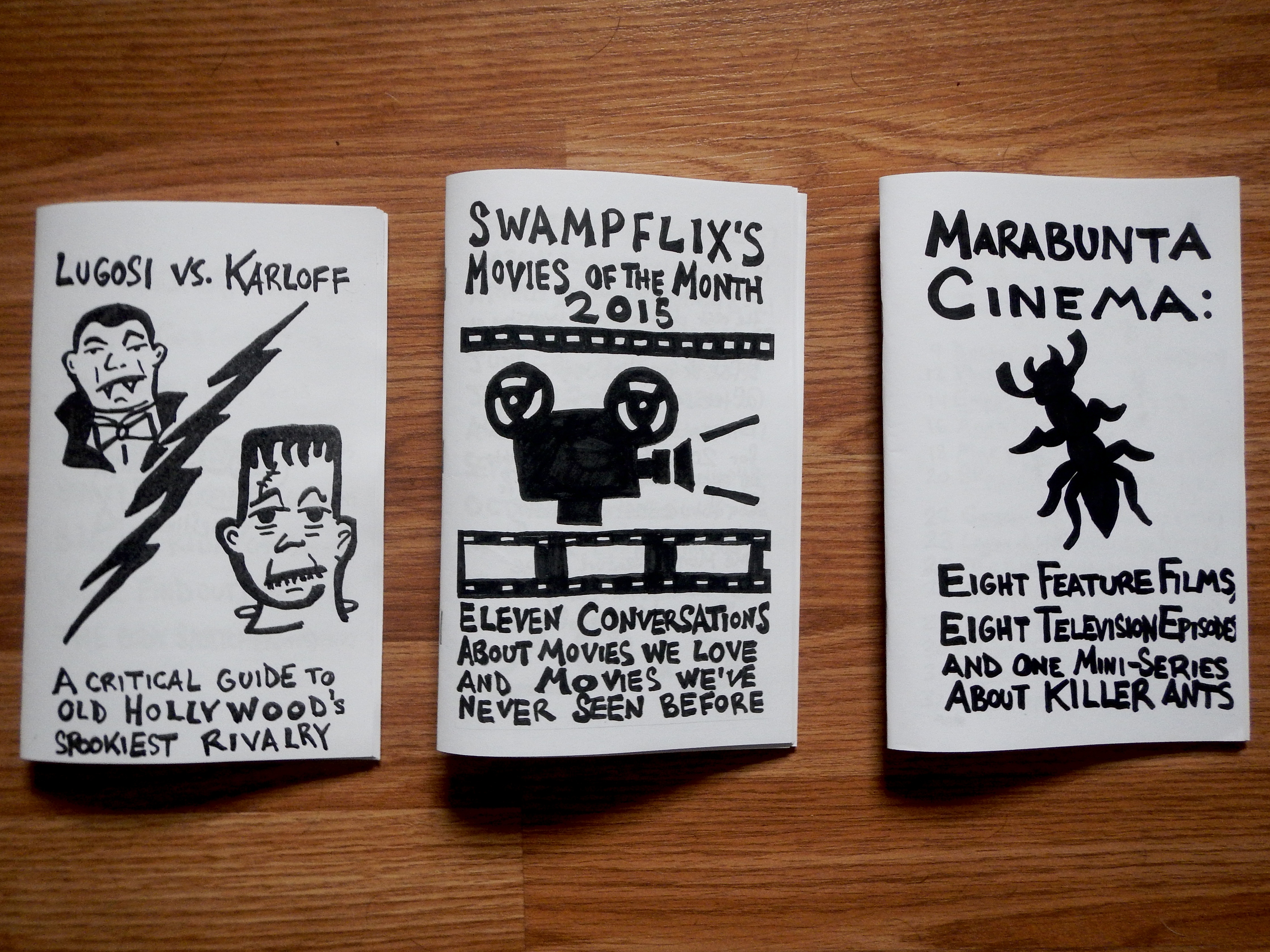
Bela Lugosi & Boris Karloff were incredibly gifted actors from the Old Hollywood studio system era. They possessed a natural, unteachable screen presence that would literally haunt audiences well after they left the cinema, inspiring many a nightmare over the past century through mere body language & subtle vocal manipulation. Unfortunately, the pair’s natural knack for horror did them wonders in the Universal Pictures “famous monsters” series, but in the longterm left them pigeonholed in a genre that relies mostly on fads. It’s rare that an actor gets the opportunity to embody a role as iconic as Lugosi’s Count Dracula or Karloff’s turn as the Frankenstein monster, but perfectly nailing that type of character can unfortunately lead to decades of typecasting if you don’t play your cards right (or if you are contractually obligated to play whatever role your studio hands you). Lugosi & Karloff’s time as famous monsters left a huge mark on cinema & the public consciousness echoed years down the line in films as disparate as Tim Burton’s arguably perfect Ed Wood & weirdo, abstract art films like The Spirit of the Beehive. They also left the actors very little to stand on in terms of career growth.
Cursed to toil away in horror pictures of varying quality for the remainder of their careers after the decline of the famous monsters series, Lugosi & Karloff’s success & choice of projects largely depended on the ebb & flow of the horror genre’s profitability. When times were dire, the two often would have to fight over the scraps tossed their way, which lead to a not-so-secret professional rivalry between the actors. It surprised me, then, to recently discover that Lugosi & Karloff were frequently paired in unlikely collaborations, sharing screentime in no less than eight feature films. This rivalrous union lasted for a little over a decade, on & off again, as their personal tension grew increasingly malignant. The best thing about the Lugosi-Karloff collaborations is how the pair’s offscreen rivalry was echoed in the majority of their characters’ onscreen clashes in personality, adding a meta level of fascination to a handful of (sometimes impressive, mostly minor) horror pictures.
Here’s a complete list of the eight Lugosi-Karloff collaborations, each ranked & reviewed and arranged in chronological order. For a more complete/academic history of the spooky duo’s onscreen collaborations & offscreen clashes, you might want to track down the massive book Bela Lugosi & Boris Karloff: The Expanded History of a Haunting Collaboration by Gregory William Mank, which details the overlap in their careers in an extensive 700 page study. The piece you’re reading now is instead intended more as a quick & dirty critical guide to what Old Hollyood’s most haunting rivalry & most unlikely collaboration has to offer to audiences (both modern & otherwise) in terms of entertainment.
The Black Cat (1934)


“Suggested by the immortal Edgar Allan Poe classic” (to borrow the title card’s language) that inspired later adaptations by none other than Roger Corman in the Tales of Terror anthology film & Dario Argento in his segment of Two Evil Eyes, 1934’s The Black Cat is about as loose as a literary adaptation can get. The only element the film shares in common with Poe’s short story is the appearance of a black cat that is murdered in a fearful rage, then reappears unharmed. If you’re looking for a (slightly) more faithful cinematic adaptation of the story, I’d suggest looking to Corman’s Tales of Terror (which also features versions of Poe’s “Morella” & “The Facts in the Case of M. Valdemar”). 1934’s Unversial Pictures production of The Black Cat is fascinating not because it’s a loose, full-length adaptation of a Poe short story, but because it features the first collaboration between Lugosi & Karloff. It’s an alarmingly violent film that allows the two actors to stray from their usual typecast roles as Count Dracula & the Frankenstein monster, playing more recognizably human characters, however just as horrific.. Even though The Black Cat stands as the first collaboration of eight, it would eventually prove itself superior to all of the films to follow. No other Lugosi-Karloff collaboration could possibly match the delicious old school horror aesthetic achieved in The Black Cat. It’s an incredible work.
The Black Cat begins with a young couple meeting a recently imprisoned psychiatrist, Dr. Vitus Verdegast (Lugosi), while honeymooning in Hungary, In a scene typical to the film’s unnerving violence, the trio suddenly find their plans derailed in a gruesome bus crash. Lugosi’s Verdergast lays on the creep factor early, gently stroking the hair of the sleeping female passenger because she reminds him of his deceased wife. After the bus crash, he leads the unsuspecting couple to recover at the spooky mansion of his bitter rival, the mentally unhinged architect Hjalmar Poelzig (Karloff). As the situation gradually sours, it becomes apparent that Poelzig is, in fact, the true villain of the story. He traps Vendergast & the newlyweds in his (gorgeous Art Deco) home, planning to include them in an elaborate Satanic ceremony at an celestial event dubbed “The Dark of the Moon”. Karloff’s Poelzig is an intense dude. Among other strange traits, he’s known to brood in a darkened dungeon stocked with the bodies of deceased women he keeps pristinely preserved in glass cases, all the while stroking his titular black cat (who curiously appears alive in the film even after Lugosi’s Verdergast kills it in a frightened rage). When Poelzig’s plans of a Satanic ritual finally come to fruition (after being thoroughly researched in a book helpfully titled The Rites of Lucifer), he brings to a head a decades old rivalry he’s enjoyed with Verdergast, ending it once & for all in an alarmingly dark, violent display that threatens the lives of all four parties involved.
Although, as I said, Lugosi & Karloff are allowed to stray from their infamous roles as Dracula & the Frankenstein monster here, there are of course slight nods to those hallmarks of their careers in the film. Lugosi’s psychiatrist is for the most part a sympathetic, broken man, but before this gentleness is revealed his early actions towards his wife’s young dead ringer recall Dracula’s modes of hypnosis & seduction. Karloff’s architect also shows shades of the Frankenstein monster in his earliest scenes, especially when he’s introduced as a gigantic, lumbering silhouette. Otherwise, they’re spooky in a way that’s divorced almost entirely from the “famous monsters” they were asked to play time & time again. One of the best aspects of the film is watching Karloff & Lugosi trade ominous spooky phrasings back & forth, like “Death is in the air,” “We shall play a little game, a little game of death,” and – in response to the accusation “Sounds like a lot of supernatural baloney to me” – “Supernatural, perhaps. Baloney, perhaps not.” Both their onscreen & offscreen rivalries are intensely palpable throughout the film, even represented in the heavily-acknowledged metaphor of a longterm game of chess, delicious meta treat for fans.
Perhaps what’s so surprisingly enjoyable about The Black Cat is that it has a lot more to offer beyond the obvious pleasures of Lugosi & Karloff spookiness & rivalry. The Art Deco set design is not quite Metropolis-sized in its opulence, but it is still a sight to behold. The way the camera glides throughout its crisp, cramped corridors reminded me of the simple visual effectiveness of this year’s Ex Machina. This is not a half-assed horror film Universal Pictures slapped together on a quick shooting schedule. It’s an elaborate production that proved to be the studio’s biggest box office hit of 1934, one that was boldly violent & sacrilegious for its time. The Black Cat is a short, simple film with only a few moving parts to work with, but it still makes room for stabbings, car crashes, torture, shootings, a murdered pet, a robed Satanic ceremony, a gigantic special effects explosion, and one of the two main players being skinned alive (!!!!!). All of this mayhem is set to a constant old school horror soundtrack that gets deeply satisfying once it devolves into relentless onslaught of heavy organs. To wrap it up at The Black Cat‘s conclusion, a character reads a movie review in the newspaper about how a (fictional) director should stay away from horror as a genre & stick to things that could actually happen, perhaps allowing the film to preemptively scoff at potential critics. It’s hard to imagine critics either now or 80 years ago brushing The Black Cat off so easily, anyway. Considering the time of its release as well as the strength & rarity of its Lugosi & Karloff performances, the film is near perfect,. faithfulness to Poe be damned.
Gift of Gab (1934)


Although it was pretty apparent from the get-go that The Black Cat would be the Lugosi & Karloff’s best & most significant work together, it was not so apparent that their very next picture would be of no significance at all. A vague comedy about a slick-talking radio announcer, Gift of Gab has the everything but the kitchen sink, vaudeville style of yuck-it-up humor of the Old Hollywood studio system on comedic autopilot. True to oldschool major studio comedy form, the film is more like a variety show than a work with any consistent tone or purpose. At various times it aims for romance, humor, death-defying action, intrigue, musical performances, and (the reason why I tuned in) a little bit of spookiness to boot, all with no attempts to connect with one another. In trying to be everything to everyone, Gift of Gab ended up being nothing to anyone at all, a trifle of no consequence.
Should I even bother you with the plot to this movie? I’ll at least try to keep it quick. A fast-talking snake oil salesman named Phillip “Gift of Gab” Gabney cons his way off the streets & into “the radio racket” as the successful host of a kind of variety show meant to promote a rich drunk’s failing brand of chicken livers. Gabney also cons his way into the heart of the radio station’s “working girl” program director. And somewhere in there we’re treated to an obnoxiously long sequence about sneaking radio equipment into a football game for a pirate broadcast. There’s also some antics involving someone parachuting out of an airplane. None of it matters. The film’s plot is mostly a vague pretense meant to provide a structure for the film’s musical performances & painfully stale vaudeville routines. My favorite synopsis of Gift of Gab is this concise, one-sentence take on IMDb: “Conceited radio announcer irritates everyone else at the station.” That about sums it up.
As for Bela Lugosi’s & Boris Karloff’s contribution to this forgotten “treasure”, the two horror giants are relegated to the roles of bit players in the film’s long list of on-air radio performers. In a four minute radio sketch (which is for some reason staged like a play), Lugosi & Karloff appear as threatening, ghoulish rogues in a goofy short-form murder mystery. Lugosi’s entire contribution in this scene is to appear from behind a closet door, hold a gun, and ask “What time is it?” (which I’m sure played great on the radio) and Karloff tops him merely by having two lines, taking time to light a cigarette, and laughing maniacally upon his exit. There are some cute touches to the sketch, especially in the way that murderous, knife-wielding arms appear from offscreen (again, on the radio) to threaten the goofball detectives who can’t quite solve the murder, despite Karloff announcing himself as The Phantom & donning a Jack the Ripper-like costume of a cape & a top hat. The whole thing more or less amounts to one of those Saturday Night Live sketches where a politician pops in for a quick cameo as themselves to get a cheap pop from the audience.
The story goes that The Three Stooges were originally scheduled to appear in Gift of Gab & I assume that they were going to play the bonehead detectives in this scene, a sort of a short-form precursor to Abbott & Costello Meet Frankenstein. Alas, that didn’t happen and what’s left isn’t much to speak of. If you’re morbidly curious about watching Karloff & Lugosi appear in a brief bout of broad comedy, do yourself a favor & skip the other 66 minutes of Gift of Gab. Instead, just watch the most easily accessible, low-quality YouTube clip of their contribution to the shoddy variety show comedy. It’s for time savers like these that YouTube was launched in the first place.
The Raven (1935)


Although it’s difficult to imagine a more perfect collaboration between between spooky superstars Bela Lugosi & Boris Karloff than their first film together, The Black Cat, their next tribute to the work of Edgar Allan Poe at least comes close to matching it. After making a brief appearance in the vaudevillian trifle of a romantic comedy Gift of Gab, Lugosi & Karloff returned to what they do best: being generally creepy & making meta references to their offscreen professional rivalry. The Raven doesn’t alter much of the pair’s The Black Cat dynamic. They merely switch roles as victim & villain, this time with Lugosi taking the reins as the film’s murderous creep with a spooky mansion & Karloff talking a backseat as the bitter, broken prey. Otherwise, it’s essentially just more of the same. When then “the same” is as great of a benchmark as The Black Cat, though, that’s not exactly a problem.
Much like with The Black Cat, The Raven starts with a car crash that leaves a young woman in Lugosi’s medical care. This time Lugosi plays a surgeon, Dr. Richard Vollin, instead of a psychiatrist, but the dynamic is still remarkably similar. In The Black Cat, Lugosi’s doctor falls for his patient because of her resemblance to his deceased wife. In The Raven, he falls for his patient because she portrays the (deceased wife) character Lenore in a staged performance of Poe’s “The Raven” (an especially beautiful one that looks like a sequined masquerade). Vollin is a Poe collector & enthusiast to an obsessive degree, something he calls “more than a hobby”, so the possibility of seducing a real life Lenore is too tempting to pass up. He lures his faux Lenore, along with her father & her beau, to his spooky mansion as part of a plan to not only live out the tragic love story of Poe’s “The Raven”, but also the torture chamber antics of the Poe story “The Pit & The Pendulum.” To help him with this dastardly plan, Vollin volunteers to perform plastic surgery on an escaped convict (played by Boris Karloff, of course) only to physically maim the poor lout & turn him into a monster. Lugosi intones to Karloff, “Monstrous ugliness brings monstrous hate. Good! I could use your hate,” and essentially turns the mangled convict into his own personal Igor (perhaps as a nod to Karloff’s long history of playing Frankenstein’s monster).
Although Karloff receives top billing for The Raven, something he was also awarded in The Black Cat, this is unmistakably Bela Lugosi’s show. Watching the horror legend recite Poe’s “The Raven” in front of an exaggerated raven’s shadow, don surgical gear to apply a knockout gas to the camera lens, gleefully give tours of his torture chamber, and recite lines like “Death is my talisman, Mr Chapman. The one indestructible force, the one certain thing in an uncertain universe. Death!” are all priceless moments for oldschool horror fans. I like to think that Vincent Price was a fan of this specific Lugosi performance & modeled his own effete murderers in Roger Corman’s Poe productions, particularly in The Pit & The Pendulum and The Masque of the Red Death, after the horror icon.
As for the film itself, it didn’t do so well financially & seemed to ruffle a few feathers with its playfully morbid atmosphere, despite it being very much toned down from what was delivered in The Black Cat. This reception reportedly lead to a temporary ban on the horror genre in England & just a general slump in production of major studio horror films for a long time to come, much to the detriment of Lugosi’s & Karloff’s careers. This shift in attitude is even detectable in the film’s press kit which asks, “Was Edgar Allan Poe a mental derelict?” and goes on to suggest that Poe’s characters were “but a reflection of himself.” It’s a shame that the film mostly fell flat with audiences, since another success like The Black Cat could’ve lead to more work for Lugosi & Karloff where they didn’t have to play Count Dracula & the Frankenstein monster every damn film. The Raven is a pretty great alternative to that overwhelming portion of their work, one that continues the meta-rivalry of the chess game in The Black Cat in yet another great, loose tribute to Poe. I’d say that even though Karloff had the upper hand this round in receiving top billing, it was Lugosi who scored the victory. He’s just so much fun to watch here & all of the movie’s best moments are dependent upon his performance.
The Invisible Ray (1936)


One great thing about these Lugos-Karloff collaborations was, of course, that they allowed two actors to stray from their legendary roles as the Frankenstein monster & Count Dracula. Unfortunately for Lugosi, the 1936 picture The Invisible Ray only allowed him to stray as far as the role of a mad scientist, something he had played almost as often as he portrayed the world’s most famous vampire. Fortunately for the audience, the film made enough room for two mad scientists, so Karloff & Lugosi could continue living their offscreen professional rivalry in meta, fictional contests. Karloff always gets top billing in these pictures, which I’m sure drove Lugosi mad, but in their first few movies together they typically traded the narrative spotlight back & forth. In The Black Cat they shared it. In The Raven Lugosi stole the show. In The Invisible Ray Karloff actually earns his top billing, playing the more interesting, omnipresent mad scientist of the pair.
The best The Invisible Ray has to offer is in the spooky mad scientist sci-fi horror in the the two segments that bookend the duller half of the film. The promise of this antiquated sci-fi horror glory is apparent as soon as the film’s “Forward”: “Every science fact accepted today once burned as a fantastic fire in the mind of someone called mad. Who are we on this youngest of planets to say that the INVISIBLE RAY is impossible to science? That which you are now to see is a theory whispered in the cloisters of science. Tomorrow these theories may startle the universe as a fact.” So what “science fact” are we to look forward to in the future? Apparently an alien element known as Radium X, delivered to Earth via a “few thousand millions of years” old asteroid crash has been discovered by Karloff’s maddest-of-all scientist. Karloff has a million & ten different uses for Radium X that range from curing blindness to the creation of a sort of death ray. Too bad exposure to the element causes his skin to glow in the dark & the gentlest of his touches to kill on contact. Lugosi’s less-mad scientist wants to use Radium X to help prove his vague theories about how “the Sun is the mother of us all,” and although the two men work together on the element’s discovery & procurement, they disagree on its practical applications, something that gives Lugosi’s dissenter the moral high ground once Karloff’s touch becomes luminous & deadly. Again, this conflict reflects their real life professional rivalry, seeing how they both had a distaste for one another, but worked on eight feature films together anyway.
I’ve skipped over a lot of the film’s second act shenanigans, which involve a lengthy expedition to Africa in the quest to harvest Radium X from the asteroid crash site. This being a 1930’s film, there’s a lot of unseemly representation of black characters in these scenes as subservient, easily frightened native tribesmen, but if nothing else this is the first instance I’ve seen of a non-white character having a speaking role in any Karloff-Lugosi collaboration to that poing. There’s also some thought given to how women’s contributions to the scientific community, represented here in Karloff’s much-suffering wife & mother, are often attributed to men. Of course, these instances of non-white, non-male representation are a little thin & undercooked. At best, it’s a modest start & not much more.
As I said before, the best The Invisible Ray has to offer is in its mad scientist spookiness. Early scenes featuring a Frankenstein-esque castle being repurposed as a planetarium provide some great, oldschool outer space weirdness, which combined with Karloff’s transformation into The Very Visible Man supplies The Invisible Ray with its most memorable elements. Karloff is particularly captivating in the film, whether he’s donning a stunning welding mask & cape combo (complete with rubber gloves), glowing like a nightlight, or dispensing of his enemies with the simple act of a genteel handshake. By comparison, Lugosi’s presence is far more understated, distinguished only by a goatee that makes him look like a mid-90s alt bro. The Invisible Ray was far from the pair’s best collaboration (that would be The Black Cat), but it’s also far from their nadir. In short, it’ll do.
Son of Frankenstein (1939)


Both the break from Lugosi & Karloff’s famous monsters work & the peculiarity of the duo’s ongoing, onscreen meta-rivalry are unfortunately missing from Son of Frankenstein. The final film in Karloff’s trilogy of Universal Pictures Frankenstein productions, Son of Frankenstein is a dreary, by-the-numbers affair. The first Frankenstein film had a strange, otherworldly magic to it already dubbed on this site The Spirit of The Spirit of the Beehive. Its followup, The Bride of Frankenstein, is remarkable for its prowess as an early example of the horror comedy. The third film has, what, Bela Lugosi’s first performance as Igor? A replacement Dr. Frankenstin Jr. with a John Waters mustache? The first appearance of the Frankenstein monster’s fur vest? These might be interesting images in isolation, but they hardly amount to justification for a 100 minute feature, by far the lengthiest of the Lugosi-Karloff collaborations.
This spirit of creative bankruptcy is apparent in Son of Frankenstein as soon as Franken-junior is introduced with the line, “This one’s probably just as bad as his father!” Franken-junior also laments early on that people often get his father mixed up with his monstrous creation, upset that his family name is synonymous with horror & monsters. That pretty much sums up the entirety of the film’s interesting dialogue. Franken-junior is, of course, met with a cold reception when he moves into his deceased mad scientist father’s spooky castle and, of course, becomes obsessed with recreating Franken-senior’s work. Through a little bit of revisionist cheating, it’s revealed that the Frankenstein monster (played by Karloff, of course) & Igor (played by Bela Lugosi, as mentioned), are still for the most part physically intact, despite certainly being destroyed in the earlier films. Somewhere along the way Franken-junior’s little moppet offspring, Franken-junior Jr., “adorably” gives his dad away to the cops in a high-pitched squeak that pretty much made me want to watch the little bastard drown in a fire. That’s the most I felt of the film’s conflict. The only element of interest, really, is that Karloff’s monster & Lugosi’s Igor are good buddies, forming a sweet sort of symbiotic relationship in a world that wasn’t made for them, to say the least.
Although Karloff’s reign as the top-billed performer continues here & you’d think that Lugosi’s secondary role as Igor would push him to the side, Son of Frankenstein actually stands as a victory for Lugosi in terms of the actors’ longterm struggle to hog the spotlight. It’s not the best of their joint efforts, but at least Lugosi got more lines? He’s oddly captivating as Igor, especially in his Wolfman-like make-up (why did Lugosi never play the Wolfman?!) complete with a broken neck from a past lynching, while Karloff is remarkably dull as the monster he’s played so well in the past. In a completely non-verbal performance, his sole moment of interest is a scene in which he smashes Franken-junior’s very sciency science lab in a blind rage, an image that’s begging for an “open up this pit” meme. The rest of the film is just Karloff going through the motions while Lugosi tries to make the most of his role as a hairy, deformed Igor.
Son of Frankenstein arrived in the midst of a career slump for both Lugosi & Karloff. The decline of monster films that followed The Raven had limited the amount of roles the spooky duo were offered, but a successful double bill re-release of the original Dracula & Frankenstein films renewed interest in the Universal Pictures “famous monsters” brand, which lead to Son of Frankenstein‘s production. Although the film was a financial success for the studio, it’s a creatively weak endeavor at best, amounting to not much more than a collection of “what if?”s. What if, as originally planned, horror icon Peter Lorre had played the role of Franken-junior? What if Bela Lugosi had played the Wolfman instead of Igor & battled Karloff’s monster in a continuation of their meta rivalry? What if Franken-Junior Jr died a slow, agonizing death in a fire, putting an end to his annoying little squeaks forever? Alas, nothing so satisfying is delivered in Son of Frankenstein. That didn’t stop the studio, however, from returning to the well at least one more time in Ghost of Frankenstein. Karloff smartly declined to reprise his role for that trifle, obviously growing tired of the limitations of his most famous character. Unfortunately, Lugosi’s escape from the franchise was not so easy, as he returned as Igor in the Lon Cheney film. Poor Bela.
Black Friday (1940)

After the last gasp for air in Universal Pictures’ famous monsters brand in the creatively bankrupt Son of Frankenstein, there wasn’t much work to go around for actors Boris Karloff & Bela Lugosi. The drought that followed for the eternally typecast horror movie heavyweights is perhaps what turned up the heat on their professional rivalry & turned their next collaboration, 1940’s Black Friday, into such a disastrous bore. A bland gangster film with only the slightest hints of horror or sci-fi in its formula, Black Friday is a shameful what-could’ve-been experience, one made dull by Lugosi & Karloff’s refusal to play nice & share the scraps that Hollywood had left for them to fight over.
In Black Friday, Boris Karloff plays a brilliant neurosurgeon who saves his close friend’s life by replacing his brain with that of an infamous mobster. Once a meek college professor, Karloff’s buddy starts to show personality traits of the gangster his surgeon-savior-friend effectively murdered to extend his life. The split-personality professor now has the hots for the deceased gangster’s showgirl girlfriend, drinks & smokes with the same mannerisms, threatens violence in a way far outside his normal character, and (much to Karloff’s surgeon’s piqued interest) talks of a hidden fortune stashed before his death. Rival gangsters & the showgirl dame rush to uncover the fortune before the surgeon can beat them to it, while he’s not fighting off suspicion about what happened to his once genteel friend. It’s even less exciting to watch this all unfold than it sounds, exhausting even for a feature barely more than an hour in length.
If you’re asking where Bela Lugosi fits into all of this, you’re not alone. The original script cast Lugosi as the troubled neurosurgeon & Karloff as the split personality professor-gangster. That formula might’ve actually been interesting. Alas, Karloff insisted on playing the surgeon & instead of taking the role of the professor-gangster Karloff had left vacant, Lugosi was relegated to the much smaller part of a rival gangster. Perhaps the reason they didn’t switch roles outright was that playing the rival gangster allowed Lugosi to avoid ever filming a scene with Karlof? It also allowed him to continue their onscreen meta rivalry that dated all the way back to the actors’ first collaboration, The Black Cat. As a result, although Lugosi is second billed he only has a bit role in the film and does not appear in a single scene with his rival.
There are only a few isolated moments of interest in Black Friday. The film’s opening credits play over a calendar reading Friday the 13th & are followed by an intense death row march that promises a much more horrific vibe than what follows. The film’s sole moments of outright horror are a brutal car crash stunt & an onscreen brain surgery, both motifs echoed from earlier Karloff-Lugosi collabs The Black Cat & The Raven. Watching Lugosi play gangster & Karloff don surgical gear are fantastic images, but aren’t put to much use. The only line of dialogue that really stuck with me was when Karloff’s daughter pesters him about his professor friend’s sudden change in personality & he snaps, “Haven’t you guessed?! The operation I performed was a brain transplantation,” as if that were the most obvious explanation for the change. The rest of Black Friday is a forgettable slog made hopelessly dull by two great actors who were visibly tired of working with each other on occasional projects & fighting over the scraps of the rest.
You’ll Find Out (1940)

I was pretty harsh on the concept of the ensemble cast radio play comedy as it was presented in The Gift of Gab, the single Bela Lugosi/Boris Karloff collaboration that brought me absolutely no joy. Perhaps it was the fact that Lugosi & Karloff were only two of thirty featured Universal Pictures stars fleshing out the vaudevillian vignettes meant to support the Phillip “Gift of Gab” Gabney vehicle. Perhaps I was just too high coming off the glorious heights of the pair’s first & best collaboration, 1934’s The Black Cat, and Gift of Gab was a letdown of a follow-up. Maybe it’s just a terrible movie. Either way, after less awe-inspiring titles like Son of Frankenstein & Black Friday, another Lugosi-Karloff ensemble comedy doesn’t play nearly as disappointingly. You’ll Find Out is far from the most exciting project Karloff & Lugosi worked on together, but since it came from a time after the decline in popularity of Universal’s famous monsters brand that made their careers, it’s about all you can ask for in terms of Karloff-Lugosi content. You’ll Find Out exceeds Gift of Gab both in quality & quantity; what was essentially minuscule cameos in Gab are fleshed out into featured parts as antagonists here. They also threw in a role for Peter Lorre, making this the only instance that he & Lugosi appeared together onscreen despite their shared Hungarian origins & similar career paths. A nice piece of lagniappe, that.
Unfortunately, You’ll Find Out isn’t exactly a Karloff-Lugosi vehicle like The Black Cat or The Raven. Instead, the film was meant to capitalize on the popularity of real-life radio personality Kay Kyser. Kyser was famous for hosting a music quiz called Kay Kyser’s Kollege of Musical Knowledge (oh God, don’t focus on the first three letters of that acronym). On the program, Kyser, often dubbed “The Ol’ Professor” & dressed in a scholar’s cap & gown, asked live audience members for bits of musical trivia and followed up their answers with obnoxious, “humorous” questions like “What’s the difference between a weasel, a measel, and an easel?” (in tandem with a rendition of “Pop Goes the Weasel, of course), much to the delight of an easily-pleased public. Har har. As this was during the height of big band music’s peak popularity, Kyser & his live orchestra rode the success of the craze for all it was worth, including just as many feature films that Lugosi had managed to film together in their unlikely, rivalrous collaboration – eight.
Kyser & his wacky crew are a little shrill & old-fashioned in the outdated comedy shenanigans that threaten to sink You’ll Find Out. If it weren’t for Lorre, Karloff, and Lugosi, the film would be a total wash. In a flimsy plot involving the Kyser clan entertaining an heiress during a part she’s throwing at a spooky castle (“What a beautiful spot for a murder!”) the band ends up saving her life from three oldschool horror creeps (guess who) conspiring to take hold of her inheritance. Karloff plays a seemingly congenial judge & friend of the family who pretends, poorly, that he has the heiress’ best interests in mind, despite being an obvious creep. Lugosi has the much more entertaining role of a turban-wearing mystic named Prince Saliano. Saliano insists that he communicates with the dead & that “The spirits are strongly displeased with the skeptical,” a sentiment that gives him free reign to torture the party guests. Lorre, for his part, plays a supposed “psychic expert”, brought in by Karloff’s corrupt judge to “expose” Saliano as a phoney to the unsuspecting heiress. Lorre is obviously not who he says he is & the three creeps are obviously in creepy cahoots.
The best moments of You’ll Find Out are the mere pleasure of seeing Karloff, Lorre, and Lugosi share a single frame. This happens exactly twice in the film: once when they’re quietly conspiring in a study & again at the climax when they’re holding the entire party hostage at gunpoint. In that second instance, Karloff & Lorre are brandishing pistols while Lugosi, again establishing himself as the ultimate horror movie badass, is sporting a fistful of dynamite. Although Lorre & Karloff are billed before Lugosi, Lugosi delivers what is by far the most interesting performance of the trio. As the same fate also befell him in The Raven, Son of Frankenstein and, arguably, even The Black Cat (although that last one is easily the most well-balanced of his Karloff collaborations in terms of sharing the spotlight), that distinction seemed to be his curse. Not only does Lugosi’s Prince Saliano get his own secret dungeon packed with high-tech gadgetry in You’ll Find Out; he also gets to put all the gadgets to use in the film’s centerpiece – an over-the-top séance in which he plays with Tesla coils, shows the heiress a vision of her dead father, and tries to kill her with a falling chandelier. During this séance, Lugosi delivers the film’s best line: “Presently I shall assume a state of trance in which the outer mind merges with the astral portion of the human ego. The Spirit of Evil is trying to enter this room, but the Fires of Death will guard us.” There’s also a great moment in the climactic scuffle where all of his séance equipment goes off at once, making the mansion look like an automated haunted house on the fritz.
You’d be forgiven for believing that You’ll Find Out is a trfile of an antiquated studio comedy. It most certainly is, especially in early scenes that focus on Kay Kyser’s hokey big band shenanigans. Any oldschool horror fan with a little bit of patience will have plenty of fun with the Lorre-Karloff-Lugosi trio’s dastardly villainy, though. It’s true that Lugosi steals the show in You’ll Find Out (doesn’t he always?), but the image of the three horror greats working together is the rarest of treats, something well worth putting up with a failed vaudeville gag or two depending on how much you love Peter Lorre, Boris Karloff, and -the most loveable of them all- Bela Lugosi.
The Body Snatcher (1945)
Thankfully, Lugosi & Karloff’s eighth & final collaboration was somewhat of a return to form after a drought in proper horror films that lead the duo to costarring in less-than-exciting fare like the gangster brain-swap picture Black Friday & the radio play comedy You’ll Find Out. The Body Snatcher was the first of the spooky duo’s films together to aim for a true horror aesthetic since their earliest collaborations The Black Cat & The Raven. Although it would sadly be Lugosi & Karloff’s final joint effort, it would also prove to be one of their best.
In the film, Karloff plays Captain Gray, a boisterous grave robber who sells stolen corpses to a medical facility for a small profit. Decked out in Jack the Ripper garb very similar to his costume in Gift of Gab, Karloff is deliciously cruel in his role as the titular body snatcher. He’s particularly heartless in the way he embarrasses the doctor who serves as his reluctant business partner, throwing his weight around & parading his dealings with the well-respected man of medicine in a way that recalls Michael Gambon’s performance in The Cook, the Thief, His Wife & Her Lover. Gray even blackmails the doctor into performing an experimental spinal surgery on a paralysed little girl simply because he can, creating an immediate need for fresh subjects that drives Gray to cold-blooded murder. All this is told from the perspective of a young medical student eager to learn “the poetry of medicine.” Instead, his mentor teaches him that “a real man & a good doctor” deals in grave robbing & murder in the name of medical research.
Directed by Robert White (who later helmed the classics The Day the Earth Stood Still, West Side Story, Star Trek: The Movie, and Sound of Music, among others), The Body Snatcher has a distinctly well crafted look to it, particularly in the production design of its external settings. Especially spooky is a sort of one-woman Greek chorus, the angelic singing of a street performer who haunts dark alleys in hopes of spare change. When her voice is suddenly silenced the effect is deeply chilling. Gray’s evil lair where he conducts his grave-robbing business & strokes a cat like Dr. Claw in Inspector Gadget (or like Karloff’s former role in The Black Cat, come to think of it) is a beautifully uncomfortable vision of squalor. White brings a quality of production & a cinematic eye to The Body Snatcher that had largely been missing from Karloff & Lugosi’s collaborations since The Black Cat more than a decade before.
As for Lugosi’s contribution to The Body Snatcher, he’s once again relegated to playing Karloff’s second fiddle, but he’s at least afforded a featured part in one of the film’s most memorable scenes. After eavesdropping on the doctor & discovering the exact nature of his partnership with Gray, Lugosi’s lowly assistant foolishly confronts Gray alone & unarmed in the graverobber’s home. He says, “I know you kill people to sell bodies. Give me money or I tell police you murder the subjects,” in a line that has to consist of at least half of Lugosi’s total dialogue in the film. Gray pays the assistant the requested blackmail money, but then gets him drunk & murders him with his bare hands. As far as the ongoing, onscreen meta rivalry between Lugos & Karloff’s characters over the years goes, this display of violence easily ranks among the most brutal & extensive, topped only by Lugosi skinning Karloff alive at the climax of The Black Cat. The Black Cat may surpass the quality & novelty of The Body Snatcher in a few ways, but that’s unfair ideal for a film to have to live up to. The Body Snatcher is surely one of the best of Karloff & Lugosi’s collaborations and a fitting note for the pair to end their work together on. The film’s promotional material promises The Body Snatcher to be, “The screen’s last word in shock sensation!” which might not be true for cinema at large, but is at least literally true in the context of Lugosi & Karloff’s appearances together on film. It was the final word.
-Brandon Ledet