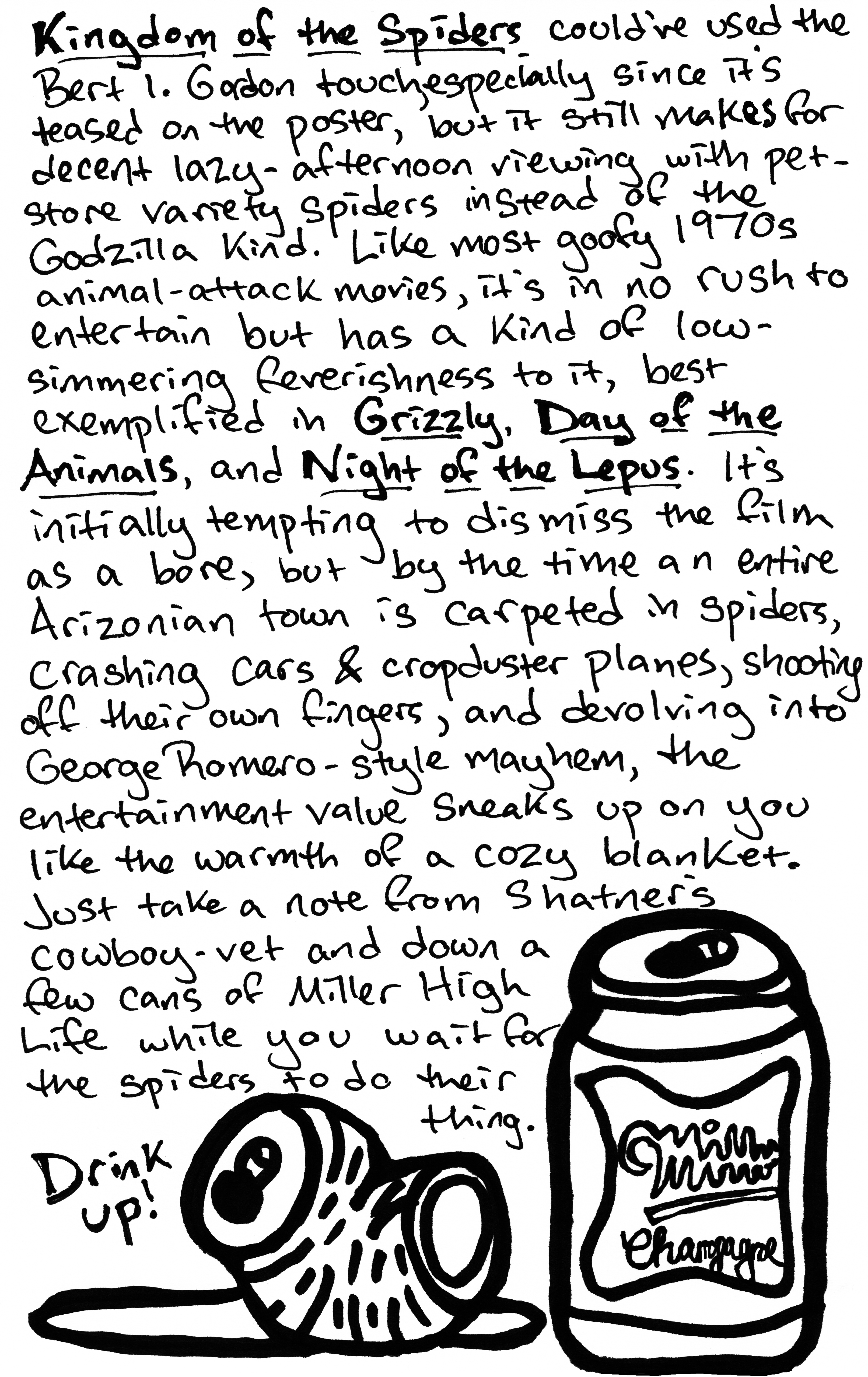
I’ve watched a few disparate adaptations & reinterpretations of Beauty and the Beast in recent years, each with their own unique window into the dark magic of the fairy tale: the intensely sensual surrealism of the French version from 1946, the tactile storybook atmospherics of the Czech version from 1979, the Internet Age psychedelia of the animated Japanese version from 2021. All of these retellings of the “tale as old as time” have, of course, touched on the hesitant attraction of an innocent young woman to a wounded, mysterious brute, but they also all ultimately focus more on the brute’s troubled past & cursed homelife than the inner life of the vulnerable beauty who loves him. That’s where Walerian Borowczyk’s take on Beauty and the Beast finds new, forbidden territory worthy to explore (as a French adaptation from a Polish director, as long as we’re tracking geography). A profane masterpiece of erotic menace & goofball social satire, Borowczyk’s perversion of the Beauty of the Beast template delves deeper into the monstrous extremes of women’s desire & pleasure than any other retelling I can name, to the point where the titular beast is merely a prop, a piece of furniture. And wait until you see what the women do to the furniture! The Beast is also singular its smutty eagerness to roll around in its own filth, an instinct that eventually pushes past the absurd into the sublime. It’s the only version of this story I’ve seen that reasonably compares to the 1940s Cocteau film that defines so many adaptations’ basic visual language, mostly because both works were clearly made for abject perverts.

Technically, The Beast is not an adaptation of the 18th century fairy tale at all, at least not in terms of plot. Like the recent anime version in Belle, Borowczyk’s film assumes the audience’s overfamiliarity with the source material, using its basic iconography for shorthand to push & warp its broader themes to new extremes. This is still a story where a young, naive woman is married off to a cursed, wretched beast as a desperate financial ploy, with the deep sadness of their newly shared castle’s faded glory haunting their tentative romance. And just in case you don’t catch his allusions to the fairy tale, Borowczyk hands the beast’s would-be bride a single red rose as a symbol of their delicate union. It’s just that this is the kind of film where the young beauty mashes that rose into her clitoris as an unconventional masturbation tool, destroying it in lustful mania while entertaining a zoological ravishment fantasy that would make even the most jaded cinephile blush. You’d think there’s nothing left that a Beauty and the Beast tale could do to surprise an audience, considering how many times it’s been retold & reshaped over the past few centuries. The Beast dropped my jaw in shock in its very first frame, which zooms in on the textbook veterinary details of equine genital arousal. The movie opens with relentless, repetitive images of erect horse cocks, fairly warning the audience that if you stick around long enough you will watch beasts fuck in intense biological detail. You won’t find that kind of novelty in either of Disney’s retellings of the tale, but Borowczyk’s version has a way of distilling it down to its most essential, throbbing parts.
The beastly beau in this picture is the poorly socialized nephew of a decrepit French baron, living in a Grey Gardens style faded estate in the rot of long-lost wealth. Hoping that a traditional Christian marriage will bring the mysteriously disgraced family back into the royal fold, they arrange for the ancient nobleman’s brother, a highly reputable Cardinal, to ordain his weirdo nephew’s union with a spritely British heiress. Only, the heir to the estate is a hopeless loser, spending every waking moment in the stables overseeing an intensive horse-breeding program with a fervor that pushes beyond the practical to the disturbed. Luckily, his wife-to-be is just as much of a shameless pervert, immediately matching the unholy, decadent vibe of the chateau with her own morbid sexual curiosity. Since her beau is too socially obtuse to understand or reciprocate her enthusiasm, he leaves her sexually frustrated in the absurdly long wait for the Cardinal’s arrival, dead time that she fills with wet dreams of the estate’s sordid history. There are superstitious rumors that a former lady of the house had mated with a cryptid beast who cyclically haunts the grounds every couple centuries, which is supposedly how the family was excommunicated from the Church in the first place. The beauty sweatily reimagines this human-bestial coupling in extensive, graphic detail while furiously masturbating in her bridal nightgown until the poor cloth is ripped to shreds. The horny, mythical beast of the past and the shy, grotesque beast of the present are eventually linked in a last-minute twist, but their connection is far less important than the perverted pleasures of the women who desire their touch (and thrusts).
Before The Beast devolves into full-on cryptid erotica, its value as a unique work gets lost among its many literary parallels, which extend far beyond the fairy tale it most overtly alludes to. The long, pointless wait for the Cardinal’s arrival at the castle plays out as an existential joke, recalling surrealist works like The Exterminating Angel & Waiting for Godot. There are also overt Buñuel parallels in its blasphemous mockery of the wealthy & religious ruling class as degenerate brutes, pushing its satire to de Sadist extremes but never fully matching the heightened Buñuelian humor at hand. The centerpiece of the work really is the pornographic depictions of bestial fucking, then – starting with the horses, working up to more traditional onscreen heterosexual couplings, and then climaxing with the historical ravishment fantasy that swallows up most of the third act. “Climax” is the only word you could really use to describe that payoff, too, since the humanoid wolverine who couples with an actual human being spurts semen by the bucketload for minutes on end as their tryst pushes beyond taste & reason. A faux-classy harpsichord soundtrack keeps the mood lightly comical throughout this absurd display, and it concludes with a punchline in which the Cardinal, finally arrived, performs a grand, fingerwagging speech about the evils of bestiality & women’s libidos as if he were reading from a pre-prepared pamphlet. In the end, it’s the women’s arousal & search for pleasure that registers as the film’s most blasphemous acts, even more so than its extensive depictions of their monstrous ravishment fantasies. They’re greatly enjoying themselves, much to everyone else’s disgust & confusion, which remains a global movie censorship taboo to this day.
Borowczyk finds his own fairy tale visual language here with images that have no obvious connection to the Beauty and the Beast tale: a snail sliming its way across a lady’s sky-blue shoe; lurid flashes of red paint through hallway doors that slyly recall aroused genitals: pornographic close-ups on actual aroused genitals; etc. As soon as his equivalent of Belle arrives on the estate taking dozens of dirty Polaroids of every perverted detail she can collect, it’s clear that he’s taking the story to new, distinct places. Most Belles cower in fear of the erotic menace lurking in their new home castles, gradually warming up to the beast who stalks the grounds. In this version, she’s so immediately fired up by the ugly erotic charge of the central pairing that it freaks out everyone around her, including the audience. A half-century later, it remains a bold, hilarious, intensely alienating take on a story that’s continued to be told countless times since, but rarely with such gleeful prurience.
Welcome to Episode #196 of The Swampflix Podcast. For this episode, Britnee, James, Brandon, and Hanna discuss four horror films directed by auteurs who only dabbled in the genre once, starting with Ingmar Bergman’s Hour of the Wolf (1968).
00:00 Welcome
03:07 The Beast (1975) 08:31 No One Will Save You (2023) 10:22 Death of a Cheerleader (2019) 12:18 Night Tide (1961) 16:12 Anchorman (2004) 22:08 Good Boy (2023) 24:19 The Severing (2023)
28:47 Hour of the Wolf (1968) 50:54 Peeping Tom (1960) 1:10:25 Near Dark (1987) 1:27:22 Willow Creek (2013)
Halloween is rapidly approaching, which means many cinephiles & genre nerds out there are currently planning to cram in as many scary movies as we can over the next month. In that spirit, here’s a horror movie recommendation for every day in October from the Swampflix crew. Each title was positively reviewed on the blog or podcast in the past year and is currently available on a substantial streaming service. Hopefully this helps anyone looking to add some titles to their annual horror binge. Happy hauntings!
“Sunshine, wine, swimming, antiquing, ambient acoustic strumming … If it weren’t for all of the violent hallucinations & vampiric ghouls this would be a pleasant little getaway” Currently streaming on Paramount+, for free (with a library card) on Hoopla, and for free (with ads) on PlutoTV.
“I braced myself for it to be far more needlessly vicious than it was, given the New French Extremity’s fetish for grisly details. Calvaire does a good job of implying instead of dwelling and, more importantly, of cutting its unbearable tension with gallows humor so it’s not all misery & pain. Part of my amusement might have been enhanced by the two main characters being assigned names I associate with comedy: Marc Stevens (who shares a name with John Early’s grifter villain on Los Espookys) and Paul Bartel (who shares a name with one of the greatest comedic directors to ever do it). Regardless, director Fabrice du Welz also amuses himself by framing this grim & grueling torture session as ‘the best Christmas ever’ in its sicko villain’s mind, contrasting the hyperviolent hostage crisis the audience is watching with the delusional family reunion of his imagination in a bleakly hilarious clash of realities. I don’t mean to imply that Calvaire‘s not also a nonstop misery parade, though. It’s that too.” Currently streaming on Shudder.
“A very cool, loose hangout dramedy about truck stop sex workers that gradually turns into a rigidly formulaic grindhouse slasher to pay the bills. Not everyone gets to be Sean Baker; sometimes you gotta cosplay as Rob Zombie to land your funding.” Currently streaming for free (with a library card) on Hoopla and for free (with ads) on Tubi.
“What I mean when I say ‘kids are scary’ is that being around other people’s children naturally makes people anxious and nervous, or at least that’s my experience. What if they trip and fall while running past my table at a cafe? Do I suddenly become responsible for their wellbeing? What if the parent thinks I tripped them? What if the kid thinks I tripped them and blames me? Kids are tiny, vulnerable people, but they also have a capability for pure, unfiltered malice that can be creepy as well, and since they’re only just learning how to regulate their emotions and communicate their thoughts, interaction with them can be a minefield. There’s Something Wrong with the Children is probably the first film that I’ve ever seen that captures that particular unease.” Currently streaming on Amazon Prime and MGM+.
“In which a pair of drunkard ghosts coach a child who’s been scared bald on how to grow his hair back, only for their advice to work way too well for his own good. Little-kid nightmare logic that you can only find in German fairy tales and Canadian B-movies, pinpointing the middle ground between Hansel & Gretel and The Pit. Wonderfully deranged.” Currently streaming for free (with ads) on Tubi.
“I was starving for a genuinely over-the-top animal attack movie after being let down by Cocaine Bear, and this hit the spot. It’s basically the same faintly sketched-out story, but its tactility & sincerity go a long way in making its attack scenes much worthier of the ambling journey. There’s something especially unnerving about the way the animals appear to leap out of stock footage, as if they’re crossing a forbidden barrier into reality to tear into the character actors (and, more often, the stunt doubles). Incredible that it wasn’t directed by Larry Cohen.” Currently streaming on Shudder and for free (with ads) on Tubi.
“As trippy as it can be in its Skinamarinkian disorientation, it’s anchored to a concise, recognizable premise that could neatly be categorized as The Blair Witch Project Part IV: Blair Witch Goes to Hanging Rock. It strikes a nice balance between the slow-moving quiet of its bedroom art brethren and mainstream horror’s return to big, bold, bloody haunted house scares. Maybe that makes it a less artistically daring film than World’s Fair or Skinamarink, but it also makes it a more overtly entertaining one.”. Currently streamingon Screambox, for free (with a library card) on Hoopla, and for free (with ads) on Tubi.
“Seeing a lot of grossed-out responses from unsuspecting audiences wishing this was more of a straightforward road trip love story. I’m coming from the opposite direction, wishing it weren’t so tenderly underplayed & remorseful about its hunger pangs for gore. It’s kinda nice to have something that drifts between those two magnetic pulls, though, especially since it’s so unusual to see a Near Dark-style genre blender positioned as a prestigious Awards Contender.” Currently streaming on Amazon Prime and MGM+.
“Feels like Lynch twisting himself in knots to make the James from Twin Peaks archetype genuinely compelling … and he eventually gets there. I’ve been thinking a lot lately about how noir antiheroes are mostly just sad sack losers who make their own shit luck by feeling sorry for themselves, and this one turns their mopey interchangeability into a kind of existential horror.” Currently streamingon The Criterion Channel.
“In The Lawnmower Man, director Brett Leonard justifies testing the limitations of stage-of-the-art 90s CG animation by inventing convoluted science lab experiments that create a VR cyberworld. Here, he takes a bold step forward by suggesting that exact CG cyberworld is where our souls go when our bodies die, treating his Windows 95 screensaver graphics as if they were the most typical, durable approach to visual effects available. Stunning, even if extraordinarily goofy.” Currently streamingfor free (with ads) on Tubi.
“Brandon Cronenberg’s deeply unnerving debut is a sickly TMZ geek show. I need to stop hanging out online, because I keep reading flippant dismissals about how unimpressive he is as body horror’s premier nepo baby, then still really enjoying each of his movies when I get to see them for myself.” Currently streamingfor free (with ads) on Tubi.
“In which a madman plastic surgeon transforms an injured go-to dancer into his missing daughter’s doppelganger, in order to claim her inheritance in her absence. Technically, this is a PG-rated comedy, but it feels like it should have been bumped to the top of the video nasties list. Delicious, deep-fried Southern sleaze.” Currently streaming on Screambox.
“Hideous gore, gratuitous male & female nudity, and a babyfaced Udo Kier soaring miles over the top as a camped-up villainous lead. What more could you want?” Currently streaming on The Criterion Channel and AMC+.
“Like all other Amicus anthology horrors I’ve seen, this is consistently entertaining throughout but never exactly surprising nor even thrilling. It’s horror comfort viewing, best enjoyed under a blanket with a humongous mug of tea.” Currently streaming on Screambox, for free (with a library card) on Kanopy, and for free (with ads) on Tubi.
“The greatest British portmanteau horror of all time, trading in the rigid stage-play traditionalism of classic Amicus anthologies for a more fluid, music video era dream logic.” Currently streaming on Shudder and for free (with a library card) on Kanopy.
“A pure psychedelic meltdown of id at the bottom of a deep well of communal grief. Restructures the seaside ghost story of Carpenter’s The Fog through the methodical unraveling of Akerman’s Jeanne Dielman, dredging up something that’s at once eerily familiar & wholly unique.” Currently streaming on Hulu.
“A pensive motherhood horror about the pain of trading in youthful passion & rebellion for familial comfort & ease. Lots of thematic overlap with The Five Devils in that way, even if they’re nothing alike aesthetically. Besides landing every one of its scares and dramatic beats, this just has some truly world-class hand acting. Cracking knuckles and spatchcocking chickens will never feel the same again.” Currently streamingon Shudder and AMC+.
“Without question, the greatest evil-stepparent horror of all time, a superlative indicated by its definitive title. Terry O’Quinn is the stepfather, a sociopathic serial killer who cycles through families like he’s updating his wardrobe, killing the old batch in cold blood instead of dropping it off at Goodwill. O’Quinn is an explosive volcano of white-man rage, barely suppressing his violent outbursts under a thin facade of Ward Cleaver, Father Knows Best-style suburban Family Values. It is one of the all-time great villain performances, regardless of genre. There was already a bland, forgettable remake in the aughts, but the only other actor who could maybe pull this performance off is Will Forte, whose comedic version of bottled-up fury is a direct echo of the terror in O’Quinn’s piercing, hateful eyes.” Currently streamingon Peacock, Screambox, for free (with ads) on Tubi, and for free (with a librarby card) on Kanopy & Hoopla.
“A tense domestic thriller about a pushy, macho plumber who walks all over a married couple of uptight academics; directed for television by a young Peter Weir. Cuts to the core of liberal urbanites’ fear of the working-class brutes they invite into their home for routine repairs; a home invasion thriller where the menace is politely welcomed inside.” Currently streamingon The Criterion Channel.
“As absurd as this prototypical slasher can be tonally, it feels true to how I remember high school: a conformity cult led by fascist jocks, lording over poorly socialized losers who would’ve been just as awful if we were given the opportunity. Our jocks never offered to take us hang-gliding, though, so now I feel like I missed out on something.” Currently streamingon The Criterion Channel.
“A strong sequel in a very strong franchise, possibly the horror franchise with the best hit to miss ration (5:1, in my book, and even the dud has Parker Posey to liven it up, so that’s something). Even though there are moments that are questionable (some of the people we see attacked should not have survived what happened to them), there are more than enough great sequences, character beats, and thrills to make up for them.” Currently streaming on Paramount+.
“It wasn’t until after the viewing that I realized the director, Gerard Johnstone, was also the man behind Housebound, a film we loved so much that we made it into content for Swampflix twice: first with a very positive 2015 review and again five years later as the topic on one of our earliest episodes of the Lagniappe podcast. That actually explains the comedic sensibility; it’s not omnipresent, but it’s almost funnier that the jokes are paced with some distance between them, allowing them to break the tension when they reappear, and the emotional whiplash of it all is part of the fun. ” Currently streaming on Amazon Prime.
“A young, baby-faced Clint Howard stars as a military academy misfit who summons Satan to smite his bullies using the Latin translation software on the school computer. It’s a dual-novelty horror that cashes in on the personal desktop computer & Satanic Panic trends of its era, combining badass practical gore spectacles with proto-Lawnmower Man computer graphics. It isn’t long before the prematurely bald Baby Clint graduates from translating Latin phrases from a Satanic priest’s diary to asking the computer dangerous questions like ‘“’What elements do I need for a Black Mass?’”’ and ‘“’What are the keys to Satan’s magic?’”’, stoking parents’ technological and religious fears with full aggression. And the third-act gore spectacle he unleashes with those questions is gorgeously disgusting.” Currently streamingon Shudder.
“Some fun, fucked-up Discomfort Horror that Malignantizes the post-torture porn cruelty of titles like Don’t Breathe into something new & exciting. It also has the best end-credits needle drop since You Were Never Really Here, leaving the audience in a perversely upbeat mood despite the Hell we just squirmed through.” Currently streaming on Hulu and Max.
“Simultaneously a familiar experience and an alien one, mixing generic horror tropes with an experimental sensibility – like a Poltergeist remake guided by the spirit of Un Chien Andalou. It’s the kind of loosely plotted, bad-vibes-only, liminal-space horror that requires the audience to meet it halfway both in emotional impact and in logical interpretation. In the best-case scenario, audiences will find traces of their own childhood nightmares in its darkened hallways & Lego-piece art instillations. Personally, I was more hung up on the way it evokes two entirely separate eras of my youth: my alone-time online as a sleep-starved teen and my alone-time in front of cathode TVs as a sleep-starved tyke a decade earlier.” Currently streaming on Hulu and Shudder.
“Before pressing play I was skeptical this would be enough of a Horror Film to work as proper Halloween season viewing. One of the first shots is a newspaper headline that reads ‘STRANGLER STILL AT LARGE!'” Currently streamingon Amazon Prime and The Criterion Channel.
“Super scary, both as a traditional Gothic ghost story and as a worst-case-scenario vision of Daniel Radcliffe’s career path as a bland leading man instead of an eccentric weirdo millionaire.” Currently streamingon Paramount+ and for free (with a library card) on Hoopla.
“The surprisingly goofy midway point between Poltergeist and Jacob’s Ladder. Can’t quite match the euphoric highs of either comparison, but it’s still a fun dark-ride attraction of its own merit. The rubber-mask monsters are adorably grotesque, and they pop out of the most surprising places.” Currently streaming on Shudder, Amazon Prime, and for free (with ads) on Tubi.
“A deliciously trashy VHS slasher where every single kill comes with its own punny quip. You hardly have time to question why they call him Dr. Giggles before he’s performing involuntary open-heart surgery while giggling like a madman and proclaiming ‘”‘Laughter is the best medicine.'”‘ It has no idea how to fill the time between the kill gags, but it really delivers the goods where it counts.” Currently streamingfor free (with ads) on Tubi.
“A kind of anti-choice, pro-environmentalist creature feature where an aborted, toxically mutated fetus gets its revenge on the brothel-clinic that brought it into this sick, sad world. It’s not a perfect movie but it’s a perfect This Kind Of Movie, delivering everything you could possibly want to see out schlock of its ilk: a wide range of rubber monster puppets, over-the-top character work, stop-motion buffoonery, and multiple opportunities to feel greatly offended while never being able to exactly pinpoint its politics. Wonderfully fucked up stuff.” Currently streamingfor free (with ads) on Tubi.
“I always assumed we didn’t have basements in Louisiana because we’re built on mushy swampland. Turns out it’s because we’re built on seven gateways to Hell. Honestly makes a lot more sense.” Currently streamingon Shudder, Peacock, andfor free (with ads) on Tubi.
There’s nothing especially unique about the mid-90s cyberthriller Cyberstalker. Its novelty as internet chatroom techsploitation is not only drowned out by much bigger, louder Hollywood thrillers of its era like Hackers, Virtuosity, and The Net, but it also fought for video store shelf space with countless other direct-to-VHS cybertitles just like it: Cyberpunk (1990), Cyber-C.H.I.C. (1990), Cyber Tracker (1994), Cyberjack (1995), Cyber Bandits (1995), Cyber Zone (1995), Cyber Vengeance (1997), and cyber-so-on. Cyberstalker‘s home video distributor Troma has since attempted to distinguish it from that overflowing bucket of cyberschlock by retitling it The Digital Prophet, but there are no marketing strategies creative enough to save it from the anonymity of content dungeons like Amazon Prime, Tubi, and PlutoTV. The only distinguishing detail that might hook in an outsider audience who’s not a glutton for vintage cybertrash is a villainous role overperformed by horror convention veteran Jeffrey Combs, who counts as a major celebrity get for a film on this budget level.
Combs isn’t the main villain of Cyberstalker, though. He’s just her cult leader & heroin supplier. The titular cyberstalker is a reclusive chatroom nerd & comic book enthusiast played by Annie Biggs, an actress & director of little note. Troma’s “Digital Prophet” rebranding makes some sense as a marketing ploy, then, since it centers the much more recognizable Combs, who writes the comic books that drive the actual cyberstalker mad. Biggs plays a true believer in her dealer/abuser’s unhinged cyber-rhetoric, and her dedication to the cyber-cause gradually transforms her from a Lisa Loeb cosplayer shut-in to a cyborg dominatrix . . . at least in her mind. As she recruits victims from the Cyberthoughts comics’ Cyecom chatroom, they only see her as a nerd with a gun. The audience has the privilege of seeing the real world through her cyber-eyes, though, where her earthly body glitches out into PC monitor static and Windows 95 screensaver psychedelia. It’s a little disappointing that the most novel, cyber-specific imagery in the movie is all in the killer’s head, but it is real to her and, thus, temporarily real for us.
No-name, no-relation director Christopher Romero attempts to treat this chatroom-murders novelty subject like a standard serial killer thriller, borrowing from the disembodied, leather-gloved hands of gialli and the window-blinds shadows of noir instead of intently pushing the vaporwave CG imagery to its Brett Leonard extremes. In his most hilarious move, Romero even recreates the infamous Psycho shower scene with a handgun instead of a kitchen knife. Despite those misguided efforts to dull down & normalize the film’s cyberthriller elements, there are still plenty moments of 90s techsploitation kitsch that shine through: the first victim is strangled with a modem chord; all victims read their Cyecom chatroom correspondence out loud for the audience’s benefit, like Sandra Bullock in The Net; and the final showdown with the cops on the killer’s trail is staged in a warehouse stocked with Dell computer monitors. Of course, since there are countless other video store titles where you can find those exact mid-90s cyberthriller novelties, I should probably just be reporting on the one thing that might draw new audiences in to see Cyberstalker in particular: Combs. The production could only afford Combs for a few scenes, but he makes the most of them, especially when performing a gunshot wound during the final shootout, making a full meal of his death like Paul Reubens in the Buffy the Vampire Slayer movie.
I rented Cyberstalker for one American dollar. It was a small fee to skip the ad breaks of whatever cyberequivalent I would’ve watched on Tubi instead if this one wasn’t so cheap to rent. I’m sure I would’ve gotten just as much (and just as little) out of Cyber-C.H.I.C., Cyber Vengeance, or whatever random noun Tubi would’ve autofilled as I typed the word “cyber” in the search bar, but I have no regrets watching this randomly selected cybertitle. If nothing else, I’ve never seen a serial killer character costumed to look like Lisa Loeb before. The closest example I can think of is Carol Kane in Cindy Sherman’s Office Killer, but even she had more of a Big Bad Wolf in Grandma’s nightgown look.
For this lagniappe episode of The Swampflix Podcast, Boomer, Brandon, and Alli discuss the roughly prototypical high school slasher Massacre at Central High (1976).
There was some mild online controversy earlier this year when American film critic Scott Mendleson referred to Bollywood superstar Shah Rukh Khan as “India’s Tom Cruise” in headline shorthand, as if SRK’s legendary career was secondary to its closest Hollywood equivalent. I’m going to risk doubling down on that accidental insult here by comparing those two stars’ current run of action blockbusters, hopefully in a more specific way. The cultural & industrial contexts of Cruise & SRK’s respective careers might be incomparable, but right now they happen to be the only world-famous movie stars keeping the lone-wolf action genre alive, and they’re both doing so decades past the point where they could reasonably play the archetype. While Cruise has put in two old school star-power performances in the past year with M:I Dead Reckoning (yay!) and Top Gun: Maverick (booo!), SRK has done the same, if not better, in Pathaan and now Jawan. Both stars have long enjoyed a kind of ageless, plastic handsomeness that they’ve tirelessly applied to nationalistic action spectacles in recent years, often to deliriously entertaining results. And as outdated as that muscles-and-explosions version of action cinema feels this long after Stallone & Schwarzenegger’s heyday in the Reagan Era, Cruise & SRK both managed to surprise me this year in the exact same way. There was a moment in the ludicrously overstuffed Dead Reckoning: Part 1 when it suddenly occurred to me just how many badass women Cruise had managed to gather around him as Ethan Hunt over seven entries in the ongoing Mission: Impossible series. No longer relegated to minor roles as arm candy, distressed damsels, and refrigerated wives, Cruise had slowly built a small crew of fierce femme fighters in actors Rebecca Fergusson, Venessa Kirby, Pom Klementieff, and Hayley Atwell. While most lone-wolf action blockbusters provoke you to think “Dudes rock!” (including Maverick & Pathaan), there was a brief moment of Dead Reckoning that left me thinking “I love women so much!,” a much rarer feat. So, I was delighted that SRK’s latest, Jawan, wholly dedicates itself to that same novel cause, at least once it gets the requisite hero worship of its macho lead out of the way.
Jawan stars Shah Rukh Khan as a renegade prison warden who routinely sneaks a small girl gang of select prisoners out of jail to help him commit wholesome acts of political terrorism. In a plot similar to this year’s Ajith Kumar bank-heist actioner Thunivu, SRK’s populist terrorist only takes hostages for media attention, deliberately going viral so he can expose corporate & governmental greed directly to The People. He never actually threatens the lives of the Mumbai citizens at the business end of his guns & explosives, but he uses their terror to amplify his political messages on social media & traditional newscasts. It’s an extremist cause but a righteous one, ultimately re-routing corporate & governmental bribe money to heal societal ills like high suicide rates among farmers who owe predatory banks unreasonable sums, underfunded government hospitals left to rot without proper subsidies and, the issue closest to his heart, long-overdue prison reform. It’s initially jarring to watch hundreds of women prisoners applaud their warden in universal celebration, not to mention the adulation of the hostages he takes at gunpoint while masking his identity in public. He’s always on the right side of the Us vs Them political divide, though, a righteousness backed up by his wholly dedicated girl-gang prisoner crew. It’s like watching SRK arm the cast of Gangubai Kathiawadi with rifles & grenades to aim at the politicians & bankers who damned them to poverty in the first place. Of course, since law enforcement only exists to protect property, not serve the people, armed forces are sent to swiftly, violently shut down his one-man Joker/Anonymous movement ASAP. And of course, since SRK is SRK, he escapes a fatal fate at the government’s hands by simply wooing the woman in charge, romancing her to his side of the fight as part of the gang.
I’ve maybe revealed a couple surprise, pre-intermission plot twists in the above paragraph, but there are plenty more to be discovered throughout Jawan (including a ludicrous development that directly addresses how far its star has aged out of these kinds of roles). This is a non-stop entertainment machine, the full package. It marries the recent transcendent achievements of South Indian action-blockbusters out of Tollywood & Kollywood with the classic payoffs of Bollywood masala cinema (by hiring Tamil director Atlee for a traditional big-budget Hindi production). You can feel that marriage most clearly in the musical romance sequences, which in recent years have more often been downplayed as music video asides but here feature at a central, prominent place in the narrative, emphasized just as much as the CG action spectacle of its mass shoot-outs, liberally tossed explosives, and glimpses of flaming horses. There are references in the dialogue to other mass-entertainers in the same vein like the S.S. Rajamouli historical action epic Baahubali and the reliably charming Indian actor Alia Bhatt, solidly rooting the film in a larger industry of peers. SRK is a major, load bearing pilar in that industry, and he’s afforded plenty of screenspace to ham it up here, both as a dashing romantic lead and as a grizzled political terrorist who hides behind old-school Universal Monster masks styled after The Phantom of the Opera & The Mummy. His appeal as an action star is universal (to the point where comparing him to Tom Cruise really is an insult to his own unique, unmatched celebrity), but it’s probably not out of line to note that he has a particular appeal to heterosexual women as an object of desire. So, there’s something wonderful about the way this particular crowd-pleaser surrounds SRK with hundreds of women, filling the frame to cheer him on and fight beside him as if the entire gender as a social group were his co-star instead of his assigned romantic partner in South Indian “Lady Superstar” Nayanthara. I was charmed by the brief flash of that army-of-women supporting cast in Dead Reckoning, but Jawan outshone that aspect of it with the same blinding commitment to excess that Pathaan outshone all other McQuarrie-era Mission: Impossible sequels with, besting them at their own game (even while their MVPs played on entirely different fields).
“Why do I watch WrestleMania? My answer is that the poet must not avert his eyes from what’s going on in the world. In order to understand, you have to face it.”
“Our sense of the real world today is massively challenged; I include here reality television, breast enhancement, and the carefully choreographed, fake drama of WrestleMania, populated by larger-than-life characters with muscles that nature doesn’t normally provide us with and who take pleasure in telling everyone how unbelievably evil they are.”
“What is fascinating about WrestleMania is the stories around it: the dramas between the owner of the whole show and his son, who are feuding, and his wife in the wheelchair who is blind, and he is then showing up in the ring with girls who have huge, fake boobs, and he is fondling them. This is almost sort of an ancient Greek drama – evil uninterrupted by commercials.”
These are just a choice few Werner Herzog quotes about the cultural & literary virtues of professional wrestling, pulled from the 2019 GQ listicle “Werner Herzog Cannot Stop Talking About WrestleMania” – a masterpiece of modern clickbait publication that I return to often. Herzog was promoting his work as an actor on the Star Wars television series The Mandalorian around the time those various press junket quotes were assembled, a time when his familiarity as a household name was bridging the gap between art cinema snobs and their sworn enemies, “Disney Adults.” His public perception has since been bifurcated in recent years, split between his well-earned designation as a world-class auteur and his more recent evolution into a Nic Cagian human meme who pontificates about supposedly low-brow subjects like WrestleMania & Ana Nicole Smith in a severe German accent. Unlike Nic Cage, though, Herzog has not allowed his YouTube Era reputation as a human meme affect the tone or content of his work as a serious filmmaker, give or take a few over-the-top scenes in his collaboration with Cage in Bad Lieutenant: Port of Call, New Orleans. As often as you hear Herzog explain the grotesque poetry of reality TV & pro wrestling in interviews, it’s difficult to detect their influence on his actual work. That is, unless you happen to be one of the few people who remember his 2001 historical fantasy drama Invincible, which presents an academic-level understanding of the historic origins of wrasslin’, as well as its modern mutation into mass, crass populist entertainment.
Invincible stars real-life strongman Jouko Ahola as historical strongman Zishe Breitbart, a young Jewish blacksmith from a small Polish village who grew to fame as “The Strongest Man in the World” in 1920s Germany. Herzog takes a pro wrestling-style truthiness approach to the material, moving Breitbart’s story to the early stirrings of Nazi Germany a decade later, playing up the significance of his Jewish heritage in a heightened, more satisfying kayfabe version of his life’s story. In the film, Breitbart enters the entertainment industry through the strongman circus acts that sparked pro wrestling as an artform. He challenges a traveling strongman for prize money in what is supposed to be a rigged wrestling bout and easily defeats the brute in a Goliath vs Goliath matchup. Word of his incredible strength quickly spreads, and he’s summoned to work as a regular stage act in a Berlin cabaret, ringmastered by a Nazi-friendly psychic played by Tim Roth. Roth’s conman mystic is quick to use Breitbart’s Jewish heritage as a race-baiting point of division between the Nazi officers and Jewish citizens in the cabaret audience, which is perfectly in tune with how hot-topic political divisions are exploited for cheap heat in modern pro wrestling programs. Breitbart is the underdog hero for the Jewish people, who feel increasingly hopeless as the Nazis rise to political power. The carnie mystic MC is a hero to the Nazis, pretending to summon supernatural strength from The Dark Arts to overpower the strongman’s brute force (a “skill” he can sell as a war-winning weapon for Hitler’s army). In truth, they’re working together as a scripted act, putting on a show to stoke their divided audience’s Us vs Them bloodlust; it’s wrestling in a nutshell.
Aesthetically, Invincible is worlds away from the reality-TV crassness of what Herzog refers to as “WrestleMania”. In its best moments, there’s an ancient cinematic quality to the director’s visual storytelling, effectively remaking Bob Fosse’s Cabaret as if he were Tod Browning adapting a fairy tale. In its worst moments, it plays like standard-issue Oscar bait of its era, bolstered by a prestige-desperate Hans Zimmer score that tells the audience exactly how to feel at every second of runtime. Its Oscar chances were self-sabotaged by Herzog’s choice to have his European actors speak phonetic English in post-production dubs instead of performing naturally in their various native languages. That might have been a deliberate attempt to evoke a Bressonian style of performance, but it just comes across as bizarre & confused, and only the established professional actors Tim Roth & Udo Kier come across as capable performers. The camerawork can come across as bizarre & confused as well, alternating between a handheld documentary style and a Hollywood-schmaltz fantasy & artifice that attempts to (in Ross’s showman wording) “[articulate the audience’s] collective dreams”. Its moments of visual lyricism make sense to me as a historically set fairy tale about Nazi obsession with mysticism clashing against a Freaks vs. The Reich style superhero. They’re especially effective when Herzog gazes at the sea-life bodies of jellyfish & crabs as if he were a space alien considering their otherworldly beauty for the very first time. He’s really good at articulating the uncanniness of everyday life & pop media in that way, which is how he’s gotten famous as an interviewee outside of art cinema circles. It’s amusing, then, that he can’t convincingly translate that wonder with the world into an Oscar-friendly movie for normies; he’s too much of a genuine weirdo.
Around the time of Invincible, Herzog was essentially directing one feature film a year at a consistent pace, and he’s only gotten more prolific in the two decades since. While some of his 2000s titles like Grizzly Man, Encounters at the End of the World, and the aforementioned Bad Lieutenant have endured with a certain cultural cachet, many like Invincible have fallen through the cultural cracks; they can’t all be stunners. If you’re going to excavate this one Herzog title out of relative obscurity within that massive catalog, I do think it’s worth considering as a bizarre, failed attempt to reach for Awards Season prestige beyond the usual, routine boundaries of his critical accolades. He has found wider public recognition in the years since, but mostly as a weirdo public persona (an extension of the first-person narration style he developed in his 2000s-era documentaries). Invincible does recall one very specific aspect of that public persona, at least: his inability to stop talking about WrestleMania. Whether that’s enough of a reason to dig this one particular discarded Herzog DVD out of the Goodwill pile is up to your completionist interest in his career, I guess, as well as your personal fascination with the Greek tragedy & grotesque poetry of wrasslin’ as an artform.
Like many bored, frugal Americans, I recently dragged myself out of the house on National Cinema Day to take advantage of the newly invented corporate holiday’s adverised movie ticket price of $4. I very much appreciated the discount, just as I appreciate local theaters’ weekly $6 ticket deals on Tuesdays. On the audience’s end, it’s nice to feel like we’re scoring a bargain; on theaters’ end, it’s a smart ploy to lure us through the door to buy the popcorn & cocktails that actually drive profits. On both sides, it was just a great excuse to hide from the heat on what turned out to be the hottest day in the history of recorded temperatures in New Orleans (so far!). What I couldn’t get over while sweating my way through The Broad Theater’s parking lot, though, was the genius of stoking ticket sales during such a low tide of new, exciting releases. Besides the promise of central air-conditioning, there just wasn’t much on The Broad’s marquee that looked like it would pull in a huge crowd without the $4 ticket deal. Barbie & Black Beetle were the blockbusters on offer, neither of which were in their first-weekend rush; Passages& Landscape with Invisible Hand were their smaller, artsier counterbalance, neither of which are especially attention-grabby outside a small circle of media obsessives who know the names Cory Finley & Ira Sachs. And so that left room on the marquee for the true heroes of the day: a restoration of the four-hour French New Wave manboy autopsy The Mother and the Whore and an opportunistic re-release of Emma Seligman’s stress-nightmare comedy Shiva Baby, working up some enthusiasm for the following week’s follow-up Bottoms. Early this summer, when there was absolutely nothing of importance or interest to see in local theaters, IP-driven monstrosities like Fast X, Super Mario Bros, and The Little Mermaid clogged up local marquees for months, leaving us in a stagnant cultural dead zone. By National Cinema Day, theaters & distributors had figured out the perfect way to fill that cultural void: robust repertory programming.
Truth be told, August’s best repertory re-release had already left theaters by National Cinema Day, but I made time to catch it at The Broad earlier that week on a $6 Tuesday deal. A new digital restoration of Park Chan-wook’s international breakout Oldboy was re-released nationwide by the hip cinema distributor Neon last month, commemorating the film’s 20th anniversary. That’s two whole decades of college-freshmen edgelords daring each other to watch this Totally Badass, Totally Fucked Up revenge thriller over a case of the cheapest beer that’s ever been swallowed. And since I was a college freshman around when Oldboy first hit DVD myself, it’s incredible that I had never seen it before its prestigious victory lap this August, enjoying the afterglow of Park’s more refined, acclaimed works like The Handmaiden & Decision to Leave. My friend group just happened to get our grubby, beer-clutching hands on other edgelord starter-pack films of the 2000s instead: American Psycho, Requiem for a Dream, Suicide Club, Ichi the Killer, etc. However, I am a movie nerd with an internet connection, so I have absorbed plenty of the details & circumstances of the sex & violence in Oldboy over the past couple decades of “You’ve got to see this fucked up movie!” cultural osmosis, to the point where I wasn’t sure what was left to be discovered by finally watching it once its re-release arrived at my nearest theater. I mostly showed up to watch Oldboy out of solemn duty as a Cult Cinema enthusiast needing to mark a major 2000s title off my checklist. So, given how familiar I felt with its major bullet points (and hammer holes), I was shocked by how well the mystery aspect of the movie worked for me as a new viewer. Just like its reformed shitbag protagonist, I really wanted to know the whos & whys behind the elaborate torture schemes. Unlike the titular oldboy, though, I was fully aware of how much we’d have to suffer to get to those answers.
As a digital “restoration”, the new Oldboy release is not some revelatory visual experience; this is not Criterion cleaning up & hyper-saturating a Technicolor marvel like The Red Shoes. Neon’s Oldboy scan still looks stuck in the mid-00s, and it’s much more likely to impress a longtime devotee who’s used to screening it on a cathode-ray TV than a first-time viewer. Its overt aughtsiness is integral to its prominence in the pop culture canon, though, so it’s for the best that it still looks of its time. Its sickly fluorescent lighting is true to the aesthetics of American torture porn in that era—typified by Saw & Hostel—while its absurdly convoluted plot mechanics recall the grander, elevated European torture porn of the time: Martyrs, Calvaire, Inside, etc. Oh Dae-Su (Choi Min-sik) may have been imprisoned & tormented in a small cell outside of time for fifteen grueling years, but he’s allowed a window to the outside world in a small motel-style television, where he consumes early-aughts pop culture & news coverage like oxygen entering his lungs. Once “freed,” he’s equipped with a 2000s-vintage flip phone, a pay-by-the-hour internet cafe, and a rudimentary video chat platform that doesn’t yet stream audio. Of course, he hasn’t really been freed at all, as the mysterious tormenter behind his imprisonment uses these wicked tools of the early internet to imprison him in a slightly larger cell (the massive city of Seoul instead of just one room inside it). He’s trapped by the lack of reasoning behind his torment and the mysterious face responsible for it, given five days to solve the puzzle and secure his revenge before the punishment gets even more severe. The audience knows he’s being played with like a half-dead mouse, but it takes a while to find the cat who’s batting him around, and it takes even longer to figure out why that cat hasn’t gotten bored of him yet.
Maybe I’m wrong about that. Maybe all audiences everywhere already know every beat of Oldboy, and I was the last genre gobbler around who could enter the theater without knowing exactly where its twisty story is going. After so many years of dorm room canonization, it wouldn’t be surprising if there were no surprises left in Oldboy for the uninitiated. I hadn’t seen it, nor read its comic book source material, nor spoiled myself with its 2010s Spike Lee remake, and even I already felt like I had its iconic hallway fight scene and the grimiest details of the final villain’s speech committed to memory. It was a joy to squirm along with fellow in-the-flesh moviegoers during its scenes of covert incest & unflinching dental gore, though, and I was surprised by how much I cared about the motivation behind those grotesqueries beyond their shock-value novelty. In fact, I skipped out on seeing a personal-favorite cult classic I’ve seen many times before (but never in a proper theater) to make time for that first-time watch of Oldboy, and I left a satisfied customer; it was up against a 50-year anniversary restoration of the landmark folk horror The Wicker Man that same week. Neon’s re-release of Oldboy appeared to be a successful financial gamble too, surpassing the box office sales of the film’s original run in just a couple weeks. I can only hope that success means more nation-wide repertory programming is on the way, bolstering the couple regular local slots The Prytania clears in its schedule for its Wildwood & Classic Movies series. The Broad is pretty great about picking these releases up when they’re offered by distributors, which is how I’ve gotten to see other, obscurer cult classics like The Doom Generation,Funeral Parade of Roses, and The Last Movie for the first time in a proper theater. It’s a rare treat that’s getting a lot less rare, and I hope that it becomes the go-to move when padding out release schedules during the leaner months on the theatrical release calendar. It would certainly lure me in to buy more cocktails & popcorn, whatever keeps the projectors on.
Welcome to Episode #195 of The Swampflix Podcast. For this episode, Brandon, James, Hanna, and Britnee discuss the rudimentary CG realms of director Brett Leonard, starting with his supernatural serial killer thriller Hideaway (1995).
00:00 Welcome
01:58 Fools Rush In (1997) 05:55 Jodorowsky’s Dune (2013) 13:28 Rebecca (1940) 16:13 Amateur (1994) 20:40 Petals on the Wind (2014) 25:33 We Were the Mulvaneys (2002) 30:15 Jawan (2023) 35:35 Cyberstalker (1995)
39:16 Hideaway (1995) 1:00:24 The Lawnmower Man (1992) 1:23:11 Virtuosity (1995) 1:41:50 Siegfried & Roy: The Magic Box (1999)
Only two feature films into his career, I’m already comfortable thinking of Bertrand Mandico as my favorite working director, even though only his debut was a total stunner. Mandico’s The Wild Boys is my favorite film released within my lifetime – a Bidgoodian wet nightmare about gender dysphoria and, ultimately, gender obliteration. His follow-up, After Blue (Dirty Paradise), is more of a flippant prank, using the same sensory intoxication & erotic menace for a much sillier purpose: worshipping the almighty Kate Bush in the rubble of our fallen civilization. Although it’s seemingly shot in a muted black & white that sidesteps the cosmic blues & purples that make his other features so vivid & vibrant, I’m dying to see his third feature, Conann, which appears to be a gender-subverted riff on the pulp fantasy character Conan the Barbarian. It’s going to take a while for that latest dispatch from Mandico’s id to reach American screens (it just premiered at Cannes this summer), so I decided to placate my curiosity as best as I could by digging into his back catalog of short films. Altered Innocence has consistently been Mandico’s home distributor since the company’s inception; it’s even arguable that Mandico’s films have been a brand-defining cornerstone for the Vinegar Syndrome partner label, along with the similar dreamlike genre throwbacks of Knife+Heart director Yann Gonzalez. Given that close affiliation, their publishing a collection of Mandico’s short films on a single Blu-ray disc, titled Apocalypse After, was a total no-brainer. Given my own personal obsession with The Wild Boys, the only surprising thing is that I didn’t jump on this disc the second it was released last year. I guess I needed to get worked up about a new feature from Mandico dangling just outside my reach to seek out his already-available shorts I hadn’t yet seen. Well, that and if I immediately jumped on every new Altered Innocence release I wanted to see I’d struggle to pay my energy bill, and I wouldn’t be able to watch them anyway.
The titular short on this disc, “Apocalypse After (Ultra Pulpe)”, is a calling-card submersion in the subliminal perversions of cinema, consciously transforming “science fiction” into “science titillation” while shouting in frustration that the images still aren’t erotic enough for the director’s liking. Longtime Mandico collaborator & muse Elina Löwensohn stars as the director’s avatar, an arthouse pornographer named Joy d’Amato (in cheeky reference to real-life pornographer Joe d’Amato). Mandico’s films are full of sarcastic allusions to real-life artists he admires in this way: Kate Bush, Henry Darger, Jean Cocteau, Walerian Borowczyk, etc. Curiously, he has yet to name-drop the three filmmakers he most reminds me of—Kenneth Anger, Guy Maddin, and James Bidgood—likely because their influence is already blatantly apparent in the text. Joy d’Amato is more Bertrand Mandico than she is Joe d’Amato, though, shooting a live-action version of paperback sci-fi cover art with the same vintage porno sensibility you can find in all of Mandico’s recent work. In a way, the film shoot setting positions “Apocalypse After” as Mandico’s Knife+Heart (a movie he acted in as a porno cinematographer), but it’s even less of a coherent, linear story and even more of an expression of its director’s fascinations & frustrations with his artform. Dialogue that declares details of the film shoot “magnificently hideous” or complain, “It’s beautiful, but at the same time I don’t know what he means,” function as meta commentary on the achievements & shortcomings of Mandico’s art. No dialogue feels more essential to the piece than an actor’s monologue recalling watching forbidden, adult films as a child – compelled & mesmerized by the images on the screen but too young to fully comprehend them. Mandico has a way of turning pornographic indulgence into transcendent visual art, and even then he directs his avatar in Löwensohn to shout that the images are still not erotic enough. Nothing ever could be.
The “Apocalypse After” short is a thematically cohesive but logically incoherent collection of all the stylistic flourishes & quirks sketched out in Mandico’s first two features: the plant life molestations of The Wild Boys, the hollow geode-face zombies of After Blue, and the practically achieved glamour that merges their aesthetics – gel lights, rear projections, body glitter, smoke, prosthetic nipples, etc. The presentation of Mandico’s previous shorts on the Apocalypse After disc is strictly chronological, so you can watch the director arrive at that personal aesthetic over decades of obsessive tinkering. Over three full hours of his two decades of short-form experiments, Mandico Heads get to watch the filth maestro develop his cosmic visual language in ten preceding works. In that context, “After Apocalypse” is less of a jumbled collection of Mandico pet obsessions than it is a natural crescendo of a clear pattern in methodology. His seemingly weird-for-weird’s sake indulgences become more recognizably thoughtful & designed in retrospect, the same way the “Magick Lantern Cycle” packaging of Kenneth Anger’s shorts makes “Lucifer Rising” feel like the most obvious place his art could lead him, not an out-of-nowhere novelty. The Apocalypse After disc starts with Mandico imitating Jan Švankmajer’s stop-motion nightmares in antiqued sepia tone, then seeking the same ancient artifice in short-form magical realist dramas. He hits a breakthrough mid-career with the mid-length film “Boro in the Box”, which playfully reimagines filmmaker Walerian Borowczyk’s life in the style of Au Hazard Balthazar (a prototype for the more recent Balthazar riff EO). By the time Mandico returns to stop-motion in his post-“Boro” short “Living Still Life” (this time animating taxidermized animals), his style is distinctly of his own. As a result, all of the essential Mandico bangers arrive late on the disc, after he finds his distinct voice as a filmmaker: the Cronenbergian colonoscopy sideshow act “Prehistoric Cabaret,” the fairy tale creature feature “Our Lady of Hormones,” the unlikely Enys Men sister film “Depressive Cop” and, of course, the aforementioned self-portrait in heat “Apocalypse After.”
There are certainly other current filmmakers whose every feature I anticipate with the same gusto as Mandico’s, namely Peter Strickland and Amanda Kramer. None in that unholy trio of perverts gets the critical respect they deserve as playful subverters of the artform. The academic interest critics used to have in similarly perverse, cerebral genre filmmakers like Cronenberg, Lynch, and Jodorowsky has more recently shifted to formally muted & restrained works of slow cinema auteurs instead. A lot of the leeway we used to give venerated genre freaks of the past hasn’t trickled down to the unvenerated genre freaks of today, at least not for anyone who hasn’t struck a distribution deal with A24. Altered Innocence appears to be committed to the cause at least, offering a step-by-step study of Mandico’s work for anyone who cares to learn how he arrived at something as wildly baffling as The Wild Boys. The only other comparable presentation of a current director’s shorts that I can name is the The Islands of Yann Gonzalez, which I will leave to your imagination what is covered and who handled the distro.