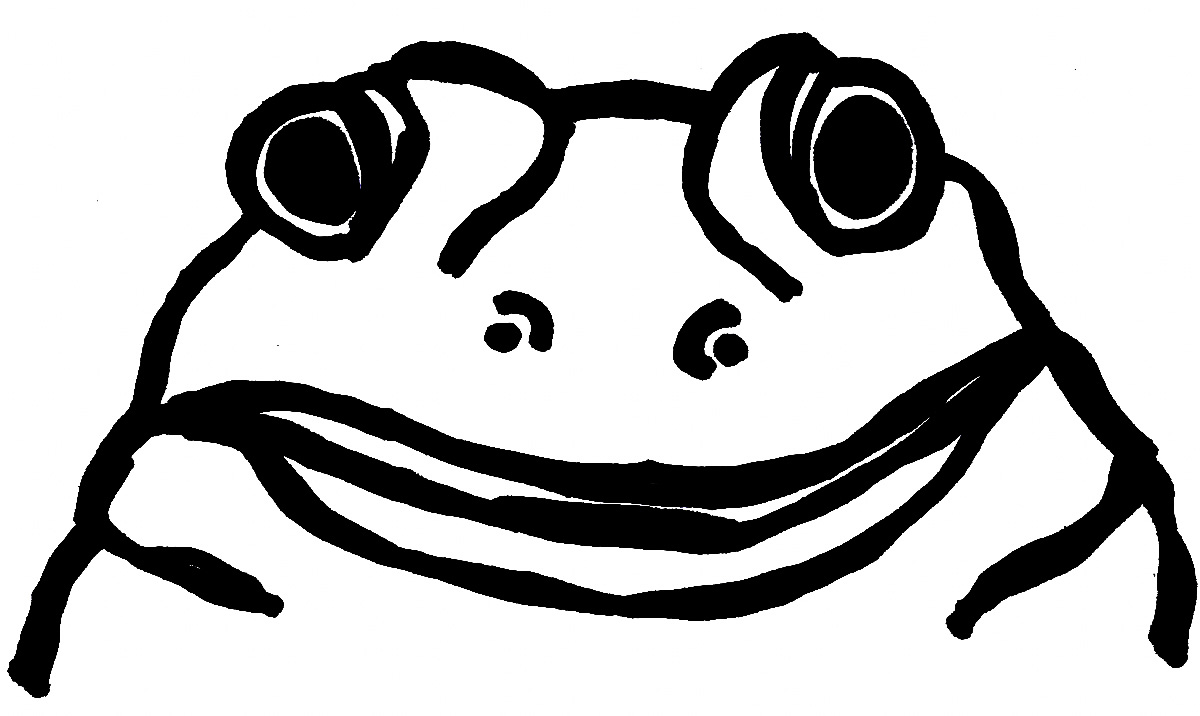
Frogman (2024)

There are two things that can quickly win me over to enjoying an otherwise mediocre movie: a cool-looking monster and a go-for-broke ending.  Thankfully, the new found-footage cryptid horror Frogman has both.  Based on real-life legends of a half-human, half-frog mutant who wields a magic sparkler wand in the woods outside of Loveland, Ohio, Frogman gets away with a lot of time-wasting bullshit just by delivering on an adorable creature design, lovingly rendered as a rubber-suit monster.  The titular Frogman appears early in flashback camcorder footage from the late-90s, assuring the audience that this is not exactly a Blair Witch Project or Willow Creek situation where the monster will go entirely unseen.  He’s around, and he’s so dang cute that you can’t wait to spend more time with him.  Unfortunately, the movie then makes you wait a full hour to return to the pleasure of the Loveland Frog’s company, but it does reward your patience by ending on 20 hectic minutes of over-the-top Frogman action, adding to the cryptid’s lore by dreaming up a frogperson death cult who worship the wizardly beast and offer up their bodies to be merged with his froggy DNA.  It’s entirely possible to roll your eyes through a majority of the film’s runtime and still get excited by the concluding title card warning that “Frogman is still out there,” teasing a potential sequel.  Any time spent with Frogman is time well spent.

While Frogman does not mimic Blair Witch & Willow Creek‘s withholding of an onscreen monster, it mimics everything else about their narrative structure, often reading like a copy of a copy.  A struggling low-fi filmmaker who captured the late-90s camcorder footage of Frogman as a child (Nathan Tymoshuk) returns to Loveland to prove wrong all the haters & doubters of the “Hey guys” YouTube commentariat who mock the credibility of his sighting.  He brings along two friends who also don’t take the existence of Frogman seriously but are still excited about the idea of making a movie (Chelsey Grant as an insufferably corny actress who’s road-testing a hack Southern Belle stock character named Norma Jean Wynette, and Benny Barrett as an aspiring cinematographer who constantly complains about “losing light” even though he shoots every single interaction backlit & out of focus on an ancient camcorder).  The friend-dynamic drama between that central trio is autopilot found-footage filmmaking, but things pick up quick once they start interacting with the local yokels of Loveland.  The amount of true believers who are deadly serious about Frogman give the wayward crew the creeps, then the wizardly Frogman’s “telekinetic interference” with the shoot throws the project into chaos, trapping them in a deadly game of hide-and-seek with a bloodthirsty frog cult.  So, while Frogman is not always ribbeting, given enough time it is plenty ribbiculous.

If there’s anything new that Frogman brings to the found-footage horror canon, it’s all contained in its ending and in its monster.  The titular rubber-suited Frogman looks great and—defying found-footage tradition—does not kill every single character who lays eyes on him, which means the movie has to find a new way to end its story that doesn’t just mindlessly echo the exact beats of Blair Witch.  Otherwise, Frogman is most recommendable as regional cinema.  Recalling Matt Farley’s modern small-town cryptid classic Don’t Let the Riverbeast Get You!, there’s something charming about Frogman’s extremely local sensibilities in the quest to put Loveland, Ohio on the map by promoting the existence of its resident cryptid; the only shame is that nothing in the movie is half as funny nor as surprising as any random page of a Matt Farley script.  Still, Frogman excels as a tourism ad for the city, which just adopted the Loveland Frog as its official mascot in 2023, after nearly seven decades of reported sightings.  Even when I was bored with the interpersonal drama between the central mockumentary crew, I was still delighted by the Frogman merch they found in their interrogation of the Loveland citizenry: a sign that reads “Frog parking only; violators will be toad” and t-shirts with slogans like “Frog around and find out” or “M.I.L.F. (Man I Love Frogman)”.  It made me want to travel to Loveland just to visit the gift shop.

-Brandon Ledet

Cuckoo (2024)

Tilman Singer has quickly become the most exciting new voice in cosmic horror.  His debut feature Luz started as a film school thesis project but was so strangely, psychically powerful that it broke out into wide release as one of the very best films of 2019 (according to me, anyway).  I watched Luz as a quietly buzzy horror curio that reached my living room via VOD rental, and I was blown away by the volatile imbalance between its cosmic-scale ambitions and its dirt-cheap budget.  His follow-up sophomore feature Cuckoo arrived in New Orleans with much louder fanfare.  Backed by Neon’s hip-cred marketing machine and starring one of the few non-influencer celebrities that teens care about (Hunter Schafer, of Euphoria fame), Cuckoo is a much hotter ticket than Luz was just a few years ago.  Its recent local premiere at Overlook Film Fest was packed to the walls with horror-hungry eyeballs, and although the enthusiasm in the room sounded mixed, anyone familiar with Luz knew exactly what kind of a surreal mindfuck we were in for.  Cuckoo escalates the verbal psychedelia of Luz to something more traditionally thrilling, hopping genres from demonic possession to creepy asylum horror but maintaining the same screenwriting ambitions of pulling brain-melting ideas out of simple, stripped-down tools.

Hunter Schafer stars as a grieving teen who joins her estranged, emotionally distant, German father’s new family after her mother’s death.  That new, uneasy family unit moves into a seasonally unoccupied resort in the Alps so the father & stepmother can work for the site’s enigmatic owner, played by a cartoonishly evil Dan Stevens.  Of course, the resort doubles as a mad scientist laboratory for Stevens’s Dr. Caligari-style medical experiments, which somehow involve strange shrieking sounds in the woods outside the cabins and the strange woman who makes them.  The movie explains exactly what’s going on in due time, but it’s the kind of explanation that only further twists your brain in knots with every new detail.  What’s important is that Singer effectively squeezes unnerving scares out of simple, straightforward methods, somehow crafting one of modern cinema’s creepiest cryptids by dressing one of his actresses in a trench coat, wig, and sunglasses.  I suppose it’s also important that Schafer’s teen brattiness is what ultimately saves the day, since her resolve to drown out the world with comically large, loud headphones until she’s old enough to move out on her own is exactly what protects her from the wigged cryptid’s aural violence.  She also eventually learns how to love at least one member of her new family, but it’s a perilous road getting there, one with many pitstops on hospital beds.

Cuckoo slowly builds its own unique mythology instead of leaning on traditional creature-feature or mad scientist payoffs.  It’s an impressive mix of sly humor & unnerving psychedelia, one that gets genuinely nightmarish in its forced pregnancy threats but also allows Dan Stevens to goof off with an exaggerated German accent & a magical flute, as if he were a recurring SNL character instead of a villainous fascist.  It’s a great theatrical experience, less so for its visual eccentricities (which mostly amount to time-loop editing & a vibrating frame) than for its aural ones (constant shrieks & gunshots that are best heard loud). I get the sense that all the central collaborators are getting away with something here.  Schafer recently said in a GQ interview that she’s no longer interested in playing roles that center her transgender identity, and this movie doesn’t care about that at all; it just cares how cool she looks wielding a butterfly knife: very.  Stevens also gets plenty of room to go big as an absolute maniac, something it feels like he hasn’t gotten to do on this scale since The Guest a full decade ago.  Then there’s Singer, who’s now found a much bigger canvas and a much bigger audience for his cosmic horror oddities.  I hope his work continues to escalate this way, since he has a lot of potential to become one of the all-time greats in the genre, if not only in his power to bewilder.

-Brandon Ledet

Cryptozoo (2021)

I struggle with parsing out how sincerely to take Dash Shaw’s movies.  Both his debut feature, My Entire High School Sinking into the Sea, and its follow-up, Cryptozoo, present a bizarre clash of far-out psychedelia in their animation & laidback aloofness in their storytelling.  His hand drawn 2D characters casually stroll through apocalyptic crises rendered in expressive, kaleidoscopic multimedia meltdowns.  Meanwhile, their personalities are decidedly inexpressive, mumbling about their often-inane internal conflicts in apparent obliviousness to the chaos around them.  Cryptozoo at least pushes that internal fretting into bigger questions about the ethical & political conflicts of its psychedelic fantasy world.  It’s just difficult to determine how much those conflicts are intended to be taken seriously vs how much are an ironic joke about the film’s own sprawling, convoluted mythology.  Shaw’s films are never boring to look at, though, even if his characters appear to be bored within them.  His visual playfulness is a quality that’s increasingly difficult to find in modern animation, questions of sincerity be damned.

As the title alludes, Cryptozoo is an animated fantasy film about a futuristic zoo for cryptids: dragons, unicorns, sasquatches, gorgons, etc.  The battlefield for its central conflict is a world where cryptids are suddenly plentiful but violently distrusted by the general human public – X-Men style.  The warring factions in discerning how humans should relate to these mythical creatures are “conservationists” who want to centrally locate the cyptids in a Disney World-like “zoo” and militarists who want to deploy them as biological weapons.  It’s a distinctly capitalist paradigm, where every single resource—including living creatures—must serve one of two purposes: money or military.  The warmongers are obviously the “bad guys” in that debate, but the supposed “sanctuary” alternative of the cryptozoo must earn enough money to stay afloat, which leads to the cryptids’ captivity & exploitation in an amusement park setting by the supposed “good guys”.  This convoluted mythology is debated in solemn, conversational tones while extravagant, badass illustrations of the cryptids themselves roar in the background.  How seriously you’re supposed to take those debates and how meaningful their themes are outside the confines of the film are a matter of personal interpretation, something I’ve yet to settle on myself.

Part of my struggle with how sincerely relate to Cryptozoo might be a result of viewing it through a modern-animation context, where I’m comparing it against other recent psychedelic oddities like The Wolf House, Violence Voyager, and Night is Short, Walk on Girl.  Despite its crudely layered multimedia approach to animation, the film is more likely spiritually aligned with fantasy films of the 1970s & 80s – titles like Heavy Metal, Wizards, and Gandahar.  In that era, animated fantasy epics were all intensely sincere allegories about pollution, prejudice, and ethnic genocide.  Cryptozoo‘s messaging is a little more resistant to 1:1 metaphor, but I’ll at least assume that its musings on the corrupting force of capitalism is politically sincere.  It’s a little hard to immediately latch onto that sincerity when your film opens with a nudist stoner voiced by Michael Cera being gored by a unicorn, but that doesn’t mean the entire resulting conflict is meant to be taken as a joke.  Realistically, the only reason I’m putting this much consideration into its dramatic sincerity at all is because the imaginative color-pencil drawings that illustrate its conflicts are objectively badass, making the rest of the film worth contending with instead of outright dismissing as stoner nonsense.  I’m buying what Dash Shaw is selling, though I’m still not sure why.

-Brandon Ledet