Scenes from a Screenwriter’s Marriage

We try our best to cover both the highest and the lowest ends of cinema here, from the finest of fine art to the trashiest of genre trash. Occasionally, those two polar-opposite ends of the medium intersect in unexpected ways. Last week, I found myself watching two seemingly discordant movies that covered the exact same metatextual topic – one because it screened in The Prytania’s Classic Cinema series during New Orleans French Film Fest and one because the Blu-ray was heavily discounted during an online flash sale. Both 1963’s Contempt and 1989’s The Black Cat are movies about screenwriters who jeopardize their marriages by taking on doomed-from-the-start film projects that put their wives’ personal safety at risk. The former was directed by French New Wave innovator Jean-Luc Godard at the height of his professional career, while the latter was directed by Italo schlockteur Luigi Cozzi in a sly attempt to cash in on his tutelage under his much more famous mentor, Dario Argento. They also both happen to be literary adaptations, at least in theory. While Godard was relatively faithful to his source-material novel, Cozzi’s film is an adaptation in name only, daring to bill itself as “Edgar Allen Poe’s The Black Cat” in its opening-credits title card before immediately abandoning its source text to leech off Argento’s legacy instead of Poe’s. Godard does indulge in his own allusions to an earlier, foundational filmmaker’s work in Contempt, though, by casting Fritz Lang as himself and including discussions of Lang’s early artistic triumphs, like M. You’d never expect these two movies to have anything in common at first glance, but The Black Cat really is Contempt‘s trashy cousin, long estranged.

Typically, I don’t think of Jean-Luc Godard’s signature aesthetic to be all that distant from the low-budget, high-style genre filmmaking ethos that guided the Italo horror brats of the 70s & 80s. At the very least, both sides of that divide would have been passionately reverent of Alfred Hitchcock as a cinematic stylist. However, Contempt is so far removed from the handheld, D.I.Y. crime picture days of Breathless that it’s hardly Godardian at all, at least not visually. Shot on location at seaside Italian villas in Technicolor & Cinemascope, Contempt is often breathtaking in its visual grandeur, especially in its 2023 digital restoration that aggressively pops the intensity of its colors. Godard presents star Brigitte Bardot in several magazine glamour-shoot set-ups that accentuate the otherworldly beauty of her body, with particular attention paid to her buttcheeks. Of course, vacationing with a beautiful woman in an exotic locale doesn’t fundamentally change who you are, so the usual self-defeating macho bullshit that plagues Godard’s protagonists follow him there too. Michel Piccoli co-leads as a cash-strapped screenwriter who takes a well-paying job doing re-writes on an already-in-production Fritz Lang adaptation of Homer’s Odyssey. Lang is making a much more abstract, artsier picture than what his American producer had greenlit, so Piccoli ends up in a sickening position where he must undermine the work of a genius he respects to instead please a meathead cad from The States who values commerce over art (Jack Palance, playing a pitch-perfect dipshit). Worse yet, the American pig has the hots for Bardot, and Piccoli does nothing to get in his way or to protect his obviously uncomfortable wife. This leads to an endlessly vicious, Who’s Afraid of Virginia Woolf?-style argument between the couple, so that they spend much of their time in an Italian paradise bickering about the purity of their love and the corruption of money. Meanwhile, Fritz Lang amusedly shakes his head, as if he’s seen this all before.

The marital crisis of The Black Cat is much more outlandish & abstract, but it also starts with a filmmaker taking on an ill-advised project. Our protagonist is a Luigi Cozzi-style horror director who decides to make good use of the Italian film industry’s loose copyright laws to make his own unsanctioned sequel to Suspiria. The project is in the early writing phase, where he is collaborating with a writing partner to sketch out the backstory of the Third Mother referenced in Argento’s Suspiria, believing there was room for another cash-grab witchcraft story in that lore (after the Second Mother was covered in Argento’s Inferno, and long before the Third Mother was covered in Argento’s Mother of Tears). They foolishly decide to pull inspiration from a “real”, powerful witch named Levana, who is awakened from her cosmic slumber by the project. Specifically, once the wart-faced Levana catches wind that she will be played onscreen by the director’s wife, she flips the fuck out and invades the real world through a mirror in the couple’s home, puking a chunky green goo in the actress’s face and then generally causing havoc. From there, The Black Cat is a supernatural horror free-for-all, following its scene-to-scene whims without any care or attention paid to the pre-existing work of Dario Argento, Edgar Allen Poe, or high school physics teachers. The movie is a jumbled mess of demonically possessed space fetuses, witchcraft-practicing house cats, 19th Century ghost children, telekinetic explosions, laser-shooting eyeballs, internal organ ruptures, creepy-crawly spiders, and whatever else amuses Levana as she tears apart this doomed marriage, all because she doesn’t want a movie made about her. What a diva.

You can assume a lot of what was on Godard’s mind while he was making Contempt just by watching the movie. Between the intensely bitter (and even more intensely gendered) marital argument that eats up most of the runtime and the art-vs-commerce argument that eats up the rest, you get a pretty clear picture of what was going on in his internal & professional life at the time. Even after watching the “Cat on the Brain” interview included on the Blu-ray disc, I cannot begin to tell you what Cozzi was attempting to communicate in The Black Cat. During the interview, he describes the picture as “science fiction,” likening it to his Star Wars knockoff Starcrash, with which it only shares a few extraneous insert shots of outer space. I’d say it’s much more spiritually in line with his supernatural slasher film Paganini Horror, which hooks the audience with the undead spirit of famous composer Niccolo Pagnini for a familiar starting point, then launches into a series of hair-metal music video vignettes where he just does whatever amuses him from scene to scene. Both of these vintage European relics might generally be about the artform of screenwriting, but only Contempt seems to put any sincere thought into that craft, while The Black Cat is much more about trying whatever looks cool in a scene, internal logic be damned. Something the two pictures do have in common, though, is the assertion that the basic labor & finance of filmmaking will ruin your marriage, whether through the intrusion of jackass Hollywood money men or the intrusion of evil mirror-dimension witches. If two movies so far apart in philosophy, tone, and intent happen to come to that same conclusion, I have to believe there’s some truth to it. Mamas, don’t let your babies grow up to be screenwriters.

-Brandon Ledet

Claudio Simonetti’s Demons

You might assume that the ideal way to watch the 1985 supernatural Italo horror Demons would be to see it projected in the oldest operating cinema in town, in our case the original location of The Prytania.  In the film, a group of strangers are gifted free tickets to a mysterious horror film at an ancient cinema that has materialized out of the urban void.  That movie turns out to be a gory cheapie about an ancient mask buried in Nostradamus’s tomb.  We watch this story unfold twice removed, where movie-within-a-movie victims try on the cursed mask, which transforms them into demonic, flesh-eating demons who torment their companions.  Meanwhile, the in-film audience of the movie squirms in their seats, noticing an alarming resemblance of the mysterious horror film’s violence to their own journeys to the screening.  Mainly, the promotional mask prop displayed in the cinema’s lobby has cut one of their cheeks the same way it cut & infected characters in the film they’re watching, which of course leads to a demon-zombie breakout in the theater that matches the chaos of the movie within the movie.  They’re all effectively Skinamarinked—unable to leave the theater thorough the doors they entered from—as they individually transform into cannibalistic monsters and tear each other to shreds.  Seeing Demons in a classic single-screener cinema could only add an extra layer of uncanny meta-horror to that gory practical-effects display, especially if the cinema in question could cover the insurance costs of blocking the exits and cutting their customer’s cheeks at the box office.

It turns out there’s an even better way to see Demons, though, one that trades in the layered meta-aesthetics of a haunted cinema for the open-aired joviality of a family barbeque.  Italian prog rock composer Claudio Simonetti recently toured one of the several undead mutations of his band Goblin to play live accompaniment for Demons in concert venues around the country, including The Broad’s outdoor extension The Broadside.  The show was rigidly timed to a Tim & Eric style video package that opens with a postcard from Simonetti & Demons director Lamberto Bava, then concludes with a greatest-hits medley of 70s & 80s horror scores, most of which Simonetti composed under the Goblin name.  In-between, the band played a reworked, bulked-up version of the Demons score to a full screening of the film, emphasizing both how few scenes prompted them to pause for dialogue and how frequently its now-anthemic theme is repeated for the gnarliest sequences of over-the-top gore.  As for Demons itself, it’s got one of the greatest opening acts in all of nonsense Italo horror cinema, capturing the feeling of collectively dreaming at the movies without distracting itself with minor concerns like plot & coherence.  Once the in-film movie projector and auditorium are torn apart there isn’t much glue to hold the whole thing together, though, save for the repetition in Simonetti’s synth riffs, so it was great to hear them cranked up to an obnoxious volume.  By the end, the familiarity of those riffs gave the screening a celebratory, communal air – the culmination of a once-in-a-lifetime Halloween season of great movies screening at The Broad (including several directed by Demons producer Dario Argento).

Years ago, the hot horror-nerd ticket would have been to see the full classic Goblin line-up play a live score for Suspriria, a tour that (to my knowledge) never came through New Orleans.  If you’re going to see “Claudio Simonetti’s Goblin” live instead (a variation of the band that only includes Simonetti from Goblin’s original membership), you might as well see them play a live score for Demons, since it’s a film that Simonetti scored after the legendary band had originally broken up.  He might primarily be a solo composer, but you can tell Simonetti loves having a full band behind him, playing rockstar in his denim jacket & wallet chain combo.  The encore set after Demons concluded touched on plenty of classic-Goblin staples, including themes from Dawn of the Dead, Suspriria, and (in my book, their finest work) Deep Red.  It also included some wonderfully bizarre choices that rivaled Bava’s shoddy surrealist filmmaking in Demons, most notably in the glitchy-GIF repetition of the classic New Line Cinema logo while performing the theme from Cut & Run and in their prog rock remix of John Carpenter’s Halloween score, transforming a notoriously sparse piano line into an overcomplicated monster.  I still would love to see Demons projected in an antique venue like The Prytania someday, just for the proper sense of ambiance.  I can’t imagine it’ll be a more memorable or endearing evening than that evening at The Broadside, though, where the stage lights twinkling off Simonetti’s absurdly long wallet chain were like stars twinkling in the night sky.

-Brandon Ledet

The Nightmares on Broad Street

The early-Fall lull between the Summer Blockbuster schlock dump and Awards Season prestige rollouts is always somewhat of a cinematic dead zone, but this year’s has been especially harsh.  The ongoing SAG/AFTRA strikes have scared major studios into delaying some of their biggest Fall releases for fear that their marketing would fail without the star power of a Zendaya or a Timmy Chalamet doing traditional promo, leaving very little of note on the new release calendar (until the Studios cave on those actors’ reasonable demands for fair compensation).  I’m sure it’s been a strain on movie theaters in the meantime, and I hope that they squirrelled away enough of that sweet Barbenheimer money this summer to survive the drought.  Speaking selfishly, though, it’s been awesome for me as a regular moviegoer.  Stumbling into this new-release wasteland during Halloween Season inspired local indie theaters to get creative in their respective repertory programming, resulting in what has got to be the greatest month of local film listings I can remember in my lifetime (with the caveat that I grew up in the era when suburban AMC multiplexes strangled the life out of what used to be a much more robust New Orleans indie cinema scene).  I spent most of October bouncing and forth between The Broad and The Prytania on the same #9 Broad bus line, frantically catching as many never-seen-on-the-big-screen horror titles as I could while the getting was good.  And there were still plenty more I missed that I would’ve loved to see properly projected, including the early Universal Horror all-timer The Black Cat.  What a time to be unalive!

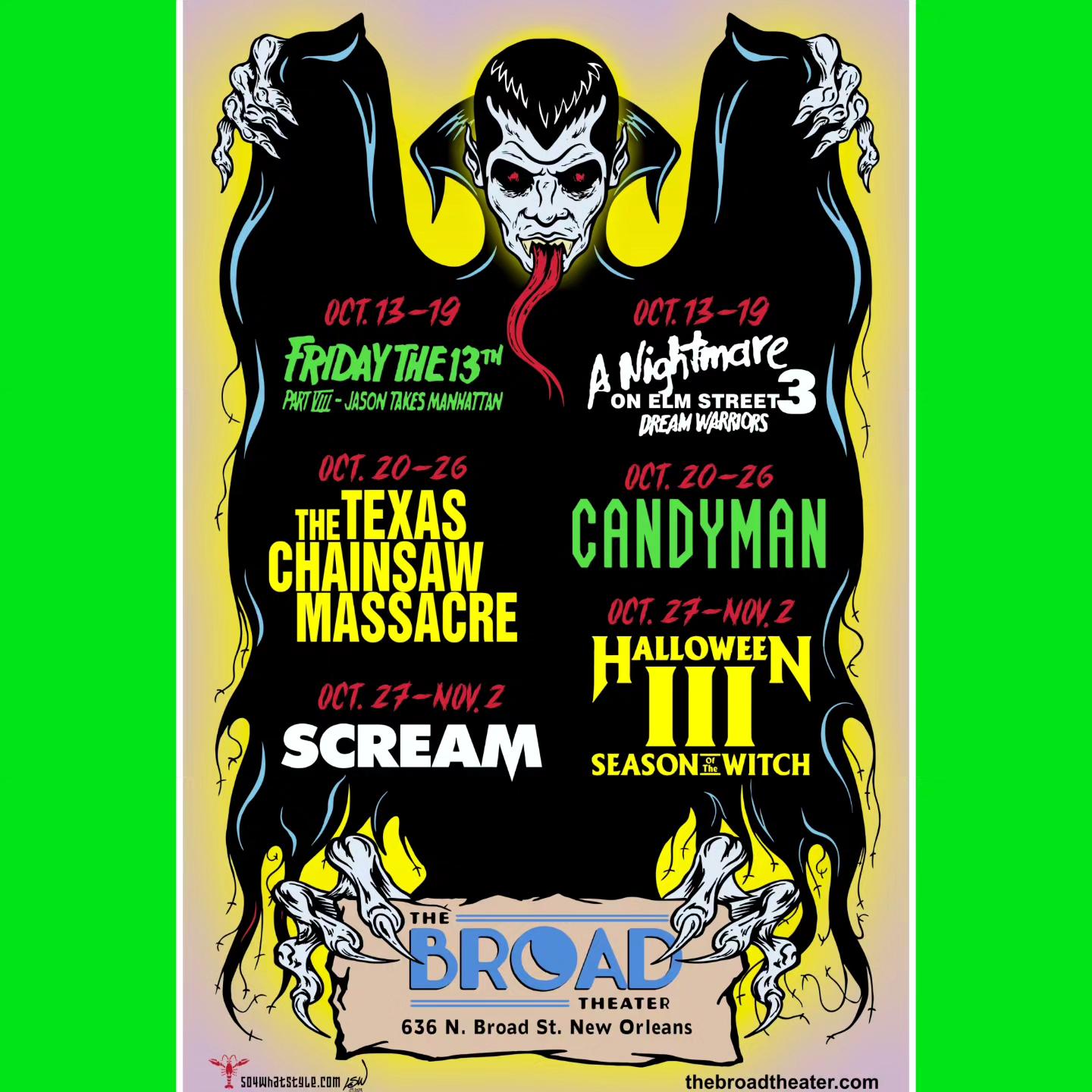
If I were to parse out the two distinct flavors of these theaters’ dueling Spooktober line-ups, I’d say The Prytania offered an older, dustier variety of venerated genre classics while The Broad offered slightly warped cult favorites of the video store era.  I personally trekked out to The Prytania to see odds-and-ends obscurities I’d never seen before at all, let alone on the big screen (Dracula’s Daughter, Bell, Book and Candle, The Creeping Flesh), but they also programmed a long list of definitive Hall of Fame horror classics that should be checked off of any genre fan’s personal watchlist (Don’t Look Now, Psycho, The Wicker Man, The Shining, The Exorcist, etc.).  Meanwhile, The Broad’s lineup made a few more surprising, left-of-field choices, mostly in straying from the classics to instead screen their most chaotic, divisive sequels.  While The Prytania screened the John Carpenter slasher-definer Halloween, The Broad screened its Michael Meyersless sequel Halloween III: Season of the Witch.  While The Prytania screened fellow slasher-definer Friday the 13th on Friday the 13th, The Broad screened Friday the 13th, Part VIII: Jason Takes Manhattan, its most over-complained-about sequel.  The Prytania’s schedule was so plentiful with exciting horror titles this October that I hardly had time to watch movies anywhere else, but I pushed myself to catch the most esoteric selections in the “Nightmares on Broad Street” program anyway, just to support the iconoclasm, as detailed below.  And while I’m comparing the two theaters’ programs here, I should note that the one film they both played last month was Wes Craven’s teen meta-slasher Scream, which I suppose makes it their consensus pick for the greatest horror film of all time.

A Nightmare on Elm Street 3: Dream Warriors (1987)

The most rewarding trip I had to The Broad this October was to revisit Dream Warriors, a movie I mostly remember from late-night cable broadcasts and oft-repeated Blockbuster VHS rentals.  The film marks Heather Langenkamps’s return (and shockingly morbid departure) as the series’ Final Girl figurehead, now a young medical student researching violent sleep disorders in order to help suffering teens survive nightly dreamworld visits from Freddy Kreuger.  The film’s limited setting in a mental hospital narrows its focus to a small group of traumatized teen insomniacs and their befuddled doctors who can’t quite figure out how they all suffer from the same group delusion that causes them to self-harm; spoiler: it’s because Freddy is real.  Dream Warriors has long been a favorite of mine in the series due to the novelty of its imaginative kill scenes, which include Freddy puppeteering one of his victims using their exposed veins as marionette strings and Freddy transforming his finger-knives into hypodermic needles to feed the hungry mouths of another victims’ pulsating track marks.  It’s pretty fucked up, especially since it’s combined with Freddy’s early stirrings as a stand-up comedian – crushing one victim’s head with a television while quipping “Welcome to primetime!,” declaring another victim “tongue-tied” after literally tying them to a bedframe with his detachable tongue, and punctuating every misogynist kill with the punchline “Bitch!”.

What will always stick with me about Dream Warriors now, though, is that it’s the only Nightmare on Elm Street movie that has managed to make me cry.  Maybe I’m getting too soft in my old age, or maybe it was just the theatrical atmosphere replacing the film’s usual brewskies-on-the-couch presentation, but I got unexpectedly emotional watching these kids get disbelieved and blamed for their own illness for so long before finding unexpected strength in solidarity.  Every authority-figure adult in their lives is dismissive of their nightly suffering except the one who happened to go through their exact supernatural torture in her own youth, and then she teaches them how to fight against their isolating threats as a collective group through lucid dreaming.  It’s oddly sweet, even as it is hideously gruesome.  It’s probably no coincidence that the three best-remembered Elm Street movies are the ones Wes Craven had a direct creative hand in—the original, Dream Warriors, and New Nightmare—and, while I might personally prefer New Nightmare in that trio, they’re certainly all worthy of standalone repertory programming.  Not many theaters would take a chance on the sequels outside a marathon context, though, so Dream Warriors immediately registered as mandatory viewing, even in such a crowded month.

Friday the 13th Part VIII: Jason Takes Manhattan (1989)

Speaking of slasher sequels no one would usually take a chance on, holy shit.  Dream Warriors has plenty of long-running goodwill among horror addicts as one of the best of its franchise, but Jason Takes Manhattan has a long-running reputation of is own as one of its franchise’s worst.  Wrongly.  The standard-issue complaint about this much-mocked slasher sequel is that it’s flagrantly mistitled, promising that Jason Voorhees will take a grand budget-burning tour of New York City, when in reality he spends most of the runtime killing teens on a boat trip to the city.  Given that marketing department disappointment, I wish the film had simply been retitled Jason Takes a Cruise to calm the horror nerds’ nerves.  Complaining about the locale of Jason’s tireless teen slayings in this outing three decades after the first-weekend jeers is idiotically shortsighted & petty, since Jason Takes Manhattan is scene-to-scene the most memorably entertaining entry in its franchise, give or take Jason X (which is mostly set on a ship of sorts itself).  En route to Manhattan, Jason punishes high school seniors for celebrating graduation with the old-fashioned teen sex, drugs, and rock ‘n’ roll that he loathes so deeply: filming amateur rock videos in the engine room, snorting coke off mirrors in the supply closet, and seducing the uptight principal to get out of completing their science fair projects.  It’s a random assemblage of quirky slasher-teen behavior that even on land would be more entertaining than the snoozy cabin-in-the-woods doldrums of earlier Friday the 13th sequels, and then the Manhattan-themed rampage promised in the title is delivered as a sweet novelty dessert.

If anything, there’s something immensely satisfying about the way Jason’s whirlwind Manhattan tourism is delayed for a condensed, climactic payoff instead of being drawn out into urban slasher tedium.  An opening credits sequence details the grimy back-alleys of 1980s NYC, particularly focusing on a barrel of toxic sludge that serves as the bathtub for a gigantic rat.  We do not return to that alley until the third act, when Jason drowns the film’s most detestable character headfirst in that exact barrel, the rat now dead beside him to emphasize just how gross the sludge truly is.  There’s also some great metaphysical character at work here as well, where Jason now appears to be made entirely of toxic sludge himself, having been submerged in the murky waters of Crystal Lake for so long that he’s essentially a hulking collection of sentient goo.  His younger, drowned self appears to the film’s Final Girl in frequent, psychedelic hallucinations during the boat trip to Manhattan – underlining the killer’s supernatural constitution, connecting his qualities as an aquatic zombie to the waters that connect Crystal Lake to the Hudson Bay and, frankly, killing time between his actual kills.  Mostly, though, his gooey, goopy body is just an extension of the way the movie associates New York City with sludge & grime, painting it as a landscape made entirely of rats, rape, street punks, and shared hypodermics. In a way, you get a little taste of Manhattan on the ride to its shores in Jason himself.  More importantly, it’s one of the precious few entries in his franchise where he isn’t a total bore.  Too bad so few people get past the misleading title to see that; it was the least well-attended horror screening I saw all month.

Opera (1987)

Now here’s where things get interesting.  The Broad had already filled its schedule with classic horror films at the start of the month, and then Taylor Swift dropped a rushed-to-market concert film that cleared even more room on local marquees, since film studios were scared to compete with the most famous woman alive.  I’ve never been a bigger Swiftie.  Because Swift’s Eras Tour cleared the weekly release schedule, The Broad added three additional classic horrors to its line-up, all digital restorations of vintage gialli by Dario Argento.  And so, I got to see my personal favorite Argento film on the big screen with my friends instead of the way I’ve watched it previously: alone as a fuzzy YouTube rip.  Like with my appreciation for Jason Takes Manhattan, Opera is far from the wider consensus pick for Argento’s best; I was genuinely shocked to see it theatrically listed alongside his better respected works Deep Red & The Bird with the Crystal Plumage on The Broad’s marquee.  At this point in the month, it was starting to feel like someone was programming a mini horror festival just for me, and it was delightful to see plenty likeminded freaks in the audience instead of the empty seats I was met with at the screening of my favorite Friday the 13th.

Opera finds Argento working in his Inferno mode, putting far more effort into crafting individual images than weaving them into a cohesive story.  After being hired to direct a real-life opera of Macbeth and abandoning the project before production, Argento salvaged his scrapbook of ideas for its staging in this loose mystery crime thriller about a gloved killer’s obsession with an opera singer.  The killer’s mechanism for torturing his muse is tying her up with pins pointed at her open eyelids so she cannot look away from his violent slayings of her friends, lovers, and collaborators.  It’s a double-contrivance of Hitchcockian voyeurism, where the killer obsessively watches the singer from the anonymous crowds of her opera house and, in turn, makes her watch him perform his art backstage.  It’s also just an excuse for Argento to indulge in a glorious clash of high & low sensibilities, alternating between operatic vocal performances in the theatre and thrash-metal slashings on the streets.  Opera might feature his most overactive, over-stylized camerawork to date, too, most notably in scenes where the camera adopts the POV of the trained ravens on his Macbeth set to directly attack his own audience in murderous swoops & dives.  Opera may not be as beautiful as Suspriria, nor as horrifying as Tenebrae, but it’s Argento’s mostly wildly impulsive vision – both his most invigorating and his most incompressible.  I loved seeing it get the proper theatrical setting it deserves.

Halloween III: Season of the Witch (1982)

YWhile there may still be some novelty in exalting Opera & Jason Takes Manhattan as the top of their respective classes, I’d say Halloween III: Season of the Witch has been thoroughly reclaimed in the modern discourse to the point where calling it The Best Halloween Movie is almost an online Film Bro cliche.  Hell, that thought even occurred to me back when we covered it on the podcast in 2016, when I called it the best Halloween movie.  There’s some necessary semantic clarification to make there, though, because I’m not only saying that its infamous Michael Meyersless deviation from the John Carpenter slasher franchise makes it the most interesting movie of its series.  I’m saying that it’s the best horror movie in any context that’s specifically about Halloween as a holiday, from the roots of its pagan Samhain traditions to its modern Trick or Treat rituals in the American suburbs.  The only films I skipped on the Nightmare on Broad Street roster were the widely beloved horror classics The Texas Chainsaw Massacre, Candyman, and Scream, and I believe the horror nerd community has gotten over Season of the Witch‘s disregard for Michael Meyers slashings well enough that it now registers among that verified pantheon of seasonal greats (in a way they still haven’t gotten over the title of Jason Takes Manhattan).  The reason I didn’t skip Season of the Witch, though, is that The Broad happened to screen it on Halloween Night, and I couldn’t fathom a better way to cap off this exquisite month of local repertory moviegoing. It was a hoot, and I’m already excited to see what they pull out of the haunted vault next year.

-Brandon Ledet

She Will (2022)

2022 has gradually shaped into Dario Argento’s comeback year, something I never dared to expect from the 82-year-old Italo horror legend.  The low-key giallo revival Dark Glasses is Argento’s first directorial credit in a decade and easily his best in twice as long.  He was also shockingly great as the lead performer in Gaspar Noé’s Vortex, his first acting credit outside cameo roles & narration tracks.  Of all the various ways Argento’s comeback year has taken shape, though, the least surprising has got to be his in-name-only producer credit on She Will, cosigning a younger artist’s work.  Not only is Argento making movies again; apparently, he’s also entering his “Wes Craven Presents” era.

That stamp of approval goes a long way in Charlotte Colbert’s debut feature, especially since it’s an indictment of the macho, abusive brutes who occupied every director’s seat when Argento first started making artsy horror pictures in the 1970s.  Is Malcolm McDowell’s pretentious, villainous abuser-auteur supposed to be a stand-in for Jodorowsky, for Polanski, for one of Dario’s fellow giallo greats?  It doesn’t matter much, since the film is less about his behind-the-scenes crimes than it is about his victim’s delayed revenge.  Alice Krige headlines as an ice-queen film actress whose star has faded; she channels her lingering resentments from that child-actor abuse on McDowell’s sets into a witchy, supernatural revenge.  The mechanism of public #MeToo callouts simply isn’t enough; only black magic evisceration will do.

I very much vibe with She Will‘s burn-it-all-down political anger, so it’s a shame I couldn’t also vibe with its filmmaking aesthetics.  Between its ominous shots of the woods and Krige’s mutually destructive relationship with her young nurse (helping her recover from a double mastectomy), it just ends up playing like a watered-down, VVitch-ed up version of Saint Maud.  It’s well considered thematically, like in how the soil at Krige’s Scottish health retreat is enriched by the ashes of locally burned witches, strengthening both her skin and her witchy powers.  Its most exciting ideas are just presented in the limpest nightmare-sequences around, with time-elapse nature footage edited together in the Elevated Horror equivalent of an Ed Wood montage.  I almost want to say the film is worth it for Krige’s performance as the icy lead, but truth is she had a lot more to do in this same register as the mentorial witch in Gretel & Hansel.  There just isn’t much to see here that hasn’t been covered by its sharper, more vivid contemporaries.

Regardless, I still think a “Dario Argento Presents” project is, by default, a more exciting turn for the actor-director-producer’s late career phase than an actual Dario Argento film.  Dark Glasses is only interesting within the context of his larger catalog and can only feel like a faint echo of former glories.  By contrast, throwing his name by newcomers like Colbert helps them get platformed at film festivals like Overlook and streaming services like Shudder, where She Will has earned a lot more sincere praise than I’m giving it here.  It’s an investment in the future of horror filmmaking instead of a victory lap for its faded past, which according to this film was a lot more spiritually & morally bankrupt than we’ve ever fully reckoned with.

-Brandon Ledet

StageFright: Aquarius (1987)

Not to be confused with Alfred Hitchcock’s Stage Fright, StageFright: Aquarius is a 1987 giallo film directed by Michele Soavi, who got his start assisting Dario Argento and shooting second unit work on Tenebrae, Phenomena, and Opera. His second film was the previously reviewed La chiesa in 1989, but this freshman feature has a lot of style, which spackles over the occasional slip-ups that are common in debut films. 

Our film opens on a grimy street, as a woman in a platinum wig seeks an honest night’s work, only to be attacked and pulled into a shadowed entryway. This causes a commotion as a dozen people gather and stare at her murdered body, only for the killer to suddenly and energetically burst forth from the door and begin to dance as we pan out to see that the street is just a set on a stage in a modestly sized theater, and our characters are but actors on it. Well, most of them are actors; some are dancers, and there’s also an inexplicable saxophone player in a billowing Marilyn Monroe dress perched on one of the faux rooftops. The killer happens to be wearing a giant owl head, and it’s one of the strangest but most fascinating openings I’ve seen in a film in this genre. The choice to open with offscreen traffic noise and slowly pan up a city street makes for a clever misdirect that is also ultimately a metaphor about the film’s own method of doing more with less

After wounding her ankle on-stage in the opening scene, Alicia (Barbara Cupisti) acquiesces to the prompting of Betty (Ulrike Schwerk) to sneak out of the side door and get her ankle treated, without the permission of egomaniacal director Peter (David Brandon). They charm affable theater owner/property manager Willy (James Sampson) into letting them out through the side door. It turns out that the hospital that Betty knew about that was nearby is actually a psychiatric hospital, but as Betty points out, psychiatrists do attend medical school, so after an encounter with an unfriendly nurse, Alicia sees a doctor. On the way out, she asks about the room that has bars over the door, and the women learn that the prisoner is serial killer Irving Wallace (Clain Parker), who’s awaiting trial. Wallace escapes from his room due to an orderly’s carelessness, and, hiding in Betty’s trunk, returns with them to the theater. Alicia is immediately fired upon return, and while Peter is dressing her down, Betty is killed outside with a pickaxe. 

Surprisingly, Alicia discovers this almost immediately and the police are called and arrive at once. Her body is taken away, there are reporters, it’s a whole deal. Two patrolman (Soavi in a cameo, with Mickey Knox as his older partner) are stationed outside of the theater and Willy clocks out for the night, entrusting Peter to lock the place up. Instead, he has “ingenue” Corinne (Loredana Parrella) hide the key so that everyone is locked in and forced to participate in an all-night rehearsal so that they can open the play early and capitalize on the tragedy. Of course, that means that Irving is now locked in with the cast as well as their producer, Ferrari (Piero Vida). The first to be subdued is Brett (Giovanni Lombardo Radice, credited as John Morghen), who portrays the killer within the play; Irving takes his owl head mask and uses it as his disguise to get close to Corinne in the scene in which she dies, only for onlookers to respond too slowly to the dawning realization that she is actually being murdered. And, as she’s the only one who knows where the key is, they’re in for a long night. 

The play within the movie is about a fictional killer named The Night Owl who preys on vulnerable women and murders them. The characters within the film also recognize that the play is a stylish but trashy cheap thrill masquerading as something more; one character describes it as a “thoughtful musical” when asked, but this “artistic endeavor” is fully funded by a sleazy businessman who doles cash out of a briefcase like a gangster. The director of the play, a possible jab at Argento, is fully invested in his artistic vision … but that vision proves to be completely malleable if it sells a few extra tickets. There’s also a moment in which the director is confronted by the killer wielding a chainsaw and just throws a woman directly into the path of the blades, which, as someone whose knowledge of Argento is … extensive, seems like a pretty good jab at the older filmmaker’s less-than-modern take on gender dynamics. 

Speaking of the play, in order to enjoy the movie, it’s important not to worry about what the production’s narrative is or how it could possibly work, and I think this might be an intentional comment on Italian horror as a genre as well. We see several disparate scenes, included but not limited to: 

  • The aforementioned scene in which a sex worker played by Alicia is pulled into a dark alcove/building and murdered, then the owl-headed killer bursts out and dances while a woman plays a saxophone on a rooftop above. This appears as the film’s opening but is presumably not the beginning of the play, as Alicia’s role is repeatedly referred to as the “lead role,” despite her being killed in this scene. 
  • A scene in which Laurel (Mary Sellers) is dancing on a bed while wearing a red wig and dressed as Raggedy Ann–not just a dress like Raggedy Ann’s, but literally dressed as the doll, apparently. We later see that she’s even wearing pads that simulate a body shape that’s essentially identical to the patented Ann doll. This part is apparently non-essential to the plot, as Laurel is tapped to replace Alicia in the aforementioned lead role when Alicia is briefly fired for getting her ankle checked out, and there’s no mention of someone else taking on Laurel’s old role. 
  • The love/killing scene in which Corinne does an interpretive dance around her bedroom while mooning after but also fearing The Night Owl. Although Corinne is intentionally styled to appear more prudish/innocent than the other female characters, there’s no doll on the bed in this scene or any indication that she has a Raggedy Ann. 

I leave it to the giallo fanfiction writers of the world, which I assume exist (if only because I can’t be the only one, right?) to put together a feasible narrative in which these scenes might appear, but I like to think that this is supposed to reflect how most giallo films are often composed of striking individual scenes that ultimately add up to a whole that is greater—but less comprehensible—than the sum of its parts. This film is no exception, although it’s much more fun and compelling than many of its peers, despite occasional wonkiness. For one thing, I fully support the decision to get up in the catwalk above the stage more than once; in a theater, that’s a natural place to stage a scene, but the film puts both of its catwalk scenes in Act III, which makes it feel narratively unbalanced. The dubbing in this one is particularly funny, as there’s the characteristic slight syncing/emphasis issues that are pretty common in Italian cinema, but while most characters are clearly speaking (possibly phonetically memorized) English that’s been dubbed over, there’s no attempt to do so with Ferrari. Either he’s just straight up speaking Italian or every one of his lines was rewritten between filming and voiceover. There’s also an inconsistency of verbiage, as the events of the night are given the nickname “The Sound Stage Killings,” but this isn’t a sound stage; it’s a live theatrical performance space. Those quibbles are fun and easily ignored, but I did have some qualms with the finale. The movie reaches a natural conclusion (our final girl defeats the real Night Owl and escapes to notify the police), but it keeps going for some reason, following her return to the theatre, where she reunites with Willy. In shoddy ADR, he endlessly repeats a line about how the apparent prop gun that was found in one of his desk drawers and which turned out to be useless against Irving is, in fact, a real gun as the play crew had initially guessed, but that none of the actors had figured out how to turn the safety off, only for there to be one final altercation with Irving. The pacing of it is all off, and it feels like it was added to pad the runtime (even with this scene, it’s a lean 86 minutes); forgivable, but not very fun. 

StageFright: Aquarius is currently streaming on Shudder, although the title is styled much less interestingly as Stage Fright.

-Mark “Boomer” Redmond

Further into the Inferno: The Follies of Deepening Suspiria’s Mythology

I love Dario Argento’s Suspira. It’s very high among my favorite titles from the Italian genre film legend, matched only by the likes of Opera & Tenebre. At the same time, I could not care less about the story Suspiria tells if I tried. Like the murder mystery gialli Argento cut his teeth directing, this is explicitly a style-over-substance endeavor, one that pays much more careful attention to the lighting of a kill & the menace of the soundtrack than the logic or structure of its mythology. Suspiria is a gorgeous, gore-coated object that overwhelms in its sensual pleasures, but does little to develop its central story beyond the elevator-pitch premise of “A ballet school run by witches.” Argento doesn’t even save the revelation of that premise for a mysterious reveal; one of the earliest scenes features a track from prog band Goblin where whispers of “Witch, witch-witch-witch” overwhelm the soundtrack. It’s such a weird impulse, then, for each of Suspiria’s later follow-ups to lean so heavily into the witchy dance school’s background mythology as if that was something the original film was missing. No Suspriria descendent follows this trivial pursuit as thoroughly as Luca Gaudagnino’s 2018 eponymous remake. Guadagningo’s Suspriria sprawls into almost a full extra hour of runtime to make room for exploring the political struggles of the coven who run the dammed dance academy, the childhood background of their latest victim Susie Banion, the cultural climate of the country outside the academy’s walls, and any number of other lore concerns that were not on Argento’s mind as much as staging witchy, ballet-themed kills. The truth is, though, that Argento himself was just as guilty of needlessly fleshing out Suspiria’s mythology; he just saved that indulgence for his own sequels to the original film. It’s also true that no mythology-minded Suspiria follow-up—whether from Guadagningo or Argento—has been especially bad, even though every single one is remarkably goofy.

Argento himself wasted zero time diving into Suspiria’s unexplored mythology in his own sequels to the film. The second title in what would eventually be know as The Three Mothers Trilogy, 1980’s Inferno, opens with characters reading large blocks of text out of a fictional book titled The Three Mothers that details lore only casually referenced in the previous film. While Suspiria briefly mentions that its German setting is just one of three connected, international covens – the others located in Rome & NYC – it doesn’t waste much time wondering what’s going on with the witches who run those other houses. Inferno, by contrast, explains in plain academic dialogue how the Mother of Sighs, the Mother of Tears, and the Mother of Darkness divvy up their geographically disparate power structure—connecting its tale of NYC witchcraft to the German events of the previous film. Still, the actual narrative of Inferno has little to do with this suddenly complex lore until the final showdown staged with the Mother of Darkness witch who resides in New York. Mostly, Argento slips back into the sensory indulgences of complexly constructed kills that guided the overall trajectory of the first film, even joking with the supposed seriousness of its mythology when a character mistakes “The Three Sisters” for an R&B vocal group. It wasn’t until the much-delayed conclusion to the trilogy, 2007’s Mother of Tears: The Third Mother, that he really committed to pretending Suspiria’s lore actually meant something, now having spent decades fleshing out its legacy. In the film, his real-life daughter Asia Argento reopens the same The Three Mothers book to kickstart her fated path to confront the titular third Mother in Rome; only this time the pursuit of that mystery & confrontation are made to be the main thrust of the text, so that the brutal gore (and shoddy CGI scares) that interrupt the mythology are more a distraction than they are the entire point. It’s no coincidence that the most mythology-obsessed entry in the Three Mothers Trilogy is also the weakest picture, artistically. Its Roman Catholic mysticism & ancient texts mysteries approximate a mid-00s horror version of The Da Vinci Code, except its guidance under the Dimension Extreme label makes it way cheaper & meaner than that may sound.

As Luca Guadagnino’s Suspiria remake is a shameless indulgence in pure excess, it can’t help but eat up all of the lore stretched out across the entire Three Mothers Trilogy in a single sitting. Gaudagnino goes beyond the establishment of there being a coven of witches in three major cities to ask who these witches are, what political climates they have to deal with, how they delegate power, and how they select their victims. He also picks up the idea of their being a book explaining the mechanics of these covens and their respective houses by filling entire notebooks with handwritten, geometrically diagrammed explanations of how witchcraft works in this universe on a practical, if not mathematical level. This elaboration of core mythology may seem philosophically opposed to the barebones, imagery-distracted lore of the original Suspiria, but it does touch on the most core aspect of Dario Argento’s work: excess. The giallo legend may have poured more of his excessive, obsessive detail into the lighting & staging of a kill than establishing a sense of logic in the witchcraft behind it, but Guadagnino’s overly-detailed attention to the lore is still in the same sprit of unbridled, maybe even ill-advised excess. Oddly, that over-commitment to mythology ultimately has the same effect on the audience that the disregard for it achieved in Argento’s original version. There’s so much going on in Luca Guadagnino’s Suspiria that it’s difficult to pay attention to or emotionally invest in any one narrative thread, so that what mostly remains is the film’s sense of style. Suspiria (’77) & Inferno recognize this effect outright and fully commit to Argento’s witchcraft giallo aesthetic once they establish the basic tenants of the lore that drives their conflict. Mother of Tears & Suspiria (’18) are much more frantic in their relationship with mythology, chasing a sense of meaning so desperately in their embellishment of witchcraft lore that an overindulgence in backstory & narrative itself becomes part of the filmmaking style.

Whether keeping the mythology as thinly sketched out as it was in the original film or over-explaining superfluous new wrinkles to the lore, the overall strength of a Suspiria follow-up still lies in the pleasures of its sense of style. Inferno may be the most underrated in this regard– mixing the neon witchcraft aesthetic from its predecessor with the gloved-hand giallo kills of other Argento works & Fulci-level shameless gags singular to its own vision (there are a couple cat & rat-themed eco-horror kills I find especially pleasurable) to achieve something truly special. Suspiria (2018) is similarly pleasurable in its stylistic deviations (ultimately landing somewhere between Possession & Society, but nowhere near Argento), even if its attention to lore often feels like wasted energy. Mother of Tears is the clear weak link in the chain, but even the cheap & cheesy violence of its large-scale horror mystery has a kind of charm to it, like an especially gory episode of Masters of Horror or an expired box of Easy Mac. There are no bad Suspiria movies, but there are certainly ones that try way too hard to pretend the series’ core mythology means something; it very much doesn’t.

-Brandon Ledet

Suspiria (2018)

On an aesthetic level, Luca Guadagnino’s Suspriria bears very little resemblance to Dario Argento’s Supsiria. If anything, this 40 years-later reimagining of that cult-favorite resembles an entirely different flavor of intensely stylized, European arthouse horror: Andrzej Żuławski’s Possession. Guadagnino’s picture may have maintained the witchy dance academy setting & central character names from the Argento original, but it ditches all of that film’s intense giallo cross-lighting & prog rock sensibilities for the cold, greyed-out concrete & infectious madness of Possession. Where Suspriria (2018) deviates in tone & imagery from its source material, however, it did zero in on the most vital aspect of Argento’s work: excess. Everything about Guadagnino’s Suspiria is indulgently excessive: at 142 minutes, it’s structured as six acts & an epilogue; Tilda Swinton appears in multiple roles among an already sprawling cast of witchy women (including actors from the original film); unsatisfied with merely being a stylish tale of witchcraft, it also attempts to engage with the politics of post-war Germany; it features an original soundtrack from Radiohead frontman Thom Yorke. The most Suspiria (1977) thing about Suspiria (2018) is that it’s wholly confident that every self-indulgent impulse it has is worth exploring; the only difference in that respect is that the Argento version was more frequently correct in that shared delusion.

One of my favorite tactics that carries over from Original Flavor Suspiria to Nu Suspiria is that neither waste any effort hiding that they are about dance schools “secretly” run by a coven of witches. In the original, this mystery is “spoiled” by an early sequence of a frightened dance academy student fleeing into the woods while the prog band Goblin whispers, “Witch, witch-witch-witch” over the soundtrack. In the new version, that same freaked-out runaway character (Chloë Grace Moretz) blurts, “They are witches” in blatant terms to her old-man psychiatrist (a gender-blind cast Tilda Swinton) before continuing, “They’ll hollow me out and eat my cunt on a plate.” The psychiatrist, of course, believes this paranoia to be delusional and a large part of the narrative likens his dismissal of her cries of witchcraft to the ways he failed his long-gone wife during The Holocaust. That post-war grief & guilt swirls outside the dance academy, while inside the flesh-eating witches in question are undergoing a more insular political crisis of their own. Unbeknownst to the young dancers in their care, the women who run the academy as an incognito coven are experiencing a kind of civil war on two key issues: choosing new leadership & selecting an unwitting student for a mysterious ritual that will secure the school’s future (at the student’s own peril, of course). That freshly-arrived American student’s name is Susie Banion (Dakota Johnson in a role originated by Jessica Harper), who is afforded her own lengthy backstory in a distant Mennonite community, just in case the narrative wasn’t already overstuffed without it.

It’s probably safe to say that no one loves the original Suspiria for the strengths of its story. Like most giallo-related media, it’s a film best appreciated for its overbearing sense of style more so than the cohesion of its narrative. This only became increasingly apparent as Argento attempted to retroactively make sense of his witchcraft lore in the Suspiria sequels Inferno & Mother of Tears, expanding the original film’s elevator pitch of “A ballet school run by witches” into an unwieldy (but still charming) mess now known as the Three Mothers Trilogy. Guadagnino greedily eats up this now-sprawling mythology and attempts to reinforce each element with even more over-explained backstory: how the dance school relates to its German setting; why Susie Banion is targeted and what her life was like before the ritual was initiated; how the coven negotiates & organizes its collective will across hundreds of women in three separate locales. Beyond skewing its overall aesthetic closer to Żuławski than any gialli, Guadagno’s Suspiria avoids becoming a pointless retread of its Argento source material by pulling its narrative to the opposite extreme – from vaguely stretched-out elevator pitch to overly complex, unnecessarily dense mythology. Paradoxically, the effect of that overcorrection is oddly similar to how plot & lore work in the original film; its narrative is such an overdose of information that very little of it sticks to the walls and what’s mostly left for the audience to digest is the overbearing sense of style it’s delivered through.

As much as I admire Guadagningo’s dedication to excess here, this is the exact kind of messy ambition that invites viewers to pick and choose individual elements at play to praise or critique—as opposed to the more unified vision of the Argento original, which is more of an all-or-nothing proposition. Personally, my favorite aspect of the new Suspiria is the purposeful ways that the act of dance (modern here instead of ballet) is linked to the practice of witchcraft, establishing a cause & effect relationship between dancers’ beautifully contorted bodies and their grotesquely contorted victims’, left to stew in their own piss & mucus. I was also in love with the complexly detailed imagery of Susie Banion’s nightmare montages, each individual flash of a tableau carefully staged like fine art photography. At the same time, there were two glaring stylistic choices that harshed my buzz throughout: a camcorder-level choppy frame rate effect worthy of a Milli Vanilli music video & the jarring inclusion of Thom Yorke’s crooning vocals in an otherwise phenomenal soundtrack. My aversion to those choices are likely personal biases, given that they’ve also bothered me in previous works (specifically, the choppy frame rate in Daughters of the Dust, and Sufjan Stevens’s voice in Guadagnino’s Call Me by Your Name), but I can’t help but find them cheapening & distracting all the same for crashing me down from the film’s otherworldly spell to a much more pedestrian tone.

There’s so much on the screen in Suspiria that most audiences will find something to nitpick in their personal experience with its relentless over-indulgences in gore-soaked, lore-obsessed witchcraft horror. I envy those who weren’t distracted by stray choices like Yorke’s mewing, appreciating this love letter to excess in its overwhelming entirety. I also pity those who can’t find anything to enjoy here; Guadagnino offers so much to choose from that if you can’t latch onto something the problem is you. I’m personally falling somewhere in the vast middle between those extremes—in impressed, but frustrated appreciation of the film’s dedication to the extremes.

-Brandon Ledet

La chiesa (The Church, 1989)

EPSON MFP image

fourstar

Following the completion of my Dario Argento project, I felt myself suffering from a distinct lack of Argento in my life. As such, I had to try and fill this lack with some of his other work. Upon beginning the retrospective, I decided not to include films that Argento had written but not directed, as this would have included a large body of films that were never released in the U.S. and would thus have been nearly impossible to track down. Most of the films to which he contributed a story or script idea in the heyday of his career did cross over, however, and I was able to track down a DVD copy of La chiesa (The Church). La chiesa was intended to be the third film in the series and is considered to be an official sequel according to some sources, but it’s unclear how it fits into that series.

Lamberto Bava (son of director Mario Bava) had previously served as the assistant director on Argento’s 1982 film Tenebrae, and the two collaborated again on Demoni and Demoni 2, the latter of which was the film debut of a very young Asia Argento, with Bava directing and Argento contributing to the script. However, a film originally titled The Ogre (directed by Bava and written by Dardano Sacchetti, who contributed to the scripts for Demoni and Demoni 2) was released as Demoni 3: The Ogre in 1988, with La chiesa following in 1989. 1991 saw the release of yet another film titled Demoni 3, directed by Umberto Lenzi, who had previously directed 1969’s Legion of the Damned from a script by—you guessed it—Dario Argento. Adding to the confusion, Bava did not direct La chiesa; it was instead directed by Michele Soavi, another member of that generation of Italian horror directors. All of this also fails to note that there were at least three other films that had the name “Demoni” applied to them as a marketing strategy; simply put, it’s ultimately unclear whether or not this film should be considered as a text which is part of an official ongoing narrative or simply as a text to be discussed in relation to the other texts made by its creators.

Regardless, the film works well as a standalone horror movie, and has Argento’s fingerprints all over it even if it was directed by someone else. Long ago, Teutonic Knights came upon a village that was supposedly inhabited by witches. An inquisitor damned the village when he saw one of the inhabitants with crucifix-shaped scars on her feet, and the knights slaughtered the entire population and buried all of the bodies in a mass grave; the location was then consecrated with a giant cross, and a church was built atop this grave to seal the great evil inside. One child (Asia Argento) almost escapes, but is simply the last victim—or so it seems. In present day (1989) Italy, Evan Altereus (Tomas Arana) arrives at the titular church, where he is taking over as the librarian. He meets art restorer Lisa (Barbara Cupisti), who is working to revitalize a mural that shows the image of souls being tormented by a giant demon and his smaller attendants. Evan also meets the Bishop (Feodor Chaliapin, Jr.), who is obsessed with the maintenance of the church, and Father Gus (Hugh Quarshie), who spends a great deal of his time practicing archery and imagining that he is either a Teutonic Knight or shooting at one. Lotte (Asia Argento), the preteen daughter of the church groundskeeper, lives in the church as well.

Evan becomes fascinated by the gothic cathedral’s history, talking incessantly to Lisa about the designs of gothic churches and the oddness of the fact that no royal or high clergyman had ever been buried there. Renovations in the basement lead to the discovery of a scroll that becomes the focal point of Evan’s obsession, ultimately leading him to find the cross/seal; he breaks this seal and becomes the first person possessed by demonic spirits. Ultimately, as the groundskeeper and others fall under the influence of evil, the church’s built-in failsafes, designed by the alchemist architect, seal the church’s doors, trapping the aforementioned characters inside along with a field trip group of about twenty nine-year-olds, an argumentative young biker couple, an elderly couple, and a small bridal party. As the hand of evil closes around them, Father Gus races to save himself and Lotte.

First things first: this movie, like a lot of Argento’s directorial work, doesn’t hold up narratively or logically. The opening scene, featuring the slaughter of an entire village, raises a lot of questions from the first moments. Are the inhabitants of this village actually witches? Is Asia Argento’s character immortal, or is she reborn in the present day? I want to say that the backstory would have a stronger impact if it was made clear that the villagers were innocent and that the possessing entity was created out of the evil of slaughtering so many innocents, but there’s not enough evidence against that reading to definitively state that is not already the case. Even if we accept that (a) the villagers were witches, and that (b) the witches were in league with demons, and thus (c) the demons are entombed evil who escape and begin to possess the church inhabitants, there are still so many things left unexplained. Why does the demon-capturing failsafe only take effect after possessed Evan returns from ripping out his own insides and stalking Lisa at home? He could have never come back, in which case a demon made it into the real word beyond the church without consequence. Why does Father Gus have flashbacks about Teutonic Knights, and is he the knight in that sequence or the knight’s killer?

So much is left unexplained that the film fails under minimal scrutiny. That having been said, this is still a very effective and scary film. The gore here is shocking because so much of the terror comes from slowly-building tension of watching possessed people act in eerie and creepy ways toward the unsuspecting innocents they have infiltrated. Evan’s full on demonic appearance is deeply unsettling in all of its practical effects glory, and it’s only one of the haunting images on display throughout. There are visuals here that I don’t think Argento would have been able to realize with his own skill sets, and there’s a writhing mass of dead bodies at the end that’s truly glorious in all its grotesque hideousness. Unfortunately, it doesn’t look like the film ever got a DVD release in the original Italian, and the dubbing work here is notably bad; Lotte and an adult woman even have the exact same voice in the dub, which is really distracting. Overall, however, if you’re suffering from a lack of Argento in your life, like I was, it’ll help to fill that void, and is an interesting experiment in collaboration for Argento fans.

-Mark “Boomer” Redmond

Dracula 3D (2012)

EPSON MFP image

twostar

campstamp

I have to admit, I was a little worried that by the time I finished watching and writing about all of Dario Argento’s movies, I would cause his death through some terrible accidental sympathetic magic problem. Luckily it looks like that is not going to be the case. Or, maybe fate’s planning to keep him going until I’ve finished my determination of which Argento is the most Argento is the most Argento. We’ll see.

Dario Argento’s Dracula 3D is not the director’s worst film. It isn’t his worst adaptation, or his worst period piece (Phantom of the Opera holds the record in all three of those categories). It’s no surprise that people dislike this movie; what is a surprise is that, while Opera holds an abysmal 13% on Rotten Tomatoes, Dracula holds a barely­-better 14% approval rating, which is strange considering that it is merely a bad movie, not one that is an affront to good taste and the basic tenets of human decency. There are even some fresh and original ideas here that work in the film’s favor, unlike Phantom, where the new ideas were detrimental to the overall film in virtually every instance (steampunk rat killing cart, anyone?). I’m not arguing that this is enough to save the movie—it definitely isn’t—but it does make the viewing a much less painful experience. There were times when I found myself enjoying the film and its eccentricities in spite of its multitude of flaws.

You know this story, for the most part. The film opens to find a young woman named Tanja (Miriam Giovanelli) sneaking out on Walpurgis Night to tryst in some hay. After she and her lover part ways, she is pursued by a dark force and flees through the woods, coming upon the home of Zoran (Giuseppe Lo Console, who portrayed the nameless butcher in Giallo and Federica’s nameless boss in Do You Like Hitchcock?, so good for him getting a name this time around). For a moment, it seems Zoran will help her, but he instead just watches when she is attacked by Dracula (Thomas Kretschmann, who previously appeared in La sindrome de Stendhal as rapist/killer Alfredo Grossi). Later, Tanja rises from the dead as a new vampire so that she can fill the role of “vampire bride” in this narrative. The story proper gets going when Jonathan Harker (Unax Ugalde, which I’m pretty sure is the also the name of an artifact that Captain Picard is set to unearth on his next furlough) arrives in Transylvania aboard a CGI train and makes his way into the town. He spends the night at a local inn so that he can head to the count’s castle the next morning, but he spends enough time there to take note of all the garlic heaped around and be accosted by an imprisoned Renfield (Giovanni Franzoni). He also visits Lucy (Asia Argento), who is a dear friend of his wife, Mina. She warns him about the count in a very vague way, and she and her father fear for his safety when he finally departs. At the count’s home, he witnesses some strangeness and Tanja attempts to seduce him, but Dracula screams that Harker is his; he feasts on the younger man, who also becomes a vampire and then is dispatched in short order. Mina (Marta Gastini) arrives and begins to investigate, and she is aided by the sudden appearance of famed vampire hunter Abraham van Helsing (Rutger Hauer). Dracula recognizes Mina as the rebirth of his long dead love and tries to put her under his thrall. Can she resist his charms long enough for van Helsing to end Dracula’s reign of terror? (Yes.)

I love Rutger Hauer. His face alone is iconic; his line readings are the stuff of legend. He’s one of my favorite actors of all time, and even though I don’t understand his interest in appearing in mixed-­quality vampire media, I will never turn down the opportunity to watch; they’re two great tastes that taste great together! Whether he’s camping it up as Lothos in the 1992 film version of Buffy the Vampire Slayer, portraying Dracula himself in Dracula III: The Legacy, bringing un-life to Kurt Barlow in the remade Salem’s Lot, or slumming it as Sookie’s fairy godfather on True Blood, I am there. I’m tempted to give this film an extra star just because he’s in it, but I’ll refrain, if only because I’m saving all my stars for Ladyhawke (come at me talking shit about Ladyhawke, and we will throw down). Unfortunately, even Hauer can’t make this film work, although his presence lends the film more credibility than it really deserves, but all his gravitas can’t make large swathes of his dialogue sound like something a real person would say.

As for the new and interesting things that Argento brings to the table, there are a few. In this retelling, the villagers are all complicit in Dracula’s killings, having made a pact with him in exchange for various favors (this Dracula paid for several townspeople to go to college, which is both awesome and ridiculous). The scene in which the Count repays their attempt to back out of the deal by slaughtering all of them is probably the best in the film: first, Phenomena­-esque swarms of flies appear in the inn dining hall as different people voice their objections; the swarm then coalesces into Dracula as the last few flies are absorbed into his person. It’s a really cool effect in a sea of bad CGI and incomprehensible lighting choices that lend the film an overall Asylum Studios feeling (the composited train is the most offensive; could Argento really not get a real train car?). I also enjoy the character of Zoran, whose blind devotion to Dracula in the face of his fellows’ wishy-washiness makes him a strangely compelling figure, whether he’s doing something as small as not giving Jonathan a letter that Mina has sent or something as eventful as taking it upon himself to murder Tanja’s mother to prevent her from reporting the appearance of Dracula to the authorities in the city. There’s also some nice use of legacy dialogue from previous Dracula adaptations, most notably the “children of the night/what music they make” line.

But, as I said before, this is not a good movie. The subplot involving Tanja is completely pointless and serves only as an excuse to bare some breasts (Asia also has yet another scene in this film in which she showers/bathes, which only gets more weird and uncomfortable every time). Renfield is likewise wasted, as he is devoted to Tanja, not the Count himself, in this retelling. The dubbing is some of the worst I’ve ever seen and heard; inexplicably, Lucy’s surname in the film is changed from Westenra to Kisslinger, and the dubbing wreaks havoc here as some pronounce her name as Kissinger (no “l”) a la Henry, while other characters enunciate the name as kiss-­linger. Aside from the swarm of flies, all of Dracula’s alternate forms are rendered very poorly; history will never forget the scene in which he transforms into a giant praying mantis in order to kill Lucy’s father, but the Drac-­wolf that tears out Jonathan Harker’s throat is actually much, much worse. Perhaps the worst thing of all, however, is that this is the only film from the entire Argento canon that is available on Netflix. I had to actually leave my apartment to track down every other film in this retrospective, but Dracula 3D came to me. It’s a shame that this weak entry in the director’s oeuvre is the one that is most accessible. This is a movie that, frankly, doesn’t really need to exist, but it does, and we all have to live with it. I recommend the film for Argento fans and hardcore Hauer devotees; the rest of you should just skip it.

-Mark “Boomer” Redmond

Giallo (2009)

EPSON MFP image

three star

I don’t know if it’s fair to detract from this movie’s score based on what I learned about it after viewing it. I’m not talking about Adrien Brody’s high-profile lawsuit against the production company to block distribution of Giallo in the U.S. until he received the remainder of his paycheck; that sort of thing shouldn’t (and doesn’t) really affect an interpretation of the film’s quality. What I am talking about is the fact that I honestly thought Dario Argento had gone out and hired someone with an unusual, potentially deformed facial structure to portray the killer, much like he had hired an elderly prostitute to portray the briefly corporeal Helena Markos in the final moments of Suspiria, and it turns out I was very, very wrong. The prosthetics applied to the killer are hideous if you accept that this is the face of a real person, but, once their falsity is pointed out, they are embarrassingly obvious—in the sense that I’m embarrassed by the fact that I made it through the whole film without realizing that it was actually Brody under all that bulbous latex. So, completely outside the world of the film itself, I have to admit that this has the overall effect of making the film goofier in retrospect.

Following the kidnapping of a beautiful tourist, Linda (Emmanuelle Seigner) arrives in Turin to visit her sister, fashion model Celine (Elsa Pataky). When Celine doesn’t come home when expected, Linda goes to the police, who direct her to Inspector Enzo Avolfi (Adrien Brody), an antisocial detective who is on the trail of a serial kidnapper and murderer (also Brody) who uses his unlicensed taxi as a cover in his abductions. Linda forces her way into his investigation, and they learn from a not-quite-dead victim that her assailant is literally yellow, a fact which they use to determine that the killer, now nicknamed “Giallo,” has jaundice as a result of kidney problems and track him to a clinic. Meanwhile, Enzo reveals that his dedication to the job arose from the fact that he saw his mother murdered by a serial killer when he was a child, a butcher whom he later encountered and killed in revenge as a teenager. Giallo realizes that Linda and Enzo are closing in and takes Linda hostage, promising to tell her where Celine is hidden once he gets away.

When I hit the midpoint of this Dario Argento project, I decided to start keeping track of which of his recurring motifs were used most often and then, when we got to the end, I planned to use this info to determine which Argento was the most Argento of all the Argentos. Strangely, within the first few minutes of this film, it seemed like Giallo was aiming to be the most motif-heavy, as there was a brief scene where a character attended an opera, then a scene of running in the rain, the killer’s eyes being reflected in a mirror, and other elements that had already appeared in four or more films. And then it occurred to me: if The Black Cat was Argento doing Poe and Do You Like Hitchcock? was Argento doing Hitchcock, then Giallo is Argento doing Argento, and it works in some ways but fails in too many others.

The all-too-brief sequences of Enzo’s youth, which are shot to be stylistically similar to Argento’s movies of the late seventies and early eighties, are the most interesting part of the film. These shots are beautiful, and they really make me want to see the aging director craft a giallo period piece set during the era of his greatest successes, perhaps as the last project of his career before retirement. There’s also a return to form with regards to his cinematic eye here; the use of color throughout is particularly well done, especially as this element has been absent from his work for over a decade at this point (a chase sequence that makes its way down a giant yellow spiral staircase is notably both fun and visually appealing). I also appreciated that Enzo and Linda learned the name of the killer fairly early in the film’s run time and tracked down his location, prompting Giallo to be more proactive in a way that none of Argento’s previous antagonists had been. There’s even a fake-out downer ending with an ambiguous epilogue, which is another departure from some of Argento’s more tired ending tropes. Brody seems to be phoning in his performance as Enzo, perhaps to counterbalance his performance as the more striking Giallo, but Seigner is likable and sympathetic as a woman who refuses to give up on her sister, and she makes the character’s decision to acquiesce to the killer’s hostage taking believable.

On the other hand, the original ideas here serve to highlight just how much of this movie isn’t fresh or clever. While Seigner plays her role with understated franticness, Brody poorly acts each of his roles in a different way. The inspector is an interpretation of a hard-boiled NYC cop (it is explained that Enzo spent some time in the states growing up after the death of his mother) with a chip on his shoulder that prevents him from forming emotional relationships; Giallo is a grotesque Quasimodo who shrieks back at his victims and gets off on stealing women’s beauty by mutilating them. Both characters are too broad to leave much of an impression, and the revelation of Enzo’s backstory is more interesting in its execution than in the material revealed. Alternatively, the backstory of Giallo–that his junkie mother abandoned her jaundiced, hepatitis-infected baby to be raised by the church, where he was isolated by his yellow skin–is too maudlin to be taken completely seriously. That the film takes an unusual turn in its final third is interesting, but not interesting enough to save it.

-Mark “Boomer” Redmond