Buffy the Vampire Slayer (1992)

What is there left to say about Buffy the Vampire Slayer? I got into the franchise after the TV series had ended, but only just, in a roundabout manner. In short, there was a demo for the video game adaptation of the show on a disc that came with the Official XBox Magazine, the subscription to which was bundled with the system when I got it for my fifteenth birthday. This led to obtaining the movie on VHS at a flea market within the following year and finding the DVDs of the first few seasons at the GameStop on Essen Lane shortly thereafter, starting a lifelong love for the slayer and her pals. I’m currently in the midst of a rewatch of the show right now, and even under great duress I could not calculate the number of rewatches I’ve had. Normally, people who enjoy the show don’t care much for the movie (or vice versa), but I love them both; I couldn’t begin to tell you how many times I’ve watched this film any more than I could tell you how many times I’ve watched the show.

We get a brief intro set in “Europe” in “The Dark Ages” that establishes the lore that vampires walk among us and that the only one with the strength and skill to face them is a girl called to be the Slayer, who is guided in her craft by the Watcher. We cross-cut from the medieval Slayer lifting an ornate stake into the air to a pom-pom held aloft by airheaded cheerleader Buffy (Swanson). We find ourselves in Southern California in “The Lite Ages,” where Buffy and her clique are a softer version of the Heathers, whose only concerns are shopping, dances, boyfriends, and curfews. After a chance encounter with a couple of broke mechanics named Benny (David Arquette) and Pike (Luke Perry), Buffy meets Merrick (Donald Sutherland), who introduces himself as her Watcher and tells her of her destiny, much to her “eww.” Elsewhere, sensing that the Slayer has come into her powers, the elder vampire Lothos (Rutger Hauer) arrives in Los Angeles with his flunky Amilyn (Paul Reubens) in tow to begin rebuilding his vampire coven. Amilyn attacks Pike and Benny one night; Pike is rescued by Merrick, but Benny isn’t so lucky, showing up at Pike’s place the following night floating around and attempting to convince Pike to join him, Salem’s Lot style. Meanwhile, Buffy is convinced to accompany Merrick to a graveyard when he knows details of her dreams, which he reveals to be memories of past Slayers. When a vampire emerges from the ground, her instincts kick in and she defeats it with ease. The two begin training, with Merrick warning her that she must keep her identity a secret from the vampires, and Buffy also strikes up an unlikely romance with Pike. Finally being challenged by a father figure while also finding something to love in a man she would have previously been too vapid to consider because of his working class background, Buffy grows as a person without losing the things that make her unique, and it may be just enough to give her the edge over Lothos despite so many previous Slayers dying at his hands. 

In writing about the film as a companion piece to All Cheerleaders Die, Brandon identified Buffy as “Clueless before Clueless, if Clueless were a Hammer Horror,” and that’s spot on. Buffy, like Cher after her, is the perfect 90s heroine: an archetypically ditzy girl with seemingly nothing going on upstairs whose apparent vapidity and cluelessness obscure a kind heart and a healthy intelligence that simply doesn’t present in a traditional, measurable way. When given the chance to see beyond the rim of the literal and metaphorical valley, they demonstrate a wealth of character. Buffy’s relationship with Merrick is quite charming, especially in contrast to the apathetic neglect that her parents demonstrate, and Pike serves as a nice contrast to Buffy’s boyfriend Jeffrey, who, instead of defending Buffy against a sexist remark from one of his friends when he asks to “borrow” her, declines on the grounds that he’d “get her dirty.” 

Although the film and the series are narratively aligned in the broad strokes (the events of the film are basically canon, with the one major change being that the film’s screenplay featured Buffy burning the gym down during her final fight, which was cut from the movie for budget reasons but treated as canonical in the show), they’re very different tonally. Buffy the series is funny, but it’s a supernatural drama first and foremost, with the comedy being an innate part of its charm but not what first comes to mind when one thinks about it. Buffy the film is a comedy from the ground up, starting with the gag that a Valley Girl with a name like “Buffy” might have a serious destiny, fated to slay the vampires that start to spring up all over Los Angeles. This gives the film the chance to tell jokes on several levels, from the lowbrow comedy Buffy cutting the hot dog that Benny uses as a phallus to mock her, to the more conceptual humor that arises from someone like Buffy having a special destiny, to the slapstick of Paul Reubens being staked and dying very, very slowly. One of my favorite jokes features the vapid teens trying to come up with a dance theme that’s socially aware, deciding on environmentalism but having trouble with landing it conceptually, coming up with the catchphrase “don’t tread on me” before realizing that you “kind of have to” tread on the earth. Later, the banner at the dance reads “Hug the World,” which is so comically meaningless that it’s hard not to snort. It’s good stuff all around. 

It’s hard to watch the film now knowing how mentally unwell Swanson has become in recent years, not to mention that a film that’s barely thirty years old has also lost so many members of its cast, with Perry and Hauer passing in 2019, Reubens in 2023, and Donald Sutherland in 2024. I don’t think that any of them were defined by their roles in this film, all having greater success elsewhere, but I still think of Sutherland’s role in this when I picture him in my mind, and I may be the only person on earth who thinks about Amilyn before Pee-Wee Herman when Reubens is mentioned. Nonetheless, that’s not what makes this movie an unintentional period piece, as this is a perfect little time capsule of the 1990s, a snapshot of a time when “Buffy, the vampire slayer” was a conceptual novelty and not a far-reaching media empire (this year’s failed reboot notwithstanding). The film is full of cameos from actors who would go on to have a much bigger cultural footprint: Stephen Root as the principal of Hemery High, Hilary Swank as the scheming Heather Duke to Buffy’s (sweet) Heather Chandler, and even a blink-and-you’ll-miss-it appearance from babyfaced Ben Affleck as a member of a rival school’s basketball team. The best time to have seen this movie was when you were a kid or a teenager and you watched it three times a day for two weeks during summer vacation, but the second-best time to watch it is now.

-Mark “Boomer” Redmond

Fierce People (2005)

One of the most promising debut features of the year so far has been playwright Cory Finley’s Thoroughbreds, which coldly (and comically!) examines ruthlessness & sociopathy among the wealthy. Watching the film, there was something about its studied emotional distance and trilling tribal drum soundtrack that reminded me of the 2002 novel Fierce People in a way I couldn’t shake. A distastefully fun read, Fierce People is a work of outright pop fiction in which a young son of a cultural anthropologist studies the wealthy people in his immediate social circle as if he were a National Geographic reporter researching a third world tribe. One of the most significant aspects of Thoroughbreds is its featured performance of the late Anton Yelchin, a surprise delight that made its connection to Fierce People even more apparent. In 2005, a baby-faced Yelchin starred in a feature film adaptation of Fierce People, a movie I’ve been putting off watching for years because of its . . . muted reputation. Directed by Griffin Dunne—a prestigious auteur who has been involved in such celebrated projects as Practical Magic, Movie 43, and the Rear Window-riffing romcom Addicted to Love—Fierce People is an ill-conceived adaptation of a deeply #problematic novel that could only get more glaringly awkward in its translation to the screen. If considered in direct comparison to Thoroughbreds, it can only be understood as the lesser work on both a narrative & technical level, lacking both the latter film’s attention to dialogue and its thrilling sense of visual craft. Still, much like with the novel, I found myself enjoying Fierce People despite myself, if not only for the strength of its before-they-were-stars cast. Besides Yelchin (and old-timers Donald Sutherland & Diane Lane), the film also features performances from Kristen Stewart, Chris Evans, and Paz de la Huerta. I find the novelty of that crew near impossible to resist.

With an adapted screenplay from the novel’s own author, Dirk Wittenborn, Fierce People largely retains its original story, with only a few details excised for brevity. Because his mother (Lane) is detoxing from a cocaine habit on a rich man (Sutherland)’s dime, Yelchin’s impossibly smug protagonist misses an opportunity to study the fictional Ishkanani tribe in South America for a summer with his estranged father. He instead pours all his frustrated anthropological energy into studying the rich people around him for the primal racists, rapists and murders that the they truly are beneath their mask of civilization. Caught between the worlds of the wealthy (Stewart, Evans) and their exploited staff (de la Huerta), Yelchin’s coming of age story is a dangerous game of sex, drugs, and rock n’ roll in a violently inhospitable environment. Besides Dunne’s awkwardly cheesy visualizations of his psychedelic drug trips and pubescent sexual awakening, the movie stumbles in a couple major ways that are likely to be instant turnoffs for most audiences. They’re both problems inherent to adapting the source material in the first place: 1) Part of Yelchin’s internal transformation requires him to dress like a South American tribesman and become a savage warrior. Again, the Ishkanani are a fictional people, but still. 2) The story takes a violent left turn in its second act with a plot-derailing male on male rape, which completely shifts its tone from dark comedy to sexual assault whodunit. It’s a turn that’s not entirely earned either onscreen or on the page, if not only because it values mystery over trauma.  Even the film’s marketing is unsure how to deal with it, addressing only the more humorous opening half with inappropriate taglines like “Every family tree has its nuts.” It’s possible that someone who’s masterfully adept at uneven tones could’ve navigated these two issues in an expert adaptation, but Dunne & Wittenborn were probably not team to do so. Fierce People remains just as politically awkward (yet oddly compelling) as its source material.

I can’t recommend Fierce People, the book or the movie, in good conscience without a litany of cautionary warnings about its attitudes towards colonization & sexual assault (the latter of which is at least taken seriously, if not thoughtfully). However, I do think the strength of its cast, which only gets more unbelievable every year, is enough of a draw to overcome some of that awkwardness. This is especially true in Yelchin’s case, considering the rarity of seeing him command a lead role and the film’s thematic overlap with Thoroughbreds, which might prove to be one of his most significant performances. If you’re looking to supplant your Thoroughbreds experience with some extratextual materials, Fierce People would not at all be a terrible place to start; the connections are there. I’d just prepare yourself for an occasional cringe before taking the plunge. It’s far from the most self-aware of modern narratives, even if its ultimate target is the 1%.

-Brandon Ledet

The Hunger Games: Mockingjay – Parts I & II (2014, 2015)

EPSON MFP image

fourstar

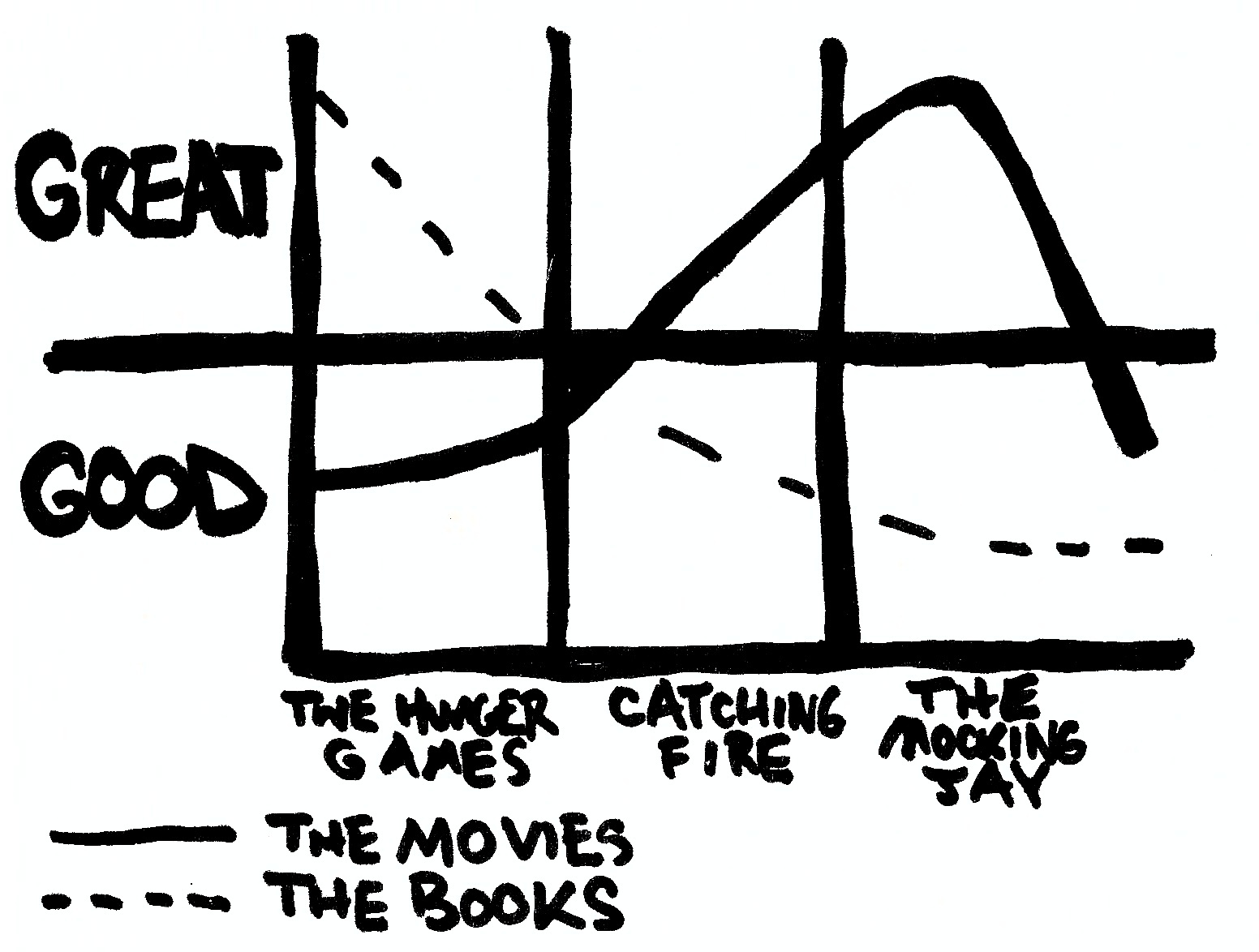
I’ve enjoyed following the Hunger Games saga, both as a series of YA novels & and as a series of dystopian sci-fi film. It’s a pretty grim franchise for something a lot of people consider “kids’ stuff”, one that takes its forcing-to-children-to-fight-to-the-death-for-entertainment premise very seriously. Its haves-vs-have-nots dystopian world-building is nothing particularly new and can especially be seen telegraphed in properties like Battle Royale & The Running Man, but I think it’s a pretty great sci-fi intro for teens, especially refreshing for its strong female protagonist Katniss Everdeen (played by Jennifer Lawrence in the films, duh) & in the way its potentially-corrosive love triangle conflict is handled. One strange aspect for me has been how the film versions of the Hunger Games trilogy have resisted the law of diminishing returns. I felt that Suzanne Collins’ novels started at their strongest point, doing a great job of establishing an in-the-moment intensity in its abysmal future-world by dragging the audience along closely with Katniss’ experience navigating the Hunger Games. The quality dropped off a bit for me in the sequels, though, as the pacing seemed to get away from Collins and large swaths of summarizing overtook the focused intimacy of early scenes. The first movie was pretty great as well, doing a good job of capturing Katniss’ in-the-moment POV, but the film series subsequently seemed to improve from there, knowing exactly what to show & what to ignore in Collins’ sprawling narrative for maximum effect.

EPSON MFP image

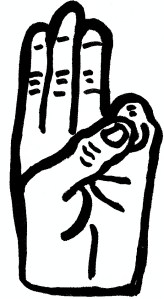
Mockingjay – Part I might just be the pinnacle of the Hunger Games movies for me. General consensus has the franchise peaking with the second film, Catching Fire, but I’d say it’s at the very least a close call. the film’s themes of PTSD, regret, powerlessness, and the pressures of being the face of a revolution all hit me pretty hard. I’ve heard friends & family describe the film as boring, saying nothing happened, which is pretty surprising for a film with such a high bodycount & grandscale warfare, but I had a genuinely emotional reaction to its horrors, getting teary-eyed at the film’s hospital bombings, mass graves, and three-fingered solutes. Its murderers’ row of talented actors certainly didn’t hurt: Philip Seymour Hoffman, Julianne Moore, Jeffrey Wright, Natalie Dormer, and Donald Sutehrland are all at the top of their game here, which is really saying something. I also appreciated scenes of Jennifer Lawrence, who is an incredibly gifted actor, pretending to be an incredibly inept actor as Katniss fails miserably to produce convincing propaganda clips to rally support for a revolution. Mockingjay – Part I‘s riots, uprisings, strikes, and rescue missions were all a lot more satisfying to me than expected & Lawrence deserves a lot of credit for anchoring the film’s emotional resonance.

Mockingjay – Part II unfortunately didn’t hold up quite as well for me. I think the issue is that Collins’ summarizing had gotten out of control by the final book, so that the film version struggles to make individual scenes count for much as it chases an exponential momentum of a plot trying to wrap up a widespread political revolution, a small family’s struggle to remain a unit, and a strained, increasingly bitter love triangle in just two hours time. There were a few small moments to enjoy in the chaos — my favorite was when Katniss is called out for the “tacky romance drama” & cliché  “the one” specialness of her mythology at a wedding — but for the most part the films struggles to let its Big Moments properly breathe. Mocking Jay – Part II‘s killer C.H.U.D.s & third act Major Character Death both failed to land with full impact thanks to the runaway momentum of Collins’ plot & pacing. And because director Francis Lawrence did such a great job with Catching Fire & Mockingjay – Part I, I’m willing to give him the benefit of the doubt & suppose that the rushed nature of Mockingjay – Part II was far from his fault. Considering all of the ground that the novel covers (I’m struggling not to go long here just touching on it), Francis Lawrence  could’ve stretched Mockingjay into its own separate trilogy & given each underserved scene its own proper moment to shine.

I can’t imagine impatient fans, who groused about splitting the finale into two parts in the first place, would’ve been receptive to a Mockingjay – Part III,  though. If you consider that Francis Lawrence had no choice but to split the finale into two parts, I think he did a great job of adapting a difficult work of fiction for the screen. Mockingjay – Part I carries the emotional weight the film series as earned over the last few years & Mockingjay – Part II does the necessary work of bringing the whole thing to a close. The two halves function well together as a single, four-hour feature. One picks up exactly where the other leaves off & together they do a satisfactory job of carrying a work that’s spread pretty thin to a convincing conclusion. Although I’d contend that Part I is the far superior picture, they average out to something pretty great in the end, which fairly unusual for the third film in a sci-fi trilogy.

Bonus points: I’d like to take this opportunity to give kudos to the Hunger Games series for being the only action franchise I can think of where fashion as an artform plays a deeply integral part to the films’ central themes. I particularly liked a moment in Mockingjay where Katniss is told she’ll be “the best dressed rebel in history” & it’s a sentiment that actually means something significant. It’s a cool, distinguishing detail, if nothing else.

– Brandon Ledet