The Boy and the Heron (2023)

Full disclosure: I’ve been struggling with what to write about The Boy and the Heron for over a week now. It’s obviously a beautiful movie, made with loving care, attention to detail, and bizarre imagination that one has come to expect from Hayao Miyazaki, and has all of his hallmarks of adorable and anti-adorable creatures, but also has a narrative that feels more incomplete than normal. I should also disclose that, although I am a forever proponent of watching these films with subtitles rather than with dubbing, my viewing experience was of the dubbed version of the film, and I’m not certain if there are differences between the two versions that could explain some of what I’m missing. 

Mahito Maki is a twelve-year-old boy who awakens one night to learn that there is a fire raging through Tokyo, and that the hospital where his mother is located is in the center of the conflagration. He runs toward the fire’s destruction, but his mother is lost. Some time later, his father, a manufacturer of air munitions, evacuates his family to his wife’s ancestral estate, currently occupied by his late wife’s sister, whom he has married in the interim since the opening scene. Mahito has trouble bonding with Natsuko, whom everyone remarks upon as being nearly identical to his late mother, and he further isolates himself by intentionally gouging a nasty wound in his head that is then presumed to have been the result of violence from bullies, and he is allowed to remain at the estate rather than having to go to school. Exploring the area, he finds a run-down structure and enters it through a doorway that is not completely sealed; later, he learns from one of his stepmother’s seven attendants, Kiriko, that this was the library of his great-granduncle, who was obsessed with magic and who disappeared in his youth, prompting the tower to be sealed. Mahito also finds himself the subject of the attention of a large grey heron, which speaks to him in a language he understands and tempts the boy to follow him into the tower. Fashioning himself a bow and an accompanying arrow (fletched with a recovered feather from the heron), Mahito enters the tower with Kiriko when searching for Natsuko, who has disappeared; deep within a hall, they encounter the heron again, who tempts Mahito with an image of this mother. Mahito manages to injure the heron in its beak because of the transitive magical properties of the heron’s feather, turning him into a grotesque bird man, who is ordered by a wizard to assist Mahito in his journey, and the heron, Kiriko, and Mahito find themselves transported to another world.

This isn’t a new story, not really. Children going to fantasy worlds is one of the oldest tropes of children’s literature, whether that world be Narnia or Oz or Neverland or Wonderland or Fantasia or the Labyrinth (etc.), and, from what I can tell, the novel from which The Boy and the Heron takes most of its narrative inspiration, 2006’s The Book of Lost Things, is also one of these narratives. In that novel, the main character’s stepmother has already given birth to his half-sibling (rather than being pregnant still, as in the film), and so there are even more parallels to fantasy media of this kind; I haven’t read the book, but a review of several summaries implies that the presence of a new baby is part of the incitement of the protagonist’s journey, as in Labyrinth. The tropes here are from all over. Just like the Pevensies in The Lion, the Witch, and the Wardrobe, Mahito has been evacuated from a city center during WWII (although we’re not supposed to think too hard about the fact that Majito’s father is making military equipment for the Axis); the recent death of the boy’s mother is even more strongly felt here than in The NeverEnding Story; and this film manages to ride the line that divides the Oz books from their most famous adaptation with The Wizard of Oz, as Mahito’s journey is clearly real, as Dorothy (et al)’s travels into Oz were in L. Frank Baum’s novels, but said world contains images that are derived from things that he has seen in the real world, as in the 1939 picture. 

What is new here also seems to have come largely from Miyazaki. There’s nothing in any of the summaries of The Book of Lost Things that indicate recurring bird images and motifs as part of that novel’s narrative (the book seems to largely feature canines and lycanthropes), but we all know that this man loves flight; it’s all over his work. Here, this is seen in the “real” world via Mahito’s father’s work as an air munitions manufacturer but which translates into several different species of birds in the “fantasy” world, all of whom have different natures that present to Mahito as things which at first seem cruel or wicked to him but which ultimately prove that the apparent violence of nature exists not because of malice in the world, but simply because existence does not conform to us as individuals. There is the heron first, whose motivations are unclear and who exists more as a trickster, whose behavior is inscrutable. Second are the pelicans, who first attack Mahito and are later seen descending upon and devouring this film’s cutesy sprite creatures, the Warawara. Although they seem to be malicious in this attack at first, a dying gull tells Mahito that their people are starving as a result of having been brought to this place, where they have no other natural food source. Finally, we meet the parakeets, who are largely anthropomorphic and willing to eat human flesh. The last of these do have some malicious intent, just as Mahito’s emotional climax of the film requires that he recognize that he has malice within himself as well, which saves him from the same fate as his great-granduncle. It’s this same realization that he has come to an age where he has to force himself to grow and mature as a person by recognizing that he can feel negative emotions and not act upon them that leads him to finally accept Natsuko and go home. After he has a fun adventure with the time-traveling child version of his mother, of course. 

I’m not sure that this one is destined to become an indisputable classic like some of Miyazaki’s other work, but that’s what we always say about late additions to the canon of an auteur with a career that has already proven that it will have a lasting legacy. It’s clearly a deeply personal film, and when making something that is created with an intentionally idiosyncratic worldview (rather than aiming for something more like universal appeal), there’s always the danger of making it insular and inscrutable. I certainly expect this one to have a smaller audience of devotees than something like Princess Mononoke or even Howl’s Moving Castle (which was greeted with a similarly lukewarm/confused audience reception as The Boy and the Heron upon initial release, to my recollection), but if there’s one thing that I’ve learned over the years, it’s that there’s no Miyazaki film that isn’t someone’s favorite, and that will apply here, too. It could even happen to you. 

-Mark “Boomer” Redmond

Lagniappe Podcast: Moon Garden (2023)

For this lagniappe episode of The Swampflix Podcast, Boomer, Brandon, and Alli discuss the dreamworld fantasy film Moon Garden (2023).

00:00 Welcome

01:22 Inu-Oh (2022)
05:11 It’s a Wonderful Knife (2023)
08:22 Thanksgiving (2023)
11:35 The Marvels (2023)
22:06 The Killer (2023)
28:00 A Fish Called Wanda (1988)
33:45 E.T. (1982)
39:40 Godzilla Minus One (2023)
42:50 FYC Screeners

1:06:20 Moon Garden (2023)
1:33:13 Best of 2023 Catchup

You can stay up to date with our podcast through SoundCloudSpotifyiTunesTuneIn, or by following the links on this page.

-The Lagniappe Podcast Crew

Piaffe (2023)

Piaffe is a post-adolescence coming of age story about a shy adult shut-in who musters up the courage to learn new things about her desires, her body, and her self outside her cloistered home.  In doing so, she grows a horse tail, has masochistic sex with a perverted botanist, and takes on a new trade as a commercial foley artist.  Most of the events that transform her life & body are a natural matter of course rather than a deliberate, personal choice.  The foley artist job falls in her lap when her nonbinary mystic sibling is unexpectedly institutionalized, leaving her to complete their work providing horse-riding sound effects for a TV commercial advertising a mood stabilizer called Equili.  She gets into character as the horses she soundtracks by clopping dress shoes onto wooden dresser drawers, which causes her very own horse tail to grow from the base of her spine. Her sexual relationship with the botanist is more of a personal choice than something that happens to her, but it’s a choice she can only make after truly getting to know herself as a literal horsegirl with increasingly specific sexual desires – mostly involving getting her tail hair brushed.  Falling somewhere between the stern kink dynamics of the dark 2000s office romance Secretary and the flippant, prurient surrealism of the 1970s dark fantasy piece The Beast, Piaffe is funny, sexy, cool, and inexplicable, but never in an especially showy way.

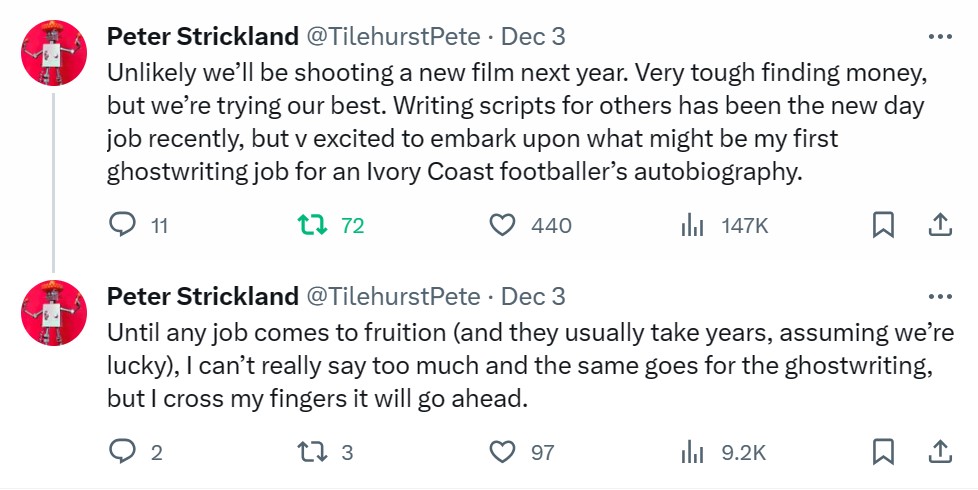
It isn’t the movie’s fault, but there was something grim about watching Piaffe the same week that England’s premiere auteur fetishist Peter Strickland was stress-tweeting about struggling to find funding for his next project.  One of our greatest working directors can’t get a new movie off the ground, and yet he’s formidable enough that younger artists are out there making (pretty great, possibly unaware) pastiches of his work.  Piaffe plays as just as much of a career-retrospective overview of Peter Strickland’s style as his recent music industry satire Flux Gourmet, which likewise combined his foley-art giallo throwback Berberian Sound Studio with his kink-dynamic relationship drama The Duke of Burgundy into a single, self-spoofing work.  The ASMR phone sex of Piaffe, wherein our equestrian protagonist brushes her tail hair over a telephone receiver to excite her lover, feels like a gag pulled directly from a Strickland film that doesn’t yet exist.  And given that Strickland is struggling to land funding for his next project, maybe it never will.  What Piaffe offers is a sturdy Strickland substitute that proves he’s not the only filmmaker who can reliably deliver weird-for-weird’s-sake fetish comedies for the midnight movie crowd; in that context, it’s maybe the best of its kind since The Berlin Bride.  I can still only take it as a consolation prize, though, as I’d unquestionably list Strickland among the most exciting artists working in cinema right now (alongside Amanda Kramer & Bertrand Mandico), so I’m bummed to hear he’s not currently working on anything at all.

For all I know, Piaffe director Ann Oren has never seen a Peter Strickland film, and their parallel sensibilities are entirely coincidental.  My only previous exposure to Oren is in her outsider-art Hatsune Miku cosplay documentary The World is Mine, which is specifically about the erosion and erasure of identity within a digital-age fandom “community.”  I will refrain from assuming anything about her based on this high-art horsegirl cosplay erotica follow-up, except maybe that experimentation with new, fabricated identities & personae is an artistic preoccupation of hers – something that can only be confirmed as she establishes a larger body of work.  I have hopes that, in time, Oren will prove to be just as formidable a prankster artist as Strickland.  It’s something I already felt in this film’s fetishistic fixation on the mechanical tools of filmmaking & horseback riding, grazing its fingertips over leather harnesses and the rusty metal gears of an ancient zoetrope.  I just need to see more of her work to know what to anticipate in the next picture.  Meanwhile, I already know what I want & get out of Strickland’s films, and I’m stuck looking for those qualities elsewhere while he’s twiddling his thumbs waiting for someone to sign the checks. 

-Brandon Ledet

The Cassandra Cat (1963) 

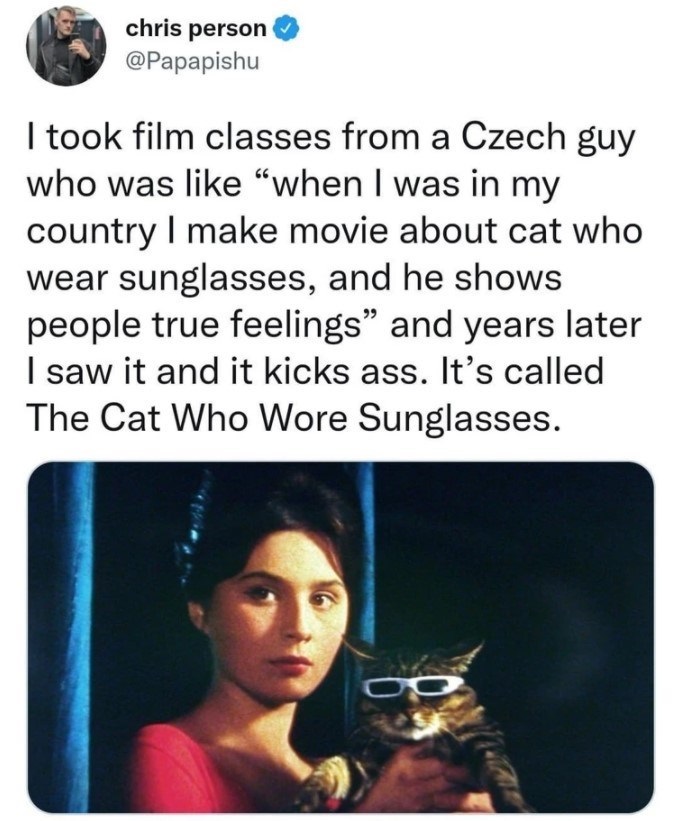
One of the sharpest reminders that the Internet is not real life that I’ve gotten recently was the sparse attendance at a local screening of The Cassandra Cat.  Also distributed under the English titles When the Cat Comes and That Cat, The Cassandra Cat is best known (to me) as the subject of a viral tweet, recommended by a film student whose Czech professor bragged about making a movie about a cat who wore sunglasses called The Cat Who Wore Sunglasses.  I certainly didn’t expect that one tweet would exalt The Cassandra Cat up to the level of household Czech New Wave standards like Daisies or Valerie and Her Week of Wonders, but it is one of those tweets that rattle around in the back of my mind the same way serious film scholars can quote lines of criticism by Kael, Sarris, and Godard.  So, when there were fewer than ten people in attendance for The Prytania’s afternoon screening of its recent restoration, I was shocked.  I could not believe so few people showed up to see a half-century-old Czech film about a magical cat that I’ve only ever heard about via Viral Tweet.  So weird.

Y’all missed out.  The Cassandra Cat is a wonderfully imaginative children’s film about collective action, holding adults accountable for being liars & cheats, and about how cats are excellent judges of character.  The titular cat is a trained circus performer who arrives to a small Czech village with an army of talented coworkers: a ringleader magician, a gorgeous trapeze artist, and a legion of faceless, supernatural puppeteers.  Their act initially goes over well with the townspeople until the final routine, in which the trapezist takes off the cat’s sunglasses so he can stare his naked cat eyes into the audience.  It turns out that the cat’s direct gaze has the magical power to expose people’s true nature by making them glow like mood rings (an effect achieved through body paint & gel lights).  Adulterers glow yellow, revealing secret affairs hidden from their spouses.  Selfish careerists glow violet, exposing their greed to higher-minded comrades.  Lovers glow red, revealing their pure, earnest hearts as artists & true friends among their careerist counterparts.  This, of course, causes a riot among the adults, who spend the rest of the film attempting to banish & discredit the cat in front of the children who witnessed their secret selves.

There is some political allegory to The Cassandra Cat that might not entirely translate to modern audiences unfamiliar with the day-to-day complexities of the Czech Republic pre-Prague Spring.  Mostly, though, it’s fairly easy to follow as the Czech New Wave version of “The Harper Valley PTA”.  That’s what makes it such a great children’s film, especially once the magical cat is weaponized by the town’s schoolchildren, who stage a mass classroom walkout until he’s surrendered to their care & use.  It’s also a great children’s film because of its vintage sense of magic & whimsy, recalling other psychedelic children’s media of bygone eras like H.R. Pufnstuf, The Peanut Butter Solution, and The 5,000 Fingers of Dr. T.  There were no actual children present at that afternoon screening at The Prytania, just a few stray adult weirdos who had nothing better to do in the breezy sunshine outside.  At this point, The Cassandra Cat is a film exclusively for weirdo shut-ins, the kid who file away hit tweets in the back of their minds in case the forgotten Czech films referenced therein happen to pop up on the local repertory schedule.  Maybe that makes us losers, but if like to think that if a cat stared at us that day we’d at least glow red.

– Brandon Ledet

The Beast (1975)

I’ve watched a few disparate adaptations & reinterpretations of Beauty and the Beast in recent years, each with their own unique window into the dark magic of the fairy tale: the intensely sensual surrealism of the French version from 1946, the tactile storybook atmospherics of the Czech version from 1979, the Internet Age psychedelia of the animated Japanese version from 2021.  All of these retellings of the “tale as old as time” have, of course, touched on the hesitant attraction of an innocent young woman to a wounded, mysterious brute, but they also all ultimately focus more on the brute’s troubled past & cursed homelife than the inner life of the vulnerable beauty who loves him.  That’s where Walerian Borowczyk’s take on Beauty and the Beast finds new, forbidden territory worthy to explore (as a French adaptation from a Polish director, as long as we’re tracking geography).  A profane masterpiece of erotic menace & goofball social satire, Borowczyk’s perversion of the Beauty of the Beast template delves deeper into the monstrous extremes of women’s desire & pleasure than any other retelling I can name, to the point where the titular beast is merely a prop, a piece of furniture.  And wait until you see what the women do to the furniture!  The Beast is also singular its smutty eagerness to roll around in its own filth, an instinct that eventually pushes past the absurd into the sublime.  It’s the only version of this story I’ve seen that reasonably compares to the 1940s Cocteau film that defines so many adaptations’ basic visual language, mostly because both works were clearly made for abject perverts.

Technically, The Beast is not an adaptation of the 18th century fairy tale at all, at least not in terms of plot.  Like the recent anime version in Belle, Borowczyk’s film assumes the audience’s overfamiliarity with the source material, using its basic iconography for shorthand to push & warp its broader themes to new extremes.  This is still a story where a young, naive woman is married off to a cursed, wretched beast as a desperate financial ploy, with the deep sadness of their newly shared castle’s faded glory haunting their tentative romance.  And just in case you don’t catch his allusions to the fairy tale, Borowczyk hands the beast’s would-be bride a single red rose as a symbol of their delicate union.  It’s just that this is the kind of film where the young beauty mashes that rose into her clitoris as an unconventional masturbation tool, destroying it in lustful mania while entertaining a zoological ravishment fantasy that would make even the most jaded cinephile blush.  You’d think there’s nothing left that a Beauty and the Beast tale could do to surprise an audience, considering how many times it’s been retold & reshaped over the past few centuries.  The Beast dropped my jaw in shock in its very first frame, which zooms in on the textbook veterinary details of equine genital arousal.  The movie opens with relentless, repetitive images of erect horse cocks, fairly warning the audience that if you stick around long enough you will watch beasts fuck in intense biological detail.  You won’t find that kind of novelty in either of Disney’s retellings of the tale, but Borowczyk’s version has a way of distilling it down to its most essential, throbbing parts.

The beastly beau in this picture is the poorly socialized nephew of a decrepit French baron, living in a Grey Gardens style faded estate in the rot of long-lost wealth.  Hoping that a traditional Christian marriage will bring the mysteriously disgraced family back into the royal fold, they arrange for the ancient nobleman’s brother, a highly reputable Cardinal, to ordain his weirdo nephew’s union with a spritely British heiress.  Only, the heir to the estate is a hopeless loser, spending every waking moment in the stables overseeing an intensive horse-breeding program with a fervor that pushes beyond the practical to the disturbed.  Luckily, his wife-to-be is just as much of a shameless pervert, immediately matching the unholy, decadent vibe of the chateau with her own morbid sexual curiosity.  Since her beau is too socially obtuse to understand or reciprocate her enthusiasm, he leaves her sexually frustrated in the absurdly long wait for the Cardinal’s arrival, dead time that she fills with wet dreams of the estate’s sordid history.  There are superstitious rumors that a former lady of the house had mated with a cryptid beast who cyclically haunts the grounds every couple centuries, which is supposedly how the family was excommunicated from the Church in the first place.  The beauty sweatily reimagines this human-bestial coupling in extensive, graphic detail while furiously masturbating in her bridal nightgown until the poor cloth is ripped to shreds.  The horny, mythical beast of the past and the shy, grotesque beast of the present are eventually linked in a last-minute twist, but their connection is far less important than the perverted pleasures of the women who desire their touch (and thrusts).

Before The Beast devolves into full-on cryptid erotica, its value as a unique work gets lost among its many literary parallels, which extend far beyond the fairy tale it most overtly alludes to.  The long, pointless wait for the Cardinal’s arrival at the castle plays out as an existential joke, recalling surrealist works like The Exterminating Angel & Waiting for Godot.  There are also overt Buñuel parallels in its blasphemous mockery of the wealthy & religious ruling class as degenerate brutes, pushing its satire to de Sadist extremes but never fully matching the heightened Buñuelian humor at hand.  The centerpiece of the work really is the pornographic depictions of bestial fucking, then – starting with the horses, working up to more traditional onscreen heterosexual couplings, and then climaxing with the historical ravishment fantasy that swallows up most of the third act.  “Climax” is the only word you could really use to describe that payoff, too, since the humanoid wolverine who couples with an actual human being spurts semen by the bucketload for minutes on end as their tryst pushes beyond taste & reason.  A faux-classy harpsichord soundtrack keeps the mood lightly comical throughout this absurd display, and it concludes with a punchline in which the Cardinal, finally arrived, performs a grand, fingerwagging speech about the evils of bestiality & women’s libidos as if he were reading from a pre-prepared pamphlet.  In the end, it’s the women’s arousal & search for pleasure that registers as the film’s most blasphemous acts, even more so than its extensive depictions of their monstrous ravishment fantasies.  They’re greatly enjoying themselves, much to everyone else’s disgust & confusion, which remains a global movie censorship taboo to this day.

Borowczyk finds his own fairy tale visual language here with images that have no obvious connection to the Beauty and the Beast tale: a snail sliming its way across a lady’s sky-blue shoe; lurid flashes of red paint through hallway doors that slyly recall aroused genitals: pornographic close-ups on actual aroused genitals; etc.  As soon as his equivalent of Belle arrives on the estate taking dozens of dirty Polaroids of every perverted detail she can collect, it’s clear that he’s taking the story to new, distinct places.  Most Belles cower in fear of the erotic menace lurking in their new home castles, gradually warming up to the beast who stalks the grounds.  In this version, she’s so immediately fired up by the ugly erotic charge of the central pairing that it freaks out everyone around her, including the audience.  A half-century later, it remains a bold, hilarious, intensely alienating take on a story that’s continued to be told countless times since, but rarely with such gleeful prurience. 

-Brandon Ledet

Invincible (2001)

“Why do I watch WrestleMania?  My answer is that the poet must not avert his eyes from what’s going on in the world.  In order to understand, you have to face it.”

“Our sense of the real world today is massively challenged; I include here reality television, breast enhancement, and the carefully choreographed, fake drama of WrestleMania, populated by larger-than-life characters with muscles that nature doesn’t normally provide us with and who take pleasure in telling everyone how unbelievably evil they are.”

“What is fascinating about WrestleMania is the stories around it: the dramas between the owner of the whole show and his son, who are feuding, and his wife in the wheelchair who is blind, and he is then showing up in the ring with girls who have huge, fake boobs, and he is fondling them.  This is almost sort of an ancient Greek drama – evil uninterrupted by commercials.”

These are just a choice few Werner Herzog quotes about the cultural & literary virtues of professional wrestling, pulled from the 2019 GQ listicle “Werner Herzog Cannot Stop Talking About WrestleMania” – a masterpiece of modern clickbait publication that I return to often.  Herzog was promoting his work as an actor on the Star Wars television series The Mandalorian around the time those various press junket quotes were assembled, a time when his familiarity as a household name was bridging the gap between art cinema snobs and their sworn enemies, “Disney Adults.”  His public perception has since been bifurcated in recent years, split between his well-earned designation as a world-class auteur and his more recent evolution into a Nic Cagian human meme who pontificates about supposedly low-brow subjects like WrestleMania & Ana Nicole Smith in a severe German accent.  Unlike Nic Cage, though, Herzog has not allowed his YouTube Era reputation as a human meme affect the tone or content of his work as a serious filmmaker, give or take a few over-the-top scenes in his collaboration with Cage in Bad Lieutenant: Port of Call, New Orleans.  As often as you hear Herzog explain the grotesque poetry of reality TV & pro wrestling in interviews, it’s difficult to detect their influence on his actual work.  That is, unless you happen to be one of the few people who remember his 2001 historical fantasy drama Invincible, which presents an academic-level understanding of the historic origins of wrasslin’, as well as its modern mutation into mass, crass populist entertainment.

Invincible stars real-life strongman Jouko Ahola as historical strongman Zishe Breitbart, a young Jewish blacksmith from a small Polish village who grew to fame as “The Strongest Man in the World” in 1920s Germany.  Herzog takes a pro wrestling-style truthiness approach to the material, moving Breitbart’s story to the early stirrings of Nazi Germany a decade later, playing up the significance of his Jewish heritage in a heightened, more satisfying kayfabe version of his life’s story.  In the film, Breitbart enters the entertainment industry through the strongman circus acts that sparked pro wrestling as an artform.  He challenges a traveling strongman for prize money in what is supposed to be a rigged wrestling bout and easily defeats the brute in a Goliath vs Goliath matchup.  Word of his incredible strength quickly spreads, and he’s summoned to work as a regular stage act in a Berlin cabaret, ringmastered by a Nazi-friendly psychic played by Tim Roth.  Roth’s conman mystic is quick to use Breitbart’s Jewish heritage as a race-baiting point of division between the Nazi officers and Jewish citizens in the cabaret audience, which is perfectly in tune with how hot-topic political divisions are exploited for cheap heat in modern pro wrestling programs.  Breitbart is the underdog hero for the Jewish people, who feel increasingly hopeless as the Nazis rise to political power.  The carnie mystic MC is a hero to the Nazis, pretending to summon supernatural strength from The Dark Arts to overpower the strongman’s brute force (a “skill” he can sell as a war-winning weapon for Hitler’s army).  In truth, they’re working together as a scripted act, putting on a show to stoke their divided audience’s Us vs Them bloodlust; it’s wrestling in a nutshell.

Aesthetically, Invincible is worlds away from the reality-TV crassness of what Herzog refers to as “WrestleMania”.  In its best moments, there’s an ancient cinematic quality to the director’s visual storytelling, effectively remaking Bob Fosse’s Cabaret as if he were Tod Browning adapting a fairy tale.  In its worst moments, it plays like standard-issue Oscar bait of its era, bolstered by a prestige-desperate Hans Zimmer score that tells the audience exactly how to feel at every second of runtime.  Its Oscar chances were self-sabotaged by Herzog’s choice to have his European actors speak phonetic English in post-production dubs instead of performing naturally in their various native languages.  That might have been a deliberate attempt to evoke a Bressonian style of performance, but it just comes across as bizarre & confused, and only the established professional actors Tim Roth & Udo Kier come across as capable performers.  The camerawork can come across as bizarre & confused as well, alternating between a handheld documentary style and a Hollywood-schmaltz fantasy & artifice that attempts to (in Ross’s showman wording) “[articulate the audience’s] collective dreams”.  Its moments of visual lyricism make sense to me as a historically set fairy tale about Nazi obsession with mysticism clashing against a Freaks vs. The Reich style superhero.  They’re especially effective when Herzog gazes at the sea-life bodies of jellyfish & crabs as if he were a space alien considering their otherworldly beauty for the very first time.  He’s really good at articulating the uncanniness of everyday life & pop media in that way, which is how he’s gotten famous as an interviewee outside of art cinema circles.  It’s amusing, then, that he can’t convincingly translate that wonder with the world into an Oscar-friendly movie for normies; he’s too much of a genuine weirdo.

Around the time of Invincible, Herzog was essentially directing one feature film a year at a consistent pace, and he’s only gotten more prolific in the two decades since.  While some of his 2000s titles like Grizzly Man, Encounters at the End of the World, and the aforementioned Bad Lieutenant have endured with a certain cultural cachet, many like Invincible have fallen through the cultural cracks; they can’t all be stunners.  If you’re going to excavate this one Herzog title out of relative obscurity within that massive catalog, I do think it’s worth considering as a bizarre, failed attempt to reach for Awards Season prestige beyond the usual, routine boundaries of his critical accolades.  He has found wider public recognition in the years since, but mostly as a weirdo public persona (an extension of the first-person narration style he developed in his 2000s-era documentaries).  Invincible does recall one very specific aspect of that public persona, at least: his inability to stop talking about WrestleMania.  Whether that’s enough of a reason to dig this one particular discarded Herzog DVD out of the Goodwill pile is up to your completionist interest in his career, I guess, as well as your personal fascination with the Greek tragedy & grotesque poetry of wrasslin’ as an artform.

-Brandon Ledet

Apocalypse After: Films by Bertrand Mandico (1998 – 2018)

Only two feature films into his career, I’m already comfortable thinking of Bertrand Mandico as my favorite working director, even though only his debut was a total stunner.  Mandico’s The Wild Boys is my favorite film released within my lifetime – a Bidgoodian wet nightmare about gender dysphoria and, ultimately, gender obliteration.  His follow-up, After Blue (Dirty Paradise), is more of a flippant prank, using the same sensory intoxication & erotic menace for a much sillier purpose: worshipping the almighty Kate Bush in the rubble of our fallen civilization.  Although it’s seemingly shot in a muted black & white that sidesteps the cosmic blues & purples that make his other features so vivid & vibrant, I’m dying to see his third feature, Conann, which appears to be a gender-subverted riff on the pulp fantasy character Conan the Barbarian. It’s going to take a while for that latest dispatch from Mandico’s id to reach American screens (it just premiered at Cannes this summer), so I decided to placate my curiosity as best as I could by digging into his back catalog of short films.  Altered Innocence has consistently been Mandico’s home distributor since the company’s inception; it’s even arguable that Mandico’s films have been a brand-defining cornerstone for the Vinegar Syndrome partner label, along with the similar dreamlike genre throwbacks of Knife+Heart director Yann Gonzalez.  Given that close affiliation, their publishing a collection of Mandico’s short films on a single Blu-ray disc, titled Apocalypse After, was a total no-brainer.  Given my own personal obsession with The Wild Boys, the only surprising thing is that I didn’t jump on this disc the second it was released last year.  I guess I needed to get worked up about a new feature from Mandico dangling just outside my reach to seek out his already-available shorts I hadn’t yet seen.  Well, that and if I immediately jumped on every new Altered Innocence release I wanted to see I’d struggle to pay my energy bill, and I wouldn’t be able to watch them anyway.

The titular short on this disc, “Apocalypse After (Ultra Pulpe)”, is a calling-card submersion in the subliminal perversions of cinema, consciously transforming “science fiction” into “science titillation” while shouting in frustration that the images still aren’t erotic enough for the director’s liking.  Longtime Mandico collaborator & muse Elina Löwensohn stars as the director’s avatar, an arthouse pornographer named Joy d’Amato (in cheeky reference to real-life pornographer Joe d’Amato).  Mandico’s films are full of sarcastic allusions to real-life artists he admires in this way: Kate Bush, Henry Darger, Jean Cocteau, Walerian Borowczyk, etc.  Curiously, he has yet to name-drop the three filmmakers he most reminds me of—Kenneth Anger, Guy Maddin, and James Bidgood—likely because their influence is already blatantly apparent in the text.  Joy d’Amato is more Bertrand Mandico than she is Joe d’Amato, though, shooting a live-action version of paperback sci-fi cover art with the same vintage porno sensibility you can find in all of Mandico’s recent work.  In a way, the film shoot setting positions “Apocalypse After” as Mandico’s Knife+Heart (a movie he acted in as a porno cinematographer), but it’s even less of a coherent, linear story and even more of an expression of its director’s fascinations & frustrations with his artform.  Dialogue that declares details of the film shoot “magnificently hideous” or complain, “It’s beautiful, but at the same time I don’t know what he means,” function as meta commentary on the achievements & shortcomings of Mandico’s art.  No dialogue feels more essential to the piece than an actor’s monologue recalling watching forbidden, adult films as a child – compelled & mesmerized by the images on the screen but too young to fully comprehend them.  Mandico has a way of turning pornographic indulgence into transcendent visual art, and even then he directs his avatar in Löwensohn to shout that the images are still not erotic enough.  Nothing ever could be.

The “Apocalypse After” short is a thematically cohesive but logically incoherent collection of all the stylistic flourishes & quirks sketched out in Mandico’s first two features: the plant life molestations of The Wild Boys, the hollow geode-face zombies of After Blue, and the practically achieved glamour that merges their aesthetics – gel lights, rear projections, body glitter, smoke, prosthetic nipples, etc.  The presentation of Mandico’s previous shorts on the Apocalypse After disc is strictly chronological, so you can watch the director arrive at that personal aesthetic over decades of obsessive tinkering.  Over three full hours of his two decades of short-form experiments, Mandico Heads get to watch the filth maestro develop his cosmic visual language in ten preceding works.  In that context, “After Apocalypse” is less of a jumbled collection of Mandico pet obsessions than it is a natural crescendo of a clear pattern in methodology.  His seemingly weird-for-weird’s sake indulgences become more recognizably thoughtful & designed in retrospect, the same way the “Magick Lantern Cycle” packaging of Kenneth Anger’s shorts makes “Lucifer Rising” feel like the most obvious place his art could lead him, not an out-of-nowhere novelty.  The Apocalypse After disc starts with Mandico imitating Jan Švankmajer’s stop-motion nightmares in antiqued sepia tone, then seeking the same ancient artifice in short-form magical realist dramas.  He hits a breakthrough mid-career with the mid-length film “Boro in the Box”, which playfully reimagines filmmaker Walerian Borowczyk’s life in the style of Au Hazard Balthazar (a prototype for the more recent Balthazar riff EO).  By the time Mandico returns to stop-motion in his post-“Boro” short “Living Still Life” (this time animating taxidermized animals), his style is distinctly of his own.  As a result, all of the essential Mandico bangers arrive late on the disc, after he finds his distinct voice as a filmmaker: the Cronenbergian colonoscopy sideshow act “Prehistoric Cabaret,” the fairy tale creature feature “Our Lady of Hormones,” the unlikely Enys Men sister film “Depressive Cop” and, of course, the aforementioned self-portrait in heat “Apocalypse After.”

There are certainly other current filmmakers whose every feature I anticipate with the same gusto as Mandico’s, namely Peter Strickland and Amanda Kramer. None in that unholy trio of perverts gets the critical respect they deserve as playful subverters of the artform.  The academic interest critics used to have in similarly perverse, cerebral genre filmmakers like Cronenberg, Lynch, and Jodorowsky has more recently shifted to formally muted & restrained works of slow cinema auteurs instead.  A lot of the leeway we used to give venerated genre freaks of the past hasn’t trickled down to the unvenerated genre freaks of today, at least not for anyone who hasn’t struck a distribution deal with A24.  Altered Innocence appears to be committed to the cause at least, offering a step-by-step study of Mandico’s work for anyone who cares to learn how he arrived at something as wildly baffling as The Wild Boys.  The only other comparable presentation of a current director’s shorts that I can name is the The Islands of Yann Gonzalez, which I will leave to your imagination what is covered and who handled the distro.

-Brandon Ledet

The Cow Who Sang a Song into the Future (2023)

La vaca que cantó una canción hacia el futuro (The Cow Who Sang a Song into the Future) is a beautiful, entrancing film, the first feature from writer-director Francisca Alegria. Although most reviews of the film that I have seen draw attention to the film’s environmental themes and magical-realist atmosphere, I’ve seen very little discussion about the film’s presentation of family. One of the film’s inciting incidents is the dumping of industrial waste from a paper factory into the Cruces River, but what stands out the most to me is the way that the movie focuses on a different kind of toxic waste, and the way that it can pollute the very thing that gives us life. 

Magdalena (Mía Maestro) is a doctor living in a cold urban home, having put as much distance between herself and her rural upbringing as possible. When she receives a call from her brother Bernardo (Marcial Tagle) telling her that their dairy farmer father Enrique (Alfredo Castro) has suffered from a heart attack, she returns home with her two daughters, including teenaged Tomás (Enzo Ferrada), whose gender identity she does not respect. Upon arriving and performing her own medical inspection of her father, she is told that he did not have a standard heart attack, but that it was a sudden stress-induced health issue. Enrique, for his part, tells his children that he passed out after seeing their long-dead mother Cecilia (Leonor Varela) outside of a cell phone store. Magdalena does not believe him, of course, since she was the one who watched her mother commit suicide by tying herself to her motorcycle and driving into the river when she was a mere seven years old, but he’s absolutely correct; we in the audience saw Cecilia climb out of that same river, accompanied by a mournful him that seems to come from the dead fish surrounding her, in the film’s opening moments. But what brought her back, and why?

As a character study, this is a piece about a woman who has long embodied the worst aspects of her father but learns to represent the best parts of her mother. As with many texts containing magical realism, much is left up to the interpretation, but we first see her being harsh and cold with the people closest to her, first telling Tomás that, as long as she lives in Magdalena’s house, she is her “son.” Her brother’s feelings about her are clear from their first onscreen interaction; although Bernardo lovingly embraces his nieces, when Magdalena moves in to hug him, he waves her off, citing that he has been working and is too filthy to be touched. When they arrive at the farm, Magdalena sends Bernardo off to take care of the dairy “for once” while she attends to their father. In comparison to the lush verdancy of the countryside, her home in the city is sterile, and when nature intrudes (in the form of a spider in her bathroom window), she doesn’t attempt to coax it outside and close the window, but instead runs off for a can of insecticide, which she sprays into the air futilely when she returns to find that the spider is nowhere to be seen. 

All of these are elements that tie Magdalena to Enrique, who is likewise queerphobic, dismissive of his child, and sees the natural world as something that exists only to benefit human beings, diametrically opposed by civilization. Enrique also chides Bernardo for failing to take care of the dairy, even blaming him when their cows die despite their death being the direct result of Enrique’s refusal to listen to his son; his reaction to Bernardo’s insistence that they dig a new well for the cows shows that this is a recurring argument, but it’s that very lack of forethought that leads to the herd drinking from the poisoned river when they are overcome with thirst, essentially damning the dairy farm to close. When the tearful Bernardo brings this to his father’s attention, the older man calls his son a homophobic slur and degrades him. Magdalena has spent her life seeing things through her father’s myopic, cruel vision of the world, and her own family has suffered from his polluting influence as a result. That this traces itself back to her childhood is no surprise. Like her father, she has long seen her mother’s suicide as a sign of weakness due to not wanting to be a mother, as evidenced by all the times in her memory that her mother was absent while still alive. In truth, those absences were the fault of her father, who had Cecilia institutionalized multiple times because he could not control her. Luckily for her, learning this is epiphanic, and even if she is limited in her ability to heal the world, it’s not too late to heal her relationship with Tomás.

If you were wondering if there is an actual singing cow in this movie, then I regret to inform you that there is not … there are several. At the start of the film, what appears to be non-diegetic music plays as the shores of the Cruces give up hundreds of dead fish, with these images soundtracked by a mournful elegy about dying. After there are news reports that the toxic waste in the water has killed not only the fish but also the various water grasses and insects that sustain other animals in the ecosystem, which leave the area in search of other food resources. Finally, the cows drink the waters of the river and themselves succumb to the poison, but before they pass, they join their voices in a chorus, grieving for the calves that were taken from them so that they would continuously produce milk for the farm, and rejoicing that the pain that came from that separation, which they consider to be worse than death, will end soon. This has the potential to be unintentionally funny, especially in the odd occasional moment in which one of the cow “actors” is chewing cud almost in time to the song like something out of Mister Ed, but the sincerity of the moment manages to make it work despite the potential to be undermined. 

That separation between mother and child stands as a metaphor not just for the relationship between Magdalena and the long-dead mother whom she unconsciously resents, but also between Magdalena and her own elder daughter. When we first meet Tomás, she is in her bedroom, showing her beau an online newspaper clipping about Cecilia’s death, asking if the boy sees the resemblance between Tomás and her grandmother. Her self-actualization is blocked not only by her mother’s bigotry but also her disconnection from her roots, and her hunger for a connection drives her to seek out her resurrected grandmother and the two bond. The revived Cecilia is mute throughout the film, but there’s a magic to the way that these two women who share a familial bond but who have never met are able to form a connection without the need for words. A love that transcends speech reappears again at the end, when Tomás and her mother reunite, and even without words, it’s clear that the two of them have gained a better understanding of each other, in unvoiced acceptance. 

This is certainly one of the most moving films I’ve seen this year, as well as one of the most lyrical, beautifully composed, and haunting. It sets its mood and never alters course, hypnotic in its commitment to its themes. It should not be missed. 

-Mark “Boomer” Redmond

Arrietty (2010)

It comes up here from time to time, but my favorite fictional thing is a story about tiny people in a normal sized world. I’ve talked about my childhood love of Honey I Shrunk the Kids and how that translated into a fondness for the (first two) Ant-Man movies, but a lot of it can be traced back to my utter absorption into one specific series of novels I read in my youth: The Borrowers, by Mary Norton. There’s nothing more magical to me than tiny beings using normal-sized objects in novel ways: the knight from a chess set as a kind of decorative bust; a watch, sans band, hung on a wall as a clock; a postage stamp framed as a piece of art. I never understood why those books were so much less well known than other fantasy novels of the same ilk, and I never could figure why Arrietty Clock, who was just about the coolest girl in the world, was less famous than Lucy Pevensie, Dorothy Gale, Pippi Longstocking, or Wendy Moira Angela Darling. There have been numerous adaptations over the years, but one of the best came out when I was too busy with grad school to take note of it, but I finally have, and it’s a delight. 

Arrietty was released in Japan in 2010 before seeing a U.K. release the following year and U.S. distribution through Disney in 2012, under the title The Secret World of Arrietty. I refuse to call it that (can you imagine if The Wizard of Oz was titled Dorothy’s Secret World or The Lion, the Witch, and the Wardrobe was called The Secret World of Lucy?), but I do want to list it here for those of you who will want to seek it out for your own enjoyment. I’ll also recommend that, since the film is available on HBOMax in both the original Japanese and the U.S. English version, that you check it out in its original language, in spite of my love for Carol Burnett, who voices the Haru equivalent in the English dub. I was particularly fascinated to see this adaptation, which sets the story in (seemingly) 1980s Japan rather than Edwardian England, as I’ve always thought of this as a quintessentially English story, like Mary Poppins or the Narnia series, and although the idea of updating the setting to the U.S. seems heretical to me, I knew the Studio Ghibli aesthetic would more than make up for any displacement. 

Arrietty is a fourteen-year-old girl who lives with her mother Homily and father Pod. The three of them are “borrowers”: humanoid beings of 4-5 inches in height, who live alongside and parallel to full-sized humans. The former survive by “borrowing” from the latter, whom they call “human beans,” keeping themselves hidden and their existence secret. As the story opens, Arrietty has finally reached an age when she is to be taken on her first borrowing expedition into the home of an older woman named Sadako, who lives with her housekeeper Haru and who has recently taken in her great nephew Shō, a boy roughly Arrietty’s age who suffers from a heart condition. In the novel, Arrietty’s family lived in the base of a clock (hence their surname there), but here, they live largely beneath the house in a beautifully detailed home of their own; they access the larger house through a series of secret holes that are accessible only to them because of their size, although the passageways between them require a bit of exploration and adventure to navigate, and vermin like rats pose a threat to them. Shō spotted Arrietty in the garden when he first arrived and is fascinated by her, and he startles her when she and her father are on one of their expeditions, causing her to drop a precious sugar cube, which the Borrowers are forced to forsake. Shō further attempts to befriend Arrietty, with whom he shares both a profound loneliness and a deep melancholy, as she is likely to be among the last of her kind and has never known anyone other than her parents, while he has spent his short life as an invalid with few friends and little hope for a future despite an upcoming operation. Despite his best intentions, however, their friendship endangers the Borrower family in ways that neither could have predicted. 

This is not a perfect translation of the novel(s), but it is a marvelous and lovely example of how to translate a denser text for the screen. Some changes are small; I already mentioned above that the family lives in a crawlspace rather than a mantel clock, but there are also character changes that shift the story subtlely, and not for the worse. Shō is much friendlier from the outset than the unnamed boy in the novel, who has a bit of the old British superiority complex despite having been raised mostly in India; that is completely removed here, as is the fact that he had little English literacy as a result of having lived abroad. In the novel, it is this fact and Arrietty’s willingness to read to him that helps the two to bond, while here, the things that he does for the Borrowers he does purely out of the goodness of his heart. There are also fewer Borrowers here and the Clock family’s isolation is more profound as a result; Pod mentions to his daughter that there used to be others of their kind elsewhere in the house but that they have either moved on or been killed. The Clock’s relatives like Uncle Hendreary (Pod’s brother) who are rumored to have moved to a nearby badger sett and the boy’s attempts to transmit letters between the two families are cut, which also adds to the textual richness of the questions regarding any other Borrowers out there in the world; until we meet feralish Borrower Spiller later in the film, we’re unsure whether Arrietty and her family are the last of her kind, deepening her kinship with Shō. This also eliminates a lot of the squabbling between the various Borrowers, which is a fun comedic element in the novels as they get into rather large rows for such tiny specimens but makes for a more concise narrative here. 

But what’s most impressive here, of course, are the visuals. The backdrops are painted with that lovely Ghibli precision, and the style lends itself well to creating the sumptuous verdancy of an ivy-draped garden from the perspective of a four-inch teenager. Because Arrietty and her family are so tiny, the idiosyncrasies of every teacup, sideboard, and wainscot are terrifically magnified, and all of it is lovingly rendered in gorgeous detail. Great attention is paid to smaller characteristics as well; in one scene, Homily pours tea for her family, and it comes out in (relatively) huge globs because of the surface tension of the water, a characteristic that carries over to the behavior of rain in a different beautifully animated section of the narrative. A glob of cheese on toast, likewise, does not flatten, but retains its bead-like shape. All of these details combine to make the film incredibly immersive, and it’s all the more to its benefit. 

-Mark “Boomer” Redmond

Blind Willow, Sleeping Woman (2023)

It hasn’t come up in a while, but I’m a big fan of author Haruki Murakami, having first read The Wind-Up Bird Chronicle nearly twenty years ago and having devoured several other novels and short story collections in the years since; in fact, as I write this, I have a copy of his short story collection First Person Singular sitting next to my bed. As such, when I settled into the theater to see Master Gardener, I was pleasantly surprised to see that there was an upcoming screening of a new animated feature that would consolidate several of his short pieces into a single narrative. The common elements of the stories that make up the aforementioned Singular is that they are all from the point of view of an unnamed protagonist, none of whom are the same from piece to piece but all of whom are quintessentially Murakami. Not universally, but among them are people seeking missing cats, characters fascinated by wells, men who share Murakami’s interest in running, people who meticulously cook delicious-sounding meals from simple ingredients, lots of discussion about staying in shape by swimming at the local natatorium, detailed descriptions for the care and upkeep of vinyl records, and, above all, men who yearn. From the lowliest television fee collector’s son to the everyday salaryman to the reclusive artist, all of Murakami’s men yearn — for the lives that they might have lived, for the loves that they never had or that they had and lost, for meaning. I can’t say that it never would have occurred to me that any number of these men could have ever been the same man because, in a way, they were all always Murakami to me, even when they had names, various fractals of the man who has been the weaver of many of the images and ideas that have gotten stuck in the craw of my consciousness over the years. 

Blind Willow, Sleeping Woman is the great crossover between six different pieces of short fiction, familiar and unfamiliar, and was adapted, produced, directed, and scored by Pierre Földes, who has largely worked previously as a composer; I didn’t recognize his name, but his C.V. contains two melancholic films I recall from my teenage years: L.I.E. and 12 and Holding. The film establishes three major characters: Katagiri, a perpetually overworked and overlooked accountant who lives a lonely life as the result of his inability to bond with others; his colleague Komura, a younger man whose future with the company looks bleak and whose life is further rattled by the sudden departure of his wife Kyoko, who leaves him a note comparing life with him to living with a “chunk of air;” and Kyoko herself who, after several days of watching constant news coverage of the 2011 earthquake, packs her things and leaves. Although the film is divided into numbered chapters, the stories are not discrete but melded together, and done so inventively. Most notably, there is one story that was almost too familiar, an adaptation of the story “The Wind-up Bird and Tuesday’s Women,” which was initially published in 1986 in The New Yorker before appearing as the first story in the 1993 collection The Elephant Vanishes and which was later reworked into the first chapter of The Wind-Up Bird Chronicle, which was published in 1994 in Japan and 1997 in the U.S. Ironically, this actually comprises the final section of the film, placing what has always been treated as an introduction as a conclusion instead. 

Set in 2011 in the wake of that year’s devastating earthquake in Tokyo, most of the narrative follows Komura, with the film opening on his married life to Kyoko at a time just when their marriage is falling apart; for days, she has been unresponsive in front of the TV, watching news coverage of the attempts to save trapped citizens. When Komura is at work, she leaves him, writing a note asking him not to contact her, to look for her cat, and that she is never coming back. This sets up two plot elements: a trip that Komura takes to visit his younger teenage cousin to accompany him for a hospital visit, and a second trip that Komura is encouraged to take by his co-worker Sasaki. The former is the title story from the Blind Willow, Sleeping Woman collection and was originally about an unnamed man who accompanies his cousin to the doctor and takes the opportunity to relate how he would accompany his best friend to visit his girlfriend after an operation and is largely focused on time, daydreams, and recollections; here, this narrative is recast as the story of how Komura and Kyoko met, putting her in the place of the ill girlfriend who settled for Komura when her boyfriend died, at least in this version. The second of these is largely the plot of “UFO in Kushiro,” the first story in after the quake and the story from which Komura’s name is drawn. In it, Komura travels to Kushiro at the behest of his friend to deliver a small, nondescript package, and there he is drawn in by his colleague’s sister Keiko and her friend Shimao, who tries to draw Komura out of his funk. Alongside these two journeys is an adaptation of “Super-Frog Saves Tokyo,” in which Katagiri (who, it should go without saying, had no connection to Komura in any of the source materials) is visited by a man-sized frog who requests the timid man’s moral support in Frog’s upcoming battle with Worm, the creature who caused the recent earthquake (in the story the January 1995 earthquake) and whose ongoing efforts threaten to fully reduce the city to rubble. Elsewhere, Kyoko relates the story of a strange offer she received on the night of her twentieth birthday, in a story (“Birthday Girl”) also taken from the Blind Willow collection. 

The animation here is unsettling, even when it’s not intended to be. Director Földes apparently filmed the whole thing as a live action “reference” and then covered the heads of the actors with 3D models, which were then traced and animated. Other people who exist in the background or in the space through which our main characters move are thus translucent against the solid background. It’s an image that calls to mind the way that children draw things: a table first, and then the objects on it, so that the table and the wallpaper shine through the phone and the lamp drawn over them, but here it’s not the mark of a child’s process of learning about object permanence and layering images but is instead an evocation of the ephemerality. Whether or not Katagiri’s interactions with Frog are real is left to the interpretation of the reader (or viewer, as is the case here), but this is a world that is haunted, where the people who are not interacted with are ghosts and wisps. I hesitate to call it ugly (although it is, at times) and instead will simply call it unique. That method, combined with the easy pace at which the film progresses, makes the whole thing seem dreamlike. I’m sure that there will be others for whom this feels like a slog, but the film picks up the pace as it progresses, and every part of it feels as if it’s crafted with care, even if the aesthetic is intentionally haphazard. Ironically, however, I think the people least likely to enjoy this may be Murakami fans. Not that the author’s readers are a toxic fandom who will hate this melting together of different stories, but because transforming these from prose to film necessitates the loss of much of the narration that creates the rhetorical space in which his literary mannerisms flourish. His dialogue is still here, however, as is his sense of what makes people “tick,” and I still think it’s well worth visiting for fans and novices alike.

-Mark “Boomer” Redmond