
Rabbit Trap (2025)

“Listen,” speak-sings Daphne Davenport (Rosy McEwen) into her microphone over ambient nature sounds that she and her husband Darcy (Dev Patel) have been recording. “Noise … the oldest of gods. Before language, before flesh, before name, she was here.” It’s 1976, and the two of them have moved from London to the Welsh countryside with reel to reel recorders and state of the art microphones, which they traipse around the forest with, capturing the sounds of squelching marshes, nightbirds chirping as they move through the air in bloblike flocks, skittering feet of bugs across leaves, and the distant song of unseen fauna, or at least one hopes it’s something so natural. Later, the couple meets a mysterious androgynous child (actress Jade Croot, although The Child is only ever referred to as “he”), and when the boy asks if he can sing Daphne a lullaby that his mother used to sing him as a child, she records him as well. Listening back to it later, Darcy says it “sounds like a spell.” Rabbit Trap traffics in this idea, of sound as song, noise as god, voice as spellcraft, in a beautiful little folk horror from director Bryn Chainey, who has heretofore mostly worked in short film. 

There are points of comparison that it would be easy to go to when describing the film’s atmosphere. The sudden presence of a creepy child who brings with him portents of folkloric truth calls The Killing of a Sacred Deer to mind, and although this is set in Wales rather than on the Cornish coast, the atmosphere of isolation, hallucination, and lost time invokes Enys Men. There’s a sequence in which The Child leads Daphne to a series of tunnels and trenches that seem neither manmade nor natural and lures her through them by whistling a tune that she whistles back to him, and for a moment I felt I was watching Jessie Buckley harmonize with her own echo in Men. Despite these intentional homages or simple similarities, Rabbit Trap feels fresh despite being familiar. Even the way that this film goes to horror media’s most frequently visited well of late (grief and trauma are the real monsters) doesn’t feel like the cliché that it is. For one thing, the film never feels the need to dwell on what’s causing Darcy’s sleep paralysis. We see him experiencing strange dreams of the windows of the house being covered in goop and a spectral figure that may represent his father, with Daphne being quick to record his sleeptalking in the hopes that it might help him remember something when he wakes. Later, those dreams recur after he has broken a fairy circle, and in the end of the film, we find him standing in a beautiful vista recording his truth so that he can play it for Daphne later, since it’s too hard for him to say to her face. We can really only speculate what it is that’s caused Darcy to see himself as the source of an emotional “rot,” because it’s important only in its implications, not in its specifics. 

The plot kicks off when Darcy accidentally wanders into a ring of mushrooms, which folklore calls a “fairy ring,” and to break one invites the wrath of the Tylwyth Teg, fae from another world. Shortly thereafter, The Child appears outside of their cabin. Playing off Darcy’s concerns that he might be a burglar, he instead calls himself a hunter, taking Darcy to see the traps that he lays out for rabbits, taking special care to note that the bait has to be offered with honest and meaningful intention in order for the trap to work. The Child grows closer to both of them, taking an active interest in Daphne’s previous musical work (he asks if she’s famous, to which Darcy replies “You can’t really be famous with her kind of music. She’s more… influential”) and enjoying his and Darcy’s excursions into the marshes to record nature noise. As he becomes more and more of a surrogate child to the couple, his affection for Daphne grows to the point that he asks her to pretend to be his mother, as he claims his died long ago. Darcy, with his unspoken and only vaguely defined issues surrounding fatherhood, starts to get a little creeped out by this, and The Child’s behavior becomes more invasive and presumptuous. What little we do know about Darcy’s past is revealed to us not explicitly but in the way that he talks about sound—that god, that ghost, calling it a “Vibration of an event, an energy shadow, memory carved into the air, a scared lost creature desperate for somewhere to hide before it fades away. When you hear a sound,” he says, “you become its home, and your body is the house it haunts.” Darcy’s body is keeping an unknown score, and The Child has come to find a new family, one way or another. 

Much is left up to interpretation here. My personal reading is that the story The Child tells early in the story, about a baby brother that wandered into the Tylwyth Teg circle and disappeared, is actually about him, and that he grew up parentless in the fae realm, or that he was otherwise a kind of inverse changeling. Now that the ring has been disturbed again, he has the opportunity to go back out into our world and try to reestablish some kind of family, which would explain his quiet (and later loud) desperation on this front. This would also make his introduction of himself as a “hunter,” rather than the more accurate descriptor of “trapper,” a bit of foreshadowing despite the metaphorical, psychedelic rabbit trap that Daphne and Darcy must pass through at the end. Of course, this is a film that leaves a great deal up to your imagination, one that is more a visual and sonic experience than it is a narrative one. Its brisk runtime, coming in at under 90 minutes, means that this tone over text ethos never wears out its welcome. It’s unlikely that, at this late date, many people are still considering new entries onto their end of the year lists, and although this one was stellar, it’s one that will be waiting for you when you’re ready for it, but it’s an inexpensive rental if you’re still doing your 2025 end of the year cramming. 

-Mark “Boomer” Redmond
Demon Pond (1979)

A late-70s Japanese folk horror about a demonic dragon that lurks underwater, threatening to drown a nearby village that won’t do its bidding, sounds like film bro catnip — the kind of zany, go-for-broke genre freak-out that the smelliest twentysomething in your life makes their entire personality for a couple years before moving on (see: 1977’s House). In practice, 1979’s Demon Pond is much more delicate than that. Its titular demon is a whispered-about, metaphorical presence that never graces the screen. Its vintage Moog score lilts and swells instead of hammering the audience with analog synth coolness. Its heroic fights against the otherworldly spirits that haunt the human world are staged as the ceremonial ringing of a bell. It yearns more than it burns, getting more wrapped up in doomed romance than doomed society. If you want the zany, go-for-broke genre freakout version of Demon Pond, check out something like Yokai Monsters: Spook Warfare. Here, the yokai are quiet observers of human longing & misery, their supernatural antics held at bay by calm waters & a ringing bell. The film gingerly holds the audience in its palm like a flower petal, until it crushes us in the vengeful fist of its climax.

Although adapted from a traditionalist kabuki stage play, Demon Pond structurally mimics the basic story template of folk horror cinema like The Wicker Man, The Wailing, and The Last Wave. These are stories in which a Big City outsider stumbles into a rural town with its own mysterious, supernatural traditions that ultimately leads to his demise (and often to the wide-scale destruction of everyone around him). In this case, a schoolteacher on vacation pretends to be studying the small village he’s visiting as a casual tourist, when he’s in fact searching for a dear friend who disappeared from his life three years prior. He finds that friend married to an alarmingly delicate, ethereal woman who’s so childlike in her innocence that she seems alien to the human world. Indeed, her earthly presence is reflected in a magic-realm doppelganger that only the audience can see: a spiritual priestess who lords over the local yokai, bound to an ancient agreement that they will not flood the nearby village as long as the humans on-site ring the temple’s ceremonial bell three times a day. An academic collector of local folk tales, the teacher’s lost friend has taken up the lifelong duty of ringing said bell to save the thousands of villagers who would drown if the area floods. Meanwhile, the villagers have long dismissed the bell business as ancient superstition, but they’re starting to suspect that the strangers at the edge of town are the reason they’re suffering the unreasonably long drought that’s threatening their livelihoods. The race to see which superstition will win out (i.e., whether continuing to ring the bell or slaughtering the outsiders will fix the village’s water woes) is a one-track race to doom, inevitably leading to the village being sunk to the bottom of the titular pond.

Part of Demond Pond‘s delicate nature is due to its queer angle on gender & romance, resulting from the casting of stage actor Bandō Tamasaburō in the dual role of Yuri/Yuki, bell-tender/princess. Tamasaburō was specifically trained in the kabuki art of onnagata: male actors who play overly dramatic female roles. He performs the fragile softness of Yuri and the all-powerful romantic fury of Yuki with a heightened, drag-like attention to gender cues that adds to the stagecraft artifice of the film’s fantasy realm. It also adds a subversive texture to the central romance between the ringers of the temple bell, something the movie leans into heaviest when it draws out the couple’s intimate mouth-to-mouth kiss into elaborate choreography & blocking worthy of an early-MTV music video. Meanwhile the aquatic-yokai princess Yuki is most pained by her bell-bound agreement to not flood the village because it keeps her apart from a neighboring prince she yearns to marry. She eventually comes to welcome the flood, as it would free her to love as she pleases, making poetic proclamations like, “How blissful to dissolve in the stream of affection. Let my body be crushed to pieces. Still my spirit will yearn for him.” That’s some high-quality yearning right there, especially since its cinematic adoption of kabuki theatricality drags it into the realm of tragic queer love.

For most of its runtime, Demon Pond floats somewhere between the isolationist folk-tradition dread of The Wicker Man and the garish high-artifice spectacle of The Wizard of Oz. Then, it’ll swerve into a special effects showcase sequence here or there unlike anything you’ve seen anywhere else. When the yokai “creatures of mud” (humanoid catfish, crabs, frogs, etc.) emerge from the pond grounds to summon the fabled flood, they’re represented in costuming befitting of community theatre or a well-attended Halloween soiree. When their bell-bound princess emerges, however, her otherworldly magic is represented in purely cinematic double-exposure techniques truly befitting of an underwater spirit. When the village inevitably fails to ring her bell and floods in the consequences of its own inaction, director Masahiro Shinoda (and special effects wizard Nobuo Yajima) go full tokusatsu spectacle, crushing the village under a heavy flow of water with the same might & scale of a Godzilla rampage. Whereas most later Godzilla pictures would indulge in kid-friendly pro wrestling drama, however, Demon Pond‘s spectacle is instead a tragic expression of nuanced, adult conflicts. Its superstitious villagers are paradoxically desperate for water but afraid of a pond. Its doomed-lover outsiders are paradoxically resentful of those villagers but feel responsible for keeping them alive, undrowned. The entire local structure at the edge of the Demon Pond hangs on a precarious balance, one so delicate it can be thrown off by a single bell tone. When it all comes crashing down, you feel the weight of that tragedy pressing directly on your heart. It hurts.

-Brandon Ledet

Lagniappe Podcast: Enys Men (2023)

For this lagniappe episode of The Swampflix Podcast, Boomer, Brandon, and Alli discuss Mark Jenkin’s psychedelic, seaside folk horror Enys Men (2023).

00:00 Welcome
00:36 GalaxyCon Austin 2023

09:38 Missions: Impossible 1 – 4 (2000 – 2011)
17:15 Barbie (2023)
21:53 Triangle of Sadness (2022)
30:23 Turtles Forever (2009)
35:35 Oldboy (2003)

46:35 Enys Men (2023)

You can stay up to date with our podcast through SoundCloudSpotifyiTunesStitcherTuneIn, or by following the links on this page.

-The Lagniappe Podcast Crew

Enys Men (2023)

In a year when all the buzziest horror titles are slow-cinema abstractions, it feels nice to finally have one stab me squarely in the brain stem after so many near-misses.  I greatly enjoyed the experience of parsing my way through The Outwaters & Skinamarink, but my response to both of those microbudget crowd-displeasers was more intellectual than emotional.  Yes, Skinamarink left me tense & unnerved, but it also left me with lingering questions about how its modern digital filters interacted with or clashed against its vintage analog setting.  The Outwaters is, by design, much more traditionally satisfying, delivering recognizable scares in its found footage freak-out finale, but it also leaves plenty of free time to question whether the deliberate boredom of its opening acts is worth the journey to that finale.  I had no such doubts or hesitations about Mark Jenkin’s slow-cinema nightmare Enys Men.  In many ways, Enys Men is even more inscrutable & disjointed than both of those digital-age D.I.Y. abstractions, since its dream-logic “plotting” makes it impossible to fully interpret in any clean, clear terms.  And yet I had full confidence that Jenkin thoroughly, thoughtfully considered each of his formal & narrative choices so that instead of picking apart its eerie psychedelic imagery I was instead fully submerged in it, eventually gasping for air as the resulting tension became unbearable.  When defining the effects & methods of slow cinema as a young film critic, Paul Schrader coined the term “transcendental style” as an easy go-to marker for what it could achieve.  It’s immensely satisfying to finally know what that transcendence feels like, at least when it’s deployed for a purely horrific effect.

It’s a little dishonest for me to link Enys Men so closely with smaller, modernist works that just happen to terrorize audiences at the same slow-drip tempo.  This Cornish folk horror about a Stone Henge-like monument to sailors drowned at sea is part of a long English filmmaking tradition, as recently documented in the folk horror compendium Wooodlands Dark and Days Bewitched.  Its vintage 16mm camera equipment & 1970s setting threaten to dip into kitschy folk-horror pastiche, but instead it feels like a genuine marriage of form & content that projects a timeless, eerie familiarity rather than cutesy nostalgia.  Even its version of “transcendental style” owes a lot to slow cinema giants of the distant past, with its science researcher protagonist repeating her daily field work in a distinct, methodical Jeanne Dielman rhythm (before her own fixed routine unravels to resemble the seaside ghost story of John Carpenter’s The Fog).  Slow cinema has only gotten more extreme in the half-century since Chantal Akerman made The Greatest Film of All Time, though, and Enys Men‘s underlying modernity eventually shines through in the volatility of its editing style once its nameless researcher loses grip.  It’s remarkable how Jenkin dredges up something that feels at once familiar yet cutting edge – a Skinamarinkian slow-cinema shocker rendered in a vintage Don’t Look Now color palette.  More important, its traditionalist imagery is useful in establishing a false sense of comfort & safety among a jaded horror audience who’ve seen it all before, so that when we’re plunged into the unfamiliar in the final hour, the effect is much scarier than it would’ve been under a layer of modern digital grain.

Mary Woodvine stars as the nameless volunteer scientist who studies a small cluster of flowers on the cliffs of the titular Enys Men (a Cornish name that translates to “Stone Island”).  After several lonely weeks observing “No changes” in those flowers, she notices lichen growing on their pedals, an intrusion that has an instant hallucinatory effect on her psyche.  Initially isolated with only her field research and a few dog-eared paperbacks to fill her days, she’s joined by the presence of ghostly figures from both the history of Enys Men and from the history of her own life.  It’s unclear where the young girl who resembles her fits into her own past (a lost daughter? a younger version of herself?), but it is clear that the drowned miners & seamen memorialized by the stone monument outside her cottage door still linger around the island as lost spirits.  Or at least that’s what little sense my brain could make of the loopy, looping images Jenkin floods the screen with; there’s ultimately too little information to confidently assign any linear story to the emotional, hallucinatory journey our researcher in distress travels.  Enys Men is a pure psychedelic meltdown of id at the bottom of a deep well of communal grief, one where running out of your monthly supply of tea is just as devastating as losing a boatful of loved ones at sea.  Like Akerman before him, Jenkin makes his troubled protagonist’s world so small & regimented that the tiniest changes in her routine mean the world in the moment.  Only, assigning any logical meaning to those changes is a fool’s mission in this case, as her downfall is staged entirely inside her own mind, with the titular island serving mostly as spooky Old World set dressing.

Hesitations about individual examples aside, you have to respect that the innate marketability of the horror genre is starting to import experimental filmmaking tactics into the mainstream.  Enys Men immediately picked up North American distribution after it premiered at last year’s Cannes, likely because its traditionalist folk horror aesthetic was such an easy sell.  Meanwhile, Jenkin’s previous feature Bait has yet to reach wide domestic distribution despite its years of fanatic endorsement from major British critic Mark Kermode and its similar vintage visual panache.  It’s likely no coincidence that Bait is a real-world drama about gentrification in a small Cornwall fishing village, which can’t help sounding like homework even if it’s just as freely, weirdly expressive as Jenkin’s follow-up.  The joy of seeing movies as difficult as The Outwaters & Skinamarink break through as unlikely hits earlier this year only highlights how horror has become one of the only viable mediums where artists can Trojan Horse actual Art into mainstream venues, since the genre’s popularity is seemingly eternal.  Since Skinamarink was the biggest hit of the three, it turns out that a little grassroots buzz & viral marketing on TikTok also help.  It’s a shame that Enys Men missed the boat on TikTok’s momentary obsession with sea shanties a few years ago, when it was best primed to be a cult-circuit hit.  It’s still wonderful that it was nationally distributed at all, though, since it’s the exact kind of sensory nightmare that requires theatrical immersion to fully work its dark, hypnotic magic.

-Brandon Ledet

Nanny (2022)

In Nikyatu Jusu’s debut feature Nanny, a Senegalese domestic worker struggles to maintain her sanity while caring for the white child of a wealthy NYC family and scraping together money to emigrate her own son to her new home.  It’s essentially an atmospheric horror update to Ousmane Sembène’s Black Girl, the second one I’ve seen this year after the South African apartheid horror Good Madam.  I personally preferred Good Madam, but Nanny earned better reviews and the Grand Jury Prize at Sundance, so I’m out of sync with the consensus.  I suspect that’s because Nanny is less of a proper Horror Movie, landing the same accolades as an important “social thriller” that Get Out earned outside of horror circles in 2017 (in a way no other Blumhouse productions have in the years since, until now).  It’s an immigration story first & foremost, neatly containing all of its supernatural menace in its frequent nightmare & hallucination sequences in a way that the more straight-forward body possession story Good Madam does not.  Whichever spooky revision of Black Girl you prefer, it’s undeniably cool that they both exist, and remarkable that their distribution paths converged on the festival circuit this year – Nanny premiering locally at New Orleans Film Fest and Good Madam premiering at Overlook.

Comparisons aside, Nanny mostly holds together as a sharply tense, surprisingly funny domestic drama about working class exploitation, with plenty of spooky window dressing to maintain an eerie mood.  Heavily referencing African folklore figures like the arachnid trickster-god Anansi and the alluring water spirit Mami Wata, Jusu easily establishes a dense visual language in the film’s plentiful nightmare sequences & daytime hallucinations.  Spiders, mirrors, snakes, and mermaids creep into the frame at almost every turn, disrupting the labor exploitation story at the film’s core in violent jolts of surrealist imagery.  Highlighting that labor exploitation is the main point, though, and whatever supernatural scares accompany it are only there to provide texture.  With a few scattered edits, Nanny could easily be reconfigured into a standard Sundance drama about an undocumented worker’s grim daily routine sacrificing her own familial bonds to hold a wealthy family together for petty cash.  If anything, removing the supernatural horror elements might have left more room to dwell in the moments of discomfort, heartbreak, and rebirth in the film’s rushed ending, which would’ve been much more emotionally effective if the audience were allowed to fully sink into it.

Speaking generally, I’m happy that horror movies are starting to earn festival prestige & awards-season accolades instead of being siphoned off as disposable straight-to-streaming #content (which accounts for a lot of Blumhouse’s output these days).  Nanny winning the Grand Jury Prize at Sundance feels a little like Silence of the Lambs winning Best Picture at the Oscars, though.  Technically, it’s an industry win for horror, but it’s such a safe, cleaned-up, presentable version of horror that it doesn’t leave much room for the victory to be repeated.  I would need an actual, physical intrusion of a devious spider-god or killer mermaid into the “real world” to get excited about what this movie’s success means for the prominence of the genre on awards ballots & festival red carpets.  As is, I get the sense that Jusu is much more interested in the Dardennes-style economic drama she gets to tell outside those horror elements, which were more of a funding & marketing hook than the main purpose of her story.  Thankfully, the horror industry is booming right now with or without festival accolades, so I can find what I’m personally looking for in stories like these plenty other places: Good Madam, Good Manners, His House, Zombi Child, I Am Not a Witch, etc., etc., etc.

-Brandon Ledet

You Are Not My Mother (2022)

It’s been four years since Ari Aster’s Hereditary and twice as long since Jennifer Kent’s The Babadook, so we’re well past the point where it’s easy to take atmospheric horrors about grief, motherhood, and mental illness for granted.  Already this year, I’ve seen Andrea Riseborough headline her own entry in that genre with Here Before and Sandra Oh do the same (to much lesser impact) in Umma.  That’s why it’s difficult to get excited about the low-budget Irish indie You Are Not My Mother, which continues the trend with no flashy stars or gimmicks to set it apart with any freshness or novelty.  Still, while You Are Not My Mother is far from the first (or best) Metaphor Horror about the ways mental illness can haunt multiple generations of a family, it is a solid one.  It’s pure genre filmmaking in that way, and TV actor Carolyn Bracken does her best to keep up with the virtuosa mother-in-distress performances of Toni Collette and the like to make sure it meets the genre’s relatively high standards.

Boldly, this small-scale indie horror opens with a ritualistic baby burning, just so you know it’s not fucking around.  That white-hot cold open is necessary to establish its genre boundaries, since the first act is essentially a domestic drama about hereditary mental illness, with no other clear signals that it’s a horror film.  Three generations of depressed women occupy a small suburban home: a despondent grandmother (seen mysteriously burning a baby in the opener), her bed-sick daughter, and the granddaughter who can barely rouse those two caretakers for a simple ride to school.  Things turn wicked when the typically reclusive mother disappears for days without warning, then returns a chipper, model parent with a newfound energy that does not feel true to her usual deflated self.  The traditional horror markers ramp up from there, as the granddaughter confronts her mother’s sinisterly cheery imposter in the week leading up to Halloween, with the matriarch above them finally spilling her guts about why she burned that baby and who she failed to protect with the ritual.

The Halloween setting of the final act is more than just a horror mood-setter.  You Are Not My Mother conveys a reverence for the Gaelic origins of Samhain unseen in the genre since 1982’s Halloween III: Season of the Witch.  If it does anything to set itself apart from modern trends of Metaphor Horror about grief, mental illness, and motherhood, it’s in the way it retrofits that template into a folk horror tradition – drawing in faerie & changeling folklore to conjure a sense of Old-World dark magic.  I suppose there’s also something novel about the film’s choice of POV, in which the mother-in-crisis is estranged as a monstrous Other, mostly seen through the terrified eyes of her freaked-out child.  Otherwise, you know exactly what you’re going to get from a modern, slow-burn horror in this style at this point, so there’s nothing to really say about You Are Not My Mother‘s quality, except in comparison to other films of its ilk.  In terms of new releases, it’s not as thrilling as Here Before but also not as dully generic as Umma; it’s middling.

-Brandon Ledet

Men (2022)

There’s been a lot of recent pushback against the suggestion that A24 has an overriding “house style.”  Younger film nerds who were raised on a cinematic diet of Disney-owned studios like Marvel, Pixar, and Lucasfilm can go a little overboard transferring their fandom of boardroom-directed brands to auteur-driven distributors like A24 & Neon, but I don’t know that they’re entirely wrong to do so.  Some of A24’s unified “house style” is an illusion generated by their brand-conscious marketing & distribution strategies (which are truly admirable in the way they lure broad audiences into seeing niche-interest art films).  I can’t deny that their in-house productions often share common tones & tropes, though, even if that’s only a result of selecting which projects to fund, as opposed to dictating what directors deliver in the final edit.  For instance, I’m confident I would’ve guessed what studio produced the “A24 Horror” film Men before I would’ve guessed which frequent A24 employee directed it.  Alex Garland is usually reliable for a chilly sci-fi creepout (Ex Machina, Annihilation, Devs), not an atmospheric folk horror with a blatant 1:1 metaphor behind all its grotesque imagery.  That’s glaringly recognizable A24 territory, even if general praise for the studio as a corporate auteur can be a little silly.

With Men, Alex Garland updates The Wicker Man for the post-Get Out era and ends up making his version of mother! in the process.  Jessie Buckley stars as the Big City outsider intruding on the strange, insular customs of rural Brits, tethered to her London homebase only through daily Facetime calls with her sister (who provides Lil Rel-style running commentary and eventual rescue).  The small-village cult she stumbles into worships at the altar of Misogyny.  The villagers are so unified in their hatred of women that they all share the same actor’s CG-applied face (Rory Kinnear’s), making the title Men shorthand for Yes, All Men.  This is a purely allegorical exercise.  Buckley’s terrorized heroine might be from a real-world London, but the countryside village where she vacations is outright Biblical in its heavy-handed visual metaphors, complete with a first-act reference to forbidden fruit in the Garden of Eden.  All of the men (or, more accurately, all of the man) in her vicinity blame her for their own moral & behavioral shortcomings, violently punishing her for their own sins.  Each variation of Kinnear represents a different misogynist archetype, from schoolboy mouthbreather to clueless microagressor to repressed incel to base, hateful animal.  In their sickly presence Buckley realizes that all men are the same, all men are creeps, and their pathetic, self-hating abuses against her are not actually her fault, no matter how deftly they’re excused (which is where the allegory echoes beyond the borders of the village to resonate in her real-world social life).

It’s difficult to parse out which aspects of Men are personal to Garland as an auteur vs. which aspects result from the expectations & standards of A24 Horror as a brand.  It’s a useless distinction in a lot of ways, since I appreciate both the director and the studio for consistently bringing provocative genre films to the American multiplex.  The reason I mention it at all is because Men is near impossible to discuss as a standalone work.  Most of the conversation around it focuses more on broad genre trends than it does on this movie in particular, guided by individual audiences’ personal appetite for yet another atmospheric, allegorical horror with blatant social messaging.  Regardless of the way Men participates in the macro trends of A24 productions or modern horror at large, I do think it’s clear that Garland is exploring something personal here.  It’s an anguished, pathetic expression of guilt about the misogyny lurking in all men—even the “nice” ones—that gets stunningly cathartic in its go-for-broke climax, releasing all of the film’s slow-winding tension in a slimy, disjointed fit of body horror.  If you want, you can continue to track the central metaphor in that grotesque display through the ways one form of misogyny (to borrow a term from Genesis) begets another.  It’s also just a broadcast of ugly, difficult-to-stomach impulses direct from Garland’s psyche, which is the exact kind of personal art I’m always looking for at the movies.  I find it strange that Garland stepped outside his home realm of sci-fi to exorcise these particular demons, but I hope enough people appreciate the effort that he feels it was worth the risk.  It’s a great, squirmy little horror film no matter where it fits in the larger cultural landscape or the director’s own catalog.

-Brandon Ledet

In the Earth (2021)

Understandably, there have been hundreds of attempts to make timely COVID-era films over the past year and a half. Most of these productions are on the level of Doug Liman’s Locked Down: throwaway novelties of limited scope & budget that’re only worthwhile as cultural time capsules of the minor inconveniences and quirks of daily life that define this never-ending global pandemic for most people surviving it. I’m interested in this burgeoning exploitation genre the way I am with most fad-cinema novelties of the past: disco musicals, aerobics-craze horrors, sports dramas about skateboarders, etc.  There is something especially cynical & dark about exploiting COVID-era “lockdown life”, though, since this particular global “fad” comes with a real-life bodycount in the millions.  From what I’ve seen so far, there have only been three works of COVID cinema that have really grappled with the grief, isolation, and exhaustion of the pandemic: the “screenlife” cyberghost story Host, the Bo Burnham video diary Inside, and Ben Wheatley’s psychedelic folk horror In the Earth.  This is likely a cinematic subject we’ll be unraveling for the rest of our lives, since it affects every last person on the planet, but genuinely great films made in the thick of this ongoing crisis have so far been in short supply.

For its part, In the Earth smartly reflects on the maddening grief of COVID-19 indirectly, from a distance. Its characters discuss the social isolation of quarantine and the bureaucratic discomforts of routine testing, but they never specify the exact scope or nature of the virus they’re protecting themselves from.  It’s less about the specific daily safety measures of COVID in particular, but more about how a year of social & spiritual isolation has permanently remapped their brains in chaotic, fucked up ways. By stepping away from the lockdown restrictions of city life to instead stage its COVID-flavored horror show in the woods, it recontextualizes this never-ending global crisis as a dual Man vs. Nature and Man vs. Man struggle, attempting to document something a little more philosophical about the absurdity, violence, and emptiness of living right now.  Its two central villains are trying to directly bargain with Nature through science and through religious mysticism, respectively, as if all our modern ills can only be solved by radically overhauling the way we live among each other on this planet (which feels right, even if nearly impossible).

A field researcher is guided by a park ranger into the thick of British wilderness, searching for a rogue scientist who’s gone off the grid and off the rails in her recent experiments.  They eventually find the mad scientist, who is directly communicating with trees trough a convoluted system of strobe lights & synthesizers she’s arranged in the woods like a sinister art instillation.  In her mind, this human-to-Nature line of communication could potentially unlock some great, authentic power that will help us better understand (and potentially command) our place in the global ecosystem.  The philosophical counterpoint to her experiment and the main obstacle on our journey to her is an axe-wielding maniac who stalks the woods.  His plan to reconnect with Nature involves local folklore rituals that honor the elder god Parnag Fegg, The Spirit of the Woods.  The advocate for science and the advocate for religion are both violently insane, of course, but they have a way of luring in the two new interlopers in the woods with calm, disarmingly kind demeanors that make them vulnerable to their respective extremist rhetoric. These are extreme times, after all, and the social isolation of the past year has made us all a little batty in our own special ways.

I can’t tell you exactly what Ben Wheatley was trying to communicate with this gory, psychedelic horror show, nor do I really want to hear the specifics of his intent.  As a horror movie, it’s perfectly entertaining & unsettling mix of sci-fi, folk horror, and woodland slasher genre tropes.  The surgical details of the axe wounds are just as effectively upsetting as the psychedelic freak-outs of its strobe light centerpiece.  As a nightmare reflection of our collective, COVID-era mindset, it’s much more difficult to pin down exactly what it’s doing except to say that it’s impressively strange, upsetting stuff considering its limited scope & budget.  So many movies being made in and about these times are so caught up in the mundane, practical details of daily life that they never transcend the novelty of its setting.  In the Earth is a rare example of COVID Cinema that aims for something a little more intangible and indescribable — something that captures the existential horrors of current life rather than the logistical ones.

-Brandon Ledet

A Classic Horror Story (2021)

C’era una volta, Italy was a world power … in horror. Lucio Fulci, Mario Bava, Michele Soavi, and of course my beloved Dario Argento were i re of horror cinema. But in the year 2021 … non così tanto. After all, there’s a reason that recent giallo throwbacks like Knife + Heart and Berberian Sound Studio don’t take place in Italy itself (the former) or, if they do, why they are set during the height of Italian horror exportation (the latter). When it comes to domination of the international horror market, Italy is a failed state.  So when Italy exported the recent Una classica storia dell’orrore, I was excited. And although A Classic Horror Story couldn’t live up to that legend, it does live up to its title. 

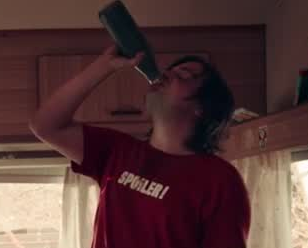
We meet young lawyer Elisa (Matilda Lutz) as she is preparing to return home to “visit” her parents, but in reality she is leaving her current city to seek to terminate her pregnancy and recuperate afterward with family before heading back to work. To get home, she is carpooling in a small camper with vacationing couple Mark and Sofia (Will Merrick and Yuliia Sobol), unfriendly doctor Riccardo (Peppino Mazzotta), and their driver, the nerdy and talkative Fabrizio (Francesco Russo). It isn’t explicit, but later dialogue between Mark and Fabrizio, in which the latter expresses annoyance with cultural assumptions that northern Italians make about southern Italians (in short, that everyone in the south is involved with the mafia), suggests that they are travelling from the north to the southern coast. Fabrizio plans to film parts of the trip for his YouTube channel, entitled “Friends of Fabrizio,” and asks the four riders to introduce themselves to the camera, saying that it’s important that his audience come to like them, even stocking the camper’s minifridge with beers to act as a social lubricant and get everyone to come out of their shells. Elisa is pressured into taking a sip but immediately falls ill, forcing them crew to stop by the roadside. While Riccardo argues on the phone with his recently estranged wife, a now inebriated Mark forces his way into the driver’s seat, and insists that he drive the rest of the way. The others accept that he cannot be talked out of it, and he does a fairly decent job for a drunk driver, even bonding with Fabrizio along the drive, until he swerves to avoid a dead animal in the road. 

It’s daytime when Elisa awakes, and the camper is now in a vast field, encircled by forest. Mark’s leg is broken and there are no signs of civilization other than a rustic cabin that also occupies the clearing. Riccardo and Fabrizio set out to look for the road, but seemingly trace a great circle instead, ending up back at the site where the camper and cabin are located. Another venture into the forest also results in the discovery of some kind of pagan altar to “three knights,” including pig heads on stakes. After their initial reluctance, the group (minus the still-immobilized Mark) enter the cabin looking for a way to contact or locate help when its door opens with a mysterious creak. Inside, they find ritualisting paintings that relay a local legend that Fabrizio summarizes: the tre cavalieri are Osso, Mastrosso and Carcagnosso, pagan deities who blessed local land in exchange for sacrifices, and that these sacrifices involve the ritualistic removal of individual victims’ ears, eyes, and tongue. The only other decorations in the cabin are photos of what appear to be generations of people wearing animalistic masks, or who perhaps have actual animal heads, as the result of their devil’s deal with the Cavalieri. When the clearing is bathed in a saturating red light while ominous sirens sound, Riccardo, Fabrizio, Elisa, and Sofia take shelter in the cabin’s attic, which gives them a bird’s eye view of three masked entities dragging Mark from the camper to the cabin and securing him to the table within and mutilating his eyes before killing him. As if this weren’t horrifying enough, they also discover a child in the attic in a cocoon made of sticks and straw; the group asks for her name, but she is unable to answer, as she has no tongue. 

The group makes another attempt to escape through the woods during the day, discovering a graveyard of abandoned vehicles that imply that this kind of sacrifice has been going on for a very long time. One of the vehicles belonged to the young girl’s family, and she reveals her name, Chiara, to Elisa by recovering her diary from within it. She also implies that they are all in some kind of inescapable purgatory, which is supported by their failure to escape the woods once again; worse, when they return to the clearing, the camper is gone. 

It’s all but impossible to talk about this much further without getting into major spoilers, so here ye be warned: spoilers abound from here on out. 

Elisa wakes in the night to discover that Ciara, Riccardo, and Sofia have been dragged out of the cabin and into the clearing, where a crowd of animal-headed cultists watch with rapt attention as Osso, Mastrosso and Carcagnosso take the older victims’ eyes and ears, respectively. Elisa is rightfully terrified, and when Fabrizio reappears in the cabin saying that they have to escape, she all but collapses into an embrace with him. As they hold one another, however, she can hear a small, tinny voice … as it gives Fabrizio instructions over his earpiece. 

There is no sacrifice or ritual here, at least not in service of harvest gods. All of this has been of Fabrizio’s design, as he seeks to craft a classic horror story. He bemoans the state of contemporary Italian cinema, which consists entirely of insipid comedies and brainless YouTube fluff, and wants to make a new Italian classic. Oddly enough, he doesn’t invoke the names of the three giants of giallo cinema that I cited above, and instead draws on comparisons to extremely American representations of the genre: Friday the 13th, A Nightmare on Elm Street, and Texas Chainsaw Massacre (Titanic is also mentioned for good measure). The Osso, Mastrosso and Carcagnosso that he mentioned are actually the supposed founders of the three Mediterranean crime families, tying back to his repeated references to the mafia, including a joke that he told to break the tension and lighten Chiara’s spirits during a particularly grim moment. Not that she actually needed this, of course; she’s still alive, and has been in on it the whole time. 

Fabrizio’s biggest problem is that, for all his supposed learnedness about the nature of horror, he forgot about one of the genre’s most important features: the final girl. After a brief interlude in which we learn that Fabrizio has the support (or at least the indifference) of local politicians and police, Elisa escapes from the wheelchair to which her hands are nailed, and she turns the tables on Fabrizio and Chiara, and she’s kind enough to film the whole thing before escaping into the woods and eventually finding her way to a beach, where horrified onlookers are briefly stunned by the bloody girl in their midst before they immediately take their phones out and begin to film her. 

The first hour or so of A Classic Horror Story isn’t anything to write home about, being more “serviceable” than “good.” But the final 35 minutes more than make up for the water-treading of the first and second acts. What’s also praiseworthy here is how much it fits with what I want to see more of in horror: wherein we are first led to believe that something supernatural is afoot, before we get the important reminder that all evil in this world is done by humans. There’s a genuine eeriness that permeates the proceedings as soon as the travellers find themselves in the clearing, especially with the apparent presence of pagan deities and sacrifices in creepy masks, as well as the strange lighting and the wailing sirens. Unfortunately, those elements suffer from appearing in a film that was released so soon after the higher-budgeted Midsommar, especially given that the source imagery from which both films are borrowing are similar. It’s not identical, of course, but neither are Garden State and Elizabethtown, which didn’t stop contemporary critics from making the same note about the short time between those similar releases. There are very similar scenes of an outdoor cultist feast with our heroine at the head of the table, and it’s even present in the various lodgings, which don’t look alike precisely, but which are both juuust unconventional enough to lend an air of uncanniness to the proceedings. 

I truly didn’t see that final act twist coming, and my opinion of the film took a sharp increase as it drew to a conclusion. It didn’t turn this into the instant horror classic that it was aiming for, and there’s an extension of its metacommentary into the end credits that I have mixed feelings about (it’s kind of dumb but the final moment of self-deprication amused me). That’s the element that I think will age the most poorly, but then again, only time will tell. A Classic Horror Story is streaming now on Netflix. 

-Mark “Boomer” Redmond

Midsommar (2019)

“For Dani, it is a wish fulfillment fantasy. A fairy tale.”

About a week after seeing Midsommar, the friend with whom I attended a screening featuring a post-film Q&A with director Ari Aster turned to me as we were hanging out and asked, “Boomer, did you actually like Midsommar?” And I replied, “Yeah, of course I did. Didn’t you?” To which he responded, “I’m not sure. I think that Q&A kinda ruined it for me.” And I have to admit, as soon as the film ended, I was fully ready to do my write-up, only for my excitement to dwindle as Aster and Alamo Drafthouse founder Tim League swirled mostly-empty rocks glasses and chuckled. At first, I was mostly concerned for Aster’s feelings (I’m a softie like that); when I saw Hereditary, there wasn’t a single guffaw or chuckle from the audience with whom I sat in the dark and partook in a somber meditation on grief (at least until the very end, but I’ll circle back around to that), but in the sold-out audience for Midsommar, there were laughs within the first 5 minutes, leading to out-and-out peals of laughter until the film’s closing moments. I worried that Aster would hear this reaction and determine that we were a theater filled with bumpkins and deviants–and not the fun kind–who didn’t appreciate his work.

This was not the case, or if it was, Aster did a good job covering his disappointment, engaging in the good natured ribbing of the characters’ foibles, noting that if a viewer didn’t think the film was intentionally comedic by the time an older woman was manhandling the male lead’s buttocks and helping him thrust, then he must not have done his job. Comedy was his real interest, he stated, and he had gotten sidelined into doing horror because that seemed to be of greater public interest. And that is one of the beautiful draws of Midsommar: it is hilarious. I needn’t have worried at all it seems; I wrote in my Hereditary review about “a moment close to the end of the film that sent much of the auditorium agiggle, despite being one of the creepiest sequences,” but Aster stated that he himself found that scene hilarious, and it was intentionally comedic.

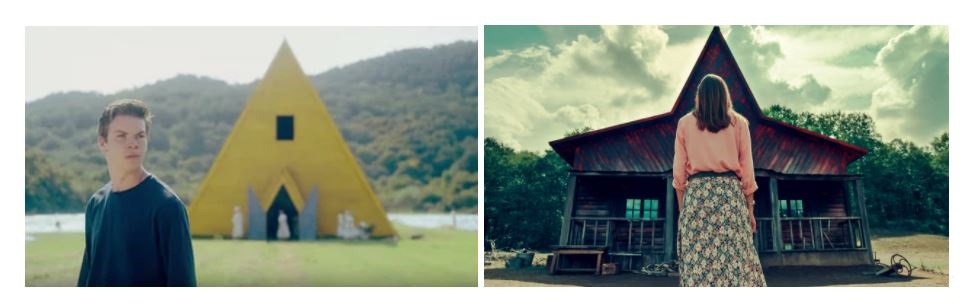
It’s been long enough since Midsommar came out that an extended director’s cut rerelease has already happened, but in case you’ve had the misfortune of missing the film, a brief synopsis: Dani (Florence Pugh), recently having experienced a horrific family tragedy, accompanies her douchebag boyfriend Chad Christian (Jack Reynor) on a trip to Sweden. Ostensibly, this is not a holiday but a research expedition as part of Josh (William Jackson Harper)’s thesis research about Hårga, the commune from which the group’s exchange student friend Pelle (Vilhelm Blomgren) hails. However, the inclusion of Mark (Will Poulter), a doofus completely lacking in even the least bit of self-awareness, cements that the Swedish foray exists solely for the purpose of eating a bunch of mushrooms and trying to bed as many commune girls as possible during the Hårga’s titular Midsommar festival, with this year’s being a special kind that only comes every ninety years. And then, as is the genre’s wont, bad things happen. And good things, too. After all, that quote about Dani above? That’s from Aster.

From Texas Chainsaw Massacre to Dead Calm to upcoming Movie of the Month Who Can Kill a Child?, I’m pretty much always on board with a daytime horror movie. Midsommar pushes past the boundary of the “day won’t save you” concept into a completely disorienting perpetual daylight. This starts even before the audience has the opportunity to ask themselves if something’s rotten in the village, when Mark expresses unease upon learning that it is after 8 PM, despite the sun still appearing high in the sky; the film takes advantage of the northern latitudes’ geographically anomalous prolonged days and plays on the effects that could arise from being unaccustomed to such an unusual night/day rhythm. Characters attempt to circumvent community rules under the cover of “darkness” with about the success that you would expect. People lose track of time and then possibly lose track of the concept of time, all under the watchful and unfaltering gaze of the sun. That alone isn’t enough to make the film worthwhile, of course; the 2006 remake of The Wicker Man kept the seminal original’s daytime frights, but lost the core of what made Robin Hardy’s version a classic (although what it lost in the fire it gained in the flood; it’s a romp).

What makes Midsommar work isn’t just the unease that comes from the finding of no safe haven from horror in the light, it’s also the discomfiting nature of lingering on what Aster called “static image[s] of relatively little interest.” It’s been three years since the YouTube channel “Every Frame a Painting” stopped updating, but I have no doubt that they would have a lot to say about the growing Aster oeuvre. His two big features so far have depended heavily on lingering shots of mostly-static settings to convey a sense of displacement and balance. The mainstream horror-going audience has spent over a decade now subsisting on films that depend heavily on unearned jump scares to produce a reaction, but Midsommar and its predecessor instead use the quietness of their presentation to inspire a disquiet of the soul. We’ve been forcefed Baghouls hiding behind open medicine cabinet doors for so long that when lingering shots of pastoral peace are succeeded by calm pans across striking farmhouses or documentarian framing of a Swedish banquet, there’s nowhere for that energy to go; so it just builds and builds until whoops, now you’re wearing a bear suit and boy are you not going to like it.

A friend who is known for his tirades recently produced a new rant about the performative sententiousness of horror fans, noting that many he has met seem to think that horror fans have a kind of ownership of subtextual analysis. And hey, I know I’ve been guilty of that. (Said friend also hated Hereditary, unsurprisingly.) In a way, Aster reminds me of Panos Cosmatos, in that his films act as originals in spite of being pastiches of older genre films; I’ve said before that my favorite thing about Hereditary is how it starts out as an apparent homage to The Bad Seed, before turning into Ordinary People for so long that you gaslight yourself into thinking all that seemingly extraordinary stuff from Act 1 was just in your head, before bam: Rosemary’s Baby all along. In Midsommar we find a movie that, frankly, owes its existence to the aforementioned The Wicker Man (1973, just to be clear), but has a lot more going on than at first meets the eye. You don’t need another thinkpiece on this movie; various outlets have already dove into the apparent pro-eugenics nature of the narrative, an argument that I’ve read four times now and still have difficulty following, and have read the film as a trans narrative and a new camp classic. And if a slightly sloppy Q&A (someone actually gave Aster their contact info on a Drafthouse order card and asked to work on his next project, so the audience was matching the level of “shoot your shot” that the director was putting out, at least) in which Aster admitted under questioning that the 72-year life cycle didn’t actually jibe with the 90-year festival cycle didn’t ruin it altogether, I don’t think anything can.

P.S.: I didn’t even get to touch on my three favorite moments, but here they are:

  1. The paneled cloth depicting a particular Hårga fertility ritual, and each time that something popped up on screen that had appeared in it previously (how Christian didn’t notice that his lemonade was distinctly pinker than anyone else’s is a mystery).
  2. The foreshadowing in Pelle’s scene with Dani, where he tells her that his parents died too. In a fire.
  3. “What game are those kids playing?”
    “Skin the fool.”

-Mark “Boomer” Redmond