Ministry of Fear (1944)

As we browsed our local video store last weekend, my friend and I were at the directors’ wall and I picked up Ministry of Fear, prompting my companion to tease me for being on such a Fritz Lang kick lately. I’m now decently familiar with his pre-Hollywood films, having seen (and loved) Metropolis, M, and Die Nibelungen, and I’ve seen some of his Hollywood noirs both pre-(Fury) and post-(The Blue Gardenia) WWII. I was curious what he was up to in the years leading up to and during the war, however, especially if he was doing any of the same kind of espionage thrillers that Alfred Hitchcock was churning out consistently, with his pre-war thrillers (The Man Who Knew Too Much, The 39 Steps, Sabotage, and The Lady Vanishes) presaging the troubles to come, his wartime pictures (The Foreign Correspondent, Saboteur) highlighting the contemporary cost of war and the paranoia of the homefront, and his immediate post-war films (Notorious) dealing with the aftermath. Lang, perhaps because he was more personally affected by the war, didn’t deal with the subject very much at the time. His 1943 film Hangmen Also Die! was loosely based on the assassination of Nazi official Reinhard Heydrich, with his following feature in 1944, Ministry of Fear, being the only other time he touched on the subject, other than in post-war flick Cloak and Dagger, which echoes Notorious in that it follows someone tasked with finding Germans who have run to ground. 

Stephen Neale (Ray Milland) departs the Lembridge Asylum, where he has lived for some number of years. He makes his way to the train station, where the ticket clerk recommends he visit the village’s fundraising fête to kill time while waiting for passage to London. After entering the drawing to win a cake by guessing the exact weight, he goes to the fortune teller’s tent. Once he crosses the matronly Mrs. Bellane’s palm with silver, she gives him the ordinary spiel about love, but when he grows defensive about a past relationship, she instead tells him the precise weight of the cake, which he wins. Neale departs with the cake over the protests of a young man who arrives just as he’s leaving, and it’s clear that he was the one who was “supposed” to win. Just before the train to London leaves the station, Neale is joined by a blind man in his carriage. When he offers a piece of the cake to the man, he notices that he’s crumbling it instead of eating it, as if searching for something, but before he has much time to ponder this, the train stops due to a Nazi air raid, and the “blind” man makes off with the cake after beating Neale with his cane. Neale pursues him, and the man takes shelter in a derelict cabin to shoot back at him, only for the raid to blow the structure to pieces. 

Once he makes it to London, Neale engages private detective George Rennit (Erskine Sanford) to help him figure out who’s trying to kill him, and their investigation leads them back around to the Mothers of Free Nations, the charity that had organized the Lembridge fête. Neale meets siblings Willi (Carl Esmond) and Carla (Marjorie Reynolds, of Holiday Inn) Hilfe, who run the organization, and Willi agrees to help Neale make sense of things. To that end, they visit Mrs. Bellane, only to discover that, instead of the older woman Neale met in Lembridge, she’s a young, beautiful woman (Hillary Brooke, who appeared as one of the inconsiderate houseguests in Maisie Was a Lady). She invites them to attend the seance she’s hosting, and Neale meets fellow guest Dr. Forrester, a psychiatrist. The last person to arrive is the same man who tried to take the cake from Neale at the fête, and who is introduced as Mr. Cost. During the seance, a woman’s voice calls out, accusing Neale of killing her. Neale grows upset, and a shot rings out. When the lights come up, Dr. Forrester pronounces Cost dead, and suspicion falls upon Neale, who escapes. He attempts to reunite with Rennit at his office, but finds it ransacked. When another bombing forces him to take shelter with Carla, he explains the reason that he was institutionalized in Lembridge, and what it had to do with his wife’s death. With an unknown man (Percy Waram) tailing him everywhere he goes, presumably at the behest of the spy ring that has infiltrated the Mothers of Free Nations, he begins to fall for Carla, while remaining unsure where her allegiance lies. When he learns that Forrester has connections within the British government, he sets out to expose the league of spies before they can deliver intel about troop deployments to their German allies, but his veracity is challenged by his troubled past. 

Unfortunately, Ministry of Fear is little more than a knockoff Hitchcock, complete with a McGuffin, a wrongfully accused fugitive, a fight on a train, and a blonde love interest. In fact, one could easily mistake this for a Hitchcock film, were it not for the fact that the police in Ministry are shockingly competent. It has a few interesting things going for it, but it’s ultimately fairly run of the mill. This appears to have been a product of executive meddling, as reportedly neither Lang nor Graham Greene, who wrote the novel on which the film was based, were very happy with the final product. By opening with Neale being released from an asylum, rather than a prison, the film implies that he might have been there for reasons relating to his mental state, and there was a potentially rich narrative question about just how much we could trust our lead which could have been mined, but the film never chooses to go there. Some of Lang’s trademark visual flair comes through; the obliteration of Neale’s “blind” attacker by an air raid is a shocking site, and I was also particularly taken with a sequence in a tailor’s shop near the end that’s shot mostly in the reflection of a floor-to-ceiling mirror. The seance sequence is effectively spooky as well, and it was an inspired touch to have the only light in the final gunfight sequence be provided by the flash of muzzle fire. Alas, it’s not quite enough to propel this one to greatness, and I can really only recommend this to Lang completists and anyone curious about what his take on a Hitchcock style plot would be.

-Mark “Boomer” Redmond

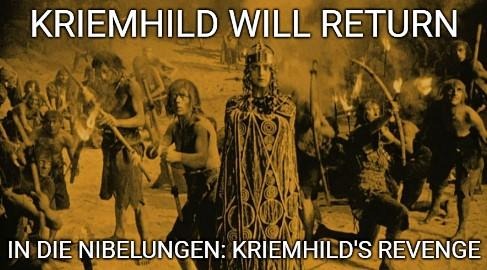
Die Nibelungen: Kriemhild’s Revenge (1924)

On the trivia subpage for Die Nibelungen on TVTropes, which treats this film and its predecessor as a single work, there’s a notation that Kriemheld’s Revenge is generally considered the superior work. Since the expansion of Google into mostly pyramid schemes of search engine optimization, I’ve had a hard time verifying that against any academic texts, but the few blog posts I’ve found seem divided roughly down the middle. Most viewers are in agreement that one part is good and the other is great, with proponents of exalting Kriemhild over Siegfried mostly noting that the former ejects all of the more fantastical elements of the latter, instead going for more grounded spectacle in the form of massive battles. I found Kriemhild to be a bit of a letdown after all of the filmic magic of Siegfried; it’s still a lot of fun, but it didn’t live up to its first half. 

When Kriemheld’s Revenge opens, we find the grieving Kriemhild attempting to use Siegfried’s gold hoard to win over the commonfolk of Burgundy to rise up and avenge the death of her husband at the hands of the monster Hagen Tronje. Hagen, who is forever up to no good, discovers where the hoard is hidden and throws it into the river to cut off Kriemhild’s support (it was also Siegfried’s wedding gift to her, to further underline the betrayal of the act). Rudiger, a military commander and vassal of King Etzel (better known to us as Attila the Hun), comes to Burgundy to seek Kriemhild as a bride for the mighty warrior king. Although initially reluctant, she realizes that this may be her only chance to see Siegfried’s killer see justice, and she agrees on the condition that Rudiger swear an oath to help her kill Hagen. Before she leaves her homeland, she stops at the same spring where Hagen murdered her late husband, and digs up several handfuls of earth to take with her to her new home. 

Some time later, Kriemheld has solidified her alliance with Etzel by bearing him a son, and she requests that her husband invite her family to celebrate the Midsummer Solstice with them in the Hun kingdom. The Huns themselves have grown restless as they believe that Kriemhild has tamed their king; outside of his fortress, they speak traitorously among themselves, asking “What is in the mind of our King?” and replying “Lord Etzel sleeps; the white woman stole our lord! She uses her golden hair to bind him!” Kriemhild herself believes that she has this power over Etzel, as she comes to him to beg him to fulfill his oath, saying “He who murdered Siegfried is now in your hands.” Etzel, who knows that Kriemhild does not love him, tells her that he can’t, as he and his people hold the responsibility of hospitality sacred. Kriemhild then bribes the rebellious Huns instead, asking only for the head of Hagen Tronje but for her family to be spared. They kill most of the Burgundian envoy in the caves beneath the feasting hall, with only one knight escaping to tell the royal family, prompting Hagen to murder Etzel and Kriemhild’s baby on the spot. All out war then erupts, with the remainder of the film playing out as the Burgundians barricade themselves in the feast hall and attempt to fend off wave after wave of attacks. Kriemhild makes several overtures to her brothers, promising to spare them if they will simply deliver up Siegfried’s murderer, but they stubbornly refuse. By the end, the feast hall has been burned to the ground and Hagen meets his death, and the entire dynasty of Burgundy is dead, Kriemhild included. Her revenge has been wrought, and it cost her everything. 

Narratively, there’s not as much to discuss this time around. It’s essentially an extended version of the Red Wedding from Game of Thrones (a comparison a Redditor made eleven years ago, so I’m somewhat late to this party), with a forty-five minute battle sequence that is unfortunately somewhat repetitive. One of the things that I found my mind wandering to as the fight wore on (and on) was an exhibit of illustrated manuscripts that I saw at the Blanton Museum several years ago. At the time, I was struck by a tendency of medieval artists to depict all of history through a contemporary lens: every event, from the Bronze Age through the life of Christ, was depicted with then-modern fashion, weapons, and armor. Setting a Biblical story in modern times (or even modern raiment) is something that, in the present, would be considered virtually heretical to contemporary believers, so much so that I’m hard pressed to think of a TV or film production that tries it. There was the short lived NBC series Kings, which was a modern retelling of the life of King David, but when it comes to updating the gospel narrative, I can only think of Tyler Perry’s ill-fated TV movie spectacle Passion and the recent evangelical-owned Angel Studios’ Testament. To get back on topic, Fritz Lang’s Die Nibelungen is twice removed from the original story’s origin. As the presence of Atilla the Hun indicates, whatever real life events were narrativized and mythologized in Nibelungenlied had to have happened at the tail end of the Classical Era, in the 5th Century C.E. Nibelungenlied, or The Song of the Nibelungs, was, as best we can tell, first recorded in print in 1200, and as such has all the trappings of medievality, including the reimagining of 5th Century characters in the armor, ornamentation, and fashions of the beginning of the 13th Century, all captured on film in the 20th. It’s artifice upon artifice upon artifice, and it’s a fascinating thing to behold. I was still having more fun watching Siegfried talk to birds and turn invisible last time, but this one gives you time to meditate on what it means as an artifact, mythologized all the way down. 

In all of the intertitles, the first letter of the dialogue is ornamented, in the style of an illuminated manuscript, and the speaker is indicated by what appears in the illustrated first letter. In accordance with his legendary ability as a horseman (and many horse-related justifications for the etymology of his name), Etzel’s icon is that of a horse, and Kriemhild’s cowardly brother Gunther’s is a crown. Kriemhild’s lines are denoted by a unicorn. To a medieval audience, this would suggest nobility, suffering, and salvation, and it’s something that appears to be an intentional choice of Lang’s rather than something taken from a pre-existing text (although I am not an authoritative source on this). From what I’ve gathered in my reading, Nibelungenlied is a tragic story about how revenge only begets further violence, with long periods of scholarship centered around two women, Brunhild and Kriemhild, and how they brought down an entire dynasty through their wiles. I think that Lang’s use of the unicorn for Kriemhild is a sly acknowledgement that she’s soldiering on in sacrifice in order to see justice done, even if the ultimate end of her endeavor is the death of her entire family line. Earlier audiences would have seen Gunther’s forcible capture of and marriage to Brunhild as the natural thing for an ancient king to do, something that we in the present “can’t judge” via the same moral lens as we would the same thing happening today. 

Perhaps Lang had already seen the writing on the wall with regards to the path that Germany was headed down, because if we view this narrative through that aforementioned modern lens, it’s clear that the real villains here are King Gunther and his evil buddy Hagen. Gunther, a legendary Germanic figure, is a sniveling, craven man, unfit to lead his nation and who commits the real “original sin” of this story that sets all the tragedy in motion: invading a sovereign nation with no justification other than his desire to expand and control, and—let’s not mince words here—raping the Icelandic queen Brunhild. He and his brothers’ commitment to protecting his inner circle is the embodiment of cronyism, as they take “bros before hoes” to an extreme end, refusing to allow Hagen Tronje to meet his just reward even at the cost of their family honor and, eventually, their lives. Gunther is a shortsighted despot who lacks the will to take accountability for his poor decision making, and in so doing, brings a nation to ruin. Does that remind you of anything? The fact that this film predates WWII by over a decade is merely testament to the fact that history is alive and forever repeating itself, and that artists can always see the pendulum swing back into darkness that lies just over the horizon. As established last time, that didn’t protect Die Nibelungen from being used by the Nazi propaganda machine (and it’s worth noting that the racist presentation of the Huns here shows them as being so alien and ugly that it can’t be justified), but I do think that Lang was trying to send a message to his adopted home before it was too late. Or perhaps, sometimes, a unicorn is only a unicorn. 

-Mark “Boomer” Redmond

Die Nibelungen: Siegfried’s Death (1924)

I really had no idea what to expect when I put a hold on a library DVD copy of Die Nibelungun. I just wanted to watch some more Fritz Lang. When I opened the case, I found two discs inside and, upon examination, discovered that they were two halves of a single story (or a film and its immediate sequel; I’m sure there is a distinction, but it makes little difference). I remember thinking to myself, “Oh, well, they must be short.” Dear reader, they are not. I haven’t watched the second half yet, but the runtime of Siegfried’s Death alone is 150 minutes, although some portion of that is introductory information about the Kino Lorber restoration and its sources. Sorry about that spoiler title, by the way, but it’s in the text (or this version of it, anyway); but also, this story is so old that it’s referenced tangentially in Beowulf, so don’t blame me. Putting this disc in, hitting play, and seeing that runtime, I admit that I felt a little daunted. And then, two and a half hours later, I was still utterly entranced when it came to an end. 

Even if you think you haven’t heard this story before, you have, if not in the form of all the pieces it shares with more familiar epics that preceded, then in the stories which took inspiration from it, probably most notably The Lord of the Rings. Siegfried (Paul Richter), son of Westphalian King Sigmund (or Sigmonde, if you prefer the spelling from Beowulf), surpasses the forging skills of his teacher, a craven man named Mime. When Sigfried learns of the beauty of Princess Kriemhild of Burgund (Margarete Schön), he decides to seek her hand, and Mime, in a fit of pique, directs him to Burgund through a wood that contains monsters. Siegfried happens upon a dragon, which he slays; a taste of the dragon’s blood gives him the power to understand birdsong, and a nearby bird tells him to bathe in the dragon’s blood to become invincible. Sigmund does so, but a falling leaf lands on his back above his shoulderblades, leaving him with one vulnerable spot. 

Siegfried finds himself in a land of dwarves, and manages to defeat their king, Alberich, despite the latter being invisible. In exchange for his life, he offers Siegfried the sword Balmung, the magical net he has which allows him to be invisible or appear in another form, and a horde of gold. When Alberich tries to kill Siegfried atop the treasure heap, Siegfried easily bests him, and with his dying breath, Alberich curses the treasure and all who might use it. With his newfound wealth, Siegfried is able to present himself at the court of Burgund as a king with several vassals. There, he meets King Gunther (Theodor Loos), Kriemhild’s brother, and his obviously evil vizier, Hagen of Tronje (Hans Adalbert Schlettow). Hagen tells Gunther not to allow Siegfried to woo Kriemhild unless Siegfried agrees to help Gunther win the hand of Icelandic queen Brunhild (Hanna Ralph), a maiden warrior whose suitors must best her in a triple sport competition. Siegfried goes to Brunhild’s castle under the guise of one of Gunther’s bannermen and, using the helm he won from Alberich, becomes invisible and helps Gunther cheat. 

Brunhild returns to Burgund with Gunther, whom she reluctantly marries in a double ceremony with Kriemhild and Siegfried, and Siegfreid and Gunther become blood brothers. Brunhild initially refuses to consummate the marriage, until Gunther convinces Siegfried to “tame” her, disguised as Gunther, which he does by wrestling her. Brunhild, still bristling, antagonizes Kriemhild by insisting that as the queen of Burgund, she should be able to walk into church before Kriemhild, as the wife of a vassal, and the argument leads to Kriemhild revealing Siegfried’s role in Brunhild’s hostile wife-takeover. Brunhild, furious, demands that Gunther kill Siegfried, and lies that Siegfried deflowered her. Gunther is torn by his blood oath, but Hagen convinces him to allow him to do the deed, and likewise tricks Kriemhild into revealing Siegfried’s vulnerable spot, which he uses to kill him during a hunt. Brunhild mocks Gunther for allowing the lie of a woman to trick him into taking his best friend’s life, then takes her own. When Siegfried’s body is returned, Kriemhild demands justice against Hagen, but her family protects him because of their complicity. 

Kriemhild swears vengeance: “Whether you hide behind my family, or upon the altar of God, or beyond the edge of the world, you will not escape my vengeance, Hagen Tronje!”

This movie is so fucking cool. There are images in here that are so potent and so powerful that I’m surprised this film doesn’t have the same broad awareness that Metropolis does. It’s clearly been incredibly influential. There are shots in Die Nibelungen that are recreated almost identically in Dune, Lord of the Rings, and even Star Wars. There are images here that are incredibly powerful: Brunhild brooding, perfectly centered in the frame; Siegfried, holding aloft the sword that he has just forged; Alberich and his cohort turning to stone upon defeat. Kriemhild’s dreams are manifested in beautiful, if crude, animation, and there’s a sequence at the end where Kriemhild looks at the place where Siegfried said his last goodbye to her and the image slowly crossfades into an image of a skull. Siegfried’s fight against the landwyrm in the forest still looks sick as hell, and the framing of Brunhild’s stronghold, bracketed above with the aurora borealis and below with a field of unquenchable flame is an image that I’ll never forget. 

So one must wonder, why exactly has this film been largely forgotten while Metropolis, M, and others endure? Well … this is an adaptation of Germany’s national epic, which I mean in the literary tradition of great poetic works which define, delineate the founding of, and reinforce national identities. The more well known adaptation of this text is Richard Wagner’s operatic The Ring Cycle, which has been accused of carrying over the composer’s own antisemitic views (although his friendship with the racial science codifying historical monster Arthur de Gobineau did not begin until at least half a decade after The Ring Cycle was completed). Die Nibelungen, having Fritz Lang as its director, excludes Wagner’s more regressive choices (notably, Alberich and Mime are largely considered to be anti-Jewish stereotypes in The Ring Cycle, which they are not here, at least as far as I can tell). Still, that doesn’t mean that a film adaptation of Germany’s national epic poem, which was all about the proud traditions of Germanic ancestry and nation building, wasn’t considered fair game by the Nazi propaganda machine. The opening of the film sees Lang dedicating the movie to the “proud German people,” whom he himself would flee less than a decade later after an ominous meeting with Joseph Goebbels, which made it easy for Die Nibelungen to be trotted out at party meetings. 

This becomes the default means for examining any piece of German interbellum art, and it’s valid, but I’m not a sufficiently qualified historian to get into that extensively, and there’s already probably a decent amount of scholarship about that which you can find online (for now, anyway). What I do find interesting, if not surprising, is that the primary conflict of this text is so blatantly patriarchal. Brunhild is treated as a kind of villain here, but to a modern reader/viewer, she’s completely justified. Her unwilling marriage to Gunther makes her, for all practical purposes, a sex slave in a gilded castle, and Siegfried’s use of glamour and magic to deceive her into believing that Gunther has passed the challenges she created to maintain her dominion and anonymity means that, yes, Siegfried is an accessory to her rape. She has every right to demand his death, and Gunther’s, for that matter. Instead, within the narrative itself, she’s a vindictive woman whose manipulations cause her husband’s downfall. 

I’m going to go ahead and disregard authorial intent, which would have us agree that her line about “a kingdom brought down by a woman’s lie” is clearly meant to be taken at face value. I also have a feeling that Kriemhild’s revelation to Hagen about Siegfried’s weakness is also supposed to be more “a woman can bring a nation to ruin” reinforcement of sexist presuppositions. To some, Kriemhild is the Madonna whose naivete creates the possibility for Siegfried to be killed, and Brunhild the Whore whose lies lead to his death. I’m going to reject that paradigm and say that, as a text, Die Nibelungen makes it explicit that Gunther is the root cause of every conflict here, either because of his belief that he deserves Brunhild or because of his craven weakness as a monarch so easily misled by Hagen, who is the other villain of the piece. Helen didn’t start the Trojan War; Paris did. 

A five hour epic in two parts is a hard sell. In ten years, I have convinced fewer than a dozen people to check out Baahubali, and I only have to overcome people’s resistance to subtitles for that; for Die Nibelungen, I’m also fighting their resistance to silent film. And, it’s also entirely possible that the back of this filmic diptych will be awful and I’m setting them (and myself) up for disappointment. I’ll let you know once I’ve engaged with Kriemhild’s Revenge.

-Mark “Boomer” Redmond

Lagniappe Podcast: Fury (1936)

For this lagniappe episode of The Swampflix Podcast, Boomer & Brandon discuss Fritz Lang’s mob-justice noir Fury (1936).

00:00 Welcome
01:34 Nadja (1994)
05:07 Queen Margot (1994)
07:47 Number Seventeen (1932)
12:32 Miroirs No. 3 (2026)
15:57 Ernst Lubitsch
24:33 Fat Girl (2001)
30:34 Mad Love (1935)
36:11 Ruthie the Duck Girl (1999)
43:53 The Wolf House (2018)
47:49 A Body to Live In (2026)
53:22 Undertone (2026)
1:03:07 The Chronology of Water (2026)
1:07:17 Alpha (2026)
1:17:27 OBEX (2026)
1:22:37 The Bride! (2026)
1:26:42 They Will Kill You (2026)
1:30:55 The Drama (2026)
1:36:26 Forbidden Fruits (2026)

1:44:42 Fury (1936)

You can stay up to date with our podcast through SoundCloudSpotifyiTunesTuneIn, or by following the links on this page.

– The Lagniappe Podcast Crew

The Blue Gardenia (1953)

With the spooky season having come to a close (as much as it does for year-round horror sickos such as we), it’s officially Noir-vember in my house, and to my delight, Criterion recently added a collection of some underseen ones. Scrolling through, none of the directors’ names jumped out at me initially, until suddenly the name “Fritz Lang” appeared, and the decision was made. The Blue Gardenia comes rather late in the storied director’s prolific career; after this one, he would only release a half dozen more films, one of which saw him returning to the Dr. Mabuse well. Based on a novella by Vera Caspary (who had previously written the novel Laura), the film features a screenplay by Charles Hoffman, who spent no small part of the last decade of his life writing 22 episodes of the Adam West Batman series, not that any of that series’ tone is present here. There’s a certain sense of lightness for a story that revolves around something so depraved, but it’s not campy, and is a true noir through and through. And it’s got a special appearance from Nat King Cole playing the title tune! 

Norah Larkin (Anne Baxter, three years after her star-making role as the title character in All About Eve) is a switchboard operator who’s been saving the latest letter from her fiancé, a soldier in the Korean War, to read it on the night of her birthday, so she can pretend that he’s really there. Earlier in the day, she watches as Harry Prebble (Raymond Burr), an advertising artist who specializes in pastels of women for pin-up calendars, semi-successfully flirts with Norah’s roommate Crystal (Anne Sothern), getting her phone number. Crystal’s in an on-again, off-again relationship with her ex-husband Homer (Ray Walker), and their third flatmate Sally (Jeff Donnell) runs down to the store when the latest trashy dime-store novel from a Mickey Spillane-style writer, so Norah has the apartment to herself when she reads her fiancé’s letter … in which he tells her that he’s fallen in love with a nurse he met while recovering in a Japanese hospital. Hurt, she receives a call from Prebble, who’s looking to meet up with Crystal; he doesn’t give her the chance to explain that he’s mistaken and decides, in her vulnerable state, to meet him at the Blue Gardenia restaurant. There, he plies her with several Pearl Diver cocktails and, once she’s good and drunk, he takes her to his place, where he spikes the coffee, she requests with something else. Confused and thinking that she’s in the company of her lost fiancé, she initially returns his kisses, but when she attempts to reject his overtures once she realizes herself, he becomes aggressive and attempts to assault her. She fends him off with a fireplace poker and, fearing that she’s killed him, runs home without her shoes, in the rain. 

When Norah awakes the next morning, she hears about the incident and, having no memory of what happened after the first round of drinks, fears that she is the murderer. This is where the film gets a little fuzzy, narratively. We in the audience have no reason to believe that she’s not the killer, and we also have no reason not to want her to “get away with it,” even if what she’d be getting away with is a pretty clear-cut case of self-defense. As we see her turn to more and more desperate methods to try and ensure that she’s never caught, we’re entirely sympathetic to her plight; the scene in which she burns her dress after hours and is caught by a policeman who merely gives her a warning about using her incinerator during hours outside those permitted by law is particularly fraught. She’s wracked by intense and escalating feelings of guilt as she watches her co-workers be called in for questioning by the police while ignoring her, since she and Prebble have no connection that anyone knows of, and he wasn’t even trying to contact her when he called her shared apartment. Eventually, she calls a tip line set up by seemingly sympathetic (but ultimately sensationalistic) journalist Casey Mayo (Richard Conte), and even meets him in person while claiming she’s doing so “for [her] friend,” whom the press—specifically Casey—has dubbed the Blue Gardenia Murderess. She’s ultimately arrested, but Conte discovers a contradiction that might set her free.

As a mystery, I found this one a little underwhelming. I always prefer when a crime picture like this one gives the audience the chance to solve the mystery alone with the characters; I am a devoted fan of Murder, She Wrote, after all. I expressed to my viewing companions this disappointment in this aspect of the film in our post-screening debrief and it’s worth noting that although the real killer is identified at the end and confesses (because, unexpectedly, Norah didn’t kill him), none of us recognized them. As it turns out, they did appear in an earlier scene, but it came so close to the beginning that the character was unrecognizable when reappearing at the end, and if I had seen this in isolation and missed that clue I would accept it as a personal failure to pay sufficient attention, but that this missed in triplicate tells me that this is a problem of the film, not of my attentiveness. That having been said, that the film needs someone other than Norah to be the killer is, for lack of a better term, perfunctory. We know she’s not a murderer, and I was never convinced that the police were ever really going to catch her; it was more of a matter of when her roommates would put two and two together regarding Norah’s skittishness and defensiveness. I expected them to figure it out earlier and help Norah cover it up, and that would have been a perfectly acceptable noir concept, but instead we have a bit of a forced romance between Norah and Casey, one which ultimately feels kind of insulting to her (after she’s discharged, she glares at and rebuffs him for his part in her initial arrest, but this is merely a ploy to seem hard to get). 

The most fun parts of the film are when we get to see the three women roommates interact with one another, and it’s a rare look into a slice of life of a bygone era, of domesticity between three single(ish) women sharing a tiny apartment. On the night after her birthday, Norah is awakened by Crystal as the mother hen of their little group. As her alarm goes off, she refers to it as “the mine whistle” to the other women, and sends Sally off to make the orange juice (condensed and out of a can — yeesh) while she gets the bathroom first that morning, as she directs the understandable groggy Norah to coffee and toast duty. Crystal is the most delightful character overall, and learning that Ann Sothern, whom I had only previously seen in Lady in a Cage, starred in a ten-film series as an underworked show girl named Maisie inspired me to track down those films for a future marathon (they were only available on the Russian equivalent of YouTube, uploaded from VHS rips from TCM, so pray for me). It’s too bad that her ultimate role in the story (as well as Sally’s) is pretty minor, since she’s full of quips and various other character choices that give the film a lot of life. 

Not necessarily the most interesting noir that I’ve ever seen, but with great performances from Sothern and Baxter and an effectively menacing villain in Burr, this one is worth checking out if you’ve got a noir itch and you’ve already seen all the classics. 

-Mark “Boomer” Redmond

Spies (1928)

I am excited to watch what’s being marketed as the final chapter in the Mission: Impossible saga later this week, but I’m not sure exactly when I’m going to be able to clear an entire evening for it. Clocking in at 169 minutes of Hollywood action spectacle, The Final Reckoning is easily the longest Mission: Impossible sequel to date. Likewise, the most recent James Bond sequel, 2021’s No Time to Die, clocked in at 163 minutes as the longest of its own decades-spanning franchise. The Fast and Furious series is following the same trend, with both 2021’s F9 and 2023’s Fast X breaking the 140min barrier because two hours is no longer enough space to tell the epic story of black-market street-racers who found a second life as international superspies. I have no doubt that its own upcoming finale, Fast 11, will be even longer. It’s clear that these decades-running espionage thriller series have become bloated through the virtue of their success, racking up enough international box office to earn a blank-check approval for every imaginable indulgence, supercharged by the egos of Hollywood Elite freaks like Tom Cruise & Vin Diesel. In a roundabout way, though, their exponentially expanding runtimes do call back to the earliest days of spy-thriller cinema, both in the episodic “Until next time…” storytelling of pre-show serials and in the epic scale of Fritz Lang’s 1928 genre landmark Spies (aka Spione), which in its original exhibition ran for an impressive 178 minutes, putting all of its modern decedents to shame. Even its incomplete, surviving prints stretch past the 140 minute mark, trimmed down by half an hour but still meeting the modern Hollywood standard.

Despite its near-three-hour runtime, Spies is not an especially self-serious or prestigious work. Lang sets his espionage saga against the same kind of impossible, expressionist backdrops crafted for his sci-fi epic Metropolis the previous year, but it’s all in service of telling a low-brow, pulpy romance between undercover spies. If the film has earned any historical or artistic prestige outside the typically masterful imagery of Lang’s monocled eye, it’s all due to the fact that it is almost a century old. Co-written with his wife & collaborator Thea von Harbou, Spies pioneers a long list of genre tropes both big (referring to the protagonist only by his agent number, 326) and small (comically tiny cameras, disappearing ink, etc). As a result, it now plays heavily tropey, taking three hours to tell a fairly simple love story between two spies who work for opposing agencies. Our somewhat heroic Agent No. 326 (Willy Fritsch) is employed by the German Secret Service to thwart the criminal-mastermind plans of Haghi (Rudolf “Dr. Mabuse” Klien-Rogge) to intercept a top secret British-Japanese peace treaty. Not nearly as suave nor as talented as he thinks, No. 326 is already on the Russian enemy’s radar at the start of his mission, and he’s assigned to be taken down by the femme fatale counterspy Sonja (Gerda Maurus), who’s always two steps ahead of his plan. Only, Sonja is secretly a bit of a softie, blackmailed by Haghi to commit evil deeds. Naturally, she immediately falls in love with No. 326, constantly saving his ass in times of crisis and engineering a scheme to free them both from their professional obligations so they can spend the rest of their lives in each other’s arms.

This airport paperback plot doesn’t sound especially substantial in the abstract, at least not when compared to other, juicier Fritz Lang triumphs of its era like Metropolis, Destiny, and M. It’s illustrated with the same German Expressionist gloom & grandeur as those more infamous works, however, finding Lang at the height of his powers (long before he sleepwalked through late-career studio noirs like Beyond a Reasonable Doubt). The opening prologue and explosive climax are especially stunning, kicking things off with a rapid-fire montage of espionage action and closing things out with a literal circus of violence. It’s at those bookends where Lang crafts isolated images in inserts that rival the beauty of any individual frame of classic cinema: a spy posing atop the rubble of an exploded bank wall, a low-angle close-up of an assassin on a motorcycle, a woman’s hands posed with gun & cigarette. There are a few other scenes sprinkled throughout the sprawling runtime that rival those images (namely, the makeup rituals of a creepy secret agent named Nemo the Clown and a boxing ring encircled by ballroom dancers), but much of the drama between those spectacular bookends takes on stage-play feel. Whereas Ernst Lubitsch would’ve turned No. 326 & Sonja’s ill-advised romance into a perverse romp (see: Trouble in Paradise), Lang & von Harbou craft a fairly somber story rife with blackmail, prostitution, opium addiction, and suicide. The old-fashioned sweetness of the central romance can’t help but be marred by the grim practicalities of spy work, which sometimes leads to bursts of violent visual poetry but often leads to conflicted players clawing their own faces in agony over who to be loyal to – lover or employer.

Even the relatively shortened Restored Cut of Spies was a little trying on my 21st Century attention span, which began to waver any time Lang strayed from grand German Expressionist spectacle to stage-bound melodrama. At the same time, I’ve seen plenty of Ethan Hunt, James Bond, and Dom Toretto spy thrillers in recent years that are just as long but not half as cool. It would’ve taken the same time commitment for me to catch up with the most recent Fast & Furious film, which I never got around to because nothing from the previous, even-longer one lingered with me past the end credits; they even found a way to make a forgettably dull image out of the Fast Family finally launching a car into space. Meanwhile, there are at least a dozen individual frames from Spies that will be burned into the back of my skull forever, even if it’s telling an equally inconsequential story as most of its modern equivalents. All that these bloated spy-thriller sequels need to do to earn their ever-expanding runtimes is take a page from Fritz Lang’s book and craft some of the most fantastic, gorgeously composed images in the history of cinema. It’s that simple.

-Brandon Ledet

Beyond a Reasonable Doubt (1956)

1956’s Beyond a Reasonable Doubt is a late-career noir directed by Fritz Lang, his very last production for an American studio. It’s weirdly flat in style for Lang, whose early triumphs M & Metropolois helped establish foundational cinematic language that pushed the still-young artform to its furthest extremes. Here, he’s so bored with the form that he goes through the motions of a legal procedural as if he were making a televised Movie of the Week, give or take a few lateral camera maneuvers that attempt to liven up long scenes of men talking at desks & tables. Lang even calls attention to this TV-movie quality by speeding along witness testimony in montage as presented on a local news broadcast, shot in the same multi-camera style as the film proper. However, the longer you stick with Beyond a Reasonable Doubt‘s preposterous, only-in-the-movies courtroom drama the more complicated its moral & narrative implications become, until it spirals out into a big-picture indictment of the entire American justice system and then, ultimately, lands a few unexpected jabs as a twist-a-minute thriller. What I’m getting at here is that it’s Fritz Lang’s Juror #2.

Dana Andrews (of Laura fame) stars as a hotshot novelist who’s eager to score a big hit with his second book so he can afford a high-society marriage to his newspaper heiress fiancée (Joan Fontaine, of Rebecca fame). His best lead is a hairbrained idea cooked up by his father-in-law-to-be, a newspaper man who’s in constant public battle with the local DA over the ethics of capital punishment. Incensed that the DA is “trying to reach the governor’s chair over the bodies of executed men,” the father-in-law schemes to trick the aspiring politician into sentencing a provably innocent man to death based on planted, circumstantial evidence. Convinced that the scheme has the potential for national publicity, the novelist foolishly agrees to frame himself for the murder of a burlesque dancer, hoping to turn the experience into his next hit book (and, why not, make a political statement against capital punishment too, if it’s convenient enough). As anyone who’s ever seen a movie before would guess, things go awry when the evidence proving his innocence is destroyed, and his fated date with an electric chair becomes more inevitable than theoretical.

It’s how Douglas Morrow’s script disappears that exonerating evidence and what happens to the novelist once it’s gone that makes Beyond a Reasonable Doubt narratively tricky. The 80-minute potboiler doesn’t fully get cooking until the final quarter, when Morrow throws in at least one twist too many and the pot boils over. The first twist is a violent shock. The second is a disappointingly conventional cop-out that defuses the tension. Then, the third twist desperately attempts to add some traditional thriller tension back into the plot, calling the movie’s morals & politics into question in a way that can’t fully be reconciled because it happens at the very last moment. At the start, Beyond a Reasonable Doubt is a thought experiment cooked up by noble writers who aim to take down wicked politicians who use state-sanctioned murder to further their careers. Since the objectively evil practice of capital punishment is still alive & well today (with Louisiana & other states gassing prisoners and subjecting them to firing squads again), maybe it’s to the movie’s benefit that it ends as a cheap-thrills mystery plot instead. Lang & Morrow made no detectable impact on the American justice system, but they did pull a few gasps out of an unsuspecting audience, even if entirely out of incredulity. Like with Clint Eastwood’s Juror #2, I doubt it would’ve been notable to anyone if it were filed under a workman director’s name instead of Lang’s, but there is something to its moral precarity that can’t be fully dismissed.

-Brandon Ledet

Scenes from a Screenwriter’s Marriage

We try our best to cover both the highest and the lowest ends of cinema here, from the finest of fine art to the trashiest of genre trash. Occasionally, those two polar-opposite ends of the medium intersect in unexpected ways. Last week, I found myself watching two seemingly discordant movies that covered the exact same metatextual topic – one because it screened in The Prytania’s Classic Cinema series during New Orleans French Film Fest and one because the Blu-ray was heavily discounted during an online flash sale. Both 1963’s Contempt and 1989’s The Black Cat are movies about screenwriters who jeopardize their marriages by taking on doomed-from-the-start film projects that put their wives’ personal safety at risk. The former was directed by French New Wave innovator Jean-Luc Godard at the height of his professional career, while the latter was directed by Italo schlockteur Luigi Cozzi in a sly attempt to cash in on his tutelage under his much more famous mentor, Dario Argento. They also both happen to be literary adaptations, at least in theory. While Godard was relatively faithful to his source-material novel, Cozzi’s film is an adaptation in name only, daring to bill itself as “Edgar Allen Poe’s The Black Cat” in its opening-credits title card before immediately abandoning its source text to leech off Argento’s legacy instead of Poe’s. Godard does indulge in his own allusions to an earlier, foundational filmmaker’s work in Contempt, though, by casting Fritz Lang as himself and including discussions of Lang’s early artistic triumphs, like M. You’d never expect these two movies to have anything in common at first glance, but The Black Cat really is Contempt‘s trashy cousin, long estranged.

Typically, I don’t think of Jean-Luc Godard’s signature aesthetic to be all that distant from the low-budget, high-style genre filmmaking ethos that guided the Italo horror brats of the 70s & 80s. At the very least, both sides of that divide would have been passionately reverent of Alfred Hitchcock as a cinematic stylist. However, Contempt is so far removed from the handheld, D.I.Y. crime picture days of Breathless that it’s hardly Godardian at all, at least not visually. Shot on location at seaside Italian villas in Technicolor & Cinemascope, Contempt is often breathtaking in its visual grandeur, especially in its 2023 digital restoration that aggressively pops the intensity of its colors. Godard presents star Brigitte Bardot in several magazine glamour-shoot set-ups that accentuate the otherworldly beauty of her body, with particular attention paid to her buttcheeks. Of course, vacationing with a beautiful woman in an exotic locale doesn’t fundamentally change who you are, so the usual self-defeating macho bullshit that plagues Godard’s protagonists follow him there too. Michel Piccoli co-leads as a cash-strapped screenwriter who takes a well-paying job doing re-writes on an already-in-production Fritz Lang adaptation of Homer’s Odyssey. Lang is making a much more abstract, artsier picture than what his American producer had greenlit, so Piccoli ends up in a sickening position where he must undermine the work of a genius he respects to instead please a meathead cad from The States who values commerce over art (Jack Palance, playing a pitch-perfect dipshit). Worse yet, the American pig has the hots for Bardot, and Piccoli does nothing to get in his way or to protect his obviously uncomfortable wife. This leads to an endlessly vicious, Who’s Afraid of Virginia Woolf?-style argument between the couple, so that they spend much of their time in an Italian paradise bickering about the purity of their love and the corruption of money. Meanwhile, Fritz Lang amusedly shakes his head, as if he’s seen this all before.

The marital crisis of The Black Cat is much more outlandish & abstract, but it also starts with a filmmaker taking on an ill-advised project. Our protagonist is a Luigi Cozzi-style horror director who decides to make good use of the Italian film industry’s loose copyright laws to make his own unsanctioned sequel to Suspiria. The project is in the early writing phase, where he is collaborating with a writing partner to sketch out the backstory of the Third Mother referenced in Argento’s Suspiria, believing there was room for another cash-grab witchcraft story in that lore (after the Second Mother was covered in Argento’s Inferno, and long before the Third Mother was covered in Argento’s Mother of Tears). They foolishly decide to pull inspiration from a “real”, powerful witch named Levana, who is awakened from her cosmic slumber by the project. Specifically, once the wart-faced Levana catches wind that she will be played onscreen by the director’s wife, she flips the fuck out and invades the real world through a mirror in the couple’s home, puking a chunky green goo in the actress’s face and then generally causing havoc. From there, The Black Cat is a supernatural horror free-for-all, following its scene-to-scene whims without any care or attention paid to the pre-existing work of Dario Argento, Edgar Allen Poe, or high school physics teachers. The movie is a jumbled mess of demonically possessed space fetuses, witchcraft-practicing house cats, 19th Century ghost children, telekinetic explosions, laser-shooting eyeballs, internal organ ruptures, creepy-crawly spiders, and whatever else amuses Levana as she tears apart this doomed marriage, all because she doesn’t want a movie made about her. What a diva.

You can assume a lot of what was on Godard’s mind while he was making Contempt just by watching the movie. Between the intensely bitter (and even more intensely gendered) marital argument that eats up most of the runtime and the art-vs-commerce argument that eats up the rest, you get a pretty clear picture of what was going on in his internal & professional life at the time. Even after watching the “Cat on the Brain” interview included on the Blu-ray disc, I cannot begin to tell you what Cozzi was attempting to communicate in The Black Cat. During the interview, he describes the picture as “science fiction,” likening it to his Star Wars knockoff Starcrash, with which it only shares a few extraneous insert shots of outer space. I’d say it’s much more spiritually in line with his supernatural slasher film Paganini Horror, which hooks the audience with the undead spirit of famous composer Niccolo Pagnini for a familiar starting point, then launches into a series of hair-metal music video vignettes where he just does whatever amuses him from scene to scene. Both of these vintage European relics might generally be about the artform of screenwriting, but only Contempt seems to put any sincere thought into that craft, while The Black Cat is much more about trying whatever looks cool in a scene, internal logic be damned. Something the two pictures do have in common, though, is the assertion that the basic labor & finance of filmmaking will ruin your marriage, whether through the intrusion of jackass Hollywood money men or the intrusion of evil mirror-dimension witches. If two movies so far apart in philosophy, tone, and intent happen to come to that same conclusion, I have to believe there’s some truth to it. Mamas, don’t let your babies grow up to be screenwriters.

-Brandon Ledet

M (1931)

For a moment, I considered not opening this review with a reference to Laurence Sterne’s novel The Life and Opinions of Tristram Shandy, Gentleman, thinking to myself, “Surely, I’ve referenced it enough already.” Then I double checked and realized I’ve only brought it up twice previously (in my reviews for Beau is Afraid and The Love Butcher), so here we go! Tristram Shandy was published in multiple volumes, the first of which was released in 1759, not even two decades after the publication of the first novel of the English language, Samuel Richardson’s Pamela, or Virtue Rewarded, in 1740. Shandy has long been a fascinating point of study not just because it’s one of the first novels in our language, but because despite being one of the earliest examples, it already demonstrated many stylistic and literary characteristics that we associate with postmodern fiction. Novels went from a complete, well, novelty to something that could be deconstructed within an astonishingly short time, with Shandy featuring a stream of consciousness narrative, a playful interaction with the nature of the printed word on the page (including several pages left intentionally blank to demonstrate a story that the narrator does not know), and various other elements first-time readers are often shocked to find in something so old. 

Fritz Lang’s most famous work, the pioneering silent science fiction film Metropolis, premiered in 1927; just four years later, his first sound picture M was screened for the first time. Within the short period between them, Lang had already developed some of the basic elements of what we would consider keystones of narrative filmmaking and used them in an effective way that’s the equal of any film that’s been produced in the intervening nine decades. In many ways, the introduction of “talkies” was like the building of a cinematic Tower of Babel (quick note here—I started writing this before seeing Metropolis and learning that the biblical Babel story is actually a big part of that text), necessitating a foundational re-evaluation of the language of the art down to its very core. But I’m getting ahead of myself. 

M is the story of a Berlin in terror, as several children have been found murdered in a way that demonstrates they share the same killer. As the film opens, a woman scolds the kids in the courtyard of her building for singing a nursery rhyme about a killer of children as she sets the table for her daughter, who never appears, despite her mother’s increasingly plaintive shouts of the daughter’s name into an empty street. The girl, Elsie Beckmann, has already fallen beneath the dark shadow of Hans Beckert (Peter Lorre), who lures the child to accompany him by purchasing her sweets and a balloon from a blind street vendor. Her eventual fate is implied as we see her beloved ball bounce into a ditch, and the balloon she was given drifts in the wind, abandoned. This sets off a fury in the city, as angry parents demand that more be done to apprehend the child predator, and this creates a domino effect. First, Inspector Lohmann (Otto Wernicke) of the police begins to crack down on various underworld activity, including harassing the patrons of a seemingly legal drinking establishment. That leads, in turn, to a meeting between various capos—led by a man known only as “The Safecracker” (Gustaf Gründgens)—for different criminal elements around the city to convene so that they can start their own manhunt so that the investigation will end and they can get back to racketeering, prostitution, and the like. 

While Lohmann’s men set out to find the murderer using then-novel forensic science like fingerprints, handwriting analysis, and behavioral studies, Safecracker’s boys set up an organized city-wide network of informants among the unhoused. Both end up finding Beckert at roughly the same time, as the killer’s habit of whistling “In the Hall of the Mountain King” during his compulsory episodes leads the blind balloon vendor from the beginning to identify Beckert to one of Safecracker’s men, and they tail him and even manage to tag him (with a white “M,” hence the title) before he realizes he’s being followed and ends up trapped in an office complex. The criminal underworld sets out searching the entire building where Beckert has gone to ground, while Lohmann’s men lay in wait at Beckert’s home, having discovered where he lived through methodical search and the discovery of red pencil shavings that matched the letters Beckert had written to the police. With Beckert now in their hands, Safecracker and company hold a kangaroo trial for the man, one in which he must plead his case for mercy, leading Lorre to give one of the greatest monologues in cinematic history. 

One of the truly great inventions that Lang gives us here is the narrative montage. In a silent film, narrative has to be displayed entirely through image and action, with dialogue and the occasional expository interstitial card, while M takes advantage of the opportunity to deliver information through audible dialogue and visuals at the same time. There’s a point in the film where Inspector Lohmann explains the methodologies that he and his men are using to try and locate the murderer, and as he describes various departments and what they do, we’re able to “visit” those people and places without a break in his monologue and without having to create interstitial expository cards (the closest we come is to a sign that identifies the homicide department). It’s such a common part of contemporary film language that its use is invisible to us now but is a quantum leap in filmic storytelling that we shouldn’t take for granted. Germany’s first “talkie” was The Blue Angel starring Marlene Dietrich, appearing at the movie theater only a year before M, and yet Lang had already created something that’s as integral to the nature of film as we know it as the letter “e” is to our language. And this could have been catalyzed in just about any movie, but it just so happens to have happened in one of the true masterpieces. 

That’s not the only thing that makes it feel so ahead of its time. So much of what we talk about when we talk about a film’s morals and ethics in the present is a discussion of the clarity of the value that the text espouses, but M is less concerned with blame than it is with prevention. That’s demonstrated in two ways: one that’s clearly intentional and is core to the reading of the film, and the other that’s a little more ambiguous and may have been unintentional. First, Lorre’s Beckert is one of the most compelling depictions of a compulsive evil on film. His utter fear at being trapped like a hunted animal pleading for mercy and compassion making him almost pitiable, in spite of the fear we know he inspires. At first appearing solely as a menacing figure, his terrified screaming about how he lives in a constant state of mental agony and that he can only quiet the voices when he commits these heinous acts, one can’t help but pity him, even while affirming that his afflictions don’t justify his crimes. Although there are several minutes of footage that are missing and the abruptness of the ending implies (at least to me) that there may be some frames missing from that final reel, the film that exists is the text that we have and so we must interpret from it. We never hear the verdict of Beckert’s trial; we cut away from the doors of a courtroom to find a few weeping mothers on the bench outside. “This won’t bring back our children,” is all that they have to say, and then “We, too, should keep a closer watch on our children.” Beckert is certainly to blame for his crimes, but he is not the only one responsible, and the only thing that we can exert influence over is ourselves and the company we keep, so that’s where our energy should go. Secondly and more subtly, it’s worth noting that although the police and organized crime figure out Beckert’s identity at roughly the same time, the police go about arresting Beckert by waiting for him in his home while Safecracker’s men catch Beckert when he already has his next victim in hand. Their methodology may not be “just,” but if this had been left entirely to the law, they would have only apprehended him after he had already slain another child, while community action prevented another death. The depiction of a kangaroo court makes it clear that we’re not supposed to see the summary execution of this guy as “justice,” and that the state’s justice should prevail (even if Beckert’s fate is ambiguous), but it’s still inarguable that one more little girl would have died if those same people hadn’t taken the law into their own hands in the first place. Prevention supersedes responsibility. 

M has been so beloved for so long that it’s difficult to say anything new about it. It’s the kind of classic film urtext that has been dissected, contextualized, and decoded nearly to death in nine decades since its release. That also makes it the kind of urtext that has so much discourse that most people are intimidated by the sheer amount of scholarship surrounding it or think that it’ll be outside of their grasp to understand, or they think it falls into the category of impenetrable artsy-fartsy stuff that culture snobs are always going on about. None of that is true. This movie is extremely accessible, not to mention scary, beautiful, and bewitching. There’s a reason that it’s stood the test of time.

-Mark “Boomer” Redmond

Lagniappe Podcast: Metropolis (1927)

For this lagniappe episode of The Swampflix Podcast, Boomer, Brandon, and Alli discuss Fritz Lang’s German expressionist sci-fi landmark Metropolis (1927).

00:00 Welcome

01:07 Idiocracy (2006)
07:40 Days of Heaven (1978)
13:42 The Parallax View (1974)
20:01 Blue Sunshine (1977)
25:54 Phantom Thread (2017)
29:02 M (1931)
33:30 Gasoline Rainbow (2024)
38:42 Furiosa (2024)
43:26 Hundreds of Beavers (2024)
47:56 Blue Velvet (1986)
51:55 It’s Such a Beautiful Day (2012)
57:30 Le Samouraï (1967)
59:02 Evil Does Not Exist (2024)

1:02:22 Metropolis (1927)

You can stay up to date with our podcast through SoundCloudSpotifyiTunesTuneIn, or by following the links on this page.

– The Podcast Crew