
On the trivia subpage for Die Nibelungen on TVTropes, which treats this film and its predecessor as a single work, there’s a notation that Kriemheld’s Revenge is generally considered the superior work. Since the expansion of Google into mostly pyramid schemes of search engine optimization, I’ve had a hard time verifying that against any academic texts, but the few blog posts I’ve found seem divided roughly down the middle. Most viewers are in agreement that one part is good and the other is great, with proponents of exalting Kriemhild over Siegfried mostly noting that the former ejects all of the more fantastical elements of the latter, instead going for more grounded spectacle in the form of massive battles. I found Kriemhild to be a bit of a letdown after all of the filmic magic of Siegfried; it’s still a lot of fun, but it didn’t live up to its first half.
When Kriemheld’s Revenge opens, we find the grieving Kriemhild attempting to use Siegfried’s gold hoard to win over the commonfolk of Burgundy to rise up and avenge the death of her husband at the hands of the monster Hagen Tronje. Hagen, who is forever up to no good, discovers where the hoard is hidden and throws it into the river to cut off Kriemhild’s support (it was also Siegfried’s wedding gift to her, to further underline the betrayal of the act). Rudiger, a military commander and vassal of King Etzel (better known to us as Attila the Hun), comes to Burgundy to seek Kriemhild as a bride for the mighty warrior king. Although initially reluctant, she realizes that this may be her only chance to see Siegfried’s killer see justice, and she agrees on the condition that Rudiger swear an oath to help her kill Hagen. Before she leaves her homeland, she stops at the same spring where Hagen murdered her late husband, and digs up several handfuls of earth to take with her to her new home.
Some time later, Kriemheld has solidified her alliance with Etzel by bearing him a son, and she requests that her husband invite her family to celebrate the Midsummer Solstice with them in the Hun kingdom. The Huns themselves have grown restless as they believe that Kriemhild has tamed their king; outside of his fortress, they speak traitorously among themselves, asking “What is in the mind of our King?” and replying “Lord Etzel sleeps; the white woman stole our lord! She uses her golden hair to bind him!” Kriemhild herself believes that she has this power over Etzel, as she comes to him to beg him to fulfill his oath, saying “He who murdered Siegfried is now in your hands.” Etzel, who knows that Kriemhild does not love him, tells her that he can’t, as he and his people hold the responsibility of hospitality sacred. Kriemhild then bribes the rebellious Huns instead, asking only for the head of Hagen Tronje but for her family to be spared. They kill most of the Burgundian envoy in the caves beneath the feasting hall, with only one knight escaping to tell the royal family, prompting Hagen to murder Etzel and Kriemhild’s baby on the spot. All out war then erupts, with the remainder of the film playing out as the Burgundians barricade themselves in the feast hall and attempt to fend off wave after wave of attacks. Kriemhild makes several overtures to her brothers, promising to spare them if they will simply deliver up Siegfried’s murderer, but they stubbornly refuse. By the end, the feast hall has been burned to the ground and Hagen meets his death, and the entire dynasty of Burgundy is dead, Kriemhild included. Her revenge has been wrought, and it cost her everything.
Narratively, there’s not as much to discuss this time around. It’s essentially an extended version of the Red Wedding from Game of Thrones (a comparison a Redditor made eleven years ago, so I’m somewhat late to this party), with a forty-five minute battle sequence that is unfortunately somewhat repetitive. One of the things that I found my mind wandering to as the fight wore on (and on) was an exhibit of illustrated manuscripts that I saw at the Blanton Museum several years ago. At the time, I was struck by a tendency of medieval artists to depict all of history through a contemporary lens: every event, from the Bronze Age through the life of Christ, was depicted with then-modern fashion, weapons, and armor. Setting a Biblical story in modern times (or even modern raiment) is something that, in the present, would be considered virtually heretical to contemporary believers, so much so that I’m hard pressed to think of a TV or film production that tries it. There was the short lived NBC series Kings, which was a modern retelling of the life of King David, but when it comes to updating the gospel narrative, I can only think of Tyler Perry’s ill-fated TV movie spectacle Passion and the recent evangelical-owned Angel Studios’ Testament. To get back on topic, Fritz Lang’s Die Nibelungen is twice removed from the original story’s origin. As the presence of Atilla the Hun indicates, whatever real life events were narrativized and mythologized in Nibelungenlied had to have happened at the tail end of the Classical Era, in the 5th Century C.E. Nibelungenlied, or The Song of the Nibelungs, was, as best we can tell, first recorded in print in 1200, and as such has all the trappings of medievality, including the reimagining of 5th Century characters in the armor, ornamentation, and fashions of the beginning of the 13th Century, all captured on film in the 20th. It’s artifice upon artifice upon artifice, and it’s a fascinating thing to behold. I was still having more fun watching Siegfried talk to birds and turn invisible last time, but this one gives you time to meditate on what it means as an artifact, mythologized all the way down.
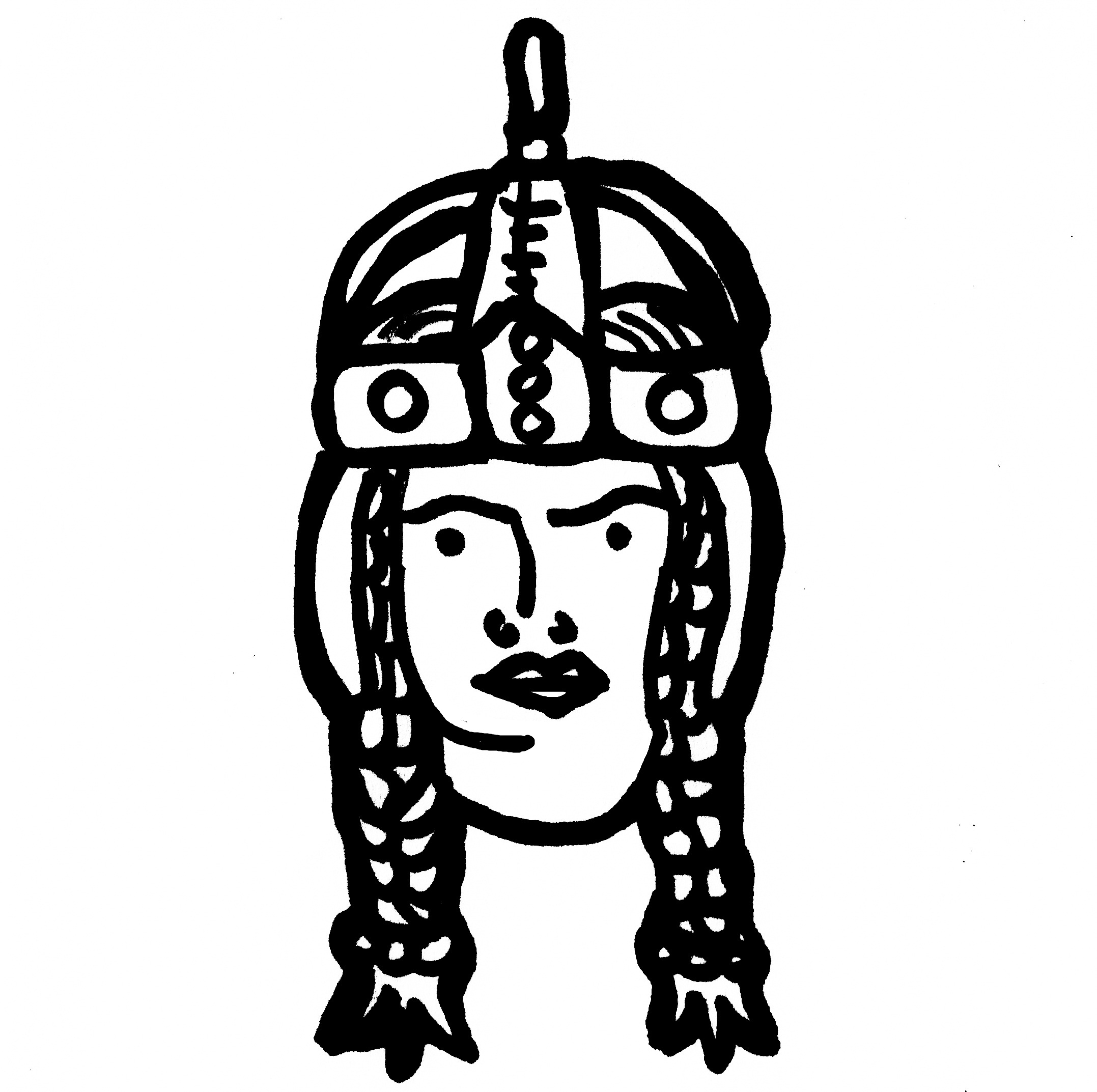
In all of the intertitles, the first letter of the dialogue is ornamented, in the style of an illuminated manuscript, and the speaker is indicated by what appears in the illustrated first letter. In accordance with his legendary ability as a horseman (and many horse-related justifications for the etymology of his name), Etzel’s icon is that of a horse, and Kriemhild’s cowardly brother Gunther’s is a crown. Kriemhild’s lines are denoted by a unicorn. To a medieval audience, this would suggest nobility, suffering, and salvation, and it’s something that appears to be an intentional choice of Lang’s rather than something taken from a pre-existing text (although I am not an authoritative source on this). From what I’ve gathered in my reading, Nibelungenlied is a tragic story about how revenge only begets further violence, with long periods of scholarship centered around two women, Brunhild and Kriemhild, and how they brought down an entire dynasty through their wiles. I think that Lang’s use of the unicorn for Kriemhild is a sly acknowledgement that she’s soldiering on in sacrifice in order to see justice done, even if the ultimate end of her endeavor is the death of her entire family line. Earlier audiences would have seen Gunther’s forcible capture of and marriage to Brunhild as the natural thing for an ancient king to do, something that we in the present “can’t judge” via the same moral lens as we would the same thing happening today.
Perhaps Lang had already seen the writing on the wall with regards to the path that Germany was headed down, because if we view this narrative through that aforementioned modern lens, it’s clear that the real villains here are King Gunther and his evil buddy Hagen. Gunther, a legendary Germanic figure, is a sniveling, craven man, unfit to lead his nation and who commits the real “original sin” of this story that sets all the tragedy in motion: invading a sovereign nation with no justification other than his desire to expand and control, and—let’s not mince words here—raping the Icelandic queen Brunhild. He and his brothers’ commitment to protecting his inner circle is the embodiment of cronyism, as they take “bros before hoes” to an extreme end, refusing to allow Hagen Tronje to meet his just reward even at the cost of their family honor and, eventually, their lives. Gunther is a shortsighted despot who lacks the will to take accountability for his poor decision making, and in so doing, brings a nation to ruin. Does that remind you of anything? The fact that this film predates WWII by over a decade is merely testament to the fact that history is alive and forever repeating itself, and that artists can always see the pendulum swing back into darkness that lies just over the horizon. As established last time, that didn’t protect Die Nibelungen from being used by the Nazi propaganda machine (and it’s worth noting that the racist presentation of the Huns here shows them as being so alien and ugly that it can’t be justified), but I do think that Lang was trying to send a message to his adopted home before it was too late. Or perhaps, sometimes, a unicorn is only a unicorn.
-Mark “Boomer” Redmond


Pingback: Lagniappe Podcast: Leather Jacket Love Story (1998) | Swampflix