Before his death in 2020, director Stuart Gordon was planning a comeback, alongside his screenwriting collaborator Dennis Paoli, with whom he had worked on films like Re-Animator, From Beyond, and Castle Freak. That intended return was to be Suitable Flesh, another Lovecraft adaptation, and although Gordon didn’t live to see it completed, his friend and longtime collaborator Barbara Crampton was determined to usher it to completion, which she achieved this year with Joe Lynch in the director’s chair. I’ve never seen any of Lynch’s feature work, but I was very impressed with his short film Truth in Journalism that was a bit of an internet phenom a few years ago (although the fact that everything that references the film online now gives away the twist, sometimes in the title). And while there’s nothing that’s technically wrong with this one, I have to admit that I just didn’t enjoy it.
Elizabeth Derby (Heather Graham) is a psychiatrist living an idyllic life of career success, loving marriage with handsome if temporarily unemployed husband Edward (Johnathon Schaech), and a fulfilling best friendship with colleague Daniella Upton (Crampton). After a session with a man who is trying to give up smoking, a young man from the nearby Miskatonic University bursts into her office and introduces himself as Asa Waite (Judah Lewis, of The Babysitter). He tells her that his father, Ephraim (Bruce Davison), wants his son’s body, in a scene that would have been more effective if it had been played with more ambiguous dialogue that implied (for instance, abuse at the hands of his father), but instead just sounds like ranting and raving. When she gets a phone call from Asa later, she fears that he’s in danger and goes to his house, only to become embroiled in an apparent domestic disturbance situation that belies dark magic. Eventually, Derby finds herself swapping back and forth between her body and that of Asa, but the entity with which she is exchanging corporeal forms with is not Asa, but something much older and more powerful, and if they switch a third time, it will be permanent.
Narratively, this one is a bit sloppy, and it’s also not really a surprise that the Lovecraft story from which is takes its concept, “The Thing on the Doorstep”, is often considered one of the talented racist’s lesser works. Lewis is doing fine work as the menacing thing that first possesses Asa’s father before taking him over, and although I love seeing Graham in just about anything, there’s a bit of a disconnect between Lewis’s version of (what we’ll call) the spirit and hers, and I wish Graham’s version was as menacing as Lewis’s. There’s also something very fun about the idea of a possessing spirit that has bodysurfed through time in male bodies because of its misogynistic ideals, only to end up in a woman’s body and learn how much it enjoys riding dick. Unfortunately, that’s not enough to save this movie, nor is its gruesome final act, which is what I think will end up being what Suitable Flesh is most remembered for. A shambling, battered corpse that begs for death isn’t the freshest idea (An American Werewolf in London and Return of the Living Dead immediately spring to mind), but it’s realized here in a truly horrifying fashion.
Still, for me, the film’s highlight was Crampton (as she often is). She looks amazing here, and her turn as the confused Dr. Upton who has to come to terms with the fact that her best friend is not losing her mind but is in fact experiencing a truly supernatural event is a sight to behold. In many ways, she’s the true protagonist, the one with the most character development and the person with whom we sympathize the most. It makes the first half of the narrative seem like filler until we get to the good parts, and I have to be honest, I think the late Gordon would have gotten us there faster and better.
As I’m piecing together my personal Best Films of 2023 list in these last few weeks of the year, I’m becoming increasingly self-conscious of how many of my favorite new releases are shamelessly nostalgic for the toys & kitsch collectibles of my youth. Even without a new Godzilla film juicing the numbers, it’s been a great year for films about Furbies, Barbie dolls, Ninja Turtles, and tokusatsu superheroes like Ultraman, Kamen Rider, and The Power Rangers. My Best of the Year list is starting to look like a 1998 Toys”R”Us TV commercial, which is somewhat embarrassing for a man of my age. I am approaching 40 years old, and I still don’t wanna grow up. Thankfully, Godzilla Minus One‘s inclusion in this year’s throwback-toy-commercial canon is at least helping to class up the list a little, as it’s a much more sincere, severe drama than most movies that have excited me lately. It’s just as openly nostalgic for vintage tokusatsu media as Shin Ultraman, Shin Kamen Rider, and Smoking Causes Coughing, announcing itself as an official 70th anniversary celebration of the original 1954 Godzilla film that started it all. However, it’s the only film in this year’s crop to hit the same notes of deep communal hurt as the ’54 Godzilla, which is a much more ambitious aim than reviving the goofball slapstick antics of the child-friendly kaiju & superhero media that followed in its wake. Godzilla Minus One‘s sincerity is incredibly rewarding in that contrast, to the point where it’s the only Godzilla movie I can remember making me cry.
To commemorate that 70th anniversary, Godzilla Minus One dials the clock back to the widescale destruction of post-WWII Japan, covering the first few years of national rebuilding after nuclear devastation. The giant primordial lizard of the title is once again shaken awake by the human folly of the atomic bomb, a great sin against Nature echoed in the creature’s flamethrower-style “atomic breath.” The film’s limited budget means that Godzilla gets limited screentime, but the monster is deployed wisely as an unstoppable, unfathomable horror whose atomic power is so great that it burns away the flesh of its own towering body. Godzilla is scary again, more of a harrowing extension of war survivors’ PTSD than a rollicking hero to children everywhere. The cleverest move the movie makes, then, is by limiting the scope of its drama to match the limited scope of its monster attacks. We feel the fear Godzilla stirs in just a few cowering citizens’ lives, even though both the monster and its victims represent large-scale national grief in metaphor. It’s a small-cast wartime melodrama that’s occasionally interrupted by kaiju-scale mayhem, the same way a soldier who survives war is supposed to go through the motions of normal life in peacetime despite frequent, violent reminders & memories of the atrocities they’ve witnessed or participated in. The “Minus One” of the title refers to people struggling to rebuild their lives from Ground Zero, only to be reset even further back by the grand-scale cruelties of life & Nature, through the monster. It’s tough to watch.
The drama gets even more intimate & insular from there. Most Godzilla movies dwell on the city-wide chaos of the monster attacks, depicting thousands of victims scattering away from Godzilla’s path like helpless insects. In contrast, Godzilla Minus One zooms in to assess the value of just one, individual life in that mayhem. Its mournful protagonist (Ryunosuke Kamiki) is a kamikaze pilot who dodged his suicidal mission during the war and now suffers intense survivor’s guilt, convinced that he morally failed in his duty to serve his nation. The sudden appearance of Godzilla offers the self-hating young man a second attempt at wartime valor, to the point where he’s disturbingly excited by the prospect of facing off against the monster instead of experiencing healthier responses like fear & grief. In a more proudly nationalistic action thriller, this sentiment would go unchallenged, and his self-assigned self-sacrifice would be celebrated as traditional macho heroism. Instead, Godzilla Minus One is about the community of people around the pilot—each having survived their own war atrocities & personal shortcomings—convincing him that his life is worth living, that he has value beyond the damage he can cause as a lone soldier in a war that’s officially over. The honor of serving his country through death is no nobler than risking his life de-activating leftover explosive mines to put food on his family’s table; it’s sad & disgraceful, and it should be treated as a worst-case scenario.
The dramatic beats of Godzilla Minus One are just as predictable as the rhythm of its monster attacks, and just as devastatingly effective. I cried with surprising frequency during the final twenty-minute stretch, even though I saw each dramatic reveal coming from a nautical mile away. Maybe it’s because I vaguely related to the communal struggle to rebuild after multiple unfathomable catastrophes, having remained in New Orleans through a series of floods & hurricanes. Maybe it’s because I more personally related to the pilot’s struggle to learn a foundational sense of self-worth, the toughest aspect of adult life. Maybe it’s because composer Naoki Satō’s gargantuan score drummed those sentimental feelings out of me through intense physical vibration. Who’s to say? All I can confidently report is that the drama is just thunderously affecting as Godzilla’s roars, which is a rarity in the series.
“We are a fucked species; know it.” “We are all cruel beasts – born that way, die that way.” “Polite society is fucking boring.” “Polite society will destroy you.” “All sexuality is basically immoral.”
Poor Things is the kind of movie about the total scope of life as a human being that allows characters to voice those kinds of abstract philosophical statements, often with immediate dismissive pushback from the poor souls hearing them. In that way, it’s the culmination of everything provoc-auteur Yorgos Lanthimos has been working towards since early antisocial provocations like Dogtooth & Alps. He’s always had a coldly detached fascination with basic human behavior & relationships, but he has yet to dissect & catalog them all in a single text the way he does here. Every new Lanthimos movie feels like it’s poking at some assumed social norm as if it were a corpse he found in the woods. Poor Things finds that naive interrogation at its most scientifically thorough & perversely fun, to the point where he articulates the entire human experience through repurposed dead flesh. In doing so, he’s clearly made The Movie of the Year, and so far the movie of his career.
Emma Stone stars as the repurposed corpse in question: a suicide victim who has been reborn as a Frankenstein-style brain transplant experiment in a mad scientist’s Turn-of-the-Century laboratory. Her monstrous “Daddy God” creator—played with pitiable Elephant Man anguish by Willem Dafoe—initially keeps his experiment on a short leash, confining her entire life to his grotesque but lavish home. She eventually breaks free, though, as all Frankenstein monsters do, and ventures into the world as an adult-bodied woman with the mind of a rapidly developing child. Her resulting interrogation of the world outside her home is intensely violent, as anyone who can picture an adult-sized toddler throwing a temper tantrum would expect. It’s also intensely sexual, as she can find no joy more immediately self-fulfilling than orgasmic bliss but lacks basic understanding of that joy’s socially appropriate boundaries: assumed monogamy, acceptable dinner conversation, the stigma of sex work, when & where it’s permissible to masturbate, etc. If she is meant to represent humanity at its most basic & untouched by learned social restrictions, she represents us as insatiably horny, violent beasts who have to consciously strive to learn empathy for each other because it is not innate in our souls. It’s a hilarious, uncomfortably accurate assessment of the species.
If there’s any one particular social norm that Lanthimos naively interrogates here, it’s a gendered one. Much of the reanimated monster’s exploration of Life is limited by the men who wish to control her. First, her Daddy God confines her as a domestic prisoner, the same way all fathers of young women fear their freedom as autonomous adults. Once she’s loose, a small succession of selfish bachelors aim to trap her again in the domestic prison of marriage: Ramy Youssef as an ineffectual Nice Guy, Mark Ruffalo as a dastardly fuckboy fop, and Christopher Abbott as a sociopathic abuser. All the men in the monster’s life seek to control her in ways that stifle her self-development. It’s a movie about male possessiveness just as much as it’s about the absurdities of Life & societal decorum in that way, and the heroic triumph at the center is mostly in watching the creature fuck & read her way out of her patriarchal bonds to become her own person. At times, that sentiment is expressed through philosophical assessment of what it means to live as an ethical person in modern society. More often, it’s a crass celebration of women being annoying & gross in public despite the men around them demanding they calm it down. It’s oddly uplifting in either case.
Yorgos Lanthimos’s films have become more recognizably comedic since he broke through to a wider audience with The Lobster, and they’re all the better for it. There’s a sense of playful collaboration here where the director allows each contributor freedom to run wild: Stone & Ruffalo in their sketch comedy acting choices, cinematographer Robbie Ryan in his fish-eye lens fantasia, screenwriter Tony McNamara in his violent perversions of vintage humorist quips. It’s telling that the only work that’s directly alluded to onscreen (besides, arguably, Mary Shelley’s Frankenstein and its James Whale mutations) is Oscar Wilde’s The Importance of Being Earnest, another prankishly prurient comedy of manners. Lanthimos has always morbidly poked at social norms & decorum with this same curious outsider’s perspective, but never before while taking so much obvious glee in the act, nor on this wide of a scope. I rarely have this much fun thinking about how we’re “a fucked species” of “cruel beasts,” and how our rules of appropriate social interaction are so, so very “fucking boring.”
Thanksgiving is, unfortunately, unlikely to be remembered very fondly in the years to come. I was enticed to the theater after reading a review that compared it to Scream, which was like catnip to me. And while I suppose I can see what that critic was alluding to, I’m not as warm to its charms.
The film starts off with a strong opening: Thomas Wright (Rick Hoffman), proprietor of Right Mart stores, is convinced by his new wife Kathleen (Karen Cliche) to open his store on Thanksgiving evening with Black Friday deals. This means that Mitch Collins (Ty Olsson) must leave his family Thanksgiving with his beloved wife Amanda (Gina Gershon) to open the store when another manager calls in sick. Over at the Right Mart, the crowd has gotten quite rowdy, and their agitation only increases when Thomas’s daughter Jessica (Nell Verlaque) succumbs to peer pressure and lets herself and her friends in through a side entrance. When dipshit jock Evan (Tomaso Sanelli) taunts a teen from a rival high school through the glass of the store, things reach a tipping point, and even the presence of local sheriff Eric Newlon (Patrick Dempsey) can’t prevent the shoppers from surmounting a barricade and pressing against the glass doors of the store until they break, causing a stampede that crushes and maims many people, with poor Amanda, who had come to the store to bring a late Thanksgiving dinner to her husband, being crushed to death.
This opening sequence is the best thing about the movie, with frenetic action, rising tension, and spectacular violence, all in pursuit of a free waffle maker that is promised as a prize to the first hundred customers. From there the film becomes a little rote, and it’s not helped by the total non-presence of teen characters. Jessica is our viewpoint character and thus we never feel any real tension regarding whether she will make it out, and she’s the most undeveloped final girl that I think I have ever seen, just sleepwalking through this movie with only the thinnest of characterizations (a dead mom). Her best friend Gabby (Addison Rae) is virtually indistinguishable from her in motive and action, with the only real difference between them being that Gabby is dating the aforementioned Evan. Evan himself is sketched out more clearly, but he has not a single redeeming characteristic, as he filmed the Right Mart riot and posted it online for the viral fame while later denying that he had done so; he also bullies a smaller student into performing his classwork and then breaks his word to pay him for doing so, and he mocks Jessica’s new boyfriend Ryan (Milo Manheim) behind his back but accepts gifts from him without reservation. Rounding out our little gang of shits are two more likable members, Evan’s teammate Scuba (Gabriel Davenport) and his girlfriend, Yulia (Jenna Warren). The issue is that we never really care about any of these people; even Jessica, with whom we are supposed to sympathize as the lead, is completely forgettable.
I’m not making the argument that we need to care about any of the characters in a slasher for it to be effective. Most slashers released in the wake of Halloween (which did have a relatable and likable main character in Jamie Lee Curtis’s Laurie Strode) didn’t realize that part of that film’s capturing of lightning in a bottle was in the fact that we cared about Laurie and her friends. A Nightmare on Elm Street also understood this, making Nancy Thompson (and to a lesser extent Kristen and Alice) very relatable; even Child’s Play and its sequel wouldn’t be as memorable without Andy or Kyle. The characters in the Friday the 13th series are largely indistinguishable and interchangeable, which is why any discussion of characters from that series takes the form of “the one played by Kevin Bacon” and “the one played by Crispin Glover,” with the only character name most people remember being “Tommy Jarvis.” Still, most slashers don’t bother with that level of character work and are still fun, but this overall shallow dimensionality of the players here is to the film’s detriment. I mean, we’re on to the second page of this review already, and I haven’t even mentioned the killer or his schtick, that’s how thinly this whole thing is drawn.
The slasher here is called “The Pilgrim,” and wears a mask of John Carver, who is credited with the composition of the Mayflower Compact and who is a local hero in the Plymouth setting. I suppose that the Scream connection comes in that the killer is adept at using the phone (and by extension, social media) to scare the local teens and convince them to do what he wants as he seeks vengeance on those who participated in the Black Friday Massacre the year prior. The mask is almost too silly to be truly scary, and the inconsistency in the Pilgrim’s spree undermines what could push this into being a successful horror comedy. Several kills are clearly based on Thanksgiving traditions, like when he stabs one of the teens through their ears with corn-on-the-cob holders, or when he gruesomely cooks a person alive to serve as the turkey-like centerpiece of the final act unmasking. Other kills are consistent with the Pilgrim’s message, but don’t have much to do with the holiday. In fact, his first kill is of a waitress at the local diner who was one of the first in line at the store and was the one whose cart got caught on Gina Gershon’s hair and pulled away part of her scalp. The waitress runs for her life and almost makes it but is chased down and struck by her own car, which launches her into a dumpster, its swinging lid coming down so hard it severs her in half at the waist. The lower half of her body is left on a Right Mart sign that advertises “half off.” It’s not as funny as it thinks it is (not even getting into the fact that the killer couldn’t possibly have planned for that scenario to play out that way), but it feels like the movie should have chosen whether it was going to go all-in on Thanksgiving themed murders or excised them and instead just gone for puns. Failing that—and I thought this was where the film was going—there should be two killers. One of the great failings of the Scream franchise is that it has never made a film where the two Ghostfaces are operating at cross-purposes or are unaware of the other. Given that Spyglass is being spineless in their eviction of Melissa Barrera from the series over her comments regarding the Palestinian genocide (and that Jenna Ortega was announced to have left the project the following day, with most of the internet believing that she walked in support of Barrera, although we can’t know for sure), that series is effectively dead, and if it continues, it’s dead to me. There’s a scene here in Thanksgiving where it makes it almost obvious that there are two killers, with two separate murders that are too far apart from one another to have happened in the time that we are shown it to have occurred, and yet this isn’t part of the resolution.
Where the film does succeed, outside of the first act, is in the ingenuity of its kills and its variety of red herrings. With regards to the latter, there’s no shortage of potential killers; Ty Olsson’s bereaved widower with a grudge against the Wrights is a front-runner, joined by Jessica’s ex-boyfriend Bobby (Jalen Thomas Brooks), a promising baseball player whose career is waylaid when his pitching arm is broken during the Right Mart stampede, and there’s even a newly appointed deputy that some of the townsfolk are mysteriously hostile toward for never-explained reasons. The best kill in the film, however, isn’t even at the hands of the Pilgrim, at least not directly. Several characters are participants in the town’s local Thanksgiving parade, specifically riding a float in the shape of a boat. When the Pilgrim disrupts the parade, leading the truck towing the float to stop short, sending the bowsprit of the ship straight through his head, much to the horror of his two elementary-aged granddaughters who were in the vehicle with him. It’s the film’s best joke, too, and it needed to land several more in order to really pull off a sufficiently campy tone. I’m sure it’s no surprise to anyone, but director Eli Roth prioritizes shock value over comedic timing, and the film suffers for it. Stronger performances from the teen characters or characterization invested in making them more interesting, better and more frequent jabs at the genre and comedy in general, and a little more consistency throughout would have made this film more like a valid cinematic release and not like a misplaced episode of Hulu’s Into the Dark.
You might assume that the ideal way to watch the 1985 supernatural Italo horror Demons would be to see it projected in the oldest operating cinema in town, in our case the original location of The Prytania. In the film, a group of strangers are gifted free tickets to a mysterious horror film at an ancient cinema that has materialized out of the urban void. That movie turns out to be a gory cheapie about an ancient mask buried in Nostradamus’s tomb. We watch this story unfold twice removed, where movie-within-a-movie victims try on the cursed mask, which transforms them into demonic, flesh-eating demons who torment their companions. Meanwhile, the in-film audience of the movie squirms in their seats, noticing an alarming resemblance of the mysterious horror film’s violence to their own journeys to the screening. Mainly, the promotional mask prop displayed in the cinema’s lobby has cut one of their cheeks the same way it cut & infected characters in the film they’re watching, which of course leads to a demon-zombie breakout in the theater that matches the chaos of the movie within the movie. They’re all effectively Skinamarinked—unable to leave the theater thorough the doors they entered from—as they individually transform into cannibalistic monsters and tear each other to shreds. Seeing Demons in a classic single-screener cinema could only add an extra layer of uncanny meta-horror to that gory practical-effects display, especially if the cinema in question could cover the insurance costs of blocking the exits and cutting their customer’s cheeks at the box office.
It turns out there’s an even better way to see Demons, though, one that trades in the layered meta-aesthetics of a haunted cinema for the open-aired joviality of a family barbeque. Italian prog rock composer Claudio Simonetti recently toured one of the several undead mutations of his band Goblin to play live accompaniment for Demons in concert venues around the country, including The Broad’s outdoor extension The Broadside. The show was rigidly timed to a Tim & Eric style video package that opens with a postcard from Simonetti & Demons director Lamberto Bava, then concludes with a greatest-hits medley of 70s & 80s horror scores, most of which Simonetti composed under the Goblin name. In-between, the band played a reworked, bulked-up version of the Demons score to a full screening of the film, emphasizing both how few scenes prompted them to pause for dialogue and how frequently its now-anthemic theme is repeated for the gnarliest sequences of over-the-top gore. As for Demons itself, it’s got one of the greatest opening acts in all of nonsense Italo horror cinema, capturing the feeling of collectively dreaming at the movies without distracting itself with minor concerns like plot & coherence. Once the in-film movie projector and auditorium are torn apart there isn’t much glue to hold the whole thing together, though, save for the repetition in Simonetti’s synth riffs, so it was great to hear them cranked up to an obnoxious volume. By the end, the familiarity of those riffs gave the screening a celebratory, communal air – the culmination of a once-in-a-lifetime Halloween season of great movies screening at The Broad (including several directed by Demons producer Dario Argento).
Years ago, the hot horror-nerd ticket would have been to see the full classic Goblin line-up play a live score for Suspriria, a tour that (to my knowledge) never came through New Orleans. If you’re going to see “Claudio Simonetti’s Goblin” live instead (a variation of the band that only includes Simonetti from Goblin’s original membership), you might as well see them play a live score for Demons, since it’s a film that Simonetti scored after the legendary band had originally broken up. He might primarily be a solo composer, but you can tell Simonetti loves having a full band behind him, playing rockstar in his denim jacket & wallet chain combo. The encore set after Demons concluded touched on plenty of classic-Goblin staples, including themes from Dawn of the Dead, Suspriria, and (in my book, their finest work) Deep Red. It also included some wonderfully bizarre choices that rivaled Bava’s shoddy surrealist filmmaking in Demons, most notably in the glitchy-GIF repetition of the classic New Line Cinema logo while performing the theme from Cut & Run and in their prog rock remix of John Carpenter’s Halloween score, transforming a notoriously sparse piano line into an overcomplicated monster. I still would love to see Demons projected in an antique venue like The Prytania someday, just for the proper sense of ambiance. I can’t imagine it’ll be a more memorable or endearing evening than that evening at The Broadside, though, where the stage lights twinkling off Simonetti’s absurdly long wallet chain were like stars twinkling in the night sky.
We do not have an Alamo Drafthouse in New Orleans and, to be honest, I’m totally okay with that. I appreciate the chain’s consistent enthusiasm for programming retro genre schlock, but there’s just something off-putting about watching any movie while underplayed teenagers scurry like peasants in the dark, delivering little treats & trinkets to the royal customers on our pleather thrones. Canal Place’s worst era was the brief period when it attempted to mimic the Alamo dine-in experience, which I’m saying as someone who worked in the theater’s kitchen during those long, dark years. I mean, why pay for a $20 salad when you can simply wait an hour and then literally walk to several of the greatest restaurants in the world? It was a baffling novelty in our local context. I was recently invited to an Alamo Drafthouse while vacationing in the Twin Cities, though, and I feel like I got introduced to the chain’s whole deal in the one context where it does make sense. For one thing, the Twin Cities Alamo is not located in the Twin Cities at all, but rather way out in the strip mall suburbs where there’s nothing better to do or eat within walking distance. In fact, there’s hardly anything within walking distance at all. “Public transportation” instructions on Google led me to take a train ride from downtown Minneapolis to downtown St. Paul, then a bus ride from St Paul to the side of a featureless suburban highway, and then a cheap Uber ride for the final stretch to the theater. That’s hardly equivalent to wedging a combo restaurant-cinema onto the busiest corner of the French Quarter. Also, I traveled there specifically to attend an all-day horror movie marathon, where mid-film snack & drink deliveries were necessary for my hourly survival. That overpriced pizza saved my life.
The annual “Dismember the Alamo” event is a Halloween Season tradition where the theater chain programs four-to-five “surprise” horror films, typically selected from the AGFA library. The program varies theater to theater, so I can only report on what screened this year at the Twin Cities location (which is, again, not located in either of the Twin Cities). It opened with two movies I’ve already reviewed for this site in Octobers past: Messiah of Evil (which I love) and The Changeling (which I tolerate) – two artistically minded, leisurely paced horrors of relative respectability. The plan was then to screen two more slower paced, fussily styled horrors Swampflix has already covered in Ringu and Blood & Black Lace, but technical difficulties intervened. While the staff scrambled to get the second half of the program running, I was happy to have time to chat with a long-distance friend in a venue notorious for not tolerating mid-film chatter of any kind. Then, when the show got back on the rails, they had thrown out the planned program to instead play two oddball 80s novelties I had personally never seen. The pacing picked up, the movies got weirder, and the room took on more of a horror nerd party vibe than the horror nerd sleepover feel of the opening half. I got treated to the full surprise lineup experience of the Dismember the Alamo ritual, to the point where even the marathon’s programmers were surprised by the titles they ended up playing when the DCPs for Ringu & Black Lace refused to cooperate. The Great Pumpkin smiled warmly upon me that day, which I very much needed after traveling alone in the Minnesota cold.
The third film in this year’s Dismember the Twin Cities Alamo lineup was the 1988 haunted house horror Night of the Demons. It was perfect Halloween Season programming, regardless of its function as a much-needed energy boost within the marathon. In the film, the absolute worst dipshit teens to ever disgrace the screen spend Halloween night getting torn to shreds by demons whenever they get too horny to live. In the audience, the awed seriousness that met The Changeling gave way to chortles & cheers, especially as the Reaganite jocks onscreen received their demonic comeuppance from the monstrously transformed goths they bully in the first act. That vocal response continued into the opening credits of 1981’s The Burning, which is credited as the brainchild of a young Harvey Weinstein. Weinstein’s name lingered in the air as the film’s horndog teen boy protagonists pressured their coed summer camp cohorts for sex in nearly every scene, only to be violently interrupted by a disfigured slasher villain named Cropsy. The Burning proved to be a fascinating bridge between the urban, gloved-killer grime of Italo proto-slashers and the sickly summer camp hedonism of the standard American brand. I imagine it would’ve inspired multiple bodycount slasher sequels if it were simply retitled Cropsy instead of the much more generic The Burning, since the horrifically disfigured villain on a revenge mission has an interesting enough look & signature weapon (gigantic gardening shears) to justify his own long-running franchise. He at least deserves it as much as Jason Voorhees, since The Burning is a major improvement on a template established by early entries in the Friday the 13th series. Likewise, I wonder why Linnea Quigley’s hot-pink harlequin bimbo look from Night of the Demons hasn’t inspired decades of Halloween costumes among the horror savvy. It might be her at her most iconic, give or take her graveyard punk look from Return of the Living Dead or her chainsaw-bikini combo from the cover of the Linnea Quigley’s Horror Workout VHS.
If there are any lessons in horror marathon programming here, it might just be in the attention paid to pacing. I love giallo & J-horror just as much as the next schlock junkie, but I was excited to watch objectively worse movies than Ringu & Black Lace just to make sure I didn’t end up using my pizza as a greasy pillow. Also, if you have to improvise your lineup on the fly, you might be surprised by the connections that arise from the last-minute entries. All four movies in this particular lineup were about cursed spaces haunted by the sins of the past — violence that lingers in the landscape where it took place, to the point of supernatural phenomena. In Messiah of Evil & Night of the Demons, that violence is perpetuated by otherworldly embodiments of pure Evil. In The Changeling & The Burning, it’s perpetuated in acts of revenge for personal wrongs of the recent past. All four films are connected by the tropes & traditions of horror as a storytelling medium & communal practice, a connection strengthened by a well-informed, horror savvy audience who stays immersed in that milieu year-round. More practically, though, what I learned is that the Alamo Drafthouse experience makes total sense in that movie marathon context. I cannot imagine a more comfortable venue where I could binge four horror movies in a row, save for my living room. And since I’m unlikely to invite 200 strangers to my house to watch a surprise horror movie lineup, even that caveat is moot. If there were a New Orleans branch of the Alamo Drafthouse, I’d attend the Dismember the Alamo marathon every year with religious devotion. I’d just hope that they’d stick it way out in the suburbs of Metairie or St. Bernard so that it’s competing with AMC instead of our humble indie spots like The Prytania, who’ve done a great job restoring Canal Place to its former glory.
The early-Fall lull between the Summer Blockbuster schlock dump and Awards Season prestige rollouts is always somewhat of a cinematic dead zone, but this year’s has been especially harsh. The ongoing SAG/AFTRA strikes have scared major studios into delaying some of their biggest Fall releases for fear that their marketing would fail without the star power of a Zendaya or a Timmy Chalamet doing traditional promo, leaving very little of note on the new release calendar (until the Studios cave on those actors’ reasonable demands for fair compensation). I’m sure it’s been a strain on movie theaters in the meantime, and I hope that they squirrelled away enough of that sweet Barbenheimer money this summer to survive the drought. Speaking selfishly, though, it’s been awesome for me as a regular moviegoer. Stumbling into this new-release wasteland during Halloween Season inspired local indie theaters to get creative in their respective repertory programming, resulting in what has got to be the greatest month of local film listings I can remember in my lifetime (with the caveat that I grew up in the era when suburban AMC multiplexes strangled the life out of what used to be a much more robust New Orleans indie cinema scene). I spent most of October bouncing and forth between The Broad and The Prytania on the same #9 Broad bus line, frantically catching as many never-seen-on-the-big-screen horror titles as I could while the getting was good. And there were still plenty more I missed that I would’ve loved to see properly projected, including the early Universal Horror all-timer The Black Cat. What a time to be unalive!
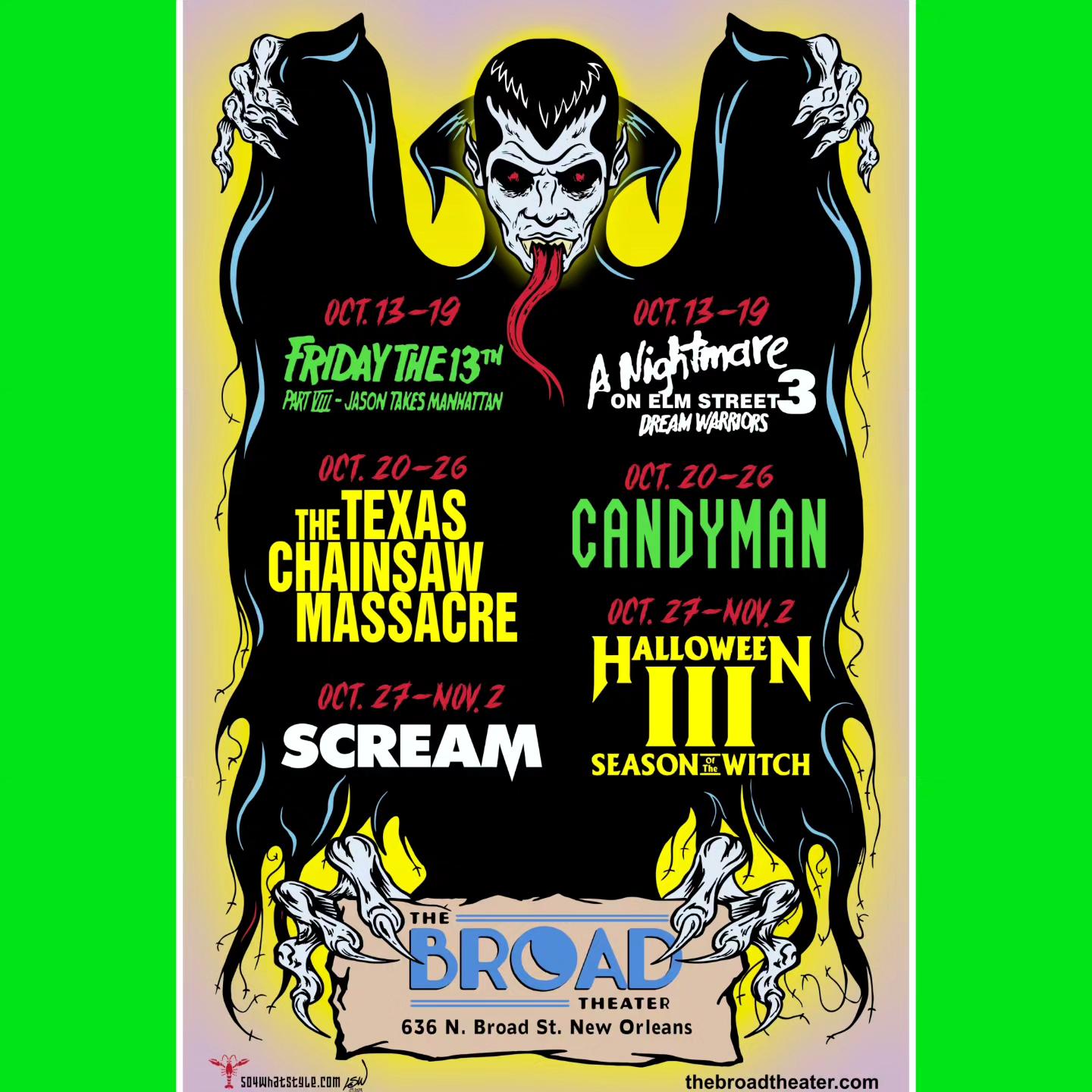
If I were to parse out the two distinct flavors of these theaters’ dueling Spooktober line-ups, I’d say The Prytania offered an older, dustier variety of venerated genre classics while The Broad offered slightly warped cult favorites of the video store era. I personally trekked out to The Prytania to see odds-and-ends obscurities I’d never seen before at all, let alone on the big screen (Dracula’s Daughter, Bell, Book and Candle, The Creeping Flesh), but they also programmed a long list of definitive Hall of Fame horror classics that should be checked off of any genre fan’s personal watchlist (Don’t Look Now, Psycho, The Wicker Man, The Shining, The Exorcist, etc.). Meanwhile, The Broad’s lineup made a few more surprising, left-of-field choices, mostly in straying from the classics to instead screen their most chaotic, divisive sequels. While The Prytania screened the John Carpenter slasher-definer Halloween, The Broad screened its Michael Meyersless sequel Halloween III: Season of the Witch. While The Prytania screened fellow slasher-definer Friday the 13th on Friday the 13th, The Broad screened Friday the 13th, Part VIII: Jason Takes Manhattan, its most over-complained-about sequel. The Prytania’s schedule was so plentiful with exciting horror titles this October that I hardly had time to watch movies anywhere else, but I pushed myself to catch the most esoteric selections in the “Nightmares on Broad Street” program anyway, just to support the iconoclasm, as detailed below. And while I’m comparing the two theaters’ programs here, I should note that the one film they both played last month was Wes Craven’s teen meta-slasher Scream, which I suppose makes it their consensus pick for the greatest horror film of all time.
A Nightmare on Elm Street 3: Dream Warriors (1987)
The most rewarding trip I had to The Broad this October was to revisit Dream Warriors, a movie I mostly remember from late-night cable broadcasts and oft-repeated Blockbuster VHS rentals. The film marks Heather Langenkamps’s return (and shockingly morbid departure) as the series’ Final Girl figurehead, now a young medical student researching violent sleep disorders in order to help suffering teens survive nightly dreamworld visits from Freddy Kreuger. The film’s limited setting in a mental hospital narrows its focus to a small group of traumatized teen insomniacs and their befuddled doctors who can’t quite figure out how they all suffer from the same group delusion that causes them to self-harm; spoiler: it’s because Freddy is real. Dream Warriors has long been a favorite of mine in the series due to the novelty of its imaginative kill scenes, which include Freddy puppeteering one of his victims using their exposed veins as marionette strings and Freddy transforming his finger-knives into hypodermic needles to feed the hungry mouths of another victims’ pulsating track marks. It’s pretty fucked up, especially since it’s combined with Freddy’s early stirrings as a stand-up comedian – crushing one victim’s head with a television while quipping “Welcome to primetime!,” declaring another victim “tongue-tied” after literally tying them to a bedframe with his detachable tongue, and punctuating every misogynist kill with the punchline “Bitch!”.
What will always stick with me about Dream Warriorsnow, though, is that it’s the only Nightmare on Elm Street movie that has managed to make me cry. Maybe I’m getting too soft in my old age, or maybe it was just the theatrical atmosphere replacing the film’s usual brewskies-on-the-couch presentation, but I got unexpectedly emotional watching these kids get disbelieved and blamed for their own illness for so long before finding unexpected strength in solidarity. Every authority-figure adult in their lives is dismissive of their nightly suffering except the one who happened to go through their exact supernatural torture in her own youth, and then she teaches them how to fight against their isolating threats as a collective group through lucid dreaming. It’s oddly sweet, even as it is hideously gruesome. It’s probably no coincidence that the three best-remembered Elm Street movies are the ones Wes Craven had a direct creative hand in—the original, Dream Warriors, and New Nightmare—and, while I might personally prefer New Nightmare in that trio, they’re certainly all worthy of standalone repertory programming. Not many theaters would take a chance on the sequels outside a marathon context, though, so Dream Warriors immediately registered as mandatory viewing, even in such a crowded month.
Friday the 13th Part VIII: Jason Takes Manhattan (1989)
Speaking of slasher sequels no one would usually take a chance on, holy shit. Dream Warriors has plenty of long-running goodwill among horror addicts as one of the best of its franchise, but Jason Takes Manhattan has a long-running reputation of is own as one of its franchise’s worst. Wrongly. The standard-issue complaint about this much-mocked slasher sequel is that it’s flagrantly mistitled, promising that Jason Voorhees will take a grand budget-burning tour of New York City, when in reality he spends most of the runtime killing teens on a boat trip to the city. Given that marketing department disappointment, I wish the film had simply been retitled Jason Takes a Cruise to calm the horror nerds’ nerves. Complaining about the locale of Jason’s tireless teen slayings in this outing three decades after the first-weekend jeers is idiotically shortsighted & petty, since Jason Takes Manhattan is scene-to-scene the most memorably entertaining entry in its franchise, give or take Jason X (which is mostly set on a ship of sorts itself). En route to Manhattan, Jason punishes high school seniors for celebrating graduation with the old-fashioned teen sex, drugs, and rock ‘n’ roll that he loathes so deeply: filming amateur rock videos in the engine room, snorting coke off mirrors in the supply closet, and seducing the uptight principal to get out of completing their science fair projects. It’s a random assemblage of quirky slasher-teen behavior that even on land would be more entertaining than the snoozy cabin-in-the-woods doldrums of earlier Friday the 13th sequels, and then the Manhattan-themed rampage promised in the title is delivered as a sweet novelty dessert.
If anything, there’s something immensely satisfying about the way Jason’s whirlwind Manhattan tourism is delayed for a condensed, climactic payoff instead of being drawn out into urban slasher tedium. An opening credits sequence details the grimy back-alleys of 1980s NYC, particularly focusing on a barrel of toxic sludge that serves as the bathtub for a gigantic rat. We do not return to that alley until the third act, when Jason drowns the film’s most detestable character headfirst in that exact barrel, the rat now dead beside him to emphasize just how gross the sludge truly is. There’s also some great metaphysical character at work here as well, where Jason now appears to be made entirely of toxic sludge himself, having been submerged in the murky waters of Crystal Lake for so long that he’s essentially a hulking collection of sentient goo. His younger, drowned self appears to the film’s Final Girl in frequent, psychedelic hallucinations during the boat trip to Manhattan – underlining the killer’s supernatural constitution, connecting his qualities as an aquatic zombie to the waters that connect Crystal Lake to the Hudson Bay and, frankly, killing time between his actual kills. Mostly, though, his gooey, goopy body is just an extension of the way the movie associates New York City with sludge & grime, painting it as a landscape made entirely of rats, rape, street punks, and shared hypodermics. In a way, you get a little taste of Manhattan on the ride to its shores in Jason himself. More importantly, it’s one of the precious few entries in his franchise where he isn’t a total bore. Too bad so few people get past the misleading title to see that; it was the least well-attended horror screening I saw all month.
Now here’s where things get interesting. The Broad had already filled its schedule with classic horror films at the start of the month, and then Taylor Swift dropped a rushed-to-market concert film that cleared even more room on local marquees, since film studios were scared to compete with the most famous woman alive. I’ve never been a bigger Swiftie. Because Swift’s Eras Tour cleared the weekly release schedule, The Broad added three additional classic horrors to its line-up, all digital restorations of vintage gialli by Dario Argento. And so, I got to see my personal favorite Argento film on the big screen with my friends instead of the way I’ve watched it previously: alone as a fuzzy YouTube rip. Like with my appreciation for Jason Takes Manhattan, Opera is far from the wider consensus pick for Argento’s best; I was genuinely shocked to see it theatrically listed alongside his better respected works Deep Red & The Bird with the Crystal Plumage on The Broad’s marquee. At this point in the month, it was starting to feel like someone was programming a mini horror festival just for me, and it was delightful to see plenty likeminded freaks in the audience instead of the empty seats I was met with at the screening of my favorite Friday the 13th.
Opera finds Argento working in his Inferno mode, putting far more effort into crafting individual images than weaving them into a cohesive story. After being hired to direct a real-life opera of Macbeth and abandoning the project before production, Argento salvaged his scrapbook of ideas for its staging in this loose mystery crime thriller about a gloved killer’s obsession with an opera singer. The killer’s mechanism for torturing his muse is tying her up with pins pointed at her open eyelids so she cannot look away from his violent slayings of her friends, lovers, and collaborators. It’s a double-contrivance of Hitchcockian voyeurism, where the killer obsessively watches the singer from the anonymous crowds of her opera house and, in turn, makes her watch him perform his art backstage. It’s also just an excuse for Argento to indulge in a glorious clash of high & low sensibilities, alternating between operatic vocal performances in the theatre and thrash-metal slashings on the streets. Opera might feature his most overactive, over-stylized camerawork to date, too, most notably in scenes where the camera adopts the POV of the trained ravens on his Macbeth set to directly attack his own audience in murderous swoops & dives. Opera may not be as beautiful as Suspriria, nor as horrifying as Tenebrae, but it’s Argento’s mostly wildly impulsive vision – both his most invigorating and his most incompressible. I loved seeing it get the proper theatrical setting it deserves.
Halloween III: Season of the Witch (1982)
YWhile there may still be some novelty in exalting Opera & Jason Takes Manhattan as the top of their respective classes, I’d say Halloween III: Season of the Witch has been thoroughly reclaimed in the modern discourse to the point where calling it The Best Halloween Movie is almost an online Film Bro cliche. Hell, that thought even occurred to me back when we covered it on the podcast in 2016, when I called it the best Halloween movie. There’s some necessary semantic clarification to make there, though, because I’m not only saying that its infamous Michael Meyersless deviation from the John Carpenter slasher franchise makes it the most interesting movie of its series. I’m saying that it’s the best horror movie in any context that’s specifically about Halloween as a holiday, from the roots of its pagan Samhain traditions to its modern Trick or Treat rituals in the American suburbs. The only films I skipped on the Nightmare on Broad Street roster were the widely beloved horror classics The Texas Chainsaw Massacre, Candyman, and Scream, and I believe the horror nerd community has gotten over Season of the Witch‘s disregard for Michael Meyers slashings well enough that it now registers among that verified pantheon of seasonal greats (in a way they still haven’t gotten over the title of Jason Takes Manhattan). The reason I didn’t skip Season of the Witch, though, is that The Broad happened to screen it on Halloween Night, and I couldn’t fathom a better way to cap off this exquisite month of local repertory moviegoing. It was a hoot, and I’m already excited to see what they pull out of the haunted vault next year.
I first became aware of Cobweb through a rare positive modern horror review from the boys (well, no longer “boys” I guess) of Red Letter Media. Like them, I am shocked by the distributor’s decision to drop this film into theaters in late July, right at the height of Barb–enheimer madness; we often treat this spooky time of the year as the default season for horror movies, but this is a Halloween movie if ever there was one, taking place in the lead up to and on Halloween Night. It’s the perfect little quiet piece of nasty work to end the season, if you haven’t already decided what the last stop on your horror train will be this year.
Mark (Antony Starr, of The Boys) and Carol (Lizzy Caplan) are bad parents, the kind of bad parents that you’ve met before. Mark is charming in a way that wears off very quickly, as his facade of joviality is as paper-thin as his rictus grin is reptilian. Carol seems to live in constant fear of the potential for Mark to become violent, but despite that she withers beneath her husband’s cold fury, she is capable of cruelty all on her own, and her constant fretting over the locking of doors implies deeply rooted issues. As a result, elementary-aged Peter (Woody Norman) is a shy, withdrawn, and bullied child, a fact that is accentuated by how much smaller he appears to be in comparison to his classmates. He gets a new substitute teacher in the form of Miss Devine (Cleopatra Coleman) just in time for a series of Halloween related projects, including fear-related drawing projects and decorating pumpkins. She quickly notices Peter’s isolation from his peers and what appear to be other signs of abuse; for one thing, the boy seems to be perpetually tired. What she doesn’t know is that Peter never gets a full night’s sleep because he is awakened every night by tapping coming from within the walls of his bedroom, a knocking that his parents deny the existence of and which is soon accompanied by the soft, whispering voice of a little girl begging for help.
My viewing companion for the film noted that he had previously seen child actor Norman in the Joaquin Phoenix vehicle C’mon C’mon, and noted that he was a talented performer in that one as well, and he gives a very strong performance here. Caplan has a panicked, nervous energy here that I haven’t seen from her before, as it lacks the sardonic sense of humor of her more customary roles; she manically moves from room to room locking doors behind her like Nicole Kidman in The Others. Carol’s moments of genuine kindness toward her son always have a bitter aftertaste of guilt that will be terribly familiar to anyone who’s ever known a parent who is unable to stand up to their partner regarding the treatment of their child, and it’s potent, given how little other characterization she gets. Putting Starr in this role of Stepfather-adjacent pathological paternalism is the casting equivalent of shorthand that carries over the barely-contained psychopathy of his Homelander character on Amazon’s The Boys. He never commits any acts of physical violence, but his presence alone is menacing, and his hot-and-cold affection for his son is distressing. That Norman is holding his own in these scenes against the performers playing his parents is astonishing; I’ve rarely seen such a talented child actor, and I genuinely can’t remember the last one I saw whose last name wasn’t Fanning.
The constant danger that poor Peter is in is palpable as the walls close in around him and his lifelines are clipped. His father is clearly dangerous, but he can’t rely on his mother for help as she is Mark’s collaborator as much as she is his prisoner, and Peter loses access to the only sympathetic person in his life, Miss Devine, when he is expelled from school after striking back at his bully at the suggestion of the voice behind the walls. The voice claims that she is Peter’s sister, locked away in the walls for being born “wrong” somehow, and that she has been waiting for Peter to grow strong enough to move the grandfather clock in their parents’ bedroom that hides the door to her prison, so that they can escape together before Mom and Dad decide to lock Peter away, too. Although the audience is naturally distrustful of the voice, we have no reason to think that the parents are innocent either, and Peter has no one else he can turn to anyway, so he commits to the plan to help her escape.
It would be incorrect to say that Cobweb “loses steam” as it enters its third act; if anything, the film picks up the pace from there. It does, however, lose some of its atmosphere and tension once it crosses that threshold. If you’re the kind of person who’s hypervigilant now as a result of growing up with a parent whose hair-trigger temper was like a second language, this will be familiar to you. The film inevitably takes a sharp turn into a different kind of horror once we get more answers about what’s in the walls (if anything) and what the parents know (or don’t). When Coleman re-enters the plot, things pick up a bit, and the film’s final chilling moments make up for some of the more conventional horror turns that occur. Still, this one is a real overlooked gem from this year, especially if you’re looking for something that puts atmosphere first.
Welcome to Episode #198 of The Swampflix Podcast. For this episode, Brandon is joined by Aaron Armstrong of the We Love to Watch podcast to discuss the eight classic Universal horrors that feature Frankenstein’s monster.
My favorite of the original Child’s Play trilogy, and thus my favorite Chucky movie overall. I love the way it trades in the grimy cruelty of the original for the visual sensibilities of a children’s film, from its exaggerated cartoon framing to its primary color palette to its bookend trips to the toy factory. Speaking of which, the climactic spectacle on the factory floor is some A+ mayhem, really leaning into the novelty of killer-doll gore at its purest. It’s one of those R-rated horrors that feels like it was specifically made for an audience of children sneaking the TV remote past their sleeping parents.
Child’s Play (1988)
The original Child’s Play hits all the exact story beats you’d expect from its Killer Doll: The Movie premise, but its in-the-moment execution is often exquisite. The animatronic puppetry is mind-boggling, the patter of little doll feet in the Evil Dead POV shots is somehow genuinely chilling, and the gradual transformation of Chucky’s head from generic My Buddy Doll knockoff to Baby Brad Dourif really sells the dark Movie Magic of it all. It’s also really funny to imagine the excruciating boredom a serial strangler would feel having to hang out with the world’s sweetest child until it’s time to smite his enemies; not to mention the frustration of having little plastic hands you can’t even properly wrap around a throat – horrifying.
An in-name-only “remake” that exploits the Chucky name to make its own evil-doll horror comedy for the A.I. era, functioning more as a prototype for M3GAN than a direct mutation of the 1988 original. While a drastic deviation from the Original Flavor™ Child’s Play in terms of plot & tone, though, it does ultimately amount to a similar effect. It plays like the exact kind of nasty, ludicrous horror flicks kids fall in love with when they happen to catch them at too young of an age on cable. It’s too violent for children but far too silly for adults, the exact formula that made early Child’s Play movies cult classics in the first place.
Bride of Chucky (1998)
Chucky is resurrected for the post-Scream era, complete with a nü-metal soundtrack, mall goth costuming, and postmodern references to competing horror villains like Freddy, Jason, Michael, and Pinhead. Thankfully, this comedic rebrand also pairs him with a totally committed Jennifer Tilly, who counterbalances the killer’s trademark misogyny as a bimbo-dominatrix-turned-fellow-doll who gleefully pushes all his psychosexual buttons just to watch him squirm. It’s not all that tense or upsetting as a horror film, but it’s highly amusing as a “The straights are not okay” anti-romcom, and it’s fun to finally see Chucky mastermind Don Mancini queer up the franchise that pays his bills.
Seed of Chucky (2004)
Don Mancini’s New Nightmare, riding the final ripples of the post-Scream meta horror trend as far as it had left to go (not very). It’s a mixed bag from start to end, but enough of the jokes land and the Glen-Or-Glenda doll is a novel enough intrusion for it to mostly make up for the eyerolls. Also very cute to see John Waters nerding out as an obvious fan as if he won a “Be in a Chucky movie!” contest, even if he just missed the series’ glory days
Child’s Play 3(1991)
Things would get worse down the line, but this has always been my least favorite of the original Chucky trio. It’s fun to see Chucky fully come into his own as a mainstay slasher villain, since this is late enough in the series for him to start quipping his way through every kill with catchphrases & cheap one-liners. Having to spend even 90 breezy minutes in its drab military school setting is a chore, though, and I always feel like I’m being punished alongside Andy for crimes I didn’t commit. That boredom is rewarded with a last-minute trip to an amusement park, but the killer finale makes me slightly resentful that we don’t spend the whole movie there.
Curse of Chucky (2013)
Considering how much flak the 2019 Child’s Play remake got for straying from Mancini’s original vision, it’s incredible that Mancini had made his own in-house, in-name-only Chucky knockoff just a few years earlier. In this case, Chucky’s more of a haunted house catalyst than of an A.I. cautionary tale, so he’s more Annabelle than M3GAN. Unlike Annabelle, though, this evil doll actually moves; his kills are brutal enough to make up for a lot of the usual trappings of a purposeless, tropey reboot.
Cult of Chucky (2017)
With Curse of Chucky, it felt like Don Mancini wanted to make a generic haunted house movie and the only way to land funding was to put a Chucky in it. Here, he does the same with the spooky mental asylum genre, except he puts many Chuckies in it. It’s the cheapest and least substantial of the bunch, but the gore gags are gnarly enough to make it worthwhile, and it’s delightful to see how convoluted the series lore has gotten to keep the story going. This has to be the all-time silliest ten hours of prerequisite homework to fully appreciate a TV show in the history of the medium, but if you’ve made it this far, you’re doomed to keep tuning in.



















 Swampflix