Wake Up Dead Man: A Knives Out Mystery (2025)

“His flock has not only begun to shrink, but to calcify,” Bishop Langstron (Jeffrey Wright) warns young Reverend Jud Duplenticy (Josh O’Connor) about his reassignment to serve under Monsignor Jefferson Wicks (Josh Brolin) at Our Lady of Perpetual Fortitude in upstate New York. Jud has just faced a committee of three upper-level members of the church for punching a fellow priest in the face, and he recounts the story of his turn to Christ, one of redemption not achieved but ongoing. Jud was a boxer in his youth before he found salvation, and for large parts of the film, the driving conflict is between Jud’s willingness to sacrifice, his sincere desire to bring others closer to Christ, and his testament to Christ’s love, versus Wicks’s egotistical self-martyrdom, his drive to consolidate his power at the expense of eroding his flock’s faith, and his heretical performance of his own prejudices as if they were God’s words. If Glass Onion could be (rightly) criticized for being a little too on-the-nose with its depiction of an Elon Musk-like richer-than-sin weenie loser villain, Wake Up Dead Man instead goes for a less specific target with the same ostentation by taking on all of the sins of modern right wing nationalism that cloak their evil under a banner of faith, and those who put darkness for light. Like me, director Rian Johnson had a profoundly religious upbringing, and although we both have left the churches in which we were raised, this film demonstrates a deep and abiding admiration for and fondness of true believers who practice God’s love, and I both respect and was moved by the approach. Johnson may have, intentionally or unintentionally, created one of the best pieces of Christian propaganda since Chronicles of Narnia or “Sinners in the Hands of an Angry God,” and he did it showing the apotheosis of contemporary American Christian Nationalism tending to a church that was literally without Christ. 

When I was young, one of the oft-repeated sermons that I witnessed (through countless Thursday chapel sessions at the fundamentalist Christian school that I attended, Sunday School sermons, Children’s Church ministries, and Wednesday Youth Pastor recitations) was one about the Christ-shaped hole in everyone’s being. Sometimes the hole was in your soul, and sometimes it was in your heart; if it was in your latter, they would occasionally use a piece of wood cut into a heart, with a lower-case-t-shaped void in the middle, into which a conveniently sized cross could slot as a visual representation. (Presumably, the more ambiguous nature of the soul prevented it from being carved out of scrap wood for these performances). I get the feeling that Johnson likely sat through some of these same services, and he transposes that metaphor in this film to a literal void in the shape of a crucifix on the walls of Our Lady of Perpetual Fortitude. We learn the reason for this in a story related by Martha Delacroix (Glenn Close), who witnessed the destruction of the temple as a child; the monsignor’s grandfather Prentice was a widower with a daughter, Grace, when he became the shepherd of the town’s flock, and the daughter was a girl of “loose morals” who ended up a pregnant teen. Prentice promised her his fortune if she remained under his roof and didn’t embarrass him by going into the town, and she honored her end of the bargain until his dying day, watching as Prentice poisoned her own son against her and groomed him into becoming the next in a line of men who disguise their hatred behind their vestments. She found his bank accounts empty, and destroyed much of the church, supposedly out of rage, before dying while pounding on the outside of his “Lazarus tomb,” which can only be opened from the outside by construction equipment but which can be opened from within with only a light push. Ever since, Grace has been characterized as “The Harlot Whore,” and has become a key figure in Monsignor Jefferson’s fiery sermons.

It’s to this lost flock, not only shrinking but calcifying, that Jud arrives. That sounds like a coldly analytical way to describe it, but it’s with that same clinicality that Jud diagnoses the rot at the heart of Perpetual Fortitude, metaphorically calling it a cancer that must be cut out. This raises suspicions, of course, when Jefferson Wicks dies, seemingly impossibly. He entered a small cubby near the pulpit with no apparent exit, in full view of all witnesses, and collapsed before a knife was found in his back. Those in attendance that day other than Jud were a select few extremely devoted followers, who form our cast of suspects and witnesses. Martha was there, as was her husband Samson (Thomas Haden Church), the church groundskeeper who has found the strength to maintain his own sobriety because of his respect for the Monsignor’s own dubious overcoming of his addictions. Town doctor Nat Sharp (Jeremy Renner), whose wife recently left him for someone she met on a Phish message board and took the kids with him, is present, as is concert cellist Simone Vivane (Cailee Spaeny), who is currently funneling all of her savings into Perpetual Fortitude in the hopes that the Monsignor will be able to cure her of her painful, disabling neuropathy. The town has also become home to Lee Ross (Andrew Scott), a former pulp sci-fi novelist of some (niche) renown whose pivot into libertarianism has made him an outcast in the elite literary circles he envies and left him with only a small but devoted fandom of survivalists who, in his words, “all look like John Goodman in The Big Lebowski.” Ross hopes to make his way back into polite society by publishing a book of Wicks’s sermons and his own accompanying essays and commentary, and as such is one of the Monsignor’s sycophants. Rounding out the group is Vera Draven (Kerry Washington), who is carrying on the family tradition of acting as the Wicks family’s lawyer, following in her father’s footsteps, as well as Cy (Daryl McCormack), the son her father forced her to adopt when she was still a student and the boy was already old enough to be in school. Cy has returned to Perpetual Fortitude, tail between his legs, after a failed attempt at breaking into politics. 

Most of the film’s political satire revolves around Cy. I mentioned before that the satire in this one is less about mocking a specific individual than about painting a broader picture, but Cy seems like a deliberate invocation of Christian Walker, at least if I’m reading Cy as being as closeted (which I am). When Cy complains to Jud that he failed to make his political ambitions come true, it was in spite of the fact that he hit every single right-wing talking point, listing them one by one in a screed that lasts for over a minute of the film’s runtime. He describes his playbook as, to paraphrase, “making people think about something that they hate and then make them afraid it will take away something that they love,” which is an encapsulation of the go-to method of reactionary appeals to perceived attacks on normalcy. Wicks is clearly not a technically adept person, a member of an older generation, but Cy’s incessant need to constantly curate his existence for his online following means that Wicks’s ideas work their way out to Cy’s followers, a genealogy of intolerance. It works thematically while also justifying why there’s footage of a very important meeting that reveals every participant’s motivation. 

We’ve gotten pretty far into this without ever mentioning Benoit Blanc (Daniel Craig), the gentleman detective who is ostensibly the star of this series. He enters the film fairly late as well, but it’s a damned good entrance, as he finds himself inside Perpetual Fortitude and face to face with Jud, who has provided the narration to this point, and finds it difficult to find something nice to say about the church and can only bring himself to compliment the architecture. Blanc has been brought in by the local sheriff (Mila Kunis), and he’s fascinated by the opportunity to solve what is, despite the lack of a door, a locked-room mystery. It turns out that the church reading group has all read multiple examples of the genre, including The Murder of Roger Ackroyd and The Hollow Man, which means that any one of them could have drawn inspiration from them. It was here that I first suspected that we were being led to the inevitable conclusion that Jud had committed the crime and was merely an unreliable narrator, as is the case in Roger Ackroyd (um, spoiler alert for a book that turns one hundred next year, I suppose); after all, his name sounds like someone trying to say the word “duplicity” after too many drinks. As it turns out, the presence of Roger Ackroyd is a clue, but not the one that I thought. 

Blanc, despite a slightly smaller presence here, is nonetheless excellent when he’s on screen. As with the previous two installments in this series, there’s much to laugh at and be puzzled by here, and the audience for my screening had a delightful time. You will too. 

-Mark “Boomer” Redmond

2 Highest 2 Lowest

Over the past few months, I have consistently watched one to two classic episodes of Law & Order every night around dinner time. The ritual started as a fascination with the high cinematic quality of the show’s early seasons, especially in contributions from all-star cinematographer Ernest Dickerson and maniacally intense screen actor Michael Moriarty. Now that I’m about five seasons deep into the show, though, both of those notable names have departed, and I can no longer tell if I’m impressed with the craft anymore or if I’m just addicted to the storytelling format. There’s a hypnotic satisfaction to the show’s procedural narrative rhythms that soothes something deep in my otherwise anxious brain. It’s so hypnotizing, in fact, that every movie I watch just reads as different flavors of Law & Order now. The last time I went to a repertory screening was to see the grimy 80s crime thriller Night of the Juggler, which just played as an especially trashy episode of vintage Law & Order (with extended chase scenes that would’ve blown the show’s weekly budget). This week, I got to see a double feature of films by Akira Kurosawa and Spike Lee at The Prytania, and I still could only interpret them as variations of Law & Order. 1963’s High and Low? That’s classy Law & Order. Its new straight-to-AppleTV+ remake? That’s Law & Order as early-aughts melodrama, with some occasional twerking in the courthouse. Everything is Law & Order for those with eyes to see (and access to a family member’s Hulu log-in).

I would like to extend myself some grace for mentioning my new Law & Order habit in yet another classic movie review, since High and Low and Night of the Juggler share a similar first-act premise that invites the reference. Both films start with a crazed criminal kidnapping the child of a wealthy businessman they envy & loathe, only to discover that they have abducted the wrong kid by mistake, complicating their chances of collecting the demanded ransom. While Night of the Juggler uses that premise to launch into a Death Wish-style campaign of brute-force vengeance against the scurrying sickos of NYC, High and Low is much more thoughtful & introspective about the wealth disparity issues of Yokohama, Japan. Longtime Kurosawa muse Toshiro Mifune stars as an executive at a ladies’ shoe manufacturer who’s in the middle of a complex negotiation to take over the company when he’s informed by telephone that his son has been kidnapped. Only, his servile chauffer’s son has been abducted by mistake, which corners Mifune’s hard-edged business prick into a tough moral quandary: whether to use his life’s savings to fund the purchase of his business or to fund the return of an innocent child whose father cannot afford the outrageous ransom demands otherwise. While he struggles to make his choice, his wife, his grieving chauffer, and the detectives assigned to the case look on in horror, amazed that he would consider for a second to choose shoes over the life of a child. He eventually relents.

Like all great Law & Order episodes, High and Low really gets cooking in its second half, after the crime has been fully defined and all that’s left to do is exact punishment. It’s not only satisfying to watch detectives zero in on a prime suspect by listening for evidence of specific streetcar rattles in his recorded phone calls or by staging stake-outs to catch him purchasing heroin in an American GI jazz bar, but the way the investigation’s success is dependent on how public sentiment plays out in the press adds another layer of tension to the on-the-ground drama. As the walls close in around the working-class maniac who takes a wild shot at a corporate goon above his station by fucking with his family, the “high” and “low” signifiers of the title become increasingly literal, recalling the geographically “upper” & “lower” class distinctions of Parasite. The businessman’s invaded home is revealed to be perched at the top of an otherwise economically dire neighborhood, a symbol of financial superiority that visibly mocks the struggling workers below. As cruel as the kidnapper is for threatening the life of a child (and murdering his accomplices with overdoses of pure heroin) while rocking ice-cold mirrored sunglasses, the source of his resentment is vivid, and the businessman’s innocence in their clash is proven to be a matter of law, not of morality. The Law & Order connections also become unignorable in the back half once the detectives start interviewing the kidnapper’s neighbors for clues while they continue to work their manual-labor jobs at fish markets, junk yards, and bus depots. All that’s missing is the show’s iconic reverberated gavel-banging sound effect to punctuate each change in locale.

I wish I could say I got as much out of Spike Lee’s Highest 2 Lowest as I got out of the Kurosawa film. His modernization of the classic crime picture is one of those conceptually baffling remakes that only invites you to question its changes to the source material instead of engaging with it as a standalone work. Lee casts Denzel Washington (one of the few working actors who could credibly be said to be on Mifune’s skill level) as a record company executive instead of the more logical hip-hop version of the original character: a sports sneaker magnate. Instead of mistakenly kidnapping the son of an anonymous employee, a disgruntled rapper who couldn’t earn his way on to the exec’s label (A$AP Rocky, holding his own against Washington’s trademark intensity) kidnaps the exec’s godson, as the chauffer in this version is a close family friend (the always-welcome Jeffrey Wright). That major change to the central dynamic weakens the tension of the businessman’s moral dilemma, but Lee makes other changes elsewhere that feel more thoughtful & pointed. At the very least, the update from tracking public sentiment in the press to tracking public sentiment in social media memes helps make it apparent why Lee might have thought to remake High and Low in the first place (even if it appears that he hasn’t seen a meme in at least fifteen years). Likewise, when the record exec and his chauffer decide to seek vigilante justice outside of the official, sluggish detectives’ investigation, it opens the movie up to broader social commentary about how true justice is achieved. There’s also some interesting visual play in how Lee relocates the final showdown between businessman & kidnaper on either side of a plexiglass barrier from prison to recording booth, but then he stages that same showdown a second time in a prison cell anyway, so the point of the exercise starts to muddle.

Questioning Spike Lee’s every minor decision does not stop at how Highest 2 Lowest relates to its source material. It’s constant. The movie opens with the worst Broadway showtune I’ve ever heard in my life, with its title populating onscreen in a childlish Toy Story font. The first half of the story, before the kidnapping victim is returned, is scored by an oppressive strings arrangement that makes every familial heart-to-heart play like TV movie melodrama instead of a big-screen thriller from a major auteur. The whole thing reads as laughably phony, especially by the time Washington has one of those melodramatic heart-to-hearts in his teenage son’s bedroom, which is decorated with a Kamala Harris campaign poster. Again, baffling. At the same time, Lee does occasionally convey total awareness of how he’s trolling his audience, pairing Jeffrey Wright’s casting with a full art-gallery collection of Basquiat paintings, drawing attention to his casting of Allstate TV commercial spokesman Dean Winters by nicknaming one of Wright’s handguns “Mayhem”, and having Washington erroneously refer to Law & Order: “SUV” like a true out-of-touch millionaire. The most generous reading of these small, playful touches could link them to Kurosawa’s own jokey details, like staging his kidnapping during a child’s game of Sherriff & Bandit or delegating the police-artist suspect sketches to a child who can barely fingerpaint. Personally, I don’t find any comparisons between the two films to be especially flattering to Lee. He seems to be having fun in Highest 2 Lowest, and I suppose it’s overall worth seeing for his trademark fleeting moments of brilliance, but its lows are much lower than its highs are high. It resembles the modern, corny version of Law & Order I had assumed the show had always been, whereas Kurosawa’s High and Low recalls the classic, refined version I never knew existed until this summer (which is somewhat ironic given Lee’s professional connection to vintage Law & Order cinematographer Ernest Dickerson).

-Brandon Ledet

The French Dispatch (2021)

When I was a teenager, I thought of Wes Anderson as a singular genius who made esoteric art films for in-the-know sophisticates.  In my thirties, I now see him for what he actually is: a populist entertainer.  The fussed-over dollhouse dioramas that typify Anderson’s visual style often distract from the qualities that make his films so popular & rewatchable: they’re funny.  Laughing my way through his new high-style anthology comedy The French Dispatch felt like a rediscovery of the heart & humor that always shine in Anderson’s work but are often forgotten in retrospect as we discuss the consistency of his visual quirks.  People often complain about how visually lazy mainstream comedies are, and here’s a film packed with Hollywood Celebrities where every scene is overloaded with gorgeous visuals and hilarious jokes.  You can access it at practically any strip mall multiplex, right alongside the superhero & animated-animal sequels that otherwise crowd the marquee.  No one else is making films exactly like Anderson’s, but everyone stands a chance of being entertained by them.

Judging by the wraparound segments of The French Dispatch, Wes Anderson appears to be self-aware of his usefulness in presenting Art Film aesthetics to wide audiences.  The titular literary magazine is written by high-brow artsy types in the fictional town of Ennui, France, but is published as a newspaper insert in the farmlands of Kansas.  The film is structured like a magazine layout, with light humorous moodsetters, standalone articles of in-depth culture writing, and a heartfelt obituary to cap it all off.  The deceased is the magazine’s editor, whose death makes the entire film feel like a love letter to the lost art of editing at large, in the age of ad-driven clickbait production.  Mostly, though, it’s all just a platform for rapidfire joke deliveries from talented celebrities dressed up in gorgeous costumes & sets.  The anthology structure makes it play like a warmer, more frantic version of Roy Andersson’s sketch comedies, except the presence of household names like Frances McDormand & Benicio Del Toro means that more than a couple dozen people will actually watch it.  And they’ll laugh.  The French Dispatch may be more-of-the-same from Wes Anderson, but it really helped clarify how much I value him as a comedic filmmaker – even if he’d likely rather be referred to as a “humorist”.

Scrolling through this ensemble comedy’s massive cast list, it’s easy to distinguish which new additions to the Wes Anderson family feel at home among the returning players (i.e., Jeffrey Wright as a James Baldwin stand-in) vs. which ones were invited to the party merely because they’re celebrities (i.e., Liev Schreiber as the talk show host who interviews Wright).  It’s much more difficult to single out which performer is the film’s MVP.  Tilda Swinton is the funniest; Henry Winkler is the most surprising; Benicio del Toro is the most emotionally affecting.  It’s likely, though, that the film’s true MVP is newcomer Timothée Chalamet as a scrawny political idealist who incites a vague yet violent student’s revolution on the streets of Ennuii with no clear political goal beyond the fun of youthful rebellion.  It’s not that Chalamet is any stronger of a presence than this fellow castmates, but his Teen Beat heartthrob status outside the film is highly likely to draw some fresh blood into Anderson’s aging, increasingly jaded audience.  The general reaction to The French Dispatch indicates that adult audiences who’ve been watching Wes Anderson since the 1990s are tiring of his schtick. Meanwhile, teenage girls hoping to get a peek at their favorite shirtless twink are perfect candidates for newfound, lifelong Anderson devotion.  He worked best on me when I was that age, anyway.

The French Dispatch is dense & delightful enough that I’m already excited to watch it again, which is exactly how I felt when I first watched titles like Rushmore & The Life Aquatic in my teens.  It might be my favorite of his film since The Royal Tenenbaums, or at least it feels like a perfect encapsulation of everything he’s been playing with since then.  There’s a high likelihood that I walked out of Moonrise Kingdom & The Grand Budapest Hotel with this same renewed enthusiasm for his work, and I’ve merely forgotten that immediate elation in the few years since.  Regardless, I don’t know that I’ve ever so clearly seen him as one of America’s great comedic filmmakers the way I do now.  His visual & verbal joke deliveries in this latest dispatch are incredibly sharp & consistently funny.  Many scenes start as fussed-over dollhouse dioramas shot from a cold, clinical distance.  Those neatly segmented spaces tend to fill with oddly endearing goofballs, though, and you can tell he’s having the most fun when he’s feeding them punchlines.

-Brandon Ledet

Broken Flowers (2005)

In my Silver City review, I mentioned my recent writing retreat, in which I went internet-free in a cabin for a week to get some fiction writing done, and the collection of “Blockbuster’s Twilight Years”-era DVDs that had been purchased during that organization’s decline and which found there way to the cabin. One of these films was Jim Jarmusch’s 2005 Bill Murray vehicle Broken Flowers. I have a complete and utter Jarmusch blind spot, never having seen any of his films. In fact, I only know him from his appearance on Fishing with John for, as you well know by now dear reader, I am a weirdo. After the abysmal experience of watching In Secret and once again trying and failing to get through Titus, I really wanted to clear my Jessica Lange palate, so I figured I’d give it a shot.

Don Johnston (Bill Murray) is a serial womanizer, now retired after having done quite well in the field of “computers,” and living rather disaffectedly. When his latest ladyfriend Sherry (Julie Delpy) leaves him, citing that she feels like his mistress even though he isn’t married, he receives a second blow: an untraceable letter from a woman claiming that Don fathered a now nineteen-year-old son with her and she kept it from him. The letter’s author warns that the boy is now on a road trip, and she has her suspicions that he’s looking for his father, and doesn’t want Don to be taken completely unaware. At the urging of his neighbor Winston (Jeffrey Wright), Don travels to see the five women who might have sent the letter.

First up is Laura (Sharon Stone), who married a now-dead stock car racer. Now a professional closet organizer, she does have a teenaged child—a daughter inexplicably named Lolita, who even more inexplicably expresses a sexual interest in 55-year-old Don. Next up is Dora (Frances Conroy), formerly a flower child but now leading a boring existence as the wife and business partner of real estate agent Ron (Christopher McDonald). Then it’s on to Dr. Carmen Markowski (Jessica Lange), who Don remembers as being very passionate about becoming a lawyer, but who is now some kind of animal whisperer, and from there Don locates Penny (Tilda Swinton), living in a bleak, crumbling clapboard farmhouse somewhere that definitely has a meth problem. Finally, Don visits the grave of Michelle, the fifth and final potential author of the letter. Returning home, he notices a young man (Mark Webber) whom he seems to remember having run into before, and buys him a sandwich and a coffee. Assuming that the boy is the long-lost son whose arrival was foretold, Don starts talking about being the kid’s father, freaking him out and causing him to run off. Alone in the street, Don watches as a car drives by slowly as a teenaged boy (Homer Murray, Bill’s real life son) makes eye contact with Don from the passenger seat, and then is gone.

While definitely a product of a certain time and of a certain generation of masculinity, which detracted from the end product for me, this was a good watch overall. The idea of Don Johnston as a Don Juan-esque lothario is a bit of a stretch (no offense to Murray, but let’s get real) and the fact that the film hinges on not just his one-time sexual voracity in his peak, but also his virility and that he’s never changed his behavior, is the weakest element. Murray’s also doing none of the heavy lifting here, as the editing is doing nearly all of the work while Murray sits back and lets his motionless silence be captured by Jarmusch’s directorial eye. There’s a great performance in here from the male lead, but it’s all in the Kuleshov of it all, while Murray does that thing that he always does (hey—if it’s not broke).

Looking at Jarmusch’s larger filmography, it seems his earlier films that predate Broken Flowers were largely anthological works, while his more recent ones seem to be more standard in their narrative structure, and this film is a kind of bridge between those two forms, conceptually, as it follows Don through a series of vignettes that consist of reunions with the women he once loved, each one shorter than the last, beginning with an overnight with Laura, a dinner with Dora and her husband, a constantly-interrupted period between appointments with Carmen, a four or five sentence exchange with Penny, and finally no time at all with Michelle. This adherence to structure is something that I love in any work of art; I think that the attention to detail is something that soothes my hyperactive brain. There’s also a lot of fun with the minor details of each interaction: Laura’s daughter’s detachment from the death of her father (“It was on the TV”), the utter sterility and banality of Dora’s bland dinner (a big slab of meat, unseasoned white rice, and crinkle cut carrots, possibly boiled), and the dilapidation of Penny’s home. There’s also something fascinating about the high number of basketball hoops everywhere he goes, which Don always instantly assumes means that there’s a teenage boy about and that he’s come to the right place, and yet their omnipresence renders them completely irrelevant as a clue.

Before Don goes on his adventure, Winston primes him to be on the lookout for pink items and objects to match the pink paper on which the letter was typed, and to try and obtain writing samples to compare to the written address on the envelope, which is the only handwriting on the letter. Although he isn’t successful in the latter endeavor, he (and by extension the viewer) is drawn to pink items everywhere in his adventure: Penny’s boots and motorcycle, Dora’s business card (to match her husband’s blue one), Carmen’s pants, etc. It’s a nice touch that, like the basketball hoops that appear so frequently, all of these clues are meaningless as well. The film sets itself up as a mystery: who sent the letter? And in the end, that mystery isn’t important, and remains unsolved. Each woman with whom he reunites is utterly noncommittal in their responses to Don’s roundabout questions, and in the end, it’s not as if he could have expected something different: if any one of them had taken the time to send Don a letter without divulging their identity, then they wouldn’t really allow themselves to be taken by surprise as he intends and suddenly confess when confronted in person. The possibility is even floated that Sherry wrote the letter as an attempt to shake Don out of his comfort zone, and that’s a possibility, but that resolution doesn’t really matter in the end.

As a showcase for the women who round out this cast, including Chloë Sevigny as Carmen’s assistant and Pell James as Sun Green, a compassionate florist who tends to the wounds that Don received from Penny’s friends, this is a pretty nice vehicle. It’s a film with a lot of breathing room but no real fat to be trimmed, playing out in shots that are long enough to convey meaning and last not one moment more. The blipvert/fever dreams that Don has in his quiet moments were initially distracting, especially as they simply once more reminded viewers that Don is still a perfectly virile man capable of sexual thought, which errs a little too close to the “New Yorker story in which an aging professional lusts after his student/protege” genre for my personal tastes, but not enough to derail the whole shebang.

-Mark “Boomer” Redmond

The Hunger Games: Mockingjay – Parts I & II (2014, 2015)

EPSON MFP image

fourstar

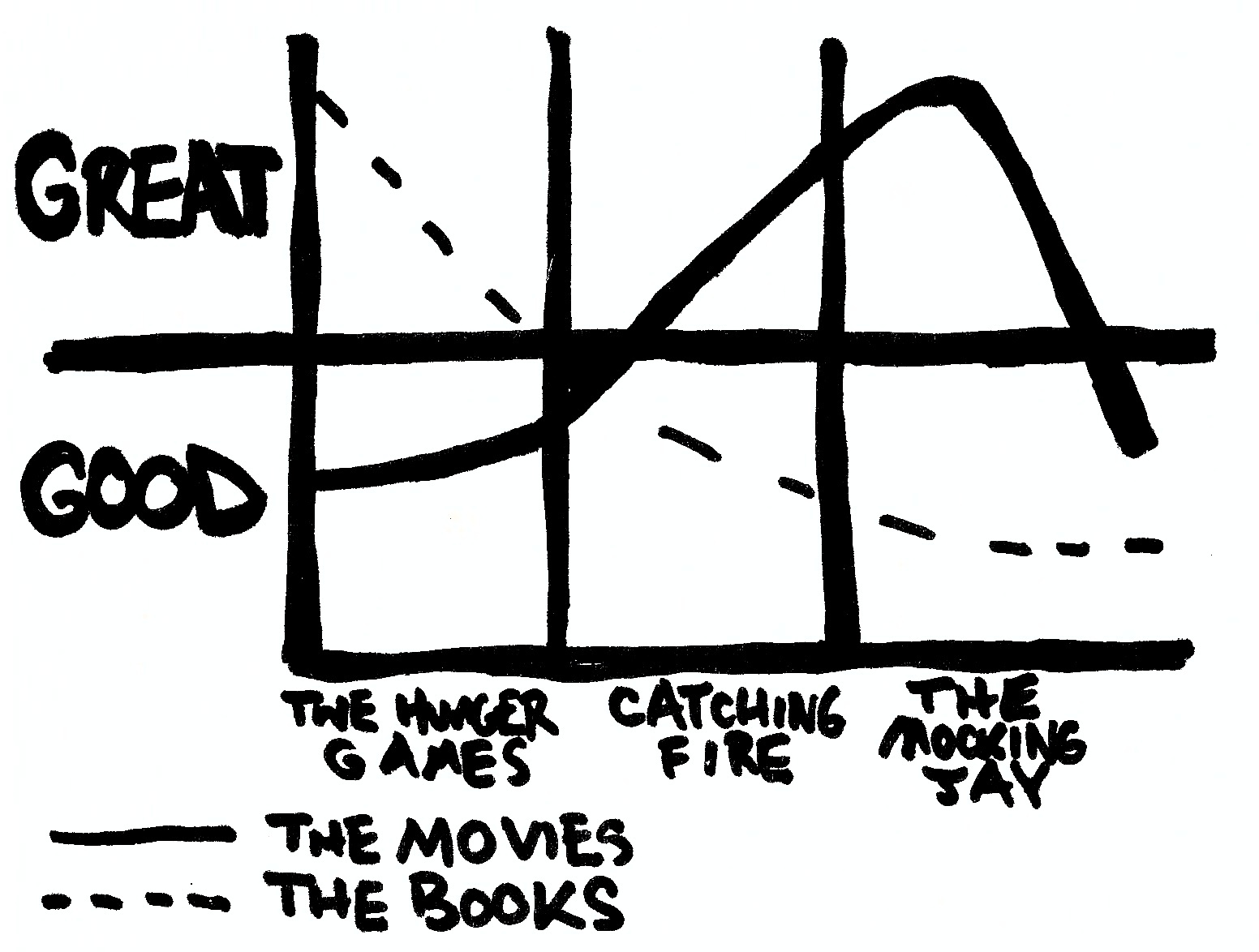
I’ve enjoyed following the Hunger Games saga, both as a series of YA novels & and as a series of dystopian sci-fi film. It’s a pretty grim franchise for something a lot of people consider “kids’ stuff”, one that takes its forcing-to-children-to-fight-to-the-death-for-entertainment premise very seriously. Its haves-vs-have-nots dystopian world-building is nothing particularly new and can especially be seen telegraphed in properties like Battle Royale & The Running Man, but I think it’s a pretty great sci-fi intro for teens, especially refreshing for its strong female protagonist Katniss Everdeen (played by Jennifer Lawrence in the films, duh) & in the way its potentially-corrosive love triangle conflict is handled. One strange aspect for me has been how the film versions of the Hunger Games trilogy have resisted the law of diminishing returns. I felt that Suzanne Collins’ novels started at their strongest point, doing a great job of establishing an in-the-moment intensity in its abysmal future-world by dragging the audience along closely with Katniss’ experience navigating the Hunger Games. The quality dropped off a bit for me in the sequels, though, as the pacing seemed to get away from Collins and large swaths of summarizing overtook the focused intimacy of early scenes. The first movie was pretty great as well, doing a good job of capturing Katniss’ in-the-moment POV, but the film series subsequently seemed to improve from there, knowing exactly what to show & what to ignore in Collins’ sprawling narrative for maximum effect.

EPSON MFP image

Mockingjay – Part I might just be the pinnacle of the Hunger Games movies for me. General consensus has the franchise peaking with the second film, Catching Fire, but I’d say it’s at the very least a close call. the film’s themes of PTSD, regret, powerlessness, and the pressures of being the face of a revolution all hit me pretty hard. I’ve heard friends & family describe the film as boring, saying nothing happened, which is pretty surprising for a film with such a high bodycount & grandscale warfare, but I had a genuinely emotional reaction to its horrors, getting teary-eyed at the film’s hospital bombings, mass graves, and three-fingered solutes. Its murderers’ row of talented actors certainly didn’t hurt: Philip Seymour Hoffman, Julianne Moore, Jeffrey Wright, Natalie Dormer, and Donald Sutehrland are all at the top of their game here, which is really saying something. I also appreciated scenes of Jennifer Lawrence, who is an incredibly gifted actor, pretending to be an incredibly inept actor as Katniss fails miserably to produce convincing propaganda clips to rally support for a revolution. Mockingjay – Part I‘s riots, uprisings, strikes, and rescue missions were all a lot more satisfying to me than expected & Lawrence deserves a lot of credit for anchoring the film’s emotional resonance.

Mockingjay – Part II unfortunately didn’t hold up quite as well for me. I think the issue is that Collins’ summarizing had gotten out of control by the final book, so that the film version struggles to make individual scenes count for much as it chases an exponential momentum of a plot trying to wrap up a widespread political revolution, a small family’s struggle to remain a unit, and a strained, increasingly bitter love triangle in just two hours time. There were a few small moments to enjoy in the chaos — my favorite was when Katniss is called out for the “tacky romance drama” & cliché  “the one” specialness of her mythology at a wedding — but for the most part the films struggles to let its Big Moments properly breathe. Mocking Jay – Part II‘s killer C.H.U.D.s & third act Major Character Death both failed to land with full impact thanks to the runaway momentum of Collins’ plot & pacing. And because director Francis Lawrence did such a great job with Catching Fire & Mockingjay – Part I, I’m willing to give him the benefit of the doubt & suppose that the rushed nature of Mockingjay – Part II was far from his fault. Considering all of the ground that the novel covers (I’m struggling not to go long here just touching on it), Francis Lawrence  could’ve stretched Mockingjay into its own separate trilogy & given each underserved scene its own proper moment to shine.

I can’t imagine impatient fans, who groused about splitting the finale into two parts in the first place, would’ve been receptive to a Mockingjay – Part III,  though. If you consider that Francis Lawrence had no choice but to split the finale into two parts, I think he did a great job of adapting a difficult work of fiction for the screen. Mockingjay – Part I carries the emotional weight the film series as earned over the last few years & Mockingjay – Part II does the necessary work of bringing the whole thing to a close. The two halves function well together as a single, four-hour feature. One picks up exactly where the other leaves off & together they do a satisfactory job of carrying a work that’s spread pretty thin to a convincing conclusion. Although I’d contend that Part I is the far superior picture, they average out to something pretty great in the end, which fairly unusual for the third film in a sci-fi trilogy.

Bonus points: I’d like to take this opportunity to give kudos to the Hunger Games series for being the only action franchise I can think of where fashion as an artform plays a deeply integral part to the films’ central themes. I particularly liked a moment in Mockingjay where Katniss is told she’ll be “the best dressed rebel in history” & it’s a sentiment that actually means something significant. It’s a cool, distinguishing detail, if nothing else.

– Brandon Ledet