The Not-So-New 52: Justice League — The Flashpoint Paradox (2013)

Welcome to The Not-So-New 52, your digital Swampflix comic book (adaptation) newsstand! Starting in 2007, DC Comics and Warner Premiere entered the direct-to-home-video market with animated features, mostly in the form of adaptations of well-received event comics or notable arcs. This Swampflix feature takes its name from the 2011 DC relaunch event “The New 52,” and since there are (roughly) fifty-two of these animated features as of the start of 2024, Boomer is watching them in order from the beginning with weekly reviews of each. So, get out your longboxes and mylar sleeves and get ready for weekly doses of grousing, praise, befuddlement, recommendations, and occasional onomatopoeia as we get animated for over fifteen years of not-so-new comic cartoons. 

Well … it’s come to this. This feature takes its name from the 2011 reboot of DC comics, The New 52, and if you’ve learned anything from reading these “issues,” it’s that each reboot of the comics requires a “crisis” event in order to reset everything and create a new, “fresh” jumping on point. For The New 52, that crisis was called Flashpoint, and it involved Barry Allen’s version of The Flash traveling back in time to prevent the death of his mother, only to return to a present so altered from his experience that things are worse for everyone else. Sure, his mom is alive in the present, but his wife is married to and has had children with another man, he is without his powers, and several key players in the ongoing preservation of mankind are absent or so altered that they are barely recognizable. If this sounds familiar to you, then maybe you read this comic, or maybe you watched the third season of CW’s The Flash, which adapted parts of this story, or you saw the disastrous Warner Bros release of The Flash last year, which also featured parts of this plot. For something so recent, it’s been picked apart and reused in quite a few adaptational ways. And hey – that’s fine! The source material isn’t the problem with this movie, it’s just that I hate the animation in this one, and I really despise that this was the first step in DC’s attempt to create a more interconnected universe (sigh) among these DTV features, which had heretofore been standalones or duologies. You see, this is the first film in the “DC Animated Movie Universe™,” and that series will encompass sixteen of the next twenty-four of these movies, with up to three or four of them being released in succession before they throw in the occasional standalone to break things up. I have a feeling we’ll be desperate for them when the time comes. On your mark, get set, I guess. 

We open with a brief prologue in which we establish the relationship between child Barry Allen and his mother, including her teaching him the so-called “serenity prayer” as a kind of proverb, followed by him discovering her murdered body after school one day. From this, we transition to present day, where Barry (Justin Chambers), accompanied by his wife Iris (Jennifer Hale), leaves flowers on his mother’s grave and says that he wishes he could have been fast enough to save her that day; Iris reminds him that he was only a boy, and if he had gotten home any earlier, it’s likely that he would have been murdered as well. This discussion is interrupted by news that several of Flash’s rogues have gathered at the Flash Museum in order to destroy his legacy; he arrives to face off against the Top, Mirror Master, Heat Wave, and Captains Boomerang and Cold. He handles them all with relative ease until the arrival of Eobard Thawne (C. Thomas Howell), aka the Reverse Flash, who manages to cement him onto a wall and attach a bomb to him. He also reveals that he’s put bombs on all of the other rogues present, and that’s when the rest of the Justice League arrive, and boy oh boy, are they ugly as shit. Their proportions are all out of whack in a way that I think is aiming to be anime-esque but is really just hideous. I mean, look at Superman here: 
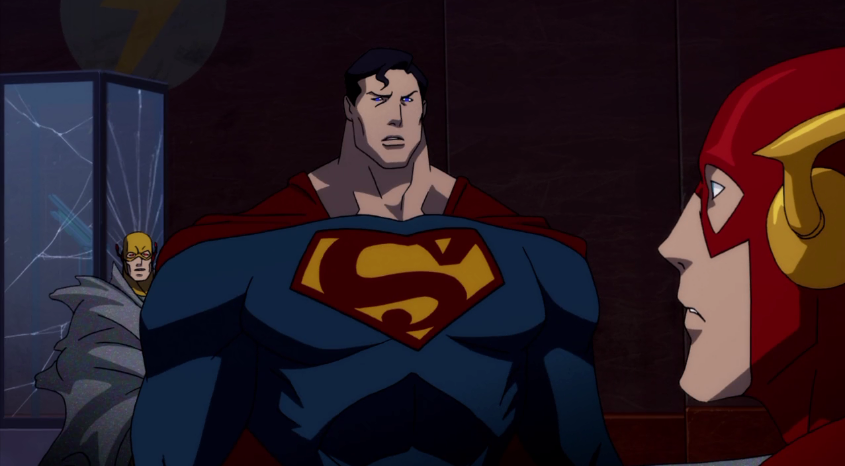
His insignia is three times the width of his face, and his shoulders are 8.5 times as wide as the widest part of his jawline. For comparison, when drawing the human figure in proportion, most artistic instruction tells the artist to draw the shoulder line as twice the length of the height of the head, or three times as wide. Superman’s shoulders here are almost double that, at 3.75 times his head height and 6.92 times his head width. I know that some of this is a matter of artistic license or preference, but I would prefer not to look at this; it’s fucking hideous. If we’re being charitable, we can say that this is probably to provide greater contrast to how emaciated and weak his alternate self will appear in the other timeline (spoiler alert), but I hate it, and it puts as much of a sour taste in my mouth about his new film “series” right from the get-go, both the first time I saw it and this time as well. 

Anyway, after they disarm the bombs and Thawne is taken into custody, he says some creepy shit and we head into the opening credits. When we re-emerge into the film proper, Barry wakes up at his desk to find that things are not quite as he remembered them; his boss asks him for an update on the case of the Elongated Kid being murdered rather than the Elongated Man, a TV news report shows a “Citizen” Cold fighting off Captain Boomerang at the Cold Museum, and oh, yeah, he doesn’t have his powers, and his mother is alive. He tries to tell his mom that he’s the Flash, but she doesn’t have any idea what he’s talking about. Elsewhere, a more grizzled Batman (Kevin McKidd) has no problem using guns or throwing his enemies off of buildings to their deaths, although his attempted murder of a villainess is interrupted by Cyborg (Michael B. Jordan, wasted in this role). The younger hero attempts to recruit the Bat into joining the squad that the former is attempting to put together—and in so doing exposits the greater context of what’s happening in this new reality—in order to end the war between Atlantis, as led by Aquaman (Cary Elwes) and the Amazons, with Queen Diana (Vanessa Marshall) as their leader. These two plotlines intersect when Barry, desperate to find someone to help him figure everything out, slips into Wayne Manor, where he finds that this world’s Batman is Thomas Wayne, who became a vigilante when his young son was gunned down in an alley, rather than the other way around. From here, it’s all about figuring out how to get Barry’s powers back and set right what once went wrong. 

There’s fun to be wrung here from some of the little twists of fate and characterization on the darker side of the mirror. It’s so corny that Martha Wayne becomes the Joker in the same moment that Thomas decides to become Batman that it loops all the way back around to being kind of cool, actually. The idea of the “Shazam Kids,” a group of kids to all merge into one hero in the form of Captain Marvel/Shazam is also a neat little touch. Otherwise, though this is a real slog to get through. My problem with the animation isn’t just that the new character designs are awful (although they are, just terrible, really), but also that some of the designs that are clearly reused from other projects look bizarre alongside these bulging hulks; this is most noticeable with the contingent of Atlanteans who are clearly just copied over from Young Justice (Kaldur is especially obvious), who look like carefully carved Greek statues next to the blown-out Aquaman. It also looks cheap, and it has the unfortunate problem of looking cheaper the longer the movie goes on, as if they were running out of budget with every minute. The seams show most close to the end when a newly-repowered Barry is running at superspeed, and the figure of him running on screen looks like an incompletely rendered animatic, like they didn’t actually bother to give the animation team time to finish rendering the CG elements for the final release. One would think that, with the launch of a new ongoing film franchise following this movie that some of the budget would be spent on creating, for instance, a CGI running Flash that looks top-notch, so that they could then use that same model for future films in the series, but this just looks like shit. Furthermore, although it isn’t this film’s fault, both other adaptations of this story for TV and film include the fact that Barry sets out to save his mother from being killed as the catalyst for the plot, meaning that the mystery in this adaptation—who changed the past and why—is utterly moot if you’re coming to this film after interacting with either of those pieces of media. 

I hate this one, and it doesn’t even really need to exist. In a meta sense, I understand the impulse to make one last movie under the Warner Premier label (which dissolved in 2013 and was absorbed into Warner Bros Home Entertainment and Warner Bros Animation; the next film will be released with solely the latter in its production logos), and to find it clever to do a rebooting crisis as the finale. That doesn’t make me feel more fondly toward it, however. Almost all of these movies so far have been completely standalone, with no connection to one another. So what continuity do you need to reboot in order to start telling a new story from the ground up? None! Just start your DTV interconnected franchise with the next movie! There was no tract of land here that needed to be cleared to build a new house, just open space, and they stuck this hideous movie in here for no good reason.

-Mark “Boomer” Redmond

The People’s Joker (2024)

The People’s Joker made me cry. 

A festival darling a couple of years ago, this DIY transfemme autofiction bildungsroman took an usually long time to reach general audiences, seeing as it was stuck in legal limbo for a while. You see, Vera Drew chose to tell the story of her life—from her earliest realizations that her body didn’t match her concept of herself, to her first real romance and how that other person’s journey of self-discovery helped her understand herself even further, into a happy, fantasy future—all through the lens of living in a comic book world. After an opening that parodies the framing device of Joker, we see a flashback to our essentially unnamed protagonist as a child (when her deadname is spoken aloud, by her mother for instance, it’s bleeped, except in one scene later where it’s uncensored to great effect). In this world, the little AMAB’s greatest dream is to one day be a cast member on UCB (that is, the United Clown Bureau, rather than the Upright Citizen’s Brigade) Live, a parody of SNL in which men in the cast are credited individually as Jokers or Jokemen, while all of the women are consigned to being credited en masse as “The Harlequins.” 

Notably, in this imagining, that Bruce Wayne is Batman is a well-known fact, and he all but rules Gotham with an iron glove. His drones scour the streets for crime, all comedy other than that of UCB Live has been outlawed, and there are films about him in-universe, one of which is clearly a take on Batman Forever, with one of the lines spoken by Nicole Kidman cracking our protagonist’s egg. When she asks her mother about it on the car ride home after the movie, and whether one could be born into “the wrong body,” her mother takes her straight to Arkham, where the sinister Dr. Crane prescribes a semi-antidepressant called Smylex, which is taken via inhaler and instantly distorts the patient’s face into a rictus grin. After a troubled childhood in which an eternally offscreen father leaves all child-rearing to his wife, and with whom our protagonist has an understandably strained relationship, our protagonist (now played by Vera Drew as an adult) moves to Gotham and attempts to get involved on UCB Live and is accepted into the incubator program only to discover that it’s a for-profit scam. This does enable our protagonist to meet their new best friend, Oswald Cobblepot, at the UCB center, and the two of them decide to set up their own illegal anti-establishment “anti-comedy” club. A whole rogues gallery becomes the (lampshaded) found family of the protagonist, including Poison Ivy, Catwoman, Bane, and the Riddler (who gets in early as riddles are, in fact, the antithesis of jokes, making him perfect for their anti-comedy). Our protagonist finds that none of their jokes land, until one day, they see a performance by a Joker named Jason Todd, who’s modeled after the Jared Leto “interpretation” of the character, down to the “damaged” tattoo on his forehead. 

The audience notices before our protagonist does that Jason’s open coat reveals his top surgery scars, so it comes as little surprise to us when he comes out as transgender to our protagonist, although it’s a mild shock to them. Our protagonist asks to be introduced on stage as Joker the Harlequin, and we see Joker and Jason, whom she calls “Mistah J,” play out, and it’s a perfect encapsulation of the complexity of relationships with people who are, whether they tell you at the start with a tattoo on their face or not, damaged. People who are toxic can also be the first people to see us for who we really are, and while that doesn’t cover for the ways in which their behavior is harmful, it does add shades of gray to the fact that these are people who may ultimately teach us something about ourselves. This culminates in our protagonist’s decision to proceed with gender affirming care, presented here as her plummet into a vat of estrogen, Harley Quinn style, only for her and Mr. J to come face to face with the Batman, who has his own abusive backstory with Jason. This is all stuff that is better discovered than recapped, so I won’t summarize further, but this sort of gives you the idea of what this narrative is. Kinda. 

What’s really fun here is just how many different ideas and styles are combined. The segments about J-the-H’s childhood are largely live action, sometimes in locations or sets but sometimes backgrounded only by collages or drawings of her hometown of Smallville. The film-within-a-film mentioned above uses action figures and 3D models to bring not-Batman Forever to life, while some sequences are fully comprised of what appears to be hand-drawn animation. One character exists solely as a puppet, while Poison Ivy is a purely a computer model that looks like she was rendered for a Windows 2000 ROM-based semi-animated point-and-clicker, and characters with more immediate impact on the plot appear in whatever the reimagined memory demands. Some of the film is some combination of several of these, and it’s often so poorly composited that it looks like it’s been cobbled together with excerpts from The Amazing Bulk, but that adds charm rather than taking away from it. I should warn that making the film “busy” in this way might not work for everyone; my viewing companion in particular said that the film’s constant jumps between styles did not mesh with his particular strain of ADHD, and this seems to have made the narrative less legible to him than to me. If you’re able to handle pastiche movies like the kinds put out by Everything is Terrible, you’ll be able to follow this. 

There’s a lot of heart here, especially when it’s clear that Vera is speaking through Joker, like when she admits that when she first arrived in the city she would sometimes call suicide hotlines that would automatically connect her to Kansas because of her area code, and she would use that experience to ground herself by asking how the weather was back home, even if that place had never really been “home.” It’s not all positive, however, as we also feel the biting sting of betrayal when Mr. J calls her by her deadname, the only time that it’s said clearly, in an argument; as she recalls, he had never even known her by that name, so it wasn’t an accident or a slip of the tongue but an intentional use to hurt her. It’s visceral and real, which feels like an odd thing to say about a movie that so provocatively calls attention to its artifice. 

One thing that this one has over the film that it’s parodying/satirizing/reimagining is that it’s actually funny. I’ll admit that I didn’t see the entirety of Todd Phillips’s Joker, but I can promise you that I saw enough. It’s not funny. And hey, not every joke in this one lands, but they come so fast and so furiously across a variety of spectrums that there’s going to be something for everyone here, except for the people who refuse to give the film a chance based purely on their ideologies. The anti-comedy stylings of several of the jokers are funny in their anti-humor with no real knowledge of comics, but there are obviously in-jokes and references, like the omnipresence of the TV-topping mind control device that Jim Carrey’s Riddler’s plan in Forever hinged upon and Catwoman’s complaint that Frank Miller always writes her as a sex worker (not that sex work is bad, she clarifies, but because it’s sexist of him to think that women can’t just be burglars). Most of these are funny even without the context, and some of the jokes that landed most with my theater crowd were oblique jokes about pop culture in general; the biggest laugh of the night came when the yet-unhatched Joker asks to be introduced on stage as Joker the Harlequin for the first time and their Penguiny friend commenting on their femme attire and pointing out that drag, like comedy, had been outlawed, but only because of the fallout from the explosion at RuPaul’s fracking ranch. 

This is an unusual experience of a film, and I expect that whatever impact it might have been able to have on larger culture has been largely blunted by Warner Bros’ intensive scrutiny and attempts to prevent its release with (unsustainable) claims that it falls outside of fair use, and the overall silence about it (so far at least) from the dipshit side of the cultural divide means that it may not get the popularity bump that everything the right wing pundits complain about does, for better and for worse. I didn’t really know what to expect, and I got something that was unique in its presentation but universal in its examination of the way that (sigh) sometimes, it’s society that’s sick, or it’s our parents who make us sick by their reaction to curiosity and parts of the human experience that are repressed due to societal pressures. It’s an Adult Swim fever dream, and, in its final moments and with its final line, it brought tears to my eyes. You know if this is for you, and if it is, seek it out.

-Mark “Boomer” Redmond

The Not-So-New 52: Superman — Unbound (2013)

Welcome to The Not-So-New 52, your digital Swampflix comic book (adaptation) newsstand! Starting in 2007, DC Comics and Warner Premiere entered the direct-to-home-video market with animated features, mostly in the form of adaptations of well-received event comics or notable arcs. This Swampflix feature takes its name from the 2011 DC relaunch event “The New 52,” and since there are (roughly) fifty-two of these animated features as of the start of 2024, Boomer is watching them in order from the beginning with weekly reviews of each. So, get out your longboxes and mylar sleeves and get ready for weekly doses of grousing, praise, befuddlement, recommendations, and occasional onomatopoeia as we get animated for over fifteen years of not-so-new comic cartoons. 

Superman: Unbound is a breath of fresh air after what feels like way too many of these animated DC movies in a row that were centered around the morality of killing. Under the Red Hood had, as its central feature, that the Red Hood’s vendetta against Batman wasn’t because the latter let Jason Todd die, but because he let Jason’s killer, Joker, live. Superman vs. The Elite focused on the importance of Superman’s intractable moral code and how his rule that he never uses deadly force ensures that he is a benevolent force in contrast to the “modern” Elite. Dark Knight Returns has Batman’s refusal to break his no-killing rule in order to put Joker down for good also be a major plot point, as his almost doing so and then being framed for the Joker’s murder is the primary axis on which the second part turns. Although all of these movies were adaptations of source material that was spread out across decades of comics, having all of them adapted within such a short time was beginning to feel stale and uncreative. And that’s not even getting into the fact that the next film from this studio, Flashpoint Paradox, will also feature this as a plot point (in the form of an alternate timeline Batman who is willing to murder), it’s nice to get a break from that, if only for one movie. 

That Unbound is a little different is a nice change of pace, even if it creates a bit of a snarl regarding which of these movies are related to each other, which shouldn’t be too much of a surprise, given how often this is a problem in the originating medium. Remember when we talked about Superman/Batman: Apocalypse, and how that was an adaptation of the “Supergirl from Krypton” story arc in that book that led into the 2005 relaunch of the Supergirl comic, which was itself created to reintroduce the character after the most recent reboot of the company’s continuity with 2005-6’s Infinite Crisis (not to be confused with 1986’s Crisis on Infinite Earths)? Long-running Superman foe Brainiac hadn’t been seen since that crossover event, and was reintroduced in 2008 with a storyline in the “Brainiac” storyline from Superman’s main comic, Action Comics, upon which Unbound is based. That comic plot heavily featured the involvement of the new Kara Zor-El Supergirl that we all now know and love, and threads left over from both “Supergirl from Krypton” and her own ongoing series are part of the “Brainaic” arc. So, to recap, this film is an adaptation of a storyline that follows closely upon and directly tied to the storyline that was adapted into Apocalypse, but Unbound is, for some reason, not a sequel to Apocalypse in its film form. It’s okay if you need to take a break or a drink after that, I promise. It’s not really relevant, but has to be mentioned because, in case you’ve never noticed, comic book pedantry is the lifeblood of the internet, where you’re reading this right now. 

Unbound opens in the middle of a hostage situation, as Lois Lane (Stana Katic) has been taken by armed men after volunteering to be their captive in lieu of other, less Superman-adjacent people who might otherwise be at higher risk, per her logic. It’s not him who comes to her assistance initially, however, as the first hero to arrive on scene is Supergirl (Molly Quinn), whose recent appearance in this fictional world is given some lip service based on the fact that Lane’s captors don’t recognize her. Superman (Matt Bomer) eventually arrives on the scene, and our unrelated-to-the-plot action cold open comes to a conclusion. Back at the offices of The Daily Planet, one of Lois’s co-workers hits on her piggishly while insinuating that he “knows” Clark and Lois aren’t together because there can be only one reason that Kent is forever disappearing without explanation and is ostensibly single despite being built like a brick house, and it starts with “in” and ends with “the closet.” Clark walks in while this is happening and uses his heat vision to cause the man to take a harmless but humiliating tumble out of his chair, which sets up our emotional conflict for this film: Clark and Lois are dating, she knows his secret identity, she does count on him to rescue her from terrorists but not the office misogynist, she thinks that there’s no reason to keep their relationship a secret while he keeps her at emotional arm’s length with that tired old canard about how their dating as civilians would somehow endanger her, and so on and so forth. 

As a side note, for each of these movies that has focused on Superman as the primary character (rather than just as a member of the Justice League), whether as a result of what source material is chosen for adaptation or through deliberate choice, the most traditional Clark/Lois relationships (she adores Superman and either sees Clark as just a friend or is obsessed with proving that he’s secretly the big blue boy scout) has either been excised or used as part of the narrative and then dismissed. In Doomsday, Lois and Superman are openly dating but he refuses to “come out” to her as Clark until the end of the film, when his (temporary) death at the hands of the titular villain put things into perspective for him. In Public Enemies, she’s absent completely, other than an unvoiced cameo at the end of the film, and she’s likewise not present in the entirety of Apocalypse. All Star Superman featured their relationship as a major part of the plot, with Superman and Lois having been an item for some time and him again “coming out” to her as Clark as he nears the end of his life. Most recently, in Superman vs. The Elite, their relationship was as intimate as it could be, with her already being aware of both of his identities and the two of them at least cohabitating and possibly being married already. Here, the formula is a little different: she’s aware of both of his identities, the two are dating, but they’ve kept their relationship (as Clark and Lois) a secret; even still, based on the recurring story elements we’ve mentioned, it’s not exactly a surprise that the events of the film cause Clark to (sing along if you know the words) re-evaluate his position and decide to come around to Lois’s more open way of thinking. 

Back to the narrative, Clark must dash out of a staff meeting when there’s news of a meteorite that’s headed toward Arizona. When he gets there, however, he learns that the meteorite is actually a probe that can transform into a humanoid robot that he puts down after some difficulty. Bringing the ‘bot back to his Fortress of Solitude, Kara joins him and identifies the probe as a herald of Brainiac (John Noble), a spacefaring cyborg who roams the galaxy in an effort to collect all knowledge in the universe. It’s not a bad goal, but his methods are genocidal: he finds planets with sentient life, “collects” one of said planet’s major cities and shrinks it down to bell jar size and keeps it in his menagerie, then destroys the planet. It’s the result of a flaw in his programming; once he’s “studied” a planet, he can’t let it grow and change from that point forward because then his knowledge would be incomplete, so he must ensure that his database remains inerrant by freezing the planet in time via total annihilation. Kara saw him in action when she was a child, as he came to Krypton and “collected” the planet’s Argo City; the only reason anyone lived to tell the tale was because Brainiac didn’t see the logic in wasting the energy to blow up a planet that was already on the precipice of destruction. Having learned this, Superman heads into space aboard a Kryptonian ship to face Brainiac head-on and, if possible, restore the shrunken cities that the cyborg has captured. 

I like how straightforward this one is, and as these movies go, this is possibly one of the ones with the lowest barrier to entry. You don’t really need to know anything about Brainiac since it’s all explained over the course of the film. There are a lot of nifty setpieces, like Supes’s early desert battle with the Brainiac probe, Superman’s time spent shrunken down and placed into Argo City, and the final swampy battle between Superman and Brainiac proper. This film also approaches the series’ mandate for more adult storytelling from a different angle, as it doesn’t rely solely on more violence to hit a PG-13 rating, and instead uses more adult humor (Lois is surprised that Clark didn’t think of pretending to be gay years ago, as it’s “the perfect cover,” made more on-the-nose given that this is the first time that the character has been voiced by an out gay man). There’s also some horror on display here, too, of the overt body horror variety on display with all of the upgrades Brainiac has made to his body and the way that all of his weird prehensile tubes attach to him, as well as the terror of more subtle moments. This is best evidenced when Superman is horrified to learn that the people in Brainiac’s shrunken cities are alive but essentially in stasis, meaning that one of the children who is excited to see him has been a toddler for decades. It’s good stuff, and reminds me of the simplicity of the old Fleischer Studios Superman cartoons of the 1940s: straightforward, cleanly animated, and digestible. Not necessarily the best of the lot, but a perfect low-commitment animated movie for a rainy weekend afternoon. 

-Mark “Boomer” Redmond

Family Portrait (2024)

Boredom is a funny thing. I recently attended a screening of Family Portrait, a domestic drama that runs just under eighty minutes. In truth, I call it a “drama” because I’m not really sure what else it could be, even though the word drama implies a level of action that’s not really present here. I don’t want to come down too hard on this film, as it was made by a local filmmaker and shot in the hill country near me, with help from a grant from the film society to which I belong. When asked about it by friends after the show, I admitted that although I wasn’t bored by it (I am, after all, that insufferable film person archetype who loves The Tree of Wooden Clogs and whom the internet loves to hate), it was boring. Intentionally so, I think, but nonetheless, a successful experiment in generating the sensation of being the guest at someone else’s family get-together and having nothing to do there is going to be, well, that. Director Lucy Kerr could not be present at the screening that I attended, but she shot an introduction for the film that looked like she was being forced to do it at gunpoint, and that set a certain tone for the whole thing.

The plot, such as it is, revolves around Katy (Deragh Campbell), who has returned to her family’s humongous estate, which lies on the Guadalupe River, so that her assembled sisters, brothers-in-law, and nieces and nephews can take their Christmas card photo. Also present is her boyfriend Olek (Chris Galust), a Polish immigrant, who is to be the photographer and who is excused from the photograph as he has not married into the family yet. After the film opens with a dialogue-free scene in which these as-yet-unknown-to-us characters cross a large yard and gather beneath a tree in slightly slowed footage, the soundtrack droning as we see a few small interactions between characters that imply we’ll be learning more about them later, we start the day with Katy, who wakes up later than the rest of the family. She asks Olek why he reacted the way he did to one of the other near-dozen adults the previous night; he didn’t like the way that they were talking about his accent (which they misidentify as Russian despite knowing he’s Polish), and she reminds him that these are simple Texas people. Her mother prepares breakfast (with the help of a “domestic”), her father tells a meandering story about how one of the family’s photos (that we don’t get to see) is a famous one that was long-misidentified as being from the Vietnam War rather than from WWII. The family gets word that an uncle’s stepdaughter has died after a recent hospital visit; Katy’s father expresses that he thinks that she died because she went to the hospital (and in this case he appears to be right, as the implication is that she was an early COVID-19 victim before the virus was acknowledged), which leads to a light argument with his daughters about hospital safety and mandatory (meningitis) vaccines (for public university students). 

Most of the film follows Katy as she tries to find her mother so that they can take their card photo and she and Olek can catch their flight, while everyone else just kind of shrugs off her concerns and says that the matriarch has to be around somewhere. Most of the interactions that take place do so around her as she wanders the property, finally going into first the woods and then the river before coming back to the house, and the film ending. Two of her brothers in law lounge on lawn chairs as one recounts to the other at hypnotic length about how the office that he worked at in the early nineties became obsessed with watching a streaming video of a university coffee pot. Her sisters have a brief talk about dreams in the most literal way possible; one of them admits that she literally has no ability to imagine things, that she can’t create an image in her mind, and that she doesn’t really know if she dreams. Recounting it as a topic here makes it sound thoughtful, and I want to clarify here that this is not the case. It’s more like being privy to a discussion between three adults with no real inner lives to speak of as they while away a lunch date in the next booth over at Bennigan’s. In fact, every conversation that every character has is so insubstantial that, in comparison to how little seemed to happen, I’m surprised I was able to get this much text onto the page describing these vignettes. 

They only constitute about a fifth of the film, however, as the rest of it consists mostly of long shots of leaves blowing in the wind, water flowing in a stream, minutes-long extreme close-ups of jawlines and partial profiles, and long pans around what can only be described as a compound rather than a yard as Katy languidly looks for her mother. One of my first interpretations, which I must admit is not too charitable to Kerr, was that this was a poor attempt at imitating European art films. You know when you’re watching something like King of the Hill or Arrested Development or The Simpsons and there’s a gag about a film in the vein of, say, Tree of Wooden Clogs, and they parody it as plotless, static, and boring? Family Portrait, in some ways, feels like someone who’s never seen a European film but who has seen the parodies of it trying to make an earnest attempt at that kind of art. That’s boring, but like I said, that doesn’t bore me. I’ve seen a lot of this kind of grasping for artistic merit over the years, and this one is far and away one of the prettiest examples, if nothing else. From there, though, I thought, perhaps that is the point. After all, we’ve all had that feeling of the midday doldrums, the feeling you get when you’ve been around family for too long (or spent some time with someone else’s huge family) and you’ve got nothing but time to kill until the appointed hour of dinner or to leave (or take a family picture). Adding a layer of that element of anxiety that’s moderately surreal and ephemeral but not quite nightmarish; it’s a stress dream about getting everything together in time to make it to the airport and trying to get help from the people around you, but they’re all completely apathetic about it. It evokes that fine line between boredom and panic, and if I had come to rest on that as my final reading of the text, I would have concluded that the movie was a bit pretentious but harmless and sufficiently pleasant in terms of its technical composition, and I’d add that I was glad I had seen it in the theater as I don’t think I would have been able to stay engaged at home. 

But in the composition of this review, I’ve decided to try and go very generous with regards to Kerr, and say that maybe Family Portrait isn’t about that at all. You see, this isn’t at all what I was expecting when I first saw this on the film society’s calendar, with a blurb that summarized the film as “Gathering at the dawn of the COVID-19 pandemic, a Texas clan’s attempts to sit for a photograph are foiled by a missing matriarch and her disturbed daughter,” and which promised “a study of cracked family dynamics into a series of chiaroscuro contrasts.” You read that and you think “Oh, maybe it’s about a family that doesn’t get along very well but who are able to put things aside once a year for this picture, and then they end up trapped together for an extended period of time.” That sounds fun. Or “Maybe it’s about the conflict between this rich family and their servants as they’re all forced together.” I loved Triangle of Sadness, that sounds great! But this film is none of those things. The novel coronavirus is largely a background detail in Family Portrait, and I couldn’t stop wondering why such a minor narrative element was so vital to the narrative of the marketing. The sudden disappearance of Katy’s mother isn’t because she got infected; that’s not how it works. 

The only conclusion I could reach was that, perhaps, this is a film about the banality of evil, in a similar vein as Zone of Interest. If that’s the case, it’s also an oddly confessional one, as Kerr shot the film entirely in and around her family home, which she notes in the introduction is called “Kerplunk” in a presumed play on the family name (and in fact, a plaque with Kerplunk written on it appears in one of the many common rooms in the house, where the men of the family are watching football). If I were a first-time filmmaker and the recipient of a grant, I wouldn’t cop to the fact that I grew up in that level of decadent comfort, in a gigantic home of countless rooms on an estate that meets a lazy flowing river and encompasses various other buildings as well as separate tennis and basketball courts. It’s like advertising to the whole world that you had the privilege of a spacious home and plenty of outdoor space while the rest of us were squirreled away in our little apartment hovels sanitizing apples and cereal boxes. This family, which we’ll call “the Kerrs” for the sake of simplicity, are completely insulated from the reality of the pandemic at their gates, with their servants still at hand and where the most stressful thing in life is trying to take a photograph. The banality of every conversation, then, contributes to the larger examination of aristocratic separation from common suffering, and that’s a brave thing to bring to the table for dissection as a filmmaker. 

Is this a confession? A pretension? An experiment in boredom? In the end, I’m not sure. 

-Mark “Boomer” Redmond

Lagniappe Podcast: All About Eve (1950)

For this lagniappe episode of The Swampflix Podcast, Boomer, Brandon, and Alli discuss the Old Hollywood classic All About Eve (1950), starring Bette Davis.

00:00 Movie of the Month

04:20 We’re All Going to the World’s Fair (2022)
11:58 Deerskin (2020)
17:38 Problemista (2024)
28:34 Nimona (2023)
32:26 Family Portrait (2024)
37:15 Aliens (1986)
41:00 The Birds (1963)
47:10 King Kong vs. Godzilla (1962)
54:10 Riddle of Fire (2024)

57:17 All About Eve (1950)

You can stay up to date with our podcast through SoundCloudSpotifyiTunesTuneIn, or by following the links on this page.

– The Podcast Crew

Problemista (2024)

I’ve been a fan of Julio Torres’s for years, ever since a friend introduced me to the joys of Patti Harrison and I got into that whole crew. Los Espookys was a lot of fun, and I was excited to hear about his directorial debut when it originally premiered at SXSW last year, in 2023. It took some time for it to make it to my local theater, but I was excited to see that not only did it hit the mainstream multiplex nearest me, but that there was a surprisingly dense group of people in attendance at my Tuesday night screening, and it got a response from everyone there. 

Alejandro (Torres) is the son of a Salvadoran artist, and many of her designs for public art features came from his imagination, made manifest by her. As an adult, he’s living in a nightmare NY apartment situation and attempting to break into his dream job, as a toy designer for Hasbro. Unfortunately, despite his application to their “talent incubator program,” which included such designs as Cabbage Patch Dolls that have smartphones and the attendant anxiety that comes with such devices, slinkies that simply refuse to go down stairs, and a Barbie with her fingers crossed behind her back (instant drama in the dream house), he has not been selected. Instead, he makes a meager living at a cryogenic facility, where he is assigned to a particular corpse, Bobby (RZA), a painter who was focused on one particular subject: eggs. Bobby’s been frozen for over twenty years, and his art critic wife Elizabeth (Tilda Swinton) is fed up with the ever-increasing cost of his “care.” When Alejandro is fired for a workplace accident—one with zero consequences—at roughly the same time that Bobby is to be moved to a smaller, less expensive part of the facility that does not accommodate his paintings, he latches onto the idea of helping her put together a show of Bobby’s work, as she needs the help and he needs an employee sponsorship in order to remain in the U.S. She agrees, but Ale quickly realizes that he’s bitten off more than he bargained for. Elizabeth is, it turns out, an erratic, defensive, bitter, verbally abusive narcissist, perhaps the exact evil monster his mother foresaw him encountering in a dream. 

Swinton’s performance here is utterly phenomenal, and Torres’s directorial and narrative choices that make her alternatively demonic, sympathetic, and delusional are pitch perfect. There are countless tiny details about Elizabeth that build a portrait of a very particular kind of person, one whom all of us have encountered at some point. When she’s sold on something, she’s devoted to it to the point of nearly psychotic loyalty, as evidenced by her obsession with using FileMaker Pro, a three decade old computer program, in order to maintain continuity across all of her databases. She’s hit a point of technological arrested development, and her frustration is made the problem of everyone else around her: Apple phone service agents for whom explaining how to find her photos on her phone is a daily occurrence, Ale for having to learn software that might be older than he is, and everyone who crosses her path and is blinded by her smartphone’s flashlight, which is always at full blast. She’s a classic evader, as she deflects any and all attempts to rationalize with her by changing the subject to one of her other countless complaints, and she has no appreciation for how her apathy toward signing his sponsorship documentation keeps him in a perpetual state not just of anxiety but of danger as well. 

Alejandro is her perfect foil in addition to being her assistant and, in some ways, both her student and her teacher. The details are best left discovered through a viewing rather than recited here, but the plan to be saved from deportation via Elizabeth’s sponsorship fails … but not before she empowers him to achieve not just his short-term goal of staying in the country, but his larger goals of sharing his ideas with the world through his toy creation. When he was a boy, Alejandro’s mother never limited his dreams in the slightest, and instead of that making him a selfish, demanding adult, it’s made him a soft-spoken sweetheart, and through learning to stand up to Elizabeth and break through the barrier she’s built between her reality and the world at large, he grows. And, having witnessed (and received) countless rants and diatribes from Elizabeth, he learns that this is rarely the best way to resolve a situation; there are instances in which it’s the only way to resolve it, though, and he uses this new wisdom to not only make sure that he receives credit for his ideas, but to secure a future for himself. The film has already provided an alternative happy ending by creating a path for him to stay in the U.S., and in a more realistic movie, we would likely have seen Ale accepting the job as a translator from his immigration lawyer and we would end the film with his next year’s submission to the Hasbro incubator program. Instead, Alejandro goes for broke and so does Problemista, to my delight. 

If you haven’t seen the movie or any of its advertising, then this probably sounds like a fairly straightforward plot description, since I’ve mentioned absolutely nothing about the film’s touches of magical realism, other than a brief mention of Ale’s mother’s dreams about his future. In the dream, she sees her son approaching a darkened cave, the depths of which are completely occluded other than two glowing red eyes. Elizabeth becomes that monster, dragon-like, but when Alejandro breaks through her self-deception forcefield and gets her to take an opportunity to show Bobby’s paintings despite it being “beneath” her, he appears in that imagined cave wearing a child’s toylike idea of a chivalric knight’s armor, besting her. Alejandro imagines the thirty day grace period he has to find sponsorship for his employment visa as an upturned hourglass, set amongst hundreds of other such devices, and he sees a woman fade from existence in front of him at the lawyer’s office when her time runs out. And, when he is forced into a series of degrading, quick, for-cash Craigslist jobs, the website is personified as a living being (Larry Owens) that presents him with opportunities for food delivery, handing out hair care product advertisements, and, ever present as a last resort, “Cleaning Boy (kink).” 

There are a myriad of effusively captured smaller roles here as well. Torres’s partner James Scully, of You and Fire Island fame, is ironically cast as Ale’s nemesis. The perfectly named Bingham is a white, New England landed gentry layabout whom Elizabeth is asked by a friend to take on as a secondary assistant, and whose effortless WASPy sycophantism charms her. There are hints throughout that Elizabeth may owe what meager success she had in her critical career to her aggressiveness and self-delusion more than to her eye for art, and although I don’t know that this makes her “shallow” necessarily, she’s positively wooed by Bingham’s surface level blaséness and taken in by him, to the degradation of her working relationship with Ale. One couldn’t ask for a more perfect narrator for all of this than Isabella Rosselini, whose soft enunciation of Torres’s script creates just as much magic as the visuals, and as a fan of Killjoys, it’s always exciting to see Kelly McCormack out and about in the world, even if her appearance is brief (but memorable!). My favorite appearance, however, was from Greta Lee, who appears briefly as Dalia, a former protegee (and more) of Bobby, who is in possession of Blue Egg on Yellow Satin, the final painting needed to complete his posthumous(?) show. She’s an utter delight to see here, and she makes a big impression despite her relatively short screen time. 

This is my favorite movie that I’ve seen so far this year, and I couldn’t have been happier that I ended up in a less-than-ideal seat at the theater because there were so many other people already there. There was a constant undercurrent of pure joy that rippled throughout, and it proved that it had something for everyone as groups of various ages released giggles, laughs, and even the occasional chuckle, all over different bits and jokes. (One thing that we could all agree on: Torres’s eccentric running style never got old.) I loved this one, and if you have enough joy in your heart, I think you’ll love it too. 

-Mark “Boomer” Redmond

The Not-So-New 52: The Dark Knight Returns (2012, 2013)

Welcome to The Not-So-New 52, your digital Swampflix comic book (adaptation) newsstand! Starting in 2007, DC Comics and Warner Premiere entered the direct-to-home-video market with animated features, mostly in the form of adaptations of well-received event comics or notable arcs. This Swampflix feature takes its name from the 2011 DC relaunch event “The New 52,” and since there are (roughly) fifty-two of these animated features as of the start of 2024, Boomer is watching them in order from the beginning with weekly reviews of each. So, get out your longboxes and mylar sleeves and get ready for weekly doses of grousing, praise, befuddlement, recommendations, and occasional onomatopoeia as we get animated for over fifteen years of not-so-new comic cartoons. 

In this very special double-sized issue of The Not-So-New 52, we will be covering not one but two films (after a fashion). Even though it’s Marvel that’s better known for their double-sized special editions, I won’t let the fact that Warner Premiere released their adaptation of Frank Miller’s seminal 1986 work The Dark Knight Returns in two separate parts keep me from reviewing them together. Combined, they make up a run time of just about two-and-a-half hours, which is the length of a real movie and is shorter than any live action Batman movie has been since 2005, so let’s get to it.

The Dark Knight Returns is probably one of the best known stories in the Batman canon, right? It, alongside Watchmen, basically shattered the paradigm of comic books as a medium in the late 1980s, ushering in (for better and for worse) a whole new era of comics, one designed with a more mature reader in mind. For some, this meant more adult storytelling; for others, this meant more grounded, realistic stories; for still others, this meant more tits, guns, and swearing, none of which are bad things in their own right, but which were not used creatively. The comic version of Returns can be considered a bit of an original sin with regards to creating expectations of maturity in the medium that instead ushered in an era characterized by a lack of subtlety, artistically meritless storytelling, and so, so, so many pockets—more than anyone could ever want or need. But Returns can’t be blamed for that, since other than a few poorly aged elements (as in Year One, Frank Miller’s depiction of Selena is once again as a sex worker, although she’s graduated to madame in her old age), there’s nothing that stands out. It was groundbreaking in its time and for good reason. Even reading it today, it’s hard not to be impressed with the unconventional use of the medium, from the way that political talking heads are presented in little boxes that capture the not-quite-square edges of a cathode ray tube TV, the way that simultaneous action is depicted not from simple panel-to-panel cutaways but in the way that a splash page might be boxed in by a series of smaller squares and errant dialogue boxes. Its place in the canon is well-deserved, and while I understand the critical backlash when it’s viewed through the lens of its (il)legacy, I see this for the landmark that it is. 

This is the story of an aged Bruce Wayne, forced out of retirement just as Jim Gordon is forced into it, back on the prowl after watching his city fall into disrepair and dystopia under the Reagan administration (an element that the film keeps intact, making a product of its time into a period piece). As more innocent civilians fall victim to the ever-expanding gang calling themselves The Mutants, Bruce once again dons the cowl in order to fight the rising tide of crime in Gotham. Along the way, he finds himself aided by Carrie Kelly, a teenage tomboy who christens herself the new Robin and refuses to be left out of things. Unfortunately, although the wounds of the past may scar and heal, they can also run deep. The supposedly reformed Harvey Dent, now having undergone extensive reconstruction of the side of his face that scarred him and made him Two-Face, is unable to avoid the temptations of recidivism and his own alter ego, while the Joker, catatonic (and thus harmless) for decades, awakens out of his waking sleep as soon as his nemesis returns to public attention. 

This ends Part 1 of the films, while Part 2 spends some time with the long-delayed final dance between Batman and Joker, which ends in a way that brings down the wrath of Gotham’s new commissioner, Ellen Yindel, who wants Batman brought down, dead or alive. Outside of the context of all of this, there’s Cold War shenanigans afoot, which finally intersects with our main story when the Gipper starts a nuclear war with the USSR via conflict with the fictional nation of Corto Maltese. Superman, reduced to little more than an errand boy for the White House, manages to divert the missiles that are bound for the US, but only just, and the resultant EMP blast causes chaos in Gotham. Through the respect that he commands from the Mutants gang—some of whom have already rechristened themselves “Sons of Batman” following his hard-won defeat of the Mutant leader—he conscripts them to help get people out of harm’s way in the forms of various fires and other disasters. In one memorable image, the shadow of an airplane that is falling out of the sky grows larger as people scream in terror below. And in the midst of all of this, Reagan sends Superman in to “handle” his old friend.

Frank Miller, who wrote both Year One and The Dark Knight Rises in a short period of time in the back half of the 1980s, is a polarizing figure, and there are elements of his political … “eccentricities” all over the original work and, as a result of being a pretty faithful adaptation, this film. Don’t be confused by the fact that Reagan is presented as a bumbling fool playing dice with the so-called free world in the name of his ego and the corporations that own him; this is a story that deeply reflects the right-wing views of its creator. It’s tricky, because Miller’s oeuvre often reflects a staunch anti-authoritarian bent, insofar as he depicts all politicians as either puppets or puppeteers, all police (other than Jim Gordon) as rotten and violent, and all authority as inherently corrupt. On the other hand, his heroes are usually somewhere on a narrow spectrum between the Randian hero (individualistic, suited to his life through intelligence and aptitude, characterized by moral fortitude — at least in the eyes of the author) and the Great Man Theory (that great leaders, like Batman and Jim Gordon, are born with the instinct to lead when the need for them to emerge is greatest, and that history is founded upon the acts of such men); the latter of these two is a pillar of fascism, and the former could charitably be called fascism-curious. Miller’s Batman is the libertarian Batman, for better or for worse, but in a way that feels so quaint that it’s almost comforting in its simplicity in comparison to whatever the fuck is happening today. 

So, yeah, Reagan is the overarching villain of this piece, but not because of any of the reasons that he was in real life (scratch just about any social problem in our country and Reagan bleeds), but because his cowboy aw-shucks approach to international conflict wrote a check that his ass couldn’t cash. All the other targets of ridicule are strawman sock puppets through whom Miller can verbalize a reductive caricature of bleeding hearts who get their comeuppance, always painfully and frequently fatally; they espouse the kind of wooly-headed liberal thinking that leads to getting gassed to death. Carrie Kelley’s parents are burnouts too stoned to notice that their teenage daughter isn’t in her room at night, let alone that she’s become the protege of the local vigilante that they consider a fascist (a bit of pre-emptive mocking of any reader who might have the same criticism). All mainstream media TV anchors (other than Lana Lang) are empty-headed, spineless gigglepusses spouting glib puns while delivering devastating, life-changing news. A man-on-the-street interview features one man praising Batman’s defeat of the Mutant leader and expressing that he hopes the Dark Knight takes out the landlords next, and we’re supposed to disagree with him. The (then) newer, gentler approach to psychiatric treatment is painted as an elaborate pantomime of rendering individual responsibility irrelevant through the construction of a narrative of victimhood, which is a reactionary position to a reductive view of some mental health. 

The last of these is personified in Dr. Bartholomew Wolper, a fame-seeking psychiatrist who also identifies Batman as a “fascist vigilante,” and who first gains attention in the narrative as the doctor treating Harvey Dent. Wolper’s argument is that all of the rogues gallery of Gotham are all victims of Batman, you see, acting out horrific crimes because the Batman is so menacing that he creates his own villains. After three years of rehabilitation and extensive reconstructive surgery that restores him to his pre-Two-Face face, Wolper is successful in getting Dent paroled, only for Dent to disappear within hours and return to his old habits immediately, with his mantra of “both sides match” given a darker meaning as we see that he hallucinates himself as fully scarred now. Despite this clear error in judgment, when Joker is inspired out of his withdrawal from the world, Wolper is given the opportunity to treat him as well, and once again advocates for the release of a dangerous murderer. The irony, of course, is that Wolper is actually right this time, as the narrative makes it clear that Joker truly had no will to live without a
Batman to face, and he probably would have remained in his catatonia until he died of old age if Bruce hadn’t been forced to take up the cowl again and wake him up out of his stupor. Any kudos we could give Wolper for his insight here is immediately irrelevant, as he is the Joker’s first victim almost immediately, getting his throat slit live on television while on a thinly veiled late night show (in the original comic, the host is “Dave Endocrine” and clearly modeled on Letterman, while in the film he’s just a generic brunet voiced by the actual Conan O’Brien). 

This is a fundamentally conservative work in many ways, but more than that, it’s reactionary. The media, the peace movement, psychiatry as whole: it’s all quackery in Miller’s eyes and is therefore the same under his pen. In this most recent viewing, my second, I was struck by some of the similarities to a semi-contemporary work that we had recently discussed on the podcast, Tightrope, which was also right-of-center in its relationship with 80s urban crime. Even if you’ve never really identified it as such, you know the kind of thing that I’m talking about when you see it. Everything’s always grimy, the city is a place where it’s not safe to go out at night or in the day, as upstanding citizens are in constant mortal danger at the hands of violent addicts and remorseless sociopaths, and the only thing standing between life and death for the next victim is a morally gray cop who’s not afraid to get his hands dirty. It bears a lot in common with Returns, down to the Reagan cameo (in Tightrope, this is in the form of a papier-mâché head of the Gipp in a parade float storage facility). Returns takes place in a similarly dangerous locale, but with a societal order whose edges are more frayed and a greater sense of hopelessness, but it’s impossible to separate it from its regressive elements; that man on the street who wanted Batman to take care of landlords that I mentioned a few paragraphs back? In Miller’s original text, it’s homosexuals that he hopes Batman eradicates with violence. Even when the words are changed, that spirit of bone-deep right-wing meanness permeates everything. 

But the fact of the matter is this: The Dark Knight Returns is a great narrative. Truly one of the best. All through the first half of the story, I kept thinking about how it’s impossible to really translate the way that the comic used its form as part of its storytelling device into a feature for the screen, and grousing about the things that I didn’t like about it. Some of the 80s slang that the Mutants and Carrie use is like, totally radical, so razor, utterly fetch, but sounds artificial when actually spoken aloud instead of read on the page, and the casting of Ariel Winter (of Modern Family fame) as Carrie was also dissonant to me in a way that was distracting. But once the meat of the story gets going, it takes off and doesn’t stop, and I was won over by it. Peter Weller endows the aged Wayne with so much pathos that it’s impossible not to be moved by it, which feels silly to say about one of these little direct to video products, but there’s a great attention to detail here that’s worth the time, even if it’s twice what’s normal for one of these. It’s not perfect, but it’s so damn good that you forgive it for its shortcomings. 

-Mark “Boomer” Redmond

The Not-So-New 52: Superman vs. The Elite (2012)

Welcome to The Not-So-New 52, your digital Swampflix comic book (adaptation) newsstand! Starting in 2007, DC Comics and Warner Premiere entered the direct-to-home-video market with animated features, mostly in the form of adaptations of well-received event comics or notable arcs. This Swampflix feature takes its name from the 2011 DC relaunch event “The New 52,” and since there are (roughly) fifty-two of these animated features as of the start of 2024, Boomer is watching them in order from the beginning with weekly reviews of each. So, get out your longboxes and mylar sleeves and get ready for weekly doses of grousing, praise, befuddlement, recommendations, and occasional onomatopoeia as we get animated for over fifteen years of not-so-new comic cartoons. 

It’s funny that Batman: Year One is the shortest of these films, faithfully adapting a brief four-issue comic run, while this follow-up is about ten minutes longer despite adapting a single issue, Action Comics #775, titled “What’s So Funny About Truth, Justice & the American Way?” But let’s back up a bit; remember when we talked about All Star Superman and I mentioned in passing that DC Comics had a habit not just of rebooting, but also of buying out other comic book companies and then grafting that company’s line up onto their own as a new universe in their big multiversal complex? We didn’t get into it at the time, but that wasn’t just a thing that they did back in the golden era, it’s something that they still do, or at least they were still doing up until the turn of the millennium. You see, discussion of Superman vs. the Elite requires a little bit of discussion about The Authority, a comic published by Wildstorm, shortly after DC’s acquisition of said organization, and buckle up, because this is a wild one – no pun intended. Jim Lee, already a widely beloved and known comic book artist, founded WildStorm in 1992 as one of the initial studios working under Image Comics, starting out with two Lee-drawn series, WildC.A.T.S. and Stormwatch (hence “WildStorm”). Stormwatch saw sales and interest stagnate as the nineties continued, and in 1997, Warren Ellis was brought on to helm the series’ second volume; he used this opportunity to inspect comics as a medium, and he slowly introduced a couple of his original characters to the series. 

First up was Jenny Sparks (intro’d in 1996 in issue #37 of the first volume of Stormwatch), an electrical lady (let’s leave it at that, if you’re a fan, you know, but let’s not drag this down or out), followed by Apollo and Midnighter in February 1998’s Stormwatch vol. 2 #4. These two are obvious pastiches of more famous heroes, with the sun god representing Superman and the violent vigilante standing in for Batma; and they’re a couple, although this isn’t confirmed for a few years. Now, going back to WildStorm for a minute, it’s worth noting that they didn’t just publish entries in their own little superhero universe, but they also licensed other properties like The X-Files, A Nightmare on Elm Street, and Friday the 13th. So, uh, in August of 1998, virtually all of the characters not created by Ellis were killed off … by xenomorphs … in an intracompany one-shot entitled WildC.A.T.s/Aliens. This let Ellis pick his favorites and start a new team with them, so that’s good news for him, right? Except, sometime late that year, Lee sold WildStorm to DC Comics, with the deal going into effect in January of 1999. In yet another plot twist, however, DC still gave Ellis the go-ahead to proceed with the planned comic The Authority, which was headed by Jenny Sparks and featured Superman Apollo and Batman Midnighter, as well as Hawkgirl Swift and Doctor Fate the Doctor, alongside characters like The Engineer and Jack Hawksmoor, whose analogues are less straightforward. The first issue of The Authority hit the newsstands in May of 1999, and it was already clearly a different kind of comic — one in which the “heroes” weren’t afraid to kill their enemies, with the issue’s final pages showing panels of Midnighter breaking necks and Jack Hawksmoor punching a man in the face so hard that his head explodes. Then issue #2 starts with this image:

Or at least it does in the reprints. That was what I read, lo these many years ago, when a friend loaned me his trade paperbacks when I was a freshman in college, a half decade or so after these were originally published. I really enjoyed them at the time, although I remember them with the same sort of “I can’t believe I’ve never read something like this before” awe that I felt about some other things which, looking back, have aged terribly (Garth Ennis’s Preacher comes to mind). A quick review of the comics themselves on a few sites of ill repute alongside the publication information among a frighteningly high number of tabs that were created since I started writing this document tells me that what I liked mostly came from the Ellis era, while what left a bad taste in my mouth (like the character of Seth Cowie) came later, when the comic was handed off to Mark Millar. In general, The Authority was a book about, essentially, a team of empowered people who were willing not just to kill, but to murder. 

Which brings us back to Superman vs. The Elite. The film is based, as previously mentioned, on the Authority Elite, a new team of “heroes,” who appear on the scene shortly after a bit of a mixed PR issue for Superman (George Newbern). Supervillain Atomic Skull escapes from his imprisonment and goes on a rampage in Metropolis, killing dozens of people and causing the standard evil amount of property damage, before the Kryptonian arrives on the scene and apprehends the Skull, remanding him once again to the custody of the authorities (no relation). But the public isn’t fully satisfied by this resolution, as Supes finds himself questioned by several members of the populace about why he doesn’t just execute the Skull there on the spot, since he has the power to do so, and if he did, it would ensure that he won’t escape to do it again. Called to account for this before the UN, under the lead of Secretary Efrain Baxter (Henry Simmons), Superman is asked point blank, right at the nine-and-a-half minute mark: “Are you the Superman that the 21st Century needs?” Superman starts to give one of his speeches about how he isn’t an executioner, but he’s called away due to escalating tensions between the recurring fictional DC Middle Eastern nations of Bialya and Pokolistan. When he arrives on the scene, the Pokolistani military unleashes a new bio-weapon in the form of a big bug monster thing, that Superman fights for a bit before splitting in half; unfortunately, each half regenerates into its own separate entity, and Supes is assisted in putting them both down by the titular Elite, led by Manchester Black (Robin Atkin Downes). Afterwards, the starstruck neophyte heroes teleport away before they can embarrass themselves. 

People are excited by these new figures, at least initially. Unfortunately, after they work with Superman to save a high number of civilians from becoming casualties of terrorism, they set out to prove themselves to be the kind of heroes that “the world needs” for the modern world, including executing Atomic Skull in the street after another prison break and assassinating the leaders of Bialya and Pokolistan to end the conflict abroad. Kal-El, disquieted by the speed at which the citizenry turn on him and embrace superpowered beings dealing out summary executions, spends some time out of the public eye with Lois (Pauley Perrette), but is ultimately drawn back into the conflict and shows the world just how scary he can be without his unflinching adherence to his own moral code, killing the Elite one by one and forcing Manchester to watch and await his own murder . . . Until, of course, the curtain is pulled back to reveal that Superman has killed no one, and that all of this was a bit of pageantry to remind everyone that mercy is a virtue, especially in the face of an alien god. 

Writing this review has been a pain, to be honest. I got through that first batch of reviews for the first quarter of the year and told myself that I’d keep on powering through and keep my nice publication buffer in place, but this one was a real speed bump in that plan. The fact of that matter is that this one isn’t bad; it would be hard pressed to be less than decent given that the story on which it’s based is considered top tier. There was a solid year and a half (and three other movies) between All Star Superman and this one, which is sufficient time between releases (and expected viewings) for the immediate comparisons to one another to be less obvious, but when you watch them within a couple of weeks of one another, it becomes hard not to. I dislike the animation and character designs in this one quite a lot, with special attention to Manchester Black’s severely angular face and the exaggeration of Superman’s chin to the point of making his face pear shaped a lot of the time. Again, it’s not “bad” in any objective way like some of these that had extremely cheap looking character designs (Public Enemies comes to mind), but I’m not a fan. At other times, the action can look quite good, with Superman’s de-escalation of the Pokolistani and Bialyan conflict without the loss of life being a nice bit of fun, but it adds up to an experience that’s a little bit less than the sum of its parts. I think I would have liked this one a little more if we were further removed from All Star. Both of them are stories that examine the classic character through the lens of viewing him as a humble god living amongst mortals, more powerful than they but in awe of their potential; their shepherd, their servant, their steward … their Superman. But whereas the previous film does so by showing us an aloof omniscient being spending his last days making sure that his work will continue after his death, and in so doing creating a peaceful parable about choosing to be the best versions of ourselves, this one turns it back around on us and is about recognizing that might does not make right and that Superman (and perhaps, by extension, God)’s deification isn’t because of his omnipotence, but because of his mercifulness.

There’s a lot to really enjoy here, from the intentionally comedic (there’s an in-universe cartoon about Superman that features an even more kid-friendly version of the character) to the meaningful (Superman’s solemn crisis after his super-hearing causes him to overhear a child who has fallen under the sway of the Elite’s media influencer campaign to talk about how it would be “fun to kill,” even in a backyard game), to the heartfelt (the revelation that the note he left behind for Lois prior to his final showdown with the Elite saying simply “Believe, always believe”). I’m going to chalk it up to its proximity to All Star Superman as the reason that it failed to connect with me, even as I can admire parts of it. It probably works a lot better with a little breathing room. 

-Mark “Boomer” Redmond

Movie of the Month: A Place in the Sun (1951)

Every month one of us makes the rest of the crew watch a movie they’ve never seen before, and we discuss it afterwards. This month Britnee made Boomer and Brandon watch A Place in the Sun (1951).

Britnee: Based on Theodore Dreiser’s 1925 novel An American Tragedy, George Stevens’s melodramatic noir masterpiece A Place in the Sun is one of my all-time favorite films. It’s overdramatic, shocking, gripping, and stars a young Elizabeth Taylor. That alone should convince anyone to watch it. Stevens won the Academy Award for Best Director for A Place in the Sun in 1951, and several years later in 1956, he won the award again for Giant (which also stars Elizabeth Taylor!). He treats his characters with such thoughtfulness and uses unique filmmaking techniques to drill through the layers of their humanity, drilling especially deep in this one.

George Eastman (Montgomery Clift) hitchhikes to California with the hopes of starting a career at his wealthy uncle’s factory. He’s working class and comes from a poor family, but he badly wants to be a part of the upper class. That’s American dream, isn’t it? He is given an entry-level job at the factory, where he hits it off with his co-worker, Alice Tripp (Shelley Winters). They become a couple but don’t make their relationship public because it’s against the rules for male and female factory workers to fraternize. Gradually, George starts to step out on Alice to get closer to Angela Vickers (Elizabeth Taylor), the daughter of another wealthy industrialist in town. He’s hypnotized not only by Angela’s beauty, but by the status that she and her family hold. Angela is drawn to George as well, and she begins to invite him to more social events with the upper crust of society. Alice becomes increasingly upset as George puts her on the backburner to attend numerous fancy gatherings, and her frustrations are elevated when she finds out she is pregnant with his child. After her attempt to have an abortion is unsuccessful (in a very scandalous scene), she begins to pressure him into marriage. At the same time, his romantic relationship with Angela is blossoming.

Angela invites George to spend Labor Day weekend at her family’s lake house, which he does after telling Alice the trip is for his career advancement. Poor sweet Alice opens the morning paper to find a front-page photo of George having the time of his life on a boat with Angela. She tracks him down and quickly arrives to the town where they’re vacationing. This is the part of the film where I yell “Hell yeah, Alice! Show him you’re not messing around!” Unfortunately, when George meets her in town, he realizes that he needs to get rid of Alice to move on to a life with Angela, and that’s when the film takes the turn into being more of a legal thriller than a melodrama.

I’m always impressed by how much I’m drawn to the humanity of each main character in this film: Alice, Angela, and George. I know that George is terrible, but I’m almost able see into his soul. All of his sadness, confusion, and internal struggle with his conscience is boldly laid bare by Clift’s performance and enhanced by Stevens’s intense camera close-ups. Brandon, did you have a similar experience with George’s character?

Brandon: For me, the most surprising aspect of George’s character is that he’s not especially violent or sociopathic by nature; he’s just desperate.  When compared to the most infamous rowboat killer of Old Hollywood—Gene Tierny’s heartless murderess in 1945’s Leave Her to Heaven—George ain’t all that bad.  He’s operating from a similar place of selfishness, but it’s more out of financial gloom than it is out of inhuman cruelty.  His humanity didn’t strike me as especially deep or complex, though – just realistic.  One of the reasons Angela is so drawn to George is that he’s so quiet & pensive, which she misinterprets as him being “complicated”.  Really, he’s just distracted by the walls closing in on his potential future as the husband of a wealthy heiress, dooming him instead to a life as the impoverished husband of a lowly factory worker.  The more streetwise Alice, on the other hand, sees right through his desperate social climber schemes, since she doesn’t view his troubled badboy persona through the same naively romantic lens that Angela does.  Her own downfall is also one of financial desperation, making this more of a story about the evils of money & class division than it is a story about the evils of personal moral failure.

No matter the motivations for George’s mistreatment of Alice, he still behaves like an absolute scoundrel and a coward.  At its heart, A Place in the Sun is an epic-scale fuckboy melodrama about the moral crimes young men were willing to commit for the chance to be with Elizabeth Taylor, often at the expense of less outwardly elegant women like Shelley Winters.  After all, Taylor was the most marriageable woman of all time, apparently lethally so.  As with most classic melodramas, I found the interior lives of the two main actresses far more compelling than their counterpart in the male lead.  Montgomery Clift plays an adequate prototype for a leather clad street-tough that would soon be perfected by the likes of Marlon Brando & James Dean, but I mostly found him useful as a point of contrast between Taylor & Winters.  Elizabeth Taylor is the more stunningly beautiful actor of the pair, and she would go on to become one of the most-imitated, most-well-paid, and most-gossiped-about stars of studio-system Hollywood.  Shelley Winters acts circles around Taylor in the picture, though, and her talents were mostly rewarded with a late-stage career resurgence as a psychobiddy freakshow in hagsploitation schlock like Whoever Slew Auntie Roo?  One was great at acting, while the other was great at being a movie star, and I find it fascinating how that difference is reflected in their characters here, so early in their respective careers.

Boomer, since this is ultimately a movie about callously comparing women against each other, what do you make of the difference between what Elizabeth Taylor & Shelley Winters bring to the screen in their competing roles as Alice & Angela?

Boomer: Looking back to the Wikipedia summary for this film, I’m immediately struck by the second sentence. From the top, it reads: “In 1950, George Eastman, the poor nephew of rich industrialist Charles Eastman, is offered an entry-level job at his uncle’s factory, where he begins dating co-worker Alice Tripp. Alice believes George’s Eastman name will bring her advantages” [emphasis added]. I don’t think that this is true, actually. If it was said explicitly, then I missed it, and if it’s not explicit, I think that’s more of an inference on the part of the composer of the plot description than something that’s implied in the narrative. If anything, Alice just seems like a lonely girl stuck in the kind of job that women in the 50s were supposed to do until a man married them and they could become housewives, but there are plenty of women around her who are older than she is, so there’s an implication that she worries she could end up an “old maid” like them. The implication that Alice is concerned with hitching herself to George for financial reasons is particularly unkind to her; her willingness to terminate her pregnancy (even if she can’t find a doctor to perform the operation) makes it clear that she’s not trying to entrap him with a child, and her declaration that she doesn’t care if they have to live in poverty as long as their together rings true.

On the other hand, Taylor brings a lightness to her character that’s lovely to behold, and I think that we’re supposed to be as entranced by her ethereality as George is. Her name implies an angelic nature not just in that she remains faithfully devoted to George until the end, but also that she’s a being that’s forever out of his reach and unable to be touched. But there’s also a naivety to her, and I can’t tell if that’s something that I’m projecting from the metatext, or something that’s really there. Before this, Shelley Winters was a huge sex symbol, and her dressing down to play dowdy Alice here was actually her playing against type, and that undisguisable beauty that lies beneath is impossible to completely conceal. Some quick research tells me that this was filmed from October of 1949 to March of 1950, which means that Clift and Winters were 29 during filming, and Taylor turned 18 during February, 1950. Although Winters still has a healthy vitality and youthful glow under all their attempts to frump her down a little, Clift very much looks older than his age, and far too old for the high school aged Taylor. To me, that discrepancy implies that there was never really a chance that this would work out – that Angela’s infatuation with George, while reciprocated, is not really as deep as Alice’s genuine love for him, and is more of a passing fancy and a fascination with someone outside of her privileged class than loving devotion. Then again … I’m keenly aware that I’m looking at this from a modern perspective and from within the horizon of my own experience, so maybe I’m no better than the person who crafted that implication that Alice was a gold-digger in the Wikipedia article. At least I’m admitting it’s my interpretation and not citing it as a fact! Ultimately, I think that the fact that Taylor brings the air of the ingenue to the role and Winters, by default having to play the supposedly less desirable option, is the perfect foil to her. Both of them deserve better than what they got, but it’s particularly hard to watch what happens to Alice. 

While we’re on the topic of Alice, I do want to note that one of my favorite things about this one was the way that the art direction was such a powerful contributor to the narrative, since that hasn’t been touched upon yet. In the scene in which George calls home to tell his mother about his promotion, there’s a giant sign above the men camped out in her mission house asking the reader how long it’s been since they’ve written their mother, just to underline the distance between George and his mother, and the lack of contact between them. 

Still later, when George is at home obsessing over Angela, a neon sign in the distance flashes her last name (presumably on some building that her father owns) in the distance, illustrating his preoccupation. 

It’s not subtle, but I do like it. One that was subtle, however, was that every time we saw Alice’s address, whether it be on a piece of mail or on the side of the building where she lived, we saw that she lives at 4433 ½. It’s just another way that she’s stuck in the margins, a place not really held for her but one where she has to find somewhere to try and dig in and make space for herself. Poor Alice. 

Lagniappe

Boomer: The dissolve transitions in this movie are amazing. There’s so much storytelling happening in the visuals alone in this movie; the superimposition of shot over shot to convey mood, a character’s internal thoughts, everything — truly solid filmmaking, even if the movie milks its melodrama a little hard. 

Britnee: The atmosphere of Alice’s room in the boarding house really stuck with me. All of the claustrophobic shots in that room are so haunting. Particularly the scenes with that big open window at night. It’s the first thing that comes to my mind when I think about A Place in the Sun. I really can’t explain why.

Brandon: To further highlight the difference between what I appreciated in Taylor vs Winters, I’d like to point out my favorite moments of their respective, separate screentime.  Taylor’s best moment is in an early scene when she first flirts with Clift at a party, modeling an incredible, white floral Edith Head gown that has been imitated just as often in the decades since as her iconic hairstyle.  Meanwhile, Winters’s best moment is in the subtle choreography of her own flirtation with Clift at a movie theater, signaling her availability to him solely through strategic shifts in her body language.  Both contributions are essential to what makes this movie so great, but they’re very different contributions.

Next month: Brandon presents Torch Song Trilogy (1988)

– The Swampflix Crew

Mishima: A Life in Four Chapters (1985)

Sometime recently, I was telling a friend of mine (a fellow freak, if you will) a story that I had just read in an interview with one of Yukio Mishima’s former lovers. The person was a sex worker, and Mishima picked them up at a gay bar with the intention of having something longer term, but they ended up only meeting twice, because the sex worker was so disturbed by the scene that Mishima wanted. In essence, he didn’t want a partner; he wanted a witness, someone to watch as Mishima committed play-seppuku – complete with a false dagger and a red sash that took the place of Mishima’s entrails and blood. According to the account, Mishima came to complete erection and ejaculated at the time that he drew the false blade across his stomach, all without ever touching his genitals. I haven’t been able to find that interview again, but it crosses my mind often. Mishima was an awful man, but he’s nonetheless fascinating, and it’s an endless source of fascination to me whenever I stumble across some incel fascist on the internet who worships Mishima but is bigoted against queer people; it’s a truly fascinating compartmentalization of ideological conflicts. As a result of recounting that anecdote, there’s been a lot of Mishima talk in the friend group lately, which culminated in a recent screening of Paul Schrader’s 1985 biopic Mishima: A Life in Four Chapters

The film, which features a score composed by Philip Glass (when his name appeared on screen, one of my friends declared “I knew it! He loves arpeggios!”) and which was executive produced by both Francis Ford Coppola and George Lucas, is a true technical achievement. The narrative takes place in three different segments, some of which break down further into smaller sub-sections. There are the biographical sections, which include everything prior to the fateful day that Mishima attempted his coup (all in black & white) and the day of said sad little effort (in color). Although there is factual information in these sections—like the fact that Mishima was isolated from the rest of his family as a child by his grandmother, who forbade him from sport, sunlight, and playing with other boys—the film has very little interest in the elements that make up a traditional drama about a real person. This isn’t a biography of Mishima so much as it is a portrait of him, and it’s an expressionistic one at that. 

Where this is most apparent is in the way that Schrader adapts, with extreme brevity, parts of three different Mishima novels. The first segment is based upon The Temple of the Golden Pavilion, which was loosely based upon the arson of the golden pavilion at Kinkaku-ji in Kyoto. In it, a boy named Mizoguchi, who is afflicted with a debilitating stammer, becomes an acolyte of the titular temple but comes to hate it and ultimately burns it down (this is an oversimplification of the plot, but so is the retelling in the film). The second segment is based loosely on one of the four characters who populate the novel Kyoko’s House, in which a young actor named Osamu agrees to sell himself to a woman who is part of the yakuza in exchange for the cancellation of his mother’s debts; he and the woman become lovers, and they begin to partake in sadomasochism that ultimately leads to both his death and hers. The third adapts part of Runaway Horses, a 1930s-set period piece about a young man named Isao who, trained in the samurai code by his father, resents the apparent Westernization and materialism of his community and nation, so he plots to assassinate several key government figures in order to halt the spread of capitalism and its influence upon Japan. 

Although the biographical segments are shot in a more realistic style (the black & white “history” being filmed very traditionally, while the “day of the coup attempt” segments are all done with handheld cameras to add a kinetic energy to the proceedings), the narrative adaptation sections have a lovely artificiality. The room that Osuma and his lover share is a vaporwave lover’s nest in a black void, and Mizoguchi and his friend walk a constant path around a scale replica of the temple on stones that imply a path across a body of water that is no more than a painted floor. Isao and his friends plan their assassinations within another room in a void, but when their plans are stopped by the authorities, this is represented by all of the panels comprising the room’s walls being pulled outward and collapsing as police surround them from all sides. It’s a bold stylistic choice, but one that pays off, as these are the coolest and most interesting parts of the film, and as a metaphor for Mishima himself, it’s also very clever. Each of the men who populate these narratives represent some part of Mishima’s psyche. Pavilion’s Mizoguchi is obsessed with an ideal of beauty and longs to set it free just as Mishima was obsessed with the traditional Yamato-damashii (Japanese cultural traditions and values) and was willing to commit destructive acts to see it unshackled; Osuma represents Mishima’s devotion to his ideal, imperialist vision of Japan and his willingness to be hurt or even killed in a masochistic relationship with that vision; and Runaway Isao’s ultranationalism is Mishima to the core, down to the eerie way in which Mishima predicted (or perhaps announced) his death, as he and Isao share the same fate. 

If you’re looking for a scholarly work about Yukio Mishima, this isn’t it. One of our friends (the same one who identified Glass’s arpeggios) asked if she would need to know anything about Mishima before watching the movie, and we told her “no” before the screening, but I’m not sure I’d say the same thing now. From a narrative perspective, having no knowledge about Mishima (and especially not knowing how he died) makes the ending more shocking and perhaps more powerful, but I’m also not sure how much one would get out of this if this was their first introduction to him. If anything, as the film does little to elaborate on the extent to which Mishima’s views were utterly fascistic, it could end up making him more of a figure of admiration for his life (which is, uh, bad) and not for his literature (which is fine, in my opinion). The man wrote a play entitled My Friend Hitler, after all, and although scholarship is split on whether it’s a fascist work or an anti-fascist one, I’m going to make Roland Barthes roll over in his grave a little on this one and say that, in this case, what we know of the author is relevant to interpretation of the text. On the whole, that’s a bit of a Paul Schrader specialty—the line between apologia and empathy is always fuzzy in his work—but it’s worth noting that his first choice was to adapt Forbidden Colors, arguably Mishima’s most overtly homosexual work, was rejected by the Mishima estate, which led to the inclusion of Kyoko’s Room instead, so the extent to which he was able to craft a fuller portrait of the man was undeniably curtailed. 

The movie is vibrant, and, as an impressionistic telling of the life of a … let’s say “conflicted” writer, it’s beautiful and impressive. I’m not sure it’s a great movie, but it’s certainly a cool one, and it’s worth checking out if you have any interest in Mishima and his work.

-Mark “Boomer” Redmond