The Not-So-New 52: Superman vs. The Elite (2012)

Welcome to The Not-So-New 52, your digital Swampflix comic book (adaptation) newsstand! Starting in 2007, DC Comics and Warner Premiere entered the direct-to-home-video market with animated features, mostly in the form of adaptations of well-received event comics or notable arcs. This Swampflix feature takes its name from the 2011 DC relaunch event “The New 52,” and since there are (roughly) fifty-two of these animated features as of the start of 2024, Boomer is watching them in order from the beginning with weekly reviews of each. So, get out your longboxes and mylar sleeves and get ready for weekly doses of grousing, praise, befuddlement, recommendations, and occasional onomatopoeia as we get animated for over fifteen years of not-so-new comic cartoons. 

It’s funny that Batman: Year One is the shortest of these films, faithfully adapting a brief four-issue comic run, while this follow-up is about ten minutes longer despite adapting a single issue, Action Comics #775, titled “What’s So Funny About Truth, Justice & the American Way?” But let’s back up a bit; remember when we talked about All Star Superman and I mentioned in passing that DC Comics had a habit not just of rebooting, but also of buying out other comic book companies and then grafting that company’s line up onto their own as a new universe in their big multiversal complex? We didn’t get into it at the time, but that wasn’t just a thing that they did back in the golden era, it’s something that they still do, or at least they were still doing up until the turn of the millennium. You see, discussion of Superman vs. the Elite requires a little bit of discussion about The Authority, a comic published by Wildstorm, shortly after DC’s acquisition of said organization, and buckle up, because this is a wild one – no pun intended. Jim Lee, already a widely beloved and known comic book artist, founded WildStorm in 1992 as one of the initial studios working under Image Comics, starting out with two Lee-drawn series, WildC.A.T.S. and Stormwatch (hence “WildStorm”). Stormwatch saw sales and interest stagnate as the nineties continued, and in 1997, Warren Ellis was brought on to helm the series’ second volume; he used this opportunity to inspect comics as a medium, and he slowly introduced a couple of his original characters to the series. 

First up was Jenny Sparks (intro’d in 1996 in issue #37 of the first volume of Stormwatch), an electrical lady (let’s leave it at that, if you’re a fan, you know, but let’s not drag this down or out), followed by Apollo and Midnighter in February 1998’s Stormwatch vol. 2 #4. These two are obvious pastiches of more famous heroes, with the sun god representing Superman and the violent vigilante standing in for Batma; and they’re a couple, although this isn’t confirmed for a few years. Now, going back to WildStorm for a minute, it’s worth noting that they didn’t just publish entries in their own little superhero universe, but they also licensed other properties like The X-Files, A Nightmare on Elm Street, and Friday the 13th. So, uh, in August of 1998, virtually all of the characters not created by Ellis were killed off … by xenomorphs … in an intracompany one-shot entitled WildC.A.T.s/Aliens. This let Ellis pick his favorites and start a new team with them, so that’s good news for him, right? Except, sometime late that year, Lee sold WildStorm to DC Comics, with the deal going into effect in January of 1999. In yet another plot twist, however, DC still gave Ellis the go-ahead to proceed with the planned comic The Authority, which was headed by Jenny Sparks and featured Superman Apollo and Batman Midnighter, as well as Hawkgirl Swift and Doctor Fate the Doctor, alongside characters like The Engineer and Jack Hawksmoor, whose analogues are less straightforward. The first issue of The Authority hit the newsstands in May of 1999, and it was already clearly a different kind of comic — one in which the “heroes” weren’t afraid to kill their enemies, with the issue’s final pages showing panels of Midnighter breaking necks and Jack Hawksmoor punching a man in the face so hard that his head explodes. Then issue #2 starts with this image:

Or at least it does in the reprints. That was what I read, lo these many years ago, when a friend loaned me his trade paperbacks when I was a freshman in college, a half decade or so after these were originally published. I really enjoyed them at the time, although I remember them with the same sort of “I can’t believe I’ve never read something like this before” awe that I felt about some other things which, looking back, have aged terribly (Garth Ennis’s Preacher comes to mind). A quick review of the comics themselves on a few sites of ill repute alongside the publication information among a frighteningly high number of tabs that were created since I started writing this document tells me that what I liked mostly came from the Ellis era, while what left a bad taste in my mouth (like the character of Seth Cowie) came later, when the comic was handed off to Mark Millar. In general, The Authority was a book about, essentially, a team of empowered people who were willing not just to kill, but to murder. 

Which brings us back to Superman vs. The Elite. The film is based, as previously mentioned, on the Authority Elite, a new team of “heroes,” who appear on the scene shortly after a bit of a mixed PR issue for Superman (George Newbern). Supervillain Atomic Skull escapes from his imprisonment and goes on a rampage in Metropolis, killing dozens of people and causing the standard evil amount of property damage, before the Kryptonian arrives on the scene and apprehends the Skull, remanding him once again to the custody of the authorities (no relation). But the public isn’t fully satisfied by this resolution, as Supes finds himself questioned by several members of the populace about why he doesn’t just execute the Skull there on the spot, since he has the power to do so, and if he did, it would ensure that he won’t escape to do it again. Called to account for this before the UN, under the lead of Secretary Efrain Baxter (Henry Simmons), Superman is asked point blank, right at the nine-and-a-half minute mark: “Are you the Superman that the 21st Century needs?” Superman starts to give one of his speeches about how he isn’t an executioner, but he’s called away due to escalating tensions between the recurring fictional DC Middle Eastern nations of Bialya and Pokolistan. When he arrives on the scene, the Pokolistani military unleashes a new bio-weapon in the form of a big bug monster thing, that Superman fights for a bit before splitting in half; unfortunately, each half regenerates into its own separate entity, and Supes is assisted in putting them both down by the titular Elite, led by Manchester Black (Robin Atkin Downes). Afterwards, the starstruck neophyte heroes teleport away before they can embarrass themselves. 

People are excited by these new figures, at least initially. Unfortunately, after they work with Superman to save a high number of civilians from becoming casualties of terrorism, they set out to prove themselves to be the kind of heroes that “the world needs” for the modern world, including executing Atomic Skull in the street after another prison break and assassinating the leaders of Bialya and Pokolistan to end the conflict abroad. Kal-El, disquieted by the speed at which the citizenry turn on him and embrace superpowered beings dealing out summary executions, spends some time out of the public eye with Lois (Pauley Perrette), but is ultimately drawn back into the conflict and shows the world just how scary he can be without his unflinching adherence to his own moral code, killing the Elite one by one and forcing Manchester to watch and await his own murder . . . Until, of course, the curtain is pulled back to reveal that Superman has killed no one, and that all of this was a bit of pageantry to remind everyone that mercy is a virtue, especially in the face of an alien god. 

Writing this review has been a pain, to be honest. I got through that first batch of reviews for the first quarter of the year and told myself that I’d keep on powering through and keep my nice publication buffer in place, but this one was a real speed bump in that plan. The fact of that matter is that this one isn’t bad; it would be hard pressed to be less than decent given that the story on which it’s based is considered top tier. There was a solid year and a half (and three other movies) between All Star Superman and this one, which is sufficient time between releases (and expected viewings) for the immediate comparisons to one another to be less obvious, but when you watch them within a couple of weeks of one another, it becomes hard not to. I dislike the animation and character designs in this one quite a lot, with special attention to Manchester Black’s severely angular face and the exaggeration of Superman’s chin to the point of making his face pear shaped a lot of the time. Again, it’s not “bad” in any objective way like some of these that had extremely cheap looking character designs (Public Enemies comes to mind), but I’m not a fan. At other times, the action can look quite good, with Superman’s de-escalation of the Pokolistani and Bialyan conflict without the loss of life being a nice bit of fun, but it adds up to an experience that’s a little bit less than the sum of its parts. I think I would have liked this one a little more if we were further removed from All Star. Both of them are stories that examine the classic character through the lens of viewing him as a humble god living amongst mortals, more powerful than they but in awe of their potential; their shepherd, their servant, their steward … their Superman. But whereas the previous film does so by showing us an aloof omniscient being spending his last days making sure that his work will continue after his death, and in so doing creating a peaceful parable about choosing to be the best versions of ourselves, this one turns it back around on us and is about recognizing that might does not make right and that Superman (and perhaps, by extension, God)’s deification isn’t because of his omnipotence, but because of his mercifulness.

There’s a lot to really enjoy here, from the intentionally comedic (there’s an in-universe cartoon about Superman that features an even more kid-friendly version of the character) to the meaningful (Superman’s solemn crisis after his super-hearing causes him to overhear a child who has fallen under the sway of the Elite’s media influencer campaign to talk about how it would be “fun to kill,” even in a backyard game), to the heartfelt (the revelation that the note he left behind for Lois prior to his final showdown with the Elite saying simply “Believe, always believe”). I’m going to chalk it up to its proximity to All Star Superman as the reason that it failed to connect with me, even as I can admire parts of it. It probably works a lot better with a little breathing room. 

-Mark “Boomer” Redmond

Movie of the Month: A Place in the Sun (1951)

Every month one of us makes the rest of the crew watch a movie they’ve never seen before, and we discuss it afterwards. This month Britnee made Boomer and Brandon watch A Place in the Sun (1951).

Britnee: Based on Theodore Dreiser’s 1925 novel An American Tragedy, George Stevens’s melodramatic noir masterpiece A Place in the Sun is one of my all-time favorite films. It’s overdramatic, shocking, gripping, and stars a young Elizabeth Taylor. That alone should convince anyone to watch it. Stevens won the Academy Award for Best Director for A Place in the Sun in 1951, and several years later in 1956, he won the award again for Giant (which also stars Elizabeth Taylor!). He treats his characters with such thoughtfulness and uses unique filmmaking techniques to drill through the layers of their humanity, drilling especially deep in this one.

George Eastman (Montgomery Clift) hitchhikes to California with the hopes of starting a career at his wealthy uncle’s factory. He’s working class and comes from a poor family, but he badly wants to be a part of the upper class. That’s American dream, isn’t it? He is given an entry-level job at the factory, where he hits it off with his co-worker, Alice Tripp (Shelley Winters). They become a couple but don’t make their relationship public because it’s against the rules for male and female factory workers to fraternize. Gradually, George starts to step out on Alice to get closer to Angela Vickers (Elizabeth Taylor), the daughter of another wealthy industrialist in town. He’s hypnotized not only by Angela’s beauty, but by the status that she and her family hold. Angela is drawn to George as well, and she begins to invite him to more social events with the upper crust of society. Alice becomes increasingly upset as George puts her on the backburner to attend numerous fancy gatherings, and her frustrations are elevated when she finds out she is pregnant with his child. After her attempt to have an abortion is unsuccessful (in a very scandalous scene), she begins to pressure him into marriage. At the same time, his romantic relationship with Angela is blossoming.

Angela invites George to spend Labor Day weekend at her family’s lake house, which he does after telling Alice the trip is for his career advancement. Poor sweet Alice opens the morning paper to find a front-page photo of George having the time of his life on a boat with Angela. She tracks him down and quickly arrives to the town where they’re vacationing. This is the part of the film where I yell “Hell yeah, Alice! Show him you’re not messing around!” Unfortunately, when George meets her in town, he realizes that he needs to get rid of Alice to move on to a life with Angela, and that’s when the film takes the turn into being more of a legal thriller than a melodrama.

I’m always impressed by how much I’m drawn to the humanity of each main character in this film: Alice, Angela, and George. I know that George is terrible, but I’m almost able see into his soul. All of his sadness, confusion, and internal struggle with his conscience is boldly laid bare by Clift’s performance and enhanced by Stevens’s intense camera close-ups. Brandon, did you have a similar experience with George’s character?

Brandon: For me, the most surprising aspect of George’s character is that he’s not especially violent or sociopathic by nature; he’s just desperate.  When compared to the most infamous rowboat killer of Old Hollywood—Gene Tierny’s heartless murderess in 1945’s Leave Her to Heaven—George ain’t all that bad.  He’s operating from a similar place of selfishness, but it’s more out of financial gloom than it is out of inhuman cruelty.  His humanity didn’t strike me as especially deep or complex, though – just realistic.  One of the reasons Angela is so drawn to George is that he’s so quiet & pensive, which she misinterprets as him being “complicated”.  Really, he’s just distracted by the walls closing in on his potential future as the husband of a wealthy heiress, dooming him instead to a life as the impoverished husband of a lowly factory worker.  The more streetwise Alice, on the other hand, sees right through his desperate social climber schemes, since she doesn’t view his troubled badboy persona through the same naively romantic lens that Angela does.  Her own downfall is also one of financial desperation, making this more of a story about the evils of money & class division than it is a story about the evils of personal moral failure.

No matter the motivations for George’s mistreatment of Alice, he still behaves like an absolute scoundrel and a coward.  At its heart, A Place in the Sun is an epic-scale fuckboy melodrama about the moral crimes young men were willing to commit for the chance to be with Elizabeth Taylor, often at the expense of less outwardly elegant women like Shelley Winters.  After all, Taylor was the most marriageable woman of all time, apparently lethally so.  As with most classic melodramas, I found the interior lives of the two main actresses far more compelling than their counterpart in the male lead.  Montgomery Clift plays an adequate prototype for a leather clad street-tough that would soon be perfected by the likes of Marlon Brando & James Dean, but I mostly found him useful as a point of contrast between Taylor & Winters.  Elizabeth Taylor is the more stunningly beautiful actor of the pair, and she would go on to become one of the most-imitated, most-well-paid, and most-gossiped-about stars of studio-system Hollywood.  Shelley Winters acts circles around Taylor in the picture, though, and her talents were mostly rewarded with a late-stage career resurgence as a psychobiddy freakshow in hagsploitation schlock like Whoever Slew Auntie Roo?  One was great at acting, while the other was great at being a movie star, and I find it fascinating how that difference is reflected in their characters here, so early in their respective careers.

Boomer, since this is ultimately a movie about callously comparing women against each other, what do you make of the difference between what Elizabeth Taylor & Shelley Winters bring to the screen in their competing roles as Alice & Angela?

Boomer: Looking back to the Wikipedia summary for this film, I’m immediately struck by the second sentence. From the top, it reads: “In 1950, George Eastman, the poor nephew of rich industrialist Charles Eastman, is offered an entry-level job at his uncle’s factory, where he begins dating co-worker Alice Tripp. Alice believes George’s Eastman name will bring her advantages” [emphasis added]. I don’t think that this is true, actually. If it was said explicitly, then I missed it, and if it’s not explicit, I think that’s more of an inference on the part of the composer of the plot description than something that’s implied in the narrative. If anything, Alice just seems like a lonely girl stuck in the kind of job that women in the 50s were supposed to do until a man married them and they could become housewives, but there are plenty of women around her who are older than she is, so there’s an implication that she worries she could end up an “old maid” like them. The implication that Alice is concerned with hitching herself to George for financial reasons is particularly unkind to her; her willingness to terminate her pregnancy (even if she can’t find a doctor to perform the operation) makes it clear that she’s not trying to entrap him with a child, and her declaration that she doesn’t care if they have to live in poverty as long as their together rings true.

On the other hand, Taylor brings a lightness to her character that’s lovely to behold, and I think that we’re supposed to be as entranced by her ethereality as George is. Her name implies an angelic nature not just in that she remains faithfully devoted to George until the end, but also that she’s a being that’s forever out of his reach and unable to be touched. But there’s also a naivety to her, and I can’t tell if that’s something that I’m projecting from the metatext, or something that’s really there. Before this, Shelley Winters was a huge sex symbol, and her dressing down to play dowdy Alice here was actually her playing against type, and that undisguisable beauty that lies beneath is impossible to completely conceal. Some quick research tells me that this was filmed from October of 1949 to March of 1950, which means that Clift and Winters were 29 during filming, and Taylor turned 18 during February, 1950. Although Winters still has a healthy vitality and youthful glow under all their attempts to frump her down a little, Clift very much looks older than his age, and far too old for the high school aged Taylor. To me, that discrepancy implies that there was never really a chance that this would work out – that Angela’s infatuation with George, while reciprocated, is not really as deep as Alice’s genuine love for him, and is more of a passing fancy and a fascination with someone outside of her privileged class than loving devotion. Then again … I’m keenly aware that I’m looking at this from a modern perspective and from within the horizon of my own experience, so maybe I’m no better than the person who crafted that implication that Alice was a gold-digger in the Wikipedia article. At least I’m admitting it’s my interpretation and not citing it as a fact! Ultimately, I think that the fact that Taylor brings the air of the ingenue to the role and Winters, by default having to play the supposedly less desirable option, is the perfect foil to her. Both of them deserve better than what they got, but it’s particularly hard to watch what happens to Alice. 

While we’re on the topic of Alice, I do want to note that one of my favorite things about this one was the way that the art direction was such a powerful contributor to the narrative, since that hasn’t been touched upon yet. In the scene in which George calls home to tell his mother about his promotion, there’s a giant sign above the men camped out in her mission house asking the reader how long it’s been since they’ve written their mother, just to underline the distance between George and his mother, and the lack of contact between them. 

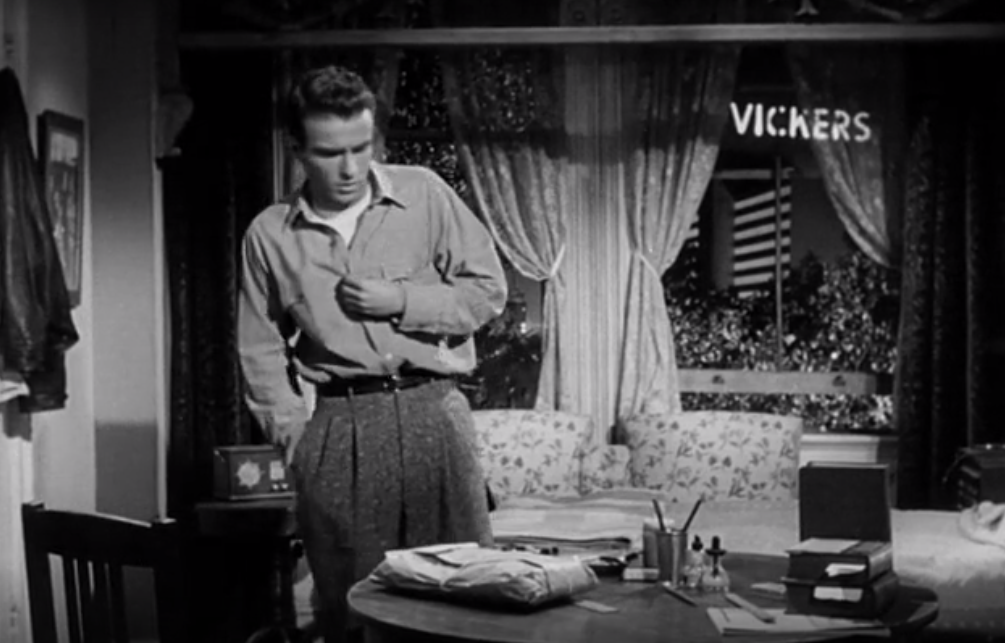
Still later, when George is at home obsessing over Angela, a neon sign in the distance flashes her last name (presumably on some building that her father owns) in the distance, illustrating his preoccupation. 

It’s not subtle, but I do like it. One that was subtle, however, was that every time we saw Alice’s address, whether it be on a piece of mail or on the side of the building where she lived, we saw that she lives at 4433 ½. It’s just another way that she’s stuck in the margins, a place not really held for her but one where she has to find somewhere to try and dig in and make space for herself. Poor Alice. 

Lagniappe

Boomer: The dissolve transitions in this movie are amazing. There’s so much storytelling happening in the visuals alone in this movie; the superimposition of shot over shot to convey mood, a character’s internal thoughts, everything — truly solid filmmaking, even if the movie milks its melodrama a little hard. 

Britnee: The atmosphere of Alice’s room in the boarding house really stuck with me. All of the claustrophobic shots in that room are so haunting. Particularly the scenes with that big open window at night. It’s the first thing that comes to my mind when I think about A Place in the Sun. I really can’t explain why.

Brandon: To further highlight the difference between what I appreciated in Taylor vs Winters, I’d like to point out my favorite moments of their respective, separate screentime.  Taylor’s best moment is in an early scene when she first flirts with Clift at a party, modeling an incredible, white floral Edith Head gown that has been imitated just as often in the decades since as her iconic hairstyle.  Meanwhile, Winters’s best moment is in the subtle choreography of her own flirtation with Clift at a movie theater, signaling her availability to him solely through strategic shifts in her body language.  Both contributions are essential to what makes this movie so great, but they’re very different contributions.

Next month: Brandon presents Torch Song Trilogy (1988)

– The Swampflix Crew

Mishima: A Life in Four Chapters (1985)

Sometime recently, I was telling a friend of mine (a fellow freak, if you will) a story that I had just read in an interview with one of Yukio Mishima’s former lovers. The person was a sex worker, and Mishima picked them up at a gay bar with the intention of having something longer term, but they ended up only meeting twice, because the sex worker was so disturbed by the scene that Mishima wanted. In essence, he didn’t want a partner; he wanted a witness, someone to watch as Mishima committed play-seppuku – complete with a false dagger and a red sash that took the place of Mishima’s entrails and blood. According to the account, Mishima came to complete erection and ejaculated at the time that he drew the false blade across his stomach, all without ever touching his genitals. I haven’t been able to find that interview again, but it crosses my mind often. Mishima was an awful man, but he’s nonetheless fascinating, and it’s an endless source of fascination to me whenever I stumble across some incel fascist on the internet who worships Mishima but is bigoted against queer people; it’s a truly fascinating compartmentalization of ideological conflicts. As a result of recounting that anecdote, there’s been a lot of Mishima talk in the friend group lately, which culminated in a recent screening of Paul Schrader’s 1985 biopic Mishima: A Life in Four Chapters. 

The film, which features a score composed by Philip Glass (when his name appeared on screen, one of my friends declared “I knew it! He loves arpeggios!”) and which was executive produced by both Francis Ford Coppola and George Lucas, is a true technical achievement. The narrative takes place in three different segments, some of which break down further into smaller sub-sections. There are the biographical sections, which include everything prior to the fateful day that Mishima attempted his coup (all in black & white) and the day of said sad little effort (in color). Although there is factual information in these sections—like the fact that Mishima was isolated from the rest of his family as a child by his grandmother, who forbade him from sport, sunlight, and playing with other boys—the film has very little interest in the elements that make up a traditional drama about a real person. This isn’t a biography of Mishima so much as it is a portrait of him, and it’s an expressionistic one at that. 

Where this is most apparent is in the way that Schrader adapts, with extreme brevity, parts of three different Mishima novels. The first segment is based upon The Temple of the Golden Pavilion, which was loosely based upon the arson of the golden pavilion at Kinkaku-ji in Kyoto. In it, a boy named Mizoguchi, who is afflicted with a debilitating stammer, becomes an acolyte of the titular temple but comes to hate it and ultimately burns it down (this is an oversimplification of the plot, but so is the retelling in the film). The second segment is based loosely on one of the four characters who populate the novel Kyoko’s House, in which a young actor named Osamu agrees to sell himself to a woman who is part of the yakuza in exchange for the cancellation of his mother’s debts; he and the woman become lovers, and they begin to partake in sadomasochism that ultimately leads to both his death and hers. The third adapts part of Runaway Horses, a 1930s-set period piece about a young man named Isao who, trained in the samurai code by his father, resents the apparent Westernization and materialism of his community and nation, so he plots to assassinate several key government figures in order to halt the spread of capitalism and its influence upon Japan. 

Although the biographical segments are shot in a more realistic style (the black & white “history” being filmed very traditionally, while the “day of the coup attempt” segments are all done with handheld cameras to add a kinetic energy to the proceedings), the narrative adaptation sections have a lovely artificiality. The room that Osuma and his lover share is a vaporwave lover’s nest in a black void, and Mizoguchi and his friend walk a constant path around a scale replica of the temple on stones that imply a path across a body of water that is no more than a painted floor. Isao and his friends plan their assassinations within another room in a void, but when their plans are stopped by the authorities, this is represented by all of the panels comprising the room’s walls being pulled outward and collapsing as police surround them from all sides. It’s a bold stylistic choice, but one that pays off, as these are the coolest and most interesting parts of the film, and as a metaphor for Mishima himself, it’s also very clever. Each of the men who populate these narratives represent some part of Mishima’s psyche. Pavilion’s Mizoguchi is obsessed with an ideal of beauty and longs to set it free just as Mishima was obsessed with the traditional Yamato-damashii (Japanese cultural traditions and values) and was willing to commit destructive acts to see it unshackled; Osuma represents Mishima’s devotion to his ideal, imperialist vision of Japan and his willingness to be hurt or even killed in a masochistic relationship with that vision; and Runaway Isao’s ultranationalism is Mishima to the core, down to the eerie way in which Mishima predicted (or perhaps announced) his death, as he and Isao share the same fate. 

If you’re looking for a scholarly work about Yukio Mishima, this isn’t it. One of our friends (the same one who identified Glass’s arpeggios) asked if she would need to know anything about Mishima before watching the movie, and we told her “no” before the screening, but I’m not sure I’d say the same thing now. From a narrative perspective, having no knowledge about Mishima (and especially not knowing how he died) makes the ending more shocking and perhaps more powerful, but I’m also not sure how much one would get out of this if this was their first introduction to him. If anything, as the film does little to elaborate on the extent to which Mishima’s views were utterly fascistic, it could end up making him more of a figure of admiration for his life (which is, uh, bad) and not for his literature (which is fine, in my opinion). The man wrote a play entitled My Friend Hitler, after all, and although scholarship is split on whether it’s a fascist work or an anti-fascist one, I’m going to make Roland Barthes roll over in his grave a little on this one and say that, in this case, what we know of the author is relevant to interpretation of the text. On the whole, that’s a bit of a Paul Schrader specialty—the line between apologia and empathy is always fuzzy in his work—but it’s worth noting that his first choice was to adapt Forbidden Colors, arguably Mishima’s most overtly homosexual work, was rejected by the Mishima estate, which led to the inclusion of Kyoko’s Room instead, so the extent to which he was able to craft a fuller portrait of the man was undeniably curtailed. 

The movie is vibrant, and, as an impressionistic telling of the life of a … let’s say “conflicted” writer, it’s beautiful and impressive. I’m not sure it’s a great movie, but it’s certainly a cool one, and it’s worth checking out if you have any interest in Mishima and his work.

-Mark “Boomer” Redmond

Love Lies Bleeding (2024)

Saint Maud was one of the movies I was most looking forward to prior to the first quarantine back in 2020, having seen many trailers for it all through the last half of 2019. When I finally did get the chance to see it, it was revelatory – an amazing, understatedly vitriolic little thriller that handled religious trauma in a different way. Instead of Maud having been victimized by a past religious indoctrination or being someone who’s so well-versed in scriptural tradition that she can twist it to whatever her ends might be, she’s a dangerously unwell person making up her own faith through incomplete, piecemeal understanding of religion coupled with hallucinatory, delusional “visions.” Throughout that film, we see her interpretation of the world through her perspective; the face of the woman for whom she is a hospice carer takes on elements of the demonic in moments, “God” speaks to her through a roach in her apartment, and she sees herself as an angel in the film’s last moments, until the final split-second that shows us in the audience what’s actually happening to Maud (brutally and horrifically). 

I wasn’t terribly interested in Love Lies Bleeding until the friend with whom I went to see Drive-Away Dolls asked me if we would be seeing it as well, and told me that it was directed by Rose Glass, who also helmed Saint Maud. That was better advertisement than any of the trailers for the film that I had seen, and I was not disappointed. Bleeding is the story of an intensely passionate love between two women and the way that drugs, troubled pasts, unrequited longing, and violence conspire to keep them apart. Somewhere in west Texas—I assume, given the prevalence of Lone Star beer—it’s 1989, and Lou (Kristen Stewart) works at Crater Gym, a cavernous warehouse full of free weights, meatheads, and stenciled slogans like “Pain is weakness leaving the body” and its ilk. It’s a shit life, rubbing one out every night on the couch while her TV dinner goes cold, trying and failing to quit smoking, and unclogging the same gym toilet over and over while fending off the advances of Daisy (Anna Baryshnikov), who may be the only other queer woman in town but whom Lou finds repellant. One day, bisexual bodybuilder Jackie (Kay O’Brian) appears in the gym and upends Lou’s world; she’s hitch-hiking her way to a body-building competition in Vegas and is stopping over here for a bit after getting a job waiting tables at the local gun range/club’s cantina. 

The two immediately hit it off and after a passionate night together in which Lou introduces Jackie to steroids to which she has access, Lou agrees to let Jackie stay with her until she goes further west to the competition. The situation is complicated by the fact that the gun range is owned by Lou Sr. (Ed Harris), Lou’s father. The range is just a cover, though, as his real business is running guns across the border to Mexico, and he’s got local law enforcement in his pocket, and Lou knows he’s bad news since she was once more involved in the family business, although she hasn’t spoken to her father in years following the suspicious disappearance of her mother. The only other remaining family Lou has is her sister Bethany (Jena Malone), mother of three married to utter piece of shit J.J. (Dave Franco), who also works for Lou Sr. and got Jackie her job after he has sex with her in a bar parking lot, the night before she and Lou meet. J.J. is habitually physically abusive of Bethany, and when he puts her in the hospital, the simmering rage, resentment, and violence under the surface of everything comes to a boil, with tragic consequences. 

The southern fried thriller-noir bona fides of this movie are on full display. A mixture of Blood Simple, Thelma & Louise, and Blue Velvet with a little Requiem for a Dream sprinkled in for good measure, the film is elegant in its construction. The fingerprints from Blood Simple are all over this one, from its grimy, sweaty, eighties, west Texas setting to that classic visual of the highway at night, a dark void surrounding the small halo of light from a vehicle’s headlights. Bleeding’s final moments could take place in the exact same field as the one in which Ray buries Dan Hedaya’s Marty, just in daylight. Moreover, just like Abby and Ray in the Coen brothers’ film, our protagonists are forced to commit larger and larger acts of violence in order to try and be together, free from the potential for violence. Ed Harris channels Dennis Hopper’s Frank Booth here, albeit in a more subdued manner. Although his violence is free from any psychosexual elements (give or take how much enjoyment he gets from forcing Jackie to learn to shoot while he “coaches” her through extensive body contact), he is just as sadistic as Booth, and Lou Sr. is perhaps the most frightening onscreen psychopath since Anton Chigurh. The similarities to Thelma & Louise are fairly close to the surface, and there’s something fascinating happening with the way that steroids are treated with the same intensity and as having the potential for the same fall out as intravenous drugs in Requiem. 

Where this film picks up the torch from Glass’s earlier work is in the way that we are once again made privy to the internal life of an emotionally and mentally unwell person. Jackie is a fascinating character. When we first meet her, she’s using her body to get what she needs, and is at peace with that. She has history, but no origin; the earliest part of her life that she mentions is being adopted at age thirteen (by parents that no longer speak to her and who call her a “monster”), and she tells Lou that she turned to bodybuilding as a way to change her body due to fatphobic bullying. Like Maud, she’s running from something, but unlike her, she also has a goal in mind and is relying on herself to get there, self-actualizing where Maud turned to a hollow, false spirituality. She’s remarkably self-sufficient and dedicated, as we see when she wakes up under an overpass and immediately gets to work on both exercise and brushing her teeth. In this, she is a contrast to both Lou, who is never seen exercising and is instead trying to shortcut with steroids, and Daisy, who is most clearly communicated to us as undesirable through the centering of her poor dental hygiene. She’s still human, however, and allows her lust-turned-passion for Lou and her thirst for validation through victory in the Vegas competition to lead her down a path that deteriorates her mental state. At first, her steroid-affected hallucinations of developing greater vein and muscle definition are empowering and concurrent with her deepening passion with Lou, but when she tries to run from the consequences of her first major (albeit justified) act of violence, she ultimately has a nightmarish series of visions in Vegas that cause her to become even more aggressive, resulting in her falling first into the hands of the authorities and then under the influence of Lou Sr. 

Another thing that’s fun about these visions is the way that they relate back to things that we see her absorbing, even if they’re making their way into her subconscious without her really noticing. After their first night together, Lou prepares breakfast for Jackie, who (somewhat ungratefully) asks her to leave the yolks out, a period-appropriate “healthier” alternative to eating a whole egg; later, in a montage we see Lou carefully separating out the yolks while preparing breakfast, and several shots of the eggs ending up in the garbage alongside the remnants of emptied ashtrays. This comes back around when Jackie later hallucinates that she has vomited Lou onto the stage in front of her at the competition, covered in a sort of amniotic egg white mixture. Further, in the film’s climax, Jackie imagines herself fully hulking out and turning into a giant woman (apologies that that song will be stuck in your head for the rest of the day, Steven Universe fans), and this is actually foreshadowed earlier on, when we see her watching the 1939 animated version of Gulliver’s Travels. (If you’re like me, you probably assumed that this was used because the film is in the public domain, and were delighted to see that there was a narrative reason behind its inclusion.) It’s all very elegantly constructed, and as a man who always loves it when things fall perfectly into place, it was incredibly satisfying. 

There should be no mistaking that this is still a brutal movie. It’s not one for those with queasy stomachs, and I’m not just talking about all of the disgusting mullets (of which there are … many). J.J.’s death is extreme, and we see the aftereffects of it multiple times. That’s the kind of thing you’d probably expect from a movie with the word “bleeding” in the title, but just in case you’re somehow floating around out there with the idea that this is more romance than grit, I want to make it clear that this is a ferocious, vicious piece of work, but I wouldn’t have it any other way.

-Mark “Boomer” Redmond

The Not-So-New 52: Justice League — Doom (2012)

Welcome to The Not-So-New 52, your digital Swampflix comic book (adaptation) newsstand! Starting in 2007, DC Comics and Warner Premiere entered the direct-to-home-video market with animated features, mostly in the form of adaptations of well-received event comics or notable arcs. This Swampflix feature takes its name from the 2011 DC relaunch event “The New 52,” and since there are (roughly) fifty-two of these animated features as of the start of 2024, Boomer is watching them in order from the beginning with weekly reviews of each. So, get out your longboxes and mylar sleeves and get ready for weekly doses of grousing, praise, befuddlement, recommendations, and occasional onomatopoeia as we get animated for over fifteen years of not-so-new comic cartoons. 

A direct sequel to Crisis on Two Earths, Justice League: Doom does not follow up on the apparent membership drive that ended the previous film. It seems that only one new recruit has joined the team since that movie’s finale, but it’s still a continuation, if one knows that this is the case and what to look for. This was another one that I had seen a few times even before beginning this project, not so much out of any particular fondness for it, but because it was the last one that was released before I finished grad school and moved back to Baton Rouge, so it was an easy one to put on in the background and do some unpacking or chores. It’s not as strong a film as Crisis was, but it still has some of the same magic, and it’s pretty good, even if it’s a little thinner than its predecessor. 

The Royal Flush gang, a villainous group that is characterized by their costumes taking inspiration from the highest point cards for the suit of spades, has been engaging in a series of break-ins, and Batman is on the case. He discovers that they have been using a piece of technology that allows them to pass through walls in order to complete their crimes, and when he engages them, the rest of the Justice League gets involved. During this distraction, Flash villain Mirror Master is able to use his ability to hide in reflections to surreptitiously enter the Batcave via the Batmobile’s rear view mirror, where he downloads files from the main computer. Some time later, each member of the League is attacked while they are alone. The man behind the attacks is Vandal Savage, an immortal who has been alive since the dawn of mankind, and he offers each of the League’s individual nemeses the opportunity to finish off their archenemy once and for all. While in his civilian guise, Martian Manhunter is given a drink by an attractive woman who turns out to be his enemy Ma’alefa’ak (another shapeshifting Martian and, depending on the continuity, J’onn’s brother), and the drink turns out to contain a compound that will result in the Manhunter sweating out highly flammable magnesium. Wonder Woman faces off against Cheetah, who manages to land a cut on the Amazon, resulting in an infection that causes her to see everyone around her as Cheetah, so that she will fight until her heart gives out. Superman is lured to the top of the Daily Planet building because a downsized reporter is planning to jump off of the roof, but is in fact a disguised Metallo, who is armed with a gun with a kryptonite bullet. Flash ends up with a bomb drilled into his wrist which will explode if he goes under a certain speed, Green Lantern is lured to an apparent hostage situation that goes south in a way that leaves him feeling unworthy of his powers, and Batman is tricked out of his home by the apparent disterment of his parents’ graves, only to find himself taken off guard by Bane, who knocks him out and stuffs him in his father’s casket (with the late Thomas Wayne’s skeletal remains) and reburies them in Thomas’s grave. 

It’s the darkest hour for the Justice League, but Batman breaks free first by digging himself out of his father’s grave and then finding Green Lantern and showing him that the people who were presumably killed by his failure were animatronics designed to shake his confidence, and along with newest ally Cyborg, they are able to rescue the others from their various traps. Batman reveals that all of these plans were actually his, that they were his failsafes should any of the other members of the League go rogue (or fall under brainwashing or magic compulsion, or any other manner of things that can and do happen in these four color fantasies). The others are not pleased with this revelation, but they still have to work together to face off against Vandal Savage, whose current plan is nothing short of genocidal: induce a solar flare that will ravage half of the planet’s surface and rewind the clock on mankind’s technological level to that of the Industrial Revolution. 

As a movie, this one doesn’t really feel like a sequel to the film that preceded it. While that one began life as a part of the Justice animated series, it had an entirely new voice cast that relied on some of the stunt casting that this series was known for, while this one mostly brings back the voice cast of that show. Kevin Conroy is back as Batman (as it should ever be), Tim Daly returns to voice Superman, Susan Eisenberg again voices Wonder Woman, Carl Lumbly is once again Martian Manhunter, and Michael Rosenbaum also returns to play Flash (albeit a different Flash). The only major casting change is that this film has Nathan Fillion as Green Lantern, as it features the Hal Jordan version of the character rather than the John Stewart version (voiced by Phil LaMarr). This is Fillion’s second time playing the character following his appearance in Emerald Knights. The character designs are a little different, too, and I watched this one several times without ever realizing it was supposed to be connected to Crisis, despite that one being one of my favorites. This time around, the connections were a little more apparent, especially in the musical choices; the opening title theme for this one very clearly incorporates the distinctive notation from the first. You can hear the exact same motif when the title appears here in Crisis and here, but I don’t think I’ve ever watched them close enough together to notice that before. There’s also fun new voice talent in this one, and it falls to me as one of the carriers of the Farscape fandom flame to call special attention to Claudia Black’s performance as Cheetah, which is absolutely delightful. The scene where Wonder Woman sees everyone as Cheetah gives Black the chance to do some neat little work as different variations on the same voice, which I liked a lot. 

Speaking of villains, however, this one falls a little flat in that department. Whereas Crisis had two interesting villains in the form of the nihilistic Owlman and the unhinged Superwoman, this is one of the thinner portrayals of Vandal Savage. Phil Morris’s voice acting is strong, but the characterization is a bit light, especially when you compare him here to his presence as the overall big bad of Young Justice, which admittedly had a lot more time to flesh him out. While both Owlman’s plan to destroy all universes and Vandal’s here to rule by reducing the population to a manageable half are very much schlocky comic book evil plans, the former had a sense of reality to it based on character motivation, while the latter feels broad and out of proportion for the motivation, like taking a bulldozer to a hangnail. Doom hinges on two major axes: the emotional core of the League’s feelings of betrayal due to Batman’s distrust, and the narrative plot point of the doomsday plan. The climax of the first is much more interesting and comes fairly early on, while the evil plot itself—despite being smaller in scale than in the preceding film—feels very cackly, Saturday morning cartoony. 

It’s unfortunate that this one is a bit of a dull note to end our time with Lauren Montgomery, who directed this film and several previous, starting with Superman Doomsday, when she was only twenty-seven years old(!). She was also a storyboard artist for that one, before she directed Wonder Woman, First Flight, Crisis on Two Earths, Apocalypse, and Year One. She was a storyboard artist on virtually all of the others, and she would continue to do this up through Batman: Bad Blood, at which point she became very heavily involved with a series called Voltron: Legendary Defender. These days, it looks like she’s gearing up to direct an as-yet-untitled animated film that is being released by Avatar Studios (she had previously been a storyboard artist on eight episodes of Avatar: The Last Airbender and was a supervising producer on The Legend of Korra in addition to doing some storyboard work for that program), so she’s still working, but this will be her last feature for this franchise. I wish her well! If they ever do another follow-up in this sub-series, I would love to see her return. For now, though, we say goodbye, and choose to remember her work at its best.

-Mark “Boomer” Redmond

Lagniappe Podcast: Godzilla (1954)

For this lagniappe episode of The Swampflix Podcast, Boomer, Brandon, and Alli celebrate Godzilla’s 70th birthday (and first Oscar win) by looking back to the monster’s 1954 debut.

00:00 SXSW

04:31 How to Build a Truth Engine (2024)
06:42 Last Things (2024)
09:30 Bottoms (2023)
11:11 Dune: Part Two (2024)
14:52 Mishima: A Life in Four Chapters (1985)
21:30 Love Lies Bleeding (2024)
29:07 Theodore Rex (1994)
32:42 Brief Encounter (1945)
37:44 Throw Momma from the Train (1987)
40:43 Twins (1988)
43:31 Wise Guys (1986)

45:43 Godzilla (1954)

You can stay up to date with our podcast through SoundCloud, Spotify, iTunes, TuneIn, or by following the links on this page.

– The Podcast Crew

How to Build a Truth Engine (2024)

How to Build a Truth Engine is a documentary about disinformation and how we can try to combat it. Bookended by footage of the terrorist insurrection on January 6th, 2021, the film features journalists, software engineers, anthropologists, neuroscientists, and other talking heads as they tackle the topic of information warfare. The bitter irony, as one of those interviewed says, is that we live in an era in which people have access to more information than ever before, but that same mechanism which has enabled that access has also provided such a fertile breeding ground for misinformation that people have been algorithmically partitioned off into different realities. As we move from expert to expert, an idea of consciousness is constructed for the uninitiated: that among the strengths of the human mind are its abilities to recognize patterns and then complete those patterns. They don’t get into the nitty gritty about it overmuch, but if you’ve ever taken an anthropological literature course, it’s familiar, and it isn’t overcomplicated to the point where the viewer is going to have a syllabus’s worth of Michelle Sugiyama articles to read or need to learn the word “pareidolia.” 

The film rests on several pillars that all of us living in reality understand to be fundamentally true. Neurologically speaking, humans find patterns in everything, even when there isn’t one (in the same way that we see a cloud and superimpose “bunny” or “whale”), and it’s become clear that information warfare is the new frontier of mankind’s conflicts. Journalism is a dying industry despite the fact that we need the fifth estate now more than ever, and the root cause of this has been the dissolution of legacy and local newspapers as advertising revenue dried up (the connection between this and capitalism, however, is not made by this film). There was a time when there was a (mostly) functional journalistic body wherein the Woodwards and Bernsteins of the world were capable of bringing down men who abused their power – sometimes, anyway. Now that most people get their news from social media, there is no longer any official entity or body that can be held legally liable for spreading and disseminating information that is not only not fact-checked, but which is often patently false upon its face. People’s algorithmically driven social media feeds exist solely to drive engagement on the platform, not deliver factual or truthful content, and we are all living in a bit of a hellscape because of it. 

The people to whom we are introduced as experts in their field have very impressive credentials. There’s Susan Benesch, the current faculty associate of Berkman Klein Center for Internet and Society at Harvard. She’s also the founder of the Dangerous Speech Project, an initiative that attempts to balance concerns about inflammatory, inciting rhetoric and the necessity of protecting free speech through the tactic of “counterspeech,” a form of providing alternative narratives in an empathetic way as a means to counter hate speech and misinformation. Zahra M. Aghajan, a clinical neuroscience researcher, is interviewed several times. There’s also Vwani Roychowdhury, a professor who has been with UCLA’s electrical engineering department since 1996, and who is also Director of The Roychowdhury Group in Computational Science, which specializes in machine learning and application; along for the ride is Behnam Shahbazi, a student for whom Roychowdhury was the advisor for Shahbazi’s paper a”StoryMiner: An Automated and Scalable Framework for Story Analysis and Detection from Social Media.” There’s also Itzhak Fried, MD, PhD, a neurosurgeon and Professor In Residence and Director of the Epilepsy Surgery Program at UCLA Health, who has been recognized several times for his advancement of the science. 

Rounding things out are a host of New York Times employees, some of whom operate across multiple departments but all of whom are involved with the “Visual Investigations” team, which they themselves describe as “combin[ing] traditional reporting with digital sleuthing and the forensic analysis of visual evidence to find truth, hold the powerful to account and deconstruct important news events.” There’s Malachy Browne, who’s the “enterprise director” of this team, who has won the Pulitzer twice, first in 2020 for exposing Russian culpability in Syrian hospital bombings, and again in 2023 for the team’s involvement in exposing which Russian unit was responsible for the murder of over two dozen civilians in Bucha, and the name of the commander of the unit. We’re walked through a lot of the reconstruction of this particular investigation, which establishes the credibility of the team, which also includes Haley Willis, who mostly covers human rights topics with the V.I., and Muyi Xiao, whose beat includes covering the news out of China. Her credentials are established through her coverage of COVID-19 as early as mid-January 2020, initially through reconstructing forensic digital data of communication between medical professionals but which was quickly silenced by the Chinese government. 

Several years back, I made a new friend who told me that he never watched documentaries, citing that he had taken a specific rhetoric of film class that made him too savvy to all of the ways that documentaries are manipulative, so he simply couldn’t trust any of them any more. I thought about him a lot while watching this doc, one that I was genuinely excited to see. As someone who has lost family members down the rabbit hole of bizarre, impossible conspiracy theories in the past ten years as they have approached mainstream metastasis, I was hoping for something new, something fresh, perhaps some new idea about how to break through to the brainwashed masses. And I was still mostly appreciative of the film, even as it repeated tired old canards that all of us who have watched as logic and reason were beaten back into the darkness in the past decade already know. I was a little surprised by the sloppiness of the proofreading for the subtitles (my screening featured them for the entire run time, not simply when translation was needed). I raised an eyebrow at the idea that A.I. (in the form of StoryMiner, a potential contender for the “truth engine” of the title) could somehow be harnessed for good to help seek and map out online conspiracy theories so that counterspeech could be developed to fight back against misinformation (it’s telling that I saw this just two days after another SXSW event featuring a sizzle reel of A.I. salespitching was booed). And, in the wake of the way that the Overton Window on trans liberation has been moved further and further into right-wing conservatism because the NYT is a chickenshit rag that has started acting as a mouthpiece for the exact kind of vile rhetoric that this documentary is (correctly) identifying as evil, I was skeptical of how much this documentary was dick-riding the erstwhile newspaper of record. 

All these things, in combination with very style-over-substance editing (the visuals in this documentary are, at my estimation, 85% semi-related drone footage with voice over), were matters of concern. I was still willing to go along with the presentation, all while wondering if there would be a mention of Palestine’s apartheid and the way that even people who consider themselves “liberal” have been silent about the issue for years and have revealed themselves as genocide apologists in the past six months; as the film went on, I thought “well, perhaps that’s a topic that’s outside of the scope of this particular documentary.” After all, it was difficult to tell when this was produced, or when the footage was shot. Muyi Xiao appears in some footage with braces, and some without (and, simply to clarify and not to belittle, when I saw “without” I mean “before”). When she is walking around Times Square, advertising can be seen for the final season of Insecure—which aired its finale the day after Christmas in 2021—but then again, I’m 98% percent positive that some of the drone footage included an advertisement of the 2011 film Real Steel (it could be an advertisement for something else entirely that simply has the same name and a similar typeface, but I couldn’t find evidence of anything like that while researching in prep for this review). And then. And then. 

As I mentioned before, this film milks the NYT Visual Investigations team’s coverage of the Bucha massacre for all the credibility that they can, and there’s no argument that they did damn fine journalism there. Their coverage of a Syrian bombing is likewise impressive, including their demonstration of how satellite imagery is combined with cell phone footage to triangulate where the videos are taken and establish their veracity. Before we get to see a recap of the Bucha investigation, we hear a phone call, translated from Russian to English via on-screen subtitles, in which a soldier (presumably one of the paratroopers from 234th Air Assault Regiment) calls his mother. He asks her what the news at home is saying, what she is hearing from people around her, tells her that they keep being told of victory after victory, but that he and his companions have no idea how much of what they are told is true, if anything. Although we then go on to learn just how depraved the activities that this caller et al went on to perform in Bucha were, I can’t help but interpret that there’s an attempt at an invocation of empathy for him; you don’t play the audio of a confused, possibly scared soldier calling his mommy without an agenda. An hour or so later, after dozens of interviews and countless minutes of footage of jungles, oceans, and city skylines, another voicemail is played, one which is identified as being a call from a “Hamas terrorist” in October of 2023, and which is translated on-screen with a speech I won’t transcribe, but one which aligns with the narrative that Israel has attempted to put forth to justify their ongoing genocide of the people of Palestine. It’s horrific to hear, so brief that you wouldn’t even have to take a bathroom break to miss it, just have a thirty second coughing fit. It’s so out of place that it feels like it was inserted at the last minute, a quick little virtue signal to the bloodthirsty neoliberals who think (or pretend to think) that it’s antisemitic to criticize starving millions to death in their homes or cutting them to pieces with death from the sky. 

I was shocked at this. I kept expecting that the film would loop back around on it, bring it up, maybe even use this as a demonstration piece to say, “Look how easy it is to use media to persuade; we told you that this audio recording was from Hamas and provided a translation that makes the blood boil, when in fact this is a recipe from a podcast.” In fact, it is one of the never-verified messages provided to the West by the Israeli military, and is treated not as a potential piece of propaganda to be analyzed, dissected, and verified. At best, in a text that is taking a moral stance on the literally society-sustaining importance of journalistic rigor, it feels like a half-baked and careless attempt at relevance that compromises the film’s integrity. A less charitable reading would be to say that this segment shatters any pretense that Engine could otherwise make that it maintains a clear set of ethics, and is therefore useless as a document of fact. The latter is my personal reading, and it renders what is otherwise a strong (if atypically slick) “documentary” which makes strong points about disinformation … as disinformation itself. I’m not going to pile on the contributors to the documentary for this; from what I can tell from additional research, Haley Willis spoke out against the firing of Emily Wilder from the Associated Press in 2021 when conservatives fought for her to be ousted because of her collegiate involvement with a pro-Palestinian justice organization. Further, although I was initially annoyed that there appears to be zero commentary about queer rights from Benesch’s Dangerous Speech Project (despite the overt hate speech that the community, especially trans people, have been subject to in recent years), they did issue a statement that they concurred with the ICJ’s denunciation of Israel’s genocidal rhetoric. As for searching for the names of the other participants in conjunction with this topic, most of the results keep leading back to the same Variety article, in which Siddhant Adlakha comes to the same conclusion that I do. 

As I sat in the auditorium before my screening, I overheard an older group of people behind me talking about another documentary that they had seen during SXSW, which I assume was The Truth vs. Alex Jones. They were discussing how they hoped that the film would open some people’s eyes about the man, and about how broken the system is when the justice system can find a man guilty of defamation on a scale that boggles the mind and that same person can get right back to grinding, telling more lies and spreading more misinformation and warping more minds, with no real consequences. They hoped that they could get others to watch it and that it would open some minds about just how much damage Jones has done to democracy. I couldn’t help but think about that Vonnegut quote about how artistic resistance to governmental malfeasance and war is as effectual as a custard pie, and I never really lost the feeling that reminder brought on throughout the rest of Engine, even when I was attuned to it. The ability that this documentary had to change hearts and minds was infinitesimal to begin with, and its lack of conviction in its ethics eradicates that potential.

-Mark “Boomer” Redmond

Last Things (2024)

When I first read a blurb in the paper advertising a screening of Deborah Stratman’s Last Things, the description called to mind Enys Men: a “documentary exploring the geo-biosphere throughout evolution and extinction” featuring “stunning visuals ranging from the microscopic to unending landscapes” that “defies the boundaries of what a documentary can be.” There was the promise that the film blended science fiction with science fact but which continued to express itself as truth. In the end, it wasn’t like Enys Men at all. In fact, I’m not entirely sure what a good point of comparison would be, other than to say, with an awe and respect that this description wouldn’t normally imply, that it’s one of the most student film-y pictures I’ve ever seen. I loved it. 

Insofar as Last Things has a narrative at all, it tells the story of the geology of our planet as an epic poem about the emergence of life in a form we wouldn’t recognize as life. Through the anthropomorphization of molecules and minerals, an origin myth emerges – one that’s not untrue in the way that a lot of origin myths are not untrue. For instance, did you ever consider that rocks could go extinct? I certainly hadn’t, but as it turns out, there was a time when iron floated freely in the planet’s oceans, suspended in it much like salt is at present. With the emergence of the first organisms that performed photosynthesis (cyanobacteria), oxygen became a component of the atmosphere for the first time, causing the iron in the ocean to oxidize and fall to the ocean floor, where they formed into banded rock of magnetite, silica, and other minerals. Formations like this one are extinct rocks, in the sense that they can never form again (at least not on this planet). 

It’s fascinating stuff, but it’s also not for the easily bored. At only fifty minutes, it falls shy of the length we would normally classify as a feature film, but there will be moments when you wonder how that amount of time has not already elapsed. It’s comprised almost entirely of open-source footage: NASA’s conceptual animation lab footage of the planetary nebula cloud, electron microscope imagery of chloroplasts, images of ice forming in water blown up to the highest magnification. Whether its ambition exceeds its grasp is in the eye of the beholder, but I thoroughly enjoyed the way that a story emerges from the cutting and pasting of bits of philosophy, poetry, vintage science fiction, and more against the visuals of rocks, minerals, and protozoa. As we are told by a scientist talking about chondrites—meteors that fall to earth without interacting with another body outside of the asteroid belt, meaning that they have been unchanged since the moment the furnace of the sun spat them out, before our planet was formed—“All matter does have a history, but it doesn’t remember it.” 

On the more fantastical end of the spectrum that Last Things slides up and down, our own bodies are stated to have a “genetic memory” connected to the rock, as the emergence of eukaryotic cells (and therefore life as we know it) required that the prokaryotic cells which banded together to symbiotically evolve into eukaryotic life required that taking in of minerals in order to form mitochondria. The film does this, ping-ponging back and forth between scientific fact and what we might call speculative geology, and it does it all with pulsing, hypnotic electronic music. It called to mind a movie that I saw at the New Orleans IMAX on a fifth grade field trip entitled The Hidden Dimension, which included a lot of microphotography, but to a much more psychedelic effect. 

There came a moment in Last Things in which the camera lingers for a long time on a rock formation in a park. It made me think of the Kuleshov effect, the theory and effect that Lev Kuleshov was able to demonstrate through the editing together of disparate images intercut with the face of Russian silent film actor Ivan Mosjoukine. Although the image of Mosjoukine was unchanging, the audience interpreted different meanings from his (identical) facial expressions based upon what footage appeared in between. Between the music and the fantasy, it does almost start to feel as if the rock is experiencing something, even thought that clearly can’t be the case. Can it? 

What’s the relationship between eukaryotic life, Petra, and glistening space concrete? Is there one? Director Stratman has stated that the film was born out of her existential panic about living through the planet’s sixth mass extinction event, and although I can’t speak for her, it seems to partially be about finding peace with the finity of human existence by viewing our transience, brevity, and diminutiveness by holding us up against mineral formations that meaningfully predate our solar system. If our concept of prehistory does not extend beyond the formation of the earth, it’s barely scratching the surface. And hey, the life that became us changed the planet; our ancestors caused rocks to go extinct, and those rocks became part of us, and although there’s no meaning in that, there is beauty, and we should appreciate it. 

I’d recommend reading this interview with Stratman; it’s insightful, and it says more about Last Things than I can. And if you get the chance to see this one, don’t miss it. 

-Mark “Boomer” Redmond

Dune: Part Two (2024)

Hey hey hey it’s throat-singing o’clock! I remember, lo several years ago now, when someone was online complaining about multiplex soundtrack overlap and how, in the moment that Beth died in Little Women, they could hear Babu Frik laughing in the next screening over. I had a similar experience last week when I could hear the chanting of the Sardaukar armies during a quiet moment in Drive-Away Dolls; I just sat there thinking how much I couldn’t wait to check out Dune 2, and that day has finally come. 

We open shortly after we left off in the last one, with Paul Atreides (Timothée Chalamet) and his mother Jessica (Rebecca Ferguson), the concubine of the late Duke Leto Atreides, have been taken in by Stilgar (Javier Bardem), the leader of a local division of scavengers known as Fremen. Paul has recently slain one of the Fremen in ritual combat, which makes most of them leery of him, but a young woman named Chani (Zendaya) sees something in the outworlder that she respects. The desert world of Arrakis, the only place in the universe where the space travel-enabling spice melange can be found, has been returned to the governance of House Harkonnen, headed by the Baron (Stellan Skarsgård), who is currently training his nephew Feyd-Rautha (Austin Butler) in the ways of wanton cruelty and planetary management. The Bene Gesserit, as headed by Reverend Mother Mohiam (Charlotte Rampling) sets her sights on using Feyd as the fulfillment of her sect’s centuries-long eugenics/missionary work following the presumed end of the Atreides bloodline, but reports coming from Arrakis that there is a new leader among the Fremen raise the curiosity of Princess Irulan (Florence Pugh), whose allegiance is torn between her allegiance to the Bene Gesserit and her loyalty to her father, the emperor (Christopher Walken). Meanwhile, on Arrakis, Paul becomes embedded with the Fremen. When his mother first attempts to use her powers and the apparent fulfillment of prophecy in Paul as proof that he is the long-awaited Fremen messiah, Paul’s public rejection of this endears him both to the non-believers, who appreciate his honesty, and the true believers, who believe that this is merely messianic humility. When his mother, now pregnant, drinks of the mysterious “water of life,” she becomes the new Reverend Mother of the Fremen, a position she’s more than happy to leverage to further spread the glad tidings of her son’s ascendancy. 

This is a huge movie, just big and bold and broad and beautiful. It’s so captivating that even a week later, I still feel more like it was something that I experienced more than it was something that I saw; talking about it as a film almost feels like the wrong way to discuss it. There’s a sequence in the movie in which the Fremen enact a guerilla attack on one of the Harkonnen spice-harvesting machines, which is dozens of stories high and takes up the same amount of space as a quarter of a city block. They come from multiple fronts—bursting forth from under the sand, storming out from behind caves, and sharpshooting one of those dragonfly helicopters. It’s so perfectly captured and rendered on screen that I could almost feel the desert sun on my skin, the heat coming off of the sand. The tremendous, hideous machine has these pillar-like feet/ground hammerers that move every few minutes, and Paul and Chani take cover behind one while working out how to take down the copterfly. There’s an almost ineffable, indescribable reality of the starkness of the shadow, the perfect sound mix, the pacing of the cuts, all of them in perfect harmony that is just pure movie magic, and I was there. Desert environments are inherently otherworldly, but they do exist in reality, such that in the rare instances that we do see other environs like the world where the Harkonnens’ seat of power is, these are even more removed from what we consider reality but appear so complete and real that it’s truly something to behold on the big screen. The sequence in which we visit the Harkonnen arena and the sunlight is so intense that everything is monochrome except in the shade is a particular standout, just phenomenal, and the inky, strange fireworks that fill the air only make it that much cooler. Everything that you’ve heard about this movie’s mastery of every facet of the art of filmcraft is true, and more. 

Narratively, this one does a great job of establishing all the lore that you would need to know through dialogue and imagery, and adds some things which give the text a slightly different depth or interpretation. While Stilgar is every bit the perfect disciple, who sees the wisdom of the prophesied “Lisan al-Gaib” even in Paul’s dismissal of the title (it shows the messiah’s humility) and is willing to give his own life just to give Paul a chance to speak to a quorum of tribal leaders, Chani is here (unlike in the text) unwilling to ascribe any kind of spiritual meaning to Paul’s accomplishments. The film chalks this up to a cultural difference, which helps make the Fremen seem less monolithic; the northerners (like Chani) are of a more agnostic bent than their neighbors in the south (like Stilgar), who are more religious in general and have among them a strong lean toward fundamentalism. Their opposing views of Paul make his tragic turn more meaningful, as he moves from the moral certitude that he must reject all attempts to elevate him to power, as he believes the Fremen can only be meaningfully and permanently liberated if they are led to victory by one of their own, to taking on the mantle of their deliverer and leading them against the Harkonnens. Although there was a kind of filigree that the David Lynch adaptation had that is mostly absent here, there are still moments of bizarre psychedelia as well; after all, it wouldn’t quite be Dune without it. Psychic dreams abound, and when Jessica drinks the Water of Life while pregnant with her daughter, the fetus becomes psychically capable of communication with her mother while possessing the knowledge and experience of a hundred generations, so there are some shots of her in utero as she and her mother “talk,” and that’s the kind of seriously-treated wackiness that makes this whole thing so much more than the sum of its parts. 

I wouldn’t normally make this specific recommendation, but I really think that you ought to see this one in theaters if you can. Every person that I talked to who saw the first Dune at the movies thought it was a staggering masterpiece, while reactions among those who saw it at home were more mixed. To paraphrase Nicole Kidman, we go to the movies to go somewhere we’ve never been before, not just to be entertained, but to be reborn. You should see this one as big as you can. 

-Mark “Boomer” Redmond

The Not-So-New 52: Batman — Year One (2011)

Welcome to The Not-So-New 52, your digital Swampflix comic book (adaptation) newsstand! Starting in 2007, DC Comics and Warner Premiere entered the direct-to-home-video market with animated features, mostly in the form of adaptations of well-received event comics or notable arcs. This Swampflix feature takes its name from the 2011 DC relaunch event “The New 52,” and since there are (roughly) fifty-two of these animated features as of the start of 2024, Boomer is watching them in order from the beginning with weekly reviews of each. So, get out your longboxes and mylar sleeves and get ready for weekly doses of grousing, praise, befuddlement, recommendations, and occasional onomatopoeia as we get animated for over fifteen years of not-so-new comic cartoons. 

Right here on the cusp of the twelfth film of this project, I hit the first snag; Batman: Year One is not available on HBO Max, or whatever it’s called these days. Heretofore, every single one of these movies was on the service, and from what I can tell, all of the remaining ones are as well. With the high number of premium subscription service material that has started to migrate over to free services (Lovecraft Country is on Tubi, the people’s streaming service) or more widely accessed ones (Six Feet Under is on Netflix) while David Zaslav plunders and pillages HBO and Warner Brothers, I checked to see if it was on one of those, and it was not. In fact, it’s only available as a rental. So, while I wait to acquire it through the library, I figured I’d talk a little bit about the recent history of these movies as they relate to streaming and the Warner Bros. conglomeration. It hasn’t come up here before, but Warner got into it pretty heavy with Netflix some years back, and it was because of these movies. 

Well, it was technically mostly because of Warner Premiere, but considering that Warner Premiere consisted almost entirely of these films, cheapy cash-ins on legacy animated properties (Happiness is a Warm Blanket, Charlie Brown; Tom and Jerry Meet Sherlock Holmes; A Miser Brothers’ Christmas), even cheaper long-distant sequels to Warner properties (Return to House on Haunted Hill, The Dukes of Hazzard: The Beginning, The Lost Boys: The Tribe), eleven separate Scooby-Doo movies, and—inexplicably—Trick ‘r Treat, let’s be honest, these DC flicks were the real reason this happened. In 2010, Netflix and Warner agreed that the former, which was still largely a DVD-by-mail service and had not pivoted to streaming as their primary market, would allow for a 28-day gap between the retail release of a DVD and the date that it would be allowed to be sent out to subscribers. This was under pressure from Warner, who cited at the time that they make approximately 75% of their retail sales for all physical media within that time frame. By 2012, this window had increased to 56 days; to put that time frame into perspective, the first film to be affected by the 28-day window would have been Justice League: Crisis on Two Earths, and the last to be mailed out within the first month would be this film, before the next one (Justice League: Doom) would be delayed to two months. 

All of this is, of course, moot now, as Netflix ended its DVD service as of September of last year. A half decade ago, however, DC had the idea to create their own streaming service. It would not only host every DC-related series and movie ever produced, but it would also provide unfettered access to the company’s digital comic vault that contained every story ever published, and would produce a few original series, notably the previously mentioned Titans, the Doom Patrol adaptation, and (most excitingly for me and the reason that I signed up for it) the third season of the prematurely canceled Young Justice series, which was originally supposed to be a Netflix production. DC Universe, as the service was called, didn’t last long, launching in September of 2018 and being discontinued in less than three years in January of 2021, when its programming was folded into the then-new HBO Max service, which had replaced HBO Go in September of 2020, and even as HBO Max was rebranded Max in May of 2023. This didn’t include everything that DC Universe had hosted (obscure TV series like the 1980s Superboy didn’t migrate over), but it has, to my knowledge, always included these animated movies, and the fact that Batman: Year One seems to be missing is another indicator, perhaps, that the overall quality of the service has declined. 

Batman: Year One is a fairly faithful adaptation of its source material, perhaps the most true-to-the-text one we have seen so far. Said comic is also the oldest one that has been tackled in this franchise as well. The Year One comic was released in 1986, following on the heels of the previously discussed crossover event Crisis on Infinite Earths, and was intended to cement what would now be the character’s new origin canon, although the Dark Knight’s was one of the least changed backstories under the new reboot. An adaptation of the comic languished in development for decades. In fact, the legends tell us that it was even considered for adaptation as the third film in the Burton Batman franchise, before the reins were turned over to Joel Schumacher in order to move in a more “kid-friendly” direction and away from the gritty reality of this narrative. Years later, when Christopher Nolan’s Batman Begins was first announced, I seem to remember early trade publications citing that it would be a direct adaptation of Year One, but I don’t feel like fighting with the pathetic shell of a useful search engine that Google has become in order to confirm that one way or another. Even without that confirmation, the 2005 film does bear many similarities to the comic, with two major direct lifts from it; the first is the scene in which Batman summons a huge flock of bats that darken the sky using a supersonic device, and the second a sequence in which Jim Gordon tells Batman, his new ally, about the impending appearance of a clown-like villain who calls himself “Joker,” which is the final scene in both movies. 

This is a short one, but it’s got meat on its bones. On the same January day, Gotham City’s “prodigal son” Bruce Wayne (The OC’s Benjamin McKenzie) returns home, musing from his high vantage point as he flies into the city that it almost looks calm from the air, despite being a seedy place of misery at ground level, while Internal Affairs Lieutenant James Gordon (Bryan Cranston) arrives in the city by train, fretting about the place’s high crime rates and his concerns about bringing his pregnant wife to such a place. Bruce plans to rid Gotham of crime from the ground up, demonstrating that he has spent his eight year absence training physically to do so. Elsewhere, Gordon is “welcomed” to the GCPD by corrupt Commissioner Loeb (frequent Cohen Brothers collaborator Jon Polito), reckless and bloodthirsty SWAT lieutenant Brendon (Stephen Root), and Gordon’s new partner, the violent and hair-triggered Flass (Fred Tatasciore). Loeb hints at some dark part of Gordon’s past that makes him think that he’ll be easy to extort, but Gordon’s plan is the same as Bruce’s: making Gotham a place worth living in. Bruce’s first night out as an attempted crime fighter goes very poorly, as he attempts to rescue an underage sex worker from her pimp, only to be stabbed by the girl herself and being severely beaten by the crowd that gathers. The person who deals him the most damage is a prostitute named Selena Kyle (Eliza Dushku, in a pretty thankless role overall considering what she’s capable of). Although he manages to evade police and drag his way into his home, Bruce sits facing a bust of his father and planning to let himself bleed out if he doesn’t receive a sign that he should go on, which arrives in the form of a bat that crashes through the window. We don’t get to hear the line about “criminals [being] a cowardly and superstitious lot” in his internal monologue, but this is a very straightforward reenactment of the same scene in the comics, which emulates the first appearance of the character all the way back in 1939. 

Inspired, Bruce takes on the costumed alter ego of “Batman,” and although he starts out hassling a trio of teenagers boosting a television set, he eventually works his way up to threatening Loeb and his associate, the mobster Carmine Falcone (Alex Rocco), during a dinner at one of their homes. Gordon is the mythological one good apple in the GCPD, but Loeb’s fury about Batman’s threats leads him to assign Gordon to finding the Batman, all while Jim faces off against his own department — up to and including his fellow detectives beating him with a baseball bat in a parking garage while wearing masks because he refuses to get dirty and join the grift like they did. Inspired by the Bat, Selena Kyle decides to become a masked denizen of the night herself, but in pursuit of theft instead of justice, and models her costume on a cat motif. 

At barely more than an hour, this one just barely qualifies as a feature, but it’s a pretty good one. It’s economically paced, even if the parts with Selena feel like dead weight. In contrast, the original comic had a bit more plot having to do with Harvey Dent (the future Two-Face) as the third face of the fight for justice in Gotham, from within the DA’s office, with the added wrinkle that his overt derring-do made him one of Gordon’s suspects for the true identity of Batman. The Selena stuff is also everything that has aged most poorly about the source material, as it was one of those things where Frank Miller just couldn’t help himself but make Catwoman a sex worker (this was retconned almost immediately and is, for all intents and purposes, the only thing considered non-canonical in the comic to this day). The film’s biggest weakness, however, is that everything great about it has already been adapted in some form. Batman: The Animated Series depicted the death of Thomas and Martha Wayne almost exactly as it was retold in Year One, down to angle and perspectives from the comic. An uninformed viewer would likely see this one and think that it was ripping off Batman Begins by centering the narrative around the antics of Carmine Falcone or having Batman be saved by the appearance of hundreds of bats, but both that character and that sequence originated in this film’s source material. As a whole, I can’t see it having much reason to exist other than for its own sake and for the interest of people who are already familiar with and fans of the comic, which doesn’t seem to add up to much. Cranston is great as Gordon, and it’s great that what feels like the entire second half of the film is just Batman vs. cops, but I’m not sure it’s enough, especially given the number of hoops you have to jump through to find this one. There’s nothing wrong with it, but it does feel … vestigial.

-Mark “Boomer” Redmond