My Christmas Wish: Treat Yourself to All That Heaven Allows (1955) This Year

Last year, Douglas Sirk’s All That Heaven Allows made it to number 24 on Swampflix’s Top 100 films, so naturally I spent the evening of last Christmas Eve closing that blind spot. If you’re a weirdo like I/we am/are (and if you’re on this site, that’s probably the case), you’ll likely find yourself recognizing the plot from its contours, because what Star Wars is to Spaceballs, this movie is to John Waters’s Polyester. Since Brandon had already written a review years earlier, I repurposed the review I couldn’t stop myself from writing to save for this year as an earnest recommendation to spend some part of your Christmas season with Sirk too, on the 70th anniversary of Heaven’s release. 

Cary Scott (Jane Wyman) is a well-off widow in New England. Her life is quiet, with visits from her two college-aged children Kay (Gloria Talbott) and Ned (William Reynolds) growing fewer and further between. Her best friend, Sara Warren (Agnes Moorhead), takes her out socially; attempts to get her to pair off with older widowers in their social circle are unsuccessful, as she feels no spark with any of them. One day, she realizes that some new hunk is tending to her landscaping, and he introduces himself as Ron Kirby (Rock Hudson), the son of the late Mr. Kirby who was previously engaged as the Scott family’s arborist. When she visits him at his home, she learns that he sleeps on a cot in a room attached to the greenhouse, and when he mentions planning to tear down the old mill on the property, she cajoles him into giving her a tour of the long-abandoned building, and she encourages him to convert it into a livable home instead. As their romance burgeons, their love is represented in ongoing changes to the mill house, which comes to resemble a livable home more and more. Ron takes Cary to meet some of his friends, a couple who have given up on the lifestyle of trying to keep up with the Joneses in New York and now instead tend a tree farm. As the night goes on, a party erupts, and the couple introduces Cary to their bohemian friends: birdwatchers, beekeepers/artists, cornbread masters, and lobster-catchers. 

Cary has a wonderful, uninhibited time, but there’s trouble around the corner; her high society friends are rather snooty about her relationship, as are her children. When she mentions selling the house and moving in with Ron (post nuptials, of course), Ned becomes quite upset about his mother selling his childhood home and tells her that the “scandal” she’s bringing upon the family by dating someone who’s merely (upper) middle class could jeopardize his career options. The local gossip hound starts a rumor that Cary and Ron had been an item since before her husband died, which deeply upsets Kay, as she begs her mother to break things off with Ron. Everyone also seems to be utterly scandalized by their dramatically different ages. (Hudson was 30 and Wyman 38 at the time, and those are the ages that they appear to be to me, but the film may be trying to imply a greater disparity.) She acquiesces to the demands of her fairweather socialite friends and her ungrateful children, only to learn some months later that her sacrifice was in vain. Both of her children delay their Christmastime return to their hometown, and when they arrive, they reveal their own new life plans; Kay will be getting married to her beau in February when he graduates, and Ned will be leaving straight from his own graduation to take a position in Europe that will last, at minimum, a year. They present her with a Christmas gift that she doesn’t want (more on that in a minute), and Ned even suggests that they sell the house, since the kids won’t be needing it as their “home” any longer. Via a simple misunderstanding, Cary comes to believe that Ron is getting married to another woman, and the melodrama only unfolds further from there. 

Sirk is a Technicolor artist, and this is a gorgeous movie, and a very funny one at that. One of the things that I really loved about this cast was the opportunity to see Agnes Moorhead play a kinder, more sympathetic role. Just a couple days after watching this one I caught her name in the opening credits of Dark Passage and thought to myself, aloud, “That woman was working.” And, wouldn’t you know it, I tuned into the New Year’s Twilight Zone marathon on H&I just in time to catch her episode of that: 

Moorhead’s Sara Warren is the only real friend that Cary has, as she’s the one who encourages her to get back together with Ron when she sees just how heartbroken her friend is. We learn this in a scene that’s perfectly framed and is one of many pointed social critiques that the film makes. We cut to a shot of a housekeeper vacuuming a carpet, as the camera dollies backward through the doorway to the room in which Sara and Cary are talking, and Sara closes the door to shut out the noise so that the two women can converse. It’s a neat gag, but it plays into the overall social critique of the movie, in which even the most sympathetic member of the bourgeoisie is still an aristocrat shutting out her social inferiors, despite her softening her heart towards her friend’s desire to date a blue collar business owner. There’s also a great contrast between the country club cocktail party that Cary attends near the film’s opening scene and the lobsterfest that happens at Ron’s friends’ house, where the upper class is presented undesirably. A married man makes a pass at Cary, kissing her; a potential romantic interest tells her that there’s little need for passion at their age, to which she (rightfully) takes some offense; the town gossip queen is there to do her thing. Ron’s group’s party is a lively place, where he plays the piano and sings boisterously, and people dance with great fervor. It’s never commented upon, but it is present throughout. 

Another fun little tidbit about this one is its distaste for television. Early on in the film, Sara suggests that Cary get a television to keep her company now that the house is empty, which Cary finds to be a contemptible suggestion. When a television salesman sent by Sara calls upon the Scott household, Cary shoos him away in a huff. In the final insult, however, Cary receives a television set as a gift from her children for Christmas. Ned even reiterates that Cary will be lonely and unfulfilled without her children and should have something in the house to distract her from her pitiful solitude, as if he and his sister hadn’t done everything in their power to sabotage her relationship with Ron. After the children have gone off to do their own things, their mother is left alone in the house, lit only by the lights of the Christmas tree and a duplicate fire: one in the hearth and its mirror in the flat TV screen — the giver of warmth and its cold reflected image. It’s striking and memorable, and the relatively tiny window that the TV might give of the world is visually contrasted with the vivid Technicolor world just on the other side of the panoramic windows that Ron has installed into the home he built to share with Cary. It’s good stuff. 

The film doesn’t demand a winter or Christmas time frame to be viewed, but I think it works best in that context. I’m getting the word out now so you can put it on the calendar before we all get Christmas brained. And, while you’re at it, when was the last time you watched Polyester?

-Mark “Boomer” Redmond

Lagniappe Podcast: Suddenly, Last Summer (1959)

For this lagniappe episode of The Swampflix Podcast, Boomer & Brandon discuss Joseph L. Mankiewicz’s 1959 adaptation of the Tennessee Williams-penned Southern Gothic stage play Suddenly, Last Summer, starring Katherine Hepburn & Elizabeth Taylor.

00:00 Welcome

01:31 The Naked Gun (2025)
06:35 Together (2025)
14:40 Freaky Tales (2025)
23:26 Weapons (2025)
41:04 I Confess! (1953)
46:01 The Phantom Lady (1944)
47:42 Stage Fright (1950)
52:30 The People’s Joker (2024)
56:04 The Last Picture Show (1971)

1:01:35 Suddenly, Last Summer (1959)

You can stay up to date with our podcast through SoundCloudSpotifyiTunesTuneIn, or by following the links on this page.

– The Lagniappe Podcast Crew

The Leather Boys (1965)

To my surprise, the film I’m most looking forward to from this year’s Cannes slate is not the new Lynne Ramsay, the new Ari Aster, the new Julia Ducournau, nor any other new release from an established-name auteur. The Un Certain Regard selection Pillion was the title that most caught my attention in the trades, teased with a premise in which “A timid man is swept off his feet when an enigmatic, impossibly handsome biker takes him on as his submissive.” Given their recent freakshow outings in Please Baby Please & Infinity Pool, respectively, the casting of Harry Melling & Alexander Skarsgård as that unlikely couple is certainly part of the attraction, despite debut writer-director Harry Lighton being an unproven no-namer at the time of this posting. Honestly, though, it’s just an alluring logline premise on its own no matter the talent involved, even if it’s more or less been done before: recently in Jeff Nichols’s excessively hetero biker-culture melodrama The Bikeriders and a half-century ago in the kitchen-sink drama The Leather Boys.

The Bikeriders starred Austin Butler as a gorgeous greaser whose affection is fought over by his wife (Jodie Comer) and his gang leader (Tom Hardy) despite his one true love being the open road, breaking both their hearts. That bisexual love triangle goes more or less unspoken despite the homoeroticism inherent to depicting a group of men whose sole passion is to get filthy, roughhouse, and pound beers together while dressed in heavy leather. It’s so blatantly intrinsic to biker culture that a 1960s British studio film could get away with telling its own queer love triangle story without being censored out of existence. The Leather Boys is just as carefully chaste in depicting its unspoken bisexual tug-of-war as The Bikeriders, and yet it was saddled with an X rating because it did not similarly bury those themes in subtext. In contrast, Pillion promises to be explicit enough in its themes and its sexual imagery to have legitimately earned that X rating, at least according to early festival-circuit reviews. Still, it’s impressive that such a non-judgemetal portrayal of closeted, hush-hush homosexuality within 60s biker culture was made in its time at all.

Colin Campbell stars as the lead leather boy, Reggie, who’s still a hotheaded teenager when he marries his high school sweetheart Dot (Rita Tushingham). The working-class knuckleheads aren’t at all prepared for the day-to-day realities of marriage, and they struggle to settle into a healthy routine after the initial rush of lust cools. Every conversation quickly escalates into a top-volume shouting match, with Reggie frustrated that his wife isn’t motivated to cook or clean while he works at the local garage and Dot frustrated that her husband no longer wants to have sex. To blow off steam, Reggie starts spending more time around his leather-jacketed biker buddies at the local cafe, where he strikes up a fast, passionate friendship with a flamboyant jokester named Pete (Dudley Sutton). Pete & Reggie hit it off so well that they end up sharing a bed every night in a relative’s spare room while the naive teens’ marriage hangs in limbo. Only Pete seems to be aware of the romantic tensions of this “friendship”, while Reggie doesn’t have any self-awareness of his own feelings or desires whatsoever.

The Leather Boys is a sordid love triangle played as kitchen sink melodrama . . . with motorcycle races! While its source-material novel depicts two young leather-clad lovers on a wild sex & crime spree, the movie version is deliberately subtle & underplayed, avoiding all of the typical road-to-ruin trappings of similar teen thrillers of the 1950s. No one dies. Reggie & Pete sleep together, but they do not fuck. The early implications that Pete is gay start as a general disinterest in girls and an eagerness to perform the wifely duties Dot neglects, and his queerness is only confirmed by the delicate way he holds his “fags” while smoking in bed. Reggie’s own sexuality is even more subtly played, to the point where it’s never fully defined. He’s confused by Pete’s social flamboyance, confused by his own disinterest in bedding his wife, and generally just all-around confused by his feelings & life. The only thing he’s certain about is that he’s intensely uncomfortable when Pete introduces him to a larger queer community at the local gay bar, which breaks the spell of their brief tryst as best bros.

Through all of its rocker-culture ephemera and the hormonal confusion of its lost teen lead, The Leather Boys ultimately proves to be a more direct prototype for the coming-of-age rock opera Quadrophenia than for The Bikeriders or Pillion. Its kitchen-sink realism mostly manifests in its improvised slang, with the Cockney teens punctuating their every thought with phrases like, “You’re a right blighter,” “Get roffed!” and, of course, “Innit?” There’s also a kind of hidden-camera quality to the visual style, framing both the cramped interiors & wide exteriors of the location shoots through an extreme wide-angle lens, as if the entire film were shot in a motorcycle’s rearview mirror. It’s a cool, sensitive, surprisingly frank story of a young man with conflicted feelings, torn between his love for his wife and his attraction to his fellow leather boys. The only reason it was rated X was so that impressionable teenagers wouldn’t leave the theater to buy bikes & leather jackets of their own and flirt with a little confused gay romance for themselves.

-Brandon Ledet

Imitation of Life (1959)

Imitation of Life is a weird document. All That Heaven Allows lives and dies based upon your investment in the happiness of its lead character, and Written on the Wind is a narrative about a wealthy American family in slow decline, rent asunder by internal forces of jealousy, desperation for approval, and poor parental love; both are also shot in glorious Technicolor. Imitation of Life, on the other hand, was marketed in much the same way as Heaven, namely that it was supposedly a romantic picture about a widow finding love again, but that narrative is by far the least interesting thing about the film. What it turns out to be instead is an unexpectedly heartbreaking story about a family that is torn apart by societal forces that even an abundance of motherly love can’t overcome, with the emergence of a new theatre star as the supposed primary plot of the film while actually serving as the background to a much more interesting story. 

Lora Meredith (Lana Turner) loses her daughter, Susie, at Coney Island one day, then finds her in the company of another girl, Sarah Jane. Lora, delighted, meets who she first assumes is Sarah Jane’s nanny, Annie Johnson (Juanita Moore), but learns that Annie is actually Sarah Jane’s mother. Annie describes her late husband as having been “close to white” and that Sarah Jane takes after him, rather than Annie. Upon discovering that Annie and her daughter are essentially homeless, she takes them into her apartment, as there is an extra room off of the kitchen (a common feature of the time, as Lora is essentially putting them up in the maid’s quarters, and their placement there is not an accident). The supposed A-plot features Lora seeking to make it as a star onstage in the big city; she successfully bluffs her way into the office of talent agent Allen Loomis (Robert Alda) and gets an invitation to a party that same evening where all the movers and shakers will be. When it turns out that this is a prelude to a casting couch situation, she leaves in an understandable huff, although this is all forgiven when Loomis ends up becoming her agent regardless. He gets her an audition for the latest play by David Edwards (Dan O’Herlihy), and when she stands up to him about a scene not working as written, he’s likewise impressed with her moxy and gives her an even bigger part. This is counterposed with her budding romance with Steve Archer, a photographer whom she met that fateful day at the beach; he took a photo of the girls balancing an empty can on a sleeping man’s stomach that day and eventually sold it for use in advertisements for beer. (Incidentally, Steve is played by John Gavin, who you may remember as Marion Crane’s afternoon delight stud-muffin in Psycho; try not to let his character being named Sam Loomis there while his character here is romantic rivals with a different Loomis confuse you.) Steve and Lora grow closer until he finally proposes, but his insistence that she give up her career is a non-starter. 

All throughout, the film focuses on Annie and her relationship with her daughter, who is clearly struggling under the weight of her Black identity. When she and her mother first arrive at the Merediths’, Susie tries to give Sarah Jane her newest and most prized doll, which happens to be Black, causing Sarah Jane to resent the younger girl’s innocent insensitivity. When Annie is telling the story of Mary and Joseph’s trip to Bethlehem at Christmas time, Sarah Jane asks what color Jesus was. Lora tells her that Jesus is whatever color one imagines him to be, and Sarah Jane protests that this can’t be the case since they are being taught he was a real person. Finally, she says “Jesus was white. Like me.” Things really come to a head, however, when Annie comes to Sarah Jane’s school to bring her lunch and learns that her daughter has been passing as white among her peers and the teachers, and the realization among her classmates when they learn the truth bears out much of Sarah Jane’s fears about exposure and the mistreatment she can expect because of the racism of the society in which she lives. When I started that last sentence, when I got to the end of it, I had to rethink my initial plan to conclude that Sarah Jane is mistreated “because of the color of her skin,” because that’s exactly the opposite of what’s happening. Sarah Jane is being treated fairly because of her apparent whiteness, and injustice and unfairness enters into the equation when a white supremacist society inexorably forces its way into these dynamics. Annie laments that her heart breaks because she can’t explain to the daughter that she adores why reality is so unfair, because Sarah Jane was “born to be hurt” by the world because of no fault of her own. 

Things are even worse for Sarah Jane when there’s a time jump from 1947 to 1958, the passage of time represented by continuously superimposed images of Lora’s name on various marquees and the accompanying year. Her newfound wealth has afforded them a manse in the countryside, where Annie and Sarah Jane (Susan Kohner) continue to live with Lora and Susie (Sandra Dee). It’s unclear what exactly Annie’s role in this new house is, as there are other servants now. A charitable read of the situation is that Lora and Annie have essentially been coparenting both of the girls since Annie and her daughter first came into the Meredith household, with Lora in the breadwinner role and Annie as the housewife, but even if that’s what’s happening here, it ignores all of the power dynamics at play. It’s also clear that Lora has been paying Annie in addition to housing her, as Annie mentions having saved up enough to send Sarah Jane to college. I’m not sure, but how you read this situation can have a lot of bearing on how you feel about its participants. If we choose to read Annie as co-head of household, as she’s mostly treated, then her oversight of the house and meals feels a little funny but isn’t ultimately demeaning. If we choose to read that the relationship between Annie and Lora has changed from being two women trying to make it in the big city together to one that feels familial but is nonetheless employer-employee, then Lora becomes much less sympathetic. My ultimate reading boils down to how Lora reacts when the two are parted by death, and that although she truly loved Annie and considered her a partner in life and not a servant, she nonetheless found herself occasionally acting in the patronizing manner of the era despite her affection and devotion. 

Sarah Jane, for her part, is having a rough go of things, continuing to seek inroads to the life of privilege to which she feels entitled and which her perceived whiteness gives her just enough ingress to see how things are on the other side. This reaches a point of harrowing violence, when she goes to meet up with the boy who’s talked about running away together and getting married, only to find him sullen and unable to look her directly in the eye. He demands to know if what he’s learned—that Annie is her mother and that Sarah Jane is Black—is true. Sarah Jane denies it, but he nonetheless beats her savagely. Meanwhile, she’s having to deal with all of Susie’s stories about finishing school and watching her not-quite-sister get a pony as a graduation gift; to get out, she claims to be working at the NYC library, but Annie discovers she is actually working as a sort of sexy lounge singer where men leer at her, and when Annie’s appearance once again outs her as non-white, she loses the job. This prompts her to flee even further, finally ending up as a chorus girl out west, but when Annie comes to see her one last time, she tells Sarah Jane that she has come to say that she won’t chase her anymore, and that she loves her daughter enough to accept her choices. When one of the other chorus girls finds them together, Annie pretends to be no more than Sarah Jane’s old nanny in order to preserve her daughter’s concealment of her true identity. 

It’s this that serves as the film’s climax. Sure, there are other things going on. Lora and Susie are distant because Lora always put her career first. Steve re-enters the picture, and he and Lora make plans to travel together and get to know one another again that she immediately reneges upon when offered a part in a new film from an Italian art director. Steve keeps Susie busy that summer and she falls madly in love with him (who wouldn’t?). Susie tells her mother to just be with Steve, and they get together. All seems kind of rote and pale in comparison to what’s happening with Annie, doesn’t it? That’s clearly intentional, and even though there’s a kind of going-through-the-motions energy of everything happening with the Merediths, I was never bored by any of it. Everything happening with Annie just overpowers it, as she ultimately succumbs to (perhaps literally) a broken heart from losing her daughter, spiritually if not literally. Her funeral service features a performance of “Trouble of the World” from Mahalia Jackson, and it’s beautiful. 

In many ways, this is one of director Douglas Sirk’s finest hours. Annie’s story is beautiful, thoughtful, and tender, while Lora’s is perfectly serviceable. It may be that the DVD I saw of this didn’t have a very colorful transfer, but where this one is lacking is in its visual panache. You can almost feel the chill of the blue snow in All that Heaven Allows, but the colors here seem muted, although that may be due to the fact that this was a Eastmancolor production, not a Technicolor one. Susie’s room in the country manse stands out for this reason, as her bubblegum pink room should really pop, but it feels rather dull. Infamously, a publicity stunt surrounding this film was that half of its two-million-dollar budget was spent entirely on Lana Turner’s wardrobe, and while there are many fine pieces, it feels like they’re lacking in some razzle dazzle that one of Sirk’s other pictures would have more effectively conveyed. There are also some places where the narrative seams are less than flush. For instance, the extended sequence of Sarah Jane doing a musical number at the NYC club seems to be a leftover sequence from when the film was conceived as a musical. Both Steve (demanding that Lora forsake the stage in 1947) and Susie (realizing that her infatuation with Steve is childish and relinquishing her mother of any guilt in pursuing him in 1958) make decisions that feel more narratively convenient than true to the characters. Nonetheless, this one is definitely a contender for Sirk’s greatest work.

-Mark “Boomer” Redmond

Both Ways (1975)

Long before New Queer Cinema directors like Derek Jarman, Todd Haynes, and Gregg Araki were praised for their confrontational depiction of queer sexuality onscreen in the 1990s, there was already a strong, decades-long independent filmmaking tradition of doing just that in hardcore gay pornography.  At least, that was the central thesis of Liz Purchell’s archival work in the Ask Any Buddy project, which is where I first heard of Jerry Douglas’s 1975 bisexual romance thriller Both Ways.  Although the review of Both Ways on the Ask Any Buddy podcast was less than glowing, it still felt like a necessary purchase when I ran across a used DVD copy of the film in a Minneapolis record store, since its X-rated onscreen sex meant I’d unlikely be able to access it on any mainstream streaming service in the near future (which is the exact kind of false scarcity logic that’s led me to collect a modest stack of vintage porno titles like Pink Narcissus, SexWorld, Bijou, and Fleshpot on 42nd Street).  On its surface, Both Ways is a fairly straightforward—pun unintended—porno drama about a closeted bisexual man living a double life, but between the director’s commentary track on the Vinegar Syndrome disc, the supplementary insight from the Ask Any Buddy pod, and the plot’s last-minute swerve into Hickcockian violence—okay, pun obviously intended that time—it ends up feeling like a surprisingly substantial work of outsider art.

The first sounds you hear in this Golden Age porno is a child giggling as his father tickles him on a carnival Ferris wheel.  Gerald Grant stars as a straight-laced family man: a Harvard graduate (which he’ll remind you of frequently) who’s built a tidy suburban life for himself as a high-powered lawyer and a loving father of a young son.  All is not well in the bedroom, though, as his sexually neglected wife, played by Andrea True (likely the most famous member of the cast, due to her disco hit “More More More”), confronts him for being distracted by a secret affair outside the house that she can’t quite figure out.  She’s correct, of course, as her husband has been sneaking around with—shocker of all shockers—a Yale student played by Dean Tait.  Now, you might expect that vintage pornography about a closeted bi man’s infidelity would mean double the variety of onscreen sex, but it really just doubles the amount of couples bickering.  This is the kind of porno-chic relic that speeds through rapid edits of sex scenes so it can really dig into its domestic melodrama, making for a shockingly sincere representation of male bisexuality for its era … until it takes a wild swerve into psychological thriller territory.  After all of its cheeky humor about collegiate rivalry between Harvard & Yale and all of its sentimental homelife drama in which the father figure constantly buys his cavity-sweet son handfuls of balloons, Both Ways gets really dark in its final twenty minutes, making for a chilling ending to something that’s ostensibly supposed to heat couples up on a naughty date night.

In filmmaking terms, Both Ways is surprisingly playful for a hardcore porno.  Douglas does a lot to mirror the domestic scenes in both of our antihero’s competing relationships, even going as far as to symmetrically pose his actors in front of wall-hung mirrors to drive the point home.  During early domestic squabbles where both couples recount how they first met and during a later pornographic montage of the cheating husband alternating between his two partners in two separate beds, the threesome’s body language is exactly copied in direct contrast to underline how little meaningful, physical difference there is between the two relationships.  Douglas also plays around with insert shots of artificial exteriors to simulate intimate dialogue when characters are navigating the world outside their bedrooms, shooting his actors against a surreal blue-void “sky”.  He also tries his best to ground this tale of extramarital romance within the context of Free Love looseness, setting a major couple’s spat at a swingers’ wife-swap orgy and meticulously framing a lit joint at the center of a male performer’s buttcheeks.  Other visual details & directorial choices are more inscrutable, such as the frequent cutaways to a frumpy housekeeper during the aforementioned wife-swap, the repetitive focus on yellowed copies of New York Times headlines to mark the timeline of the couples’ pasts, and the Ivy Leaguers’ obsession with ceramic beer steins – which only become more noticeably bizarre the more they become directly involved in the scene-to-scene plot.  It’s all baffling in its distraction from the presupposed purpose of hardcore pornography, but it also all adds to the feeling that this is a personal, thoughtful, creative project for Douglas instead of a quick cash grab between writing his off-Broadway stage plays.

I’m fond of Both Ways despite all of its lopsided plotting and its confused representation of Normal male bisexuality.  Even after the domestic melodrama gives way to crime-thriller psychology, the movie still has an oddly light tone to it, present both in the generic funk-guitar background music and in the nosy investigations of a local antiques dealer who mistakes the husband’s sneaking around for living a double life as an undercover Commie spy.  It may not be the artistic pinnacle of Golden Age pornography, but it does function as a clear, standalone example of how porn from that era has unique cultural value as independent filmmaking.  If nothing else, it’s difficult to imagine any mainstream Hollywood studio dramas of that time depicting male bisexuality with so much candor (even if it is easy to imagine a Hollywood version of this film choosing to conclude with the exact same act of domestic violence).  I got the sense that the reason the Ask Any Buddy crew were less enthused about Both Ways in their much better-informed review is that Jerry Douglas had previously contributed to a much more accomplished bisexual porno as the writer of Radley Metzger’s Score, which makes this one suffer by comparison.  I cannot personally speak to that comparison, as I have not yet scored a copy of Score while killing time in second-hand media stores on vacation, but I also never expected to find Both Ways through that method either, so never say never.

-Brandon Ledet

Bonus Features: A Place in the Sun (1951)

Our current Movie of the Month, 1951’s A Place in the Sun, is a high-emotions noir about a desperate social climber who drowns his pregnant girlfriend so she doesn’t get in the way of his wealthier, prettier romantic prospect.  In essence, it’s an epic-fuckboy melodrama about the moral crimes young men were willing to commit for the chance to be with Elizabeth Taylor.  She was the most marriageable woman of all time, after all, apparently lethally so.  At the time, Taylor was just starting to make the transition from child star to adult romantic lead, and A Place in the Sun doesn’t ask her to do much other than to look elegant while modeling classic gowns designed by Edith Head.  Most of the film’s more serious brooding is left to Taylor’s costars Montgomery Clift & Shelley Winters as the factory-worker couple who’re undone by her natural glamor. 

Elizabeth Taylor’s onscreen transformation into a convincingly mature actress did not begin & end with A Place in the Sun.  It was a gradual rebranding over several projects under her studio-system contract with MGM.  If you’re curious to track her progress through this transitional era, here are a few more titles to check out in addition to our Movie of the Month.

Conspirator (1949)

Elizabeth Taylor’s first role as an adult character was co-lead of the Cold War espionage thriller Conspirator, starring opposite Robert Taylor.  Elizabeth plays Robert’s 18-year-old bride but was only 16 at the time of shooting, while her co-star was more than double her age, in his late 30s.  That might sound like a gross, old-fashioned approach to Old Hollywood romance—and maybe it is—but it’s at least acknowledged & addressed in the text.  Elizabeth plays a young, bratty teenager who has no business getting married, while Robert plays a Soviet spy posing as a British officer who’s attracted to her because she’s naive and easy to manipulate.  There’s some sly humor to the way the pair star in entirely separate movies for the first half of Conspirator.  Elizabeth is playing girlish, flirty games while Robert is plotting to subvert the Western Bloc, often undermined by his young wife’s immature antics.  That tension slowly deflates once the bride is fully clued into her husband’s true allegiances, but the path to that reveal is more fun than you might expect.

Of course, the teenage Taylor radiates pure movie star glamor in this otherwise mediocre Red Scare noir — the same natural glamor that she echoes in the soon-to-come A Place in the Sun.  There’s something incredibly charming about her character’s insistence on being treated like an adult, while also being too scared to sleep alone during thunderstorms and waiting around like a puppy for her crush to call on the telephone.  Conspirator is far from her best onscreen work, but it is a clear marker of her transition into being seen as an adult by her audience, almost to the point of it being her character’s arc.  In a third-act argument with her Filthy Commie husband, he remarks, “You’ve grown up, haven’t you?”, and she spits back “You can’t lie to me anymore, if that’s what you mean.”  The couple’s age gap may make for an uncomfortable pairing, but the movie clearly knows what it’s doing with it; the paranoid anti-Communist politics on the other hand . . .

Father of the Bride (1950)

Vincent Minnelli’s original adaptation of the 1949 novel Father of the Bride is just as bubbly & fluffy as its later adaptations in Norah Ephron’s 1991 version and the most recent straight-to-HBO-Max remake.  Like in A Place in the Sun, Taylor isn’t asked to do much in the picture besides look elegant in her couture gowns, this time including an iconic wedding dress (that ironically telegraphs of her many tabloid-covered weddings decades down the line).  Most of the film’s psychological grit defaults to the titular father (Spencer Tracy), who narrates his neurotic breakdown as he watches Daddy’s Little Girl prepare to walk down the wedding aisle, struggling to reconcile how he sees her vs her actual, adult autonomy.  In that way, it’s a perfect role for the teenaged Taylor, who was asking audiences to stop looking at her like a little girl and start seeing her as an adult.  It’s also a strange, upsetting reflection of macho insecurities lurking just under the surface of every American dad’s Neanderthalic skull.

The 1950 Father of the Bride might be light-hearted fluff, but it’s still high-quality fluff when compared to the mawkish sentimentality of its two remakes.  At the very least, its surrealistic nightmare sequence in which Tracy sinks into the floor while walking Taylor down the aisle is the high-water mark for the series as visual art.  More importantly, there’s something about the promo shots of Tracy spanking Taylor in her wedding dress that gets to the core of this series’ Suburban Dad Psychosis more than anything that happens in the actual films.  This is fundamentally a comedy about how fathers infantilize their daughters for as long as they can get away with it, so there’s something apt about casting a young actor who was pleading to no longer be infantilized by her audience as a child star.

Giant (1956)

Taylor didn’t fully come into her own as a lead actor playing adult characters until she reunited with A Place in the Sun director George Stevens for the sprawling Texas family drama Giant.  Specifically, it happens about halfway into the epic melodrama, just when my borrowed library DVD prompted me to flip the disc over to Side B.  In the first 100 minutes on Side A, Taylor plays a defiant but romantic teenager who’s swept off her feet by a Texas cattle rancher (Rock Hudson), only to discover that her handsome, charming husband is also a raging racist & misogynist in most social settings, as is the way of his home state.  At the start of Side B, she’s shown knitting in the family parlor, her hair pasted grey for an unconvincing geriatric stage-drama effect.  Decades into her marriage to an old-fashioned, uptight cowboy, she’s still a progressive do-gooder who challenges his Conservative views on women and the Mexican servant class every chance she gets, which means she has a lot more to chew on here than she has in Conspirator, Father of the Bride, or even A Place in the SunGiant is the kind of well-meaning, anti-racist drama that’s just old & creaky enough to undercut its point by casting white actors in brownface for the minor roles, but it’s still surprisingly left of center for a studio production of this epic scale, and Taylor is the main mouthpiece for its political messaging.

I’m tempted to pitch Giant as what might happen if Douglas Sirk guest-directed a season of Yellowstone, but the existence of Sirk’s Written on the Wind (released the same year, also starring Hudson) makes that comparison somewhat redundant.  Stevens was a formidable contemporary of Sirk’s, but there’s nothing especially stylish or personal about his filmmaking craft that makes Giant more essential viewing than Written on the Wind or Imitation of Life, which combine to cover a lot of the same thematic territory.  He was a talented workman director within the studio system, most reliable for his ability to manage large-scale productions without them spiraling out of control.  It’s not a flashy, auteurist approach to directing, but it does allow for the Old Hollywood dream factory to do its work at peak efficiency.  If nothing else, Giant is worth seeing for the spectacle of its cast.  It almost seems impossible that a single movie could gather Elizabeth Taylor, Rock Hudson, James Dean, Carroll Baker, Dennis Hopper and Sal Mineo all in one picture, but when you stretch your runtime out 3.5 hours and your setting over multiple decades, you have the space for that kind of feat.  Taylor & Hudson are the white-hot center of the drama, though, and they’re the main reason to clear an evening to watch it in full.  When Hudson first spots a teenage Taylor on her family farm, she’s riding a wild, misbehaved horse and he absentmindedly calls her a “beautiful animal” in a way that equates the two.  Years into their marriage, that wild streak never fades, and the adult version of Taylor’s character is given plenty open land to run free and buck Texas social conventions, to her husband’s fury & frustration.  It was a career-making role for her, one that cleared a path to the even juicier roles in Tennessee Williams & Edward Albee adaptations that were just over the horizon. 

-Brandon Ledet

Movie of the Month: A Place in the Sun (1951)

Every month one of us makes the rest of the crew watch a movie they’ve never seen before, and we discuss it afterwards. This month Britnee made Boomer and Brandon watch A Place in the Sun (1951).

Britnee: Based on Theodore Dreiser’s 1925 novel An American Tragedy, George Stevens’s melodramatic noir masterpiece A Place in the Sun is one of my all-time favorite films. It’s overdramatic, shocking, gripping, and stars a young Elizabeth Taylor. That alone should convince anyone to watch it. Stevens won the Academy Award for Best Director for A Place in the Sun in 1951, and several years later in 1956, he won the award again for Giant (which also stars Elizabeth Taylor!). He treats his characters with such thoughtfulness and uses unique filmmaking techniques to drill through the layers of their humanity, drilling especially deep in this one.

George Eastman (Montgomery Clift) hitchhikes to California with the hopes of starting a career at his wealthy uncle’s factory. He’s working class and comes from a poor family, but he badly wants to be a part of the upper class. That’s American dream, isn’t it? He is given an entry-level job at the factory, where he hits it off with his co-worker, Alice Tripp (Shelley Winters). They become a couple but don’t make their relationship public because it’s against the rules for male and female factory workers to fraternize. Gradually, George starts to step out on Alice to get closer to Angela Vickers (Elizabeth Taylor), the daughter of another wealthy industrialist in town. He’s hypnotized not only by Angela’s beauty, but by the status that she and her family hold. Angela is drawn to George as well, and she begins to invite him to more social events with the upper crust of society. Alice becomes increasingly upset as George puts her on the backburner to attend numerous fancy gatherings, and her frustrations are elevated when she finds out she is pregnant with his child. After her attempt to have an abortion is unsuccessful (in a very scandalous scene), she begins to pressure him into marriage. At the same time, his romantic relationship with Angela is blossoming.

Angela invites George to spend Labor Day weekend at her family’s lake house, which he does after telling Alice the trip is for his career advancement. Poor sweet Alice opens the morning paper to find a front-page photo of George having the time of his life on a boat with Angela. She tracks him down and quickly arrives to the town where they’re vacationing. This is the part of the film where I yell “Hell yeah, Alice! Show him you’re not messing around!” Unfortunately, when George meets her in town, he realizes that he needs to get rid of Alice to move on to a life with Angela, and that’s when the film takes the turn into being more of a legal thriller than a melodrama.

I’m always impressed by how much I’m drawn to the humanity of each main character in this film: Alice, Angela, and George. I know that George is terrible, but I’m almost able see into his soul. All of his sadness, confusion, and internal struggle with his conscience is boldly laid bare by Clift’s performance and enhanced by Stevens’s intense camera close-ups. Brandon, did you have a similar experience with George’s character?

Brandon: For me, the most surprising aspect of George’s character is that he’s not especially violent or sociopathic by nature; he’s just desperate.  When compared to the most infamous rowboat killer of Old Hollywood—Gene Tierny’s heartless murderess in 1945’s Leave Her to Heaven—George ain’t all that bad.  He’s operating from a similar place of selfishness, but it’s more out of financial gloom than it is out of inhuman cruelty.  His humanity didn’t strike me as especially deep or complex, though – just realistic.  One of the reasons Angela is so drawn to George is that he’s so quiet & pensive, which she misinterprets as him being “complicated”.  Really, he’s just distracted by the walls closing in on his potential future as the husband of a wealthy heiress, dooming him instead to a life as the impoverished husband of a lowly factory worker.  The more streetwise Alice, on the other hand, sees right through his desperate social climber schemes, since she doesn’t view his troubled badboy persona through the same naively romantic lens that Angela does.  Her own downfall is also one of financial desperation, making this more of a story about the evils of money & class division than it is a story about the evils of personal moral failure.

No matter the motivations for George’s mistreatment of Alice, he still behaves like an absolute scoundrel and a coward.  At its heart, A Place in the Sun is an epic-scale fuckboy melodrama about the moral crimes young men were willing to commit for the chance to be with Elizabeth Taylor, often at the expense of less outwardly elegant women like Shelley Winters.  After all, Taylor was the most marriageable woman of all time, apparently lethally so.  As with most classic melodramas, I found the interior lives of the two main actresses far more compelling than their counterpart in the male lead.  Montgomery Clift plays an adequate prototype for a leather clad street-tough that would soon be perfected by the likes of Marlon Brando & James Dean, but I mostly found him useful as a point of contrast between Taylor & Winters.  Elizabeth Taylor is the more stunningly beautiful actor of the pair, and she would go on to become one of the most-imitated, most-well-paid, and most-gossiped-about stars of studio-system Hollywood.  Shelley Winters acts circles around Taylor in the picture, though, and her talents were mostly rewarded with a late-stage career resurgence as a psychobiddy freakshow in hagsploitation schlock like Whoever Slew Auntie Roo?  One was great at acting, while the other was great at being a movie star, and I find it fascinating how that difference is reflected in their characters here, so early in their respective careers.

Boomer, since this is ultimately a movie about callously comparing women against each other, what do you make of the difference between what Elizabeth Taylor & Shelley Winters bring to the screen in their competing roles as Alice & Angela?

Boomer: Looking back to the Wikipedia summary for this film, I’m immediately struck by the second sentence. From the top, it reads: “In 1950, George Eastman, the poor nephew of rich industrialist Charles Eastman, is offered an entry-level job at his uncle’s factory, where he begins dating co-worker Alice Tripp. Alice believes George’s Eastman name will bring her advantages” [emphasis added]. I don’t think that this is true, actually. If it was said explicitly, then I missed it, and if it’s not explicit, I think that’s more of an inference on the part of the composer of the plot description than something that’s implied in the narrative. If anything, Alice just seems like a lonely girl stuck in the kind of job that women in the 50s were supposed to do until a man married them and they could become housewives, but there are plenty of women around her who are older than she is, so there’s an implication that she worries she could end up an “old maid” like them. The implication that Alice is concerned with hitching herself to George for financial reasons is particularly unkind to her; her willingness to terminate her pregnancy (even if she can’t find a doctor to perform the operation) makes it clear that she’s not trying to entrap him with a child, and her declaration that she doesn’t care if they have to live in poverty as long as their together rings true.

On the other hand, Taylor brings a lightness to her character that’s lovely to behold, and I think that we’re supposed to be as entranced by her ethereality as George is. Her name implies an angelic nature not just in that she remains faithfully devoted to George until the end, but also that she’s a being that’s forever out of his reach and unable to be touched. But there’s also a naivety to her, and I can’t tell if that’s something that I’m projecting from the metatext, or something that’s really there. Before this, Shelley Winters was a huge sex symbol, and her dressing down to play dowdy Alice here was actually her playing against type, and that undisguisable beauty that lies beneath is impossible to completely conceal. Some quick research tells me that this was filmed from October of 1949 to March of 1950, which means that Clift and Winters were 29 during filming, and Taylor turned 18 during February, 1950. Although Winters still has a healthy vitality and youthful glow under all their attempts to frump her down a little, Clift very much looks older than his age, and far too old for the high school aged Taylor. To me, that discrepancy implies that there was never really a chance that this would work out – that Angela’s infatuation with George, while reciprocated, is not really as deep as Alice’s genuine love for him, and is more of a passing fancy and a fascination with someone outside of her privileged class than loving devotion. Then again … I’m keenly aware that I’m looking at this from a modern perspective and from within the horizon of my own experience, so maybe I’m no better than the person who crafted that implication that Alice was a gold-digger in the Wikipedia article. At least I’m admitting it’s my interpretation and not citing it as a fact! Ultimately, I think that the fact that Taylor brings the air of the ingenue to the role and Winters, by default having to play the supposedly less desirable option, is the perfect foil to her. Both of them deserve better than what they got, but it’s particularly hard to watch what happens to Alice. 

While we’re on the topic of Alice, I do want to note that one of my favorite things about this one was the way that the art direction was such a powerful contributor to the narrative, since that hasn’t been touched upon yet. In the scene in which George calls home to tell his mother about his promotion, there’s a giant sign above the men camped out in her mission house asking the reader how long it’s been since they’ve written their mother, just to underline the distance between George and his mother, and the lack of contact between them. 

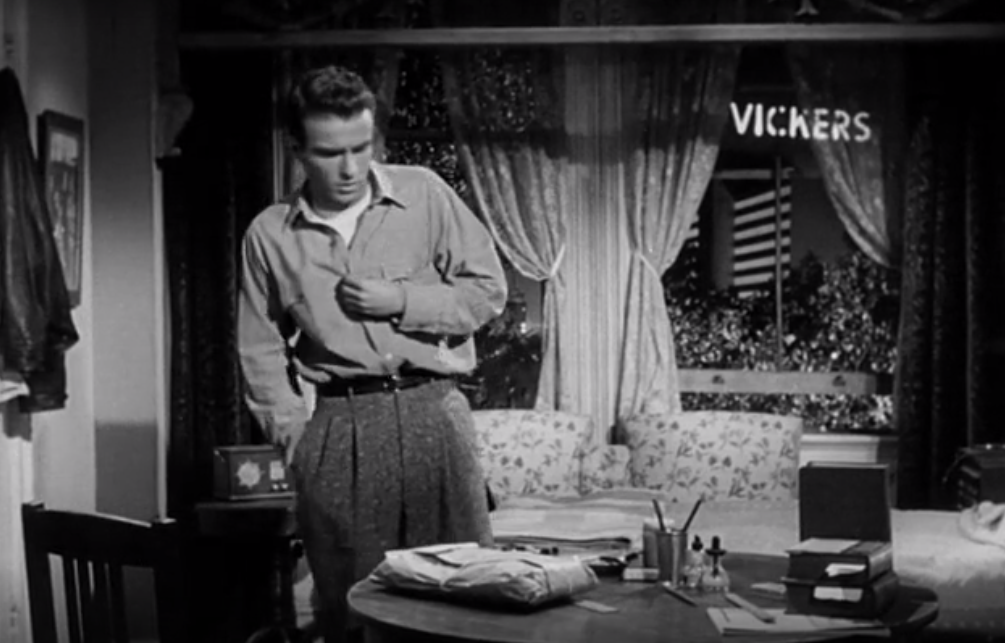
Still later, when George is at home obsessing over Angela, a neon sign in the distance flashes her last name (presumably on some building that her father owns) in the distance, illustrating his preoccupation. 

It’s not subtle, but I do like it. One that was subtle, however, was that every time we saw Alice’s address, whether it be on a piece of mail or on the side of the building where she lived, we saw that she lives at 4433 ½. It’s just another way that she’s stuck in the margins, a place not really held for her but one where she has to find somewhere to try and dig in and make space for herself. Poor Alice. 

Lagniappe

Boomer: The dissolve transitions in this movie are amazing. There’s so much storytelling happening in the visuals alone in this movie; the superimposition of shot over shot to convey mood, a character’s internal thoughts, everything — truly solid filmmaking, even if the movie milks its melodrama a little hard. 

Britnee: The atmosphere of Alice’s room in the boarding house really stuck with me. All of the claustrophobic shots in that room are so haunting. Particularly the scenes with that big open window at night. It’s the first thing that comes to my mind when I think about A Place in the Sun. I really can’t explain why.

Brandon: To further highlight the difference between what I appreciated in Taylor vs Winters, I’d like to point out my favorite moments of their respective, separate screentime.  Taylor’s best moment is in an early scene when she first flirts with Clift at a party, modeling an incredible, white floral Edith Head gown that has been imitated just as often in the decades since as her iconic hairstyle.  Meanwhile, Winters’s best moment is in the subtle choreography of her own flirtation with Clift at a movie theater, signaling her availability to him solely through strategic shifts in her body language.  Both contributions are essential to what makes this movie so great, but they’re very different contributions.

Next month: Brandon presents Torch Song Trilogy (1988)

– The Swampflix Crew

FYC 2023: Delicious Melodrama

One great thing about the Awards Season ritual is that it sets aside a commercially viable space for traditional melodramas, which have otherwise been banished to the depths of Lifetime & Hallmark television broadcasts.  The only way you can still attract a sizeable audience to the grandly emotional domestic dramas Hollywood used to routinely market as “women’s pictures” is to save them for Oscar-qualifying runs in the last month of the year, when interviews with their stars are suddenly headline worthy news items instead of background promotional noise.  In general, that’s all the Oscars are good for anyway: clearing out a little space in the calendar for wide audiences to discuss & celebrate movies outside the usual big-ticket tentpole IP.  Few genres benefit more from that space than the emotional-breakdown acting showcases and lavish period pieces that are traditionally marketed to women, though, if not only for their value as easy filler for Best Actress and Best Costume Design awards ballots.  It’s the most blubbering time of the year, and I’m always in need of a good cry.

If there’s any working director who understands the artistic value of the woman’s picture, it’s surely Todd Haynes, who was effectively anointed this generation’s Douglas Sirk after his period-piece melodramas Carol & Far from Heaven.  Haynes worked his way back into Awards Consideration this year with May December, a film that purposefully, perversely plays with the hallmarks of modern melodrama in the director’s signature style.  The film stars Natalie Portman as a method actor studying the quirks & mannerisms of the real-life tabloid headliner who inspired her latest role, played by longtime Haynes collaborator Julianne Moore.  Moore plays a notorious Movie-of-the-Week topic due to the sordid formation of her family, which started in the 90s when she had an affair with a 7th grader, birthed his twin children behind bars, and then married him after prison to cover up the abuse with the cultural fix-all of good old fashioned family values.  Portman promises to give Moore’s . . . unique family history the thoughtful, empathetic representation onscreen that was missing from its earlier, trashier depictions, but in the process of studying her subject, she uncovers ugly, festering truths just beneath the peachy family surface: Moore’s continued abuses of manipulative power, the young husband’s stunted emotional development in the years since the crime (played with heartbreaking vulnerability by Charles Melton), and her own twisted attraction to the role. 

If there’s anything surprising about May December‘s stature as a serious Awards Contender, it’s that Haynes tells its story through disposable TV Movie aesthetics.  Usually when a great directors’ film festival darling gets sidelined on Netflix it’s disappointing; this time it’s darkly funny.  Haynes calls attention to the heightened melodrama of the piece by ironically deploying soap opera music stings over minor, everyday domestic concerns, the same way Moore’s character violently sobs every time she overbakes a cake or forgets to buy enough hotdogs for a family cookout.  The director is at his most prankish here, riffing on the real-life tabloid story of child rapist Mary Kay Letourneau in a parody of Movie-of-the-Week melodrama, revealing the bizarre details as Portman does research by literally flipping through a tabloid.  He takes the emotional pain of the story seriously, though, the same way his Barbie-doll retelling of Karen Carpenter’s tragic life’s story in Superstar is far more dramatically severe in practice than its tongue-in-cheek presentation sounds in the abstract.  The hazy soap opera filters, icy camp performances, and throwaway jokes about dwindling hotdog supplies set May December up to be a perverse laugh riot, but Haynes’s love for melodrama is too sincere for things to devolve that way.  It’s the same effect as ironic audiences settling in to laugh at the “No more wire hangers!” histrionics of Mommie Dearest, only to be confronted by the film’s non-stop onslaught of genuinely upsetting domestic abuses.

As much as I appreciate Todd Haynes’s unique brand of weaponized irony, I can’t say that May December is my favorite melodrama that screened for critics this Awards Season.  That honor belongs to the culinary period piece The Pot-au-Feu, which will eventually be released in the United States as The Taste of Things.  The film is a romantically penned love letter to Juliette Binoche, just as every Todd Haynes film is a loving tribute to Julianne Moore.  Binoche stars as the most underappreciated chef in 19th Century France, doing all of the complex, hands-on kitchen work that gets the master of her house recognized as “The Napoleon of Gastronomy.”  That restaurateur (Benoît Magimel) acknowledges her value as a culinary artist, at least, and he spends every minute they’re not cooking together begging for her hand in marriage.  Binoche prefers to let her cooking do the talking and expresses her mutual adoration for her employer through the beauty & poetry of her food.  Only he and a small social club of nerdy gourmets (essentially, the world’s first foodie podcast) truly understand her value in the field, but the audience is invited to share in their awe.  The emotions in the household get exponentially bigger as the two chefs’ mutual yearning starts to border on ritualistic kink, and it all eventually boils over into a fiery romance with no safety valve.  Love, life, and tragedy inevitably ensue.

The Taste of Things is an aggressively sensual romance about the joy of sharing thoughtfully prepared meals – very likely the best film about food since Pig.  Its honeyed tone & lighting are absurdly cozy & warm, with handheld camerawork that takes the term “food porn” as literally as it can without indulging in sploshing.  Still, the big emotions of its central tearjerker romance place it just as firmly in the melodrama category as Haynes’s latest, which is much colder & more detached.  Both are great Wine Mom movies, but only May December plays into that genre with ironic, Lifetime-parodying self-awareness, while The Taste of Things is achingly sincere & straightforward in its full-hearted commitment to melodrama.  Maybe that commitment makes it more mawkish & cliche, but it also makes it more emotionally satisfying when it violently yanks your heartstrings the way only the best women’s pictures can.

-Brandon Ledet

Bonus Features: Peyton Place (1957)

Our current Movie of the Month, 1957’s Peyton Place, is a sprawling epic of small-town scandal & melodrama.  It’s essentially Douglas Sirk’s “Harper Valley PTA”, an exquisite illustration of lowly gossip & pulp.  Since its source-material novel was essentially the Fifty Shades of its time, its major-studio adaptation had to put on an air of arty prestige & high-minded sexual education to justify the indulgence.  The sex education aspect is loudly pronounced, advocating for healthy sexual habits to be openly discussed and taught in schools, since the small-town sex shaming of all “dirty talk” is what causes heartbreak & tragedy in its doomed characters’ lives.  Prestige is a much trickier quality to signal to the audience, something the film prompts in its sweeping shots of artificial woodland vistas and soaring melodramatic strings.  It also signals prestige in the casting of Lana Turner as its biggest-name star, prominently advertising her performance over much meatier roles for the teens-in-crisis beneath her.  When Peyton Place hit theaters, Turner was a glamorous movie star that afforded the film an air of legitimacy. A year later, an act of domestic violence in which her daughter stabbed a mobster boyfriend in her family home would make her a magnet for tabloid scandal, dragging Turner down to the movie’s true gossipy nature.

Getting a sense of where Peyton Place fits within the restrictions & subversions of Old Hollywood’s final hours means getting familiar with how Lana Turner was understood & adored as an Old Hollywood movie star.  So, here are a few recommended titles if you enjoyed our Movie of the Month and want to bask in more of her Studio Era glamour.

The Postman Always Rings Twice (1946)

Since every other title on this list casts Lana Turner for her star power but doesn’t actually center her as its star, it’s imperative to include her iconic, spotlight-commanding role in this classic studio noir.  Turner plays the world’s most pragmatic femme fatale in The Postman Always Rings Twice, using her smoky sexual charisma to inspire a lovelorn drifter to kill her husband so she can run her own roadside diner, to both her and her lover’s eventual peril.  Despite a couple mid-film courtroom battles that ice their wayward momentum, it’s a great story about two lost souls who are so rottenly horny for each other that they don’t know what to do except destroy everything.  If nothing else, it’s easily 1000x sexier than its 80s erotic thriller remake, a movie that Turner dismissed as “pornographic trash” without ever actually watching it.

The Bad and the Beautiful (1952)

The only reason the mean little Hollywood tabloid The Bad and the Beautiful can’t claim to be a proper Lana Turner showcase is that she’s outshined by an incredibly unrelenting Kirk Douglas performance that leaves no scenery in his path unchewed.  The movie itself is also somewhat outshined by its own overperforming peers in the same way, as it boldly, brashly recalls Citizen Kane & Sunset Boulevard without having any of the necessary virtuosity to back it up.  Luckily it’s bitchy & cynical enough to stand on its own as a self-hating Hollywood mythmaker, and it props Turner up as a mildly fictionalized version of herself – a powerhouse Studio System starlet with a troubled life offscreen.  She’s unusually vulnerable in the role too, plunging to rock bottom before towering over Douglas’s frantic anti-hero as his romantic foil.

Imitation of Life (1959)

Turner also plays a struggling actress who eventually makes it big in Douglas Sirk’s classic melodrama Imitation of Life, and I’d say she’s also outshined as a secondary attraction there, despite her prominence on the poster.  Like in Peyton Place, Turner’s name is used as a box office draw, but the most compelling melodrama in the film is reserved for the teens running circles at her feet.  She looks absolutely fabulous in the role as the matriarch Broadway star, though, modeling a million-dollar wardrobe that broke records for Old Hollywood productions at the time. 

By pretending to position Turner center stage, Sirk was able to get away with telling a subversive story about racial discrimination, passing, and self-hatred with Juanita Moore’s character in a way that would’ve frightened off studio execs without blinding them with Turner’s gowns & jewels.  The boldly political sex education messaging of Peyton Place is hidden behind Turner’s star wattage in a similar way, even if it’s not nearly as tasteful nor exquisitely staged as its Douglas Sirk equivalent.  By the time she “starred” in Imitation of Life, the real-life tragedy in Turner’s family had already made tabloid headlines, but she was still useful to Sirk as a signal of class & prestige, which I think says something about the inherent strength & respectability of her screen presence.

-Brandon Ledet

Movie of the Month: Peyton Place (1957)

Every month one of us makes the rest of the crew watch a movie they’ve never seen before, and we discuss it afterwards. This month Britnee made Boomer, Brandon, and Alli watch Peyton Place (1957).

Britnee: I love drama. Soap operas like The Bold and the Beautiful and Days of Our Lives were the inspiration for “playing pretend” with my Barbie dolls when I was a wee one. Now, as a grown adult, I spend most of my time in the BravoSphere obsessing over everything Real Housewives (when I’m not watching movies, of course). Yes, I like my drama on the trashy side, so it’s no surprise that I fell in love with the classic melodrama Peyton Place

Peyton Place is adapted from Grace Metalious’s debut novel of the same name that shocked the world in 1956. It was regarded as smut by the public and banned in various cities and countries due to its racy subjects, including incest, rape, abortion, and adultery. Film producer Jerry Wald jumped on getting the rights to Peyton Place from Metalious less than a month after the novel was released. The result is definitely a sanitized version of the novel, but it’s still pretty scandalous considering that the film was released in 1957.

In the small New England town of Peyton Place, the gossip is hot and the secrets are plentiful. Michael Rossi (Lee Phillips) arrives for his new job as the high school principal along with his “liberal” education methods in tow. We soon find out that he is taking the position from Mrs. Thornton (Mildred Dunnock), who is a tenured English teacher more than fit for the job. There’s a plethora of sad moments throughout the film, but Mrs. Thornton’s heartbreak at that disappointment hits me so hard. We are then introduced to multiple families who have all sorts of juicy secrets, particularly the MacKenzies and the Crosses. Constance MacKenzie (Lana Turner) is a widow and shop owner, raising her only-child, Allison (Diane Varsi). Allison is best friends with Selena Cross (Hope Lange), who’s mother Nellie (Betty Fields), is Constance’s maid. Selena has an extremely rough life, especially compared to Allison’s. She lives in a shack with her mother, younger brother, and horrible alcoholic stepfather.

The judgmental and hypocritical society of Peyton Place causes irreparable damage to much of the community, particularly the youth. Allison is judged harshly by Constance for an innocent kiss, only to find out that she was the product of an affair. Selena is raped and impregnated by her stepfather, struggles to get an abortion, and miscarries due to an accident. Her mother, Nellie, then commits suicide at the MacKenzie residence. To make matters worse, she murders her stepfather in self-defense when he tries to attack her again and is put on trial. And that’s not even getting into Rodney & Betty’s struggles outside the main drama. There is never a dull moment in the film, since we are following so many different families and couples, which is one of the things I appreciate most about it. You can rewatch it multiple times and focus on a different character each time. It’s movie magic!

I’m dying to know what the rest of the crew thought of this movie. We’re there any characters y’all found more fascinating than others?

Brandon:  I loved this.  It’s the exact intersection of high and low art sensibilities where you’ll find most of cinema’s shiniest gems.  For whatever reputation Peyton Place might have as a trashy paperback, this adaptation treats it with the same wide Cinemascope vistas and sweeping orchestral overtures you’d expect in a David Lean adaptation of a literary classic.  A sprawling, gossipy epic of small-town scandal & melodrama, it’s essentially Douglas Sirk’s “Harper Valley PTA”, an exquisite rendering of sensationalist pulp.  The material at hand earns that treatment too.  No matter what prurient curiosity the novel may have held as the Fifty Shades of Grey of its time, it also functions as politically-minded sex education advocacy.  It argues that good, healthy sex habits should be openly discussed and even taught in schools, since the small-town sex shaming of all “dirty talk” is what causes heartbreak & tragedy in these doomed characters’ lives.  There’s something genuinely radical about its 50s-era sex positivity, especially when the proudly horny Allison explains to her male classmate “Girls want to do the same things as boys,” a truth that still hasn’t been fully absorbed in small-town American rhetoric.

Singling out individual characters is a smart way to discuss this film, since there are seemingly hundreds to choose from, each representing their own hot-button issue meant to inspire hushed watercooler & beauty salon chatter among anyone lucky enough to have visited Peyton Place.  I was also heartbroken by the professional disappointments Mrs. Thornton suffers in the first act; I found myself crying over her open-hearted kindness within seconds of meeting her, as her students pooled money together to buy a congratulatory gift for a promotion that never came.  She’s only a small part of the story, though, especially as her potentially pompous replacement proves himself to be just as noble & progressive in his approach to teen-years education.  What I was more hanging on the edge of my seat about was the character arc of Allison’s friend Norman Page (Russ Tamblyn). 

Throughout the film, Norman is portrayed as sexually timid & confused, to the point where he was an obvious representative of closeted (and maybe even oblivious) homosexuality.  What was unclear was how far the movie could possibly go in openly discussing his sexual orientation, beyond broad, Freudian characterizations of his overbearing mother and his self-hating nature as a “coward” and a “sissy.”  My fear was that Allison would be romantically paired with Norman as a narrative attempt to “cure” him, but thankfully they just remain good friends & co-conspirators.  Like many of the hot-button issues the movie collects like Pokémon, Norman’s status as a sexual outlier is never exactly challenged or resolved.  It’s more just plainly represented as a simple fact of life (as much as it could be in a time of intense sexual repression).  The difference with Norman’s sexual identity crisis, though, is that it’s never openly discussed like the affairs, suicides, rapes, and miscarriages playing out elsewhere in town.  Even for a movie that proudly tackles the most sensational topics of its day, Norman’s (ambiguous, unconfirmed) queerness is too controversial to be discussed in clear, honest terms, which is what makes him such a fascinating character to keep track of in the larger crowd.  There’s a tension to seeing just how far the movie is willing to go in his characterization in every scene he enters.

Boomer: It’s funny that Brandon should mention “Harper Valley PTA,” since that’s the only real exposure that I had to Peyton Place (other than its use as exactly the same epithet that Jeannie C. Riley used) prior to this viewing: “You think that as the mother I’m not fit / Well, this is just a little Peyton Place / And you’re all Harper Valley hypocrites.” That is to say, a Peyton Place is somewhere that there’s an awful lot of funny business going on, if you know what I mean. I don’t know how much of that was born out of the film itself and how much was the result of the various sequel soaps and other adaptations that were released in its wake, because in practice, there’s actually very little sex in the film, with what little there is being unspoken or deep in the back story, while the forefront is composed of so much suspicion and gossip. There’s one really frisky classmate of Allison and Selena who flirts with the former before devoting himself to his one real childhood sweetheart (to whom he seems faithful despite his raging hormones, especially in combination with his disdain for his father’s own implied adulteries), and then in the backstory Connie had an affair with a married man, of which Allison is the product. It’s barely salacious, even for the time period, and only the first of these is common knowledge, though it enters the town’s thriving marketplace of gossip attached to the incorrect players. Peyton Place’s prosperity comes in the form of its textile mill, but it runs just as much on the rumor mill, as very little information that gets passed around is accurate, and real secrets get covered over in the rush. Connie’s affair could have remained hidden forever, just like Lucas Cross’s crimes and sins, because town gossip was mostly concerned with fiction. 

I, like Brandon, also thought of Douglas Sirk while watching this, but in my mind I titled it “Sirk’s Twin Peaks” because in both titular towns, the deepest and most harrowing crime is at the expense of a teenage girl and mostly concerns itself with her peers and the people of her parents’ generation who are supposed to be looking out for their children. (And they both have Russ Tamblyn!) It could just as easily have been Sirk’s Blue Velvet, however, given that it was the earlier of David Lynch’s works about an idyllic town with a monstrous underbelly of violent unchained id and a facade of perfect Americana with a maggoty core. (And they both have Hope Lange!) But the film is only Lynchian in its topic, not in its tone or its temperament, and in this mixture between the cheerful color of full-on Cinemascope melodrama and its seedy story of suspicion and vice that makes it feel at once both dated and timeless in the best possible way. 

Alli: I went into this movie, as I do with a lot of movies from this era, with my 1950s housewife lenses on. I like to imagine that I’m completely fresh and contemporary to an old movie. From that perspective, Peyton Place is positively lurid. Teenage sexuality? Class consciousness? Education reforms? Abortion? Absolutely shocking. Which is why I couldn’t stay in that frame of mind for long. It’s just too ahead of its time. I’m honestly astonished that it even got made. It’s not always an easy watch, but it is a worthwhile one, filled with drama, critiques of small town America, and necking. If this movie were made on this scale today, there are still people who would find it absolutely shocking and controversial. 

It starts off strong with Michael Rossi arriving in town observing the dilapidated shacks on the wrong side of the tracks, only to arrive on mainstreet in this idyllic New England hamlet, complete with beautiful green trees, gorgeous homes, and quaint local businesses. He has a conversation with a restaurant owner about the state of employment in Peyton Place where we find out that almost everyone works at a woolen mill and that business has a stranglehold over everything in town. Like any town where one industry dominates the entire economy, the business owners have a vested interest in making sure that education is undervalued and that the status quo is maintained. Rossi does manage to haggle for a better salary, even with the reluctance of the school board, probably because he is not the “older” woman Mrs. Thorton (“older” in scare quotes here because it’s later revealed that she’s in her mid to late 40s). This clash of capitalistic American values against an educator’s desire for fairness and equality for all students is riveting. When he’s demanding a salary and refusing to do the unpaid labor of coaching sports teams, I was elated. We need more movies where characters stick up for themselves in the faces of tycoons.

All these teens’ stories are so good. I love them sneaking around and indulging in horny teenage rebellion. I love Betty slutting it up. It’s extremely satisfying when Allison stands up for herself to her hypocrite mother. Norman suffering his Psycho-esque Norma Bates mother is just oedipal perfection. Selena’s story, however, is heartbreaking, and quite frankly, it was extremely difficult for me to watch. The abuse she suffers at the hands of her stepfather is presented so starkly and realistically. In a movie full of overblown drama, this plot line unfortunately feels the most realistic until the town rallies behind her (real life is rarely that hopeful). When she snaps and kills Lucas, it is weirdly satisfying, even with the thought that she may have just doomed herself by trying to save herself.

I’m so glad that I watched this soapy, melodramatic epic. It is going to stick in my mind for a long time.

Lagniappe

Alli: I was so focused on how great the narrative is, I forgot to mention it’s beautiful too! How about Mrs. Mackenzie in that red dress going to Rossis’ house for Christmas? The bright, saturated colors there are just wonderful.

Brandon: My only previous exposure to Peyton Place was the shot of Jayne Mansfield reading it during a self-indulgent bubble bath in Will Success Spoil Rock Hunter?, a visual gag that’s much funnier now that I know of the novel’s sub-literary reputation.

Britnee: I find myself referencing Peyton Place more and more as I get older. I’m not sure if that’s a good thing, but it’s a reminder of how relevant the film still is. It should come as no surprise that a Peyton Place themed excursion to its Camden, Maine filming location is on my vacation wishlist. The Camden Public Library even put together a map of Peyton Place landmarks. The majority of the locations haven’t changed much since 1957. It’s the melodramatic time capsule of my dreams!

Boomer: I was on the edge of my seat waiting to see which actor I knew from their appearances on Alfred Hitchcock Presents or The Alfred Hitchcock Hour would appear next. I immediately recognized Mildred Dunnock (Mrs. Thornton) from her three appearances in the former program and her singular appearance in the latter, in the episodes “None Are So Blind,” “The West Warlock Time Capsule,” “Heart of Gold,” and “Beyond the Sea of Death.” Arthur Kennedy (Lucas Cross) appeared in the Hour episode “Change of Address,” Betty Field (Nellie Cross) was in the Presents episode “A Very Moral Theft” and “The Star Juror” episode of Hour, and Staats Cotsworth (Charles Partridge) had a role in Hour‘s “The Thirty-First of February.” Even Lorne Green, who will forever be the original Battlestar Galactica‘s Commander Adama to me, appeared in the Presents episode “Help Wanted.” Surprisingly, the big one was Robert H. Harris, who played Peyton Times editor Seth Bushwell: the was in no fewer than eight episodes of Presents (“Shopping for Death,” “The Orderly World of Mr. Appleby,” “The Hidden Thing,” “Toby,” “The Dangerous People,” “The Safe Place,” :Graduating Class,” and “The Greatest Monster of them All”) and an episode of Hour entitled “Consider Her Ways.”

Next month: Brandon presents Will Success Spoil Rock Hunter? (1957)

-The Swampflix Crew