I Confess! (1953)

It’s a dark night in Quebec City. We move in, slowly, on one building in particular, gliding in through the window to find a man dead on a carpet. The beaded curtain that hangs over the door to the room is still moving, his killer having departed mere moments earlier. On the street, a man in a cassock emerges from the dead man’s house and moves up the street, slowly, until he enters Ste. Marie’s church. The killer, Otto Keller (O. E. Hasse), begs Father Michael Logan (Montgomery Clift) to take his confession, and the young priest does so. Otto begins with an expression of his gratitude to Father Logan, who helped him and his wife Alma (Dolly Haas) find work and lodging in the rectory, before he admits that he accidentally killed local dirtbag lawyer Villette (Ovila Légaré), whom he initially only intended to rob so that Alma wouldn’t have to work so hard. Father Logan confirms that his confession is held in confidence and that he will not involve the law, but that Keller must return the money and turn himself in. The following morning, Father Logan makes his way to Villette’s house, where he meets primary investigator Inspector Larrue (Karl Malden), who tells him that Otto discovered the body. Larrue observes Father Logan speaking to a woman outside and becomes suspicious, even though he doesn’t hear her say the words “Villette is dead? Then we’re saved!” to the priest. The woman turns out to be Ruth Grandfort (Anne Baxter), the wife of local legislator Pierre Grandfort, who is close friends with Crown Prosecutor Willy Robertson (Brian Aherne), but her and Father Michael’s friendship goes back even further, and is deeper. 

I Confess! gets off to a marvelous start, but then it ends up spinning its wheels for far too long, even for a film that clocks in at a mere 95 minutes. The story feels like it’s headed toward a conclusion at about the halfway mark, and by the time we reached the final third, I kept checking the time and finding myself startled to discover that only a minute or two had passed since I had last checked. The ending is sufficiently strong that the last twelve minutes were at least engaging, but it wasn’t enough to come back from the slump. Conceptually, it’s pure Hitchcock: the wrongfully accused man who must prove his innocence but for some reason cannot, the blonde who loves him, and a crew of police investigators who are at turns both foolish and malicious. As a narrative device, having a character who can’t defend himself against false allegations because he’s bound by the sanctity of the confessional is also a fresh idea, and complicating matters further by having the victim be a blackmailer extorting the priest’s ex-girlfriend in a way that potentially implicates the priest himself is a fun place to take that concept. Unfortunately, Clift is dreadfully dull in this role, Hasse’s turn as the villainous Keller is similarly underwhelming, and the apathy that Hitchcock allegedly had for this project comes through in the workmanlike nature of the cinematography. 

When I told my mother that I had recently watched this one, she asked if it had been released before or after Montgomery Clift’s infamous car accident, noting that he might have been stiff because of the resulting physical and psychological scars (and the addictions that came in attempting to medicate the latter). That didn’t happen until 1956, and I Confess was released only a couple of years after A Place in the Sun, in which I seem to remember finding him very convincing. I don’t know where the blame for his stilted performance here comes from, and I can say the same thing about Hesse. Keller seems to reflect the era’s general antipathy to German immigrants, and taken as a sole piece of evidence in a vacuum, one would think that Hitchcock thought that all Germans who asked only for the opportunity to work and bemoaned their lot in life as “[men] without a country” were simply lying in wait for the opportunity to turn on their supposed benefactors, lie about their motives, steal, frame clergymen, and kill their own wives for trying to see justice done. He’s a factor in the plot, but he’s not a character, and the film is much worse off for letting us know who the manslaughterer is from the start but not making that person interesting. Baxter ends up the MVP here, and the best part of the film comes after Father Michael has been arrested and she decides she has to explain everything to the police at the cost of her social standing and dignity: years before, Michael went off to fight in the war and told Ruth not to wait for him; when he came back, she had already married Pierre. When their innocent reunion is interrupted by a thunderstorm, the two are forced to take shelter in a gazebo, where the blackmailer/victim discovered them the next morning and inferred they had slept together, which would be enough to ruin Ruth’s marriage, embroil her husband in a scandal, and (even though he wasn’t yet ordained) defrock Michael. When her testimony ends up doing more harm than good, as the hours she spent with Michael the night of the murder fall before the time of death but her explanation finally provides the police with a potential motive for Michael, she’s distraught, and Baxter sells it tremendously. It’s just not enough to save it. 

The film almost does something interesting near its conclusion, when the jury finds that there simply isn’t enough evidence to convict Michael and he’s released. Although he’s not culpable in the eyes of the law, his verdict in the court of public opinion is much heavier, and it would have been interesting to spend a little more time with this narrative thread. Can he return to the church? How has his downfall affected the faith of his parishioners? Will some forgive but never forget? None of these questions get the chance to be answered, or even a moment’s breathing room, as Michael barely makes it down the steps before Mrs. Keller attempts to tell Larrue that her husband was the true killer, only for Keller himself to shoot her (so much for the whole motive of his theft being to spare her a life of servitude, I suppose). Oh well. A necessity really only for Hitchcock or Clift completists, I’d say skip this one. 

-Mark “Boomer” Redmond

Movie of the Month: A Place in the Sun (1951)

Every month one of us makes the rest of the crew watch a movie they’ve never seen before, and we discuss it afterwards. This month Britnee made Boomer and Brandon watch A Place in the Sun (1951).

Britnee: Based on Theodore Dreiser’s 1925 novel An American Tragedy, George Stevens’s melodramatic noir masterpiece A Place in the Sun is one of my all-time favorite films. It’s overdramatic, shocking, gripping, and stars a young Elizabeth Taylor. That alone should convince anyone to watch it. Stevens won the Academy Award for Best Director for A Place in the Sun in 1951, and several years later in 1956, he won the award again for Giant (which also stars Elizabeth Taylor!). He treats his characters with such thoughtfulness and uses unique filmmaking techniques to drill through the layers of their humanity, drilling especially deep in this one.

George Eastman (Montgomery Clift) hitchhikes to California with the hopes of starting a career at his wealthy uncle’s factory. He’s working class and comes from a poor family, but he badly wants to be a part of the upper class. That’s American dream, isn’t it? He is given an entry-level job at the factory, where he hits it off with his co-worker, Alice Tripp (Shelley Winters). They become a couple but don’t make their relationship public because it’s against the rules for male and female factory workers to fraternize. Gradually, George starts to step out on Alice to get closer to Angela Vickers (Elizabeth Taylor), the daughter of another wealthy industrialist in town. He’s hypnotized not only by Angela’s beauty, but by the status that she and her family hold. Angela is drawn to George as well, and she begins to invite him to more social events with the upper crust of society. Alice becomes increasingly upset as George puts her on the backburner to attend numerous fancy gatherings, and her frustrations are elevated when she finds out she is pregnant with his child. After her attempt to have an abortion is unsuccessful (in a very scandalous scene), she begins to pressure him into marriage. At the same time, his romantic relationship with Angela is blossoming.

Angela invites George to spend Labor Day weekend at her family’s lake house, which he does after telling Alice the trip is for his career advancement. Poor sweet Alice opens the morning paper to find a front-page photo of George having the time of his life on a boat with Angela. She tracks him down and quickly arrives to the town where they’re vacationing. This is the part of the film where I yell “Hell yeah, Alice! Show him you’re not messing around!” Unfortunately, when George meets her in town, he realizes that he needs to get rid of Alice to move on to a life with Angela, and that’s when the film takes the turn into being more of a legal thriller than a melodrama.

I’m always impressed by how much I’m drawn to the humanity of each main character in this film: Alice, Angela, and George. I know that George is terrible, but I’m almost able see into his soul. All of his sadness, confusion, and internal struggle with his conscience is boldly laid bare by Clift’s performance and enhanced by Stevens’s intense camera close-ups. Brandon, did you have a similar experience with George’s character?

Brandon: For me, the most surprising aspect of George’s character is that he’s not especially violent or sociopathic by nature; he’s just desperate.  When compared to the most infamous rowboat killer of Old Hollywood—Gene Tierny’s heartless murderess in 1945’s Leave Her to Heaven—George ain’t all that bad.  He’s operating from a similar place of selfishness, but it’s more out of financial gloom than it is out of inhuman cruelty.  His humanity didn’t strike me as especially deep or complex, though – just realistic.  One of the reasons Angela is so drawn to George is that he’s so quiet & pensive, which she misinterprets as him being “complicated”.  Really, he’s just distracted by the walls closing in on his potential future as the husband of a wealthy heiress, dooming him instead to a life as the impoverished husband of a lowly factory worker.  The more streetwise Alice, on the other hand, sees right through his desperate social climber schemes, since she doesn’t view his troubled badboy persona through the same naively romantic lens that Angela does.  Her own downfall is also one of financial desperation, making this more of a story about the evils of money & class division than it is a story about the evils of personal moral failure.

No matter the motivations for George’s mistreatment of Alice, he still behaves like an absolute scoundrel and a coward.  At its heart, A Place in the Sun is an epic-scale fuckboy melodrama about the moral crimes young men were willing to commit for the chance to be with Elizabeth Taylor, often at the expense of less outwardly elegant women like Shelley Winters.  After all, Taylor was the most marriageable woman of all time, apparently lethally so.  As with most classic melodramas, I found the interior lives of the two main actresses far more compelling than their counterpart in the male lead.  Montgomery Clift plays an adequate prototype for a leather clad street-tough that would soon be perfected by the likes of Marlon Brando & James Dean, but I mostly found him useful as a point of contrast between Taylor & Winters.  Elizabeth Taylor is the more stunningly beautiful actor of the pair, and she would go on to become one of the most-imitated, most-well-paid, and most-gossiped-about stars of studio-system Hollywood.  Shelley Winters acts circles around Taylor in the picture, though, and her talents were mostly rewarded with a late-stage career resurgence as a psychobiddy freakshow in hagsploitation schlock like Whoever Slew Auntie Roo?  One was great at acting, while the other was great at being a movie star, and I find it fascinating how that difference is reflected in their characters here, so early in their respective careers.

Boomer, since this is ultimately a movie about callously comparing women against each other, what do you make of the difference between what Elizabeth Taylor & Shelley Winters bring to the screen in their competing roles as Alice & Angela?

Boomer: Looking back to the Wikipedia summary for this film, I’m immediately struck by the second sentence. From the top, it reads: “In 1950, George Eastman, the poor nephew of rich industrialist Charles Eastman, is offered an entry-level job at his uncle’s factory, where he begins dating co-worker Alice Tripp. Alice believes George’s Eastman name will bring her advantages” [emphasis added]. I don’t think that this is true, actually. If it was said explicitly, then I missed it, and if it’s not explicit, I think that’s more of an inference on the part of the composer of the plot description than something that’s implied in the narrative. If anything, Alice just seems like a lonely girl stuck in the kind of job that women in the 50s were supposed to do until a man married them and they could become housewives, but there are plenty of women around her who are older than she is, so there’s an implication that she worries she could end up an “old maid” like them. The implication that Alice is concerned with hitching herself to George for financial reasons is particularly unkind to her; her willingness to terminate her pregnancy (even if she can’t find a doctor to perform the operation) makes it clear that she’s not trying to entrap him with a child, and her declaration that she doesn’t care if they have to live in poverty as long as their together rings true.

On the other hand, Taylor brings a lightness to her character that’s lovely to behold, and I think that we’re supposed to be as entranced by her ethereality as George is. Her name implies an angelic nature not just in that she remains faithfully devoted to George until the end, but also that she’s a being that’s forever out of his reach and unable to be touched. But there’s also a naivety to her, and I can’t tell if that’s something that I’m projecting from the metatext, or something that’s really there. Before this, Shelley Winters was a huge sex symbol, and her dressing down to play dowdy Alice here was actually her playing against type, and that undisguisable beauty that lies beneath is impossible to completely conceal. Some quick research tells me that this was filmed from October of 1949 to March of 1950, which means that Clift and Winters were 29 during filming, and Taylor turned 18 during February, 1950. Although Winters still has a healthy vitality and youthful glow under all their attempts to frump her down a little, Clift very much looks older than his age, and far too old for the high school aged Taylor. To me, that discrepancy implies that there was never really a chance that this would work out – that Angela’s infatuation with George, while reciprocated, is not really as deep as Alice’s genuine love for him, and is more of a passing fancy and a fascination with someone outside of her privileged class than loving devotion. Then again … I’m keenly aware that I’m looking at this from a modern perspective and from within the horizon of my own experience, so maybe I’m no better than the person who crafted that implication that Alice was a gold-digger in the Wikipedia article. At least I’m admitting it’s my interpretation and not citing it as a fact! Ultimately, I think that the fact that Taylor brings the air of the ingenue to the role and Winters, by default having to play the supposedly less desirable option, is the perfect foil to her. Both of them deserve better than what they got, but it’s particularly hard to watch what happens to Alice. 

While we’re on the topic of Alice, I do want to note that one of my favorite things about this one was the way that the art direction was such a powerful contributor to the narrative, since that hasn’t been touched upon yet. In the scene in which George calls home to tell his mother about his promotion, there’s a giant sign above the men camped out in her mission house asking the reader how long it’s been since they’ve written their mother, just to underline the distance between George and his mother, and the lack of contact between them. 

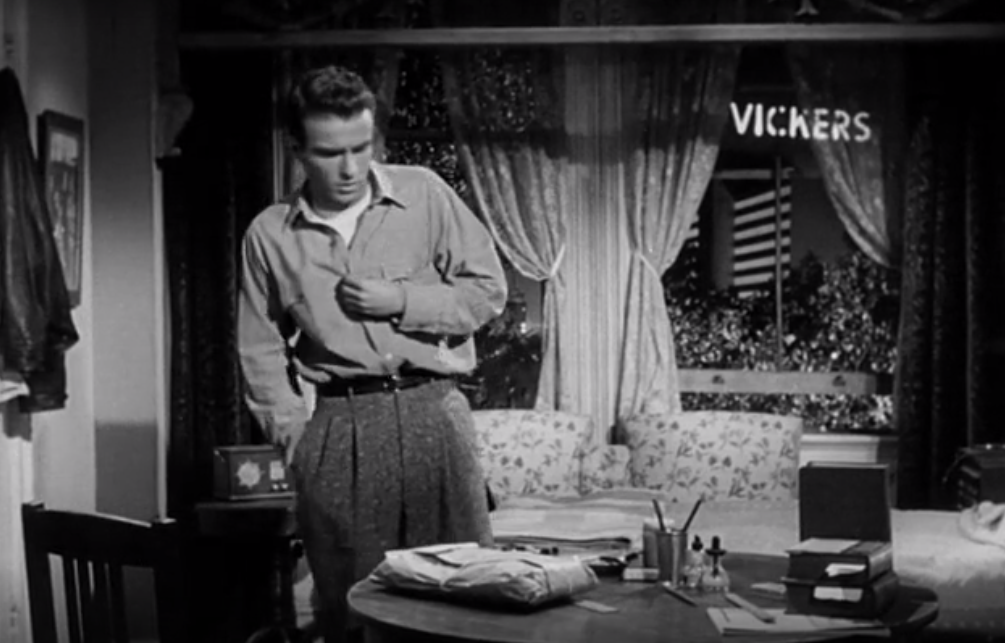
Still later, when George is at home obsessing over Angela, a neon sign in the distance flashes her last name (presumably on some building that her father owns) in the distance, illustrating his preoccupation. 

It’s not subtle, but I do like it. One that was subtle, however, was that every time we saw Alice’s address, whether it be on a piece of mail or on the side of the building where she lived, we saw that she lives at 4433 ½. It’s just another way that she’s stuck in the margins, a place not really held for her but one where she has to find somewhere to try and dig in and make space for herself. Poor Alice. 

Lagniappe

Boomer: The dissolve transitions in this movie are amazing. There’s so much storytelling happening in the visuals alone in this movie; the superimposition of shot over shot to convey mood, a character’s internal thoughts, everything — truly solid filmmaking, even if the movie milks its melodrama a little hard. 

Britnee: The atmosphere of Alice’s room in the boarding house really stuck with me. All of the claustrophobic shots in that room are so haunting. Particularly the scenes with that big open window at night. It’s the first thing that comes to my mind when I think about A Place in the Sun. I really can’t explain why.

Brandon: To further highlight the difference between what I appreciated in Taylor vs Winters, I’d like to point out my favorite moments of their respective, separate screentime.  Taylor’s best moment is in an early scene when she first flirts with Clift at a party, modeling an incredible, white floral Edith Head gown that has been imitated just as often in the decades since as her iconic hairstyle.  Meanwhile, Winters’s best moment is in the subtle choreography of her own flirtation with Clift at a movie theater, signaling her availability to him solely through strategic shifts in her body language.  Both contributions are essential to what makes this movie so great, but they’re very different contributions.

Next month: Brandon presents Torch Song Trilogy (1988)

– The Swampflix Crew