Exiled: A Law & Order Movie (1998)

As I’ve previously mentioned in recent reviews of The Night of the Juggler, Highest 2 Lowest, and every podcast topic I can shoehorn it into, I’ve been watching a lot of Law & Order lately. I had never seen a full episode of the criminal-justice procedural before this summer, and I’m now roughly 200 episodes deep into its original run, both facts to my shame. Part of the attraction in early seasons of the show is how pristine their current HD scans look on Hulu, especially in the initial stretch where most episodes were shot by all-star cinematographer Ernest Dickerson. Now that I’m halfway into the ninth season, that attention to visual craft has mostly faded, and I’m more addicted to the storytelling format than I am impressed by the imagery. So it goes. However, I have recently found, hidden in those Hulu uploads, a made-for-TV Law & Order movie that aired in November of 1998 and makes a conscious effort to return to the cinematic slickness of the show’s early style. The only problem with Exiled: A Law & Order Movie, really, is that it’s all law and no order, deviating from the show’s bifurcated format to only focus on the police work that leads to a suspect’s arrest, skipping over the courtroom litigation that follows. That choice undercuts the set-up, punchline rhythms that make the show so routinely satisfying, but I suppose movies have a lot more leeway to leave an audience hanging. As someone currently invested in the show’s season-to-season quality shifts, it was an illustrative reminder of how much the show has changed over its first decade on air, dialing the clock back to where it started in 1990. I can’t imagine it’s especially useful to anyone who’s not currently nursing a Law & Order addiction, though, since it just barely works as a by-the-numbers cop thriller without its connection to the show.

Exiled is first & foremost a vanity parade for actor (and credibly alleged sexual abuser) Chris Noth, likely intended to capitalize on his then-recent premiere as Mr. Big on the hit HBO Show Sex and the City. Noth even gets a partial “Story By” credit, indicating that he got to shape how his original-cast Law & Order character, Detective Mike Logan, would return for his two-hour victory lap. For those who haven’t seen or thought about Detective Mike Logan since the 1990s, I will remind you that his character left the show in disgrace after punching a homophobic politician in front of TV news cameras, finally letting his hothead temperament get away from him in front of the wrong people. The “exile” of the title refers to his reassignment after that incident, having been shipped off to work domestic calls on Staten Island instead of homicide cases in Manhattan. At the start of the movie, he recovers a drowned corpse in the bay between his old life and his new one, shrewdly deciding to angle for his old job back by claiming jurisdiction over a homicide that clearly belongs to the other side. From there, Logan immediately returns to his old ways. He whores around Manhattan, shamelessly hitting on both the victim’s twin sister and his new partner, while interrogating suspects in his old favorite strip joints up & down 42nd Street (the kind that only exist on broadcast television, where strippers conspicuously dance in their bras & panties instead of fully nude). Like all “very special episodes” of Law & Order, the investigation inevitably leads to the mafia and a major corruption scandal, except now the TV-movie budget can afford a couple car chases & shootouts that the show never splurges on. Because Logan isn’t slated to return to the main cast of the show (as he quickly becomes busy tormenting Carrie Bradshaw elsewhere in the city), the movie then has to return him to where he starts in this story: an ambitious hothead loser with a barely manageable sex addiction, eternally imprisoned on Staten Island. It digs him back up just to bury him all over again.

Exiled is most interesting as an outlier curio for longtime Law & Order fans, an extended side-quest episode packed with trivial tidbits. It’s the only entry in the Law & Order canon I can name that doesn’t feature the iconic theme song or gavel-bang sound effects. Dana Ekleson’s casting as Logan’s Staten Island partner marks the first female detective in the show’s main cast. Ice-T also makes his first appearance  here, although in this instance he’s playing a pimp named Kingston, not his detective character from Law & Order: SVU. It’s also the last time Mike Logan appears in the main cast of the flagship show, only returning later in recurring cameos on Law & Order: Criminal Intent. Speaking of its infinite spin-off series, 1998 was the very last year that Law & Order remained a singular, standalone show and not a franchise brand. To that end, Noth’s return to the series here is a naked effort to tie together all the loose threads of the original show’s casts before they fray beyond repair. Hilariously, that move makes the movie double as both a vanity project for Noth and also a tearful goodbye to John Forie’s background player Detective Tony Profaci, who hangs around the first eight seasons of the show doing nothing in particular except handing reports to the characters who matter. If the name “Profaci” means nothing to you, then there’s nothing to see here, but I found it amusing to see him get the Main Player treatment in Exiled while fan favorites Jerry Orbach & Sam Waterston are relegated to his usual background role. Also, Dabney Coleman fills in the Special Guest Star slot to maintain some continuity in the show’s usual format, even if the courtroom drama half is skipped entirely. Exiled is a snapshot of where the Law & Order of old (1990) intersects with the Law & Order of “now” (1998), captured just before the show mutated into a new, unmanageable beast. Now that this is out of my system, I will do my best not to clutter up this movie blog with too many more dispatches from my series watch-through in the second half of the show’s run, but I can’t make any promises. I’m already in too deep.

-Brandon Ledet

The Naked Gun: From the Files of Police Squad! (1988)

I had a very difficult time getting anyone interested enough in the new Naked Gun to go see it with me, so much so that Brandon beat me to the punch with his review of it. Suffice it to say, we are in agreement that it’s a delight. And man, Elon Musk sure is catching strays out there in theaters this year, isn’t he? Between very thinly veiled versions of him appearing as villains in The Naked Gun, M3GAN 2.0, Superman, Mountainhead, and LifeHack, and a stand-in for him realizing that his whole life has been wasted and he’s likely hellbound in The Phoenician Scheme, this really hasn’t been a good year for him, has it? I doubt we’re going to Hollywood Carol him into turning his life around, but it sure is nice to see him getting egg on his face. But let’s return to a simpler time, when a movie’s evil villain didn’t have to be the richest man in the world, and when simply being a high-level drug trafficker with designs on killing Queen Elizabeth II was enough. 

Lt. Frank Derbin (Leslie Nielsen) of LAPD’s special unit called Police Squad has just returned from a vacation overseas, where he had a bit of a busman’s holiday in the form of busting up a conference of the United States’ then-greatest enemies, including Yasser Arafat, Ayatollah Khomeini, Idi Amin, and Mikhail Gorbachev (whose famous birthmark Derbin reveals to be a fake). Upon returning home, he learns that his girlfriend has left him and his partner, Officer Nordberg (O.J. Simpson), is in the hospital after attempting to bust a heroin operation aboard a ship in L.A. Harbor, where he was caught and shot by men who work for shipping magnate Vincent Ludwig (Ricardo Montalban). Nordberg’s wife begs Drebin to find the men responsible, but heroin found on Nordberg’s jacket points to him having been on the take; Drebin is given only 24 hours by Captain Ed Hocken (George Kennedy) to clear Nordberg’s name, as Police Squad has been authorized by Mayor Barkley (Nancy Marchand, aka Livia Soprano) to take charge of security operations for the impending visit of Liz II. Meanwhile, Ludwig instructs his unsuspecting secretary, Jane (Priscilla Presley), to get close to Drebin and learn what he knows under the guise of wanting to purge his company of any potential illegal activities. Jane and Frank immediately fall in love, but can he stop Ludwig’s plan to assassinate the queen, clear Nordberg’s name, and butcher the national anthem in 85 minutes? I mean 24 hours? 

I have pretty strong memories of watching The Naked Gun as a kid, but I think that I probably saw the film’s first sequel more often, given that it was likely cheaper to license for television. At the very least, very few of these gags were familiar to me (other than the scene in which Derbin accidentally drops Ludwig’s pen into a fish tank and ends up killing one of the prized tropical fish in the process of fishing it out). I think part of that might have been that child-me would have been a little bored by the film’s ending, as it spends a pretty long time at a baseball stadium, and as a reluctant little league player during the wave of Angels in the Outfield, Field of Dreams, Little Big League, and countless other family baseball movies, I would have tuned out. In fact, as much as I was enjoying this movie, the back half is largely eaten up by Frank attempting to stop an assassination attempt at Anaheim Stadium, and I started to feel my opinion of it waver. Luckily, the location allows for a lot of beats in which Nielsen gets to do something hilarious, which made up for the fact that the film parks itself there for so long. One of the best bits involves Frank faking his way onto the field by knocking out and taking the place of a famed international opera singer, which leads to him ending up on the mound, “singing” a half-remembered version of “The Star-Spangled Banner.” It’s a delight, as is all of the stadium nonsense during which the queen is subjected to the vagaries of a baseball game, like having to ask someone to get out of your seat or ingest “dugout dogs” (one of which Ludwig discovers, to his horror, contains the remains of one of his lackeys who fell into the vat while trying to kill Frank). 

Humor is subjective, and one of the difficult things about reviewing it, as we’ve said before, is that the issue with a lot of discussions of comedy is that they can often simply devolve into recapping the jokes or reciting the dialogue. What I will say about the friend that I was finally able to convince to go see the new Liam Neeson Naked Gun was that he was glad I talked him into it, and that although he didn’t enjoy the sight gags as much as I did, he found the dialogue very funny, and I think that’s a testament to what works about Naked Gun conceptually. I love all of the visual puns and the playing around with the language of film (there’s a particularly funny bit where the camera pans from one room to another, with most of the characters going through the set door while Frank merely steps around the edge of the set wall), but even if that’s not something that you’re going to enjoy as much as I did, you’ll probably still get a kick out of the cleverness of the dialogue. I’d still say that this one ranks below my personal favorite spoof flick, Top Secret!, but that’s a high bar to clear, and I’ll admit that it’s not without its flaws—in particular, that it spends several minutes doing a direct parody of The Blue Lagoon rather than the genre tropes that it traffics in for most of the runtime is arguably worse than the baseball digression that happens in Naked Gun

It’s also interesting to look back at this one and see how much the most recent film drew from it without needing an audience to be familiar with its specifics. There is, of course, the scene in which two characters’ innocent misadventures are mistaken for degeneracy by an observer, Frank’s horny clunkily inelegant internal monologue upon meeting his love interest, and the scenes in which Frank gets raked over the coals by his superior. More specifically, when John Huston was explaining his master plan to his cronies in this year’s sequel, I said aloud, to my companion, “Isn’t this the exact plot of Kingsman?” (It is.) But the “use technology to brainwash people into committing acts of violence” villain plan is actually taken directly from the original, albeit on a much larger scale. In this film, Ludwig is able to use a remote device to turn people into Manchurian assassins; it’s never explained in any detail, as we just get close-ups of the sleeper agents’ watches when he pushes the button, and that’s all that we need to know. Brevity is the soul of wit, after all. 

If you’re feeling a little nostalgic for an old school Naked Gun experience after seeing the new one, or need something to tide you over until you get the chance to check it out yourself, you really can’t go wrong with this one. Unusually for a comedy of its age, very few of the jokes have aged poorly, especially in comparison to some of “racial” comedy in the Hot Shots! movies; it’s possible that the film’s opening could come across as offensive if one wasn’t aware that the characters at the conference are specific world leaders/figures of the time, but that can’t be helped. If anything, the only thing that really dates this is the presence of the late (“alleged”) killer O.J. Simpson, but he’s not given much to do in this one other than be injured over and over again. That’s got to be worth it to somebody, right? 

-Mark “Boomer” Redmond

The Naked Gun (2025)

It’s generally bad practice to review a movie’s cultural context (or, worse, its tabloid press) instead of reviewing the movie itself, but I cannot resist the bait this time. The new genre-spoof legacyquel The Naked Gun is review-proof in the way most absurdly silly comedies are. Its plot, construction, and themes are all secondary to its efficiency in telling jokes, which are better experienced onscreen than in text. As a joke-delivery system, The Naked Gun may not hit the same rapid-fire rhythm as previous Police Squad! movies from the 80s & 90s, but it does hit the same success rate as previous Lonely Island-brand movies from director Akiva Shaffer (Popstar, Hot Rod); it’s very funny from start to end. The most surprising & rewarding aspect of the movie has occurred offscreen, however, playing out in the tabloid headlines of grocery store checkout lines. Regardless of whether you’ve seen the film, you’re likely already aware of the unexpected real-life romance that’s developing between its two stars, whom I can say with full confidence we are all rooting for. It was top of my mind watching the movie opening weekend, anyway, to the point where it was actively informing & enhancing the text instead of distracting from it. There is something innocently, infectiously sweet about Liam Neeson & Pamela Anderson’s tabloid flirtations that makes this goof-a-second spoof feel more substantial & relevant than it possibly could otherwise – so much so that my everyday happiness is now directly tied to their still-developing romance. It’s already a generous enough gift that the new power couple gave me an opportunity to laugh all the way through an 85-minute comedy with my friends, but now I desperately need them to stay together until one of the three of us dies. They have made me their snowman.

If the significance of being Liam Neeson & Pamela Anderson’s snowman is lost on you, it’s because you have not yet seen The Naked Gun. I am citing the kind of absurdist, for-its-own-sake gag that can only be referenced through the vaguest terms without spoiling what makes it funny. The highest compliment I can pay to The Naked Gun is to report that it is tightly packed with those snowman gags, each of which had me laughing myself breathless in public: the owl dad, the heat-vision dog, the jazz club scat, the bodycam chili dogs, and so on. There is no shortage of deliriously silly nonsense. Of course, it gets away with indulging in that goofball free-for-all because it’s working within a familiar structure that doesn’t require set-up or explanation. Shaffer’s The Naked Gun continues the same detective-story spoofery as the ZAZ-era Naked Gun films, dusted off with a few updated cultural references. Liam Neeson stars as Frank Drebin, Jr., son of the deadpan dolt police detective Frank Drebin played by Leslie Neilson in the original series. In fact, Drebin’s entire LAPD station is staffed by the sons of former Police Squad! characters, allowing for metatextual jabs at both the film’s own preposterous participation in the legacyquel format and the real-life legacy of former Naked Gun actor O.J. Simpson. Neeson’s casting is smart beyond his name’s homophonic resemblance to Neilson’s. He’s similarly self-serious as an onscreen persona, having now starred in almost two solid decades of post-Taken thrillers worthy of goofy self-parody. He plays Frank Drebin, Jr. with the straightest face he can manage, which makes all of his overly literal, Amelia Bedelia misunderstandings of basic figures of speech consistently funny. The investigation in this specific episode also deals with a megalomaniac tech-bro Elon Musk stand-in (Danny Huston) to help bring the Naked Gun format up to date, and there are specific parodic references to recent thriller titles like Mission: Impossible – Fallout that do the rest of that work. It’s exactly what you’d expect from a modern-day Naked Gun movie, except with a few self-contained, sketch-comedy deviations specific to its director’s Lonely Island pedigree.

What I did not expect from a modern-day Naked Gun was to be emotionally moved by its central romance. Filling the role of previous series love interest Priscilla Presley, Pamela Anderson co-stars as Neeson’s buxom femme fatale Beth Davenport. An author of “true crime” novels based on stories that she “makes up” herself, Davenport becomes overly involved in the investigation of her software-engineer brother’s death, teaming up with Drebin to take down the Musky supervillain who killed him. After an initial noir-trope meeting in the Venetian-blinds shadows of Drebin’s office, the unlikely pair are caught off-guard by how immediately, intensely attracted they are to each other, which is impossible to fully differentiate from Neeson & Anderson’s publicity-cycle romance. Many of the broader noir tropes spoofed here ring true to their real-life relationship, especially when Drebin laments that he wakes up every day in his “lonely cop apartment” mourning his “dead cop wife,” echoing Neeson’s recent public perception as a perpetually grieving widower. Likewise, Davenport’s eagerness to get in on the action of the Police Squad investigation as a true-crime junkie recalls Anderson’s struggle to earn her way back onto the big screen after Hollywood discarded her as leftover 90s eye candy. I was happy to see her shine in a role worthy of her recent late-career makeover after that Delicate Betty Boop magnetism was wasted by last year’s Awards Season dud The Last Showgirl. I was also relieved to see Neeson back in the tabloids for something that wasn’t sexually objectifying or bizarrely racist. More so that I can ever remember, I am genuinely happy for this millionaire celebrity couple and emotionally invested in their long-term success. As for The Naked Gun, it’s difficult to guess what its own long-term success might be. It’s neither as densely packed with rewindable background visual gags as the original Naked Gun series nor as instantly rewatchable as the sing-along music video sketches of Shaffer’s Popstar, but it’s still dependably funny and—for at least as long as its real-life love affair lasts—romantically sweet.

-Brandon Ledet

Eddington (2025)

I remember when the first reviews of Beau is Afraid were coming out, one of the earliest reports were of someone who stood up as the credits rolled and shouted, “I better not hear any fucking clapping!” I saw that movie by myself on a Saturday morning because I love a pre-noon matinee, but this time, I went to see Eddington with a group of friends. One friend left the theater for two extended periods of time, and I assumed that they weren’t feeling well until, standing outside after the 145-minute runtime had come to its conclusion, they expressed righteous indignation over the movie’s pace and momentum. Another friend stated that they also felt the film was overlong, especially its final act, and said he would rank it 3.5 stars. I was a little too tired to get into it that night, but I thought this one was great. It’s not as exceptional as Ari Aster’s previous work, but it’s just as confident and feels like a return to his more conceptually focused first couple of films. 

The film opens in May of 2020, and we learn a lot about Eddington, New Mexico fairly quickly. As the town’s resident vagrant (an unrecognizable Clifton Collins Jr.) approaches from the desert, we see that it’s not very large, maybe sixteen square blocks, and we learn later that a lot of what we do see is unoccupied. Just outside of town is the potential site for a new AI data center, the construction of which (and the accompanying “job creation”) are a center of the platform for Eddington mayor Ted Garcia (Pedro Pascal), who is up for re-election. Garcia has followed gubernatorial guidelines for masking and social distancing, which has escalated what are likely long-term frictions between Garcia and Eddington’s sheriff, Joe Cross (Joaquin Phoenix), whose asthma makes him overly inclined to side with the “I can’t breathe with a mask” contingent. Cross’s home life is a nightmare; his mother-in-law Dawn (Deirdre O’Connell) has moved into the home he shares with his wife Louise (Emma Stone), a temporary situation that has become extended, and which is further exacerbated by Dawn’s ceaseless, breathless repetition of too-online conspiracy ideas and justifications. There’s a shrine to Dawn’s late husband and Louise’s father, Joe’s predecessor as sheriff, in their already-cramped house, and Louise is clearly starting to be affected by the omnipresence of Q-addled discourse being broadcast in her home 24/7. She also makes creepy, Tim Burton-esque dolls that she sells on Etsy, unaware that all of her sales are coming from people that Joe pays back. Garcia’s house is a little more peaceful, as he parents his son Eric (Matt Gomez Hidaka) solo while also running the town and a local bar. Without thinking it through or talking it over with his wife, he declares his own candidacy for mayor in the upcoming election, and he sets out to dethrone Garcia. 

This is not a stylish movie in the way that Beau or Midsommar were. It’s grounded, and for some, it may be too grounded. My frustrated friend grew very bored very quickly of how much of the film was taken up with people looking at their phones, which I think means that the film effectively captured the perpetual boredom (intercut with moments of intense existential dread) that came from the unfettered screentime that characterized the time period in which it’s set. Like a lot of real life conflict, many find themselves unable to invest in a film in which there are no characters to sympathize with or root for. Garcia is more than willing to sell out Eddington’s future by ensuring that the town will be rendered uninhabitable within a few decades—optimistically—by allowing its resources to be consumed by the data center, over the objections of the only person living in town who voices any dissent about what the project will mean to the town’s future. Later scenes set in his home also reveal him to be one of those toilet paper hoarders, which is a clever bit of visual storytelling in that it shows us that, for all his outward appearances of being progressive and compassionate, he’s susceptible to (and buys into) the same base panicky animal instincts shared by others. It would have been perhaps too pat a narrative if this selfishness in combination with his carelessness about the community and its environmental needs was compared to his acquiescence to COVID mandates put in place for the common good, and to have that realization of his hypocrisy be the catalyst for Joe’s mayoral campaign. Of course, that would also cause us to lend too much sympathy to Joe, and it’s important that we never think too highly of him or consider that any actions he takes could be reasonable on any level. Joe has to be detestable despite any sympathy that we may have for him as a result of what he’s dealing with at home; it’s imperative that he have no real ideals or ideology because the moment we can trace his violent impulses and their fallout to an internal ethical construction, we run into the danger of potentially empathizing with him. 

Every Aster protagonist prior to Joe is someone with whom we empathize, in part because their behavior stems from traumas that are completely external. In Hereditary, Toni Collette’s Annie has been driven to the point of madness by a lifetime of being gaslit by her cultist mother and the death of her daughter, so while her downfall is inevitable, it’s also relatable and understandable. In Midsommar, Florence Pugh’s Dani can come across as needy and difficult, but she’s dealing with the reality of her family’s tragic, horrifying death and the unspoken-but-not-unknown reality that her boyfriend is staying with her out of pity rather than compassion, duty rather than love. The title character in Beau is Afraid is impotent and pathetic, but his entire life is an endless nightmare constructed and architected by his mother in order to make him that way. Joe’s tragic flaw is entirely a matter of his pride. To the extent that his actions are affected by external circumstances, his acting out could be traced to the pandemic, but he’s not alone in dealing with that; literally everyone on Earth is dealing with the same problem. Beau’s world is designed to isolate and emotionally destroy him in a kind of actualization of the paranoid idea that “The world is out to get you,” while Joe is reacting to the events of very real time and place that we all experienced, but he (like many psychopathically individualistic people at that time) falls into the same paranoid trap. Beau was right; the world was out to get him. Joe, on the other hand, is very, very wrong. There’s not a single thing that Joe touches that isn’t worse for having come into contact with him, and every action that he takes results in making Eddington worse, less safe, and more fractured, and the events that spill out of Eddington into the rest of the world (notably the escalation of a Kyle Rittenhouse-esque figure to the national stage) also make everything worse. There’s no one to root for here, and that in combination with the laser-focus on a shaky, unsteady period of recent history makes for a movie that’s bound to alienate audiences despite its verisimilitude in comparison to the more surreal films in Aster’s C.V. I’ve loved all of his movies, but just as much as I wouldn’t blame someone for not enjoying Midsommar or Beau, I wouldn’t argue with someone who hated this movie because this is not a movie that’s meant to please. It’s doing something else. 

Not to keep putting this movie in conversation with all of Aster’s other work, but each of his movies have been about people on the verge, dealing with madness that works its way out of them. In this film, the madness is in everyone. Louise is a particularly pitiable figure, trapped in a place that she hates and surrounded by reminders of the past. Her father was sheriff before Joe, and her mother’s reverence for him seems to be a point of contention, with implication that he was abusive and that this abuse left Louise open to manipulation by Q-esque radical Vernon Jefferson Peak (Austin Butler). Peak is a curious figure here, as he had little real effect on the plot or on Eddington. Dawn, deep into her conspiracy rabbit hole, takes Louise to one of Peak’s meetings, where his improbable tale of childhood trafficking (which bears all the markings of false memory syndrome, if Peak even believes what he’s saying at all and isn’t merely being used to generate a cult of personality around himself) moves Louise to abandon her family and join him. Narratively, he simply removes Louise from the story, but on a more holistic level, he epitomizes the kinds of dangerous grifters who can emerge from times of social upheaval, and a demonstration of just how far-reaching their influence can be due to the rise of social media and larger communication infrastructure. He’s there for the same reason that goofy Sarah, the wannabe social justice influencer is: because Eddington is trying (and mostly succeeding) to create a panoramic externalization of the general American circumstances of 2020. And it works! For me, at least. 

-Mark “Boomer” Redmond

All Light, Everywhere (2021)

It’s been a popular meme among online movie-nerds in recent years to declare “All movies are bad” in self-deprecating irony.  The latest experimental essay from Theo “Rat Film” Anthony actually makes a sincere case for that exact sentiment, damning its own medium as a tool of police & military violence since the moment of its invention.  All Light, Everywhere broadly details the weaponization of motion picture recordings in our racist surveillance state, but it extends that critique to the very first examples of motion pictures, underlining that “All movies are bad” – at least on a moral, political level.  It’s one of those philosophical nightmares that makes you bitter about being born on this miserable hell planet (or at least makes the cinephile in you want to find a new hobby).  It’s also a great movie, even if it is anti-movie.

It doesn’t take much effort for All Light, Everywhere to make a modern audience feel sickened & infuriated by police bodycam tech.  The breezy, self-protective training that cops receive when equipped with bodycams and the smug self-satisfaction of the tech’s biggest manufacturer Axios advertising their wares is difficult to stomach.  Memories of Black citizens murdered by the police state without consequence for the cops who pulled the trigger—thanks to the intentional limitations & biases of surveillance tech—lurk just outside the frame, souring every chipper onscreen boast about its profitability and illusion of accountability.  Anthony even threads those memories into his larger thematic preoccupations with his home city of Baltimore by citing the murder of Freddie Gray as a specific example of bodycams protecting cops instead of citizens.  It’s all emotionally raw, morally corrupt, and worthy of documentation.

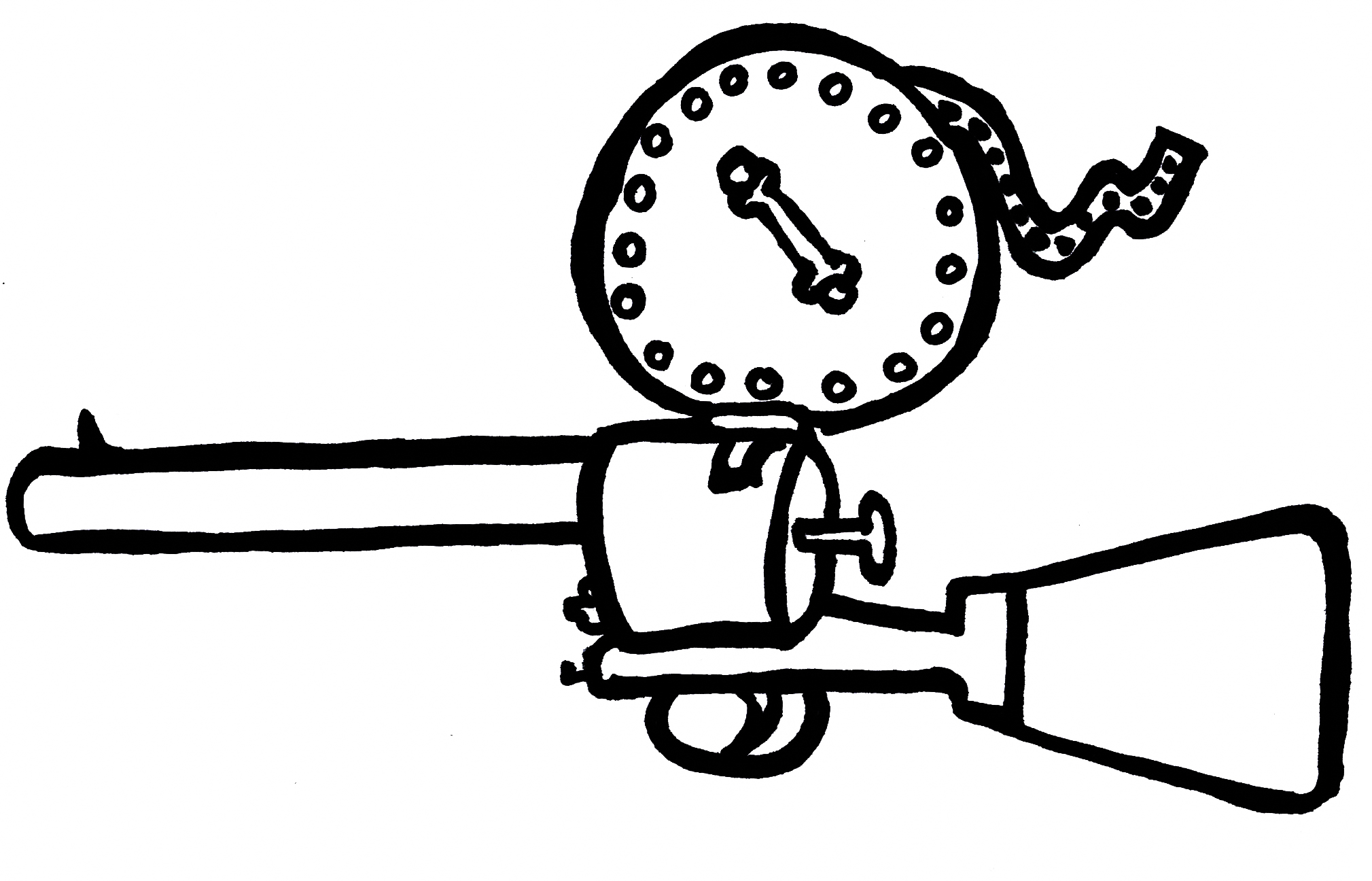
Where All Light, Everywhere excels is in connecting that modern weaponization of the motion picture camera back to its earliest uses & abuses.  Early movie cameras were typified by designs like “the photographic rifle” and “the photographic revolver,” leaving behind a language where cameras still “shoot” their subjects.  There’s a hypothetical version of this movie to be made where each new development in motion picture tech was used to further the art & distribution of pornography, but instead Anthony focuses on how they were used to afford the illusion of unbiased automation to morally bankrupt police & military systems.  Police body cameras are just the next logical evolution in a long history of supposedly “objective” motion picture recordings reinforcing the biases of the inherently violent political institutions behind them.

If you’ve seen Rat Film, you know that Anthony does not lay out this political history of the weaponized movie camera in a linear, easily digestible argument.  Instead, scientific explanations of the camera’s “blind spots”, the philosophy of its place in modern culture, its effect on human perception of the world, and the racial politics of Baltimore as a microcosm of the US at large are all loosely mixed in an open-ended visual essay that’s heavier on atmospheric dread than it is on declarative statements.  Still, the movie leaves you disgusted with the motion picture as a medium, no matter how open its arguments are left for interpretation or how much Anthony strives to leave on a moment of hope in the epilogue.  It turns out all movies really are bad.  Bummer.

-Brandon Ledet

Kathryn Bigelow and the Tough-as-Nails Heroine

One of the more popular theories as to why Kathryn Bigelow is the only woman to ever win an Oscar for Best Director is that she almost exclusively makes movie about men & masculinity. That’s not to say she doesn’t have an active, genuine interest in the topic as auteur, but rather that it’s curious that the filmmaker fixated on telling men’s stories happens to be the one woman director to ever win her field’s top prize. Bigelow’s preoccupation with macho, dirtbag men is especially noticeable in our current Movie of the Month—the Y2K sci-fi epic Strange Days—in which a scumbag anti-hero played by Ralph Fiennes is inexplicably centered in the film’s narrative instead of the more traditionally heroic badass played by Angela Bassett. Bassett’s stunt-driving, punches-throwing, testicles-kicking, politically radical heroine is a true wonder—a spectacle in herself—which makes it all the more tragic that even she is helpless to Fiennes’s greasy macho charms in the main role. That letdown is an intentionally frustrating aspect of the script (which Bigelow penned with her creative partner and already then-former husband James Cameron), but it still left me wondering what the film might have played like if Bigelow were more interested in Basset’s inner life and instead centered the woman as the lead. It would at least have been a novel departure from her usual mode.

As far as I can tell, Bigelow’s 1990 cop thriller Blue Steel is her only feature film to date with a woman in the top-billed role. Jamie Lee Curtis stars a rookie NYC police officer with a violent streak that immediately lands her in hot water. She’s not exactly the tough-as-nails badass Bassett portrays in Strange Days, but that archetype is exactly what she aspires to be. When pressed by her male colleagues about why she wants to be a cop in the first place, she “jokes” about coveting the violent authoritarianism of the position, musing “Ever since I was a kid, I wanted to shoot people.” The truth turns out to be more that she grew up powerless to stop her abusive father from physically assaulting her mother, and her new badge & gun armory allows her to wield power over him and other abusers. The first time she dons her blue uniform, she struts down the street with newfound, first-in-her-lifetime confidence. During her first night on the job she overreacts to the threats of an armed suspect and unloads every bullet she’s got into his chest. She just as capable of violence as Bassett’s tough-as-nails heroine, but lacks that role model’s cool, even hand and moral sense of justice. It’s a dangerous inner conflict that the film eventually likens to the sociopathic impulses of a deranged serial killer – a man. Naturally, this wouldn’t be a Bigelow film if there wasn’t some destructive, alluring force of masculinity present to steer the central conflict.

Blue Steel’s grotesquely macho villain subverts Jamie Lee Curtis’s hero status at the film’s center by realigning her with the Final Girl archetypes that first made her famous. Ron Silver costars as a dangerously narcissistic Wall Street brute turned serial killer, essentially laying out the entire American Psycho template in an underpraised stunner of a role. This mustache-twirling villain is first inspired to kill when he witnesses Curtis decimate her perp on her first night of patrol. His fetishistic obsession with her (and her gun) quickly escalates into erotic thriller territory, a tension he relieves by shooting randomly selected victims on the NYC streets. He also shoehorns his way into the rookie cop’s romantic life with his Wall Street wealth, so that she’s unknowingly dating the very killer she’s professionally hunting. While the film is willing to link the trigger-happy cop’s penchant for violence with the Wall Street creep’s own sociopathy, this largely becomes a tale of a woman who’s boxed in on all sides by macho bullies. Between her abusive father, her gaslighting boyfriend, and the police force higher-ups who do not believe her accounts of being attacked by creeps on the street, Blue Steel’s heroine is awash in a flood of insidious machismo. For at least this one film, Bigelow proves that she can center a woman protagonist’s story why still satisfying her auteurist preoccupations with the nature & textures of masculinity. In that way, Blue Steel deserves to be regarded as one of the director’s foremost texts.

There are plenty of other reasons why Blue Steel deserves higher critical prominence in the Bigelow canon that have nothing to do with its tough-as-nails heroine. From the harsh noir lighting to the ice-cold atmospheric score & eroticized gun violence, this deeply creepy, mean thriller finds Bigelow at one of her most stylistically indulgent moments as a director. She’s channeling some serious 80s Friedkin vibes here, which I mean as a high compliment; all that’s missing is an elaborate chase scene & a Wang Chung soundtrack. Still, the most readily recognizable significance of the film within the director’s larger catalog is the rare chance to see her center a woman protagonist while remaining true to the violence & masculinity of her typical milieu. It’s not exactly the hypothetical “What if Angela Bassett was Top-Billed in Strange Days?” scenario that genre nerd audiences are likely to hope for, but it is the closest Bigelow has ever gotten to satisfying that ideal. It’s also, notably, an exquisite chiller of a film in its own right.

For more on December’s Movie of the Month, the Kathryn Bigelow’s Y2K sci-fi epic Strange Days (1995), check out our Swampchat discussion of the film and our look at the director’s continued fascination with police brutality in Detroit (2017).

-Brandon Ledet

Kathryn Bigelow and the Few Bad Apples

For most of its sprawling, thematically dense runtime, Kathryn Bigelow’s Y2K sci-fi epic Strange Days—our current Movie of the Month—is a politically daring, eerily prescient rebuke of the historically racist Los Angeles Police Department. As much as the film’s futuristic VR recording tech was predictive of the way police body cams & citizens’ cell phone footage would later change the way we publicly processed police brutality in the coming decades, it also served a snapshot of its then-current political angst. Strange Days plays like a big-budget blockbuster amplification of the racial police force pushback that led to the Rodney King riots, reinterpreting real-life civil unrest through a futuristic sci-fi lens. It’s a bizarre jolt of a letdown, then, when those citizens vs. police tensions are resolved in a last-minute turnaround where a police commissioner swoops in to admonish his corrupt, racist employees – simplifying the LAPD’s systemic racism to just a few rogue cops who don’t follow protocol. That same misinterpretation of racist policing in black neighborhoods would pop up again decades later, when Bigelow fixed her eye on a racist past instead of a racist future.

2017’s Detroit drew much more vocal criticism for its political shortsightedness than Strange Days suffered in the 90s, but that’s likely because more people happened to see it in the first place (not to mention the democratization of critical publication in a post-Twitter world). A brutal historical drama about the 1967 Detroit race riots, the film wasn’t exactly a crowd-pleasing box office smash, but Bigelow’s transformation from underappreciated genre film auteur to Oscar-winning establishment director means that every feature she releases in the modern era is something of an event. Like Strange Days, Detroit rushes out the gate throwing wild punches in a frenetic, meticulously detailed account of how one police raid of an unlicensed black nightclub spiraled out into a weeks-long, city-wide riot. The first hour of the film is an adrenaline-flooded nightmare as handheld war-style photography mixes with real-life news footage to paint the backdrop for the smaller, more confined story to follow in its second hour. It’s once the story slams the brakes to park at The Algiers Hotel in that second hour that the film draws a lot of its political backlash from critics – an unease with depictions of police brutality that was only exacerbated by the film being released the same week as the police-condoned racist mayhem of Charlottesville.

Once Detroit shifts from its macro view of how the 1967 riots ignited & spread to the specific, intimate terror of The Algiers Hotel, its interests shift from political unrest to militaristic torture. Convinced that a sniper in the hotel is shooting at the National Guards, a small band of police officers torture the business’s residents to “confess” who is guilty of the (non-existent) crime. The duration & methodical repetition of this sequence, in which several black men are murdered & psychologically tormented by white cops, drew a lot of criticism as torture porn that turned black pain & brutalized black bodies into mass entertainment. That lingering fixation on physical abuse & torture had been part of Bigelow’s visual language since her earliest features, an approach to storytelling that could only be described as “unflinching.” Whether that sensibility was worth continuing when she shifted into telling real-life black stories as a white artist is a conversation worth having, especially since Charlottesville was such a raw nerve when the film was first released. What really disappointed me about Detroit personally, though, was Bigelow’s continued reluctance to interrogate the racism of the offending police force as an institution rather than a defect among a few bad apples. She showed very little progress on that front in the 22 years between Strange Days & Detroit, if any at all.

In its superior opening hour, Detroit is actively interested in the institutional reinforcement of racial segregation & subjugation, which only makes its third-act backpedaling all the more frustrating. In a bewildering mixed-media collage of animation, real-life newsreel footage, and blood pressure-raising historical reenactments, Bigelow paints a wide picture of the systemic racial inequality that led to the civil unrest at the film’s core: the history of urban housing inequality and the cycle of white flight; the media coverage of the riots as senseless self-destruction rather than a purposeful expression of political discontent; the police force’s unwillingness to shoot looters dead, as they value property over black lives; etc. When we zero in on the extensive torture session at The Algiers, however, that critical eye towards institutionalized inequality becomes much murkier, to the point of being meaningless. Every commanding officer, National Guardsmen, and varying other police force higher-ups who catch wind of what the “rogue” cops did at The Algiers (entirely under the direction of a single bully, played by the eternally punchable Will Pourter) is disgusted by their actions. Although the real-life cops who committed these heinous acts were never fully held accountable, the movie makes sure it’s clear that they acted as a standalone gang of rotten apples. It makes no moves to interrogate how their evil acts may have been encouraged or even deliberately trained into them by their higher-ups. They’re portrayed as human flaws in the system, instead of the ugly truth that they’re a sign of the system working exactly as intended.

For me, Detroit is overall a mixed bag, but the in-the-moment effect of its intense opening hour is almost enough to carry it. There’s some truly impressive, ambitious craft on display from Bigelow before the film slams its brakes to dwell on militaristic torture tactics for a literal eternity. Strange Days is similarly upsetting in is own depictions of intimate brutality, but its bigger sci-fi ideas remain a work of sprawling ambition throughout, making for a wholly satisfying picture in its entirety. No matter how much my genre-nerd impulses allow me to overlook Strange Days’s political shortcomings, however, I can’t help but be disappointed to see Bigelow’s “a few bad apples” misinterpretation of systemic police brutality & racism continue all the way into the 2010s. It only makes the superior firm’s own backpedaling conclusion more of a letdown in retrospect.

For more on December’s Movie of the Month, the Kathryn Bigelow’s Y2K sci-fi epic Strange Days, check out our Swampchat discussion of the film.

-Brandon Ledet

Movie of the Month: Strange Days (1995)

Every month one of us makes the rest of the crew watch a movie they’ve never seen before and we discuss it afterwards. This month Brandon made Hanna, Boomer, and Britnee watch Strange Days (1995).

Brandon: Long before she was routinely churning out Oscar Buzz dramas about wartime brutality, Kathryn Bigelow had a much more exciting, subversive career as a genre film auteur. Her early catalog of slickly stylized, darkly brooding genre pictures was a fitting evolution from her educational background as a painter, providing her a sturdy canvas for bold visions with evocative themes. The problem was that no one seemed to give a shit. Bigelow scored a surprise hit with the X-treme Sports bromance thriller Point Break, but it was an anomaly among her other underseen, money-losing experiments in stylized genre filmmaking: her 1950s motorcycle gang throwback The Loveless, her neo-Western vampire tale Near Dark, her apocalyptic sci-fi epic Strange Days, etc. As Bigelow’s profile has ballooned in the decades since—thanks partly to being the first & only woman ever to win an Oscar for Best Director—these titles have gradually earned film-nerd prestige as cult classics, but their distribution & cultural clout still remain disappointingly muted considering what they achieve onscreen. For instance, I was only able to see Strange Days for the first time this year because I happened to pick up a long out-of-print DVD of the film at a local thrift store, as it is not currently streaming or available for purchase in any official capacity. That’s absolutely baffling to me, considering that the film plays like a major 1990s blockbuster of great cultural importance, not some esoteric art film that appeals to few and has been seen by even fewer.

Released in 1995, Strange Days is set in the near-future apocalypse of Y2K. Like a (much) bigger budget version of former Movie of the Month Last Night, Bigelow’s film uses the ceremonial end of the Millennium on New Year’s Eve, 1999, to signal a complete societal breakdown and possible end of life as we know it. However, in this case the apocalypse seems to be less of a literal cosmic or technological event than it is a political shift that amplifies the various crises of contemporary mid-90s Los Angeles. Blatantly influenced by real-life cultural events like the Rodney King riots, the O.J. Simpson trial, and the Lorena Bobbitt saga, Strange Days is an allegorical amplification of its own times more than it is a predictor of future events – a time-honored tradition in science-fiction worldbuilding. Yet, its central conflict was incredibly prescient about the way virtual reality technology, misogynistic abuse in the entertainment industry, and documentation of systemically racist police brutality would play out in the following couple decades. Along with her creative partner (and already then-former husband) James Cameron, Bigelow framed the social & political crises of the 1990s as the beginning of the End Times. The scary thing is that it feels like we’re still living in the exact downward trajectory depicted onscreen.

Ralph Fiennes stars as Lenny: a former, disgraced LAPD officer who makes a greasy living selling virtual reality clips of real-world crimes & home-made pornography for a black-market technology known as S.Q.U.I.D. (Superconducting Quantum Interference Device). The Cronenbergian SQUID device allows users to live in the head of the filmmakers who record those clips – feeling their emotions & physical sensations on top of seeing through their eyes. Beyond selling literal memories on the black market, Lenny is also hopelessly stuck in his own past – bitter about being ejected from an increasingly corrupt police force, obsessed with former girlfriend Faith (a routinely abused grunge rocker played by Juliette Lewis, who curiously performs Rid of Me-era PJ Harvey songs throughout the film), and exploiting the bottomless kindness of an old friend who’s obviously in love with him (Angela Bassett, an eternal badass) even though she’s way out of his league. Lenny’s already pitiful existence as a Los Angeles bottom-feeder spirals further out of control once he stumbles into possession of VR clips confirming a conspiracy theory that his former employers, the pigs at the notoriously racist LAPD, executed political-minded rapper Jeriko One (Glenn Plummer), who threatened a revolution that would overturn the power structure of the entire city, if not the world. Faced with a rare opportunity to expose the LAPD for the corrupt, racist murderers they truly are, Lenny must decide what’s most important to him: reclaiming the supposed glories of his own curdled past or fighting for a brighter future for others who need his help. The city-wide Y2K celebration rages into a fever pitch around him as he reluctantly follows this conflict to an inevitably violent, Hellish climax. Also, Angela Bassett’s there to kick corrupt-cop ass & save the day whenever Lenny fails to do the right thing – far too often.

Strange Days lost tens of millions of dollars at the American box office, a commercial failure that threatened to permanently derail Kathryn Bigelow’s directorial career. It’s only gotten more thematically relevant as bodycam-documented police brutality, #metoo testaments of ritualized sexual assault in the entertainment industry, and advancements in virtual-reality escapism have escalated in the decades since, but I don’t know that it would have been a hit today either. Hell, I don’t know that this movie could have been made today, at least not on this scale. Its production budget, thematic ambitions, and unflinching brutality make it out to be a one-of-a-kind miracle that it was ever greenlit in any era, since these kinds of financial-risk blockbusters are usually not allowed to be this politically alienating or emotionally unpleasant. Hanna, what do you make of Stranger Days’s dual nature as commercial filmmaking and provocative art? Do you think it satisfies more as a big-budget action spectacle or as a seething political provocation? Or is it stuck somewhere between those two sensibilities, failing to satisfy as either?

Hanna: CW: Rape

I was definitely more drawn to the existential and political threads in Strange Days; I am especially always down for the exploration of technology-facilitated escapism and the feedback loop of social decline that inevitably follows. I think it’s totally fitting that Lenny is motivated into action by a cruel corruption of his black-market product– a particularly heinous snuff film which provides a first-person POV of a brutal rape. It reminded me a little of YouTube, starting out as a platform for AFV-esque bloopers and cat videos but being unable keep the thinly-veiled child pornography from creeping past the censors. Eventually the things that help us forget how awful the world is will be corrupted by the awfulness of the world, at which point we have to do something about the real world or (more likely) find a new outlet of escape. I appreciated Strange Days’s unwavering portrait of how brutal the world is for people whose realities are so politically fraught (like Jeriko One) that they can’t afford to slip into the mind of an 18-year-old girl taking a shower for the fun of it, and how important it is for people who can (like Lenny) to reckon with the actual world instead of feeding off of stale pleasures.

The film didn’t quite shine as much as a blockbuster for me, mainly because of how completely grimy and disgusting I felt throughout and afterwards: Lenny is as weaselly as he could be without being totally unlikeable (although I really appreciated his cacophonous silk ensembles); the villains represented and practiced the full spectrum of physical, sexual, and emotional, and political violence; and the first-person rape scenes were absolutely grotesque. I don’t usually have a problem with unpleasant movies, but I like my commercial cyber-noir films to have a little more heart. In that respect, Angela Bassett is Strange Days’s saving grace as Mace – she is a blast to watch in the action scenes, and serves as the only source of real compassion for the movie. I was also deeply in love with the sheer scale (and diversity!) of the confetti-riddled New Year’s party at the end of the film, which wouldn’t have been possible with an indie budget.

I really struggle with the brutality of this movie – on one hand I think it is absolutely thematically critical, and it’s such a relief when the abscess of horrible people is kind-of washed away (although the upstanding moral center of the police commissioner seemed a little too good to be true). On the other hand, two and a half hours of that was a real doozy. On the other other hand, I think Strange Days being difficult to watch is part of the point – it’s like we’re SQUIDing a feature-length tape from one of the extras, or from Kathryn Bigelow’s demented psyche. I’m all twisted up. What do you think, Britnee? Is Strange Days worth the brutality? Do you think there are things Bigelow could have done to make the ride a little smoother without compromising the story?

Britnee: That’s a question that’s been weighing on my mind since we initially watched Strange Days. Suffering through the intense scenes of rape and racial violence was difficult, and that’s the reaction that I think Bigelow was aiming for. This type of brutality is all too common in today’s modern world, and it’s crazy how this Y2K sci-fi movie from the mid-90s remains so relevant. She was onto something for sure. Here we are in 2019, and the same crap is happening. Bigelow really understands how shitty humanity truly is, and that point is made clear in Strange Days. Now, could this point have been made without going as far as she did with the POV rape scene? I think so. The moment it’s made obvious that a rape is about to occur, the scene could have ended. We didn’t need to be subjected to witnessing the rape to understand what was happening.

Even though there are brutal, hard-to-watch moments in Strange Days, I don’t think that should deter anyone from watching the film. The film itself is pretty amazing and thought provoking, so fast forwarding through a few minutes of this over two hour movie won’t spoil the experience one bit. Honestly, other than the POV rape scene, the amount of violence in Strange Days is no different than any other action movie.

I think everyone in the crew would agree with me saying that Angela Basset is the star of the show. Her Mace character is a complete badass, and she completely outshines everyone else, especially Lenny. Boomer, what would Strange Days look like without Mace? Could the film survive the absence of that character?

Boomer: This is such a good question. This movie lives and dies based on Angela Bassett. In fact, despite never having seen the movie before, there are two particular images from it that are permanently lodged in my subconscious: Mace in her bodyguard/chauffeur uniform (a style I think I’ve been unconsciously trying to emulate for most of my life) and her face as the colorful confetti falls around her like so much technicolor snow. I concluded that those two shots must have been included in a promo for the film’s airing on the Syfy (ugh) channel back when it was still Sci-Fi (much better); digging through the TV archives, it looks like there were four airings in November 1998, two in May of 1999, and one in September of 1999, all of which line up perfectly with the timeline in my mind of when these images would have found their way into my brain and gotten stuck there. And before you ask–yes, there was an airing on New Year’s Day 2000, smack dab in between the thematically similar Until the End of the World and the generically titled The Apocalypse (presumably this one), which was itself followed by Night of the Comet, a personal favorite. That promo (which I can’t find anywhere) may even explain my lifelong obsession with and adoration of Angela Bassett although that could also be chalked up to seeing What’s Love Got to Do With It at a very young age.

There’s essentially no film without Mace, at least not one with a character with whom the audience can sympathize and empathize. I found it difficult to identify with Nero, despite the fact that he’s our viewpoint character and the ostensible protagonist. We’ve all been on the blunt end of a relationship that ended badly, finding ourselves in a situation wherein we still care deeply about our ex after they’ve moved on, but Nero’s ongoing obsession with and attachment to Faith, above and beyond being an unsubtle metaphor, is off-puttingly pathetic. Sure, he cares about her, and she’s undoubtedly gotten herself into a bad situation with the abusive Gant, but she’s a big girl and making her own (truly terrible) decisions; given the revelation at the end about who else she’s been sleeping with and why, Nero comes across as even more of an idiotic galoot. The “Faith” that lives in his mind (and his clips) is pure artifice, and for all his charisma and supposed worldliness, his inability to comprehend his own myopia makes him pitiful, not pitiable. In contrast, Mace is a total badass; she doesn’t have to feint at cowardice in order to get close to those she fights and then fight dirty like Nero, she just stands tall (and stylish) and refuses to flinch in the face of mad dogs, burning cars, and raging Pris cosplayers. Without Mace in his life, Nero may have made it to Retinal Fetish unharmed, but he for sure would have been killed at the hands of Steckler and Engelman long before the final villain got a chance to enact his plan.

There was only one thing about Mace that I didn’t like, and that was the fact that she and Nero ended the film with a kiss. I understand the symbolism and all, especially given that the fact that the film’s chronometer keeps ticking even after the new year, showing that the world didn’t end and life does, in fact, go on. It’s sweet, but I would have preferred an ending in which their relationship remained platonic. I understand that her affection for him comes as a result of his tenderness with her son (even keeping him in a different room while the kid’s father is taken out in handcuffs so he doesn’t have to see his father being arrested) in spite of the racial tension between the LAPD and working class people of color, but her devotion to him as a result of a single (admittedly important) act of kindness despite a years-long friendship characterized by his selfishness makes her seem, in some ways, no better than Nero in his continued allegiance to Faith. In a movie that is otherwise ahead of its time with regards to social commentary and exhilarating visuals, their final kiss feels like a concession to the discourse of the time (I felt much the same way in the film’s final minutes, which move from an “all cops in this system are corrupt” to showing that the middle-aged white commissioner is actually sympathetic to the plight of the downtrodden). What do you think, Brandon? Is this a concession for a mainstream audience, or am I being too hard on a movie that I genuinely loved and enjoyed?

Brandon: That kiss played as more bittersweet than crowd-pleasing to me, but mostly because I never saw their relationship as platonic to begin with. The parallel between Nero’s unrequited obsession with his ex and Mace’s unrequited obsession with Nero is a tragic presence throughout the film, one that mirrors the SQUID technology’s commodification of dwelling on past & memories. Nero and Mace are both emotionally stuck in place in a way that makes them ineffective human beings, not to mention ineffective heroes. The difference between them is that Nero knows exactly how much heartache that unrequited desire causes, but still uses it to his own petty advantage. He knows from his own experience that Mace’s love for him means she would do anything for him, and nearly every exchange they share in the movie involves him exploiting that devotion to accomplish his own small-minded goals. It’s up to Mace to hold him accountable to be a hero in the one instance where he can make a positive effect on the world, since his natural impulse is to use the Jeriko One tape to yet again shoehorn his greasy self back into his ex’s life, unwelcome and uninvited. He’s the ultimate toxic dirtbag crush in that way, so when Mace kisses him at the end it feels like she’s only sinking deeper into a romantic pattern everyone else knows is bad for her – despite the swelling triumph of the moment.

For me, the crowd-pleasing Hollywood Ending element at play is the police commissioner’s last-minute turnaround, which has already been referenced briefly a couple times above. It does seem odd that a film so allegorically tethered to the systemic racism of the Rodney King-era LAPD in particular would backpedal in its final moments to downplay the problem as a few bad apples spoiling the bunch. Hanna, you mentioned that the appalled police commissioner saving the day seemed to good to be true for you as well. How much do you think that Hollywood Ending undercuts the film’s commentary on the racism & brutality of the LAPD? Does it ultimately feel soft on cops as a societal menace or is the criticism of police as an institution earlier in the film strong enough to survive the “happy” ending?

Hanna: I absolutely think it was too soft on cops; it definitely felt like a “bad apples” ending when I was hoping for a “bad apple tree” ending. One of key elements of horror in race-based police brutality– before, during, and after the Rodney King riots – is that there is little to no possibility of justice for victims, family, or community members; the system works to protect itself above all else, resulting in acquittals or minimal sentencing for acts of outrageous violence performed by police officers. The institutional preservation of racist cops has been so critical to the existence of our law enforcement system that it seems kind of ridiculous for a film documenting the depravity and moral perils of Y2K urban life to leave it out. Sure, it would have been heartbreaking for the commissioner to double down on the scumminess of law enforcement by ordering Mace’s arrest or refusing to arrest his own officers, but it would have felt more true to life and to the nihilistic Strange Days universe. Maybe Bigelow wanted the ending to reflect the type of justice that the United States should work towards in the next millennium (in which case I would have at least appreciated a nod to institutional rot in the higher ranks); maybe she wanted to shoehorn a shred of optimism into Strange Days. I also imagine that a corrupt commissioner taking down the only ray of light in this movie might not test well with audiences.

One thing that really stood out to me about Strange Days, and crystallized its pre-Y2K identity, is the aura of derision surrounding the SQUIDs. In Strange Days the SQUID tech seems to be purely black-market outside of the police force, and SQUID addicts (called “wireheads) are publicly scorned. In 2019, documenting and sharing every aspect of life for the sake of others in multiple modes of media has become ubiquitous, as has living vicariously through the videos and posts of people living glamorous, exhilarating lives. The only missing component is the simultaneous sensory experience, which honestly doesn’t seem too far off. Britnee, what did you think of the SQUID and pre-Y2K tech anxiety in Strange Days?

Britnee: When reminded that this film did come out in 1995, the SQUID technology in Strange Days does have a speculative sci-fi vibe. It just seems like the ridiculous type of futuristic tech that could only be made up in movies. Yet, it turns out that it’s not too far out there when considering the direction our modern world is going with tech. As Hannah mentioned, there’s a widespread obsession with having every waking moment of life recorded, and it’s becoming deadly. Take, for instance, Facebook Live. At first, it seemed like the only people using the platform were old high school classmates selling crap from pyramid schemes during Facebook Live “parties,” and all of a sudden, this technology was being used to live-stream shootings from the POV of actual killers. Even those obnoxious gender reveal videos are becoming deadly. Recently, a plane crashed while dumping a punch of pink water over a gender reveal party and a grandmother died during a gender reveal explosion. The age-old “keeping up with the Joneses” attitude is being amplified by modern tech, and everyone wants to do something wilder than the next person to get viral video fame. I swear, one day some idiot is going to make a gender reveal weapon of mass destruction and nuke us all. That’s exactly how the world is going to end. The trajectory of livestreaming and everyday video documenting does remind me of the SQUID. It started out as innocent fun and blew up into something totally dangerous.

The look of the SQUID and its mechanics honestly freaked me out so much. The idea of giving up control of my body and feelings to experience someone else’s is very unsettling. And the risk of being lost in a permanent brain fry like the black market dealer Tick (aka Sonny Bono’s long lost brother) really does a number on my blood pressure. When sensory SQUID-like tech starts to hit the market, I am going to stay so far away from that shit. Memories and feelings are private, and the idea of sharing them, much less having someone experience them without consent, is, for lack of better term, icky. Boomer, if Bigelow were to create Strange Days in 2019, what would the SQUID look like? How would it be used/distributed?

Boomer: The SQUID is ridiculous looking, but at least it doesn’t have the nauseating aspects of the things from Existenz, so that’s something, at least. We’ve already seen some level of VR in our world with the rise of the PS4 VR system and the Oculus Rift, but for something that is as fully immersive as the SQUID appears to be, it is definitely going to be something that requires access to more than just the eyes and ears, and it won’t be as interactive as the programs designed for those systems. It’s not like anyone playing back the Jeriko One cartridge or the opening robbery footage would be able to alter the outcome, so it’s not really a “game,” it’s more of a movie that you experience (despite Nero’s admonition that it’s “not ‘like TV, only better;'” it kind of has to be). Although you can gather all the information that you would need to create a purely audio/visual experience from external equipment that we have now (glasses with cameras, microphones), and those things could eventually be minimized even further (contact lenses that feed to a video, in-ear aids that could actually record what one is hearing), neural access would still require something that’s not too dissimilar from what we see on-screen, although the transmission of it would probably include the internet and not mini-discs. And, hopefully, one would be able to wear one without a horrible wig that screams “villain” from the first moment one appears on-screen (ahem). The real question is how Nero is able to sell the experience of being a woman taking a shower. No way is the SQUID water safe.

Lagniappe

Brandon: I love that the SQUID technology is so new & low-tech that the black-market equipment is still prohibitively bulky. In order to “secretly” record someone with the device you have to accessorize your outfit with a fanny pack & an obnoxious wig to conceal the device, so the price of violating other people’s privacy it is that you look like an absolute jackass. Considering how the disastrous PR for Google Glass played out just a few years ago, that ended up being yet another prescient detail from this eerily accurate premonition of the shithole future we’re currently living in.

Hanna: I think it’s a little ironic that Strange Days was able to perfectly predict a cellphone-equivalent tool for citizens to use against institutional abuses (including police brutality), but was unable to predict the continued apathy of police commissioners in the face of damning video evidence.

Boomer: While checking to see if there was anything else that might have sparked my lifelong Angela Bassett fascination, I learned that she played Betty Shabazz in two separate, unrelated films (notably in Malcolm X, but also in Mario van Peebles’s Panther). Let’s also all take a moment to note how deeply fucked up it is that the main IMDb image for Brigitte Bako, the actress playing Iris, is taken from this film and is in fact the shot directly after her killer opens her eyelids?

Britnee: The few moments that we get of Tick’s pet lizard are some of my favorite parts of Strange Days. I wish the little guy would have had more screen time. Apparently, I’m not the only person that recognized his prominent role in the film as I found a fantastic little webpage for this Eastern Collared Lizard.

Upcoming Movies of the Month
January: The Top Films of 2019
February: The Top Films of the 2010s

-The Swampflix Crew

New Orleans Uncensored (1955)

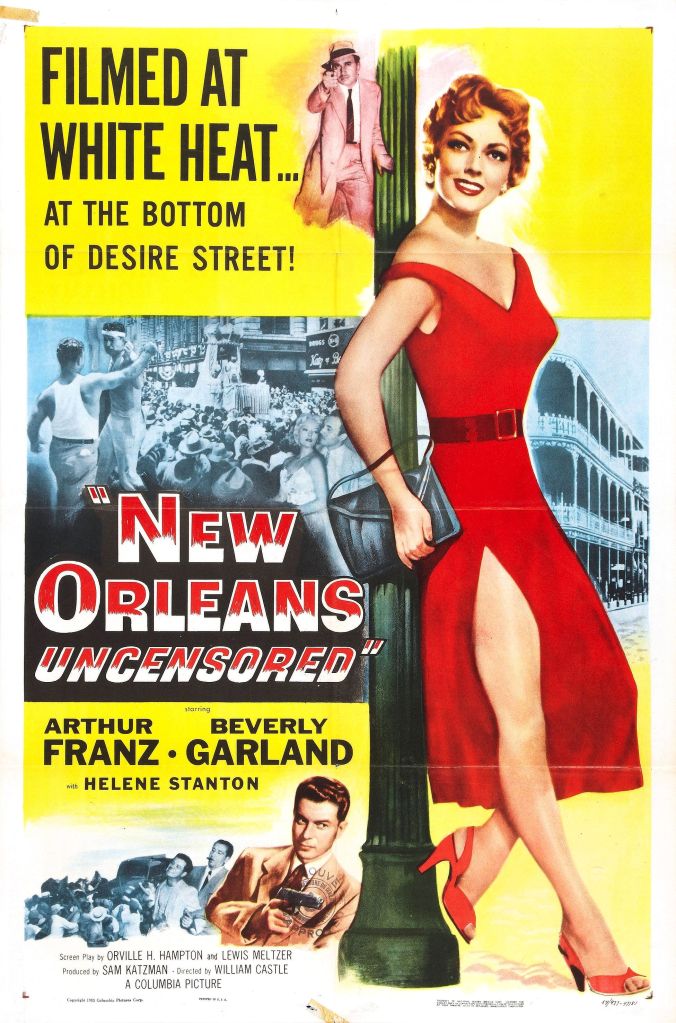
The Prytania has been running an unofficial William Castle retrospective over the past few months as part of their ongoing Classic Movies series. That programming choice made a lot of sense around October, when Castle’s iconically kitschy team-ups with Vincent Price – The Tingler, The House on Haunted Hill, 13 Ghosts, etc. – where a perfect celebratory lead-up to Halloween. One Castle title just before that run stood out like a sore thumb, though, as it predated his infamous theatrical horror gimmicks and instead fell into a genre Castle isn’t often associated with. New Orleans Uncensored is a cheap-o, locally shot noir about corrupt shipping dock workers, much more in tune with films like Panic in the Streets than anything resembling the Percepto! or Emergo! horror gimmickry that later made Castle a legend. The director does find stray chances to exhibit his eye for striking, attention-grabbing imagery throughout the film, but for the most part his presence is overpowered by New Orleans itself, making the film more of a worthwhile curio for locals than it is for Castle fanatics.

Originally titled Riot on Pier 6, this film mostly concerns the organized crime rackets that had quietly, gradually overtaken hold of the second largest port in the U.S. Amazingly, it frames the suggestion that New Orleans government & business might be susceptible to corruption as a total shock; sixty years later it’s as obvious of a fact as the sky being blue. The docks themselves are portrayed as gruff working-class playpens where fistfights often break out en mass to the point where workers are recruited for professional boxing careers and assigned nicknames like “Scrappy.” This wild, bully-overrun schoolyard is controlled from behind the scenes by a few Dick Tracy-level mobster archetypes who tend to fire bullets instead of throwing punches, the cowards. We watch a naïve outsider who hopes to start his own legit shipping business at the docks get seduced by the power & convenience the existing mafia structure offers him instead; he then eventually helps the fine folks at the NOPD take those criminals down once he realizes the full scope of their corruption & violence. It’s all very surface-level, familiar noir territory.

The one distinguishing element of New Orleans Uncensored is the visual spectacle of its locale – a 1950s New Orleans backdrop that looks almost exactly the same half a century later. Whereas Panic in the Streets was a document of local faces & personalities, Castle’s film is actively interested in documenting the physical locations of the city like an excited sight-seeing tourist. Panic in the Streets was mostly contained at the shipping docks and backrooms that concerned its plot, while New Orleans Uncensored goes out of its way to capture as many of the city’s cultural hotspots as possible: Pontchartain Beach, The Court of Two Sisters, Jackson Square, French Quarter nightclubs, Canal Street float parades, etc. In one particularly egregious indulgence in sight-seeing, a couple shares a nightcap beignet at Café du Monde, claiming the ritual is “a traditional New Orleans way of saying goodnight.” It’s practically a tourism board television ad. Of course, as the title suggest, the appeal of this local sightseeing to outsiders is the city’s national reputation for sin & debauchery. The film’s plot about corrupt shipping dock companies getting their due punishment for their transgressions against social order is mostly an excuse for displaying as much sex, drunkenness, and Cajun-flavored merriment as the Hays Code would allow. That becomes a major problem in the snooze of third act when the tourism is sidelined to resolve the much less engaging mafia plot, but it’s fun while the good times last.

There isn’t much room for William Castle to show off this unique touch for attention-grabbing gimmickry & cheap-o surrealism while ogling “The Mistress of The Mississippi.” Outside an opening credits graphic where a disembodied hand stamps the word “UNCENSORED” on a map of the city and a drunken montage depicting an all-nighter of a couple partying until dawn in French Quarter nightclubs, Castle is fairly well behaved in his visual stylings. The closest the film comes to touching on his iconic gimmickry is the way the movie is presented as if it were a documentary instead of a fictional drama – bolstered by stock footage & news reel voiceover. However, that choice often reads as an Ed Woodian means of cutting financial corners more than some deliberate artistic vision. If anything, the movie does function as a genuine documentary, as its sightseeing record of a 1950s New Orleans is far more valuable & purposeful than its criminal conspiracy drama or its William Castle visual play. The history & personality of the city is far more pronounced than Castle’s here, and if the movie maintains any value as a cinematic artifact it’s in that local tourism.

-Brandon Ledet

Corrupt Lieutenant (1984)

I have a bad habit of occasionally purchasing second-hand DVDs solely for their shoddy cover art. I don’t think I’ve ever topped myself in this trivial pursuit since the day I purchased a bootleg copy of some forgotten cop thriller titled Corrupt Lieutenant. The cover for my obviously unofficial copy of Corrupt Lieutenant is a master work of outsider art & visual anti-comedy. Falling somewhere between rudimentary Photoshop collage & a nightmare swirl of stock photography, it’s the exact kind of utter garbage my terrible raccoon brain can’t help but hoard away at home instead of just letting it rot at Goodwill. Unfortunately, that means these movies sometimes collect dust, unwatched for years until I force myself to follow through on actually giving them a chance. As it turns out, Corrupt Lieutenant not only has some of the best-worst artwork I’ve ever found on one of these ill-advised excursions to the thrift store; it also stands as one of the few select examples I can think of where it turns out the movie itself was actually worth the gamble. As far as cop thrillers go, it’s not exactly mind-blowing, but considering the state of its cover art it’s a miraculously competent picture.

It’s worth noting upfront that my unsanctioned copy of Corrupt Lieutenant isn’t even titled correctly. Although it’s been released under the alternate titles The Order of Death, Corrupt, and Bad Cop Chronicles #2: Corrupt, this Italian crime thriller was originally distributed under the name Copkiller, which is by far its most apt moniker. Since the distributors of the film allowed its copyright designation to slip into public domain status, however, it’s been repackaged several times over in disparate stabs by a wide range of enterprising folks trying to make a buck. This is how Copkiller was retitled Corrupt Lieutenant in the early 90s after its star antihero, Harvey Keitel, was featured in the infamous Abel Ferrara film Bad Lieutenant. The two films don’t really have all that much to do with each other outside of Keitel’s starring role in both. The Ferrara picture plays like an especially deranged version of a Scorsese crisis of faith exploration, while its Italian predecessor is more of a sleazy, giallo-esque knockoff of the crooked cop genre Friedkin ignited with The French Connection. Performances from Harvey Keitel and a typically acting-shy Johnny Rotten combine with a score from omnipresent Italian composer Ennio Morricone to afford the film an air of legitimacy, but its shitty public domain transfers, off-kilter Italian dubbing, and sleaze > substance ethos are all constant reminders of its true place in the world as a forgotten work of mediocre genius.

A killer dressed in a police uniform and ski mask is terrorizing the cops of New York City by murdering them one by one, seemingly at random. A young John Lydon plays a spoiled brat punk who confesses to these crimes to Harvey Keitel’s grizzled lieutenant. Keitel’s either believes the confession or is angered enough by its flippancy to falsely imprison Lydon in his own apartment, since the rest of the force is treating him like a liar and a prankster. After a period of keeping the smirking punk tied up & torturing him for a more detailed confession (he feeds him out of a dog food bowl, shoves his head in an oven & cranks the gas, etc.), Keitel’s forces his prisoner at gunpoint to actually slit a cop’s throat, an ill-considered plan that backfires in a wide variety of ways. While figuring out what to do about that cop’s death, Keitel’s finds himself seducing the widow of the man they killed and Lydon moves into his former captor & newfound accomplice’s apartment on his own free will, nagging him as a kind of spiritually corrupt conscience. The film takes on a tense, slowly ratcheted form of psychological torment from there as the weight of the crime the two committed together and the true identity of the (would-be titular) cop killer eventually driving the whole thing home for an inevitably tragic conclusion.

Corrupt Lieutenant is most notable for the authenticity of its violence & grime. Lydon, formerly Johnny Rotten, is reported to have provided his own wardrobe for the picture, which shows in his convincingly ratty, 80s punk appearance. When Keitel’s corrupt lieutenant goes on a bender and starts bonding with the gross little bugger in the most unlikely of unions, the grotesqueness of their collective downfall looks & feels legitimate, an effect that’s only amplified by the VHS-quality imagery of a shitty bootleg DVD transfer. Similarly, Keitel’s physical violence laid upon Rotten’s scrawny shoulders is a convincing kind of rough-housing and it’s occasionally tempting to worry about the little shit’s physical wellbeing. Instead of reading the punk’s rights, Keitel’s more prone to shout, “Shut the fuck up!” and thrash him around the interrogation room. I’m not convinced the film has anything more to say beyond a Cops Can Be Violent Criminals Too cliché, but the way Rotten worms that idea into Keitel’s head in the back half and the way Beetlejuice/Mars Attack actress Silvia Sidney posits that, “The police create disorder, not order. They inspire us to commit crimes so that we can be punished for them,” makes the idea interesting and more than a little bit slimy. There’s even a hint that Rotten’s confessed cop killer gets a sexual satisfaction out of having Keitel’s slap him around, which is then backed up by the S&M collages plastered on his bedroom walls.

I’m not exactly sure what I expected out of Corrupt Lieutenant/Copkiller/The Order of Death/Corrupt when I popped it in the DVD player, but the sleazy Italian cop thriller I got was a surprisingly entertaining watch. That could maybe be chalked up to the low expectations set by its laughably bad cover art, but I think anyone with a little appreciation for giallo or the post-Friedkin crooked cop thrillers of the 70s & 80s would be able to get on board with it as a minor entertainment. Funnily enough, just about the only scenario in which I wouldn’t recommend the film is if someone were specifically looking for a work similar to Abel Ferrara’s Bad Lieutenant. Corrupt Lieutenant has even less to do with that work than Herzog’s “spiritual sequel,” which was mostly about, I don’t know, iguanas & Nic Cage freakouts. Much like the cover art for my DVD copy of the film, that little bit of revisionist rebranding was amusingly brash & ill-considered.

-Brandon Ledet