Piaffe (2023)

Piaffe is a post-adolescence coming of age story about a shy adult shut-in who musters up the courage to learn new things about her desires, her body, and her self outside her cloistered home.  In doing so, she grows a horse tail, has masochistic sex with a perverted botanist, and takes on a new trade as a commercial foley artist.  Most of the events that transform her life & body are a natural matter of course rather than a deliberate, personal choice.  The foley artist job falls in her lap when her nonbinary mystic sibling is unexpectedly institutionalized, leaving her to complete their work providing horse-riding sound effects for a TV commercial advertising a mood stabilizer called Equili.  She gets into character as the horses she soundtracks by clopping dress shoes onto wooden dresser drawers, which causes her very own horse tail to grow from the base of her spine. Her sexual relationship with the botanist is more of a personal choice than something that happens to her, but it’s a choice she can only make after truly getting to know herself as a literal horsegirl with increasingly specific sexual desires – mostly involving getting her tail hair brushed.  Falling somewhere between the stern kink dynamics of the dark 2000s office romance Secretary and the flippant, prurient surrealism of the 1970s dark fantasy piece The Beast, Piaffe is funny, sexy, cool, and inexplicable, but never in an especially showy way.

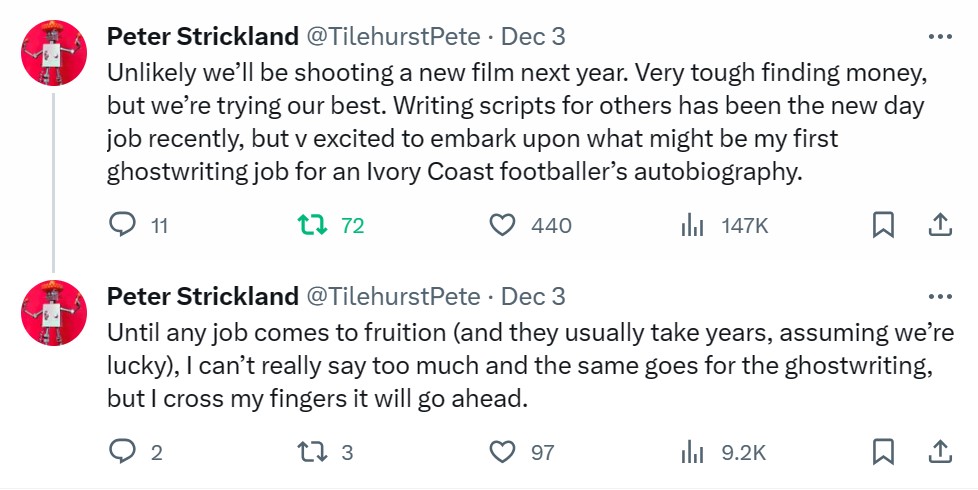
It isn’t the movie’s fault, but there was something grim about watching Piaffe the same week that England’s premiere auteur fetishist Peter Strickland was stress-tweeting about struggling to find funding for his next project.  One of our greatest working directors can’t get a new movie off the ground, and yet he’s formidable enough that younger artists are out there making (pretty great, possibly unaware) pastiches of his work.  Piaffe plays as just as much of a career-retrospective overview of Peter Strickland’s style as his recent music industry satire Flux Gourmet, which likewise combined his foley-art giallo throwback Berberian Sound Studio with his kink-dynamic relationship drama The Duke of Burgundy into a single, self-spoofing work.  The ASMR phone sex of Piaffe, wherein our equestrian protagonist brushes her tail hair over a telephone receiver to excite her lover, feels like a gag pulled directly from a Strickland film that doesn’t yet exist.  And given that Strickland is struggling to land funding for his next project, maybe it never will.  What Piaffe offers is a sturdy Strickland substitute that proves he’s not the only filmmaker who can reliably deliver weird-for-weird’s-sake fetish comedies for the midnight movie crowd; in that context, it’s maybe the best of its kind since The Berlin Bride.  I can still only take it as a consolation prize, though, as I’d unquestionably list Strickland among the most exciting artists working in cinema right now (alongside Amanda Kramer & Bertrand Mandico), so I’m bummed to hear he’s not currently working on anything at all.

For all I know, Piaffe director Ann Oren has never seen a Peter Strickland film, and their parallel sensibilities are entirely coincidental.  My only previous exposure to Oren is in her outsider-art Hatsune Miku cosplay documentary The World is Mine, which is specifically about the erosion and erasure of identity within a digital-age fandom “community.”  I will refrain from assuming anything about her based on this high-art horsegirl cosplay erotica follow-up, except maybe that experimentation with new, fabricated identities & personae is an artistic preoccupation of hers – something that can only be confirmed as she establishes a larger body of work.  I have hopes that, in time, Oren will prove to be just as formidable a prankster artist as Strickland.  It’s something I already felt in this film’s fetishistic fixation on the mechanical tools of filmmaking & horseback riding, grazing its fingertips over leather harnesses and the rusty metal gears of an ancient zoetrope.  I just need to see more of her work to know what to anticipate in the next picture.  Meanwhile, I already know what I want & get out of Strickland’s films, and I’m stuck looking for those qualities elsewhere while he’s twiddling his thumbs waiting for someone to sign the checks. 

-Brandon Ledet

Honeymoon in Vegas (1992)

Allow me to introduce you to a 1990s romcom starring Sarah Jessica Parker as a lovelorn Manhattanite whose romantic rut dating commitment-phobic bachelors is disrupted by the attentions of a brash Big Spender.  Instead of talking it out over brunch with the gals, she’s rescued by a skydiving Nicolas Cage in an Elvis costume.  Okay, in all honesty, Honeymoon in Vegas has very little in common with Sex and the City outside of Parker’s casting.  If anything, the film is more weirdly predictive of the Adrian Lyne erotic thriller Indecent Proposal than it is of Parker’s signature HBO sitcom.  For one thing, its story is filtered through the perspective of her reluctant fiancée, a marriage-cynical private eye played by Nic Cage.  While Sex and the City is narrated by Parker’s voice as a cosmopolitan sex columnist, Honeymoon in Vegas allows Cage to narrate the story in 1940s noir speak, the film’s only notable stylistic touch (before it floods the screen with Elvis impersonators in the third act).  The closest Parker’s allowed to get to a full Carrie Bradshaw moment is in her casino-lobby outrage with Cage for getting them into an Indecent Proposal scenario in the first place, shouting within earshot of children & milquetoast Midwest tourists, “I’m a whore, Jack! You’ve made me into a whore. You brought me to Las Vegas, and you turned me into a whore!”  It’s impossible to watch this incredulous meltdown without recalling Bradshaw’s outburst at an Atlantic City craps table in the classic Sex and the City episode “Luck Be an Old Lady.”  That is, it’s impossible if you happened to have spent all of this year catching up with and thinking about Sex and the City for the first time in your life, which is exactly where I’m at right now.

I’m only focusing on Sarah Jessica Parker so much here because it’s rare to see her out of Carrie Bradshaw drag, whereas opportunities to see a frantic Nic Cage impersonate Elvis are much more plentiful.  See also: David Lynch’s Wild at Heart, SNL’s “Tiny Elvis” sketch, and Cage’s real-life marriage to The King’s daughter, Lisa Marie.  I guess it’s pretty rare to see him dressed up in the full Elvis costume, though, unless you’ve happened to be personally invited to tour his home full of Elvis memorabilia.  In order to justify this indulgence, Cage had to team up with workman comedy director Andrew Bergman, who cast him in two back-to-back mediocre romcoms as a hapless leading man: Honeymoon in Vegas & It Could Happen to You.  He’s less of a Nice Guy dreamboat here as he is in that latter film, spending most of his honeymoon tailing James Caan’s high-roller conman villain as he seduces Parker away from him.  Cage starts the film terrified of marriage because of a deathbed promise he made to his mother, but he loves Parker’s sweetheart schoolteacher character so much that he’s willing to go back on his word.  Only, he doesn’t act quickly enough, so Caan swindles him into a rigged card game, bullying him to put a weekend with his fiancée on the table as a substitution for poker chips.  Parker’s outrage with being “turned into a whore” isn’t played for the same moral or seductive complexity as Demi Moore’s own monogamy crisis in Indecent Proposal, even as she flirts with the idea of letting Caan sweep her off her feet (via helicopter).  Mostly, it’s just an excuse for sweaty, farcical Mad, Mad, Mad, Mad World shenanigans as Caan elbows Cage out of the picture . . . until he skydives back into it dressed as Elvis.

There isn’t much on Honeymoon in Vegas‘s mind besides setting the stage for its ludicrous skydiving-stunt finale, which is emphasized in a marketing tagline that sells it as “A comedy about one bride, two grooms, and 34 flying Elvises.”  The Elvis costumed skydiving team The Flying Elvi has since become a legitimate Vegas attraction, boasting on their website to be “the only officially licensed skydive team by Elvis Presley Enterprises.”  The creation of that novelty act might be the movie’s only lasting triumph, but it’s at least more a more appropriate movie tie-in than, say, the Mardi Gras scooter gang The Krewe of the Rolling Elvi hosting a private screening of Sofia Coppola’s dour drama Priscilla (a real thing that recently happened at The Prytania; I cannot imagine the mood that took over that room by the end credits).  Otherwise, there’s nothing especially recommendable about Honeymoon in Vegas except for its opportunities to think about where it fits in its various players’ long-term careers.  James Caan coasts along as the comedic heavy.  Pat Morita & Peter Boyle give career-worst performances as a disaffected cab driver and a Hawaiian mystic, seemingly having gotten their scripts swapped in the mail.  Seymour Cassel is given the funniest character detail as a mobster named Tony Cataracts.  A young Tony Shalhoub is adorable as a nervous concierge who’s terrified of Caan.  An even younger Bruno Mars is even more adorable as the world’s tiniest Elvis impersonator.  Nic Cage gets in a few signature bizarro line-readings in his sing-songy angry voice, getting increasingly funnier as his character gets increasingly apoplectic.  And then there’s Sarah Jessica Parker, who gets one big scene where she gets to shout about being made into a hooker before being passed around like a trophy between the two male leads.  Luckily, she got a lot more to do down the line in the Sex and the City series, unless you want to take a really cynical view of Carrie’s long-term love triangle with Aidan & Big.

-Brandon Ledet

Biosphere (2023)

Mumblecore may be long gone as a moment in time, but the Duplass Brothers are still out there keeping its memory alive.  While mumblecore overachievers Greta Gerwig & Noah Baumbach made the highest-grossing film of the year—a feature-length toy commercial, no less—The Duplasses are still making low-key, low-profile indies, still putting together dependably entertaining pictures with limited resources.  Even so, their new sci-fi bromance Biosphere feels like a mumblecore throwback stunt in its limited scope, featuring only two actors on a single, sparse, Apple Store futurist set.  That scaled-down approach to movie production made more sense when they were making lockdown-era laptop dramas like Language Lessons, but at this point in on-set COVID safety protocols, it’s more of a flex than a necessity.  In cynical Gen-X 90s terms, the narrative would’ve been that Barbie was a sign that Gerwig & Baumbach “sold out” and that the Duplasses are somehow nobler artists for continuing to slack around on a condemned & abandoned mumblecore playground.  In these post-Poptimism times we’re living in now, though, there’s no such thing as selling out, and all that really matters is that Barbie is one of the best movies of the year, while Biosphere is just the latest example of what its producers have been consistently making for the past couple decades running.

That doesn’t necessarily mean they’re lacking in ambition, though.  Biosphere takes admirably big swings on its tiny playground, and it scores major bonus points for taking those swings early, so that it actually has to fully deal with the social discomforts of its premise instead of saving it all for a last-minute twist. Mark Duplass stars opposite Sterling K Brown as childhood best friends . . . and the only two human beings left alive after a nuclear apocalypse.  Every detail outside the bond of their friendship gets phonier & phonier the further the story spirals out from there.  Duplass unconvincingly stars as the Republican president of the United States and the main instigator of the nuclear shoot-out that ended it all, despite having more of an under-achieving court jester vibe.  Brown is slightly more believable as the politically progressive scientist who built the self-contained biodome they’re riding out the Apocalypse in, but the circumstances of when & why he built it get less credible by the minute.  That doesn’t matter nearly as much as the question of how two cisgender men are supposed to rebuild society without any outside collaborators for procreation, a question made even more uncomfortable by how their dorm-room college bro relationship is tested by their newfound need to be Everything to each other in a world the size of a living room.  Since the movie is most effective when it’s about the specifics of their evolving friendships, it’s probably for the best that there is no world outside their biohome.

I can’t say much more about Biosphere‘s premise without completely spoiling it, which I guess means that you should watch it with your best bro, so you have someone to talk it out with.  It’s thematically provocative in its discussions of the physiology & power dynamics of gender, poking specifically at the most sensitively guarded area of the topic: straight male companionship.  What does it say about the Duplasses’ filmmaking ambitions that Mark already starred in a movie about those exact bromantic sensitivities way back in 2009?  I’m not sure, but I do know that Humpday was received as a substantial entry in the mumblecore canon, while Biosphere feels untethered from anything especially urgent or substantial at all.  Even within the subgenre of movies contained in biospheres, it’s nowhere near as provocative as the eco-terror bomb-thrower Silent Running nor as memorably goofy & inane as the stoner bro comedy Biodome.  It’s just a Duplass Brothers movie that happens to have a sci-fi theme – the kind of low-key, oddly phony drama that makes you wonder why they didn’t just stage an off-Broadway play instead of making a movie.  I appreciate its ambition to challenge its audience in its thematic ideas, while I also question when The Duplasses are going to start challenging themselves with cinematic ones.

-Brandon Ledet

Godzilla Minus One (2023)

As I’m piecing together my personal Best Films of 2023 list in these last few weeks of the year, I’m becoming increasingly self-conscious of how many of my favorite new releases are shamelessly nostalgic for the toys & kitsch collectibles of my youth.  Even without a new Godzilla film juicing the numbers, it’s been a great year for films about Furbies, Barbie dolls, Ninja Turtles, and tokusatsu superheroes like Ultraman, Kamen Rider, and The Power Rangers.  My Best of the Year list is starting to look like a 1998 Toys”R”Us TV commercial, which is somewhat embarrassing for a man of my age.  I am approaching 40 years old, and I still don’t wanna grow up.  Thankfully, Godzilla Minus One‘s inclusion in this year’s throwback-toy-commercial canon is at least helping to class up the list a little, as it’s a much more sincere, severe drama than most movies that have excited me lately.  It’s just as openly nostalgic for vintage tokusatsu media as Shin Ultraman, Shin Kamen Rider, and Smoking Causes Coughing, announcing itself as an official 70th anniversary celebration of the original 1954 Godzilla film that started it all.  However, it’s the only film in this year’s crop to hit the same notes of deep communal hurt as the ’54 Godzilla, which is a much more ambitious aim than reviving the goofball slapstick antics of the child-friendly kaiju & superhero media that followed in its wake.  Godzilla Minus One‘s sincerity is incredibly rewarding in that contrast, to the point where it’s the only Godzilla movie I can remember making me cry.

To commemorate that 70th anniversary, Godzilla Minus One dials the clock back to the widescale destruction of post-WWII Japan, covering the first few years of national rebuilding after nuclear devastation.  The giant primordial lizard of the title is once again shaken awake by the human folly of the atomic bomb, a great sin against Nature echoed in the creature’s flamethrower-style “atomic breath.”  The film’s limited budget means that Godzilla gets limited screentime, but the monster is deployed wisely as an unstoppable, unfathomable horror whose atomic power is so great that it burns away the flesh of its own towering body.  Godzilla is scary again, more of a harrowing extension of war survivors’ PTSD than a rollicking hero to children everywhere.  The cleverest move the movie makes, then, is by limiting the scope of its drama to match the limited scope of its monster attacks.  We feel the fear Godzilla stirs in just a few cowering citizens’ lives, even though both the monster and its victims represent large-scale national grief in metaphor.  It’s a small-cast wartime melodrama that’s occasionally interrupted by kaiju-scale mayhem, the same way a soldier who survives war is supposed to go through the motions of normal life in peacetime despite frequent, violent reminders & memories of the atrocities they’ve witnessed or participated in.  The “Minus One” of the title refers to people struggling to rebuild their lives from Ground Zero, only to be reset even further back by the grand-scale cruelties of life & Nature, through the monster.  It’s tough to watch.

The drama gets even more intimate & insular from there.  Most Godzilla movies dwell on the city-wide chaos of the monster attacks, depicting thousands of victims scattering away from Godzilla’s path like helpless insects.  In contrast, Godzilla Minus One zooms in to assess the value of just one, individual life in that mayhem.  Its mournful protagonist (Ryunosuke Kamiki) is a kamikaze pilot who dodged his suicidal mission during the war and now suffers intense survivor’s guilt, convinced that he morally failed in his duty to serve his nation.  The sudden appearance of Godzilla offers the self-hating young man a second attempt at wartime valor, to the point where he’s disturbingly excited by the prospect of facing off against the monster instead of experiencing healthier responses like fear & grief.  In a more proudly nationalistic action thriller, this sentiment would go unchallenged, and his self-assigned self-sacrifice would be celebrated as traditional macho heroism.  Instead, Godzilla Minus One is about the community of people around the pilot—each having survived their own war atrocities & personal shortcomings—convincing him that his life is worth living, that he has value beyond the damage he can cause as a lone soldier in a war that’s officially over.  The honor of serving his country through death is no nobler than risking his life de-activating leftover explosive mines to put food on his family’s table; it’s sad & disgraceful, and it should be treated as a worst-case scenario.

The dramatic beats of Godzilla Minus One are just as predictable as the rhythm of its monster attacks, and just as devastatingly effective.  I cried with surprising frequency during the final twenty-minute stretch, even though I saw each dramatic reveal coming from a nautical mile away.  Maybe it’s because I vaguely related to the communal struggle to rebuild after multiple unfathomable catastrophes, having remained in New Orleans through a series of floods & hurricanes.  Maybe it’s because I more personally related to the pilot’s struggle to learn a foundational sense of self-worth, the toughest aspect of adult life.  Maybe it’s because composer Naoki Satō’s gargantuan score drummed those sentimental feelings out of me through intense physical vibration.  Who’s to say?  All I can confidently report is that the drama is just thunderously affecting as Godzilla’s roars, which is a rarity in the series.

-Brandon Ledet

Poor Things (2023)

“We are a fucked species; know it.”
“We are all cruel beasts – born that way, die that way.”
“Polite society is fucking boring.”
“Polite society will destroy you.”
“All sexuality is basically immoral.”

Poor Things is the kind of movie about the total scope of life as a human being that allows characters to voice those kinds of abstract philosophical statements, often with immediate dismissive pushback from the poor souls hearing them.  In that way, it’s the culmination of everything provoc-auteur Yorgos Lanthimos has been working towards since early antisocial provocations like Dogtooth & Alps.  He’s always had a coldly detached fascination with basic human behavior & relationships, but he has yet to dissect & catalog them all in a single text the way he does here.  Every new Lanthimos movie feels like it’s poking at some assumed social norm as if it were a corpse he found in the woods.  Poor Things finds that naive interrogation at its most scientifically thorough & perversely fun, to the point where he articulates the entire human experience through repurposed dead flesh.  In doing so, he’s clearly made The Movie of the Year, and so far the movie of his career.

Emma Stone stars as the repurposed corpse in question: a suicide victim who has been reborn as a Frankenstein-style brain transplant experiment in a mad scientist’s Turn-of-the-Century laboratory.  Her monstrous “Daddy God” creator—played with pitiable Elephant Man anguish by Willem Dafoe—initially keeps his experiment on a short leash, confining her entire life to his grotesque but lavish home.  She eventually breaks free, though, as all Frankenstein monsters do, and ventures into the world as an adult-bodied woman with the mind of a rapidly developing child.  Her resulting interrogation of the world outside her home is intensely violent, as anyone who can picture an adult-sized toddler throwing a temper tantrum would expect.  It’s also intensely sexual, as she can find no joy more immediately self-fulfilling than orgasmic bliss but lacks basic understanding of that joy’s socially appropriate boundaries: assumed monogamy, acceptable dinner conversation, the stigma of sex work, when & where it’s permissible to masturbate, etc.  If she is meant to represent humanity at its most basic & untouched by learned social restrictions, she represents us as insatiably horny, violent beasts who have to consciously strive to learn empathy for each other because it is not innate in our souls.  It’s a hilarious, uncomfortably accurate assessment of the species.

If there’s any one particular social norm that Lanthimos naively interrogates here, it’s a gendered one.  Much of the reanimated monster’s exploration of Life is limited by the men who wish to control her.  First, her Daddy God confines her as a domestic prisoner, the same way all fathers of young women fear their freedom as autonomous adults.  Once she’s loose, a small succession of selfish bachelors aim to trap her again in the domestic prison of marriage: Ramy Youssef as an ineffectual Nice Guy, Mark Ruffalo as a dastardly fuckboy fop, and Christopher Abbott as a sociopathic abuser.  All the men in the monster’s life seek to control her in ways that stifle her self-development.  It’s a movie about male possessiveness just as much as it’s about the absurdities of Life & societal decorum in that way, and the heroic triumph at the center is mostly in watching the creature fuck & read her way out of her patriarchal bonds to become her own person.  At times, that sentiment is expressed through philosophical assessment of what it means to live as an ethical person in modern society.  More often, it’s a crass celebration of women being annoying & gross in public despite the men around them demanding they calm it down.  It’s oddly uplifting in either case.

Yorgos Lanthimos’s films have become more recognizably comedic since he broke through to a wider audience with The Lobster, and they’re all the better for it.  There’s a sense of playful collaboration here where the director allows each contributor freedom to run wild: Stone & Ruffalo in their sketch comedy acting choices, cinematographer Robbie Ryan in his fish-eye lens fantasia, screenwriter Tony McNamara in his violent perversions of vintage humorist quips.  It’s telling that the only work that’s directly alluded to onscreen (besides, arguably, Mary Shelley’s Frankenstein and its James Whale mutations) is Oscar Wilde’s The Importance of Being Earnest, another prankishly prurient comedy of manners.  Lanthimos has always morbidly poked at social norms & decorum with this same curious outsider’s perspective, but never before while taking so much obvious glee in the act, nor on this wide of a scope.  I rarely have this much fun thinking about how we’re “a fucked species” of “cruel beasts,” and how our rules of appropriate social interaction are so, so very “fucking boring.”

-Brandon Ledet

Fallen Leaves (2023)

Finnish arthouse darling Aki Kaurismäki is neither the first renowned director to return from self-imposed “retirement” (Miyazaki, Soderbergh, Lynch), nor will he be the last (Tarantino).  What’s funny about the six-years-later follow-up to his announced “retirement” film The Other Side of Hope is that Kaurismäki has not returned for some grand, career-defining statement that shakes the foundation of everything he made in his heyday (The Boy and the Heron, Twin Peaks: The Return).  He simply just made another Aki Kaurismäki movie.  Everything I’ve written previously about Kaurismäki classics like Shadows in Paradise and The Match Factory Girl could easily be copied & pasted into a review of his comeback picture, Fallen Leaves.  So, I’m just going to go for it.  It looks like “a Polaroid in motion.”  It totally nails “the absurd indignities of modernized labor & urban living.”  It’s got everything you could possibly want from a Kaurismäki film: “the carefully curated visuals, the low-key absurdist humor, the fixation on the embarrassing exploitations of entry-level labor.”  He’s maybe the most consistent, unsurprising director around, and yet each individual film is so thoroughly, methodically lovely that he keeps getting away with it.  Every Aki Kaurismäki movie is another refresher on why he is one of the greatest; Fallen Leaves is just the latest.

If there’s any late-career reflection on the director’s previous work here, it’s all in the background.  One of the film’s central locations is a Helsinki arthouse movie theater plastered with posters advertising an assortment of New Hollywood, French New Wave, and genre schlock classics, suggesting Kaurismäki has spent time pondering where he fits in the grand, ongoing conversation that is cinema.  You will not believe which Jarmusch film he plucks from that conversation to illustrate the confusion.  Otherwise, he just sticks to the usual script.  Fallen Leaves is a low-key, high-charm love story about two pitifully lonely people struggling to make room for each other’s messes in their small, tidy lives.  They’re cute together, but it takes a while to make the pieces to fit.  One hands the other their phone number, and it’s immediately lost.  One is an alcoholic, while the other is hurt by their family’s history with the disease.  One adopts a pet, while the other suffers a horrific accident.  Their parallel lives in Helsinki are soundtracked by throwback rock ‘n roll karaoke and radio news broadcasts covering the Russian-Ukrainian war.  Eventually their missed connections and self-guarding defenses recede long enough for them to meet on the right page.  It’s sweet, even though the world around them can be so sad & cruel.  It’s like finding love in real life.

I can’t confidently say where Kaurismäki’s work fits in the grand conversation of cinema, mostly because his artistic statements remain so intimately personal & self-contained.  In in the interest of keeping things small & tidy, it’s much easier to hear where Fallen Leaves chimes in on the cinema of this year in particular.  It fits neatly in two of 2023’s more rewarding trends: established directors excelling just by playing the hits (Anderson, Coppola, Haynes) and Mubi absolutely killing it in curating their festival acquisitions (The Five Devils, Passages, Rimini).  It also fits neatly in Kaurismäki’s larger catalog: modest, tidy, uncluttered, expressive only in its primary colors and Tati-styled visual gags.  He’s the kind of director who makes people say, “Once you’ve seen one, you’ve seen them all.”  Only, every time you watch one you find yourself thinking “I really need to see them all.” 

-Brandon Ledet

The Killer (2023)

I would consider myself a David Fincher fan. I’ve long been a defender of Alien³, Se7en is a classic, and The Game is underrated. Although Fight Club is hyped to hell and back by the worst kind of people is not a negative for the film itself, in my opinion, because I think that Fincher is in on the joke that a lot of the film’s fanbase seems to have misunderstood. I also think that’s the case in his most recent work, The Killer, although several of the reviews I’ve read so far do not seem to agree. 

Michael Fassbender is The Killer, an assassin whose internal monologue is right up there with Christian Bale’s as Patrick Bateman or Ewan McGregor’s in Trainspotting, as he details the comings and goings in his day as he waits in an abandoned WeWork location in Paris for the right opportunity to slay a high-profile target. This includes a lot of unnecessary recitation of statistics about the world’s population, how his job as a professional killer has very little effect on these numbers and is therefore (to his mind) irrelevant, and how the clandestine nature of his work requires him to maintain the delicate balance between being intermittent garishness (because tourists are ignored in most big cities) and boringly invisible. In many ways, he’s not that different from Fincher’s previous unnamed protagonist in Fight Club, in that he is a disaffected man who believes he’s managed to concentrate all of life’s idiosyncrasies down into a series of mantras, but who isn’t really as smart, clever, or effective as he thinks he is. 

I watched the recent Sandman adaptation from Netflix with some trepidation, especially as it approached the adaptation of one of my favorite issues, “Men of Good Fortune.” That story comments about the constancy of human life despite the passage of what we perceive to be great periods of time in a way that I have always loved: when Dream enters a tavern in 1389, there are several overlapping, unattributed dialogue balloons that reveal little pieces of information about the people and the times in which they live: the “spirit of the working man” having died with the executed leaders of the Peasants’ Revolt, complaints about the mediocre restaurant fare and poll taxes, the need for the return of “law and order,” and how the general state of things means “the end of the world is soon.” When he returns to that same tavern in 1989, despite the change in the decor and the intervening centuries, the same talk is happening: “There’s going to be a revolution [over] Thatcher’s bloody poll tax,” “the labour movement died with the miners’ strike,” “no respect for law and order,” and, of course, “all the signs are there in the Bible[;] it’ll be the end of the world very soon.” There’s been so much superhero saturation in the last decade and a half, without much consideration of the fact that comic books and film/TV are very different media forms. That overlapping of dialogue balloons is something that the show tried to emulate but couldn’t capture.

When I was first getting into comics as a teenager, decompression comics were all the rage, as comics attempted to emulate filmic narrative, and as films continue to adapt and echo comics, some of the seams are showing. I didn’t know that this was based on a graphic novel before starting the movie, but as soon as a credit popped up at the film’s opening which stated that it was “based on The Killer by Alexis ‘Matz’ Nolent [and] Illustrated by Luc Jacamon,” I had an inkling of what I was in for, and it did not disappoint. While Fassbender delivered his character’s long internal monologue, I felt like I could see exactly how it would play out on the page. The Killer’s monologue in a series of rectangular boxes, with his repeated mantras of “Stick to the plan. Anticipate, don’t improvise” (which appears five times) and “Fight only the battle you’re paid to fight” (four times) broken out as their own individual pieces of the monologue, trailing down the page. And in my mind’s eye, it totally worked, that decompression of the monologue over a series of still images as The Killer does his dirty work, presumably only repeating it to himself once per issue/chapter as he performs that segment’s murder. But when repeated like this over and over again in a film, its effect seems more silly than anything else. If you’ve ever read a collection of old Chris Claremont X-Men titles from the 80s and 90s, you’ll know what I’m talking about—it feels like every issue contains Wolverine repeating to himself that “[he’s] the best there is at what [he] do[es] … and what [he] do[es] isn’t very pretty,” and either Jean or Scott explaining their “psychic rapport,” or Cannonball expositing his powers by declaring “Ah’m nigh invulnerable when ah’m blasting!” If you’re only getting that month’s issue and reading it, then waiting until the next month, these things don’t stand out as much, but when you’re reading them all at once, it’s not only noticeable, but intrusive. That feels like it’s happening here in The Killer, but it somehow still manages to work in Fincher’s hands because he manages to make that repetition feel more like an indictment of the character and his ego, at least in my reading of the film. 

The Killer is often shown to be less adept at his profession than his internal monologue would imply, and the film’s humor (to me) lies in the irony between how good said Killer thinks that he is and his multiple bumbling failures. The whole thing feels like an indictment of the manosphere way of thinking; every few weeks, some guy will post something online like “My wife freaked out that I didn’t check my blindspots before changing lanes, and I explained to her that I have kept precise track of every single other vehicle on the interstate for the last hour,” and a bunch of other dudes will post “Hell yeah, brother” and their own stupid variation on “I too inflate my ego by LARPing as a hypervigilant hero.” The Killer feels like one of these guys, and it’s not lost on me that Fincher’s most famous work, the one that so many people fundamentally misunderstand, is one of the pieces of media that is a favorite of exactly this kind of person; this guy saw Fight Club and loved it for all the stupidest reasons. It’s not an out-and-out comedy; this isn’t the kind of movie where the Killer completes a monologue about how badass he is after field stripping and rebuilding a rifle only for a spring to pop out of somewhere accompanied by a sound effect. It is a movie, however, where the first twenty minutes are spent entirely in the head of our lead as he watches for his opportunity to take his shot while sharing his exercise and dietary regimen like it’s the opening of American Psycho, right down to listing the number of McDonald’s restaurants in France before reciting the protein content of his meals. And, after all of that … he doesn’t get the shot, instead killing the woman that his target is entertaining. He recites to himself that he must “Forbid empathy” as “Empathy is weakness,” but from the second chapter of the movie onward, his entire motivation is revenge because his girlfriend got roughed up because he screwed up his assignment (which he fouled up by … killing his target’s lover, a symmetry that he never recognizes or acknowledges because, again, he’s just not as smart as he thinks he is). Like a lot of manosphere grifters, he pretends that he has no emotions at all, but he only listens to his “work” playlists, and they’re all just The Smiths, which is the saddest of sadboy music ever committed to audiotape. 

I’ve really only focused on that first chapter for the most part. Chapter 2 features The Killer’s flight from Paris and return to his home in the Dominican Republic to find his home ransacked before tracking down his injured girlfriend to the hospital and gathering information about the people who were sent to kill him. Chapter 3 takes place in New Orleans, where The Killer was first recruited and where his handler lives (although not for long), as well as his steps to prepare for his revenge and further track down the people who tried to kill his girlfriend, and in Chapters 4 and 5 he travels to Florida and then New York to take out these two killers, one called the Brute and the other known as the Expert (Tilda Swinton). Finally, in Chapter 6, he confronts the man who contracted him in the first place. Through all of this, he experiences good luck much more than he demonstrates cleverness; it may make sense that European airline employees don’t find his sitcom aliases (which include Archie Bunker from All in the Family, Lou Grant from The Mary Tyler Moore Show, and both Felix and Oscar from The Odd Couple) unusual, but once he’s back in The States, someone should at least make a joke about it. Most of the things that he manages to accomplish are things that just about anyone with access to the internet can do (like cloning a key card) or rely on other people to respond amicably to him (the garage owner who lets him use the washroom as if it were a public restroom, the taxi dispatcher allowing him entry after closing, the taxi driver agreeing to drive him despite the presence of other cabs and said driver’s impending smoke break), which is impossible to predict. 

The Killer sails through all of these interactions with ease and attributes it to his skill, but we rarely see anything that requires any actual skills. After missing that first shot, he does kill everyone else who crosses his path, but does so either by shooting from point blank range and thus making it impossible to miss, or breaking a middle-aged woman’s neck and pushing her down a flight of stairs, either of which are manageable feats of strength or skill for most able-bodied adults. His internal monologue frequently dips into smug assurances to an invisible audience that he knows what he’s doing by, for instance, predicting just how long it should take a person of a certain age and fitness to die from a particular attack, only to be instantly proven wrong when his victim doesn’t make it past thirty seconds. None of this ever makes The Killer question his self-assurance about how good he is at what he does, and while that’s a very annoying trait in the participants in the alpha male subculture that I feel is the target of the film’s mockery, it makes for a kind of tragicomic character that I found sufficiently amusing, if not precisely comedic. The most impressive thing that he does is fight off a much taller opponent, which relies more on his ability to take a beating than the memorization of little Snapple trivia facts. . 

What is funny about this is that, at least in my interpretation of the text, Fincher has made another movie that will see its proponents divided starkly along the lines of those who think that the machismo that the film is parodying is something to be unironically emulated and those who will read it as a satire of exactly that kind of person. It’s well-made and well-executed, but it honestly feels more like a mini-series than anything else, especially with its perfectly divided “chapters,” which I have no doubt is meant to invoke the nature of comic book storytelling if it isn’t directly lifted from the source material. Each one has something going for it, but taken altogether, the whole thing feels less than the sum of its parts, like when you binge a TV program and are suddenly taken aback at having reached the ending so suddenly and so quickly and are annoyed at yourself for not having savored the experience more. When it comes to staying power, it will likely find itself more in the lukewarm waters alongside Panic Room rather than Gone Girl, but it’s nonetheless solid, entertaining, and tongue-in-cheek. 

-Mark “Boomer” Redmond

The Marvels (2023)

It’s been a long time since one of these movies was good, hasn’t it? It’s been four and a half years since Endgame, and since then even I, longtime superhero movie proponent-turned-apathetic-turned-detractor, have grown tired of talking about how this franchise had degenerated into serviceable if dreary (Guardians 3), effective if propagandistically nostalgia-driven (No Way Home), and even ugly and miserable (The Eternals, which I/we never even bothered to review, and Quantumania). I couldn’t quite bring myself to finish Shang-Chi, never bothered with Love and Thunder, and only watched the Doctor Strange sequel because I will watch anything Sam Raimi does, but again, there’s no hyperlink for that because no one around these parts could be arsed to write one. Not even me! But sometimes you get an invitation that you can’t (or don’t want to) reject, and you find yourself drinking a milkshake and looking at Brie Larson’s face and really enjoying yourself. 

The big joke going around about this one is that, in order to understand it, you’ll have had to done a ton of homework, including not only watching all of the films but also the TV series Ms. Marvel and WandaVision (which, full disclosure, I did see), and perhaps the universally reviled Secret Invasion, which was so far from my radar that I initially typed out Secret Wars and then had to correct myself after a quick Google search. One of the great things about the Alamo Drafthouse is that, for these movies, they often edit together a quick homemade “previously on” segment to introduce the film for audience members who may not be trying to pass the MCU SATs (the voiceover of which is slowly sounding more and more acerbic, which I cannot object to). Even without that, however, I think this one is actually an easy entry point, with the only truly required “reading” is Captain Marvel, and I think it’s fair to say that if you care about this movie at all, you’re probably caught up. The character introductions to one another in this one serve as functional introductions for the audience as well, and they handle the “who’s who” as deftly as is possible for dialogue that is expository, both in and outside of the text. 

Brie Larson returns as Carol “Captain Marvel” Danvers, who is shown to be working for Nick Fury (Samuel L. Jackson) in checking out various disruptions that he’s now detecting from his satellite base. Also on said station—or technically just outside, as we first see her performing EVA—is Monica Rambeau (Teyonah Parris), who picked up some various light-based powers like being able to phase through matter and shoot light blasts in WandaVision. She and Carol have a past, specifically that “Aunt Carol” was like her second mother before disappearing in the 1990s with the (unfulfilled) promise to return; further, she was one of the people who disappeared during “the Blip,” and returned to learn that she was just a few months too late to be able to say goodbye to her mother before she succumbed to cancer. Meanwhile, planetside in Jersey City, teenaged Kamala Khan (Iman Vellani), Captain Marvel superfan who has styled her own superhero identity of “Ms. Marvel” after Carol’s, is drawing her fanfic of getting to team up with her hero, when she suddenly disappears. It seems that elsewhere, a woman named Dar-Benn (Zawe Ashton) from the resource-depleted planet of Hala has discovered the location of a seemingly magical gauntlet/bangle, which she plans to use to restore her world to its prior glory. Because of wibbly-wobbly spacey-wacey quantumbabble, this leads to Kamala, Carol, and Monica becoming “entangled,” such that any time two of them use their powers, they physically exchange places. 

This fairly absurd premise introduces a freshness and a spontaneity to the proceedings that makes it fun and frenetic in a way that this franchise hasn’t really managed to elicit in a while. When the MCU goes cosmic, that’s generally where it has the most room to play around and be weird and fun, as evidenced by the first two Guardians and Rangarok, and this one takes a page from the playbooks of those movies to visit some novel backdrops for interesting action sequences in vibrant color—and it’s been a while since you could say that about one of these. This includes a sequence of hand-drawn animation of Kamala’s comics that feature her fighting alongside Captain Marvel, complete with onomatopoeic “booms,” as well as an extended scene  in a palace on a world where the language is song, but the highlight for me comes at the climax. This is the kind of movie where there aren’t enough undamaged escape pods to flee a deteriorating space station, but there are a few dozen kitten-like aliens with secretly tentacled mouths and which have previously been demonstrated to be capable of swallowing people whole and spitting them back out again. As a last ditch effort, these “cats” are let loose to devour the remaining 150 people on board as they run in terror before adorable kittens, so that the cats can be put in the last escape pod and then vomit everyone up later once they’ve escaped. All of this literal cat herding is set to “Memory” from Webber’s Cats. It’s the kind of fun that these movies should be having/inducing, if they must continue to be made. 

What really makes the movie work, however, is the chemistry between its cast members. The three women, whom Kamala dubs “The Marvels” even though Monica claims no such moniker (in the movies, at least), play well against each other. Carol and Monica’s estrangement makes for easy relationship shorthand, but that’s not a criticism, since this film could (as its detractors have assumed) be too lore-dense for its own good. Kamala’s hero worship of Carol makes her fulfillment of that fantasy a lot of fun to watch, and although it would be very easy for a different performer to fail to stay on this side of the line between endearing and overbearing, Vellani is doing stellar work as the younger Marvel; she’s not even close to going out of bounds. Her energy is infectious, and her realistic reactions to things that the other characters (and we who have been watching these movies for fifteen years) have become jaded to make it all feel fresh and new again. 

I’m sure there is good faith criticism of this movie that doesn’t focus solely on the product so much as its perceived “wokeness” or its box office performance. This is a show that follows the maxim of MST3K: “repeat to yourself it’s just a show” (and at this point, this is more of a fun, not-too-serious episode of a long-runner show than it is a movie unto itself; it’s time we all stopped kidding ourselves about that), “and you should really just relax.” For a lot of extremely online people who have a hyperfixation on this franchise and experience no joy outside of taking it away from others, I’m sure they’ll also find no end of faults to complain about here. I can already sense them opening their microblogging platforms; I can already hear the deep inhale as they prepare to unleash an incogent rant about how Disney is trying to ram something down their throats (it’s always about throats with those guys). I’m not here to carry water for that monopoly, I assure you, and the company’s failure to invite the director to the premiere is outrageous. If anything, though, Thanksgiving season is a time when a lot of people end up cooped up with their families for extended periods of time, and sometimes the best way to get everyone to shut up for a while is to let the local Regal play babysitter for a while. There are worse things to do. 

-Mark “Boomer” Redmond

Thanksgiving (2023)

Thanksgiving is, unfortunately, unlikely to be remembered very fondly in the years to come. I was enticed to the theater after reading a review that compared it to Scream, which was like catnip to me. And while I suppose I can see what that critic was alluding to, I’m not as warm to its charms. 

The film starts off with a strong opening: Thomas Wright (Rick Hoffman), proprietor of Right Mart stores, is convinced by his new wife Kathleen (Karen Cliche) to open his store on Thanksgiving evening with Black Friday deals. This means that Mitch Collins (Ty Olsson) must leave his family Thanksgiving with his beloved wife Amanda (Gina Gershon) to open the store when another manager calls in sick. Over at the Right Mart, the crowd has gotten quite rowdy, and their agitation only increases when Thomas’s daughter Jessica (Nell Verlaque) succumbs to peer pressure and lets herself and her friends in through a side entrance. When dipshit jock Evan (Tomaso Sanelli) taunts a teen from a rival high school through the glass of the store, things reach a tipping point, and even the presence of local sheriff Eric Newlon (Patrick Dempsey) can’t prevent the shoppers from surmounting a barricade and pressing against the glass doors of the store until they break, causing a stampede that crushes and maims many people, with poor Amanda, who had come to the store to bring a late Thanksgiving dinner to her husband, being crushed to death. 

This opening sequence is the best thing about the movie, with frenetic action, rising tension, and spectacular violence, all in pursuit of a free waffle maker that is promised as a prize to the first hundred customers. From there the film becomes a little rote, and it’s not helped by the total non-presence of teen characters. Jessica is our viewpoint character and thus we never feel any real tension regarding whether she will make it out, and she’s the most undeveloped final girl that I think I have ever seen, just sleepwalking through this movie with only the thinnest of characterizations (a dead mom). Her best friend Gabby (Addison Rae) is virtually indistinguishable from her in motive and action, with the only real difference between them being that Gabby is dating the aforementioned Evan. Evan himself is sketched out more clearly, but he has not a single redeeming characteristic, as he filmed the Right Mart riot and posted it online for the viral fame while later denying that he had done so; he also bullies a smaller student into performing his classwork and then breaks his word to pay him for doing so, and he mocks Jessica’s new boyfriend Ryan (Milo Manheim) behind his back but accepts gifts from him without reservation. Rounding out our little gang of shits are two more likable members, Evan’s teammate Scuba (Gabriel Davenport) and his girlfriend, Yulia (Jenna Warren). The issue is that we never really care about any of these people; even Jessica, with whom we are supposed to sympathize as the lead, is completely forgettable. 

I’m not making the argument that we need to care about any of the characters in a slasher for it to be effective. Most slashers released in the wake of Halloween (which did have a relatable and likable main character in Jamie Lee Curtis’s Laurie Strode) didn’t realize that part of that film’s capturing of lightning in a bottle was in the fact that we cared about Laurie and her friends. A Nightmare on Elm Street also understood this, making Nancy Thompson (and to a lesser extent Kristen and Alice) very relatable; even Child’s Play and its sequel wouldn’t be as memorable without Andy or Kyle. The characters in the Friday the 13th series are largely indistinguishable and interchangeable, which is why any discussion of characters from that series takes the form of “the one played by Kevin Bacon” and “the one played by Crispin Glover,” with the only character name most people remember being “Tommy Jarvis.” Still, most slashers don’t bother with that level of character work and are still fun, but this overall shallow dimensionality of the players here is to the film’s detriment. I mean, we’re on to the second page of this review already, and I haven’t even mentioned the killer or his schtick, that’s how thinly this whole thing is drawn. 

The slasher here is called “The Pilgrim,” and wears a mask of John Carver, who is credited with the composition of the Mayflower Compact and who is a local hero in the Plymouth setting. I suppose that the Scream connection comes in that the killer is adept at using the phone (and by extension, social media) to scare the local teens and convince them to do what he wants as he seeks vengeance on those who participated in the Black Friday Massacre the year prior. The mask is almost too silly to be truly scary, and the inconsistency in the Pilgrim’s spree undermines what could push this into being a successful horror comedy. Several kills are clearly based on Thanksgiving traditions, like when he stabs one of the teens through their ears with corn-on-the-cob holders, or when he gruesomely cooks a person alive to serve as the turkey-like centerpiece of the final act unmasking. Other kills are consistent with the Pilgrim’s message, but don’t have much to do with the holiday. In fact, his first kill is of a waitress at the local diner who was one of the first in line at the store and was the one whose cart got caught on Gina Gershon’s hair and pulled away part of her scalp. The waitress runs for her life and almost makes it but is chased down and struck by her own car, which launches her into a dumpster, its swinging lid coming down so hard it severs her in half at the waist. The lower half of her body is left on a Right Mart sign that advertises “half off.” It’s not as funny as it thinks it is (not even getting into the fact that the killer couldn’t possibly have planned for that scenario to play out that way), but it feels like the movie should have chosen whether it was going to go all-in on Thanksgiving themed murders or excised them and instead just gone for puns. Failing that—and I thought this was where the film was going—there should be two killers. One of the great failings of the Scream franchise is that it has never made a film where the two Ghostfaces are operating at cross-purposes or are unaware of the other. Given that Spyglass is being spineless in their eviction of Melissa Barrera from the series over her comments regarding the Palestinian genocide (and that Jenna Ortega was announced to have left the project the following day, with most of the internet believing that she walked in support of Barrera, although we can’t know for sure), that series is effectively dead, and if it continues, it’s dead to me. There’s a scene here in Thanksgiving where it makes it almost obvious that there are two killers, with two separate murders that are too far apart from one another to have happened in the time that we are shown it to have occurred, and yet this isn’t part of the resolution.

Where the film does succeed, outside of the first act, is in the ingenuity of its kills and its variety of red herrings. With regards to the latter, there’s no shortage of potential killers; Ty Olsson’s bereaved widower with a grudge against the Wrights is a front-runner, joined by Jessica’s ex-boyfriend Bobby (Jalen Thomas Brooks), a promising baseball player whose career is waylaid when his pitching arm is broken during the Right Mart stampede, and there’s even a newly appointed deputy that some of the townsfolk are mysteriously hostile toward for never-explained reasons. The best kill in the film, however, isn’t even at the hands of the Pilgrim, at least not directly. Several characters are participants in the town’s local Thanksgiving parade, specifically riding a float in the shape of a boat. When the Pilgrim disrupts the parade, leading the truck towing the float to stop short, sending the bowsprit of the ship straight through his head, much to the horror of his two elementary-aged granddaughters who were in the vehicle with him. It’s the film’s best joke, too, and it needed to land several more in order to really pull off a sufficiently campy tone. I’m sure it’s no surprise to anyone, but director Eli Roth prioritizes shock value over comedic timing, and the film suffers for it. Stronger performances from the teen characters or characterization invested in making them more interesting, better and more frequent jabs at the genre and comedy in general, and a little more consistency throughout would have made this film more like a valid cinematic release and not like a misplaced episode of Hulu’s Into the Dark

-Mark “Boomer” Redmond

The Cassandra Cat (1963) 

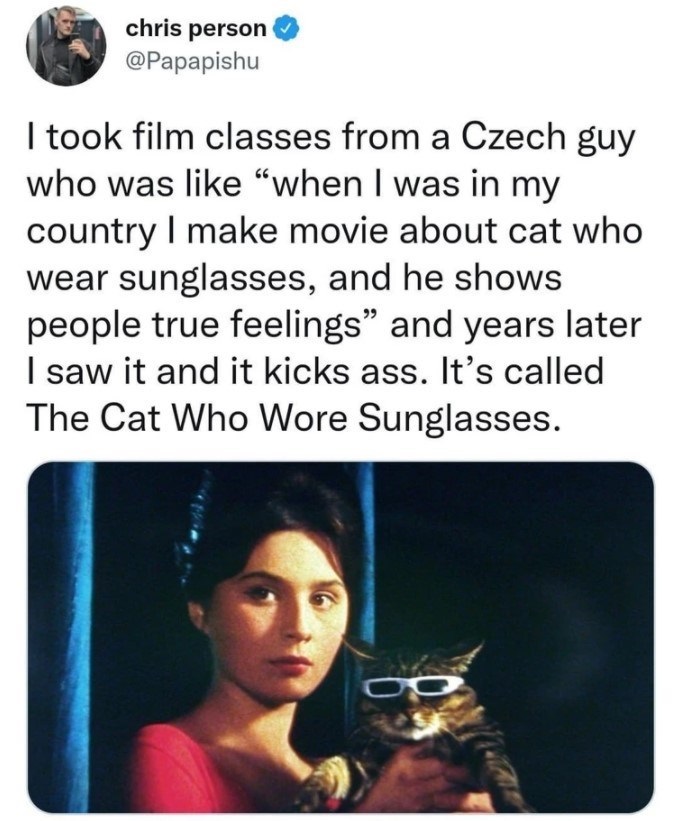
One of the sharpest reminders that the Internet is not real life that I’ve gotten recently was the sparse attendance at a local screening of The Cassandra Cat.  Also distributed under the English titles When the Cat Comes and That Cat, The Cassandra Cat is best known (to me) as the subject of a viral tweet, recommended by a film student whose Czech professor bragged about making a movie about a cat who wore sunglasses called The Cat Who Wore Sunglasses.  I certainly didn’t expect that one tweet would exalt The Cassandra Cat up to the level of household Czech New Wave standards like Daisies or Valerie and Her Week of Wonders, but it is one of those tweets that rattle around in the back of my mind the same way serious film scholars can quote lines of criticism by Kael, Sarris, and Godard.  So, when there were fewer than ten people in attendance for The Prytania’s afternoon screening of its recent restoration, I was shocked.  I could not believe so few people showed up to see a half-century-old Czech film about a magical cat that I’ve only ever heard about via Viral Tweet.  So weird.

Y’all missed out.  The Cassandra Cat is a wonderfully imaginative children’s film about collective action, holding adults accountable for being liars & cheats, and about how cats are excellent judges of character.  The titular cat is a trained circus performer who arrives to a small Czech village with an army of talented coworkers: a ringleader magician, a gorgeous trapeze artist, and a legion of faceless, supernatural puppeteers.  Their act initially goes over well with the townspeople until the final routine, in which the trapezist takes off the cat’s sunglasses so he can stare his naked cat eyes into the audience.  It turns out that the cat’s direct gaze has the magical power to expose people’s true nature by making them glow like mood rings (an effect achieved through body paint & gel lights).  Adulterers glow yellow, revealing secret affairs hidden from their spouses.  Selfish careerists glow violet, exposing their greed to higher-minded comrades.  Lovers glow red, revealing their pure, earnest hearts as artists & true friends among their careerist counterparts.  This, of course, causes a riot among the adults, who spend the rest of the film attempting to banish & discredit the cat in front of the children who witnessed their secret selves.

There is some political allegory to The Cassandra Cat that might not entirely translate to modern audiences unfamiliar with the day-to-day complexities of the Czech Republic pre-Prague Spring.  Mostly, though, it’s fairly easy to follow as the Czech New Wave version of “The Harper Valley PTA”.  That’s what makes it such a great children’s film, especially once the magical cat is weaponized by the town’s schoolchildren, who stage a mass classroom walkout until he’s surrendered to their care & use.  It’s also a great children’s film because of its vintage sense of magic & whimsy, recalling other psychedelic children’s media of bygone eras like H.R. Pufnstuf, The Peanut Butter Solution, and The 5,000 Fingers of Dr. T.  There were no actual children present at that afternoon screening at The Prytania, just a few stray adult weirdos who had nothing better to do in the breezy sunshine outside.  At this point, The Cassandra Cat is a film exclusively for weirdo shut-ins, the kid who file away hit tweets in the back of their minds in case the forgotten Czech films referenced therein happen to pop up on the local repertory schedule.  Maybe that makes us losers, but if like to think that if a cat stared at us that day we’d at least glow red.

– Brandon Ledet