Moonage Daydream (2022)

Some psychedelic, “psychotronic” cinema is great because it tests the boundaries of filmmaking as an ever-evolving artform, especially cinema’s unique ability to simulate the elusive, illogical imagery of dreams.  Most of it is just a cheap way to babysit stoners.  The new David Bowie “documentary” Moonage Daydream falls firmly in that latter category, earning a prize spot among the stoner-babysitter Classic Rock “classics”: Heavy Metal, The Song Remains the Same, lava lamps, Tommy, blacklight posters, the iTunes visualizer, The Wall, etc.  It’s more of a scrapbook in motion than a proper essay film or documentary.  Or maybe it’s just the Bowie version of your local planetarium’s Pink Floyd laser show.  I do think there’s some cinematic value to that kind of stoner-pacifying psychedelic filmmaking, but the rewards are pretty limited.  It paints a beautiful backdrop for your couch-potato bong rips, then gently puts you to sleep so you can’t get into too much trouble while you’re high.

Do not watch Moonage Daydream if you want to learn about the life, loves, and art of glam rock musician David Bowie.  Do watch Moonage Daydream if you want to hear Bowie intone Headspace app meditations about life, love, and art over a randomized slideshow medley of concert footage & movie clips.  Some of the sci-fi pulp ephemera used to illustrate his lyrical mumblings make sense as mood setting for Bowie’s “alien rockstar” period as his Ziggy Stardust persona.  However, as the never-before-seen concert footage is continually interrupted by selections as disparate as Kenneth Anger’s Lucifer Rising and Ed Wood’s Plan 9 from Outer Space long after Bowie’s moved on to more grounded, coked-out material, it’s clear those clips are only included to keep the otherwise repetitive imagery freshly varied.  Bowie’s reputation as a cineaste is cited as an excuse to roll vintage sci-fi footage that looks cool alongside his music; the use of William S. Burroughs’s “cut-ups” technique in his writing is cited as an excuse to randomly quote him at his most abstractly philosophical, with no discernible reasoning behind arrangement or progression.  The whole film is about as carefully planned out as the improvised “liquid light shows” projected behind Jefferson Airplane performances in the 1960s.  It’s a Bowie-themed novelty kaleidoscope, a psychedelic “action painting” with a glam rock soundtrack.

This is not the approach to Bowie’s life, art, and legacy that I expected from documentarian Brett Morgen.  His earlier film Montage of Heck deliberately de-mystified the ethereal rock star persona of Kurt Cobain, stripping away the self-destructive romance of his memory to show how sad & dysfunctional his drug addiction made his life on a practical, real-world level.  By contrast, this montage of glam is only interested in David Bowie as an otherworldly prophet with an uncanny ability to tap into the collective unconscious through his far-out music; it’s more interested in his stage personae than his life as a real-world human being.  That approach isn’t fundamentally wrong, but it leaves little room for tracking Bowie’s progress as an artist beyond noting his relocations from London to Los Angeles to Berlin to beyond.  Since Morgen was given full blessing and access by the Bowie estate, he finds some freshly striking imagery to mine for his psychedelic freak-out montage; I was particularly tickled to see Ziggy Stardust perform at length in a slutty little kimono, conscious of his newfound status as a sex symbol.  There’s just only so much Morgen can achieve by focusing on Bowie’s finely curated surface aesthetics, and it’s not quite enough to sustain 135 minutes of continuous abstraction . . . unless it’s used as background enhancement for other, more illicit hobbies.

-Brandon Ledet

Girl Picture (2022)

One danger of watching too many movies is that you can become a spoiled little brat.  It’s easy to become jaded about what makes an individual picture special when you’ve seen dozens of equally great movies just like it, to the point where you overvalue novelty & surprise instead of emotional resonance & dramatic truth.  Girl Picture is a thoroughly lovely teen-girls-at-the-edge-of-adulthood drama, chronicling the messy lives & loves of three Finnish high schoolers who are figuring themselves out before they get locked into the braindead rituals of adult responsibilities.  It’s thorny, sweet, well observed, and swooningly romantic in all the exact ways you’d want a coming-of-age drama to be.  And yet, I found myself comparing it against a long line of already-established modern classics that have delivered exactly what it offers, titles like Water Lilies, Girlhood, Princess Cyd, Babyteeth; etc. That’s great company to be in, no matter where Girl Picture ultimately fits in that hierarchy, but I also can’t help but search for the few dramatic details & stylistic nuances that help it stand out in that crowded field.  The easiest solution would’ve been to, you know, just watch fewer movies to begin with.

I can really only think of two aspects of Girl Picture that distinguish it from the rest of its high-style, coming-of-age sorority.  The most obvious distinguishing factor is its setting, with trades in the genre’s typical American summer backdrop for a harsh Finnish winter.  The less obvious, less easily definable distinction is the film’s matter-of-fact approach to sex.  I’m not used to watching teens order drinks at a sweaty dance club, then doing vigorous Hand Stuff as a nightcap.  Girl Picture is very nonchalant about sex, centering its two main BFF’s paths to sexual self-discovery – one learning how to advocate for her pleasure with boys in bed, the other learning how to let girls into her heart instead of just into her sheets.  There isn’t much drama to the story beyond to those two bedroom crises, and its sexual frankness also sometimes plays as deliberately rattling, at one point harshly cutting from a cliche shot of a teen’s hand soaring through the wind outside a car window to that same hand doing something much more vulgar between a fellow teen’s legs.  It’s not at all played for shock value, though.  If anything, these youngsters are extremely polite fuckers; they always ask for verbal consent before indulging their bodies, which at least feels unique to this generation of kids even if it’s not unique to this specific picture.

Ultimately, novelty doesn’t make or break a movie like this.  These dramas are hinged on the personalities of the girls they profile, and Rönkkö, Mimmi, and (Mimmi’s love interest) Emma are all lovely to spend 100 minutes with.  It’s a relatively low-stakes winter, with only so many mistakes that can be made between house parties, gym class, and afterschool jobs at the mall.  When one girl swoons as if she’s met the love of her life, it cuts to the other playing laser tag with strangers in the woods.  It’s all sweetly innocent, even when it’s raunchy or heart-soaringly romantic.  Director Alli Haapasalo finds plenty room to flex her sense of visual style in this feature debut, too, even if it’s all decorated in the same neon crosslighting, strobelit dance parties, and pastel bedroom decor that’s typical to the genre.  No matter how familiar Girl Picture can feel frame by frame, it’s always a pleasure, and it’s headlined by a lovely group of kids who deserve the absolute best.  Rooting for these girls to get their acts together before life throws real consequences at them is more than enough to make this a satisfying teen-years drama.  Just try your best to forget that you’ve seen it all done before many times over.

-Brandon Ledet

Bones and All (2022)

The timing of Bones and All’s theatrical run is indicative of how slight signifiers in a film’s marketing strategy can greatly change its public perception.  Released a month earlier, this young-cannibals-in-love road trip story would’ve been treated as a major studio Horror Film, falling somewhere between the somber-epic mythmaking of Doctor Sleep and the teen heartthrob pop-horror of The Twilight Saga.  By holding it off until November, MGM was able to position the film as a prestigious Awards Contender instead – something that loses money in the short-term, then hopefully buys the studio a couple golden statues months down the line.  As a result, I’ve been seeing a lot of grossed-out responses from audiences who were expecting Bones and All to be more of a straightforward road trip love story, repulsed by its most shocking moments of blood-guzzling, flesh-chewing violence.  As someone who twiddles their thumbs for most of the stretch between Halloween & January Dumping Season on the film release calendar, I’m coming from the opposite direction, wishing Bones and All weren’t so tenderly underplayed & remorseful about its hunger pangs for gore.  It’s kinda nice to have something that drifts between those two magnetic pulls, though, especially since it’s so unusual to see a Near Dark-style genre blender treated as a genuine threat to Award Season’s more traditional biopics & historical weepies.  The exact same cut of this movie would not have had that fighting chance if released in October instead of November, which is exactly how silly & arbitrary this entire “Best of the Year” selection process is on an industry-wide scale.

I was amused to see Bones and All‘s dual nature as a somber, awardsy drama and a viciously violent cannibal movie reflected in the casting of its two leads.  Certainly, the Oscar nominated Tiger Beat heartthrob Timothée Chalamet is the film’s biggest draw, as it relies heavily on his twinky dirtbag charms as history’s scrawniest leading man.  As a genre-trash connoisseur, though, I was most excited to see Escape Room‘s Taylor Russell get her due as the film’s front-and-center protagonist, as she’s a far more powerful emotional anchor than that high-concept, low-execution horror franchise likely deserves.  Here, Russell headlines a coming-of-age story for a teen girl in rural 1980s America who’s going through an unexpected Raw phase: channeling her newfound adult instincts & urges into sudden acts of cannibalism.  Abandoned by her family, she seeks a home & a self-assured identity on the road, where her natural scent as “an eater” is frequently clocked by fellow cannibals.  Against the odds, she hooks up with Chalamet’s fellow loner eater and makes a small, manageable place for herself in the world where she can live without pain & guilt.  Only, no matter how much she personally heals from her traumatic past, it has a way of creeping back in to ruin her progress – mostly through the villainous presence of Mark Rylance as an old-timey hobo (doing his best Rose the Hat).  Bones and All is equally balanced as an understated road trip drama about pained personal healing and an eerie supernatural horror about the wounded souls & vicious monsters at the fringes of American rot.  Which version of the film you see in that Rorschach test-in-motion is a matter of personal disposition and might even change from scene to scene.

I reacted to this movie the same way I’ve reacted to every Luca Guadagnino picture I’ve seen: sustained appreciation without total elation.  Guadagnino consistently makes good movies—never great ones—precisely because of his tendency for dramatic restraint.  With his two outright horror films (the other being his 2018 Suspriria “remake”), you can feel him actively fighting that impulse, reaching into the depths of Hell for transcendence & catharsis instead of his usual grounded frustrations & melancholy.  Bones and All digs as far down as it can into the mud, blood, bone shards, buzzing flies, and ash of its underground-cannibal America, but it still feels self-consciously reserved & tethered to reality – recalling the authenticity-obsessed docudrama of American Honey more than the horned-up ferocity of Trouble Every Day.  The doomed lovers of Bones and All never fully give in to the transcendent pleasures of their grotesque hunger.  The hellish pool party of A Bigger Splash never fully devolves into the blood-soaked, poolside orgy it threatens to be.  Armie Hammer never bites into that cum-filled peach.  For a lot of audiences, that restrained approach to over-the-top genre tropes is what makes Guadagnino great; it’s what makes Bones and All a sincere Awards Contender, unlike other artfully grotesque horrors of the year like Mad God, Flux Gourmet, and Men.  For me, it’s what keeps his work from ever fully accessing the cathartic release those tropes tap into, an approach that feels more timid than admirable.  It’s apparently what gets you in the door to compete with The Fabelmans instead of Barbarian, though, so what do I know?

-Brandon Ledet

The Menu (2022)

A few weeks ago, YouTube recommended a recent video essay for me entitled “rage & revenge: the birth of a new genre” [capitalization sic], created by Rowan Ellis. Apparently, it’s now a major part of The Discourse to consider recent films about women taking revenge as a genre unto itself, using the famous “good for her” quote from Lucille Bluth as its title.  I’m not sure about the need for this specific taxonomic declension, but I can also tell you right now that most of the films that fall into that basket are ones that I already love, and the overlap in the Venn diagram between the films which are commonly identified using this term and my oft-cited love for “women on the verge” pictures is the shape of the moon a couple of days prior to being full. I’d even say that many of them overlap between the two subgenres, notably mother!, Midsommar, Promising Young Woman, and even Knives Out! and Ready or Not. It was the last two of these that was at the forefront of my mind every time I saw the trailer for The Menu, as the advertisement included certain specific details that were very similar: the woman out of place among the narcissistic rich elites who finds their decadence alienating, and that her specific presence as a member of a class that was unlike theirs would be the key to her success. The movie is … not quite that, but it still qualifies. 

Hawthorne is an exclusive offshore restaurant situated on a private island and operated by celebrity chef Julian Slowick (Ralph Fiennes). Each evening, a cohort of twelve wealthy diners is shuttled to the island for a multi-course dinner, nearly all courses of which are informed by every little pretension of molecular gastronomy you’ve seen hyped and mocked on the internet and in sitcoms since the 1990s. One attendee, a food critic, is even said to have been the person who “basically discovered” slow eggs, which automatically made me flashback to a nearly five-year-old NYT piece about chef Alice Waters and her practice of cooking a single egg over a fire in a long cast iron spoon, the memory of which comes to mind unbidden about once a month, although rarely through so direct an association. Our viewpoint character on all of this is Margot (Anya Taylor-Joy), who is accompanying snobby foodie Tyler (Nicholas Hoult) to the restaurant on his dime; we’re immediately introduced to his fanboy idolization of Slowick in his first few moments, and his endless stream of prattle about gourmand nonsense and food science is breathless not because of his awe or wonder but because of its businesslike efficiency. He seems like exactly the kind of man who peacocks by taking a woman to a ludicrously expensive restaurant and explaining every little detail in a rehearsed speech as part of a mating ritual, not for any real love of foodcraft. 

Rounding out the night’s guests are: a wealthy couple, Richard (Reed Birney) and Anne (Judith Light, who I was delighted to see), who have eaten at Hawthorne over a dozen times; Lillian (Janet McTeer), a well-acted caricature of every food critic character you’ve ever seen on screen, and her editor Ted (Paul Adelstein); fading star George Diaz (John Leguizamo) and his girlfriend/assistant Felicity (Aimee Carrero); and a trio of tech bro worms (Arturo Castro, Rob Yang, and Mark St. Cyr) who boast to one another about their infidelities, off shore accounts, and general shittiness. Upon arrival, there is a heated discussion between Tyler and the maitre d’ Elsa (Hong Chau, who steals every scene that she’s in) regarding the fact that Margot is not his guest of record, but she is allowed to stay, despite her apathy about the situation. Elsa gives the diners a tour, which includes their poultry coops, meat smokehouse, and even the dorms in which the staff who work under Slowick reside, which looks more like a prison than anything else, down to an exposed toilet and shower in the same large room in which they all sleep in barracks. At the restaurant proper, dinner commences and Slowick introduces each course by clapping his hands loudly, which results in his staff dropping what they are doing and coming to military attention like the most well-behaved cooking reality show contestants on earth, at which point he gives a speech about the materiel being presented and its connection to some part of his past (and later, the pasts of some of his other high-ranking chefs). This starts out innocently enough with a sort of microcosm of an ocean ecosystem on a plate, then gets more provocative with a “lack of bread” course that includes several sauces for dipping but no actual bread, and then only becomes more dangerous from there. 

The touch of the darkly comic fluctuates in its efficacy here. There are many lines that are laugh-out-loud funny, and others that are witty little observations about how people who all think that they’re the main character simply because of their wealth or power must prop themselves up by being the most annoying person in the room. Diaz attempts to ingratiate himself with the tech boys because he wants to convince himself that he’s still cool; Lillian’s running commentary on the food isn’t just for the benefit of herself and her editor but is also clearly projected so that even amongst the hubbub of the evening her comments on the broken emulsion of a particular sauce is still heard by the staff, who present her with a full bowl of the broken sauce. Tyler takes pictures of his food despite that being explicitly forbidden at the start of the evening, and Ted simply plays sycophant to whatever Lillian says, often completely reversing course on a statement in the middle when Lillian objects with an opposing opinion. It elucidates each diner in a way that’s efficient without feeling utilitarian while also planting little character morsels for you to recall and smile—although presumably not laugh—when they cross your mind. Margot’s cunning bon mots are fun, but they don’t stick to your ribs in quite the way that they ought. Of course, sitting in a cinema where the jokes aren’t landing with other people can also artifically dampen that feeling, as there are certain things that made me chuckle audibly but to which no one else reacted, so that could be while I’m feeling less than satiated by this particular meal. It’s not bad, I’m just still hungry (ok, I’ll stop). I’m just hesitant to say more because I wouldn’t want to spoil you, or your appetite (ok, that was the last one, I promise). 

I don’t think that this would actually fall into the Good For Her genre. The ending is fun and functional, and although I would go so far as to say it borders on exhilarating, I wouldn’t call it cathartic. It’s not merely enough that assholes get their comeuppance for the film to qualify (if it did, this would make the cut), it’s that our Final Girl has to have actually performed some kind of rampage, and that just doesn’t happen here. It’s more a cold and calculated game of riddles between the staff and the diners with Margot falling somewhere in the middle, having to find the line between the ones who take and the ones who give and straddle it in order to survive. I’ll leave it at that, but if you’re a knowledge sponge with a functionally adult attention span like I am, then I’d recommend checking out Tara Heimberger’s thesis on the subject, “Female Rage, Revenge, and Catharsis,” here. This was a movie that will play as well for you as a rental once it’s available on demand as it does on the big screen, gorgeous island vistas aside, so I recommend it, maybe paired with a five-course dinner. 

-Mark “Boomer” Redmond

Official Competition (2022)

As the Fall Film Festival season spills over into the Year-End Listmaking frenzy and the new year’s hangover Awards Ceremonies, it’s easy to be tricked into believing that movies are Important.  Forget all the jump-scare horrors of October and the action blockbuster bloat of what’s now a six-month summer.  This is the time of year when cinema cures all the world’s ills, from “solving” racial & economic injustice in 180 minutes or less to fortifying millionaire actors’ praise-starved egos with gold-plated statuettes.  And so, it’s the perfect time of year to catch up with the Spanish film industry satire Official Competition, which is exactly as cynical about the absurd ritual of Important Cinema Season as the ritual deserves.  Dissatisfied with merely being grotesquely wealthy, a pharmaceutical CEO decides to purchase cultural clout by funding a high-brow art film.  He employs a temperamental arthouse auteur to complete the task in his name (Penelope Cruz, sporting one of cinema’s all-time greatest wigs).  To make the most of the opportunity, she has to manage the competing egos of her two male stars (Oscar Martinez as a pretentious stage actor & Antonio Banderas as a himbo film star), and the three mismatched artists violently bicker their way into purchasing a Palme d’Or.  Hilarity ensues, with none of the pomp nor dignity of Prestige Filmmaking left intact.

As you can likely tell from the dual presence of Cruz & Banderas, Official Competition borrows a lot of aesthetic surface details from the Almodóvar playbook: ultra-modernist art gallery spaces, video-instillation digi projections, cut-and-paste magazine collages, etc.  It just repurposes those Great Value™ Almodóvar aesthetics for broad goofball schtick instead of subtly complex melodrama.  And it works!  The jokes are constant & consistently funny, always punching up at the absurd self-importance of artsy filmmaker types’ delusion that they can change the world through a millionaire producer’s vanity project.  From the himbo’s Instagram charity sponcon to the theatre snob’s practiced awards rejection speech to the auteur’s failure to master TikTok dance crazes, the movie constantly pokes fun at its three central players for being far less Genius, Important, and Uniquely Talented than they believe themselves to be.  At its core, this is a comedy about a boyish rivalry between the two actors under Cruz’s direction, and her mistaken belief that she’s the sole voice of reason on-set.  They’re all equally ridiculous and all a constant source of verbal & visual punchlines. 

Even though Official Competition is essentially a farce, it can’t help but absorb some of its own arthouse prestige through proximity.  The three main actors all put in great, nuanced performances as broad film-world archetypes, especially Cruz as the exasperated auteur who can’t fully domesticate her collaborators.  The Almodóvar set details afford it a crisp art instillation feel, especially in a lengthy gag involving a loudly mic’d lesbian makeout session.  Its icy humor at the expense of its own industry also goes subzero in the third act, when the vicious on-set rivalries become outright lethal.  It’s a very smart comedy about a very silly industry that thinks very highly of itself, an easy but worthwhile target for ridicule.  It’s around this stretch on the annual film distribution calendar—when the novelty horror titles dry up between Halloween & January dumping season—that I’m desperate for a little novelty & levity in my moviewatching diet.  Official Competition meets me halfway in that respect, finding plenty novelty & levity in Prestige Filmmaking itself.

-Brandon Ledet

Last Dance (2022)

It’s undeniable that the art of drag has changed drastically in the past decade, at least from what I can see in New Orleans.  The traditionalist dive-bar pageant drag that I grew up with in the city has been pushed out to the edges of the frame, found only in the annual Gay Easter parade in the Quarter or at spaghetti & mimosas brunches on the West Bank.  These days, most local drag acts are young cabaret weirdos who are much more interested in testing the boundaries of good taste than they are in looking pretty under a pound of pancake-batter makeup.  In most cities, drag’s recent shift towards the avant-garde might only be attributable to the popularity of television programs like Ru Paul’s Drag Race and its legion of international spinoffs.  Here, it’s more directly influenced by the New Orleans Drag Workshop, an intensive drag bootcamp that spawned most of the city’s most vital, exciting queens for the better half of the 2010s.  That’s the local legacy of drag mother Lady Vinsantos, who closed the New Orleans Drag Workshop just before the pandemic in 2019, leaving behind a glamorously mutated art scene that now sets the city apart from the Southern Pageant traditions I remember from Mardis Gras & Decadences past.

The French “dragumentary” Last Dance honors Vinsantos for recontouring the New Orleans drag scene into the vibrant freak show it is today, so it was wonderful to see it presented with ceremonial prestige at this year’s New Orleans Film Festival.  As the older, stuffier crowd attending the local premiere of the Louis Armstrong documentary Black & Blues spilled out onto the sidewalk in front of The Prytania, the drunken reprobates waiting for the Vinsantos doc rushed in, ready to cheer on & heckle the projection of their friends’ faces onto the century-old silver screen.  The movie asks, “Remember when Neon Burgundy had that gigantic beard?” as if it’s making nostalgic small talk between stage acts at The All-Ways.  It treats local drag performers like Franky, Tarah Cards, and Gayle King Kong as if they were the first wave of punk bands to perform onstage at CBGB’s, a much-deserved reverence you’ll only find in film-fest documentaries like this & To Decadence With Love.  Director Coline Albert may not be from New Orleans, but she does a great job of highlighting what makes the local drag scene special, and how much of a hand Vinsantos had in shaping that scene into what it is.

Besides, New Orleans is only one part of Vinsantos’s story, as it’s told here.  This is a documentary of thirds, split between the closure & legacy of the New Orleans Drag Workshop, Vinsantos’s youthful run as a chaos queen in San Francisco, and the character’s official retirement show in Paris – a lifelong dream realized.  The writing & production of the Paris show helps establish a narrative momentum as Vinsantos reminisces about what he’s accomplished with his drag artistry in two distanced American cities, saving the movie from devolving into pure talking-heads tedium.  Even as someone who’s attended many shows populated entirely by Workshop “draguates” (as well as Vinsantos’s horror-host screening of the San Francisco cult film All About Evil), I’ve had little direct interaction with his own work, as he’s been gradually, consciously ceding the stage to younger talent.  Last Dance operates as a fly-on-the-wall portrait of Vinsantos as a self-doubting, frustrated artist with a chaotic stop-and-start creative process.  The Paris retirement show finale and clips from past triumphs also offer a decent sketch of what the Lady Vinsantos stage persona is like in action – a volatile combo of a Strait-Jacket era Joan Crawford and a Grande Dame revision of Freddy Kreuger.  The retirement of that persona is very much worth preserving here, even if she eventually rises from the grave to terrorize yet another city.

To Last Dance‘s credit, it doesn’t attempt to cover all of Vinsantos’s various art projects from throughout the decades.  His dollmaking, songwriting, and filmmaking efforts are only captured in glimpses, sometimes frustratingly so.  The archival fragments of the D.I.Y. drag-horror films he made as a prankish youth in San Francisco were the major highlight for me, since they have a vintage texture that can’t be matched by modern digital cameras.  Even just limiting itself to the dual retirement of the Drag Workshop and the Lady Vinsantos persona, though, the movie can still feel a little narratively unfocused, frantically plane-hopping between the three cities tethered to Vinsantos’s heart.  If it’s at all meandering or overlong, though, the indulgence is clearly earned.  If anything, we should have rolled out the red carpet and handed over a Key to the City to make the ceremony of this retirement documentary even more ostentatious.  As is, getting home from the post-screening Q&A after 1a.m. at least felt appropriate to the late-night freak scene Vinsantos helped establish here; the only thing the event was missing was a crowd-hyping MC and a two-drink minimum.

-Brandon Ledet

Nanny (2022)

In Nikyatu Jusu’s debut feature Nanny, a Senegalese domestic worker struggles to maintain her sanity while caring for the white child of a wealthy NYC family and scraping together money to emigrate her own son to her new home.  It’s essentially an atmospheric horror update to Ousmane Sembène’s Black Girl, the second one I’ve seen this year after the South African apartheid horror Good Madam.  I personally preferred Good Madam, but Nanny earned better reviews and the Grand Jury Prize at Sundance, so I’m out of sync with the consensus.  I suspect that’s because Nanny is less of a proper Horror Movie, landing the same accolades as an important “social thriller” that Get Out earned outside of horror circles in 2017 (in a way no other Blumhouse productions have in the years since, until now).  It’s an immigration story first & foremost, neatly containing all of its supernatural menace in its frequent nightmare & hallucination sequences in a way that the more straight-forward body possession story Good Madam does not.  Whichever spooky revision of Black Girl you prefer, it’s undeniably cool that they both exist, and remarkable that their distribution paths converged on the festival circuit this year – Nanny premiering locally at New Orleans Film Fest and Good Madam premiering at Overlook.

Comparisons aside, Nanny mostly holds together as a sharply tense, surprisingly funny domestic drama about working class exploitation, with plenty of spooky window dressing to maintain an eerie mood.  Heavily referencing African folklore figures like the arachnid trickster-god Anansi and the alluring water spirit Mami Wata, Jusu easily establishes a dense visual language in the film’s plentiful nightmare sequences & daytime hallucinations.  Spiders, mirrors, snakes, and mermaids creep into the frame at almost every turn, disrupting the labor exploitation story at the film’s core in violent jolts of surrealist imagery.  Highlighting that labor exploitation is the main point, though, and whatever supernatural scares accompany it are only there to provide texture.  With a few scattered edits, Nanny could easily be reconfigured into a standard Sundance drama about an undocumented worker’s grim daily routine sacrificing her own familial bonds to hold a wealthy family together for petty cash.  If anything, removing the supernatural horror elements might have left more room to dwell in the moments of discomfort, heartbreak, and rebirth in the film’s rushed ending, which would’ve been much more emotionally effective if the audience were allowed to fully sink into it.

Speaking generally, I’m happy that horror movies are starting to earn festival prestige & awards-season accolades instead of being siphoned off as disposable straight-to-streaming #content (which accounts for a lot of Blumhouse’s output these days).  Nanny winning the Grand Jury Prize at Sundance feels a little like Silence of the Lambs winning Best Picture at the Oscars, though.  Technically, it’s an industry win for horror, but it’s such a safe, cleaned-up, presentable version of horror that it doesn’t leave much room for the victory to be repeated.  I would need an actual, physical intrusion of a devious spider-god or killer mermaid into the “real world” to get excited about what this movie’s success means for the prominence of the genre on awards ballots & festival red carpets.  As is, I get the sense that Jusu is much more interested in the Dardennes-style economic drama she gets to tell outside those horror elements, which were more of a funding & marketing hook than the main purpose of her story.  Thankfully, the horror industry is booming right now with or without festival accolades, so I can find what I’m personally looking for in stories like these plenty other places: Good Madam, Good Manners, His House, Zombi Child, I Am Not a Witch, etc., etc., etc.

-Brandon Ledet

Sissy (2022)

I saw a good number of my favorite movies of the year (so far) at Overlook Film Fest in June, which is usually the case.  The programming at that annual horror festival is unmatched by any other local fest I can name, as long as you’re a fully committed genre nerd who doesn’t pay much attention to the Awards Prestige dramas of the fall.  It’s also condensed to a single weekend in early summer, which means it’s impossible for me to catch every movie I want to see in the program. So, I often spend the half-year after Overlook catching up with titles I missed during the festival (which almost invariably pop up on the streaming platform Shudder at one time or another).  Often, I feel validated in which movies I opted to skip at the fest (i.e., She Will), but every now and then there’s a fun little novelty like Sissy that I wish I had seen with a crowd.  It’s always hard to tell how much of an enthusiasm boost I’m giving to movies based on the horror-nerd fervor of the festival, but I do suspect that Sissy killed in the room at Overlook, and I would have loved to share in that joy.

In micro-subgenre terms, Sissy offers an Australian splatstick comedy version of the modern social media thriller. Let’s call it Heavenly Tweetures, Ingrid Goes Down Under, Aussies Aussies Aussies, whatever you like.  It references cult sitcom Kath & Kim in its opening minutes, so you immediately know that it’s filling an Australia-specific niche.  At the same time, its story of a “mental health” social media influencer who becomes a homicidal maniac when she reunites with her childhood bully is a fairly standard-issue template for its genre.  Sissy only Aussifies that template in its irreverent tone & practical-effects gore.  There’s a Dead Alive tinge to its head-crunching kills that makes for a good, goofy time even when the movie is at its most brutal.  That buoyancy seeps through its ironic Disney princess musical score, its Blood Brilliant Tampons™ visual jokes, and its adoring Love Island reality TV parodies; but it’s the gore gags I most would’ve wanted to experience with a crowd.  They’re delighfully vicious, and they’re ultimately what makes the movie special.

There really isn’t much to Sissy‘s social media satire that you can’t find elsewhere.  The titular killer’s addiction to the endorphin rush of notification chimes and her sociopathic ability to alternate between self-care rhetoric & spon-con abuse of her self-appointed position as a mental health authority are familiar to anyone who’s drawn to this kind of material.  I’d even argue that the other notable social media satire at this year’s Overlook, Deadstream, did a much better job of squeezing laughs out of that exact Youtuber brain-rot persona.  There’s a sincerity to Sissy‘s central drama that you won’t find in Deadstream, though, from its nostalgia for childhood BFF kinship to the anxiety-inducing horrors of joining an established adult friend group midstream.  If there’s any incisive social commentary to be found here, it might be in the #terminallyonline understanding of morality where everyone falls into one of two categories: “A Good Person” or “Cancelled.”  It’s when Sissy desperately, violently strikes out to avoid becoming “Cancelled” that the movie evolves into its ideal form: a flippantly funny slasher, not a thoughtful social treatise.

If watching a mental wellness YouTuber become Jokerfied at the first threat of getting cancelled appeals to you, Sissy is a hoot.  That premise is very appealing to me, so I’m not sure why I didn’t prioritize it at Overlook the way I did with Deadstream.  Frankly, I should be cancelled for the offense.

-Brandon Ledet

Valentine (2001)

It probably hasn’t escaped your attention that I like to talk about Scream. Like, a lot. Scre4m was my 59th favorite movie of the 2010s, I mentioned the franchise nine times in Part II of my favorite horror movies by year list, and I talked about how Sidney Prescott is my favorite final girl in my review of 5cream. I’ve mentioned it on our Lagniappe episodes of the podcast too many times to count, but in our Cherry Falls episode in particular, we talked about the 4-5 year glut of what I like to call “the post-Scream slashers,” which broadly fall into three categories: 

  • Movies that copied Scream‘s self-awareness and setting while adapting and updating classic horror: The Faculty as Invasion of the Body Snatchers – in a high school! Disturbing Behavior is The Stepford Wives – in a high school! Joy Ride is The Hitcher – on a road trip home from college (sorta)!
  • Movies that didn’t seem to understand that what made Scream different was how it commented upon the genre, and so simply copied the setting, the teen cast, the shadowy killer with an inexpensive outfit, and the non-supernatural horror, and just made slasher flicks with high school (and occasionally college) students being tracked down by someone on a mundane vengeance spree: I Know What You Did Last Summer, Urban Legend, and, of course, I Still Know What You Did Last Summer
  • Movies that copied the teens-in-danger trope but didn’t bother to keep it grounded and instead went all-in on the supernatural, like Final Destination and Jeepers Creepers. 

Of course, we cited Cherry Falls as the anti-Scream (and if you want more details, you can listen to the episode), but there was one movie that was accidentally left off of that list, and definitely deserves to be mentioned: Valentine, directed by Urban Legend-helmer Jamie Blanks. I won’t call myself an Urban Legend apologist because that would imply the movie needs to apologize for something (other than the presence of Jared Leto), but I will say that I find it much more entertaining that the critical consensus does, and it’s not just because Loretta Devine is divine. I always wondered if Valentine, which has the prestige of being based on a novel like I Know… and Killing Mr. Griffin, was really as bad as its reputation lets on. It breaks my heart to tell you that, unfortunately, Valentine isn’t a bad movie, it’s just … only 66.7% of a great movie. I don’t know if a lot of it ended up on the cutting room floor (as infamously happened with Disturbing Behavior, which also feels similarly disjointed) or what, but man, I’ve rarely seen a movie that feels like so much of it is missing, and I’ve seen On the Silver Globe

There’s really no other way to talk about why without getting into the entire film, so spoilers ahead, as much as something that was in theaters before 9/11 can be spoiled. 

The film opens with a promising, frenetically cut scene in a middle school Valentine’s dance in 1988, as pipsqueak Jeremy Melton (Joel Palmer) asks five different girls to dance with him: Shelley, Lily, Paige, Kate, and Dorothy. The first three are rude and cruel in the way that children often are, while Kate rejects Jeremy softly with a “maybe in a little while” and Dorothy, who is pudgier than the other girls, accepts his advances. The two of them kiss beneath the bleachers but are discovered by a pack of bullies, who mock them. Dorothy, embarrassed, quickly agrees when the bullies joke about the sixty-pound “pervert” Jeremy “attacking” her, and the bullies pour red punch over him like he’s Carrie White at the prom before stripping him out of his wet clothes and beating him up, while several of the students who are looking on wear uncanny Cupid/cherub masks . Thirteen years later, Shelley (Katherine Heigl, post-Bride of Chucky and right in the middle of Roswell) is a medical student who, after a terrible first date with a man named Jason Marquette (Adam Harrington) who continuously refers to himself in the third person and makes Shelley pay for her portion of the dinner once he realizes she’s not going to sleep with him, is pulling a midnight study session involving an autopsy.  After a jump scare, she receives a Valentine’s card with a macabre inscription before being murdered by the Cupid-masked killer. 

Elsewhere, Paige (Denise Richards) drags Kate (Marley Shelton) to a speed dating event, despite the fact that Kate hasn’t broken things off with boyfriend Adam (David Boreanaz), who is noted to have a drinking problem, hence the two of them being on the outs. they receive news of Shelley’s death and the two women, along with Lily (Jessica Cauffiel) and the now-svelte Dorothy (Jessica Capshaw), meet the detective investigating the murder, Vaughn (Fulvio Cecere). Each begins to receive creepy notes and valentines signed “J.M.,” up to and including a box of chocolates filled with maggots, and we also meet our cavalcade of other love interests/ineffective red herrings: Lily’s boyfriend Max, a video media artist who has built a maze of images of disembodied mouths and sexy torsos talking about love and sex and whatever (no one in the movie seems to like it; I think it’s terribly pretentious but I would also go and have a very good time, for what it’s worth); Dorothy’s new boyfriend Campbell, who’s wormed his way into a guest room at the giant mansion her father owns and keeps talking about NFTs his new start-up and how his money is all tied up therein; Brian, a hot guy that Kate was starting to connect with at speed dating before Paige stole him away; and Gary, Kate’s creepy neighbor, who perpetually pitches unwelcome woo at her in sentences that rhyme with her name and whom she suspects of stealing her underwear in the laundry room. 

The police remain focused on trying to locate Jason Marquette because of the “J.M.” thing and that he was the last person to see Shelley alive. There’s also a subplot about Ruthie (Hedy Burress), a woman who shows up and accuses Campbell of having bled her bank account and warning Dorothy that she’s probably being used for the same scam. The surviving women discuss whether it’s possible that any of the men in their lives could actually be Jeremy Melton, all grown up after hitting the gym and possibly getting plastic surgery, throwing around accusations and various levels of cattiness that reflect deep, unspoken grievances from childhood. Dorothy even admits to having falsely accused Jeremy, which led to him being sent to a reform school, which led to juvenile hall and so on, before he dropped off of the map. Leading up to the climactic house party at Dorothy’s, most of these are whittled away as characters are murdered: the Cupid killer shoots Lily with arrows at Max’s show (her disappearance is unremarked upon by her friends as her having simply gone on her planned business trip), Gary is discovered in Kate’s bedroom trying on her underwear by Cupid and is bludgeoned with an iron, Campbell gets an axe to the back while relighting the pilot light at Dorothy’s, etc., and Ruthie is later killed shortly after discovering his body. It’s also worth noting that in most of these scenes, the Cupid mask is seen bleeding from its right nostril, just as Jeremy did at the dance all those years ago. People leave the party in droves following a power outage that results from the method by which Cupid kills Paige—in the film’s most memorable scene, which we’ll come back to—and when Kate tries to call Lieutenant Vaughn, she discovers his corpse along with a note that she had earlier given to Adam, cementing that he’s Jeremy, come round at last to get his revenge. She goes back to the house, where Adam behaves creepily but could also just be talking about falling off of the wagon, and Kate then fights Cupid, who is unmasked as … Dorothy. However, as Adam cradles her in his arms while they wait for the police to arrive, his nose is bleeding, before we cut to credits. 

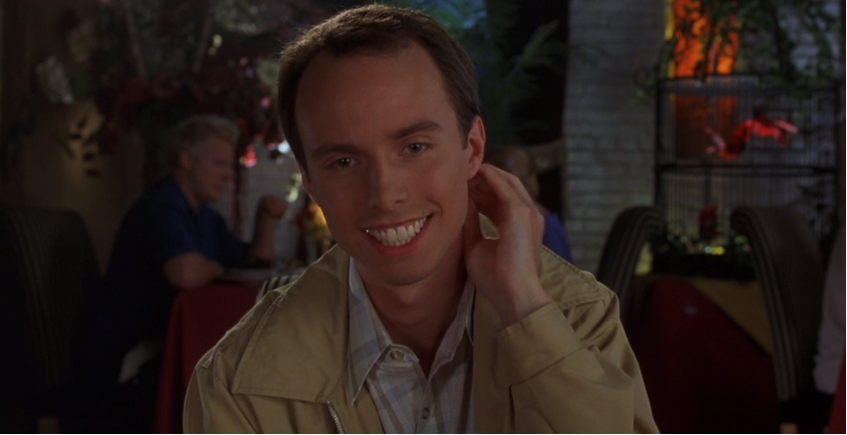
There’s a lot that’s fun and good here, but I’m more fascinated by what isn’t here than what is. Just to start us off with a visual example, one of the men that Kate meets on the speed date is a smiling goon who’s too awkward to work up the nerve to actually say something to her: 

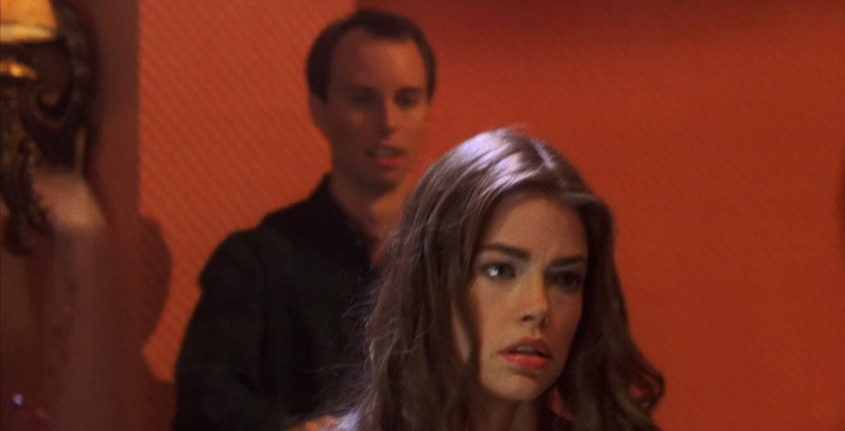
After fifty minutes, this guy shows up again, standing in the stairwell behind Paige when she comes downstairs at Dorothy’s party: 

That’s far too long between scenes for a red herring character to appear and be effective, and so little attention is drawn to him in this second appearance. It’s hard to explain but it just makes it feel like there was or should have been an intervening scene in the film’s second act, where he reappeared briefly and the film could have hinted that he was Jeremy, but it’s simply not present. In fact, there are several large group shots at Max’s art exhibition where it would make perfect sense for him to appear in the background, but I went back and watched that sequence in its entirety and he doesn’t appear in any of the crowd shots, foregrounded or otherwise; it almost makes more sense that he did appear here and was cut. 

And that’s not the only thing that’s narratively unfulfilling or otherwise doesn’t make sense in the language of film. Cameron is one of the film’s more involved red herrings, and he’s used more effectively than some of the others as well given that he is clearly up to no good, but it’s merely criminal, not homicidal.  Unfortunately, however, he is killed mere moments after we’re given the biggest hints that he might be the killer: he is unable to sexually perform for Dorothy, indicating that he’s not as into her as his cover story requires, then he gives her a necklace with a cherubic Cupid on it as a Valentine’s/apology gift, and then he goes down to one of the house’s spa areas and unsuccessfully tries to transfer her father’s money over the phone while scratching at the right side of his nose in agitation. This would be really effective if there were a scene or two in between them that left the house, creating some tension about whether Dorothy was safe or not, then cut back to Cameron trying to transfer funds. To digress for a moment, when Vaughn questions the women about boyfriends who might be behind the scary valentines and such, Kate claims that Adam simply can’t be Jeremy since she’s known him for a couple of years and even rattles off a series of facts about where he’s from and what his parents do for a living. It’s not my practice to review the movie I wish we were presented with or give feedback like this very often (I don’t never have some armchair directing feedback, but it’s not common), but this film almost begs for it, especially because the gaps are conspicuous in their absence; it’s not just that there’s something ephemeral that’s “missing,” it’s like there’s a specific shape that’s been cut out, like when a cartoon character leaves their outline after running through a wall. Right here is the perfect place for a scene where Kate, her certainty about Adam shaken, should have tried to do a little digging about Adam’s past; maybe she’s never actually met these parents and she casually asks Adam about them in a way that makes him react oddly, or she tries to look up the law firm where his mother works only to discover it doesn’t exist or contact the school where Adam’s father supposedly works only to learn there’s no “Mr. Carr” teaching there. Instead, we get two back-to-back scenes (six minutes of screentime) with Cameron and Dorothy in which no tension is built. This is pretty basic stuff, where the audience leaves one scene now assured that Cameron is the killer, then they have that determination undermined by Adam’s behavior or the discovery of lies in his personal history. 

Let’s talk about Scream for a second. I haven’t read the book on which it was based in its entirety, only the first two chapters that are available on certain websites as a preview, but there are enough differences in what I read versus what I saw to say that there were major revisions: Kate’s character is named Jill and is a mystery writer, Paige is called Tara and is an actress, and it is Adam’s character, called Nate here, who is the artist, not Max to bring the film more in line with the Scream narrative. The book opens just after the killer has committed his first revenge murder, and it happened in a bedroom, not a medical school morgue like in the film. The first victim in the novel is already dead at the time of the first line, but Valentine the film goes out of its way to evoke the opening of Scream instead, spending a lot of time with a character getting to know her before she’s killed, and utilizing one of the bigger names in the cast for this scene for shock value. Heigl didn’t have the superstar power that Knocked Up and Grey’s Anatomy would give her in the coming years and certainly wasn’t as famous as Drew Barrymore, but she was one of the big leads in a show that was aimed at and popular with the film’s demographic, and the ongoing staying power of Wish Upon a Star says a lot about how effectively it lodged itself in viewers’ minds. As in Scream, there is police involvement, and the primary red herring (Jason Marquette/Cotton Mather) is arrested for a time while the killings continue unabated, but the killer covers his tracks sufficiently that no one realizes this. And, just like Scream, the movie ends with a giant house party, and it’s this that I want to focus on for a minute. 

Dorothy’s big Valentine’s Day house party takes up far, far too much of this film’s runtime. Valentine is 93 minutes without credits, and the last 35 minutes, nearly 40% of the run time, all take place during this party. Worse that that, remember when I mentioned that nothing happens between the scene with Cameron acting suspiciously with his limp dick and Cupid necklace and the scene of him trying to defraud Dorothy’s father’s bank and then getting murdered? Nothing happens between those two scenes and the party, meaning that we spend the last 41 minutes of the movie at Dorothy’s house. The only time we leave there is when there is a quick cutaway to Lt. Vaughn calling Kate from his car to tell her that Jason Marquette was released and that he might show up at the party. Now, compare this to Scream, which likewise spent a huge part of its runtime (48 minutes) in its final act house party, but we don’t spend that entire time in Stu’s house. There are memorable scenes in the news van and down the road where Gale and Dewey take a walk that function to break up the visual monotony of spending too much screen time in one location. Once again, the outline of something missing is just as present in the narrative as the things that are actually there. To give credit where it’s due, this is where the film’s most interesting kill happens, wherein the killer manages to trap Paige in the hot tub under a clear plastic cover and starts drilling holes in it as she swims around evading the drill bit while having to keep her mouth and nose in the very small space between the cover and the water. It lasts longer than many of the other killing sequences (more on that below) and is very tense, unlike many of the others. 

One of the major things that Valentine, like a lot of Scream imitators, is missing is the characters’ attempts to fight back and survive, which often makes these scenes very brief and lacking in audience investment. In the original, Casey Beckett tries to flee the house and call for help from her parents and Tatum throws bottles of beer at Ghostface and fights for her life before getting stuck in the garage door that breaks her back; in Scream 2, which was released four years before Valentine, Maureen begs the audience to realize she’s not acting and help her, and Cici manages to do some real damage to Ghostface before being thrown off of the sorority house’s roof. And of course, in all of them, Gale and Sidney are pretty banged up at the end because they are badasses who refuse to die. Here, the murders are brief and, insofar as the characters have any agency at all, they mostly just try to hide (ineffectively): Shelley’s is the closest to a real attempt to fight back, but she still ends up hiding in a body bag, which is where the killer finds her; creepy Gary is beaten to death while cowering, moments after being discovered in Kate’s apartment by the killer and is never mentioned again; Lily gets shot to death by arrows from a distance and then falls down the center of a stairwell into a dumpster; Campbell takes an axe to the spine without ever seeing the killer coming for him. I actually saw more of this movie while testing this: from first arrow wound to dumpster fall, Lily’s death takes up 31 seconds of screen time. In comparison, Tatum’s death scene in Scream, from the moment she sees Ghostface to the moment her spine cracks, is 94 seconds, and that’s not counting the 90 seconds before that where she enters the spooky garage, struggles with the beers, and finds herself locked out of the house while tension rises. What’s more, this is one of the few areas in the movie where it feels like the failure is in the film itself, not the editing or the ostentatiously absent footage; there’s nothing missing here, the scenes simply aren’t that good. I also want to point out that some of the murders happen offscreen and it seems like it’s an actual stylistic choice, like Lt. Vaughn’s death being kept secret until Kate discovers his body, while some threads are simply left hanging, like Brian being left tied to the bed by Paige, implying that he might still be upstairs blindfolded and naked while the climax of the movie takes place. 

One thing that Valentine has that Scream doesn’t is opening credits. Stick with me here! Valentine‘s credits are intercut with its opening scene, and like I mentioned earlier, that opening is very effective and the film’s intersplicing of it all means that Valentine can have its cake and eat it, too, having old school long credits but making them interesting enough that the audience doesn’t mind. Unfortunately, this is also the film’s drawback, as the format of the titles spoils who the killer is. David Boreanaz was four years into playing his iconic role of Angel, two seasons of which were on his own show as the title character. That may have only made him a household name in households that watched Buffy, but for those households which also tolerated network series about quirky not-quite-a-cop investigators, his—wait, this math can’t be right. 245 episodes over 12 seasons? Ok, but jeezum petes—uh so yeah, Boreanaz’s turn as Booth on over a decade of Fox’s Bones also contributed to his fame. His is also the only man’s name in the movie that appears on its own during the credits. Richards is credited first, then Boreanaz, then Shelton, Capshaw, and “with” Heigl. The other men are listed in the opening, but always with other names, so you, the audience member who presumably knows who Boreanaz is, are subtly already clued in that he will be the killer, because if it’s not him, who would it be? Surely not one of these other comparative no-names (no offense), most of which, again, don’t effectively function as red herrings because they appear too infrequently. Gary is in two scenes; Brian is in two scenes. Every red herring is only 2/3 of the way there for them to work. The grinning goober who couldn’t talk at the speed dating event is only in two scenes, and all of it feels like a lot of the middle was cut out, where we would get that second scene before the final act that would lead us to believe that any one of them might be the masked killer. There’s even the tiniest bit of a hint that Vaughn might be the killer, since he’s not present at Max’s gallery opening but does mention that he’s seen Max’s work, as well as the sinister way that he isolates Paige and is a creepy lecher about it. Instead, because something is missing about the actual language of film, the viewer spends the whole rest of the movie waiting for the other shoe to drop and Adam to be unmasked as Jeremy. Imagine if Scream had opening credits and Skeet Ulrich was listed second while the rest of the male cast, including David Arquette and Jamie Kennedy, were relegated to tenth and eleventh billing; there would never be a moment of mystery, and there isn’t here, either. 

But that’s just it. The biggest empty hole that’s identifiable here is the lack of a second killer. That’s a foundational part of what made Scream work and is also present in its sequels (other than Scream 3, where it was cut at the last minute) but not its imitators (other than I Still Know…, which almost makes it the better of the two). Except—hear me out here—I think that Valentine did have a second killer, and the removal of that was one of the linchpins that made the rest of the story work. I mentioned before that the Cupid mask has nosebleeds, just like Jeremy, but it doesn’t happen every time. After Kate struggles with the Cupid-masked killer, Adam suddenly appears and kills them, with the unmasking revealing that Dorothy was under there. The Adam-is-Jeremy bloody nose reveal would have us believe that this was all part of Adam’s plan, that he somehow attacked Kate as Cupid and then dressed the disabled Dorothy (perhaps crushing her windpipe so that she couldn’t call out to Kate and reveal the deception) as Cupid so that he could then shoot Dorothy, have her revealed as the killer, and then get back together with Kate with no one to interfere and his vengeance sated. But what if that’s not what was supposed to happen? What if Dorothy and Adam were supposed to be in on it together. Some parts of the film actually make more sense this way, as Adam seems ideologically driven but Dorothy also harbors a lot of bitterness about being the “fat girl” of the group when they were younger. Further, there are some kills that, due to the editing, only make sense if this is the case, and it feels like the fact that the Cupid mask only bleeds sometimes is supposed to be a clue to this reveal, and that re-viewings of the movie with that in mind would reveal who was behind the mask during certain scenes. Adam wants to kill the women who spurned him, but has no reason to kill Cameron, and it’s notable that we don’t see the mask bleed during that scene, and that the timeline would seem to indicate that, since this was a few hours before Dorothy’s party, it was happening at roughly the same time that Adam was across town giving Kate her lollipop valentine. Although Dorothy is the reason that Jeremy went away and took a downward turn, it’s not a completely unrealistic twist that her bitterness toward her richer, smarter, prettier (in her eyes) friends led her to team up with Jeremy to take them down, only for him to fall for Kate and end up betraying her in order to have her be the scapegoat and let him have his dream future with Kate. 

However, for whatever reason, that ending didn’t sit well with test audiences, or perhaps studio executives. Maybe someone thought it was a little dated and fatphobic (which it would have been) and decided to course correct too late to fill in the gaps with it removed. Or maybe this is just a bad movie and I’m too invested in the parts of it that are good to let it go at that and insist on finding ways to close loopholes and fix bad editing with my projected fix-fic to turn this into a better film. But I don’t think so. I think that this was a movie with great promise that fell apart under its own weight with too much supporting material removed, even if I’m wrong about Dorothy. 

-Mark “Boomer” Redmond

Vesper (2022)

I was a few minutes late to my screening of the dystopian sci-fi cheapie Vesper, so I missed the opening scroll that explained exactly which doomsday scenario its few scattered characters had survived.  According to Wikipedia, the film is set in “The New Dark Ages,” triggered by bio-engineered plants & viruses that escaped from the lab and into the wild, mutating the Natural world that scientists were attempting to save from Climate Change.  Basically, in the near future we take the “Hack the planet!” messaging from Hackers a little too literally.  Whatever table-setting paragraph I missed at the start of the film didn’t end up mattering too much, though, since its interest in old-fashioned sci-fi worldbuilding does not stop there.  Vesper is essentially a feature-length worldbuilding exercise, one that invests all of its energy in exploring the lush, biohacked landscapes of its Apocalyptic Vegetation futureworld, with little attention left for the characters who have to hack their way through it.  And for a certain type of hardline sci-fi nerd, that escape to an intricately detailed otherworld is going to be immensely satisfying no matter what happens there.

Plot-wise, this is a Young Women in STEM story. The titular Vesper is a plucky teen who’s incredibly gifted at biochemistry, stubbornly determined to biohack her way out of the Biohack Apocalypse.  Camping in the woods between a petty-dictatorship barter town run by her creepy uncle and an aristocratic “citadel” with a “No Poors Allowed” sign posted to its gates, Vesper is a fairly typical YA heroine: the only freethinker who’s ruggedly independent & smart enough to rescue her dystopian world from its downward spiral.  She’s more of a video game avatar than a fully formed character, since her main function is to lead us through the overgrown vegetation and crumbling urban infrastructure of the “world of shit” she calls home.  There are plenty of contemporaries to Vesper‘s style of low-key, lived-in sci-fi, from the surreal vegetative mutations of Annihilation to the violent Natural reclamation of urban spaces in The Girl with all the Gifts to the analog sci-fi throwback of Prospect.  Only this movie exists in this specific world, though, so it’s more important that Vesper give us the full guided tour of her far-out greenhouse creations than it is for her to stir up meaningful drama with her dying father, her creepy uncle, or her fellow scrappy rebels.

Vesper can feel a little humorless and drawn out at times, but it’s shrewd about inspiring awe & disgust with limited resources.  This French-Lithuanian production was shot in an uncanny English dialect as a bid for wide international appeal, but I’m not sure that it ever had a chance to make it beyond a few festival raves & VOD streaming deals. Its detailed worldbuilding impulses are tied to such a literary sci-fi tradition that it was never going to fully break out of its nerdy niche, at least not without giving its Wilson volleyball drone sidekick a bunch of James Corden-voiced one-liners (as opposed to the defeated wheezings of Vesper’s dying father).  Its ambitions are super admirable, though, and it accomplishes a lot creatively even if its distribution has been limited.  Shot without artificial green screen environments, Vesper explores a lived-in, tactile dystopian world that should be a major draw for anyone who’s at all nerdy about world-building and practical effects.  It feels vibrantly alive – brimming with mutated plant tendrils, radioactive glow worms, and A.I. creatures made of vintage medical equipment.  You just won’t find much of that vibrant life in the drama or dialogue.

-Brandon Ledet