Episode #13 of The Swampflix Podcast: The Flesh Eaters (1964) & the Dual Franchises of The Fly

inaworld

Welcome to Episode #13 of The Swampflix Podcast! For our seemingly doomed, much-delayed thirteenth episode, Brandon discusses all five entries in the 1950s & 80s versions of The Fly with Wisconsin-based critic Dustin Koski. Also, Brandon makes special newcomer co-host Bill Arceneaux watch the early gore horror landmark The Flesh Eaters (1964) for the first time. Enjoy!

Production note: The musical “bumps” between segments were provided by the long-defunct band Gin Mittens.

-Brandon Ledet & Bill Arceneaux

Baskin (2016)

EPSON MFP image

twostar

The Turkish horror film Baskin knows how to craft a disturbing image & a depraved scenario, but is that enough of a foundation for an entire feature film? Without much of a story to tell the production winds up feeling like an HD home video of a trip to a haunted house, not at all like a narrative feature. This problem is further compounded when you’re forced to carpool to said haunted house with a gang of overgrown dude bro bully cops. The five interchangeable police officers who are tortured & destroyed by Baskin’s haunted house creations aren’t necessarily portrayed as sympathetic. In fact, they’re quite despicably abusive. However, after long enough exposure to their shitty macho jokes about bestiality & trans sex workers the film starts to take on the same one-of-the-guys locker room vibes that sunk the similarly visually-promising Witchin’ & Bitchin’. The characters are just as repugnant as they are uninteresting, but the film seems to think hanging out with them is enough of a narrative lead-up for a trip to a haunted house full of Hellish freaks when the truth is it makes the whole enterprise feel like a waste of time. There’s nothing accomplished in Baskin that couldn’t be conveyed in a still image, which is a huge problem.

The cocktail napkin plot sends the cops on a call to a remote, out of the city area, where they encounter some demonic, Event Horizon type shit, essentially entering the gates of Hell by careless mistake. The vile imagery of their Hell on Earth experience can range from beautiful (including a heavenly shot of God-sized hands plunging into water to save a drowning man, recalling the German Expressionist horror The Hands of Orlac) to despicable (eye-gouging & rape). The film tries to tack on a meaning in the depravity with some kind of Martyrs-esque philosophy about the spiritual transcendence of extreme pain, but it’s all very vague & never registers as anything more than aimlessly grotesque. Baskin is obviously proud of the demons & demonic lairs it built for the production by hand & those details indeed look great, but I get the feeling they’d be better experienced at a GWAR concert or an off-the-highway, Halloween season attraction in a warehouse. There’s not enough narrative or tonal effort here to justify a feature length film experience.

That’s not to say that the film can’t be scary. Baskin finds terror in simple, straightforward imagery. Its stark lighting & disembodied hands call back to the best of the giallo genre. Its flashlight-driven haunted house aesthetic reminds me of long gone teenage years of “urban exploring” in locations like abandoned pools & hospitals. There’s some interesting dialogue in the last act about how “you can carry Hell with you at all times; you can carry it inside you” and the film’s overall conceit about literally entering Hell opens it up to some sublimely surreal moments. There’s just not enough going on here to make its overall nastiness & cruelty worthwhile. After watching this year’s horror anthology Southbound achieve the same pull-the-rug-from-under-you terror of an unexpected trip to Hell, Baskin fails while reaching for (and without matching its grotesque cruelty for easy discomfort), this film feels more than a little useless.

There’s enough imagery in Baskin to promise that first time director Can Evernol might make some truly memorable horror pictures down the line, but that imagery is much better enjoyed as a scroll through Google image search results than as a painful 100 minute struggle through toxic bully personalities, dead still pacing, and demonic sexual assault. And if he never masters the craft of cinema, he at least has a future in the seasonal work of constructing haunted houses. Baskin isn’t successful as a feature film, but it’d make for a killer resume for that line of work.

-Brandon Ledet

Weiner (2016)

EPSON MFP image

three star

I imagine one of the most difficult decisions to make as a documentarian is when to start & when to stop collecting footage. Unlike with fictional narratives, there’s no clear beginning & end to most real-life stories and I imagine trying to establish those boundaries on an ongoing story has got to be a stressful process for a filmmaker. The documentary Weiner, on the other hand, seemed to be one of those right place/right time scenarios where a story very clearly has a beginning & an end and all the right narrative pieces just simply fall into place for its story beats. If I didn’t know any better from personal exposure to national news media I’d believe Weiner was too cut & dry to be unscripted. Following infamous politician Anthony Weiner has he attempts to run for mayor of NYC despite a past sexting/dick pic scandal, the documentary had a fairly decent opening premise for a narrative subject. It would’ve probably been a very middling film had its co-directors Josh Kriegman & Elyse Steinberg not “lucked” out & been present while a second dick pic scandal broke during the mayoral campaign while they were filming. Without this second scandal, Weiner wouldn’t be much of a recommendable experience. Without Anthony Weiner’s stubborn narcissism in continuing his campaign & allowing the film to proceed despite the scandal, it wouldn’t have much significance either. Weiner succeeds by happenstance, but it’s still a fascinating glimpse at a slow-moving political train wreck, no matter how the film happened to capture its carnage.

With an excess of footage & access, Weiner initially looks back to the former congressman’s early days when he was known as a “scrappy” & “combative” politician of the people and not an Internet age sex addict. His Achilles heel seems to be synonymous with his greatest strength: tireless passion. The same relentless dedication that made him a popular New York State congressman is also what ruins his career as he refuses to shy away from his disastrous mayoral campaign & instead addresses his scandal head on in the public eye. Weiner wants to talk economic policy and stop & frisk; reporters, somewhat understandably, want to talk dick pics. It’s a destructively stubborn decision to continue his campaign despite these circumstances, one that threatens to end both his career & his marriage in one crushing blow. One of the more interesting aspects of the documentary is how it finds its emotional core in Weiner’s marriage to Hillary Clinton advisor Huma Abedin. The couple deals with the film’s central crisis as a political enterprise rather than a romantic unit, but Abedin’s stress & disappointment seeps through that façade. Without Abedin lurking in the background of this documentary, Weiner would still have interesting things to say about how the media handles sex scandals & how the private lives of politicians sometimes outweigh the merits of their careers, but she’s what provides the film an emotional core that drives that point home. Weiner himself is too much of a tireless cartoon of a blowhard to command that kind of pathos.

In the end, it really doesn’t matter that Weiner succeeds by happenstance. The story is just too good & too strange for the audience to to look away, becoming increasingly bizarre as Weiner becomes more passionate about not backing down in the face of a scandal. At times he threatens to become physically combative, even confronting one of his documentarians for not being a true fly on the wall when they dare to ask a question. The film is interesting in the way it won’t let its subject off the hook for his brazen egotism, the media off for its fascination with sensationalism, or the audience off for participating in those two combatants’ cat & mouse shenanigans as enraptured witnesses. Still, the strangeness of its narrative details (like the revelation that Weiner’s online pseudonym was the even sillier name “Carlos Danger”) and the continued relevance of its story after the end credits (a third, worst-yet Weiner scandal just broke in the last few weeks) were all stumbled upon discoveries. Don’t look to Weiner for anything more than what you’d formally find in the technical style of a CNN documentary or a television special. As far as having an interesting story to tell, however, the film happened to strike pure gold.

-Brandon Ledet

Love & Friendship (2016)

threehalfstar

2016 very well might be The Year of the Anachronistic Jane Austen Adaptation (if it’s not already being billed as The Year of the Confined Space Thriller or The Year That Superhero Spectacles Shat the Bed). Besides the Comedy Central reality show spoof Another Period, which recontextualizes Austen-era social machinations in a petty Keeping Up with the Kardashians mindframe, we’ve also been treated to the just-as-silly-as-its-title-suggests Pride and Prejudice and Zombies. That latter, zombified Austen bastardization didn’t make much of a splash when it was released this last spring, but I got a kick out of the way the horror comedy accentuated the verbal sparring of its source material by making it literal sparring in some ludicrous knockout fights between high society women. The most recent entry in The Year of Austen Anachronisms is Wilt Stillman’s Love & Friendship, adapted from the lessor known, minor Austen title Lady Susan. While the far less subtle Pride and Prejudice and Zombies felt the need to punch up Austen’s verbal aggressions by turning them into physical altercations, Love & Friendship recognizes just how biting & playfully transgressive they already are on the page. Stillman’s film finds its own anachronism by playing the material straight, but fitting it into the format of a modern, 90min comedy, with all of the playful energy that genre implies. In a way it’s similar to Sofia Coppola’s (criminally underrated) Marie Antoinette picture, just without the Converse sneakers & unavoidably depressive third act.

It’s probably best to consider Love & Friendship as a period comedy instead of a period drama if you want to quickly get on its very particular wavelength. The film’s rapidfire, breathy dialogue & playbill-style character introductions (accompanied by phrases like “a divinely attractive man” & “a bit of a rattle”) are a relentless assault throughout the film. As a subversion of its genre the film presents the same polite-on-the-surface setting & intricately beautiful costumes, but with a new, cheeky attitude. Speaking of the usual hallmarks of the costume drama, the familiar-to-the-genre Kate Beckinsale stars as the Lady Susan of the source materials’ namesake, a character at the edge of high society fringe who’s just as self-important as she is calculated & prepared to destroy. A recent “widow without fortune”, Lady Susan is a scenery-chewing Austen archetype who wields love & friendship as deadly weapons in her designs for wealth & discomfort. The movie’s tightly paced, pleasantly efficient plot mostly centers on her machinations to find well-off husbands for both herself and her young daughter. As their financial situation is direly dependent on the kindness of acquaintances at the beginning of the film, the stakes aren’t exactly low, but it’s not easy to sympathize with our “agreeable flirt” antihero as she tries to entrap a husband of the right social stature & age range (he can’t be “too old to be governable” or “two young to die”) & sleeps with other people’s husbands for fun in the meantime. Like all traditional comedies, Love & Friendship ends with everyone finding a suitable mate, but the fun in this film is in watching Beckinsale’s lead shrewdly manipulate each piece of the puzzle so that they fall into place without her barely lifting a finger. Most of the targets of her designs don’t even know they’re being played as pawns and even the ones who do, including her poor daughter, are helpless to do anything but watch her designs play out in stunned silence. They’re all ridiculously outmatched.

All of Lady Susan’s designs wouldn’t mean a thing without her supporting players, however. Chloë Sevigny (who after this & #horror is hopefully staging an indie scene comeback) stars as a friend & conspirator who’s mostly kept around so that Lady Susan has an audience to appreciate her manipulative brilliance. Then there’s the case of the wealthy, potential beaus for Lady Susan & her daughter. The younger, more desirable candidate is a handsome gent with whom she ignites “the most peculiar friendship” and whose family is scandalized that he would associate with a flirtatious widow prone to  such “sauciness & familiarity”. The movie’s real secret weapon, however, is the delightful Sir James. A “very silly” man with “a charm of a kind”, Sir James distinctly recalls the posi stupidity of characters like Murray from Flight of the Conchords. He calls peas “tiny green balls” & “novelty vegetables”, finds difficulty remembering how many Commandments there are in the Bible, and dances like a delighted fool. There are varying degrees to which Love & Friendship’s male characters don’t measure up while going toe to toe with Lady Susan, but no one is as delightfully or entertainingly incompetent as Sir James, who has a way of stealing scenes he’s not even in as characters discuss the various charms & annoyances of his spectacular idiocy.

As amusing as the supporting players can be, however, falling for Love & Friendship depends largely on finding amusement in the cold calculations of Lady Susan, a delicately aggressive performance Beckinsale nails with ease. Although she’s a cunning manipulator who believes that “facts are horrid things” & leaves a few opposing women weeping in her wake, Lady Susan is a formidable social warmonger, a great encapsulation of the social combativeness that distinguishes a lot of Austen’s quietly powerful characters. Love & Friendship may include a lovable dolt performance from a character that belongs in a modern mockumentary-style sitcom & other 90min comedy conventions like a continuous stream of alternate take jokes included with its end credits, but it intimately understand the appeal of Jane Austen’s powerful (& humorous) archetypes in a way that’s not always captured in the more self-serious adaptations of her work. Much like the character of one Sir James Martin, the film is an all-around delight that never outwears its initial charm.

-Brandon Ledet

Roger Ebert Film School, Lesson 19: Tootsie (1982)

EPSON MFP image

Roger Ebert Film School is a recurring feature in which Brandon attempts to watch & review all 200+ movies referenced in the print & film versions of Roger Ebert’s (auto)biography Life Itself.

Where Tootsie (1982) is referenced in Life Itself: On page 147 of the first edition hardback, Ebert recalls a time when his eccentric newspaperman colleague Paul Galloway hired professionals to dress him up like Tootsie at the height of the film’s popularity. It didn’t quite elicit the desired effect. According to Roger, Galloway wasn’t offended that no one mistook him for a woman. He was upset that no one recognized him as Tootsie.

What Ebert had to say in his review:Tootsie is the kind of Movie with a capital ‘M’ that they used to make in the 1940s, when they weren’t afraid to mix up absurdity with seriousness, social comment with farce, and a little heartfelt tenderness right in there with the laughs. This movie gets you coming and going.” – from his 1982 review for The Chicago Sun-Times

EPSON MFP image

There’s a lot of pressure for Tootsie to perform for a modern audience for two entirely different reasons: 1) it’s often lauded as one of the greatest comedies of all time & 2) gender identity politics have shifted drastically in the three decades since the film’s release. I think it helps both of the film’s expectation problems if you consider it more in the context of over-the-top farces like Some Like It Hot & (maybe to a lesser degree) Mrs. Doubtfire, where deeply flawed men learn a lesson about humility & empathy by surrendering their gender-based privilege instead of a joke-a-minute laugh riot with pointed things to say about gender politics, something the film pretends to be in brief, fleeting moments. Tootsie’s cultural significance can be a little puzzling when you consider that it was nominated for ten Academy Awards & still makes the cut on a lot of Best Films of All Time lists, since to be honest, it’s not all that funny on a minute to minute basis, something that should probably be a requirement for a great comedy. As an intricately woven farce, however, it’s a fun screenplay to watch unravel as the walls separating its protagonist’s Victor Victoria-type double life crumble and his lies amount to a total shit show of bruised egos & hurt feelings. Instead of watching Dustin Hoffman’s total jerk protagonist get his much-deserved comeuppance, we see him realize how much of an asshole he truly is once he trips up on his own tangle of deceits. It’s a surprisingly sweet trajectory for a film that can be nastily bitter in its early goings-on & the farcical fever pitch of its third act is a lot of what makes Tootsie such a pleasant memory overall.

A top-of-his-game Dustin Hoffman stars as an unemployed theater actor who is talented, but notoriously difficult to work with due to an oversized hubris. Unable to land a job due to his tarnished name, the unrepentant asshole channels his frustration into an indignant female character with a ludicrous, high-pitched voice and lands a major role on a televised soap opera as his in-drag persona, unbeknownst to the cast & crew. This dynamic allows both for some delicious mockery of soap opera melodrama (seen also in less respected comedies like Joy & Delirious) and for some occasional pointed criticism about gendered work place politics, something the actor was blind to as a man. As much as he now has a soap box for complaints about how power makes a woman be unfairly perceived as “masculine” or “ugly”, a voice that inspires other women to speak up for themselves in a hostile work environment, donning a dress doesn’t instantly make him a better person. Tootsie is smart to hold onto the idea that its protagonist is a deceitful, selfish ass, allowing very little room for him to be excused for his manipulative transgressions, especially when it comes to his two love interests: a supposedly dear friend & an unsuspecting coworker. Watching this film as a kid I had never picked up on how much of an asshole Dustin Hoffman’s character is in this film; watching it now it’s the only thing I can focus on at all. Luckily, the film feels the same way & deals with his actions accordingly.

There’s not a lot going on in Tootsie formally that would really justify its inclusion on a Best Films of All Time list outside the weird imagery in a montage that includes a surreally out-of-place Andy Warhol cameo and a shot of Tootsie saluting before a Patton-esque American flag backdrop. The film’s performances are mostly serviceable, with very few moments allowed for a standout actor-centric showcase. I was especially bummed over  Bill Murray’s performance as a wisecracking bitter artist roommate, who was even more of an ass as the film’s starring role, as his entire part boils down to vocal discomfort with the idea of crossdressing (in what I’m afraid was supposed to function partly as an audience surrogate). If there’s anything impressive about how this film was made it’s in the efficiency of its screenplay. Not only does the mass confusion & chaos of the climax amount to a complex web of hurt feelings; the lead-up to that moment is also surprisingly effective. I especially liked the way the film bravely jumps into the drag persona conceit without an initial dressup montage and the way line readings from its fictional soap opera mixes with its protagonist’s true sentiments as well as the way the protagonist’s identity becomes confused as he starts making decisions based on the desires of his female avatar. Besides, you have to somewhat respect a film that can effortlessly work in a line as convoluted as, “I was a better man with you as a woman than I ever was with a woman as a man, you know?” and make it count for something. Some of Tootsie’s gender-identity politics are as outdated in a modern context as its total garbage “Go Tootsie go! Roll Tootsie roll!” pop music theme song, but it’s still a well written film with a timeless message: don’t be an asshole.

EPSON MFP image

Roger’s Rating: (4/4, 100%)

fourstar

Brandon’s Rating (3.5/5, 70%)

threehalfstar

Next Lesson: Help! (1965)

-Brandon Ledet

The Five Most Surprising Comedic Actors Lurking in Galaxy Quest (1999)


EPSON MFP image

As a full-length ode to what made the original Star Trek television series such a joy to watch, you can’t do much better than 1999’s sci-fi comedy Galaxy Quest. I guess you could argue that there’s a little influence from the The Next Generation incarnation of Star Trek mixed into the film’s DNA, considering that the spoofy homage was contemporary with titles like Nemesis, particularly noticeable in the design of the space crew’s alien enemies, but for the most part it feels true to the original Star Trek run. I suspect our resident Trekkies Alli & Boomer could do a better job explaining exactly how Galaxy Quest captures & lovingly mocks the post-Lost in Space philosophical ponderings of Gene Roddenberry’s 1960s cultural landmark, but I can say for sure that it’s difficult to think of an example of an homage that does old-line Star Trek better than Galaxy Quest. The depressive black comedy Space Station 76 might come close and JJ Abrams’s reboot of the franchise might nail a few stray details, but Galaxy Quest is more or less the pinnacle of lovingly farcical Star Trek sendups.

Besides the film’s accomplishments in capturing the spirit of its obvious, but unspoken source material, what always strikes me about Galaxy Quest is the strength & likeability of its ridiculously stacked cast. The film follows the actors who played characters on a Star Trek-esque sci-fi show as they’re misunderstood to be a real deal spaceship crew and unwittingly recruited by an alien species they mistake for enthusiastic fans of the show for a real, life-threatening outer space adventure. The casting of the Galaxy Quest crew has always struck me as inspired. The sadly deceased Alan Rickman is perfectly pitched as a Leonard Nimoy surrogate: a self-serious stage actor who’s annoyed by his genre nerd celebrity, yet still wears his prosthetic alien makeup around the house as he glumly performs simple chores. Tony Schalhoub turns “phoning it in” into his own artform as an in-over-his-head engine room technician amidst a constant state of crisis. Sam Rockwell’s role as a bit part actor justifiably paranoid about dying on the mission because he played a one-line, no-name character on the show is great meta humor. Similarly, Sigourney Weaver’s space bimbo with no real purpose on the crew besides displaying her breasts is a great subversion of her resilient, insanely competent role as Ripley in the Alien series. Even Tim Allen is a joy to watch here, bringing his iconic role as Buzz Lightyear to full live action glory as the crew’s self-important ass of a captain. Once Galaxy Quest hits its narrative groove each of these crew members helplessly find themselves slipping into their scripted roles and lift tactics from old episodic plot lines to problem solve their way back to Earth, much to the delight of their extraterrestrial fans/kidnappers.

Those famous actor crew members are largely what makes Galaxy Quest such an iconic work in the first place. It was on my most recent watch, however, where I discovered that they’re far from alone in terms of recognizable faces in the cast. It’s been a good few years since I’ve revisited Galaxy Quest, which always struck me so one of the heights of easy, pleasant viewing, and I was surprised by how well both its humor & its CG special effects have held up in the past couple of decades. What really surprised me, though, was the number of familiar faces lurking behind the film’s main flashy space crew. Here are the five Galaxy Quest supporting players that most caught me off-guard, listed form least to most exciting.

mathesar1

5) Enrico Colantoni

I really shouldn’t be surprised that Colantoni is in this movie because as a kid I probably knew him just as much for his role here as an alien nerd as I knew him as the chauvinist photographer from Just Shoot Me (I watched a lot of trash television as a youngster). In the years since its release, however, memories of Colantoni in the role had faded thoroughly to the point of vague déjà vu and I’ve come to think of the actor solely as Keith Mars, one of the great television dads (from the cult show Veronica Mars, in case you’re unfamiliar). Colantoni is damn funny as the lead alien kidnapper/nerd here, bringing a distinct Coneheads vibe to the performance. However, I’d be a liar if I didn’t admit that I was waiting for him to say “Who’s your daddy?” at some point during the production, a moment that obviously never arrived.

2ta4ecw

4) Missi Pyle

The eternally underutilized character actor Missi Pyle probably shouldn’t surprise me by popping up in a bit role as one of Colantoni’s alien underlings. Pyle’s career has long been relegated to supporting player parts on TV comedies & straight to DVD/VOD farces (she’s actually pretty phenomenal in her role as a drunken loser in the mostly unseen Parker Posey/Amy Poehler comedy Spring Breakdown, a part that seemed tailor made for Jennifer Coolidge). I think I was mostly surprised by Pyle’s inclusion in the Galaxy Quest cast because I had mentally placed Milla Jovovich in the role as I reflected back on the film. Her character’s space goth visage recalled amalgamation of Jovovich’s roles in Zoolander & Resident Evil and her super geeky, posi, genuine vibe in the role recalls Jovovich’s most iconic performance as Leeloo in Luc Beson’s ludicrous space epic The Fifth Element (a film Galaxy Quest resembles in a few production details, especially in the design of its alien weaponry).

34370-24796-0

3) Justin Long

Much like Missi Pyle, Justin Long has been in almost-famous purgatory for decades, never quite breaking out of bit roles in low profile comedies while his friends & collaborators “make it big” without him. Outside a few standout parts in comedies like Idiocracy & *shudder* Tusk, he’s mostly a background player who’s asked to allow other comedians to take the spotlight. That small potatoes status is still true in his diminished role as a geeky, convention-going superfan in Galaxy Quest, but looking back I had no idea he was in this movie at all. It’s no wonder that I didn’t recognize Justin Long in 1999, since Galaxy Quest is listed on IMDb as his first credited roe, but I was still surprised to see him onscreen here, all bright eyed & babyfaced. His few scenes as the Galaxy Quest crew’s #1 (human) superfan, the kind of dweeb who obsesses over decades-old plot holes that don’t quite match the blueprints of a fictional spaceship, is more serviceable than scene-stealing, but he was still a pleasant addition to the cast. It’s a status I’m sure he’s used to filling.

JZIfMH9

2) Rainn Wilson

In case you’re not noticing a pattern here, a lot of the more surprising supporting players in the Galaxy Quest cast are the alien kidnapper/fans that kick the film’s plot into action. Although the presence of Pyle & Colantoni caught me off-guard, what really threw me off was that Rainn Wilson was lurking among them. Much like with Long, Galaxy Quest was a kind of a career-starter for Wilson, who had only appeared in an episode of a soap opera before joining the ranks of this sci-fi comedy’s geeked-out aliens. As an unproven newcomer (this was obviously years before Wilson’s star-making turn as Dwight Schrute on The Office), Wilson mostly lurks in the background as a stealthy member of the extraterrestrial superfans. However, he fits in perfectly with his compatriot dorks & the film stands as an early glimpse at the total-weirdo energy he’d later bring to his iconic television role, as well as the strange diversity in his choice of projects, which include recent strange outliers like Cooties & The Boy.
kevinmcdd

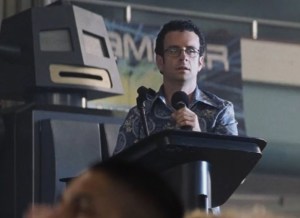
1) Kevin McDonald

Speaking of the ridiculous range of underutilized talents lurking in the film’s geeky alien troupe, I spent a lot of Galaxy Quest asking myself “Is that Kevin McDonald? No, it’s not. But is it, though?” while watching character actor Patrick Breen fill out their ranks as a Spock-like superfan of Rickman’s eternally inconvenienced personification of nonplussed stoicism. Patrick Breen, it turns out, is not Kevin McDonald. They are two separate people. Imagine my surprise, then, when the Kids in the Hall vet did show up in the film’s closing minute in a thankless, jokeless role as a sci-fi convention MC who announces the arrival of each crew member as they make their inevitable return to the Earths’ surface. Just when I thought Galaxy Quest could hold no more room for further casting surprises, Kevin McDonald swooped in at the last second, as if the film were reading my mind.

I guess that’s to be expected in a movie where Sam Rockwell plays a full-length tribute to the very nature of a thankless bit role actor, but how could Galaxy Quest’s casting director Debra Zane have known that all of those supporting players would eventually become such big names in the first place? Her intuition seems to have been just as futuristic as the film’s sci-fi setting and her work of gathering up all of these strong personalities is a large part of what makes the film such an enduring delight.

-Brandon Ledet

They’re Watching (2016)

EPSON MFP image

twostar

Roger Ebert used to repetitively quote (among other platitudes) a Howard Hawks phrasing that a good movie has “three great scenes and no bad ones.” The most frustrating thing about the straight to VOD horror cheapie They’re Watching is that it gets the first part of that formula so right & then disastrously loses control of what makes it at all special or distinct as a work of genre filmmaking in the second part. They’re Watching opens with an incredible hook & goes down punching in its glorious closing minutes of witchcraft-driven mayhem, but everything between those bookends is so mind-numbingly dull that it’s difficult to praise anything the film accomplishes. You cold sub out entire scenes, characters and plot points from this film with any number of digital-era found footage horror cheapies without losing or gaining anything particularly memorable in the process. This interchangeable, generic quality wouldn’t be such a big deal with a lot of films of this ilk, but They’re Watching tips its hand just enough to show that it could be a clever or imaginative horror flick with the right amount of effort. It just didn’t feel the need to bother.

They’re Watching teases the go-for-broke mayhem of its final moments in an opening scene of extreme violence, but that isn’t the hook that makes the film feel promising. It’s the framing device of a travel/real estate reality TV show that affords the it great potential. The bright, bubbly, inane visual & narrative palette of a daytime travel show is a fantastic contrast to the film’s ultraviolence and in its opening minutes of adopting the format I was tricked into thinking I was watching something special or worthwhile. Unfortunately, the movie immediately drops the gimmick to instead indulge in some abysmally dull, by-the-numbers found footage tedium. The film punishes American tourist archetypes as they try to find “first world inspiration” in the Eastern European country of Moldova, but instead of depicting their pain through an innocuous television show that takes classist delight in remote locations “where the Old World meets the New in surprising ways,” it instead spends almost all of its runtime functioning like the most forgettable Blair Witch Project knockoff imaginable. It doesn’t help the Blair Witch connection at all that the property the victims/television crew is profiling is a witch’s cabin in the woods. It also doesn’t help the film’s overall appeal that the only line of agreeable dialogue is when somebody shouts, “Alex, shut the fuck up!” to the most obnoxious tourist among them. Our American Idiots mock Moldovian poverty & superstition in a constant stream of offenses (to the point where they dare film undercover footage of a child’s funeral), so the audience does want to take delight in their inevitable comeuppance. However, forcing viewers to spend time with these sleazoids as they party & hangout between television tapings is cruel & unusual punishment for those following along at home.

There are some interesting images & ideas luring around in They’re Watching that suggest a better film that could’ve been produced in more capable hands. The film particularly makes great use of a prophetic painting & the common frog in its witchy mayhem, an all-out bloodbath of body-destroying telekinesis & general badassery. Too bad that bloodbath arrives too late in the game to save the film from its overall tedium. Instead of having three great scenes & no bad ones, They’re Watching has one great concluding scene, one go-nowhere opening gimmick, and a whole heap of grey mush in-between. I don’t know what that ingredient list is a recipe for, besides maybe a less-than-compelling disappointment. I’d almost rather it didn’t have one great scene at all, so that I wouldn’t have known that it was capable of more than it bothered delivering.

-Brandon Ledet

Clown (2016)

EPSON MFP image

fourstar

campstamp

The current era of straight to VOD horror pictures might be too varied & too widespread to command any particular unified aesthetic, but that wasn’t true when horror cheapies were going straight to VHS. The (thankfully hands-off) Eli Roth production Clown seems to call back to a very specific time in 90s VHS horror filmmaking when names like Clive Barker, Lloyd Kaufman, and Charles Band ruled the less than prestigious landscape. Without any intentional maneuvers in its fashion, music, or narrative, Clown effortlessly taps into a current trend of reflective 90s nostalgia by lovingly recreating the horror cheapies of that era. It does so by striking a very uncomfortable balance between horror comedy & gruesome misanthropy, forging a truly cruel sense of humor in a heartless, blood-soaked gore fest featuring a killer clown & his tiny tyke victims. You’d have to change very few details of Clown to convince me that it was actually a Full Moon Features release made twenty years ago. Besides small details like cell-phone usage and the inclusion of “That guy!” character actor Peter Stormare, the only noticeable difference is that, unlike most Full Moon “classics”, it’s a genuinely great product.

One of Clown’s greatest attributes is its patience in slowly ratcheting up the insanity levels of its over-the-top horror premise. Set in an alternate universe where children in the 2010s get super excited about birthday clowns, a selfish business dad attempts to make good by dressing as a clown for his child’s birthday party once the hired entertainment drops out. His fatal mistake is in donning a cursed clown costume with thousands of years of demonic baggage (it could happen to anyone) that completely ruins his fun, spontaneous act of self-effacing generosity by morphing him into a reluctant serial murderer . . . of children. His transformation from milquetoast real estate agent to voracious, child-eating demon is gradual, manifesting in distinct stages. At first, he cannot remove the clown uniform he wears to the child’s party, with even the false nose & wig not budging with the help of power tools. Next he falls ill, coughing up projectile vomit, and becoming as pale as clown makeup. Finally, he transforms into his true self: a gigantic, child-eating beast tied to an ancient legend that requires him to eat a very specific number of children to break the curse. This slow rollout of body horror recalls past transformation pictures like Cronenberg’s The Fly & James Gunn’s Slither, except with a much cheaper budget for its Rick Baker-reverent effects & hideous, child-destroying gore.

I’m emphasizing the horrifically young age of Clown’s victims here, because it really is a big deal. Many horror films will tease children in peril for easy shock value, but few actually dare to go there, since it’s such a sensitive subject. Think, for instance, of the Nightmare on Elm Street franchise. The film’s villain, Freddy Krueger, is explained to be a child molester & murderer, but in the actual movies he kills teenagers instead of children, which is a much easier age range of slasher victims for audiences to stomach. Clown gleefully crosses that line, leaving a disturbing aftertaste as it seems to find delight in its titular monster devouring young tykes for sustenance. This not only affords the film a kind of odd, transgressive edge; it also adds a real sense of danger to scenarios where the clown is lurking in a playground ball pit or telling young child, “I wanna see my #1 birthday boy.” In any other horror film you’d expect a relief in the promise that the film will likely let the kid off the hook. Here, the danger is not only made to feel real, it’s also made to be humorous, which is all the more disturbing.

There are a few hyperbolic ways to describe Clown that might oversell its charms. I could comfortably say it’s a lowkey retooling of Cronenberg’s The Fly or that its titular demon makes Pennywise look like Ronald McDonald, but I feel like those takes would be slightly misrepresentative of its basic aesthetic. There’s an essential cheapness to Clown that recalls projects the Masters of Horror anthology series or maybe late era Hellraiser sequels and you have to be at least somewhat down with that production level as a genre fan to get on the film’s wavelength. That being said, I do feel like Clown has undeniable flashes of brilliance, especially noticeable in the scenes where our poor, repentant, child killing clown attempts & fails to commit suicide in increasingly ridiculous ways to stop the horror (attempts that only end in goofy colors of blood splatter) and in an opening credits sequence where children’s birthday party screams are overlaid on top of otherwise innocuous cartoon clown imagery. The film is smart & incredibly uncomfortable, but houses its horror film thrills in a very specific era of nontheatrical genre trash, so it’s easy see how its better attributes might be readily dismissed by those not in tune with its particular aesthetic.

If you like trashy, throwaway horror pictures that mix black soul cruelty with incongruous humor, you might fall in love with the oddly campy discomfort Clown commands. Otherwise, maybe stick to the year’s artier horror offerings like The Neon Demon or The Witch. There have been enough great examples of those that you don’t need to catch this one if you’re not interested in its very specific, flippantly grotesque humor & tone.

-Brandon Ledet

The Invitation (2016)

EPSON MFP image

fourstar

“There’s something strange going on here and no one is saying anything.”

I may have mentioned once or a thousand times that one of my favorite plot structures is what I’ve dubbed “The Party Out of Bounds”: a story where guests at an initially civil social event stick it out once the party goes awry, held either by force or by free will, despite the very apparent fact that they should just call it a night. There have been a few great examples of Party Out of Bounds films from this year, ranging from the seething personal drama of A Bigger Splash to the go-for-broke absurdist horrors of High-Rise, but the straight-to-Netflix mystery thriller The Invitation feels like it might be the most pure & to-the-point distillation of what makes the formula work I’ve seen all of 2016. Director Karyn Kusama (Jennifer’s Body, Girlfight) & company stage their cruel, eerie mystery at a red wine & old friends dinner party that gets increasingly more disturbing by the minute as the alcohol takes hold & the conversations get morose. The major variation on the traditional Party Out of Bounds story structure in The Invitation is that only one party guest seems to notice the sinister vibes at play as his fellow partiers pass off his terror & concern as mere paranoia. This lends the film a very focused mode of psychological horror sometimes absent from films of its ilk, which makes it a unique watch even if I can boil down its basic premise & gimmick down to a well-worn trope (one that I just happen to be a sucker for).

A man travels with his new girlfriend to an ex’s home for a dinner party with friends he hasn’t seen in two years. As an outsider, his new girlfriend feels the need to overcompensate & break the silence among other party guests, but he remains stoic & pensively surveys a home where he used to live. In his own silent way, our protagonist wrestles with two distinct conflicts: a past trauma that occurred in the home that dissolved his former romance & his past lover’s new life in what appears from the outside to be some kind of sex cult. There’s a hippie niceness to his hosts’ “everything is beautiful” mode of oversexed, dazed gushing that’s eerie in contrast with the darkness their home recalls, made worse by vague platitudes like, “Pain is optional,” and “I am different. I am free. All that useless pain, it’s gone.” The protagonist senses a life-threatening danger disguised as “hospitality”, but stays to see the party through anyway, allowing for dual slow reveals of exactly what past trauma occurred in his host’s home as well as the full scope of the cult-like crowd, known simply as The Invitation, his ex has seemingly become involved with. As the partiers continuously open bottle after bottle of wine & the past gradually seeps in to inform the underlying menace of the present, our audience surrogate struggles to open his fellow guests’ eyes to what he perceives as imminent doom. So much of the satisfaction in these What’s Really Going On Here? plots depends on the strength of the films’ conclusions. The Invitation makes good on the dread of the sex & violence teased & promised throughout, but when & how the hammer falls is up for question for the entire runtime in what feels like a deliberate, sinister ritual carried out by some not-what-they-seem hippies & witnessed only by one observant party guest.

The isolation of the main character’s skepticism makes The Invitation feel just as much like a psychological horror as it does a reverse home invasion thriller (where the victim is invited as a guest to the threatening stranger’s home). With the production value just as cheap as the fictional party’s wine looks expensive, The Invitation has a way of feeling like everything’s happening inside of its protagonist’s head as he works through painful memories in a storied space, as if he’s navigating a nightmare or a session of hypnotherapy. Thankfully, the film goes to a much more interesting & terrifying place than an it-was-all-just-a-dream reveal, but the psychological torment of the film’s nobody-believes-me terror adds a layer of meaning & emotional impact that would be absent without that single-character specificity. Outside a few character actors like Toby Huss & John Carroll Lynch, even the film’s performances can come across a little cheap & artificial, but still function to enhance the way that artificiality informs the film’s psychological torment & nightmare vibes. Details like a focus on the grotesqueries of guests drinking & chewing, the strange talisman of a birthday cake, and the color-coded divisions between the past & present are just as suffocating & confining as the film’s locked doors & barred windows, as they trap  in the mind of a guest at a Party Out of Bounds who just. will. not. leave. The Invitation might not be as formally well-crafted as similar confined space thrillers frpm this year like Green Room & 10 Cloverfield Lane, but its seemingly congenial setting & psychological horror leanings make it a much stranger, more singular experience than those films can sometimes be, however cheaply made.

-Brandon Ledet

Emelie (2016)

EPSON MFP image

threehalfstar

The standard bearer of unbearable thriller intensity in2016 seems to be Jeremy Saulnier’s Green Room (despite potential arguments to be made for Don’t Breathe or 10 Cloverfield Lane in that regard), but that film’s distinction is very nearly surpassed by the first hour of the home invasion cheapie Emelie. The amazing trick Emelie pulls of is in matching Green Room’s sense of dread & helplessness without explicit onscreen violence. The film instead builds its terrorizing thriller tone off parents’ paranoia & vulnerability in leaving their children in the care of a babysitter they do not know. Emelie very nearly develops into something incredibly unique & memorable, but kinda blows it in the final half hour when it loses focus and becomes a blandly faithful genre exercise. It’s very much adept at building tension to a fever pitch, but seems unsure on where to go once it’s time for the hammer to fall.

Similar to the home invasion eeriness of films like Marytyrs & Funny Games, Emelie heightens its terror by setting it against a peaceful, serene suburbia. It opens with a babysitter abduction in plain daylight, kids blissfully biking & playing around the crime. The replacement/imposter sitter who takes over the missing girls’ job, the titular Emelie, is the source of the film’s menace. There’s an incredible amount vulnerability in parents allowing access to their home & their entire world to a complete stranger. Emelie lords over their house while they celebrate an anniversary, a building a sense of dread that only the audience is in on. To the kids, Emelie is a fun, “no rules” babysitter who allows them to draw on the walls, eat all the cookies, and destroy the living room. Her platitudes like “What if I told you that you did not have to be a boy or a girl or a human or anything?” & “Sometimes it’s okay to destroy things for fun” speak to the kids’ sense of power in the imagination while screaming at the audience’s sense of “Get the kids the fuck out of the house!” Emelie’s anarchic sense of babysitting strategy becomes even more unnerving once objects like guns, tampons, pythons, and pornographic VHS tapes come into play & it becomes clear exactly what she’s interested in the children for. Unfortunately, the destination Emelie drives its plot toward isn’t half as interesting as the journey and the film’s concluding half hour could easily be mistaken for just about any other home invasion thriller/kids in danger horror you could name.

It’s a shame Emelie succumbs to Third Act Problems as much as it does, because it very nearly nabs the top spot for thriller of the year before mimicking every thriller of every year. As soon as the deranged babysitter cuts out the lights & wages war with the oldest child in her care the film starts to fall apart. It loses track of promised threats – screwdrivers, axes, bullets – and isn’t sure how to sell the payoff of the more inventive threats that do come into play: fireworks, sportscars, walkie talkies, etc. Emelie holds its own for as long as it can, even finding engaging ways to incorporate the couple’s anniversary celebration & the babysitter’s flashback past into the always worsening situation at home in an effective broadening of the story that doesn’t loosen up the tonal claustrophobia. The dialogue also uses the corny acting inherent to a cheap production to its full advantage, selling the child actors’ authenticity in declarations like “[Cologne] is like perfume for daddies!” and findings strange terror in lines like “I found my Cubby.”

It’s rare that a thriller can get away with being this tense while showing so little onscreen violence. Emelie knows exactly what buttons to push to sell the discomfort of its children in peril scenario, especially when the kids are forced into exposure to above-their-age-range experiences like witnessing a python’s feeding habits or passionate fornication. If it had somehow worked those same provocations into its desperate-for-distinction conclusion I would’ve been much more enthusiastic about its value as a complete product. I really like Emelie, but with a better third act I could’ve fallen madly in love with it.

-Brandon Ledet