Drag Becomes Him (2015)

EPSON MFP image

fourstar

One of my favorite aspects of the drag queen reality show competition RuPaul’s Drag Race is that the system works. A lot of viewers believe a (completely believable) conspiracy that the show’s winners are predetermined & cherry picked for success (yet another theory that supports my contention that drag & pro wrestling are essentially the same thing), but I don’t really care if that’s true. My favorite contestants on the show are generally the queens crowned America’s Next Drag Superstar (except maybe in the recent case of Kim Chi), which is good enough for me, no matter what mechanism produces that result. I was curious, then, when I discovered a documentary on Jinkx Monsoon, the winner of season 4, lurking on Amazon Prime, as they were my favorite contestant on their season of the show. Truth be told, Drag Becomes Him is an interesting doc whether or not you watch RuPaul’s Drag Race with any regularity. It’s essentially a portrait of an artist who happens to make it big in a crowded field of similar talents. Although ostensibly a vanity project, the film has very little vanity as it mostly shows drag performer Jinkx Monsoon in various stages of undress & overwhelming stress. It’s a low-key document of a significant time in the unglamorous life of a performer embedded in one of America’s most glamorous & most underappreciated art forms. And even as a standalone film divorced from Monsoon’s celebrity, Drag Becomes Him still commands an interesting, unique vision & narrative, a surprising feat for a film obviously crowdfunded & cheaply made.

Jinkx Monsoon states nakedly, both in a figurative & a literal sense, that they desire “to be known as an artist, not just a female impersonator”. A Seattle queen from a very artsy, performance-based scene (as opposed to the appearance-obsessed world of “pageant queens”), Monsoon has a kind of put-on, Old Hollywood demeanor that makes it difficult to differentiate between performer & character. A theater kid type who’s always “on”, Monsoon might be a bit much to have around as close friend, but they’re a joy to watch onscreen & seem to be very sweetly sincere in an art scene that seems prone to very jaded personalities. The film is structured around Jinkx explaining the basics of drag as an art form as they slowly apply makeup & accessories, making that awkward transition from looking like a Buffalo Bill-type psychopath while in half drag to becoming a larger than life persona. Simultaneously, a narrative emerges of both Monsoon’s personal life in a broken home & their professional career from performing at the age of 15 to cutting their teeth at local clubs to becoming an enterprise with several dedicated employees. Drag Becomes Him has the benefit of a wealth of footage from every stage of Monsoon’s career, but the way it juggles all of those narratives without seeming overburdened or reading like an A-B linear Wikipedia article points to a surprisingly adept team in terms of directing & editing. This is a small scale, low stakes documentary, but it’s one done exceedingly well.

One thing I did not expect form Drag Becomes Him was how wild Jinkx Monsoon would come across in their personal life. On RuPaul’s Drag Race they were kind of pigeonholed as a relatively tame personality in contrast with their competitors. Here, Jinkx does sex, drugs, and rock n’ roll as convincingly as any queen, getting stoned & partying in celebration in a newfound high point of their career (and deservedly so). The film has a completely different tone from Drag Race, skewing kinder & more gently sincere, but it does traffic in the same unapologetically gay headspace. The way it openly leers at masculine bodies is refreshing, since this kind of content can often be phonily de-sexed in order to put a wider audience at ease. Still, Monsoon’s life is far from one continuous, glamorous party and the film finds humor & fascination with the inconveniences of the logistics of drag: the indignity & discomfort of tucking, the machinations of taking a piss while buried under layers of clothing, typing while wearing cartoonishly long nails, etc. The only aspect of Monsoon’s life the film skips over is the narcolepsy revealed during their reign on television, which seems like a curious detail to avoid. Everything else is laid bare.

I don’t think you have to be a fan of RuPaul’s Drag Race to enjoy Drag Becomes Him. The film carves out its own space entirely separate from the show’s very particular camp aesthetic. I was especially surprised by how it establishes a sort of digital pastel look all of its own that both serves its subject’s personality & helps distinguish the film as a work of art. I do think, however, that you’d be hard pressed to finish the doc without being at least somewhat a fan of Monsoon. They bare so much of their vulnerabilities as a real-life personality & their artistic sensibilities as a drag performer that it’s difficult to leave the film without feeling intimately connected. I entered Drag Becomes Him as a previous convert to all things Monsoon & I left as an even bigger, more dedicated fan. Jinkx is a talented artist & Drag Becomes Him makes a convincing, intimate case for how significant their art form can be.

-Brandon Ledet

A Town Called Panic (2009)

EPSON MFP image

fourstar

I have a bad track record with modern CG animation as filtered through companies like Disney & Pixar and a traditional 2D, hand-drawn animation feature is increasingly difficult to come by, so stop motion might very well be my final refuge in animation as a cinematic medium. This might help explain why (besides them being lovingly crafted & emotionally devastating) titles like Mary and Max & Kubo and the Two Strings have stood out to me as some of the more memorable animated features of the last decade. The 2009 stop motion madcap comedy A Town Called Panic, adapted from a cult Belgian TV show of the same name, doesn’t aim for the same awe-inspiring depth & beauty of titles like Kubo. All things considered, it’s probably a lot more in line with the slapstick antics of something like Shaun the Sheep. However, its tactile visuals, which go out of their way to call attention to its stop motion format, and its manic comedy style make for a much more memorable, enjoyable experience than most of your standard talking CG animal features could. I’m not saying that A Town Called Panic is automatically “better” than all CG animation features because of its virtue as a stop motion work (at the very least, it’s highly likely that Zootopia will make my Top Films of 2016 list at the end of the year and it easily falls under that umbrella). I just find it remarkably easy to tap into the film’s headspace because I am in love with its methods, however crudely executed.

Stop motion studios like Laika pride themselves in pushing their medium to a technical extreme, smoothing out the movement of their figurines through CGI doctoring and striving to achieve grander, larger scale accomplishments in their films’ action sequences. A Town Called Panic is refreshing in the way it casually approaches the medium, intentionally drawing attention to the crudeness of its visual style. Its characters are simple figurines anyone could pick up out of a dollar store toy bag: a cowboy, an Indian, a horse. Their character names are just as simplistic: Cowboy, Indian, Horse. When they run from danger they have to hobble violently because of the limited movement of the plastic bases attached to their feet. There’s a world built around their overly simplistic shapes; pianos, cars, houses, and computers are designed so that they can be operated by horses. It’s not the intricately mapped out, multiscale world of Zootopia, however. It’s more like a children’s playset. I haven’t seen stop motion employed so casually & so conspicuously since KaBlam! in the 90s. The approach doesn’t necessarily read as lazy, though. It merely works as a reminder of how effective stop motion can be as a visual medium even when stripped down to its bare parts. The animation in A Town Called Panic is just complicated enough to deliver the physical comedy & whimsical absurdity of its story. It’s function over fashion, but in its kids’ playset simplicity the film does achieve its own aesthetic.

The plot is similarly bare bones. As with a lot of television series, especially comedies, A Town Called Panic plays like several TV episodes strung together instead of a traditional feature-length movie plot. Cowboy, Horse, and Indian are three roommates who’ve formed a strange, symbiotic domesticity within their household. Horse is the responsible adult of the house, while Cowboy & Indian are his goofball foils. They kick the plot into action when they forget Horse’s birthday & build him a barbecue as a last minute present. Through a mistake anyone could make, really, Cowboy & Indian order 50 million bricks instead of the mere 50 required to build the barbecue and decide to hide the bricks from the much put-upon birthday boy. For all of its manic energy & physics-bending absurdity, the best attribute of A Town Called Panic is its comedic patience. There’s a great payoff to the absurd visual gag of “hiding” 50 million bricks, but it’s a very slow, methodical reveal that relies on the strength of comedic timing even more than it does on situational humor. I don’t know if I’ve ever seen a stop motion feature more confident with showing absolutely nothing happening onscreen in lingering shots so the impact of its long-game gags can pay off with greater comedic confidence. The setup of the bricks leads to many ingenious punchlines and episodic adventures, including an Atlantis-esque underwater colony, scientist kidnappers, and farm animal ammo in a territorial war. The absurdity is gradually, incrementally escalated, though. It’s a payoff that doesn’t arrive immediately, which is both surprising for a feature with such manic energy and impressive in terms of comedic confidence.

Overall, it’s difficult for me to pinpoint the exact tone of A Town Called Panic from the outside looking in. Is the franchise intended for children or stoned-out-of-their-mind college students? Both? It commands neither the cutesiness of Wallace & Gromit nor the dramatic ennui of Anomalisa, leaving it in some kind of stop-motion libido. Outside of a few details like alcohol consumption, marital infidelity, and the occasional potty language of words like “bastard” & “dumbass” it’s hard to say for sure that kids wouldn’t be able to watch it over parental concerns, but the humor isn’t exactly “adult” either. Its irreverence & whimsy recalls the stop motion comedy of Michel Gondry’s Mood Indigo or Wes Anderson’s Fantastic Mr. Fox, but it traffics in the crude simplicity of something like KaBlam!. Maybe if I were Belgian I’d have better context for A Town Called Panic’s target audience, but as an American Doofus & a stop motion fanatic all I can say is it’s very funny and I’m glad it exists. It’s rare to see a comedy in an medium brimming with so much minute-to-minute energy, yet patient enough to let longterm gags reach their full potential before payoff. This is a confident work of a very particular, unique mode of stop motion comedy & entirely deserves the traction it’s gaining as a cult curiosity on an international scale.

-Brandon Ledet

Holy Hell (2016)

three star

What is it about Californians’ disposition/DNA that makes them so susceptible to cults? Whether it’s a documentary like Going Clear or a far-fetched thriller like The Invitation, I always get the sense that a California setting is downright essential for a fertile cult breeding ground. The recent CNN documentary Holy Hell only strengthens that argument. When its cult subject The Buddhafield begins in California it flourishes, offering a spiritual utopia for college educated depressives in the midst of Reagan-era yuppiedom. It isn’t until the cult moves from California to Austin, TX that its promise of inner peace starts to fall apart in favor of the cult culture cliché of serving an enigmatic leader as a Master. Not far from the atrocity of Waco, The Buddhafield miserably & deservedly crumbled. In West Hollywood it looked like The Garden of Eden, except with the unusual uniform of Raybans & Speedos.

One of the stranger aspects of Holy Hell as a cult life expose is its ungodly wealth of access. Documentation Will Allen was a film school student nursing childhood obsessions with Death & “The Truth” when he entered The Buddhafield cult on the ground floor, so he poured his filmmaking passion into documenting the “truth” that he found with his new “family” for the decades he was hypnotized under his Master’s spell. It’s rare (I hope) that a cult as contemporary as The Buddhafield would be this unknown & this under the radar, but Holy Hell’s hook is how intimately associated & submerged its documentarian was in the menacing organization’s trenches. Allen knows exactly how to make a cult look inviting & attractive to an outsider because he lived through it himself. He initially portrays The Buddhafield as an oasis of young, attractive, talented people losing touch with reality in the wilderness as they begin to feel “Alive” for the first time & revel in “freedom from self.” He then slowly introduces the more disconcerting aspects of life at The Buddhafield, like a ritual where members are hypnotized into “knowing,” “seeing,” and “tasting” God & the gradual realization that their “spiritual leader” is a selfish, life-destroying monster that permanently damages the very victims he dares call family. At the beginning of Holy Hell, members of The Buddhafield rationalize “If this is a cult, at least it’s a really good cult.” By the end they’re left empty & permanently scarred by a human monster who still abuses young, malleable minds today (back in the holy mecca of California, of course) . . . if they were able to escape his mental grasp in the first place.

It’s tempting to get hung up on the weirder aspects of Holy Hell and treat it like a tale of curiosity like Tickled or Finders Keepers, but the abuse at the center of this documentary runs even deeper than that of those deceptively dark human interest stories. It’d be easy to reduce this story down to its weirder details, like a cult member who’s convinced that he’s making fruit salads “for God” or The Buddhafield’s strange abstinence policy or the fact that although individual members essentially work as the cult leader Michel’s employees they were still charged money for their weekly hypnotherapy sessions. There’s a lot of very specific detail to get distracted by here. However, the film’s main function is as an expose of Michel’s inhumane crimes and abuses. Holy Hell’s real life horrors are way too grave for the film to be treated as an arm’s length curiosity. It’s not a flashy documentary; it doesn’t feel too different from what you’d normally expect form a CNN production. Yet, its intimacy & the ongoing atrocity of its subject makes for a fascinating watch. At the very least I’d recommend it as a double feature to drive home the severity of Karyn Kusama’s recent thriller The Invitation. As a pair the films call into question the dangers & menace of faux spirituality, not to mention make California look like a hellscape below its sunshine & bare skin surface.

–Brandon Ledet

Knight of Cups (2016)

onehalfstar

Full confession up front: I don’t “get” Terrence Malick. The filmmaker has an admirable eye for breathtaking imagery & in theory I like the idea of the way he deconstructs the very concept of narrative cinema, but I simply get no enjoyment out his work. The much-beloved Tree of Life in particular might be the single most personally disappointing trip to the theater I can remember, based on the critical hype I was riding in and the wave of dejection I rode out. As a collection of isolated images Tree of Life succeeds in provoking awe & reflection. As a two hour theatrical experience, however, it’s an extreme exercise in patience with Sean Penn whispering vague, pretentious nothings about humanity & motherhood.

I mention this here because Knight of Cups is a deliberate doubling down on Tree of Life’s worst impulses. It trades in the former film’s suburban America setting for a similar snapshot of a wealthy man’s vacuous life in Los Angeles & swaps out Sean Penn’s whispered vagueries for those of Christian Bale, but the results are mostly the same. I feel like both Tree of Life & Knight of Cups establish their best selves & all they can offer in their opening few minutes, as if they were a resume for a cinematic skillset instead of an actual product. Both films have the feeling of an art school student trying to prove their worth in an early gig car commercial, except the car never arrives & the credits never roll. What frustrates me the most about Malick is his obvious wealth of raw material. If there weren’t so much technical skill displayed in his films I’d never feel the need to return to his work, but there’s too much promise here for me to simply walk away. He’s the filmmaking Roadrunner to my critical Wile E. Coyote. I just keep returning for more punishment, never learning my lesson.

It would feel disingenuous to tack on a plot synopsis for a review of Knight of Cups. The best I can put it is that Christian Bale is sad from having casual sex with too many beautiful models & attending too many Hollywood soirees. He navigates a world of strippers, luchadores, outer space, pool parties, and nothingness. Malick constructs “fragments, pieces of a man” in a disorienting display that might be intended to mirror the emptiness of his protagonist’s existence, but ultimately feels far too exhausting & reverently celebratory in the process to resonate as meaningful. There are a few interesting moments here or there – like when a promise of stillness is interrupted by an earthquake or when you can spot a seemingly random Famous Beautiful Person, say Joe Manganiello, in the background of an L.A. party – but for the most part the film is a wash. Once it hits its hypnotic rhythm it’s extremely difficult to focus on. The voice over becomes a foreign language and the beauty in the imagery loses its initial poetry. By the end credits there’s nothing left to feel but drained, empty, and at least a little bit cheated.

The wealth, beauty and ennui of Knight of Cups feels very much akin to a music video. Imagine, if you dare, a version of Beyoncé’s Lemonade film where nearly every actor is white and all of the pop music has been replaced with more spoken word poetry. Better yet, imagine Kanye West begging on loop that there please be “No More Parties in L.A.” for two solid hours with no indication that the party will, in fact, ever stop. The opening title card of Knight of Cups suggests that the film would be best enjoyed with the volume cranked, but I felt the exact opposite way. The film is probably best enjoyed with the soundtrack muted & replaced with something more narratively exciting & cohesive, like a rap album or, honestly, dead silence while you take care of some household chores.

I would say that after this film & Inland Empire I’m proving to have a back track record with the glacial, narratively sparse high art meditations end of cinema, but that’s not necessarily true. I fell madly in love with The Neon Demon & Heart of a Dog, which while not on an exactly comparable wavelength as Knight of Cups, at least follow a similar approach to valuing imagery & cinematic hypnosis over linear storytelling. The truth is probably a lot more likely that Knight of Cups wasn’t my thing because Malick himself just doesn’t do it for me. He probably never will, but I’m too fascinated with the glimpses of brilliance lurking in his exhaustive haze of artistic pretension to walk away. Much like Wile E. Coyote, I suspect this won’t be the last time I fall off this particular cliff. I’ll just keep doing it forever.

-Brandon Ledet


Antibirth (2016)

twohalfstar

I don’t want to say that I’m the only fan of last year’s online-bullying slasher #horror (not only would it be a little presumptuous, I also know James enjoyed it when I made him watch it for the podcast), but I do assume I’m among a very precious few hopeless weirdos who got excited when the stars of that film, Natasha Lyonne & Chloë Sevigny, were reuniting a year later in another horror cheapie. Antibirth looked to be a repeat of the neo-psychedelia explored in their previous collaboration, a total freak-out of genre filmmaking done weird & done right. Sadly, I can’t say I was nearly as hot on Antibirth as I was in #horror. Where the Tara Subkoff film felt effortlessly strange & unnerving from beginning to end, Antibirth had to strain its resources to get itself there. The entire film feels like a pained effort to reach the unhinged intensity of its final moment, when that last minute development should have ideally been a launching point. If Antibirth were a plot for a television show it would’ve been a home run. As a standalone feature film, however, it feels like all wind-up & no pitch.

Lyonne stars as a metalhead stoner with a grimy crew of dirtbag friends, including a fellow shithead played by Sevigny. Between getting blackout drunk & chain-smoking bong rips to late night television, Lyonne’s unsuspecting, unremembering protagonist is drugged at a party & abducted for nefarious purposes. Thankfully, no onscreen sexual assault is included to spoil the mood, but Lyonne’s heavy metal wastoid does emerge from the haze of her bender to find herself pregnant. Although Antibirth does rely on pregnancy-specific modes of body horror – like the terrors of sore feet, puking, ultrasounds, and sore nipples – her struggle is conveyed as entirely supernatural. There’s a Cronenbergian element to her transformation from mind-numbed party girl to expectant mother that gets gradually, grotesquely bizarre before culminating in what’s possibly the most disgusting birth scene gore I’ve ever witnessed. The problem is that her horrific birthing trauma feels like the beginning to a story rather than an ending, which is especially disheartening considering that a lot of its lead up centered on the far less compelling antics of scumbags & dazed-out alien conspiracy theorists. If the ending of Antibirth were merely the ending of a more condensed first act, we might have something interesting here, something as bizarre as the movie seems to think it already is.

One thing Antibirth isn’t lacking is a sense of style. The film plays like a low octane reimagining of Rob Zombie taking on Death to Smoochie. Its overbearing grime, Cramps-style music cues, and knockoff Tonetta music videos (something I honestly never expected to see in a film) mixes with its Chuck E Cheese-inspired Teletubby/Sasquatch hybrids to make for a really interesting underground horror tone. There are also easily recognizable seeds of good stories in the film’s talk of extraterrestrial intuition (or “interdimensional street smarts”) and its basic idea of turning the myth that “every pregnancy is different” into its own disturbing tale of body horror. In an ideal world Natasha Lyonne & Chloë Sevigny would annually team up for a horror film just as weird & off-putting as Antibirth, maybe even a couple more with the same director (this is the debut effort of Danny Perez, who’s previously done visual collaborations with Animal Collective), but their previous outing together was far more successful. Here, I only see a few germs of good ideas without the proper follow through, emphasis heavily put on “germs”.

-Brandon Ledet

Blair Witch (2016)

EPSON MFP image

three star

Director Adam Wingard & writer Simon Barrett have made an exciting reputation for themselves with their last two feature film collaborations: the home invasion subversion You’re Next & (my personal favorite) the action thriller by way of John Carpenter horror The Guest. Unfortunately, their usual knack for subversion & experimentation within genre bounds is mostly checked at the door in their latest feature, the years-late sequel/reboot hybrid Blair Witch. In the years since its 1999 release the original The Blair Witch Project has earned a growing reputation as being one of the greatest American horror films of all time, but has also suffered the misfortune of inspiring an entire subgenre of imitators. In the late 90s a found footage, documentary-style horror played like a game-changing innovation, to the point where some audiences were even convinced that the film was “real.” In 2016 the gimmick can feel a little tired & old hat. For every found footage horror that feels exciting & fresh (Creep, Unfriended) there’s a heap of examples that feel unnecessary & more than a little bit silly (The Visit, They’re Watching, Cloverfield, Exists, Da Hip Hop Witch, etc.). That’s why it’s a shame that Wingard & Barrett delivered such a straightforward found footage horror here. There are some interesting, bizarre ideas & rug pulls that shape their Blair Witch film, but they’re not pushed nearly far enough to distinguish the final product from the billion other The Blair Witch Project devotees we’ve encountered since 1999. Blair Witch finds Barrett & Wingard working in the straightforward genre picture mode they started their careers with in the horror anthology V/H/S when the film desperately needed the prankster spirit they brought to You’re Next & The Guest.

There’s not much of a plot to spoil in Blair Witch if you’re already experienced the original film. In this version of the story the younger brother of one of The Blair Witch Project’s documentarians/victims ventures back into the woods to investigate his sister’s mysterious disappearance. The original film was a search for the truth about an old world mystery. This followup is, by contrast, a search for closure. As the missing woman’s disappearance is well over a decade in the past, her brother is presumably less hopeful about actually finding her than he is about finding what happened to her. Over the course of the film, in a way, he finds a little of both, but the answers come in the form of violence and more questions (duh). The narrative setups to these films don’t really matter all too much, though. They’re basically excuses to a) get young potential victims to the woods and b) commit to a classic horror film dynamic where out of towners are punished for scoffing at locals’ superstitions. Blair Witch mirrors the basic structure of its source material to the point where it occupies the same sequel/reboot gray area of titles like Ghostbusters (2016) & The Force Awakens. The only noticeable update in the film’s basic structure is in the quality of technology available to the film student documentarians capturing the strange, spooky happenings of the woods. There’s as much focus on gear here as there is in Russ Meyer’s love letter to pinup photography, Heavenly Bodies!, with a wealth of shots devolving into people filming each other filming with various gadgets: old camcorders, state of the art Cannons, drones, earpiece cameras (which affords the film a few scenes of a Hardcore Henry style of 1st person POV), etc. It’s a detail that points to both the passage of time between the two films (especially in moments where the HQ digital photography of today clashes with the standard definition DV tapes of old) & the sequel’s reverence for found footage aesthetic (while also poking a little fun at it as a contrivance). However, it can also feel like wasted time in a film that mostly plays by the rules of its genre, never pushing that aspect to the point of self-aware parody.

That’s not to say that Blair Witch is a strict retread of its predecessor, however. Wingard & Barrett do seek out a few opportunities to pull the rug from under the audience, especially in the film’s final act. If there’s an essential difference between Blair Witch & The Blair Witch Project in terms of narrative approach, it’s that the original film was dedicated to the process of telling while the modern version lives by the virtues of showing. The 1999 feature sidesteps depicting onscreen violence by coding its witchcraft folklore into simplistic visual cues like stick figures & characters staring into the corner. The 2016 version somewhat blasphemously trades in that atmospheric terror with real, physical manifestations of its witchcraft: objects moving on their own, body horror in a pulsating, infected wound, visual confirmation that the titular witch is indeed a physical entity, etc. What’s much more interesting, though, is the way the film carves out new, original forms of terror in its play with the otherworldly logic of the woods. Time & space shift in unexpected, unsettling ways that help mark the film’s shift within its franchise from authenticity to entertainment. In its better moments Blair Witch deals in go-for-broke abstraction that somehow makes the expansiveness of Nature feel like a tightly confined space. There’s enough weirdness in the film’s final stretch that suggests that Blair Witch could’ve stood as a much stranger outlier in the found footage oeuvre were it pushed further into the directions teased by the perception-shifting instincts of its black magic spookiness. Instead, it plays like a competent, but obedient genre exercise.

In a lot of ways the mistake Blair Witch makes mirrors the folly of its protagonist: you can’t return to the past. The shaky-cam addled slowburn of the film’s opening pays plenty tribute to what made its source material so striking in 1999, but that territory has been explored a few dozen too many times in the years since to remain fresh or exciting. There’s a value to a steady camera & a cinematic eye, as evidenced by this year’s other found footage update, 10 Cloverfield Lane, but Blair Witch does manage to find other modes of blasphemy in its rug pull of a third act without ditching the found footage gimmick. It just isn’t nearly blasphemous enough. A lot of the leadup to what makes Blair Witch distinct could’ve been condensed to shorthand, given how familiar the film’s story & character beats are to anyone who’s seen a found footage horror before, and that change would’ve left a lot more room for the reality-shifting finale to run wild & free. Blair Witch is a perfectly solid genre exercise in found footage’s now-familiar thrills & chills, falling just on the right side of the divide between entertainment & tedium. If Wingard & Barrett weren’t involved this review wouldn’t likely have such a vague air of disappointment, but rather a tone of acceptance & routine. Then again, I likely wouldn’t have rushed to watch the film in the first place without their involvement, given the dime-a-dozen nature of post-The Blair Witch Project found footage fare.

For Wingard & Barrett Blair Witch stands as a step back to their humble beginnings in the serviceable horror anthology V/H/S. For a no-name, workman filmmaker that humble beginnings aspect wouldn’t be much of a detriment, but I’ve come to expect more from these two. Blair Witch boasts a few moments of flashy weirdness & reality-bending excitement that made the exercise feel at least worthwhile. Yet, on the whole the film feels a little regressive considering the immense talents who delivered it & how much it’s rooted in tradition.

-Brandon Ledet

An Evening with Richard Kelly: A Southland Tales (2007) Q&A

EPSON MFP image

“No film is every really finished, just abandoned by the filmmaker.”

This is the philosophy, or rather one of the facets of the real-life and filmmaking philosophies, of Richard Kelly. In something of a MotM miracle, I received an email last week advising that Austin’s Alamo Drafthouse would be hosting a screening of Kelly’s 2007 opus Southland Tales, with an introduction by the director and a Q&A following the film. As discussed in our email roundtable, I was a fan of Donnie Darko when it was first brought to my attention in 2003, when a DVD of the film was passed around like wildfire at the Louisiana School for Math, Science, and the Arts. Although time and distance (and a strong wave of hype backlash as the film caught on outside of the cult scene) have dulled my teenage enthusiasm for the film, my interest in Kelly’s work was piqued again by our viewing of The Box, a film I didn’t love but haven’t been able to stop thinking about. I never got the chance to see Southland Tales before this past Sunday, but I’m glad that my first viewing experience was on the big screen and not limited to the comparatively tiny television in my living room.

What’s the film about? I’ll try to be as succinct as I can: Southland Tales takes place in an alternate 2008, where post-9/11 paranoia and the overreach of infringement upon civil liberties that followed that incident has been further exacerbated by a nuclear attack on American soil (Texas, to be precise). The draft has been reinstated, interstate travel is extremely restricted, and citizens are heavily monitored via the use of information network USIdent and the deployment of heavily militarized Urban Pacification Units, which seem to have taken the place of standard police forces. The Republican Party, most notably represented by Texas Senator and potential VP Bobby Frost (Holmes Osborne) and his wife, NSA Deputy Director cum USIdent overlord Nana Mae (Miranda Richardson), is seeking to swing California to the red in order to ensure the continued power of USIdent and the party. Popular action star Boxer Santaros (Dwayne Johnson), the husband of the Frosts’ daughter Madeleine (Mandy Moore), has recently awoken in the desert with amnesia; he makes his way into the arms of Krysta Now (Sarah Michelle Gellar), a psychic porn star seeking to expand her media and merchandise empires through diversification. Krysta has recently completed a screenplay entitled The Power, which foretells the end of the world.

Elsewhere, the underground liberal forces of the Neo-Marxists oppose the Republican Party (this entire group is composed almost entirely of former SNL cast members, including but not limited to Nora Dunn, Amy Poehler, and Cheri Oteri). Their current plan involves staging a racially-motivated police shooting committed by haunted veteran Roland Taverner posing as his twin brother Ronald (Seann William Scott), an UPU officer; the intention is to have this captured on film by Boxer during a ride-along for research purposes, then use the footage to discredit Bush’s apparent successors. Their machinations are held in check by a series of double-crosses that undermine their ability to take any real political action. Elsewhere elsewhere, the wizard Baron von Westphalen (Wallace Shawn) has invented both a device that uses the power of the ocean to generate wireless electricity as well as several injectable liquids of various colors that are used as drugs for both recreational and psychic purposes. He and his band of assorted cronies (Bai Ling, Curtis Armstrong, Zelda Rubinsten, and Beth Grant) move throughout the various factions at play, gaining political power and prestige while well aware that the alternative energy source that they have created could bring about the end of humanity. And all of this is narrated by Pilot Abilene (Justin Timberlake), a former movie star whose face was disfigured by friendly fire in Iraq after he was drafted. And, hey, if you were starting to think any of this was too straightforward, don’t worry; there are also stable time loops, predestination paradoxes, mistaken identities, and all the other Kelly elements you’ve come to know and, perhaps, love. Plus a lip-synch music video.

Part multimedia experiment, part time travel film, part jeremiad prophecy of the dangers of unchecked rightwing expansion into surveillance and homeland policing, part philosophy lecture, but mostly a political satire, Southland Tales has been called many things: unwatchable, convoluted, pretentious, and incomprehensible. For my money, however, the film (and its expanded materials, which I hesitate to call “supplementary” given that they were always intended to be part of the experience) is simply too ambitious to ever have any kind of mainstream penetration, even on the level that Darko did. There’s also been a lot of name-calling and assumptions with regards to Kelly’s ego and affectations of intellectualism, even from those of us here at Swampflix; in person, however, Kelly comes across as approachable, well-spoken, thoughtful, and shy (and he’s a total babe as well– look up a picture or two if you haven’t already done yourself this great service; those triceps are poppin’). Kelly directed this film when he was twenty-nine; that’s my age, and all I have to show for a life is a stack of unopened mail and a heap of student loan debt that I’ll finish paying off seven years after I’m dead– if I’m lucky.

In case you weren’t aware, Southland was originally envisioned as the final three chapters in a six-chapter arc, with the first three components released as graphic novels (Kelly said that when these materials, which were not quite complete at the time of the Cannes premiere, were given to the press, they sneered). There is a certain feeling of incompleteness that can be felt in the film as a result, but this is not the same thing as saying that the film is, as Kelly said in his introduction, “unfinished.” There’s certainly an element of that in play in the theatrical version that was screened, but I didn’t find it as distracting as others have. He discussed the nature of the release of the film, the way that certain visual effects were never quite completed due to the fact that the money for said polishing was to have come from one studio that held the international distribution rights, but there were issues with the domestic distributor. It’s all information that you can find elsewhere, I’m sure, so I won’t get into it here. There were some new tidbits that were shared in the Q&A that I’ll share here, though.

Why is Janeane Garofalo in the final scene? In the earlier, longer version of the film that was screened at Cannes, there is an additional subplot in which Garofalo plays a general who is engaged in a Dungeons & Dragons game with veteran Simon Theory (Kevin Smith) and a couple of other characters, with that game serving as an additional metaphorical layer to the events of the film, just line the screenplay for The Power. (I did see a credit for a D&D consultant in the final credits, which confused me until this was explained.)

Was this movie inspired by Brazil? Yes, Kelly loves Brazil.

Where did the character names come from? Kelly discussed that there’s a music to character names, and described how some come from more obvious sources (like the Robert Frost-quoting Senator Bobby Frost), and some a bit more obscure from sources both historical (like the von Westphalen family, whose true allegiances are obvious from the outset for those who know Jenny von Westphalen was the wife of Karl Marx), and literary (the Taverners share their surname with Jason Taverner, protagonist of Philip K. Dick’s Flow My Tears, the Policeman Said, which shares a rightwing autocratic dictatorship with Southland). So, like many of the references to extratextual real-world works that we mentioned in The Box discussion, they’re present less because Kelly wants to prove how smart he is and more because he thinks we’re all on his level, which is a compliment more than anything else.

Why so many Saturday Night Live actors? Besides the aforementioned Poehler, Oteri, Dunn, and Garofalo, other SNL alums include Jon Lovitz and John Larroquette. I really liked Kelly’s answer to this question; when we talk about political satire, at least in America, SNL is the troupe that is on the cutting edge of that discussion.

Is the recurring theme of free will versus predestination representative of a personal philosophy or just something that Kelly finds intriguing to play with on film? This was my question, and was admittedly a little longer in the actual asking (which involved referencing the Job-like structure of The Box and eschatological nature of Southland, leading Richard Kelly to compliment me personally, so take that, world!), but Kelly stated that this was something that he thinks about a lot, that humans beings are often bandied about by forces outside of their control, and how much agency any of us have at all (one audience member asked about Krysta Now’s agency in regards to the film, but I missed the answer to that one trying to calm myself enough to ask my question). Kelly had previously mentioned that Southland was intended to be a cathartic film experience; given that the themes of the film boil down to the idea that salvation comes from forgiving the self, which is an entirely internal emotional journey, I think that this could be reflective of that idea. Forgiving one’s self, like Taverner does in the film’s final moments, removes the external elements of predestination and is purely an act of personal decision, and through that comes real existential relief.

Whatever happened to the Norma Lewis prosthetic foot prop? This one I had to ask for Britnee, per her final thoughts on The Box. As it turns out, Kelly’s father, who really did work on the Mars Viking Lander project, did something similar for Kelly’s mother, whose own foot was disfigured, not unlike Norma’s. As for the prop, Kelly said he would have to make some calls to be absolutely certain, but he’s pretty sure it’s in a props warehouse in Boston.

For more on September’s Movie of the Month, Richard Kelly’s sci-fi mystery thriller The Box, check out our Swampchat discussion of the film and last week’s look at how the film works as a literary adaptation.

-Mark “Boomer” Redmond

Roger Ebert Film School, Lesson 20: Help! (1965)

Roger Ebert Film School is a recurring feature in which Brandon attempts to watch & review all 200+ movies referenced in the print & film versions of Roger Ebert’s (auto)biography Life Itself.

Where Help! (1965) is referenced in Life Itself: On page 152 of the first-edition hardback, Ebert praises a Chicagoan revival house cinema called The Clark Theater. He wrote, “It was there one Sunday, while sitting in the balcony watching Help! with The Beatles, that I saw a fan run down the aisle, cry out ‘I’m coming, John!’ and throw himself over the rail. Strangely, there were no serious injuries.”

What Ebert had to say in his review:  Unfortunately, if he ever officially reviewed the film, it’s not currently available on his website.

Richard Lester’s first collaboration with The Beatles, the classic 1964 boyband comedy pioneer A Hard Day’s Night, has a flippantly absurdist edge to it, but mostly remains grounded in reality as the Fab Four navigate a world where fans & the press are ravenous for more, more, more. Help! trades in that absurdist tinge for all-out surreality & psychedelia, mostly to the film’s detriment. It’s as if A Hard Day’s Night captured their boozy, pill-popping rock band phase & Help! happened to catch them just a year later after they had just smoked pot for the first time. Every half-baked highdea Lester & the boys had made it to the screen without filter and the results can include some great gags & striking imagery in the film’s long string of throwaway moments. However, as a whole Help! is messy in a druggy, pot-addled way that a lot of comedies would come to be in the decade that followed. Still, you could do much worse that watching the greatest band of all time get stoned off their asses & act like goofballs in-between tour dates for two hours & Help! remains consistently entertaining, even in its blasé, ramshackle state of dazed giddiness.

For the entirety of Help!’s opening scene, I thought for sure I had popped in the wrong DVD. A Hindu-adjacent Indian cult (ostensibly modeled after the Thugee) prepare a human sacrifice to their in the flesh god-king only to discover that *gasp* she’s not wearing the sacrificial ring necessary to complete the act. Smash cut to The Beatles performing a proto music video rendition of the song “Help!” where it’s revealed that, duh, Ringo is wearing the ring. Somehow catching that detail on their era’s version of MTV (a reel-to-reel projector), a group of higher-ups in the cult go on a mission to steal the ring back from the goofball drummer. The quest to reclaim Ringo’s ring (which seems to be magically stuck to his finger) beings in London, but follows his band all over Europe (presumably between a hectic schedule of tour dates). Magic, science, and high concept hijinks all fail to remove the ring from Ringo’s finger. The espionage-themed antics that ensue recall James Bond by way of Benny Hill and the movie constantly shifts gears as it sees fit, occasionally dropping the storyline in favor of allowing The Beatles to perform music video renditions of songs like “Lose that Girl” & “Ticket to Ride”, as well as to be cute & cheeky in their downtime. It’s in some ways more of the same after A Hard Day’s Night, except with a bigger budget & a more obvious attempt to shoehorn a plot into its very loose structure.

If I had to liken Help!’s comedy style to anything more specific, I guess I could see how it would’ve had an influence on its ZAZ-style comedies like Airplane! & Naked Gun that would follow over a decade after its premiere. In true ZAZ fashion the film throws so many gags at the wall that it doesn’t at all matter that they don’t all stick. If the film’s flamethrower umbrella doesn’t elicit a chuckle then maybe you’ll laugh at its killer hand drier or its ludicrous undercover espionage costumes (of which Ringo’s gradually would become true to life over time) or whatever else flies at the screen from moment to moment. Also true to ZAZ comedies, Help! has an obvious problem with cultural . . . insensitivity when it comes to othering its neighbors from the East for their kooky religious ways. The Beatles likely included the Indian cult in their film to acknowledge their growing interest in incorporating Eastern sounds into their music, but it’s hard to watch Help! & believe this was the most ethical way of going about that. The problem is especially noticeable in a repeated gag where John Lennon chides an Indian woman for her “filthy Eastern ways,” a running joke that only gets increasingly uncomfortable with each occurrence.

According to Richard Lester, Duck Soup was a huge inspiration for the making of Help!, but I can just barely see the connection myself. I guess The Beatles have always had a Marx Brothers style of rapid-fire banter & the film does devolve into the chaos of warfare in its final act the way Duck Soup does, but Help! is done no favors by being compared to, in my opinion, one of the greatest comedies of all time. Personally, I think the film is much more reminiscent of the down-the-line ZAZ comedy Top Secret!, except that it was pulling form contemporary James Bond titles like From Russia with Love (including that film’s cultural gawking) instead of Bond films of the 80s. There are some inspired moments in the whimsical set designs, especially in The Beatles’s color-coded flat & a scene where Paul McCartney is shrunken down to thumbsize among towering, oversized props. For the most part, though, Help! is a nonstop assault of Looney Tunes goofery run amok, a dedication to irreverence that can vary from moment to moment in terms of entertainment or annoyance.

According to my extensive online research (a quick Google search), The Beatles had indeed been introduced to the dysfunctional joys of marijuana by Bob Dylan in the year prior to writing & performing Help!. If anyone can get away with dicking around while stoned on camera & still make it charming, however, it might as well be The Beatles. Help! probably could’ve used a second draft & a editor, but it’s still a joy to watch due to the inherent charm of its blitzed moptops.

EPSON MFP image

Roger’s Rating: (N/A)

Brandon’s Rating: (3/5, 60%)

three star

Next Lesson: Bonnie & Clyde (1967)

-Brandon Ledet

Kraftwerk 3-D and the Modern Concert as Cinema

At the time I’m writing this it’s been over a week since I’ve seen a proper movie, which is likely the longest stretch I’ve gone without watching one in at least two years. Thanks to the ever-expanding grey area of what does & does not qualify as cinema, however, I feel like that itch is being scratched elsewhere, with a surprising amount of that content relating to pop music. For instance, long form music videos like Beyoncé’s Lemonade or our former Movie of the Month Girl Walk //All Day and prestige television shows like Baz Luhrmann’s recent chaotic mess of a hip-hop disco musical The Get Down all feel cinematic without being what’s traditionally considered cinema. Gallons of ink have already been spilled about how television is becoming more like film & vice versa (in the form of never-ending franchises like the Marvel Cinematic Universe),but what’s been of particular interest to me lately is how music videos & live concerts have been doing the same. This might explain why while attending a 3-D Kraftwerk concert in New Orleans last Friday I found myself (between spaced out, gin & soda fueled dancing) asking “Is this cinema?” I don’t know if it was because I hadn’t watched a film in days & was desperate to tap myself into that headspace, but I wound up deciding that yes, it was. And it was one of the best movies I had seen all year.

If you’re wondering, like I was before I reached the Orpheum that Friday, exactly what a “3-D concert” is (besides watching three-dimensional musicians perform in a three-dimensional space), Kraftwerk basically performed in front of a stage-sized screen that displayed a moving image to correspond with each song, not unlike a live music video. These images were made to look 3-D through cardboard glasses specifically printed for the show & distributed at the entrance. Now, watching a screen at a live event isn’t all that novel for a 2010s concert experience. In fact, it’s almost become standard. Besides attendees watching acts through their view-blocking, media-capturing smartphones, bands often use projections & display screens to enhance the live music experience. From metal bands doing living room sets in front of projections of silent horror relics to gigantic crowd music festivals using jumbotrons to reach the folk miles form the stage, we’ve all witnessed 2-D visual media incorporated as part of the live concert experience. The concept goes back pretty far down the history of rock n’ roll too, touching on the rudimentary light shows of 60s psychedelia & the multimedia assault on the senses of acts like The Butthole Surfers. There’s something different about the way Kraftwerk is crafting their live experience that makes it more of a recognizably cinematic endeavor, however, and that difference has a lot to do with the immersion & the gimmickry of the 3-D experience.

When trying to conjure the ways live music is gradually becoming more cinematic the first thing that might come to mind is the live performance of movie scores for public screenings. Radiohead’s Jonny Greenwood performed live versions of his There Will Be Blood score for recent events. Prog rock legends Goblin embarked on an entire international tour where they performed their killer score for Dario Argento’s Suspiria along with screenings of the movie. Local musician Hellen Gillet recently performed a live score for Fritz Lang’s silent masterpiece Metropolis at an outdoor screening outside the US Mint in the French Quarter. These examples of cinema seeping into the live music experience are exciting, but they’re also more traditional than they might initially appear. Think back to the early days of silent cinema where soundtracks would be performed by a live, in-house pianist. Updating that dynamic for a pop music context is exciting, but it’s not necessarily the innovation of a homogenous live music & cinema blend that acts like Kraftwerk have been bringing to concert venues.

What’s fascinating to me lately is the film-concert hybrid, a cinematic experience specifically designed to be engaged with as a live musical act. The multimedia performances of Björk’s Biophilia & Laurie Anderson’s United States I-IV were brave steps in that direction, but the first live music cinema experience I can remember attending myself was Dan Deacon’s collaboration with visual artist Jimmy Joe Roche. Live performances of their visual album, the blisteringly psychedelic Ultimate Reality, were singularly overwhelming experiences. Two live drummers set up on opposite sides of the stage in front of an oversized projector screen. They played mechanically in sync over a recording of Deacon’s trademark synth assault, accompanied by a mid-length feature film collage of bright, kaleidoscopic imagery lifted from various Arnold Schwarzenegger films. Ultimate Reality pushes its concert-cinema hybrid even a step further by marrying its aural & visual assault with a loose narrative in which all of Arnold’s movies, from Total Recall to Junior, are melted into an incomprehensible mess of a storyline that doesn’t exactly resemble the story structure of even the loosest, most Lynchian of film narratives or the vibe-driven, movement-based structure of a live concert. Ultimate Reality occupies a strange gray area between those two extremes, the same cinematic live music territory I experienced while watching Kraftwerk 3-D.

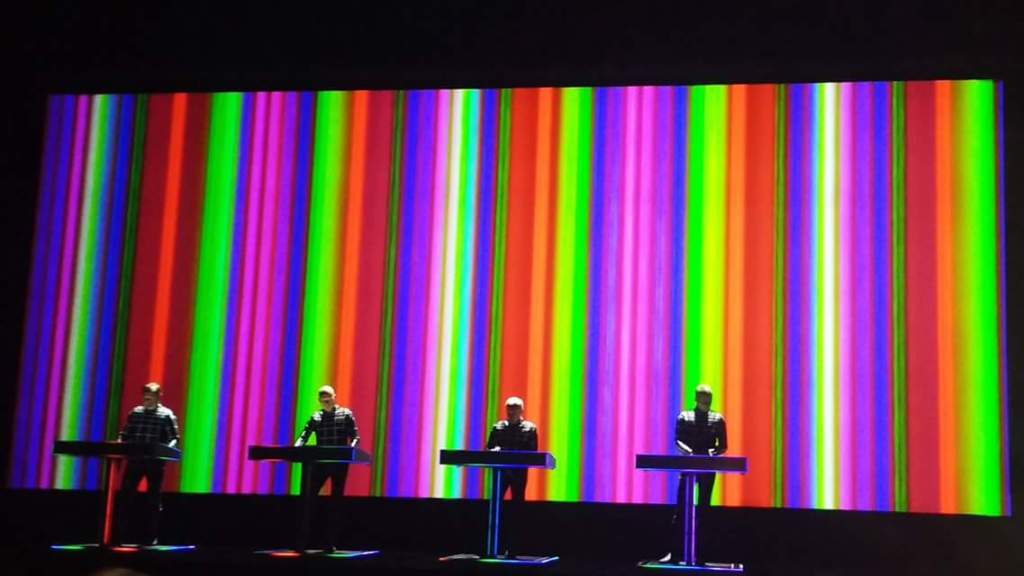
Kraftwerk is a seminal band, having played the role of innovator for nearly half a century. Listening to them perform live you can detect the early beginnings of pop music genres as varied as hip-hop, techno, industrial, and (duh) new wave lurking in the sparse, cold sounds of their digital meditations. They marry this slow, synth-soaked hypnosis, each song stretching on for dozens of minutes at a time, with a stark, minimalist, stage show. All four members of the band are centered at their own synthesizer podiums, remaining stoically still as they mix their digital soundscapes into a cohesive whole. It took me almost two songs into their set to even realize that the vocals were being provided live by one of the members. Everything felt so fixed & so clinical. Behind those four synth-commanding demigods stands a gigantic projector screen, which of course displays 3-D imagery related to each song performed. The imagery can range from archival footage of supermodels of the 1950s (during my personal favorite Kraftwerk tune “Das Model”) to crude digital renderings of a pixelated car on the highway (during the song “Autobahn”), an intentionally outdated aesthetic that recalls the look of certain Tim & Eric segments or, perhaps more appropriately, the music video project that accompanied the Death Grips album Government Plates. The rudimentary, elemental nature of these images matched the sparse genre seedlings of Kraftwerk’s music and transported their audience into a cinematic headspace that’s foreign to most concert experiences, even ones aided by higher tech on their display screens.

Unlike Ultimate Reality, 3-D Kraftwerk didn’t form its individual vignettes into a larger narrative whole. Instead, each music video experience was allowed to exist as its own separate meditation, functioning almost like a horror anthology, with the concert hall itself standing in as a wraparound segment. One song dove into the ever-present threat of nuclear war. One meditated on the machine-like efficiency of athletes who participate in the Tour de France. One provided a visualization of the digital landscape where the band’s Tron-like costumes might be considered high fashion. A particularly playful rendition of “We are Robots” had the band replaced onstage with mannequins propped up behind their synth podiums & projected in 3-D behind them. That last moment in particular pointed to the absurdity of paying to see a band so rooted in the artistry of music studio production perform “live” in the first place. The very idea of “a 3-D concert” is an exceedingly ridiculous concept on its own and the band never shied away from pointing to that absurdity. Instead of pursuing a more kinetic stage show, they turned their songs into a collection of short films with live music accompaniment, each devolving into long form meditations on concepts like international travel & “computer love”. The result felt a lot like watching a movie. Instead of feeling comradery with the band, like being within arms’ reach at a $5 punk show, you feel as if you’re watching a collection of mannequins stand before a silver screen; it’s distancing, but it’s also dazzling.

3-D technology has always been a William Castle-type gimmick meant to sell extra movie tickets to audiences looking for a novel & immersive cinematic experience. It was a perfect choice for Kraftwerk to draw an audience in with that cinema-specific gimmick because their live show already feels so similar to watching a movie in the first place. As the screen-heavy multimedia approach to the live concert becomes increasingly cinematic it’ll be interesting to see where other bands can take the basic idea explored by 3-D Kraftwerk, Dan Deacon, and others into new, more narrative territories. It’s not a perfect fit for every musical act, but in a struggling industry suffering long-term declines in album sales the idea of live music cinema could be a great potential moneymaker for bands more prone to in-the-studio tinkering than live rock n’ roll antics. More importantly, though, it could lead to innovative modes of great, cinematic art, the next evolution in both the movie going & live music experiences as we know them. It’s only appropriate that Kraftwerk would be one of the acts on the forefront of that innovation, as they have been with so many other musical advancements since the late 1960s.

wp-1474123650255.jpg
-Brandon Ledet

From Playboy Magazine to Cult Classic Contender: The Box (2009) as a Literary Adaptation

EPSON MFP image

Richard Kelly’s sci-fi mystery thriller The Box might not ever earn the legitimate cult classic status it most certainly deserves. Kelly’s other two features, Donnie Darko & Southland Tales, have already found their own dedicated of cult followings out there in the wilderness of cinematic nerdom, but The Box remains largely unchampioned. There are many, varied complaints detailing exactly why The Box “doesn’t work,” but one of the most common is that it expanded upon a basic premise that needed no depth of context or detail. Before The Box was a sprawling, two hour critical & financial misstep it was a nine page story in Playboy Magazine & a 20 minute episode of the Twilight Zone. When it comes to adapting literary text for the big screen, the critical impulse generally tends to favor the source material in terms of legitimacy, especially in the case of something like The Box, which shows very little, if any regard for solely sticking to the script of its short story origins. By exploding the central mystery of its source material into a galaxy of other unanswered questions, however, The Box far exceeds its origins’ ambitions & successes in my mind. Its DNA in Playboy Magazine & The Twilight Zone is interesting for sure, but nowhere near as fascinating as the places Kelly took the story in his go-for-broke adaptation/bastardization.

Consider the shifted stakes & the heavy-handed morality lesson of The Box’s very first incarnation, a very brief short story published by Playboy Magazine in 1970. The Richard Matheson-penned story “Button, Button” is for the most party reminiscent of what Kelly later brought to the screen. Even its central character names remained largely unchanged: Arthur, Norma, Arlington. However, the story’s scope is ludicrously miniscule as a comparison point, with these three characters more or less representing the totality of relevant players. In “Button, Button” the mysterious agent Arlington Steward drops off a box featuring a button under the cover of a glass dome. He informs the married couple of Norma & Arthur Lewis that if they press this button someone they do not know will die & they will receive $50,000 cash. The husband urges the wife not to push the button out of basic human decency, but she does so anyway, as she does in all three versions of the story (it’d be a pretty go-nowhere plot if she didn’t). What differs in the original text is its last minute twist in which Arthur is the one who is killed the promised $50,000 is collected from his life insurance policy. Incensed, Norma calls out Arlington for claiming that the person who would die would be someone she did not know. Steward retorts by questioning if Norma ever truly knew her husband. As far as morality tales go “Button, Button” is a little slight, but very efficient. However, it raises a lot of interesting, open-ended questions about the origins of its mysterious box & the menacing organization who carry out its machinations, an ambiguity its down-the-road adaptations would greedily revel in.

“Button, Button” was published too late in the game to be included in the classic black & white, Roger Sterling era of The Twilight Zone. Instead it appeared in the much cheaper, much less charming 1980s run of the show. Its basic premise remains faithful to its Playboy Magazine roots, but it does make some significant changes to the details. In the Twilight Zone version the prize for pushing the murder button skyrockets to $20,000, along with an escalation in the economic state of the couple in question. The televised Norma & Arthur live unhappily in abject poverty, with Norma playing the thankless role of a nagging shrew wife & Arthur struggling to provide for the household in a less than glamorous economy. Their philosophical conversations around whether or not to push the button are largely the same as they are in the original story, but they’re nastily heated here in a way that low income couples arguing about money often tend to be. Unfortunately, because the production value of the episode is so ungodly cheap, their tension is conveyed mostly through shouty braying, two performances that might even stand out as over-the-top in an early John Waters provocation.

Besides altering the economic tension of the central philosophical crisis, the televised version of “Button, Button” also crucially changes the detail of its gotcha ending. Instead of killing Arthur, the box only instigates Arlington Steward paying the couple their previously discussed amount, then informing them that it will be “reprogrammed” & passed along to a new household, someone they do not know. Just like the original story, it’s a tidily little morality play, although in this case the lesson is shifted from what it means to truly know someone to the value of the Golden Rule, which was the lesson of most Twilight Zone episodes anyway.

Part of the sprawling brilliance of Richard Kelly’s The Box is how it’s a pretty faithful adaptation of both of these works, yet still drowns out their central life lessons with a deafening sea of existential concerns and batshit crazy plot twists. So much of Richard Kelly’s film adaptation is eerily faithful to its source material, from the exactly look & name of “the button unit” (mostly lifted form the Twilight Zone verson of the story) to the intense focus on domesticity & the home (very strongly emphasized in the Playboy version, if you can believe it). It’s all represented in the first 20 minutes or so of The Box before Kelly blows the whole tightly controlled story apart into something infinitely more expansive & strange. You can tell Kelly was a huge, adoring fan of his source material. It’s just that he gets hopelessly lost in his fascination with its minor details. In the Twlight Zone version, Norma asks “What is this, some kind of survey or something to see who will and won’t push it?” Kelly wants to know what that survey would look like, what it would mean, and what other similar surveys it would constitute. In the Playboy version, Steward admits that he “represents and organization of international scope,” but keeps the details vague & menacing. Kelly wants to know exactly how large & powerful such an organization would have to be to function. You can even see Kelly’s admiration for his movie’s “Button, Button” roots in the details he does decide to change. For instance, when he gives Norma & Arthur a child, he can’t figure out exactly what the child is good for in the story, except as a plot device that allows for more button unit-type moral/existential dilemmas once the plot becomes truly unwieldy.

The Box has a tendency to over-explain or provide too much context for what’s basically a very simple story, but Kelly leaves the overall ambiguity of his source material’s scenario exactly how he found it. He pokes & questions initial vague details presented in the early versions of “Button, Button,” but only so that they give way to even more immense & vague details once they’re prodded. The mistake a lot of reboots, prequels, and reimaginings make is in providing too much context & background info so that all mystery is sucked out of the room in favor of mediocrity. No one liked Death Vader better after knowing he was a little blonde boy who built C-3PO & held his beloved at the lakes of Naboo. However, the kind of context Kelly piles on how somehow makes the story feel more contextless. A lesser, more disciplined mind might’ve stuck to the basic outline of “Button, Button”, but stretched it out to a feature length slog of a moral dilemma. Kelly instead gives it the exact length of time it needed to work itself out on an episode of television, then expands his scope from there, chasing his fascination with the story’s vague, menacing details once the business of a faithful adaptation was out of the way. I don’t think I’ve ever seen a literary adaptation quite like it, even from other films that started as Phillip K. Dick short stories or slight Roald Dahl novellas for children.  Kelly’s film is at once a faithful adaptation and a brazen, no-cares bastardization. Its gaze into the infinity can be at once both cripplingly silly & devastatingly impressive, but looking back to its roots as a miniscule 9 pages in Playboy Magazine only makes Kelly’s fascinating sprawl all the more puzzling. The question, then, is whether or not you find that puzzle entertaining.

For more on September’s Movie of the Month, Richard Kelly’s sci-fi mystery thriller The Box, check out our Swampchat discussion of the film.

-Brandon Ledet