

I was intrigued by the initial trailers for John Patton Ford’s modern update on Kind Hearts and Coronets, How to Make a Killing. Glen Powell as the disenfranchised heir to a massive fortune who has to pick off his awful relatives one by one, what’s not to love? Unfortunately, a better question would have been “What’s there to love?”, and the answer is “Not very much.”
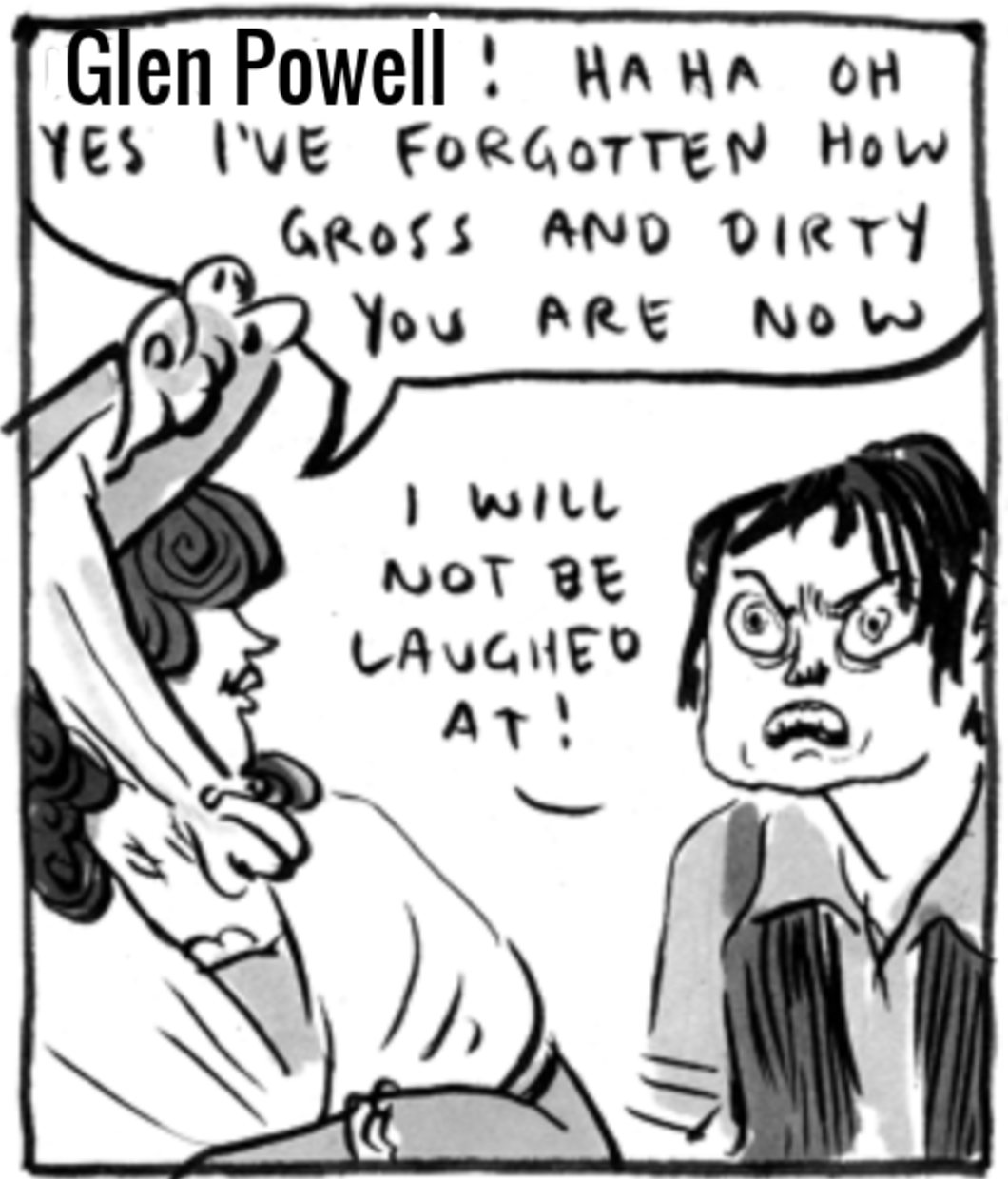
The extravagantly wealthy Redfellow clan exiles daughter Mary when she gets pregnant with the child of a commoner and refuses to abort it. The father of said child, whom Mary names Becket, dies on the day of his birth, and Mary spends the first several years of his life indoctrinating Becket into the belief that he “deserves” “the right kind of life.” Despite being a lowly civil servant, Mary ensures that Becket gets archery lessons and all of the other hallmarks of an upper class upbringing, which brings him into contact with Julia, an upper class girl with whom he falls in love. Becket shares with Julia that the Redfellow patriarch stipulated in his will that the last surviving member of the Redfellow clan inherits the entire $28M fortune, even those who were previously disinherited. As an adult, Becket (Powell) has a chance run-in with recently married Julia (Margaret Qualley) at the Manhattan haberdasherie where he works, where he’s reminded that she’s upper class and awful; it’s all very Kate Beaton’s Wuthering Heights.
When he is demoted from salesman to warehouse work at his job because the owner’s son is being slotted into Becket’s position, Becket decides to look into the whole “Let’s kill off my cousins so I can inherit everything” option. He starts with tech money halfwit Taylor (Jude Law’s son Raff), and his attendance of Taylor’s funeral brings him in contact with his uncle Warren (Bill Camp), who confesses that he always felt guilty about what happened to Mary but was powerless to stand up to current family head Whitelaw Redfellow (Ed Harris); Warren offers Taylor’s old job to Becket, who accepts. Becket sets sights on his second victim/cousin, Noah (Zach Woods), a pretentious Brooklyn hipster in the mold of Pulp’s “Common People,” whose girlfriend Ruth (Jessica Fenwick) falls for Becket after Noah’s death. Now that he has the love of a paternal figure, a job that he excels in and which nets him enough money to rent a luxurious NY apartment, and a down-to-earth girlfriend, Becket has the life he “deserves,” but it’s still not quite enough. In quick succession, he knocks off his megachurch money laundering cousin (Topher Grace), aviation obsessed uncle McArthur, and faux-humanitarian mega-adopter aunt Cassandra, leaving only Becket, Uncle Warren, and Grandpa Whitelaw in the Redfellow clan’s tontine, at which point Becket takes a pause to decide if he wants to continue with his murder spree. This is complicated by Julia’s re-entry to Becket’s life, begging for a loan for her in-over-his-head husband, and despite Becket’s “careful” alibi-creation for all of the deaths of his relatives, Julia has the evidence that would put him away if he refuses to bail her and her husband out. When Warren dies of natural causes, it all comes down to a showdown with Whitelaw, which we assume can only end one way, since we’ve been told this entire story via flashback that is set in a framing device of Becket in prison awaiting his execution.
This film has no idea what it wants to be. It’s not quite funny enough to be a true comedy and instead takes a sharp turn into knockoff noir territory, especially when it comes to Julia’s late-film-twist transformation into the femme fatale to serve as a foil to Ruth’s good girl. Qualley is horribly miscast in this role; I’ve been an advocate for her based on her performances in The Substance and Kinds of Kindness despite seeing her plumb the depths with Drive Away Dolls, but it might be time to throw in the towel on defending her against the accusations that she’s just not a very good actor. That may not entirely be her fault, though; this is just a bad movie, and no one comes off well here. I’m generally charmed by Powell and adore Fenwick, but both are underwhelming here, and even Powell’s charisma isn’t enough to make Becket someone in whom we can become emotionally invested. This is a movie about nepotism, explicitly and textually, and I can’t tell if Qualley and Law were cast with a sense of irony or not, but no one “deserves” the kind of life that a multimillion-dollar fortune provides. The only performance that I genuinely loved was Topher Grace’s, who appears in a single scene. Most of the pruning of the Redfellow family tree is done almost perfunctorily, when spending a little more time with them and their awfulness would lend at least some sense of justice to Becket’s actions. Instead, one gets the sense that we’re supposed to find them loathsome despite the fact that their sins are enjoying their wealth in the same way that we see Becket enjoy his when he starts to have his own folding money. A more sincere effort to inspect that would have been more effective, but then that wouldn’t leave enough room for the “comedy” that the film was sold on. It’s messy and inconsistent. How to Make a Killing is too many things and nothing at all: a noir with all of its grit sanded off, a comedy that isn’t very funny, good and bad actors alike having no charisma with one another, and all of it shot with flat, featureless Netflix lighting. No wonder it had no staying power in cinemas.
-Mark “Boomer” Redmond


Pingback: Lagniappe Podcast: Ömer the Tourist in Star Trek (1973) | Swampflix
Pingback: Across the Hall (2009) | Swampflix
Pingback: Podcast #268: Jackass – Best and Last (2026) & New Releases | Swampflix